Encouraging One Another in the Church Family. Colossians 3:16-17

Colossians 3:16-17Amplified Bible

16 Let the [spoken] word of Christ have its home within you [dwelling in your heart and mind—permeating every aspect of your being] as you teach [spiritual things] and admonish and train one another with all wisdom, singing psalms and hymns and spiritual songs with thankfulness in your hearts to God. 17 Whatever you do [no matter what it is] in word or deed, do everything in the name of the Lord Jesus [and in dependence on Him], giving thanks to God the Father through Him.

The Word of God for the Children of God. Gloria! In Excelsis Deo! Alleluia! Amen.

In Colossians 3:16, Paul writes this:

“Let the word of Christ dwell in you richly; teach and admonish one another in all wisdom; and with gratitude in your hearts sing psalms, hymns and spiritual songs to God.”

Now, here’s the most interesting thing: this passage from Colossians 3 is about our encouraging and admonishing one another but the source and foundation of our encouraging one another is to ensure we are each worshipping together.

The best way in which we can encourage one another in life is to make sure that we all edify each other, we all build each other up in the faith, we grow stronger in God’s family, we grow stronger together as a people of praise and worship.

And if we get our praise and worship right and become strong as a spiritual family, that will then spill over into how we live our lives throughout the week,

and we will each be taking God with us in our hearts into the everyday lives of all those others in God’s own Neighborhood which we live and work and play.

And that is, as Paul suggests, is perhaps the greatest encouragement of all.

If we have found our happiness, our contentment, our fulfilment, in the worship of God in the context of a loving and supportive spiritual family, then we will know God’s encouragements and presence in every aspect of our lives.

The praise and worship of God within the context of a Christian church family is foundational to knowing, living out, His happiness and fulfilment in our lives.

And in this passage from Paul’s letter to the Colossians, especially verses 16 and 17, we see firstly how the church family gathers together for praise and worship and then secondly, how that extends, pours itself out into every aspect of life.

So, as we think about this idea, let’s start by thinking what we actually mean by the idea of ‘praise and worship’.

And there’s three things I want to say about this.

1. Worship engages us with the Word of God in the Bible

Colossians 3:16, Paul writes this: “Let the word of Christ dwell in you richly…”

This is referring to the teaching and life of our Savior Jesus, of course, that we find in the four Gospels.

But it’s also true to say that literally the whole Bible points readers to Jesus and so there’s a very real, deep sense in which the whole Bible is the word of Christ.

And Paul uses this interesting word, ‘dwell…’: “Let the word of Christ dwell in you richly…” and that implies a deep rootedness in our lives.

As a Pastor can visit you in your home and it is always nice to do that, but they do not ‘dwell’ in your home; They ‘dwell’ in their own homes.

My home, where I ‘dwell’, is where I go to relax and get some rest, the place where I can chill out with my family and recuperate after a tough day at work.

We see this word ‘dwell’ in another important verse, in John’s Gospel where he wrote that “The Word became flesh and dwelt among us”. (John 1:14)

God became incarnate in the person of Jesus Christ, and he dwelt among us, he lived among us, and as the people were moved to, they came to him for rest and recuperation, encouragement and challenge and healing and experience God.

And there’s something important about the idea of God’s word dwelling in us.

Because in all the storms and chaos and confusions of life, we can return to God’s word every single day, find our rest, Shalom and relaxation there and recuperate with God as he speaks to us through the Bible and also be challenged and healed as we grapple with the harsh truths found deep in God’s word to us.

“Let the word of Christ dwell in you richly…”

There is a richness in God’s word that we won’t find anywhere else.

There is a fullness and a completeness to God’s word: we can turn to the Bible in any season of our life, no matter what we are going through, no matter how we are feeling – and we will each receive the richness of God’s presence in our life.

But there’s just one more interesting point to note from this phrase: “Let the word of God dwell in you richly…”

In the original Greek, the word ‘you’ is in the plural, not the singular.

So what Paul is saying is this: that it’s not just us as individuals that need to dwell in the Word, soak ourselves in the Scriptures.

But this is a corporate activity for us to focus on as a church family together.

As the body of Christ, we, together, are to ‘dwell richly in the word of God…’

Together, we are to read and study the Bible, be shaped by the Bible, and allow the Bible to transform how we are as a church and how we develop our mission, ministry and gather together regularly for praise and worship of God together.

Letting the word of God dwell richly is very much a covenanted community act, not something that we just do exclusively as individuals.

So, in the context of this passage from Colossians 3, then, we are to encourage one another – as the Body of Christ, the family of God – to study the word of God together, and be shaped by it as a family as we come to worship together.

So what does that look like in practice?

Well that leads on to the next point, which is this:

2. Our praise and worship engages both the mind and the emotions

In verse 16, Paul says this: 

“Let the word of Christ dwell in you richly; teach and admonish one another in all wisdom; and with gratitude in your hearts sing psalms, hymns, and spiritual songs to God.”

As we come to praise and worship, we want to be engaged together in both our mind and our emotions.

Firstly, our minds: “Teach and admonish one another in all wisdom”.

In Church, the idea of a sermon may seem, to people, to be outdated: there are few places in society today where someone talks to a group of people for 20 minutes in an uninterrupted way in order to work through the text of a book!

But sermons are still important in all religious settings, whether Christian, Muslim, Hindu, Jewish or whatever, because it is through the sermon that we engage together as a faith community to encourage through the sacred texts.

And the church, this church family, is a learning community.

All of us are learning together.

Just because I might have an education in Theology or Ministry, a clergy collar on, does not necessarily mean I somehow know God any better than you do.

We are all on a uniquely God designed, God planned, journey into a far deeper relationship with our God. And I too need to learn with you and from you what that looks like and hopefully I can encourage all of you in some small way too.

So, we each still need to gather together, we each need to explore together the teachings of the Christian faith so we can find our way on our spiritual journey.

But worship of God is not all about the mind: it should engage the emotions too.

As Paul says in Colossians 3:16

“Let the word of Christ dwell in you richly; teach and admonish one another in all wisdom; and with gratitude in your hearts sing psalms, hymns, and spiritual songs to God.”

Our praise and worship of God comes from our hearts, our emotional centre, as we each reflect on what God has done for us, what Jesus has done for us and the forgiveness, new life that we have received through Jesus’ death on the cross.

As we come together to worship, we reflect on God’s amazing love for us and we are each inspired, moved in our hearts to sing, to praise, to receive Communion together, have our hearts warmed as we meet together in the presence of God.

The Psalms, the old and new hymns, the songs, the Communion, should not just be ritualistic acts we go through. Instead, as Paul says here, we worship “with gratitude in our hearts” for what God has done for us in Jesus Christ.

And as he also says in this verse, our worship is “to God”.

We aren’t singing for one another, or to just do something pleasing amongst ourselves: God is our audience when we sing, when we worship, when we receive Communion, and God is ‘pleased’ with our worship… (Psalm 19:14)

It does not matter if we have a good singing voice or a bad singing voice.

It doesn’t matter if we feel worthy or unworthy when we receive Communion.

It doesn’t matter what clothes we wear to church.

It doesn’t matter what people may think about us.

We only have an audience of ONE when we praise and worship – and that one is God, the Father, and God the Son and God the Holy Spirit.

And hopefully and prayerfully God is always ‘pleased’ with our worship…

So firstly, worship of God engages with the word of God, the Bible.

Secondly, worship of God engages both the mind and the emotions.

3. Our worship impacts on how we live throughout the week

In verse 17, Paul writes this:

“And whatever you do, in word or deed, do everything in the name of the Lord Jesus, giving thanks to God the Father through him.”

Praise and Worship is not something that we do just one day a week, on a Sunday, or on those occasions throughout the week when we come to church.

Our whole life, every aspect of our life, should be an act of worship. We are to honor God with the way we live and all our behavior’s, all our relationships, all our responses should aim to be an act of worship to God.

When we are at work, we offer our work as an act of worship to God.

When we are cooking dinner, we offer our cooking as an act of worship to God.

When we are looking after the kids, when we are looking after our loved ones as Care Givers, we offer encouragement, love and care as an act of worship to God.

Everything we do is an act of praise and worship to God.

Of course, we will fail, and fail often, because we are fallible and weak. But it should be our very highest aspiration to honor God in every part of our life.

And what we do when we come to church, to meet together in worship, should energize us and orient our thinking towards God so that when we leave there after an act of worship, our minds and our hearts are focused exclusively on our God, and we seek to reflect that in how we are in the world outside those walls.

But it’s not ever going to be easy to do that, of course, and we desperately need the encouragement of one another to worship God in our own churches and the steadfast encouragement of one another to live for God throughout the week.

And that’s why I believe that the Apostle Paul here puts this teaching into the context of encouraging one another.

We simply cannot live out the Christian life on our own.

We absolutely and desperately need the encouragement of one another.

We each absolutely and desperately need the steadfast and immovable encouragement of one another so that we can deepen our walk with God.

So, this passage from Colossians 3:16 and 17 is a really important one for us to read and study and pray over and desperately hold onto because it stresses our dependence on Jesus, on one another, and our need to encourage one another.

“Let the word of Christ dwell in you richly; teach and admonish one another in all wisdom; and with gratitude in your hearts sing psalms, hymns, and spiritual songs to God. And whatever you do, in word or deed, do everything in the name of the Lord Jesus, giving thanks to God the Father through him.”

Let’s do all we can to encourage one another in the faith.

How do we do that?

Firstly, by encouraging one another to come to worship and while there, to engage with God through his word to us in the Bible and to engage with God through our emotions in the liturgical acts undertaken within its sanctuary.

Then to encourage one another to take God with us when we leave our worship services and to do all we can to live our lives as acts of worship, pleasing to God.

We are the Body of our Lord and Savior Jesus Christ in God’s Neighborhood.

We are the Church living and moving and ministering in God’s Neighborhood.

We walk by faith not by sight through God’s backyards and His Neighborhood.

The Christian faith is a community of faith weaving in and out of His Alleys.

The Christian faith is a community of faith weaving in and out of His Streets.

It is the community God has given to you and me for this season in our lives.

Let’s be sure to encourage one another as we walk together with God and, with gratitude in our hearts, thank him mightily for all that he has given us through the sacrificial life and death of his Son, our Lord and our Savior, Jesus Christ.

In the name of God, the Father and God the Son and God the Holy Spirit,

Let us Pray,

God of all wisdom and enlightenment, help me understand your word. Give me insight into the meaning of your commandments and how I should follow them. As I meditate on your wonderful miracles, may I be encouraged and empowered. As I study how you have fought our battles from the stories in the Bible, may I truly be strengthened. Help me know how you want me to put your word into practice. Assist me to know you more fully through your word and be pleasing to you. Amen.

https://translate.google.com/

Let The Words of Christ Richly Dwell, Deep within our Soul! Colossians 3:16

Colossians 3:16Amplified Bible

16 Let the [spoken] word of Christ have its home within you [dwelling in your heart and mind—permeating every aspect of your being] as you teach [spiritual things] and admonish and train one another with all wisdom, singing psalms and hymns and spiritual songs with thankfulness in your hearts to God.

The Word of God for the Children of God. Gloria! In Excelsis Deo! Alleluia! Amen.

Something spectacular happens when the saints gather to encourage, sing songs and strengthen one another in the Word of God.

This is how we are equipped to live, love, move and minister in the world; shining the maximum measure of God’s message to all we encounter, by the recollection, refreshment the Holy Spirit brings when believers are together. 

This is what our focus should be. 

First, we are to be immersed in the Word of God. Paul said, ‘to let the word of Christ dwell richly.’

We should let it saturate us until it overflows, and we are able to teach it with all wisdom. 

This is exactly what Paul instructed Timothy, 

“Study and be eager and do your utmost to present yourself to God approved (tested by trial), a workman who has no cause to be ashamed, correctly analyzing and accurately dividing [rightly handling and skillfully teaching] the Word of Truth” (II Timothy 2:15 AMP). 

If you dwell richly in the Scriptures, then that is exactly what will richness and prosperity will be revealed through your life, and by the measure of richness it receives it will be measurably, exponentially transformed by the living Word.

Amazingly, as we each progress in this spiritual discipline then the next step happens involuntary. 

Worship—singing psalms, hymns and spiritual songs as well as gratitude and thankfulness overflows from the heart. 

Without fail, as I dig into the Scriptures praying, researching, studying those commentaries to bring you these devotional messages, each morning my heart was made full, and my spirit was “quickened”, and worship naturally flowed.

Sometimes it came in the form of solemn hymns or upbeat music or praying, many times it was a smile of gratitude to God for the daily truth I learned, but whatever the form, it came from a heart truly responding to Word of Christ. 

The Word of Christ

“It is because of him that you are in Christ Jesus, who has become for us wisdom from God—that is, our righteousness, holiness and redemption” (I Corinthians 1:30).

The Lord Jesus was meek and lowly, full of compassion and great mercy – and the gracious words that fell from His lips were life and health and healing.

We are exhorted to let His Word dwell in us richly, both His spoken and written Word, for they produce in us an abundance of life and the spirit of true wisdom.

The Holy Spirit has made His dwelling place in our hearts, and He teaches us, He jars our memories, leads us in all truth:

“You have received the Holy Spirit, and he lives within you, so you don’t need anyone to teach you what is true. For the Spirit teaches you everything you need to know, and what he teaches is true, it is not a lie.”

What an amazing blessing to have the Holy Spirit indwelling us, teaching us, interceding for us, leading us.

And He has taught us to abide in Christ, to remain in fellowship with Christ, to live as Christ would have us live, in constant union with Him.

We should meditate and drink deeply on the Word of Christ, for His words bring light and joy to the spirit, indescribable, undeniable richness of life to our souls.

We should take the richness of His speech and the true jewels which encrust the glorious messages of salvation and shower them down in blessed teachings and wise counsel over the heads of those that are His kingdom of priests, His royal nation, a people set apart for the Lord to serve Him and to worship Him in time and through eternity.  

Our Lord and Savior Jesus rejoices over His children with singing, proclaiming His unconditional love towards us while pouring out His eternal heavenly grace over all that believe on His name.

Should we not let His Word dwell in us richly in humble thanksgiving and holy and humbled reverence as we blend our voices with heavenly choirs of angels?

Should we not sing psalms, and hymns, and spiritual songs with eternal gratitude in our enriched, inspired hearts to our great and gracious God?

Jesus Christ is the Wisdom of God; He is God revealed (Colossians 1:18; Hebrews 1:3).

This is why we are covenanted, instructed to let the Word of Christ dwell richly because in Him “are hidden all the treasures of wisdom and knowledge” (vs 2:3). 

Today, I join with the Apostle Paul in studying Scriptures, praying this for you; singing hymns from deep within my deeply enriched and deeply inspired soul,

I ask, “God to fill you with the knowledge of his will through all spiritual wisdom and understanding” (vs 1:9b). 

May you know Savior Christ, letting His truth dwell in you.

May you overflow into worship, gratitude from hearts filled of Jesus Christ.

To Him be all glory and might and majesty and dominion and praise and power for ever and ever! Amen.

In the name of God, the Father and God the Son and God the Holy Spirit,

Let us now Pray,

God of truth, sometimes I not sure if I’m actually hearing your voice, or if it’s just my own wandering thoughts or even another spirit. Sharpen my spiritual hearing, Lord, so I can recognize your words when you are speaking to me. Help me know it’s really all about you, with no doubt or second-guessing. When I’m asking for your guidance in important decisions, give me your peace that surpasses understanding with your answer. Help me remember that your words to me will never go against your written message in the Bible. Give me a clear mind and push out all my confusion. Amen!

https://translate.google.com/

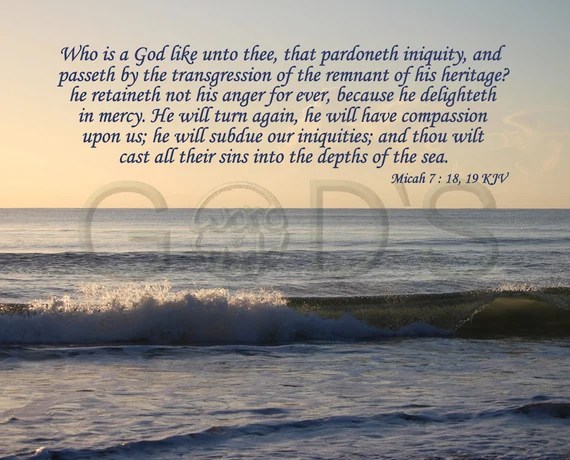
Who Embraces a God Like our God of Forgiveness and Mercy? Micah 7:18-20

Micah 7:18-20Amplified Bible

18 
Who is a God like You, who forgives wickedness
And passes over the rebellious acts of the remnant of His possession?
He does not retain His anger forever,
Because He [constantly] delights in mercy and lovingkindness.
19 
He shall again have compassion on us;
He will subdue and tread underfoot our wickedness [destroying sin’s power].
Yes, You will cast all our sins
Into the depths of the sea.
20 
You shall give truth to Jacob
And lovingkindness and mercy to Abraham,
As You have sworn to our forefathers
From the days of old.

The Word of God for the Children of God. Gloria! In Excelsis Deo! Alleluia! Amen.

Sometimes words are just not enough. God’s creation – it leaves you speechless.

Your spouse’s strength of character – it bears no comparison.

Your child’s imagination, laughter, growth, maturity – it tests your vocabu­lary.

Sometimes words can’t ever say enough.

The prophet Micah understood that concept as well.

His prophecy alternates between visions of doom and hope.

In chapter 7 he starts with a very bleak picture: “What misery is mine! … The godly have been swept from the land; not one upright man remains” (vv. 1, 2).

The prophet sees both Israel and Judah in need of ref­ormation.

Both kingdoms were living in affluence, which produced self­ish materialism.

Morals floundered, and corruption abounded.

Exile was awaiting.

Yet Micah does not despair but can end his prophecy with such great hope.

He sees that God will graciously forgive his people and restore her fortunes, and this puts Micah over the moon – All he can really say is, “Who is a God like you?”

What a beautiful question!

This exclamation is a play on the meaning of Micah’s own name: “Who is like Yahweh?”

Micah’s question is one that other nations – Egyptians, Babylon­ians, Assyrians –also asked as a way of praising their gods.

Yet Micah by no means implies that there are other gods.

The one and only God is 100% incomparable because of his forgiving character!

“Who is a God like you, who par­dons sin?”

Another way of reading this is, “Who is a God like you, who carries away sin?”

We come across that phrase in Leviticus 16, concerning the Day of Atonement.

Aaron the high priest was to lay his hands on the head of the live goat, confess all the iniquities of Is­rael over it, thereby transfer those iniquities to the goat.

Leviticus 16:22 says, “The goat will carry on itself all their sins to a solitary place.” 

Through the high priest the Lord transferred the burden of Israel’s guilt to another, and that substitute carried away all Israel’s sin and guilt.

And that’s what Micah is getting at.

God “pardons sin and forgives the transgression of the remnant of his inheritance.”

In mercy Yahweh pre­served for himself a remnant, and he forgives that remnant!

This applies to us today as the church of Christ.

When you consider forgiving the people who have hurt you, you must always consider how much Jesus has forgiven you!

You don’t deserve His love and can never earn it.

He forgave you because He is a merciful, gracious God.

Because you have already been forgiven of ALL your sins and set free, you must forgive others by becoming so transparent that His mercy and grace will radiate through every aspect of your life.

You are never to be a giver of condemnation but always a giver of mercy.

Mercy is distinctly different from forgiveness because God is merciful to us even when you don’t sin, just as you can be merciful to those who have never done anything against you.

God’s mercy doesn’t just forgive your failures and faults but reaches deep into all your weakness and need.

His attitude toward you is merciful.

We are his possession by grace.

We don’t deserve forgiveness and salvation.

But it has been promised to God’s family, God’s inheritance, in Christ!

And it is given only to those who, like Micah, are deeply sorrowful over their sins, and cry out for forgiveness.

Micah’s song of praise continues: “You do not stay angry forever.” 

The remnant would experience the judg­ment and punishment of the Lord.

But marvel upon marvel, the Lord does not hold onto his anger.

So, the people of God could look away from their time of judgment and toward the Lord.

They could rejoice that this was just tempor­ary. “You do not stay angry forever, but you delight to show mercy.”

This is all very remarkable.

Micah is saying that the Lord acts this way

– God carries away our sins,

– God forgives our rebellion, shows his mercy

be­cause that’s just who he is.

It kind of leaves us scratching our heads and asking, “Why is he that way?”

The only answer we get is, “It is my delight to do it this way!” 

Our God, by his very nature, is so very ready to forgive sinners.

That leaves us dumbstruck at the forgiving character of our God.

We see God’s forgiving charac­ter especially in his Son.

The words Micah uses in verse 18 are also used for the suffering servant of Isaiah 53. Verses 10-12,

Yet it was the Lord’s will (pleasure!) to crush him and cause him to suffer … Therefore I will give him a portion among the great, and he will divide the spoils with the strong, be­cause he poured out his life unto death, and was numbered with the transgres­sors. For he bore (carried away) the sin of many, and made intercession for the transgressors.

The LORD God does not wink at sin.

He offered the sacrifice of his Son, Jesus Christ.

He came to take our sin outside the city, to the cross of Golgotha.

He shared in our sins.

That is just who Christ is.

It moves us to bow our heads, bend our spirits to say, “Who is a God like you?”

Do you see his incredible mercy for sinners?

Mercy is also related to grace.

Grace is what saves you – mercy is what sustains you.

Mercy eliminates the pain; grace cures the disease.

Mercy offers relief from punishment; grace offers pardon from the crime.

Mercy is a word you will hear used in the legal system.

After the conviction has been made, the jury has unanimously declared the persons guilt, the sentence is about to be handed down, MERCY is begged for.

The Hebrew word for mercy is “chesed”

which means to get inside someone’s skin,

to look at where they view life and feel what they are experiencing; to move in and act on behalf of the one whose hurting.

That is exactly what Jesus did when He chose to leave the indescribable comfort and glory of Heaven to become one of us.

Mercy has also been defined as the giving of compassionate treatment, having the disposition to be kind and forgiving when kindness and forgiveness are not your first thoughts, would not define or characterize any of your first actions.

As God gives you a fresh start each new day, so should you reach beyond the pain and give to those who have hurt you a fresh start through your forgiveness.

Mercy is forgiveness soaked in the life blood of Jesus, soaked in the love of God.

Every day, when you forgive, the anger, bitterness, resentment and pain that you feel from the wrong suffered at the hands of another is weakened.

It’s only through the giving of mercy that our emotional wounds will be healed.

If you do not show mercy and forgive the unforgivable you may never find total and complete healing for your spirit, mind and body.

Right in this exact moment, do you see your God is ever ready to give mercy?

Right in this exact moment, do you see that your God is ever ready to forgive?

Only when you fully see all these can you genuinely embrace a holy fear of our awesome God, only then can you wor­ship him truly, in utter speechlessness.

This is the God whom we adore.

Cherish and embrace his mercy for repentant sinners!

Cherish and embrace his forgiveness for repentant sinners!

Cherish God as God cherishes you!

Embrace God as God embraces you!

In the name of God, the Father and God the Son and God the Holy Spirit,

Let us Pray,

Loving Heavenly Father, Great is thy faithfulness! Great is thy forgiveness and mercy which you have shown. You have loved me with immeasurable love. You are love. I pray that I will be strengthened in my inner being – in my soul – with the love that is wider than I can understand, deeper than I am able to imagine, and greater than I could ever know. As You encourage and embolden my life, may I more fully know the mystery of the Gospel as revealed through my life. In the love of Christ, I pray. Amen.

https://translate.google.com/

Embracing Forgiveness. Choosing only to Embrace the Grace, the Embrace of ABBA, our Father God. Matthew 6:14-15

Matthew 6:14-15Amplified Bible

14 For if you forgive [a]others their trespasses [their reckless and willful sins], your heavenly Father will also forgive you. 15 But if you do not forgive others [nurturing your hurt and anger with the result that it interferes with your relationship with God], then your Father will not forgive your trespasses.

The Word of God for the Children of God. Gloria! In Excelsis Deo! Alleluia! Amen.

I believe most people have arrived at the conclusion that it is utterly impossible as human beings to avoid somehow and, in some way, offending others by our words, or lack of words and being offended by others, when we are still alive.

And, while we do not have the ability to control how others feel or act when they somehow feel offended by us, we do very much have free will over our own lives to decide how we will react or will not react when allegedly offended by others.

Our making the choice – Forgiving others wholeheartedly is the definite secret of a happy and prolonged relationship in all facets of life: in our family, in our work, at school, in Church, community, neighborhoods, mission and ministry.

It is definitely not easy to forgive others, but it’s what Jesus commands us to do.

Even if the other person is not really sorry, even if we are not very sorry about our actions, we still have to forgive sincerely in order to fulfil the will of God.

Matthew 6:14-15Easy-to-Read Version

14 Yes, if you forgive others for the wrongs they do to you, then your Father in heaven will also forgive your wrongs. 15 But if you don’t forgive others, then your Father in heaven will not forgive the wrongs you do.

Jesus’ teaching here at the end of the Lord’s Prayer might be confusing.

It almost sounds as if we have to earn God’s forgiveness by forgiving others.

So, we definitely need heavy dose of a different kind of thought process here.

Ephesians 4:30-32Amplified Bible

30 And do not grieve the Holy Spirit of God [but seek to please Him], by whom you were sealed and marked [branded as God’s own] for the day of redemption [the final deliverance from the consequences of sin]. 31 Let all bitterness and wrath and anger and clamor [perpetual animosity, resentment, strife, fault-finding] and slander be put away from you, along with every kind of malice [all spitefulness, verbal abuse, malevolence]. 32 Be kind and helpful to one another, tender-hearted [compassionate, understanding], forgiving one another [readily and freely], just as God in Christ also forgave [a]you.

I envision about any kitchen sponge that has not been used for a long time.

When you put it under the tap, at first the water runs right over the sponge.

But if you set that old sponge in a bucket of ­water for a few minutes, it will gradually and inevitably transform, will soften and becomes usable again.

Our own hearts and our souls and our spirits can be, can become like that too.

When we hold onto new resentments and old bitterness’s, nursing our anger, hugging old grudges close to our chests, hearts can become as hard as a rock, and God’s grace for us will be like water running over a rock – it won’t soak in.

At this point – someone needs to get on our case – come into our throne rooms and disrupt our lives, disrupt our dysfunctional patterns of behaving, thinking.

We are not hiding anything from God – but we are trying to – and this will most definitely get big time God’s attention – God will send someone – guaranteed!

That moment of confrontation will inevitably occur – someone will arrive and will get up inside our personal space – then we will have to make some serious choices – push that other person back out the door they entered or “get God!”

Reckon ourselves with our actions – then reckon, reason things out with God:

Psalm 51:1-12English Standard Version

Create in Me a Clean Heart, O God

To the choirmaster. A Psalm of David, when Nathan the prophet went to him, after he had gone in to Bathsheba.

51 Have mercy on me,[a] O God,
    according to your steadfast love;
according to your abundant mercy
    blot out my transgressions.
Wash me thoroughly from my iniquity,
    and cleanse me from my sin!

For I know my transgressions,
    and my sin is ever before me.
Against you, you only, have I sinned
    and done what is evil in your sight,
so that you may be justified in your words
    and blameless in your judgment.
Behold, I was brought forth in iniquity,
    and in sin did my mother conceive me.
Behold, you delight in truth in the inward being,
    and you teach me wisdom in the secret heart.

Purge me with hyssop, and I shall be clean;
    wash me, and I shall be whiter than snow.
Let me hear joy and gladness;
    let the bones that you have broken rejoice.
Hide your face from my sins,
    and blot out all my iniquities.
10 Create in me a clean heart, O God,
    and renew a right[b] spirit within me.
11 Cast me not away from your presence,
    and take not your Holy Spirit from me.
12 Restore to me the joy of your salvation,
    and uphold me with a willing spirit.

But when we are “pried” open by our remembrance of God’s forgiveness of us, we are “exposed” to forgiving others, we become soft like a moistened sponge.

God, our Father’s boundless and bottomless grace soaks in and saturates the entirety of our hearts, and we become abundantly available to share his grace.

Just as a wet sponge moistens other things when it touches them, we can share grace, the blood of Christ helping to wipe others’ dirt away as we forgive others.

Dying to our accumulated resentment, anger, and bitterness softens our hearts to receive God’s all-encompassing amazing grace, to share it freely with others.

Psalm 103:11-13English Standard Version

11 For as high as the heavens are above the earth,
    so great is his steadfast love toward those who fear him;
12 as far as the east is from the west,
    so far does he remove our transgressions from us.
13 As a father shows compassion to his children,
    so, the Lord shows compassion to those who fear him.

Why should any of this matter – of what relevance – of what significance to me?

The question of genuine forgiveness is one of eternal importance and relevance.

And why is it, you may ask, so crucial that Christians forgive?

For starters, Jesus’ statement in today’s text is quite a compelling reason, for “if you do not forgive others…neither will your Father forgive your trespasses.”

Suffice it to say then, we had better make sure we are forgiving “our debtors” (Matthew 6:12).

Here’s the bottom line: forgiveness is such a central element to Christianity that it is an indicator of salvation!

Not that we are saved by any works of our own, such as forgiving others, but that when we are reconciled to God through the lifeblood of our Savior Jesus Christ, our new life will be eternally marked by grace giving and forgiveness.

Remember, our unrighteousness was exchanged for Jesus’ righteousness (2 Corinthians 5:21), our wrong for His 100% right, our injustice for His justice.

God meets our enfeebled efforts at rebellion and pride with His matchless grace in and through the person and work of our only Lord and Savior Jesus Christ.

Those to whom grace is extended should also extend grace, and those to whom forgiveness is extended should also extend forgiveness.

Forgive as you have been forgiven.

Not because it’s easy, but because it’s at the very exact core of who you are in Christ.

In the name of God, the Father and God the Son and God the Holy Spirit,

Let us Pray,

Dear Lord, search my heart. Reveal to me any remaining burs of hurt where I have attempted to forgive apart from You. I pray You would cover these hurts in Your healing grace, and through Your strength, empower me to forgive others as wholly and completely and utterly as You first forgave me. In Savior Jesus’ Name, Amen.

https://translate.google.com/

In God we will Trust though the earth gives way beneath our feet, the winds blow and the houses crumble into the heart of the sea, we will still not fear!

The earth was once an empty place!

Chaos was everywhere or as one translation puts it; the earth was a total wasteland. It was filled with darkness.

And in the darkness, the Spirit of God moved to prepare for God’s creative work.

The Lord is a Creator!

God is a God of order!

For every house is built by someone, but He who built all things is God.” Hebrews 3:4.

God took a mess of chaos and made it orderly.

From ugliness emerged beauty.

Chaos is replaced by order.

Purpose takes the place of emptiness.

God transformed darkness into light.

Are things falling apart around you?

Life rarely turns out the way we’ve planned.

We all have those times when life seems to take an unexpected turn and we wonder what to do.

Perhaps there is a problem in your relationships?

Are you facing difficulties at work or is it unemployment?

Do you have a health issue?

Are you experiencing a crisis in your ministry, business, or family?

Has your house quite literally collapsed around you?

Has your house quite literally fallen into the sea?

There’s no cause for alarm.

You’re not alone!

The Holy Spirit is present with you.

Your life may seem to be without purpose, but God’s there to turn it around.

He’ll never leave you or forsake you.

So be conscious of His presence everyday!

The presence of God gives us inward peace and joy even though our external circumstances may be turbulent.

Be still and place your hope in Him.

Psalm 46:1-3Amplified Bible

God the Refuge of His People.

To the Chief Musician. A Psalm of the sons of Korah, set to soprano voices. A Song.

46 God is our refuge and strength [mighty and impenetrable],
A very present and well-proved help in trouble.

Therefore, we will not fear, though the earth should change
And though the mountains be shaken and slip into the heart of the seas,

Though its waters roar and foam,
Though the mountains tremble at its roaring. Selah.

The Word of God for the Children of God. Gloria! In Excelsis Deo! Alleluia! Amen.

The ancient cities were often protected by large surrounding walls and imposing gates.

Inside the walls was peace and a safe atmosphere where commerce could thrive.

God is our fortress!

The Lord is our refuge.

He is the constant and consistent place of refuge and safety in the times of trouble.

“These things I have spoken to you, that in Me you may have peace. In the world you will have tribulation; but be of good cheer, I have overcome the world.” John 16:33.

There is not a promise in the Bible that says we’ll be free from troubles.

Yet those whose confidence is in the Lord have nothing to be afraid of.

Fear is a faith killer!

When a believer is afraid, it means he does not trust God enough to bring him or her out of trouble.

To act on our fear is to act as though the problem is bigger than the Almighty God.

But the truth is, there is nothing too big for Him.

“For God is not a God of disorder but of peace…….” 1 Corinthians 14:33.

The Online Dictionary defines chaos as, “A condition or place of great disorder or confusion.”

It is a state of havoc.

Chaos is discord.

It is a state of anarchy and lawlessness.

Chaos is a state of mess.

It is mayhem.

Chaos is disruption.

It is a state of disturbance.

Chaos is turbulence.

It is a state of pandemonium.

Nothing flourishes in a state of chaos.

Chaos takes away your joy and peace of mind.

But God is a God of order and not chaos.

PERFECT PEACE:

“You will keep him in perfect peace, whose mind is stayed on You, because he trusts in You.” Isaiah 26:3.

Everyone desires peace.

We want peace in our mind, marriage, business, circumstances and ministry.

But God has something much better for us! His agenda is for us to experience His perfect peace every day.

“Peace, I leave with you, My peace I give to you; not as the world gives do I give to you. Let not your heart be troubled, neither let it be afraid.” John 14:27.

The world defines peace as ‘a concept of friendship and harmony in the absence of strife, hostility and attack.’

It is a lack of conflict.

Peace is the handshake between two enemies.

It is the laying down of arms.

Peace is the lack of trouble.

It is freedom from the fear of violence between individuals or groups.

So human peace is based on feelings and circumstances!

It is conditional upon the fulfillment of a certain assumption.

Worldly peace is not permanent!

In every generation, there has always been treaties made to hopefully ensure world peace, yet so many times these treaties are violated and short lived.

But God always has His own better alternative.

The Hebrew word for peace is shalom which means ‘calm, tranquility, serenity, harmony, wholeness, completeness, and wellness.’

Shalom is an inner sense of contentment and quietness, regardless of the circumstances.

Perfect peace is internal stability!

You may be in the midst of the worst kind of trouble and still have peace.

It is irrelevant to the chaos around.

Perfect peace is calmness and reassurance in the midst of conflict.

Perfect peace is not the absence of a storm but the ability to remain calm in spite of the hopeless situation.

It is the calm of mind and heart that isn’t shaken by adversity.

Perfect peace is to be joyful in the midst of unhappiness.

It is not a trouble-free life; perfect peace is serene in the midst of difficulties.

Perfect peace is a fruit of the Holy Spirit.

“And the peace of God, which surpasses all understanding, will guard your hearts and your minds in Christ Jesus.” Philippians 4:7.

So, how can we stay calm when there seems to be turmoil all around?

In a broken world, how can we find stability?

How do you keep calm when things aren’t going the way you want them to?

1. Seek peace with God.

Sin makes us enemies of God but the blood of the righteousness of Christ brings us peace with Him.

It is therefore important that we seek peace with God.

Are you still living in sin?

Have you encountered the Lord Jesus?

Are you saved and living a life pleasing to God?

Perfect peace begins when we enter into relationship with God through Christ.

So, fix your broken relationship with God first. Proverb 16:7.

2. Remember the goodness of the Lord.

“Bless the LORD, O my soul, and forget not all His benefits:” Psalm 103:2.

God knows our tendency to forget.

That is why He is adamant that we should be intentional about remembering His goodness.

It’s good to look back and praise God for His presence, power, provision, and the people He has placed in our life.

Forgetting leads to unbelief and discouragement.

Remembering helps us overcome fear.

It fuels thanksgiving, praise and worship.

Spend time daily reflecting on God’s goodness. Psalm 77:11-12.

3. Take it to God in prayer.

Until you cast all your burdens on the Lord, you may not know perfect peace. Prayer will stay your mind on God and fill your thoughts with His peace.

“In my distress I called upon the LORD; to my God I cried for help. From his temple he heard my voice, and my cry to him reached his ears.” Psalm 18:6.

Take everything to God in prayers, pray without ceasing and let the peace of God reign in your heart. Colossians 3:15.

4. Read and Meditate on the Word of God.

God wants us to fill our hearts constantly with His Word.

When a crisis comes up, He wants His Word to be so deeply rooted and firmly established in our hearts that we will automatically react to what His Word says instead of reacting with fear. Psalm 112:6-8.

Turn to the Scriptures for fresh spiritual nourishment each day.

5. Guard your heart.

We often relinquish the peace that God has given us by the words that we allow to come out of our mouths when we are under stress.

So, control your tongue!

You and I will never enjoy perfect peace unless you learn to control it.

In other to control your tongue you need to guard what goes into your heart and what you believe in.

The information you feed into your mind determines what you believe.

So, if your heart is troubled, it means you’re looking at, and feeding in, the wrong information.

If your heart is full of worry, fear and doubt, in the times of crisis, it will bring forth words of defeat.

If your heart is full of the Word of God, your tongue will constantly speak it.

6. Give thanks.

A lifestyle of continuous thanksgiving, praise and worship keeps us in perfect peace.

Paul and Silas had peace in the prison; they gave thanks to God at the midnight season of their lives.

Although this may be the last thing you feel like doing in times of yet it’s what God first requires of us.

You can keep a bright outlook in the midst of crisis.

You can have peace when there’s trouble and chaos all around.

The Joy of the Lord is your strength.

7. Win the battle over worry.

Worry is the chief robber of peace.

It prevents you from lying down and sleeping in peace at night.

So, whenever a troubling thought shows up in your mind, pray about it.

Give it to God, and step forward in faith as He leads you.

Ask Him to exchange your worries for peace.

Don’t let your worries grow into fear.

8. Place your trust in God.

Even when you don’t understand why He has allowed certain challenges, you can trust His love and purpose.

Shift your focus away from your circumstances.

God is bigger than your challenges and is able to help you.

9. Get rid of bitterness.

Refuse to hold onto anger and resentment.

Flush out the poison of bitterness.

Choose to forgive as an act of your will, despite your feelings.

Trust God to bring about justice rather than wasting your time and energy trying to get revenge.

A vengeful attitude is a cancer of the mind.

It destroys joy and peace.

Be willing to pray for the people you’re forgiving, and act in love toward them.

Enjoy the freedom that forgiveness gives.

11. Don’t give up!

Remember that God is not through with you yet.

Wait on God to complete His good work in your life.

Keep placing your hope in God and finding your strength in Him.

12. Be still.

“Be still and know that I am God; I will be exalted among the nations, I will be exalted in the earth!” Psalm 46:10.

The original Hebrew word used for being still is Raphah.

It means for us to stop striving, to cause yourself to let go and to willingly submit ourselves wholly unto God and his control, surrender to God, to stop worrying, to relax or to be quiet.

When we’re still with God we become small, He becomes big. (John 3:29-30)

When we become smaller, we place less and less trust in ourselves.

We begin to put our trust in Him.

When we’re still God’s gentle whispers are heard.

We will have perfect peace of mind when we stop striving.

“I have set the Lord always before me; Because He is at my right hand I shall not be moved. 9 Therefore my heart is glad, and my glory rejoices; My flesh also will rest in hope.” Psalm 16:8-9.

In this world we will have troubles.

You may be in a situation right now where everything around you seem to be falling apart.

Maybe it is your ministry, career, health, or business or whole life.

Perhaps there’s a crisis within your family.

Sometimes the challenges of life shake us off balance, blowing us to and fro in ways that we never expected.

But God doesn’t want us to live stressed out!

He wants us to live a life of rest and peace.

It’s the will of God that we stand firm in faith and unshaken in the storms of life.

We should not be afraid, agitated, and intimidated when trouble comes.

God is our Rock and Refuge!

He is our Strength and Shield!

With Him by our side, we’ll not be shaken.

So, pray! and stand firm, be still read your Bibles and be at peace!

When you’re at peace, you’re displaying your unconditional faith in God.

If you focus on Him, you won’t be moved by circumstances.

The mind that is stayed on God is always calm.

You will be renewed and refreshed!

When you release your burdens to the Lord, you’ll find rest for your weary soul.

When you prioritize your thoughts on God, you’ll experience His perfect peace.

“10 For the mountains shall depart and the hills be removed, But My kindness shall not depart from you, nor shall My covenant of peace be removed,” Says the Lord, who has mercy on you.” Isaiah 54:10.

In the name of God, the Father and God the Son and God the Holy Spirit,

PRAYER POINTS:

1. Father, thank You for always being with me in the times of trouble, in Jesus name.

2. O Lord, teach me how to find Your presence in the midst of uncertainty, in Jesus name.

3. Father, help me to turn away from my circumstances and enable me to be still, in Jesus name.

4. O Lord, help me to stay steadfast in my faith, in Jesus name.

5. I will not allow my heart to be troubled, but I will trust in God, in Jesus name.

6. O Lord, help me to stand firm. Help my heart not to be troubled, in Jesus name.

7. Thank You, Lord, for answering my prayers.

https://translate.google.com/

How To Have Faith in God When Life Gets Tough – Building Up Our House, Hearing God’s Words. Matthew 7:24

Matthew 7:24-27Amplified Bible

The Two Foundations

24 “So everyone who hears these words of Mine and acts on them, will be like a wise man [a far-sighted, practical, and sensible man] who built his house on the rock. 25 And the rain fell, and the floods and torrents came, and the winds blew and slammed against that house; yet it did not fall, because it had been founded on the rock. 26 And everyone who hears these words of Mine and does not do them, will be like a foolish (stupid) man who built his house on the sand. 27 And the rain fell, and the floods and torrents came, and the winds blew and slammed against that house; and it fell—and great and complete was its fall.”

The Word of God for the Children of God. Gloria! In Excelsis Deo! Alleluia! Amen.

In our Gospel narrative story of the wise and foolish builders, Jesus explains that it’s not enough to hear God’s Word.

We also have to put it into practice.

We need to live, love and breathe in and breathe out the choice: obey the Lord and seek to follow and to serve him with all our heart, soul, mind and strength.

Picture the two kinds of people in the illustrations Jesus gives here.

Both hear his words, but one puts them into practice and the other does not.

One hears and obeys; the other hears and ignores.

Both have had the same basic instruction.

But while one follows the proven practice of building on a firm foundation, the other ignores that wisdom and builds a house that has no foundation at all.

Jesus is using a simple illustration that even children can understand.

Among his listeners, everyone knew that only a fool would try to build a house without a foundation.

A house like that would fall apart in the path of a heavy storm.

But a house with a firm foundation would withstand many storms.

Similarly, Jesus was saying, we must put God’s words into practice.

The only way to build a life that will last is to base it on the firm foundation of God and his Word.

As the psalmist had said many years earlier, “The LORD is my rock, my fortress and my deliverer; my God is my rock, in whom I take refuge” (Psalm 18:2).

As we consider these Words of God today, in truth, how well can we say that?

As we faithfully ponder and meditate upon these Words of God today, in truth, how much faith-filled faith do we choose to have and exercise in these days?

It’s easy to have faith in God when things are going well.

But what about when life gets tough, and it feels like He’s nowhere to be found?

Here are 3 ways to exercise our hearts, souls and minds to build a foundation of strong, enduring faith in God when life inevitably, subtly, suddenly gets hard.

Faith In God Through Prayer

First things first: pray.

Proverbs 27:17Amplified Bible

17 
As iron sharpens iron,
So, one man sharpens [and influences] another [through discussion].

Talk to God like you would a friend.

Tell Him what’s going on and how you’re feeling.

Connect and engage and relate with God! Ask for his help and guidance.

Prayer will connect us with God even when we are feeling lost or alone.

He is a God who hears us.

Study Scripture, Increase Your Faith

Another thing which has helped me maintain my faith is studying Scripture.

There are so many passages and verses throughout the Bible that offer comfort and hope in times of trouble.

When I’m struggling, I will often turn to familiar passages like Psalm 46:1-3:

“God is our refuge and strength, an ever-present help in trouble. Therefore we will not fear, though the earth should change and though the mountains shake in the heart of the sea; though its waters roar and foam and the mountains tremble with its tumult.”

These “go to” verses reminds me that no matter the severity of what happens, God my Father is always going to be with me, and he will never leave me alone.

Get Moving and Get Serving

Finally, we build our faith by choosing to move forward and serving others.

When I am outwardly focused on helping others, it helps me zoom out.

My fears become dim and more distant. My troubles gradually become small.

When we actively partner with the Holy Spirit, we see just how big our God is.

Jesus Didn’t Promise Easy

In John 16:33b, Jesus said:

“In this world you will have trouble. But take heart! I have overcome the world.”

Inevitably life will certainly become hard—but in the end, Jesus always wins.

And so do we.

1 Corinthians 15:57-58Amplified Bible

57 but thanks be to God, who gives us the victory [as conquerors] through our Lord Jesus Christ.

58 Therefore, my beloved brothers and sisters, be steadfast, immovable, always excelling in the work of the Lord [always doing your best and doing more than is needed], being continually aware that your labor [even to the point of exhaustion] in the Lord is not futile nor wasted [it is never without purpose].

By disciplining ourselves, we build our houses – praying, studying Scripture, serving others, we will stay connected to God even when we feel lost or alone.

Let’s not only hear the Word, but also obey it.

In God’s strength we can build houses which will withstand whatever comes!

In God’s strength we can build churches which will withstand whatever comes!

In God’s strength we can build up and we can edify God’s Neighborhood which will withstand whatever comes.

Whether sunshine or rain, whether severest droughts or mightiest hurricanes, with God on our side, we can do all things through Christ who strengthens us!

In the name of God, the Father and God the Son and God the Holy Spirit,

Let us Pray,

My Father, You are the author and sustainer of my soul. Lord, I thank You for the strength that You give. Through Your Scriptures, You embolden me with courage and cause me to stand upright. I am so grateful for Your presence in my life. In all of life, may I turn to You for an increase in these qualities. Keep me from looking within myself or to sources other than You. I thank You in the name of the Son. Amen.

https://translate.google.com/

Being the Content Christian: Keep Calm, Carry On! Philippians 4:11-13

Philippians 4:11-13 Amplified Bible

11 Not that I speak from [any personal] need, for I have learned to be content [and self-sufficient through Christ, satisfied to the point where I am not disturbed or uneasy] regardless of my circumstances. 12 I know how to get along and live humbly [in difficult times], and I also know how to enjoy abundance and live in prosperity. In any and every circumstance I have learned the secret [of facing life], whether well-fed or going hungry, whether having an abundance or being in need. 13 I can do all things [which He has called me to do] through Him who strengthens and empowers me [to fulfill His purpose—I am self-sufficient in Christ’s sufficiency; I am ready for anything and equal to anything through Him who infuses me with inner strength and confident peace.]

The Word of God for the Children of God. Gloria! In Excelsis Deo! Alleluia! Amen.

Contentment was a powerful word to the Greek-speaking people of Paul’s day.

To be content literally means “to find everything you need within yourself.”

Many teachers in that day believed contentment was the greatest virtue.

But their version of contentment was based on their self-accomplishment.

To become content, they taught, a person had to be able to provide completely and fully and utterly everything for himself or herself.

Paul knew that it was a myth to think that a human being can be completely self-sustaining – but it did not stop him from zealously, over zealously, trying.

And yet here within our passage from Philippians chapter 4, he looks deeply within himself and joyfully finds that everything he needs is there within him.

How did it get there?

God weaved it there even before he was born (Psalm 139:13-18).

God’s own Spirit had already begun living inside of Paul.

This contentment provided by the Spirit of God gave Paul tremendous freedom.

He goes on to say sometimes his physical needs have been met, and sometimes they have not been met.

But even when he has not had enough food, clothing, money, or other basic needs, he still found God’s peace and strength have been present within him.

I just realized something – You know what’s great about being a Christian?

Christian Life comes with a survival kit.

In all the roller coaster twists and turns and hiccups and hang-ups of life, we have a trusty and handy source of strength which can get us through it all.

Of course, I’m referring to the strength we find in our Lord and Savior Jesus.

The life of Saul the Master Pharisee, The Apostle Paul, serves as an excellent example in these perilous seasons of surviving everything life throws his way.

12 I know how to get along and live humbly [in difficult times], and I also know how to enjoy abundance and live in prosperity. In any and every circumstance I have learned the secret [of facing life], whether well-fed or going hungry, whether having an abundance or being in need.

Please entertain this question – What hadn’t Paul been through in his life?

At the top of his Profession as a learned and educated, influential Pharisee.

Trained and mentored by Israel’s greatest Rabbi of that time – Gamaliel …

He was the “go to Pharisee” – the #1 expert in the Law and its applications.

He had great power and influence with the Temple Authorities to pursue the “new followers” of Jesus to the ends of the earth and arrest, imprison them.

Everyone knew you didn’t get in his way – the price of such action was severe.

Then at the peak of his greatness, his power and his influence, he encountered the Resurrected Jesus on the Damascus Road and stopped cold in his own tracks.

Suddenly, he was quite literally blinded.

In less than an instant, he was made utterly helpless.

For three days he fasted and prayed – not knowing whether or not help would ever arrive, if he would ever see again, if he would be reduced to blind begging.

From the very pinnacles of success, from the top of living then thrust straight to the bottom at the snap of someone else’s finger – someone he did not know.

He no longer had his great power or his vast influence over the people.

In an instant, he was now virtually “untouchable” ……

And he was still “alive” – trying to sort out what or who was coming next!

Can we begin to place ourselves into his mounting levels of stress and anxiety?

Suddenly thrust into the unknown – he was utterly helpless as a newborn baby.

He had to “figure out” how to live in a world which he could not see and may never see again – waiting for someone, anyone, to offer him a little charity.

He did not know who he could rely on for whatever assistance was going to be required for meeting his hourly and daily needs – food, clothing, and shelter.

Then, suddenly within his blindness, Paul received a vision – Acts 9:12

Then a man named Ananias, a man called by Jesus from his life of contentment, suddenly came to his bedside – touched Paul’s eyes and healed him – “In the name of JESUS CHRIST, Be Healed” and Saul/Paul’s sight was literally restored.

Then he received meat and was strengthened ….

Sight restored Paul took up residence with the disciples who were at Damascus.

After Three Days of Prayer and Fasting – Jesus redeemed his life from the Pit.

Psalm 40:1-2

40 I waited patiently and expectantly for the Lord;
And He inclined to me and heard my cry.

He brought me up out of a horrible pit [of tumult and of destruction], out of the miry clay,
And He set my feet upon a rock, steadying my footsteps and establishing my path.

Humbled to the maximum, he began to proclaim Jesus in the Synagogues ….

Acts 9:17-20

17 So Ananias left and entered the house, and he laid his hands on Saul and said, “Brother Saul, the Lord Jesus, who appeared to you on the road as you came [to Damascus], has sent me so that you may regain your sight and be filled with the Holy Spirit [in order to proclaim Christ to both Jews and Gentiles].” 18  Immediately something like scales fell from Saul’s eyes, and he regained his sight. Then he got up and was baptized; 19 and he took some food and was strengthened.

Saul Begins to Preach Christ

For several days [afterward] Saul remained with the disciples who were at Damascus. 20 And immediately he began proclaiming Jesus in the synagogues, saying, “This Man is the Son of God [the promised Messiah]!”

Now, several years later, after who knows how many beatings and hardships,

He wrote today’s devotional Bible Passage from “house arrest” a Roman Prison.

How’s that progression for setting the example for us in 2022, learning how to be content no matter what pinnacles and “valleys of death” life sends our way?

Verse 13 is often used more on a regular basis by than the previous two verses: I can do all things through Christ who strengthens me. (Philippians 4:13).

I especially love the fact that this verse is written in direct support of “I can be content in any situation.”

So often we isolate verse 13 and we apply it to only encourage us to believe we can do the impossible because Christ strengthens us, which I am 100% all for.

However, sometimes we need to remember that this strength from Christ is not the strength to rip car doors off their hinges or to lift tractors or to lift boulders.

That strength comes from within from crazy high levels of Adrenaline when we are under an acute level of stress – following car accidents so to rescue a person.

The strength of Christ Paul talks about here in verse 13 is to help us manage the long concourse of our workdays, survive thru our toughest day to day activities.

Paul says he can remain content no matter what the circumstances are around him – he had absolute confidence, faith, hope, love and trust in Jesus his Savior.

Paul is saying the presence of the Holy Spirit within him would get him through any and all experiences – no matter how potentially catastrophic the situation.

I do not pretend to know what is going on in your life now but think about it.

The Apostle Paul wrote these words while he was locked away in a prison.

And even while captured, he wrote to people he never met about rejoicing and being full of joy (Philippians 4:4)!

I heard a preacher once say,

“You’re either in a storm, just got out of one, or about to enter one.”

That can sound daunting at first, but realistically we all know change and difficulty happen at a moment’s notice and even without a moment’s notice.

Anything can change for the better or for the worse at the snap of a finger.

Self-Related, Family Related. Work Related, Financially Related and Medically.

Like Saul who became Paul, we still have to work out the details of how we are going to actually live and navigate ourselves through these very trying times.

Koinonia Fellowship, Prayer, Fasting and Bible Study are all critically essential.

Connection and Relationship with God, the Father, Son and Holy Spirit – are our absolute #1 priority – drawing from the strength which we simply will not have.

Through Jesus, we can breathe easy, rest confidently because we can handle it.

How ever gentle or severe or even catastrophic our hiccups, our let downs or our hang-ups, the grace of our Lord and Savior Jesus gives us additional strength.

And he is with us before, after, and during the bad parts in our lives (Psalm 121).

When the winds of change blow, whether a gentle breeze or hurricane force winds, or unsearchable troubles are on the horizon, or everything goes swimmingly, know Christ has your back and will be your source of strength to keep calm and carry on!

In the name and strength of God, the Father, God the Son and the Holy Spirit,

Let us Pray,

Heavenly Father, giver of every good and perfect gift, thank You for this example of generous giving and of gracious receiving. I pray that I may be content in all things, whether I have much or little, but I also pray that You will prompt me give of what I have, when others are in need, not out of obligation but out of love for You. Thank You that all good and perfect things come from You, and may I be a good steward of all I have… and by your strength, trust You for all I need – in Jesus’ name, AMEN.

https://translate.google.com/

I’m Humbled! I’m Being Humbled! I’m Learning How to Walk Naturally in the Supernatural Anointing of a Living God.

2 Kings 5:8-14 Amplified Bible

Now when Elisha the man of God heard that the king of Israel had torn his clothes, he sent word to the king, asking, “Why have you torn your clothes? Just let Naaman come to me, and he shall know that there is a [true] prophet in Israel.” So Naaman came with his horses and chariots and stopped at the entrance of Elisha’s house. 10 Elisha sent a messenger to him, saying, “Go and wash in the Jordan seven times, and your flesh will be restored to you, and you will be clean.” 11 But Naaman was furious and went away and said, “Indeed! I thought ‘He would at least come out to [see] me and stand and call on the name of the Lord his God and wave his hand over the place [of leprosy] and heal the leper.’ 12 Are not Abana and Pharpar, the rivers of Damascus [in Aram], better than all the waters of Israel? Could I not wash in them and be clean?” So, he turned and went away in a rage. 13 Then his servants approached and said to him, “My father, if the prophet had told you to do some great thing, would you not have done it? How much more then, when he has said to you, ‘Wash, and be clean?’” 14 So he went down and plunged himself into the Jordan seven times, just as the man of God had said; and his flesh was restored like that of a little child, and he was clean.

The Word of God for the Children of God. Gloria! In Excelsis Deo! Alleluia! Amen.

He was the top commander in a powerful army.

He knew all the right people. His king regarded him as “a great man.”

He was a great military leader with many great victories on the battlefield.

He was a powerful man and a powerful leader.

His soldiers followed him, put their lives on the line without question, onto the fields of combat assured he would always lead them to victory after victory,

He had not failed his men or his king.

He was a confident man and had every reason to be.

He had influence and money.

He had an Army which was loyal to him.

He had servants at his beck and call.

He had an entourage that followed him everywhere.

His every command was followed.

And he was a leper.

Leprosy changed everything for Naaman. And this leprosy set the stage for an intriguing drama, a story that tells us something of what baptism is about.

Most of us, in our most honest moments, would choose to exercise power over walking in weakness, influence over being ignored, and prestige over neglect.

We love to be the ones who are in command, making the decisions and getting the perks and the promotions, not the one who depends on another’s mercy.

Yet, with all of his influence, Naaman found that no one could help him. And in this one area of his life, he couldn’t help himself. He was at the end of his rope.

So he went to see the prophet of God in Israel.

The prophet’s instructions, though, seemed like a joke, an insult.

Wash in the Jordan?!

What was wrong with the waters of the rivers of his native country?

Yet, they were insufficient – they had not cleansed him of his leprosy.

Now, he was desperate – his circumstances and condition were intolerable.

Naaman would gladly have done some great deed—anything!

—to be cleansed of his leprosy and to earn the favor of the God of Israel.

But the God of Israel doesn’t work that way.

God remembers His own and cares for His own, but His own does not mean only the people of Israel.

• It refers ultimately to everyone who is willing to acknowledge God, believe and worship Him, as the one and only true God.

• So, God’s grace is not going to be confined within the borders of Israel.

God wants to bring the world back to Himself, starting with Israel.

We see here the grace of God extending to a foreigner, an Aramean commander of the Syrian army.

• Naaman had everything – position, status, fame, success – and leprosy.

• The last one spoilt everything. With leprosy, the rest matters little. He has a need that is beyond him.

The author of this passage was inspired by it, wanted us to see this. Look at the words he used to describe his good life – a great man in the sight of his master (King), highly regarded, gained many victories in battles, and a valiant soldier.

• He is a great man, with great reputation, great capability, great courage, great accomplishments, AND a great sickness.

• The author ended the trail of accolades with “and he had leprosy”.

He needs God.

At the end of the day, what we really need isn’t what this world can offer us.

• Naaman needs a miraculous cure for his leprosy.

His own native waters were insufficient for the task.

It seems Naaman’s influences did not extend to his commanding the waters of his native land to cleanse him. His presence did not move the waters one inch.

I can envision him, in his desperation, standing on the water’s edge and over and over again, shouting command after command – “cleanse me my waters!”

That failing him, further enraged at the desperation of his physical plight, walking into the waters of his native land, raising his fist against his waters.

He would walk, maybe even run, deeper and deeper into the waters, dunking himself over and over and over again yelling, “cleanse me, I command you!”

Yet for all of his power and influence, for all of the victories he achieved on the battlefield, for all the loyalty he commanded of others, the love of his own king,

The Leprosy moved not one inch from his body.

He had no command over his own body – he could not command his Leprosy to leave him – he commanded thousands but could not command his own healing.

None of his servants had any power to heal him.

None of his own loyal soldiers could do anything to help their commander.

Anyone and everyone around him only communicated their utter helplessness.

Thousands and thousands and thousands of shoulders shrugging, apologizing.

What did that kind of helplessness look like to Naaman?

What does that kind of helplessness look like to us right now.

What did those feelings of complete helplessness do for Naaman’s self-esteem?

What do those feelings of complete helplessness do for our own self-esteem?

What does Helpless Pie taste like?

What does Hopeless Pie taste like?

What does Humble Pie taste like?

For Naaman, it tasted a whole lot like Leprosy.

What a new experience for Naaman – In complete command of everything and of everyone around him – except in this one thing – commanding his healing.

The author was moved by this, wanted us to see this. Look at the words he used to describe Naaman’s good life – a great man in the sight of his master (King), highly regarded, gained many victories in battles, and a loyal, valiant soldier.

• He is a great man, with great reputation, great capability, great courage, great accomplishments, AND a great sickness.

• The author ended the trail of accolades with the buzz killing statement of Naaman’s inescapable and undeniably painful reality “and he had leprosy”.

He needs God.

At the end of the day, what we really need isn’t what this world can offer us.

• Naaman needs a miraculous cure for his leprosy. He needs God to heal him.

• So, the story goes, he went seeking for God’s help, through a prophet of Israel.

That’s at first glance.

A casual reading gives us this picture of a man seeking God.

• But on closer reading, it is more accurate to say, God is reaching out to him.

• The author says God has been giving him victories in battles.

• 5:1 “He was a great man in the sight of his master and highly regarded, BECAUSE through him the Lord had given victory to Aram.” (5:1)

• His reputation was given by the God, because his successes were given BY God.

This is the GRACE of God. God showed him favour.

And then we see another of God’s sovereign act.

A young Israelite girl was captured in one of those Aramean raids and ended up as a servant for Naaman’s wife (5:2).

“Why does not my master, Naaman seek out Elisha, the Prophet in Israel …?”

• The words of this servant girl became the critical bridge for Naaman to be introduced to the prophet of God in Samaria. Ultimately, to God Himself.

• The whole story hangs on her still small voice speaking up, the daring, minor role she played and the few words she said, and we do not even know her name.

We do not even know whether or not the little girl was rewarded for her caring

• You don’t need a name to serve God or doing something significant like caring for others – daring to put your life out there, then risking rebuke, risking wrath and risking an unknown punishment for opening our mouths against authority.

And I sincerely hope and pray we don’t serve God, care for others, looking for a name and a reputation too.

• Be amazed at how God works to fulfil His will.

He can surprise us.

This young servant girl’s words of daring, caring, were brought before the King!

• Naaman used her timely words to ask for permission to go seek for this prophet.

The King took up the girl’s suggestion!

The King gave him an official letter to see the King of Israel. They might have thought that such a great prophet must be working in the King’s own courts.

• The King of Israel was taken aback and read this as a possible excuse for the Syrians to start a war, for failing to heal their commander.

• The plan almost backfired until Elisha, God’s anointed Prophet heard of the outburst and sent a message.

The King did not look for the prophet. He doesn’t know what to do next.

• Again we see the providence of God. God works at every step of this story to make this encounter possible.

Naaman was re-directed to see the prophet, with his entourage of horses and chariots (5:9). We can imagine the grandeur of this visit.

• But when he arrived at the door of Elisha’s house, Elisha remained indoors.

A messenger came out and gave him a blunt order: “Go, wash yourself seven times in the Jordan, and your flesh will be restored, and you will be cleansed.” (5:10).

• It was a test of faith moment. But this was unacceptable to a reputable man.

Elisha did not even greet him, his entourage, when he was already at his door.

2 Kings 5:11-12 “But Naaman went away angry and said, “I thought that he would surely come out to me and stand and call on the name of the LORD his God, wave his hand over the spot and cure me of my leprosy. 12Are not Abana and Pharpar, the rivers of Damascus, better than any of the waters of Israel? Couldn’t I wash in them and be cleansed?” So, he turned and went off in a rage.

• Naaman had certain expectations – he had earned and expected “due respect.”

But instead, a simple servant of Elisha had written, spoken, a simple message.

He had already written God’s script for Him: “This is what you should do and how you should do it.”

• This sounded so familiar to me because very often, we come to God in the same manner – with a certain set agenda and script.

• We have our own very specific, very detained ideas and expectations of how God ought to do things for us, and when the things don’t synchronize with our expectations, we become disappointed, not at circumstances but WITH GOD.

Moreover, going to river Jordan wasn’t going to be that simple a walk. They are now in Samaria. River Jordan would take a while, some travelling (40km away).

• Grumbling, “it would be so much easier to wash in the rivers nearer home.”

• Grumbling and dissatisfied, in the spur of the moments, he decided to leave.

His servants stepped in and talked some sense to him.

Again, we witness the providence of God acting through Naaman’s soldier!

• What do you really want?

To save face and uphold your reputation? Or to get yourself healed? If that is what you want, just do this simple thing – “wash seven times and be cleansed!” (5:13)

• This simply worded instruction carries with it a promise. Elisha did not say, “You go wash at Jordan and see what happens.” Like what some doctors say.

But the promise was given: “… and your flesh will be restored, and you will be cleansed.” (5:10).

The challenge is, can Naaman separate himself from his grumbling, trust the words of the prophet fully. It’s a crisis of faith. Can he obey what God has said?

• By God’s grace, Naaman did what he was told, and he was completely healed – “his flesh was restored and became clean like that of a young boy.” (5:14).

Naaman’s change was not just physical.

We witnessed a change that was both physical and supernaturally spiritual.

• Naaman returned back to thank Elisha and within the short discourse which followed, we see witness him addressing himself as “your servant” – 5 times in 5:15-18. No longer the proud commander with great accolades.

• He saw his true self before a true God. He confessed his faith in God: “Now I know that there is no God in all the world except in Israel…” (5:15)

• And asked for forgiveness from God for having to accompany his King when he enters the temple of Rimmon (5:18).

We see the reach of God’s grace.

God extended grace and this foreigner received it and believed God.

• In a time of great apostasy when most within Israel would not want God, this foreigner believed that Israel’s God is the only true God.

• Jesus made this comment in Luke 4:27 “And there were many in Israel with leprosy in the time of Elisha the prophet, yet not one of them was cleansed – only Naaman the Syrian.” This foreigner was willing to believe God.

Naaman was humbled and grateful and wanted to give the prophet some gifts.

• Elisha refused any reward, obviously and rightly so, because this has nothing to do with him.

• It has been the work of God from the beginning, and everything happened by the providence of God. This has been a display of God’s amazing grace!

• And that explains why what happened next is such a great aversion to God.

2 Kings 5:19-27Amplified Bible

19 Elisha said to him, “Go in peace.” So Naaman departed and was a good distance away from him,

20 when Gehazi, the servant of Elisha the man of God, said, “My master has spared this Naaman the Aramean (Syrian), by not accepting from him what he brought. As the Lord lives, I will run after him and get something from him.” 21 So Gehazi pursued Naaman. When Naaman saw someone running after him, he got down from the chariot to meet him and said, “Is all well?” 22 And he said, “All is well. My master has sent me to say, ‘Just now two young men of the sons of the prophets have come to me from the hill country of Ephraim. Please give them a [a]talent of silver and two changes of clothes.’” 23 Naaman said, “Please take two talents.” And he urged him [to accept] and tied up two talents of silver in two bags with two changes of clothes and gave them to two of his servants; and they carried them in front of Gehazi. 24 When he came to the hill, he took them from their hand and put them in the house [for safekeeping]; and he sent the men away, and they left. 25 Then he went in and stood before his master. Elisha asked him, “Where have you been, Gehazi?” He said, “Your servant went nowhere.”

26 Elisha said to him, “Did my heart not go with you, when the man turned from his chariot to meet you? Is it a [proper] time to accept money and clothing and olive orchards and vineyards and sheep and oxen and male and female servants? 27 Therefore, the leprosy of Naaman shall cling to you and to your descendants forever.” So Gehazi departed from his presence, a leper as white as snow.

Elisha was adamant in refusing Naaman’s gifts, but his servant Gehazi was eager to get them as Elisha’s “due reward.” In fact, he ran after them, literally.

• If this has been the work of God’s grace, then no one could, should, take credit for it. No one should take any reward for this and rob God of His rightful glory.

• Gehazi’s actions robbed God of His glory and marred the character of God.

Firstly Gehazi’s action itself transgressed half of the Ten Commandments.

1st – You shall have no other gods before Me.

3rd – You shall not take the name of the LORD your God in vain.

8th – You shall not steal.

9th – You shall not bear false witness against your neighbour. (He lied a few times.)

10th – You shall not covet.

But his most serious offense was the distortion of the truth about God.

• His behaviour ran contrary to all that God represents, giving the impression that the healing can be paid for, and as a sure reward, we can buy God’s favour.

• That’s precisely the distorted thinking of pagan worshippers, that man can bribe or manipulate the favor of their God into giving them what they want.

The message that Elisha conveyed – that this healing is free, it is the grace of God alone, it is the work of God alone and you don’t have to give me anything – was destroyed by this greedy act of Gehazi.

• Naaman was made to “pay”, so it seems, for the healing that he had just received. And Elisha was the one asking for it, on the pretext that he had visitors.

• It implied that the God of Israel was a “taker”, just like Baal and the rest of the pagan gods.

Little servant girls, Prophets like Elisha, wakes us out of our self-sufficiency.

The humble, humbled unknown servant girl dared and risked everything to care enough about her Master – “be healed, go and find Elisha the Prophet in Israel.”

Elisha didn’t even greet the entourage.

He sent a messenger to say, in effect, “Go, humble yourself. And be cleansed.”

• But God is HOLY (set apart, separate, distinct) and unlike any other.

He has no comparison or competition.

Gehazi’s action pulled the character of God down to the level of pagan gods.

• He was undoing what God has done – showing goodness and grace to Naaman – revealing Israel’s God as very unlike other gods.

• Gehazi put a price on the goodness and grace of God. God’s honor was badly tarnished, and His glory shaded, shadowed, robbed by Gehazi most sinful act.

• Hence the judgement of God. It is fair and it is right.

It more than just about greed and lying; it is about the holiness of God.

• God upholds His Name and glory. His judgement could be worse. He was gracious.

We have tasted God’s goodness and grace today.

We’ve come to know Him and what He has done, through Jesus.

“What can wash away my sin?
Nothing but the blood of Jesus.
What can make me whole again?
Nothing but the blood of Jesus.
Refrain:
O precious is the flow
that makes me white as snow;
no other fount I know;
nothing but the blood of Jesus.”

• Let us rejoice and give thanks.

Let us walk in the supernatural anointing of the blood of our Savior Jesus Christ.

Let us bow down, kneel down, prostrate ourselves, and humbly worship Him.

Let us honor and glorify Him in every way possible.

Are we willing to be humbled as Naaman?

Are we ready, willing and able to walk in humility s Naaman was?

In the name of God, the Father and God the Son and God the Holy Spirit,

Let us Pray,

Write Your Words of Grace on My Heart, O’ God of my Salvation,

Everlasting Father, thank you that you have revealed yourself to me. May I not forget your teaching but keep your commands in my heart. Through your power, prolong my life, bringing me peace and prosperity. May your love and faithfulness never leave me, write your words on my heart. May your grace transform my life, that I may be gracious to others. Let me trust in you with all your heart and lean not on my own understanding; in all your ways may I submit to you, and you will make my paths straight. Through Savior Jesus Christ, our Lord. Alleluia! Alleluia! Amen.

https://translate.google.com/