Romans 15:4 "For whatever was written in earlier times was written for our instruction, so that through perseverance and the encouragement of the Scriptures we might have hope."
13 Let love of your fellow believers continue. 2 Do not neglect to extend hospitality to strangers [especially among the family of believers—being friendly, cordial, and gracious, sharing the comforts of your home and doing your part generously], for by this some have entertained angels without knowing it. 3 Remember those who are in prison, as if you were their fellow prisoner, and those who are mistreated, since you also are in the body [and subject to physical suffering].
The Word of God for the Children of God.
Adeste Fidelis! Venite Adoremus! Dominum.
Gloria! In Excelsis Deo! Alleluia! Alleluia! Alleluia! Amen.
Love’s Generous Expression
Hebrews 13:1-3 Common English Bible
Our acts of service and sacrifice
13 Keep loving each other like family. 2 Don’t neglect to open up your homes to guests, because by doing this some have been hosts to angels without knowing it. 3 Remember prisoners as if you were in prison with them, and people who are mistreated as if you were in their place.
Keep Loving each other like family.
Do not neglect to open your homes to guests.
Remember the prisoners as if you were in prison with them.
What an incredibly interesting array of both ancient, contemporary ideas!
Loving each other like family – respecting and honoring one another!
Respecting the home, respecting the life of the family and their belongings.
By showing kindness to strangers, you could be showing kindness to a messenger of God.
Paying it forward, buying an extra burger to share with a homeless person, helping someone change a flat tire on their car, offering a ride to a colleague who needs one—in these ways and countless more, our God often gives us all opportunities to show hospitality and compassion for someone who has a need.
As I encounter people who are not part of a faith community, it saddens me when they describe Christians as less-than-compassionate people.
Words I often hear in these conversations are that Christians are aloof,not friendly or forthcoming; cool and distant.and judgmental and condescending.
Many people see church buildings in their communities as little more than social clubs, entertainment centers or worse, only occupied on any Sunday.
Any other day, the parking lots are 99.99% empty of cars and any activity.
They hear church people speak out mostly about what the members oppose.
Where is that sound of “little children of all ages” glorifying God and Jesus?
The world needs to see the Body of Christians as people of compassion—good-news people who minister and act like Jesus.
That will happen only when we finally nurture a habit of practicing compassion.
It is not by accident that the writer of Hebrews urges readers to love each other and to look out for the needs of strangers.
It’s easy to overlook the unusual or the unfamiliar.
It takes the love of Christ to step out, move out and reach out to the stranger who might just bring a singularly unique blessing that you never saw coming.
Learning, Growing, Living, in the Family of Faith
There’s all the difference in the world between describing what it means to ride a bicycle and actually helping somebody learn to get on the seat and pedal away.
Making a layer cake seems to be fairly straightforward when I look at the recipe books, but I haven’t had much success in making one that actually tastes right!
What I need is hands-on guidance: somebody to actually take the time to teach me to do it in front of me and then patiently allow me to try my hand at it too.
The moral instruction provided for us in Hebrews 13 is to be trained and formed in our lives not by learning to apply abstract principles but as a result of seeing these principles successfully or erroneously worked out in the family of faith.
We can read, for example, about what it means to love one another, but it is far better to observe such love in the lives of loving people.
We can understand that we are supposed to care for strangers, but we can experience it firsthand if we are brought up and raised in a home where such care, consideration and compassion for one another is faithfully practiced.
We can read the principles and hear sermons, demands for sexual purity, but we will do far better if we are raised in a flourishing home where they are modeled or we are even able to sit in such homes as we visit other families in our church.
Praise God, the list of mission and ministry opportunities goes on and on.
Establishing these ethical norms is demanding.
It takes the first love of God, our time, effort and patience, and involvement.
The miracles wrought through purposeful discipleship, transformation cannot be achieved by searching the internet, watching a video or reading an article.
If information was enough to bring about transformation, then all we would need to do is write it down or say it.
But you can’t learn love, honor, and faithfulness from the content on a screen.
No, if you are to be content, pure, loving, and hospitable, then that is going to have to be proactively discovered and actively worked out in the family of faith.
Look, then, to your brothers and sisters who exemplify Christ-likeness in these ways.
Read Hebrews 13:1-3 again, praise God for those you know who live these verses out, then be sure to learn from them so in these ways you become like them.
Make it your aim to follow their example that you, like Paul, might humbly be able to say to others, “Be imitators of me, as I am of Christ” (1 Corinthians 11:1).
Easter is but a short time away.
Celebrating the ultimate act of agape love and sacrifice and service.
What will your efforts at discipleship and transformation in preparation for this coming Easter look like, sound like, be more Christ like in these coming weeks?
I have heard repeatedly: “it takes an entire community, an entire village.”
According to Wikipedia, the original quote “it takes a village to raise a child” is an African proverb meaning it takes a whole community of people interacting with a child to ensure he or she grows in a healthy and safe environment.
Regardless of which stage of life we are all in: parents raising children, married with no children, single, or late adulthood, even a church, we need community.
In these times of recovery, perhaps we need to go back to the essential basics of the Gospel to learn it all over again – to teach it unto each other all over again?
In the name of God, the Father and God the Son and God the Holy Spirit,
Let us Pray,
Heavenly Father, thank You that while we were yet sinners You loved us and gave Christ to be the propitiation for our sins. Help us in word and deed to increase and abound in brotherly love for one another, just as we also do for You. Give us wisdom as we enter into mission and ministry to our brothers and sisters in Christ and may we speak the truth in love to Your praise and glory. This we ask in Jesus name, AMEN.
Adeste Fidelis! Venite Adoremus! Dominum.
Gloria! In Excelsis Deo! Alleluia, Alleluia, Alleluia, Amen.
28 Then one of the scribes [an expert in Mosaic Law] came up and listened to them arguing [with one another], and noticing that Jesus answered them well, asked Him, “Which commandment is first and most important of all?” 29 Jesus answered, “The first and most important one is: ‘Hear, O Israel, the Lord our God is one Lord; 30 and you shall love the Lord your God with all your heart, and with all your soul (life), and with all your mind (thought, understanding), and with all your strength.’ 31 This is the second: ‘You shall [unselfishly] [a]love your neighbor as yourself.’ There is no other commandment greater than these.” 32 The scribe said to Him, “Admirably answered, Teacher; You truthfully stated that He is One, and there is no other but Him; 33 and to love Him with all the heart and with all the understanding and with all the strength, and to [unselfishly] love one’s neighbor as oneself, is much more than all burnt offerings and sacrifices.” 34 When Jesus saw that he had answered thoughtfully and intelligently, He said to him, “You are not far from the kingdom of God.” And after that, no one would dare to ask Him any more questions.
The Word of God for the Children of God.
Adeste Fidelis. Venite Adoremus. Dominum.
Gloria. In Excelsis Deo. Alleluia, Alleluia, Alleluia, Amen.
Sometimes, the most important things aren’t difficult to grasp.
If they seem difficult to grasp, it is most likely because we ourselves, in our all too clumsy humanity have made it so because we ourselves have deemed it to be infinitely more important to be complex than simplified – it just feels “better.”
God desires us to be exclusively devoted to Him with all of our being, and to also be loving to others who surround us.
The covenant demands of God placed square upon our character boil down to the observance of these two fundamental principles that go echelons beyond laws and reveal God’s character [God IS Love] to the very hearts of all people.
Love Your Neighbor As Yourself
Mark 12:29-31Authorized (King James) Version
29 And Jesus answered him, The first of all the commandments is, Hear, O Israel; The Lord our God is one Lord: 30 and thou shalt love the Lord thy God with all thy heart, and with all thy soul, and with all thy mind, and with all thy strength: this is the first commandment. 31 And the second is like, namely this, Thou shalt love thy neighbour as thyself. There is none other commandment greater than these.
We learn many rules growing up:
Brush your teeth,
Look both ways before crossing the street,
Always tell the truth.
Which of these is most important?
What do you believe is the single most important Truth you have ever heard?
Rabbi Jesus was asked a similar question by an expert in the Mosaic Law: Of the many commands and regulations in the law of God, which one tops the list?
Jesus did not hesitate: “Love God above all”—and he quickly added the second: “Love your neighbor as yourself.”
And what kind of love does this refer to?
In connection with God’s love for us, this is unconditional, unconventional, love—totally gracious, totally generous, and totally with no strings attached.
Notice especially that Jesus says, “Love your neighbor as yourself.”
This means that if we are to love our neighbors unconditionally and generously, we will be required by God to love ourselves that self same way too!
God does not make junk.
God does not make mistakes.
We are created in God’s image; we are his masterpieces.
It’s not to just okay to love myself: God expects me to celebrate the person he created me to be – every moment celebrate God exactly as God celebrates us!
The Golden Rule Jesus gave us—“Do to others what you would have them do to you” (Matthew 7:12)—is another way of saying this command to love God and honor God and love and honor our neighbor as we love and honor ourselves.
Loving others well depends at least partly on our capacity to love ourselves.
What Does it Mean to Love Your Neighbor as Yourself?
Would it, Should it, Could it, surprise you to learn that loving your neighbor as yourself is found eight times in the Bible.
Not once, Not even twice but Eight times.
Go ahead and search for them – Seek Ye First the Kingdom of God.
Loving your neighbor as yourself is so important to God that He not only repeats Himself, He makes it a command.
And not just one in a list of many commands.
Rabbi Jesus coupled the command to love your neighbor as yourself with loving God with all our heart, all our soul, all our mind, and with all of our strength.
James calls it the royal law.
It sounds beautiful, and it is when we obey it.
But loving your neighbor as yourself isn’t always easy.
That’s why God made it a command.
He knew we’d struggle.
Making it a commandment is actually to our benefit.
How is that?
We have to be reverently and deliberately obedient
We have to do it on purpose.
We have to be intentional about it.
Sometimes even out of our need.
But if we love God as God love us … obedience just flows from us naturally.
This is what it means to love your neighbor as yourself:
1. Loving your neighbor means receiving God’s love.
Too begin to love your neighbor as yourself, you need to know two things:
you need to know what love is and that you are loved.
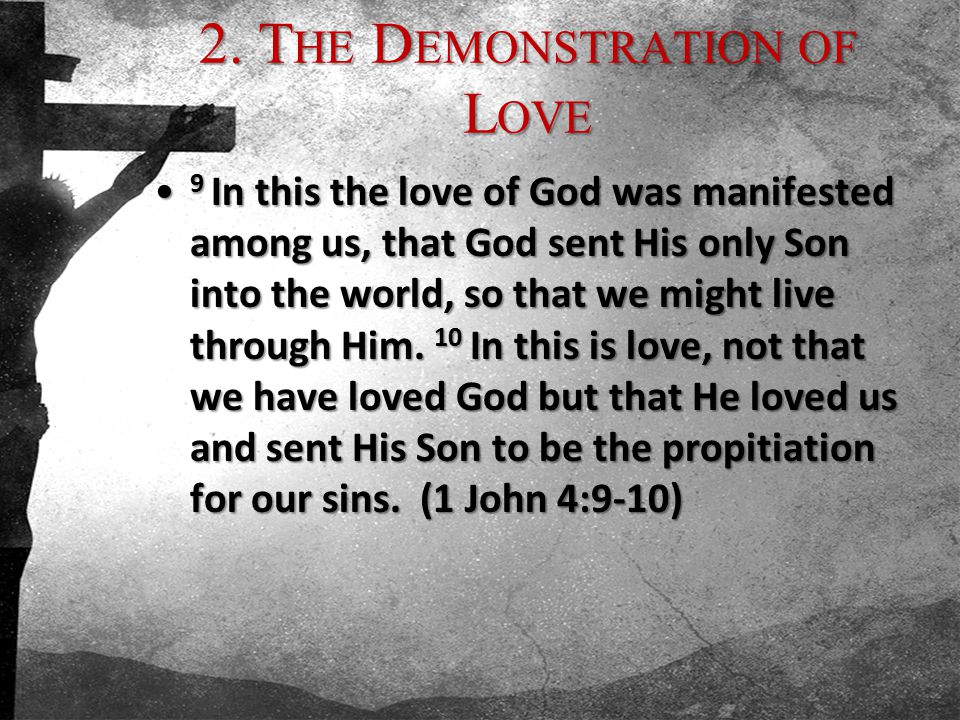
The Bible tells us “this is love. Not that we loved God but that He loved us and sent his Son as a propitiation…” (1 John 4:10).
You and I are the object of this love.
God loves you.
God loves me.
Knowing this is imperative.
And not just that we are loved in a general kind of way, but deeply loved and unconditionally and unconventionally loved.
We tap into this when we understand that God loved us first. [John 3:16-17]
He’s the source of our love.
God loved us even before Jesus gave Himself for us.
God the Father is the source of all love.
Before we can give this love we need to receive it for ourselves.
You cannot give to someone what you yourself do not have.
2. Loving your neighbor means loving ourselves as well.
To love your neighbor as yourself as commanded, you need to measure love correctly.
The measurement within this command is—as yourself.
To love your neighbor as yourself you need to love yourself.
This is something that gets badly misunderstood in the body of Christ often.
It gets mixed up with dying to self and denying self as if we need to destroy our self.
This is not true.
Jesus died for each and every one of us.
If Jesus valued us enough to go through what He went through, we each have a sacred responsibility to Him to value what He values exactly as He valued it .
We need to love what He loves – us.
The Bible tells us the Father loves us as much as He loves Jesus (John 17:20-23).
20 Neither pray I for these alone, but for them also which shall believe on me through their word; 21 that they all may be one; as thou, Father, art in me, and I in thee, that they also may be one in us: that the world may believe that thou hast sent me. 22 And the glory which thou gavest me I have given them; that they may be one, even as we are one: 23 I in them, and thou in me, that they may be made perfect in one; and that the world may know that thou hast sent me, and hast loved them, as thou hast loved me.[Authorized King James Version]
When we dare to simplify it: How dare we not love what the Father loves?
Learning to love ourselves prepares and helps us to love our neighbor.
3. Loving your neighbor means showing grace.
Knowing God is love and that this love is for you is not enough.
It needs to be developed and matured.
Imagine if you had a field of good soil and a bag of top notch seeds.
Would they produce a crop all by themselves?
No. The seeds must be planted and cared for.
Grace takes the seed of His love and the soils of our hearts and souls and creates fruit for the kingdom of God.
The Bible says,“it’s God who works in us both to will and to do of His good pleasure” (Philippians 2.13).
Loving Him and our neighbor pleases Him.
Grace helps us do this.
Grace teaches us proper love, honor and respect for ourselves and for our neighbor – our freely receiving His grace empowers us all to freely give it.
4. Loving your neighbor means acting with compassion.
From Luke’s Narrative of the Gospel, when Jesus was asked, “Who is my neighbor?” He responded with a story: the Good Samaritan [10:25-37].
Even those who have no love for God see the value of the story.
What is the bottom line of this story?
Who did Jesus say was being a neighbor?
The one who had compassion.
Compassion is not simply a warm fuzzy feeling in our hearts.
Compassion does something.
A heart moved by compassion cannot sit idly by while someone suffers a need.
Loving God and Loving your neighbor as you are Loving yourself is being moved by God, the Father, Son and Holy Spirit to help to the full extent of your ability.
5. Loving your neighbor means looking out for their wellbeing.
The NIV translation of 1 Corinthians 13 says, “love protects.”
In Philippians 2:4 it says, “Let each of you look not only to his own interests, but also to the interests of others.”
Loving your neighbor as yourself is to look out for other people’s wellbeing.
To look out for them is to pay attention.
You notice if they need something and then you help.
For example, their clothing tag is sticking out or they have food on their face so you let them know.
Or something more serious like when a neighbor has surgery or becomes sick.
Concerned for their health, well-being, I head over to their home with a meal or a loaded gift card so if they aren’t able to cook, they won’t have to cook, can eat.
6. Loving your neighbor means serving them.
Serving from the heart is kindness in action.
Kindness is one of the attributes of love listed in 1 Corinthians 13.
The surprisingly wonderful thing about kindness, though, is you can do acts of kindness without kindness residing in your heart.
If the kind thing is done out of duty then it isn’t love.
Jesus said he came to serve (Mark 10:45, Luke 19:10, Matthew 20:28).
God, who is love, came to serve.
Love serves.
For you to love your neighbor as yourself, you’ll have a heart to serve them.
Let them know you’re there for them.
If they need a ride somewhere, you drive them.
If they need their dog or cat checked on while out of town, you do that for them.
Other examples are getting their mail for them or taking them a meal if they’re not well.
Examples in a public setting are to let people in front of you in line at the store or in traffic.
7. Loving your neighbor means speaking kindly.
The childhood rhyme about sticks and stones versus words is not true.
To love your neighbor as yourself is to use words to build them up.
Speaking words of encouragement to someone who’s down is the most obvious example but there are hosts upon hosts and myriads and myriads of others.
We can be more intentional with our words by looking for and magnifying the good.
We can always find something good if we’ll take the time to look for it.
Examples of this are giving someone a simple smile, a simple compliment and simply telling someone how much you genuinely appreciate them.
8. Loving your neighbor means making allowances for other people’s humanity.
We live in a day and age when offense is as common as breathing.
Criticism is running rampant.
Love is not easily offended or critical.
Everyone does dumb things; no one is always right or knows everything.
We’re all a work in progress.
I remember sitting through a green light.
I wasn’t trying to inconvenience anyone.
I got stuck in grieving daze because a family member might die.
I remember that when I encounter people driving too slow, sitting at lights, or even cutting me off.
Maybe they have a reason.
Maybe they’re just being human.
We’re imperfect beings that do perfectly dumb things often.
Giving people the benefit of the doubt is loving your neighbor.
For example, I had someone honking their truck horn flailing their arms and cursing because I didn’t speed through an almost red light.
They were behind me and so they got stuck at the red light with me.
I don’t know why they were so angry but they may have had other pressing circumstances surrounding them that day – I prayed for them.
9. Loving your neighbor means sharing in their joys and sorrows.
The Bible says we are to“rejoice with those who rejoice, mourn with those who mourn” (Romans 12:15).
Celebrating can be difficult for us at times, especially if our neighbor is getting something we have longed for.
For example, a new job, a raise, or a pregnancy.
Celebrating with them in spite of our own pain is a strong show of love.
Likewise, mourning with our neighbor can be hard if we don’t know what to say, or have recently lost something or someone ourselves.
Loving God, Loving your neighbor as yourself is showing up and being there with your heart open, allowing them to be what they are, and support them.
10. Loving your neighbor means forgiving.
Forgiveness is a big deal to God.
Bible says He planned it for us from the foundation of the world (Ephesians 1:4).
Jesus frequently spoke forgiveness over others that resulted in the healing of their bodies.
Forgiveness is freely given to us and to love your neighbor as yourself you’ll pass the forgiveness on.
Jesus highlighted this in His story in Matthew 18 when Peter asks how many times is he to forgive.
He tells the story of a king who forgave an enormous debt to one of his servants.
This servant failed to pass the forgiveness on.
He demanded payment of a small debt from his neighbor.
When the king heard of it, he had his servant remanded for his debt, revoking the debt cancellation.
Jesus’ story tells us that love always forgives.
We all need forgiveness, so loving your neighbor is to forgive them as you have been forgiven.
In both the Hebrew [Old] and New Testaments we are commanded by God to love our neighbors as ourselves.
On several occasions Jesus himself says that is a part of fulfilling God’s law.
Again and again God shows us how to love others.
The call to love our neighbor is not complicated, but it can be challenging to follow.
It means more than being hospitable, tolerant, patient, and kind.
It means more than showing respect and honoring others.
It also means more than just being civil with people you disagree with—even though it also means all of that.
Loving our neighbor implies that the well-being of others matters—so we should work for justice, protection, and opportunities for others to thrive.
It means listening to others.
It also shows that the possibilities for showing love and care for our neighbors is endless and could leave us overwhelmed by all the needs for neighborly love!
Yet all of us can love our neighbors in the name of Jesus Christ.
We can honor, love and respect them enough to show how the love of Jesus is forever shaping us to love God with all our heart, soul, mind, and strength.
As you are loved, Jesus says, so love one another (see John 13:34).
In the name of God, the Father and God the Son and God the Holy Spirit,
Let us Pray,
Dear God, thank You for Your unconditional love. Lord, help me to know myself and to love myself. If I don’t feel self-worth, how can I expect someone else to cherish me? Help me to develop a healthy self-identity, remembering that I am a child of the King, created in Your image. Help me know who I really am, what I really want from life, and what I want in the person I will spend my life with. Thank you, Lord, for loving me so completely that I am being completely changed! Help me to be more aware of your Love so I may love my neighbor with the love you have for the world.
Adeste Fidelis. Venite Adoremus. Dominum
Gloria. In Excelsis Deo. Alleluia, Alleluia, Alleluia, Amen.
א 2 “I am Adonai your God, who brought you out of the land of Egypt, out of the abode of slavery.
The Word of God for the Children of God.
Adeste Fidelis. Venite Adoremus. Dominum.
Gloria. In Excelsis Deo. Alleluia, Alleluia, Alleluia, Amen.
The Ten Commandments are some of the most recognizable words in the entire Biblical Canon, yet they are often among the most misunderstood.
How has the coming of Jesus transformed these ancient laws?
Do these commandments still matter to Christians today in 2023?
What does it look like to obey them in today’s world?
What do they tell us about God and His Love for His beloved Children?
In this devotional message we see in verses 1-2 three truths about the Law: it’s given by God, it follows the Gospel, and it’s the path of freedom.
Loved By and Belonging to God
Adonai, The Lord who claims our allegiance is God, our Creator and Savior.
God delivered Israel when he brought them out of Egypt.
They had been slaves there for hundreds of years.
Faithful to his covenant promises to Abraham, Isaac, and Jacob (Genesis 12:1-3; 15:13-21; Exodus 3), God called this people his own and continued his work of making them into a nation through which all other nations would be blessed.
Then, many years later, through Jesus, a descendant of Abraham, God brought salvation to the world—and today God includes all who believe in Christ as his people, his worldwide family.
So if we believe in our Savior Christ, we belong to God, and we are His alone.
1 Peter 2:9-10 Complete Jewish Bible
9 But you are a chosen people,[a]the King’s cohanim,[b]a holy nation,[c]a people for God to possess![d] Why? In order for you to declare the praises of the One who called you out of darkness into his wonderful light. 10 Once you were not a people, but now you are God’s people; before, you had not received mercy, but now you have received mercy.[e]
1 Peter 2 puts it, we are a holy nation set apart to be “God’s special possession.”
From the beginning, it was love that created us and has bound us to God.
And since our relationship with God is based on love, God’s law is not a burden but a means of unconventional liberty towards showing love to our neighbors.
God, The Giver of Law and Liberty
Exodus 20:1-2King James Version
20 And God spake all these words, saying,
2 I am the Lord thy God, which have brought thee out of the land of Egypt, out of the house of bondage.
To faithfully read and respond to the Ten Commandments, we must first make a diligent effort to pray and study them, understand what they are and are not.
We find clarity in the truth that lies at their head: “I am the LORD your God.”
This poignant reminder of who God is precedes the instructions that follow.
In other words, the I am of God’s person grounds the you shall of His commands.
He can command us because of who He is.
The psalmist further expresses this:
“Know that the LORD, he is God! It is he who made us, and we are his” (Psalm 100:3).
God created us, and His being our Creator grants Him rights and authority over His creation.
Regardless of the efforts of our world to reject the creational handiwork of God, thus His authority over our lives, His role as our Ruler remains unthreatened.
He has made us; we are His.
When we should remember who spoke the law, we are in a position to grasp the purpose of the Ten Commandments as well as to understand what they are not.
First, the commandments are not a formal list of dos and don’ts given to restrict our personal freedoms.
God is NOT the Ultimate Cosmic Killjoy
God is not the Ultimate cosmic killjoy.
In fact, if you wanted to provide a heading for the Ten Commandments, you could instead call them “The Ultimate Guidelines to Freedom and Joy.”
They do not restrict our freedom but rather give us a blueprint for joy, showing us how life works best.
Second, the commandments are not intended as a ladder up which we climb to attain acceptance with God.
No such ladder has ever existed!
God brought His people out of slavery—from Egypt in the exodus, and from sin and death at the cross—before He called us to obey Him.
So we obey God because we have been “brought out by God,” not in order for us to somehow believe we could ever persuade Him to do so on our own time line.
If that were the case, why then did the bondage last as long as it did despite all the years of crying, pleading by the generations of Israelites held in bondage?
Until Moses had been prepared by 80 years of life at the pinnacle of authority, then at the bottom of authority for His “Burning Bush” encounter with God.
Rather than being rules that save us, the Ten Commandments serve as a mirror in which we should see ourselves, revealing the depths of our sin and our need for a Savior—and they show how we can all live every day to please our Savior.
Third, the Ten Commandments have not been rendered anywhere near obsolete by the coming of our Lord and Savior Jesus Christ.
When Jesus said the two greatest commandments were to love God and love our neighbor, He was summarizing the Ten Commandments (Mark 12:28-31 AKJV).
28 And one of the scribes came, and having heard them reasoning together, and perceiving that he had answered them well, asked him, Which is the first commandment of all? 29 And Jesus answered him, The first of all the commandments is, Hear, O Israel; The Lord our God is one Lord: 30 and thou shalt love the Lord thy God with all thy heart, and with all thy soul, and with all thy mind, and with all thy strength: this is the first commandment. 31 And the second is like, namely this, Thou shalt love thy neighbour as thyself. There is none other commandment greater than these.
What does it mean to love God with our heart, soul, mind, and strength?
The first four commandments tell us. [Exodus 20 verses 3-11]
What does it look like to love our neighbor as ourselves?
The final six commandments flesh that out. [Exodus 20 verses 12-17]
Jesus, master teacher that He was, summed up the ten with the two.
When we see all this, we are ready to read the Ten Commandments and let them transform our lives.
We must see the sin that the commandments reveal and respond in repentance and faith in the only One who fulfilled the law and offers Himself as our Savior.
He, the Lord Jesus Christ, will ensure that this law is not merely etched into our conscience but also inscribed upon our hearts and upon our souls.
Give yourselves unto the Lord our God and His way, and His Truth and His Life you and I will find everlasting love, everlasting joy and His everlasting liberty.
In the name of God, the Father and God the Son and God the Holy Spirit …
Let us Pray,
Psalm 40The Message
40 1-3 I waited and waited and waited for God. At last he looked; finally he listened. He lifted me out of the ditch, pulled me from deep mud. He stood me up on a solid rock to make sure I wouldn’t slip. He taught me how to sing the latest God-song, a praise-song to our God. More and more people are seeing this: they enter the mystery, abandoning themselves to God.
4-5 Blessed are you who give yourselves over to God, turn your backs on the world’s “sure thing,” ignore what the world worships; The world’s a huge stockpile of God-wonders and God-thoughts. Nothing and no one compares to you! I start talking about you, telling what I know, and quickly run out of words. Neither numbers nor words account for you.
6 Doing something for you, bringing something to you— that’s not what you’re after. Being religious, acting pious— that’s not what you’re asking for. You’ve opened my ears so I can listen.
7-8 So I answered, “I’m coming. I read in your letter what you wrote about me, And I’m coming to the party you’re throwing for me.” That’s when God’s Word entered my life, became part of my very being.
9-10 I’ve preached you to the whole congregation, I’ve kept back nothing, God—you know that. I didn’t keep the news of your ways a secret, didn’t keep it to myself. I told it all, how dependable you are, how thorough. I didn’t hold back pieces of love and truth For myself alone. I told it all, let the congregation know the whole story.
11-12 Now God, don’t hold out on me, don’t hold back your passion. Your love and truth are all that keeps me together. When troubles ganged up on me, a mob of sins past counting, I was so swamped by guilt I couldn’t see my way clear. More guilt in my heart than hair on my head, so heavy the guilt that my heart gave out.
13-15 Soften up, God, and intervene; hurry and get me some help, So those who are trying to kidnap my soul will be embarrassed and lose face, So anyone who gets a kick out of making me miserable will be heckled and disgraced, So those who pray for my ruin will be booed and jeered without mercy.
16-17 But all who are hunting for you— oh, let them sing and be happy. Let those who know what you’re all about tell the world you’re great and not quitting. And me? I’m a mess. I’m nothing and have nothing: make something of me. You can do it; you’ve got what it takes— but God, don’t put it off.
Adeste Fidelis. Venite Adoremus. Dominum.
Gloria. In Excelsis Deo. Alleluia, Alleluia, Alleluia, Amen
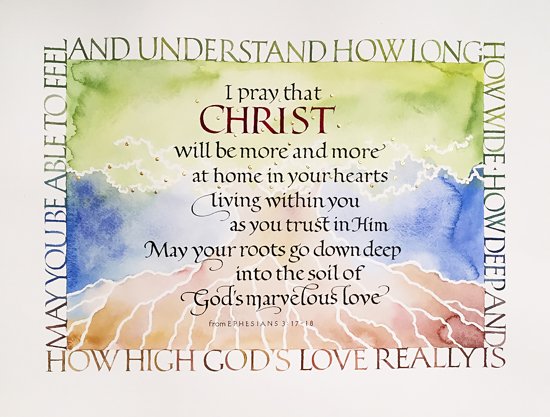
14 For this reason [grasping the greatness of this plan by which Jews and Gentiles are joined together in Christ] I bow my knees [in reverence] before the Father [of our Lord Jesus Christ], 15 from whom every family in heaven and on earth [a]derives its name [God—the first and ultimate Father]. 16 May He grant you out of the riches of His glory, to be strengthened and spiritually energized with power through His Spirit in your inner self, [indwelling your innermost being and personality], 17 so that Christ may dwell in your hearts through your faith. And may you, having been [deeply] rooted and [securely] grounded in love, 18 be fully capable of comprehending with all the saints (God’s people) the width and length and height and depth of His love [fully experiencing that amazing, endless love]; 19 and [that you may come] to know [practically, through personal experience] the love of Christ which far surpasses [mere] knowledge [without experience], that you may be filled up [throughout your being] to all the fullness of God [so that you may have the richest experience of God’s presence in your lives, completely filled and flooded with God Himself].
20 Now to Him who is able to [carry out His purpose and] do superabundantly more than all that we dare ask or think [infinitely beyond our greatest prayers, hopes, or dreams], according to His power that is at work within us, 21 to Him be the glory in the church and in Christ Jesus throughout all generations forever and ever. Amen.
The Word of God for the Children of God.
Adeste Fidelis! Venite Adoremus! Dominum.
Gloria! In Excelsis Deo! Alleluia! Alleluia! Alleluia! Amen.
God gave us Jesus as a way of saying, “I love you and you are special to me.”
That is a really great gift, isn’t it?
Much better than Valentine’s cards, or candy, or flowers.
Still, we have those special people in our lives whom we need to give our fullest possible attention to – our wives, our sweethearts, our very good friends, those co-workers who work with us and beside us and those whom we may supervise.
Treat them special because they are special – who and what and why they are is absolutely 100% irreplaceable – every single one of their lives utterly matters.
They need to know that they are truly respected, loved and deeply appreciated.
God’s Unconventional Love versus Valentine’s Day
Ephesians 3:14-19The Message
14-19 My response is to get down on my knees before the Father, this magnificent Father who parcels out all heaven and earth. I ask him to strengthen you by his Spirit—not a brute strength but a glorious inner strength—that Christ will live in you as you open the door and invite him in. And I ask him that with both feet planted firmly on love, you’ll be able to take in with all followers of Jesus the extravagant dimensions of Christ’s love. Reach out and experience the breadth! Test its length! Plumb the depths! Rise to the heights! Live full lives, full in the fullness of God.
Everyday is a special day when we open our eyes, take that next breath, set our feet upon the floor, walk forth into the kitchen get that very first cup of coffee.
We look outside, greet the morning, are welcomed by the dawn’s new sun.
A hand that raises the blades of a Venetian blind to look out the window at the sky of a sunny day.
Tomorrow, however, is a wee bit more of a special day.
Yes, it is Valentine’s Day.
But does everyone know the origin of this day?
It is a very old tradition which started because of a Bishop named Valentinus.
He lived back in the days of the Roman Empire.
Long ago, Roman officials were against young people getting married in the church.
Many young Christians wanted to be married by the priest, in the church, with God’s blessing.
Valentinus was sympathetic to these people and continued to help marry them, even though he was often threatened by the government authorities.
Sadly, he was taken to Rome and put to death for his faith and his defiance of the Emperor’s rule.
In memory and honor of Saint Valentinus, young couples started talking about choosing a Valentine, when they were actually talking about choosing a bride.
Now we call this day, Saint Valentine’s Day.
In the modern era, many people give their sweethearts Valentine’s Day cards with hearts all over them.
Some people give candies or flowers.
A red carnation or a red rose means “I love you.”
These are all ways that people show their love.
But God also gave us a gift to show us that He loved us.
It was Jesus. God gave us Jesus as a way of saying, “I love you and you are special to me.”
That is a really great gift, isn’t it?
Much better than cards, or candy, or flowers.
Today, let us meditate on biblical love, the greatest love of all time.
There once was a very old pastor, who was suffering from a long battle with cancer.
A few days before his death, he continued to hold on to a special verse that was the source of his inspiration.
He placed a bookmark where his favorite scripture passage was written:
“Who shall separate us from the love Christ? Shall tribulation, or distress, or persecution, or famine, or nakedness, or peril, or sword?” (Romans 8:34-35 KJV).
Despite facing such a trail in his life, the old pastor was most certainly blessed with the power “to grasp how wide and long and high and deep is the love of Christ;” a love that surpasses knowledge.
As children of God, we understand the fact that the root and foundation of creation is love.
It “surpasses knowledge.”
We know about human love.
Human love comes with the understanding that love comes as a reward for being good, for being faithful, being trustworthy and true, for being kind, for giving gifts, and for acting and for responding with appropriate behavior.
But this is not the same as the love which is embedded in the foundation of creation.
This is not the love that surpasses knowledge.
This is not the love that Paul prays we might have the power to grasp.
God’s love flows freely, without consideration of reward or any plan of equal or unequal or non-existent compensation.
This is a love that is not inherent to human nature.
We are more inclined to return love for love.
But the Scripture says,
“… how is it to your credit if you receive a beating for doing wrong and endure it? But if you suffer for doing good and you endure it, this is commendable before God. To this you were called, because Christ suffered for you, leaving you an example that you should follow in his steps”(1 Peter 2:20-21).
If we are to approach love in the way of biblical love, we must meditate on what it means when the Bible says, we must love God and each other as ourselves.
“Greater love has no one than this: to lay down one’s life for one’s friends. You are my friends if you do what I command. I no longer call you servants, because a servant does not know his master’s business. Instead, I have called you friends, for everything that I learned from my Father I have made known to you. You did not choose me, but I chose you and appointed you so that you might go and bear fruit–fruit that will last–and so that whatever you ask in my name the Father will give you. This is my command: Love each other.” (John 15:13-17)
Today, I would like to meditate on 3 questions about this amazing kind of love.
The first question is this:
Where does Love come from?
Where Does Love Come From?
Now some of you would answer, ‘that’s easy–it comes from within.’
Some may say, ‘It’s something that happens naturally as we mature as human beings.’
However, remember how hard it is to teach children to share?
That sharing instinct is not natural to them, but it is taught.
A human instinct is: self-survival.
C.S. Lewis, the famed English scholar, studied the various Greek words for love.
He came to distinguish the difference between what he called “needed love” and “gift love.”
Needed love is described as self-evident.
It is the most common kind of love in our world.
It is a mortal and human concept of love.
I love you, BECAUSE you love me.
I love you, because you provide for me, because you support me, and because you meet my needs.
Mr. Lewis illustrates that when we humans say to another, “I love you,” what we are really meaning is, “I need you, I want you. You hold value in my life.”
Now in contrast to “needed love” Mr. Lewis describes “gift love.”
This form of loving is born of fullness and wholeness.
The goal of gift love is to enrich and enhance the person whom it loves.
It does not require anything in return, nor does it hold requirements.
“Gift love moves out to bless and to increase rather than to acquire or to diminish. Gift love is more like a bountiful, artesian well that continues to overflow than a vacuum or a black hole. (C.S. Lewis)”
Mr. Lewis concludes this is what God’s love is all about. God’s love is gift love, not needed love.
This, of course, is the meaning of agape love; unconditional love.
Are we capable of agape love– loving as God loves?
To an extent we are.
But, we must go to the source of love, and the source of all love is God.
Jesus says in John’s narrative today, “As the Father has loved me, so have I loved you. (John 15:13)”
Perfect love does not come from within, it only comes from above.
And when God lives within us, we become capable of expressing perfect love.
Please take secure hold of your BIBLES and turn with me to 1 John 4:7-11.
In his first epistle, John writes,
“Dear friends, let us love one another, for love comes from God. Everyone who loves has been born of God and knows God. Whoever does not love does not know God, because God is love.” So, that is the answer to the first question: where does love come from? It comes from God. Then John adds, “This is how God showed his love among us: He sent his one and only Son into the world that we might live through him. This is love: not that we loved God, but that he loved us and sent his Son as an atoning sacrifice for our sins.” (1 John 4:7-11).
The Second Question is ….
What does this Love look like?
A young girl came home one day bursting with good news.
“Mom, Dad, I know why we had to learn grammar!” she exclaimed.
“It is so we can understand God.”
Her mom and dad gave her a puzzled look, so the young girl explained.
“God is love, and love can be a noun, an adjective, an adverb, or a verb.”
What a powerful concept!
Now doesn’t that preach a sermon or three lasting all the live long day!
Love isn’t just a vague feeling.
It is an action, an attitude, a spirit, and a character trait.
Since Jesus was filled with the Spirit of God, his every attitude, thought, word, action and deed was motivated by the love of God for Him and too, vice versa.
He was motivated completely and without reservation by love.
So, what does love look like?
Gift love is best illustrated with Jesus, a blameless man, hanging on a cross simply and solely because of God’s love for us.
We cannot meet any of God’s needs or even all of God’s commands.
But God’s nature is to give love, unconditionally, unconventionally, even at times when we do not deserve it.
As John writes,
“This is how God showed his love among us: He sent his one and only Son into the world that we might live through him. This is love: not that we loved God, but that he loved us and sent his Son as an atoning sacrifice for our sins.” (1 John 4:9-10)
God’s gift love is a pure and perfect love.
It is an unconventional, never-ending, and everlasting kind of love.
It does not ask for you to meet up to requirements, and it does not ask for compensation.
No matter how many times we sin or fall short of the Glory of God, His love never left us.
No matter how many times the world rebuked Him, His love never left us.
What does love look like?
There is no Greater and more Powerful image than Jesus on the Cross.
That is perfect love.
Perfect love looks like God, for He is love.
God and love are not two realities; they are one.
God’s infinite power of being is: the infinite power of love.
In every movement of love we are dwelling in God and God in us.
And when we accept the Holy Spirit into our lives, we allow God’s perfect love to be pictured through us.
We can also illustrate perfect love through the way we live.
Through every attitude, thought, word, and deed, we have.
Christians are called to be a reflection of the image of God.
We reflect God’s perfect love so that others can also see what true perfect love looks like.
Love unconditionally, unconventionally to all.
Now, the third and last question is:
What does such love require from us?
Jesus answers this question in John 15:13-17,
“My command is this: Love each other as I have loved you. Greater love has no one than this: to lay down one’s life for one’s friends. You are my friends if you do what I command. I no longer call you servants, because a servant does not know his master’s business. Instead, I have called you friends, for everything that I learned from my Father I have made known to you. You did not choose me, but I chose you and appointed you so that you might go and bear fruit–fruit that will last–and so that whatever you ask in my name the Father will give you. This is my command: Love each other.”
Jesus has issued the command: “Love each other as I have loved you.”
We are required by God’s command to love others as he has loved us–not with needed love, but with gift love.
Not because of anything they can or have done for us, but because of what our Lord and Savior Jesus Christ has done for us.
Luke 6:27-32Amplified Bible
27 “But I say to you who hear [Me and pay attention to My words]: [a]Love [that is, unselfishly seek the best or higher good for] your enemies, [make it a practice to] do good to those who hate you, 28 bless and show kindness to those who curse you, pray for those who mistreat you. 29 Whoever [b]strikes you on the cheek, offer him the other one also [simply ignore insignificant insults or losses and do not bother to retaliate—maintain your dignity]. Whoever takes away your coat, do not withhold your shirt from him either. 30 Give to everyone who asks of you. [c]Whoever takes away what is yours, do not demand it back. 31 Treat others the same way you want them to treat you. 32 If you [only] love those who love you, what credit is that to you? For even sinners love those who love them.
The world lives by the philosophy: “Scratch my back and I’ll scratch yours.”
To do good for people who are incapable of doing anything for you in return.
This is gift love, agape love. It is the love of God.
And of course, dear brother and sisters, this is the hardest form of love to give.
It is hard to love someone unconventionally when they cannot or will not or refuse to do the same for you.
But when the Spirit of the Lord is within, He will give you the strength to love.
The strength to be patient and compassionate.
The strength to reflect agape love to others who do not know God.
For the greatest command was to love God, and the second greatest command was to love one another.
Concluding Reflection’s: Love That Surpasses Knowledge
Ephesians 3:16-19Easy-to-Read Version
16 I ask the Father with his great glory to give you the power to be strong in your spirits. He will give you that strength through his Spirit. 17 I pray that Christ will live in your hearts because of your faith. I pray that your life will be strong in love and be built on love. 18 And I pray that you and all God’s holy people will have the power to understand the greatness of Christ’s love—how wide, how long, how high, and how deep that love is. 19 Christ’s love is greater than anyone can ever know, but I pray that you will be able to know that love. Then you can be filled with everything God has for you.
Love is commonly considered an emotion—a feeling, inclination of the heart.
Love involves knowing the person we love, and yet even that knowledge is not the end of love.
Paul reminds his readers of this basic truth when he prays that they may “know this love that surpasses knowledge.”
Paul is talking here about the love of God, and he’s saying that it’s not enough to know about God without having love for God.
The standard of love that believers strive for is to “be filled to the measure of all the fullness of God.”
That’s a high standard indeed!
God is, in every way, far beyond what our minds can comprehend or our hearts can contain.
We will never achieve this total fullness!
But what a powerful prayer this is—and what a wonderful goal to guide us in living our life!
To be continually growing in this “fullness of God” and his love is the delight of discipleship.
This is a wonderful prayer offered for us—but it’s also a prayer to offer on behalf of others.
What a transformation of our relationships when an entire community of Christ’s disciples experiences together a growing fullness of God’s love.
It’s beyond our ability to imagine!
Valentines Day is known as the day of love.
But God’s love lasts for eternity.
It is a perfect LOVE that loves unconditionally and unconventionally.
Where does perfect love come from?
It comes from God alone, and works within us when we become His children.
What does perfect love look like?
It looks like Jesus, a blameless man, hanging on a cross, for a world which did not deserve Him.
And as His children we reflect that image through our actions, our attitudes, thoughts, words, and deeds.
And what does such perfect love require out of us?
It requires us to move beyond “needed love” and give “gift love”.
To look around at others who are in need of God’s love and to give it to them–not asking what they can do for us, remembering what Christ has done for us.
In the name of God, the Father and God the Son and God the Holy Spirit,
Let us Pray,
We bow our hearts before You, Father God.You are the Creator of everything we seein heaven and on earth.We pray that out of Your glorious, unlimited resources,You would strengthen our hearts and minds through the power of Your Holy Spirit.May Your love be the rich soil in which our lives are rooted.May Your love be the only firm foundation upon which we build,so that, together with all Your people everywhere,we would come to truly understand how long, how high,how wide and how deep Your love really is—how it far surpasses anything we can imagine.God, fill us with the fullness and the power that comes from You alone, so that our lives would reflect your goodness and grace to the world around us. Lord, fill us to overflowing with the knowledge and the wisdom of your fullness so that we love you more and serve you better. Help us to keep offering this prayer for others, that we may all grow in you.
Adeste Fidelis! Venite Adoremus! Dominum.
Gloria! In Excelsis Deo! Alleluia! Alleluia! Alleluia! Amen.






 Loving God, Living God, Loving Hope, Living Hope, Loving Living Life His Way! "Many things are possible for the person who has hope. Even more is possible for the person who has faith. And still more is possible for the person who knows how to love. But everything is possible for the person who practices all three virtues." - Brother Lawrence (1605-1691), Practicing the Presence of God (1692).