
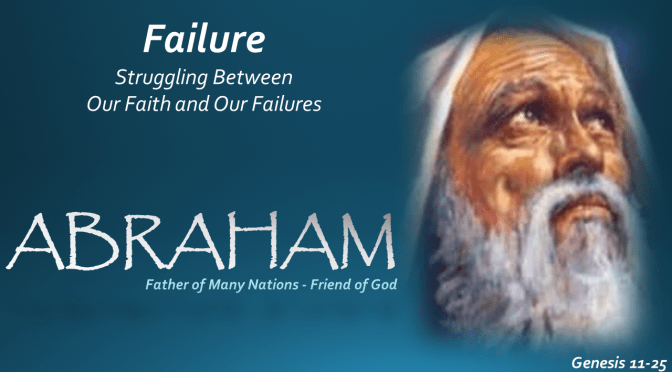
Genesis 12:1-9Amplified Bible
Abram Journeys to Egypt
12 Now [in Haran] the Lord had said to Abram,
“Go away from your country,
And from your relatives
And from your father’s house,
To the land which I will show you;
2
And [a]I will make you a great nation,
And I will bless you [abundantly],
And make your name great (exalted, distinguished);
And you shall be a blessing [a source of great good to others];
3
And I will bless (do good for, benefit) those who bless you,
And I will curse [that is, subject to My wrath and judgment] the one who curses (despises, dishonors, has contempt for) you.
And in you all the families (nations) of the earth will be blessed.”
4 So Abram departed [in faithful obedience] as the Lord had directed him; and Lot [his nephew] left with him. Abram was seventy-five years old when he left Haran. 5 Abram took Sarai his wife and Lot his nephew, and all their possessions which they had acquired, and the people (servants) which they had acquired in Haran, and they set out to go to the land of Canaan. When they came to the land of Canaan, 6 Abram passed through the land as far as the site of Shechem, to the [great] terebinth (oak) tree of Moreh. Now the [b]Canaanites were in the land at that time. 7 Then the Lord appeared to Abram and said, “I will give this land to your descendants.” So Abram built an altar there to [honor] the Lord who had appeared to him. 8 Then he moved on from there to the mountain on the east of Bethel, and pitched his tent, with Bethel on the west and Ai on the east; and there he built an altar to the Lord and called on the name of the Lord [in worship through prayer, praise, and thanksgiving]. 9 Then Abram journeyed on, continuing toward the Negev (the South country of Judah).
The Word of God for the Children of God.
Adeste Fidelis! Venite Adoremus! Dominum!
Gloria! In Excelsis Deo! Alleluia! Alleluia! Alleluia! Amen.
Through much of the country these last several days the mountains of snows have fallen and furiously – snow drifts several feet tall have covered cars and snow plows, ambulances and firetrucks and covered the doorways of houses.
Blizzards have returned! Worse than ever, the winds are howling and the wind chills are plummeting deep, to very dangerous and even life threatening levels.
Roads are impassable, homes and apartments are losing power, no heat to cook the food with, no heat to warm the place of abode, pipes are frozen, bursting.
People are trapped in their homes – medical conditions, health and safety.
“I’m dreaming of a white Christmas ….”
“Just like the ones I used to know ….”
Merry Christmas! ….
You have your White Christmas … Just not the one you wanted to know!
Immanuel God with Us and within us, if you can manage to somehow survive.
Christmas Bells are ringing everywhere people can by whatever means travel to; to celebrate that once a year moment with long distant family and friends too.
Christmas bells are silent, just past, and travelers are trying to return home from anywhere and everywhere around the globe their families were living in.
Except, outside too many locations … impassable and dangerous weather, far too dangerous for automobiles, four wheel drives and far worse for- airplanes.
Airports cannot release the planes for take off – they cannot plow their runways fast enough or at all – the risk of life and limb is simply far to dangerous to all.
Travelers are stuck in airports behind a myriad and myriad of cancelled flights.
In many places, during this Christmas season, this isn’t an unusual occurrence.
It is one which many travelers have learned how to accept and how to manage.
They know how to pack “for the occasion” – with snacks and a host of patience.
With experience, traveling gets easier, more familiar, much more manageable.
If we have previously navigated an airport or are at least familiar with the local language and likely weather, it’s not overwhelming to get where we are going.
But if we don’t know the way to our next gate or can’t read the signs pointing the way, or we suddenly encounter all the worse kind of weather conditions, we can soon feel lost and have no idea where we are and where we need to go next.
And, guess what?
New Years Eve and New Year’s Day are but a few days away ….
Another very popular travel day ….
And the weather is still going to be the weather ….
An we still have not figured out how to stop the weather from happening!
Jesus did …. Mark 4:35-41
When the weather went crazy dangerous on those disciples in that boat, they like many of today’s travelers traveling in these blizzard conditions, feared.
Jesus told his disciples …. we are absolutely going over to the “other side” of the waters and the disciples obediently loaded themselves into the boat and sailed.
They were obedient to their Rabbi – then things suddenly got crazy dangerous, the weather threatened their very lives and seasoned fisherman became afraid.
No matter what they tried, seasoned fisherman failed to right the ship in the storm, failed in their efforts to protect the lives of the others an they panicked.
They turn to wake their Rabbi … their Rabbi wakes up … and just as fast, the Rabbi rebukes the weather – “be still!” an then Rabbi turns to the disciples and wonders aloud to them ….
“Why are you so fearful?”
“How is it you have no faith?” (Mark 4:40)
THE STRUGGLE BETWEEN OBEDIENCE, FAITH AND OUR INEVITIBLE FAILURE
Abram soon to be Abraham was in a situation like that.
If we try to put ourselves in his sandals, we can see that it was no small thing to faithfully obey and follow God’s leading when he did not know where the other side was located and no one offered him a roadmap or a weather map to read.
There was only a promise from a God he had never met or experienced before.
God promised that Abraham would be a great nation and bring great blessings for “all peoples on earth,” but this would require a previously unknown, long, arduous journey and a new start, living among strangers in a faraway land.
“He did not know where he was going.”
In a miraculous demonstration of faith – against all of the best advice of his fellow countryman, he packed up and left what he knew of life behind him.
Here we pick up Genesis Chapter 12 …. Here we join the ancient Biblical story.
Genesis 12:1-20 – Faith and Failure
Genesis chapter 12 may be one of the most famous chapters in the Bible.
It forms the basis for pretty much everything that follows.
With the calling of Abraham God really begins to set a plan in motion to deliver the world from the problems that have occurred up to this point in the Bible.
I. Faith (Genesis 12:1-9)
II. Failure (Genesis 12:10-20)
Abraham is one of the most important men in all of history.
Though he lived about 4000 years ago, he is still a prominent figure today.
Christians hold up Abraham as our forefather.
Not necessarily as our physical descendant, but as our spiritual one.
He is the father of faith.
It is repeated over and over in the New Testament that He believed God, and it was credited to him as righteousness.
Christianity, which is all about faith in Jesus Christ, and walking with God by faith, holds up Abraham as an example to live by.
But for Christians of any generation, including ours, we have to admit that it’s awful hard to live up to that kind of faith standard.
We think of Abraham, or Abram, as this man of great faith who left his family, his home, his possession, just picked up, left one day when God told him to go.
He didn’t know where he was going.
He didn’t know how he would get there.
He didn’t know how he would feed himself or his family when he got there.
But God told Abram to go, and so obediently, Abram went.
That, however, is not quite the Abram of the Bible.
Was he yet a man of great faith?
Absolutely.
But do you want to know what encourages me most about Abram?
It’s not his faith, but his lack of faith.
I want to walk by faith. I want to trust God in all things, and never doubt, and never fear, and never worry – but that almost never works out – I get afraid!
And I could live my life and beat myself up all day about how Abram lived that way, therefore – “I should too – but why can’t I?, I just continuously fail!”
But when we get a real honest picture of Abram’s life, his times of great faith and trust in God, are balanced and offset by those intervening times of great doubt, disobedience and failure. Abram was not naturally a man of great faith.
Nor did he have some spiritual gift of faith, or some “secret” to trusting God.
No!
Abram became a man of great faith because for many years he had very little faith, and even in those times, God continued to keep his promises to Abram.
In Genesis 12 and following, God appears personally to Abram multiple times, each time to develop faith in his life.
During these times, God tested Abram.
You would think that a man of faith would easily pass all the tests.
But think again.
In four of those tests, Abram faith in God failed miserably.
So here is the difference between a man of faith and a man of fear.
Abram was a man of faith not because he never doubted, and not because he never failed.
Abram did lots of both.
Abram was a man of faith because when he failed, when he fell flat on his face, he got up, brushed himself off, and started over again.
That’s faith.
A man of fear gives up.
A man of fear stays on the ground.
A man of fear stops trying.
Not Abram.
And that is why he is the father of faith.
It’s not that he has great faith, but that he has a great God.
Abram knows that even when he fails, God will not.
But this is a lesson that Abram had to live into, steadily learn over time.
His first lesson is found in Genesis 12.
This chapter contains both the faithful obedience of Abram and the doubting failure.
It contains a well rounded picture of the father of faith.
The beginning of his life of faith is in verses 1-9.
I. The Faith of Abram (Genesis 12:1-9)
Abram’s walk of faith begins with God’s promise.
Genesis 12:1-3. Now the Lord had said to Abram:
“Get out of your country,
From your family
And from your father’s house,
To a land that I will show you.
I will make you a great nation;
I will bless you
And make your name great;
And you shall be a blessing.
I will bless those who bless you,
And I will curse him who curses you;
And in you all the families of the earth shall be blessed.”
This is the first time God makes these promises to Abraham.
There are three promises of God here.
God promises to make Abram a great nation,
Go promises to give him a great name,
and Go promises to bring great blessing upon the earth through Abram.
Down in Genesis 12:7, there is also the promise of land.
Together, these are the promises of God to Abram.
These promises are often called the Abrahamic Covenant, and God will repeat it and make it unconditional in Genesis 15.
It is these promises of God, these covenants from God, that Abram’s faith is founded upon.
Abram was a man of faith because he knew and believed the promises of God.
If you an I want to develop faith, you an I must know what God has said in His Word, and especially what promises He has made to you and me.
How can you an I trust the promises if we don’t know what the promises are?
Romans 10:17 says that faith comes by hearing and hearing by the Word of God.
If you an I want to be a person of faith, you an I must be in the Word of God.
You an I must read the promises, understand the promises, and as the hymn says, you an I must set a standard of living, to be “Standing on the Promises.”
The promises given to Abram were unconditional promises.
This will become much more evident in chapter 15.
The Abrahamic covenant did not depend on Abram’s faithfulness or the faithfulness of his descendants.
There are those who say today that Israel has lost their right to the land, they are no longer the chosen nation because of their constant sin and rebellion.
That is making the Abrahamic covenant based upon the works and faithfulness of the people of Israel, rather than the Word and faithfulness of God.
It is true Abram and many of his descendants did have times of disobedience.
Sometimes for hundreds of years.
But God always keeps His promises, even when great failure blossomed.
God has promised that Israel will be a great nation.
Isn’t it amazing that though Israel has always been a relatively small nation, and relatively few in number compared to the populations which surround it, yet, they are still one of the world powers in military, science and economics?
And they will become even greater during the 1000 year reign of Christ which is yet to come.
God also promised that He would make Abram’s name great.
I have already talked about how Abraham still makes the news today, even though he’s been dead for 4000 years.
Nobody else in history except for Jesus Christ has that claim to fame.
Abraham’s name truly is great.
There is also the promise in verse 3
God will bless those who bless Abram, and curse those who curse him, and all families on earth will be blessed through him.
That promise at the end of verse 3 is ultimately fulfilled in the person of Jesus Christ.
All nations on earth have been blessed through Abram, because it is through Abram’s descendants that Jesus Christ came into this world.
And when Jesus Christ returns again, and sets up His kingdom on earth, all the nations of the earth will be blessed again.
Abram hears these promises when he is still living in Haran, and so in verses 4 and following, He acts upon the promises and sets out.
Genesis 12:4-5. So Abram departed as the Lord had spoken to him, and Lot went with him. And Abram was seventy-five years old when he departed from Haran. Then Abram took Sarai his wife and Lot his brother’s son, and all their possessions that they had gathered, and the people whom they had acquired in Haran, and they departed to go to the land of Canaan. So they came to the land of Canaan.
When Abram left Haran, he took his wife Saria, and his nephew Lot with him.
As we learned last time we were in the book of Genesis, Abram probably left his father Terah in Haran.
His father had probably had enough of following God who-knows-where, and so wanted to stay in Haran. But Abram can wait no longer for he is now 75 years old. So he sets out with his wife Sarai and nephew and all of their possessions.
Can you imagine, at 75 years old, making such a change?
Most people, by the time they are 75, are pretty much set in their ways.
They are living where they are going to live, and they are comfortable there, and it’s hard to get them to change anything.
Of course, Abraham lived to be 175, so when he was 75, would be comparable to someone today being 39 if we consider it, try to figure it on a 90 year life span.
One of the reasons Abram is a man of faith is because he is willing to follow God anywhere, anytime, even when he’s 75 years old.
He departed and traveled south to Canaan, until they came to Shechem, which is in the middle, or very center of Canaan.
Genesis 12:6-7. Abram passed through the land to the place of Shechem, as far as the terebinth tree of Moreh. And the Canaanites were then in the land. Then the Lord appeared to Abram and said, “To your descendants I will give this land.” And there he built an altar to the Lord, who had appeared to him.
This is the fourth promise of God to Abram.
The first three were a great people, a great name, and great blessing.
Now we have the promise of Land.
The Land is part of the Abrahamic Covenant.
God doesn’t promise the land to Abram, but to his descendants.
This is not only a promise the land will eventually belong to his descendants, but also that he will have descendants.
God is promising to Abraham that he will have descendants, and that God will give them this land.
This promise was almost completely fulfilled when Joshua and the people of Israel entered the land about 600 years later.
But the first piece of land was obtained through a purchase made by Abram as a burial plot for his wife (Gen. 23:16-20).
Later, his grandson Jacob also bought some land in Shechem, near where Abram received the promise (Gen. 33:19).
Later, it is at the oak tree near Shechem (NIV, NAS, NKJV), possibly the same tree mentioned here, that Jacob and his companions rededicated themselves to God, and got rid of all of their idols and false gods (Genesis 35:4-5).
Six-hundred years later, when the Israelites come to Canaan in conquest, they begin their campaign by gathering at Shechem to remember the covenant, and build another altar to God (Joshua 8:30-35).
After they have defeated their enemies and have gained ownership of the land, Joshua calls the people once again to Shechem to show them that the promises have been kept.
He also asks the Israelites to make their own promises to God (Joshua 24) to serve Him and obey Him.
So this is what they do. Just as Abram builds an altar to God at Shechem, so also do the people of Israel 600 years later (Joshua 24:26-27).
It is at Shechem where Abram received the promise, and it is at Shechem that the people of Israel received the fulfillment of the promise. It is there that they also made a promise to obey God and serve Him faithfully, just as Abram did.
Imagine the relevance and significance of worshipping God in a place where 600 years before, your ancestor Abram had also worshipped God.
Imagine building an altar to God, possibly using the same stones Abram used.
Shechem was a special place for the people for it is where God first appeared to Abram in the Promised Land, where Abram first built an altar to worship God.
The altar was a symbolic and public way of worshipping God.
As long as the altar stood, it was a reminder to all who saw and knew what it meant that God spoke to Abram and promised this land to him.
When God makes promises to you, it is sometimes advisable to set up reminders for yourself.
Make an entry in your journal.
Put a sticky note on your cupboard.
I have daily written these devotionals over the last three years or so and sent them out to quite literally all over the world – It is my ministry unto the world.
It is a reminder of a promise God made to me and a promise I made to God.
As humans, we have a tendency to forget the promises of God.
Altars were a way Abram gave glory to God for these promises.
You and I can find similar means and methods to give glory to God and find ways to give Holy Spirit credit for helping me remember His promises to me.
In Genesis 12:8, Abram moves further south and builds another one of these altars.
Genesis 12:8. And he moved from there to the mountain east of Bethel, and he pitched his tent with Bethel on the west and Ai on the east; there he built an altar to the Lord and called on the name of the Lord.
This site becomes important later when Israel does finally begin to receive the land.
In the book of Joshua, after the walls of Jericho fall down, the Israelites go to attack Ai.
But they are soundly defeated.
Because Achan stole 200 pieces of silver, a wedge of gold and a Babylonian garment as spoils of war from Jericho and buried them, hid them in his tent.
After Achan’s sin is discovered, and he is put to death, they once again attack Ai, and this time they prevail.
Where Abram worshipped God, called on the name of the Lord, the Israelites also rededicated themselves to God by getting rid of the sin in their midst and then going forth to battle.
Abram’s altar and the Israelite’s actions between Bethel and Ai are another witness to their faithful, faith-filled dedication to serve and obey their God.
Genesis 12:9. So Abram journeyed, going on still toward the South.
We don’t know how long he stayed in each spot, what we are shown is Abram has no place to rest, no place to stop and settle down, no place to call home.
Though he has found a place that God will give to his descendants, it is not yet his.
He has followed God from Haran to Canaan.
God spoke to Abram and promised Him blessings and land.
Abram has built two altars to God.
Things seem to be going well for Abram.
He is making progress on his journey of faith.
When Abraham arrived at his destination, he built an altar and dedicated it to the Lord, who faithfully fulfilled His promise and who had brought him there.
What a wonderful message, what a wonderful witness and testimony in the midst of one of the most memorable pilgrimages in the pages of Scripture.
Where has God brought you?
Is your first thought to worship him for his faithfulness?
God continues to promise us spiritual blessings in this life and the next.
So let’s not forget to faithfully dedicate the steps of our lives to our faithful God, even if, like Abram to Abraham it’s mostly unclear exactly where God is leading.
Tomorrow, we will dedicate and devote some critical time to Genesis 12:10-20.
Here we will try to delve deeper into the Failures of Abram (Genesis 12:10-20)
In the name of God, the Father and God the Son and God the Holy Spirit,
Let us Pray,
God of Heaven’s Armies, You tell me to put my faith and my trust in You when I am afraid. Dear God, right now I confess I am definitely afraid. I am afraid of things that are happening in my life. I am afraid for my future. I am afraid for my loved ones. I feel helpless, hopeless. I cannot breathe. The walls are closing in around me. I can feel the anxieties near and I need Your protection. Come into me, dear God, and fill me with Your Holy Spirit. I need You now! Help me to put my hope in You. I thank You for being my rock and my shield. Thank You for being my God in whom I can really trust. I praise You because even when I was faithless, You remained faithful to me. You have never changed nor ever withdrew Your love from me. I love You, God.
Adeste Fidelis! Venite Adoremus! Dominum!
Gloria! In Excelsis Deo! Alleluia! Alleluia! Alleluia! Amen.




 Loving God, Living God, Loving Hope, Living Hope, Loving Living Life His Way! "Many things are possible for the person who has hope. Even more is possible for the person who has faith. And still more is possible for the person who knows how to love. But everything is possible for the person who practices all three virtues." - Brother Lawrence (1605-1691), Practicing the Presence of God (1692).