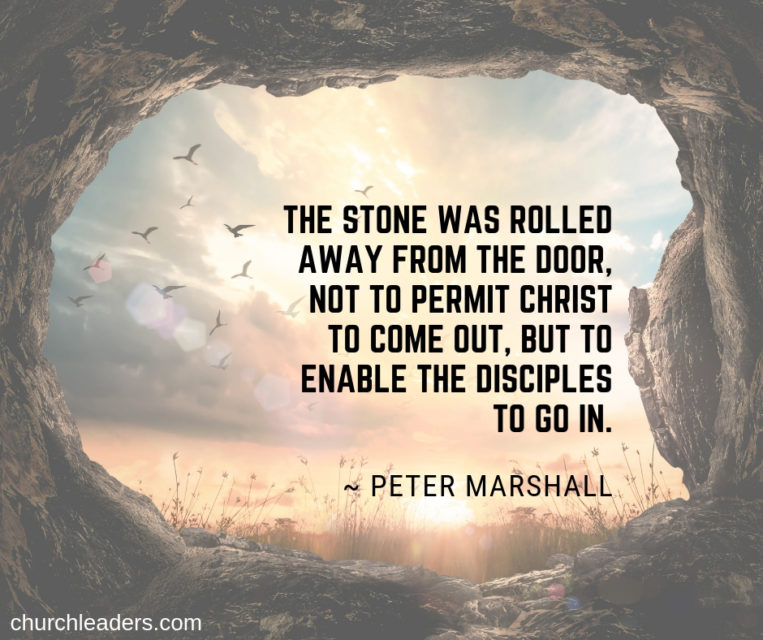
Come! Please Look For Yourselves! To Witness The Stone is Now Rolled Away, Testify Death Is Now Utterly Defeated! Luke 24:1-8

Luke 24:1-8 New King James Version

He Is Risen

24 Now on the first day of the week, very early in the morning, they, [a]and certain other women with them, came to the tomb bringing the spices which they had prepared. But they found the stone rolled away from the tomb. Then they went in and did not find the body of the Lord Jesus. And it happened, as they were [b]greatly perplexed about this, that behold, two men stood by them in shining garments. Then, as they were afraid and bowed their faces to the earth, they said to them, “Why do you seek the living among the dead? He is not here, but is risen!  Remember how He spoke to you when He was still in Galilee, saying, ‘The Son of Man must be delivered into the hands of sinful men, and be crucified, and the third day rise again.’ ” And they remembered His words.

The Word of God for the Children of God.

Adeste Fidelis! Laeti Triumphantes! Venite Adoremus! Dominum.

Gloria! In Excelsis Deo! Alleluia, Alleluia, Alleluia, Amen.

There is a new song of Triumph coming forth from the Heavens above.

Psalm 19 The Message

19 1-2 God’s glory is on tour in the skies,
    God-craft on exhibit across the horizon.
Madame Day holds classes every morning,
    Professor Night lectures each evening.

3-4 Their words aren’t heard,
    their voices aren’t recorded,
But their silence fills the earth:
    unspoken truth is spoken everywhere.

4-5 God makes a huge dome
    for the sun—a superdome!
The morning sun’s a new husband
    leaping from his honeymoon bed,
The daybreaking sun an athlete
    racing to the tape.

That’s how God’s Word vaults across the skies
    from sunrise to sunset,
Melting ice, scorching deserts,
    warming hearts to faith.

7-9 The revelation of God is whole
    and pulls our lives together.
The signposts of God are clear
    and point out the right road.
The life-maps of God are right,
    showing the way to joy.
The directions of God are plain
    and easy on the eyes.
God’s reputation is twenty-four-carat gold,
    with a lifetime guarantee.
The decisions of God are accurate
    down to the nth degree.

10 God’s Word is better than a diamond,
    better than a diamond set between emeralds.
You’ll like it better than strawberries in spring,
    better than red, ripe strawberries.

11-14 There’s more: God’s Word warns us of danger
    and directs us to hidden treasure.
Otherwise how will we find our way?
    Or know when we play the fool?
Clean the slate, God, so we can start the day fresh!
    Keep me from stupid sins,
    from thinking I can take over your work;
Then I can start this day sun-washed,
    scrubbed clean of the grime of sin.
These are the words in my mouth;
    these are what I chew on and pray.

Accept them when I place them
    on the morning altar,
O God, my Altar-Rock,
    God, Priest-of-My-Altar.

Except, who is listening to these raucous words of song and triumph?

The heavens sing their words of the Glory and Triumph of God!

They emanate from the deepest reaches of heaven down to the earth below.

They begin echoing outward unto a sleeping humanity from a place of death.

Hushed and Quiet though they may be in this moment at that place of death, they are none the less quite real and quite audible to those who will come to it.

The song will come unexpectedly to those whose hearts and whose souls were prepared to be curious about it, receive it and see it and then utterly believe it!

In this place of uncleanness and death, there is a sure and certain witness here!

In this place of darkness and stench, there is a sure and certain testimony here!

Let us now lend our eyes and ears to what this witness and testimony might be.

“Welcome to this Happy morning!”

“Welcome all ye curious ones!”  

“Welcome all ye despondent ones!”

“Welcome all ye silent and tearful and mournful ones!”

“Welcome all ye defeated, downtrodden and broken ones!”

“Welcome all ye faith-filled and faithful and hope-filled hopeful ones!”

“It is wonderful to gather in our beautiful Kingdom of God to celebrate the glory and triumph of God and the Resurrection of our Lord and Savior Jesus Christ.”

Yes! there is, emanating from here a new, fresh song of witness and testimony.  

Except, no one in particular is hearing, even listening to the words of welcome.

In fact, if we were to look at this place in that moment, we would see nobody.

Perhaps because the deafening silence of the glorious words “He is not here!” “praise God” are coming from an empty tomb which has been beckoning others where no others are paying attention, in close proximity or listening distance.

The expectancy of the glorious and triumphant message found from within the empty tomb is not one that is even the least bit anticipated, shared nor shouted.

The “Behold, Our God Wins!” witness and the living breathing testimony of the empty tomb sits all alone in a darkened silence in a place of the unclean dead.

Now, finally – a group of women come over the hill and down a path leading to the tomb of the one whom in life had been believed to be their “Messiah King.”

Three days ago, he had been brutally killed, humiliated as the ultimate criminal.

Because of Sabbath rules, he had been hastily buried and sealed behind a rock.

The women came bearing spices which they had prepared to finish preparing the not so pleasant smelling body of their dead best friend and their king.

But instead of finding a sealed tomb they came upon an open one.

Amazingly, unexpectedly, the stone had somehow been rolled off to the side.

Curious and probably just a wee bit afraid of what they would or would not find, they enter the tomb of their Rabbi and find it empty – there was just no corpse.

The women had come to anoint his body for the burial when they suddenly encountered a pair of angels asking this question – “so, why are you here?”

Followed up by the good news, “He is not here; he has risen!

What a great and wholly unexpected sequence of “GOD” events for their souls.

Such wonderful good news.

The faith-filled faithful of God went to the tomb before all others were awake.

With their whole selves, in the darkness, their eyes beheld an open tomb and a rock much too heavy for them to remove by themselves rolled off to the side.

Instead of running away and screaming into the night to tell somebody else, the curiosity of the words to a new song reached their souls, so they all went inside.

They lingered inside and witnessed to an unanticipated, unexpected, emptiness inside the tomb of their fallen Rabbi they could not understand nor easily grasp.

As they were all greatly perplexed by this sequence of events, they clearly see the two men in shiny garments standing there, they clearly hear their words:

Then, as they were afraid and bowed their faces to the earth, they said to them, “Why do you seek the living among the dead? He is not here, but is risen!  Remember how He spoke to you when He was still in Galilee, saying, ‘The Son of Man must be delivered into the hands of sinful men, and be crucified, and the third day rise again.’ ”

“He is NOT here!”

“But, IS Risen!”

Jesus is alive!

Death is defeated!

Witness to, Testify that, The Stone Was Rolled Away

Luke 24:5-8 The Message

4-8 They were puzzled, wondering what to make of this. Then, out of nowhere it seemed, two men, light cascading over them, stood there. The women were awestruck and bowed down in worship. The men said, “Why are you looking for the Living One in a cemetery? He is not here, but raised up. Remember how he told you when you were still back in Galilee that he had to be handed over to sinners, be killed on a cross, and in three days rise up?” Then they remembered Jesus’ words.

The gospel of Luke opened with angels delivering messages to Zacharias, Mary, some shepherds quietly going about their everyday duties protecting the sheep.

And to the shepherds, it was a melodious message of great joy for all people.

The message delivered here was also a message of great joy to all people.

Death had been conquered.

Jesus had defeated the power of death.

No longer do we have to fear death.

Where, O death, is your victory? Where, O death, is your sting?(1 Corinthians. 15:55).

Implications: the Witness and Testimony of a Rock Rolled Away

When we consider Jesus as Messiah, most of us think immediately in personal terms: Jesus is my Messiah. He forgives my sins. He lives in me. 

All of which, of course, is true.

But 1st-century Jewish expectations concerning the messiahship of Jesus were far broader than that.

If we had talked with a 1st-century Jew about his or her messianic expectations, we would have discovered hopes that were, in a sense far grander in their scope.

The Jews anticipated that their long-awaited Messiah would come to defeat the pagans who held sway over them, to decisively conquer their enemies, then to rebuild the temple, and to once again establish God’s just rule upon the earth.

Theirs was a nationalistic hope—a hope that the Messiah would come and vindicate the nation of Israel.

Jesus’ arrival, together with the miracles He performed, stories He told, and the prophecies He fulfilled, built to a great crescendo of high expectation among His followers, that Jesus was in fact sent of God as their true conquering king.

But just when they began to think that He really would be the one to politically redeem the people of Israel, at Calvary they saw all of their messianic hopes hanging up on a Roman gibbet, a gallows, an ugly instrument of pain and death.

And when Jesus cried out, “It is finished” (John 19:30), many of them must have quite literally agreed – any hope for their future of prosperity – was “finished.”

Now the question beckons us: How, then, did this group of believers, whose messianic hopes had been buried in a Palestinian tomb, not only continue to believe that Jesus was the Messiah but stand in the streets near where He had been executed and make an unashamed declaration of His messiahship?

The answer comes reverberating through the pages of the New Testament is found in the witness of an immovable rock having been summarily removed, somebody physically entering an empty tomb: the bodily resurrection of Jesus!

The angelic announcement to the women who had brought spices to embalm a corpse provoked a radical reassessment of what the believers had witnessed on the past Friday and a complete change in their view of their lives and futures.

When the Messiah reappeared among them, as alive as ever, these previously sad, sorrowful, defeated, brokenhearted disciples were radically transformed into bold, joyful witnesses with the loudest heartfelt songs of God’s triumph.

They now have a sure and certain witness, bearing testimony to the reality of Christ resurrected with a body that could be seen, handled, and touched, and yet also possessing capacities to do what His pre-resurrection body had not done.

His earthly work of salvation was finished;

His life and His reign were most certainly not!

By His Resurrection,

By God’s own Authority and only through God’s power,

His life and His reign were most certainly never going to end

Only in the disciples’ actions that night, seeing the rock moved away, their display of courage and not fear, to physically enter the tomb, enter, witness its emptiness, exit the tomb, hear the words of the two white clad angels, their recognition of His risen presence did Christ’s messiahship finally make sense.

Indeed, what the early Jewish believers discovered when they “found the stone rolled away from the tomb” (Luke 24:2) and saw “Jesus himself stood among them” entering through a locked and sealed door and into the Upper Room (v 36) was that an eternal hope, joy, and triumphant power ignited within their hearts.

And these remain available to all who put their trust in Jesus, the resurrected Messiah.

It is the triumph of the resurrection, and only the triumph of the resurrection, changes our witness of sadness, sorrow, and defeat into hope, joy, and power.

It is the resurrection, and only the resurrection, that declares that our Messiah will defeat His enemies, will restore His people, and will rule from sea to sea.

The Glory of God, The Triumph of God that morning, The resurrection of Jesus our Lord, Savior will change everything about how you go about your day today.

In the name of God, the Father and God the Son and God the Holy Spirit,

Let us Pray,

We Are One with the Risen Christ

Lord of life, we lift our hearts to you. As the dawn breaks, may we carry the unity we share into every moment knowing that we are one with the risen Christ. Lord, we lift our eyes to you. As the sunrises, may this moment stay with us, reminding us to look for the beautiful colors of promise in your word. Lord, we lift our prayers to you. As the dew air falls, may we breathe this morning in and know that like the earth, you sustain us, keep us and work within us always. And so, we lift our voices to you. We celebrate the greatest day in history, when Jesus rose from death, defeated darkness and bathed the world in stunning resurrection light. May we ever live to praise you! Thank you Lord of my my life and my Salvation that, in you, I no longer need to fear death and its great unknown. Instead, I can face it with confidence, knowing that you have truly defeated it. And, that on the other side of death, I will be with you forever.

Adeste Fidelis! Laeti Triumphantes! Venite Adoremus! Dominum.

Gloria! In Excelsis Deo! Alleluia, Alleluia, Alleluia, Amen.

https://translate.google.com/

I Have a Testimony! Why Is the Approaching ‘Lamb of God’ So Significant to Me? John 1:29-34

John 1:29-34 Amplified Bible

29 The next day he saw Jesus coming to him and said, “Look! The Lamb of God [a]who takes away the sin of the world! 30 This is He on behalf of whom I said, ‘After me comes a Man who has a higher rank than I and has priority over me, for He existed before me.’ 31 [b]I did not recognize Him [as the Messiah]; but I came baptizing [c]in water so that He would be [publicly] revealed to Israel.” 32 John gave [further] evidence [testifying officially for the record, with validity and relevance], saying, “I have seen the [d]Spirit descending as a dove out of heaven, and He remained upon Him. 33 I did not recognize Him [as the Messiah], but He who sent me to baptize [e]in water said to me, ‘He upon whom you see the Spirit descend and remain, this One is He who baptizes with the Holy Spirit.’ 34 I myself have [actually] seen [that happen], and my testimony is that this is the Son of God!”

The Word of God for the Children of God.

Adeste Fidelis! Venite Adoremus! Dominum.

Gloria! In Excelsis Deo! Alleluia, Alleluia, Alleluia, Amen.

The Preacher, with an inviting tone, filled the air with, “Who wants to testify about the goodness of the Lord?”

Testimonies of the goodness of God are a sure and certain motivation for the saints of God to keep going forward when the struggles in life weighed heavy.

John the Baptist had a sure, certain testimony about the goodness of God.

John 1:29-34 declares God has invaded the world in the person of Jesus Christ.

John 1:29-34 gives every Christian a sure and certain model testimony that we can draw powerful inspiration from, to learn to give about our own life journey.

First, John the Baptist knew instantaneously that in the salvation business, his ministry was decisively limited, only the perfect Lamb of God can take away sin.

Second, John the Baptist surely and certainly accepted the role of second chair.

He declared without hesitation that he absolutely was not the main thing.

John the Baptist unequivocally said, “A man who comes after me has surpassed me because he was before me.”

He was a humble servant to Jesus.

Third, John the Baptist gave a testimony of what he saw and experienced.

Without hesitation, the story John the Baptist told throughout his ministry is this: “I have seen and I testify that this is God’s Chosen One.”

On this day before Palm Sunday, we too will have a powerful and inspiring testimony: tell your family and friends the story of Jesus, the Lamb of God!

That is our Witness!

That is our Testimony

That is our Coming Story!

“BEHOLD THE LAMB OF GOD WHO TAKETH AWAY THE SINS OF THE WORLD”

Why Is the ‘Lamb of God’ So Significant To Us?

The Bible talks about the “Lamb of God” and often features imagery about lambs.

Spiritually, the Lamb of God is incredibly significant because it expresses the core of our faith.

In these our most contemporary of times, two thousand years after the words of John were first spoken and resoundingly declared, our learning why the Lamb of God is so significant can inspire us too with awe, to deepen our trust in Jesus. 

Who is the Lamb of God?

The phrase “Lamb of God” is a name given to Jesus in the Bible.

The Bible first mentions the Lamb of God in John 1:29, John sees Jesus and declares, “Look, the Lamb of God, who takes away the sin of the world!”.

John the Baptist continues to testify about Jesus and concludes in John 1:34: “I have seen and I testify that this is God’s Chosen One.”

Whenever the Lamb of God appears in the Bible, it refers to Jesus. 

What Does the “Lamb of God” Mean?

Jesus as the Lamb of God expresses significant theological and symbolic meaning.

It highlights the sacrificial nature of Jesus’ mission as the world’s Savior.

Just as lambs – gentle animals who symbolize purity – were offered as sacrifices in the Old Testament to atone for sins, Jesus served as a sacrifice to atone for the sins of humanity.

The phrase “Lamb of God” refers to Jesus as the perfect and ultimate sacrifice provided by God for the single perfect atonement of all the sins of his people. 

Why Is the “Lamb of God” So Significant?

Relating to Jesus as the Lamb of God shows us the heart of why our faith is important.

It is only by trusting Jesus’ sacrifice for our sins we can connect with a holy God.

Otherwise, we would perish. 

John 3:16 celebrates the love behind this core sacrifice: “For God so loved the world that he gave his one and only Son, that whoever believes in him shall not perish but have eternal life.”

John 3:17 declares God’s intent behind this core sacrifice: “For God did not send the Son into the world to judge and condemn the world [that is, to initiate the final judgment of the world], but that the world might be saved through Him.”

It’s important for us to trust Jesus’ work as the Lamb of God in order for us to be able to enjoy relationships with God and grow in holiness and gentleness.

Apostle Paul wrote, “For our sake he [God] made him [Jesus] to be sin who knew no sin, so that in him we might become the righteousness of God” (2 Corinthians 5:21).

Sacrifice is necessary because, as Hebrews 9:22 says, “In fact, the law requires that nearly everything be cleansed with blood, and without the shedding of blood there is no forgiveness.”

The entire sacrificial system established by God in the Old Testament prepares the way for Jesus coming to save the world as the Lamb of God.

In that system, lambs were often sacrificed in temples as offerings to God to atone for people’s sins.

A lamb was sacrificed for the sins of the people every morning and evening in Jerusalem (Exodus 29:38-42).

These sacrifices foreshadowed the perfect sacrifice of Christ on the cross that would happen later.

Interestingly, Jesus died on the cross at the same time the evening sacrifice was being made in the temple.

The Jews at that time were familiar with the Old Testament prophets Jeremiah and Isaiah, who foretold the coming of someone who would be led “like a lamb to the slaughter” (Jeremiah 11:19 and Isaiah 53:7). 

Isaiah 53:5-6 prophesies about how Jesus’ suffering and sacrifice will redeem people: “But he was pierced for our transgressions, he was crushed for our iniquities; the punishment that brought us peace [Isaiah 26:1-3] was on him, and by his wounds we are healed.

We all, like sheep, have gone astray, each of us has turned to our own way; and the Lord has laid on him the iniquity of us all.”

This person was none other than Jesus, the Lamb of God.

God instructed the Israelites to sacrifice a lamb for the Passover feast (Exodus 12:1-30).

The innocent lamb represented purity, and its sacrifice was a symbol of repentance and submission to God’s will.

Similarly, Jesus’ sacrificial death on the cross at Calvary to save humanity from sin shows he is the Lamb of God who makes the ultimate sacrifice necessary to ultimately and finally connect woefully sinful humanity to a perfectly holy God.

In fact, the slaying of the Passover lamb and applying its blood to the doorposts of the houses powerfully depicts Jesus’ atoning work on the cross.

If we trust Jesus as our Savior, we are spiritually covered by his blood, which protects us from spiritual death.

Romans 8:1-4 explains how Jesus’ physical sacrifice has made spiritual freedom possible for people:

“Therefore, there is now no condemnation for those who are in Christ Jesus, because through Christ Jesus the law of the Spirit who gives life has set you free from the law of sin and death. For what the law was powerless to do because it was weakened by the flesh, God did by sending his own Son in the likeness of sinful flesh to be a sin offering. And so he condemned sin in the flesh, in order that the righteous requirement of the law might be fully met in us, who do not live according to the flesh but according to the Spirit.”

Since humanity had sinned in the flesh (physically), and our holy God can’t be corrupted by sin, through Calvary, God made a way for our sins to be atoned for physically so we would no longer be separated from Him because of our sins.

Jesus’ work as the Lamb of God made it possible for all people to enjoy loving relationships with God, despite sin.

1 Peter 1:18-19 celebrates that redemptive work: “For you know that it was not with perishable things such as silver or gold that you were redeemed from the empty way of life handed down to you from your ancestors, but with the precious blood of Christ, a lamb without blemish or defect.”

Jesus has provided all we need to be forgiven forever for all of our sins, and he serves as our advocate for everything we need.

The entire chapter of Hebrews 10 describes the importance of Jesus’ work as the Lamb of God who takes away our sins.

As Hebrews 10:10 proclaims: “… we have been made holy through the sacrifice of the body of Jesus Christ once for all.”

Now, there is no need to sacrifice animals like lambs to God in a temple, because Jesus has provided an everlasting sacrifice on our behalf so we can enjoy relationships with God.

The chapter goes on to encourage us to persevere in our faith with confidence because of Jesus’ ultimate sacrifice for us:

“Therefore, brothers and sisters, since we have confidence to enter the Most Holy Place by the blood of Jesus, by a new and living way opened for us through the curtain, that is, his body, and since we have a great priest over the house of God, let us draw near to God with a sincere heart and with the full assurance that faith brings, having our hearts sprinkled to cleanse us from a guilty conscience and having our bodies washed with pure water. Let us hold unswervingly to the hope we profess, for he who promised is faithful.”

Not only does the Bible look back to Jesus’ crucifixion as the Lamb of God, but it also looks forward to Jesus as the Lamb of God in heaven. 

Revelation 5:6 describes Jesus in heaven as “a Lamb, looking as if it had been slain.”

This image reinforces the sacrificial nature of Jesus’ mission and emphasizes the victory he achieved through his sacrifice.

A few verses later in Revelation 5:11-13,

the Bible reveals all created beings in heaven and earth – angels, people, and other creatures – worshiping Jesus for his work as the Lamb of God:

“Then I looked and heard the voice of many angels, numbering thousands upon thousands, and ten thousand times ten thousand. They encircled the throne and the living creatures and the elders. In a loud voice they were saying: ‘Worthy is the Lamb, who was slain, to receive power and wealth and wisdom and strength and honor and glory and praise!’ Then I heard every creature in heaven and on earth and under the earth and on the sea, and all that is in them, saying: ‘To him who sits on the throne and to the Lamb be praise and honor and glory and power, for ever and ever!’”

This passage shows the importance of our own selves learning, appreciating, the indescribable wonder of God’s work and responding to it with gratitude.

Revelation 7:9 shows Jesus in heaven as the Lamb of God, with a huge amount of people whose souls had been redeemed thanks to his sacrifice on earth:

“After this I looked, and there before me was a great multitude that no one could count, from every nation, tribe, people, and language, standing before the throne and before the Lamb. They were wearing white robes and were holding palm branches in their hands.”

An angel explains to the apostle John in Revelation 17:14 that Jesus, the Lamb of God, will defeat evil and reign victorious over the universe:

“They will wage war against the Lamb, but the Lamb will triumph over them because he is Lord of lords and King of kings – and with him will be his called, chosen and faithful followers.”

Significance of Jesus as the Lamb of God Conclusion

The Lamb of God refers to Jesus as the perfect and ultimate sacrifice for sin.

The significance of the Lamb of God speaks to the core message of Christianity:

that through Jesus’ sacrifice at Calvary, we can be reconciled to God and receive forgiveness for our sins.

The Lamb of God is undeniably significant and central unto the Christian faith!

Because it emphasizes Jesus’ sacrificial mission and symbolizes his innocence, purity, and victory over sin and death.

As we approach tomorrow, the umpteenth time of our “holding up our palm branches, shouting our Hosannas” celebrating Jesus’ arrival into Jerusalem;

As we reflect on the meaning of the Lamb of God, may we be inspired to the utmost by the great love God has for us, the price that Jesus paid to redeem us.

In the name of God, the Father and God the Son and God the Holy Spirit,

Let us Pray,

Loving Heavenly Father, thank You for sending Jesus as the true Lamb of God Who has taken away all my sins. I am so thankful that Jesus died on the Cross for me, becoming the only perfect substitute for my sins. In Jesus’ name I pray, AMEN.

Adeste Fidelis! Venite Adoremus! Dominum.

Gloria! In Excelsis Deo! Alleluia, Alleluia, Alleluia, Amen.

https://translate.google.com/

Who among us does not long to hear these words pointing them, directing them, to their Living Hope: “Behold the Lamb of God who takes away the sin of the World?” John 1:25-34

John 1:25-34Amplified Bible

25 They asked him, “Why then are you baptizing, if you are not the Christ, nor Elijah, nor the Prophet?” 26 John answered them, “I baptize [only] [a]in water, but among you there stands One whom you do not recognize and of whom you know nothing. 27 It is He [the preeminent One] who comes after me, the [b]strap of whose sandal I am not worthy to untie [even as His slave].” 28 These things occurred in Bethany across the Jordan [at the Jordan River crossing], where John was baptizing.

29 The next day he saw Jesus coming to him and said, “Look! The Lamb of God [c]who takes away the sin of the world! 30 This is He on behalf of whom I said, ‘After me comes a Man who has a higher rank than I and has priority over me, for He existed before me.’ 31 [d]I did not recognize Him [as the Messiah]; but I came baptizing [e]in water so that He would be [publicly] revealed to Israel.” 32 John gave [further] evidence [testifying officially for the record, with validity and relevance], saying, “I have seen the [f]Spirit descending as a dove out of heaven, and He remained upon Him. 33 I did not recognize Him [as the Messiah], but He who sent me to baptize [g]in water said to me, ‘He upon whom you see the Spirit descend and remain, this One is He who baptizes with the Holy Spirit.’ 34 I myself have [actually] seen [that happen], and my testimony is that this is the Son of God!”

The Word of God for the Children of God. Gloria! In Excelsis Deo! Alleluia! Amen.

John, the Baptizer was born miraculously to aged parents (Luke 1:11-18), had the mission of preparing the way for Christ, the Messiah.

As a Charismatic preacher, he drew great crowds. He denounced people’s sins, called for immediate repentance, and baptized many who turned back to God.

The high point in John’s life came when he was baptizing at the Jordan River and Jesus approached him. John called out, “Look, the Lamb of God, who takes away the sin of the world!” He also had exclaimed, “This is the Son of God.”

A low point came, however, when John was in prison and began to wonder if Jesus really was the Messiah (Matthew 11:1-5).

From deep within his prison cell John the Baptist sent friends to find out, and Jesus assured him by saying that the sick were being healed, the dead were being raised, and the good news of God’s kingdom was being preached.

The first time we read the word “lamb” in the Hebrew Testament, the speaker is Isaac, is asking his father Abraham, “Where is the lamb for the [sacrifice]?” (Genesis 22:7).

In the New Testament at the beginning of Jesus’ ministry, we see this word again as John announces, “Look, the Lamb of God …”

John pointed us to Jesus, the Son of God, instead of himself, as the Lamb who came to meet our very deepest need by becoming the sacrifice for all our sin.

What truly matters to us is that John identified Jesus not once but twice before others as the Lamb of God and that we understand the meaning. Only through Jesus do we receive salvation. Jesus, God’s son, died a sacrificial lamb for all.

Why Did John Say, ‘Behold the Lamb of God’?

For any devout Jew in the time of Jesus, a lamb would have evoked powerful religious meaning.

Far more than a typical food source in that day, a lamb was considered the most appropriate sin-substitute when it came to making ritual sacrifices, which were a huge part of the role of the Jewish Temple and community tradition back then.

Jesus himself was raised Jewish and came from a long line of Israelites dating back to Abraham, the first major patriarch in the Bible.

Abraham’s son was Isaac, and his grandson was Jacob, from whom the 12 tribes of Israel came. Jesus was descended from the tribe of Judah, a son of Jacob.

They all would have been very familiar with the need to regularly make animal sacrifices to the Lord as a way to atone for their sins, particularly the sacrifice of an unblemished lamb as a way of cleansing, purifying, and honoring the Lord (Exodus 12:3-13; Leviticus 14:10-25).

But when John the Baptist encounters the man Jesus walking towards him in the wilderness, as Jesus is walking toward him, John announces, “Behold, the Lamb of God, who takes away the sin of the world!” (John 1:29, ESV).

Why would John refer to Jesus as a lamb, which was a typical religious sacrifice?

Why a lamb of God?

And what does he mean, who “takes away” sin?

Why did John say, “Behold the Lamb of God”?

https://www.blueletterbible.org/esv/jhn/1/29/t_conc_998029

What Does This Text Mean?

In the original Greek used by the Apostle John, who wrote the Book of John, he uses the Greek word ide for behold, meaning “look,” “see here,” or “consider.”

https://www.blueletterbible.org/lexicon/g2396/esv/mgnt/0-1/

He uses amnos for lamb, meaning exactly that — a young sheep.

https://www.blueletterbible.org/lexicon/g286/esv/mgnt/0-1/

And he uses theos for God, referring to “the one true God.”

https://www.blueletterbible.org/lexicon/g2316/esv/mgnt/0-1/

He also uses the word airō for takes away, which means “carries away” or “gets rid of.”

https://www.blueletterbible.org/lexicon/g142/esv/mgnt/0-1/

He uses hamartia for sin, meaning “wrongdoing.”

https://www.blueletterbible.org/lexicon/g266/esv/mgnt/0-1/

And he uses kosmos for the word world, referring to the entire world — that is, the universe, not just the local place in which he is situated.

https://www.blueletterbible.org/lexicon/g2889/esv/mgnt/0-1/

Essentially, what John the Baptizer is communicating to everyone nearby:

Essentially, what John the Baptizer is communicating to generations to come:

“Look, it’s God’s lamb who gets rid of the wrongdoings of the entire universe.”

Who among us, right in this exact moment, do not long to hear these words?

Who among us, right in this exact moment, does not need to hear these words ringing and resounding through, into every last empty cell of their their souls?

We’re in constant state of need to hear someone exclaiming “Hope is Possible!”

Hope, indeed our Living Hope is Here – And he is Jesus Christ – The Son of God!

This would have been a powerful and revelatory statement to make about Jesus.

Why Were Sacrifices Important to Jewish Culture Then?

Sacrifices had been prioritized in the Bible since the very first days. Genesis 4:4 talks about how Abel gave the Lord the very best firstborn of his flock of sheep (that is, a lamb), which greatly pleased God.

We also know Jesus’ descendant Abraham was severely tested by God and asked to sacrifice his only son. heir, Isaac, with whom God had promised to establish His covenant and bring forth a multitude of offspring.

Isaac’s apparently innocent question to his father, “Where is the lamb for a burnt offering?” (Genesis 22:7) is a poignant moment between them, for only Abraham knew he was supposed to be sacrificing Isaac upon the mountain.

Father Abraham insisted to Isaac that God would provide, and God did indeed, providing a ram at the last moment for him to sacrifice instead of his own son.

Exodus, Leviticus, and Deuteronomy further prescribe animal sacrifices, usually a lamb but also other animals, as a way for the Jewish people to make up for their wrongdoings, providing forgiveness and the removal of sin.

But these were temporary sacrifices.

They had to be done repeatedly — yearly or whenever a person was in need of cleansing from unrighteousness — to ensure good standing with the Lord.

What Was the Context of This Verse, ‘Behold, the Lamb of God’?

In this first chapter of John, we are introduced to John the Baptist, whom the Bible here calls “a man sent from God, whose name was John. He came as a witness, to bear witness about the light, that all might believe through him” (John 1:6-7).

But Scripture is extraordinarily careful to note that John himself admitted he was not the light but rather the precursor to that light, the one who introduced, the one who announced, who pointed us to the light or bore witness in advance.

Like the person, the Master of Ceremonies, asked to introduce the main speaker onstage, John was the introducer; and Jesus was the “keynote,” the main event.

Later in this first chapter of John’s narrative, we are told priests and Levites from Jerusalem asked John who he was, for he’d been baptizing people in the wilderness and urging them to turn from sin.

They asked if he was a prophet or even if he was the great prophet of old Elijah.

No, John said, adding, “I am the voice of one crying out in the wilderness, ‘Make straight the way of the Lord,’ as the prophet Isaiah said” (John 1:23).

He further added that he was baptizing with water as a way of forging the path to Jesus, so he could bear witness and point Jesus out when the time came.

And indeed, John emphatically added, “I have seen and have borne witness that this is the Son of God” (John 1:34).

Does John Actually Say Jesus Is the Lamb of God?

John reiterates twice that Jesus is the Lamb of God, first here, when he’s with the priests and Levites and sees Jesus walking toward him, and then the next day, when he’s standing with two disciples and sees Jesus, he points this out again: “Behold, the Lamb of God” (John 1:36).

Those two disciples included Andrew, who immediately followed Jesus and then went to fetch his brother, Simon Peter.

The two were Jesus’ first disciples and among the 12 apostles.

Make no mistake, John is saying: Jesus is the Lamb of God.

The Apostle Paul describes him later as “Christ, our Passover lamb, (who) has been sacrificed” (1 Corinthians 5:7).

What Does ‘Lamb of God’ Mean?

There are two key inferences here. One is that Jesus, as the “lamb” of God, is God’s perfect sacrifice.

Sacrificial lambs were required by Levitical Code to be unblemished, typically the best of the best, pure, and perfect.

They also were innocent — blood, and lives, were exchanged as debt payment.

In His willing sacrifice on the cross, Jesus paid our sin debt penalty “once for all” (Colossians 2:14).

It’s a substitute for sin, the way the people could enter the presence of God, to atone for wrongdoing, and what God was willing to accept to make things right.

John was perhaps referring to Scripture foretold in Isaiah 53:7, where the prophet described the savior of the world as one oppressed and inflicted, a “lamb that is led to the slaughter.”

The other meaning is the lamb being described in the Book of Revelation, the triumphant “Lamb standing, as though it had been slain, with seven horns and with seven eyes, which are the seven spirits of God sent out into all the earth” (Revelation 5:6).

Did John Know What He Meant Here?

We aren’t told whether John knew what he was alluding to by calling Jesus the “Lamb of God,” especially as later he seemed doubtful and sent word asking if Jesus really was the one who was to come (Matthew 11:3).

That doesn’t really matter, though, for sometimes people speak words of the Lord without understanding what they fully mean, such as in prophecy.

What matters is that John the Baptizer clearly identified Jesus not once but twice before others as the Lamb of God and that we understand the meaning.

John the Baptizer’s intent and meaning are very clear! Only through Jesus do we receive salvation. Jesus, God’s son, died a sacrificial lamb for all (John 3:16), but only those who genuinely repent, believe and follow Him receive that salvation.

We must understand that Jesus is the only way — indeed, as the Apostle John later notes Jesus as stating, “The way and the truth and the life” (John 14:6).

So, behold, all reading this piece — Jesus is Lord, Word become flesh, the Living God, our living Hope whose innocence, purity and perfect, divine nature paid the price of our sins forevermore so we who believe may live forever with Him.

He did this for you, for me, and for us all.

He is the Lamb of God, and we are His.

John the Baptizer repeatedly proclaimed him ….

Can any of us here claim that we repeatedly proclaim the exact same sentiment?

In the name of God, the Father and God the Son and God the Holy Spirit,

Let us Pray,

Most Holy and Gracious God,

You have enriched and enlightened us by the revelation of your eternal Christ. 

Comfort us in our mortality

and strengthen us to walk the path of your desire,

so that by word and deed we may manifest the gracious news

of your faithfulness and love.

Most Holy God, Giver of every Good and Perfect Gift,

Divine Father of the man Jesus who asked the disciples,

“What are you looking for,”

and who offered the invitation to “Come and See,”

open our hearts to what you reveal and give us the courage to follow. 

By Your Spirit aid us in our journey,

so that like John the Baptizer, our words and deeds point to the Lamb of God. 

For those who are suffering, let us likewise point to Christ through comfort. 

For those who are hungry, let us point to Christ through the giving of bread. 

For those in the grip of despair, let us point to Christ through our example of hope.

Almighty God,

whose Son our Savior Jesus Christ is the light of the world:

Grant that your people, illumined by your Word,

may shine with the radiance of Christ’s glory,

that he may be known, worshiped, and obeyed to the ends of the earth.

We pray this in the name of Jesus Christ,

who lives and reigns with you and the Holy Spirit,

One God in Three – now and forever, Alleluia! Alleluia! Alleluia! Amen.

https://translate.google.com/