Come! Please Look For Yourselves! To Witness The Stone is Now Rolled Away, Testify Death Is Now Utterly Defeated! Luke 24:1-8

Luke 24:1-8 New King James Version

He Is Risen

24 Now on the first day of the week, very early in the morning, they, [a]and certain other women with them, came to the tomb bringing the spices which they had prepared. But they found the stone rolled away from the tomb. Then they went in and did not find the body of the Lord Jesus. And it happened, as they were [b]greatly perplexed about this, that behold, two men stood by them in shining garments. Then, as they were afraid and bowed their faces to the earth, they said to them, “Why do you seek the living among the dead? He is not here, but is risen!  Remember how He spoke to you when He was still in Galilee, saying, ‘The Son of Man must be delivered into the hands of sinful men, and be crucified, and the third day rise again.’ ” And they remembered His words.

The Word of God for the Children of God.

Adeste Fidelis! Laeti Triumphantes! Venite Adoremus! Dominum.

Gloria! In Excelsis Deo! Alleluia, Alleluia, Alleluia, Amen.

There is a new song of Triumph coming forth from the Heavens above.

Psalm 19 The Message

19 1-2 God’s glory is on tour in the skies,
    God-craft on exhibit across the horizon.
Madame Day holds classes every morning,
    Professor Night lectures each evening.

3-4 Their words aren’t heard,
    their voices aren’t recorded,
But their silence fills the earth:
    unspoken truth is spoken everywhere.

4-5 God makes a huge dome
    for the sun—a superdome!
The morning sun’s a new husband
    leaping from his honeymoon bed,
The daybreaking sun an athlete
    racing to the tape.

That’s how God’s Word vaults across the skies
    from sunrise to sunset,
Melting ice, scorching deserts,
    warming hearts to faith.

7-9 The revelation of God is whole
    and pulls our lives together.
The signposts of God are clear
    and point out the right road.
The life-maps of God are right,
    showing the way to joy.
The directions of God are plain
    and easy on the eyes.
God’s reputation is twenty-four-carat gold,
    with a lifetime guarantee.
The decisions of God are accurate
    down to the nth degree.

10 God’s Word is better than a diamond,
    better than a diamond set between emeralds.
You’ll like it better than strawberries in spring,
    better than red, ripe strawberries.

11-14 There’s more: God’s Word warns us of danger
    and directs us to hidden treasure.
Otherwise how will we find our way?
    Or know when we play the fool?
Clean the slate, God, so we can start the day fresh!
    Keep me from stupid sins,
    from thinking I can take over your work;
Then I can start this day sun-washed,
    scrubbed clean of the grime of sin.
These are the words in my mouth;
    these are what I chew on and pray.

Accept them when I place them
    on the morning altar,
O God, my Altar-Rock,
    God, Priest-of-My-Altar.

Except, who is listening to these raucous words of song and triumph?

The heavens sing their words of the Glory and Triumph of God!

They emanate from the deepest reaches of heaven down to the earth below.

They begin echoing outward unto a sleeping humanity from a place of death.

Hushed and Quiet though they may be in this moment at that place of death, they are none the less quite real and quite audible to those who will come to it.

The song will come unexpectedly to those whose hearts and whose souls were prepared to be curious about it, receive it and see it and then utterly believe it!

In this place of uncleanness and death, there is a sure and certain witness here!

In this place of darkness and stench, there is a sure and certain testimony here!

Let us now lend our eyes and ears to what this witness and testimony might be.

“Welcome to this Happy morning!”

“Welcome all ye curious ones!”  

“Welcome all ye despondent ones!”

“Welcome all ye silent and tearful and mournful ones!”

“Welcome all ye defeated, downtrodden and broken ones!”

“Welcome all ye faith-filled and faithful and hope-filled hopeful ones!”

“It is wonderful to gather in our beautiful Kingdom of God to celebrate the glory and triumph of God and the Resurrection of our Lord and Savior Jesus Christ.”

Yes! there is, emanating from here a new, fresh song of witness and testimony.  

Except, no one in particular is hearing, even listening to the words of welcome.

In fact, if we were to look at this place in that moment, we would see nobody.

Perhaps because the deafening silence of the glorious words “He is not here!” “praise God” are coming from an empty tomb which has been beckoning others where no others are paying attention, in close proximity or listening distance.

The expectancy of the glorious and triumphant message found from within the empty tomb is not one that is even the least bit anticipated, shared nor shouted.

The “Behold, Our God Wins!” witness and the living breathing testimony of the empty tomb sits all alone in a darkened silence in a place of the unclean dead.

Now, finally – a group of women come over the hill and down a path leading to the tomb of the one whom in life had been believed to be their “Messiah King.”

Three days ago, he had been brutally killed, humiliated as the ultimate criminal.

Because of Sabbath rules, he had been hastily buried and sealed behind a rock.

The women came bearing spices which they had prepared to finish preparing the not so pleasant smelling body of their dead best friend and their king.

But instead of finding a sealed tomb they came upon an open one.

Amazingly, unexpectedly, the stone had somehow been rolled off to the side.

Curious and probably just a wee bit afraid of what they would or would not find, they enter the tomb of their Rabbi and find it empty – there was just no corpse.

The women had come to anoint his body for the burial when they suddenly encountered a pair of angels asking this question – “so, why are you here?”

Followed up by the good news, “He is not here; he has risen!

What a great and wholly unexpected sequence of “GOD” events for their souls.

Such wonderful good news.

The faith-filled faithful of God went to the tomb before all others were awake.

With their whole selves, in the darkness, their eyes beheld an open tomb and a rock much too heavy for them to remove by themselves rolled off to the side.

Instead of running away and screaming into the night to tell somebody else, the curiosity of the words to a new song reached their souls, so they all went inside.

They lingered inside and witnessed to an unanticipated, unexpected, emptiness inside the tomb of their fallen Rabbi they could not understand nor easily grasp.

As they were all greatly perplexed by this sequence of events, they clearly see the two men in shiny garments standing there, they clearly hear their words:

Then, as they were afraid and bowed their faces to the earth, they said to them, “Why do you seek the living among the dead? He is not here, but is risen!  Remember how He spoke to you when He was still in Galilee, saying, ‘The Son of Man must be delivered into the hands of sinful men, and be crucified, and the third day rise again.’ ”

“He is NOT here!”

“But, IS Risen!”

Jesus is alive!

Death is defeated!

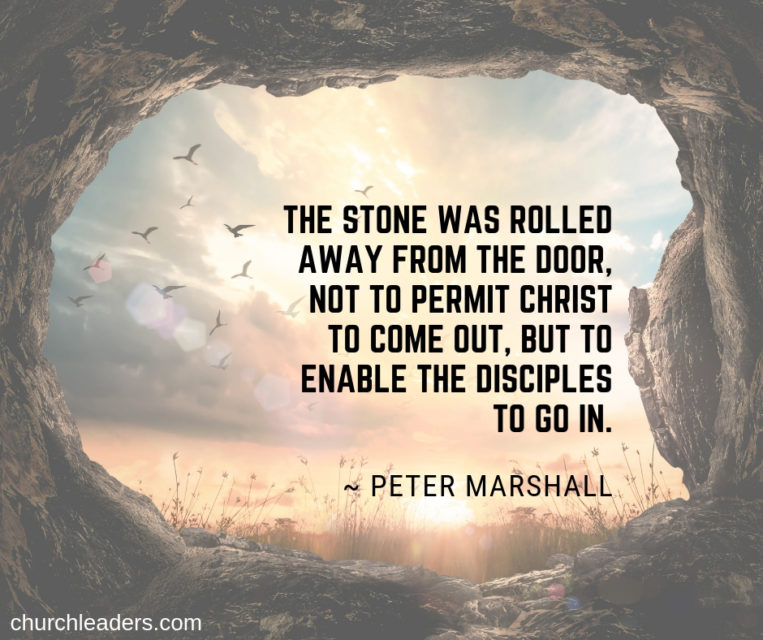
Witness to, Testify that, The Stone Was Rolled Away

Luke 24:5-8 The Message

4-8 They were puzzled, wondering what to make of this. Then, out of nowhere it seemed, two men, light cascading over them, stood there. The women were awestruck and bowed down in worship. The men said, “Why are you looking for the Living One in a cemetery? He is not here, but raised up. Remember how he told you when you were still back in Galilee that he had to be handed over to sinners, be killed on a cross, and in three days rise up?” Then they remembered Jesus’ words.

The gospel of Luke opened with angels delivering messages to Zacharias, Mary, some shepherds quietly going about their everyday duties protecting the sheep.

And to the shepherds, it was a melodious message of great joy for all people.

The message delivered here was also a message of great joy to all people.

Death had been conquered.

Jesus had defeated the power of death.

No longer do we have to fear death.

Where, O death, is your victory? Where, O death, is your sting?(1 Corinthians. 15:55).

Implications: the Witness and Testimony of a Rock Rolled Away

When we consider Jesus as Messiah, most of us think immediately in personal terms: Jesus is my Messiah. He forgives my sins. He lives in me. 

All of which, of course, is true.

But 1st-century Jewish expectations concerning the messiahship of Jesus were far broader than that.

If we had talked with a 1st-century Jew about his or her messianic expectations, we would have discovered hopes that were, in a sense far grander in their scope.

The Jews anticipated that their long-awaited Messiah would come to defeat the pagans who held sway over them, to decisively conquer their enemies, then to rebuild the temple, and to once again establish God’s just rule upon the earth.

Theirs was a nationalistic hope—a hope that the Messiah would come and vindicate the nation of Israel.

Jesus’ arrival, together with the miracles He performed, stories He told, and the prophecies He fulfilled, built to a great crescendo of high expectation among His followers, that Jesus was in fact sent of God as their true conquering king.

But just when they began to think that He really would be the one to politically redeem the people of Israel, at Calvary they saw all of their messianic hopes hanging up on a Roman gibbet, a gallows, an ugly instrument of pain and death.

And when Jesus cried out, “It is finished” (John 19:30), many of them must have quite literally agreed – any hope for their future of prosperity – was “finished.”

Now the question beckons us: How, then, did this group of believers, whose messianic hopes had been buried in a Palestinian tomb, not only continue to believe that Jesus was the Messiah but stand in the streets near where He had been executed and make an unashamed declaration of His messiahship?

The answer comes reverberating through the pages of the New Testament is found in the witness of an immovable rock having been summarily removed, somebody physically entering an empty tomb: the bodily resurrection of Jesus!

The angelic announcement to the women who had brought spices to embalm a corpse provoked a radical reassessment of what the believers had witnessed on the past Friday and a complete change in their view of their lives and futures.

When the Messiah reappeared among them, as alive as ever, these previously sad, sorrowful, defeated, brokenhearted disciples were radically transformed into bold, joyful witnesses with the loudest heartfelt songs of God’s triumph.

They now have a sure and certain witness, bearing testimony to the reality of Christ resurrected with a body that could be seen, handled, and touched, and yet also possessing capacities to do what His pre-resurrection body had not done.

His earthly work of salvation was finished;

His life and His reign were most certainly not!

By His Resurrection,

By God’s own Authority and only through God’s power,

His life and His reign were most certainly never going to end

Only in the disciples’ actions that night, seeing the rock moved away, their display of courage and not fear, to physically enter the tomb, enter, witness its emptiness, exit the tomb, hear the words of the two white clad angels, their recognition of His risen presence did Christ’s messiahship finally make sense.

Indeed, what the early Jewish believers discovered when they “found the stone rolled away from the tomb” (Luke 24:2) and saw “Jesus himself stood among them” entering through a locked and sealed door and into the Upper Room (v 36) was that an eternal hope, joy, and triumphant power ignited within their hearts.

And these remain available to all who put their trust in Jesus, the resurrected Messiah.

It is the triumph of the resurrection, and only the triumph of the resurrection, changes our witness of sadness, sorrow, and defeat into hope, joy, and power.

It is the resurrection, and only the resurrection, that declares that our Messiah will defeat His enemies, will restore His people, and will rule from sea to sea.

The Glory of God, The Triumph of God that morning, The resurrection of Jesus our Lord, Savior will change everything about how you go about your day today.

In the name of God, the Father and God the Son and God the Holy Spirit,

Let us Pray,

We Are One with the Risen Christ

Lord of life, we lift our hearts to you. As the dawn breaks, may we carry the unity we share into every moment knowing that we are one with the risen Christ. Lord, we lift our eyes to you. As the sunrises, may this moment stay with us, reminding us to look for the beautiful colors of promise in your word. Lord, we lift our prayers to you. As the dew air falls, may we breathe this morning in and know that like the earth, you sustain us, keep us and work within us always. And so, we lift our voices to you. We celebrate the greatest day in history, when Jesus rose from death, defeated darkness and bathed the world in stunning resurrection light. May we ever live to praise you! Thank you Lord of my my life and my Salvation that, in you, I no longer need to fear death and its great unknown. Instead, I can face it with confidence, knowing that you have truly defeated it. And, that on the other side of death, I will be with you forever.

Adeste Fidelis! Laeti Triumphantes! Venite Adoremus! Dominum.

Gloria! In Excelsis Deo! Alleluia, Alleluia, Alleluia, Amen.

https://translate.google.com/

Are we Looking Through Heaven’s Open Door? 10 Reasons We Should Believe in Heaven. Revelation 4:1-4

Revelation 4:1-4Amplified Bible

Scene in Heaven

After this I looked, and behold, [a]a door standing open in heaven! And the first voice which I had heard, like the sound of a [war] trumpet speaking with me, said, “Come up here, and I will show you what must take place after these things.” At once I was in [special communication with] the Spirit; and behold, a throne stood in heaven, with One seated on the throne. And He who sat there appeared like [the crystalline sparkle of] [b]a jasper stone and [the fiery redness of] a sardius stone, and encircling the throne there was a rainbow that looked like [the color of an] emerald. Twenty-four [other] thrones surrounded the throne; and seated on these thrones were [c]twenty-four elders dressed in white clothing, with crowns of gold on their heads.

The Word of God for the Children of God.

Adeste Fidelis. Venite Adoremus. Dominum.

Gloria! In Excelsis Deo! Alleluia! Alleluia! Alleluia! Amen.

Once John was charged to write the book of Revelation, when he met with the resurrected, glorified Lord Jesus in chapter 1, and having received Christ’s 7 letters to the 7 churches in chapters 2-3, he is given a vision of the throne room of God and commanded to, “Come up hither, and I will shew thee things which must be hereafter.”

Not only was John given important information for the Churches, but he was also commanded to ‘see’ and to ‘hear’ what was going to happen beyond the current Church age, “after these things.”

After acting as God’s heavenly, High Priest to the Church-age saints and interceding as heaven’s Mediator between God and man, John is shown how Christ will begin to take on His role of Judge, before returning to earth to claim His position as King of kings and Lord of lords.

“I looked, and, behold, a door was opened in heaven,” John writes, “and the first voice which I heard was as it were of a trumpet talking with me.”

The angel who met John in the prologue was the same angel who accompanied him throughout the entire revelation of Jesus Christ – which the Father gave to His Son… to give to John through His angel.

The apostle John was about to receive a preview of the future, which began with a vision of heaven in chapter 4 and moved to the worship of the Lamb of God in chapter 5.

He saw One seated on the throne which had the appearance of crystal-clear jasper and a blood-red Sardis stone, and John recorded that there was a rainbow surrounding the throne that reminded him of a brilliant green emerald. 

Twice he was summoned to, “come up here.”

The same voice which sounded like that of a trumpet in chapter 1, commanded him to join the heavenly host of angelic beings that surrounded the throne of God, by means of a door which was standing open in heaven.

And being, “in the spirit on the Lord’s day,” John was given an amazing insight into the future.. and greater revelation of Jesus Christ the Lamb of God and Lion of the tribe of Judah.

After Christ’s revelation to the Churches ended, John’s vison changed, and he was ushered into heaven – in spirit and in truth.

He discovered that the heavenly scene into which he had been brought, was preparing to unseal a special scroll which had been securely sealed by God Himself with seven seals.

As the heavenly scene unfolded, John discovered that he was witnessing to the precursor of the prophesied judgement on earth – the Day of the Lord which he recorded in chapters 6-19 when the wrath of God is revealed from heaven against all ungodliness and unrighteousness of men who hold the truth in unrighteousness. 

The sight that John saw during chapters 4-5, were the heavenly preparation for that future time of Great Tribulation, recorded in chapters 6-19, which is to fall on a Christ-rejecting sinful world and which will bring Israel to national repentance and punishment to the God-hating, Christ-rejecting, sinful world.

While John’s body remained on earth, his spirit was translated into heaven where he witnessed a vision of the angelic host that surround the throne of Almighty God – the Ancient of Days.

As he looked, John was introduced to four living creatures who worship God day and night and 24 elders who were clothed in white raiment with crowns of gold on their heads. 

The vison of the throne-room of God, the worship of the Lamb Who was slain, and the presentation of a seven-sealed scroll, which no-one but Lamb could break, are all part-and-parcel of the heavenly vision John saw in chapters 4 and 5.

It was after he had received Christ’s revelation to the Church (chapters 1-3) but before the revelation of Christ to the world in His role as Judge (chapters 6-19) when the wrath of God is poured out upon the children of disobedience, that the aged apostle John looked,

“and behold, a door was standing open in heaven, and the first voice which I had heard, like the sound of a trumpet speaking with me, said to him, ‘Come up here, and I will show you what must take place after these things.'”

In chapters 4 and 5 of Reve­la­tion, the focus shifts to a new and powerful story of God’s ongoing mission.

This new section begins with John seeing “a door standing open in heaven.”

This picture surprises us because we know that an open door often extends an invitation to come in.

This is an enticing opportunity to believe because heaven is often considered a place of mysteries that we do not have access to.

For the most part, it is God’s secret—at least from our day-to-day living in this life.

But here Jesus opens heaven’s door.

And in a voice like a trumpet, he welcomes us, saying, “Come up here.”

The invitation promises to reveal “what must take place after this.”

But as John tells the story of walking through heaven’s open door, the future is not the first thing that catches his attention.

Instead, he sees “a throne in heaven with someone sitting on it.”

Heaven’s open door has us standing before the throne of all thrones, from which everything in heaven and on earth is loved and cared for.

Still today, the Holy Spirit opens heaven’s door wide so that we can visualize, believe, this scene and let its story encourage us to live by faith in Jesus today.

Considering Reasons to Believe in Heaven

Let us strive to remember that the one who reads, hears, and takes to heart this amazing revelation is blessed.

“Blessed is he that reads, and those that hear the words of this prophecy, and keep those things which are written therein, for the time is at hand.”

Believing in Heaven …

“Heaven is a fairy tale for people afraid of the dark.” –Stephen Hawking

I’m afraid of the dark.

If we are talking about the endless kind of darkness which offers us no light anywhere, no hope ever, and nothing but nothingness, who among us would not panic at the thought of that?

I expect people like Mr. Hawking simply find the idea of Heaven too good to be true, and thus conclude that it must be a product of man’s delusional yearning for “pie in the sky by and by.”

And yet, there are solid reasons for reasonable people to believe in the concept of a Heavenly home after this earthly life.

Here are some that mean a lot to me.

By no means is this list exhaustive.

It’s simply my laymen’s thinking on the subject.

The God who made us created us with a longing for Himself and a satisfaction in nothing less. {Ecclesiastes 3:1-22}

When we get to Heaven, we will finally be satisfied, but not until then.

“I shall be satisfied with Thy likeness when I awake” (Psalm 17:15).

“I go to prepare a place for you,” said our Lord. “And if I go and prepare a place for you, I will come again and receive you unto myself, that where I am, there you may be also.” (John 14:3).

If it were not so, I would have told you.

Jesus said that.

I believe Him.

I choose to believe.

1. Jesus Believed in Heaven

In fact, He claimed to be a native.

The Lord said to Nicodemus, “No one has been to Heaven except the One who came from there, even the Son of Man.” (John 3:13). No one knows a place like a native.

Jesus told the dying thief, “Today you will be with me in Paradise.” (Luke 23:43).

So, wherever we go when we die, it’s a paradise.

True, He left us a thousand unanswered questions on the subject, but what He told us is pure gold.

For instance, when He returns, the dead in Christ accompany Him (I Thessalonians 4:14).

It appears that our eventual destination is somewhere different from the initial, intermediate place called “Paradise,” but we should have no trouble leaving the details to Him – after all, we can trust the One who died for us.

2. Scripture consistently teaches the existence of Heaven.

We must not let people get by with saying the Old Testament knew nothing of Heaven. 

“I shall dwell in the house of the Lord forever,” said David in everyone’s favorite psalm.

Or this one: “As for me, I shall behold thy face in righteousness; I will be satisfied with Thy likeness when I awake” (Psalm 17:15).

Job said, “My Redeemer liveth and at last shall stand upon the earth; yet even after my skin is destroyed, yet from my flesh I shall see God; whom I myself shall behold, and whom my eyes shall see and not another” (Job 19:25-27).

Neither must we cave to those who say the only way to understand such verses is to get inside the mind of the one who said those words originally, as if what they said is determinative and authoritative.

Peter said the prophets said more than they understood and even angels could not fathom some of these things. (I Peter 1:12).

3. I believe in Heaven because I believe in earth.

It’s so wonderful.

There is nothing else like it in the universe.

Suppose we lived in some distant world and all we knew was the planets we have seen–the barren, rocky planets that are molten in the day and frigid at night, those covered with acidic clouds or endless hurricanes–

and if someone told us about earth, with its steadiness, its atmosphere, its lovely scenery and its plant life and the richness of its minerals and a thousand other delights, we would find it hard to believe.

And yet here it is.

We are residents of this amazing planet.

We take the earth in stride because it’s all we know.

4. There has to be a heaven to even up the earthly hell God’s most faithful sometimes endure for Jesus’ sake.

Those of us who are “carried to the skies on flowery beds of ease,” to use Isaac Watts’ unforgettable image, have little idea of the price some have paid for their loyalty to Jesus Christ through the centuries.

Many live under oppressive regimes in our day, punished for doing nothing more than meeting in someone’s living room to worship or giving a friend a Bible.

I’m tempted to say “God owes them, big time,” but I don’t believe I want to be presumptuous or blasphemous.

“God is not unjust so as to forget your work and the love that you have shown toward His name in having ministered to the saints, and in still ministering” is how Hebrews 6:10 puts it.

If God were not to reward the faithfulness of the most loyal, it would be sin on His part.

After all, “this momentary light affliction is working for us an exceeding weight of glory far beyond all comparison” says 2 Corinthians 4:17.

5. Every caterpillar/butterfly testifies to our heavenly future.

Suppose we could inform that caterpillar crawling across a leaf of the glorious future just ahead of him (it?).

Would that humble creature believe he (it) would someday have gorgeous wings and flit through the sky?

So, why do we have such difficulty believing in the destiny God has planned for and promised to His own?

6. I believe in Heaven because the alternative belief is in despair.

“I would have despaired had I not believed I would see the goodness of God in the land of the living” (Psalm 27:13).

This world, by the way, is not the land of the living, but is the land of the dying.

The “land of the living” is just over the next ridge, immediately following our final breath here.

Jesus said, “Because I live, you too shall live.”

Who among us has not grieved at the thought of never seeing a precious loved one again, as we have left the cemetery.  

The alternative to faith is despair.

7. I believe in Heaven because some of the best people who ever lived believed in Heaven.

Pick up a Bible and read it ….

A whole lot of formerly ordinary people from literally all walks of life had come to faith in God, the Father, Son and Holy Spirit long before I was ever even told there was a God, the Father, Son and Holy Spirit. [Hebrews 11, Hebrews 12:1-2.]

8. I believe in Heaven because I believe in hell.

Luke 16:27-28Amplified Bible

27 So the rich man said, ‘Then, father [Abraham], I beg you to send Lazarus to my father’s house— 28 for I have five brothers—in order that he may solemnly warn them and witness to them, so that they too will not come to this place of torment.’

There has to be a hell.

I don’t like to think much about hell.

But I have to because God’s Word teaches about it.

The plain truth is that hell is real, and real people go there forever.

Several times in the Gospels we read Jesus was grieved when people turned away from him–grieved because he knew they were walking down the road that eventually would lead to hell.

The message Jesus brought is simple: Unless you turn and put your trust in me, you will die in your sins and face an eternity without me.

In Jesus’ parable of the rich man and Lazarus, we see the rich man begging for a little relief from his suffering.

Father Abraham explains that this kind of relief is not possible.

The rich man then turns his attention toward his brothers who are still living.

“Then I beg you … send Lazarus… Let him warn them, so that they will not also come to this place of torment.”

Notice a short time in hell turned this unbeliever into a motivated evangelist.

In a sense the rich man is saying,

“Someone has got to warn people that hell is real and that real people go there.”

How tragic that the man in this story found out too late.

What’s it going to take for you to become motivated?

Pray God’s grace, not his wrath, will fill your heart with a passion to save the lost.

9. I believe in Heaven because it’s a great incentive to responsible living and compassionate everything.

Skeptics will point to the shallow sayings of some believers that for the Heaven-bound this world does not matter, and that improving life on Earth is just so much arranging the deck chairs on the Titanic.

Those who say such are wrong, their thinking unbiblical, their teachings are misleading.  

We have great responsibilities here in this life, and it’s not just to get people to (ahem) “pray the sinner’s prayer” so they can go to heaven.

We were commissioned to make disciples, a far bigger thing.

“The heavens are the heavens of the Lord,” says Psalm 115:16, “but the earth He has given to the sons of men.” 

We are stewards of this planet, and thus answerable to Him.

I’ll go so far as to say those who are working to give the planet clean air and pure water, safe streets, are also doing the work of the Lord in their own way.

10. I believe in Heaven because of reasons I’m yet to discover.

There is so much more.

As some have said, we are “hard-wired” to believe in God and likewise in Heaven.

I willingly accept that and see it as residue of the creation.

The God who made us created us with a longing for Himself and a satisfaction in nothing less.

When we get to Heaven, we will finally be satisfied, but not until then. “I shall be satisfied with Thy likeness when I awake” (Psalm 17:15).

“I go to prepare a place for you,” said our Lord. “And if I go and prepare a place for you, I will come again and receive you unto myself, that where I am, there you may be also.” (John 14:3).

“If it were not so, I would have told you.”

Jesus said that. I believe Him.

I simply choose to believe.

God, the Father …

God, the Son …

God, the Holy Spirit …

The Revealed Word of God …

The Resurrection ….

In Heaven …

In the name of God, the Father and God the Son and God the Holy Spirit,

Let us Pray,

Heavenly Father, thank You for the book of Revelation and for the greater insight and understanding it gives us into the Person and Work of the Lord Jesus, of what is to take place after He comes to take the members of His mystic Body to be with Himself, and how we should live in this present age. I pray that You would bless me as I read and take to heart all that is written in this final book of Scripture. Thank You that You are the eternal and immutable God Whose plans and purposes can never fail. Thank You for the Cross of Christ and His glorious Resurrection, which secured for us an eternal inheritance, by faith. I pray that all I say and do would give glory to You and that one day I may cast my crown before His feet. Thank you for all Your goodness and grace to me and to all men. This I pray in Jesus’ wonderful name.

Adeste Fidelis. Venite Adoremus. Dominum.

Gloria. In Excelsis Deo. Alleluia, Alleluia, Alleluia, Amen

https://translate.google.com/

Who among us does not long to hear these words pointing them, directing them, to their Living Hope: “Behold the Lamb of God who takes away the sin of the World?” John 1:25-34

John 1:25-34Amplified Bible

25 They asked him, “Why then are you baptizing, if you are not the Christ, nor Elijah, nor the Prophet?” 26 John answered them, “I baptize [only] [a]in water, but among you there stands One whom you do not recognize and of whom you know nothing. 27 It is He [the preeminent One] who comes after me, the [b]strap of whose sandal I am not worthy to untie [even as His slave].” 28 These things occurred in Bethany across the Jordan [at the Jordan River crossing], where John was baptizing.

29 The next day he saw Jesus coming to him and said, “Look! The Lamb of God [c]who takes away the sin of the world! 30 This is He on behalf of whom I said, ‘After me comes a Man who has a higher rank than I and has priority over me, for He existed before me.’ 31 [d]I did not recognize Him [as the Messiah]; but I came baptizing [e]in water so that He would be [publicly] revealed to Israel.” 32 John gave [further] evidence [testifying officially for the record, with validity and relevance], saying, “I have seen the [f]Spirit descending as a dove out of heaven, and He remained upon Him. 33 I did not recognize Him [as the Messiah], but He who sent me to baptize [g]in water said to me, ‘He upon whom you see the Spirit descend and remain, this One is He who baptizes with the Holy Spirit.’ 34 I myself have [actually] seen [that happen], and my testimony is that this is the Son of God!”

The Word of God for the Children of God. Gloria! In Excelsis Deo! Alleluia! Amen.

John, the Baptizer was born miraculously to aged parents (Luke 1:11-18), had the mission of preparing the way for Christ, the Messiah.

As a Charismatic preacher, he drew great crowds. He denounced people’s sins, called for immediate repentance, and baptized many who turned back to God.

The high point in John’s life came when he was baptizing at the Jordan River and Jesus approached him. John called out, “Look, the Lamb of God, who takes away the sin of the world!” He also had exclaimed, “This is the Son of God.”

A low point came, however, when John was in prison and began to wonder if Jesus really was the Messiah (Matthew 11:1-5).

From deep within his prison cell John the Baptist sent friends to find out, and Jesus assured him by saying that the sick were being healed, the dead were being raised, and the good news of God’s kingdom was being preached.

The first time we read the word “lamb” in the Hebrew Testament, the speaker is Isaac, is asking his father Abraham, “Where is the lamb for the [sacrifice]?” (Genesis 22:7).

In the New Testament at the beginning of Jesus’ ministry, we see this word again as John announces, “Look, the Lamb of God …”

John pointed us to Jesus, the Son of God, instead of himself, as the Lamb who came to meet our very deepest need by becoming the sacrifice for all our sin.

What truly matters to us is that John identified Jesus not once but twice before others as the Lamb of God and that we understand the meaning. Only through Jesus do we receive salvation. Jesus, God’s son, died a sacrificial lamb for all.

Why Did John Say, ‘Behold the Lamb of God’?

For any devout Jew in the time of Jesus, a lamb would have evoked powerful religious meaning.

Far more than a typical food source in that day, a lamb was considered the most appropriate sin-substitute when it came to making ritual sacrifices, which were a huge part of the role of the Jewish Temple and community tradition back then.

Jesus himself was raised Jewish and came from a long line of Israelites dating back to Abraham, the first major patriarch in the Bible.

Abraham’s son was Isaac, and his grandson was Jacob, from whom the 12 tribes of Israel came. Jesus was descended from the tribe of Judah, a son of Jacob.

They all would have been very familiar with the need to regularly make animal sacrifices to the Lord as a way to atone for their sins, particularly the sacrifice of an unblemished lamb as a way of cleansing, purifying, and honoring the Lord (Exodus 12:3-13; Leviticus 14:10-25).

But when John the Baptist encounters the man Jesus walking towards him in the wilderness, as Jesus is walking toward him, John announces, “Behold, the Lamb of God, who takes away the sin of the world!” (John 1:29, ESV).

Why would John refer to Jesus as a lamb, which was a typical religious sacrifice?

Why a lamb of God?

And what does he mean, who “takes away” sin?

Why did John say, “Behold the Lamb of God”?

https://www.blueletterbible.org/esv/jhn/1/29/t_conc_998029

What Does This Text Mean?

In the original Greek used by the Apostle John, who wrote the Book of John, he uses the Greek word ide for behold, meaning “look,” “see here,” or “consider.”

https://www.blueletterbible.org/lexicon/g2396/esv/mgnt/0-1/

He uses amnos for lamb, meaning exactly that — a young sheep.

https://www.blueletterbible.org/lexicon/g286/esv/mgnt/0-1/

And he uses theos for God, referring to “the one true God.”

https://www.blueletterbible.org/lexicon/g2316/esv/mgnt/0-1/

He also uses the word airō for takes away, which means “carries away” or “gets rid of.”

https://www.blueletterbible.org/lexicon/g142/esv/mgnt/0-1/

He uses hamartia for sin, meaning “wrongdoing.”

https://www.blueletterbible.org/lexicon/g266/esv/mgnt/0-1/

And he uses kosmos for the word world, referring to the entire world — that is, the universe, not just the local place in which he is situated.

https://www.blueletterbible.org/lexicon/g2889/esv/mgnt/0-1/

Essentially, what John the Baptizer is communicating to everyone nearby:

Essentially, what John the Baptizer is communicating to generations to come:

“Look, it’s God’s lamb who gets rid of the wrongdoings of the entire universe.”

Who among us, right in this exact moment, do not long to hear these words?

Who among us, right in this exact moment, does not need to hear these words ringing and resounding through, into every last empty cell of their their souls?

We’re in constant state of need to hear someone exclaiming “Hope is Possible!”

Hope, indeed our Living Hope is Here – And he is Jesus Christ – The Son of God!

This would have been a powerful and revelatory statement to make about Jesus.

Why Were Sacrifices Important to Jewish Culture Then?

Sacrifices had been prioritized in the Bible since the very first days. Genesis 4:4 talks about how Abel gave the Lord the very best firstborn of his flock of sheep (that is, a lamb), which greatly pleased God.

We also know Jesus’ descendant Abraham was severely tested by God and asked to sacrifice his only son. heir, Isaac, with whom God had promised to establish His covenant and bring forth a multitude of offspring.

Isaac’s apparently innocent question to his father, “Where is the lamb for a burnt offering?” (Genesis 22:7) is a poignant moment between them, for only Abraham knew he was supposed to be sacrificing Isaac upon the mountain.

Father Abraham insisted to Isaac that God would provide, and God did indeed, providing a ram at the last moment for him to sacrifice instead of his own son.

Exodus, Leviticus, and Deuteronomy further prescribe animal sacrifices, usually a lamb but also other animals, as a way for the Jewish people to make up for their wrongdoings, providing forgiveness and the removal of sin.

But these were temporary sacrifices.

They had to be done repeatedly — yearly or whenever a person was in need of cleansing from unrighteousness — to ensure good standing with the Lord.

What Was the Context of This Verse, ‘Behold, the Lamb of God’?

In this first chapter of John, we are introduced to John the Baptist, whom the Bible here calls “a man sent from God, whose name was John. He came as a witness, to bear witness about the light, that all might believe through him” (John 1:6-7).

But Scripture is extraordinarily careful to note that John himself admitted he was not the light but rather the precursor to that light, the one who introduced, the one who announced, who pointed us to the light or bore witness in advance.

Like the person, the Master of Ceremonies, asked to introduce the main speaker onstage, John was the introducer; and Jesus was the “keynote,” the main event.

Later in this first chapter of John’s narrative, we are told priests and Levites from Jerusalem asked John who he was, for he’d been baptizing people in the wilderness and urging them to turn from sin.

They asked if he was a prophet or even if he was the great prophet of old Elijah.

No, John said, adding, “I am the voice of one crying out in the wilderness, ‘Make straight the way of the Lord,’ as the prophet Isaiah said” (John 1:23).

He further added that he was baptizing with water as a way of forging the path to Jesus, so he could bear witness and point Jesus out when the time came.

And indeed, John emphatically added, “I have seen and have borne witness that this is the Son of God” (John 1:34).

Does John Actually Say Jesus Is the Lamb of God?

John reiterates twice that Jesus is the Lamb of God, first here, when he’s with the priests and Levites and sees Jesus walking toward him, and then the next day, when he’s standing with two disciples and sees Jesus, he points this out again: “Behold, the Lamb of God” (John 1:36).

Those two disciples included Andrew, who immediately followed Jesus and then went to fetch his brother, Simon Peter.

The two were Jesus’ first disciples and among the 12 apostles.

Make no mistake, John is saying: Jesus is the Lamb of God.

The Apostle Paul describes him later as “Christ, our Passover lamb, (who) has been sacrificed” (1 Corinthians 5:7).

What Does ‘Lamb of God’ Mean?

There are two key inferences here. One is that Jesus, as the “lamb” of God, is God’s perfect sacrifice.

Sacrificial lambs were required by Levitical Code to be unblemished, typically the best of the best, pure, and perfect.

They also were innocent — blood, and lives, were exchanged as debt payment.

In His willing sacrifice on the cross, Jesus paid our sin debt penalty “once for all” (Colossians 2:14).

It’s a substitute for sin, the way the people could enter the presence of God, to atone for wrongdoing, and what God was willing to accept to make things right.

John was perhaps referring to Scripture foretold in Isaiah 53:7, where the prophet described the savior of the world as one oppressed and inflicted, a “lamb that is led to the slaughter.”

The other meaning is the lamb being described in the Book of Revelation, the triumphant “Lamb standing, as though it had been slain, with seven horns and with seven eyes, which are the seven spirits of God sent out into all the earth” (Revelation 5:6).

Did John Know What He Meant Here?

We aren’t told whether John knew what he was alluding to by calling Jesus the “Lamb of God,” especially as later he seemed doubtful and sent word asking if Jesus really was the one who was to come (Matthew 11:3).

That doesn’t really matter, though, for sometimes people speak words of the Lord without understanding what they fully mean, such as in prophecy.

What matters is that John the Baptizer clearly identified Jesus not once but twice before others as the Lamb of God and that we understand the meaning.

John the Baptizer’s intent and meaning are very clear! Only through Jesus do we receive salvation. Jesus, God’s son, died a sacrificial lamb for all (John 3:16), but only those who genuinely repent, believe and follow Him receive that salvation.

We must understand that Jesus is the only way — indeed, as the Apostle John later notes Jesus as stating, “The way and the truth and the life” (John 14:6).

So, behold, all reading this piece — Jesus is Lord, Word become flesh, the Living God, our living Hope whose innocence, purity and perfect, divine nature paid the price of our sins forevermore so we who believe may live forever with Him.

He did this for you, for me, and for us all.

He is the Lamb of God, and we are His.

John the Baptizer repeatedly proclaimed him ….

Can any of us here claim that we repeatedly proclaim the exact same sentiment?

In the name of God, the Father and God the Son and God the Holy Spirit,

Let us Pray,

Most Holy and Gracious God,

You have enriched and enlightened us by the revelation of your eternal Christ. 

Comfort us in our mortality

and strengthen us to walk the path of your desire,

so that by word and deed we may manifest the gracious news

of your faithfulness and love.

Most Holy God, Giver of every Good and Perfect Gift,

Divine Father of the man Jesus who asked the disciples,

“What are you looking for,”

and who offered the invitation to “Come and See,”

open our hearts to what you reveal and give us the courage to follow. 

By Your Spirit aid us in our journey,

so that like John the Baptizer, our words and deeds point to the Lamb of God. 

For those who are suffering, let us likewise point to Christ through comfort. 

For those who are hungry, let us point to Christ through the giving of bread. 

For those in the grip of despair, let us point to Christ through our example of hope.

Almighty God,

whose Son our Savior Jesus Christ is the light of the world:

Grant that your people, illumined by your Word,

may shine with the radiance of Christ’s glory,

that he may be known, worshiped, and obeyed to the ends of the earth.

We pray this in the name of Jesus Christ,

who lives and reigns with you and the Holy Spirit,

One God in Three – now and forever, Alleluia! Alleluia! Alleluia! Amen.

https://translate.google.com/

Do We Recognize Jesus Christ as Our One, Only true King? Revelation 5:13

Revelation 5:11-14Amplified Bible

Angels Exalt the Lamb

11 Then I looked, and I heard the voice of many angels around the throne and [the voice] of the living creatures and the elders; and they numbered myriads of myriads, and thousands of thousands (innumerable), 12 saying in a loud voice,

“Worthy and deserving is the Lamb that was sacrificed to receive power and riches and wisdom and might and honor and glory and blessing.”

13 And I heard every created thing that is in heaven or on earth or under the earth [in Hades, the realm of the dead] or on the sea, and everything that is in them, saying [together],

“To Him who sits on the throne, and to the Lamb (Christ), be blessing and honor and glory and dominion forever and ever.”

14 And the four living creatures kept saying, “Amen.” And the elders fell down and worshiped [Him who lives forever and ever].

The Word of God for the Children of God. Gloria! In Excelsis Deo! Alleluia! Amen.

The Bible makes it crystal clear that history is moving purposefully towards a definite conclusion.

That reality is one of the distinctive features of the biblical worldview.

One way that Christianity distinguishes itself, in other words, is in the matter of how all things come to a close.

Sometimes, in looking at old historical photographs we may just find ourselves asking,

“Where am I in this picture?”—or, “Am I even in this picture?”

“Do I recognize the person, the people or the place or the moment?”

“Is it a random small piece of history or a very specific and significant one?

“I wonder what is really happening in the picture – what is its real story?”

Is there enough personal interest in the story for me to do more research, to want to know every single detail of the time, the people, the place, the events?

When it comes to our envisioning or picturing God’s plan, though, every single person, people and place on earth is included in Revelation’s picture of history.

No one is missing from the story.

Everyone who believed or did not believe on Jesus as their Savior are included.

And when history comes to a close, it will surely end in division and separation.

Jesus spoke about this separation when He said that the sheep and goats will be divided (Matthew 25:31-46): light and darkness will be delineated, and those who believed on Jesus as their Savior will be set apart from those who do not.

No one will be left out, though tragically some will have chosen to be shut out.

Therefore, our position in this big picture matters.

All of history’s ebb and flow is to be viewed in light of the fact that there is a throne in heaven and that throne is not empty; rather, it is occupied by God, who is in control. Jesus is King, and He is seated at the right hand of the throne.

Although many do not yet recognize His kingdom, many refuse to recognize His Kingdom, or have not been introduced, it doesn’t alter the reality He yet reigns.

From humanity’s fall to the end of time there exist, as the great fourth-century theologian Augustine of Hippo put it, two rival cities—two rival loves.

By our sinful human nature, we are involved in the city of man, and only by God’s grace will we ever be involved in and ever be devoted to the city of God.

2 Corinthians 5:1-5Amplified Bible

The Temporal and Eternal

5 For we know that if the earthly tent [our physical body] which is our house is torn down [through death], we have a building from God, a house not made with hands, eternal in the heavens. For indeed in this house we groan, longing to be clothed with our [immortal, eternal] celestial dwelling, so that by putting it on we will not be found naked. For while we are in this tent, we groan, being burdened [often weighed down, oppressed], not that we want to be unclothed [separated by death from the body], but to be clothed, so that what is mortal [the body] will be swallowed up by life [after the resurrection]. Now He who has made us and prepared us for this very purpose is God, who gave us the [Holy] Spirit as a pledge [a guarantee, a down payment on the fulfillment of His promise].

The Word of God says The earthly city, the city of man, our earthly tent, our physical body is destined to be torn down by time, pass away through death.

But the heavenly city, God’s kingdom, will absolutely go on forever and ever!

Reading our text from Revelation 5:11-14, the many Angels around the throne and the voice of the living creature and the Elders, who numbered “myriads of myriads, and thousands of thousands – innumerable (verse 11) recognized Him.

Saying in a loud voice –

“Worthy and deserving is the Lamb that was sacrificed to receive power and riches and wisdom and might and honor and glory and blessing.” (verse 12)

From within the context of our own 21st jumble of our own “Christian-ality”

Our own personal expressions of devotion, personal expressions of obedience, adherence to the precepts and commandments and covenants set by our God,

In our ministries and missions, our forays into all the streets and back alley ways, all the highways and byways and boulevards of God’s Neighborhood, Luke 10:1-3, Acts 2:43-47, 1 Corinthians 12:14-26, and Galatians 3:27-29)

Enemies or Friends, Faults, Failures, Fears, Flaws, Sins not withstanding …

In the eyes of God, we are ALL Children of God …. Without any Exceptions,

From the fears, failures and faults of mankind, however, exceptions okayed,

Do ALL Lives absolutely, unequivocally, without exception, equally Matter?

Do we recognize with our whole hearts our souls, our voices – Jesus as King?

How each of us give God in Christ an answer is a matter of eternal significance.

And how we give an answer to God is also a matter of present consequence. (Matthew 5:13-16, Matthew 23:23-33, Mark 3:31-35, Mark 4:21-29, Mark 7:1-16, Luke 10:25-37, Luke 11:33-36, Luke 19:1-10, John 5:1-15, and Acts 3:1-10)

If Jesus is your One and Only true King, then you will live as His subject, seeking to obey Him even when His command cuts against all your biases, preferences.

If Jesus is your King, you will be loyal and obedient to Him above all others, for this world is not yours or mine home and you and I are just passing through.

As the Apostle Paul wrote, “Our citizenship is in heaven, and from it we await a Savior, the Lord Jesus Christ” (Philippians 3:20).

Be sure to live as a citizen of a better country and a subject of a greater King.

When our earthly tents take their last breaths, will we spend eternity joining with Angels and Elders in bringing Him honor and glory, praise and worship?

I pray we may give a good answer to God, do so in our words and conduct today.

In the name of God, the Father and God the Son and God the Holy Spirit,

Let us Pray,

God of ALL truth, sometimes I not sure if I’m actually hearing your voice, or if it’s just my own thoughts or even another spirit. Sharpen my spiritual hearing, Lord, so I can recognize your words when you are speaking to me. Help me know it’s really, only you, with no doubt or second-guessing. When I’m asking for your guidance in important decisions, give me your peace that surpasses understanding with your answer alone. Help me remember that your words to me will never go against your written word in the Bible. Give me a clear mind and push out all my confusion. I pray this in the name of Jesus Christ, My King and My Savior and Best Friend Amen.

https://translate.google.com/