Alive and Our Being Alive in God: Part Two – Our Inevitable Struggle Between Faith and our Failures. Genesis 12:10-20

Genesis 12:10-20Amplified Bible

10 Now there was a famine in the land; and Abram went down into Egypt to live temporarily, for the famine in the land was oppressive and severe. 11 And when he was about to enter Egypt, he said to Sarai his wife, “Listen: I know that you are [a]a beautiful woman; 12 so when the Egyptians see you, they will say, ‘This is his wife’; and they will kill me [to acquire you], but they will let you live. 13 Please tell them that you are [b]my sister so that things will go well for me for your sake, and my life will be spared because of you.” 14 And when Abram entered Egypt, the Egyptians saw that Sarai was very beautiful. 15 Pharaoh’s princes (officials) also saw her and praised her to Pharaoh; and the woman was taken [for the purpose of marriage] into Pharaoh’s house (harem). 16 Therefore Pharaoh treated Abram well for her sake; he acquired sheep, oxen, male and female donkeys, male and female servants, and camels.

17 But the Lord punished Pharaoh and his household with severe plagues because of Sarai, Abram’s wife. 18 Then Pharaoh called Abram and said, “What is this that you have done to me? Why did you not tell me that she was your wife? 19 Why did you say, ‘She is my sister,’ so that I took her as my wife? Now then, here is your wife; take her and go!” 20 So Pharaoh commanded his men concerning him; and they escorted him on his way, with his wife and all that he had.

The Word of God for the Children of God.

Adeste Fidelis! Venite Adoremus! Dominum!

Gloria! In Excelsis Deo! Alleluia! Alleluia! Alleluia! Amen.
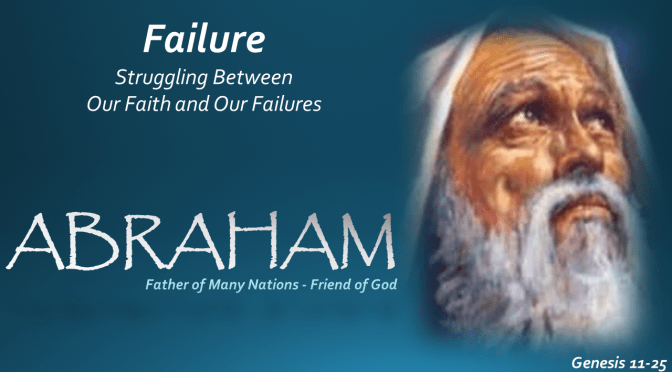
ABRAHAM’S FAITH AND FAILURES

The time between God’s promise to Abraham and its fulfillment spanned about twenty five years!  During that time, Abraham made several wrong attempts to help God fulfill His promise.  There were times, also, when Abraham made some decisions that revealed a definite lack of faith and decisive distrust in God. 

ABRAHAM FAILS! GOD’S FAITHFULNESS

Despite obvious failings amidst his successes, Abraham is a wonderful example of a man who lived by faith but continued to make mistakes in judgement.  The bottom line is we’ll fail yet God continues to remain faithful to His promises to Abraham, even in the midst of Abraham’s bad decisions and faithless choices. 

OUR FAILURES AND GOD’S FAITHFULNESS

We are told there are two ‘inevitables’ in life: death and taxes.

In leading with your life as a follower of Christ, I believe there are two other ‘inevitables’ we need to be more acutely aware of as well: faith and failure.

As Abraham’s descendants today, we will still inevitably and faithfully fail our God. Thankfully though God’s faithfulness in the face of our inevitable failures is, only but by the indescribable grace and faithful mercy of ABBA God still true. 

For His promise to us is still, “Let not your hearts be troubled” “I will never leave you nor forsake you” (John 14:1; Deuteronomy 31:6; Hebrews 13:5).

Our failures in our faithfully living for God will never deter God’s promises!

But now we come to Genesis 12 verses 10-20 to a time of failure in Abram’s life.

II. The Failure of Abram (Genesis 12:10-20)

Though he began with faith, a time of trouble leads to disobedience and doubt.

It all begins with growing, maturing sense of desperation, a time of famine.

12:10. Now there was a famine in the land, and Abram went down to Egypt to dwell there, for the famine was severe in the land.

I do not know if Abram should have gone to Egypt or not.

The way this part of the story reads, it sounds to me like it was a bad decision on Abram’s part to go to Egypt.

Nowhere do we read in the scriptures is Abram directly or indirectly condemned for his decision to go down to Egypt, but later developments, as made evident in this passage from Genesis, makes it clear his actions did not stem from faith.

Abram did not consult God, but acted independently.

No altars were built in Egypt which are mentioned, nor are we told that Abram ever called upon on the name of the Lord that he and Sarai should journey there.

His request of Sarai [later in the passage] also reflects his spiritual condition. It would thus be safe to say that Abram’s faith failed in the face of that famine.”

So we can’t be certain, but it seems that God wanted Abram to stay in Canaan – even with a famine.

Where God guides, He provides.

It was not God’s intention for Abram to leave Canaan and go to Egypt.

Now a time of testing had come upon Abram.

Not a time of plenty, but a time of wanting.

A time of famine.

Abram faced a choice.

He could stay in the land God had called him to, and trust in God to provide, or he could leave the land and trust in man, specifically the Egyptians, to provide.

Abram did what most of us do in times of trouble.

Abram trusted in man.

Abram stopped believing in God’s promises, and left for Egypt.

Through this whole chapter, we read of God speaking to Abram to tell him where to go.

We read of God appearing to Abram.

We read of Abram building altars and calling on the name of the Lord.

We read none of those things here.

In a time of trial, Abram ignored the promises of God, turned to Egypt for help.

This will become a pattern for Israelites.

Later, in another famine, Jacob and his entire family moves to Egypt.

This eventually leads to the enslavement of the Israelites to the Egyptians.

During the time of the kings, many of them made alliances with Egypt through marriage or treaties rather than trusting in God for help.

Many of the prophets warned the people of Israel about turning to Egypt for help rather than turning to God.

All of this began when Abram, the man of faith, turned to Egypt rather than turning to God.

This shift in trust leads to another failure.

He begins a pattern of lying.

Genesis 12:11-13. And it came to pass, when he was close to entering Egypt, that he said to Sarai his wife, “Indeed I know that you are a woman of beautiful countenance. Therefore it will happen, when the Egyptians see you, that they will say, ‘This is his wife’; and they will kill me, but they will let you live. Please say you are my sister, that it may be well with me for your sake, and that I may live because of you.”

Abram knows that his wife is beautiful, and that Egyptians are notorious for wanting to marry the most beautiful women.

If there was a husband in the way, it was okay to murder that husband.

So Abram concocts a lie to tell the Egyptians.

He is going to ask his wife to lie for him, so he asks her by beginning with a compliment.

Hopefully, we men compliment our wives more often than just when we want something from her.

Here, Abram wants Sarai to lie for him.

It really is only a half lie, for Sarai is Abram’s half sister (Genesis 20:12).

This is how Abram justified his lie.

It’s a little white lie.

What could it hurt?

It is also a pragmatic lie.

If Abram tells the truth, he might end up violently losing his life.

But notice what this lie does.

It not only reveals a lack of trust in God’s promises, but it also threatens their fulfillment.

In Genesis 12:10, Abram begins to trust in the Egyptians to keep him alive, now Abram is trusting in his wife.

I heard one pastor preach, “Abram was clinging to his wife’s petticoat for protection and blessing, rather than to the promises of God.”

Not only this, but his actions were a direct threat to his wife’s purity and the fulfillment of God’s promises.

God promised descendants to Abram.

Inherent in this promise is a promise that neither Abram or Sarai would not die until this promise is fulfilled.

20/20 hindsight being what it is with all of the commentaries we have to judge,

We can probably say Abram was not wrong in considering the possibility that someone would appreciate his wife as more beautiful and desire her for a wife.

Absent the cultural, historical context, we can probably also judge that it was not even wrong to suppose that someone might even kill him to marry her.

If we were doing an after-action debriefing with him, Abram was wrong to assume that this would happen and that the only way to prevent it was to lie.

Nowhere is the sure, certain promise and the protection of God considered.

Sinful deception is therefore begun before any real danger is ever experienced.

Abram has stopped trusting in God, and is fearful of a some danger not even encountered yet, and so turns to his own plans to provide his own protection.

Notice from Genesis 12:12 that Abram only thought the Egyptian men would find Sarai attractive.

And it was a common occurrence for men to murder other men just to get their wives.

Abram wanted to avoid being murdered so he decided to use this half truth about Sarai being his sister.

In such a situation, Abram, posing as Sarai’s brother, could agree to a marriage, but would insist on a long betrothal period.

Then, when the famine in Canaan was over, they could just pick up and leave.

No harm done.

It was the perfect plan.

But as the saying goes, “The best laid plans of mice and men often go astray.”

In verse 14, things seem to begin just fine.

Genesis 12:14. So it was, when Abram came into Egypt, that the Egyptians saw the woman, that she was very beautiful.

Abram was right.

He had a beautiful wife.

The Egyptian men saw her and thought she was beautiful.

Many of them are probably thinking of marrying her.

So far, Abram’s plan was working out just right.

But something happens in Genesis 12:15 that Abram never counted on.

Genesis 12:15. The princes of Pharaoh also saw her and commended her to Pharaoh. And the woman was taken to Pharaoh’s house.

It never entered Abram’s mind that Pharaoh might be interested in Sarai.

While Abram could put off the plans of other men, Pharaoh would not take no for an answer.

He took her into his palace, awaiting the time of the consummation of the union.

Part of this involved giving gifts to Abram.

Genesis 12:16. He treated Abram well for her sake. He had sheep, oxen, male donkeys, male and female servants, female donkeys, and camels.

During this time, Sarai would likely undergo a relatively long period of preparation for her presentation to Pharaoh very similar to the preparation Esther went through before presenting herself to King Ahasuerus (Esther. 2:12-14).

Can you or I imagine the lonely, agonizing nights Abram must have spent, wondering what was going on in the palace?

Abram had asked Sarai to lie so that it would go well with him (verse 13).

And it did go well.

Pharaoh sent many gifts to Abram and treated him royally.

The only thing which kept Abram from enjoying his treatment was the realization of what it meant.

Pharaoh was giving these things to Abram as a dowry.

It did go well with Abram, but without Sarai, his wife.

I believe you and I can see ourselves doing an intervention here: Prosperity is never a blessing without the peace which comes from being right with God.

But God is not thwarted by lies, doubt or our mistakes.

His promises are not so easily broken by man.

He made promises to Abram, and although Abram has stopped trusting in those promises, and is living in sin and deception, God intervenes, not only to protect Sarai and Abram, but also protect the faithful fulfilling of His promise to them.

Genesis 12:17-19. But the Lord plagued Pharaoh and his house with great plagues because of Sarai, Abram’s wife. And Pharaoh called Abram and said, “What is this you have done to me? Why did you not tell me that she was your wife? 19Why did you say, ‘She is my sister’? I might have taken her as my wife. Now therefore, here is your wife; take her and go your way.”

Abram was confronted by Pharaoh and soundly rebuked.

Abram had no excuse or explanation.

So far as we are told, he did not utter a word in his defense.

No doubt this was the wise thing to do in the light of Abram’s offense.

Pharaoh was not one to be challenged or angered unnecessarily.

Today, we can see the raging irony of the situation is obvious.

Here is a pagan correcting a prophet (cf. 20:7).

It was a sharp royal rebuke that Abram would painfully remember.

How sad, however, that Abram could not dare to speak, for this no doubt hindered any testimony to his faith in the living God Who had called him.

Christian conduct in the face of adversity does greatly affect their credibility.

Genesis 12:20. So Pharaoh commanded his men concerning him; and they sent him away, with his wife and all that he had.

We see here the patience of God with Abram, for Abram comes away from his mistake with more blessings and riches than when he came.

Abraham becomes richer than he was.

This is a curious discipline.

You would think that God would discipline Abram in a different way.

Rather than make Abram richer because of his lack of trust, you would think God would make Abram a bit more poorer and then to make him more wiser.

Well, these extra riches are double-edged.

Negatively, this is probably how Abram received Sarai’s maidservant Hagar.

When it comes down to it, every failure significantly impacts a relationship because any degree or measure of personal failure in life involves people.

We will read later his marriage to Sarai was negatively impacted. how Hagar inevitably becomes a great stumbling block to Sarai and Abram later in life.

for it is through Hagar that Abram risks making his greatest mistake ever.

But the positive aspect of this blessing is that it shows God’s great love and patience with Abram.

God is not out to destroy and punish Abram for his lack of trust.

No, God is showing Abram love and patience.

God is showing Abram longsuffering and kindness.

Even when Abram stops trusting in God, and makes his bad decisions, God continues to watch over Abram, and even bless him despite those decisions.

Today, we might even conjecture as to how foolish Abram’s fears must have appeared in the light of history.

In order to avoid a famine, Abram was forced to face down a Pharaoh.

The might of Egypt was not employed against him, but was commanded to assure his safe arrival in Canaan.

Indeed, Abram left Egypt even richer than he had come.

But none of this was the result of Abram’s faithless and dishonest actions.

It was the product of undeserved grace and mercy and providential care.

I am not saying you should go out and sin to see if God will bless you even though you’ve sinned.

That’s not the lesson of this story.

Possibly, Abram would have been much more blessed if he had stayed in Canaan.

Maybe many of the Canaanites would have left, and Abram would have received some of the land right then – we really don’t know what would have happened.

The point of this devotional account is God remains faithful to us, even when we are faithless.

Above it all, most of us literally have no desire to be known as ‘failure experts’.

And He can bless us, even when we are “experts,” have PhD’s in being wrong.

Hebrews 12:4-11Amplified Bible

A Father’s Discipline

You have not yet struggled to the point of shedding blood in your striving against sin; and you have [a]forgotten the divine word of encouragement which is addressed to you as sons,

“My son, do not make light of the discipline of the Lord,
And do not lose heart and give up when you are corrected by Him;

For the Lord disciplines and corrects those whom He loves,
And He punishes every son whom He receives and welcomes [to His heart].”

You must submit to [correction for the purpose of] discipline; God is dealing with you as with sons; for [b]what son is there whom his father does not discipline? Now if you are exempt from correction and without discipline, in which all [of God’s children] share, then you are illegitimate children and not sons [at all]. Moreover, we have had earthly fathers who disciplined us, and we submitted and respected them [for training us]; shall we not much more willingly submit to the Father of [c]spirits, and live [by learning from His discipline]? 10 For our earthly fathers disciplined us for only a short time as seemed best to them; but He disciplines us for our good, so that we may share His holiness. 11 For the time being no discipline brings joy, but seems sad and painful; yet to those who have been trained by it, afterwards it yields the peaceful fruit of righteousness [right standing with God and a lifestyle and attitude that seeks conformity to God’s will and purpose].

Sometimes He does discipline us, for He disciplines those He loves.

But sometimes He wins us over with grace and mercy.

He teaches us to be faithful to Him by revealing His faithfulness to us.

This is a step forward in Abram’s faith development.

He has learned that God is a God of love, not of fear.

He has learned that God is a God of abundant blessing, not of destruction.

He has learned that God keeps His promises, even when we do not.

When our faith no longer knows where to look, God’s eyes are 100% upon us!

When our faith slides, slips and stumbles, God does not!

When our faith falls asleep, enters a coma on us, God remains awake!

When our faith plants us on our faces on the ground and fails, God does not!

Abram has learned when God promises the end, He also provides the means.

You and I do not, and cannot, accomplish God’s will with evil methods.

These are wonderful truths for Abram to have learned, and will aid him as he continues to grow and develop into the father of faith we all know and love.

As we close out 2022 and prepare ourselves to enter upon a New Year in 2023;

Are you and I anticipating, expecting, facing a time and a season of testing?

Can you and I safely say God has called you and me to something, and all it seems is He has called you and me into a time of true faith versus famine?

Keep trusting.

Do not short circuit the test.

If you and I try to bypass the test, God will just make you and me face a different test in a different way in a different place to achieve the same outcome for God.

If Abram had been given the choice of tests – a life lived through a famine or his wife in a Pharaoh’s harem – we can rest sure he would have chosen the famine.

And then in the end, Abram had to go back to living through a famine anyway.

Of course, he had been abundantly blessed by God with more animals and more servants to aid him, but the famine just made it more difficult to feed them all.

When God puts you and me in a faith versus famine test, do not try to bypass it.

Just pass it.

Do not sidestep it.

Walk through it.

Abram has gone from faith to failure, and now back to faith.

It is an oft-repeated, much cyclical lesson, we can learn much from ….

by our inevitable faults, the magnitude of our failings and failures ….

– by our faithfulness to God in prayer – we will see how long it lasts.

Immanuel, Immanuel, His name is called Immanuel ….

God with us,

God within us,

God revealed in us ….

God being revealed through us ….

His name is still, to this day and beyond, called Immanuel ….

John 17:6-12Amplified Bible

“I have manifested Your name [and revealed Your very self, Your real self] to the people whom You have given Me out of the world; they were Yours and You gave them to Me, and they have kept and obeyed Your word. Now [at last] they know [with confident assurance] that all You have given Me is from You [it is really and truly Yours]. For the words which You gave Me I have given them; and they received and accepted them and truly understood [with confident assurance] that I came from You [from Your presence], and they believed [without any doubt] that You sent Me. I pray for them; I do not pray for the world, but for those You have given Me, because they belong to You; 10 and all things that are Mine are Yours, and [all things that are] Yours are Mine; and I am glorified in them. 11 I am no longer in the world; yet they are still in the world, and I am coming to You. Holy Father, keep them in Your name, the name  which You have given Me, so that they may be one just as We are. 12 While I was with them, I was keeping them in Your name which You have given Me; and I guarded them and protected them, and not one of them was lost except [a]the son of destruction, so that the Scripture would be fulfilled.

Do not fear becoming a ‘failure expert’ and allow it to paralyze you from learning to lead with your life.

Faith-filled, Faithfully Learn through all degrees of failure how to lead your own life well by recovering from your failure for Jesus has prayed for you.

There is nothing more beautiful to Jesus than to see His prayer to His Father answered in and through you, through your failings and through your raisings.

He knows there is a source of strength to be found in those who recover from their failure. 

All because they have come to know through recovery that their source is Him.

The One who prayed for firm faith to remain in Him before they ever wiped the fruit of the vine from their “leaking lips” and promptly went out and failed.

Our Struggle between Faith and failure is always an inevitable one for all of us.

Genesis to Revelation – all the promises of God remain 100% faithful and true!

The war has already been won so you may win your battle.

If maybe today, you are one who feels like a ‘faith in God failure expert’

I now join with God, the Father, Son, Spirit, in praying that you recover well.

In the name of God, the Father and God the Son and God the Holy Spirit,

O Lord, Mighty in Power, equally mighty in grace and mercy and forbearance, You say that I should have faith in You so that I will be upheld. I do, Mighty Lord. I give over the full measure and weight of my failings and failures over to you. I place all my faith in You. You strengthen me. Your divine life force keeps my spirit alive and burning fiercely for You. I know that with You I can overcome anything. Thank You for remaining faithful to Your chosen people. Thank You for guiding me in my life and helping me to become a vessel for Your will. I pray that I may continue to put my faith and trust in You because You know all things. You know what the hearts of Your people need, and I believe You will help me through whatever this life brings. Amen.

Adeste Fidelis! Venite Adoremus! Dominum!

Gloria! In Excelsis Deo! Alleluia! Alleluia! Alleluia! Amen.
https://translate.google.com/

Alive and Being Alive in Immanuel: Do We Know Where We are Going? Faith and Failure – Part One: Abram’s Faith. Genesis 12:1-9

Genesis 12:1-9Amplified Bible

Abram Journeys to Egypt

12 Now [in Haran] the Lord had said to Abram,

“Go away from your country,
And from your relatives
And from your father’s house,
To the land which I will show you;

And [a]I will make you a great nation,
And I will bless you [abundantly],
And make your name great (exalted, distinguished);
And you shall be a blessing [a source of great good to others];

And I will bless (do good for, benefit) those who bless you,
And I will curse [that is, subject to My wrath and judgment] the one who curses (despises, dishonors, has contempt for) you.
And in you all the families (nations) of the earth will be blessed.”

So Abram departed [in faithful obedience] as the Lord had directed him; and Lot [his nephew] left with him. Abram was seventy-five years old when he left Haran. Abram took Sarai his wife and Lot his nephew, and all their possessions which they had acquired, and the people (servants) which they had acquired in Haran, and they set out to go to the land of Canaan. When they came to the land of Canaan, Abram passed through the land as far as the site of Shechem, to the [great] terebinth (oak) tree of Moreh. Now the [b]Canaanites were in the land at that time. Then the Lord appeared to Abram and said, “I will give this land to your descendants.” So Abram built an altar there to [honor] the Lord who had appeared to him. Then he moved on from there to the mountain on the east of Bethel, and pitched his tent, with Bethel on the west and Ai on the east; and there he built an altar to the Lord and called on the name of the Lord [in worship through prayer, praise, and thanksgiving]. Then Abram journeyed on, continuing toward the Negev (the South country of Judah).

The Word of God for the Children of God.

Adeste Fidelis! Venite Adoremus! Dominum!

Gloria! In Excelsis Deo! Alleluia! Alleluia! Alleluia! Amen.
Through much of the country these last several days the mountains of snows have fallen and furiously – snow drifts several feet tall have covered cars and snow plows, ambulances and firetrucks and covered the doorways of houses.

Blizzards have returned! Worse than ever, the winds are howling and the wind chills are plummeting deep, to very dangerous and even life threatening levels.

Roads are impassable, homes and apartments are losing power, no heat to cook the food with, no heat to warm the place of abode, pipes are frozen, bursting.

People are trapped in their homes – medical conditions, health and safety.

“I’m dreaming of a white Christmas ….”

“Just like the ones I used to know ….”

Merry Christmas! ….

You have your White Christmas … Just not the one you wanted to know!

Immanuel God with Us and within us, if you can manage to somehow survive.

Christmas Bells are ringing everywhere people can by whatever means travel to; to celebrate that once a year moment with long distant family and friends too.

Christmas bells are silent, just past, and travelers are trying to return home from anywhere and everywhere around the globe their families were living in.

Except, outside too many locations … impassable and dangerous weather, far too dangerous for automobiles, four wheel drives and far worse for- airplanes.

Airports cannot release the planes for take off – they cannot plow their runways fast enough or at all – the risk of life and limb is simply far to dangerous to all.

Travelers are stuck in airports behind a myriad and myriad of cancelled flights.

In many places, during this Christmas season, this isn’t an unusual occurrence.

It is one which many travelers have learned how to accept and how to manage.

They know how to pack “for the occasion” – with snacks and a host of patience.

With experience, traveling gets easier, more familiar, much more manageable.

If we have previously navigated an airport or are at least familiar with the local language and likely weather, it’s not overwhelming to get where we are going.

But if we don’t know the way to our next gate or can’t read the signs pointing the way, or we suddenly encounter all the worse kind of weather conditions, we can soon feel lost and have no idea where we are and where we need to go next.

And, guess what?

New Years Eve and New Year’s Day are but a few days away ….

Another very popular travel day ….

And the weather is still going to be the weather ….

An we still have not figured out how to stop the weather from happening!

Jesus did …. Mark 4:35-41

When the weather went crazy dangerous on those disciples in that boat, they like many of today’s travelers traveling in these blizzard conditions, feared.

Jesus told his disciples …. we are absolutely going over to the “other side” of the waters and the disciples obediently loaded themselves into the boat and sailed.

They were obedient to their Rabbi – then things suddenly got crazy dangerous, the weather threatened their very lives and seasoned fisherman became afraid.

No matter what they tried, seasoned fisherman failed to right the ship in the storm, failed in their efforts to protect the lives of the others an they panicked.

They turn to wake their Rabbi … their Rabbi wakes up … and just as fast, the Rabbi rebukes the weather – “be still!” an then Rabbi turns to the disciples and wonders aloud to them ….

“Why are you so fearful?”

“How is it you have no faith?” (Mark 4:40)

THE STRUGGLE BETWEEN OBEDIENCE, FAITH AND OUR INEVITIBLE FAILURE

Abram soon to be Abraham was in a situation like that.

If we try to put ourselves in his sandals, we can see that it was no small thing to faithfully obey and follow God’s leading when he did not know where the other side was located and no one offered him a roadmap or a weather map to read.

There was only a promise from a God he had never met or experienced before.

God promised that Abraham would be a great nation and bring great blessings for “all peoples on earth,” but this would require a previously unknown, long, arduous journey and a new start, living among strangers in a faraway land.

“He did not know where he was going.”

In a miraculous demonstration of faith – against all of the best advice of his fellow countryman, he packed up and left what he knew of life behind him.

Here we pick up Genesis Chapter 12 …. Here we join the ancient Biblical story.

Genesis 12:1-20 – Faith and Failure

Genesis chapter 12 may be one of the most famous chapters in the Bible.

It forms the basis for pretty much everything that follows.

With the calling of Abraham God really begins to set a plan in motion to deliver the world from the problems that have occurred up to this point in the Bible.

I. Faith (Genesis 12:1-9)

II. Failure (Genesis 12:10-20)

Abraham is one of the most important men in all of history.

Though he lived about 4000 years ago, he is still a prominent figure today.

Christians hold up Abraham as our forefather.

Not necessarily as our physical descendant, but as our spiritual one.

He is the father of faith.

It is repeated over and over in the New Testament that He believed God, and it was credited to him as righteousness.

Christianity, which is all about faith in Jesus Christ, and walking with God by faith, holds up Abraham as an example to live by.

But for Christians of any generation, including ours, we have to admit that it’s awful hard to live up to that kind of faith standard.

We think of Abraham, or Abram, as this man of great faith who left his family, his home, his possession, just picked up, left one day when God told him to go.

He didn’t know where he was going.

He didn’t know how he would get there.

He didn’t know how he would feed himself or his family when he got there.

But God told Abram to go, and so obediently, Abram went.

That, however, is not quite the Abram of the Bible.

Was he yet a man of great faith?

Absolutely.

But do you want to know what encourages me most about Abram?

It’s not his faith, but his lack of faith.

I want to walk by faith. I want to trust God in all things, and never doubt, and never fear, and never worry – but that almost never works out – I get afraid!

And I could live my life and beat myself up all day about how Abram lived that way, therefore – “I should too – but why can’t I?, I just continuously fail!”

But when we get a real honest picture of Abram’s life, his times of great faith and trust in God, are balanced and offset by those intervening times of great doubt, disobedience and failure. Abram was not naturally a man of great faith.

Nor did he have some spiritual gift of faith, or some “secret” to trusting God.

No!

Abram became a man of great faith because for many years he had very little faith, and even in those times, God continued to keep his promises to Abram.

In Genesis 12 and following, God appears personally to Abram multiple times, each time to develop faith in his life.

During these times, God tested Abram.

You would think that a man of faith would easily pass all the tests.

But think again.

In four of those tests, Abram faith in God failed miserably.

So here is the difference between a man of faith and a man of fear.

Abram was a man of faith not because he never doubted, and not because he never failed.

Abram did lots of both.

Abram was a man of faith because when he failed, when he fell flat on his face, he got up, brushed himself off, and started over again.

That’s faith.

A man of fear gives up.

A man of fear stays on the ground.

A man of fear stops trying.

Not Abram.

And that is why he is the father of faith.

It’s not that he has great faith, but that he has a great God.

Abram knows that even when he fails, God will not.

But this is a lesson that Abram had to live into, steadily learn over time.

His first lesson is found in Genesis 12.

This chapter contains both the faithful obedience of Abram and the doubting failure.

It contains a well rounded picture of the father of faith.

The beginning of his life of faith is in verses 1-9.

I. The Faith of Abram (Genesis 12:1-9)

Abram’s walk of faith begins with God’s promise.

Genesis 12:1-3. Now the Lord had said to Abram:
“Get out of your country,
From your family
And from your father’s house,
To a land that I will show you.

I will make you a great nation;
I will bless you
And make your name great;
And you shall be a blessing.

I will bless those who bless you,
And I will curse him who curses you;
And in you all the families of the earth shall be blessed.”

This is the first time God makes these promises to Abraham.

There are three promises of God here.

God promises to make Abram a great nation,

Go promises to give him a great name,

and Go promises to bring great blessing upon the earth through Abram.

Down in Genesis 12:7, there is also the promise of land.

Together, these are the promises of God to Abram.

These promises are often called the Abrahamic Covenant, and God will repeat it and make it unconditional in Genesis 15.

It is these promises of God, these covenants from God, that Abram’s faith is founded upon.

Abram was a man of faith because he knew and believed the promises of God.

If you an I want to develop faith, you an I must know what God has said in His Word, and especially what promises He has made to you and me.

How can you an I trust the promises if we don’t know what the promises are?

Romans 10:17 says that faith comes by hearing and hearing by the Word of God.

If you an I want to be a person of faith, you an I must be in the Word of God.

You an I must read the promises, understand the promises, and as the hymn says, you an I must set a standard of living, to be “Standing on the Promises.”

The promises given to Abram were unconditional promises.

This will become much more evident in chapter 15.

The Abrahamic covenant did not depend on Abram’s faithfulness or the faithfulness of his descendants.

There are those who say today that Israel has lost their right to the land, they are no longer the chosen nation because of their constant sin and rebellion.

That is making the Abrahamic covenant based upon the works and faithfulness of the people of Israel, rather than the Word and faithfulness of God.

It is true Abram and many of his descendants did have times of disobedience.

Sometimes for hundreds of years.

But God always keeps His promises, even when great failure blossomed.

God has promised that Israel will be a great nation.

Isn’t it amazing that though Israel has always been a relatively small nation, and relatively few in number compared to the populations which surround it, yet, they are still one of the world powers in military, science and economics?

And they will become even greater during the 1000 year reign of Christ which is yet to come.

God also promised that He would make Abram’s name great.

I have already talked about how Abraham still makes the news today, even though he’s been dead for 4000 years.

Nobody else in history except for Jesus Christ has that claim to fame.

Abraham’s name truly is great.

There is also the promise in verse 3

God will bless those who bless Abram, and curse those who curse him, and all families on earth will be blessed through him.

That promise at the end of verse 3 is ultimately fulfilled in the person of Jesus Christ.

All nations on earth have been blessed through Abram, because it is through Abram’s descendants that Jesus Christ came into this world.

And when Jesus Christ returns again, and sets up His kingdom on earth, all the nations of the earth will be blessed again.

Abram hears these promises when he is still living in Haran, and so in verses 4 and following, He acts upon the promises and sets out.

Genesis 12:4-5. So Abram departed as the Lord had spoken to him, and Lot went with him. And Abram was seventy-five years old when he departed from Haran. Then Abram took Sarai his wife and Lot his brother’s son, and all their possessions that they had gathered, and the people whom they had acquired in Haran, and they departed to go to the land of Canaan. So they came to the land of Canaan.

When Abram left Haran, he took his wife Saria, and his nephew Lot with him.

As we learned last time we were in the book of Genesis, Abram probably left his father Terah in Haran.

His father had probably had enough of following God who-knows-where, and so wanted to stay in Haran. But Abram can wait no longer for he is now 75 years old. So he sets out with his wife Sarai and nephew and all of their possessions.

Can you imagine, at 75 years old, making such a change?

Most people, by the time they are 75, are pretty much set in their ways.

They are living where they are going to live, and they are comfortable there, and it’s hard to get them to change anything.

Of course, Abraham lived to be 175, so when he was 75, would be comparable to someone today being 39 if we consider it, try to figure it on a 90 year life span.

One of the reasons Abram is a man of faith is because he is willing to follow God anywhere, anytime, even when he’s 75 years old.

He departed and traveled south to Canaan, until they came to Shechem, which is in the middle, or very center of Canaan.

Genesis 12:6-7. Abram passed through the land to the place of Shechem, as far as the terebinth tree of Moreh. And the Canaanites were then in the land. Then the Lord appeared to Abram and said, “To your descendants I will give this land.” And there he built an altar to the Lord, who had appeared to him.

This is the fourth promise of God to Abram.

The first three were a great people, a great name, and great blessing.

Now we have the promise of Land.

The Land is part of the Abrahamic Covenant.

God doesn’t promise the land to Abram, but to his descendants.

This is not only a promise the land will eventually belong to his descendants, but also that he will have descendants.

God is promising to Abraham that he will have descendants, and that God will give them this land.

This promise was almost completely fulfilled when Joshua and the people of Israel entered the land about 600 years later.

But the first piece of land was obtained through a purchase made by Abram as a burial plot for his wife (Gen. 23:16-20).

Later, his grandson Jacob also bought some land in Shechem, near where Abram received the promise (Gen. 33:19).

Later, it is at the oak tree near Shechem (NIV, NAS, NKJV), possibly the same tree mentioned here, that Jacob and his companions rededicated themselves to God, and got rid of all of their idols and false gods (Genesis 35:4-5).

Six-hundred years later, when the Israelites come to Canaan in conquest, they begin their campaign by gathering at Shechem to remember the covenant, and build another altar to God (Joshua 8:30-35).

After they have defeated their enemies and have gained ownership of the land, Joshua calls the people once again to Shechem to show them that the promises have been kept.

He also asks the Israelites to make their own promises to God (Joshua 24) to serve Him and obey Him.

So this is what they do. Just as Abram builds an altar to God at Shechem, so also do the people of Israel 600 years later (Joshua 24:26-27).

It is at Shechem where Abram received the promise, and it is at Shechem that the people of Israel received the fulfillment of the promise. It is there that they also made a promise to obey God and serve Him faithfully, just as Abram did.

Imagine the relevance and significance of worshipping God in a place where 600 years before, your ancestor Abram had also worshipped God.

Imagine building an altar to God, possibly using the same stones Abram used.

Shechem was a special place for the people for it is where God first appeared to Abram in the Promised Land, where Abram first built an altar to worship God.

The altar was a symbolic and public way of worshipping God.

As long as the altar stood, it was a reminder to all who saw and knew what it meant that God spoke to Abram and promised this land to him.

When God makes promises to you, it is sometimes advisable to set up reminders for yourself.

Make an entry in your journal.

Put a sticky note on your cupboard.

I have daily written these devotionals over the last three years or so and sent them out to quite literally all over the world – It is my ministry unto the world.

It is a reminder of a promise God made to me and a promise I made to God.

As humans, we have a tendency to forget the promises of God.

Altars were a way Abram gave glory to God for these promises.

You and I can find similar means and methods to give glory to God and find ways to give Holy Spirit credit for helping me remember His promises to me.

In Genesis 12:8, Abram moves further south and builds another one of these altars.

Genesis 12:8. And he moved from there to the mountain east of Bethel, and he pitched his tent with Bethel on the west and Ai on the east; there he built an altar to the Lord and called on the name of the Lord.

This site becomes important later when Israel does finally begin to receive the land.

In the book of Joshua, after the walls of Jericho fall down, the Israelites go to attack Ai.

But they are soundly defeated.

Because Achan stole 200 pieces of silver, a wedge of gold and a Babylonian garment as spoils of war from Jericho and buried them, hid them in his tent.

After Achan’s sin is discovered, and he is put to death, they once again attack Ai, and this time they prevail.

Where Abram worshipped God, called on the name of the Lord, the Israelites also rededicated themselves to God by getting rid of the sin in their midst and then going forth to battle.

Abram’s altar and the Israelite’s actions between Bethel and Ai are another witness to their faithful, faith-filled dedication to serve and obey their God.

Genesis 12:9. So Abram journeyed, going on still toward the South.

We don’t know how long he stayed in each spot, what we are shown is Abram has no place to rest, no place to stop and settle down, no place to call home.

Though he has found a place that God will give to his descendants, it is not yet his.

He has followed God from Haran to Canaan.

God spoke to Abram and promised Him blessings and land.

Abram has built two altars to God.

Things seem to be going well for Abram.

He is making progress on his journey of faith.

When Abraham arrived at his destination, he built an altar and dedicated it to the Lord, who faithfully fulfilled His promise and who had brought him there.

What a wonderful message, what a wonderful witness and testimony in the midst of one of the most memorable pilgrimages in the pages of Scripture.

Where has God brought you?

Is your first thought to worship him for his faithfulness?

God continues to promise us spiritual blessings in this life and the next.

So let’s not forget to faithfully dedicate the steps of our lives to our faithful God, even if, like Abram to Abraham it’s mostly unclear exactly where God is leading.

Tomorrow, we will dedicate and devote some critical time to Genesis 12:10-20.

Here we will try to delve deeper into the Failures of Abram (Genesis 12:10-20)

In the name of God, the Father and God the Son and God the Holy Spirit,

Let us Pray,

God of Heaven’s Armies, You tell me to put my faith and my trust in You when I am afraid. Dear God, right now I confess I am definitely afraid. I am afraid of things that are happening in my life. I am afraid for my future. I am afraid for my loved ones. I feel helpless, hopeless. I cannot breathe. The walls are closing in around me. I can feel the anxieties near and I need Your protection. Come into me, dear God, and fill me with Your Holy Spirit. I need You now! Help me to put my hope in You. I thank You for being my rock and my shield. Thank You for being my God in whom I can really trust. I praise You because even when I was faithless, You remained faithful to me. You have never changed nor ever withdrew Your love from me. I love You, God.

Adeste Fidelis! Venite Adoremus! Dominum!

Gloria! In Excelsis Deo! Alleluia! Alleluia! Alleluia! Amen.
https://translate.google.com/

To Being Alive! To Be Able to Live! To be Living Into His Truth! “I Will Look Up to You, Immanuel, I Will Lift Up My Soul.” Psalm 25:1-15

Psalm 25:1-15Amplified Bible

Prayer for Protection, Guidance and Pardon.

A Psalm of David.

25 To You, O Lord, I lift up my soul.

O my God, in You I [have unwavering] trust [and I rely on You with steadfast confidence],
Do not let me be ashamed or my hope in You be disappointed;
Do not let my enemies triumph over me.

Indeed, none of those who [expectantly] wait for You will be ashamed;
Those who turn away from what is right and deal treacherously without cause will be ashamed (humiliated, embarrassed).


Let me know Your ways, O Lord;
Teach me Your paths.

Guide me in Your truth and teach me,
For You are the God of my salvation;
For You [and only You] I wait [expectantly] all the day long.

Remember, O Lord, Your [tender] compassion and Your loving kindnesses,
For they have been from of old.

Do not remember the sins of my youth or my transgressions;
According to Your lovingkindness remember me,
For Your goodness’ sake, O Lord.


Good and upright is the Lord;
Therefore He instructs sinners in the way.

He leads the humble in justice,
And He teaches the humble His way.
10 
All the paths of the Lord are lovingkindness and goodness and truth and faithfulness
To those who keep His covenant and His testimonies.
11 
For Your name’s sake, O Lord,
Pardon my wickedness and my guilt, for they are great.

12 
Who is the man who fears the Lord [with awe-inspired reverence and worships Him with submissive wonder]?
He will teach him [through His word] in the way he should choose.
13 
His soul will dwell in prosperity and goodness,
And his descendants will inherit the land.
14 
The secret [of the wise counsel] of the Lord is for those who fear Him,
And He will let them know His covenant and reveal to them [through His word] its [deep, inner] meaning.
15 
My eyes are continually toward the Lord,
For He will bring my feet out of the net.

The Word of God for the Children of God.

Adeste Fidelis! Venite Adoremus! Dominum!

Gloria! In Excelsis Deo! Alleluia! Alleluia! Alleluia! Amen.

O soul are you weary and troubled
No light in the darkness you see
There’s light for a look at the Savior
And life more abundant and free

Turn your eyes upon Jesus
Look full in his wonderful face
And the things of earth will grow strangely dim
In the light of his glory and grace
.

To lift up our eyes upon Jesus ….

To look full in His wonderful face ….

To Let the things of this earth grow strangely dim ….

In the light of His Glory and Grace ….

Not in the darkness of my fears ….

Where the things of this earth grow not so strangely magnified ….

Where the things of this world go and grow not so strangely out of control ….

Psalm 25:1English Standard Version

Teach Me Your Paths

[a] Of David.

25 To you, O Lord, I lift up my soul.

To lift up our souls to God is to confess:

On you, O Lord, we depend; in you we trust, on you we wait and in you we take refuge. O Lord, unless you bless us, we perish.

To lift up our souls to God sets us apart from all who lift up their souls to fear, who look for happiness and refuge not from God, His Son Jesus and Holy Spirit, but, happiness from within dread in their own wisdom or strength or riches.

We lift up our souls unto and into the light of the God of our salvation, not to the dark of these vanities, but to you, O Lord, because you are the center of life.

To you, Immanuel, God with us, God within us, I Lift up my soul ….

You are the great King over all; You are the creator of all things.

This very cosmos that can so astonish us is the robe of glory with which you have clothed yourself.

You are good and very great.

We lift up our souls to you.

Psalm 25:1-2English Standard Version

Teach Me Your Paths

[a] Of David.

25 To you, O Lord, I lift up my soul.
O my God, in you I trust;
    let me not be put to shame;
    let not my enemies exult over me.

From this foundational stance spring two requests.

The first is that we not be put to shame.

We ask that God not abandon us, leave us disgraced, lost, but that instead he prize us and remain always committed to our future for the sake of his name.

Our second request is that we be shown the Lord’s ways.

We plead not only for mercy but for power and wisdom to live holy lives.

If the first request asks God to stay with us and be committed to our future, the second request asks that we stay with God and remain committed to his future.

Psalm 25:1-3English Standard Version

Teach Me Your Paths

[a] Of David.

25 To you, O Lord, I lift up my soul.
O my God, in you I trust;
    let me not be put to shame;
    let not my enemies exult over me.
Indeed, none who wait for you shall be put to shame;
    they shall be ashamed who are wantonly treacherous.

Can you and I recall a time when a stranger approached us out of the blue and asked what you and I believe about Savior Jesus Christ and the Christian faith?

I easily imagine that you and I have had very few, if any, experiences like that.

I can easily imagine that you and I have a lingering fear about this encounter.

To our shame we have this fear – a shame we may not know the Lord, may not be living the life which the Lord, our Savior calls us to live – “to be His Light.”

“To be His Salt and His Light unto the Gentiles… draw them closer to Immanuel.

Immanuel, God who came to Live with Us ….

Immanuel, God who came to Live within Us ….

Immanuel, God who came to Connect with us ….

Immanuel, God who came to Converse with us ….

Immanuel, God who came to share, shout, one or two Hallelujah’s with us.

Immanuel, God who came to dispel the myth that darkness always wins over.

Turn your eyes upon Jesus
Look full in his wonderful face
And the things of earth will grow strangely dim
In the light of his glory and grace

His word shall not fail you he promised
Believe him and all will be well
Then go to a world that is dying
His perfect salvation to tell

Turn your eyes upon Jesus
Look full in his wonderful face
And the things of earth will grow strangely dim
In the light of his glory and grace

Psalm 25:5-10Amplified Bible


Guide me in Your truth and teach me,
For You are the God of my salvation;
For You [and only You] I wait [expectantly] all the day long.


Remember, O Lord, Your [tender] compassion and Your lovingkindnesses,
For they have been from of old.


Do not remember the sins of my youth or my transgressions;
According to Your lovingkindness remember me,
For Your goodness’ sake, O Lord.


Good and upright is the Lord;
Therefore He instructs sinners in the way.

He leads the humble in justice,
And He teaches the humble His way.

10 
All the paths of the Lord are lovingkindness and goodness and truth and faithfulness
To those who keep His covenant and His testimonies.

To Live, Be Alive and Be Living the Truth

The ever living and always active Word of God calls Christians be alive in God, to live with God, to live in such a way that the truth of Christ is evident in our lives.

The power of our ever alive, living God’s abundant life through the Gospel is displayed, magnified, in the life of a believer by the transformation it brings.

One of the most common metaphors for truth in the Scripture is ‘light.’

In John 8, verse 12 Jesus says:

“Again Jesus spoke to them, saying, “I am the light of the world. Whoever follows me will not walk in darkness, but will have the light of life.”

Jesus says that those who follow Him will not walk in darkness.

His truth will illuminate their path.

The apostle John writes in 1 John 1:5-7,

“This is the message we have heard from him and proclaim to you, that God is light, and in him is no darkness at all. If we say we have fellowship with him while we walk in darkness, we lie and do not practice the truth. But if we walk in the light, as he is in the light, we have fellowship with one another, and the blood of Jesus his Son cleanses us from all sin.”

What do these ancient passages seek to teach us in these contemporary times?

They tell us God still matters, Immanuel still matters, Holy Spirit still matters!

They tell us we still matter just as much as God, Immanuel, Holy Spirit matters!

It means to be a Christian is to live a life that accords with the truth of God.

Jesus says that whoever follows Him, those are the ones who will have light.

John says the ones who walk in the darkness are not truly born again, no matter what they might say or believe about the nature of their relationship with God.

What this means is that if someone walks in the darkness (i.e. not according to God’s truth), they are not fully following Jesus, because if they were following Jesus fully and completely they would have the light, because Jesus is the light.

The good news is that Christians have truth to live by.

John 14:1-3Amplified Bible

Jesus Comforts His Disciples

14 “Do not let your heart be troubled (be afraid, cowardly). Believe [confidently] in God and trust in Him, [have faith, hold on to it, rely on it, keep going and] believe also in Me. In My Father’s house are many dwelling places. If it were not so, I would have told you, because I am going there to prepare a place for you. And if I go and prepare a place for you, I will come back again and I will take you to Myself, so that where I am you may be also.

As you and I follow Jesus, as you and I grow in your relationship with Him, you and I will learn truth, you will live truth, and little by little, or lot by lot, we will be living by the truth and your life, my life too will be completely transformed. 

It is a glorious thing to live the truth, to walk in the light of God’s Word, to learn practical biblical principles of everyday life, and to grow in your love for God.

I have discovered that it’s a rather curious thing: that many people fear coming unto Christ because they think or believe that they will have to make all kinds of radical changes in their life; they will have to utterly obey this rule or that rule.

Maybe because of this Christmas season we now find ourselves in this position.

Perhaps, blessedly, new worshippers, worshippers who were never introduced to Immanuel, curious neighbors, worshippers who left the church because of some disagreement or because life’s overwhelming circumstances, come in.

The truth is that yes, when you and I turn away from our sin, you and I will have to definitely give up some “many treasure things,” but it is also true when we live the truth of God’s word, and turn away from those things which anger God, He changes our desires so that we’ll desire Him more than we do those things.

That’s because when we are living the full truth, we are living life the way that God always meant for it to be lived, the way which God created life to be lived.

1 Peter 3:8-15Amplified Bible

Finally, all of you be like-minded [united in spirit], sympathetic, brotherly, kindhearted [courteous and compassionate toward each other as members of one household], and humble in spirit; and never return evil for evil or insult for insult [avoid scolding, berating, and any kind of abuse], but on the contrary, give a blessing [pray for one another’s well-being, contentment, and protection]; for you have been called for this very purpose, that you might inherit a blessing [from God that brings well-being, happiness, and protection]. 10 For,

“The one who wants to enjoy life and see good days [good—whether apparent or not],
Must keep his tongue free from evil and his lips from speaking guile (treachery, deceit).
11 
“He must turn away from wickedness and do what is right.
He must search for peace [with God, with self, with others] and pursue it eagerly [actively—not merely desiring it].
12 
“For the eyes of the Lord are [looking favorably] upon the righteous (the upright),
And His ears are attentive to their prayer (eager to answer),
But the face of the Lord is against those who practice evil.”

13 Now who is there to hurt you if you become enthusiastic for what is good? 14 But even if you should suffer for the sake of righteousness [though it is not certain that you will], you are still blessed [happy, to be admired and favored by God]. Do not be afraid of their intimidating threats, nor be troubled or disturbed [by their opposition]. 15 But in your hearts set Christ apart [as holy—acknowledging Him, giving Him first place in your lives] as Lord. Always be ready to give a [logical] defense to anyone who asks you to account for the hope and confident assurance [elicited by faith] that is within you, yet [do it] with gentleness and respect.

We ought to be prepared for such encounters, to be sure; the apostle Peter tells us to be always be ready to give a reason for the hope we have (1 Peter 3:15).

But opportunities to explain what we believe most often result not from these random encounters with strangers but from the way we live day in and day out before those who know us well.

How we live and what we believe ought to reflect our attachment to Christ.

This is one reason why Peter says Christians are “a people for [God’s] own possession” (1 Peter 2:9).

Our Koinonia, our intimate connection to Jesus as those who are in Him and belong to Him and Live for Him is comprehensive.

That means we are not at liberty to believe whatever we want; we are not free to form our own views of marriage, of sexuality, of finance, or of anything else.

Our view is now to reflect that of our Messiah and Teacher, Jesus.

But He is not content with His disciples simply knowing the truth.

They also need to be living the truth:

“If you know these things, blessed are you if you do them.” (John 13:17)

Believing must lead to doing. We are not free to behave in any way we like either, then. Our conduct is to reflect that of our sacrificial Savior, Jesus.

Many contemporary religions and secular creeds require nothing of your lifestyle; they leave you free to live as you please.

In fact, many make their guiding principle: you do what seems right to you.

But the call to Christian discipleship is utterly different, for at its heart it is a call to follow a King who is not you.

Psalm 25:10-15Amplified Bible

10 
All the paths of the Lord are lovingkindness and goodness and truth and faithfulness
To those who keep His covenant and His testimonies.
11 
For Your name’s sake, O Lord,
Pardon my wickedness and my guilt, for they are great.

12 
Who is the man who fears the Lord [with awe-inspired reverence and worships Him with submissive wonder]?
He will teach him [through His word] in the way he should choose.
13 
His soul will dwell in prosperity and goodness,
And his descendants will inherit the land.
14 
The secret [of the wise counsel] of the Lord is for those who fear Him,
And He will let them know His covenant and reveal to them [through His word] its [deep, inner] meaning.
15 
My eyes are continually toward the Lord,
For He will bring my feet out of the net.

God has strewn our path with hopeful, hope-filled, faithful, faith-filled and joyful and joy-filled, encouraging promises, scattered throughout His Word.

He has pledged to lead us in the paths of righteousness and make the way we take straight and secure.

But can we trust His promises?

Can we be certain that His Word is true?

Can we be certain that His Word is faithful?

Can we be certain that His Word is Grace filled?

Indeed we can and this truth is expressed in many of the early psalms of David.

Often in the Book of Psalms, we see David lifting up his heart to the Lord in prayer and praise and calling out to Him for guidance and pardon.

His prayers often contain a request for God’s help in the face of his enemies, which demonstrates a quiet and expectant confidence which declares that God is trustworthy, God is graceful, faithful to His Word and will not let him down.

The promises of God are founded on nothing less than the perfection of God’s holy nature.

They are rooted in the eternal faithfulness of His everlasting Word, and His Word is securely anchored on the rock of our salvation which is Jesus…

Whose name is ‘Faithful and True’ – “for Faithful is He who hath promised, Who also will do it.”

It was David who knew this to be true in his own life, and we find him reflecting on the wonder of the Lord as he prayerfully considers the goodness of God and His faithfulness in meeting sinners and teaching them the way of truth.

“All the paths of the LORD are lovingkindness and truth,” he writes,

“His ways lead to gracious love, and He shows His fidelity towards those who keep His covenant and His testimonies.”

The faithfulness, joyfulness, peacefulness, mercy, goodness, and grace of God, are no less true today than during that time when David discovered the Lord was his Shepherd, Who yet gently leads him beside the still waters, faithfully guides him into the way of peace, guards him in the valley of the shadow, and still he prepares a plentiful table of good things in the midst of all his enemies.

Only as we remain in Christ, rest in His love, walk in the path He has planned for us, we will discover all His paths are strewn with joy, goodness and grace.

O soul are you weary and troubled
No light in the darkness you see
There’s light for a look at the Savior
And life more abundant and free

Turn your eyes upon Jesus
Look full in his wonderful face
And the things of earth will grow strangely dim
In the light of his glory and grace

Immanuel, God within us, is working in our lives with an eternal perspective, and it is only as we walk in harmony with the Lord, remain in accordance with His revealed plans and purposes that we will remain in harmony with His truth.

The way we travel may not be the path of our choosing, we expected to trudge.

The path we take will be covered with difficulties and dangers… but His truth is sufficient, His faithfulness is sufficient for every eventuality we may encounter.

He is the ONLY One who knows exactly, exactingly, the best way for each of us to take for He is the WAY, the TRUTH, the LIFE and we need to trust Him to lead us aright, even when the route is overshadowed by dark and thunderous clouds. 

As we trust His Word, carry out His will, abide in Him, and He is us, we will bear the fruit of patience and hone our faith in Him.

His Way, Truth, Life will lead us deeper into fellowship with Himself, enable us to mature in the faith, grow in grace, and gain a deeper knowledge of the holy… for He desires us to enjoy a satisfying and unbroken communion with Himself.

The Lord knows that only as we Koinonia, commune with Him and obey His new commandment to, “love as I have loved,” will He be able to fully, joyfully faithfully pour His streams of living water through us, equip us to be channels of peace, comfort and refreshment to all those with whom we come in contact.

The call to the Christian life is not merely to believe the gospel but to “let your manner of life be worthy of the gospel of Christ” (Philippians 1:27).

We all fall short.

Do you have someone helping you, and whom you can help, in identifying areas of behavior which are not yet worthy of the gospel?

Lock arms with a brother or sister in Christ, shine the light of God’s Word on one another, and seek to bring the truth to life!

The church is God’s primary appointed means of reaching His world. You are part of that. But do not expect those around you to ask about the gospel—still less to repent and believe the gospel—if you are not living out that gospel:

You are writing a gospel,
A chapter each day,
By deeds that you do,
By words that you say.
Men read what you write,
Whether faithless or true,
Say! What is the gospel
According to you?

Anonymous

In the name of God, the Father and God the Son and God the Holy Spirit,

Let us Pray,

Immanuel, as we now look back on an old year, anticipate a new one, may we look to you at all times to uphold us and make us strong, that we not go down to defeat.

Lead me, Immanuel, in the path of Your choosing. Lead me I pray, along a level path, for Your name’s sake… for Your grace, peace and faithfulness are without measure. Thank You, ABBA Father, that You are a wise, and truthful and faithful God and the One who leads and guides, and You are the One Who corrects and trains, so shepherd Your Children along the path of Your choosing. I trust You to lead us along the path of grace, truth, and righteousness all the days of my life. This I ask in Jesus’ name!

Adeste Fidelis! Venite Adoremus! Dominum!

Gloria! In Excelsis Deo! Alleluia! Alleluia! Alleluia! Amen.

https://translate.google.com/

Christmas According to Immanuel: Grace and Truth Incarnate Has Come Near to Us, Come to Fully Live With Us, and to Fully Live Within Us. John 1:14-18

John 1:14-18 The Message

14 The Word became flesh and blood,
    and moved into the neighborhood.
We saw the glory with our own eyes,
    the one-of-a-kind glory,
    like Father, like Son,
Generous inside and out,
    true from start to finish.

15 John pointed him out and called, “This is the One! The One I told you was coming after me but in fact was ahead of me. He has always been ahead of me, has always had the first word.”

16-18 We all live off his generous abundance,
    gift after gift after gift.
We got the basics from Moses,
    and then this exuberant giving and receiving,
This endless knowing and understanding—
    all this came through Jesus, the Messiah.
No one has ever seen God,
    not so much as a glimpse.
This one-of-a-kind God-Expression,
    who exists at the very heart of the Father,
    has made him plain as day.

The Word of God for the Children of God.

Adeste Fidelis! Venite Adoremus! Dominum!

Gloria! In Excelsis Deo! Alleluia! Alleluia! Alleluia! Amen.

The apostle John was one who saw the glory of the Word made flesh.

John was one who physically and spiritually gazed on Him in wonder and praised and worshipped at the true feet of Jesus Christ, his Lord and his God.

John lived with Him, walked with Him, talked with Him, and touched Him.

John, a simple fisherman, spent over three years of his life with Jesus, listening intently to His gracious words, astonished by His amazing truth, watching Him attentively as He fulfilled the prophetic Scriptures, and beholding His glory, the indescribable glory as of the only begotten of the Father, full of grace and truth.

Yes, John, a hard working, skilled and simple fisherman, could proclaim with authority: “In the beginning was the Word, and the Word was with God and the Word was God, and the Word became flesh and dwelt amongst us.” (John 1:1)

John, the fisherman, with both eyes, his heart and his soul saw His glory, the glory as of the eternal God shining in the very face of the Lord Jesus Christ.

The sum total of the eternal, omnipotent, infinite glory of God was reflected in Jesus Christ.

The combined attributes of the living God were reflected in the human person of the only begotten of the Father, the God-Man, Jesus Christ the righteous.

Over, and over again, John and the other disciples gazed on the perfection of the sinless Son of Man, and the glory which was seen in Him was a reflection of the exact image of the glory of God, the Father, both full of grace and full of truth.

The eternal Son of God in the person of the sinless Son of Man was full of God’s grace and goodness, which alone qualified Him to become our One, only perfect Savior and sacrifice for sin.

The Incarnate Word of God, made in the likeness of human flesh, was also full of truth which alone qualifies Him to be the One and the Only perfect source of God’s completed revelation.

Revelation (truth) from God, our Father in heaven, came through the eternal Son of God Who became the perfect Son of Man:

Hebrews 1:1-4Amplified Bible

God’s Final Word in His Son

1 God, having spoken to the fathers long ago in [the voices and writings of] the prophets in many separate revelations [each of which set forth a portion of the truth], and in many ways, has in these last days spoken [with finality] to us in [the person of One who is by His character and nature] His Son [namely Jesus], whom He appointed heir and lawful owner of all things, through whom also He created the universe [that is, the universe as a space-time-matter continuum]. The Son is the radiance and only expression of the glory of [our awesome] God [reflecting God’s [a]Shekinah glory, the Light-being, the brilliant light of the divine], and the exact representation and perfect imprint of His [Father’s] essence, and upholding and maintaining and propelling all things [the entire physical and spiritual universe] by His powerful word [carrying the universe along to its predetermined goal]. When He [Himself and no other] had [by offering Himself on the cross as a sacrifice for sin] accomplished purification from sins and established our freedom from guilt, He sat down [revealing His completed work] at the right hand of the Majesty on high [revealing His Divine authority], having become as much superior to angels, since He has inherited a more excellent and  glorious  [b] name than they [that is, Son—the name above all names].

Salvation (grace) came through the only begotten Son of the Father, the unique God-Man, Christ Jesus the righteous: “For by grace are You saved, through faith in HIM and not of works, lest anyone should boast.” (Ephesians 2:8-10)

God was not content just to proclaim his message — his Word — to us!

Jehovah God, Creator God, Pre-Existing God, was not satisfied that only prophets could reveal his coming message — his Living Word — unto us!

God wasn’t willing that his message, his Word, be confined to a book.

No, God’s ultimate message, his Word, is Jesus. God’s message, God’s Word, is Jesus coming in human flesh to live as one of us to reveal God to us.

This incarnation made grace and truth and abundant life accessible, touchable, palpable, and available and very much physically visible unto our human eyes.

Yet, even in an all too confining and limited human skin and burdened with human mortality, God’s glory, God’s grace, God’s truth, could not be hidden.

In all of God’s Neighborhoods ….

In all of those ancient Neighborhoods and Communities ….

And EXACTLY RIGHT NOW ….

In all of our very own Neighborhoods and Communities …..

GUESS WHAT GOD’S GRACE AND TRUTH HATH REVEALED FOR US?

full and unfailing, undying love, full unyielding, maximum faithfulness” 

absolutely, completely, fully, utterly, ultimately, eternally revealed in Immanuel!

God came near.

God became touchable.

God became knowable.

God became visible to our naked eyes.

God became huggable.

God became palpable.

God became relatable.

God became conversational.

God became connectional.

God became genuine.

God became real and fully capable of being experienced.

Grace and Truth came near.

Grace and Truth became touchable.

Grace and Truth became knowable.

Grace and Truth became visible to our naked eyes.

Grace and Truth became huggable.

Grace and Truth became palpable.

Grace and Truth became relatable.

Grace and Truth became conversational.

Grace and Truth became connectional.

Grace and Truth became genuine.

Grace and Truth became real and fully capable of being experienced.

God’s trusted message of Grace and Truth became max real in Jesus, the Word!

John 1:14-18New King James Version

The Word Becomes Flesh

14 And the Word became flesh and dwelt among us, and we beheld His glory, the glory as of the only begotten of the Father, full of grace and truth.

15 John bore witness of Him and cried out, saying, “This was He of whom I said, ‘He who comes after me [a]is preferred before me, for He was before me.’ ”

16 [b]And of His fullness we have all received, and grace for grace. 17 For the law was given through Moses, but grace and truth came through Jesus Christ. 18 No one has seen God at any time. The only begotten [c]Son, who is in the bosom of the Father, He has declared Him.

This is a stunning, breathtaking declaration.

It first announces that a miraculous crossing of the great divide—between heaven and earth, between eternity and time, God and man—took place.

God’s Son came to earth to dwell among us.

As God had walked in the garden in the cool of the day with Adam and Eve (Gen. 3:8), so God’s Son came in the wearying heat of human struggle to live with us.

What is it about God that He loves us so much?

What is it about God that He so strongly desires to live with us?

What is it about God that He so strongly desires to live within us?

What is it about God that He so strongly desires to be connected with us?

What is it about God that He so strongly desires to be relatable with us?

What is it about the availability of God’s Grace and Truth, we want to know why we are even aware of our own irresistible need to be asking God all of these questions?

In the name of God, the Father and God the Son and God the Holy Spirit,

Let us Pray,

Holy and loving God, my Abba Father, thank you for the Scriptures, the prophets, the scribes, and the scholars. Thank you most of all for Jesus, who came as your Word in human skin. Thank you for coming to my neighborhood and showing me how to live and how much you love me. As we journey through the Gospel of John, please make your presence and your will known to me as I get to know your Son better. 

Heavenly Father, thank You for sending Your only begotten Son into Your streets, Your neighborhoods and Your communities to become the unique ‘God-Man’ Who alone is full of grace and truth, Who alone was qualified, worthy to become our perfect, Kinsman-Redeemer, to die on the Cross as our heavenly substitute for sin. We gather to Exalt, Glorify and Magnify His holy name, Praise His holy name.

Adeste Fidelis, Venite Adoremus! Dominum!

Gloria! In Excelsis Deo! Alleluia! Alleluia! Alleluia! Amen.

https://translate.google.com/

Immanuel, Our Christmas Hallelujah! Psalm 146, Isaiah 9:6-7, and etcetera

Psalm 146Amplified Bible

The Lord an Abundant Helper.

146 Praise the Lord! (Hallelujah!)
Praise the Lord, O my soul!

While I live I will praise the Lord;
I will sing praises to my God as long as I live.

Do not trust in princes,
In mortal man, in whom there is no salvation (help).

When his spirit leaves him, he returns to the earth;
In that very day his thoughts and plans perish.

How blessed and graciously favored is he whose help is the God of Jacob (Israel),
Whose hope is in the Lord his God,

Who made heaven and earth,
The sea, and all that is in them,
Who keeps truth and is faithful forever,

Who executes justice for the oppressed,
Who gives food to the hungry.
The Lord sets free the prisoners.


The Lord opens the eyes of the blind;
The Lord lifts up those who are bowed down;
The Lord loves the [a]righteous [the upright in heart].

The Lord protects the strangers;
He supports the fatherless and the widow;
But He makes crooked the way of the wicked.
10 
The Lord shall reign forever,
Your God, O Zion, to all generations.
Praise the Lord! (Hallelujah!)

The Word of God for the Children of God.

Adeste Fidelis! Venite Adoremus! Dominum!

Gloria! In Excelsis Deo! Alleluia! Alleluia! Alleluia! Amen.

This beautiful Psalm is a song of praise that rejoices in the unalterable character and eternal beauty of the Lord.

It extols, it glorifies, it magnifies the greatness of His character, and it rejoices over the unalterable, unchangeable glories and indescribable majesty of our Creator God as, verse after verse, Psalmist reflects on the wonder of His name.

The author reminds us that the Lord is very great and highly to be praised.

The Lord our God is clothed with majesty and honour and brings justice to the oppressed. The Lord provides food for the hungry, sets the prisoners free, cares for His people, opens the eyes of the blind, lifts up those that are bowed down, and He is a righteous God Who loves the righteous, who loves justice and mercy.

The psalmist meditates on the greatness of his God and encourages us all to do the same.

He rejoices in the eternal faithfulness and gracious wisdom of the Lord and ponders over the majestic works of His hand.

The thoughts and the meditations of the Psalmist build into a crescendo of praise as he centers on the steadfastness of the Lord his God, Who is from everlasting to everlasting.

And finally he bursts forth from his joyful meditation on the insurmountable wonders of the Lord his God, by crying out.

“I will sing to the LORD as long as I live. I will praise my God to my last breath!”

The joy of the Psalmist is inescapably contagious, for when we spend our days reflecting on the eternal faithfulness of the Lord and turn our hearts, souls to meditate upon the beauties of His name, we will also rejoice in His wonderful works, His grace and mercy, His wisdom and might, His faithfulness and love.

As like the Psalmist we will blend the noisiness of our joyful, joy-filled voices with the heavenly choir that proclaims, “Holy, holy, holy.” Hallelujah! Amen.

Isaiah 9:6-7 Amplified Bible


For to us a Child shall be born, to us a Son shall be given;
And the government shall be upon His shoulder,
And His name shall be called Wonderful Counselor, Mighty God,
Everlasting Father, Prince of Peace.


There shall be no end to the increase of His government and of peace,
[He shall rule] on the throne of David and over his kingdom,
To establish it and to uphold it with justice and righteousness
From that time forward and forevermore.
The zeal of the Lord of hosts will accomplish this.

Immanuel, God with us and within us!

Jesus – our Wonderful Counselor!

Immanuel, God with us and within us!

Jesus – our Mighty God!

Immanuel, God with us and within us!

Jesus – our Everlasting Father!

Immanuel, God with us and within us!

Jesus – our Prince of Peace!

Say it over and over and over again ….

Sing it over and over and over again ….

Shout it over and over and over again ….

All of heaven needs to be shaken …. needs to reverberate …. Hallelujah!

Jesus, the second person of the Trinity, existed long before he was born on this earth. As God, He does not have a beginning; He IS the source of all things.

Before the world existed, he lived in eternal glory and had perfect communion with the Father and the Holy Spirit.

He was the Word that was with God in the beginning (John 1:1-2).

He was coequal, coeternal, and consubstantial with God.

He was not created; He is one with the Creator. “Through him all things were made,” and nothing that was made was made without him (John 1:3).

The universe was in God’s mind before the foundations of the earth were laid.

The starry worlds were created by him.

He measured the waters of the seas in the hollow of his hand and weighed the dust and the sands, all the rocks and trees of the earth on his precision scale.

He called by name each and every one of the stars in the heavens, and none of them is lacking in splendor. He brought into existence the things that did not exist and created everything from nothing, for his glory and our enjoyment.

As our ultimate provider and protector, the Son born to us is called Everlasting Father; Wonderful Counselor; Prince of Peace! He loves us and came to save us!

Psalm 146:1-2Amplified Bible

The Lord an Abundant Helper.

146 Praise the Lord! (Hallelujah!)
Praise the Lord, O my soul!

While I live I will praise the Lord;
I will sing praises to my God as long as I live.

Psalm 146 is a rousing song of praise that celebrates God’s faithfulness.

And today, as we say “Merry Christmas,” as we sing “Merry Christmas,” as we shout “Merry Christmas” back into the heavens we celebrate the birth of Savior Jesus, reminded within this psalm to praise the Lord, put our trust in him alone.

For the name of God and God alone alone is worthy to be exalted, deep into the deepest and furthest depths of the infinite expanse of all of the heavens above.

For God and God alone is worthy to be glorified and praised!

For God and God alone is worthy to be honored, magnified, worshiped!

For God and God alone “reigns forever . . . for all generations.”

“A Christmas Alleluia”

is a contemporary song by Chris Tomlin celebrating the day of Christ’s birth.

It recalls the scene and song of the angel hosts of heaven, singing,

“All glory to our God and King!”

And it calls us to sing “Alleluia,” which means “Praise the Lord!”

We give praise because “Christ, the Savior of the world . . . has come!”

We sing “Alleluia” because Christ’s is the highest name of all.

Joy to the World (Sir Isaac Watts, 1674-1748)

1. Joy to the world, the Lord is come!
Let earth receive her King;
let every heart prepare him room,
and heaven and nature sing,
and heaven and nature sing.

2. Joy to the world, the Savior reigns!
Let all their songs employ;
while fields and floods, rocks, hills, and plains
repeat the sounding joy,
repeat the sounding joy.

3. No more let sins and sorrows grow,
nor thorns infest the ground;
he comes to make his blessings flow
far as the curse is found,
far as the curse is found.

4. He rules the world with truth and grace,
and makes the nations prove
the glories of his righteousness,
and wonders of his love,
and wonders of his love.

With joy and expectation, with highest anticipation, we are reminded in Psalm 146 that God is the Maker of all things and that “He remains faithful forever.”

With the coming of Immanuel, God fulfills his promises to send the Messiah, the Savior; to be forever with us and forever within – us he is faithful forever.

Immanuel – our Mighty Counselor, Everlasting Father, and Prince of Peace …

Jesus, Christ our King is born!

And because of his birth, life, death, and resurrection, He demonstrates his supremacy over all. He comes to uphold “the cause of the oppressed” and to give “food to the hungry.” He “sets the prisoners free . . . gives sight to the blind,” and “brings justice and mercy,” “lifts up those who are bowed down.”

And because Christ Jesus Lives,

And because Christ Jesus Reigns for­ever,

we sing “Alleluia” to our Eternal King; we “Praise the Lord all our life!”

we shout “Alleluia!” to our Eternal King; we “Praise the Lord all our life!”

we PRAY “Alleluia!” to our Eternal King; we “Praise the Lord all our life!”

In the name of God, the Father and God the Son and God the Holy Spirit,

Let us Pray,

“I will sing to the LORD as long as I live. I will praise my God to my last breath!”

Joyful, joyful, we adore thee,
God of glory, Lord of love;
hearts unfold like flowers before thee,
opening to the sun above.
Melt the clouds of sin and sadness;
drive the dark of doubt away.
Giver of immortal gladness,
fill us with the light of day!

Mortals, join the mighty chorus
which the morning stars began;
love divine is reigning o’er us,
binding all within its span.
Ever singing, march we onward,
victors in the midst of strife;
joyful music leads us sunward,
in the triumph song of life.

Adeste Fidelis! Venite Adoremus! Dominum!

Gloria! In Excelsis Deo! Alleluia! Alleluia! Alleluia! Amen.

https://translate.google.com/

Confident Expectations! The Songs of Christmas: The Servant Songs and the Greatest Service of All. Isaiah 49:1-13

Isaiah 49:1-13Amplified Bible

Salvation Reaches to the End of the Earth

49 Listen to [a]Me, O islands and coastlands,
And pay attention, you peoples from far away.
The Lord has called Me from the womb;
From the body of My mother He has named Me.

He has made My mouth like a sharp sword,
In the shadow of His hand He has kept Me hidden;
And He has made Me a sharpened arrow,
In His quiver He has hidden Me.

And [the Lord] said to Me, “You are My [b]Servant, Israel,
In Whom I will show My glory.”

Then I said, “I have labored in vain,
I have spent My strength for nothing and vanity (pride, uselessness);
However My justice is with the Lord,
And My reward is with My God.”


And now says the Lord, who formed Me from the womb to be His Servant,
To bring Jacob back to Him and that Israel might be gathered to Him,
—For I am honored in the eyes of the Lord,
And My God is My strength—


He says, “It is too trivial a thing that You should be My Servant
To raise up the tribes of Jacob and to restore the [c]survivors of Israel;
I will also make You a light to the nations
That My salvation may reach to the end of the earth.”


This is what the Lord, the Redeemer of Israel, Israel’s Holy One says,
To the thoroughly despised One,
To the One hated by the nation
To the Servant of rulers,
[d]Kings will see and arise,
Princes shall also bow down,
Because of the Lord who is faithful, the Holy One of Israel who has chosen You.”


This is what the Lord says,
“In a [e]favorable time I have answered You,
And in a day of salvation I have helped You;
And I will keep watch over You and give You for a covenant of the people,
To restore the land [from its present state of ruin] and to apportion and give as inheritances the deserted hereditary lands,

Saying to those who are bound and captured, ‘Go forth,’
And to those who are in [spiritual] darkness, ‘Show yourselves [come into the light of the Savior].’
They will feed along the roads [on which they travel],
And their pastures will be on all the bare heights.
10 
“They will not hunger or thirst,
Nor will the scorching heat or sun strike them down;
For He who has compassion on them will lead them,
And He will guide them to springs of water.
11 
“And I will make all My mountains a roadway,
And My highways will be raised.
12 
“In fact, these will come from far away;
And, lo, these shall come from the north and from the west,
And these from the land of [f]Aswan (southern Egypt).”
13 
Shout for joy, O heavens, and rejoice, O earth,
And break forth into singing, O mountains!
For the Lord has comforted His people
And will have compassion on His afflicted.

The Word of God for the Children of God.

Adeste Fidelis! Venite Adoremus! Dominum!

Gloria! In Excelsis Deo! Alleluia! Alleluia! Alleluia! Amen.

I am impressed by good service.

Good service at a restaurant I eat at, good service by the plumber who fixes the plumbing in house when I need it – day and night, good service from teachers in our schools where children are educated, Service from all of First Responders in times of need when we require protection, emergency medical and health care.

Whenever, Wherever it may be, if I receive good service I am impressed by it.

I am very impressed because good service surpasses my expectations for not just the everyday, give-and-take interaction, but also those life saving ones.

In difficult situations or making critical choices, we are often told to trust God.

Trust is necessary to have a relationship with Him.

If you can’t trust God, you aren’t going to willingly obey His calling on your life.

Every time we worry about something, it is showing a lack of trust in God.

Every time we try to take a situation into our own hands, it shows a lack of trust.

Every time we question what God is calling us to do, it shows a lack of trust.

So, what does it mean to constantly, and confidently, expectantly trust in God?

When you take the word back to its origins, we find that one of the earliest uses of Trust was to express “confident expectation” of someone.

That is what it means to trust God: to have confident expectations of what He is going to do.

We are confident in who He is and what He can do, and we are expectant of His working.

The power of that phrase has the ability to strengthen our faith and deepen our relationship with God.

What if we faced every difficult situation and critical decision by saying,

“I have continuously confident expectations of what God is going to do.”

The power of that sentence is palpable and tangible.

So how do we apply this?

How do we act in confident expectation?

To go back to the origin, four words round out our understanding of Trust: help, confidence, protection, and support.

If you trust someone, you believe that that person is going to help you when you are in need or in danger.

Proverbs 3:5-8Amplified Bible


Trust in and rely confidently on the Lord with all your heart
And do not rely on your own insight or understanding.

6 
[a]In all your ways know and acknowledge and recognize Him,
And He will make your paths straight and smooth [removing obstacles that block your way].


Do not be wise in your own eyes;
Fear the Lord [with reverent awe and obedience] and turn [entirely] away from evil.

It will be health to your body [your marrow, your nerves, your sinews, your muscles—all your inner parts]
And refreshment (physical well-being) to your bones.

When you trust in the Lord, He will help you.

He will direct your paths and guide you.

It will be health to your body – and refreshment to your bones ….

To trust in the Lord is to acknowledge His ability to help and to seek His help.

Trust brings with it a sense of confidence in the person.

Isaiah 12:2 expresses this by saying,

“Behold, God is my salvation, I will trust and not be afraid; ‘For YAH, the Lord, is my strength and song; He also has become my salvation.’”

There is the expectation of confidence in God’s strength and His salvation.

When we are confident in God’s power, we are no longer afraid—we are bold.  

There is an assurance of protection in trust.

Trust in Him at all times, you people; pour out your heart before Him; God is a refuge for us,” states Psalm 62:8.

He is a sure and certain refuge.

He protects us, we feel confident in that protection when our trust is in Him.

There is support in trust because you believe that the person is going to be there for you and they will be with you the whole time.

When you think of support, you think of the environment or people around you—that which is going to sustain you.

Jeremiah 17:7-8 illustrates what this support from God looks like. It says,


“Blessed [with spiritual security] is the man who believes and trusts in and relies on the Lord
And whose hope and confident expectation is the Lord.

“For he will be [nourished] like a tree planted by the waters,
That spreads out its roots by the river;
And will not fear the heat when it comes;
But its leaves will be green and moist.
And it will not be anxious and concerned in a year of drought
Nor stop bearing fruit.

When a tree is planted by water, it has the support of the water to thrive.

That is what it is like for us when we confidently, expectantly trust in God—we have the confident expectation of maximum support from Him that we need.

Charles Wesley, brother of John Wesley, founder of Methodism wrote the Advent Hymn titled “Come, Thou Long – Expected Jesus.”

It is pretty much sung at some point during each and every Advent Season.

Come, Thou Long-Expected Jesus

1. Come, thou long expected Jesus,
born to set thy people free;
from our fears and sins release us,
let us find our rest in thee.
Israel’s strength and consolation,
hope of all the earth thou art;
dear desire of every nation,
joy of every longing heart.

2. Born thy people to deliver,
born a child and yet a King,
born to reign in us forever,
now thy gracious kingdom bring.
By thine own eternal spirit
rule in all our hearts alone;
by thine all sufficient merit,
raise us to thy glorious throne.

The first verse speaks to the repeatedly expressed, confident expectations, of the Prophets of the Hebrew Testament that at some God Appointed time – a Messiah would come to be born on earth – to ultimately console, restore Israel.

The 2nd verse speaks to that moment having actually occurred, we hear in the background – a confident chorus of those ancient Prophets singing: Alleluia!

At Christmas each year we read and hear the Gospel story of Jesus’ birth.

For those of us who have been involved in church, planning church worship, walking the Christian life for some time, we can take this story for granted.

Instead of being impressed by the actual “long expected coming” of the truths of Immanuel’s incarnation, we often become blasé and apathetic to the season.

Yet, as I daily delve into scripture in greater depth, I become more and more impressed at how God’s handiwork throughout the Old Testament speaks into the birth of Jesus. And lately, for me, this has come from the book of Isaiah.

Miraculously, we read that seven to eight hundred years prior to the birth of Jesus, we read the prophecies and teaching of God through the person of Isaiah.

He speaks to the leaders of God’s people with admonishment and judgement upon their rebellion toward God, but also (like all Hebrew Testament prophets) Isaiah provides a growing sense of confidence, promises of hope for the future.

Through what is known as four ‘Servant Songs’ (Isaiah 42:1-4; 49:1-13; 50:4-9; 52:13-52:12), God’s message through the long expectant, long confident Isaiah, depicts a person who will absolutely, definitely come to serve the people of God.

This person will come from within Israel, and is to serve them as one who has been called and consecrated by the Lord. Through this ‘Servant of the Lord,’ there will come restoration, consolation, hope, and salvation for God’s people.

Isaiah 49:5-6Amplified Bible


And now says the Lord, who formed Me from the womb to be His Servant,
To bring Jacob back to Him and that Israel might be gathered to Him,
—For I am honored in the eyes of the Lord,
And My God is My strength—

He says, “It is too trivial a thing that You should be My Servant
To raise up the tribes of Jacob and to restore the [a]survivors of Israel;
I will also make You a light to the nations
That My salvation may reach to the end of the earth.”

Isaiah’s words confidently, expectantly speak of how the Lord will form this servant from the womb, will provide him with strength to unite God’s people.

The Lord then seems to be speaking to this servant directly when he says,

 “It is too small a thing for you to be my servant, restore the tribes of Jacob and bring back those of Israel I have kept. I will also make you a light for the Gentiles, that you may bring my salvation to the ends of the earth.” (See also Isaiah 50:10; 52:13; 53:11).

Through what we could call this ‘Servant-King’, God will enact his mission in reconciling the world to himself once again.

No longer will God’s people be ruled by inept human leaders, but will be governed by a selfless, humble, and perfect Servant-King.

And this Servant-King, as we understand from the New Testament, is Jesus, is Immanuel, God with, within us, the birth of whom we celebrate each Christmas.

As we come together, as believers and non-believers in our worship services, and as we sing “Come All Ye Faithful” and “we sing Silent Night, Holy Night,”

Celebrating Jesus, celebrating Immanuel, God With Us and Within Us, this Christmas it is 100% worth considering at least 1 of these four Servant Songs,

because through them we find how important they are for understanding the incarnation event.

These Servant Songs – written several centuries before Jesus’ birth – reveal just how confidently, expectantly, specifically the prophetic scriptures speaks to the undeniable truth of who the expected “soon to arrive” Messiah would truly be.

In Isaiah 42:1-4 it reads:

Behold my servant, whom I uphold,
my chosen, in whom my soul delights;
I have put my Spirit upon him;
he will bring forth justice to the nations.

He will not cry aloud or lift up his voice,
or make it heard in the street;
a bruised reed he will not break,
and a faintly burning wick he will not quench;
he will faithfully bring forth justice.
He will not grow faint or be discouraged
till he has established justice in the earth;
and the coastlands wait for his law.

These words of Isaiah give us insight into the Servant-King.

We are told of what this person will do and what he won’t do.

This prophecy speaks to the heart of who Jesus is and why he has been sent.

Here are words which bring maturing confidence and expectation, hope and encouragement to the people of God, both at the time of writing and today.

Through these four verses we begin to prophetically envision a picture of the character and mission of the absolutely expected coming Servant-King Jesus.

This coming Servant-King:

  • is a specific person chosen and upheld by the Lord (verse 1)
  • is one who is delighted in by the Lord (verse 1)
  • will have the Spirit of God upon them (verse 1)
  • will bring justice to the nations and peoples of the world (verse 1)
  • will not cry aloud and lift his voice in the streets (verse 2)
  • will not break people, abuse them, or squash them (verse 3)
  • will not tire nor be discouraged from pursuing his mission (verse 4)

And when we read these, knowing our New Testament scriptures, we find that Jesus meets each aspect of this criteria.

Jesus was chosen, upheld, and delighted in by God.

He had the Spirit upon him, and has come to be the perfect just judge.

Through his ministry he worked in humility and with patience, seeking to serve, to be kind and compassionate, and tender toward others.

And finally, he did not grow discouraged or stop the work he was called to do, not even unto the point of death.

Seven hundred years after Isaiah wrote these words, they find fulfillment through the Servant-King Jesus.

Through his birth Jesus comes as the great justice-giver.

Jesus comes to bring justice to the nations, establish justice upon the earth.

Jesus achieves these words of justice through his life and ministry, ultimately turning that justice upon himself, making himself the conduit of justice by taking upon Himself the maximum measure of all of the sins of the world.

Through the cross Jesus achieves and establishes justice for the nations, and for us personally.

He serves as the Servant-King,

reminding us of the words of

Mark 10:45, “For even the Son of Man came not to be served but to serve, and to give his life as a ransom for many.”

The faithfulness of God’s Words ….

The confidence, expectations of the ancient Prophets God will absolutely COME!

The courage of the ancient Prophets to write these expectations down, not just for their coming generations of readers to remain hopeful, but for our very own coming generations too!

The confidence, the faithfulness of God’s Prophets in their Obedience to the Will of God for their times and trials and tribulations, seasons of their lives ;

But, ultimately, it comes down to ….

The faithfulness of God toward his people,

the confident delivery of true restoration,

the long expected provision of hope for the future,

and the eternal salvation for souls finds culmination at the cross.

Jesus, the Servant-King, provides us with the greatest service.

And this Christmas Eve, as we turn our hearts and souls toward the celebration of his birth may we be wonderfully expectant, impressed, strengthened in faith, and humbled through His grace, because of God’s Words through his Prophets.

In the name of God, the Father and God the Son and God the Holy Spirit,

Let us Pray,

Heavenly Father, thank You for Your perfect plan of redemption and that by grace, You formed the Lord Jesus from the womb to be Israel’s suffering Servant and eternal King. Thank You for the lives of Your Prophets, for their words spoken and written for their people and for us, through their complete obedience to Your Will. It is only by their confidence in You, by the surest certainty, the surest expectations of Your future actions in the lives of coming generations, we have these Servant Songs. Thank You for fulfilling these ancient prophetic words, Thank You that You chose to reveal that fulfillment through the songs of the Shepherds, Mary and Joseph, Zacharias and Elizabeth, Simeon and Anna. Thank You that You chose me to be part of that ancient chorus, through the Body of Christ, so that in Him we might show forth the praises of Immanuel, Him Who came to us, called us out of darkness into His marvelous light.

Adeste Fidelis! Venite Adoremus! Dominum!

Gloria! In Excelsis Deo! Alleluia! Alleluia! Alleluia! Amen.
https://translate.google.com/

Paying Attention to God: Waiting for Something Definitely Better – For Our Salvation. Songs of Christmas, Songs of Simeon’s and Anna’s Joy. Luke 2:21-38

Luke 2:21-38Amplified Bible

Jesus Presented at the Temple

21 At the end of eight days, when He was to be circumcised, He was named Jesus, the name given [to Him] by the angel [Gabriel] before He was conceived in the womb.

22 And when the time for their purification came [that is, the mother’s purification and the baby’s dedication] according to the Law of Moses, they brought Him up to Jerusalem to present Him to the Lord [set apart as the Firstborn] 23 (as it is written in the Law of the Lord, “Every firstborn male that opens the womb shall be called holy [set apart and dedicated] to the Lord)24 and [they came also] to offer a sacrifice according to what is said in the Law of the Lord [to be appropriate for a family of modest means], “a pair of turtledoves or two young pigeons.”

25 Now there was a man in Jerusalem whose name was Simeon; and this man was righteous and devout [carefully observing the divine Law], and looking for the [a]Consolation of Israel; and the Holy Spirit was upon him. 26 It had been revealed to him by the Holy Spirit that he would not die before he had seen the Lord’s Christ (the Messiah, the Anointed). 27 Prompted by the Spirit, he came into the temple [enclosure]; and when the parents brought in the child Jesus, [b]to do for Him the custom required by the Law, 28 Simeon took Him into his arms, and blessed  and praised and thanked God, and said,

29 
“Now, Lord, You are releasing Your bond-servant to leave [this world] in peace,
According to Your word;
30 
For my eyes have seen Your Salvation,
31 
Which You have prepared in the presence of all peoples,
32 
A Light for revelation to the Gentiles [to disclose what was previously unknown],
And [to bring] the praise and honor and glory of Your people Israel.”

33 And His [legal] father and His mother were amazed at what was said about Him. 34 Simeon blessed them and said to Mary His mother, “Listen carefully: this Child is appointed and destined for the fall and rise of many in Israel, and for [c]a sign that is to be opposed— 35 and a sword [of deep sorrow] will pierce through your own soul—so that the thoughts of many hearts may be revealed.”

36 There was a prophetess, Anna, the daughter of Phanuel, of the tribe of Asher. She was very old, and had lived with her husband for seven years after her marriage, 37 and then as a widow to the age of eighty-four. She did not leave the [area of the] temple, but was serving and worshiping night and day with fasting’s and prayers. 38 She, too, came up at that very moment and began praising and giving thanks to God, and continued to speak of Him to all who were looking for the redemption and deliverance of Jerusalem.

The Word of God for the Children of God.

Adeste Fidelis! Venite Adoremus! Dominum!

Gloria! In Excelsis Deo! Alleluia! Alleluia! Alleluia! Amen.

A giddy old man stands chuckling in the temple with a baby in his arms.

Chuckling with giddy joy, or lost in wonder?

Then he announces that he has seen God’s salvation and he can die in peace.

But what has Simeon’s eyes, heart and soul seen, really?

It is just a little child in his arms, a speechless newcomer to the world.

Whatever salvation this baby might work is still only a promise and a hope. But Simeon stands there in grateful anticipation at the future he holds in his hands.

Then also working in the Temple, there is the prophetess Anna, also old and approaching the end of her days. She adds to the joy and praise of the moment.

38 She, too, came up at that very moment and began praising and giving thanks to God, and continued to speak of Him to all who were looking for the redemption and deliverance of Jerusalem.

And then the brief surprising moment of their joy and song comes to a close.

Mary and Joseph do what is required of them for their son in the Temple.

They go about living their lives – watching their son grow up to be very wise.

By the time Jesus becomes a grown man, Simeon and Anna will have died.

Both Simeon and Anna will never be able to see with their own eyes what Jesus does as he grows up, as he ministers unto Israel as the Savior of the world.

But in their patient faith they saw enough to know God is true to his promises.

Today we know more than they did, for we have the rest of the gospel story.

And now, we like Simeon and Anna, try to wait patiently, hoping for more.

Waiting patiently to sing our own songs, having tasted the kingdom’s presence, we wait in hunger and thirst for its coming completely when Jesus comes again.

But for now, may we stand here in patient faith, like Anna and Simeon, and say,

“We have seen him, and we have briefly experienced Him and that is enough for us for now. So, we will wait! We know and trust that the Lord will keep his promises.”

While we wait, we Pray the Holy Spirit to remind us of what we are waiting for.

Luke chapter 2 reveals five individuals who obeyed God’s Word and were truly blessed because of it.

The first two were Mary and Joseph.

They obeyed the law of God.

They were poor, and yet they obeyed.

Sometimes, their obedience was inconvenient for them, and yet they obeyed.

In Luke 2:25-38, we learn about Simeon and Anna who also obeyed God’s Word.

Let us please begin with Simeon who obeyed God’s Word in waiting for Jesus.

Simeon Obeys God’s Word in Waiting for God to Reveal his Promised Consolation.

Waiting.

We all do it.

How long will we all do it?

And do it EXPECTANTLY?

And do it PATIENTLY?

We spend half our life waiting.

We have waiting rooms, and waiting lines.

We wait to be seated, and we wait on the phone to speak to the operator.

Sometimes it seems that all we do is wait.

Our life is one mad rush to get from one waiting line to another, just to get from one line to only wait to get into another ridiculously long waiting line.

A report from a few years ago said on average, in our lifetimes, we devotedly will spend six months sitting at stoplights—and over 5 years waiting in lines.

Five years of your life and Five years of my life—devoted to waiting in lines!

That’s why I always try to keep my Kindle app active to carry a book with me.

You can get a whole lot of reading done in five years.

And there are sayings which we have all heard:

“Good things come to those who wait”

“Some things are worth waiting for.”

If good things come to those who wait, is there anything genuinely “that good” you and I would be willing to wait expectantly, patiently, our entire lives for?

It would have to be something absolutely, really miraculously good, right?

What about if someone offered you uncountable piles of money if you agree to wait for something they “say” it is absolutely miraculous, for your entire life?

Would you be willing to wait your entire life for hundreds of million dollars?

Maybe the prospect of seeing that miraculous pile of money has you thinking, has you tempted to shove everything you have aside to say “You bet I would?”

But what good is hundreds of million dollars going to be to you if at the exact moment you see it and you hold it, you only get it one minute before you die?

The prospects of that circumstance probably does not do much for you at all.

I do not think, seriously believe I would wait for my entire life for any one of those hundreds of million dollars – my time is truly more valuable than that.

But there are things I am waiting my entire life for.

And I’m not alone in this waiting line.

Many of you are probably waiting for pretty much the same miraculous thing.

But before we talk about what that is, I want us to look at Simeon who waited his entire life for something he hardcore believed was genuinely miraculous.

And I think it was definitely something worth waiting for.

If I was given the offer to wait my entire life for the miraculous same thing he miraculously waited his entire life for, I would expectantly, gladly, “just do it.”

We are introduced to Simeon in verse 25 with…

A. Two physical characteristics (Luke 2:25a)

And behold, there was a man in Jerusalem whose name was Simeon,

So here we meet the man we are looking at today, and right away we learn two physical truths about him.

First,

he was living in Jerusalem, which was the political and religious center of Israel at that time – and is still today.

Simeon was where all the action took place.

But more importantly, we learn that his name was Simeon.

The name Simeon means “JEHOVAH has heard.”

And we will see today Jehovah God truly did hear Simeon’s prayer (and also the myriad and myriad of prayers of many others during this time) and was sending to them, for their own personal witness song the greatest answer to prayer ever.

Those are his physical characteristics.

More intriguing still are Simeon’s spiritual characteristics.

B. Three spiritual characteristics (2:25b-26)

and this man was just and devout, waiting for the Consolation of Israel, and the Holy Spirit was upon him.

The first spiritual characteristic was that he was just and devout or righteous and devout.

The word “just” or “righteous” reveals his witness and testimony, shows his obedience of the Word toward other people.

The word devout expresses his obedience of the Word toward God.

He read and studied Torah, He knew what the Torah said, and he did it.

Again, such obedience is a prerequisite for being used greatly by God.

Now, it was the hope and prayer of every Jew that the Messiah would come, and bring peace and comfort to the people of Israel.

And Simeon was like all other Jews in this regard.

For we see secondly, in verse 25, he was waiting for the Consolation of Israel.

The Consolation of Israel is a reference for Jesus and is a frequent theme found in Isaiah 40-66.

Isaiah says the Messiah would come and so Simeon was waiting for him.

Sometimes, that’s what God calls us to do.

To wait.

It’s not a glamorous task.

It’s not one that gets anyone a lot of attention.

But sometimes, all God wants for us to do…is wait.

In fact, I genuinely believe that waiting, waiting in expectation, is an essential, and very much necessary element, of every single Christian’s maturing process.

Of feeling like we have been put on the backburner, or forgotten backstage.

We know God has gifted us with every good and perfect gift and called us to do something great, but it doesn’t seem like anything is happening in that singular direction.

That might be because God is calling you to wait.

It is God teaching you patience.

God is teaching me patience.

And all too often, if we do not wait, if we try to step out and do what we want, or even what we believe God wants for us, but we do not long wait for His timing, we will fall flat on our collective faces.

We know, these times of waiting can be incredibly fruitful times for us.

So why not anticipate that we will expectantly, innately, enjoy them.

Romans 12:1-2Amplified Bible

Dedicated Service

12 [a]Therefore I urge you, [b]brothers and sisters, by the mercies of God, to present your bodies [dedicating all of yourselves, set apart] as a living sacrifice, holy and well-pleasing to God, which is your rational (logical, intelligent) act of worship. And do not be conformed to this world [any longer with its superficial values and customs], but be [c]transformed and progressively changed [as you mature spiritually] by the renewing of your mind [focusing on godly values and ethical attitudes], so that you may prove [for yourselves] what the will of God is, that which is good and acceptable and perfect [in His plan and purpose for you].

Why not, while are waiting with high eagerness and with greatest expectations anyway, read, study, ponder, learn, as much about the Word of God as we can.

Become as much like Jesus Christ as you can.

A mushroom matures in a few days, but an oak tree takes hundreds of years.

Which would you rather be?

A mushroom, or an oak tree?

If you and I choose to wait for God’s timing, you and I will become like a tree planted by streams of water, that brings forth its fruit in its season (Psalm 1:3).

And as you and I wait, we might remember that God has not forgotten you.

And as you and I wait, we might realize that God truly hears all of our prayers.

And as you and I wait on the Lord, we might just figure out He will renew our strength, you and I will mount up with wings like eagles, you and I will run and you and I will not grow weary, you and I will both walk, we will both not faint. (Isaiah 40:31)

That’s what Simeon did.

God wanted him to wait for Jesus, and he did.

Patiently waiting is a wonderful spiritual characteristic to have.

The third spiritual characteristic of Simeon was that the Holy Spirit was upon him.

This is significant because at this time in God’s history, not all believers had the Holy Spirit upon them.

The Holy Spirit could come upon a person for a while, and then could leave later.

That’s why David prayed in Psalm 51, “take not your Holy Spirit from me.”

Prior to Pentecost in Acts 2, not all believers had the Holy Spirit.

He only came upon a few, and sometimes, only for a short while.

But now, today, in the church age, the Holy Spirit dwells within all believers.

Before Pentecost in Acts 2, the Holy Spirit only came upon certain individuals for certain tasks and responsibilities.

Now, after Pentecost, the Holy Spirit is within all believers permanently.

Simeon, however, was one of those privileged saints prior to Pentecost who had the Holy Spirit.

This means that Simeon was specifically, specially chosen by God to do something specific for God.

We learn what this task was in verse 26.

Luke 2:26. And it had been revealed to him by the Holy Spirit that he would not see death before he had seen the Lord’s Christ.

Simeon had been told by God that he would not die until Messiah came.

This is quite a promise of God to Simeon!

We don’t know exactly how old Simeon was here, but tradition suggests he was as much as 115 years old, but again, that is only tradition.

And so Simeon had been waiting for God for much of his life, and he knows that he will see the Messiah before he dies.

If I was alive at that time, and I knew this about Simeon, I would have hung out with Simeon all the time.

I never would have left his side.

I would have wanted to be there when he saw the Messiah.

The question though is, why would God tell Simeon this?

Why did God think it was important that someone be there to see Messiah?

Why is it so important for Simeon to spend his whole life waiting, just to see the Messiah?

That’s incredible, but what’s the point?

The point is found in Deuteronomy 19:14-15.

Laws of Landmark and Testimony

1“You shall not move your neighbor’s boundary mark, which the forefathers [who first divided the territory] have set, in the land which you will inherit in the land which the Lord your God is giving you to possess.

15 “A single witness shall not appear in a trial against a man for any wrong or any sin which he has committed; [only] [a]on the testimony or evidence of two or three witnesses shall a charge be confirmed.

We read and we learn from God’s Word, the Laws of Landmark and Testimony that on the evidence of two or three witnesses shall a matter then be confirmed.

Simeon was one of three witnesses that God used to confirm that Immanuel, the Messiah, had come to Israel in the flesh.

The shepherds were the first, Simeon is the second, and Anna is the third, whom we will look at in a bit.

But before we look at Anna, Simeon needs to do his witnessing.

Witnesses speak what they have seen and heard, and Simeon needs to speak.

So this is what he does in Luke 2:27-35.

The wait is over, and God has called upon Simeon to speak, and Simeon, though he has been on the sidelines for so long, obediently steps forth to be a witness.

C. The Wait is Over (Luke 2:27-35)

His witnessing was about two things. First, he blesses God. He thanks God for sending the Messiah.

Luke 2:27-32. So he came by the Spirit into the temple. And when the parents brought in the Child Jesus, to do for Him according to the custom of the law (they were coming to redeem Jesus with five pieces of silver), he took Him up in his arms and blessed God and said:

“Lord, now You are letting Your servant depart in peace,
According to Your word;
For my eyes have seen Your salvation
Which You have prepared before the face of all peoples,
A light to bring revelation to the Gentiles,
And the glory of Your people Israel.”

Simeon recognizes from verse 29, that his life of waiting for the Messiah was according to the Word of the Lord.

Everything we do needs to be according to the Word of the Lord.

If God’s Word has not said it, you most likely cannot trust it.

Simeon did have the Word from God that he would live to see the Messiah, and so now he says he can depart in peace, he can die now, his devout life, complete.

Are you and I at that place in our own lives?

If we discovered we were going to die tomorrow, would we be ready to go?

Would we be able to depart in peace?

That is an important question to ask of ourselves.

God can take us at any time, and we all need to be ready to go at any time.

This means being at peace with God, and peace with one another all the time.

Do we need to confess something to God?

Do it today.

Do we need to restore a relationship with someone, but we have been putting it off?

Do not delay any longer.

In verse 30, Simeon is ready to depart because he has seen his, our, salvation.

Whenever we see the word salvation, or save, in the Bible, we each need to ask ourselves, “Salvation from what?” or “Saved from what?”

Recall in Luke 1, we saw that both Mary and Zacharias, but especially Zacharias, looked upon the infant Immanuel as the coming Messiah who would soon deliver them from Roman rule, and who would conquer the enemies of Israel.

They thought Jesus was coming to conquer.

And Jesus will do that when He comes the second time, but His first coming was to defeat sin and death.

His second coming is to rule and reign; His first was to come, serve and die.

Simeon sees the truth.

We know this for two reasons, first, because of what he says in verses 31-32.

This salvation, Simeon says, has been prepared before the face of all peoples, and is

A light to bring revelation to the Gentiles, And the glory of Your people Israel.”

Simeon is showing that he understands that Christ is coming, not to deliver the Jews from their enemies, and place Israel at the head of the nations over all the Gentile nations, but instead, that this salvation is for all people and will bring light and revelation to the Gentiles.

You see, most Jews, when they thought of the Messiah, thought He was coming just for them, and just to crush the Gentiles under His feet.

But in contrast to this, there were some in Israel who were known as

“The Quiet in the Land.”

They had no dreams of violence and of power [or] of armies and banners; they believed in a life of constant prayer and quiet watchfulness until [the Messiah] should come. All their lives they waited quietly and patiently upon God.”

Simeon was one of these Jews called The Quiet in the Land.

He understood from the Word of God what most Jews in that day had missed.

He understood that Jesus came to be a light to the Gentiles, to bring salvation to the Gentiles, to reveal himself to the Gentiles.

And that He would do this through suffering as a servant, dying on the cross, and then raising from the dead.

And how thankful all of us should be that this is why he came the first time.

I believe that Simeon partially understood this purpose of Christ’s first coming, and he reveals this purpose here by what he says in thanksgiving to God.

But Simeon is not done.

He next turns to bless Joseph and Mary in Luke 2:33-35.

Luke 2:33-35. And Joseph and His mother marveled at those things which were spoken of Him. Then Simeon blessed them, and said to Mary His mother, “Behold, this Child is destined for the fall and rising of many in Israel, and for a sign which will be spoken against (yes, a sword will pierce through your own soul also), that the thoughts of many hearts may be revealed.”

This isn’t much of a blessing, is it?

Well, actually, it doesn’t appear that the blessing of Simeon to Joseph and Mary is recorded here.

We should read this passage as saying that Simeon blessed them, and then after he was done, he then speaks to them what we read in Luke 2:34-35.

The words of Simeon to Mary about a sword piercing her own heart is a prophecy about Christ’s coming crucifixion on Calvary’s cross.

It would be the most tragic event in the life of Mary, and yet, at the same time, the greatest salvation event of all time.

Mary’s soul would be pierced, and so will ours when we innately understand the suffering of Christ, that Jesus did it all to save us.

And if people get saved, God, in, through, Christ Jesus, considers it all worth it.

The rest of Simeon’s words to Joseph and Mary are again an indication that Simeon knows what Jesus has come for.

Not to raise up Israel and deliver them from Roman rule, but to cause the fall and rising of many in Israel, and to be spoken against.

The result will be that many hearts would be revealed.

This is exactly what happens in the life of Jesus.

Most of the leaders of Israel reject him, and so they fall from their positions.

Many of the poor accept him, and so are risen to leadership in the church.

Jesus was definitely spoken against by many.

And ultimately, the thoughts of many hearts were revealed.

Most people wanted a Messiah for selfish reasons.

They wanted to profit from the Messiah, or gain power from the Messiah.

The Gospel of Luke will show all of this to us as we go through it.

Simeon also reveals the thoughts of his own heart here.

He knew what kind of Messiah Jesus would be, and he had waited his whole life for this event, and now that it had come, he could finally depart in peace.

Simeon was the second of three witnesses.

Before we move on to Anna, let me just ask you, what are you waiting for?

What are you and I looking forward to?

Is it that next vacation?

Is it getting married?

Maybe having a child…or a grandchild?

Getting that promotion at work?

Any or All of those hundreds of millions of dollars someone promised us?

Hey, all of these things are good things to wait for.

All of these things are good things to accomplish in life.

All of these things are blessings from God.

But real contentment in life comes from knowing what to look forward to, from knowing what to wait for, from knowing exactingly who we are waiting for.

Simeon knew what to wait for. He waited for and looked forward to Messiah’s first coming.

And similarly, we are to wait for Christ’s Second Coming.

The New Testament tells us over and over that we should eagerly wait and anxiously look for the blessed appearing of our Lord and Savior, Jesus Christ (Romans 8:23-25; 1 Corinthians 1:7; 4:5; 1 Thessalonians 1:10; Titus 2:13).

Living with this in mind, knowing that Jesus could come today, or tomorrow, causes us to live with the right priorities.

It causes us to live with eternity in focus.

It causes us to do things that ultimately will matter for eternity, rather than just for the next moment, the next minute, hour day, next week, next millennium.

And furthermore, if we eagerly look for Christ’s coming, we will do everything we can to speed his coming.

In Matthew 24:14, it says that the end will come only after the whole world has heard the Gospel of the Kingdom.

Waiting for Jesus should cause us to be witnesses just as Simeon’s waiting for Jesus caused him to be a witness.

Let us turn now to see the third witness, Anna.

Simeon Obeyed God’s Word in Waiting for Jesus.

Anna Obeyed God’s Word in Worshiping Jesus.

III. Anna Obeyed God’s Word in Worshiping and Devoutly Serving God (Luke 2:36-38)

Just as with Simeon,

the account of Anna begins with a description of her characteristics.

A. Anna’s Characteristics (Luke 2:36-37a)

Luke 2:36-37a. Now there was one, Anna, a prophetess, the daughter of Phanuel, of the tribe of Asher. She was of a great age, and had lived with a husband seven years from her virginity; and this woman was a widow of about eighty-four years,

First, we learn that her name was Anna.

Her name comes from the Hebrew word for grace.

And the grace of God was definitely upon her as we see in the rest of these verses.

The grace of God was upon her first of all, in that she was a prophetess.

There are several women in the Bible who have this privilege and distinction; Miriam (Exodus 15:20), Deborah (Judges 4:4), Huldah (2 Kings 22:14) and of Philips daughters (Acts 21:9) are examples of others.

Anna’s work as a prophetess was to speak the Word of God, and share what she knew about Jesus with all who would listen to her.

This is what we will see her doing in Luke 2:38, and this was the basic ministry description of all prophets in the Bible also.

The next evidence of the grace of God in her life is the fact that she was of the tribe of Asher.

You say, “What does that have to do with the grace of God in her life?”

Well, Asher was one of the northern tribes of Israel that rebelled against God, and so was carried away into captivity by the Assyrians.


God has always kept a remnant of each tribe safe for himself. We can read the accounts in 1 and 2 Chronicles and other places in Scripture which clearly show the existence of other members of the other tribes of Israel. This is an example right here in Luke 2. Anna was of the tribe of Asher. She knew who she was, and so did everyone else. She did not go to Ethiopia. She did not come to America. She was not lost. She was in Israel. And that is an example of the grace of God. Though her ancestors had rebelled and been carried off into captivity, God had nevertheless raised her up to be one of these witnesses.

A final sign of the grace of God being upon her is her age. We learn here that she was married for seven years and a widow for 84 years. This either means that she was a widow who was 84 years old, or that she had been a widow for 84 years. If we go with the second possibility, which I think has the stronger case. She would then be about 104 years old.[9] But either way, she had been a widow for a very long time. And rather than grow bitter and resentful that she had been a widow so long, she became better.

Sorrow can do one of two things to you. It can make you hard, bitter, resentful and rebellious against God, or it can make you kinder, softer, more sympathetic. It can spoil your faith, or cause your faith to take deeper root. It all depends on how you choose to respond to the sorrow and trials in your life.[10] Anna chose the better path. She chose to reveal the grace of God in her life. And I think that is one reason God gave her a long life.

Do you know what she did with her long life? She served God with it. Look at the last half of verse 37.

B. Served God (Luke 2:37b)

Luke 2:37b. [she] did not depart from the temple, but served God with fastings and prayers night and day.

This tells us that Anna, like Simeon, was another one of those who were known as The Quiet in the Land.

She served God first of all by staying in the temple.

It says she didn’t even depart from the temple.

This means that she went to the temple as much as possible.

Nobody, not even the priests lived in the temple.

The High Priest alone had chambers there, but even He did not live there.

So it means that she was there as much as possible.

And while there, she served God by fasting and praying night and day.

This is a wonderful blessing to pour out upon God’s church and God’s people if you are able to do it.

It is sometimes true, not always, but sometimes, that those who are older do not need as much food and sleep as they did when they were younger.

So some of them, some of you, take the opportunity to become prayer warriors for God. You fast and pray. You pray during the night, and pray during the day.

There are many things that go into a healthy church and fruitful ministry,

but here we see two of the most important factors of becoming a healthy Christian and a healthy church.

If you and I want to become a healthy Christian, and we want this church to become healthy, you and I need to follow the example of Anna.

First, spend as much time as possible in church, worshipping God, serving God, fellowshipping with other Christians, learning the Word of God.

That’s the first thing. It will help you; it will help the church.

But secondly, spend as much time as possible praying.

Prayer is the lifeblood of the church.

Prayer is what keeps a church and it’s ministries supported, moving forward.

Prayer is what keeps you in communication with God.

Prayer is what holds back the spiritual forces of darkness.

Prayer is how you can support the pastor and the other laity leaders of your church – the elders and the Sunday school teachers and the music team and everybody else in anointed, voluntary and appointed leadership positions.

And we see this in Anna.

She was a prayer warrior.

Not only did she pray, but she fasted and prayed, and she did it night and day.

Oh, may God give every church many people like Anna who serve God with fasting and praying night and day.

Finally, in verse 38, we read of how Anna was the third witness for Christ coming as the Messiah.

She spoke of Jesus.

C. Spoke of Jesus (Luke 2:38)

Luke 2:38. And coming in that instant she gave thanks to the Lord, and spoke of Him to all those who looked for redemption in Jerusalem.

Like Simeon, she gave all her thanks to God for sending the Messiah, and then, not stopping there, she went out and spoke to everybody who was looking for redemption in Jerusalem.

She went around telling people that their Savior, their Redeemer had come.

She was the third witness.

What are some lessons from the lives of Simeon and Anna?

Both of them would be considered elderly by today’s standards, and yet neither one of them thought that being old meant that God was done with them.

Sometimes, in our modern interpretation and understanding the standards of our culture, those of us who are younger seem to think that those who are older have nothing to teach us, and sometimes, those of us who are older, believe it.

Other times, those who are older know they have a whole lot to teach those who are of the younger generations, but they would much rather spend the bulk of their hard earned retirement years fishing and golfing and playing card games.

Both of these views are wrong.

The Bible says those who are younger should learn from those who are older.

Titus 2, for example, encourages older woman to teach and train and disciple younger women how to be mothers and wives.

Older men also, can pass on great skills and truths to younger men.

Those who are older have priceless lessons and years of wisdom to pass on to those who are younger.

And these are not just lessons about cooking and gardening and parenting, but truths from the Bible and lessons on how to pray, or resist temptation, that you and I have hardcore learned over the years – all these things can be passed on.

Even in the church, there are hundreds of things that can be done by those who are older that younger people cannot and are not able to do.

You see, I believe that retirement is often God’s way of releasing the believer from daily responsibilities in order to allow him or her to devote more time and effort to a ministry.

Maybe we shouldn’t call it retirement anymore, but transition.

We transition from working for the world at your job to working for God in the church.

I believe that actually, the years we spent working in the world could actually be God preparing us for the real work of the ministry He wants you and I to do once we have matured in our years, we are reclassifying ourselves as being “retired.”

What skills, what lessons, what truths have you learned which we ourselves can pass on to the next coming generations?

How can we encourage?

How can we help our neighbors?

How can we minister to the needs of others?

Consider the maximum measure of brevity of the Kingdom of God ….

Consider the immeasurable dimensions of God’s entire Neighborhood ….

Consider the ultimately measurable dimensions of our Neighborhoods ….

For believers, the latter years can be the richest in all of life if they become a blessing and a blessed and fruitful part, an example, a mentor, of other lives.

The gentle touch of a seasoned life alive in Jesus Christ brings mutual enrichment.

The elderly should not be great social outcasts, but a living “overpass” between generations; not just a lonely dead end but a visible well-lighted avenue to lead younger people to the riches of a superlative time of living God’s abundant life.

Contentment is not a matter of age or energy level, neither is it a function of how many possessions you have accumulated.

Contentment and significance in life is measured by how open you are to serving God and sharing Him with others.

Even though death is imminent for Simeon and Anna, they have found the meaning of life, and what makes life significant.

They did not wait around for the next vacation, or the next toy, or the next adventure, nor for riches which would, in all probability, never materialize.

No, they waited for their Messiah Jesus Christ, and as they waited, they served God, they honored and worshiped God in any and every single way they could.

What are you and I waiting for?

Who are you and I waiting for?

I hope you and I are waiting for Jesus Christ.

And as you and I do, I hope you and I are wisely using the time and abilities and talents God has given to you and me.

The entirety of our lives has meaning when we spend it all waiting for Jesus.

In the name of God, the Father and God the Son and God the Holy Spirit,

Let us Pray,

Angels
Shepherds
Tourists
Magi
Except for Simeon…
Expectantly waiting for consolation of Israel
Righteous, Devout, Spirit filled
Promised no death until…Messiah seen
Temple duties…
Mary, Joseph, Jesus divinely bump into Simeon
Simeon sees, shakes, spirit soars, secures Savior skyward
Shouts Spirit filled Simeon
“Nunc Dimittis!” – NOW! I can depart…
In peace,
Perfect, pacific peace!
Eyes see salvation!
Light to Gentiles
Glory to Israel!
Family returns…Nazareth bound
How bout us?
We came, sang, prayed
Did we see shining Savior’s salvation?
Like Simeon depart in peace?
From the pew, church, life?
“Nunc Dimittis”!!
Now!
Depart
Return in Peace!

God, our shepherd,
you continue to blaze our paths
and point to who and what’s best for us.
You said in your Word
that though the human mind plans the way,
you direct our steps.
We can plan all we want but nothing is out of reach for you.
We pray that we surrender our pride, by your Spirit,
and wholeheartedly follow your direction
so that we may have a better understanding of our calling in Jesus Christ. 
In the exalted name of Jesus, your Son, and the power of your Holy Spirit,

Adeste Fidelis! Venite Adoremus! Dominum!

Gloria! In Excelsis Deo! Alleluia! Alleluia! Amen.

https://translate.google.com/

“Come, Magnify Jehovah God With Me!” Songs of Christmas: Mary’s Song of her Truly Magnificent Theology! Luke 1:46-55

Luke 1:46-55Amplified Bible

The Magnificat

46 And Mary said,

“My soul magnifies and exalts the Lord,
47 
And my spirit has rejoiced in God my Savior.
48 
“For He has looked [with loving care] on the humble state of His maidservant;
For behold, from now on all generations will count me blessed and happy and favored by God!
49 
“For He who is mighty has done great things for me;
And holy is His name [to be worshiped in His purity, majesty, and glory].
50 
“And His mercy is upon generation after generation
Toward those who [stand in great awe of God and] fear Him.
51 
“He has done mighty deeds with His [powerful] arm;
He has scattered those who were proud in the thoughts of their heart.
52 
“He has brought down rulers from their thrones,
And exalted those who were humble.
53 
“He has filled the hungry with good things;
And sent the rich away empty-handed.
54 
“He has helped His servant Israel,
In remembrance of His mercy,
55 
Just as He promised to our fathers,
To Abraham and to his descendants forever.”

The Word of God for the Children of God.

Adeste Fidelis! Venite Adoremus! Dominum

Gloria! In Excelsis Deo! Alleluia! Alleluia! Alleluia! Amen.

My wife and I love Christmas carols.

They are what make the Christmas season so special and memorable.

This is probably true of the majority of us.

The tunes and the words remind us of what this season is all about.

They remind us of growing up, singing these very same songs in a candlelight Christmas eve service and sometimes (this year) of Christmas on a Sunday.

They remind us of sitting on the couch in our living room, watching the lights on the Christmas tree sparkle while listening to carols on the radio and TV.

Yes, Christmas carols are one of the things that make Christmas, Christmas.

Did you just happen to notice that such songs magnifying and praising God for the Savior’s birth were always part of this celebration?

Just read your Bibles ….

Such songs actually began to be sung before the Savior was even born.

One of the songs is sung by young Mary, and the other is composed by the aged Zacharias – there are actually five songs in these first two chapters of Luke.

Two by women, two by men, and one by the heavenly angels.

English Theologian and Hymn Writer Henry Burton, writing at the end of the 19th century, likens these two chapters to the entryway of the grand cathedral of the Gospel.

Imagine, as you enter the doors to this cathedral, the first thing you encounter is glorious music.

On the one side are Zacharias and Simeon, the one chanting his Benedictus, and the other his Nunc Dimittis. Facing them, as if in antiphony, are Elizabeth and Mary, the one singing her Beatitude, and other her Magnificat; while overhead, in the frescoed and star lighted sky, are vast multitudes of the heavenly host, enriching the Advent music with their Gloria’s.

Henry Burton

Burton goes on like this for some time. It is wonderful reading, and very poetic.

It seems when reading his sermon that we are being ushered slowly into the crystal halls of grace, our hearts begins to beat with the excitement of standing before the throne and bowing before the feet of Almighty God.

That is the point of music.

To invite us, to call us, to prepare us to meet God.

Luke beckons us into his Gospel with beautiful music that calls us to worship God.

He has put together his choir.

Two women, two men, and the angels as backup vocals.

Burton says that at first, the songs seem too loud.

They seem deafening, out of place, confusing.

This struck a note with me, because that is exactly what I thought when I was reading and re-reading and meditating on the opening two chapters of Luke.

These songs seem to be so misplaced, abrupt and strangely out of character for people like Mary, Zacharias and Simeon.

But Burton points out that they are intended to be deafening, for look what event in history they proclaim!

How disheartening, sad and empty it would be if Messiah had come to earth, and there was no words to tell of it or song or music to proclaim His arrival.

Matthew, Mark and John do not include any of these songs, so how thankful we are to God that the Narrator Luke did.

Can you imagine Christmas without Christmas carols?

What an absolute tragedy it would be if the first Christmas had no music to announce Messiah’s coming.

Burton says

“had there not been a burst of song, [and that the most joyful burst in history], we [would] have listened for the very stones to cry out, rebuking the silence.”

This is seen to be true as we look at Mary’s Song.

It is found in Luke 1:46-55.

It is sometimes referred to as the Magnificat, which is a Latin term from the opening word of Luke 1:46.

It means, “To magnify.”

Mary’s song is all about magnifying Jesus Christ as Lord.

Though He has not yet been born, she wants to sing His praises and magnify Jehovah God’s name.

This is where all such songs begin – with praise to God for what He has done.

Let us break this down a bit.

I. Praise (Luke 1:46-47)

And Mary said:

“My soul magnifies the Lord,
And my spirit has rejoiced in God my Savior.

Mary reveals something very significant about praising and worshipping God.

Although verse 46 comes first, it is in the present tense, whereas verse 47 is in the past tense.

In other words, her soul magnifies Jehovah God, because her spirit has already rejoiced in Jehovah her God.

A spirit that rejoices in God leads to a soul that magnifies God.

Biblically, the soul is the root and seat of our emotions.

It refers to our inner self, our emotional center (Psalms 6:3; 10:3).

It is through our souls we relate personally and emotionally with other people.

But the spirit is altogether different.

The spirit is not our emotional side.

It is the side of us that relates to God.

It is the part of us which knows who Jehovah God is, and what He is like, and what He wants from us.

It is the part of us which understands what Jehovah God has done for us, and all that Jehovah God has given to us.

When Mary says that her spirit has rejoiced in God, she is saying that she has understood who God is.

She knows what He has said in His Word.

She believes in the truths He has revealed.

This is the beginning point of all true worship magnifying Jehovah God—an understanding of the facts about Jehovah God.

Emotions and feelings are not necessarily part of true worship.

There are people who believe they have neither magnified or worshipped God unless they get goosebumps and chills, or break out in tears, or end up shouting at the top of their lungs with excitement.

That is soulish worship, but not spiritual worship.

Mary reveals that true worship of God begins with the spirit.

It begins with an understanding who Jehovah God is, and what He has done, and all that He has given to us.

If you do not take the time to read, study and understand the deeper truths of Scripture, you cannot truly worship Jehovah God from deep within your spirit.

Jesus says in John 4 that true worshippers worship God in spirit and in truth.

True worship of Jehovah God flows through the spirit based upon the solid foundation of the Word of God.

Where the Scriptures are not understood, the spirit does not get involved, and there can be no true worship.

Sometimes, the emotions and feelings of the soul get involved.

This is what happens to Mary here.

She says that her soul magnifies, and praises and delights in the Lord.

In other words, she is very emotional, and very excited about God. But this only happened because her spirit willfully understood and rejoiced in God her Savior.

A lot of people say they can’t worship unless they feel like it.

They also think they are not truly worshipping unless they feel something.

Mary reveals true worship of God will sometimes lead to feelings, but not always.

True worship of God does not focus on feelings, but on what God has done for us, and what God has given to us.

When you come to church on a Sunday, or when you sit down on Monday morning with a cup of coffee to listen to your worship CD, listen to satellite radio and read your Bible, and pray – what do all these things stand for?

Is it to get a tickle or a tingle from Jehovah God?

Is it to feel the brush of angel’s wings?

Is it to sense the Spirit falling fresh upon you?

These sorts of things are wonderful when they happen, but they do not necessarily reveal that you have worshipped.

True worship is in the Spirit, not in our emotions, and is based on the truth, not on how we feel.

Do you want to worship God? Get into the Word of God, and ask the Spirit of God to open the truths of Scriptures to your mind.

Sometimes the soul will jump in and you will get that tingle, and that rush, and heart beating wildly…but not always, and maybe not very often.

True worship does not depend on our emotions being highly activated, but depends on spiritually connecting to, understanding the depth of Scriptures.

We know that this is how Mary worshipped.

Mary had a mind that was thoroughly soaked in Scripture.

We know this from the way the angel speaks to her, how she responds to the sudden encounter with the angel Gabriel.

We know it from the words Mary speaks.

We know it from the way Mary lives and raises Jesus.

We know it from the way she interacts and relates with her husband Joseph.

We also know it, because this song of hers is very similar to the song of Hannah, long barren and scorned for it when prays to God, and she gives birth to Samuel.

And the song of Miriam, when the Israelites escaped the Egyptian army by passing through the Red Sea.

In this song, which is ten verses long, there are fifteen discernable quotations from the Old Testament.

Mary’s mind was saturated with Scripture.

Mary knew the word of God, and it came out of her when she worshipped God.

How do you and I respond to the truths of God?

With scorn, ridicule and deep seated hardcore disbelief?

With a lackadaisical yawn of boredom?

How about the thought of responding like Mary?

These truths are eternal truths, rich truths, inspiring truths.

If you allow God to speak to you through His Word, there will be times when you want to break out in song for the magnificence of what Jehovah revealed to you.

For Mary, worshipping God was the greatest, most exciting thing she could do.

The truths and promises she learned about God from Scripture caused her to rejoice in and throughout her whole entire being.

She worshipped God in spirit and in truth.

She rejoiced in the God of her salvation.

She magnified the Lord, and exalted His name.

In the rest of her song, we see some of the truths of Scripture she had learned and was exited about.

She sings about how the Messiah will benefit her, how He will benefit the world, and how He will benefit Israel.

Her benefits are found in Luke 1:48-49.

II. Mary’s Benefit (Luke 1:48-49)

For He has regarded the lowly state of His maidservant;
For behold, henceforth all generations will call me blessed.
For He who is mighty has done great things for me,
And holy is His name.

Mary says all generations will call her blessed, and that God is Holy.

For He has regarded the lowly state of His maidservant.

For He (Jehovah) who is mighty has done great things for her.

She is called “Holy Mary, Mother of God.”

She is definitely the mother of God, and she is definitely blessed, but it is God alone who is holy.

She was a sinner just like the rest of us.

But Jesus was born without sin because He did not have an earthly father.

Instead, God, who alone is holy, is His Father.

Mary reveals her knowledge of this in these verses.

First, she speaks of her own lowly state.

This of course, refers to her own humility and lowliness of mind.

But it also refers to her sinful condition.

She understood that she was a sinner.

The word Mary uses here is also used in Philippians 3:21 to refer to the body of sin that we all find ourselves in.

Philippians 3:21 speaks of our body of humiliation, in direct contrast to the body of glorification we will receive in heaven.

The main difference between our body now, and our body in heaven, is sin.

Mary knows she is a sinner.

This is why she is lowly and humble.

Secondly, she also recognizes that she is a servant.

She refers to herself as the Maidservant of God.

She does not deserve anything from God, but wishes only to serve and please Him. Yet though she is a sinner and a servant, God has seen fit to bless her.

She recognizes that all generations will call her blessed.

This is not a statement of pride, but is a remembrance of what the angel had already told her. When he appeared, he proclaimed, “Rejoice, highly favored one, the Lord is with you. Blessed are you among women” (1:28).

And this is true.

She has been blessed.

She is the most favored woman on the face of the earth.

But did you know that you can be blessed more than Mary?

Later in Jesus’ life, He is teaching, and a woman shouts out from the crowd, “Blessed is the womb that bore you…” Jesus responds by saying, “More than that, blessed are those who hear the Word of God and keep it!” (Luke 11:27-28)

Jesus was not trying to downplay the significance of Mary’s blessing.

He was putting her blessedness in perspective.

We have already seen the Mary was blessed because of her knowledge of and obedience to the Word of God.

Jesus reveals that if you and I want to be blessed just as much, if not more, than Mary, all we have to do is do the same thing she did – read the Word of God, and study, meditate upon the Word of God, hear the Word of God and just “DO IT.”

This is what it all comes back to.

The Word of God must be read, studied, meditated upon, heard and obeyed.

This is where true worship of God springs from.

This is where true blessings from God come from.

If you want to worship God, you must get into the Word.

If you want to be blessed by God, you must get into the Word.

Mary’s song reveals all of this.

She understands what God has said.

She understands who God is.

She understands what God has done.

She understands what God has done for her.

And in Luke 1:50-53, she understands what God has done for the world.

III. World’s Benefit (Luke 1:50-53)

And His mercy is on those who fear Him
From generation to generation.
He has shown strength with His arm;
He has scattered the proud in the imagination of their hearts.
He has put down the mighty from their thrones,
And exalted the lowly.
He has filled the hungry with good things,
And the rich He has sent away empty.

Mary sings that Jehovah God responds in two ways to the two different kinds of people in the world.

There are those who fear God and those who obey Him, and those who are proud and arrogant.

The ones who fear God and obey Him receive His mercy and provision for their needs.

They are exalted.

Those who are arrogant and haughty are cast down and scattered.

Fearing God is a respectful obedience of Him.

He shows his mercy to those who fear Him.

The greatest act of mercy God has ever shown is in sending Jesus Christ to the world to save sinners such as you and I.

Though we deserved only punishment, God did not give this to us, but gave us His Son Jesus Christ instead – ALL who believe in Him alone receive eternal life.

Mary implies that this good news is not just for her generation, but can be passed down from generation to generation.

The good news is for all people.

The blessings of God through Jesus Christ are for everybody, if they will just believe in Jesus.

We see the opposite happens to those who trust only in themselves.

The proud trust in themselves and in their own plans.

God scatters these plans and does not let them come to fruition.

He “breaks their measures, blasts their projects…brings them low, brings them down…[and He does this] by the very counsels with which they thought to advance and establish themselves.” (Psalm 138:6, Proverbs 16:1-9, 18-19, 18:12, 21:4)

They lay traps for others, but God causes them to fall into it themselves. Their pride leads only to their own destruction.

Before Jehovah God, the plans of the haughty will come down to nothing.

In the book of Esther, Haman sets out to destroy the people of Israel and magnify himself.

But the story ends with him losing everything he had worked for, and even getting hung on the gallows he built for his enemy, Mordecai.

Though God is not mentioned in the book of Esther, His handiwork is seen everywhere in exalting the humble, and bringing down the proud.

Even in the rest of history, the higher men rise, the further they fall.

Kings and princes – those who set themselves up the highest, “the one’s above all the rest” – fall the fastest furthest from the throne of God.

This is what Mary sings.

While the proud are brought down and left empty handed, the humble and lowly are filled and exalted.

This is not because their plans were so great, but because their God is greater.

This is the benefit God has poured out upon the world through the coming of the Messiah.

Luke 1:52Amplified Bible

52 
“He has brought down rulers from their thrones,
And exalted those who were humble.

This was a wonderful promise for people in Mary’s day.

The common people of that day were almost helpless when it came to justice and civil rights. They were often hungry, downtrodden and discouraged (Luke 4:16-19), and there was no way to ‘fight the system.’

…Mary saw the Lord turning everything upside down: the weak dethrone the mighty, the humble scatter the proud, the nobodies are exalted, the hungry are filled, and the rich end up poor!”

I want to see the world turned upside-down.

I want to see hungry people fed.

I want to see tyrants removed from their petty thrones.

I want to see broken lives put back together.

I want to see people who have little know the blessing of God’s lavish care.

I want to see clever people discover that God’s foolishness is true wisdom.

That isn’t the kind of world we live in, is it?

But is such a world coming?

Mary sings of a world in which social relationships are up-ended; she sings of an upside-down kingdom created by Jehovah God, ministered by divine grace.

If you are a disciple of Jesus, you live in that kingdom already.

Oh, I realize that kingdom isn’t fully here.

But the faithful discipleship of people like Mary is helping that kingdom show its face throughout the world.

This reminds us of the beatitudes we read in Matthew 5 and Luke 6.

Such truths are very comforting, even for us.

When you are wronged, God will set it straight.

When you are downtrodden, God will lift you up.

When you are slighted, God will bless you.

When you are insulted, God will exalt you.

Of course, the condition for Him doing these things for you is that you must be humble and lowly yourself.

You must immerse yourself deep into the Word of Truth and be obedient to it.

Mary begins her song by magnifying God.

If you have trouble magnifying God, it is probably because you are spending too much “quality time” magnifying only yourself.

If you have trouble magnifying and praising Jehovah God, it is probably because you are trying too hard to displace Jehovah God and sit yourself in His seat.

You had better step down before you get tripped up.

God opposes the proud, but gives grace to the humble.

This is the benefit to the world.

The final benefit goes to Israel in Luke 1:54-55.

IV. Israel’s Benefit (Luke 1:54-55)

He has helped His servant Israel,
In remembrance of His mercy,
As He spoke to our fathers,
To Abraham and to his seed forever.

Although the people of Israel have almost always been in a state of rebellion against God, God reminds them here through Mary He will never forsake them, but will always remember them and will always fulfill His promises to them.

God is on Israel’s side!

Mary once again shows her knowledge of Scripture by quoting one of the promises of God to Abraham from the Old Testament (Genesis 12:1-3; 17:19; 22:18; 26:4; 28:14).

Do not ever let anyone tell you that God has permanently set Israel aside and will not fulfill His promises to her.

If God does not fulfill His promises to Israel, He might not fulfill His promises to us either.

God always fulfills all of His promises.

He does not lie.

Mary shows she understands that the baby in her womb is God fulfilling another promise to Israel.

It is Jehovah God coming to help Israel and fulfill His Word.

Mary’s song is a beautiful reminder of all that God has done for us and has promised to do for those who follow after Him.

It is a new song magnifying Jehovah God that burst from the lips of Mary, based on what she knew Scripture to say.

This song, for me, seems to end way too abruptly.

All of a sudden, it’s just over.

It stops.

Maybe Mary drifted off into humming her tune. Maybe Luke didn’t record all of her song. But I think her song ended just as recorded here—with an abrupt stop.

Why?

Because her song is not over.

This was just the first verse of millions more to come.

She sang many more stanzas throughout her life, and the men and women of God throughout time who allow the words of Scripture to penetrate their minds have added many more words to this song.

You and too can Magnify Jehovah God – You and can add our own verses too.

Your life and my life are a stanza in the greatest song ever written.

You and I are part of a divine symphony.

How are you and I playing your pieces?

It’s like the end of the book of Acts.

Acts 28 ends without any conclusion.

It seems natural that there should be an Acts 29.

And there is.

There is no end to Acts, because you and I are continuing to write chapters in that book which records the acts of the Christians in the church.

You and I are Acts 29, and 30, and 31 and on and on.

It’s similar with Mary’s song.

You and I are yet writing more stanzas.

It must never be forgotten that whenever Christ has entered into the human heart, a new song has been put into the mouth of the believer.

Christianity in the heart means music in the life.

A religion or a church without joy is a scorched landscape without the sun.

Christianity without [the] elevation [of music] is as an eagle with broken wings.

Do you want to mount up with wings like eagles?

Do you want to run, and not hide from Jehovah God, run but not grow weary?

Turn to Scripture every single day, asking God to give you a note to sing.

He will show you a verse, or a passage that He wants you to read and think long and hardcore about, meditate upon and pray upon it throughout that day.

These verses pluck on the harp strings of our lives, and Jehovah God will see to it we’ll feel as if there is a constant song on our lips and a bounce in our steps.

You and I may not have a good voice.

You and I may only be capable of making “joyful, joy-filled” noises.

You and I may not have a melodious or very poetic way of saying things.

It doesn’t matter.

God made you and me, and He loves to hear us sing and give praise to His glory.

God gave you and me the wonderful gift of salvation through Jesus Christ.

During any and every Christmas season, people will often ask what to give to the person who has everything.

But only God has everything.

So what do we give to the God who has everything?

We exalt Jehovah God!

We magnify Jehovah God!

We give Jehovah God praise!

We give Jehovah God all the Glory!

We give Jehovah God all the Honor!

We give Jehovah God our prayers and our worship!

We give Jehovah God thanks.

That is what Jehovah God wants.

That is why Jehovah God created us!

Learn a lesson from Mary – sing praise and thanks to God this Christmas.

Learn a lesson from Mary – Magnify the Lord God Jehovah every single day!

In the name of God, the Father and God the Son and God the Holy Spirit,

Let us Pray,

Our hearts praise you, O Lord, our spirits rejoice in God our Savior, for you have remembered us, your humble servants. Mighty God, we celebrate the great and mighty things you have done for us—your name is to be magnified and is holy!

From one generation to another you have shown your great mercy on those who honor you. You have stretched out your mighty arm, scattering the conceited, confusing their schemes. You bring down tyrants and lift up the lowly; you fill the hungry with good things, but send the rich away empty. You have kept your promises to us; you have come to our help; you will show your people your love for ever; let the words of our mouth and the first loves of our lives magnify you, our hearts, our souls sing with the heavenly chorus to honor, worship and praise you, O Lord Jehovah.

Adeste Fidelis! Venite Adoremus! Dominum

Gloria! In Excelsis Deo! Alleluia! Alleluia! Alleluia! Amen

https://translate.google.com/

YAHWEH REMEMBERS! The Songs of Christmas – Zechariah’s – A New Song for all those Generations of Doubting, Yet, Righteous Souls. Luke 1:67-80

Luke 1:67-80Amplified Bible

Zacharias’ Prophecy

67 Now Zacharias his father was filled with the Holy Spirit and empowered by Him, and he prophesied, saying,

68 
“Blessed (praised, glorified) be the Lord, the God of Israel,
Because He has visited us and brought redemption to His people,
69 
And He has raised up a [a]horn of salvation [a mighty and valiant Savior] for us
In the house of David His servant—
70 
Just as He promised by the mouth of His holy prophets from the most ancient times—
71 
Salvation from our enemies,
And from the hand of all who hate us;
72 
To show mercy [as He promised] to our fathers,
And to remember His holy covenant [the promised blessing],
73 
The oath which He swore to Abraham our father,
74 
To grant us that we, being rescued from the hand of our enemies,
Might serve Him without fear,
75 
In holiness [being set apart] and righteousness [being upright] before Him all our days.
76 
“And you, child, will be called a prophet of the Most High;
For you will go on before the Lord (the Messiah) to prepare His ways;
77 
To give His people the knowledge of salvation
By the forgiveness of their sins,
78 
Because of the tender mercy of our God,
With which the Sunrise (the Messiah) from on high will dawn and visit us,
79 
To shine upon those who sit in darkness and in the shadow of death,
To guide our feet [in a straight line] into the way of peace and serenity.”

80 The child continued to grow and to become strong in spirit, and he lived in the deserts until the day of his public appearance to Israel [as John the Baptist, the forerunner of the Messiah].

The Word of God for the Children of God.

Adeste Fidelis! Venite Adoremus! Dominum!

Gloria! In Excelsis Deo! Alleluia! Alleluia! Alleluia! Amen.

On one particular Christmas Eve a long time ago, in a place lost to the ages, A grandmother played several Christmas carols on an old piano for her 4-year-old granddaughter.

When she played “Away in a Manger,” the grandmother started to sing as she played. After just a few words, the grand daughter tugged on her grandmother’s sleeve and said, “Please just let the piano sing it, Grandma.”

Do you ever feel that way when you sing these much loved Christmas Carols?

That nobody wants to hear your voice?

Your response ….

“Well, my child, when we sing, we aren’t singing for others, we are singing for God, making a joyful joy-filled noise and God always wants to hear His children sing, and make all kinds of joyful joy-filled noises.” 

Mary’s song in Luke 1:46-55 is one of the verses in this grand musical introduction to Luke’s Gospel.

Another verse in this musical masterpiece is the song of Zacharias.

It is found in Luke 1:67-80. It is the second verse.

One organist tells of the time she was directing the children’s church musical Christmas play. She asked one of her daughters and another little boy if they would be willing to play two verses of “Silent Night” on their flutes. The boy answered and said, “But Mrs. (_______), I can only play the first verse.”

This is the way it is with the song of Zacharias.

It’s the second verse of this song, and it picks up where Mary left off, but really, it’s more of the same. It’s the same song, second verse, with the same theme, similar ideas, and related words. Both verses focus on the single greatest theme ever found. Both focus on God’s salvation, Immanuel as the Savior of the world.

Before we look at Zacharias’s song, let me ask you a question. If you had not been able to talk for a year, what would you say when you finally could speak?

For nine months, Zechariah the priest was under verbal house arrest.

He could not utter a word to his friends, neighbors, or relatives.

But later, after his son was born and he could speak again, Zechariah could not hold back an eruption of the gospel.

The Holy Spirit set his heart on fire.

A new song for a doubting man announced the new work of God—redeeming, and remembering, and releasing, the light of his salvation into a dark world. 

As a priest, Zechariah had likely been on the lookout answers for his prayers, for a new generation, vision for the redemptive promises of God to be fulfilled.

Now, with the angels visit, with the actual birth of his son, he burst forth with God’s promises to share with everyone – and he did it by singing a new song.

A new song for a doubting, righteous, a devout and priestly man ….

Zechariah knew the Hebrew Testament Scriptures; he knew of the prophecies, he knew that someday it would be revealed to all that redemption was coming.

It was the amazing old story that God still had a purpose for his people Israel.

Redemption usually comes when we have no more tricks up our sleeves or plan B’s to pull out of our hats.

Redemption is out of our control.

God never begins with us.

He is always ahead of us.

Redemption is the miracle of God’s redeeming power to make the dream of forgiveness, mercy, and second chances possible for everyone who believes.

That’s why Zacharias sings, “Praise be to the Lord, the God of Israel, because he has come to his people and redeemed them.”

The Benedictus was, no doubt, formed in the heart of Zacharias during the long months of angelic enforced muteness, when he was not able to speak one word.

One cannot help thinking that the mind and heart of Zacharias during all those nine months had been wavering between his doubts and filling with this song.

And now, with the birth of his son, holding onto his son, it burst forth at once – as a flower suddenly bursts out where there was but a tiny green bud yesterday.

Zacharias, with the first words out of his mouth after nine months of silence, bursts forth his joyful, joy-filled praises of God, prophecies about the future.

Luke 1:67-68Authorized (King James) Version

67 And his father Zacharias was filled with the Holy Ghost, and prophesied, saying,

68 Blessed be the Lord God of Israel;
for he hath visited and redeemed his people,

Zacharias is going to prophecy about, and praise God for two things.

First, for the salvation that is to come through the Messiah (Luke 1:68-75), and second, he adds some of his own praise for his own newborn son because he will be the prophet who will soon prepare the way for the Messiah (Luke 1:76-79).

So let’s look at both sections one at a time.

First, Zacharias praises God for salvation.

1. Praise to God for Salvation (Luke 1:68-75)

These verses are a treatise on salvation.

They tell us of the greatest gift God has ever sent to earth – the gift of salvation through Jesus Christ.

Zacharias probably spoke these verses thinking primarily of praising God for His fulfillment of His promises to the nation of Israel to deliver her from her enemies and restore her once again to her rightful place among the nations.

So when he speaks of salvation in these verses, he means temporal, physical salvation from enemies like the Roman government.

We will see this when we look at Luke 1:69.

So although these verses do not directly apply to us, we can draw principles from them and apply the principles.

The main principle is that Jesus Christ came to save us from our enemies.

Our greatest enemies are sin and Satan, death and hell.

Jesus Christ came to deliver and save us from these enemies.

So I want us to look at these verses from that perspective.

It is in Luke 1:68 where we learn that God is the author of our salvation.

A. The Author of Salvation (Luke 1:68)

Luke 1:68. Blessed is the Lord God of Israel,
For He has visited and redeemed His people,

We will too often underestimate the magnificence of the plan of salvation that originated in the mind of God.

The plan of salvation which the Bible teaches is completely unlike any other plan of salvation we find among the man made world religions.

And only a God like ours could have thought it up, and brought it to pass.

The first words out of Zacharias’ mouth are praise to God for what He has done and will do in the years to come.

He is about to redeem Israel, ransom captive Israel.

Deliver them from their bondage.

This is the purpose of salvation.

B1. The Purpose (Luke 1:69)

Luke 1:69. And has raised up a horn of salvation for us
In the house of His servant David,

It appears that Zacharias knows that Mary and Joseph were of royal decent.

That the son Mary carries will be of the house of David.

The horn in Scripture signifies glory and dignity, strength and power.

An elk or a white tail buck is considered majestic and mighty by the size and shape of its antlers.

The Messiah is likened to just such a horn.

He is strong and majestic.

He is mighty.

And since He is the horn of salvation, He is strong to save.

Strong to save from what?

Well, the word “salvation” is used in the Bible many, many different ways.

Here, Zacharias seems to be using it in reference to deliverance from their enemies.

Deliverance from Rome and the Idumean King Herod, sitting on the throne in Jerusalem.

So the horn of salvation means that the Messiah will be strong to save them from their enemies.

Zacharias got this truth about salvation from the Word of God.

This is what he says in Luke 1:70.

C1. The Record (Luke 1:70)

Luke 1:70. As He spoke by the mouth of His holy prophets,
Who have been since the world began,

About Christmas time, a family was expecting their oldest son to come home from years long deployment overseas.

He was arriving on the midnight plane.

All the younger children were excited, and wanted to stay up until his arrival.

They begged their father to let them stay up. But he replied, “No, it will be too long for you to wait; you must go to rest; you will see John in the morning.”

This is how the ancient prophets spoke about the Messiah – their eldest brother Jesus – they waited and waited, they longed to see him come, but their father in heaven caused them to enter their rest, their graves way long before His arrival.

David prayed,

“Father, let me see the Horn of Salvation of which I sang so well.” (Psalm 18:2)

Job, in the midst of his pain and suffering, begged, “Father, let me see my living Redeemer. Oh, that there might be someone to intercede for me before God.” (Job 19:21-27)

But to all of these pleas, God their Father says, “No, my child, you must rest.”

We read in Hebrews 11 that “they were stoned, they were sawn in two, were tempted, were slain with the sword. They wandered about in sheepskins and goatskins, in dens and caves of the earth. And all these, having obtained a good testimony through faith, did not receive the promise” (Hebrews 11:37-38).

I am so thankful that I live after the time of Christ rather than before.

We have received the promise.

We have seen the fullness of God’s grace, mercy and love, poured out upon us in Jesus Christ.

The Hebrew Testament is a bunch of stories and hard to understand writings.

It is the cries of those who came before us to see what we have seen, to hear what we have heard, to know what we have known.

The Hebrew Testament is an ages long account of people longing to see Jesus.

Do you and I realize how blessed we are to be living after the time of Christ?

Zacharias does.

Having referred to the Word of God, he now goes back to focus again on the purpose of salvation – to save us from our enemies.

B2. The Purpose (Luke 1:71)

Luke 1:71. That we should be saved from our enemies
And from the hand of all who hate us,

Who is it that hates us most?

Satan.

He hates us because we belong to God, and Satan hates everything that belongs to God.

The world hates us also.

Jesus said that the world will hate us because it hated Him first.

Our sinful flesh also hates us.

We are somewhat severely conflicted up.

We have a new nature which strives to be like Christ, and we have an old, dead nature, called our flesh, which seeks to drag us back into our old way of living.

The old nature hates the new way of life and hates our new identity.

It too is an enemy.

Jesus came to deliver us from the hand, or rule, of all these enemies. He came to deliver us from Satan, the world, and our flesh. He came to deliver us from sin.

Again, Zacharias gleaned these truths from Scripture which he alludes to again in Luke 1:72-73.

C2. The Record (Luke 1:72-73)

Luke 1:72-73. To perform the mercy promised to our fathers
And to remember His holy covenant,
The oath which He swore to our father Abraham:

This salvation from our enemies was a promise, a covenant, an oath to the people of the Hebrew Testament, but by the mercy of God, the fulfillment of these promises has been poured out upon those who follow Jesus Christ.

Apostle Paul tells us that we are Abraham’s spiritual seed (Romans 9:7).

So again, the Bible tells us about this salvation.

Now, in Luke 1:74-75, Zacharias repeats himself again, and focuses one more time on the purpose of salvation.

B3. The Purpose (Luke 1:74-75)

Luke 1:74a. To grant us that we,
Being delivered from the hand of our enemies,

This is just like a musical piece.

There’s repetition.

There are refrains and choruses.

Parts and counterparts.

Singing and echoes.

He said in verse 69 that the purpose of the Messiah’s coming was to save us from our enemies.

Then he tells us in verse 70 that he got this truth from the Bible – that it was a promise made to the forefathers, but only now fulfilled.

Then in verse 71, he said once again that the purpose of these promises was to deliver God’s people from their enemies.

Zacharias repeats himself in Luke 1:72-73, stating he learned these truths from the Bible, and finally, once again, in Luke 1:74, the purpose of this salvation is to deliver us from our enemies.

Do you get the idea that Zacharias is trying to make a point?

What the Word of God promised has now been fulfilled in Jesus Christ.

Salvation from our enemies has come.

This is what Zacharias says over and over.

Why?

He finally tells us in the last part of Luke 1:74 and on into Luke 1:75.

Luke 1:74b-75. That we…Might serve Him without fear,
In holiness and righteousness before Him all the days of our life.

Now that we have been saved from our enemies, we are to serve Him, all the days of our lives.

And it says that we can do this without fear.

People in the Hebrew Testament lived in constant fear of God.

There is still a fear of the Lord we live under today, but there is also an intimacy and friendship we can have with God through Jesus Christ that was never before available to God’s people.

We call Him Father. Jesus can be our friend. We are filled with the Holy Spirit.

He has not given us a spirit of fear, but of love and acceptance.

Romans 8:15 says that He has not given us a spirit that makes us a slave again to fear, but he has given us a spirit of sonship, and by Him, we cry, Abba, Father.

We do not serve Him out of fear any more, but out of joy, love and gratitude.

Though we were all slaves to Satan, we have been set free through Jesus Christ.

As His freedmen, we owe God a willing, cheerful and delightful service, without fear, and a constant, persevering service all the days of our lives.

Well, from here Zacharias moves on to talk about his son, John, and the part he will play in the plan of God.

He sings praises for John for being the one to prepare the way for the Messiah.

2. Praise to God for his son, John (Luke 1:76-79)

Luke 1:76. And you, child, will be called the prophet of the Highest;
For you will go before the face of the Lord to prepare His ways,

John will also fulfill prophecies out of Isaiah and elsewhere about going before the Messiah to prepare the way for the Lord.

Zacharias recognizes these prophecies here and emphasizes them – especially this aspect about John preparing the way for the Messiah.

It’s an important task to prepare the way for the coming of Jesus Christ.

But did you know that you and I can do it too?

It is ALL within our own doing today!

Did you realize that we too can prepare the way for the Messiah?

We can prepare the way for others to meet the Messiah.

Although He has already come, He is coming again, and He has called us to prepare the way for His second coming.

How?

First, by preparing ourselves.

A lot of times, things in our lives are great stumbling blocks to people who would come to Christ.

But if we repent of these things, and, as Zacharias says in Luke 1:75, love God, serve God, love neighbors, serve neighbors in holiness and righteousness, it will go a very long way in preparing the way for others to meet the Messiah.

Some non-Christians have noted that the worst parts about Christianity are the Christians.

They say they would become a Christian if it weren’t for all the Christians.

Mahatma Ghandi thought this, as did Mark Twain.

May they not say such things about you and me.

Let us live for Christ, and so prepare the way for Him.

You can also prepare the way for the Messiah to return to earth by supporting missions through giving and praying.

Jesus will not return to earth until every person on earth has heard the good news of eternal life.

This will not be completed until the end of the tribulation, but we should be helping in the progress right now by supporting and praying for missionaries who are working among the unreached people groups.

Thirdly, we can also prepare for Christ’s coming by witnessing to friends and neighbors.

Right now we are living in what the Bible calls “The Time of the Gentiles.”

It is the time when God has temporarily set aside Israel as His chosen vessel to reach the world for Jesus Christ, and is now using the church.

The Bible tells us God has a certain number of Gentiles He wants to see saved.

When that number is reached, when the full number of gentiles has come in (Romans 11:25), then the rapture of the church will happen and we will forever more be with the Lord.

Maybe that person you know you should share the Gospel with, but haven’t, is the one God is waiting for.

Do you want to prepare the way for the Lord?

Share Him with your friends and neighbors.

Support missions work being done around the world, serve God in holiness and righteousness – all of these things will help prepare the way for His coming.

Luke 1:77-79 explains what Messiah will do after John has prepared the way.

It’s interesting that Zacharias doesn’t spend much time praising his son, John.

Praising his son leads him to praise the Savior.

There are three things he praises Jesus for.

One, to give knowledge,

Two to give light, and

Three, to give peace.

A. Knowledge (Luke 1:77-78)

Luke 1:77-79. To give knowledge of salvation to His people
By the remission of their sins,
Through the tender mercy of our God,
With which the Dayspring from on high has visited us;

The tender mercy of God is one of the most intimate truths in Scripture.

The words bring to mind a loving mother tenderly caring for her children.

They picture a father, gently teaching a toddler to walk.

Some people think and believe of God only as this demanding, angry, frowning judge who sits on his throne casting about lightning bolts and natural disasters.

This is not the picture of Luke 1:78.

God, though He is the God of thundershowers, is also the God of dewdrops.

Though He did create the unbending oak tree, he also created the tiny blade of grass – He is the God who heals. He is the God who mends – who also restores.

We have bruised and feeble souls, and He washes and cleanses our wounds with the most gentle of hands.

God is not harsh towards you and me, but is full of tender mercy.

The word Dayspring could also be translated “Sunrise” but the dayspring is the part of the sunrise that is before the sun actually rises.

Those of you who are up before sunrise, know that dawn begins with a glow above the eastern mountains.

As the sunrise progresses, the glow gets brighter and brighter until right before the sun peaks over the eastern mountains, rays of light burst up into the sky.

This is the dayspring.

It is the few minutes or even seconds of the dawn right before the sun appears.

This is what Zacharias is talking about.

It’s been a long night.

The day is almost here.

The sun has almost risen.

But He has not come yet.

But it is the dayspring.

In a few moments, the sun will come, and the day will begin.

This is the second thing the Messiah brings.

The world was in a dark night, black with sin, but Jesus was the sunrise, bringing light.

B. Light (Luke 1:79a)

Luke 1:79a. To give light to those who sit in darkness and the shadow of death,

Have you ever been lost in the dark?

It’s a terrifying experience, especially if you are in unfamiliar territory.

For all you know, one step in any direction might lead you off cliff.

If you are trying to get somewhere, you have no idea if the direction you are headed is the right direction or not.

Oftentimes, the best thing to do in such situations, is just sit down and wait for daylight.

This is what Zacharias says the world has done.

They have been lost in the darkness, and so rather than move about trying to find their way home when they might actually be going the wrong direction, they just sit there, in the darkness, waiting for either death or light.

Those are our only two options when we are lost – to die, or to receive light.

The world doesn’t know where to turn spiritually.

Though on the outside, they are going here, and going there, and making money, and having a good time eating and drinking, inside, they are lost in the dark, and just sitting there.

They don’t know which way to turn.

They don’t know where they should go.

They don’t know where truth is, and how to find God.

They’re walking in the dark.

It’s just a matter of time before they fall into a ditch or off a cliff.

Most of the world, however, just sits there, in the darkness, waiting either for death or light.

Zacharias says that light comes with Jesus Christ, the Dayspring from on high.

He is the dawn of a new day shining into the darkness, bringing light to those who are dying.

Believing in Jesus Christ for eternal life is the only way this light shines into our lives – all other attempts to receive the light are but deeds of darkness.

We only receive the light when we place our faith in Jesus Christ.

But even once this is done, and the light shines into our lives, we still go through times and periods of darkness.

It is just like the seasons.

We are currently in the darkest part of the year.

If you have a work schedule like many, you get up while it is still dark, get to work before the sun comes up, and leave work after the sun goes down.

Unless you make a point to go outside during the daytime, we could go for days without seeing the sun.

This has a terrible effect on my attitude and demeanor.

I get depressed and easily tired.

This is sometimes the way it is in our Christian lives.

Even after we have been delivered from the darkness of sin, that old body of death still clings on.

It’s amazing how strong a dead body can be.

Do we ever feel ourselves being dragged back into the old patterns of sin that we hate so much, but seem to have such a strong and irresistible pull on us?

Do we ever feel that though we have seen the dawning of a great light, darkness still clings to our soul?

We feel deadness in prayer, deadness in reading the Word, deadness in hearing the words of truth, deadness in desires after the Lord, deadness to everything holy, righteous, spiritual, heavenly and divine?

Do we ever feel a numbness, a fleshliness, a worldliness that seems to freeze up every Godly desire of our souls?

I do and countless many others as well.

I feel that way this week leading up to Christmas and then the coming new year.

Which is why I am so thankful and joyful to God to be reading Zacharias’ final words at the end of Luke 1:79.

Jesus brings knowledge, light, and finally, peace.

C. Peace (Luke 1:79b)

Luke 1:79b. To guide our feet into the way of peace.

That’s what we all want.

Peace.

We don’t want the way of worry and war.

We don’t want the way of anxiety and fear.

We don’t want the way of rebellion and restlessness.

We want the way of peace.

Peace.

The heart that is at peace is full of joy and contentment.

It is at peace with God and peace with one another.

It does not worry or fret.

It is not depressed or gloomy.

The life of peace is the life of light and joy.

Doesn’t that sound nice?

But how do we get it? .

How do we arrive at this way of peace?

How do we find it?

Guess what?

We don’t find it.

Jesus leads us to it.

This is what these last words tell us.

Jesus has come to guide our feet into the way of peace.

You don’t find peace on your own.

You don’t get to peace on your own.

You don’t cheer yourself up with movies and music, eating and entertainment, or even with relatives and recreation.

How do you get to peace?

You follow Jesus.

You let him guide you.

He knows the way because HE IS THE WAY.

He is not going to force peace upon you.

He will not make you be at peace.

But if you want to follow him there, He will gladly lead.

How do you let him lead?

You let Jesus lead by giving a portion of every single day to read the Bible and pray.

Before you read the Word, pray, saying,

“Jesus, show me something today from your Word. Give me a promise. Give me a truth. Give me an encouraging Word. Give me a correction if need be. I just so want to hear truth from you today. I want to be guided into the ways of thy peace.”

And then read the Scriptures, trying to understand what they say, and looking for a verse which God has especially for you.

When you find it, pray it.

Pray that verse, pray that passage, pray that promise.

Pray it for yourself.

Pray it for your family.

Pray it for the church.

Jesus came to this earth to fulfill the promises of God, to bring salvation, to reveal the tender mercy of God, and break forth as light into the darkness and guide our way into the way of peace.

You and I will surely and certainly miss it all, if you and I neglect the Word.

Zacharias could have never said another word in his life except for this song, and it would have been some of the best words every spoken.

They are full of tender truths and precious promises about Jesus Christ.

Though he had been mute for nine months, he probably spent that much time thinking of what he would say if he could ever speak again.

And here he said it. It’s all to the praise and honor and glory of Jesus Christ.

We too have a mission in this world. Today we are called to bring the light of Jesus to others. We must be agents of His peace in a world torn apart by sin. And by the Holy Spirit of God living in us, we can carry out this work in Jesus’ name!

It is ALL easily within our Doing ….

In the name of God, the Father and God the Son and God the Holy Spirit,

Let us Pray,

Dear Father, thank you for redeeming the broken places in my life for your glory. Help me to sing a new song of grace today. Lord Jesus, pour out your Holy Spirit on us. Make us strong in you so that we will carry on the great mission to which you have called us. We bless you, O God, that you have come and have redeemed your people, raising up for us a strong Savior from the family of your servant David, as you promised through your prophets long ago. You have rescued us from the grip of our enemy; you have enabled us to serve you without fear, in holiness and righteousness before you all our days. We thank you that you have given to us, your people, the knowledge of salvation through the forgiveness of our sins; and that by your tender mercy the Sun has risen into heaven to shine on all who live in darkness and in the shadow of death, and to guide our feet into the way of peace. Help us to tell others of you, the Savior of the world. In your name we pray. Gloria! Alleluia! Alleluia! Amen.

Remember, it is all within our doing: Our Being Ready for God’s Surprises. Luke 1:5-25

Luke 1:5-25Amplified Bible

Birth of John the Baptist Foretold

In the days of Herod [the Great], king of Judea, there was a certain priest whose name was [a]Zacharias, of [b]the division of Abijah. His wife was [c]a descendant of Aaron [the first high priest of Israel], and her name was Elizabeth. They both were righteous (approved) in the sight of God, walking blamelessly in all the commandments and requirements of the Lord. But they were childless, because Elizabeth was barren, and they were both far advanced in years.

Now it happened while Zacharias was serving as priest before God in the appointed order of his priestly division, as was the custom of the priesthood, he was chosen by lot to enter [the sanctuary of] the temple of the Lord and [d]burn incense [on the altar of incense]. 10 And all the congregation was praying outside [in the court of the temple] at the hour of the incense offering. 11 And an angel of the Lord appeared to him, standing to the right of the altar of incense. 12 When Zacharias saw the angel, he was troubled and overcome with fear. 13 But the angel said to him, “Do not be afraid, Zacharias, because your petition [in prayer] was heard, and your wife Elizabeth will bear you a son, and you will name him [e]John. 14 You will have great joy and delight, and many will rejoice over his birth, 15 for he will be great and distinguished in the sight of the Lord; and will never drink wine or liquor, and he will be filled with and empowered to act by the Holy Spirit while still in his mother’s womb. 16 He will turn many of the sons of Israel back [from sin] to [love and serve] the Lord their God. 17 It is he who will go as a forerunner before Him in the spirit and power of Elijah, to turn the hearts of the fathers back to the children, and the disobedient to the attitude of the righteous [which is to seek and submit to the will of God]—in order to make ready a people [perfectly] prepared [spiritually and morally] for the Lord.”

18 And Zacharias said to the angel, “How will I be certain of this? For I am an old man and my wife is advanced in age.” 19 The angel replied and said to him, “I am Gabriel; I stand and minister in the [very] presence of God, and I have been sent [by Him] to speak to you and to bring you this good news. 20 [f]Listen carefully, you will be continually silent and unable to speak until the day when these things take place, because you did not believe what I told you; but my words will be fulfilled at their proper time.”

21 The people [outside in the court] were waiting for Zacharias, and were wondering about his long delay in the temple. 22 But when he did come out, he was unable to speak to them. They realized that he had seen a vision in the temple; and he kept making signs to them, and remained mute. 23 When his time of priestly service was finished, he returned to his home.

24 Now after this his wife Elizabeth became pregnant, and for five months she secluded herself completely, saying, 25 “This is how the Lord has dealt with me in the days when He looked with favor on me, to take away my [g]disgrace among men.”

The Word of God for the Children of God.

Adeste Fidelis! Venite Adoremus, Dominum!

Gloria! In Excelsis Deo! Alleluia! Amen.

When faithful men of the Bible are spoken of, Zechariah is not a name often mentioned.

He is only mentioned in the Gospel of Luke because he is the father of the great John the Baptist, the fore runner of the Messiah, Jesus.

While there are not books written about him or any other mentions in the Bible, he is definitely someone we can look to as a definitive example of faithfulness.

Zechariah and his wife Elizabeth were old in age and did not have children. (Luke 1:7).

In that day, being childless usually brought sorrow to the family and shame from those around them (Luke 1:25). 

Outsiders would often think there was sin in the lives of the couple, and that childlessness was the means by which God is disciplining them.

During this though, Zechariah chose to remain faithful to God in his work as a priest and in his prayers for a child of his own.

Zechariah could have easily stopped praying, became bitter, and stopped working for the God who was not providing a child for him.

However, this is not how Zechariah’s story ends.

We know that God did in truth did remember him and answered his prayers and blessed him with a son, John the Baptist, who would cause hearts to remember.

We can be mightily encouraged that God hears our prayers, answers them in His timing for a greater, more abundant blessing than we could have ever imagined.

Today then, Let us remember to recall the story of God’s faithfulness to Zechariah and Elizabeth at moments in our lives when we too are tempted to give up on God.

It is all EASILY within our doing!

We can remember to be Prepared for His Coming!

We Can Remember to Be Ready … For God’s Surprises!

Grace and peace from God our Father, His Son and the Holy Spirit! Amen

Today, I felt impressed by the Holy Spirit for us to look at a series of surprise God Encounters surrounding the events of Advent and Christmas.

I would like for us to look at a series of times when people found themselves surprised in the presence of God Himself, in the presence of one of His Holy Angels or something revolutionary was revealed to them through a dream, a vision or through nature itself.

As we look at each encounter, I would like for us to examine how each person grew from their encounter with the LORD.

And then how we could in turn might learn something in 2022 from their experience and perhaps open a door for us have a God encounter ourselves.

How we can have an amazing experience with the Father, Son and Holy Spirit as this Advent season comes to a close and as we enter into the Christmas season.

But in order for us to experience such encounters we have to do something.

We have to BE READY …

– and that is the theme I would like for us to look at the close of this Advent and the beginning of the Christmas Season

BE READY …

I. Be Ready … to Remember who God Is and what that Means

Our first encounter involves a priest who was named Zachariah – or “REMEMBERED OF JEHOVAH” – “God Remembers Me.”

That is what the name Zachariah means – “REMEMBERED OF JEHOVAH”

Each time Zachariah heard his name or meditated, thought about his name he was called to remember that he was in the presence of the God who remembers:

+ The God who remembers the names of His Children – who remembers that He created them in His Own Image

+ The God who remembers where His People are living and what they are experiencing

+ The God who remembers His People’s dreams, hopes and wishes

+ The God who is not distant but present – who remembers the struggles, trials and testing that His People are enduring.

And each time that someone said his name – Zachariah; they were to remember themselves who God is – His Identity, His Characteristics and His Qualities. They were to remember that their God –the Good God of Creation – the God of the Exodus and the God of Rescue, Redemption and Restoration is:

+The God of All Creation – All things were and are made by Him

+The God of Love – not just loving but is LOVE

+The God of Covenant – the God of Abraham, Isaac and Jacob

+The God of Mercy and Grace

+The God who is the Only God that Exists – all else are false gods – fallen angels or statues made of stone, wood or metal. Ultimately, they have no power, they cannot give either physical life or everlasting life.

+The God who desires to be a part of people’s lives

Each time the name Zachariah was spoken it was to be a testimony to the LORD

+ God who remembers His people

+The God who is Faithful

+The God who is Truthful

Luke tells us that both Zachariah, his wife Elizabeth were excellent examples of people who both remembered God and lived lives worthy of God.

They were faithful in their marriage.

They were faithful in their love for one another.

They were faithful in their walk with the LORD.

The words that Luke chooses to describe this wonderful couple are words that speak of integrity, innocence, truthfulness and holiness.

Now, of course they were not perfect.

They were not sinless but they were lives that were pleasing to the LORD.

Over the years they had developed the habits of spiritual faithfulness.

They had grown in their walk with the LORD to the point where serving the LORD was not out of duty but became a walk of love and joy.

They had become the museum quality portraits of righteous and blameless.

They had become like some of the saints of old; Enoch, Job, Deborah and Hannah.

We do not know their exact age – only they are beyond their child rearing years.

We don’t know whether they were middle aged or were senior citizens.

Some have speculated since Zachariah was still serving in the Temple he had to be under the age of fifty going back to what Moses wrote in Numbers 8:24-26

“This applies to the Levites: from twenty-five years old and upward they1 shall come to do duty in the service of the tent of meeting. 25 And from the age of fifty years they shall withdraw from the duty of the service and serve no more. 26 They minister to their brothers in the tent of meeting by keeping guard, but they shall do no service. Thus shall you do to the Levites in assigning their duties.”

Others have pointed out that since burning the incense was not a physically demanding task, then Zachariah could have been much older; perhaps even in his 60’s or even 70’s.

We just don’t know.

What we do know is that physically the time for them to have a child had gone.

Whether that meant Elizabeth had transition into another phase of her life or the fact both of them were in their upper 50’s or beyond we don’t really know.

All we know is that for decades this wonderful couple had been serving the LORD and had been faithfully praying for a child.

They had been praying for a child that would take over for Zachariah one day emulate his father, and be a righteous priest before the LORD.

When Gabriel shows up and starts sharing with Zachariah it was meant to be a message that reminded him that he serves a God who remembers.

The God who loves him and Elizabeth and the God who remembers their hopes, their dreams and their prayers.

Today, we serve the same God – the God who remembers our fear, faults and our failures and offers us mercy – remembers dreams, hopes and our desires.

The first thing we can do each day is to remember who we are and whose we are.

The 1st thing we can do is to remember we serve the God who remembers us, who loves us beyond what we deserve, redeems us, wants the very best for us.

II. We need to Be Ready … to Receive Good News

We need to Be Ready to Receive Good News from the LORD!

We know that we need to be righteous and blameless.

We have been taught that all of our lives.

Over and over again we have been taught that we need to live right.

That we need to live according to God’s commandments and rules.

We need to be blameless.

But how many of us have been taught to “tie a string around our finger” to look at and remember to prepare ourselves, be ready to receive the goodness of God?

How many of us cause ourselves to remember, to remember to truly believe that God, our Father, through Immanuel wants to do what is best for each one of us?

How many of us cause ourselves to remember to truly believe God is in Heaven doing all He can so we can have an abundant life here on this earth – right now?

Zachariah was not ready.

In verse 18 we read that this man who was righteous and blameless was not ready to receive the blessings that God had in store for him and Elizabeth.

Why wasn’t he ready?

+Perhaps there he felt too many years had passed since that first prayer for a child that he and Elizabeth had said together – that it was “just far too late.”

+ Perhaps too many Passovers had come and gone unremembered, with no little child of theirs to run and to open the door for Elijah and the Messiah.

+Perhaps they had watched too many of their friends’ children grow up and themselves become parents – and it was simply far too painful to remember.

+Perhaps they were now comfortable looking forward to their golden years and having a quiet home.

+Perhaps Zachariah was looking at this as his last opportunity. He would offer the incense. He would go home and rejoice with God over all the things that he and Elizabeth had done. Now, it was simply time to prepare the next generation.

If you have ever prayed for something it is easy after a few years to pull your sights down a little.

To become comfortable with the status quo, things as they are and begin to wonder if we truly wanted God to remember, answer prayer in the first place.

Do you and I really want to leave the desert and go into the Promise Land?

Do you and I really want to be surprised by God, remember those memories?

Do you and I really want to leave the comforts of Babylon and go back and spend your last good years rebuilding the walls, the city and the Temple of Jerusalem?

Do you and I really want to embrace our once heartfelt desires or is it time to finally, ultimately let the dream die?

Is it time to just “shrug our collective shoulders” accept the new normal as the “new normal,” to no longer bother God or put ourselves through any bother?

While all of this was going on, there is suddenly right there in the Temple; while Zachariah was offering the incense an angel appeared.

An angel named Gabriel.

An angel of the Lord that seems did not have a great deal of patience or at least it appears that way.

Gabriel’s job was to come down and speak to Zachariah.

His job was to deliver God’s message.

His job was to make sure that Zachariah knew what God wanted him and Elizabeth to be ready for in their lives.

His job was to make sure they remembered Jehovah God, remembered, accepted Jehovah God’s infinitely better plan for the long concourse of their lives.

Yet, we read in the narrative, this day, he was not up to any counseling session.

He was not ready for any man to enter his personal space and to question him.

Somewhere, somehow, you and I have got to appreciate Angel Gabriel’s sass –

“I am Gabriel, who stands in the presence of God, and was sent to speak to you and bring you these glad tidings.”

In other words; surprise! surprise! surprise! – Zachariah – God has heard you.

“Jehovah God who remembers – has remembered to remember you this day!”

And God has sent me to tell you to “Remember! Be Ready for some Good News.”

Gabriel didn’t want Zachariah to trifle with him.

We see this same attitude in the book of Daniel where Gabriel appears to the Prophet Daniel.

Daniel too is taken aback as well.

In fact, Daniel 8 tells us not only did Gabriel give Daniel quite a fright but it was so much a fright that Daniel became ill for a brief period of time.

Seeing the majesty and power of Gabriel must be overcoming.

Remembering the sight – quite another, must become overwhelming for us.

The Bible and other ancient Jewish resources tell us Gabriel is a warrior angel.

In other words he is not to be taken lightly.

He has been sent by God to “kick start our memories” into high gear, to bring us Good News and he does not appreciate it when it is not so readily received.

These were not his words but God’s words and as far as Gabriel is concerned they are to be heard, favored and received and remembered, without question.

From what we read in verses 20ff he was not very tolerate either.

He was not happy with being questioned by Zachariah.

And he was not happy with what he took as Zachariah’s lack of faith and doubts and unwillingness to remember Jehovah God, and to receive God’s Good News.

Like a captain who tells a soldier to get in line and keep his mouth shut and his opinions to himself, Gabriel has the authority, power to shut Zachariah up for the next nine months or so – that he should remember the God who remembers.

“Always Remember God” – human. I came from the presence of the LORD GOD ALMIGHTY. Jehovah got something to say – Just listen, receive it and obey it!”

Even though Zachariah was holy, blameless and righteous he had laid down restrictions before the LORD.

Maybe they could have years ago but no longer.

Sorry, but Gabriel, you will need to go and tell God thanks but no thanks.

And after all could God really do this?

Could God really give an older couple a baby?

You go back, Gabriel and tell God that I have problems with all of this, okay?

You see, this is where Zachariah’s name should have helped him – Jehovah God remembers.

We need to remember all the good things that God has done for His People – things that people thought were impossible:

He forgot to remember that God created the heavens, the earth and him too.

He forgot to remember Jehovah God does not care that he was too old, His wife was too old, and they could not bear a child, they could not take care of a child.

He forgot to remember God remembered 99 year Abraham and his wife 90 year old Sarah – who had both questioned God and even laughed hysterically at God.

Until nine months later when God returned, and their son – Isaac was born!

+The crossing of the Red Sea.

+The crossing of the Jordan River.

+The boy David taking the head of Goliath.

+The Prophet Elisha causing an axe head to float.

Zachariah should have just said his own name and remembered that he serves Jehovah God who will do the impossible and who loves to do the impossible too.

Jehovah God loves Prayer!

Jehovah God loves a challenge.

Jehovah God loves to surprise His Children.

God loves to do something which causes people heads to shake.

Remember the words of Isaiah 43:18 – 19

“Remember not the former things, nor consider the things of old. Behold I am doing a new thing; now it springs forth, do you not perceive it? I will make a way in the wilderness and rivers in the desert.”

Remember the words of Isaiah 40:31 –

“but they who wait on the LORD shall renew their strength; they shall mount up with wings like eagles; they shall run and not be weary; they shall walk and not faint.”

Dreamers have to die because they are human but dreams do not have to die.

Visions, dreams, goals and plans given to us by God will come true I believe if we stay in faith, if we stay ready to receive God’s dreams and visions for us.

+That person you have been praying for – don’t give up – Remember Jehovah God is hearing, recalling your prayers and is at hard at work in the background

+That marriage that is not good – do not give up – continue to be a person of character, loving, praying, staying faithful – Remember Jehovah God is hearing and recalling every single one of your prayers and remember He is now at work!

+That dream; those plans – don’t give up – continue to press on – continue to believe and to sow seeds – continue to be faithful and remember God as God is right now remembering you and please allow God to work in His own time table.

Listen,

Zachariah had no clue that day that he went in to the Temple to offer incense.

As far as he knew this was the last day of his noble service to the LORD.

For at the time it was rare if a person got to offer incense in the Temple more than just one time.

This was his one time.

He could do other things but this was the highest most noble position of all – to stand as a mediator on behalf of all the people of Jehovah God and offer up the incense bringing the fragrance of the prayers of the people before the LORD.

He had no clue that day would be the beginning of the biggest dream of his life.

He had no clue that God would answer his and Elizabeth’s long held prayers.

They would have a successor.

There would be another priest in the family line.

What they didn’t fully realize was that their dream, their blessing was going to be infinitely greater and abundantly bigger than they could ever have imagined.

Today, as long as we are drawing breath – we can still pray, dream and hope.

Today and every day, as long as we are still drawing breath then we need to recall, understand that God still wants to work through us, in us and with us.

In the natural time, having children had passed for Zachariah and Elizabeth.

In the natural course of their time, the best that this aged couple could do for Jehovah God was to just once offer up the incense for prayers in the Temple.

In the natural course of time, their names would no longer be mentioned.

Except in the Gospel of Luke ….

And by the Holy Spirit of God, Jehovah God caused Dr. Luke to remember.

And now their names are mentioned, their lives remembered by generations.

But we need to Prepare …

But we need to Be Ready …

III. Be ready …. For God to Out Do Himself

I believe part of the reason Zachariah struggled was in the words of Gabriel.

Go back to verses 14 – 17 and you will see what I mean.

Verse 14 is great – after all who doesn’t rejoice over the birth of a baby.

But starting with verse 15 things take a sudden and surprising shift

Gabriel begins to talk about Nazarite vows – the boy not drinking wine or strong drink – that sounds a great deal like the vows that were given by the Lord God Almighty for such men as the ancient Judges Samson and Samuel.

Both were men of great power.

They were judges and Samuel held the office of prophet as well.

Gabriel goes on to say that the Holy Spirit would do something unique in this boy’s life.

The Holy Spirit had fallen on many people in the Old Testament.

Joseph was seen as having the Holy Spirit.

Moses had been filled with the Spirit to carry out the Exodus from the land of Egypt.

King Saul had been filled with the Holy Spirit after Samuel had anointed him as the first King of Israel.

But this boy would receive the Holy Spirit in his mother’s womb.

This boy would be radically different.

He would be the forerunner not only for the Messiah but the forerunner of all those who would repent, be baptized and be filled with God’s Holy Spirit.

This boy, John would be the forerunner of that Pentecost experience.

He would be a mighty evangelist.

That was not the usual job description of a priest.

A priest would work in the Temple or sometimes near a synagogue.

A priest would help teach, write and work around holy things.

Gabriel is telling Zachariah that his boy would be a rather unusual priest – he would be a priest that preached.

A priest that would go out and help people come back to faith.

He would be a priest that would go out and help people mature in their faith.

He would be both priest and prophet.

John would go out in the spirit and power of Elijah.

Now, that had to cause Zachariah’s heart to skip a beat or two.

Nazarite, images of Samson and Samuel.

Evangelist. Spirit of Elijah? Power of Elijah?

Images of battles with false prophets,

pulling fire down from heaven and raising people from the dead had to be flooding into Zachariah’s heart, mind and soul.

Such an overwhelming array of images and visions of having the same spirit as one of the greatest prophets to have ever tread the hills, roads and streets of the Promise Land had to take him back a step or two through the pages of scripture.

And finally, John would be a person who would bring reconciliation to families.

He would help families come back together again. He would be able to smooth the waters that existed between parents and children and children and parents.

How many ways can Zachariah say and shout and shriek – “By Jehovah, Wow!”

All Zachariah and Elizabeth were looking for was a boy that would be one of the next priests in the division of Abijah.

They were looking for a son who would be one of the 7,000+ priests that would be called upon at some time to work in the Temple and serve the people of God.

But Jehovah God had much more in store for Zachariah and Elizabeth.

Their promised son would be more than a priest.

He would be the first prophet of Israel in nearly 400 years.

He would preach a message of repentance.

He would move around in the power of the Holy Spirit.

He would be the forerunner of the Messiah.

Talk about God reaching down and out doing Himself. Talk about God just deciding to not just give Zachariah and Elizabeth a son – but what a son!

John would be more than a priest.

He would be a one of a kind of evangelist, Nazarite, family reconciler and prophet – He would be Samson, Samuel and Elijah all them mixed up in one.

Little wonder Zachariah had problems believing it.

But it all was true – by Jehovah, John became all those things and more.

You see that is the Jehovah God we serve.

The God who loves to do more than we can think or imagine in our lives.

The Jehovah God who:

+Takes a spoiled son – Joseph – who has big dreams and does not quite know how to deal with them, is betrayed, in the end leads him to become the Prime Minister of Egypt and saves not only Egypt but his own family as well – Joseph.

+Takes a slave and allows him to learn under Moses and then propels him into the 1st leader of God’s people, cross the Jordan, to the Promise Land – Joshua.

+Takes an older man and has him fall in love with a widow from a cursed land and their child who becomes the grandfather to King David – Boaz and Ruth.

+Takes a rich young man and leads him away from his father’s farm and has him become the helper and successor of the great Elijah – Elisha.

+Takes a young man who many thought was a coward and a failure and molds him into a disciple of Peter, who writes the first Gospel – the Gospel of Mark.

Zachariah had been waiting for God to show out and boy did he show out.

The next 30+ years of this boy’s life were going to be amazing.

This boy was going to be amazing, was going to surprise many, many people.

Did Zachariah and Elizabeth deserve it?

Not really.

But, since when does Jehovah God care about what His children deserve?

There were other people that lived at that time that were righteous and blameless.

They were two devout people that could not procreate, birth a baby.

That is until Jehovah, the God who remembers – finally remembered them.

The God who wants to surprise – surprised them.

The God who still fulfills answers prayers, came knocking on their door.

Today, by Jehovah God, where does all of this take us right here, right now?

We need to Be Ready … for the God who remembers – and we need to remember the God who loves us, wants the best for us and is always working for our good.

We need to Be Ready … to receive from the Lord – Good News.

We need to be ready to receive from God anointing and answers to our prayers.

We need to know that God has not forsaken us, that God has us in the palm of His hand, Jehovah God is doing what is necessary for us to live an abundant life.

We need to Be Ready … for Jehovah God to do something more surprising, even ever more miraculous than we can even dare allow ourselves think or imagine.

We need to Be Ready … for Jehovah to use us in ways we can’t even conceive.

We need to Be Ready … remember to accept Jehovah, the God of the impossible, and remember to be open to the impossible and to be a part of the impossible.

So, as we close today – Are you prepared? Are you ready?

So, as I close this devotional effort, Am I Prepared, Am I ready?

+Are we ready to remember the true God – the God who loves you, forgives you, accepts you, anoints you and approves you?

Are we ready to remember the God who hears our prayers, who knows our name who remembers our heart’s desires and is doing everything possible to help you and me to fulfill those things which bring to us the most abundant life possible?

+Are we ready to open up and receive from God Good News? Are we ready for Jehovah God to share a surprisingly new revelation to you and to me?

Are you and I ready for Jehovah God to reveal Himself, His plan in a new way?

+Are you ready for God to do something in you and through you that will cause surprise to everyone around you to whisper: “by Jehovah God, what happened?”

Or are have you settled?

Have you decided that time has passed you by.

That there are no more dreams, revelations and visions?

There are no more high moments.

There are no more God encounters?

Let us remember not grieve the Holy Spirit.

Let us remember to believe in the God of the Impossible.

Let us remember to be determined to believe, to receive and to join with God as Jehovah God does the impossible in us, with us, through Jesus, thru us, today.

Let us Pray we will remember to surprise ourselves and a whole host of others;

+Remember who we are and who Our God Is

+remember to open our hearts, our minds, our souls and our spirits to Receive Good Things from Our God

+remember to allow God to Out Do Himself in our lives and through our lives.

In the name of God, the Father and God the Son and God the Holy Spirit,

Let us Pray,

Psalm 24Amplified Bible

The King of Glory Entering Zion.

[a]A Psalm of David.

24 The earth [b]is the Lord’s, and the fullness of it,
The world, and those who dwell in it.


For He has founded it upon the seas
And established it upon the streams and the rivers.


Who may ascend onto the [c]mountain of the Lord?
And who may stand in His holy place?


He who has clean hands and a pure heart,
Who has not lifted up his soul to what is false,
Nor has sworn [oaths] deceitfully.


He shall receive a blessing from the Lord,
And righteousness from the God of his salvation.


This is the generation (description) of those who diligently seek Him and require Him as their greatest need,
Who seek Your face, even [as did] Jacob. Selah.


Lift up your heads, O gates,
And be lifted up, ancient doors,
That the King of glory may come in.


Who is the King of glory?
The Lord strong and mighty,
The Lord mighty in battle.


Lift up your heads, O gates,
And lift them up, ancient doors,
That the King of glory may come in.
10 

Who is [He then] this King of glory?
The Lord of hosts,
He is the King of glory [who rules over all creation with His heavenly armies]. Selah.

Adeste Fidelis! Venite Adoremus! Dominum!

Gloria! In Excelsis Deo! Alleluia! Alleluia! Alleluia! Amen.

https://translate.google.com/