Can I Walk in Faith with God Alone, Absent of any Community of Faith? 2Corinthians 5:11-15

2 Corinthians 5:11-15Amplified Bible

11 Therefore, since we know the fear of the Lord [and understand the importance of obedience and worship], we persuade people [to be reconciled to Him]. But we are plainly known to God [He knows everything about us]; and I hope that we are plainly known also in your consciences [your God-given discernment]. 1We are not commending ourselves to you again, but are giving you an occasion to be [rightfully] proud of us, so that you will have an answer for those who take pride in [outward] appearances [the virtues they pretend to have] rather than what is [actually] in heart. 13 If we are out of our mind [just unstable fanatics as some critics say], it is for God; if we are in our right mind, it is for your benefit. 14 For the love of Christ controls and compels us, because we have concluded this, that One died for all, therefore all died; 15 and He died for all, so that all those who live would no longer live for themselves, but for Him who died and was raised for their sake.

The Word of God for the Children of God.

Adeste Fidelis! Venite Adoremus! Dominum.

Gloria! In Excelsis Deo! Alleluia! Alleluia! Alleluia! Amen.

2 Corinthians 5:14-15 – What Controls You?

2 Corinthians 5:14-15 New American Standard Bible

14 For the love of Christ controls us, having concluded this, that one died for all, therefore all died; 15 and He died for all, so that those who live would no longer live for themselves, but for Him who died and rose on their behalf.

When you wake up every morning, what is the first thing you think of?

When you make a decision, what is the motivating factor?

These are both important questions we should be asking ourselves.

The Apostle Paul tells us what the answer should be if we are Christians, that “the love of Christ controls us”.

This “love of Christ” is not a vague notion, but can be present in two ways.

First, it is that we understand the love Christ had for us through his death.

Second, it is that our understanding of his love brings us to love him, and then our love of Jesus controls us.

It can be a struggle though, to envision what this love looks like.

Often when we hear the word love, we think of silly notes, bouquets of flowers, or even “puppy-dog” eyes for someone.

But when we only think of love in this manner, we do it a great disservice.

Especially considering we don’t always have intense emotions or feelings directed toward Jesus.

Paul’s words today should help use to realize this love is not simply a feeling for someone, but an action that stems from our “abiding” in his love (John 15:9).

But, what if ….

What if you are among those who had a bad experience with a friend or fellowship of friends, a fellowship of believers, a denomination, a local church, or several, there is that inexorable raw, that persistent pull to withdraw, walk with God alone – away, if not very far away, from all which dropped one betrayal after another on your head?

What if we just “need” some significant “walking alone with God time” for awhile?

Without, however, our losing total faith or every sight in that there is a very definite value in being a part of a living and growing body of Christ that is beyond measure?

Can I Walk With GOD Alone?

Can I walk with God alone?

It is important to recognize just what is meant by this question.

At its heart is the concept of walking with God; to be in an active and growing and spiritually fulfilling, maturing and connectional relationship with God.

Can I have an active, growing, spiritually fulfilling, maturing and connectional, relationship with God and still be apart from being in a community of believers?

In other words, is it possible to be a Lone Ranger type of Christian?

Why Is There a Need to be a Lone Ranger Christian?

There are a couple of reasons why someone might ask this question.

The first is because they are living in isolation from other believers or there is great physical distance between my house, my neighbors and neighborhoods.

There are places too in the world that are seriously hostile to faith in Christ.

Or places that faith is not practiced in the open but have gone “underground.”

And in those cases, the one who comes to faith will find themselves unable or even reluctant to gather together with willingly join with other believers.

In such cases, can they or will they still be able to effectively walk with God?

The other reason is likely more common.

A person has had a bad experience a “Christian” friend or fellowship or with a local church, and maybe several of them, perhaps even an entire denomination.

And, as a result, they have withdrawn from what they call the organized church.

They have not rejected faith in God, and still want to walk with Him.

But they are no longer interested in being a part of a community of believers.

In such cases and circumstances, will they be able to effectively walk with God?

The Community of Believers

It is worthwhile looking at what is meant here by being a part of a community of believers.

I am not referring to simply attending a local church and participating in some of its activities.

That is not bad, but it is not enough. 

We are called on to be more than a loose collection of individuals who gather weekly.

John 17:20-21 New American Standard Bible

20 “I am not asking on behalf of these alone, but also for those who believe in Me through their word, 21 that they may all be one; just as You, Father, are in Me and I in You, that they also may be in Us, so that the world may [a]believe that You sent Me.

In John 17:20-21, we find Jesus praying for those who would believe because of the message of his apostles; that’s us.

And in this prayer, he says,

“I pray also for those who will believe in me through their message, that all of them may be one, Father, just as you are in me and I am in you.”

His prayer is that we may be united as believers.

That we might be one.

In similar fashion to the unity enjoyed within the Trinity – Father, Son, Holy Spirit.

We might identify a number of things Jesus came to do, especially redemption and reconciliation (2 Corinthians 5:16-21).

But chief among them was the establishment of a new covenant people.

Jesus’ prayer, and expectation, for His people is that we be one.

And that is not compatible with walking alone.

We are to walk together.

What Does the Bible Teach?

One of the most explicit calls in the Scripture to be in community is found in Hebrews 10:24-25.

“And let us consider how we may spur one another on toward love and good deeds, not giving up meeting together, as some are in the habit of doing, but encouraging one another — and all the more as you see the Day approaching.”

Some, even in the earliest church, seem to have given up meeting with other believers.

They had left the community of faith.

And the anonymous author of Hebrews definitely encourages those who remain to continue meeting together.

Why?

To encourage each other.

They were living in a time and place where it was challenging to be believers.

While together, they could encourage each other to continue faithfully.

And, while they are together, they can “spur one another on toward love and good deeds.”

This goes beyond simple encouragement to continue faithfulness.

This looks at poignantly challenging each other to be growing in the faith and in fruitfulness.

It carries with it a high note of personal and corporate (church) accountability.

That is all incomplete, lacking, when we do not meet together in community.

The Advantage of community

What are the advantages of being a part of a community of faith?

Some have been mentioned above, but identified below are at least five advantages of walking with God in community with other believers:

  1. We can encourage each other. We all need encouragement from time to time. Especially to be encouraged to walk faithfully with God. To be involved in spiritual disciplines. And to lift us up when we have fallen or are in a low place.
  2. To hold each other accountable. Accountability is not something that we typically value. But it is important. It definitely helps me to be more disciplined when I know that others will be holding me accountable. 
  3. Corporate worship is important. Yes, I can, and do, worship out in the creation. And I find it enriching and valuable. But worshiping together with other believers is also beneficial. Corporate worship, if it is genuine and God-focused, is something that I cannot duplicate when by myself. Worshiping with others enhances my own worship experience.
  4. Sharing together in Bible Study. I study the Bible more by myself than I do with others. But that corporate Bible study is important. Sharing and discussion help me to stay centered. And I find that I actually go deeper in the Word when doing it with others. Their questions and comments draw me deeper into the Word.
  5. God has called us to be a part of the body of Christ. And he has uniquely equipped each of us to serve within the body. If I am not a part of a body, and serving appropriately, then I am hurting the body. As well, if I am not a part of a body, then I am missing out on the other gifting God has given that body. I am like an eye that has nobody to provide sight for or to receive support from.

The Disadvantage of “Going at it alone.”

In addition to missing out on the advantages listed above, attempting to “go it alone” to “Lone Ranger Christianity” in your relationship with God carries with it the following disadvantages:

  • We are acting in disobedience to Scriptural instruction to join with other believers. Can I really expect to walk in union with God when I am not in union with the body of Christ?
  • What happens when I fall, or when doubt comes my way? Most of us will likely experience doubt in our faith, often more than once. If there is no one around to help, even indirectly, it can be challenging to overcome it.
  • You will never reach your true potential as a child of God apart from the body of Christ. We are called to work, grow, and serve together. It is not enough to simply have a personal relationship with God.

The Value of Community

Can you follow God apart from a community of believers?

It is possible, especially if there are no other believers where you are.

And if that is the case God will provide for you in other ways.

But if you are among those who are “burnt out” on church, I would encourage you to not just drop out and go it on your own.

The value of being a part of a living and growing body of Christ is beyond measure, and it is essential for being the person God has called you to be.

A community with a goal that is blessed by God can do amazing things.

Together they can reach neighborhoods, serve unserved groups, and bless countless people.

What it takes is a vision of something greater—possibly even something that they could never imagine on their own.

Of course, it also takes the God who is bigger than we could ever imagine.

Churches are communities of bruised reeds and smoldering wicks.

Often there are folks in churches who pretend to “have it all together,” but no one’s life is altogether free of hang-ups, hiccups, and troubles and struggles.

Yet Jesus, the Servant, gives us hope! “In this world you will have trouble,” he says, “But take heart! I have overcome the world” (John 16:33).

Some of my favorite times in church have been celebrations of communion, when I have seen in people’s eyes a longing for the day when Jesus will return and “wipe every tear from their eyes.

There will be no more death or mourning or crying or pain. . . .” (Revelation 21:4).

God our Father, Son and Holy Spirit, please come utterly, completely, quickly!

We need thy community amongst our own to be the church you need us to be!

In the name of God, the Father and God the Son and God the Holy Spirit,

Let us Pray,

Psalm 42The Message

42 1-3 A white-tailed deer drinks
    from the creek;
I want to drink God,
    deep drafts of God.
I’m thirsty for God-alive.
I wonder, “Will I ever make it—
    arrive and drink in God’s presence?”
I’m on a diet of tears—
    tears for breakfast, tears for supper.
All day long
    people knock at my door,
Pestering,
    “Where is this God of yours?”

These are the things I go over and over,
    emptying out the pockets of my life.
I was always at the head of the worshiping crowd,
    right out in front,
Leading them all,
    eager to arrive and worship,
Shouting praises, singing thanksgiving—
    celebrating, all of us, God’s feast!

Why are you down in the dumps, dear soul?
    Why are you crying the blues?
Fix my eyes on God—
    soon I’ll be praising again.
He puts a smile on my face.
    He’s my God.

6-8 When my soul is in the dumps, I rehearse
    everything I know of you,
From Jordan depths to Hermon heights,
    including Mount Mizar.
Chaos calls to chaos,
    to the tune of whitewater rapids.
Your breaking surf, your thundering breakers
    crash and crush me.
Then God promises to love me all day,
    sing songs all through the night!
    My life is God’s prayer.

9-10 Sometimes I ask God, my rock-solid God,
    “Why did you let me down?
Why am I walking around in tears,
    harassed by enemies?”
They’re out for the kill, these
    tormentors with their obscenities,
Taunting day after day,
    “Where is this God of yours?”

11 Why are you down in the dumps, dear soul?
    Why are you crying the blues?
Fix my eyes on God—
    soon I’ll be praising again.
He puts a smile on my face.
    He’s my God.

Adeste Fidelis! Venite Adoremus Dominum.

Gloria! In Excelsis Deo! Alleluia! Alleluia! Alleluia! Amen.

https://translate.google.com/

And As Enoch First Did, How Are We to Walk in Fellowship with God? Genesis 5:21-24

Genesis 5:21-24Amplified Bible

21 When Enoch was sixty-five years old, he became the father of Methuselah. 22 Enoch walked [in habitual fellowship] with God three hundred years after the birth of Methuselah and had other sons and daughters. 23 So all the days of Enoch were three hundred and sixty-five years. 24 And [in reverent fear and obedience] Enoch walked with God; and he was not [found among men], because God took him [away to be home with Him].

The Word of God for the Children of God.

Adeste Fidelis! Venite Adoremus! Dominum

Gloria! In Excelsis Deo! Alleluia! Alleluia! Alleluia! Amen.

We are assured that no matter where our Christian walk takes us, God our Father, His Son Jesus and Holy Spirit will be there with us along the way.

Walking with God is sharing our thoughts honestly with the Lord.

That means talking with him on a daily basis.

You may be surprised to discover that of all the people mentioned in the Bible, only three—Enoch, Noah, and Levi— are expressly said to have walked with God. Their stories are found in Genesis chapters 5 and 6 and Malachi 2.

Studying Enoch’s life provides clues to how he lived a lifestyle pleasing to God.

The account of Enoch’s walk with God is told in the book of Genesis.

The writer records that Enoch walked [in habitual fellowship] with God three hundred years after he became the father of Methuselah and then that at the age of three hundred and sixty-five years, Enoch walked with God; and he was not, for God took him (Genesis 5:24).

This scripture reveals Enoch began to walk with God after his 65th birthday.

How old are you?

A recent newspaper article stated that today’s average life expectancy of a person living in the United States is about 75 years.

How many years have you left to walk in habitual fellowship with God?

After three hundred years as God’s habitual walking companion on earth, God invited Enoch to continue his walk in heaven.

Enoch, like the later prophet Elijah, went directly to heaven without dying.

Enoch’s goal was to walk in habitual fellowship with God.

Enoch’s goal was to reverently and obediently please God. 

Think about this …. how many thousands of years ago was this ….

And how primitive or advanced was their thought process way back when?

To know what [habitual fellowship] was ….

To know what obedience was ….

To know what reverent obedience was ….to ONE God alone and not many gods?

What did it mean in that ancient context to say Enoch walked with the Lord ….

“In Habitual Fellowship” ….

What does that mean?

Above and beyond all others that Enoch and Noah were the ones mentioned?

Can you and I insert that ancient vision into our 2023 contemporary vision?

That is a pretty significant adjustment for us to make – to give Enoch a place in our 2023 pulpits, worship services, prayer meetings and fellowship gatherings.

How would that ancient witness testimony connect with our own witness story?

Would it connect with us at all?

Would it relate to us in anyway?

Would it connect us with God?

Would it strengthen or weaken or do nothing for our personal faith journey?

We know so precious little, if anything, about the actions Enoch demonstrated that God took such an extraordinary notice of – that He took Him Home (verse 24).

It would be so easy to insert our own judgments and interpretations and visions and deeds of all of those remarkable “ancient” “reverent and obedient” actions.

In the New Testament, the Hebrew writer reveals two key actions that enabled Enoch to walk with God. 

By faith, Enoch was taken up so that he should not see death; he was not found because God took him up, for he obtained the witness that before his being taken up, he was pleasing to GodAnd without faith, it is impossible to please Him (Hebrews 11:5,6a). 

  1.  Enoch was pleasing to God. Enoch did what God wanted him to do. His actions reflected God’s Will for his life.
  2.  Enoch was faithful to God. The Bible says that without faith, it is impossible to please God. Enoch, through his faith, pleased God. Enoch is an example of the righteous man that Paul wrote about in Romans 1: 17, But the righteous man shall live by faith.

Many people suffer from the misconception that walking with God is about church attendance, Bible study, praying, and contributing to the needy.

It’s true, people who walk with God engage in these activities.

But, Enoch’s life highlights the genuine basis of walking with God.

From the start, it looks as though Enoch fared more regrettable than the other patriarchs.

He lived on earth for only 365 years, far shorter than the other patriarchs.

Enoch was transferred straightforwardly to heaven without dying.

At that point, however, that would imply that Enoch actually lived longer than any patriarch, for he never saw death.

So, if we think about it, Enoch is the longest living human of all, even though Methuselah lived on earth for 969 years.

But we are not specifically looking at the period or lifespan of Enoch or the other patriarchs. 

Genesis 5:22 is quick to break with the example seen up to this point.

To no one’s surprise, we are given the number of years that a man lived subsequent to fathering the child who might prompt Noah and his children.

This time, however, we are enlightened with something regarding a man:

“And Enoch walked with God,” a reality that will be rehashed in the verses that follow.

What Does it Mean to Walk with God?

In the Bible, the articulation “walked with God” alludes to somebody who is respectful and dedicated to the Lord, bringing about God’s approval.

For Enoch’s situation, this was so crucial a point that it is referenced two times: both here and in Genesis 5:24.

This entry is expected to clarify the genealogical record from Adam to Noah, so there are not many different subtleties given.

We truly do not know much in regards to Enoch.

In any case, we truly do realize that God decided to eliminate him from the earth before his earthly passing.

Enoch is the first of the men recorded in this section whose story does not end with the expression “and he died.”

This was an occasion like Elijah’s end of service when God took him “up by a whirlwind into heaven” (2 Kings 2:9-12).

Up to Genesis 5:23, 895 years old is the youngest listed age at the point of death for the patriarchs.

No details are given except that God was responsible.

Physical death happened to all of the men listed, with the exception of Enoch.

Genesis 5:24 is one of the most puzzling verses in the Bible.

Considering how completely astounding and strange this occasion is, we may have expected more subtleties.

But every expression of the Bible is centered around a specific reason.

For this situation, the genuine object is to clarify the lineage from Adam to Noah, through Seth.

Most definitely, precisely what befell Enoch is unimportant.

What we can be sure of is that Enoch “walked with God.”

Truth be told, this is such a significant piece of who Enoch was that it is rehashed twice in this chapter.

To live by faith in the Almighty means to make a relationship with God part of your ordinary way of life, to respect God with your decisions in each part of life.

Enoch’s case is strange in all of Scripture, in all of mankind’s set of experiences.

What is the significance here?

Enoch “was not, for God took him?”

Obviously, in light of Enoch’s living by faith in the Almighty, God kept Enoch from passing on.

Rather, God just removed him.

By faith Enoch was taken from this life, so that he did not experience death: “He could not be found, because God had taken him away.” For before he was taken, he was commended as one who pleased God (Hebrews 11:5).

This existence of confidence (life of faith), Hebrews tells us, satisfied God in such a way God kept Enoch from passing from this life in an ordinary manner.

So, what was it about Enoch’s walk with God?

Walking in God’s Direction

The way for us to walk is marked.

We are to watch for any obstacles that will present themselves before us, and we are to walk as Christ walked.

Walking “as he walked” or living as Christ did does not mean that we are to us pick 12 devotees, perform extraordinary supernatural miracles, or be crucified.

We cannot duplicate the existence of Christ, since quite a bit of that had to do with his way of life as God’s Son, his walk with God, his exceptional job in dying for all sin, and the social setting of the Roman world during the first century.

To live today as Christ did, we should follow his lessons and illustration of complete submission to God and to the loving service to others (1 John 2:6; 1 Peter 2:21).

Walking at God’s Pace

As we walk, we are to spread the Good News of the Gospel of Savior Jesus Christ.

We are not to try and walk ahead of the Lord nor are we to lag behind him.

Walking requires wearing shoes to help protect our feet from the elements and the terrain that we walk on.

Some are for running, walking, orthopedic issues, or just for style.

Roman soldiers regularly wore sandals (shoes), which permitted them to move rapidly during a fight and gave their feet protection.

Here Paul envisions the shoes as the “preparation of the gospel of peace.”

Shoes made a fighter prepared to fight.

The “gospel of peace” in like manner prepares a Christian for spiritual battles.

Any individual who has strolled around outside without any shoes realizes that a few regions are beyond reach when you are shoeless.

Shoes empower you to go anyplace.

The gospel secures our faith in specific essential, widespread certainties.

Without that, we would be slipping.

One of the world’s most normal issues today is that of stress, which comes in several types.

However, the peace offered through the gospel is the response to the greater part of our day-by-day tension.

We can cast our cares upon him because he cares for us (1 Peter 5:7).

Further, interfacing the idea with the “gospel of peace” may likewise recommend the possibility of Christians bringing the gospel into everyday struggles, sharing it anywhere they go (Matthew 28:18-20).

Christians are given the “gospel of peace to be prepared for the fight to come and to help other people confronting spiritual battles (Ephesians 6:15).

Walking in Progress and Intimacy with God

Any parent knows that a child must first learn to crawl, then walk, before they can run.

A child must take simple steps first then successive steps.

Walking in progress with God means to “walk by faith.”

That means Christians are to live, make it a habit, by faith.

Suffering comes and suffering goes.

We are to live with courage and refuse to give up in our walk (2 Corinthians 5:7).

Paul tells us that we that have to accept Christ as Lord and Savior should walk (to live and think by faith) in him (Colossians 2:6).

Works are vital for the Christian life (1 John 3:17-18) but works should be the result of saving faith.

Walking in intimacy is also about honestly sharing our thoughts with the Lord.

That means we are talking with him on a daily basis.

Walking to the Destination Which God Has Prepared

Getting to a specific destination that we want to arrive at means that we must take one step at a time.

We may have to be prepared to get outside of our comfort zone.

We cannot also walk where it is easy to walk.

A smooth flat surface will not always be present for us to take our steps upon.

We are assured that no matter where or when our God starts us on our Christian walk, or why takes us, Christ will be there with us along the way (Hebrews 13:5).

In the name of God, the Father and God the Son and God the Holy Spirit,

Let us Pray,

15 God, who gets invited
    to dinner at your place?
How do we get on your guest list?

“Walk straight,
    act right,
        tell the truth.

3-4 “Don’t hurt your friend,
    don’t blame your neighbor;
        despise the despicable.

“Keep your word even when it costs you,
    make an honest living,
        never take a bribe.

“You’ll never get
blacklisted
if you live like this.”

[Psalm 15 The Message]

https://translate.google.com/

What Does it Mean to Really Walk with God in Faith? Genesis 5:21-24

Genesis 5:21-24Amplified Bible

21 When Enoch was sixty-five years old, he became the father of Methuselah. 22  Enoch walked [in habitual fellowship] with God three hundred years after the birth of Methuselah and had other sons and daughters. 23 So all the days of Enoch were three hundred and sixty-five years. 24 And [in reverent fear and obedience] Enoch walked with God; and he was not [found among men], because God took him [away to be home with Him].

The Word of God for the Children of God.

Adeste Fidelis! Venite Adoremus! Dominum.

Gloria! In Excelsis Deo! Alleluia! Alleluia! Alleluia! Amen.

Walking with others is often a time of sacred, deeply personal fellowship.

As people traverse a trail or path together, they can talk to one another about their struggles, goals, or worries.

Many people might not even ever think about those steps they take with a friend, but walking with a friend can truly help a relationship grow stronger.

The same is true about our relationship with God.

From the very beginning, He wanted to walk with us, to know us personally, and for us to follow Him all of our days – we were created to walk with God.

When we choose to place our faith in Christ for salvation, we can walk with Him in fellowship.

No longer, do we or must we, live our lives according to the ways of our sinful nature, but we can out the days of our lives by the Spirit.

Biblical Examples of Walking with God

When God created humans, we almost immediately read He walked with them. 

Genesis 3:8 describes how Adam and Eve heard the Lord walking in the Garden, they heard Him walking on leaves and branches which prompted them to hide.

They did not want Him to discover they had sinned.

Adam and Eve recognized the sound of God coming towards them, indicating apparently that He regularly walked on earth with them in Eden before the fall.

However, after Adam and Eve disobeyed the Lord had hid, God could no longer physically dwell with humankind because of the presence sin.

Later, the Bible describes how other people “walked” with God, although He was not physically dwelling with them as He did in Eden.

Enoch loved the Lord and “walked faithfully” with Him (Genesis 5:24). 

Interestingly, Scripture tells us that Enoch did not taste death but was taken up by the Lord (Genesis 5:24 and Hebrews 11:5).

Noah, the great-grandson of Enoch, is also described as someone who walked with the Lord (Genesis 6:9).

His close fellowship with God is significant when we remember that the people during Noah’s time were wicked and did not worship the Lord (Genesis 6:5-7).

When God the Son took on human flesh and came to earth to save humankind from their sins, He dwelled among us (John 1:14).

As part of His ministry, Jesus walked everywhere, traveled by foot constantly.

In fellowship, Christ talked to them and taught them as they walked.

For example, after Jesus was resurrected, He walked with two of the disciples on the road to Emmaus and taught them (Luke 24:13-35).

In the future, when God establishes the New Heaven and New Earth, He will physically live and walk among humans again.

John describes this truth in Revelation 21:3:

“And I heard a loud voice from the throne saying, ‘Look! God’s dwelling place is now among the people, and he will dwell with them. They will be his people, and God himself will be with them and be their God.”

The Lord will dwell with and walk with believers for all eternity.

A Relationship with the Lord

Based on the examples of those who walked with the Lord in the Bible, to walk with God means we have a relationship with Him.

Adam and Eve walked with God physically but also had a close relationship with their Creator.

After the Fall of Man, humans lost the privilege of dwelling physically with God.

Also, sin separated them from the Lord (Isaiah 59:2).

Only those who had faith in the Lord, like Enoch and Noah, were able to have a close relationship with God.

The reason Jesus came to earth was so we could receive forgiveness of sins and eternal life (John 3:16; 2 Corinthians 5:21).

When a person trusts in Christ’s death and resurrection for salvation, they receive an everlasting relationship with Him (John 17:3; 1 Corinthians 15:1-4).

Compared to knowing Jesus, everything else seems like trash (Philippians 3:8).

At salvation, we enter a relationship with the Lord.

However, just as people need to spend time with each other and communicate to build a relationship, we also need to spend time with God and talk to Him.

To “walk” with the Lord involves communicating and listening to Him.

Praying to God is essential, but we must also read and study and pray through His Word, which is the way He speaks to us (Hebrews 4:12).

Furthermore, Christians need to discipline themselves to regularly examine their lives to ensure nothing hinders their walk with God. (Psalm 139:23-24)

Sin interferes with a believer’s relationship with God. 

If we confess our sins, telling God that we know we did wrong, then He is “faithful and just to forgive” (1 John 1:9, NLT).

Thus, we need to examine ourselves regularly and confess our sins to the Lord.

In addition to confessing sins, believers need to be aware of anything that distracts them from walking with Christ.

Some of these distractions include sinful thoughts, behaviors, and doubt (Matthew 6:14-15, 24; James 1:6-7).

However, good things can also distract us, such as focusing too much on a career, a family, a human relationship, a comfortable home, or a hobby.

In these instances, we need to obey the words of Scripture and die to ourselves, so we can learn better follow the Lord and invest in our relationship with Him (Matthew 16:24).

A Way of Life

A Way of Life

In the Bible, to walk with the Lord involves having a relationship with Him, but it also means living a specific way.

To walk with God means we are living in obedience to His standards instead of our own.

Scripture poignantly, succinctly, tells us to “walk humbly with your God,” which means humbly submitting ourselves to His direction (Micah 6:8).

At salvation, we receive the permanent indwelling of the Holy Spirit, who baptizes us (John 14:17; 1 Corinthians 12:13; Titus 3:5).

Holy Spirit enables us to live and walk in the way God desires.

In turn, we must follow the Holy Spirit’s guidance in our own Christian walk (Galatians 5:16).

As Paul emphasizes in his letter to the Galatians, “If we live in the Spirit, let us also walk in the Spirit” (Galatians 5:25, NKJV).

To live in obedience to God, we must have faith.

The Bible tells us that “we walk by faith, not by sight” (2 Corinthians 5:7, ESV).

Often, when we follow the Lord’s leading, we will not know what lies ahead.

For instance, Abraham had to walk by faith when God told him to sacrifice Isaac, his promised son (Genesis 22:1-2; Hebrews 11:17-19).

For clarity, God did not want or command human sacrifice (see Jeremiah 19:5; 32:35).

He wanted to see if Abraham would trust Him (Genesis 22:12).

Likewise, some of the things that the Lord asks us to do might not make sense at the time, but we can trust Him and step out in faith.

Finally, when individuals walk with God, others will take notice.

The fruit of the Spirit and Christlikeness will characterize their life (Galatians 5:22-23; 1 John 2:6).

Those who walk with Jesus will talk about His love and demonstrate that love practically to others.

Instead of seeking their desires or preferences, they will want to obey God’s Word no matter the risk.

This does not mean they are perfect.

All believers will continue to struggle with sin.

However, Christians who are walking (Micah 6:8) with the Lord will enjoy a strong relationship with Him, will seek to live according to His principles, morals and ethics, instead of the sinful standards of the flesh and the world.      

What Does This “Walking With God” Mean for My Life?

Walking with God means having a connectional relationship with Him and living, walking, a certain way that follows His standards based on Scripture.

This is important to all people because humans were created by God to love God and ultimately give all the glory, honor and praise and their thanks to God.

However, our sin separates us from Him.

Believing in Jesus’ death and resurrection is the only way to restore this vital relationship.

Once we trust in Christ (John 14:1-14), we can begin walking (Micah 6:8) with Him.

As part of our walk with the Lord, we need to prioritize our relationship with Him by spending quality time in reading, studying His Word and talking to Him.

Also, we need to examine ourselves regularly to see if any sins or other things in our life are hindering or distracting us from spending time with God (Psalm 51).

Finally, we need to listen to the Holy Spirit’s guidance so that we live and walk in a way that is more consistently pleasing and perpetually honoring the Lord.

“Walking” with our Lord in fellowship and obedience is the best way to live.

More on this tomorrow ….

In the name of God, the Father and God the Son and God the Holy Spirit,

Let us Pray,

Psalm 15 The Message

15 God, who gets invited
    to dinner at your place?
How do we get on your guest list?

“Walk straight,
    act right,
        tell the truth.

3-4 “Don’t hurt your friend,
    don’t blame your neighbor;
        despise the despicable.

“Keep your word even when it costs you,
    make an honest living,
        never take a bribe.

“You’ll never get
blacklisted
if you live like this.”

Adeste Fidelis! Venite Adoremus! Dominum.

Gloria! In Excelsis Deo! Alleluia! Alleluia! Alleluia! Amen.

https://translate.google.com/

Our Gracious Host Forever Following, and Our Vigilant Shepherd is Forever Keeping Us Safe Inside His Dwelling Place. Psalm 23:6

Psalm 23 King James Version

23 The Lord is my shepherd; I shall not want.

He maketh me to lie down in green pastures: he leadeth me beside the still waters.

He restoreth my soul: he leadeth me in the paths of righteousness for his name’s sake.

Yea, though I walk through the valley of the shadow of death, I will fear no evil: for thou art with me; thy rod and thy staff they comfort me.

Thou preparest a table before me in the presence of mine enemies: thou anointest my head with oil; my cup runneth over.

Surely goodness and mercy shall follow me all the days of my life: and I will dwell in the house of the Lord for ever.

The Word of God for the Children of God.

Adeste Fidelis! Venite Adoremus! Dominum.

Gloria! In Excelsis Deo! Alleluia! Alleluia! Alleluia! Alleluia! Amen.
https://www.blueletterbible.org/kjv/psa/23/6/t_conc_501006

Throughout Psalm 23, David reveals the intimate, personal nature of his close relationship with the Lord.

David has said “me” a total of six times, “I” four times, and “my” seven times.

In this beloved psalm, David writes a total of seventeen personal references in only six verses, making this passionate song of trust intensely, self-disclosing.

We expect this emphasis, because walking with the LORD by faith involves, first and foremost, a close fellowship with Him.

At its essence, true spirituality is not about going through the empty motions of bare religion.

Nor is it about the mere external activities of longstanding rituals.

Rather, a life with God is about knowing Him and loving His Son, Jesus Christ, in intimate, personal communion. 

As we approach the last verse, verse 6, Psalm 23 steadily builds to this closing crescendo.

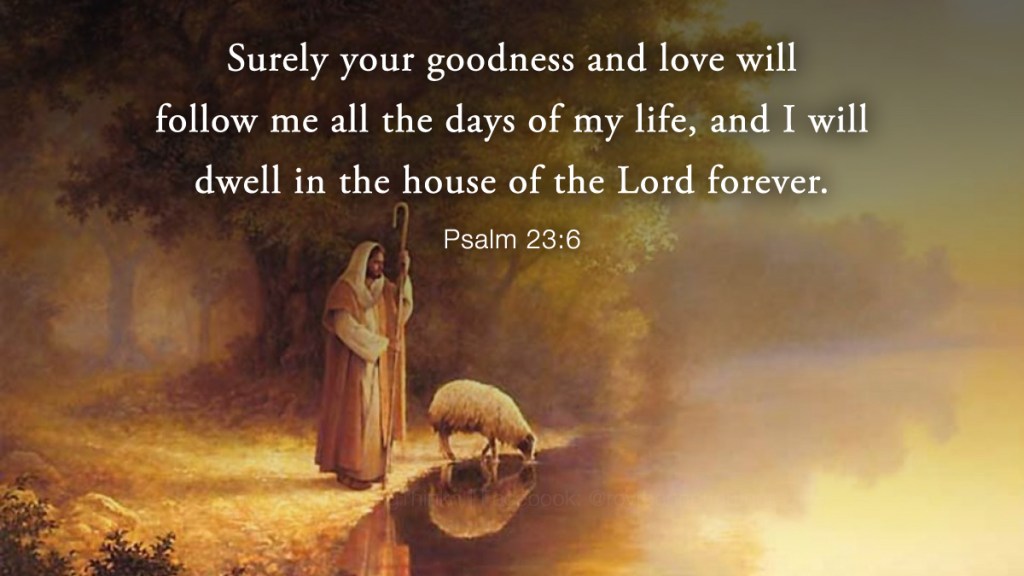
David writes, “Surely goodness and lovingkindness will follow me all the days of my life, and I will dwell in the house of the LORD forever” (verse 6).

Here, David builds upon the vivid analogy that he used in the previous verse.

In this context, he sees himself as a special guest in a grand banquet hall, where he is being served a feast by the LORD Himself. 

However, this dining hall is located in a very special place.

It is found in a royal palace—but not merely a worldly ruler’s palace.

It is found in the dwelling place of the highest of nobility—in “the house of the LORD.”

“Surely Goodness and Lovingkindness”

David begins with this emphatic word, “Surely” (ak).

This word could be translated as “indeed,” “absolutely,” “beyond any doubt,” or even “only.”

There is no place for any equivocation in David’s mind about what he says next.

He is deeply persuaded of what he is about to affirm.

This steadfast conviction should mark every believer.

David says that “goodness” (lob) will follow him.

This word speaks of the abundant blessings and lavish benefits God has bestowed upon him.

In this word is evidenced the spiritual prosperity that he has experienced in following the Lord – All that David has needed, God has always provided. 

David also confesses that the “lovingkindness” (hesed) of the LORD has followed him.

This is the Lord’s unconditional, loyal, royal love for David—and for all who put their trust in Him.

This word comes from the Hebrew root (hasad) that means ‘to bend down, to bow down.’

This describes God’s condescending love as He reaches all the way down from heaven to where exactly David is.

Could there be anything greater given to David’s life than the “goodness and lovingkindness” of the LORD?

God has given him the very best portion in His great love.

His steadfast, covenantal love for His own people never wavers, even in the furnace of affliction.

God gave each of us the very best portion of His great love – His Son Jesus.

John 3:16-17 King James Version

16 For God so loved the world, that he gave his only begotten Son, that whosoever believeth in him should not perish, but have everlasting life.

17 For God sent not his Son into the world to condemn the world; but that the world through him might be saved.

“Will Follow Me”

David adds that the Lord’s goodness and lovingkindness “will follow me.”

“Follow” (radap) means ‘to pursue after, to chase after, to run after.’

He knows that God’s mercy and grace are in close pursuit of his life.

No matter wherever he goes, he cannot get away from these ever-following assurances.

Regardless of whatever he does, he cannot escape them.

They will never let him go, even when circumstances seem to deny their reality.

These two attributes of God—“goodness and lovingkindness”—actually represent God Himself, who is continually pursuing David.

It is the figure of speech known as personification, which assigns humanlike qualities to inanimate objects.

To be sure, these two attributes represent God, who is personally following David and caring for his every need. 

By this testimony, David states that God is relentless in His love toward him.

David is assured though he will falter and fail, God will never give up on him.

Regardless of how he may disappoint the LORD, he is persuaded that God will never stop pursuing and caring for him.

Even if he trips and falls, he knows God will never distance Himself from him. 

Instead, God will pick up His servant and continue to walk with him.

David will testify elsewhere, “The steps of a man or established by the LORD, and He delights in his way. When he falls, he will not be hurled headlong, because the LORD is the One who holds his hand” (Psalm 37:23-24).

This is an irrevocable promise firmly established in God’s own faithfulness.

“All the Days of My Life”

God’s love for David will follow him “all the days of my life.”

This tender affection and unchanging allegiance of God will be a never-ending pursuit of David to the end of his days. 

His devotion toward God will surely fluctuate.

There will be times when it will strengthen or subside.

But God’s love for him is ever strong and steadfast.

God’s loyal love for David does not depend upon his love in return.

God’s love for David depends upon God Himself, who never weakens or wavers.

This is why God’s lovingkindness is always following after David.

Likewise, this same love of God is always in hot pursuit of every believer.

This divine love never takes a day off.

It never rests, never sleeps, never stops, never stumbles (Psalm 121:4).

Even in the midst of trying times, the love of God never goes on sabbatical, never takes a vacation.

It is ever strong toward us, ever sure. 

“And I Will Dwell in the House of the Lord”

The last line begins with the word “and,” which indicates that what follows is inseparably connected with what preceded it.

With great certainty, David knows that he will “dwell in the house of the Lord.”

“Dwell” (yasab) means ‘to sit down and stay.’

It conveys the idea of making one’s own abode or home.

This is to say, David will always be at home in the Lord’s presence, always in personal relationship with Him, no matter where he goes.

David pictures this meal in which God serves him as taking place “in the house of the Lord.”

Of course, the temple in Jerusalem has not yet been built by his son Solomon.

Instead, this “house” represents the intimate fellowship that David enjoys with the Lord as he lives in the very presence of God each day.

David is pointing his readership to the close communion, intimate interaction that he has with the Lord.

“Forever”

The relationship between David and the Lord will last “forever.”

What starts in this lifetime will never come to an end.

The word “forever” here means literally ‘for the length of days, for prolonged, never-ending days.’

Once David began this relationship with the Lord, he knew it would never be severed.

In the words of this analogy, once David moves into the house of the Lord, he will never move out.

This is the eternal security of every believer.

The Lord Himself is their dwelling place.

Once they dwell in the house of the Lord, they will always be living in the fullness of His love and grace. 

David wants us to know that the Lord who pursues us with lovingkindness is He who keeps us forever.

The Lord who is ever following us is ever keeping us.

Once God begins His pursuit of us, He will never let us go.

No believer can be separated from the love of God, our great Shepherd, Host, and King.

Jehovah God is dwelling within us exactly right now so that we may dwell with Him, both now and forever more.

Let all of His Children raise up!

Bless His holy name!

Jehovah Ra’a, the Lord is our Shepherd, is with us and exactly right beside us, both now and forever more.

Let all of sheep of His pasture turn their heads and give their fullest attention!

Bless His holy name!

The essential truth of our Christian life is that God has come to save us and live in us as “‘Immanuel,’ which translated means, ‘God with us’” (Matthew 1: 23).

This is the essential truth of our ministering to the Lord as well.

Forever we are Safe, Sitting in His sanctuary, abiding and residing in His house

Ministering unto the Lord, from within the sanctuary our inner temple, this is our response to the truth of Immanuel.

Because God is with us, abiding in us, and calling us to abide in Him, indeed to become one with Him, even as He and the Father are one (John 15:4, 10:14-15, 17:21-24), we joyfully, innately, instinctively, obediently, we respond, as God’s Own New Covenant priesthood (Revelation 1:5-6, 5:9-10, 1 Peter 2:5-9).

“Ministering to the Lord” (Acts 13:2) is surely what we know we must do, what our spirit within desperately, longingly yearns for, because God does live within us.

So it is a right and good and joyful thing for us to frequent the temple of the Holy Spirit within us (1 Corinthians 3:16), our “inner room” (Matthew 6:6), so we may be with our Lord in His presence, offering praise and adoration, stillness and reflection, gratitude and humility, even as He securely envelopes us in His Own “goodness and lovingkindness.”

The simple point I make here is that the more quality time and frequency we spend in God’s house now, dwelling within us, the more consistently sure we will be, every day, that “I will dwell in the house of the Lord forever.” Amen.

Love and dwell with our Lord now and looking forward to our joy of loving Him and our joy of dwelling with Him forever, always remembering with 100% joy that, “we love, because He first loved us” (1 John 4:19), we live because He lives.

We praise, thank, and bless You Lord God. Yes Lord, we gratefully and joyfully dwell in Your house today.

“Surely goodness and lovingkindness will follow me all the days of my life, and I will dwell in the house of the Lord forever.” Hallelujah!

In the name of God, the Father and God the Son and God the Holy Spirit,

Let us Pray,

Psalm 150The Message

150 1-6 Hallelujah!
Praise God in his holy house of worship,
    praise him under the open skies;
Praise him for his acts of power,
    praise him for his magnificent greatness;
Praise with a blast on the trumpet,
    praise by strumming soft strings;
Praise him with castanets and dance,
    praise him with banjo and flute;
Praise him with cymbals and a big bass drum,
    praise him with fiddles and mandolin.
Let every living, breathing creature praise God!
    Hallelujah!

Adeste Fidelis! Venite Adoremus! Dominum.

Gloria! In Excelsis Deo! Alleluia! Alleluia! Alleluia! Amen.

https://translate.google.com/

5 Ways to Truly Engage, Enjoy Christ. Luke 24:28-35

Luke 24:28-35 Amplified Bible

28 Then they approached the village where they were going, and He acted as if He were going farther. 29 But they urged Him [not to go on], saying, “Stay with us, because it is almost evening, and the day has just about ended.” So He went inside to stay with them. 30 And it happened that as He reclined at the table with them, He took the bread and blessed it, and breaking it, He began giving it to them. 31 Then their eyes were [suddenly] opened [by God] and they [clearly] recognized Him; and He vanished from their sight. 32 They said to one another, “Were not our hearts burning within us while He was talking with us on the road and opening the Scriptures to us?” 33 They got up that very hour and went back to Jerusalem, and found the eleven [apostles] gathered together and those who were with them, 34  saying, “The Lord has really risen and has appeared to Simon [Peter]!” 35  They began describing in detail what had happened on the road, and how Jesus was recognized by them when He broke the bread.

The Word of God for the Children of God.

Adeste Fidelis! Venite Adoremus! Dominum.

Gloria! In Excelsis Deo! Alleluia! Alleluia! Alleluia! Amen.

The disciples had been with Jesus for three years.

They had sat at his feet and seen him as their Teacher.

They had followed his instructions as their Lord and Master.

Jesus was also their Friend, and they loved sharing their hearts with him.

Jesus was their Messiah, and they enjoyed being with Him, in His presence.

But, as Henri Nouwen puts it, “His body and blood and their body and blood had not yet become one.”

Now, after his resurrection, Jesus broke bread with two of his followers, and this brought their relationship to a whole new level.

Jesus revealed Himself through the Scriptures, showed them the way by going before them and opening up a whole new realm as he is explaining his mission, Father God’s redemption plan for sinners, as told throughout Holy Scriptures.

As Jesus gave them the bread, they recognized him.

They realized that their Lord, Master, Teacher, and Friend was with them again.

He was alive!

He was with them!

They carried on an engaging conversation with Him for several miles.

When evening had come, they stopped and rested with Him and ate with Him.

He broke bread and shared the bread with them – and their EYES were OPENED!

The revelation: “The Lord Jesus had risen from the dead!”

This revelation brought them to their feet.

They returned (ran back as fast as they could) to Jerusalem to tell their story, and they found the other disciples saying, “It is true! The Lord has risen …!”

The reality of Christ’s resurrection brings the community of faith together to celebrate and enjoy the One who NOW walks with us, NOW lives within us!

Joyful, joyful, we adore thee,
God of glory, Lord of love;
hearts unfold like flowers before thee,
opening to the sun above.
Melt the clouds of sin and sadness;
drive the dark of doubt away.
Giver of immortal gladness,
fill us with the light of day!

Luke 24:28-35 The Message

28-31 They came to the edge of the village where they were headed. He acted as if he were going on but they pressed him: “Stay and have supper with us. It’s nearly evening; the day is done.” So he went in with them. And here is what happened: He sat down at the table with them. Taking the bread, he blessed and broke and gave it to them. At that moment, open-eyed, wide-eyed, they recognized him. And then he disappeared.

32 Back and forth they talked. “Didn’t we feel on fire as he conversed with us on the road, as he opened up the Scriptures for us?”

A Ghost Doesn’t Have Muscle and Bone

33-34 They didn’t waste a minute. They were up and on their way back to Jerusalem. They found the Eleven and their friends gathered together, talking away: “It’s really happened! The Master has been raised up—Simon saw him!”

35 Then the two went over everything that happened on the road and how they recognized him when he broke the bread.

Now, I want to ask you some very important and rather personal questions:

Why did Jesus walk all those miles with those two folks on the Emmaus Road?

Why did Jesus first choose to come close to those two raging skeptics?

Why did Jesus choose to come to your skeptical self and reveal Himself to you?

Why did Jesus first choose to reveal himself to those two raging skeptics?

Why did Jesus choose to reveal Himself to your skeptical self through Scripture?

In that most unexpected of moments, what did you feel when your eyes opened?

Why do you believe Jesus chose to “open your all too skeptical eyes?”

Why did Jesus save you?

Some might think it’s to take us to heaven or to bless us. (Psalm 23:5-6)

While these things are part of it, they are not the main reason.

The main reason Jesus revealed Himself to you, opened your eyes to His life and saved you is so He could be in a BFF intimately personal relationship with you.

I know that may seem mightily overwhelming when you think of who Jesus is and where you were, who you are and where and who we are, but it is 100% true.

For the joy which was before Him, and is now before you, since Jesus saved you for relationship, how can you make the most of it and truly enjoy Jesus Christ? 

5 Ways You Can Enjoy Christ

1. Engage His Presence

Enjoying Christ means being able to enjoy his presence.

The best way to enter his presence is through worship. 

Psalm 22:3 says God inhabits the praises of his people.

This verse means God sits among the people who praise him.

When you worship, you get God’s attention, and he draws near to you.

The one thing God desires more than anything else is to be close to you. He desires this because He wants, deeply desires for you to enjoy his presence. 

There are so many Scriptures that invite us into his presence and the beauty of his presence is everything we need is there.

You will find joy, peace, comfort, freedom, and the ability to leave every worry and care behind you.

If you really want to enjoy Christ, then you must spend time in his presence.

Spending quality time in his presence does not always mean you always have to open your mouth and say something.

Sometimes sitting quietly, in His sanctuary, in private before him and allowing his Spirit to minister unto, you is exactly what you need. (2 Samuel 7:18-29)

You cannot enjoy Christ without being in his presence, so make quality time for it – take every advantage of it and God in Christ promises you will not regret it.  

2. Engage His Promises

Part of building your relationship with Jesus is studying and praying, getting to know what he says, reveals in His Holy Scriptures, and promises He has made.

Sometimes we like to focus on the promises of blessing, but what is greater than those are his promises to be with you.

If it comes down to making a choice between having the One who blesses or the blessing, His wisdom says choosing the One who blesses wins out every time.

One way to really enjoy Christ is to think of the many promises he has made to walk with you through life.

“…And surely I am with you always, to the very end of the age” (Matthew 28:20).

“So do not fear, for I am with you: do not be dismayed, for I am your God. I will strengthen you and help you; I will uphold you with my righteous right hand” (Isaiah 41:10).

When You’re Between a Rock and a Hard Place

43 1-4 But now, God’s Message,
    the God who made you in the first place, Jacob,
    the One who got you started, Israel:
“Don’t be afraid, I’ve redeemed you.
    I’ve called your name. You’re mine.
When you’re in over your head, I’ll be there with you.
    When you’re in rough waters, you will not go down.
When you’re between a rock and a hard place,
    it won’t be a dead end—
Because I am God, your personal God,
    The Holy of Israel, your Savior.
I paid a huge price for you:
    all of Egypt, with rich Cush and Seba thrown in!
That’s how much you mean to me!
    That’s how much I love you!
I’d sell off the whole world to get you back,
    trade the creation just for you.
(Isaiah 43:1-4 Message)

“The Lord himself goes before you and will be with you; he will never leave you nor forsake you. Do not be afraid; do not be discouraged” (Deuteronomy 31:8).

“For I am convinced that neither death nor life, neither angels nor demons, neither the present nor the future, nor any powers, neither height nor depth, nor anything else in all creation, will be able to separate us from the love of God that is in Christ Jesus our Lord” (Romans 8:38-39).

I know God has promised to provide and bless and those things are wonderful.

But knowing he will be with you is the greatest of all the promises because if he is with you and for you, then who can be against you (Romans 8:31)?

The comfort, the place of Shalom, knowing there is nothing in this life that can ever separate you from His love sets a foundation for you to love, enjoy Jesus. 

3. Engage and Value His Purpose

If you want to enjoy your relationship with Christ, then you need to value the things he values.

His purpose for your life and your purpose for your life must align.

If these two things don’t agree, then you will never enjoy Christ.

Part of his purpose for you is to walk in obedience and avoid sin.

There was a 30 year period of time in my life where I allowed sin to rule, which was clearly never in alignment with even .001% of Jesus’s purpose for my life.

I can assure you those were the most miserable times in my life. 

I have discovered the best place to be in life is walking in the center of his will.

When you innately know you are doing what God has called you to do, there is a definite place satisfaction and a decisive source of enjoyment that comes that is utterly, fully and completely unmatched by anything, anyone else on this earth.

This has nothing to do with how big or small your family is, how much money you o an do not make or how successful, how big a failure you are in your career.

Those things are not germane nor are they the foundation of enjoying Christ.

When you walk and talk with Jesus, listen to His Words with intent to align your life with His life, His purpose, there is no greater joy you will ever experience!

4. Engage His People

You cannot enjoy your life with Christ if you do not engage with and enjoy his people.

A friend I know who is married and has one kid recently told me this story.

He and his wife were invited to share a family dinner with another couple.

They could find no one to watch their son and asked if they could bring them.

They were told they were welcome, but we don’t really want kids in our house.

That dinner never happened. 

A friendship was damaged …

You cannot say you love Jesus if you don’t love the ones he calls his own.

It is simply not possible.

Here is how the Bible puts it.

“Whoever claims to love God yet hates a brother or sister is a liar. For whoever does not love their brother and sister, whom they have seen, cannot love God, whom they have not seen” (1 John 4:20).

Make a friend, Be a friend, Bring a friend to Christ ….

If you are going to enjoy Christ, then you must learn to enjoy his people.

So often we focus on the faults and failures, failings and imperfections we see in others, and most of the time they are quickly obvious and easy to spot, mention.

I know mine are.

But guess what?

So are yours.

We are all imperfect people who are reflections of a perfect Christ.

Sometimes we get it wrong and mess this up, but as the expression goes, you do not throw the baby out with the bath water.

If you want to enjoy Christ, you cannot separate that from enjoying his people.

By the way, you better get used to His people because you are going to spend eternity with them, so you might as well enjoy them now.

5. Engage His Position

The last thing you need to enjoy Christ is to engage the position he must have in your life.

He must be Lord of all.

The truth of walking and talking with Jesus is either He is Lord of absolutely everything, or He is Lord of absolutely nothing.

There is no in between.

People that never make Jesus Lord of their life never experience the full joy of walking with Jesus.

When Jesus is Lord, and he sits at the center of your life, then life takes on a whole new perspective.

You will face many of the same challenges, but you will do so with Jesus at the helm of your life.

Knowing this alone can free you from anxiety because if He is at the wheel, you will arrive safely wherever He wants you to go. 

Build Your Relationship

Enjoying Christ is all about the relationship you and I share with Him, and if you and I miss this, then you and I miss it all.

The fact is you and I have someone we can be completely transparent with, who knows everything thing about us good and bad, yet still desires to fellowship.

This is truly amazing.

I encourage you to lean muchly into your Koinonia relationship with Jesus.

Be intentional about spending time with Him, make him the center of your life.

If you do, you will discover your walk with him will get sweeter and sweeter every day.

I will leave you with the words from a song by the Heritage Singers.

“I just keep falling in love with Him
Over and over, and over, and over, again
I keep falling in love with Him,

Over and over, and over and over again
He gets sweeter and sweeter as the days go by,

Oh, what a love between my Lord and I
I keep falling in love with Him
Over and over, and over, and over, again.”

In the name of God, the Father and God the Son and God the Holy Spirit,

Let us Pray,

Psalm 100 The Message

100 1-2 On your feet now—applaud God!
    Bring a gift of laughter,
    sing yourselves into his presence.

Know this: God is God, and God, God.
    He made us; we didn’t make him.
    We’re his people, his well-tended sheep.

Enter with the password: “Thank you!”
    Make yourselves at home, talking praise.
    Thank him. Worship him.

For God is sheer beauty,
    all-generous in love,
    loyal always and ever.

Adeste Fidelis! Venite Adoremus! Dominum.

Gloria! In Excelsis Deo! Alleluia! Alleluia! Alleluia! Amen.

https://translate.google.com/

“Do You Really Want to be Made Well?” Surrender to God’s Healing in Your Life! John 5:1-9

John 5:1-9Amplified Bible

The Healing at Bethesda

Later on there was a Jewish feast (festival), and Jesus went up to Jerusalem.

Now in Jerusalem, near the Sheep Gate, there is a [a]pool, which is called in Hebrew (Jewish Aramaic) Bethesda, having five porticoes (alcoves, colonnades). In these  porticoes lay a great number of people who were sick, blind, lame, withered, [b][waiting for the stirring of the water; for an angel of the Lord went down into the pool at appointed seasons and stirred up the water; the first one to go in after the water was stirred was healed of his disease.] There was a certain man there who had been ill for thirty-eight years. When Jesus noticed him lying there [helpless], knowing that he had been in that condition a long time, He said to him, “Do you want to get well?” The invalid answered, “Sir, I have no one to put me in the pool when the water is stirred up, and while I am coming [to get into it myself], someone else steps down ahead of me.” Jesus said to him, “Get up; pick up your pallet and walk.” Immediately the man was healed and recovered his strength, and [c]picked up his pallet and walked.

Now that day was the Sabbath.

The Word of God for the Children of God.

Adeste Fidelis! Venite Adoremus! Dominum.

Gloria! In Excelsis Deo! Alleluia! Alleluia! Alleluia! Amen.

Picture the scene: a pool of water surrounded by covered porches.

Bethesda was known as a place of healing.

At certain times of the year, an angel of the Lord stirred the waters.

It was then that the porticoes were often crowded with destitute people who were blind, lame, and paralyzed – waiting to be the ones who were 1st healed.

Among them lay a man who had been lame for thirty-eight long years.

He came! Except there was no one willing to help him get into the pool.

Jesus was watching the proceedings from a short distance away.

Jesus approached asked the man, asking him; “Do you want to get well?”

On the surface, the answer would seem obvious.

Of course the man wanted to be well!

But here, Jesus was asking a deeper question.

He was probing the man’s heart.

Did he really want to be made whole-

-Did he really want to be healed, to be transformed inside and out, healed in body, mind, and soul?

Without waiting for the man to give his response, to tell Jesus his story ….

Jesus spoke to him a second time: “Get up! Pick up your mat and walk.”

From a human standpoint, it was impossible for the man to get up.

To others who were listening, this may even have sounded a bit cruel.

But at that moment the healing power of Jesus touched the man, filling his body, mind, and spirit with wholeness.

As Jesus healed the man, he was saying, in effect, “Pick up your mat and be out of here. You never have to think of coming back to this kind of life again.”

The steps Jesus took in healing this man give us an outline of how our Lord meets us today.

He probes our hearts, commands the impossible, provides the power, and tells us, up close and personal, to “be healed, ” get up and leave our old life behind.

What Presence …

What Authority …

What Sovereignty …

What a Savior!

How to Surrender to God’s Healing in Your Life …

At first glance, one may raise an eyebrow at the title of this devotional.

Why would one need to surrender to healing?

We pray for, ache for, pray without ceasing, generally get on our hands and knees searching for healing in so many aspects of our lives.

So why would someone resist it when it is offered to them?

Or is it resistance?

Perhaps, surrendering to God’s healing has nothing to do with fighting against it so much as it is our coming to the realization and acceptance that we need it.

This means coming to a point of humility and admitting our shortcomings or, perhaps worse, the vast diversity our very worst faults, failures and failings.

But then, we may be well aware we need healing.

So then, surrendering to God’s healing isn’t something fraught with resistance or stained with denial, but it is shrouded in the most severest spoken, unspoken actions, expressions, of doubt that God really can bring healing to a broken life.

Or that after an extended period of suffering, He will ever really bring healing.

Have you ever found yourself thinking,

“I know God can heal my life, but I do not know if I believe He ever will.”

Whether surrendering to God’s healing has to do with resistance to healing, denial of the need for healing, or doubting the possibility of recovery, it’s good to step back when in need of healing and take a “selfie” – a clear photograph of your spirit and heart.

What part of “self” might stand in the way of our surrender to God’s healing?

Here are some areas to self-examine and see if any of these may be a part of your surrendering difficulties or process:

1. To heal means to freely and fully admit your weakness.

There’s a verse in II Corinthians 12 that is often quoted when it comes to recognizing one’s weaknesses. “For when I am weak (in human strength), then I am strong (truly able, powerful, drawing from God’s strength),”

2 Corinthians 12:7-10Amplified Bible

A Thorn in the Flesh

Because of the surpassing greatness and extraordinary nature of the revelations [which I received from God], for this reason, to keep me from thinking of myself as important, a thorn in the flesh was given to me, a messenger of Satan, to torment and harass me—to keep me from exalting myself! Concerning this I pleaded with the Lord three times that it might leave me; but He has said to me, “My grace is sufficient for you [My lovingkindness and My mercy are more than enough—always available—regardless of the situation]; for [My] power is being perfected [and is completed and shows itself most effectively] in [your] weakness.” Therefore, I will all the more gladly boast in my weaknesses, so that the power of Christ [may completely enfold me and] may dwell in me. 10 So I am well pleased with weaknesses, with insults, with distresses, with persecutions, and with difficulties, for the sake of Christ; for when I am weak [in human strength], then I am strong [truly able, truly powerful, truly drawing from God’s strength].

Apostle Paul clearly states his beliefs of strength in the last part of verse ten.

The idea is that to gain strength, one is best set by first coming to the end of themselves.

Only in that weakness can their strength be infused with the might of the Holy Spirit, thus bringing about a strength that only comes from God, Himself.

But let’s step back a bit to a portion not as often quoted in verse 9. Jesus said, “My grace is sufficient for you, my power is made perfect in weakness.”

This is a critical portion of the text when looking at the final part of verse ten and coming to terms with your weakness.

Admitting our weaknesses can make us feel as though we’ve been put into a vulnerable and exposed position.

In a way, it’s “waving our white flag” coming before God for healing with naked souls and our sins, failings, hurts, and brokenness splayed with no disguises.

But His “straight to the point” answer in this healing process has nothing to do with pointing out the errors of our ways or making sure we are valid in our hurt, or our ideations or perceptions or our reality of our brokenness is .01% justified.

His answer is straightforward and strong:

“My grace is sufficient for you.”

His grace is enough.

Enough.

1. Marvelous grace of our loving Lord,
grace that exceeds our sin and our guilt!
Yonder on Calvary’s mount outpoured,
there where the blood of the Lamb was spilt.
Refrain:
Grace, grace, God’s grace,
grace that will pardon and cleanse within;
grace, grace, God’s grace,
grace that is greater than all our sin!

To first admit our weakness is to place ourselves into the submissive role of someone who needs to be rescued – sit still and accept Jesus Christ is God.

And Who better to do this with than the one whose power is made perfect in weakness?

2. Abandoning denial means you embrace the truth.

The truth can be a painful place to go.

The whole “the truth will set you free” concept from John 8 may be remarkably true, it can also mean “coming to terms” with some very harsh, frank realities.

It may mean you must face the abuses that have broken you.

You may need to travel to some dark places to come out the other side into a place of everlasting living hope.

Denial can be a protective mechanism.

If it doesn’t exist, therefore, there is no problem.

Or, stated differently, if everything is working, then nothing needs fixing.

But are you thriving just because you have duct-taped and paper-clipped an industrially stapled your life together in a way you can only barely function?

Are you experiencing the strength and power of God’s grace being sufficient for you when pretending to be healthier than you truly are?

Surrendering to healing may mean ripping off some bandages that have dried onto the wounds.

The hurts may need to bleed again in order to, this time, be healed properly with as minimal scarring as God will allow.

Can you find the courage to be honest and say, “I need to experience God’s healing in my life”?

3. Surrendering means acting in faith God will keep His promises.

Nothing can kill a dream faster than the disappearance of hope.

So when doubt and trepidation enter the healing process of our brokenness, we can begin to embrace the complexity and diversity of the all of the lies and the insinuations we have weaved that God may not do what He has said he will do.

However, God has promised to heal the brokenhearted.

He has promised to meet our needs (Psalm 23).

He has promised to be the Savior to a bleeding and busted soul (Psalm 22).

Coming before God in surrender may mean we go to Him with speculation and concern.

It might also mean you come to Him and lay aside your perceived ideas of how He will heal you.

In the same way physical healing may not be provided to you in the way you imagine it, your emotional, spiritual, and mental healing may come through avenues and processes you have not considered.

To surrender genuinely does mean to step out in faith, trusting and believing that He is sufficient and can bring healing; not presenting Him with a list of ways you believe He absolutely needs to bring that healing into your life and then stepping back to gnash teeth, bite your fingernails, doubting He’ll read it.

Can you fully, genuinely say, “I trust God to do what He has promised without expecting Him to tell me how and without putting a timeline on it?” (Psalm 24)

Healing is a process.

It’s not a simple one, nor is it straightforward and standardized.

Plus, let’s be honest.

Since when is God predictable in the journeys He takes his people on?

Surrendering to the Lord for healing is, in and of itself, a process.

It’s coming to terms with admitting you need healing, it’s realizing that there will be some tough stuff to relive, walk through, evaluate, and even admit; it’s recognizing you probably won’t know how healing will come—just that it will.

In the end, healing isn’t a simple process with an easy answer.

Neither is “white flag” surrendering.

You may find yourself surrendering to God’s healing in one moment,

then in the next, you’re taking it all back, trying with all remaining strength to wrestle it back from Jesus and rebuilding up your defensive walls once again.

So hold on to and grasp that His strength will be made perfect in your weakness.

That His grace is sufficient for this journey on which you will embark.

And also, know that His healing isn’t a three-step process.

His healing will be customized for His relationship with you and for His glory to be seen and shown to the world around you.

Be ready for great things.

“White Flag ” healing is miraculous, so hold on tight, proceed with great hope!

In the name of God, the Father and God the Son and God the Holy Spirit,

Let us Pray,

Father, Son and Holy Spirit, we give all glory to You, for through Your mighty power at work within us, You are able to accomplish infinitely more than we might ask or think. By thy grace help us not to grieve You, dear Spirit, but to kneel, “wave our white flags” to wholly submit to You, allow Your power to have full an maximum sway in us. We thank You for Your gracious presence dwelling within us. We thank You for thy intercession on our behalf. Glory to You in the Church and in Christ Jesus.

Adeste Fidelis! Venite Adoremus! Dominum.

Gloria! In Excelsis Deo! Alleluia! Alleluia! Alleluia! Amen.

https://translate.google.com/

Evidence God Is at Work in Our Lives. John 5:17

John 5:10-17Amplified Bible

10 So the Jews kept saying to the man who had been healed, “It is the Sabbath, and you are not [a]permitted to pick up your pallet [because it is unlawful].” 11 He answered them, “The Man who healed me and gave me back my strength was the One who said to me, ‘Pick up your pallet and walk.’” 12 They asked him, “Who is the Man who told you, ‘Pick up your pallet and walk’?” 13 Now the man who had been healed did not know who it was, for Jesus had slipped away [unnoticed] since there was a crowd in that place. 14 Afterward, Jesus found him in the temple and said to him, “See, you are well! Stop sinning or something worse may happen to you.” 15 The man went away and told the Jews that it was Jesus who had made him well. 16 For this reason the Jews began to persecute Jesus continually because He was doing these things on the Sabbath. 17 But Jesus answered them, “My Father has been working until now [He has never ceased working], and I too am working.”

The Word of God for the Children of God.

Adeste Fidelis! Venite Adoremus! Dominum.

Gloria! In Excelsis Deo! Alleluia! Alleluia! Alleluia! Amen.
“My Father is always working, and so am I” (John 5:17).

Always is a big promise.

We cannot uphold the promise of always meaning always any more effectively that we can uphold the promise of never saying never again.

But God can.

He is always working.

Jesus is always working.

The Holy Spirit is always working.

But what is all of this work, and what does it have to do with us?

“Man was created from the beginning in God’s image that he might image forth God’s glory,” John Piper wrote. Paul wrote to the Corinthians,

“So whatever you eat or drink, or whatever you do, do it all for the glory of God” (1 Corinthians 10:31).

Jesus was in argument about working on the Sabbath with Jewish leaders when He said, “My Father is always working, and so am I.”

They were upset Jesus had performed a miracle on the Sabbath.

The Life Application Bible explains

“Genesis 2:2 says that God rested on the seventh day, but this does not mean he stopped doing good. Jesus was saying that when the opportunity to do good presents itself, we should not ignore it, even on the Sabbath.”

Work, in the context of John 5:17 and translated from the original Greek language it was written in, means to work out. 

The days on our calendars flip over with purpose.

God goes before us, behind us, and is with us.

We were created to bring glory to Him with our everyday lives.

Paul wrote to the Philippians, “Work hard to show the results of your salvation, obeying God with deep reverence and fear” (Philippians 2:12).

Work, in this context, means to bring about.

We bring glory to God by obediently following His lead on our lives, as the Holy Spirit progressively sanctifies us.

Everyday life may seem ordinary, but if we stretch our perspective to align with the Lord’s, we will certainly start to notice the extraordinary in our daily lives.

What is God’s Work?

“For God so loved the world that he gave his one and only Son, that whoever believes in him shall not perish but have eternal life” (John 3:16).

God’s plan all along was to save us from ourselves.

He gave us free will, and we chose to rebel against Him.

It began with the original rebellion in the garden, and continues to flood into our current existence. Jesus didn’t pop onto the pages of the Bible in the New Testament Gospel accounts.

The apostle John clarified, He was with God in the beginning. (John 1:1-5)

Jesus was sent to live among us and die for our sins.

Through Him, we are justified by His atoning sacrifice, once for all (Romans 3:25-26).

He did this to accomplish the will of His Father, so we can live life to the full (John 10:10).

He came to give us an example to live by, though we will never accomplish it in perfection as He did, without sin.

Jesus came to serve not be served (Mark 10:45).

Jesus came to seek and save the lost (Luke 19:10)

Jesus came …. (John 10:14-17)

14 I am the Good Shepherd, and I know [without any doubt those who are] My own and My own know Me [and have a deep, personal relationship with Me]— 15 even as the Father knows Me and I know the Father—and I lay down My [very own] life [sacrificing it] for the benefit of the sheep. 16 I have [a]other sheep [beside these] that are not of this fold. I must bring those also, and they will listen to My voice and pay attention to My call, and they will become [b]one flock with one Shepherd. 17 For this reason the Father loves Me, because I lay down My [own] life so that I may take it back.

Jehovah God’s work is infinite and ongoing, and never ends from the scenery surrounding us to the days of our lives and onto eternity. (Psalms 121, 139)

What is Evidence of God’s Work?

Genesis 1:26-28 Amplified Bible

26 Then God said, “Let Us (Father, Son, Holy Spirit) make man in Our image, according to Our likeness [not physical, but a spiritual personality and moral likeness]; and let them have complete authority over the fish of the sea, the birds of the air, the cattle, and over the entire earth, and over everything that creeps and crawls on the earth.” 27 So God created man in His own image, in the image and likeness of God He created him; male and female He created them. 28 And God blessed them [granting them certain authority] and said to them, “Be fruitful, multiply, and fill the earth, and subjugate it [putting it under your power]; and rule over (dominate) the fish of the sea, the birds of the air, and every living thing that moves upon the earth.”

We are evidence of God’s creation.

“Very good,” is the way He described His creation.

“In His image” gives us a sneak peek into the question of what God looks like and is like.

“The existence and attributes of God are evident from creation itself, even though sinful human beings suppress and distort their natural knowledge of God,” James N. Anderson wrote

Psalm 19 vividly expresses a doctrine of natural revelation: the entire created universe ‘declares’ and ‘proclaims’ the glorious works of God.

Beautiful sunsets and scenery around the globe automatically give way to the evidence of God’s creation.

But He isn’t done yet.

He’s still creating.

Scripture says He knit us in our mother’s womb. (Psalm 139:13)

We have unique purpose on this earth, as evidence of Him. 

In a parable Matthew recorded, Jesus said,

“The master said, ‘Well done, my good and faithful servant. You have been faithful in handling this small amount, so now I will give you many more responsibilities. Let’s celebrate together!’” (Matthew 25:23).

The evidence of His work in our lives is the by-product of the work He has given us to do based on the talents He’s placed in us.

Whatever our age and stage in life, He is working through our relationships with the people He has placed around us.

The work we do is meant to point to Him.

The way we live is meant to lead others to Him.

We are made in His image.

We are evidence of God.

The Great Commission utterly envelopes us as it did those disciples, to ‘GO!’

God’s goal is to reach every heart and soul, and eye and ear, hand and foot with the Gospel, and He’s never failed to keep a promise.

We are part of that promise.

Not because He needs us, but out of His love for us.

The work He gives us isn’t easy, but it’s light. 

 Matthew recorded Jesus words:

“Come to me, all of you who are weary and carry heavy burdens, and I will give you rest. Take my yoke upon you. Let me teach you, because I am humble and gentle at heart, and you will find rest for your souls. For my yoke is easy to bear, and the burden I give you is light” (Matthew 11:28-30).

The evidence of God’s work in our lives is the way we live them, in our active and daily pursuit of Him.

Telling of Him, not only with our mouths delivering Gospel truth, but our lives putting it on full display, bringing above and beyond maximum glory unto Him with everyone who comes to know Him, experience Him, love Him through us.

What is Our Part?

Colossians 3:22-24Amplified Bible

22 Servants, in everything obey those who are your masters on earth, not only with external service, as those who merely please people, but with sincerity of heart because of your fear of the Lord. 23 Whatever you do [whatever your task may be], work from the soul [that is, put in your very best effort], as [something done] for the Lord and not for men, 24 knowing [with all certainty] that it is from the Lord [not from men] that you will receive the inheritance which is your [greatest] reward. It is the Lord Christ whom you [actually] serve.

Life has a purpose we cannot fully see from our limited perspective.

Whatever we find ourselves doing, we are called to do with all of our hearts.

Not perfectly, because that’s an impossible thing for us to attain.

God wants the totality of our hearts to be dedicated to Him.

Our part is to put Him first, not ourselves and not the opinions or approval of other people. Jesus came to serve, not to be served.

Our part is to serve others, get our hands and feet dirty with all of our hearts.

Paul wrote to Timothy,

1 Timothy 1:14-16 Amplified Bible

14 The grace of our Lord [His amazing, unmerited favor and blessing] flowed out in superabundance [for me, together] with the faith and love which are [realized] in Christ Jesus. 15 [a]This is a faithful and trustworthy statement, deserving full acceptance and approval, that Christ Jesus came into the world to save sinners, among whom I am foremost. 16 Yet for this reason I found mercy, so that in me as the foremost [of sinners], Jesus Christ might demonstrate His perfect patience as an example or pattern for those who [b]would believe in Him for eternal life.

Our part is not to lose perspective on our dependance upon Christ alone and our need for constant forgiveness and redemption in this life.

“For the Son of Man came to seek and save the lost,” Luke recorded Jesus’ saying (Luke 19:10).

Our part is remembering we once were lost, now are on a mission for the lost.

Our part is communicating we once were lost, now on a mission to labor in the fields of God’s kingdom, to give aid and comfort, a living hope of a true future.

Hebrews 11:1-2 Amplified Bible

The Triumphs of Faith

11 Now faith is the assurance (title deed, confirmation) of things hoped for (divinely guaranteed), and the evidence of things not seen [the conviction of their reality—faith comprehends as fact what cannot be experienced by the physical senses]. For by this [kind of] faith the [a]men of old gained [divine] approval.

To lead, guide and direct others towards the voice of their Savior Jesus Christ.

To be evidence of Jesus to the people in our lives, which brings glory to God.

In the name of God, the Father and God the Son and God the Holy Spirit,

Let us Pray,

God, Builder of all things, I know that when I acknowledge your authority and your power that you will make my paths straight in front of me. Please empower me to live a greater life in Christ. May your Holy Spirit who lives in me draw me closer to you. Give me a mind of understanding. Let me see as you see, and not as the world sees. Let me labor as You labored, Let me serve as You first served, let me love as You first loved. I trust your judgment fully and know that my own judgment is limited. I believe you have everything in control, and you will guide me and my hands and my feet, my heart and my soul to labor to exactly where you require me to go. Amen.

Adeste Fidelis! Venite Adoremus! Dominum.

Gloria! In Excelsis Deo! Alleluia! Alleluia! Alleluia! Amen.

https://translate.google.com/

Living Life Under Pressure: Dr. Jekyll, and Mr. Hyde and Our “Christianality.” Ephesians 4:17-24

Ephesians 4:17-24 Amplified Bible

The Christian’s Walk

17 So this I say, and solemnly affirm together with the Lord [as in His presence], that you must no longer live as the [unbelieving] Gentiles live, in the futility of their minds [and in the foolishness and emptiness of their souls], 18 for their [moral] understanding is darkened and their reasoning is clouded; [they are] alienated and self-banished from the life of God [with no share in it; this is] because of the [willful] ignorance and spiritual blindness that is [deep-seated] within them, because of the hardness and insensitivity of their heart. 19 And they, [the ungodly in their spiritual apathy], having become callous and unfeeling, have given themselves over [as prey] to unbridled sensuality, eagerly craving the practice of every kind of impurity [that their desires may demand]. 20 But you did not learn Christ in this way! 21 If in fact you have [really] heard Him and have been taught by Him, just as truth is in Jesus [revealed in His life and personified in Him], 22 that, regarding your previous way of life, you put off your old self [completely discard your former nature], which is being corrupted through deceitful desires, 23 and be continually renewed in the spirit of your mind [having a fresh, untarnished mental and spiritual attitude], 24 and put on the new self [the regenerated and renewed nature], created in God’s image, [godlike] in the righteousness and holiness of the truth [living in a way that expresses to God your gratitude for your salvation].

The Word of God for the Children of God

Adeste Fidelis! Venite Adoremus! Dominum.

Gloria! In Excelsis Deo! Alleluia! Alleluia! Alleluia! Amen.

I would like to share about the pressures of life we encounter on a daily basis.

It is important for us as believers to recognize that all of the who’s, the what’s the where’s the when’s and the why’s we are bombarded by everyday will have either a significantly positive or a very negative form of influence in our lives.

There are people, places an things who, which if we let them, will cunningly manipulate, pressure us, into situations where we got no business being in.

In today’s world pressure begins at an early age.

There’s the social pressure of fitting in.

There’s the pressure of looking a certain way, financial pressures.

I once told a former boss I needed a raise, that 4 other companies were after me.

He asked me which ones, I said;

“anywhere else north, anywhere else south, anywhere else east and anywhere else west, just anywhere else except here!”

We experience mounting pressures in the workplace, emotional and social relationships pressures, fitting in, making keeping new friends, moving, being a caregiver, divorce, illness, the pressures of measuring up, having all the latest gadgets, the pressures of social media, pressure of keeping up with the Joneses.

Pressure will have stress and anxiety eventually creep up on you and it will get in the way of your daily life, your work life, your family life, social life, church life and even your daily walk in God, the Father, Savior Christ and Holy Spirit.

But my bible tells me …

Something pretty radical and diametrically opposite ….

Psalm 23 Amplified Bible

The Lord, the Psalmist’s Shepherd.

A Psalm of David.

23 The Lord is my Shepherd [to feed, to guide and to shield me],
I shall not want.

He lets me lie down in green pastures;
He leads me beside the still and quiet waters.

He refreshes and restores my soul (life);
He leads me in the paths of righteousness
for His name’s sake.


Even though I walk through the [sunless] [a]valley of the shadow of death,
I fear no evil, for You are with me;
Your rod [to protect] and Your staff [to guide], they comfort and console me.


You prepare a table before me in the presence of my enemies.
You have anointed and refreshed my head with [b]oil;
My cup overflows.


Surely goodness and mercy and unfailing love shall follow me all the days of my life,
And I shall dwell forever [throughout all my days] in the house and in the presence of the Lord.

Know that when you go to God, He will provide you with every last measure and degree of His Shalom, His peace as necessary to withstand the pressures of life.

Which God did when He sent His Son Jesus to us and Jesus died for us at Calvary.

Dr. Jekyll, Mr. Hyde, The World, Living Out Our Christianality

Do you ever feel as if sometimes you are two different “Christian” persons?

Under one circumstance you are staunchly Christian because that is what your Mother and Father taught you when you were too busy trying to just “grow up.”

Then you encountered the “real world” where you had to really live your life on your own – you got your first apartment, went off to college in another state or country, you got your very first job in a fast food place or department store and all of a sudden life comes at you at warp 10 – you have to adjust, then readjust?

When you realize that real life is not always going to be, cannot always be really lived, realistically understood by what your Mother and Father had taught you?

Economics change.

Politics change.

Society and Culture changes.

We are caught up in those changes.

Subtly or “in a heartbeat” suddenly we have to adjust life to those changes.

What Mother and Father taught us – biblically or not so biblically.

What the world is teaching us – challenging our perceptions of “biblically.”

Moment by Moment, do I live my life “Biblically versus Realistically?!?”

Moment by Moment, can I live my life “Biblically versus Realistically?!?”

Moment by Moment, should I live my life “Biblically versus Realistically?!?”

Then comes the inevitable progression to inserting the question – “WHY?”

And that becomes the greatest question we all have to grapple with everyday, in everyway we were probably never taught either by our Mothers and our Fathers.

Back in the nineteenth century, Robert Louis Stevenson explored that idea in his short suspense novel titled “The Strange Case of Dr. Jekyll and Mr. Hyde.”

In an effort to become a better person, Dr. Jekyll, a mild-mannered man of science, develops a potion that can separate his good self from his bad self.

Expectedly or Unexpectedly, what happens instead is that his good side fades more, more away, the bad side turns out to be much more evil than expected.

At night he changes drastically and dramatically and he becomes Mr. Hyde, a mysterious, ugly and violent man whose life can think only of its own desires.

Once Dr. Jekyll realizes his own evil, he makes “the only choice possible” and clamps down on his Mr. Hyde, resolving not to take the magic potion anymore.

But Mr. Hyde has become too powerful, strong, too influential to overcome.

In despair of ever changing himself for the good, Dr. Jekyll commits suicide.

In no way do/would I ever advocate the act of suicide as any solution to crisis!

As such thoughts enter into your mindset – get professional help immediately!

Do NOT ever act upon those self-destructive thoughts – Call 911 locally

The 988 Suicide & Crisis Lifeline is a United States-based suicide prevention network of over 200+ crisis centers that provides 24/7 service via a toll-free hotline with the number 9-8-8. It is available to anyone in suicidal crisis or emotional distress.

International Suicide Hotlines

One Biblical versus Worldly Response

Some of you are probably feeling like you’re losing it, you’re at a breaking point.

God is surely, certainly telling you today, Pray! stay with me, I’m going to get you thru this, stay in my will, don’t lose your courage, come stay in my house …

Psalm 23 The Message

23 1-3 God, my shepherd!
    I don’t need a thing.
You have bedded me down in lush meadows,
    you find me quiet pools to drink from.
True to your word,
    you let me catch my breath
    and send me in the right direction.

Even when the way goes through
    Death Valley,
I’m not afraid
    when you walk at my side.
Your trusty shepherd’s crook
    makes me feel secure.

You serve me a six-course dinner
    right in front of my enemies.
You revive my drooping head;
    my cup brims with blessing.

Your beauty and love chase after me
    every day of my life.
I’m back home in the house of God
    for the rest of my life.

A Father, Son and Holy Spirit Inspired Response:

The apostle Paul speaks of the same struggle in different terms—“old self” and “new self.”

One of the great issues of life is how we can change permanently and deeply so that we look, live and love far more like Jesus and less of ourselves all the time.

Will it take moral effort, or meditation, or what?

In Ephesians 4 Paul says it requires “the truth that is in Jesus.”

There is much to learn about how the power of the cross creates that truth in us.

But today let’s give thanks Christ can change our old self into a new self which honors all of him and nothing of ourselves.

There is a significant difference between the pressures of the world upon our shoulders and the pressure God our Father sometimes want you to grow thru.

You see the world wants to do everything it can to crush you, to drive you into despair, make you feel forsaken, destroy you, but my bible tells us otherwise.

Ephesians 4:17-24 J.B. Phillips New Testament

Have no more to do with the old life! Learn the new

17-19 This is my instruction, then, which I give you from God. Do not live any longer as the Gentiles live. For they live blindfold in a world of illusion, and cut off from the life of God through ignorance and insensitiveness. They have stifled their consciences and then surrendered themselves to sensuality, practising any form of impurity which lust can suggest.

20-24 But you have learned nothing like that from Christ, if you have really heard his voice and understood the truth that he has taught you. No, what you learned was to fling off the dirty clothes of the old way of living, which were rotted through and through with lust’s illusions, and, with yourselves mentally and spiritually re-made, to put on the clean fresh clothes of the new life which was made by God’s design for righteousness and the holiness which is no illusion.

Sometimes there are seasons in which there is one trial after another.

Remember this Verse to the Hymn …. “What a Friend We Have in Jesus?”

“Have we trials and temptations?
Is there trouble anywhere?
We should never be discouraged—
Take it to the Lord in prayer.
Can we find a friend so faithful,
Who will all our sorrows share?
Jesus knows our every weakness;
Take it to the Lord in prayer.”

Temptations are around us at all times, so we can answer the first part of this Hymns verse with a great big resounding, heaven shaking, “Yes!!!”  

We all well understand that many times in the midst of trials and temptations that our hearts can subtly, so quickly and suddenly lose hope and be tempted to descend into deep discouragement if we do not stay focused and remain in faith.

I praise God that my Savior Jesus knows me inside and out and He also knows very well EVERY single last one of my least and greatest weaknesses within me.  

I pray as I may descend into measures and degrees of discouragement, I may remember to stay in fellowship with Him in prayer and He will reveal to me calm meadows filled with lush grasses and still waters to slake my thirsty soul.  

I deeply this wonderful BFF Friend named Jesus will not only show me my weaknesses but He will enable encourage and inspire me to learn, grow and sitting at His table, to become far strong in those weak places within my soul.  

I encourage you to take your known and unknown weaknesses to Him in prayer, and to ask Him for wisdom and healing.  

To reveal in His times the weaknesses within you that you are not aware of.

Many times it is when we are standing in the midst of hardships that we awaken our awareness of His awareness to areas within our soul weak or broken down.  

We can think we are so strong to find out differently in the midst of a trial.  

Let this not become a constant or instantaneous source of discourage for your heart but rather a source to determine yourself to grow in the midst of it all.

I thank God today that I serve and walk with my good friend Jesus.  

He said He would share in all of my sorrows,

and even though He knows every weakness of yours’s and mine,

He continues to forever stand with us and vigilantly walk beside us.  

What a friend we have in Jesus!!

In the name of God, the Father and God the Son and God the Holy Spirit,

Let us Pray,

Most glorious, kind, and blessed God of the present moment, I beg Your grace and Your presence that I might be able to reject the temptations of the enemy and my flesh that drive my mind to obsess on the past or worry about the future. Help me instead to embrace the sufferings and challenges of the present moment knowing that You are with me in them and that if I surrender myself to You and the duties of this life in the present moment, You will give me all I need to endure or overcome any challenge, take care of all matters that are outside of my control, and will reveal Yourself and Your holy will within and through them. By Your grace I reject, in Jesus’ name, all regrets, laments, frustrations, or other temptations that draw my thoughts and attention away from the duties of this present moment and more importantly, away from Your presence and provision. I affirm, invoke, and implore the power of Jesus’ name against the efforts of the enemy to draw me out of Your presence in this moment, and I, by God’s Grace, His Divine Will, my human will, through the power of thy Holy Spirit, choose to take every thought captive to the obedience of Christ.

Adeste Fidelis! Venite Adoremus! Dominum.

Gloria! In Excelsis Deo! Alleluia! Alleluia! Alleluia! Amen.

https://translate.google.com/

My Life is Under Pressure, My Faith is Under Pressure, “Even Though My Life is Being Torn,” I Will Make Time for God! James 1:2-4

James 1:2-4The Message

Faith Under Pressure

2-4 Consider it a sheer gift, friends, when tests and challenges come at you from all sides. You know that under pressure, your faith-life is forced into the open and shows its true colors. So don’t try to get out of anything prematurely. Let it do its work so you become mature and well-developed, not deficient in any way.

The Word of God for the Children of God.

Adeste Fidelis! Venite Adoremus! Dominum.

God has a way of changing us deeply through various crisis points in our lives.

But what happens when God strings together a long series of crisis points?

Eventually the trail of change-points will lead somewhere, like stepping-stones crossing a river – the whole thing is this – the pressure we apply on ourselves of wanting to know where “where” is – where are all of these “crises” taking us to.

As we come to realizing this, our collection of snapshot crises starts to become an “epic” movie with a story line with more plot twists we can shake a stick at.

But how does one tell where the story is supposed to be going?

How does one know where we are being lead to by all of this “story writing?”

The pressure we place upon ourselves to always “have to know” our destination so we can better prepare ourselves, “packing our suitcases” better for traveling.

Last Minute Details – one after the other – from every which direction and we have to adjust our lives to it all – ceaseless change – and ceaseless adjustment.

When our bodies, spirits confronts an experience called a diagnosis of cancer.

Heart Failure ….

End of Life Issues ….

Then something else happens with our jobs, our schooling, our finances –

Ours, our spouses housing situation changes as our, their, health changes ….

Then our children give us a phone call …. Illness, finances, marriage issues ….

And then still try to live a “normal” life ….

And still make quality time for God …. and Trust God to keep things in our lives in good order, make a space, keep a space, be the space in the “peace of Christ.”

That’s not easy.

“My God! My God … Everything in my life is moving too fast for me!”

Dear God … “Stop the World I Want to Get Off – Right Now!”

Multi-Tasking is not everyone’s gift.

Even if it were, repeated multi-tasking over the duration of repeated crises becomes exhausting to our bodies, our minds and our souls – we get tired!

God assures us that he has plans for our lives, but it can be hard, seemingly impossible to tell from the midst of the storm where those plans might lead.

Sometimes it would be nice to have a burning-bush episode like Moses had—something concrete to see through the fog of life’s busyness (see Exodus 3).

Why is it so difficult to determine God’s direction for our lives?

Sometimes it’s simply because we forget to ask.

It’s surprisingly easy to charge into the events of a day without bothering to ask God what he wants from us that day.

Sometimes that can prompt God to allow a minor crisis to pop up as a wake-up call to pull our attention back to him.

When was the last time you asked God to show you his plans for your day?

When was the last time we sought out a direction for our lives ….

When was the last time we simply shout to each and every single crises to do their absolute worst because we know that even when the crisis is catastrophic:

– God is always going to be at His absolute best-and that will be enough for us?

How about just “standing still” (Psalm 46:10-11) against the wind shear, all the wild and wilder and wildest winds, shouting, giving God every ounce of Praise?

How about asking him right now?

Slap a smile upon your faces ….

Declare to all ….

Even though ….

Even Though My Life is Under Great Pressure, My Faith is Under Even Greater Pressure, Even Though My Life is Being Torn Apart,
My God Was, My God Is, My God Forever will Remain My God!

I will Testify ….

I will make my Testimony ….

I will shake, rattle and roll the Gates of Heaven ….

Unto God’s Throne itself ….

Even though my Life Maybe or Actually is Torn ….

I will kick down the gates of hell ….

I DECLARE THE SOVEREIGNTY OF GOD OVER MY WHOLE LIFE!

Psalm 34:1-12The Message

34 I bless God every chance I get;
my lungs expand with his praise.

I live and breathe God;
if things aren’t going well, hear this and be happy:

Join me in spreading the news;
together let’s get the word out.

God met me more than halfway,
he freed me from my anxious fears.

Look at him; give him your warmest smile.
Never hide your feelings from him.

When I was desperate, I called out,
and God got me out of a tight spot.

God’s angel sets up a circle
of protection around us while we pray.

Open your mouth and taste, open your eyes and see—
    how good God is.
Blessed are you who run to him.

Worship God if you want the best;
worship opens doors to all his goodness.

10 Young lions on the prowl get hungry,
but God-seekers are full of God.

11 Come, children, listen closely;
I’ll give you a lesson in God worship.

12 Who out there has a lust for life?
Can’t wait each day to come upon beauty?

In the name of God, the Father and God the Son and God the Holy Spirit,

Let us Pray,

God of truth, Author of my life, Perfecter of my faith, sometimes I not sure if I’m actually hearing your voice, or if it’s just another one of my own cascade of thoughts from within another crisis or confusion or even another spirit. Sharpen my spiritual hearing, Lord, so I can recognize your words when you are speaking to me. Help me know it’s really you, with no doubt or second-guessing. When I’m asking for your guidance in important decisions, give me your peace that surpasses understanding with your answer. Help me remember that your words to me will never go against your written word in the Bible. Give me a clear mind and push out all my confusion. Let my Testimony be one not of repeated Crisis Control, but of highest praise to You!

Adeste Fidelis! Venite Adoremus! Dominum.

Gloria! In Excelsis Deo! Alleluia! Alleluia! Alleluia! Amen.

https://translate.google.com/

An Attitude Adjustment? How Can We Know ‘Goodness and Mercy Will Follow’ Us When We are Hurting? Psalm 23:6

Psalm 23Authorized (King James) Version

Psalm 23

A Psalm of David.

The Lord is my shepherd; I shall not want.
He maketh me to lie down in green pastures:
he leadeth me beside the still waters.
He restoreth my soul:
he leadeth me in the paths of righteousness for his name’s sake.
Yea, though I walk through the valley of the shadow of death,
I will fear no evil: for thou art with me;
thy rod and thy staff they comfort me.
Thou preparest a table before me in the presence of mine enemies:
thou anointest my head with oil; my cup runneth over.
Surely goodness and mercy shall follow me all the days of my life:
and I will dwell in the house of the Lord for ever.

The Word of God for the Children of God.

Adeste Fidelis! Venite Adoremus! Dominum.

Gloria! In Excelsis Deo! Alleluia! Alleluia! Alleluia! Amen.

One of the great hymns of the faith is “Surely Goodness and Mercy.”

In its verses, this hymn summarizes what is taught in Psalm 23.

The chorus, of which I’m sure you are familiar, simply quotes verse 6.

Please read Psalm 23, then sing along with this hymn (at least verse 1):

A pilgrim was I, and a wandering—In the cold night of sin I did roam

When Jesus the kind Shepherd found me—And now I am on my way home.

Surely goodness and mercy shall follow me All the days, all the days of my life;

Surely goodness and mercy shall follow me All the days, all the days of my life.

If you want to keep singing, then you’ll have to look up the other verse in your hymnal or online, but please wait to do so until after you have finished reading the rest of this devotional.

Of all the words that David could have used to describe the blessings of God, he chose “goodness and mercy.”

In this brief study of this Psalm, we have previously talked about our Shepherd providing for us, about restoring our souls, leading us, comforting us, securing us, anointing us with oil, fattening our lives, and overflowing us with blessings.

David sums all this up as “goodness and mercy.”

Goodness supplies all of our needs, and mercy saves us from our sin.

What wondrous blessings our Shepherd has lavished upon us!

Yet, the focus of this final verse is not on the blessings of goodness and mercy, but on their temporal extent—how long will they last – they will last forever!

God’s goodness and mercy will follow me “all the days of my life.”

This means that God is good and merciful when the days are bright and sunny, and when the days are dark and grey.

God lavishes me with goodness and mercy in the days of feasting and in the days of fasting.

God shows me goodness and mercy when I am in the prime of life, and when I walk through the valley of the shadow of death. 

Surely goodness and mercy shall follow me all the days of my life!

But God’s goodness and mercy are not limited to this life only!

They will be shown to me “forever!”

When I pass from this life to the next, “I will dwell in the house of the Lord.”

I will not be condemned to destruction.

I will not be made to pay for my sins.

I will not be isolated from my Lord. I will dwell in His house forever!

Surely goodness and mercy will follow me, all the days of my eternal life!

What Does ‘Surely Goodness and Mercy Will Follow Me’ Mean?

This verse appears in the beginning of Psalm 23:6. 

“Surely goodness and mercy shall follow me all the days of my life: and I will dwell in the house of the Lord forever.” 

King David wrote this Psalm.

It very eloquently an passionately speaks of the goodness of God.

One of the rewards of being a Christian is the love that God shows to us.

He loves all His creation.

However, submitting to God and accepting Jesus Christ as personal Savior affords us special benefits.

As Christians, God’s goodness and mercy are available to us even when we miss the mark.

We have access to Him through Jesus Christ.

We can ask for forgiveness, and it is like we have a clean slate.

You will not receive this sort of treatment from man.

Man keeps a record of our faults and is quick to remind us of who we were.

Sometimes it is hard to imagine someone just forgetting about all the stuff that you used to do, but that’s God. God sees our worth.

He sees the brighter picture. 

Jeremiah 29:11 reads, “I know the plans that I have for you says the Lord, thoughts of peace and not of evil, to give you an expected end.”

I pray that God will help you to grasp what it means to know that goodness and mercy shall follow you all the days of your life.

The goodness and mercy of God especially follows you when you are hurting.

Psalms 34:18 says, “The Lord is nigh unto them that are of a broken heart; and saved such as be of a contrite spirit.”

Contrite means to show remorse or be filled with guilt.

You can feel the presence of God draw near to you best when you are in tears.

That is a comforting feeling.

Even when no one else wants to listen, God will draw near to you.

You might say goodness and mercy have not always followed me.

The Bible says that “in this life you will have tribulation but be of good cheer; I have overcome the world” (John 16:33).

God’s peace will allow us to remain stable in an unstable world.

His peace has already overcome the world.

What is the Context of Psalm 23?

Most Christians learned Psalm 23 in Sunday School, or your parents made you read it at home until you memorized it.

In the Kingdom of God, people are often referred to as sheep.

The church leader or pastor is referred to as the shepherd.

Here King David uses the imagery of a shepherd to show God’s blessing and protection of His people (The KJV Study Bible, Barbour Publishing, 2011).

You might ask, why does my pastor care about what I am doing?

As much as we do not like people in our business, pastors are shepherds.

Ultimately, God will hold them accountable for how they tended the sheep.

We are sheep.

If you go line by line, you realize that since the Lord is your shepherd; you shall not want for anything.

I have heard some Saints say that they do not want for nothing.

Think about your life.

You have everything that you need and many things that you want.

You have so much stuff until you must give it away annually.

I know people with some incredible wardrobe closets.

A lot of people would be happy with just two week’s supply of the clothes in someone else’s closet.

God gives us what we need and much of what we want.

When God makes us to lie down in green pastures, that is symbolism for basic needs.

Verse three says “He restoreth my soul.”

God restores you when life or the enemy seeks to depress you and worry you about the cares of this life.

All humans sleep and should wake up refreshed.

I remember the host of times when I have felt that I had a difficult day, all I would desire to do, is to just go to sleep where ever, when ever convenient.

When I would awaken, I would feel refreshed and just have a different outlook on things.

It is a trick of the enemy to make us feel like our situation is the worst that it could be.

That is why you and I need to discipline ourselves to read the Word of God every single day, pray the Holy Spirit, and find out what God says about the situation.

God as shepherd also guides us. 

Psalms 23:4 says “Yea, though I walk through the valley of the shadow of death, I will fear no evil: for thou art with me, thy rod and thy staff they comfort me.” 

We should not be fearful living this life.

God is our shepherd.

Many times the wife and I I have driven by the scene of an accident and thought that if we had been five minutes earlier, that could have been us.

God is going before us and making the crooked places straight (Isaiah 45:2).

We have been, by measures and degrees ill and perhaps even sometimes close to death, but our ever vigilant God sets his rod and staff, keeps us here on purpose.

There are twists and turns on this walk called life, but God is always near us.

Verse five says “Thou preparest a table before me in the presence of mine enemies: thou anointest my head with oil: my cup runneth over.”

I have been in both enlisted in the Navy and an Officer in the Army.

I have completed both of their Basic Trainings.

During marches from this point of some place to that far off place called “somewhere else, who knows where,” we sang cadences to keep in step. 

I have often marched to the song;

“You dig one ditch, you better dig two.”

“You never know whose coming for you!”

Often, your blessing is in the presence of your enemies.

Everyone is not your friend, and you are a nice person.

Different people have different motives and intents, but the plan of the Lord prevails (Proverbs 19:21).

Like a Lion lurking in the brush, the enemy of mankind is wily and persistent- constantly looking to redirect our steps away from where God requires us to be

It is important to note that if you know the purpose that God has for you, you need to stick with the plan, aware of the plan and let Him work out the kinks.

You can talk to God about issues and ask Him to fix it.

Sometimes, I am amazed at what He will do if you just ask Him.

It is even better when you can hear that He is listening.

So I try to be careful about what I say and do because I know that He is listening, and we can always on the fact that He will at the most inconvenient of time (for me anyway) “drop a dime” on you and a quarter on me and on those around us.

God also gives us integrity checks.

So step up to the test.

God, your Shepherd is with your every single “pilgrim” step of the way.

What is God’s Goodness?

God’s goodness is His love.

God is love and, God is good.

Many of us can say that we do not deserve to be here.

Sometimes people do not want God to have mercy on people that have done some awful things.

I remember a soul chilling phrase from the movie Chicago when the defendant was asked why she killed someone. She said, “He had it coming.”

I am still amazed about who God chooses to use.

He is not calling us up and asking for permission to use certain people.

God looks at the heart and sees how repentant people are (1 Samuel 16:7).

His Word says that He is married to the backslider (Jeremiah 3:14).

When we sin, we must repent.

God knows that we are not perfect.

He knows that temptation and trials are all around.

We must get in the Word so that we have some help for what we face.

Look to Luke 15:11-32.

Read about the prodigal son.

He came in like a spoiled brat and demanded what he thought was his.

You normally get these things at the reading of the will.

His still living father gave him his inheritance early.

The younger son went away, lived his life as he saw fit and best for him and in the midst of all his presumed joy and happiness, things did not go as planned.

He ended up broke, wishing he could eat any food with the pigs.

He stood up, took a long accounting of himself in his mirror, returned home, presumably by the longest and the narrowest and the safest paths possible.

Amazingly, Radically, His father waited at home, treated him well at his return.

Sometimes, God will allow us to learn, earn our Doctorates in Life, through the “long way around the barn” school of hard knocks, but in His goodness and in His mercy He remains steadfast, waiting at home, stands ready to receive us.

How Can We Know Goodness and Mercy Will Follow Us Every Day?

Episode by episode, long experience, David knew God’s record of faithfulness.

Episode by episode, experience by experience, we too can know God’s record.

If you have been around for any length of time, you have experienced God’s goodness and his mercy and probably never even fully realized it every day.

If you need confirmation, become the prodigal son as he turns away from the smells and sights of the pig sties, turns around, determines that at no matter what the cost in time and effort and risk, steels himself, and just goes home.

Become that prodigal son and on the “journey home” just search the scriptures.

Look at the scriptures from beginning to end and the many clouds of witnesses.

Read the stories, as much as humanly possible, pray the scriptures, purposely become the people of the scriptures – become like Abraham, leave it all behind.

Pick everything up, go to that far off, unknown place where God is sending you.

Where step after step, meal after meal, day after day, trial after trial, tribulation after tribulation, God is setting up your table of abundance in full sight of every single enemy who will seek to stop you in your tracks from going home to God.

How long did it take for the prodigal son to finally crest the hill where he finally saw, took a glance of home – the Lord who is our Shepherd, guided every step!

Along the way, how many fields and meadows and still waters did the prodigal take his rest in, refresh and bathe himself by and long gulps, slaked his thirst.

Most importantly, look at Jesus who God sent as a sacrifice and atonement for our sins – because ultimately – that prodigal son – made it all the way home.

Hard steps?

Absolutely to be expected ….

Yet by Psalm 23, we must not allow ourselves to give up on the goodness of God.

Because our Father awaits us at our eternal home ….

“AND WEI SHALL DWELL IN THE HOUSE OF THE LORD OUR GOD, FOREVER ….”

In the name of God, the Father and God the Son and God the Holy Spirit,

Let us Pray,

Psalm 24 The Message

24 1-2 God claims Earth and everything in it,
    God claims World and all who live on it.
He built it on Ocean foundations,
    laid it out on River girders.

3-4 Who can climb Mount God?
    Who can scale the holy north-face?
Only the clean-handed,
    only the pure-hearted;
Men who won’t cheat,
    women who won’t seduce.

5-6 God is at their side;
    with God’s help they make it.
This, Jacob, is what happens
    to God-seekers, God-questers.

Wake up, you sleepyhead city!
Wake up, you sleepyhead people!
    King-Glory is ready to enter.

Who is this King-Glory?
    God, armed
    and battle-ready.

Wake up, you sleepyhead city!
Wake up, you sleepyhead people!
    King-Glory is ready to enter.

10 Who is this King-Glory?
    God-of-the-Angel-Armies:
    he is King-Glory.

Adeste Fidelis! Venite Adoremus! Dominum.

Gloria! In Excelsis Deo! Alleluia! Alleluia! Alleluia! Amen.

https://translate.google.com/