The Absolute Surety of God’s Love for Us. What More is there for us to say? What More is there for us to do now? 1 John 4:7-21

This probably comes as no surprise to you, but since covid-19 rearranged so many of our lives and schedules, we have changed how much time we spend looking at a screen, whether it’s a tv, smartphone, laptop, or computer screen.

As a whole, we are spending a significant amount of time on these devices.

With that increased usage comes an increase in our exposure to hateful and divisive behaviors.

Anger, violence, and unrest that is posted to social media platforms only reflects and magnifies the anger, violence, and unrest in our communities.

With all of this unrest in our global communities, some people may reasonably wonder exactly where God is in all of this.

Others are max tempted to question the quality and quantity of God’s goodness.

They might ask,

They might shout,

They might scream at the top of their collective lungs,

They might march in the streets, raising high signs of protest and indignation,

“If God is so good, then how can He allow all of this hate and violence to exist?

But just because there is human hatred and violence in our presence, this in no way negates God’s goodness and love.

You see, the world’s concept of love cannot hope to compare with God’s love.

I am referring to God’s love that was on display when He gave His one and only Son to die on the cross for the sins of the world.

We can’t do anything to deserve God’s love, but He loves us anyway.

God’s love abides forever, and He wants us to be sure of His love for us.

Today we will be using 1 John 4 for our focal passage.

John has already spoken to us twice on the theme of love as we looked at his writings in 1 John chapters 2 and 3.

Now he was dealing with the topic for the third time.

It is critically important here to know this about Scripture: when Scripture addresses a matter even once, it is important, but when God inspires a biblical writer to address a topic repeatedly, we should really sit up and take notice.

So, let us “sit up” and take notice once again to what God tells us about love.

1 John 4:7-10Amplified Bible

God Is Love

Beloved, let us [unselfishly] [a]love and seek the best for one another, for love is from God; and everyone who loves [others] is born of God and knows God [through personal experience]. The one who does not love has not become acquainted with God [does not and never did know Him], for God is love. [He is the originator of love, and it is an enduring attribute of His nature.] By this the love of God was displayed in us, in that God has sent His [One and] only begotten Son [the One who is truly unique, the only One of His kind] into the world so that we might live through Him. 10 In this is love, not that we loved God, but that He loved us and sent His Son to be the propitiation [that is, the atoning sacrifice, and the satisfying offering] for our sins [fulfilling God’s requirement for justice against sin and placating His wrath].

The Word of God for the Children of God. Gloria! In Excelsis Deo! Alleluia! Amen.

Love is the very nature of God.

So, John writes,

“Love is from God, and love comes from God because God is love.”

Love is not just another characteristic of God among many.

It’s God’s very nature from which all the other attributes come.

Everything that comes from God can be attributed to His love for us.

So, if God judges, He judges in love.

That does not mean God condones sin, but in love, He is exposed to that sin and sent His son to die for sin’s penalty.

Most all of us are familiar with John 3:16, that says

“For God so loved the world that he gave his only begotten son that whosoever believes in him shall not perish but have everlasting life.”

1 John 4 verse 9, John is reminding us that God sent His one and only Son into the world so that we can know that God loves us.

The origin of Love is God.

Love began with God.

So, Jesus is the manifestation of God’s love.

God showed his love toward us by sending His Son to pay our sin debt.

How great is God’s love?

The answer to that is that God’s love is seen in the value of the gift: God gave His one and only Son (John 3:16-17).

And that is an extremely valuable gift.

So, God sent His Son as a demonstration of His love for us.

The Greek word used in 1 John 4 verse 9 for “only son” is the same word that was used to describe Abraham’s offering up of his only son, Isaac.

Let’s go back in Scripture several hundred years and I will explain that.

In Genesis 22, God tested Abraham.

He told Abraham to take his only son, Isaac, whom Abraham loved, to the land of Mariah and offer him as a burnt offering on the mountain to God.

Abraham did not question God but obeyed God immediately.

The story reaches its climax when Abraham, who had bound Isaac and laid him on the altar, raised his knife to the sky.

It was not until then that God’s angel called to Abraham, telling Abraham not to harm the boy.

Abraham proved his reverent fear of God.

God knew Abraham’s heart and knew that Abraham would carry out God’s order to sacrifice his son Isaac.

Then, in a beautiful display of His vast mercy and grace, God provided a ram to sacrifice in young Isaac’s place.

God, out of His love, provided the substitute sacrifice.

Do you and I see the similarities?

God spared Abraham’s son, but the difference is He didn’t spare His own Son on the cross.

God willingly gave His Son to die in our place, and Jesus willingly took the punishment for our sins upon Himself.

God did not do this because we are lovable, rays of sunshine on a stormy day.

By no means.

He loved and sent His Son to rescue us, not because we are lovable, but because God is love.

So, the greatness of God’s love is seen in the costliness of His self-sacrifice for us who are so utterly and completely undeserving.

So now with all of that in mind John writes,

“Let us love one another, because love is from God, and everyone who loves has been born of God and knows God.”

1 John 4:11 – “Dear friends, if God loved us in this way, we also must love one another.”

We’ve already seen in 1 John 4:7 the command to love one another.

John repeated that twice more here in 1 John 4 verse 11 and then in verse 12.

With this call to love one another as God loved us comes great responsibility.

We are to love others as God has loved us.

That is an enormously tall order.

Are we even capable of such an indescribable magnitude of Love?

God has loved us with a boundless, changeless, ultimate self-sacrificing love.

God still loves us in the same way today, as he seeks to display that magnitude of love through us.

So, we saw in 1 John chapter 4 verses 8-9, that God revealed His love when His Son, Jesus, became the sacrifice for our sins.

He took away our sin, but He didn’t just take away the bad.

He gave to us as well.

What did he give us?

Jesus gave us life that we might live through Him.

Now you are perhaps asking the inevitable question, what does that mean?

That clearly means that we are to live in Him, which means we are to allow others to see His love in and through us.

People should see Jesus’s love shine from us without us saying a word.

To love with God’s love gives evidence that we have a relationship with the One who displays His love through us.

Then, if we didn’t understand the positive side of that, John States it negatively in 1 John chapter 4 verse 8. “The one who does not love, does not know God.”

Now that all sounds pretty and nice doesn’t it?

But here comes the test.

Think about your relationships right now.

It is reasonably safe to say there is someone that you find difficult to love.

It is reasonably safe to say there is someone that you find impossible to love.

It is reasonable safe to say there is that someone you have no trouble hating.

Your instructions here are to ask God to help you love these individuals as He loves them.

Again, that is a pretty tall order.

Kind of like standing or sitting still as someone runs nails down a chalkboard.

But it is not something that, through God’s miracles, we cannot accomplish.

John goes a little deeper and says:

1 John 4:12 – 13 – “No one has ever seen God. If we love one another, God remains in us, and his love is made complete in us. 13 This is how we know that we remain in him and he in us: He has given us of his Spirit.”

John reminds us here that no one has ever seen God.

So how do we even know that God is around?

Believers reveal the presence of God through the way they love one another.

The very fact that we love one another serves as evidence that God remains in us, and we remain in Him.

We embrace God’s love, He comes to live in us, and His love pours out of us as we love others.

So, when individual or groups of people see the mutual love given and shared between brothers and sisters in Christ, they see the display of God’s love.

A quick recap.

When we accept Christ as our personal Savior, the Holy Spirit comes to live within us.

In that, we now possess the fruit of that spirit.

One of those fruits is love.

As a Christian, love is the fruit of God’s indwelling Spirit.

God is perfect in His love.

He Lacks nothing.

But God’s love is made complete when that love flows through us.

God has chosen to use His people as channels of His love.

So, we are to present ourselves to Him daily as instruments of His continual love.

When we love others, we cooperate with God’s redemptive plan for the world, so that others can be sure of God’s love for them.

Let me ask you.

If you ever plan on going to another particular church and you see the church members fighting and quarreling among each other, is that a church you would want to attend, give of your time, tithe and other material spiritual resources?

On the other hand, if you go to another church and the people are loving and caring and show a genuine love toward one another, is that a church you would like to attend and be part of, give of your time and tithe and material resources?

I rest my case.

And here’s the thing.

Putting God’s love on display is to be a continuous, ongoing activity.

Now we will all have to admit that there are times when it is hard to love, especially when we feel that we have been wronged or hurt by someone.

It is in those moments, in our humanity, that the last thing we want to do is express forgiveness and extend acts of kindness to that person.

But God has commanded us to love one another as God first loved us, and what God commands, He makes possible through the max example set by His Son.

Will we, do it?

Sadly, probably not!

It is in our sin nature that we simply find it much too easy to magnify hate.

Can we, do it? Can we unconditionally love one another as God first did?

Yes, we can!

If we willingly surrender our whole selves – hurts, hang-ups and hates too – and sacrifice all of those hurts, hang-ups and hates on the altar of His Mercy.

Psalm 103:1-5Amplified Bible

Praise for the Lord’s Mercies.

A Psalm of David.

103 Bless and affectionately praise the Lord, O my soul,
And all that is [deep] within me, bless His holy name.


Bless and affectionately praise the Lord, O my soul,
And do not forget any of His benefits;


Who forgives all your sins,
Who heals all your diseases;


Who redeems your life from the pit,
Who crowns you [lavishly] with lovingkindness and tender mercy;


Who satisfies your years with good things,
So that your youth is renewed like the [soaring] eagle.

So, we are to love, not for our enfeebled sake, but for the sake of Jesus Christ.

And the key to transforming boundless hate into loving others is in loving God.

Luke 6:27-36Amplified Bible

27 “But I say to you who hear [Me and pay attention to My words]: [a]Love [that is, unselfishly seek the best or higher good for] your enemies, [make it a practice to] do good to those who hate you, 28 bless and show kindness to those who curse you, pray for those who mistreat you. 29 Whoever [b]strikes you on the cheek, offer him the other one also [simply ignore insignificant insults or losses and do not bother to retaliate—maintain your dignity]. Whoever takes away your coat, do not withhold your shirt from him either. 30 Give to everyone who asks of you. [c]Whoever takes away what is yours, do not demand it back. 31 Treat others the same way you want them to treat you. 32 If you [only] love those who love you, what credit is that to you? For even sinners love those who love them. 33 If you do good to those who do good to you, what credit is that to you? For even sinners do the same. 34 If you lend [money] to those from whom you expect to receive [it back], what credit is that to you? Even sinners lend to sinners expecting to receive back the same amount. 35 But love [that is, unselfishly seek the best or higher good for] your enemies, and do good, and lend, [d]expecting nothing in return; for your reward will be great (rich, abundant), and you will be sons of the Most High; because He Himself is kind and gracious and good to the ungrateful and the wicked. 36 Be merciful (responsive, compassionate, tender) just as your [heavenly] Father is merciful.

The more we love God, the more of God’s love will flow out of us toward others.

Picture it as a garden hose attached to the outdoor faucet of a house.

When the faucet is turned on, the water flows.

The hose doesn’t produce the water.

It is only the conduit for the water to flow freely.

In ourselves, we might find it difficult, impossible to love, especially to love unconditionally, as God loves.

But when we are attached to Him, when we remain in Christ as Jesus said (John 15:1-5), His love flows freely through us.

And I would commend all of you reading this for your demonstrations of your sacrifices of unconditional mercy towards one another, love of one another.

God loves watching us constantly encouraging others. Writing notes, making phone calls, giving of your time, and just spending time with one another.

That lets others know we truly care. And remember what God has always said. If we want to make a lasting impact on our society and community, then just care.

Our lives ought to be characterized by daily acts of kindness.

We should serve in order to share Christ’s sacrifice that gave us salvation.

To love others is to seek their highest good.

God’s presence, God’s mercy, God’s love does not just seek to meet needs, but it aims to max exceed those needs in maximum abundance in the name of Christ.

Let me give you a biblical example.

The gospel of Mark 2:1-12, illustrates for us a crystal-clear example of loving sacrificial service with genuine gospel intent.

You might remember the story.

Four men carried a paralyzed man on a mat to meet Jesus, believing Jesus was able to heal the man.

But when they arrived, the crowd’s size made it impossible for the men to get their friend to Jesus.

But they refused to give up.

They would not be denied.

Their love for their friend compelled them to max out the extra mile.

They had that man’s highest good at heart.

The men climbed to the top of the house, removed the roof, and lowered their friend before Jesus.

And Jesus, who is love, not only healed the man but also forgave his sins.

What a beautiful example of tangible acts of kindness.

What a glorious example of seeking someone’s highest good.

If only you and I had such a story to tell …. imagine the max impact on others!

1 John 4:19-21 – “We love because he first loved us. 20 If anyone says, “I love God,” and yet hates his brother or sister, he is a liar. For the person who does not love his brother or sister whom he has seen cannot love God whom he has not seen. 21 And we have this command from him: The one who loves God must also love his brother and sister.”

John didn’t leave any gray areas here, did he?

Nor did he sugarcoat his words. “If anyone says I love God and yet hates his brother or sister he is a liar.”

Then to further stress that truth, John said, “For the person who does not love his brother or sister whom he has seen cannot love God whom he has not seen.

The statements strike to the core of the issue.

Of course, some would say it’s easier to love God because He first loved us.

But John argued just the opposite.

Logically, it’s easier to show love to people who are visibly present, rather than God, who is an invisible spirit.

So here is the issue.

A failure to love people whom we can see is a failure to love God whom we cannot see, and a failure to love is hate.

It gets down to this, we live out our love for God when we choose to love other people whom we would find it easier to rationalize and fully realize our hate.

Love overcomes hate.

There is so much visible hate in our world today that it is vitally important that Christians love one another. But our love should not stop with other Christians.

Impossible love needs to go out into the world and seek to win the lost to Christ.

Jesus came in human flesh because He loved us. He gave His life out of love for the lost, and we are to follow His example.

We, too, are to love the sinner.

We are to love the down cast and broken.

We are to love the weak and lonely.

We are to love the sick and needy.

We are to love the least of these as Jesus said. (Matthew 25:34-40)

So, to be sure of God’s maximum love, there is something we must do.

How can we be sure of God’s love for us?

Commit yourself to love like Jesus, who unselfishly gave His life for others.

Try to keep in mind and max love like the four men who did whatever it took to get their paralyzed friend to Jesus.

Practice sacrificial, transforming love like the Good Samaritan who willingly set aside the traditional hatred of others towards him, to meet a stranger’s needs.

This is the kind of love that grabs someone’s attention and changes the world.

By showing our love for one another, even those we declare our worst enemy, it will “heap coals on their heads,” help others to be sure of God’s love for them.

Maybe you have never felt God’s love. If you have not, is it because you have never asked Jesus Christ, God’s son, to come and pour his love into your life.

Why not do that now?

Stuff your pride under the chair and take that first critical step toward Jesus.

Your heart and your soul and your whole life will surely be glad you did.

Pray unto the Father and Author and Weaver of your life and ask Him to come into your heart and instruct and guide and love your life from this day forward.

In the name of God, the Father and God the Son and God the Holy Spirit,

Let us Pray,

Loving Heavenly Father, You have loved me with immeasurable love. You are love. I pray that I will be strengthened in my inner being – in my soul – with the love that is wider than I can understand, deeper than I am able to imagine, and greater than I could ever know. As You encourage and embolden me, may I more fully know the mystery of the Gospel as revealed in my life. In the love of Christ, I pray. Amen.

https://translate.google.com/

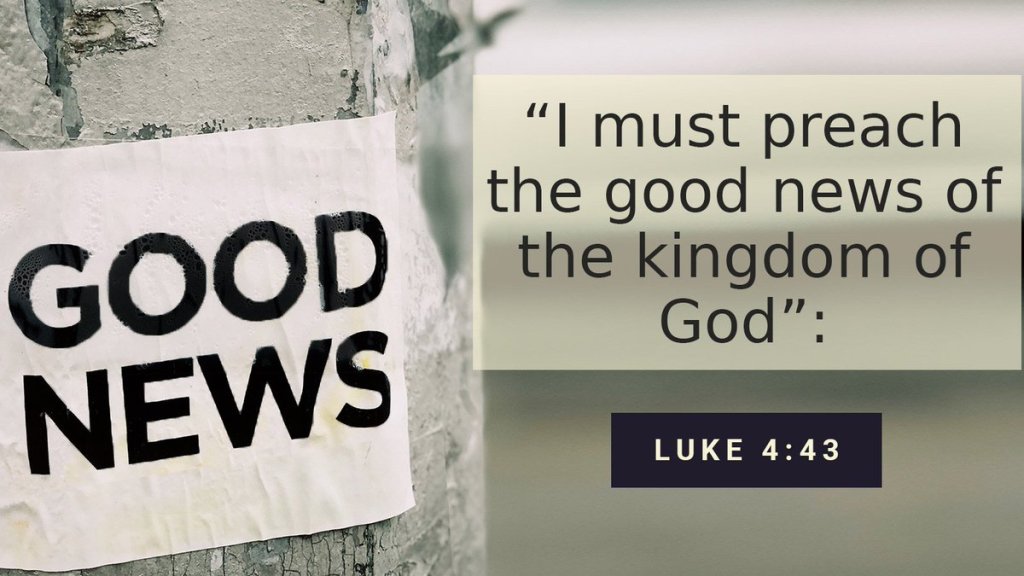
How Jesus Viewed Ministry Success: Focus on God’s Purposes. Luke 4.43

Luke 4:40-44Common English Bible

40 When the sun was setting, everyone brought to Jesus, relatives and acquaintances with all kinds of diseases. Placing his hands on each of them, he healed them. 41 Demons also came out of many people. They screamed, “You are God’s Son.” But he spoke harshly to them and wouldn’t allow them to speak because they recognized that he was the Christ. 42 When daybreak arrived, Jesus went to a deserted place. The crowds were looking for him. When they found him, they tried to keep him from leaving them. 43 But he said to them, “I must preach the good news of God’s kingdom in other cities too, for this is why I was sent.” 44 So he continued preaching in the Judean synagogues.

The Word of God for the Children of God. Gloria! In Excelsis Deo! Alleluia! Amen.

Ministry success is easily attributable to Jesus.

He captivated thousands because he taught “as one with authority” (Mark 1:22). He was utterly unique, like no one they had ever seen nor heard before.

Each Child of God is utterly unique, like no one else anyone has seen before. We all uniquely offer a unique diversity of God given gifts to God’s unique kingdom.

He made himself available to people when they needed a presence – (verse 40)

He did something incredible positive with His availability – healing – (verse 40)

He did something incredibly powerful with His availability – rebuking demons with an unheard-of authority (verse 41).

He was incredibly available and incredibly flexible, would preach to thousands, heal the sick, and spend time with the untouchables. At one point, his renown, authority was so great that people tried to make him king by force (John 6:15).

He took time for himself – to make himself available to His Father in Heaven. (Verse 42) How frequently do we honor our Father by honoring His Sabbath?

How often do we prioritize making ourselves available to God and his healing? Do we value “setting ourselves apart” and permitting God to Minister unto us?

Rabbi Jesus recognized that his ministry was ever changing according to the purposes set aside by His Father in Heaven and he needed to be flexible in his ministry – keeping his focus on the purposes of his Father God knowing when to move onto the diversity of needs, addressing the needs of people elsewhere (verses 43 and 44).

Rabbi Jesus could have stayed where he was and regularly had large crowds gather in his presence. But what did Jesus do with this “ministry success?”

Did he set up headquarters, hang up signs, pass out flyers, and increase seating capacity? Did he get hung up on denominational differences, and divisiveness?

Did he stay with the people begging him to remain and bask in their adoration?

Praise God! Absolutely not. That’s not how Jesus defined ministry success.

Real Ministry Success

Rabbi Jesus focused only on his God ordained purpose: to teach the truth. Jesus repeatedly says this in passages like John 18:37 and Mark 1:35–39, as well.

Jesus did not look to boasting of the crowds as proof of his success in ministry. He did not withhold his identity from people flocking to hear, see, touch him.

His sole focus? He did and said only what the Father led him to do (John 5:19).

For what purpose of His Father God was His Son, Rabbi Jesus led to do?

Preach the Gospel — Announce the Good News to all people.

Luke 4:14-19Common English Bible

Jesus announces good news to the poor

14 Jesus returned in the power of the Spirit to Galilee, and news about him spread throughout the whole countryside. 15 He taught in their synagogues and was praised by everyone.

16 Jesus went to Nazareth, where he had been raised. On the Sabbath he went to the synagogue as he normally did and stood up to read. 17 The synagogue assistant gave him the scroll from the prophet Isaiah. He unrolled the scroll and found the place where it was written:

18 The Spirit of the Lord is upon me,
    because the Lord has anointed me.
He has sent me to preach good news to the poor,
    to proclaim release to the prisoners
    and recovery of sight to the blind,
    to liberate the oppressed,
19     and to proclaim the year of the Lord’s favor.[a]

For what other purposes did God send His Son?

Offer the people an everlasting connection to God.

Offer the people an everlasting relationship to God.

Offer the people an everlasting Koinonia – fellowship with God.

John 3:16-17English Standard Version

For God So Loved the World

16 “For God so loved the world, [a] that he gave his only Son, that whoever believes in him should not perish but have eternal life. 17 For God did not send his Son into the world to condemn the world, but in order that the world might be saved through him.

Luke 19:10English Standard Version

10 For the Son of Man came to seek and to save the lost.”

John 10:14-18English Standard Version

14 I am the good shepherd. I know my own and my own know me, 15 just as the Father knows me and I know the Father; and I lay down my life for the sheep. 16 And I have other sheep that are not of this fold. I must bring them also, and they will listen to my voice. So, there will be one flock, one shepherd. 17 For this reason the Father loves me, because I lay down my life that I may take it up again. 18 No one takes it from me, but I lay it down of my own accord. I have authority to lay it down, and I have authority to take it up again. This charge I have received from my Father.”

A thought. It can be tempting to look at success in ministry as a numbers game.

Our logic?

The more people that come to our church or ministry, the more successful we are in the kingdom.

Except numbers never define success – God defines success by relationships.

Steadfast and Immovable, Faithful under all circumstances, Connections, Koinonia, Fellowship, Relationships with Him, His Son and the Holy Spirit.

God defines success in relationships by His Son’s understanding of Success:

Mark 10:42-45English Standard Version

42 And Jesus called them to him and said to them, “You know that those who are considered rulers of the Gentiles lord it over them, and their great one’s exercise authority over them. 43 But it shall not be so among you. But whoever would be great among you must be your servant, [a] 44 and whoever would be first among you must be slave[b] of all. 45 For even the Son of Man came not to be served but to serve, and to give his life as a ransom for many.”

God’s Servant Leader Rabbi Jesus is a great example for what success looks like.

Jesus teaches us that success is not merely defined by popularity or crowds, but by our steadfast and faithful obedience to God and to his purposes for our lives.

Faithfulness is the key to ministry success.

But don’t misunderstand me. I don’t define faithfulness as merely plodding along, barely making a ripple for the Kingdom of God…

…not even close!

What’s the root word in faithfulness? Faith!

Jesus didn’t simply bumble along.

He had absolute faith in what the Father had called him to do.

So much faith that he bet his entire life on it.

To faithfully pursue God’s purpose means two things:

  1. To desire his will infinitely more than our own finite and temporary glory.
  2. To believe he will accomplish his mission in us and through us for His sake.

Are we faithfully Pursuing God’s Mission?

So, are we pursuing God’s mission for us?

So, are we aware of God’s purpose for us?

Our ministry and mission fields might be:

  • Our family, both biological and church families
  • Our workplace,
  • Our schools,
  • Our communities and neighborhoods,
  • Our vocational ministry – inside the church, missional outside the church,
  • Our volunteer work,
  • Or anywhere else God ordains us to be (Isaiah 6:8-11).

Define your mission field.

Refine your measurement of ministry success.

And above all, have a steadfast and immovable faith – God always accomplishes his will— God will always fulfill His purpose for me, and he will do so through you, too.

Psalm 138:8English Standard Version

The Lord will fulfill his purpose for me;
    your steadfast love, O Lord, endures forever.
    Do not forsake the work of your hands.

Individually, how well do we, in our contemporary 2022 context, understand our God (not ourselves) fulfilling His singularly unique purpose for our lives?

Individually, how well do we, in our contemporary 2022 context, understand faithfulness to God’s fulfilling of our singularly unique purpose for our lives?

Individually, how well do we, in our contemporary 2022 context, understand faithful obedience to God’s fulfilling of our singularly unique purpose for us?

In the name of God, the Father and God the Son and God the Holy Spirit,

Let us Pray,

Sovereign God, You have authored my life, have ordered each of my steps and opened this door to success in my life. With this new path comes a new uncertainty that tempts me to fear. Make me strong, Mighty God! Make me courageous, God of Heaven! In the face of new challenges, I will trust You. For from You comes Your Spirit which empowers me to be Your witness in all circumstances. In Jesus’ name. Gloria! In Excelsis Deo! Alleluia! Alleluia! Alleluia! Amen.

https://translate.google.com/

Blessed Assurance! God HAS got My Back! Will I trust God to “Be There?” Will I fall Backwards into His Hands? Isaiah 6:8-10.

Isaiah 6:8-10ESV

Isaiah’s Commission from the Lord

And I heard the voice of the Lord saying, “Whom shall I send, and who will go for us?” Then I said, “Here I am! Send me.” And he said, “Go, and say to this people:

“‘Keep on hearing,[a] but do not understand;
keep on seeing,[b] but do not perceive.’
10 Make the heart of this people dull,[c]
    and their ears heavy,
    and blind their eyes;
lest they see with their eyes,
    and hear with their ears,
and understand with their hearts,
    and turn and be healed.”

The Word of God for the Children of God. Gloria! In Excelsis Deo! Alleluia! Amen.

It is that old familiar scene on any playground populated by young kids and their parents – the young child closes their eyes, turns their backs to their moms or dads and suddenly out of the blue they yell out: “Catch Me” as they lean out their arms as far and wide as they can and then free fall backwards.

Hopefully that young child hears their Mom’s or Dad’s voice: “Here I Am!”

And prayerfully, Mom or Dad is quick enough to catch their free-falling child.

We trust our parents to be there when we need them.

We need to not just hear of that trust but to actually feel that trust for ourselves.

We need to experience that trust then we can give that trust back to them.

Whether we fall forward or backwards, we need to know someone will catch us.

Not just catch us – some of the time (pranking us) but absolutely all the time.

So, here in our text from Isaiah chapter 6, God has just empowered Isaiah for a mission of who knows what kind of magnitude and God’s knows what purpose.

Without question, Isaiah utters these “famous first and last words” ….

“Here I am! Send me.”

These words are among the most famous of Old Testament texts.

Often, they are taught in a motivational light in an attempt to inspire people to completely leave behind whatever they were doing and to step up, to serve God.

Sadly, what is frequently left out is the mission that Isaiah was volunteering for.

But God did not try to hide His mission and message from Isaiah before he sent Isaiah back; he was straightforward.

However, behind and underneath all of that were these unwritten, but certainly implied questions and statements by God,

– “In this exact moment, I need to know how much you trust me, Isaiah?”

– “In this singular moment of your life, how far does your trust of me extend?”

– “Exactly right now, Isaiah, do you completely trust me with your whole life?”

– “Will you free-fall backwards into my arms when not having a good day?”

– “Will you always move forwards – even in those most very uncertain of days?”

– “Even when distrust of Me becomes your first desire, will you still go for Me?”

– “Even if it means Me getting behind you, subtly or not so subtly, pushing you forward against your will, into places we both know you would rather not go?”

“Think about these things, Isaiah. take what time you need. I will still be here!”

Now, ask yourself this question- How much time elapsed before Isaiah said:

“Here I am! Send me.” 

An hour? A day? “A week?”

An immediate response – no time lapse at all?

What can be implied by Isaiah’s apparent and immediate response?

Isaiah’s Immediate and Unconditional and Unquestioning Trust in the Lord?

The unsaid, immediately understood – “Yes! Lord! I know you have my Back?”

“Yes! Lord! I absolutely trust that You WILL have my Back 100% of the time?”

Do you somewhere believe maybe Isaiah had crossed fingers behind his back?

Or that his expression of ““Here I am! Send me.” was utterly unconditional?

If you had been the one called away by God in such a moment as Isaiah’s, would there be “every available finger crossed” behind your back – toes crossed too?

Immediate, Unquestioned and Unconditional Trust – given to God on the spot?

“Just like that?”

Is that exact, exacting magnitude of trust really somewhere in human nature?

Consider what we are not considering nor even aware of in that exact moment:

Sadly, what is frequently left out is the mission that Isaiah was volunteering for.

Blindly, Deafly, and Boldly, moving forward in some direction through the ages with a very specific mission known only but to God message to who knows who?

Are we really so prepared to be that trusting with what Isaiah was trusted with?

Isaiah was called to be an unpopular preacher with an unpopular message.

Despite the enormous risks – that Scripture never really specifically identifies?

For a God no one’s ever personally seen – Jesus will be born in about 800 years.

Isaiah 6:8English Standard Version

Isaiah’s Commission from the Lord

And I heard the voice of the Lord saying, “Whom shall I send, and who will go for us?” Then I said, “Here I am! Send me.”

Just what indescribable magnitude of trust did Isaiah possess in those days?

Just what undeniable magnitude of trust did Isaiah just communicate to God?

Essentially, God instructed Isaiah:

“{consistently, continuously, constantly} Tell your countrymen,
Listen, but the words will go in one ear and out the other.
Look, but you’ll never realize what you’re looking at, never get it.
Your hearts are going to be hard, your ears shut, and your eyes blind.”

Isaiah 6:9-10 ESV

The commentator Matthew Henry wrote of this passage, “there are many who hear the sound of God’s word, but do not feel the power of it.”

There are a few hard lessons for us to be learned here.

For starters, God’s word does not only soften us, it also hardens us.

Those to whom Isaiah was called to speak God’s words to were going to be willfully obstinate and oppositional and therefore hard toward the truth.

Considering such a magnitude of obstinance and opposition, how easy or how hard was it for Isaiah to maintain his covenant promise of unconditional trust?

If this passage of Isaiah were transplanted into 2022, how easy or hard would it be for Isaiah (for us) to maintain his covenant promise of unconditional trust?

What do you think his conversion rate was then?

What do you think or believe his conversion rate would be in 2022?

By our standards today would we hold Isaiah up as a picture of ministerial success or nothing but his wasted time, effort and money and resources?

Or would we declare him irrelevant for the times we are living in and with a brush of our 2022 theology cast him aside as unloving and non-anointed?

What this encounter with God should teach us, is that first and foremost our success should be gauged by our actual unconditional trust and obedience.

Such a magnitude of unquestioning trust and obedience to God will most certainly produce fruit, but we may not always be able to see it right away.

Still, we must ever be unconditionally prepared to fall back into the trusting arms of our Savior Jesus Christ – knowing He WILL always be there to catch us.

Isaiah’s work and message may have seemed to him incessantly grim, and a burden which grew heavier and heavier, more and more impossible to bear.

Our work and message in 2022 are not that much different from Isaiah’s and undoubtedly bear the same magnitude of burden – still we bear it up for God.

Will we be there for each other as God is always there for us in Christ Jesus?

In the name of God, the Father and God the Son and God the Holy Spirit,

Let us Pray,

Loving Heavenly Father, Author and Solemn Protector of my life. You have loved me with unconditional, immeasurable love. You are love. My life is wide open. I pray that I will be strengthened in my inner being – in my soul – with the love and trust that is wider than I can understand, deeper than I am able to imagine, and greater than I could ever know. As You encourage and embolden me, may I more fully know and trust the mystery of the Gospel as revealed in my life. In the love of Christ, I pray. Gloria! In Excelsis Deo! Alleluia! Alleluia! Alleluia! Amen.

https://translate.google.com/


A Most Amazing Question: If God is for Us Who Else Can Be Against Us? God has Got Your Back! Romans 8:31

Romans 8:31Amplified Bible

31 What then shall we say to all these things? If God is for us, who can be [successful] against us?

The Word of God for the Children of God. Gloria! In Excelsis Deo! Alleluia! Amen.

Amazingly enough, this is a question that we should be asking ourselves regularly. ‘If God is for us, who can be against us?’ 

In Romans 8 alone, Paul has written extensively to prove this very point.

God loves us, he sent his son Jesus to die for us, he gave us the Holy Spirit to be our counselor and guide and to remind us of everything Jesus told us.

In lieu of this, this question holds amazing implications for us as believers… understanding the dynamics of how God feels about you will change your life.

When we are holding this perspective in view and weighing everything else that happens against this revelation of God’s unceasing love, unceasing protection towards you and me, then the rest seems less than relevant and unimportant.

David held this perspective throughout his entire life, he wrote in the Psalms, “The LORD is with me; I will not be afraid. What can man do to me?” (Psalm 118:6).

He penned this in the midst of the high potential for great turmoil and unrest.

Reasonably, the people would be mightily afraid of that turmoil and unrest as in the briefest of moments people’s lives could go from wonderful to catastrophic.

Reasonably, the people wanted to know who would protect them and who could protect them and who should be protecting them from the coming Roman fury.

Significant questions to ask since no human being could long stand against a Roman soldier with Roman training carrying Romans Swords, Roman Spears.

Who could stand up to or against the commands of an unstable Emperor Nero?

Based on human history, Paul knew the Emperor was going to do whatever was on his mind, was going to give his orders and his will would not be questioned.

Ask yourselves this question: how many times Paul had asked himself the same question during his missionary journeys when he had no control over his life, how much time did he have to live, who was going to be trying to end his words.

Paul undoubtedly had asked himself – “who was powerful enough, who was loving enough, who was strong enough, could protect him from “what’ next?”

But all of his life – he had earned one very valuable lesson – there was always God who would never, ever leave his side under any circumstance (Psalm 121)

He could write about God’s eternal vigilance (Psalm 23) because he knew God and knew that God always loved him and in light of that, nothing else mattered.

Just as asking this question is important, so is our reminding ourselves of the answer. 

‘If God is for us, then who is against us?’ 

Who can be our foe if God is on our side?

With growing confidence, Paul goes on in the next couple of verses to explain how God is the one who justified us (Romans 8:33) and Jesus is the one who died for us (Romans 8:34) so in reality who can bring an accusation against us.

This is so critically important to teach our children, the stranger on the street.

This is so critically important for everyone to hear.

This is so critically important for everyone to listen to.

This is so critically important to for everyone to learn.

This is so critically important to understand.

This is so critically important for us to “wrap our minds and our lives” around.

So many people, too many people miss it in life, take God’s grace for granted, if they do not understand the boundless extent of God’s daily love towards them.

Jude tells us to keep ourselves in the love of God (Jude 1:21) because he knew that having this revelation equips the saints to be powerful in the kingdom.

It is amazing to me to know that God chose me and called me to be his child.

It is beyond amazing to know Jesus died for me, while yet his enemy, and sits at the right hand of the Father interceding for us all – “As Iron Sharpens Iron!”

It is amazing to know that nothing can separate me from his love.

Understanding this will empower you to overcome any obstacle you face.

Understanding this will release you from the fear that keeps you in chains.

David said in the Psalm, 

“The LORD is my light and my salvation- whom shall, I fear? The LORD is the stronghold of my life- of whom shall I be afraid?” (Psalm 27:1). 

And in today’s passage Paul asks,

What, then, shall we say in response to this?” 

What is there to say?

Could anything be a stronger encouragement to faith than the unalterable evidence of what God has already done for the salvation of His people of faith?

God is the Sovereign Lord, and it is from Him that our salvation comes and with Him that our salvation forever rests and remains undeniably, eternally secure.

God who gave so amazingly and so abundantly of Himself to provide salvation will certainly give continued, final salvation, protect His Children at all costs.

To those who are “in Christ Jesus” ……

there are no rational grounds for apprehension for their salvation is secured.

In spite of my many unanswered questions,

with my whole heart, I believe.

I believe in the living God, the joy of the universe,

  who is the pulse and purpose of all things seen and unseen,

  who from the dust of earth calls up living beings to be children of eternity,

  who through countless ages has provided for us many liberators

  and tirelessly seeks to bring victory out of defeat and life out of decay.

I believe in Jesus the Christ, God’s one and only true Son,

  who is bone of our bone and flesh of our flesh,

  who took upon himself the healing of the human race,

  who bearing the burden of our sins went to Golgotha carrying his cross,

  who was betrayed, crucified, dead and buried in a borrowed tomb,

  who on the third day was found to be gloriously alive,

  meeting with those who trust him and serve him to the end of the world.

I believe in the Holy Spirit of God,

  within and among all who cherish Christ and his way, truth and life

  who brings hope out of despair, love out of apathy, and joy out of sorrow,

  who unceasingly regenerates and reforms and transforms His church

  that it may always be the contemporary body of the risen Christ,

  loving the world through prayer, word and deed.

I believe that even I am caught up in the resurgent life of Christ Jesus,

  and that nothing in life or death can separate me from his love and joy.

In spite of unanswered questions, yes! I believe. Amen!

This affirmation, this glorious revelation leaves me absolutely speechless!

Today, I am blessed to know and understand that God loves me, and nothing can or will separate me from him.

Today we celebrate our life for what and where it is, with our families, may we take time to praise God for the marvelous thing he has done by sending Jesus.

In the name of God, the Father and God the Son and God the Holy Spirit,  

Let us Pray,

Thank You, God, for being my Father and forgiving all my sins, not because I deserve it, but because in absolute love Christ died in my place to pay the price for my sins, all of them. Thank You for all You have done for me, will continue to do, and that my future glorification is as equally complete in Christ as my past justification, when I first trusted Jesus as my only Savior. Thank You that because I am in Christ, You are 100% ‘for me.’ Let me never forget that amazing truth. In Jesus’ name I pray, AMEN.

https://translate.google.com/

Consistent Habits Will Consistently Change Everything. The Key to Desire God’s Word and Prayer. Psalm 119:18

Psalm 119:17-24Amplified Bible

Gimel.

17 
Deal bountifully with Your servant,
That I may live and keep Your word [treasuring it and being guided by it day by day].
18 
Open my eyes [to spiritual truth] so that I may behold
Wonderful things from Your law.
19 
I am a stranger on the earth;
Do not hide Your commandments from me.
20 
My soul is crushed with longing
For Your ordinances at all times.
21 
You rebuke the presumptuous and arrogant, the cursed ones,
Who wander from Your commandments.
22 
Take reproach and contempt away from me,
For I observe Your testimonies.
23 
Even though princes sit and talk to one another against me,
Your servant meditates on Your statutes.
24 
Your testimonies also are my delight
And my counselors.

The Word of God for the Children of God. Gloria! In Excelsis Deo! Alleluia! Amen.

Let us begin with a short prayer from today’s biblical text for this devotion,

17 
Deal bountifully with Your servant,
That I may live and keep Your word [treasuring it and being guided by it day by day].

In the name of God, the Father and God the Son and God the Holy Spirit. Amen

The prayer of the Psalmist is for God to deal “bountifully” with His servant.

We read this prayer because we opened our Bibles, and we opened our eyes.

When we opened our eyes, we gave God full and unfettered access to our souls.

Except,

When we never open up our Bibles, what will we consistently never find?

When we sporadically open up our Bibles, what do we consistently expect to find?

When we consistently open up our Bibles, what do we consistently expect to find?

When we habitually open up our Bibles, who do we consistently hope to find?

When we habitually open our eyes to read our Bibles, what is likely to happen?

If like David, we could, would, should, expect to discover “wondrous things.”

If we are like David, we expect to discover “wonderful things” done by God.

Remember, David only had a small portion of the Bible God’s given us today!

The reality is this…

There is no wasted moment reading God’s Word!

Let me qualify that statement a bit – there is no wasted moment reading God’s Word when we do with consistently open eyes, consistently open hearts, souls.

Even if you only read a single verse, you are hearing from God himself.

And you have the chance to “behold wondrous GOD things” in his Word.

From now on, starting today, learn a new habit, never let a single day pass without consistently reading at least one verse.

We can do that, right?

With consistent practice, then “enlarge thy tent”- read two… Three… Four…

And before you know it, you are consistently reading whole entire chapters.

This tiny habit, consistently done will consistently snowball and change your life.

Will we do this?

Perhaps and then again, perhaps not ….

Psalm 1:1-2Amplified Bible

Book One

The Righteous and the Wicked Contrasted.

[a]Blessed [fortunate, prosperous, and favored by God] is the man who does not walk in the counsel of the wicked [following their advice and example],
Nor stand in the path of sinners,
Nor sit [down to rest] in the seat of [b]scoffers (ridiculers).

But his delight is in the law of the Lord,
And on His law [His precepts and teachings] he [habitually] meditates day and night.

Perhaps we are in that moment of life when we are not consistently feeling so blessed, not feeling so very fortunate, or so prosperous and so favored by God.

And that is why we have our eyes and our hearts, and our souls closed off now.

Psalm 13:1-4Amplified Bible

Prayer for Help in Trouble.

To the Chief Musician. A Psalm of David.

13 How long, O Lord? Will You forget me forever?
How long will You hide Your face from me?

How long must I take counsel in my soul,
Having sorrow in my heart day after day?
How long will my enemy exalt himself and triumph over me?


Consider and answer me, O Lord my God;
Give light (life) to my eyes, or I will sleep the sleep of death,

And my enemy will say, “I have overcome him,”
And my adversaries will rejoice when I am shaken.

Have you ever spent seasons where consistently getting into the Bible felt more like ceaseless drudgery than ceaseless delight?

Where you perhaps have felt guilty, because you knew you should be studying God’s Word every day, but you just simply never felt like consistently doing it?

If so, you’re not alone.

Many “steadfast, stout hearted” Christians said that their biggest struggle in their devotional life was a lack of desire to “read the Bible and to pray daily.”

This certainly isn’t something to feel guilty about.

Instead, it’s a consistent reality a lot of us will consistently face every day.

One has to wonder – if we consider all of the intrigue David experienced on a daily basis, if we recall all of his efforts to hide from Saul, avoid his enemies and avoid his own son, Absalom, his hours, days and weeks spent hiding in caves,

Did David really have the time to consistently read and study God’s Scriptures every single day – or have them read and then interpreted to him “on the run?”

But what if it could be different for us?

Imagine this…

Changing your mindset …. use what we have learned from our consistently inconsistent efforts at reading and studying and praying through the Bible,

To learn a new habit – we can consistently and habitually get our hearts, minds and souls into…… letting God open our eyes, revealing, teaching us about trust.

Psalm 13:5-6Amplified Bible


But I have trusted and relied on and been confident in Your lovingkindness and faithfulness;
My heart shall rejoice and delight in Your salvation.

I will sing to the Lord,
Because He has dealt bountifully with me.

A great place to begin learning and practicing this new habit is with Psalm 119.

This lengthy but beautifully written Psalm has its entire focus on the Word of God, which contains the instructions of our Heavenly Father for His Children.

How we consistently need the Word of God, for it is our daily food, and it is refreshment for our souls.

Psalm 119:1-7Amplified Bible

Meditations and Prayers Relating to the Law of God.

[a]Aleph.

119 How blessed and favored by God are those whose way is blameless [those with personal integrity, the upright, the guileless],
Who walk in the law [and who are guided by the precepts and revealed will] of the Lord.

Blessed and favored by God are those who keep His testimonies,
And who [consistently] seek Him and long for Him with all their heart.

They do no unrighteousness;
They walk in His ways.

You have ordained Your precepts,
That we should follow them with [careful] diligence.

Oh, that my ways may be established
To observe and keep Your statutes [obediently accepting and honoring them]!

Then I will not be ashamed
When I look [with respect] to all Your commandments [as my guide].

I will give thanks to You with an upright heart,
When I learn [through discipline] Your righteous judgments [for my transgressions].

When I slowly, subtly, begin to give thanks to God with an upright heart ……

When I slowly, subtly begin to learn ….

When I slowly, subtly, begin to discover ….

When I slowly, subtly, begin to change what I believed to be unchangeable ….

When through discipline, I start to realize it is God who is consistently trying to reveal something indescribably wonderful – to “shock open” my eyes and soul.

How we should consistently treasure the Word of God, for it is our #1 guide and #1 teacher, our strength, and our #1 sure and certain and consistent defense.

How we should consistently read, mark, learn, and inwardly digest the Word of God, for it is consistent life and health, it is peace and light, it is joy and hope.

And as the Psalmist trawls the depth of its treasures, his whispered prayer is: “Open my eyes, that I may behold Wonderful things from Your Law.”

We are not only servants and students of the Word, but we are sons and daughters of its Author, and so that should stir our hearts to search the Scriptures daily to discover the truths in which the Lord desires to teach and train us, as well as the areas in which He seeks to guard and correct us.

As His children, we should treasure His Word in our heart that we might not sin against Him, and as we reach for our Bible, our prayer should mirror that of the Psalmist: “Open my eyes, that I may behold Wonderful things from Your Law.”

We need to ensure that our eyes are wide open to all that is in the Word as we saturate ourselves in His wonderful ways, reflect on the beauty of His person.

We should crave for the milk of the ever-Living, ever transformational, Word of God so that we may continually grow in grace and in a knowledge of the Lord Jesus, and we should habitually meditate upon the meat of the Word so that we may walk in spirit and truth and live in submission to the guiding of the Spirit.

Day by day, our prayer should consistently be: “God, my Father, God, my teacher, open my eyes, that I may behold Wonderful things from Your Law.”

When our eyes are open and earnestly looking to Jesus, they are not searching out the things of this world.

When our heart is gasping for the Lord, it is not lusting after the things of the flesh.

But when our eyes are consistently closed in disinterest or discouragement, our own imagination can be consistently, tragically, funneled in a wrong direction.

Let us continually, consistently look to the Lord in excitement, open our eyes in prayerful expectation that we WILL see the wonderful things that are written in Scripture and contemplate on the glories that are contained in the Word of God.

In the name of God, the Father and God the Son and God the Holy Spirit,

Let us Pray,

Heavenly Father, I pray that You will open my eyes, that I too may behold wonderful things from Your Law. Open my eyes so that I may contemplate the glories of Your person and gain nourishment from Your instruction. Open my eyes, I pray, to see the consistently wonderful truths in the precious Word of God. In Jesus’ name, AMEN.

https://translate.google.com/

Leading Lives of Consistency. Nehemiah 11:1-2, 1 John 2:4-6

Nehemiah 11:1-2 Amplified Bible

Time Passes; Heads of Provinces

11 Now the leaders of the people lived in Jerusalem; but the rest of the people cast lots to bring one [person] out of ten to live in Jerusalem, the holy city, while nine-tenths remained in the other cities. And the people blessed all the men who volunteered to live in Jerusalem.

The Word of God for the Children of God. Gloria! In Excelsis Deo! Alleluia! Amen.

As time passes us by ……

And time will consistently pass us by ……

We can consistently bet our lives on it and time will always consistently win.

As the clock keeps right on ticking even after we remove the inner workings of the watch, even after we slam the snooze button, or we unplug the alarm clock.

Examining pros and cons, benefits, detractions of daylight savings time.

Time keeps right on going whether we like it or not, consistently, every second.

Time is going to do whatever it is time wants to do – consistently, every single moment of every single second of every single day – for quite literally, eternity.

How do we consistently contemplate leading lives of such equal consistency as Christians in this consistently busy, consistently fast paced, changing world?

To begin with, we might try consistently contemplating our living out this consistency exactly where God has placed us.

We are needed where we are planted, in our homes and community as a church.

There are constantly people who consistently live with real needs all around us.

What if we consistently sacrificed our lives on a daily basis, celebrating what God has done in us, by serving others and sharing the good news of Jesus? What if we consistently stepped out into God’s neighborhood to make a difference?

In Nehemiah 11, we see a people, immediately after rededicating their lives to the Lord their God, and renewing their covenant with Him in chapter 10, stayed consistent and began taking consistent and decisive, definitive steps to fulfill their renewed covenant commitment by moving their lives into Jerusalem.

This was not an easy or safe task, but one that showed their consistent devotion to God, which they declared in the previous chapter 10.

What we learn from this is that leading lives of consistency is not a one-time thing; not once a month, not weekly, but hourly and even second by second.

We are called to consistently sacrifice for God’s mission and to be an example (of Jesus) to others consistently.

It is forever easy to say you want to be more constant with your walk with Jesus after a great night of worship, but it is another to live it out in all your daily life.

How consistent are you to consistently live out the faith you consistently profess?

Can you make a change today that will help you live more consistently for Jesus?

1 John 2:4-6Amplified Bible

Whoever says, “I have come to know Him,” but does not habitually keep [focused on His precepts and obey] His commandments (teachings), is a liar, and the truth [of the divine word] is not in him. But whoever habitually keeps His word and obeys His precepts [and treasures His message in its entirety], in him the love of God has truly been perfected [it is completed and has reached maturity]. By this we know [for certain] that we are in Him: whoever says he lives in Christ [that is, whoever says he has accepted Him as God and Savior] ought [as a moral obligation] to walk and conduct himself just as He walked and conducted Himself.

Now, we will discuss other side of consistency being inconsistency. What does it look like when you know that someone’s words are different than their actions?

In 1 John 2 we see a sobering picture of what consistency is, and what it is not.

Paraphrasing the first part of chapter 2, John essentially says that if you say you have “consistently” received the love and grace of Jesus Christ, but do not live by His commandments, then you are a liar, and the truth of God is not in you.

In other words,

if you have put your faith in Jesus and there is no outward change, no want nor desire to know Him more, no want to love the things He loves, no care for His mission with consistency, then you should stop and really examine your heart.

You should contemplate stopping and examine your walk and relationship with Him, because something consistently appears to be consistently out of order.

Our walk and growth in Jesus will never be perfect… so please do not hear me saying when we have the slightest mess up, we should question all of our faith.

What I am saying is what John is: when we do sin, we have an advocate with the father, who has paid the price for our mess-ups and His name is Savior Jesus.

Lord and Savior Jesus set the perfect example, which should consistently serve to consistently inspire us to consistently strive for consistency in all our faith.

Someone who is consistent behaves in the same way, has the same attitudes towards people or things, or achieves the same level of success in something.

In consistency, there is no contradiction.

there is continuity, practice, determination, faithfulness, balance, harmony, stability, orderliness, reliability and quality.

As Christians, we need to accept nothing less than true consistency!

Paul and Barnabas spoke of the need for a congregation to be consistent 

– Acts 13:43 43 Now when the congregation had broken up, many of the Jews and devout proselytes followed Paul and Barnabas, who, speaking to them, persuaded them to {consistently} continue in the grace of God

Consider contemplating Acts 14:22 22 strengthening the souls of the disciples, exhorting them to {consistently} continue in the faith, and saying, “We must through many tribulations enter the kingdom of God.”

From God’s own Words, the declaration is clear that we as Christians should be consistent in godly living, consistently continue in the covenant ways of God.

There is no need for anyone to think that consistency is not needed in our lives!

When we do everything, God requires from us, we must not slack nor be distracted because there is nothing to glory about it.

We still have a whole lot more Kingdom work to do for the transformation process to continue. 

Luke 17:10 10 So likewise you, when you have done all those things which you are commanded, say, ‘We are unprofitable servants. We have done what was our duty to do.’” 

Reality: God has shown the greatest love to mankind by the death of His Son. God has done more for us by allowing us to find an entrance into His church.

Because more is consistently done for us, we have a consistent obligation to do more to ensure the transformation process God intends continues to manifest.

It not only brings consistency, but it also shows reflection that we are grateful to God for the work of redemption.

“To whom much is given — of them much shall be required.”

The blessings we consistently enjoy are not the fruit of our merit — but the fruit of God’s consistent and never changing and always and forever available mercy.

By how much the more grace we have received (Romans 6:1) — by so much the more the maximum magnitude of glory we are obliged to return unto the Giver. 

grateful mind is a great mind.

A consistent life means that we carefully consider the effect our lifestyle on our society.

A consistent life is a looking-glass, wherein Christ sees His own likeness. 

A consistent life means that we recognize that our dependency is on God. 

We must be consistent in our Christian lives because we know our consistency is not derived from our finite strength or finite skill but from the power of God. 

Godly duties performed are regarded before God when we allow Christ fills them.

Any good work we do can never be sustained without the support of Christ or the power of the Holy Spirit.

If we ever do any good work, it is still not the reason for our continued physical existence – Our Lord and Savior Jesus Christ is the very reason why we are alive.

When we have kept all the commandments, there is one commandment above all to be kept; that is, “all our righteous acts are like filthy rags!”

In most of our works — we are abominable sinners; and in the best of our works — we are consistently unprofitable servants, consistently unconscionable sinners.

Hebrews 13:8Amplified Bible

Jesus Christ is [eternally changeless, always] the same yesterday and today and forever.

Let us always go in the unchanging, unchangeable strength of our Savior God.

What areas of our “Christian life” are consistently showing inconsistency?

How can we consistently make those continuous changes God presents to us?

And consistently focus on what Jesus is consistently calling each of us to do?

In the name of God, the Father and God the Son and God the Holy Spirit,

Let us Pray,

Great God in heaven, unchanging, unchangeable Savior, I believe in you and trust in you. I want to walk as Jesus walked. I want to abide in You. Be with me as I go about my day. Help me to make wise, wiser, decisions as I work to be more like you. Amen.

https://translate.google.com/

Our Crossroads and God’s Roadmap. Jeremiah 6:16 and Matthew 7:13-14

Jeremiah 6:16Amplified Bible

16 
Thus says the Lord,
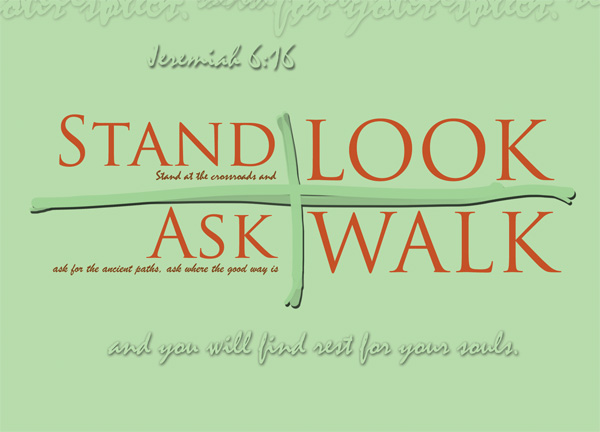
“Stand by the roads and look; ask for the ancient paths,
Where the good way is; then walk in it,
And you will find rest for your souls.
But they said, ‘We will not walk in it!’

Matthew 7:13-14Amplified Bible

The Narrow and Wide Gates

13 “Enter through the narrow gate. For wide is the gate and broad and easy to travel is the path that leads the way to destruction and eternal loss, and there are many who enter through it. 14 But small is the gate and narrow and difficult to travel is the path that leads the way to [everlasting] life, and there are few who find it.

The Word of God for the Children of God. Gloria! In Excelsis Deo! Alleluia! Amen.

Just because a certain path seems right does not mean it’s the right one to take.

But that does not mean it is wrong either.

We must, therefore, ask and trust God to show us which way to go.

He knows the end from the beginning.

God will lead us in the right way.

“You make known to me the path of life; in your presence there is fullness of joy; at your right hand are pleasures forevermore.” Psalm 16:11.

What a wonderfully assuring thing it is to believe that even when we are faced, confronted by the biggest and most difficult decisions in life, the Word of God for the Children of God makes known to us the sure paths that will bring life.

WHAT ARE CROSSROADS?

Literally, a crossroad is a road that crosses another.

It is the place where two or more roads intersect.

Figuratively, to be “at a crossroad” is to be at a stage in one’s life when it is necessary to choose a path that will affect one’s life in truly profound ways.

A crossroad is a place of decision.

It is a place of doubts and questions.

A crossroad is a place where we wrestle with conflicting voices.

It is a transit point.

A crossroad is a gate or access point.

It is a place of separation and goodbye.

A crossroads is the end of a chapter and the beginning of another one.

A crossroad is a critical moment.

It can be a place of crisis, where the pains of yesterday connects us to the hope of the coming tomorrow.

A crossroad is a place of opportunity, where the road ahead offers promises.

A crossroad is a point in your life where you have several options that you need to weigh.

Each option on each crossroad will lead you to a different destination or goal.

Each path on each crossroad will to a different destination.

Crossroads are unavoidable.

Crossroads are inevitable.

Every day, we make significant decision that will affects our lives positively or negatively.

The choice to continue the same straight path is no longer possible.

A decision has to be made.

The straight road has now split into two or more.

Which decision will you make?

Looking left, right, back from where you came, and looking straight ahead.

Where do you turn?

Do you turn back to where you came, choose a path to follow, or do you stand around in the middle of the road and continuously scratch at your bald spot?

Which road is the right one?

And carefully, prayerfully weigh the consequence of choosing a decisive path?

Today, you may be standing at a crossroad.

Your crossroads could be one to decide your ministry or career path.

It could be the start or end of a relationship.

Your crossroad could be a choice of making a change right now or if you wait too long it might just become “too late” – whatever “too late” means to God.

It could be the choice of what course to study for what career field in college.

Do you make a choice of asking mom and dad – about entering into the military, or do you just go ahead on your own and enlist, ask for mom and dad’s support.

Your crossroad could be whether to start a business or hold on to your job.

It might be starting a relationship with that “special, lifelong someone,” and doing the career thing or to get married and starting a family of your very own.

Perhaps you are in a crossroad where you are faced with the decision to stay where you are or move on to another place – to another job or career field.

Perhaps it might even be a decision to finally put in your retirement papers.

Whatever pathway you decide to take, it will definitely affect the course of your life and destiny for an indeterminate period of time.

Are we ready for that “indeterminate period of time” right this exact moment?

When standing at the crossroads, the one thing we really need is guidance.

God definitely has set aside a path for us which leads to life! (Psalm 16:11)

He promises to guide, instructs, direct us when we are at the crossroads of life.

“Your ears shall hear a word behind you, saying, “This is the way, walk in it,” Whenever you turn to the right hand or whenever you turn to the left.” Isaiah 30:21.

God will always give you and me a direction to take in life.

But you and I still need to sharpen our hearing ability.

Matthew 7:13-14Amplified Bible

The Narrow and Wide Gates

13 “Enter through the narrow gate. For wide is the gate and broad and easy to travel is the path that leads the way to destruction and eternal loss, and there are many who enter through it. 14 But small is the gate and narrow and difficult to travel is the path that leads the way to [everlasting] life, and there are few who find it.

The parable of the two gates pictures the people of Earth walking on two roads.

One road is broad, and many walk that way.

The other road is narrow, and few find the gate to it.

These two roads don’t lead to the same place (Matthew 7:13-14).

We are fond of dividing the world into two.

We speak of the rich and the poor, but there are many people who are neither rich nor poor.

We speak of the bosses and the workers, but many people are neither, and some are both.

We speak of the educated and uneducated, but some people have education yet lack wisdom, whilst some uneducated people are very wise.

This just shows that dividing the world in two, or even three, is usually presumptuous, simplistic, inaccurate, and perhaps even alienating.

But does this apply to all cases?

In particular, is the world divided into the saved and the unsaved —those in God’s way and those following Satan?

Many folks would call that a presumptuous, simplistic, inaccurate, and alienating view of the world.

Only Two Ways

Rabbi Jesus, however, here divides humanity in just that manner: people are travelling either the broad road to destruction or the narrow road to life —just two groups and no exceptions (Matthew 7:13-14).

Later in that chapter, he again divides people into two groups: the wise who hear and do his words (Matthew 7:24), and the foolish who do not hear and do his words (Matthew 7:26).

On a later occasion, Jesus spoke of how he will, at the last judgment, separate the people of all nations into two “as a shepherd separates the sheep from the goats” (Matthew 25:32-33).

The “sheep” at his right hand will inherit the kingdom prepared for them (Matthew 25:34). 

The “goats” at his left hand will be sent into the eternal fire prepared for the devil and his angels (Matthew 25:41). 

When these two groups have gone their way, nobody else shall remain (Matthew 25:46).

So, when Jesus pictures the two gates, or two builders, or the sheep separated from the goats, he has included all human beings.

Each of us is on one of those pathways.

Or to point the finger, you, I, are in one of those groups. 

Which one?

The Way of the Many

Not only has Jesus divided the world in two, but appallingly, he has numbered those who are on the road to destruction as “many” and those on the road to life as only a “few” (Matthew 7:13-14).

Why are there “many” going in at the wrong gate, walking on the wrong road?

Jesus gives no reason for the number.

He does not even indicate that the number cannot be changed.

He leaves it open that the majority could walk the way to life, and only a few walk the way to destruction, or for that matter everyone could walk the way to life leaving deserted the road which leads to inevitable destruction.

When Jesus says, “enter by the narrow gate” (Matthew 7:13), presumably he means anyone who listens to him say that, can make the choice do exactly that.

Why would Rabbi Jesus tell everybody to enter by the narrow gate, and walk the narrow way, if most of them cannot do that?

You might say, “Jesus does give the reason why many go down the broad way.

The word translated narrow means difficult.

https://www.blueletterbible.org/kjv/mat/7/13-14/t_conc_936014

https://www.blueletterbible.org/lexicon/g2346/kjv/tr/0-1/

It’s the nature of human beings to choose what’s easy, not what’s hard.”

Well, I am not so sure.

People do all kinds of things that are difficult because they think those things are right, they enjoy the challenge, they deem the reward well worth the effort.

Surely the Christian life is a worthy challenge, and brings a wonderful reward, such that you would expect many more people to choose it than actually do.

Choosing Destiny

Anyway, there is nothing compelling people to follow the broad way leading to destruction, even though most people do.

Destiny doesn’t force people to follow one of the two roads.

They choose the gate they enter; they choose the road they walk; hence they choose their destiny.

There is nothing preventing people from following the right way leading to life, even though few do.

The Way of the Few

Although Jesus speaks of two roads, only one of them is of his making.

Jesus never desired that there be a road to destruction, and he never caused anyone to follow it.

The broad road represents a way of living designed by Satan.

Jesus provides an alternative way, represented by the narrow road.

When Jesus says, “enter by the narrow gate” (Matthew 7:13), he refers to the gospel way of living.

In early times, Christianity was actually called “the Way” (Acts 19:9,23).

In fact, Jesus called himself the way: “I am the way, the truth, and the life; no one comes to the Father except by me” (John 14:6).

Seeking the Way

When Jesus mentioned the narrow gate and the difficult path beyond it, he said, “And few there be who find it” (Matthew 7:14). 

There are two ways you can find something.

One is to stumble upon it by some fortunate circumstance; the other is to seek it by making an intelligent and systematic search.

Rabbi Jesus tells us which way to find the gate to the true way: 

“Ask, and it shall be given you; seek, and you shall find; knock, and it shall be opened to you” (Matthew 7:7 NASB).

Total Commitment

We can gather from this that walking the narrow way means making an absolute and total commitment to Jesus Christ.

It means loving him, obeying him, depending on him, worshipping him, giving all of us to him, being his utterly committed and utterly devoted disciples.

And where do we start?

The Holy Spirit tells us clearly what to do to begin this journey, as follows…

DIVINE GUIDANCE and DIRECTION!

“The Lord is my shepherd; I shall not want. 2 He makes me to lie down in green pastures; He leads me beside the still waters.” Psalm 23:1-2.

When God is your Shepherd, you have access to all things that you need.

Divine guidance is God having the final say in running the affairs of your life.

When He’s leading, you are never alone.

God has a definite blueprint for your life and a road map to get you there.

WHAT TO DO WHEN AT LIFE’S CROSSROADS?

1. Know God.

Do you know Him?

Most people know about God, but they don’t really know Him.

To know God is to spend time with Him.

It is a relationship!

To know God is to obey Him.

To know God is to fear Him.

To know God is to trust Him unconditionally.

You must have a continuous daily fellowship with the Holy Spirit.

2. Be known by God.

Are you a child of God? (John 1:12-13)

Is Jesus your Lord and Savior? (Romans 10:9-13)

You must be born again. (John 3:1-15)

3. Pray the prayer of enquiry.

Prayer of enquiry is prayer for insight, guidance and direction.

It is asking God what to do about a particular situation.

Prayer of enquiry is to know God’s will concerning an issue.

It is a prayer to ask God why? Which? How? and When but NOT Why?

Ask him to give you ears to hear and eyes to see the ways He is speaking to you.

Consider fasting occasionally to help you focus more on God.

4. You must have faith.

“For we walk by faith, not by sight:” 2 Corinthians 5:7.

It is not for those who will walk by sight or logic.

Have unconditional faith in God’s promises to guide you.

5. Cultivate the presence of God through praise and worship.

Praise invites God into your situation immediately.

And where God is, there is liberty and fullness of joy. (2 Corinthians 3:15-18)

He will guide you when you give Him high praise and worship.

6. Dig deeper in the Bible.

The Bible has been rightly defined as, “Basic Instruction Before Leaving Earth.”

The Bible is our spiritual GPS, always available to tell us which way leads to where we want to go and how to turn around if we get on the wrong path.

7. Be humble. Psalm 25:9.

He leads the humble in justice,
And He teaches the humble His way.

God loves humble people

8. Cultivate quietness.

Set aside a consistent time every day to meet with God.

Try starting out with a half-hour quiet time, and after you’ve developed greater intimacy with Him, increase that time to an hour.

It usually takes about five to ten minutes during the start of your quiet time to clear your mind enough to focus fully on God, so do not rush your quiet time.

9. Practice unconditional love.

Live without unforgiveness, malice, bitterness and anger.

10. Listen.

“My sheep hear my voice, and I know them, and they follow me.” John 10:27.

God can speak through the following ways:

His Word. Psalm 107:20.

Audible voice. Genesis 12:1;

Dreams. Judges 7:13.

Visions. Genesis 46:2; and Prophets. Ezra 9:11.

Let your heart be still. Psalm 46:10

Block out the distraction.

Tune in to heaven’s radio.

11. Seek wise counsel

To some people, crossroads are places of confusion.

Don’t be afraid to ask for directions and seek wise counsel from family, trusted friends, a pastor or counsellor.

12. Be patient; Don’t be in a hurry.

No matter how long it takes, be confident that God has heard your prayers and will respond. Let your mind be at rest. Don’t try to rush through the process.

“Show me your ways, O LORD; teach me your paths.” Psalm 25:4.

There is comfort in knowing God is guiding, leading and instructing us, especially when we are standing on crossroads.

But not many people are willing to ask for direction.

Come to God today!

Don’t live your life on logic, human reasoning, and trials.

It will only lead you to broken heart, failures and disappointments.

God has a better plan.

Don’t take steps on your own or make important decisions without asking Him.

Always strive to know the will of God concerning everything you are doing.

SO, WHAT’S OUR DECISION?

“Enter by the narrow gate; for wide is the gate and broad is the way that leads to destruction, and there are many who go in by it. 14 Because narrow is the gate and difficult is the way which leads to life, and there are few who find it.” Matthew 7:13-14.

There is no neutral ground.

The Lord Jesus, who on the Cross at Calvary made the greatest sacrifice for us at the crossroad of Golgotha, said there is a broad road that leads to destruction and a narrow road that leads to eternal life.

What road have you chosen?

If you realized you are on the wrong road, why not repent and get on the right road today?

If you are willing to repent and surrender your life to Jesus Christ, then pray this prayer right now:

LORD Jesus, I come to You right now. I know I am a sinner, please forgive me my sins. With my mouth, I declare that Jesus, from today, I accept You as the LORD of my life. Change my heart from a disobedient heart to a heart that will obey You. With my new heart, I believe that it is because of me that You came into this world; You died for my sins, take away my problems, fill me with Your Holy Spirit, write my name in the Book of Life, and make me brand new in Jesus mighty name.

PRAYER POINTS

1. O Lord, have Mercy for placing my confidence in human reasoning, in Jesus name.

2. By Your Mercy, O Lord, save me from every wrong decision I have made, in Jesus name.

3. O Lord, open up my spiritual understanding, in Jesus name.

4. O God, teach me deep and secret things, in Jesus name.

5. O Lord, thank You for the revelation power of the Holy Spirit, in Jesus name.

6. O God, remove from me every form of distractions that has blocked my spiritual eyes and ears, in Jesus name..

7. My Father, give me the spirit of revelation and wisdom in the knowledge of You, in Jesus’ name.

8. Open my spiritual eyes, O Lord, to see visions concerning my life, in Jesus name.

9. I reject the manipulation of the spirit of confusion, in Jesus name.

10. My Father, guide and direct me in knowing Your mind, in Jesus name.

11. If . . . (mention it) is not Your will for me, O Lord, re-direct my steps, in Jesus name.

12. Thank God for answering your prayers.

In the name of God, the Father and God the Son and God the Holy Spirit …..

https://translate.google.com/

Sometimes it Takes a Crisis to Know we Belong and are Connected to God.

John 15:4-5Amplified Bible

Remain in Me, and I [will remain] in you. Just as no branch can bear fruit by itself without remaining in the vine, neither can you [bear fruit, producing evidence of your faith] unless you remain in Me. 5 [a]I am the Vine; you are the branches. The one who remains in Me and I in him bears much fruit, for [otherwise] apart from Me [that is, cut off from vital union with Me] you can do nothing.

The Word of God for the Children of God. Gloria! In Excelsis Deo! Alleluia! Amen.

Do we BELONG anywhere or to anyone at any time in any one singular place?

Are we CONNECTED to anything or to any one which transcends ourselves?

Are we IN CONNECTION to anything or to anyone which transcends ourselves?

One of the most striking paradoxes of our current Internet, Broadband, WIFI, social media crazed culture today… is the crisis, believe it or not, of connection.

Never has our world experienced the level of connection that has become possible in just the last 10 years.

It’s become the world of social media globalization … an unlimited potential connection… What has emerged is the quite literal ability to be connected to anyone on the planet at any time …. and Time Zones do not seem to matter.

Yet never have people felt so disconnected….so alienated…so alone.

Sociologists and psychologists are describing the growing and deepening and darkening crisis of social alienation that is plaguing modern life.

Not just an issue of lacking popularity or social success…

Actress Winona Ryder Finds Fame Lonely

“When I was 18, I was driving around at two in the morning, completely crying and alone and scared. I drove by this magazine stand that had this Rolling Stone that I was on the cover of, and it said, ’Winona Ryder: The Luckiest Girl in the World.’ And there I was feeling more alone than I ever had.”

Citation: Winona Ryder, cited from Plugged In, Vol. 6, no. 4 (April 2001); submitted by Van Morris, Mount Washington, Kentucky.

There is a very simple premise to this journey…

The search for connection… is a search for the common.

• The very root of the word “community” is “common.”

Here lies the challenge –

The loss of some transcendent connection gives rise to a tendency to find identity through distinctions that prove destructive.

From niche marketing and clothing styles… to social cliques and gangs… to ethnic rivalries and nationalism…

we are so hungry to find ourselves…to belong … that our identify is often simply reduced to that of identifying with some sub-group over and against others.

And those connections prove not only destructive… but dissatisfying…. far too fragile to really provide the deep and long-lasting connection we all long for.

The desperate alternative is to try and simply diminish our differences… forge ahead with “out of thin air,” elusive ideas of common identity… communism, “new” and “untried” tendencies of ‘social tolerance’ and spiritual relativism.

Our Need – to discover the common in the midst of the unique… not a bland conformity… but unity amidst diversity without socio-cultural divisiveness.

The question of equality and inequality, checks and balances. Differences don’t divide when they are centered and secured in the commonalities that connect.

Everything everywhere comes across or is aggressively marketed to us as being “deliberately, catastrophically, maliciously” (politically) unbalanced, unequal.

What part of our daily existence is not being presented as the “ultimate crisis of inequality” requiring some manner of socio-economic, socio-political answer?

Is genuine “equality” even achievable?

Biblically – Absolutely Not! …. when the assessment, evaluation, planning and application and definition of “genuine equality” is left in the hands of mankind.

Everyone has their own personal vision of what “genuine equality” means and how it should be addressed in the grand scheme of things – whatever that word and phrase “grand scheme of things” implies, means to whoever is in charge.

And thus, our greatest crisis is …… which drives everyone it seems into a frenzy,

So, who is in charge?

From our Gospel Narrative, the man, Master Rabbi Jesus simplifies it for us ….

John 15:1-5 Amplified Bible

Jesus Is the Vine—Followers Are Branches

15 “[a]I am the true Vine, and My Father is the vinedresser. Every branch in Me that does not bear fruit, He takes away; and every branch that continues to bear fruit, He [repeatedly] prunes, so that it will bear more fruit [even richer and finer fruit]. You are already clean because of the word which I have given you [the teachings which I have discussed with you]. Remain in Me, and I [will remain] in you. Just as no branch can bear fruit by itself without remaining in the vine, neither can you [bear fruit, producing evidence of your faith] unless you remain in Me. 5 [b]I am the Vine; you are the branches. The one who remains in Me and I in him bears much fruit, for [otherwise] apart from Me [that is, cut off from vital union with Me] you can do nothing.

God Himself set the Eternal Record straight before mankind was even around.

Genesis 1:1-5Amplified Bible

The Creation

1 In the beginning God ([a]Elohim[b]created [by forming from nothing] the heavens and the earth. The earth was [c]formless and void or a waste and emptiness, and darkness was upon the face of the deep [primeval ocean that covered the unformed earth]. The Spirit of God was moving (hovering, brooding) over the face of the waters. And God said, [d] “Let there be light”; and there was light. God saw that the light was good (pleasing, useful) and [e]He affirmed and sustained it; and God separated the light [distinguishing it] from the darkness. And God called the light day, and the darkness He called night. And there was [f]evening and there was [g]morning, one day.

Crisis of any kind is tough.

Crisis of Leadership in a Crisis is …… never for the faint nor the weak at heart.

“Leadership Vacuum” crises are definitely considered tougher than most.

Who does one turn to for answers when there is no one “standing tall?”

In that Upper Room, the man, Master Rabbi Jesus, is preparing his disciples for the crisis which is about to befall them – His coming crucifixion and his Death.

The disciples must learn who will be in charge in the coming chaos – and it will not be them – after Jesus they must become secure in their connection in God.

He tells them clearly; the coming crisis is unavoidable -it must come for them to move on, it must come so the Holy Spirit should be sent to help them out.

The disciples have to be in a whirlwind of all different manners of thought.

Everything was going very well; life was good and abundant – but in a short span of hours, all that would suddenly come crashing down around them.

All things being equal in one moment, suddenly thrust into inequality.

Going back to the ways things were before Jesus and before his resurrection?

The reality of his resurrection they and nobody else had any concept of?

Why would God allow this?

What would become of all the promises of God, given to them by Jesus?

In the fog of a crisis, it can be hard to see anything good that God might be doing.

Whether your finances are at risk through a job loss, or you have a relationship that’s threatening to implode, or you’re experiencing some other devastating event, it’s heart-breaking to see your world turned upside down.

Eventually you wonder whether God might be punishing you for something.

But the fact is, we often seek to connect with God in our crises in ways that we wouldn’t ordinarily consider.

We are only one short moment from our worst crisis: One rumor of lay-offs or one unexplained result on a medical test or car accident can change everything.

Suddenly being thrust into crisis, suddenly life cannot about us anymore, it must become about something or someone infinitely greater than yourself.

A major crisis can persuade us to do anything, negotiate anything with God.

Except in the end, we must realistically ask ourselves: is that really so bad?

Obviously, reality is crisis and suffering are indescribably, undeniably painful.

But Master Rabbi Jesus’ point in John 15 is that the only way we can thrive in life is by surrendering, being naturally connected to him, like branches to a vine.

That means our lives will still be in a crisis, but they will be made far richer, by being connected to his grace in a crisis, than if we are drifting off on our own.

The point is not that crises aren’t bad; it’s that being connected to Jesus Christ is greater. Sometimes God uses the blinding fog of a crisis to help us find him.

Has he ever done that with you?

When the storms of a life in crisis are raging around you right now ……

Is He, perhaps right in this exact and exacting moment, revealing His Presence?

In the name of God, the Father and God the Son and God the Holy Spirit,

Let us Pray,

Lord God, Author of my Salvation, I look to You right now. Your Word says that You are the door of the sheep. So, Father, we place our trust in You because You will open doors for us that are closed. I pray for Your divine guidance through these doors and thank You for opening them. With You, there is always a way, but alone we will remain stagnant. Thank You for being the eternal door, Gloria! Alleluia! Amen.

https://translate.google.com/

This is the Burden we each Share: Restoring Yet Respecting. Bearing Without Burdening. Galatians 6:2

Galatians 6:1-3NKJV

Bear and Share Burdens

Brethren, if a man is [a]overtaken in any trespass, you who are spiritual restore such a one in a spirit of gentleness, considering yourself lest you also be tempted. Bear one another’s burdens, and so fulfill the law of Christ. For if anyone thinks himself to be something, when he is nothing, he deceives himself.

The Word of God for the Children of God. Gloria! In Excelsis Deo! Alleluia! Amen.

The English poet John Donne famously wrote, “No man is an island.”

Whether we are Believers or Non-Believers, we each need to realize something which was very important to Jesus: we are all members of a larger community.

No believer in Christ should think or allow themselves to feel he/she is totally independent of others. No Christian should ever try to think he is on his own.

As in a family, connections, Koinonia fellowship, relationships, in the body of Christ— the church—function best when there’s a deep-felt awareness and a genuine concern for others, even while we are maintaining healthy boundaries.

The common good requires our working together to restore relationships that are broken by sin— and doing so with a spirit of gentleness and self-awareness.

Whatever sin a person is guilty of, we must not boast, “That would never happen to me!” Such pride is inevitably the first step toward a mighty fall.

A humble, gentle inquiry such as “How may I help?” or “How may I pray for you?” can be the beginning toward gaining someone’s confidence without coming across as being disrespectful, over-bearing, intrusive, interfering.

People truly need their privacy, even when being helped in a sinful situation.

Gentle restoration demands respecting the person as being one of God’s most beloved, much cherished image bearers and allowing for their personal privacy.

Different people have different, unique needs in terms of their personal space.

Within established boundaries, healthy and functional relationships allow for our needs. After all, each one of us is unique. And we all have burdens to bear.

What we do with other people’s burdens then, has eternal significance.

First question is this: what do we do with bearing our own burden?

Either we come to Jesus, who has lifted the burden of sin from us, and we start helping others with their burdens or we let other people suffer overmuch under their burdens, and thus indicate that we actually do not know truly Christ at all, in spite of what we may confess.

I fear that sometimes we think and act as if true piety and true religion consists in letting others carry their own burdens until they can bear them no more and then “we just subtly or not so subtly” move in and stay until rescue is achieved.

Especially true when, in our opinion, they are carrying a burden of their own making. We might even think that because someone deserves the weighty burden they are carrying, they absolutely should not have our help to carry it.

But when we think, we believe and we act “vengefully” along these lines, are we really any different from all those Pharisees Rabbi Jesus personally held to an account who loaded people down with burdens that were impossible to carry?

He continually calls out to everyone who is loaded down by their burdens:

Jesus said, “Come to me, all you who are weary and burdened, and I will give you rest. Take my yoke upon you and learn from me, for I am gentle and humble in heart, and you will find rest for your souls. For my yoke is easy and my burden is light” (Matthew 11:28-30).

Jesus didn’t say “stay in your homes and suffer alone or as you choose to see fit.

He didn’t say “give yourself your own rest when you are too tired of yourself.”

He didn’t say “you deserve the weight of your burden so LEAVE ME ALONE!”

He said, “Come to me …. any time, every time from any and from every place.”

He said, “where two or three are gathered in my name, I am truly there in their midst.” Where two or three gather, come together, be available to each other….

Bearing the burden of His image, let us remember then, Jesus lifted the burden from us, as undeserving as we all are.

He lifted our burden through his death on the cross: “Surely He took up our infirmities and carried our sorrows” (Isaiah 53:4).

Days are filled with sorrow
Days are filled with sorrow and care
Hearts are lonely and drear
Burdens are lifted at Calvary
Jesus is very near ……..

Cast your care on Jesus today,
Leave your worry and fear;
Burdens are lifted at Calvary,
Jesus is very near……..

Troubled soul, the Savior can see
Every heartache and tear
Burdens are lifted at Calvary
Jesus is very near ……..

Burdens are lifted at Calvary
Calvary, Calvary
Burdens are lifted at Calvary
Jesus is very near
Jesus is very near ………

“Burdens are lifted at Calvary …. Jesus is very Near.” Rev. John M. Moore (1952)

There is truly no better place to learn the law of sacrificial love than bearing His image at the foot of the cross. There is no better person from whom to learn this law than from our Jesus, the Lamb of God, who takes away the sins of the world.

There’s no better way to bear His image, display pure religion than to selflessly bear each other’s burdens – gently restoring yet respecting – the undeserving helping the undeserving – for in this way we will truly fulfil the law of Christ.

Yes! Burdens are Lifted at Calvary …..

But where is Calvary?

Just a “two-thousand-year-old place” we cannot see or touch or feel or taste?

Calvary, in these 21st century times and seasons, in the very real sense, is …..

Wherever two or three are Gathered in the name of Jesus Christ – our Savior!

Koinonia! Worshipping and Praising, Confessing, Giving Thanks and Praying!

In the name of God, the Father and God the Son and God the Holy Spirit,    

Let us Pray,

Heavenly Father Thank You for always seeing me and my needs and the needs of Your beloved Children. Your Word tells me that When I ask, it will be given to me, and what I seek, I will find. For when I ask of You, I must believe that I will receive it. What I seek shall be found. When I knock, You answer, so Father, I praise You for being the door that is always opened; thank you Father, Gloria! Alleluia! Amen.

https://translate.google.com/

Lord, When I Look Up at Your Skies, at what Your Fingers have Made, Tell Me, what is Your Purpose for Me? Psalm 8:4

Psalm 8:1-4New American Standard Bible

The Lord’s Glory and Mankind’s Dignity.

For the music director; on the Gittith. A Psalm of David.

Lord, our Lord,
How majestic is Your name in all the earth,
You who have [a]displayed Your splendor above the heavens!
From the mouths of infants and nursing babies You have established [b]strength
Because of Your enemies,
To do away with the enemy and the revengeful.

When I [c]consider Your heavens, the work of Your fingers,
The moon and the stars, which You have set in place;
What is man that You think of him,
And a son of man that You are concerned about him?

The Word of God for the Children of God. Gloria! In Excelsis Deo! Alleluia! Amen.

In this psalm the glory of God and the glory of humanity are folded together like the fingers of two hands.

And yet it seems like a mismatch.

What is our fragile existence compared to the majesty of God?

Yet Psalm 8 links the wonder of human existence with divine splendor.

God is pleased to fold his glories into ours to create a unique and wonderful fellowship.

As a boy, I would look up into the heavens on a clear night, through a telescope my father gave me, and we would see an array of uncountable numbers of stars.

If we know our constellations, we can tell where the “Big” and “Little Dipper” are, and we can find the North Star by its brightness – but from how far away?

Do we still follow the Mars Rover Perseverance Launched in 2020?

https://mars.nasa.gov/mars2020/

Do we still have the child like curiosity of what the surface of Mars looks like?

Do we still look at the images being sent back?

Aside from what we “see” on the surface of Mars, its rocks, its hills, its craters, its far distant mountains, its further distant horizons and sun rise and sunset.

What else do we see which may not be so obvious to the human eye?

We see the ‘tracks’ of humanity left by the Man-Made Perseverance Rover!

Yet, we have yet to actually put human feet to Martian soil.

But we have that curiosity – what does it look like?

But we have that curiosity – what would it feel like to be the first to step on it?

But we have that curiosity – what would it feel like to hold soil in our hands?

But we have that curiosity to keep right on trying, overcome the technological obstacles in our path which keeps us from answering those questions I asked.

We have that insatiable drive to overcome the enormous challenges, to invent the non-existent technology which would be needed to truly set foot on Mars.

Probably not in our generation – maybe not in the next two or three or four, but it is inevitable that one day humanity will launch that Manned Space Craft like it did in July 1969 – the Apollo 11 Moon walk by Late Astronaut, Neil Armstrong.

https://www.nasa.gov/mission_pages/apollo/apollo11.html

Psalm 8:1-5Complete Jewish Bible

(0) For the leader. On the gittit. A psalm of David:

(1) Adonai! Our Lord! How glorious
is your name throughout the earth!
The fame of your majesty
spreads even above the heavens!

(2) From the mouths of babies and infants at the breast
you established strength because of your foes,
in order that you might silence
the enemy and the avenger.

4 (3) When I look at your heavens, the work of your fingers,
the moon and stars that you set in place —
5 (4) what are mere mortals, that you concern yourself with them;
humans, that you watch over them with such care?

The psalmist tells us that God, the Creator and Author of our humanity, is mindful of our human tracks, as faint as they may seem in the universe.

Between the infinite abyss of outer space and the quanta of subatomic particles are the very unique and singular personal prints of life made in God’s image.

Heaven zooms in on this track, for it holds the undeniable promise of a glorious communion with its Author and its Creator and its Maintainer and its Sustainer.

Put yourself in David’s place on that singular night which he craned his neck up, whether it was from his perspective as a shepherd or viewpoint of a King.

How big was the Moon that night he penned that verse?

Against the backdrop of that Moon,

How many stars did he count before he simply gave up trying to count them all.

Until God finally reached His own point of connection, a time of quiet, intimate, contemplative relationship deep inside David’s soul – and we have Psalms 8?

No matter how plain your life may seem, your Creator wants to weave his own vision of His own handwork deep into yours – as Deep as He reached David’s.

Nowadays, just what keeps us and our children from reaching those “depths?”

An insatiable “Lack of Curiosity?”

An insatiable “Lack of Faith?”

An insatiable “Lack of Hope?”

An insatiable “Lack of Love?”

An insatiable “Lack of Perseverance?”

An insatiable “Lack of God, the Father, God the Son and God, the Holy Spirit?”

Psalm 8:1-4The Message

God, brilliant Lord,
    yours is a household name.

Nursing infants gurgle choruses about you;
    toddlers shout the songs
That drown out enemy talk,
    and silence atheist babble.

3-4 I look up at your macro-skies, dark and enormous,
    your handmade sky-jewelry,
Moon and stars mounted in their settings.
    Then I look at my micro-self and wonder,
Why do you bother with us?
    Why take a second look our way?

God the Father, on the other hand, always has us on his mind.

“What is mankind that you are mindful of them . . . ?”

Though we don’t often act like it, we humans are at the top of creation’s glory.

“God created mankind in his own image . . . male and female he created them” (Genesis 1:27).

But then their sin scarred his image in them.

It wasn’t obliterated, but it was definitely blurred in an indescribable manner.

Yet every­ image bearing child reveals more of God’s glory.

Creation bears God’s fingerprints; we bear his very likeness.

The psalmist’s question is profoundly humbling and wondrously uplifting: “What is mankind that you are mindful of them . . .?”

We are each made in the image of God.

And though the rebellion of sin reverberates in our daily lives, God still sees his likeness in us.

His Son came to redeem and restore us.

We are “growing in the knowledge of God” (Colossians 1:10).

What a blessing it is that God is mindful of his image bearers!

What a blessing it is to know his image bearers have a fruitful purpose!

Look up into the heavens as David did that night – what is your purpose?

Contemplate and Meditate upon the Future which God has in store for us!

It does not matter at what stage of life you find yourself in this exact moment.

Become insatiably curious for witnessing God handiworks in that future!

In the name of God, the Father and God the Son and God the Holy Spirit,

Let us Pray,

You, O Lord, are more wonderful than our lips can proclaim!
When we look up, consider the awesome works of your hands,
Your .01% consideration, love for us is more than amazing!
You have actually trusted us with the whole of the earth,
And put everything we see under the care of our hands.
Lord, O Sovereign Lord, the earth is filled with your glory!

Lord God,

Mere words are not enough to express Your awesomeness,

Your majesty, Your holiness.

Our highest expressions of theology are but baby talk next to You:

Your creation, Your very self.

Make us insatiably curious and aware, through Your Holy Spirit,

that You are absolutely in heaven’s fullness and here among us.

May this awareness lead us to approach this hour more carefully.

The words we speak, the tunes we sing, the worship we bring,

the thoughts we think, the joy and sadness we feel, the life we live,

may these be an aroma ultimately pleasing to You.

For in spite of the inadequacy of our words,

this humble and incomplete expression of worship is addressed to You.

Make it complete, whole, full to overflowing,

O God, our rock, our strength and our redeemer.

In Savior Christ’s name we pray. Alleluia! Alleluia! Alleluia! Amen.

https://translate.google.com/