Romans 15:4 "For whatever was written in earlier times was written for our instruction, so that through perseverance and the encouragement of the Scriptures we might have hope."
13 “Enter by the narrow gate; for wide is the gate and broad is the way that leads to destruction, and there are many who go in by it. 14 [a]Because narrow is the gate and [b]difficult is the way which leads to life, and there are few who find it.
The Word of God for the Children of God.
Adeste Fidelis! Venite Adoremus! Dominum.
Gloria! In Excelsis Deo! Alleluia! Alleluia! Alleluia! Amen.
Every child of God walks by “faith,” each and every step that we take reveals to God’s neighborhood, to all God’s neighbors, the visible measure of our “faith.”
Our Christianity is our most visible part and we must have the willingness to hear, a doubtless heart to believe, godly sorrow to repent, be unashamed to confess, the obedience to be baptized, the moral strength to endure till the end.
When we are willing to take up our cross and follow after Christ, we are taking the right steps on the straight and narrow path that leads to life everlasting.
At one time or another, I can practically guarantee that every Christian has heard another person tell them – (truth be told – this was my favorite line.)
“I do not need God, I do not need Jesus, I do not need church, I don’t really need anyone’s religion; I just try to be that good person and live by the Golden Rule.”
It’s not uncommon to hear people talk like this, usually they are trying to say “not interested” “go away” minimize God’s demand for how we should “live.”
As long as our visible “lifestyle” communicates to everyone around us, that we innately treat others as we want to be treated, God should accept us—right?
And usually this is enough to dissuade us from furthering the conversation.
We may never even start that conversation because we have assured ourselves beforehand that that is exactly the “automatic” response we will each receive.
The Question then becomes, If our Rabbi Jesus were to turn around in the exact moment we had that thought, looked us straight and narrowly into our eyes,
What would those soul piercing eyes immediately, not so subtly communicate?
Do you know, Oh Christian, you’re a sermon in shoes? Do you know, Oh Christian, you’re a sermon in shoes? Jesus calls upon you, to spread the gospel news, (1) So walk it, and talk it, a sermon in shoes. (2) Live it, and give it, a sermon in shoes. (3) Teach it, and preach it, a sermon in shoes. (4) Know it, and show it, a sermon in shoes. (Ruth Harms Calkin)
Rabbi Jesus most likely wore very simple sandals ….
So, without Rabbi Jesus ever using any words, can we hear his eyes tell us ….
“Do you know, Oh Christian, I am a sermon in very simple sandals ….?”
“Do you know, Oh Christian, I am a sermon in very simple sandals ….?”
“I am calling upon you, to spread the gospel news ….“
“(1) So I walk it, and talk it, a sermon in very simple sandals ….”
“(2) So I live it an give it, a sermon in very simple sandals ….”
“(3) So I teach it, and preach it, a sermon in very simple sandals ….”
“(4) Because I know it, therefore I show it, a sermon in very simple sandals ….”
Matthew 7:13-14 The Message
Being and Doing
13-14 “Don’t look for shortcuts to God. The market is flooded with surefire, easygoing formulas for a successful life that can be practiced in your spare time. Don’t fall for that stuff, even though crowds of people do. The way to life—to God!—is vigorous and requires total attention.
Have we ever stopped to consider how demanding Jesus’ words truly are?
How challenging is it to meet the needs of others with the same creativity, the same energy, the spontaneity, the same devotion that we want from others?
No wonder the man Rabbi Jesus describes this way of life as narrow and small.
The man Rabbi Jesus poignantly points out only a few are walking on this road.
When we are walking down any paved or gravel or well trod path through the middle of a forest – we will probably see signs everywhere along the way which sternly tell us to “stay on the path, protect our forests and protect our wildlife.”
We definitely want to see the forest through the trees so we walk the pathway which is before us, prepared by somebody before us that we might enjoy it all.
We want to keep the rest of the forest pristine for those who are coming after us, that they too may enjoy the enormous beauty God has placed before them.
We do not want to be the one person who ruins someone else’s experience.
We make every effort we can to stay on the pathway someone else prepared.
As tempting as it is to wander through forest glades, through flowing streams.
Christianity is like that …. staying on the moral and ethical path Jesus gave us by his giving up quite literally everything of “value” to him (Philippians 2:5-11).
Romans 5:6-8The Message
6-8 Christ arrives right on time to make this happen. He didn’t, and doesn’t, wait for us to get ready. He presented himself for this sacrificial death when we were far too weak and rebellious to do anything to get ourselves ready. And even if we hadn’t been so weak, we wouldn’t have known what to do anyway. We can understand someone dying for a person worth dying for, and we can understand how someone good and noble could inspire us to selfless sacrifice. But God put his love on the line for us by offering his Son in sacrificial death while we were of no use whatever to him.
Despite all of the opposition he would receive, despite all the plots against his life, all the violence, humiliations he had to endure from both friend and foe, to walking out the straight and narrow pathway leading to a place called Golgotha.
To Communicate, for our “attentive(?)” listening ears the Immortal Words …
“Father, forgive them – for they know not what they do ….” Luke 23:33-35
“It is Finished….” John 19:28-30
After His resurrection … to receive the motivation of all motivations ….
John 21:15-17Amplified Bible
The Love Motivation
15 So when they had finished breakfast, Jesus said to Simon Peter, “Simon, son of John, do you love Me more than these [others do—with total commitment and devotion]?” He said to Him, “Yes, Lord; You know that I [a]love You [with a deep, personal affection, as for a close friend].” Jesus said to him, “Feed My lambs.” 16 Again He said to him a second time, “Simon, son of John, do you love Me [with total commitment and devotion]?” He said to Him, “Yes, Lord; You know that I love You [with a deep, personal affection, as for a close friend].” Jesus said to him, “Shepherd My sheep.” 17 He said to him the third time, “Simon, son of John, do you love Me [with a deep, personal affection for Me, as for a close friend]?” Peter was grieved that He asked him the third time, “Do you [really] [b]love Me [with a deep, personal affection, as for a close friend]?” And he said to Him, “Lord, You know everything; You know that I love You [with a deep, personal affection, as for a close friend].” Jesus said to him, “Feed My sheep.
Are you and I willing to receive, to immerse ourselves into such a motivation, prepared to love, say, your overbearing employer with kindness and courtesy?
Are you and I willing to sacrificially meet the needs of your spouse, children, and neighbors even if your needs aren’t the ones which not about to be met?
Will you and I care for the least lovely persons around us without expecting anything in return?
Psalm 23:4-6Amplified Bible
4 Even though I walk through the [sunless] [a]valley of the shadow of death, I fear no evil, for You are with me; Your rod [to protect] and Your staff [to guide], they comfort and console me. 5 You prepare a table before me in the presence of my enemies. You have anointed and refreshed my head with [b]oil; My cup overflows. 6 Surely goodness and mercy and unfailing love shall follow me all the days of my life, And I shall dwell forever [throughout all my days] in the house and in the presence of the Lord.
How about those who are truly difficult to love – like your own “enemies?”
Preparing a table before them ….
with the prospect of “anointing and refreshing their heads with oil ….
extending the invitation to God’s “goodness and mercy and unfailing love” which will absolutely follow them for all of the remaining days of their lives ….”
to dwell forever, throughout all their remaining days, in the house and in the presence of the Lord – who could, on confession, be their everlasting salvation.
When we are being transformed by the enormity of the love of Jesus, who is our Savior, we can definitely, but with difficulty, walk on this narrowed way of life.
Rabbi Jesus alone lived and loved this way….
Rabbi Jesus alone live and loved and died for us this way ….
Jesus walked the narrow way out his sealed tomb,
Peter, John and Mary Magdalene walked the narrow way down and through the narrow opening of the tomb – witnessed and testified to its eternal emptiness.
Jesus is Resurrected, Jesus is ALIVE!
He calls us to follow, the narrow path, serving not in our own strength but in his.
How will his love empower you to walk, love others with his kindness today?
In the name of God, the Father and God the Son and God the Holy Spirit,
Let us Pray,
Heavenly Father, thank You for sending Your Son to us that we may come to know Your greater and ever more wiser and eternal ways, that through His teachings we may experience the only meaningful pathway to everlasting life, that in Christ Jesus, my Savior, I have been saved by grace and have an eternal inheritance kept for me in heaven. I pray that I may be disciplined enough to die daily to all that is of self and live every day of my life for Christ. Help me to choose to enter the narrow gate of disciplined, dedicated discipleship, which leads to an abundant life here on earth.
Adeste Fidelis! Venite Adoremus! Dominum
Gloria! In Excelsis Deo! Alleluia! Alleluia! Alleluia! Amen.
10 Now there was a famine in the land; and Abram went down into Egypt to live temporarily, for the famine in the land was oppressive and severe. 11 And when he was about to enter Egypt, he said to Sarai his wife, “Listen: I know that you are [a]a beautiful woman; 12 so when the Egyptians see you, they will say, ‘This is his wife’; and they will kill me [to acquire you], but they will let you live. 13 Please tell them that you are [b]my sister so that things will go well for me for your sake, and my life will be spared because of you.” 14 And when Abram entered Egypt, the Egyptians saw that Sarai was very beautiful. 15 Pharaoh’s princes (officials) also saw her and praised her to Pharaoh; and the woman was taken [for the purpose of marriage] into Pharaoh’s house (harem). 16 Therefore Pharaoh treated Abram well for her sake; he acquired sheep, oxen, male and female donkeys, male and female servants, and camels.
17 But the Lord punished Pharaoh and his household with severe plagues because of Sarai, Abram’s wife. 18 Then Pharaoh called Abram and said, “What is this that you have done to me? Why did you not tell me that she was your wife? 19 Why did you say, ‘She is my sister,’ so that I took her as my wife? Now then, here is your wife; take her and go!” 20 So Pharaoh commanded his men concerning him; and they escorted him on his way, with his wife and all that he had.
The Word of God for the Children of God.
Adeste Fidelis! Venite Adoremus! Dominum!
Gloria! In Excelsis Deo! Alleluia! Alleluia! Alleluia! Amen.
ABRAHAM’S FAITH AND FAILURES
The time between God’s promise to Abraham and its fulfillment spanned about twenty five years! During that time, Abraham made several wrong attempts to help God fulfill His promise. There were times, also, when Abraham made some decisions that revealed a definite lack of faith and decisive distrust in God.
ABRAHAM FAILS! GOD’S FAITHFULNESS
Despite obvious failings amidst his successes, Abraham is a wonderful example of a man who lived by faith but continued to make mistakes in judgement. The bottom line is we’ll fail yet God continues to remain faithful to His promises to Abraham, even in the midst of Abraham’s bad decisions and faithless choices.
OUR FAILURES AND GOD’S FAITHFULNESS
We are told there are two ‘inevitables’ in life: death and taxes.
In leading with your life as a follower of Christ, I believe there are two other ‘inevitables’ we need to be more acutely aware of as well: faith and failure.
As Abraham’s descendants today, we will still inevitably and faithfully fail our God. Thankfully though God’s faithfulness in the face of our inevitable failures is, only but by the indescribable grace and faithful mercy of ABBA God still true.
For His promise to us is still, “Let not your hearts be troubled” “I will never leave you nor forsake you” (John 14:1; Deuteronomy 31:6; Hebrews 13:5).
Our failures in our faithfully living for God will never deter God’s promises!
But now we come to Genesis 12 verses 10-20 to a time of failure in Abram’s life.
II. The Failure of Abram (Genesis 12:10-20)
Though he began with faith, a time of trouble leads to disobedience and doubt.
It all begins with growing, maturing sense of desperation, a time of famine.
12:10. Now there was a famine in the land, and Abram went down to Egypt to dwell there, for the famine was severe in the land.
I do not know if Abram should have gone to Egypt or not.
The way this part of the story reads, it sounds to me like it was a bad decision on Abram’s part to go to Egypt.
Nowhere do we read in the scriptures is Abram directly or indirectly condemned for his decision to go down to Egypt, but later developments, as made evident in this passage from Genesis, makes it clear his actions did not stem from faith.
Abram did not consult God, but acted independently.
No altars were built in Egypt which are mentioned, nor are we told that Abram ever called upon on the name of the Lord that he and Sarai should journey there.
His request of Sarai [later in the passage] also reflects his spiritual condition. It would thus be safe to say that Abram’s faith failed in the face of that famine.”
So we can’t be certain, but it seems that God wanted Abram to stay in Canaan – even with a famine.
Where God guides, He provides.
It was not God’s intention for Abram to leave Canaan and go to Egypt.
Now a time of testing had come upon Abram.
Not a time of plenty, but a time of wanting.
A time of famine.
Abram faced a choice.
He could stay in the land God had called him to, and trust in God to provide, or he could leave the land and trust in man, specifically the Egyptians, to provide.
Abram did what most of us do in times of trouble.
Abram trusted in man.
Abram stopped believing in God’s promises, and left for Egypt.
Through this whole chapter, we read of God speaking to Abram to tell him where to go.
We read of God appearing to Abram.
We read of Abram building altars and calling on the name of the Lord.
We read none of those things here.
In a time of trial, Abram ignored the promises of God, turned to Egypt for help.
This will become a pattern for Israelites.
Later, in another famine, Jacob and his entire family moves to Egypt.
This eventually leads to the enslavement of the Israelites to the Egyptians.
During the time of the kings, many of them made alliances with Egypt through marriage or treaties rather than trusting in God for help.
Many of the prophets warned the people of Israel about turning to Egypt for help rather than turning to God.
All of this began when Abram, the man of faith, turned to Egypt rather than turning to God.
This shift in trust leads to another failure.
He begins a pattern of lying.
Genesis 12:11-13. And it came to pass, when he was close to entering Egypt, that he said to Sarai his wife, “Indeed I know that you are a woman of beautiful countenance. Therefore it will happen, when the Egyptians see you, that they will say, ‘This is his wife’; and they will kill me, but they will let you live. Please say you are my sister, that it may be well with me for your sake, and that I may live because of you.”
Abram knows that his wife is beautiful, and that Egyptians are notorious for wanting to marry the most beautiful women.
If there was a husband in the way, it was okay to murder that husband.
So Abram concocts a lie to tell the Egyptians.
He is going to ask his wife to lie for him, so he asks her by beginning with a compliment.
Hopefully, we men compliment our wives more often than just when we want something from her.
Here, Abram wants Sarai to lie for him.
It really is only a half lie, for Sarai is Abram’s half sister (Genesis 20:12).
This is how Abram justified his lie.
It’s a little white lie.
What could it hurt?
It is also a pragmatic lie.
If Abram tells the truth, he might end up violently losing his life.
But notice what this lie does.
It not only reveals a lack of trust in God’s promises, but it also threatens their fulfillment.
In Genesis 12:10, Abram begins to trust in the Egyptians to keep him alive, now Abram is trusting in his wife.
I heard one pastor preach, “Abram was clinging to his wife’s petticoat for protection and blessing, rather than to the promises of God.”
Not only this, but his actions were a direct threat to his wife’s purity and the fulfillment of God’s promises.
God promised descendants to Abram.
Inherent in this promise is a promise that neither Abram or Sarai would not die until this promise is fulfilled.
20/20 hindsight being what it is with all of the commentaries we have to judge,
We can probably say Abram was not wrong in considering the possibility that someone would appreciate his wife as more beautiful and desire her for a wife.
Absent the cultural, historical context, we can probably also judge that it was not even wrong to suppose that someone might even kill him to marry her.
If we were doing an after-action debriefing with him, Abram was wrong to assume that this would happen and that the only way to prevent it was to lie.
Nowhere is the sure, certain promise and the protection of God considered.
Sinful deception is therefore begun before any real danger is ever experienced.
Abram has stopped trusting in God, and is fearful of a some danger not even encountered yet, and so turns to his own plans to provide his own protection.
Notice from Genesis 12:12 that Abram only thought the Egyptian men would find Sarai attractive.
And it was a common occurrence for men to murder other men just to get their wives.
Abram wanted to avoid being murdered so he decided to use this half truth about Sarai being his sister.
In such a situation, Abram, posing as Sarai’s brother, could agree to a marriage, but would insist on a long betrothal period.
Then, when the famine in Canaan was over, they could just pick up and leave.
No harm done.
It was the perfect plan.
But as the saying goes, “The best laid plans of mice and men often go astray.”
In verse 14, things seem to begin just fine.
Genesis 12:14. So it was, when Abram came into Egypt, that the Egyptians saw the woman, that she was very beautiful.
Abram was right.
He had a beautiful wife.
The Egyptian men saw her and thought she was beautiful.
Many of them are probably thinking of marrying her.
So far, Abram’s plan was working out just right.
But something happens in Genesis 12:15 that Abram never counted on.
Genesis 12:15. The princes of Pharaoh also saw her and commended her to Pharaoh. And the woman was taken to Pharaoh’s house.
It never entered Abram’s mind that Pharaoh might be interested in Sarai.
While Abram could put off the plans of other men, Pharaoh would not take no for an answer.
He took her into his palace, awaiting the time of the consummation of the union.
Part of this involved giving gifts to Abram.
Genesis 12:16. He treated Abram well for her sake. He had sheep, oxen, male donkeys, male and female servants, female donkeys, and camels.
During this time, Sarai would likely undergo a relatively long period of preparation for her presentation to Pharaoh very similar to the preparation Esther went through before presenting herself to King Ahasuerus (Esther. 2:12-14).
Can you or I imagine the lonely, agonizing nights Abram must have spent, wondering what was going on in the palace?
Abram had asked Sarai to lie so that it would go well with him (verse 13).
And it did go well.
Pharaoh sent many gifts to Abram and treated him royally.
The only thing which kept Abram from enjoying his treatment was the realization of what it meant.
Pharaoh was giving these things to Abram as a dowry.
It did go well with Abram, but without Sarai, his wife.
I believe you and I can see ourselves doing an intervention here: Prosperity is never a blessing without the peace which comes from being right with God.
But God is not thwarted by lies, doubt or our mistakes.
His promises are not so easily broken by man.
He made promises to Abram, and although Abram has stopped trusting in those promises, and is living in sin and deception, God intervenes, not only to protect Sarai and Abram, but also protect the faithful fulfilling of His promise to them.
Genesis 12:17-19. But the Lord plagued Pharaoh and his house with great plagues because of Sarai, Abram’s wife. And Pharaoh called Abram and said, “What is this you have done to me? Why did you not tell me that she was your wife? 19Why did you say, ‘She is my sister’? I might have taken her as my wife. Now therefore, here is your wife; take her and go your way.”
Abram was confronted by Pharaoh and soundly rebuked.
Abram had no excuse or explanation.
So far as we are told, he did not utter a word in his defense.
No doubt this was the wise thing to do in the light of Abram’s offense.
Pharaoh was not one to be challenged or angered unnecessarily.
Today, we can see the raging irony of the situation is obvious.
Here is a pagan correcting a prophet (cf. 20:7).
It was a sharp royal rebuke that Abram would painfully remember.
How sad, however, that Abram could not dare to speak, for this no doubt hindered any testimony to his faith in the living God Who had called him.
Christian conduct in the face of adversity does greatly affect their credibility.
Genesis 12:20. So Pharaoh commanded his men concerning him; and they sent him away, with his wife and all that he had.
We see here the patience of God with Abram, for Abram comes away from his mistake with more blessings and riches than when he came.
Abraham becomes richer than he was.
This is a curious discipline.
You would think that God would discipline Abram in a different way.
Rather than make Abram richer because of his lack of trust, you would think God would make Abram a bit more poorer and then to make him more wiser.
Well, these extra riches are double-edged.
Negatively, this is probably how Abram received Sarai’s maidservant Hagar.
When it comes down to it, every failure significantly impacts a relationship because any degree or measure of personal failure in life involves people.
We will read later his marriage to Sarai was negatively impacted. how Hagar inevitably becomes a great stumbling block to Sarai and Abram later in life.
for it is through Hagar that Abram risks making his greatest mistake ever.
But the positive aspect of this blessing is that it shows God’s great love and patience with Abram.
God is not out to destroy and punish Abram for his lack of trust.
No, God is showing Abram love and patience.
God is showing Abram longsuffering and kindness.
Even when Abram stops trusting in God, and makes his bad decisions, God continues to watch over Abram, and even bless him despite those decisions.
Today, we might even conjecture as to how foolish Abram’s fears must have appeared in the light of history.
In order to avoid a famine, Abram was forced to face down a Pharaoh.
The might of Egypt was not employed against him, but was commanded to assure his safe arrival in Canaan.
Indeed, Abram left Egypt even richer than he had come.
But none of this was the result of Abram’s faithless and dishonest actions.
It was the product of undeserved grace and mercy and providential care.
I am not saying you should go out and sin to see if God will bless you even though you’ve sinned.
That’s not the lesson of this story.
Possibly, Abram would have been much more blessed if he had stayed in Canaan.
Maybe many of the Canaanites would have left, and Abram would have received some of the land right then – we really don’t know what would have happened.
The point of this devotional account is God remains faithful to us, even when we are faithless.
Above it all, most of us literally have no desire to be known as ‘failure experts’.
And He can bless us, even when we are “experts,” have PhD’s in being wrong.
Hebrews 12:4-11Amplified Bible
A Father’s Discipline
4 You have not yet struggled to the point of shedding blood in your striving against sin; 5 and you have [a]forgotten the divine word of encouragement which is addressed to you as sons,
“My son, do not make light of the discipline of the Lord, And do not lose heart and give up when you are corrected by Him; 6 For the Lord disciplines and corrects those whom He loves, And He punishes every son whom He receives and welcomes [to His heart].”
7 You must submit to [correction for the purpose of] discipline; God is dealing with you as with sons; for [b]what son is there whom his father does not discipline? 8 Now if you are exempt from correction and without discipline, in which all [of God’s children] share, then you are illegitimate children and not sons [at all]. 9 Moreover, we have had earthly fathers who disciplined us, and we submitted and respected them [for training us]; shall we not much more willingly submit to the Father of [c]spirits, and live [by learning from His discipline]? 10 For our earthly fathers disciplined us for only a short time as seemed best to them; but He disciplines us for our good, so that we may share His holiness. 11 For the time being no discipline brings joy, but seems sad and painful; yet to those who have been trained by it, afterwards it yields the peaceful fruit of righteousness [right standing with God and a lifestyle and attitude that seeks conformity to God’s will and purpose].
Sometimes He does discipline us, for He disciplines those He loves.
But sometimes He wins us over with grace and mercy.
He teaches us to be faithful to Him by revealing His faithfulness to us.
This is a step forward in Abram’s faith development.
He has learned that God is a God of love, not of fear.
He has learned that God is a God of abundant blessing, not of destruction.
He has learned that God keeps His promises, even when we do not.
When our faith no longer knows where to look, God’s eyes are 100% upon us!
When our faith slides, slips and stumbles, God does not!
When our faith falls asleep, enters a coma on us, God remains awake!
When our faith plants us on our faces on the ground and fails, God does not!
Abram has learned when God promises the end, He also provides the means.
You and I do not, and cannot, accomplish God’s will with evil methods.
These are wonderful truths for Abram to have learned, and will aid him as he continues to grow and develop into the father of faith we all know and love.
As we close out 2022 and prepare ourselves to enter upon a New Year in 2023;
Are you and I anticipating, expecting, facing a time and a season of testing?
Can you and I safely say God has called you and me to something, and all it seems is He has called you and me into a time of true faith versus famine?
Keep trusting.
Do not short circuit the test.
If you and I try to bypass the test, God will just make you and me face a different test in a different way in a different place to achieve the same outcome for God.
If Abram had been given the choice of tests – a life lived through a famine or his wife in a Pharaoh’s harem – we can rest sure he would have chosen the famine.
And then in the end, Abram had to go back to living through a famine anyway.
Of course, he had been abundantly blessed by God with more animals and more servants to aid him, but the famine just made it more difficult to feed them all.
When God puts you and me in a faith versus famine test, do not try to bypass it.
Just pass it.
Do not sidestep it.
Walk through it.
Abram has gone from faith to failure, and now back to faith.
It is an oft-repeated, much cyclical lesson, we can learn much from ….
by our inevitable faults, the magnitude of our failings and failures ….
– by our faithfulness to God in prayer – we will see how long it lasts.
Immanuel, Immanuel, His name is called Immanuel ….
God with us,
God within us,
God revealed in us ….
God being revealed through us ….
His name is still, to this day and beyond, called Immanuel ….
John 17:6-12Amplified Bible
6 “I have manifested Your name [and revealed Your very self, Your real self] to the people whom You have given Me out of the world; they were Yours and You gave them to Me, and they have kept and obeyed Your word. 7 Now [at last] they know [with confident assurance] that all You have given Me is from You [it is really and truly Yours]. 8 For the words which You gave Me I have given them; and they received and accepted them and truly understood [with confident assurance] that I came from You [from Your presence], and they believed [without any doubt] that You sent Me. 9 I pray for them; I do not pray for the world, but for those You have given Me, because they belong to You; 10 and all things that are Mine are Yours, and [all things that are] Yours are Mine; and I am glorified in them. 11 I am no longer in the world; yet they are still in the world, and I am coming to You. Holy Father, keep them in Your name, the name which You have given Me, so that they may be one just as We are. 12 While I was with them, I was keeping them in Your name which You have given Me; and I guarded them and protected them, and not one of them was lost except [a]the son of destruction, so that the Scripture would be fulfilled.
Do not fear becoming a ‘failure expert’ and allow it to paralyze you from learning to lead with your life.
Faith-filled, Faithfully Learn through all degrees of failure how to lead your own life well by recovering from your failure for Jesus has prayed for you.
There is nothing more beautiful to Jesus than to see His prayer to His Father answered in and through you, through your failings and through your raisings.
He knows there is a source of strength to be found in those who recover from their failure.
All because they have come to know through recovery that their source is Him.
The One who prayed for firm faith to remain in Him before they ever wiped the fruit of the vine from their “leaking lips” and promptly went out and failed.
Our Struggle between Faith and failureis always an inevitable one for all of us.
Genesis to Revelation – all the promises of God remain 100% faithful and true!
The war has already been won so you may win your battle.
If maybe today, you are one who feels like a ‘faith in God failure expert’
I now join with God, the Father, Son, Spirit, in praying that you recover well.
In the name of God, the Father and God the Son and God the Holy Spirit,
O Lord, Mighty in Power, equally mighty in grace and mercy and forbearance, You say that I should have faith in You so that I will be upheld. I do, Mighty Lord. I give over the full measure and weight of my failings and failures over to you. I place all my faith in You. You strengthen me. Your divine life force keeps my spirit alive and burning fiercely for You. I know that with You I can overcome anything. Thank You for remaining faithful to Your chosen people. Thank You for guiding me in my life and helping me to become a vessel for Your will. I pray that I may continue to put my faith and trust in You because You know all things. You know what the hearts of Your people need, and I believe You will help me through whatever this life brings. Amen.
Adeste Fidelis! Venite Adoremus! Dominum!
Gloria! In Excelsis Deo! Alleluia! Alleluia! Alleluia! Amen.
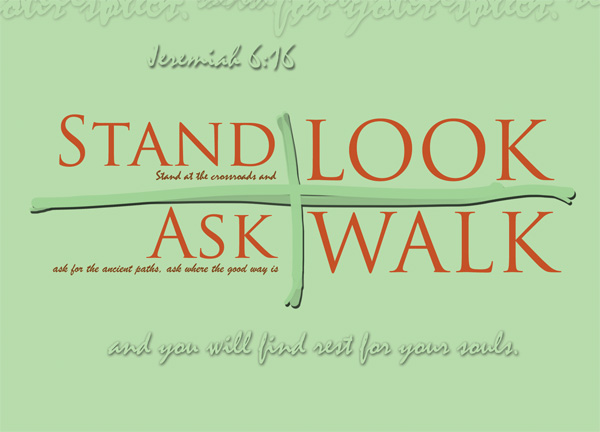
16 Thus says the Lord, “Stand by the roads and look; ask for the ancient paths, Where the good way is; then walk in it, And you will find rest for your souls. But they said, ‘We will not walk in it!’
Matthew 7:13-14Amplified Bible
The Narrow and Wide Gates
13 “Enter through the narrow gate. For wide is the gate and broad and easy to travel is the path that leads the way to destruction and eternal loss, and there are many who enter through it. 14 But small is the gate and narrow and difficult to travel is the path that leads the way to [everlasting] life, and there are few who find it.
The Word of God for the Children of God. Gloria! In Excelsis Deo! Alleluia! Amen.
Just because a certain path seems right does not mean it’s the right one to take.
But that does not mean it is wrong either.
We must, therefore, ask and trust God to show us which way to go.
He knows the end from the beginning.
God will lead us in the right way.
“You make known to me the path of life; in your presence there is fullness of joy; at your right hand are pleasures forevermore.” Psalm 16:11.
What a wonderfully assuring thing it is to believe that even when we are faced, confronted by the biggest and most difficult decisions in life, the Word of God for the Children of God makes known to us the sure paths that will bring life.
WHAT ARE CROSSROADS?
Literally, a crossroad is a road that crosses another.
It is the place where two or more roads intersect.
Figuratively, to be “at a crossroad” is to be at a stage in one’s life when it is necessary to choose a path that will affect one’s life in truly profound ways.
A crossroad is a place of decision.
It is a place of doubts and questions.
A crossroad is a place where we wrestle with conflicting voices.
It is a transit point.
A crossroad is a gate or access point.
It is a place of separation and goodbye.
A crossroads is the end of a chapter and the beginning of another one.
A crossroad is a critical moment.
It can be a place of crisis, where the pains of yesterday connects us to the hope of the coming tomorrow.
A crossroad is a place of opportunity, where the road ahead offers promises.
A crossroad is a point in your life where you have several options that you need to weigh.
Each option on each crossroad will lead you to a different destination or goal.
Each path on each crossroad will to a different destination.
Crossroads are unavoidable.
Crossroads are inevitable.
Every day, we make significant decision that will affects our lives positively or negatively.
The choice to continue the same straight path is no longer possible.
A decision has to be made.
The straight road has now split into two or more.
Which decision will you make?
Looking left, right, back from where you came, and looking straight ahead.
Where do you turn?
Do you turn back to where you came, choose a path to follow, or do you stand around in the middle of the road and continuously scratch at your bald spot?
Which road is the right one?
And carefully, prayerfully weigh the consequence of choosing a decisive path?
Today, you may be standing at a crossroad.
Your crossroads could be one to decide your ministry or career path.
It could be the start or end of a relationship.
Your crossroad could be a choice of making a change right now or if you wait too long it might just become “too late” – whatever “too late” means to God.
It could be the choice of what course to study for what career field in college.
Do you make a choice of asking mom and dad – about entering into the military, or do you just go ahead on your own and enlist, ask for mom and dad’s support.
Your crossroad could be whether to start a business or hold on to your job.
It might be starting a relationship with that “special, lifelong someone,” and doing the career thing or to get married and starting a family of your very own.
Perhaps you are in a crossroad where you are faced with the decision to stay where you are or move on to another place – to another job or career field.
Perhaps it might even be a decision to finally put in your retirement papers.
Whatever pathway you decide to take, it will definitely affect the course of your life and destiny for an indeterminate period of time.
Are we ready for that “indeterminate period of time” right this exact moment?
When standing at the crossroads, the one thing we really need is guidance.
God definitely has set aside a path for us which leads to life! (Psalm 16:11)
He promises to guide, instructs, direct us when we are at the crossroads of life.
“Your ears shall hear a word behind you, saying, “This is the way, walk in it,” Whenever you turn to the right hand or whenever you turn to the left.” Isaiah 30:21.
God will always give you and me a direction to take in life.
But you and I still need to sharpen our hearing ability.
Matthew 7:13-14Amplified Bible
The Narrow and Wide Gates
13 “Enter through the narrow gate. For wide is the gate and broad and easy to travel is the path that leads the way to destruction and eternal loss, and there are many who enter through it. 14 But small is the gate and narrow and difficult to travel is the path that leads the way to [everlasting] life, and there are few who find it.
The parable of the two gates pictures the people of Earth walking on two roads.
One road is broad, and many walk that way.
The other road is narrow, and few find the gate to it.
These two roads don’t lead to the same place (Matthew 7:13-14).
We are fond of dividing the world into two.
We speak of the rich and the poor, but there are many people who are neither rich nor poor.
We speak of the bosses and the workers, but many people are neither, and some are both.
We speak of the educated and uneducated, but some people have education yet lack wisdom, whilst some uneducated people are very wise.
This just shows that dividing the world in two, or even three, is usually presumptuous, simplistic, inaccurate, and perhaps even alienating.
But does this apply to all cases?
In particular, is the world divided into the saved and the unsaved —those in God’s way and those following Satan?
Many folks would call that a presumptuous, simplistic, inaccurate, and alienating view of the world.
Only Two Ways
Rabbi Jesus, however, here divides humanity in just that manner: people are travelling either the broad road to destruction or the narrow road to life —just two groups and no exceptions (Matthew 7:13-14).
Later in that chapter, he again divides people into two groups: the wise who hear and do his words (Matthew 7:24), and the foolish who do not hear and do his words (Matthew 7:26).
On a later occasion, Jesus spoke of how he will, at the last judgment, separate the people of all nations into two “as a shepherd separates the sheep from the goats” (Matthew 25:32-33).
The “sheep” at his right hand will inherit the kingdom prepared for them (Matthew 25:34).
The “goats” at his left hand will be sent into the eternal fire prepared for the devil and his angels (Matthew 25:41).
When these two groups have gone their way, nobody else shall remain (Matthew 25:46).
So, when Jesus pictures the two gates, or two builders, or the sheep separated from the goats, he has included all human beings.
Each of us is on one of those pathways.
Or to point the finger, you, I, are in one of those groups.
Which one?
The Way of the Many
Not only has Jesus divided the world in two, but appallingly, he has numbered those who are on the road to destruction as “many” and those on the road to life as only a “few” (Matthew 7:13-14).
Why are there “many” going in at the wrong gate, walking on the wrong road?
Jesus gives no reason for the number.
He does not even indicate that the number cannot be changed.
He leaves it open that the majority could walk the way to life, and only a few walk the way to destruction, or for that matter everyone could walk the way to life leaving deserted the road which leads to inevitable destruction.
When Jesus says, “enter by the narrow gate” (Matthew 7:13), presumably he means anyone who listens to him say that, can make the choice do exactly that.
Why would Rabbi Jesus tell everybody to enter by the narrow gate, and walk the narrow way, if most of them cannot do that?
You might say, “Jesus does give the reason why many go down the broad way.
It’s the nature of human beings to choose what’s easy, not what’s hard.”
Well, I am not so sure.
People do all kinds of things that are difficult because they think those things are right, they enjoy the challenge, they deem the reward well worth the effort.
Surely the Christian life is a worthy challenge, and brings a wonderful reward, such that you would expect many more people to choose it than actually do.
Choosing Destiny
Anyway, there is nothing compelling people to follow the broad way leading to destruction, even though most people do.
Destiny doesn’t force people to follow one of the two roads.
They choose the gate they enter; they choose the road they walk; hence they choose their destiny.
There is nothing preventing people from following the right way leading to life, even though few do.
The Way of the Few
Although Jesus speaks of two roads, only one of them is of his making.
Jesus never desired that there be a road to destruction, and he never caused anyone to follow it.
The broad road represents a way of living designed by Satan.
Jesus provides an alternative way, represented by the narrow road.
When Jesus says, “enter by the narrow gate” (Matthew 7:13), he refers to the gospel way of living.
In early times, Christianity was actually called “the Way” (Acts 19:9,23).
In fact, Jesus called himself the way: “I am the way, the truth, and the life; no one comes to the Father except by me” (John 14:6).
Seeking the Way
When Jesus mentioned the narrow gate and the difficult path beyond it, he said, “And few there be who find it” (Matthew 7:14).
There are two ways you can find something.
One is to stumble upon it by some fortunate circumstance; the other is to seek it by making an intelligent and systematic search.
Rabbi Jesus tells us which way to find the gate to the true way:
“Ask, and it shall be given you; seek, and you shall find; knock, and it shall be opened to you” (Matthew 7:7 NASB).
Total Commitment
We can gather from this that walking the narrow way means making an absolute and total commitment to Jesus Christ.
It means loving him, obeying him, depending on him, worshipping him, giving all of us to him, being his utterly committed and utterly devoted disciples.
And where do we start?
The Holy Spirit tells us clearly what to do to begin this journey, as follows…
DIVINE GUIDANCE and DIRECTION!
“The Lord is my shepherd; I shall not want. 2 He makes me to lie down in green pastures; He leads me beside the still waters.” Psalm 23:1-2.
When God is your Shepherd, you have access to all things that you need.
Divine guidance is God having the final say in running the affairs of your life.
When He’s leading, you are never alone.
God has a definite blueprint for your life and a road map to get you there.
WHAT TO DO WHEN AT LIFE’S CROSSROADS?
1. Know God.
Do you know Him?
Most people know about God, but they don’t really know Him.
To know God is to spend time with Him.
It is a relationship!
To know God is to obey Him.
To know God is to fear Him.
To know God is to trust Him unconditionally.
You must have a continuous daily fellowship with the Holy Spirit.
2. Be known by God.
Are you a child of God? (John 1:12-13)
Is Jesus your Lord and Savior? (Romans 10:9-13)
You must be born again. (John 3:1-15)
3. Pray the prayer of enquiry.
Prayer of enquiry is prayer for insight, guidance and direction.
It is asking God what to do about a particular situation.
Prayer of enquiry is to know God’s will concerning an issue.
It is a prayer to ask God why? Which? How? and When but NOT Why?
Ask him to give you ears to hear and eyes to see the ways He is speaking to you.
Consider fasting occasionally to help you focus more on God.
4. You must have faith.
“For we walk by faith, not by sight:” 2 Corinthians 5:7.
It is not for those who will walk by sight or logic.
Have unconditional faith in God’s promises to guide you.
5. Cultivate the presence of God through praise and worship.
Praise invites God into your situation immediately.
And where God is, there is liberty and fullness of joy. (2 Corinthians 3:15-18)
He will guide you when you give Him high praise and worship.
6. Dig deeper in the Bible.
The Bible has been rightly defined as, “Basic Instruction Before Leaving Earth.”
The Bible is our spiritual GPS, always available to tell us which way leads to where we want to go and how to turn around if we get on the wrong path.
7. Be humble. Psalm 25:9.
He leads the humble in justice, And He teaches the humble His way.
God loves humble people
8. Cultivate quietness.
Set aside a consistent time every day to meet with God.
Try starting out with a half-hour quiet time, and after you’ve developed greater intimacy with Him, increase that time to an hour.
It usually takes about five to ten minutes during the start of your quiet time to clear your mind enough to focus fully on God, so do not rush your quiet time.
9. Practice unconditional love.
Live without unforgiveness, malice, bitterness and anger.
10. Listen.
“My sheep hear my voice, and I know them, and they follow me.” John 10:27.
God can speak through the following ways:
His Word. Psalm 107:20.
Audible voice. Genesis 12:1;
Dreams. Judges 7:13.
Visions. Genesis 46:2; and Prophets. Ezra 9:11.
Let your heart be still. Psalm 46:10
Block out the distraction.
Tune in to heaven’s radio.
11. Seek wise counsel
To some people, crossroads are places of confusion.
Don’t be afraid to ask for directions and seek wise counsel from family, trusted friends, a pastor or counsellor.
12. Be patient; Don’t be in a hurry.
No matter how long it takes, be confident that God has heard your prayers and will respond. Let your mind be at rest. Don’t try to rush through the process.
“Show me your ways, O LORD; teach me your paths.” Psalm 25:4.
There is comfort in knowing God is guiding, leading and instructing us, especially when we are standing on crossroads.
But not many people are willing to ask for direction.
Come to God today!
Don’t live your life on logic, human reasoning, and trials.
It will only lead you to broken heart, failures and disappointments.
God has a better plan.
Don’t take steps on your own or make important decisions without asking Him.
Always strive to know the will of God concerning everything you are doing.
SO, WHAT’S OUR DECISION?
“Enter by the narrow gate; for wide is the gate and broad is the way that leads to destruction, and there are many who go in by it. 14 Because narrow is the gate and difficult is the way which leads to life, and there are few who find it.” Matthew 7:13-14.
There is no neutral ground.
The Lord Jesus, who on the Cross at Calvary made the greatest sacrifice for us at the crossroad of Golgotha, said there is a broad road that leads to destruction and a narrow road that leads to eternal life.
What road have you chosen?
If you realized you are on the wrong road, why not repent and get on the right road today?
If you are willing to repent and surrender your life to Jesus Christ, then pray this prayer right now:
LORD Jesus, I come to You right now. I know I am a sinner, please forgive me my sins. With my mouth, I declare that Jesus, from today, I accept You as the LORD of my life. Change my heart from a disobedient heart to a heart that will obey You. With my new heart, I believe that it is because of me that You came into this world; You died for my sins, take away my problems, fill me with Your Holy Spirit, write my name in the Book of Life, and make me brand new in Jesus mighty name.
PRAYER POINTS
1. O Lord, have Mercy for placing my confidence in human reasoning, in Jesus name.
2. By Your Mercy, O Lord, save me from every wrong decision I have made, in Jesus name.
3. O Lord, open up my spiritual understanding, in Jesus name.
4. O God, teach me deep and secret things, in Jesus name.
5. O Lord, thank You for the revelation power of the Holy Spirit, in Jesus name.
6. O God, remove from me every form of distractions that has blocked my spiritual eyes and ears, in Jesus name..
7. My Father, give me the spirit of revelation and wisdom in the knowledge of You, in Jesus’ name.
8. Open my spiritual eyes, O Lord, to see visions concerning my life, in Jesus name.
9. I reject the manipulation of the spirit of confusion, in Jesus name.
10. My Father, guide and direct me in knowing Your mind, in Jesus name.
11. If . . . (mention it) is not Your will for me, O Lord, re-direct my steps, in Jesus name.
12. Thank God for answering your prayers.
In the name of God, the Father and God the Son and God the Holy Spirit …..


 Loving God, Living God, Loving Hope, Living Hope, Loving Living Life His Way! "Many things are possible for the person who has hope. Even more is possible for the person who has faith. And still more is possible for the person who knows how to love. But everything is possible for the person who practices all three virtues." - Brother Lawrence (1605-1691), Practicing the Presence of God (1692).