

Micah 5:1-5 English Standard Version
The Ruler to Be Born in Bethlehem
5 [a] Now muster your troops, O daughter[b] of troops;
siege is laid against us;
with a rod they strike the judge of Israel
on the cheek.
2 [c] But you, O Bethlehem Ephrathah,
who are too little to be among the clans of Judah,
from you shall come forth for me
one who is to be ruler in Israel,
whose coming forth is from of old,
from ancient days.
3 Therefore he shall give them up until the time
when she who is in labor has given birth;
then the rest of his brothers shall return
to the people of Israel.
4 And he shall stand and shepherd his flock in the strength of the Lord,
in the majesty of the name of the Lord his God.
And they shall dwell secure, for now he shall be great
to the ends of the earth.
5 And he shall be their peace.
Word of God for the Children of God
Glory be to the Father,
and to the Son, and to the Holy Ghost;
as it was in the beginning,
is now, and ever shall be,
world without end. Amen, amen.
If you had lived in the first century, this text would have sounded all wrong.
When Jewish people spoke of “going up” to Judea, the destination they had in mind was Jerusalem.
And when they spoke of a city connected with the great King David, what came to mind was again Jerusalem. Jerusalem was where the palace and temple were.
Jerusalem was the natural birthplace of anyone destined for a throne.
But Micah had prophesied a different birthplace for this future king.
Though Bethlehem was “small among the clans of Judah,” it was big in the eyes of God.
Bethlehem illustrates God’s method of operation.
“God chose the weak things of the world to shame the strong” (1 Corinthians 1:27). Why?
“So that no one may boast before him” (1:29).
Boasting is fueled by pride.
We climb the ladder of success pulling others down from the rung ahead of us.
We want to prove that we are big stuff.
But at Christmas we are on our way to Bethlehem, not Jerusalem.
When the prophet Micah announced a coming hope for the discouraged people of God, he opened with a surprising statement: revealing the promised Messiah would come not from Jerusalem—the royal city from which most of his original Jewish hearers would have anticipated a king to hail—but from Bethlehem.
From this small, unexpected town, God’s work would unfold before His people.
Jerusalem was the most prominent city in Israel.
It was the city of the great King David, the location of the temple, and the primary focus of God’s people.
Bethlehem would not have been on anyone’s radar.
It was “too little to be among the clans of Judah.”
It wouldn’t have made their Top 100 list, and it certainly wouldn’t have been in their Top 10. The significance of this Bethlehem is found in its insignificance.
Thinking about the rest of the Bible story, we realize this makes perfect sense.
This is how God works!
When Goliath taunted the people of Israel, the strong and brave soldiers of Israel fled.
Instead of “great” soldiers, God used an insignificant shepherd boy—from Bethlehem, of all places!—with five stones and a sling to deliver God’s people.
When the good news of the Messiah’s birth came, we might have expected that the cultural elite of the day would have been the first to hear of it, but instead, God brought the good news to a few insignificant shepherds. This is God’s way.
Those who dismiss the message of the Bible often stumble over the fact that God’s answer for the world lay in a baby who was born in cold dark obscurity.
This is not a message anyone would ever invent!
Yet it was into this insignificant place that the Messiah came to rule.
The tiny newborn boy who lay in a Bethlehem food trough was the one with a never-ending kingdom which far surpasses all other kingdoms.
Isaiah 61:1-8 English Standard Version
The Year of the Lord’s Favor
61 The Spirit of the Lord God is upon me,
because the Lord has anointed me
to bring good news to the poor;[a]
he has sent me to bind up the brokenhearted,
to proclaim liberty to the captives,
and the opening of the prison to those who are bound;[b]
2 to proclaim the year of the Lord’s favor,
and the day of vengeance of our God;
to comfort all who mourn;
3 to grant to those who mourn in Zion—
to give them a beautiful headdress instead of ashes,
the oil of gladness instead of mourning,
the garment of praise instead of a faint spirit;
that they may be called oaks of righteousness,
the planting of the Lord, that he may be glorified.[c]
4 They shall build up the ancient ruins;
they shall raise up the former devastations;
they shall repair the ruined cities,
the devastations of many generations.
5 Strangers shall stand and tend your flocks;
foreigners shall be your plowmen and vinedressers;
6 but you shall be called the priests of the Lord;
they shall speak of you as the ministers of our God;
you shall eat the wealth of the nations,
and in their glory you shall boast.
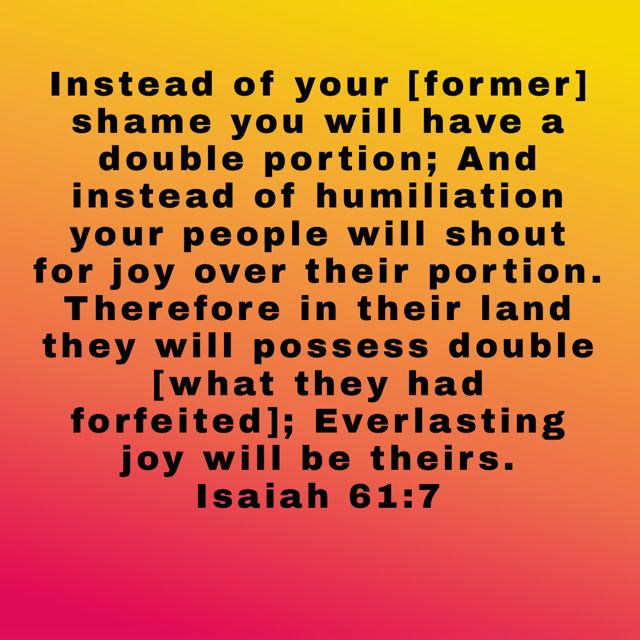
7 Instead of your shame there shall be a double portion;
instead of dishonor they shall rejoice in their lot;
therefore in their land they shall possess a double portion;
they shall have everlasting joy.
8 For I the Lord love justice;
I hate robbery and wrong;[d]
I will faithfully give them their recompense,
and I will make an everlasting covenant with them.
Seeking, Searching, Recognizing, Implementing the pattern of God’s ways in those ancient days enables us to recognize the Messiah now that He has come.
It readies us for the reality that the one upon whom all God’s promises rested would die a humiliating death on a cross.
It reminds us that this is God’s way and always has been and always will be.
And it therefore changes the way we look at our lives. If you consider yourself of significance, beware: for such a view is often the precursor to being humbled.
If you consider yourself of little import, ability, influence, then be encouraged, for God works through insignificant people in insignificant places.
So be of no doubt that God can do great things through your insignificance.
That has always been His way.
Many of us struggle because we don’t have much to boast about.
But may I again remind you that God uses people (Luke 1:26-38) whose names would never appear in any papers to accomplish great things for his kingdom?
Truth is we’ll understand that better when we stand before God’s throne and hear his “Well done!” for those insignificant things that have truly mattered.
In the name of God, the Father the Son and the Holy Spirit,
Praying ….
Psalm 61
For the choir director; on a stringed instrument; by David.
1 Listen to my cry for help, O Elohim.
Pay attention to my prayer.
2 From the ends of the earth, I call to you
when I begin to lose heart.
Lead me to the rock that is high above me.
3 You have been my Machseh,
a Migdal-Oz against the enemy.
4 I would like to be a guest in your tent forever
and to take refuge under the protection of your wings. Selah
5 O Elohim, you have heard my vows.
You have given me the inheritance
that belongs to those who fear your name.
6 Add days upon days to the life of the king.
May his years endure throughout every generation.
7 May he sit enthroned in the presence of Elohim forever.
May mercy and truth protect him.
8 Then I will make music to praise your name forever,
as I keep my vows day after day.
Glory be to the Father,
and to the Son, and to the Holy Ghost;
as it was in the beginning,
is now, and ever shall be,
world without end. Amen, amen.
 Loving God, Living God, Loving Hope, Living Hope, Loving Living Life His Way! "Many things are possible for the person who has hope. Even more is possible for the person who has faith. And still more is possible for the person who knows how to love. But everything is possible for the person who practices all three virtues." - Brother Lawrence (1605-1691), Practicing the Presence of God (1692).