
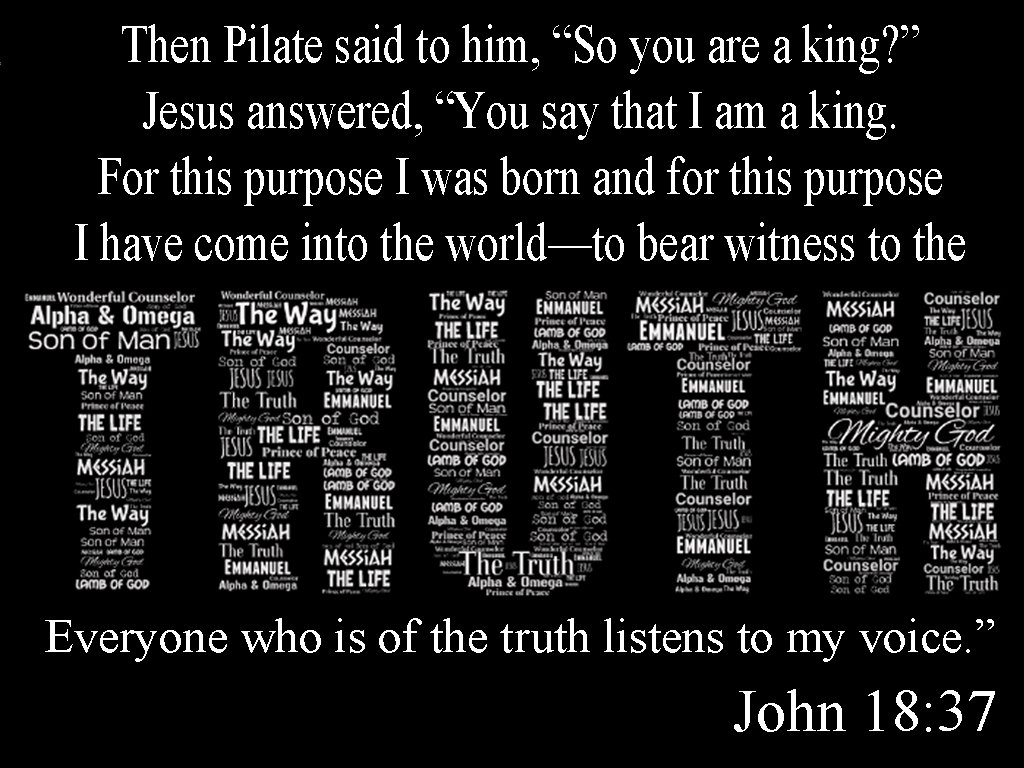
John 18:33-38 New American Standard Bible 1995
33 Therefore Pilate entered again into the Praetorium, and summoned Jesus and said to Him, “Are You the King of the Jews?” 34 Jesus answered, “Are you saying this [a]on your own initiative, or did others tell you about Me?” 35 Pilate answered, “I am not a Jew, am I? Your own nation and the chief priests delivered You to me; what have You done?” 36 Jesus answered, “My kingdom [b]is not of this world. If My kingdom were of this world, then My servants would be fighting so that I would not be handed over to the Jews; but as it is, My kingdom is not [c]of this realm.” 37 Therefore Pilate said to Him, “So You are a king?” Jesus answered, “You say correctly that I am a king. For this I have been born, and for this I have come into the world, to testify to the truth. Everyone who is of the truth hears My voice.” 38 Pilate *said to Him, “What is truth?”
And when he had said this, he went out again to the Jews and *said to them, “I find no guilt in Him.
The Word of God for the Children of God.
Glory be to the Father,
and to the Son, and to the Holy Ghost;
as it was in the beginning,
is now, and ever shall be,
world without end. Amen, amen.
Being On One Side of the Truth or the Other …
John 18:37-38 Amplified Bible
37 So Pilate said to Him, “Then You are a King?” Jesus answered, “You say [correctly] that I am a King. This is why I was born, and for this I have come into the world, to testify to the truth. Everyone who is of the truth [who is a friend of the truth and belongs to the truth] hears and listens carefully to My voice.” 38 Pilate said to Him [scornfully], “What is truth?”
And when he had said this, he went out to the Jews again and told them, “I find no guilt in Him [no crime, no cause for an accusation].
Jesus’ statement here about truth is in line with everything he has taught.
Jesus stands before Pilate “full of grace and truth” (John 1:14).
He is the bread of life; the living water; the Good Shepherd, the way, the truth, and the life; the only way to know God the Father (John 6:35; 7:38; 10:11, 14:6).
As he stands in judgement before this Roman governor, face to face, eye to eye, voice to voice, word to Word, thought to thought, Jesus offers Pilate the chance to experience the truth into a relationship with him—like one of his disciples.
But doing that would be very costly for Pilate. If Pilate were to accept what Jesus has to say, he would have to make the truth more important than Rome. Or political power. Or wealth. If Pilate accepted Jesus’ claims and set Jesus free, he would be throwing away his credibility with the Jews, if not his entire career.
Throughout this Gospel Narrative, John has been helping us to understand that all we possess on this earth—all our power, our influence, and wealth—pales in comparison to the incomparable truth of Jesus.
“… Everyone who is of the truth [who is a friend of the truth and belongs to the truth] hears and listens carefully to My voice.”
The offer Jesus extends goes far beyond Pilate, to our chance to experience life with God the way we are created to live it. Nothing is more important than that.
Sadly, Pilate rejects Jesus’ offer.
What about you and me?
What might we need to let go of in order to embrace the truth of Jesus?
What about the church?
What might the church need to let go of in order to embrace the truth of Jesus?
A Prayer to Pick Truth Over say … Crowd Pleasing
John 18:37-40 The Message
37 Then Pilate said, “So, are you a king or not?”
Jesus answered, “You tell me. Because I am King, I was born and entered the world so that I could witness to the truth. Everyone who cares for truth, who has any feeling for the truth, recognizes my voice.”
38-39 Pilate said, “What is truth?”
Then he went back out to the Jews and told them, “I find nothing wrong in this man. It’s your custom that I pardon one prisoner at Passover. Do you want me to pardon the ‘King of the Jews’?”
40 They shouted back, “Not this one, but Barabbas!” Barabbas was a Jewish freedom fighter.
Without even waiting for an answer from Jesus, in all likelihood not even really desiring one, nor prepared to hear one or have to listen to one and think twice about the course of his coming actions and have to entertain the possibility he will have to alter it, Pilate leaves the presence of Jesus and returns to the crowd.
It can be hard to change course, from the truth the crowd prefers to side with God’s Truth, especially if you and your choice could be dangerously unpopular.
Perhaps, like me, you have found your faith tested when standing firm to the voice of Jesus against a persuasive crowd. It’s human nature to want to be liked, but sometimes, this pressure leads us to make choices that don’t glorify God.
Pontius Pilate is well remembered for his display of crowd-pleasing weakness.
As a Roman governor as Caesar’s representative, Pilate routinely presided from his Jerusalem headquarters to ensure law, order during Jewish festival times.
During this particular Passover in John’s narrative, he found himself standing before a large crowd growing ever larger and crying out for Jesus’s crucifixion.
Roman law prohibited the Sanhedrin from carrying out capital punishment, so they demanded that Pilate issue the death sentence.
Luke 23:2 captures the nature of their manipulation:
Luke 23:1-5 The Message
Pilate
23 1-2 Then they all took Jesus to Pilate and began to bring up charges against him. They said, “We found this man undermining our law and order, forbidding taxes to be paid to Caesar, setting himself up as Messiah-King.”
3 Pilate asked him, “Is this true that you’re ‘King of the Jews’?”
“Those are your words, not mine,” Jesus replied.
4 Pilate told the high priests and the accompanying crowd, “I find nothing wrong here. He seems harmless enough to me.”
5 But they were vehement. “He’s stirring up unrest among the people with his teaching, disturbing the peace everywhere, starting in Galilee and now all through Judea. He’s a dangerous man, endangering the peace.”
Read again the protesting crowds interpretation of their “truth” …
“We found this man misleading, undermining the law and order of our nation and forbidding us to give tribute to Caesar, and saying that he himself is Christ, a king.”
Does this have a familiar ring of truth for us today?
History repeating itself all over again?
Words, actions, behaviors, deeds all guided by the alleged truth of “the crowd?”
Who ever has the majority, who ever can shout the loudest, exerts the greatest measure and degree of influence, becomes the bigger bully, gets their “truth?”
Jesus came to bear witness to the truth, yet Pontius Pilate refused to listen to the Messiah. After much questioning, he could find no lies or fault with Him.
Instead, in a moment of great irony, Pilate responded to Truth Himself with the question, “What is truth?” (John 18:37-38).
Despite Pilate’s investigation, Herod’s findings, and even his wife’s report of a troubling dream warning of Jesus’ innocence, Pilate remained unsettled by the mob (Matthew 27:19).
In hopes of appeasing everyone, Pilate offered to free Jesus under the Passover tradition of a prisoner release.
Sadly, the crowd demanded the release of Barabbas. They traded a murderer whose name in Greek (barr-abbas) means “son of the father” for Jesus, the True Son of the Father–how they all (including us?) missed the message!
Although Pilate continued to look for ways to release Jesus, a final blow of peer pressure broke him as the Jews cried out, “If you release this man, you are not Caesar’s friend. Everyone who makes himself a king opposes Caesar” (John 19:12).
At this he freed Barabbas, had Jesus beaten beyond recognition, humiliated Him with a purple robe and crown of thorns, and handed Him over for crucifixion.
The trouble with crowd-pleasing is that it often requires us to compromise what we know to be true.
Christians are not immune to this “follow the crowd” temptation, yet God will help us when we seek discernment and strength through scripture and prayer.
Each day is full of opportunities to unhinge ourselves from the “vocal will of the crowds to honor our Lord, Savior and King as we strive to sort through the vast, deceiving amounts of “crowd truths,” glorify God, through our daily decisions.
How are you, me, the church, being challenged to be a witness to God’s truth today rather than give in to the pressure of popularity? Like Pilate, have you found yourself tempted to follow the crowd despite what you know is right?

In the name of God, the Father and God the Son and God the Holy Spirit,
Let us Pray,
Father God, it is hard to hear your Truth when the voices around me are loud. Whether it’s my kids, friends, or workplace, I confess I want to be liked, and it is often unpopular to go against the group. Even though it’s human nature to want to fit in, remind me daily that you have given me a new and better nature in Christ. Forgive me when I have given into people-pleasing or made choices to gain acceptance or approval of others even when I knew it was wrong. Forgive me for the times I did not stand up for you, Jesus, and the times I complied rather than speaking your truth and light into a situation. Holy Spirit, bring to mind instances that need your forgiveness and wash me with fresh new boldness and strength to reflect your glory in my words and actions. Help me speak your name with love and grace, and give me wisdom and discernment to make Truth-honoring choices today and always. In Jesus’ Name …
Psalm 118 The Message
118 1-4 Thank God because he’s good,
because his love never quits.
Tell the world, Israel,
“His love never quits.”
And you, clan of Aaron, tell the world,
“His love never quits.”
And you who fear God, join in,
“His love never quits.”
5-16 Pushed to the wall, I called to God;
from the wide open spaces, he answered.
God’s now at my side and I’m not afraid;
who would dare lay a hand on me?
God’s my strong champion;
I flick off my enemies like flies.
Far better to take refuge in God
than trust in people;
Far better to take refuge in God
than trust in celebrities.
Hemmed in by barbarians,
in God’s name I rubbed their faces in the dirt;
Hemmed in and with no way out,
in God’s name I rubbed their faces in the dirt;
Like swarming bees, like wild prairie fire, they hemmed me in;
in God’s name I rubbed their faces in the dirt.
I was right on the cliff-edge, ready to fall,
when God grabbed and held me.
God’s my strength, he’s also my song,
and now he’s my salvation.
Hear the shouts, hear the triumph songs
in the camp of the saved?
“The hand of God has turned the tide!
The hand of God is raised in victory!
The hand of God has turned the tide!”
17-20 I didn’t die. I lived!
And now I’m telling the world what God did.
God tested me, he pushed me hard,
but he didn’t hand me over to Death.
Swing wide the city gates—the righteous gates!
I’ll walk right through and thank God!
This Temple Gate belongs to God,
so the victors can enter and praise.
21-25 Thank you for responding to me;
you’ve truly become my salvation!
The stone the masons discarded as flawed
is now the capstone!
This is God’s work.
We rub our eyes—we can hardly believe it!
This is the very day God acted—
let’s celebrate and be festive!
Salvation now, God. Salvation now!
Oh yes, God—a free and full life!
26-29 Blessed are you who enter in God’s name—
from God’s house we bless you!
God is God,
he has bathed us in light.
Adorn the shrine with garlands,
hang colored banners above the altar!
You’re my God, and I thank you.
O my God, I lift high your praise.
Thank God—he’s so good.
His love never quits!
Glory be to the Father,
and to the Son, and to the Holy Ghost;
as it was in the beginning,
is now, and ever shall be,
world without end. Amen, amen.




 Loving God, Living God, Loving Hope, Living Hope, Loving Living Life His Way! "Many things are possible for the person who has hope. Even more is possible for the person who has faith. And still more is possible for the person who knows how to love. But everything is possible for the person who practices all three virtues." - Brother Lawrence (1605-1691), Practicing the Presence of God (1692).