
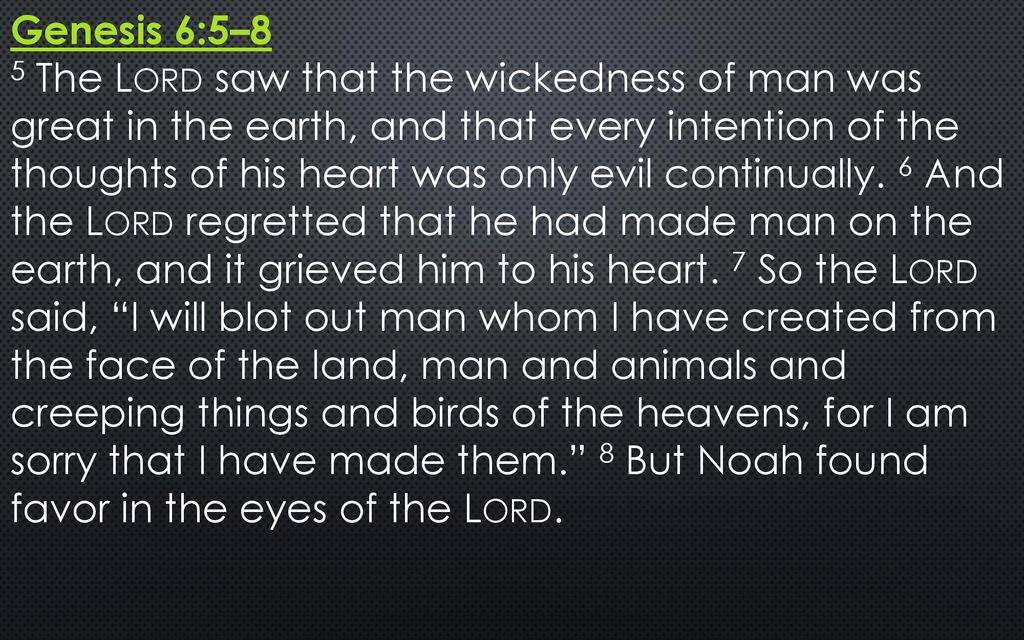
Genesis 6:5-8 New King James Version
5 Then [a]the Lord saw that the wickedness of man was great in the earth, and that every intent[b] of the thoughts of his heart was only evil [c]continually. 6 And the Lord was sorry that He had made man on the earth, and He was grieved in His heart. 7 So the Lord said, “I will destroy man whom I have created from the face of the earth, both man and beast, creeping thing and birds of the air, for I am sorry that I have made them.” 8 But Noah found grace in the eyes of the Lord.
The Word of God for the Children of God.
Glory be to the Father,
and to the Son, and to the Holy Ghost;
as it was in the beginning,
is now, and ever shall be,
world without end. Amen, amen.
This text is challenging.
Let’s try to break the text down ….
Genesis 6:6 Authorized (King James) Version
6 And it repented the Lord that he had made man on the earth, and it grieved him at his heart.
https://www.blueletterbible.org/lexicon/h5162/kjv/wlc/0-1/
Heb: nāḥam to be sorry, console oneself, repent, regret, comfort, be comforted
- (Niphal)
- to be sorry, be moved to pity, have compassion
- to be sorry, rue, suffer grief, repent
- to comfort oneself, be comforted
- to comfort oneself, ease oneself
Ancient Greek philosophers imagined a perfect supreme being.
It would know everything and be in control of everything too. It could not be influenced by people or other creatures, because that would imply weakness or lack of control. It could not have any emotions, be truly responsive to humans.
The Greeks called this supreme being God.
The early Christian church slowly developed in a culture, in a society, that was heavily influenced by this Greek thinking. So Christian theologians often used those ideas to explain Christian teachings to the gentile Greek-minded people.
Even today, our concepts of God tend to be influenced by those perspectives.
So when we come to a passage like Genesis 6:6, we might think,
“What?! God regretted what he had done? He changed his mind? Human sin hurt God to the depths of his heart?”
That doesn’t fit well with our Greek-minded ideas of a perfect supreme being.
One can surmise that this verse would be a “gotcha” verse to counter Paul’s arguments when in Athens (Acts 16:16-31).
I am not a Greek Philosopher outside of what I learned well over 40 years ago during an World Literature class in my first days of College.
And I personally do not know any Greek Philosophers today.
This being typical in too many places…
We try to explain such verses away and not take them at any face value and leave such verses in higher academia for those with PhD’s to explain better.
But I know God wants us to realize that our actions—good and bad—affect him.
When I hurt a friend, that puts a barrier between me and that person.
Similarly, our wrongs against God set up a barrier between us and him.
As we confess our sins to God and receive his forgiveness through Jesus, let us give God a healthy sacrifice of pause, realize that those sins have truly hurt him.
In the name of God, the Father and God the Son and God the Holy Spirit,
Let us Pray,
Psalm 42 Authorized (King James) Version
Psalm 42
To the chief Musician, Maschil, for the sons of Korah.
1 As the hart panteth after the water brooks,
so panteth my soul after thee, O God.
2 My soul thirsteth for God, for the living God:
when shall I come and appear before God?
3 My tears have been my meat day and night,
while they continually say unto me, Where is thy God?
4 When I remember these things, I pour out my soul in me:
for I had gone with the multitude,
I went with them to the house of God,
with the voice of joy and praise,
with a multitude that kept holyday.
5 Why art thou cast down, O my soul?
and why art thou disquieted in me?
hope thou in God:
for I shall yet praise him for the help of his countenance.
6 O my God, my soul is cast down within me:
therefore will I remember thee from the land of Jordan,
and of the Hermonites, from the hill Mizar.
7 Deep calleth unto deep at the noise of thy waterspouts:
all thy waves and thy billows are gone over me.
8 Yet the Lord will command his lovingkindness in the daytime,
and in the night his song shall be with me,
and my prayer unto the God of my life.
9 I will say unto God my rock, Why hast thou forgotten me?
why go I mourning because of the oppression of the enemy?
10 As with a sword in my bones, mine enemies reproach me;
while they say daily unto me, Where is thy God?
11 Why art thou cast down, O my soul?
and why art thou disquieted within me?
hope thou in God: for I shall yet praise him,
who is the health of my countenance, and my God.
Glory be to the Father,
and to the Son, and to the Holy Ghost;
as it was in the beginning,
is now, and ever shall be,
world without end. Amen, amen.
 Loving God, Living God, Loving Hope, Living Hope, Loving Living Life His Way! "Many things are possible for the person who has hope. Even more is possible for the person who has faith. And still more is possible for the person who knows how to love. But everything is possible for the person who practices all three virtues." - Brother Lawrence (1605-1691), Practicing the Presence of God (1692).