
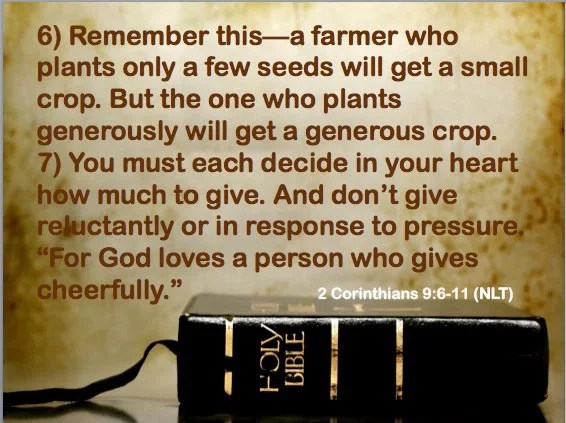
2 Corinthians 9:6-11 The Message
6-7 Remember: A stingy planter gets a stingy crop; a lavish planter gets a lavish crop. I want each of you to take plenty of time to think it over, and make up your own mind what you will give. That will protect you against sob stories and arm-twisting. God loves it when the giver delights in the giving.
8-11 God can pour on the blessings in astonishing ways so that you’re ready for anything and everything, more than just ready to do what needs to be done. As one psalmist puts it,
He throws caution to the winds,
giving to the needy in reckless abandon.
His right-living, right-giving ways
never run out, never wear out.
This most generous God who gives seed to the farmer that becomes bread for your meals is more than extravagant with you. He gives you something you can then give away, which grows into full-formed lives, robust in God, wealthy in every way, so that you can be generous in every way, producing with us great praise to God.
Word of God for the Children of God
Glory be to the Father,
and to the Son, and to the Holy Ghost;
as it was in the beginning,
is now, and ever shall be,
world without end. Amen, amen.
Fuel for Cheerful Giving …
God loves a cheerful giver.
One reason for this is that He is a cheerful giver, gladly and generously giving Himself and every good gift to His people.
And one of the good gifts God has given us is a series of promises and proverbs to fuel our cheer as we give.
2 Corinthians 9 provides an abundance of such fuel.
Paul teaches “whoever sows sparingly will also reap sparingly, and whoever sows bountifully will also reap bountifully.”
This is essentially a proverb, like those we read in the Old Testament:
“One gives freely, yet grows all the richer; another withholds what he should give, and only suffers want” (Proverbs 11:24).
Proverbs 11:24 The Message
24 The world of the generous gets larger and larger;
the world of the stingy gets smaller and smaller.
The thing about proverbs, though, is that they should be read for what they are—general truths—rather than what they are not: categorical promises.
Paul is not giving us a formula: If you put in a certain amount, you will receive a larger amount.
Instead, he is encouraging his readers to sow gladly and liberally because there are benefits to be had when we do so.
Generous giving brings its own rewards, which the stingy will never know.
If you scatter only a few seeds of your favorite flower and expect a beautiful display in a few weeks, you will be disappointed.
If you sow handful after handful, the result will be glorious to behold.
More fuel for our giving comes a few verses later, where Paul says that those who are generous “will be enriched in every way.”
Sadly, it is common for people to stop right there, concluding that God will make them wealthy once they’ve given away some money.
He may do just that, but it comes with the purpose revealed in the rest of the verse: “You will be enriched in every way to be generous in every way.”
God may indeed enrich you, but the enrichment is intended for a much greater generosity, which in turn will “produce thanksgiving to God.”
What a promise this is, that God will repay our generosity so that we might continue to be generous!
As we give away, God gives us more to give away.
Who could ever be tight-fisted in the face of such lavish promises?
It is a tragedy that so many have abused these promises and proverbs, using them to bait well-intentioned people into giving for all the wrong reasons.
There is no need or excuse for false assurances of prosperity or manipulative donation calls that tug hard at our heart strings; we have so many good, God-honoring reasons to be generous!
The truths and promises of God’s word are rich enough, and they alone will fuel genuine Christian cheer as we give.
Dwell on these truths, and on our Savior, who “though he was rich, yet for your sake … became poor, so that you by his poverty might become rich” (2 Corinthians 8:9).
That is the only authentically generous way to give in a way which truly honors God: to give both sacrificially and cheerfully.
If your church is in the habit of welcoming newcomers in the faith, you know one delightful quality of new believers is the straightforward manner of their obedience.
One Sunday a church in the Midwest was greeted by a welcoming committee of three turkeys, a pig, and 15 chickens tied up just outside the church entrance.
The Pastor’s previous week’s sermon had been on tithing, and these animals represented one tenth of a new member’s flock and herd. It brought smiles to our faces, and we genuinely thanked the farmer for his offering, even though it was a bit tough and tumble for the deacons to collect the whole offering later.
But the farmer understood something else too: he knew that the mission of God requires resources to get it done–not only to provide for the needs of the poor, but also to feed, clothe, and transport the workers.
In the process our gifts can also have the joyous result of prompting praise from the people who benefit from them.
As Paul points out, “Men will praise God … for your generosity.”
It’s true that our gifts are not always appreciated, for some people feel entitled to anything they receive. But this should not deter anyone of us from giving.
Even God’s “indescribable gift” of his Son is not always cherished.
Luke 6:27-34 The Message
27-30 “To you who are ready for the truth, I say this: Love your enemies. Let them bring out the best in you, not the worst. When someone gives you a hard time, respond with the supple moves of prayer for that person. If someone slaps you in the face, stand there and take it. If someone grabs your shirt, giftwrap your best coat and make a present of it. If someone takes unfair advantage of you, use the occasion to practice the servant life. No more payback. Live generously.
31-34 “Here is a simple rule of thumb for behavior: Ask yourself what you want people to do for you; then grab the initiative and do it for them! If you only love the lovable, do you expect a pat on the back? Run-of-the-mill sinners do that. If you only help those who help you, do you expect a medal? Garden-variety sinners do that. If you only give for what you hope to get out of it, do you think that’s charity? The stingiest of pawnbrokers does that.
And being aware of the warm appreciation of many who receive our gifts both friends and enemies in God’s name can help us be much more cheerful givers.

In the name of God, the Father the Son and the Holy Spirit ….
Praying ….
Psalm 119:33-40 The Message
33-40 God, teach me lessons for living
so I can stay the course.
Give me insight so I can do what you tell me—
my whole life one long, obedient response.
Guide me down the road of your commandments;
I love traveling this freeway!
Give me an appetite for your words of wisdom,
and not for piling up loot.
Divert my eyes from toys and trinkets,
invigorate me on the pilgrim way.
Affirm your promises to me—
promises made to all who fear you.
Deflect the harsh words of my critics—
but what you say is always so good.
See how hungry I am for your counsel;
preserve my life through your righteous ways!
Glory be to the Father,
and to the Son, and to the Holy Ghost;
as it was in the beginning,
is now, and ever shall be,
world without end. Amen, amen.

 Loving God, Living God, Loving Hope, Living Hope, Loving Living Life His Way! "Many things are possible for the person who has hope. Even more is possible for the person who has faith. And still more is possible for the person who knows how to love. But everything is possible for the person who practices all three virtues." - Brother Lawrence (1605-1691), Practicing the Presence of God (1692).