Romans 15:4 "For whatever was written in earlier times was written for our instruction, so that through perseverance and the encouragement of the Scriptures we might have hope."
14 Behold, a day is coming for the Lord, when the spoil taken from you will be divided in your midst. 2 For I will gather all the nations against Jerusalem to battle, and the city shall be taken and the houses plundered and the women raped. Half of the city shall go out into exile, but the rest of the people shall not be cut off from the city. 3 Then the Lord will go out and fight against those nations as when he fights on a day of battle. 4 On that day his feet shall stand on the Mount of Olives that lies before Jerusalem on the east, and the Mount of Olives shall be split in two from east to west by a very wide valley, so that one half of the Mount shall move northward, and the other half southward. 5 And you shall flee to the valley of my mountains, for the valley of the mountains shall reach to Azal. And you shall flee as you fled from the earthquake in the days of Uzziah king of Judah. Then the Lord my God will come, and all the holy ones with him.[a]
6 On that day there shall be no light, cold, or frost.[b]7 And there shall be a unique[c] day, which is known to the Lord, neither day nor night, but at evening time there shall be light.
8 On that day living waters shall flow out from Jerusalem, half of them to the eastern sea[d] and half of them to the western sea.[e] It shall continue in summer as in winter.
9 And the Lord will be king over all the earth. On that day the Lord will be one and his name one.
Word of God for the Children of God
Glory be to the Father, and to the Son, and to the Holy Ghost; as it was in the beginning, is now, and ever shall be, world without end. Amen, amen.
Today’s message from Zechariah 14:9 paints a beautiful picture for us: a future where God is the one true King over the whole earth.
Imagine that—a time when everyone is united under His loving rule, and all the disagreements and fights we see now are gone.
This isn’t just a nice thought for the future; it’s a guide for how we should try to live our lives today.
This big promise compels us to think about how we can bring a little bit of that future unity into our world right now.
It’s about our being kind, finding ways to get along with others, and showing the same love to everyone, no matter how different they might seem from us.
We’re being called to act like citizens of God’s kingdom today, working to make peace and help others just like Jesus did.
So, how do we do this?
We can start small, in our families, schools, or workplaces, by being the person or people who truly listens, forgives, and tries to understand where others are coming from. Every act of kindness, every effort to make peace, is like planting fields of the most responsive seeds of God’s future kingdom here in our time.
In the name of God, the Father and God the Son and God the Holy Spirit,
Praying …
Psalm 29
A Psalm of David.
1 Give unto the Lord, O ye mighty, give unto the Lord glory and strength. 2 Give unto the Lord the glory due unto his name; worship the Lord in the beauty of holiness.
3 The voice of the Lord is upon the waters: the God of glory thundereth: the Lord is upon many waters. 4 The voice of the Lord is powerful; the voice of the Lord is full of majesty. 5 The voice of the Lord breaketh the cedars; yea, the Lord breaketh the cedars of Lebanon. 6 He maketh them also to skip like a calf; Lebanon and Sirion like a young unicorn. 7 The voice of the Lord divideth the flames of fire. 8 The voice of the Lord shaketh the wilderness; the Lord shaketh the wilderness of Kadesh. 9 The voice of the Lord maketh the hinds to calve, and discovereth the forests: and in his temple doth every one speak of his glory.
10 The Lord sitteth upon the flood; yea, the Lord sitteth King for ever. 11 The Lord will give strength unto his people; the Lord will bless his people with peace.
Glory be to the Father, and to the Son, and to the Holy Ghost; as it was in the beginning, is now, and ever shall be, world without end. Amen, amen.
14 “Again, it will be like a man going on a journey, who called his servants and entrusted his wealth to them. 15 To one he gave five bags of gold, to another two bags, and to another one bag,[a] each according to his ability. Then he went on his journey. 16 The man who had received five bags of gold went at once and put his money to work and gained five bags more. 17 So also, the one with two bags of gold gained two more. 18 But the man who had received one bag went off, dug a hole in the ground and hid his master’s money.
Word of God for the Children of God
Glory be to the Father, and to the Son, and to the Holy Ghost; as it was in the beginning, is now, and ever shall be, world without end. Amen, amen.
A steward is someone who takes care of and manages someone else’s property or belongings. The steward is not the owner but is responsible to the owner for all that the owner has entrusted to them.
The Bible includes many examples of stewardship. When God placed Adam and Eve in the Garden of Eden, he charged them with its care (Genesis 2:15).
Since the beginning, humans have been entrusted by God to steward his creation, his blessings, and the very lives he gives them.
In Jesus’ parable in our Bible reading today, three servants received bags of gold from their master before he left on a journey.
They were expected to be productive, innovative, and enterprising with what they had been given.
Specifically, they were to invest their master’s resources in worthwhile ventures, aiming for growth and multiplication.
While two servants faithfully embraced this responsibility, one did not. The master’s approval clearly fell upon the two who were faithful.
As the Lord’s stewards, we don’t possess anything on our own.
All we have is entrusted to us by our gracious heavenly Father.
Yet while we live and breathe, we are called to nurture and care for what God has given us, using it for his glory.
What does Matthew 25:14 teach us?
Jesus’ servants must work diligently for Him while waiting for His return, not wasting the talents and resources which they have been given. Jesus uses two additional parables to illustrate a state of constant readiness for His return after He has gone. His followers should be diligently working for Him while waiting.
What is the meaning of Matthew 25:18?
This represents God’s intent for the skills, abilities, and resources He gives to His people: to be used prudently, wisely and for God’s benefit. To do otherwise is to “waste our talents.” Here Jesus describes the servant, given a single talent.
What is the moral lesson of Matthew 25:14-30?
The point of the parable is that we are to use whatever we have been given by God exclusively for God’s purposes. The severe consequences to the lazy and unproductive servant, far beyond anything triggered by mere blind business mediocrity, tells us that we are to heavily invest our lives, not waste them.
Then one day we too will hear the Master’s words: “Well done, good and faithful servant.”
In the name of God, the Father and God the Son and God the Holy Spirit,
Praying …
16 1-2 Keep me safe, O God, I’ve run for dear life to you. I say to God, “Be my Lord!” Without you, nothing makes sense.
3 And these God-chosen lives all around— what splendid friends they make!
4 Don’t just go shopping for a god. Gods are not for sale. I swear I’ll never treat god-names like brand-names.
5-6 My choice is you, God, first and only. And now I find I’m your choice! You set me up with a house and yard. And then you made me your heir!
7-8 The wise counsel God gives when I’m awake is confirmed by my sleeping heart. Day and night I’ll stick with God; I’ve got a good thing going and I’m not letting go.
9-10 I’m happy from the inside out, and from the outside in, I’m firmly formed. You canceled my ticket to hell— that’s not my destination!
11 Now you’ve got my feet on the life path, all radiant from the shining of your face. Ever since you took my hand, I’m on the right way.
Glory be to the Father, and to the Son, and to the Holy Ghost; as it was in the beginning, is now, and ever shall be, world without end. Amen, amen.
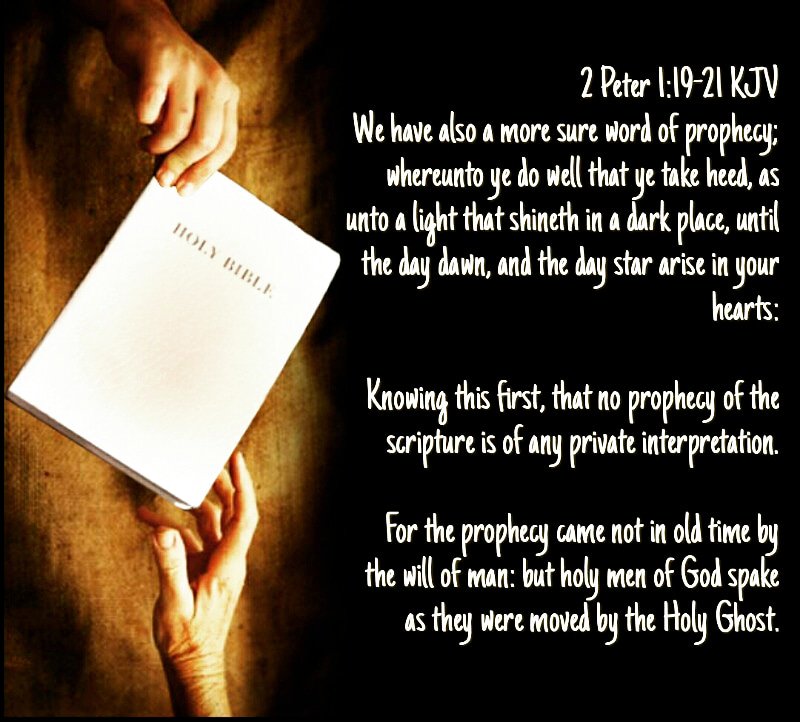
19 So we have the prophetic word made more certain. You do well to pay [close] attention to it as to a lamp shining in a dark place, until the day dawns and light breaks through the gloom and the [a]morning star arises in your hearts. 20 [b]But understand this first of all, that no prophecy of Scripture is a matter of or comes from one’s own [personal or special] interpretation, 21 for no prophecy was ever made by an act of human will, but men moved by the Holy Spirit spoke from God.
Word of God for the Children of God
Glory be to the Father, and to the Son, and to the Holy Ghost; as it was in the beginning, is now, and ever shall be, world without end. Amen, amen.
Brother’s, Sister’s, Friends, welcome. It is such a blessing to gather together today and delve into the profound truths in God’s Word. We encounter in 2 Peter 1:19 an affirmation of the uniqueness, power, and authority of the Bible.
Peter writes,
“We have the prophetic word more fully confirmed, to which you will do well to pay attention as to a lamp shining in a dark place, until the day dawns and the morning star rises in your hearts.”
The Bible isn’t just any book; it’s a divine revelation, a lamp guiding us through life’s darkest valleys.
Rev. Dr. A.W. Tozer said,
“The Word of God well understood and religiously obeyed is the shortest route to spiritual perfection. And we must not select a few favorite passages to the exclusion of others. Nothing less than a whole Bible can make a whole Christian.”
This quote underlines the uniqueness, power, and authority embedded by God in the Bible, which we will further explore today.
Let’s bow our heads in prayer.
Dear Lord, we thank You for Your Word, which is a lamp unto our feet and a light unto our path. As we now study Your Word today, give us hearts that are receptive, minds that are attentive, and spirits that are willing to obey what You reveal to us. In Jesus’ name, we pray. Amen.
Now, let’s open our hearts and minds to the divine truths that the Lord wants to reveal through His Word today.
The Uniqueness of the Bible
The composition:
It was written over a span of approximately 1500 years by more than 40 authors diverse backgrounds, including kings, shepherds, fishermen, tree dressers and nomads, cup bearers, fugitives under sentence of death, fisherman, scholars.
Yet, despite the vast differences in time, background, culture, upbringing and authorship, the Bible maintains a highly remarkable consistency in its message.
This unity amidst diversity points to a divine authorship, a supernatural hand guiding human thoughts, hands of human authors to pen God’s revelation.
The content:
It contains historical narratives, poetry, prophecy, wisdom literature, law codes, and apocalyptic visions.
Yet, all these diverse genres are carefully woven together to tell one overarching story: God’s redemptive plan for humanity.
No other book presents such a comprehensive and coherent narrative that spans from the creation of the world to the end of time.
Its truth: As Hebrews 4:12 declares,
“For the word of God is living and active, sharper than any two-edged sword, piercing to the division of soul and of spirit, of joints and of marrow, and discerning the thoughts and intentions of the heart.”
The Bible is unique because it is God’s living Word that penetrates our hearts, convicts us of our sins, and transforms us into the likeness of Christ.
The impact: The Bible has shaped civilizations, inspired great works of art, literature, and music, and transformed countless lives.
It has provided hope to the hopeless, comfort to the grieving, guidance to the lost, and salvation to the sinner.
The Bible’s enduring influence and transformative power attest to its divine origin and authority.
Its survival:
Despite numerous attempts throughout history to destroy or discredit the Bible, it remains the most widely read and distributed book in the world.
Its survival against all odds is a testimony to the truth of Isaiah 40:8, “The grass withers, the flower fades, but the word of our God will stand forever.”
It’s not just a book; it is the living Word of God, a divine revelation that guides us, convicts us, transforms us, and ultimately leads us to salvation in Christ.
The Power of the Bible
It’s transformative:
It has the ability to change us from the inside out.
As we read and meditate on God’s Word, it shapes our thoughts, attitudes, and behaviors.
It molds us into the image of Christ, helping us to grow in godliness and holiness.
The Apostle Paul, in his letter to the Romans, affirms this when he writes,
“Do not conform to the pattern of this world, but be transformed by the renewing of your mind” (Romans 12:2).
This transformation happens as we immerse ourselves in the powerful Word of God.
It’s healing:
It brings comfort and peace to troubled hearts.
It provides hope to the hopeless, strength to the weak, healing to the broken.
The psalmist testifies to this when he writes, “He sent out his word and healed them; he rescued them from the grave” (Psalm 107:20).
God’s Word has the power to heal our emotional wounds, mend our broken relationships, and restore our joy.
It’s guiding:
It is a lamp to our feet and a light to our path (Psalm 119:105).
It provides direction when we are lost, wisdom when we are confused, and clarity when we are in doubt.
It guides us in making decisions, choosing paths, and navigating life’s complexities.
Charles Spurgeon once said:
“A Bible that’s falling apart usually belongs to someone who isn’t.”
This quote speaks to the power of the Bible in sustaining us through life’s trials and tribulations.
As we cling to God’s Word, it holds, binds, us together, giving us the strength to endure, the faith to believe, and the hope to persevere.
The power of the Bible is not just in its words, but in the God who speaks through them.
As we read, study, and meditate on the Bible, we encounter the living God, who uses His Word to transform, heal, and guide us.
The Authority of the Bible
Its ability to guide us in all areas of life:
It provides us with the moral and ethical standards by which we should live.
It gives us guidance on how to relate to God and to others.
It provides us with a worldview that helps make sense of the world around us.
It gives us hope for the future and comfort in times of sorrow.
It instructs us in the way of salvation and leads us to a relationship with God through Jesus Christ.
Its ability to change lives:
Throughout history, countless individuals have been radically changed by the message of the Bible.
It has the power to convict people of sin, to bring them to repentance, and to lead them to faith in Christ.
It has the power to comfort, to heal, to guide, and to give hope.
It has the power to change hearts and minds, to transform societies, and to shape cultures.
Grounded in the character of God:
Because God is truthful, His Word is truthful.
Because God is faithful, His Word is reliable.
Because God is powerful, His Word is powerful.
Because God is loving, His Word is life-giving.
The authority of the Bible is an expression of the authority of God Himself.
To submit to the authority of the Bible is to submit to the authority of God.
Conclusion
As we wrap up today, let’s remember that the Bible isn’t just a book.
It’s a divine revelation, a guide through life’s darkest valleys, and a source of spiritual perfection.
Let’s not just randomly pick it up and choose our favorite passages, but let’s strive to understand and obey the whole Bible.
Because nothing less than a whole Bible can make a whole Christian.
And now, may the grace of our Lord Jesus Christ, the love of God, and the fellowship of the Holy Spirit be with us all, now and forevermore.
Let’s pray.
Psalm 119:1-16 The Message
119 1-8 You’re blessed when you stay on course, walking steadily on the road revealed by God. You’re blessed when you follow his directions, doing your best to find him. That’s right—you don’t go off on your own; you walk straight along the road he set. You, God, prescribed the right way to live; now you expect us to live it. Oh, that my steps might be steady, keeping to the course you set; Then I’d never have any regrets in comparing my life with your counsel. I thank you for speaking straight from your heart; I learn the pattern of your righteous ways. I’m going to do what you tell me to do; don’t ever walk off and leave me.
* * *
9-16 How can a young person live a clean life? By carefully reading the map of your Word. I’m single-minded in pursuit of you; don’t let me miss the road signs you’ve posted. I’ve banked your promises in the vault of my heart so I won’t sin myself bankrupt. Be blessed, God; train me in your ways of wise living. I’ll transfer to my lips all the counsel that comes from your mouth; I delight far more in what you tell me about living than in gathering a pile of riches. I ponder every morsel of wisdom from you, I attentively watch how you’ve done it. I relish everything you’ve told me of life, I won’t forget a word of it.
* * *
Glory be to the Father, and to the Son, and to the Holy Ghost; as it was in the beginning, is now, and ever shall be, world without end. Amen, amen.
Dear Lord, thank You for Your Word and the truths we’ve explored today. As we go out into the world, help us to remember and live out these truths. Keep our hearts receptive, our minds attentive, and our spirits willing to obey what You reveal to us. In Jesus’ name, we pray. Amen.
15 He is the image of the invisible God, the firstborn over all creation. 16 For everything was created by him, in heaven and on earth, the visible and the invisible, whether thrones or dominions or rulers or authorities— all things have been created through him and for him. 17 He is before all things, and by him all things hold together. 18 He is also the head of the body, the church; he is the beginning, the firstborn from the dead, so that he might come to have first place in everything. 19 For God was pleased to have all his fullness dwell in him, 20 and through him to reconcile everything to himself, whether things on earth or things in heaven, by making peace through his blood, shed on the cross.[a]
Word of God for the Children of God
Glory be to the Father, and to the Son, and to the Holy Ghost; as it was in the beginning, is now, and ever shall be, world without end. Amen, amen.
Imagine a universe in which everything is completely random.
There is no order; there is no consistency; there is no purpose.
What a horrible place that would be!
Yet those who believe in a purely naturalistic explanation for the origin of the universe find themselves in precisely such a place.
I’m thankful that we can know that there is purpose, there is direction, and that there is order in the universe.
This universe was designed, laid out, and is maintained by the Creator, the God of the universe, Himself.
The laws of physics are such a beautiful picture of the great order that God gives to His creation. Not only has God created this world, but He is 100% intimately involved in keeping everything orderly, running according to His perfect plan.
This truth actually brings us great comfort.
I don’t know if you’ve figured this out, but I have noticed many times over the many years that I’ve been alive that life does not actually turn out the way that I thought it would when I was much younger. As a matter of fact, life regularly takes twists and turns that I never would have ever imagined in my early years.
Unexpected tragedies come.
We experience loss.
We experience pain, heartache, sorrow, failure, and despair.
But knowing that God reigns on His throne on high is an incredible comfort.
We can be assured that nothing takes place that is outside of His control.
Take a moment to think about God’s perspective on this universe.
Consider God’s perspective on your problems.
God is not stressed out.
God is not sitting on His throne wringing his hands in worry about how things are going to turn out.
As you go throughout this day, take time to ponder God’s sovereignty.
Meditate on the reality that He is in control of everything.
Take time to ponder His sovereignty and how it makes a difference in your life.
Consider how big of a deal that is.
TODAY’S BIG IDEA:“God is in control, and you can relax and trust in Him.”
In the name of God, the Father and God the Son and God the Holy Spirit,
Praying …
Psalm 24
A psalm by David.
1 The earth and everything it contains are Yahweh’s. The world and all who live in it are his. 2 He laid its foundation on the seas and set it firmly on the rivers.
3 Who may go up Yahweh’s mountain? Who may stand in his holy place? 4 The one who has clean hands and a pure heart and does not long for what is false[a] or lie when he is under oath. 5 This person will receive a blessing from Yahweh and righteousness from Elohim, his savior. 6 This is the person who seeks him, who searches for the face of the El of Jacob.[b] Selah
7 Lift your heads, you gates. Be lifted, you ancient doors, so that the Melek of glory may come in.
8 Who is this Melek of glory? Yahweh, strong and mighty! Yahweh, heroic in battle!
9 Lift your heads, you gates. Be lifted, you ancient doors, so that the Melek of glory may come in.
10 Who, then, is this Melek of glory? Yahweh Tsebaoth is the Melek of glory! Selah
Glory be to the Father, and to the Son, and to the Holy Ghost; as it was in the beginning, is now, and ever shall be, world without end. Amen, amen.
1 Paul, a servant of Christ Jesus, called as an apostle[a] and set apart for the gospel of God— 2 which he promised beforehand through his prophets in the Holy Scriptures— 3 concerning his Son, Jesus Christ our Lord, who was a descendant of David[b] according to the flesh 4 and was appointed to be the powerful Son of God according to the Spirit of holiness[c] by the resurrection of the dead. 5 Through him we have received grace and apostleship to bring about[d] the obedience of faith for the sake of his name among all the Gentiles,[e]6 including you who are also called by Jesus Christ.
7 To all who are in Rome, loved by God, called as saints.
Grace to you and peace from God our Father and the Lord Jesus Christ.
Word of God for the Children of God
Glory be to the Father, and to the Son, and to the Holy Ghost; as it was in the beginning, is now, and ever shall be, world without end. Amen, amen.
“What do you want to be when you grow up?”
Maybe you heard this question as a child or a teenager.
Our responses usually focus on some kind of career path or occupation.
And as we grow older, we realize that we need some kind of work or career to help us with the costs of living.
Yet consider the nuance of the question.
It doesn’t ask, “What do you want to do?” It asks, “What do you want to be?”
Being has to do with our essence, our character, our identity. And in God’s carefully crafted economy, being goes ahead of doing. We are so that we can do.
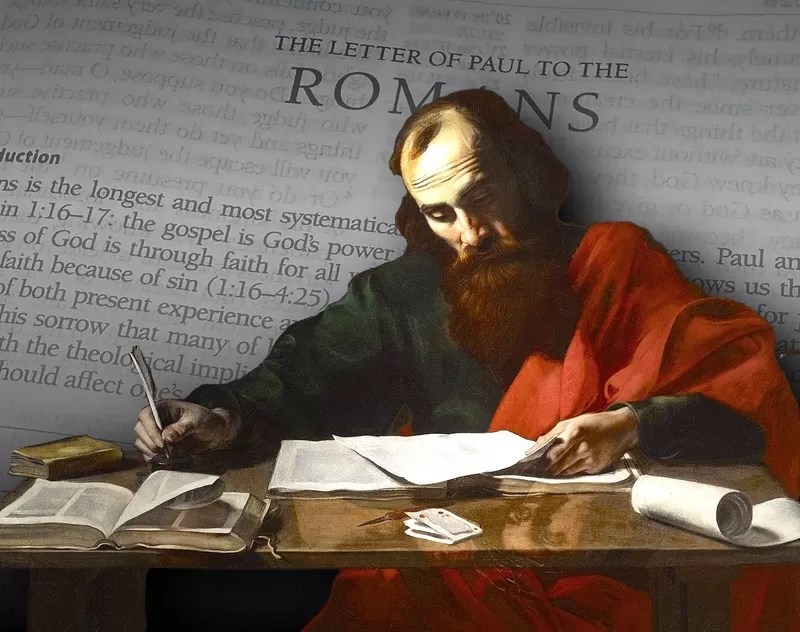
The apostle Paul opens his letter to the Romans with a defining statement:
“Paul, a servant of Christ Jesus, called to be an apostle and set apart for the gospel of God. . . .”
On the face of it, this statement addresses the question “Who am I?”
Yet, looking deeper, we can see that it’s more about “Whose am I?”
Paul’s identity is inseparable from his relationship with Jesus.
Paul identifies himself as a servant—or, more precisely, a bondservant—of Christ Jesus.
What is a bondservant according to the Bible?
A bondservant is one owned by another. They do not have anything that is their own—even their time belongs to their master. They wake up each day seeking to know and do the will of their master above all else. Do we live to do the Lord’s will, doing “all things for the sake of His gospel”?
What is the difference between a servant and a bondservant?
A bond-servant was a slave who had been offered his freedom, but who, of his own volition, who chose to remain a slave and serve his master faithfully.
The master didn’t force him or threaten or coerce him to stay, to do his bidding, but it was the slave who chose joyfully and willingly to take on the role of slave.
What does Paul mean when he calls himself a bondservant?
Paul willingly embraced the title of bondservant because it referenced Christ’s ownership of his life.
Just like a master paid the price to purchase a slave, Christ came and purchased our lives with His own lifeblood. This means we are no longer slaves to sin, but we are slaves to Christ, bound unto a life of service to a perfect, loving Master.
In essence, Paul belongs to Jesus, his Redeemer, who called and commissioned him. He no longer lives to please and serve himself but to please and serve the One who has rescued him.
This radical Christ-centeredness is the character that every believer takes on.
Like Paul’s, our own identity becomes quite literally inseparable from our transformative relationship with Jesus Christ.
What does separated unto the gospel mean?
Paul is saying that the ultimate purpose for his separation to the Gospel was to get lost people saved; to get people to put their faith in the living and glorified Christ Who died for their sins, was buried, rose again for their justification.
What is the lesson learned in Romans Chapter 1?
After telling the Christians in Rome he is eager to come see them and preach the gospel there, Paul declares that the gospel is God’s power to save everyone who believes in Jesus. We need to be saved, because our sin has earned God’s wrath.
As a whole, humanity has rejected God as creator and provider.
How to apply the Word of God to everyday life?
Consider a few suggestions:
Read and meditate daily. Reading and meditating alone will not bring application, but you have to start somewhere. …
Pray for wisdom. As you meditate on the Word, ask the Lord to give you understanding and discernment. …
Ask Questions. …
Look for situations. …
Make changes.
Who am I according to God’s Word?
I am the righteousness of God—I have right standing with Him—in Jesus Christ (2 Corinthians 5:21).
My body is a temple of the Holy Spirit; I belong to Him (1 Corinthians 6:19).
I am the head and not the tail, and I only go up and not down in life as I trust and obey God (Deuteronomy 28:13).
In the name of God, the Father and God the Son and God the Holy Spirit
Praying …
Psalm 8
God’s Glory, Human Dignity
For the choir director: on the Gittith. A psalm of David.
1 Lord, our Lord, how magnificent is your name throughout the earth! You have covered the heavens with your majesty.[a] 2 From the mouths of infants and nursing babies, you have established a stronghold[b] on account of your adversaries in order to silence the enemy and the avenger.
3 When I observe your heavens, the work of your fingers, the moon and the stars, which you set in place, 4 what is a human being that you remember him, a son of man[c] that you look after him? 5 You made him little less than God[d][e] and crowned him with glory and honor. 6 You made him ruler over the works of your hands; you put everything under his feet: 7 all the sheep and oxen, as well as the animals in the wild, 8 the birds of the sky, and the fish of the sea that pass through the currents of the seas.
9 Lord, our Lord, how magnificent is your name throughout the earth!
Glory be to the Father, and to the Son, and to the Holy Ghost; as it was in the beginning, is now, and ever shall be, world without end. Amen, amen.
14 Remind them of these things, charging them before God[a] not to fight about words; this is in no way profitable and leads to the ruin of the hearers. 15 Be diligent to present yourself approved to God, a worker who doesn’t need to be ashamed, correctly teaching the word of truth. 16 But avoid irreverent, empty speech, for this will produce an even greater measure of godlessness. 17 And their word will spread like gangrene; Hymenaeus and Philetus are among them. 18 They have deviated from the truth, saying that the resurrection has already taken place, and are overturning the faith of some.
Word of God for the Children of God
Glory be to the Father, and to the Son, and to the Holy Ghost; as it was in the beginning, is now, and ever shall be, world without end. Amen, amen.
One of Christians’ most important responsibilities is to study the Scriptures.
Church is essential, and we learn a lot from the man of God in the pulpit, but it is up to us to study and grasp what God says: “Study to shew thyself approved unto God, a workman that needeth not to be ashamed, rightly dividing the word of truth.”2 Timothy 2:15.
2 Timothy 2:15 teaches us five things about studying the Word of God:
1. “Study to shew thyself approved unto God,”
We get God’s approval when we think it is important enough to study what God has written for us in the Bible’s preserved words.
Notice that it says “study” and not “read.”
We are to delve into it like we want to pass life’s tests and know God’s mind.
It is the only source that will help us get through life’s difficulties and learn more about the Father.
Reading is different from studying.
We read scriptures on their surface for a short time, while studying requires much more time for rereading, comparing Scriptures with Scripture, and so much prayer.
It takes “work,”, a labor, a commitment, and a determination to get the most out of God’s Word diligently.
2. “a workman that needeth not to be ashamed ”
When we study the Bible, we will not be embarrassed by believing the wrong things. God will show us what is the Way, Truth, Life. And as we are not afraid to suffer shame for Christ’s now, we will not be ashamed before Him at His coming.
3. “rightly dividing the word of truth. ”
In studying the Word of God, “rightly dividing” implies handling the Scriptures accurately, not just as an intellectual exercise but guided by the Holy Spirit.
John 14:26 declares, “But the Comforter, which is the Holy Ghost, whom the Father will send in my name, he shall teach you all things, and bring all things to your remembrance, whatsoever I have said unto you.”
Through the Holy Spirit, we can understand how the Word is divided and then allow His Word to divide us (Hebrews 4:12). Thus, proper digging into God’s Word will expose our sinful nature and shape our lives to abide in His Word.
God’s Word is called the “word of truth.” It is not a collection of accurate statements, but it is the truth from our Creator.
It is the TRUTH, and we don’t need to justify it because the TRUTH requires no justification. It is the only source of truth on Earth, and God has preserved it for not just the select few but for all to read!
David declares in Psalms 12:6–7: “The words of the LORD are pure words: as silver tried in a furnace of earth, purified seven times. Thou shalt keep them, O LORD, thou shalt preserve them from this generation for ever.”
The reverse teaching of 2 Timothy 2:15 is that, if one does not study God’s word, he is not approved of God! — That is a hard truth to swallow. Looking at it that way, one should put a higher priority on one’s Bible study.
As we diligently study, rightly dividing the truth, we learn the Word incarnate, Jesus Christ.
John 1:14 echoes this truth: “And the Word was made flesh and dwelt among us.”
Every page turned, every chapter we study, and every verse pondered points to the living Word, who brings grace, truth, and the fullness of God’s revelation.
Brethren, as born-again believers in Christ, we are called His “ambassadors.”
We are His “workmanship” (Ephesians 2:8–10).
God expects every Christian to be His “workman”! We are to study the word by rightly dividing the truth, and then allow the Truth to divide us (Hebrews 4:12).
May our studies be more than just academic exercises; let it be a faithful work, digging into the depths of God’s wisdom and the beauty of His Son, Jesus Christ.
Isaiah 2:1-5 The Message
Climb God’s Mountain
2 1-5 The Message Isaiah got regarding Judah and Jerusalem:
There’s a day coming when the mountain of God’s House Will be The Mountain— solid, towering over all mountains. All nations will river toward it, people from all over set out for it. They’ll say, “Come, let’s climb God’s Mountain, go to the House of the God of Jacob. He’ll show us the way he works so we can live the way we’re made.” Zion’s the source of the revelation. God’s Message comes from Jerusalem. He’ll settle things fairly between nations. He’ll make things right between many peoples. They’ll turn their swords into shovels, their spears into hoes. No more will nation fight nation; they won’t play war anymore. Come, family of Jacob, let’s live in the light of God.
I Am a Student
Always Begin With God…
In the first two to three decades of life, most people are students.
The instruction we receive during that time provides us with the building blocks we need for a productive life.
As believers in Christ, we are also students. We need to learn God’s Word and grow in the grace and knowledge of the Savior.
We need to absorb God’s Word continuously in order to be transformed by the power of his Spirit, who works in us, teaches us, the truth and wisdom of God.
On a daily basis we need to walk in step with the Lord and his Spirit, growing to know God and to share his love with others everywhere.
There’s a tale of a man on a stroll who hears a voice say to him: “Gather some pebbles.” Though he sees no one, the voice persists: “Gather some pebbles and put them in your pocket, and tomorrow you will truly be both glad and sorry.”
Intrigued, the man thinks, “Why not?” So he picks up a few pebbles and puts them in his pocket. The next day he discovers they have all been transformed into diamonds. Then he feels gladness for taking some, and he is sorry for not taking more.
Similarly, our study of God’s Word may not reveal its benefits right away.
Yet over time, nuggets of truth and wisdom will prove to be invaluable treasures—blessing our lives in countless ways.
In the name of God, the Father and God the Son and God the Holy Spirit,
Praying …
Psalm 19 New American Standard Bible
The Works and the Word of God.
For the music director. A Psalm of David.
19 The heavens tell of the glory of God; And their expanse declares the work of His hands. 2 Day to day pours forth speech, And night to night reveals knowledge. 3 There is no speech, nor are there words; Their voice is not heard. 4 Their [a]line has gone out into all the earth, And their words to the end of the world. In them He has placed a tent for the sun, 5 Which is like a groom coming out of his chamber; It rejoices like a strong person to run his course. 6 Its rising is from [b]one end of the heavens, And its circuit to the [c]other end of them; And there is nothing hidden from its heat.
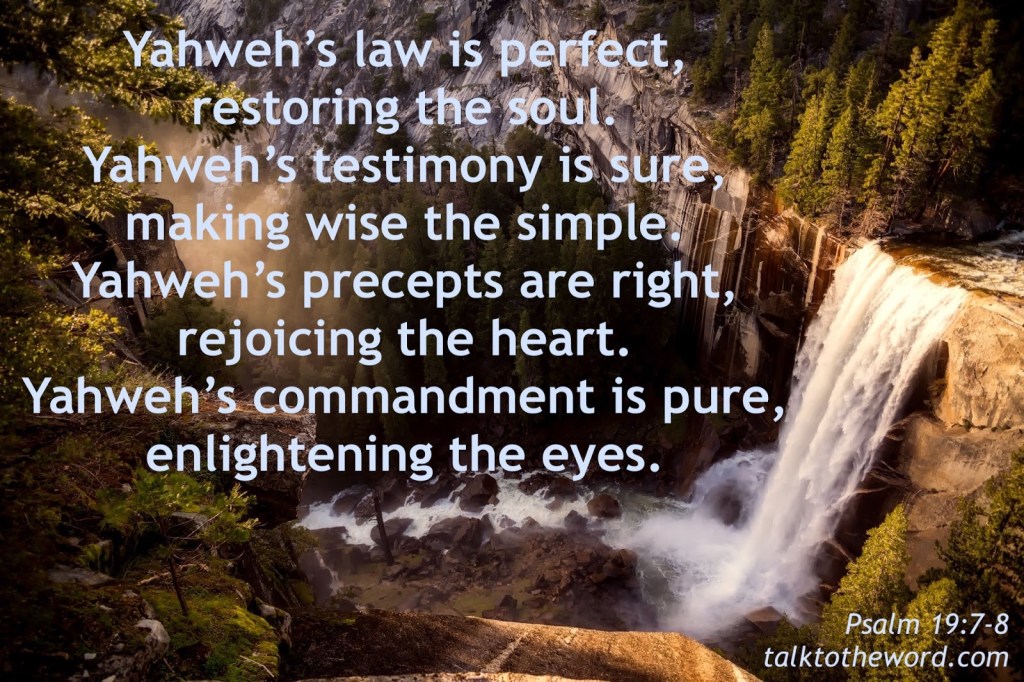
7 The Law of the Lord is [d]perfect, restoring the soul; The testimony of the Lord is sure, making wise the simple. 8 The precepts of the Lord are right, rejoicing the heart; The commandment of the Lord is pure, enlightening the eyes. 9 The fear of the Lord is clean, enduring forever; The judgments of the Lord are true; they are righteous altogether. 10 They are more desirable than gold, yes, than much pure gold; Sweeter also than honey and drippings of the honeycomb. 11 Moreover, Your servant is warned by them; In keeping them there is great reward. 12 Who can discern his errors? Acquit me of hidden faults. 13 Also keep Your servant back from presumptuous sins; Let them not rule over me; Then I will be innocent, And I will be blameless of great wrongdoing. 14 May the words of my mouth and the meditation of my heart Be acceptable in Your sight, Lord, my rock and my Redeemer.
Glory be to the Father, and to the Son, and to the Holy Ghost; as it was in the beginning, is now, and ever shall be, world without end. Amen, amen.
19 The heavens tell of the glory of God; And their expanse declares the work of His hands. 2 Day to day pours forth speech, And night to night reveals knowledge. 3 There is no speech, nor are there words; Their voice is not heard. 4 Their [a]line has gone out into all the earth, And their words to the end of the world. In them He has placed a tent for the sun, 5 Which is like a groom coming out of his chamber; It rejoices like a strong person to run his course. 6 Its rising is from [b]one end of the heavens, And its circuit to the [c]other end of them; And there is nothing hidden from its heat.
7 The Law of the Lord is [d]perfect, restoring the soul; The testimony of the Lord is sure, making wise the simple. 8 The precepts of the Lord are right, rejoicing the heart; The commandment of the Lord is pure, enlightening the eyes. 9 The fear of the Lord is clean, enduring forever; The judgments of the Lord are true; they are righteous altogether. 10 They are more desirable than gold, yes, than much pure gold; Sweeter also than honey and drippings of the honeycomb. 11 Moreover, Your servant is warned by them; In keeping them there is great reward. 12 Who can discern his errors? Acquit me of hidden faults. 13 Also keep Your servant back from presumptuous sins; Let them not rule over me; Then I will be innocent, And I will be blameless of great wrongdoing. 14 May the words of my mouth and the meditation of my heart Be acceptable in Your sight, Lord, my rock and my Redeemer.
Word of God for the Children of God
Glory be to the Father, and to the Son, and to the Holy Ghost; as it was in the beginning, is now, and ever shall be, world without end. Amen, amen.
What should motivate us to read the Bible?
Reminding ourselves of the benefits of reading the Bible may help us to make it a priority in our lives.
In this post, I discuss the beauty of God’s Word, based on Psalm 19:7-11.
Today I’ll visit verses 7 and 8 to identify four important benefits we receive when we read the Scripture (based on the NIV Bible).
1. God’s Word refreshes the soul (v7).
The idea here is “being brought back.”
If we are not actively seeking God, we will drift away from Him, leading to a spiritual drought.
As we become more focused on the world around us and less on spiritual things, God may feel far away.
Our prayers may not seem effective.
However, as we spend more time in God’s Word, our focus will return to God, and our souls will be fed.
Our relationship with God will be renewed.
James 1:5-7 New International Version
5 If any of you lacks wisdom, you should ask God, who gives generously to all without finding fault, and it will be given to you. 6 But when you ask, you must believe and not doubt, because the one who doubts is like a wave of the sea, blown and tossed by the wind. 7 That person should not expect to receive anything from the Lord.
2. God’s Word makes the simple wise (v7).
Who couldn’t use more wisdom?
Sometimes we all have questions about marriage, parenting, or just life in general. We may read self-help books, ask our friends for advice, or attend seminars or conferences, hoping to have our questions answered.
However, the Bible seems to be the last place we go.
There’s nothing wrong with books or our friend’s advice, as long as they point us to the Bible.
God has given us the answers to all of life’s important questions in His Word (2 Peter 1:3).
Confirming One’s Calling and Election
3 His divine power has given us everything we need for a godly life through our knowledge of him who called us by his own glory and goodness.
3. God’s Word gives joy to the heart (v8).
Sometimes, joy may be lacking in our lives, due to the pressures and demands of life.
We may be in a particularly hard or sorrowful time.
However, we are commanded to rejoice always (Philippians 4:4).
We are to be joyful no matter what circumstances we find ourselves in.
That is really hard to do when we are not spending enough time in God’s Word.
As we read God’s promises in the Bible, we can find many reasons for joy.
You can find a list of 10 Bible promises to bring you joy here.
4. God’s Word gives light to the eyes (v8).
Have you ever stumbled your way through a dark room, only to trip or bump into something?
A light is extremely useful in the darkness.
It lets us see clearly what is around us and it keeps us safe.
The Bible does this for us as we try to stumble our way through the dark world.
Only in the light (John 8:12) of the truth of Scripture can we see the sinful world as it really is. If we obey God’s commands, we will stay safe on the right path.
With benefits like these we can’t afford not to spend time in God’s Word.
Reading our Bible regularly keeps us close to God.
It also gives us wisdom, joy, and guidance.
I know my days are far better when I’m consistently spending time with God.
Whether you read it in a book or on your phone, an iPad, whether you listen to it on an app, whether you read a lot or a little—any time, every time you do spend in God’s Word will absolutely benefit you, and in turn, benefit those around us.
2 Timothy 3:14-17 New International Version
14 But as for you, continue in what you have learned and have become convinced of, because you know those from whom you learned it, 15 and how from infancy you have known the Holy Scriptures, which are able to make you wise for salvation through faith in Christ Jesus. 16 All Scripture is God-breathed and is useful for teaching, rebuking, correcting and training in righteousness, 17 so that the servant of God[a] may be thoroughly equipped for every good work.
Will you covenant with God, making the reading and studying and praying and application of God’s Word an absolute priority in your day, every single day?
In the name of God, the Father and God the Son and God, the Holy Spirit,
Praying …
Psalm 119:9-16 Complete Jewish Bible
ב (Bet)
9 How can a young man keep his way pure? By guarding it according to your word. 10 I seek you with all my heart; don’t let me stray from your mitzvot. 11 I treasure your word in my heart, so that I won’t sin against you. 12 Blessed are you, Adonai! Teach me your laws. 13 I proclaim with my mouth all the rulings you have spoken. 14 I rejoice in the way of your instruction more than in any kind of wealth. 15 I will meditate on your precepts and keep my eyes on your ways. 16 I will find my delight in your regulations. I will not forget your word.
Glory be to the Father, and to the Son, and to the Holy Ghost; as it was in the beginning, is now, and ever shall be, world without end. Amen, amen.
16 But He said to him, “A man was giving a big dinner, and he invited many; 17 and at the dinner hour he sent his slave to tell those who had been invited, ‘Come, because everything is ready now.’ 18 And yet they all alike began to make excuses. The first one said to him, ‘I purchased a field and I need to go out to look at it; [a]please consider me excused.’ 19 And another one said, ‘I bought five yoke of oxen, and I am going to try them out; [b]please consider me excused.’ 20 And another one said, ‘I took a woman as my wife, and for that reason I cannot come.’ 21 And the slave came back and reported this to his master. Then the head of the household became angry and said to his slave, ‘Go out at once into the streets and lanes of the city and bring in here those who are poor, those with disabilities, those who are blind, and those who are limping.’ 22 And later the slave said, ‘Master, what you commanded has been done, and still there is room.’ 23 And the master said to the slave, ‘Go out into the roads and the hedges and press upon them to come in, so that my house will be filled. 24 For I tell you, none of those men who were invited shall taste my dinner.’”
Word of God for the Children of God
Glory be to the Father, and to the Son, and to the Holy Ghost; as it was in the beginning, is now, and ever shall be, world without end. Amen, amen.
Receiving an invitation is usually seen as an honor, and most people welcome a gracious request to join in the celebration and meal In God’s kingdom, our main approach should be simply to invite people to “come and see” what God offers us in Christ—salvation and full life forever! This is often more effective than getting into a debate about a teaching or criticizing others for their beliefs.
Psalm 34:8-10 New American Standard Bible
8 Taste and see that the Lord is good; How blessed is the man who takes refuge in Him! 9 Fear the Lord, you His saints; For to those who fear Him there is no lack of anything. 10 The young lions do without and suffer hunger; But they who seek the Lord will not lack any good thing.
In Jesus’ parable of the great banquet, God the Father is portrayed as a generous host who wants to share of his limitless abundance and fullest joy with others.
The host prepares a feast, ensuring that everything is taken care of.
God undertakes everything needed for our salvation—even footing the bill by sacrificing his own Son for our sake.
And he opens the doors of his kingdom, extending his invitation to all.
Ultimately God wants his house filled with all whom he has invited.
And as followers of Jesus who have become God’s servants, we receive an expanded role.
We become inviters and bringers, actively seeking and urging others to join us.
This role has sometimes been described as “one beggar telling another beggar where to find food”—or, as in this parable, one invited guest informing another guest about the indescribable banquet hall brimming with our eternal blessings.
What does Luke chapter 14 verse 23 mean?
People who are outcast and Gentiles, even robbers waiting to waylay travelers, are welcome. Jesus compels them to come: He does not force them, but He does work hard to show them why it’s a good idea. Parables are meant to teach, apply a certain moral and ethical lesson—not to be taken with any wooden literalism.
What is the moral lesson of the parable of the Great Banquet?
Because those invited were too busy with things, they made their lame excuses and turned down the invitation from the master and missed the great feast!
In this parable the invitation to the banquet is Jesus’ invitation for us to accept His salvation. Accepting this invitation to salvation means that we ask Jesus to enter our hearts, forgive our sins and choose to do the things He wants us to do.
In the name of God, the Father and God the Son and God, the Holy Spirit,
Praying …
Psalm 84 New American Standard Bible
Longing for the Temple Worship.
For the music director; [a]on the Gittith. A Psalm of the sons of Korah.
84 How lovely are Your dwelling places, Lord of armies! 2 My soul longed and even yearned for the courtyards of the Lord; My heart and my flesh sing for joy to the living God. 3 The bird also has found a house, And the swallow a nest for herself, where she may put her young: Your altars, Lord of armies, My King and my God. 4 Blessed are those who dwell in Your house! They are ever praising You. Selah
5 Blessed is the person whose strength is in You, In [b]whose heart are the roads to Zion! 6 Passing through the Valley of [c]Baca they make it a [d]spring; The early rain also covers it with blessings. 7 They go from strength to strength, [e]Every one of them appears before God in Zion.
8 Lord God of armies, hear my prayer; Listen, God of Jacob! Selah 9 See our shield, God, And look at the face of Your anointed. 10 For a day in Your courtyards is better than a thousand elsewhere. I would rather stand at the threshold of the house of my God Than live in the tents of wickedness. 11 For the Lord God is a sun and shield; The Lord gives grace and glory; He withholds no good thing [f]from those who walk with integrity. 12 Lord of armies, Blessed is the person who trusts in You!
Glory be to the Father, and to the Son, and to the Holy Ghost; as it was in the beginning, is now, and ever shall be, world without end. Amen, amen.
5 Therefore, I strongly urge the elders among you [pastors, spiritual leaders of the church], as a fellow elder and as an eyewitness [called to testify] of the sufferings of Christ, as well as one who shares in the glory that is to be revealed: 2 shepherd and guide and protect the flock of God among you, exercising oversight not under compulsion, but voluntarily, according to the will of God; and not [motivated] for shameful gain, but with wholehearted enthusiasm; 3 not lording it over those assigned to your care [do not be arrogant or overbearing], but be examples [of Christian living] to the flock [set a pattern of integrity for your congregation]. 4 And when the Chief Shepherd (Christ) appears, you will receive the [conqueror’s] unfading crown of glory. 5 Likewise, you younger men [of lesser rank and experience], be subject to your elders [seek their counsel]; and all of you, clothe yourselves with humility toward one another [tie on the servant’s apron], for God is opposed to the proud [the disdainful, the presumptuous, and He defeats them], but He gives grace to the humble.
6 Therefore humble yourselves under the mighty hand of God [set aside self-righteous pride], so that He may exalt you [to a place of honor in His service] at the appropriate time, 7 casting all your cares [all your anxieties, all your worries, and all your concerns, once and for all] on Him, for He cares about you [with deepest affection, and watches over you very carefully].
Word of God for the Children of God
Glory be to the Father, and to the Son, and to the Holy Ghost; as it was in the beginning, is now, and ever shall be, world without end. Amen, amen.
As Peter gives final instructions at the close of his letter, he addresses both old and young, leaders and followers, shepherds and sheep. Leaders should lead out of generosity and not for gain, he warns, because the flock belongs to God.
What does it mean to humble myself under the mighty hand of God?
In other words, don’t try to deal with your feelings and fears from your limited human perspective; surrender them to the Power of God within you.
Don’t brood and dwell on perceived wrongs that are being done to you, because that kind of negative thought energy can pull us back into fear-base
Followers should follow with a teachable spirit. All should wear humility visibly, as if it were clothing. Humility should be like a uniform that God’s people wear.
Humility starts with an acknowledgment of our complete dependence on God.
When the Heidelberg Catechism asks, “What is your only comfort in life and in death?” the answer shows our dependence:
“I am not my own, but belong—body and soul, in life and in death—to my faithful Savior, Jesus Christ.” We rely completely on Jesus for our salvation and our very existence. What a relief that it does not depend on our own strength!
That humility should shape how we treat one another. We all belong to God, so we have neither an authority of our own nor a right to profit from other people.
That same ancient catechism draws out the implications of our dependence: “Because I belong to him, Christ, by his Holy Spirit, assures me of eternal life and makes me wholeheartedly willing and ready from now on to live for him.”
What does 1 Peter 5 5 teach us?
All of us must live in humility toward each other and toward God, who opposes the proud.
the Bible, those who do not know Christ are called “workers of lawlessness” (Matthew 7:23). Unbelievers are marked by lawlessness (Matthew 23:28), and will increase in the end times (Matthew 24:12). Lawlessness was associated with those who broke the Law of Moses (the Torah) and were therefore sinners.
How do I humble myself biblically?
Thank God often and always. Thankfulness stops pride growing. …
Confess your sins regularly. Confession is a reality check as it reminds us who we are. …
Be ready to accept humiliations. …
Don’t worry about status. …
Have a sense of humour. …
Listen to others. …
Ask questions. …
Consider others before yourself.
May we in humility serve God by serving one another!
In the name of God, the Father and God the Son and God, the Holy Spirit,
Praying …
Psalm 25 Holman Christian Standard Bible
Psalm 25
Dependence on the Lord
Davidic.
1 Lord,[a] I turn to You.[b] 2 My God, I trust in You. Do not let me be disgraced; do not let my enemies gloat over me. 3 No one who waits for You will be disgraced; those who act treacherously without cause will be disgraced.
4 Make Your ways known to me, Lord; teach me Your paths. 5 Guide me in Your truth and teach me, for You are the God of my salvation; I wait for You all day long. 6 Remember, Lord, Your compassion and Your faithful love, for they have existed from antiquity.[c] 7 Do not remember the sins of my youth or my acts of rebellion; in keeping with Your faithful love, remember me because of Your goodness, Lord.
8 The Lord is good and upright; therefore He shows sinners the way. 9 He leads the humble in what is right and teaches them His way. 10 All the Lord’s ways show faithful love and truth to those who keep His covenant and decrees. 11 Because of Your name, Yahweh, forgive my sin, for it is great.
12 Who is the man who fears the Lord? He will show him the way he should choose. 13 He will live a good life, and his descendants will inherit the land.[d] 14 The secret counsel of the Lord is for those who fear Him, and He reveals His covenant to them. 15 My eyes are always on the Lord, for He will pull my feet out of the net.
16 Turn to me and be gracious to me, for I am alone and afflicted. 17 The distresses of my heart increase;[e] bring me out of my sufferings. 18 Consider my affliction and trouble, and take away all my sins. 19 Consider my enemies; they are numerous, and they hate me violently. 20 Guard me and deliver me; do not let me be put to shame, for I take refuge in You. 21 May integrity and what is right watch over me, for I wait for You.
22 God, redeem Israel, from all its distresses.
Glory be to the Father, and to the Son, and to the Holy Ghost; as it was in the beginning, is now, and ever shall be, world without end. Amen, amen.
32 And they went away by themselves in the boat to a secluded place. 33 Many [people] saw them leaving, and recognized them and ran there together on foot from all the [surrounding] cities, and got there ahead of them. 34 When Jesus went ashore, He saw a large crowd [waiting], and He was moved with compassion for them because they were like sheep without a shepherd [lacking guidance]; and He began to teach them many things.
Word of God for the Children of God
Glory be to the Father, and to the Son, and to the Holy Ghost; as it was in the beginning, is now, and ever shall be, world without end. Amen, amen.
Jesus was tired, and the people were spiritually lost and in danger — “sheep without a shepherd.”
So Jesus gave them what they needed most: “He began teaching them many things.”
From a Christian point of view, saying a “shepherd and teacher” is redundant.
A shepherd teaches by guiding, leading, protecting, correcting, and caring.
Christian, you have a Shepherd and a Teacher.
Jesus had a pattern of slipping away from time to time to rest, refresh himself, and talk with His heavenly Father.
He also encouraged His disciples to take up this same practice in Mark 6, after they had labored in ministry, telling them, “Come away by yourselves to a desolate place and rest a while” (Mark 6:31).
Yet on this occasion, just as Jesus and the disciples arrived at their destination to rest, a great crowd formed.
If this crowd was not necessarily unwanted, it was certainly unsought.
There would be no possibility of rest.
But Jesus did not lash out in frustration, seeing these people as an intrusion.
Instead, He “had compassion on them.”
Literally, as the Greek puts it, His bowels churned.
We might say our stomach lurched.
Jesus was stirred to the very core of His being by this crowd.
Why?
“Because they were like sheep without a shepherd.”
Indeed, they may literally have looked like sheep: thousands of people in their light-colored Middle Eastern clothing, scattered against the landscape.
But, more importantly, they were in need of a shepherd for their souls.
They needed help navigating safely through life and securely through death.
Jesus had come to be Shepherd, looking for the lost sheep—looking for you and for me.
Jesus went on to feed the crowd, physically and spiritually, proving Himself to be the Shepherd who makes us lie down in green pastures, leads us beside still waters, and restores our souls (Psalm 23:1-3).
Here is the King inviting people into His kingdom, the Shepherd inviting sheep into His fold.
Where the disciples said, Send them away, Jesus said, Sit them down (Mark 6:36, 39).
This is what Jesus does for us: He sees us, hungry and thirsty, straying and lost, He welcomes us, He has compassion for us, even at the cost of His very own life.
Where else can we find a love so true?
Souls of men, why will ye scatter Like a crowd of frightened sheep? Foolish hearts, why will ye wander From a love so true and deep? [1]
1Frederick William Faber, “Souls of Men, Why Will Ye Scatter” (1854).
Today, see the leading of your Shepherd not as an imposition on your life but as an act of grace toward you.
If you are confused about your way forward, trust Him to guide you through, in this life and to the next.
When struggling to love others, ask Him to give you His heart of compassion for fellow lost sheep needing a Psalm 23 Shepherd. Christian, you have a Shepherd.
In the name of God, the Father and God the Son and God, the Holy Spirit,
Praying …
Psalm 121 The Message
121 1-2 I look up to the mountains; does my strength come from mountains? No, my strength comes from God, who made heaven, and earth, and mountains.
3-4 He won’t let you stumble, your Guardian God won’t fall asleep. Not on your life! Israel’s Guardian will never doze or sleep.
5-6 God’s your Guardian, right at your side to protect you— Shielding you from sunstroke, sheltering you from moonstroke.
7-8 God guards you from every evil, he guards your very life. He guards you when you leave and when you return, he guards you now, he guards you always.
Glory be to the Father, and to the Son, and to the Holy Ghost; as it was in the beginning, is now, and ever shall be, world without end. Amen, amen.






 Loving God, Living God, Loving Hope, Living Hope, Loving Living Life His Way! "Many things are possible for the person who has hope. Even more is possible for the person who has faith. And still more is possible for the person who knows how to love. But everything is possible for the person who practices all three virtues." - Brother Lawrence (1605-1691), Practicing the Presence of God (1692).