What Does it Really Look Like to ‘Honor Your Father and Mother’? Exodus 20:12, Deuteronomy 5:16

    Honoring your father and your mother is the only commandment out of the Ten Commandments that is followed by a promise, Honor your father and your mother, as the Lord your God has commanded you, that your days may be long, and that it may be well with you in the land which the Lord your God is giving you. (Deuteronomy 5:16)

    Exodus 20:12Amplified Bible

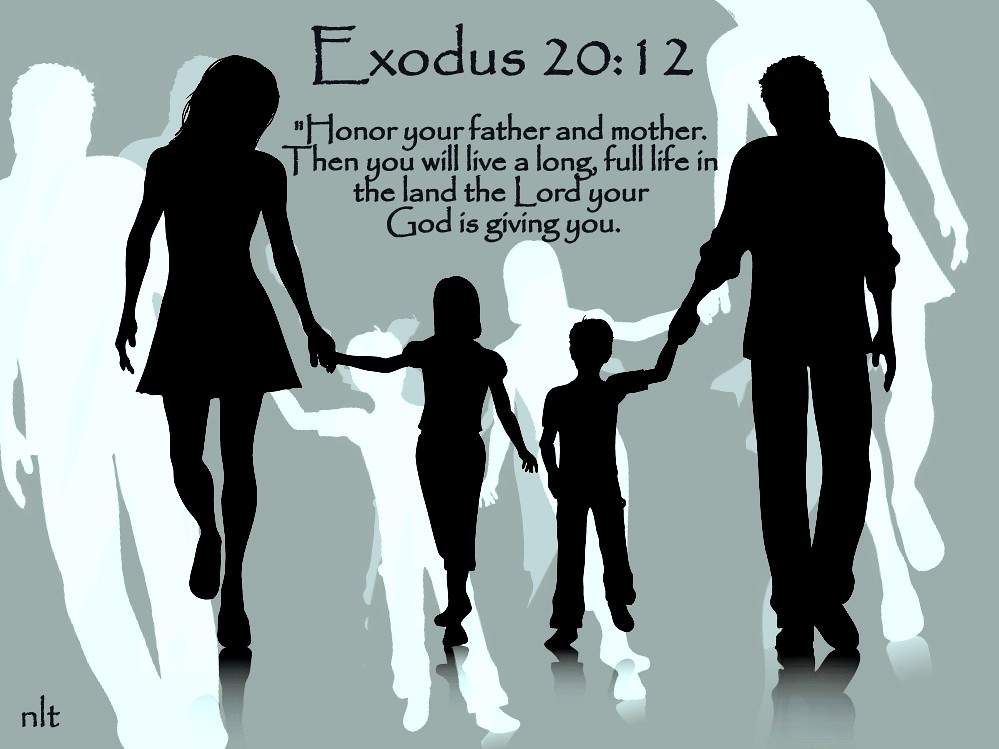
    12 “Honor (respect, obey, care for) your father and your mother, so that your days may be prolonged in the land the Lord your God gives you.

    The Word of God for the Children of God.

    Adeste Fidelis. Venite Adoremus. Dominum.

    Gloria. In Excelsis Deo. Alleluia, Alleluia, Alleluia, Amen.

    Most Christians are very familiar with the verse “honor your father and mother”, but few actually know of it’s origin in the Bible.

    The command to honor your father and mother actually comes from the Old Testament book of Exodus 20 in the story of the 10 Commandments.

    However, it is also a command that is repeated several times in both the Old and New Testament. 

    Chapter 20 of the Book of Exodus serves as a powerful reminder of the intimate relationship God has with humankind.

    This passage specifically reveals the intense care and concern that God shows toward His Children.

    Today this chapter remains popular because of a very special occurrence – the Ten Commandments.

    At eighty plus years old, after venturing up to Mount Sinai, Moses, a father, brought down the Ten Commandments, rules given Him directly from God.

    The Ten Commandments described ten precepts for how God expected His people to behave.

    This monumental moment follows after the Israelites fled Egypt. 

    Chapter 19 in the Book of Exodus details how the Israelites camped in the wilderness, now living a life outside of slavery for a few months.

    God informs Moses that He desires to bless the nation of Israel.

    However, He also wants them to keep a covenant with Him (Exodus 19:5-6).

    The Ten Commandments serve as part of that covenant.

    One of these commandments spoke to the relationship between a child and parent and is a guideline we as Christians still ought to be following today.

    Exodus 20:12The Message

    12 Honor your father and mother so that you’ll live a long time in the land that God, your God, is giving you.

    The reason this commandment in addition to the other nine is still relevant today is because Jesus indicated such to later believers (Matthew 5:17-20).

    Jesus did not abolish the law, but rather came to fulfill it.

    The Apostle Paul wrote to the followers at the church at Ephesus;

    Ephesians 5:1-2 Amplified Bible

    Be Imitators of God

    Therefore become imitators of God [copy Him and follow His example], as well-beloved children [imitate their father]and walk continually in love [that is, value one another—practice empathy and compassion, unselfishly seeking the best for others], just as Christ also loved you and gave Himself up for us, an offering and sacrifice to God [slain for you, so that it became] a sweet fragrance.

    We are to do our part yet today in abiding in Jesus, by these commandments.

    Today, I do not believe there is little to no controversy about whether or not the Ten Commandments are still relevant.

    What has been up for rather contentious debate in the meaning of “honor” in the context of parents and children.

    There are many instances of children being the victims of incest, abandonment, neglect, or other severe and seriously exploitive forms of ultra damaging abuse.

    In these situations, how does a child honor a parent, when the parent lacks any concept or context of abiding in God, His Son Jesus and have honor for the child.

    To understand this commandment, we have to examine the original context.

    What Is the Original Meaning of Honor Your Father and Mother in Exodus 20?

    The commandment to honor our father and mother is the fifth of the ten mentioned.

    The commandment to precedes this one is honoring the Sabbath, followed by the commandment to not murder.

    Scripture explains the reason why the commandment should be followed.

    Exodus 20:12Amplified Bible

    12 “Honor (respect, obey, care for) your father and your mother, so that your days may be prolonged in the land the Lord your God gives you.

    The benefit of abiding by this commandment is longer life, specifically for the Israelites venturing on toward the Promised Land.

    Dennis Prager [https://dennisprager.com/] emphasizes that though this could be viewed as a reward, this is also a reason.

    And many of the other commandments are not given explicit reasons to be followed.

    Prager suggests in a society where parents are honored by children, the society is bound to survive longer, than a society with a weaker family structure.

    This commandment in Exodus is mentioned a number of other times in the Bible, each time as an admonishment to God’s people to better establish them. 

    Deuteronomy 5:16 tells us, “Honor your father and your mother, as the LORD your God has commanded you, so that your days may be long and that it may go well with you in the land that the LORD your God is giving you.”

    Ephesians 6:2 states: “Honor your father and mother” – which is the first commandment with a promise”

    God blesses the people when their parents are honored, but the people are punished when they do not.

    To honor is to hold someone in high regard or reverence.

    The word honor does not mean agree with or even obey, but does suggest in this context a child should hold the highest utmost respect for both of their parents.

    Now that we better understand the original context and interpretation of the commandment to honor thy mother and father, we can try to discern how this precept applies to modern-day life.

    How Can Christians ‘Honor Your Father and Mother’ Today?

    With an understanding of the word honor, there need not be a change in how parents are respected by children today.

    However, with modern cultural shifts, this commandment for some has taken on a different interpretation.

    We can perhaps better, more prayerfully understand the proper ways of honoring parents by first understanding how honoring should not appear.

    As Dennis Prager discusses in his video analysis of the commandment, some parents yearn to be loved, rather than honored.

    The visual example given in his video is that of a parent showering their child with gifts in order to receive affection.

    This same parent when trying to discipline their child instead receives severe retaliation from them.

    This is definitively not an example of a child honoring their parent because instead of respecting them as an “authority” figure, they are simply seeking what else, exactly how much more they can manipulate, gain from the parent.

    Much like the Bible commands us to love others, the call to honor our parents is an outward action – something we do for others.

    Honoring our parents is therefore not contingent upon what they give in return.

    Within the Ten Commandments, verse 12 of Exodus 20 gives no clarification as to what parents are to be honored or even how.

    We can conclude then that all parents are deserving of honor, and we can use the context of love within the Bible to discern appropriate ways to show honor.

    We can even in some instances see how people have honored God as Father as an example.

    Ways we can appropriately honor our parents include:

    Expressing Gratitude
    Parents invest time and effort into raising children.

    Those reasons alone are enough to show them gratitude for the sacrifices they make.

    Parents provide shelter, food, clothing.

    For every action they do in their support of their child is in itself a far more than sufficient reason for expressing their appreciation and gratitude.

    Spending Time Together
    When physically possible, children can and should get together with their parents.

    This acknowledges their existence and places a level of importance upon the relationship.

    If being together physically is not an option, calling a parent on the phone for a check-in is also beneficial.

    Dennis Prager shares with fellow believers he called his parents once a week.

    Serve
    Another way for children to honor their parents is to find creative ways to serve their desires, wants and needs, much like parents perform on behalf of children.

    To Honor or Not to Honor

    It goes without saying and preaching to the choir that modern parenting is not equivalent to the parenting in ancient biblical Jewish culture.

    Children today learn differently and have certain responsibilities such as owning a cell phone [I never did], which was not true for past generations.

    No matter the time, parents should always be honored.

    One concern followers, nonbelievers have with the commandment is the issue of bad parents, individuals who have abused their children by various means.

    The Bible does not qualify which parents deserve honoring.

    Additionally, Jesus mentions we are to love others as ourselves (Matthew 22:39) and to bless those who persecute us (Romans 12:14).

    We, therefore, know that even when seemingly impossible, we should all do our best to express love for our parents, our children as we express love for our God.

    This fifth commandment, however, does not advocate for putting ourselves in danger with bad parents.

    Applying this commandment for children who have been abused will look different in terms of how they show their honoring.

    Spending time together may be an impossibility but talking on the phone or writing a letter could prayerfully be an option depending on the circumstance.

    Sometimes we have to set boundaries in relationships, and whenever that is the case we have to pray unto our ABBA God for wisdom, so that we may honor His commandment and honor our parents while keeping ourselves safe (James 1:5).

    There are no easy or set human answers how to be complete, perfect parents.

    As Mom’s and Dad’s together …

    The very best we can do is diligently consult the Word of God for His Children.

    Study it …

    Like Jesus did, intentionally plumb its depths, its ways, its truths and its life.

    Pray without ceasing over every aspect of it, revelation from it …

    Koinonia, Fellowship with our ABBA Father, His Son Jesus, Holy Spirit, other Parents …

    Finally,

    Be Still, Be Quiet, know only God is God, and can, should be, exalted as God.

    Matthew 6:25-33New King James Version

    Do Not Worry

    25 “Therefore I say to you, do not worry about your life, what you will eat or what you will drink; nor about your body, what you will put on. Is not life more than food and the body more than clothing? 26 Look at the birds of the air, for they neither sow nor reap nor gather into barns; yet your heavenly Father feeds them. Are you not of more value than they? 27 Which of you by worrying can add one [a]cubit to his [b] stature?

    28 “So why do you worry about clothing? Consider the lilies of the field, how they grow: they neither toil nor spin; 29 and yet I say to you that even Solomon in all his glory was not [c]arrayed like one of these. 30 Now if God so clothes the grass of the field, which today is, and tomorrow is thrown into the oven, will He not much more clothe you, O you of little faith?

    31 “Therefore do not worry, saying, ‘What shall we eat?’ or ‘What shall we drink?’ or ‘What shall we wear?’ 32 For after all these things the Gentiles seek. For your heavenly Father knows that you need all these things. 33 But seek first the kingdom of God and His righteousness, and all these things shall be added to you.

    In the name of God, the Father and God the Son and God the Holy Spirit,

    Let us Pray,

    Heavenly Father, thank You for my parents and for giving me life. Thank You for the pleasant and harsh lessons I have learned and the good times and the bad we have shared together. Forgive me for the times when I have not sufficiently honored my father and mother as I ought – for I am now acutely aware that this is dishonoring to You. From this day forward, I pray that I should honour You in all my interactions with my own family and with my friends, and may my life be honoring to You.

    Adeste Fidelis. Venite Adoremus. Dominum.

    Gloria. In Excelsis Deo. Alleluia, Alleluia, Alleluia, Amen.
    https://translate.google.com/

    Honoring Parents, Honoring God. Exodus 20:12

    Exodus 20:12Amplified Bible

    12 “Honor (respect, obey, care for) your father and your mother, so that your days may be prolonged in the land the Lord your God gives you.

    The Word of God for the Children of God.

    Adeste Fidelis. Venite Adoremus. Dominum.

    Gloria. In Excelsis Deo. Alleluia, Alleluia, Alleluia, Amen.

    The fifth commandment is simultaneously a simple instruction and an indispensable element of the well-being of entire societies.

    When the Lord gives the command “Honor your father and mother,” He is laying down the essential blueprint for maintaining the stability of families, communities, the Body of Christ and His churches and hosts of all nations.

    What does it mean to honor your parents?

    The word for “honor” carries the notion of weight and heaviness; children ought to feel the weight of respect for their parents.

    By this fifth commandment, God places the full weight of responsibility for the lifetime of moral and ethical upbringing of the children and their instruction in righteous living, firmly and squarely on the shoulders of the father and mother.

    By this “God” weight, this weight of God, Parents are owed such high regard because God has placed upon them in their roles, the stewardship of such a role, accountability to such a role, to raise the next generation of children, is worth many times over, far beyond its utmost maximum possible weight in honor.

    While children are in view here, the Bible also has much to say about parenting that honors God (see also Ephesians 6:4; Colossians 3:21). — More on this later.

    How does a child display this honor?

    In several ways.

    For one, a child ought to show practical respect to his or her parents.

    This can be as simple as speaking well of our parents, showing them courtesy, looking them in the eye, and addressing them with a due sense of deference.

    Second, it involves genuine love; there should be heartfelt expressions of affection between parents and their children.

    Third, unless it would involve disobeying God, a child ought to obey what his or her mom and dad say.

    This expectation is found all over Proverbs: for example, “Hear, my son, your father’s instruction, and forsake not your mother’s teaching” (Proverbs 1:8).

    Fourth, a child should submit to their parents’ discipline and authority.

    All good parents discipline their children (though it must not be done in anger nor vindictively or disproportionately), and children should ought to be taught to implicitly trust such discipline is for their long-term good (Hebrews 12:5-11).

    In ancient Israel, respect for ones parents was valued so highly that those who disregarded it flagrantly or persistently faced the death penalty (Deuteronomy 21:18-21).

    Why such a significant consequence?

    Because the home provides the most essential and vital training ground, the success of which affects how the child will relate to authorities of all kinds.

    We never outrun authority in our lives.

    There are political authorities we are called to obey (Romans 13:1-7).

    Spiritual authorities we are to respect (Hebrews 13:17; 1 Thessalonians 5:12).

    And those of advanced years we are commanded to honor (Leviticus 19:32).

    Most significantly, when children are taught how, when they learn over time to honor their parents, even despite their parents’ many imperfections, they learn what it too means to learn how to honor our ABBA, our perfect heavenly Father.

    Reverence for parents is an integral part of reverence for God.

    Because parental authority is God-given, for children to learn to honor their parents is to come to that place of spiritual maturity and honor God Himself.

    So if you are a parent [age not specific] with children [age?] at home, it is not loving (though it may be easier) to fail to insist that your children honor you.

    If you are an adult with parents still living, it is a matter of obedience to God you still show them the honor they are due, not according to how well (or other- wise) you feel they raised you but according to the position the Lord gave them.

    As you honor them, you will be pleasing Him and showing those around you that God-given authority, when exercised in a godly way, is a blessing to all.

    Honoring Parents …

    It may come as a surprise to many of us this commandment is not age-specific.

    It’s a commandment not just for the young but for children of all ages.

    God asks parents be worthy of honor in the way they relate to their children.

    And God commands that children obey and show respect for their parents in line with doing what is right.

    This means both are to act appropriately at each stage of their lives together.

    This commandment came to a society without the support systems that many of us are used to.

    Adult children were totally responsible to look after aging parents.

    God reminds us that as long as we have parents, we are to honor them, seeing that their living is respectable and they are well cared for.

    It’s not just a matter of doing what our parents tell us to do when we are young.

    It’s a matter of showing our utmost respect, life-long honor to the parents who gave us life, sacrificed incredibly all to raise us, launched us upon life’s journey.

    The apostle Paul calls this “the first commandment with a promise.”

    God indicates when we honor the parents with whom we are in relationship, he will honor us and He will surely and certainly bless us.

    Some parents are easier to honor than others.

    But respecting to the utmost those whom the Lord has chosen to place over us opens a door to abundant blessings.

    By honoring our parents and others whom God places in authority over us, we honor and glory and our utmost worship and praise unto our Father in heaven.

    Which is what each and everyone of us were created, shaped by God, to do …

    In the name of God, the Father and God the Son and God the Holy Spirit.

    Let us Pray,

    Heavenly Father, ABBA Father, thank You for my parents and for giving me life. My First ABBA, Thank You for the lessons I have learned and the good times we have shared together. Forgive me for the times when I have not honored my father and mother as I ought – for I am aware that this is dishonoring to You. From this day forward, I pray that I may honour You in all my interactions with my family and my friends, and may my whole life be honoring unto You. This I pray in Jesus’ name.

    Adeste Fidelis. Venite Adoremus. Dominum.

    Gloria. In Excelsis Deo. Alleluia, Alleluia, Alleluia, Amen.

    https://translate.google.com/

    Our Celebration of Father’s Day 2022. Honor in the Home. Exodus 20:12

    Most Christians are very familiar with the verse “honor your father and mother”, but few actually know of its origin in the Bible.

    The command to honor your father and mother actually comes from the Old Testament book Exodus 20 in God’s writing, giving of the 10 Commandments.

    However, it is also a command that is repeated several times in both the Old and New Testament. 

    Chapter 20 of the Book of Exodus serves as a powerful reminder of the intimate relationship God has with humankind.

    This passage specifically reveals the intense care and concern that God shows toward His followers.

    Today this chapter remains popular because of a very special occurrence – the Ten Commandments.

    After venturing up to Mount Sinai, Moses brought down from God’s own hand the Ten Commandments, rules given Him directly from God.

    The Ten Commandments described ten precepts for how God expected His people to behave.

    This monumental moment follows after the Israelites fled Egypt. 

    Chapter 19 in the Book of Exodus details how the Israelites camped in the wilderness, now living a life outside of slavery for a few months.

    God informs Moses that He desires to bless the nation of Israel.

    However, He also wants them to keep a covenant with Him (Exodus 19:5-6).

    The Ten Commandments serve as part of that covenant.

    One of these commandments spoke to the relationship between a child and parent and is a foundational guideline we as Christians still follow today.

    The reason this commandment in addition to the other nine is still relevant today is because Jesus indicated such to later believers (Matthew 5:17-20).

    Jesus did not come to abolish the law, but rather came to fulfill it.

    We are to do our part in abiding by these commandments.

    Today, there is a growing measure of controversy about whether or not the Ten Commandments are still relevant.

    What is up for debate in the meaning of “honor” in the context of parents and children.

    Exodus 20:12Amplified Bible

    12 “Honor (respect, obey, care for) your father and your mother, so that your days may be prolonged in the land the Lord your God gives you.

    The Word of God for the Children of God. Gloria! In Excelsis Deo! Alleluia! Amen.

    This week I saw a posting on social media which asked these questions:

    “What’s the #1 thing you want from your children?”

    “What’s the #1 thing you want from your mom and dad?”

    I was struck by the depth of answers along with the longing in the hearts of the children for their parents, parents for their children to love and serve the Lord.

    • To know God and make Him known.

    • To have the ability to see God’s presence in all circumstances.

    • Respect and obedience to God.

    • I want them to love God deeply in their heart leading to serving and glorifying Him with their lives.

    • To be sold out to Jesus.

    • For them to taste and see that the Lord is good, thus causing them to love the Lord with all that they are.

    • Love and respect.

    • To love and obey Jesus for themselves.

    After all these thoughtful responses, one person answered the question, “What’s the #1 thing you want from your children?” this way…

    • To be quiet.

    One person responded to him this way, “He didn’t ask what wives want from their husbands!”

    Another one quickly commented, “Sir, you know going get criticized for that!” To which that ‘father’ replied, “I am counting on it.”

    He further shared his insight into his response.

    He redeemed himself when he wrote,

    “Being quiet isn’t obviously the #1 thing but I think it’s something as you get older you see the value in being quiet. Sit still! Be quiet when God is telling you something. Be quiet when someone with more experience is talking.”

    All I could think to myself was;

    “Right on!”

    Behind each of these posts from parents is a longing for their children to honor them, and to honor God.

    In the fifth commandment, recorded in Exodus 20:12, we discover the #1 thing God wants from His children: “Honor your father and your mother, that your days may be long in the land that the LORD your God is giving you.”

    Deuteronomy 6:6-7 tells us these commands are to be inscribed on our hearts so we can impress them upon our children.

    Today, as a way to get these commandments into our heads and into our hearts,

    I am encouraging families in the course of their celebrations today, to spend a little bit of “Father to Children” “Children to Father” time to make a bookmark and work together at reading and sharing and memorizing these short phrases.

    1. One God

    2. No idols

    3. Revere His Name

    4. Remember to Rest

    5. Honor Parents

    6. No murder

    7. No adultery

    8. No stealing

    9. No lying

    10. No coveting

    Listen again to the command from Exodus 20:12:

    “Honor your father and your mother, that your days may be long in the land that the LORD your God is giving you.”

    Our main idea is this: Honoring your parents is always proper.

    After making some observations, we’ll contemplate the precept. Then, we’ll consider the promise and conclude with how to practice this commandment.

    Observations

    1. This is a hinge commandment.

    The first four commands deal with our relationship with God. The final six relate to our relationships with others.

    The fifth commandment establishes that loving our neighbor starts at home.

    When we’re out of step at home we’ll be out of whack with God and others. “The relationship between parent and child is the first and primary relationship, the beginning of all human society.”

    2. This is the first commandment dealing with the family.

    The fifth commandment focuses on the parent-child relationship while the seventh commandment calls us to marital fidelity. Family life is the bedrock of a culture. As the family goes, so goes the nation, and the church.

    3. This is given to children of all ages.

    The atmosphere of the home is in large part related to the response of the children, not just to the loving leadership of the parents.

    4. This command is a present imperative, which means we are to be in the habit of honoring continually.

    This is not a suggestion but rather an uncompromising command.

    5. This command is directed to each of us.

    The word “your” is used four times and “you” is used once.

    The Precept

    This precept is relatively simple to understand and yet fierce in its force: “Honor your father and mother…” “Kavod” is the Hebrew word for honor and respect. The word “honor” literally means a “heavy weight.”

    To “honor” is to assign the greatest possible weight to a person in terms of respect by holding them in “high regard.”

    We say of someone we really respect: “She’s worth her weight in gold” or, “he’s a heavyweight.”

    On the other hand, to “dishonor” means to treat someone as if they were “light or insignificant.”

    To honor is to treat with distinction; to dishonor is to treat someone like dirt.

    The opposite of honor is “in vain,” which means “empty, useless, and of no value.”

    To honor our parents is to give them their full due weight. We’re to honor our parents because of their position, not necessarily because of their performance.

    Scripture tells us eight times to “honor your father and mother.” It’s repeated so much because it doesn’t come naturally to us.

    The word “honor” is the same word translated “glory” in reference to the Lord.

    To glorify the Lord is to assign Him the highest and heaviest place because He deserves it.

    Interestingly, the only entities we’re to honor, according to the first five books of the Bible, are the Lord and our parents.

    The Dictionary of Biblical Imagery offers a helpful definition:

    “To show honor entails an affective side (a feeling of respect or reverence) and a set of outward manifestations, such as gestures (bowing before or being attentive) or actions (conferring titles or privileges). All these ways of showing honor elevate the person that is honored.”

    The emphasis here is on the attitude, not merely the act.

    We’re to show honor in both our attitudes and in our actions.

    To honor is to elevate and to esteem and to live it out in experience.

    Let’s consider how this word is used in two other passages.

    • Honoring the elderly is linked to honoring the Almighty. Leviticus 19:32:

    “Stand up before the gray head and honor the face of an old man, and you shall fear your God: I am the Lord.”

    I wonder if this verse will be in someone’s Father’s Day card this year!

    • We prioritize honor according to what we prize highly.

    Speaking of wisdom, Proverbs 4:8 says: “Prize her highly, and she will exalt you; she will honor you if you embrace her.”

    I came across a simplified definition of honor you could use with your kids or grandkids.

    It’s from the book, Say Goodbye to Whining, Complaining, and Bad Attitudes in You and Your Kids by Turansky and Miller.

    • Treating people as special.

    • Doing more than what’s expected.

    • Having a good attitude.

    The Promise

    We see a promise connected to this command in the second half of verse 12: “…that your days may be long in the land the Lord your God is giving you.”

    When the Apostle Paul quoted this command in Ephesians 6:2 he added, “this is the first commandment with a promise.”

    Actually, this is the only commandment which spells out the benefits of keeping it. Honor is so honorable God Himself underscored it with a promise.

    God is a promise-making and promise-keeping God.

    It’s been estimated there are over 30,000 promises in the Bible, which 2 Peter 1:4 calls, “…His precious and very great promises…”

    These promises help us see honoring your parents is always proper.

    Here’s a list of positive promises from the Bible associated with this command.

    1. Your life will generally be longer.

    This ultimately refers to the duration of the nation of Israel in the land but also has personal application for believers as we see in Ephesians 6:3: “That it may go well with you and that you may live long in the land.”

    The phrase, “live long in the land” was identified with the fulfillment of God’s blessings, not a blanket promise for a long life.

    2. You will experience blessing. 

    Deuteronomy 5:16: “Honor your father and your mother, as the LORD your God commanded you, that your days may be long, and that it may go well with you in the land that the LORD your God is giving you.”

    The word “well” is an adverb meaning “fine, well, good, or beneficial.”

    3. It is the right thing to do. It’s always right to honor our parents. 

    Ephesians 6:1: “Children, obey your parents in the Lord, for this is right.”

    The Puritans taught that a child should be the parent’s echo. When the parent speaks, the child should echo back with honorable obedience.

    4. It teaches respect for authority.

    When honor is taught in the home, it will spread to other areas of a child’s life.

    Jen Wilken writes: “This life is the lab in which God’s children learn to submit to heavenly authority by submitting to earthly authority.” 

    Romans 13:1-2: “Let every person be subject to the governing authorities. For there is no authority except from God, and those that exist have been instituted by God. Therefore, whoever resists the authorities resists what God has appointed, and those who resist will incur judgment.”

    Billy Graham said, “A child that is allowed to be disrespectful to his parents will not have respect for anyone else.”

    5. God provides protection for those who honor their parents. 

    Proverbs 6:20-23: “My son, keep your father’s commandment, and forsake not your mother’s teaching. Bind them on your heart always; tie them around your neck. When you walk, they will lead you; when you lie down, they will watch over you; and when you awake, they will talk with you.”

    6. You will bring peace and joy to your parents. 

    Proverbs 15:20: “A wise son makes a glad father, but a foolish man despises his mother.”

    7. You will grow in wisdom and insight. 

    Proverbs 4:1-4: “Hear, O sons, a father’s instruction, and be attentive, that you may gain insight, for I give you good precepts; do not forsake my teaching. When I was a son with my father, tender, the only one in the sight of my mother, he taught me and said to me, ‘Let your heart hold fast my words; keep my commandments, and live.’”

    8. God is pleased when you honor your parents. 

    Colossians 3:20: “Children, obey your parents in everything, for this pleases the Lord.”

    9. God will turn your heart back home.

    We see this promise in Malachi 4:6, the last verse of the Old Testament, when God will

    “turn the hearts of fathers to their children and the hearts of children to their fathers, lest I come and strike the land with a decree of utter destruction.”

    The Dangers of Dishonoring

    Disobedience to parents is listed along with other heinous sins in

    Romans 1:30-32: “Slanderers, haters of God, insolent, haughty, boastful, inventors of evil, disobedient to parents, foolish, faithless, heartless, ruthless. Though they know God’s righteous decree that those who practice such things deserve to die, they not only do them but give approval to those who practice them.”

    One of the signs of the end times will be the increasing disobedience of children according to 2 Timothy 3:1-2: “But understand this, that in the last days there will come times of difficulty. For people will be lovers of self, lovers of money, proud, arrogant, abusive, disobedient to their parents.”

    Today, families are under attack, with parental authority being questioned and disregarded.

    Years ago, the Duke of Windsor observed,

    “The thing that impresses me about America is the way parents obey their children.”

    The Bible says it’s dangerous for children to disobey.

    While there are beautiful blessings for obedience, there are also some negative promises associated with breaking this command.

    God has a deep revulsion toward anyone who revolts against their parents.

    1. A shortened life. Cursing a parent was a capital offense and punishable by death. 

    Exodus 21:15, 17: “Whoever strikes his father, or his mother shall be put to death. Whoever curses his father, or his mother shall be put to death.”

    Proverbs 20:20 adds, “If one curses his father or his mother, his lamp will be put out in utter darkness.”

    2. An uncomfortable life.

    Parents, you might want to quote Proverbs 30:17 the next time your teenager rolls their eyes at you:

    “The eye that mocks a father and scorns to obey a mother will be picked out by the ravens of the valley and eaten by the vultures.”

    3. A cursed life. The word “diss” means to disrespect. If you diss or dishonor your parents, 

    Deuteronomy 27:16 says God will bring punishment: “Cursed be anyone who dishonors his father or his mother…”

    4. An exiled life. Are you aware one of the reasons the Jews were sent into Babylonian exile was a failure to honor their parents? 

    Ezekiel 22:7, 15: “Father and mother are treated with contempt…I will scatter you among the nations and disperse you through the countries…”

    Honoring your parents is always proper.

    Years ago, I read an article from Focus on the Family and still reference it today.

    The basic idea is our parenting roles change as our children grow.

    I don’t have time to explain it fully but here are the four phases:

    • Commander

    • Coach

    • Counselor

    • Consultant

    If you want to learn more,

    Go to Focus on the Family.com to the article “The Four Phases of Parenthood.”

    Putting it into Practice

    As always, Jesus provides the best model of how to obey this command.

    1. Jesus honored His parents by being submissive to them.

    We read this about Jesus as a preteen in Luke 2:51: “And He went down with them and came to Nazareth and was submissive to them. And his mother treasured up all these things in her heart.”

    2. Jesus honored His earthly mother by providing care for her.

    It’s incredible that while He was on the cross, about to pay the price for all of our sins, He took the time to keep the fifth commandment by making sure His mom would be cared for when He was gone. 

    John 19:26-27: “When Jesus saw His mother and the disciple whom He loved standing nearby, He said to His mother, ‘Woman, behold, your son!’ Then He said to the disciple, ‘Behold, your mother!’ And from that hour the disciple took her to his own home.”

    3. Jesus honored His Heavenly Father by becoming a sacrificial servant.

    Philippians 2:7-8: “But emptied Himself, by taking the form of a servant, being born in the likeness of men. And being found in human form, He humbled himself by becoming obedient to the point of death, even death on a cross.”

    The fifth commandment applies to everyone, no matter your age or stage in life.

    We are called to honor our parents, whether they’re alive or not. As a way to help us to put this commandment into practice, let’s focus on five questions.

    Questions to Ponder

    1. How are you doing showing honor to others?

    According to Romans 12:10 we’re to “outdo one another in showing honor.”

    2. In what specific ways are you honoring or dishonoring your parents?

    Have you been treating them as distinguished or like dirt?

    Do you consider their advice and their role in your life as weighty or worthless?

    Proverbs 1:8 challenges us to hear and heed what our parents tell us: “Hear, my son, your father’s instruction, and forsake not your mother’s teaching.”

    Proverbs 23:22: “Listen to your father who gave you life, and do not despise your mother when she is old.”

    You may be asking a couple questions at this point.

    Do I still need to obey my parents now that I’m an adult?

    How do I honor my parents even if I disagree with them on some things?

    Here’s my short answer:

    The biblical command to obey your parents, when you become an adult, and the biblical command to honor your parents never expires.

    Obeying your Parents and Honoring your parents is always proper.

    Here are 10 practical pointers to help us honor our parents:

    • Take initiative to improve the relationship in whatever increments you can.

    • Recognize your parents have done some things right and some things wrong.

    • Forgive them, even as God in Christ has forgiven you.

    • Thank your parents for the sacrifices they have made for you.

    • See your parents as Christ sees them.

    • Treat them with kindness.

    • Support and care for them.

    • Always speak well of them, whether they are alive or not.

    • Esteem them publicly and privately.

    • Don’t forsake them.

    3. Parents, in what ways are you showing honor to your kids? 

    Colossians 3:21 says, “Fathers, do not provoke your children, lest they become discouraged.”

    Let’s make sure we’re being good examples and not exasperating our children.

    Do all that you can to make it easier for them to honor you.

    Ray Fowler writes: “You can’t change your ancestors, but you can do something about your descendants!”

    4. Adults, how are you honoring your aging parents today? Are you looking for ways to demonstrate care and concern?

     1 Timothy 5:8: “But if anyone does not provide for his relatives, and especially for members of his household, he has denied the faith and is worse than an unbeliever.”

    I’m reminded of the Grimm’s Fairy Tale about a family with two children and an elderly grandfather.

    The grandfather could no longer eat neatly at the table. At first the parents rebuked him; then made him sit in the corner; eventually took away his knife, fork and spoon, placed food in a trough where he would eat with his fingers.

    One day the dad saw his children playing outside with some wood, a hammer, and a saw.

    “What are you building?” he asked.

    They replied: “A trough for you when you get old!”

    Are you taking care of your elderly parents?

    What are you teaching your children right now about honoring the elderly?

    5. In what ways are you showing honor to God, Your Father?

    Is God weighty to you or do you regard Him as worthless? 

    Psalm 29:2: “Ascribe to the Lord the glory due His name; worship the Lord in the splendor of His holiness.”

    God blesses the people when their parents are honored, but the people are punished when they do not.

    To honor is to hold someone in high regard or reverence.

    The word honor does not mean agree with or even obey but does suggest in this context that a child should hold respect for their parent.

    Now as we better understand the scriptural context and interpretation of the 5th commandment to honor thy mother and father, we can discern how this precept applies to modern-day life.

    Ways we can appropriately honor our parents include:

    Expressing Gratitude

    Parents invest time and effort into raising children.

    Those reasons alone are enough to show them gratitude for the sacrifices they make.

    Parents provide shelter, food, clothing.

    For every action they do in support of the child is itself a reason for appreciation.

    Spending Time Together

    When physically possible, children can and should get together with their parents.

    This acknowledges their existence and places a level of importance upon the relationship.

    If being together physically is not an option, calling a parent on the phone for a check-in is also beneficial. 

    Serve

    Another way to honor parents is to find ways to serve their wants and needs, much like parents perform on behalf of children.

    To Honor or Not to Honor

    Modern parenting is not equivalent to the parenting in biblical Jewish culture.

    Children today learn differently and have certain responsibilities such as owning a cell phone, which was not true for past generations.

    No matter the time, parents should always be honored.

    One concern some followers and nonbelievers have with the commandment is the issue of bad parents, individuals who have abused their children by various means.

    The Bible does not qualify which parents deserve honoring.

    Additionally, Jesus mentions we are to love others as ourselves (Matthew 22:39) and to bless those who persecute us (Romans 12:14).

    We, therefore, know that even when seemingly impossible, we should do our best to express love.

    This commandment, however, does not advocate for putting ourselves in danger with bad parents.

    Applying this commandment for children who have been abused may look different in terms of how they show their honoring.

    Spending time together may be an impossibility but talking on the phone or writing a letter could be an option depending on the circumstance.

    Sometimes we have to set boundaries in relationships, and whenever that is the case we can pray to God for wisdom, so that we may honor His commandment and honor our parents while keeping ourselves safe (James 1:5).

    https://www.biblestudytools.com/bible-study/topical-studies/a-biblical-command-we-never-outgrow-honor-your-father-and-mother.html

    In the name of God, our Father and God the Son and God the Holy Spirit,

    Let us pray,

    Father God thank you for your perfect fathering –

    I praise you because I am fearfully and wonderfully made;

    shepherded and nurtured; disciplined and challenged

    so I can flourish in your purpose and plan for me

    and bear my Father’s image more fully still.

    Father God, thank you for your perfect example.

    I praise you because you show all fathers how to love;

    to shepherd and nurture; discipline and challenge

    so their sons and daughters can flourish in this world as you have planned,

    and carry your presence to all they meet.

    Father God, bless all fathers today –

       with wisdom, with patience, with courage –

    and above all with love for their children.

    Father God, bless all children today –

       with openness to correction, with eagerness to learn –

    and above all with love for their fathers.

    Father God bless all who are fatherless today –

       surround them with godly men to teach, affirm and guide –

    and above all to love with the love of a father – in your strength.

    Amen.

    https://translate.google.com/