Romans 15:4 "For whatever was written in earlier times was written for our instruction, so that through perseverance and the encouragement of the Scriptures we might have hope."
24 There is nothing better for a man than to eat and drink and assure himself that there is good in his labor. Even this, I have seen, is from the hand of God. 25 For who can eat and who can have enjoyment without Him? 26 For to the person who pleases Him God gives wisdom, knowledge, and joy; but to the sinner He gives the work of gathering and collecting so that he may give to one who pleases God. This too is vanity and chasing after the wind.
Word of God for the Children of God
Glory be to the Father, and to the Son, and to the Holy Ghost; as it was in the beginning, is now, and ever shall be, world without end. Amen, amen.
“Ecclesiastes 2:24 (KJV) – There is nothing better for a man, than that he should eat and drink, and that he should make his soul enjoy good in his labour. This also I saw, that it was from the hand of God.”
The book of Ecclesiastes is traditionally attributed to King Solomon, who had reigned over Israel in 10th century BCE, and known for his wisdom and wealth.
In this verse, Solomon reflects on the fleeting nature of life and the ultimate futility of worldly pursuits.
He encourages his audience to find satisfaction in the simple pleasures of life and to acknowledge that these pleasures come as gifts from the hand of God.
The verse begins with the affirmation that there is nothing better for a person than to eat, drink, and enjoy the fruit of their labor.
This echoes a theme found throughout Ecclesiastes, which emphasizes the transience of life and the absence of ultimate meaning in human pursuits.
Despite this seemingly pessimistic perspective, Solomon’s message is one of acceptance and contentment in the face of life’s challenges and uncertainties.
The theme of enjoying the simple pleasures of life is echoed in other passages of the Bible, such as Psalm 34:8, which says,
“Taste and see that the Lord is good; blessed is the one who takes refuge in him.”
This theme is also consistent with the much broader message of Ecclesiastes, which advocates for a genuine balanced, measured approach to life, avoiding excessive, obsessive, attachments to wealth, power, or hedonistic pleasure.
Solomon’s assertion these pleasures come “from the hand of God” underscores the idea of divine providence and belief all good things ultimately come from God.
This echoes a common biblical theme of acknowledging God’s sovereignty and provision in all aspects of life.
It also serves as a timely reminder to be grateful for the blessings we receive, recognizing that even the simplest, simplified joys of life are gifts from God.
The broader context of Ecclesiastes is quite important for understanding the significance of this verse.
The book as a whole reflects on the fleeting nature of life and the pursuit of meaning and purpose in the face of mortality.
Solomon explores various avenues in search of fulfillment, including wisdom, pleasure, and wealth, but ultimately concludes that true satisfaction is found in fearing God and joyfully keeping his commandments (Ecclesiastes 12:13).
Ecclesiastes 2:24 serves as a reminder to find contentment and joy in the present moment, rather than striving after fleeting pleasures or earthly wealth.
It encourages a perspective of gratitude and mindfulness, recognizing that even the simple acts of eating, drinking, enjoying one’s labor are gifts to be savored and appreciated.
Symbolically, the act of eating and drinking can be seen as a metaphor for nourishment and sustenance, both physical and spiritual.
Enjoying the fruits of one’s labor reflects the satisfaction that comes from hard work and accomplishment.
Through these simple acts, Solomon invites his audience to find fulfillment in the everyday, rather than in the pursuit of grandiose or unattainable goals.
Ecclesiastes 2:24 offers a message of contentment, gratitude, and mindfulness, reminding readers to find joy in the simple pleasures of life and acknowledge God’s provision in all things.
It is a call to embrace the present moment and find fulfillment in the here and now, rather than constantly striving after ephemeral pursuits.
In doing so, the verse encapsulates the much broader themes of Ecclesiastes and offers a perspective that is both timeless and relevant to readers today.
DAILY LIFE WITH GOD
(Ecclesiastes 2:24-26)
Central Idea: We are to enjoy our daily lives as gifts from the hand of God.
Purpose: To encourage believers to find contentment in God.
Our happiness in life comes from the hand of God (2:25).
The simple pleasures of life are God’s gifts for us to enjoy (2:26a).
God judges sinners with the frustration of working for God’s people (2:26b).
In the name of God, the Father the Son and the Holy Spirit ….
Praying …
Psalm 23 Authorized (King James) Version
Psalm 23
A Psalm of David.
1 The Lord is my shepherd; I shall not want. 2 He maketh me to lie down in green pastures: he leadeth me beside the still waters. 3 He restoreth my soul: he leadeth me in the paths of righteousness for his name’s sake. 4 Yea, though I walk through the valley of the shadow of death, I will fear no evil: for thou art with me; thy rod and thy staff they comfort me. 5 Thou preparest a table before me in the presence of mine enemies: thou anointest my head with oil; my cup runneth over. 6 Surely goodness and mercy shall follow me all the days of my life: and I will dwell in the house of the Lord for ever.
Glory be to the Father, and to the Son, and to the Holy Ghost; as it was in the beginning, is now, and ever shall be, world without end. Amen, amen.
7 A good name is better than precious ointment, And the day of death than the day of one’s birth; 2 Better to go to the house of mourning Than to go to the house of feasting, For that is the end of all men; And the living will take it to heart. 3 [a]Sorrow is better than laughter, For by a sad countenance the heart is made [b]better. 4 The heart of the wise is in the house of mourning, But the heart of fools is in the house of mirth.
Word of God for the Children of God
Glory be to the Father, and to the Son, and to the Holy Ghost; as it was in the beginning, is now, and ever shall be, world without end. Amen, amen.
“For this is the end of all mankind, and the living will lay it to heart.” – Ecclesiastes 7:2
This is one of those verses in the Bible that serves as a sober reminder to all of us that we will, one day, die, and that day could be any moment of any day.
It could be today for any one of us.
Now think about James 4, which just reminds us that our life is a mist, it’s a small gust of wind, barely visible vapor. It’s here one second and gone the next.
That’s part of the picture in Ecclesiastes 7,“This is the end of all mankind,” and listen to this phrase, “The living will lay it to heart.” Those who live who are wise, remember Ecclesiastes, this is a big part of wisdom literature in the Bible.
Reminded of God’s Wisdom
Ecclesiastes 7:1-4 The Message
Don’t Take Anything for Granted
7 A good reputation is better than a fat bank account. Your death date tells more than your birth date.
2 You learn more at a funeral than at a feast— After all, that’s where we’ll end up. We might discover something from it.
3 Crying is better than laughing. It blotches the face but it scours the heart.
4 Sages invest themselves in hurt and grieving. Fools waste their lives in fun and games.
There is wisdom that’s found in living daily, with the reality that none of us is going to be guaranteed any more tomorrows, and so we make the most of today.
Doesn’t this just lead us like, “Oh, just think about how this leads us to pray and then to live”?
What if you knew today was your last day, how would that change the way you love the people around you, the way you then speak to those people around you, the way you prioritize, rationalize, reprioritize any number of different things?
Now, obviously, there’s a sense in which that kind of thinking falters a bit. I mean if you knew today was the last day, you might not go to work, or do email, or this or that in the same way that… Well, we need to do sometimes on a daily basis in our jobs as we faithfully follow the Triune God and provide for families.
Ecclesiastes 7:2 Helps Us Honor God
Psalm 23 The Message
23 1-3 God, my shepherd! I don’t need a thing. You have bedded me down in lush meadows, you find me quiet pools to drink from. True to your word, you let me catch my breath and send me in the right direction.
4 Even when the way goes through Death Valley, I’m not afraid when you walk at my side. Your trusty shepherd’s crook makes me feel secure.
5 You serve me a six-course dinner right in front of my enemies. You revive my drooping head; my cup brims with blessing.
6 Your beauty and love chase after me every day of my life. I’m back home in the house of God for the rest of my life.
We go to school, raise our families, whatever it might be, but it is good to think, “Okay, how can I live, love, work today in a way I’m ready to see Jesus’ face?
How can I relate to others today in a way that I’m ready to see Jesus’ face, and they are ready to see Jesus’ face?”
It changes the way you live when you lay it to heart, your life is a vapor, a mist.
So we pray, God, help us today to make the most of the day we have.
And if we’re listening to this prayer tonight, tomorrow, to make the most of each moment, each day with you.
Before you God, we want to be found faithful before you, when we want to stand before you on that day.
And if it’s today, hear you say, “Well done, good, and faithful servant.”
Ecclesiastes 7:2 Leads Us to Pray for God’s Grace
Isaiah 40:8 The Message
6-8 A voice says, “Shout!” I said, “What shall I shout?”
“These people are nothing but grass, their love fragile as wildflowers. The grass withers, the wildflowers fade, if God so much as puffs on them. Aren’t these people just so much grass? True, the grass withers and the wildflowers fade, but our God’s Word stands firm and forever.”
God, we pray for your grace to live before you, that could happen today, and to live before others like this.
Triune God makes echelons more sense, not that it didn’t before, but your great commandment. Still covenanted to love you with all our heart, soul, mind, and strength, and I love others as ourselves.
Triune God, help us to do that today, help us to love you wholeheartedly and love others selflessly, and seems like the wisest way to live today if we knew it was going to be our last. So, God helps us to do this, help us to love you, love others, care for others, speak to others in a way that points them to you, walk in holiness before you, share the gospel, to share the good news that has all of the power to transform people’s lives around us for all of eternity.
Called to Share the Gospel with Urgency
Acts 2:14-21 The Message
Peter Speaks Up
14-21 That’s when Peter stood up and, backed by the other eleven, spoke out with bold urgency: “Fellow Jews, all of you who are visiting Jerusalem, listen carefully and get this story straight. These people aren’t drunk as some of you suspect. They haven’t had time to get drunk—it’s only nine o’clock in the morning. This is what the prophet Joel announced would happen:
“In the Last Days,” God says, “I will pour out my Spirit on every kind of people: Your sons will prophesy, also your daughters; Your young men will see visions, your old men dream dreams. When the time comes, I’ll pour out my Spirit On those who serve me, men and women both, and they’ll prophesy. I’ll set wonders in the sky above and signs on the earth below, Blood and fire and billowing smoke, the sun turning black and the moon blood-red, Before the Day of the Lord arrives, the Day tremendous and marvelous; And whoever calls out for help to me, God, will be saved.”
God, we pray that you would help us to live like that, knowing that the people around us are not guaranteed tomorrow either, that they could be gone tomorrow.
And so help us to share the gospel with urgency today as we pray for unreached people all the time.
God, we pray for the spread of the gospel to billions, three billion-plus people who have little to no knowledge of the gospel right now, many who will not make it to tomorrow, without ever hearing the good news of your grace.
Help us in our lives and our families and churches to make this gospel known among all the nations in the little bit of time you’ve given us on this earth. God, we pray you’d help us to live with the end in mind and to lay all of this to heart today. In Jesus’ name, we pray. Amen.
Why is it better to go to a funeral than a party?
Why is a funeral better than a party? Because it reminds us that everyone dies, and the living need to take this to heart.
Seeing someone ready to be buried makes us think about life’s brevity. We realize death is coming for all, and this should affect how we live.
What does it mean sorrow is better than laughter?
The New Living Translation says that the reason why sorrow is better than laughter is because “sadness has a refining influence on us.”
As unenjoyable as sorrow might be, it actually has the power to affect me in a profound, life-changing way that laughter has never been capable of doing.
Book of Ecclesiastes in the Old Testament written by King Solomon, the wisest man that ever lived. He wrote much of the Book of Proverbs as well.
He had experimented in his youth with living life to the fullest.
Chasing after all kinds of pleasure: food, drink, women; trying to find the meaning of life in his riches or in his great accomplishments.
But he always came back to the same theme – You have heard what he wrote: “Vanity of Vanities, all is vanity.” It is all Chasing after the Wind.
He knew life was empty and meaningless and futile when viewed “under the sun” = without a personal relationship with God who alone can give meaning to our lives.
So in this short verse he gives us God’s perspective on dealing with our mortality.
Laughing and feasting provide a escape from the pressures of life but they do not prepare us for death.
Something about contemplating death turns our thoughts towards the eternal rather than the temporal and makes us ask the tough questions.
What are some of those tough questions?
Remember Solomon tells us it is better to go to a house of mourning than to go to a house of feasting.
1) Tough Question #1: What’s so valuable about coming face to face with death?
Somehow what we are experiencing together today, despite the mourning, the grief, the sorrow, is more valuable than times of feasting and happiness.
How can that be? There’s an illustration in the Bible that I think provides the answer.
Apostle Peter writes in his second epistle people in our day will end up mocking the promise of Jesus coming back to earth, will hold men accountable.
Where is the promise of His coming? People scoff.
We are just eating and drinking and having a grand old time. We don’t have to answer to God.
But Peter points back to the days of Noah – just before God brought judgment via a worldwide flood – people were ignoring God in similar fashion. Forcing us to face the reality of death in a service like this helps prevent God’s judgment from taking us by surprise.
2) Tough Question #2: Why are we all headed for death anyway?
Death entered into this world back when sin entered into this world.
Death physically is the separation of the body from the spirit.
But even more importantly, death spiritually involves our separation from the God who created us who is perfectly holy.
We are all sinners. That should be no surprise to anyone here. I have been blessed already with 1 grandkid. I love them to death. But I’m not surprised to find that they all can be selfish and disobey their parents. You have to teach kids to behave and share their toys; you don’t have to teach them how to sin.
So it’s no surprise that as adults we wrestle with selfishness, with pride, with various appetites of the flesh.
No matter how hard we try, we are not going to escape sin.
The wages of sin is death.
Wages are what you get for what you do. [I’m retired now, so I don’t get any more financial wages. I hope that doesn’t mean I’m not doing anything.]
After death comes the judgment where we stand accountable before God.
There is no escaping that accountability.
We can deny that reality.
We can hide behind a life of pleasure – of escapism – of trying to avoid the unpleasantness of death.
We can even try to stay young by watching our diet and exercising.
But we won’t escape death.
3) Tough Question #3: How can we be prepared to face God? How can we who are sinners end up spending eternity with a God who is holy?
Here’s where people have invented all types of humanistic and religious systems to attempt to erase their sins and wipe the slate clean.
They all center around some type of works approach to do enough good so that we can earn God’s favor. But the truth is we can never be good enough.
It’s not about going to church. It’s not about being baptized or confirmed.
It’s not about reading your Bible and praying.
Don’t get me wrong; those are good activities. But they can’t save you.
What you need is to enter into a personal relationship with Jesus Christ.
In the name of God, the father and God the Son and God, the Holy Spirit,
Praying …
Psalm 84 The Message
84 1-2 What a beautiful home, God-of-the-Angel-Armies! I’ve always longed to live in a place like this, Always dreamed of a room in your house, where I could sing for joy to God-alive!
3-4 Birds find nooks and crannies in your house, sparrows and swallows make nests there. They lay their eggs and raise their young, singing their songs in the place where we worship. God-of-the-Angel-Armies! King! God! How blessed they are to live and sing there!
5-7 And how blessed all those in whom you live, whose lives become roads you travel; They wind through lonesome valleys, come upon brooks, discover cool springs and pools brimming with rain! God-traveled, these roads curve up the mountain, and at the last turn—Zion! God in full view!
8-9 God-of-the-Angel-Armies, listen: O God of Jacob, open your ears—I’m praying! Look at our shields, glistening in the sun, our faces, shining with your gracious anointing.
10-12 One day spent in your house, this beautiful place of worship, beats thousands spent on Greek island beaches. I’d rather scrub floors in the house of my God than be honored as a guest in the palace of sin. All sunshine and sovereign is God, generous in gifts and glory. He doesn’t scrimp with his traveling companions. It’s smooth sailing all the way with God-of-the-Angel-Armies.
Glory be to the Father, and to the Son, and to the Holy Ghost; as it was in the beginning, is now, and ever shall be, world without end. Amen, amen.
Ecclesiastes 4:9-12 Authorized (King James) Version
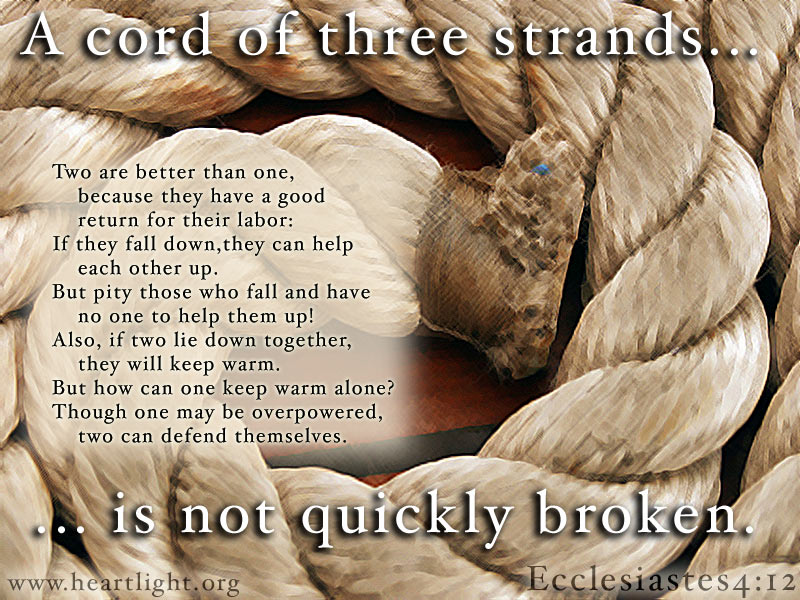
9 Two are better than one; because they have a good reward for their labour. 10 For if they fall, the one will lift up his fellow: but woe to him that is alone when he ; for he hath not another to help him up. 11 Again, if two lie together, then they have heat: but how can one be warm alone? 12 And if one prevail against him, two shall withstand him; and a threefold cord is not quickly broken.
Word of God for the Children of God.
Glory be to the Father, and to the Son, and to the Holy Ghost; as it was in the beginning, is now, and ever shall be, world without end. Amen, amen.
What is Ecclesiastes trying to tell us?
Ecclesiastes explores the incomparably vast futility of ‘chasing’ worldly pursuits and the importance of fearing God and enjoying life’s simple gifts, ultimately suggesting that the truest meaning and purpose are found in a knotted relationship with God, not in material success or fleeting pleasures.
Here’s a more detailed breakdown:
The Futility of “Under the Sun”: The book uses the phrase “under the sun” to describe life without God, where everything seems meaningless and ultimately unsatisfying.
Vanity and Meaninglessness: The author, traditionally believed to be Solomon, explores various aspects of life, including wisdom, knowledge, pleasure, work, and time, and concludes that they are all ultimately “vanity” or “meaningless” when considered apart from God.
The Importance of Fearing God: Ecclesiastes emphasizes the importance of “fearing God” which means trusting, obeying, and serving God, rather than relying on oneself or worldly achievements.
Enjoying Life’s Gifts: While acknowledging the limitations of life, the book also encourages people to enjoy the simple gifts of life, such as good food, good company, and the beauty of creation.
Finding Meaning in God: The book suggests that true meaning and purpose are found in a relationship with God, not in material possessions, achievements, or fleeting pleasures.
Hope for God’s Judgment: Ecclesiastes also reveals the surest hope for God’s judgment that will destroy evil and bring justice, which fuels a life of honesty and integrity, despite life’s mysteries.
What is the main point of the book of Ecclesiastes?
The book reveals the necessity of fearing God in a fallen and frequently confusing and frustrating world. Humans seek lasting significance, but no matter how great their accomplishments, humans are unable to achieve the lasting significance they desire.
How do I apply Ecclesiastes to my life?
8 Lessons From Ecclesiastes
Everyone Faces Challenging Times. …
Be Cautious of Busyness. …
Uncertainty Is a Part of Life. …
A Relationship With God Gives Life Meaning. …
Focus on God’s Gifts. …
The End Is More Important Than Life. …
God Is in Control. …
Follow God’s Commandments.
Teamwork is important.
There is strength and a sense of community in working together toward a common goal.
Working together is essential in overcoming challenges and achieving shared objectives.
Matthew 28:16-20 Authorized (King James) Version
16 Then the eleven disciples went away into Galilee, into a mountain where Jesus had appointed them. 17 And when they saw him, they worshipped him: but some doubted. 18 And Jesus came and spake unto them, saying, All power is given unto me in heaven and in earth. 19 Go ye therefore, and teach all nations, baptizing them in the name of the Father, and of the Son, and of the Holy Ghost: 20 teaching them to observe all things whatsoever I have commanded you: and, lo, I am with you always, even unto the end of the world. Amen.
Teamwork develops synergy, where individual strengths complement each other, leading to greater productivity and creativity.
Through teamwork, various perspectives and skills contribute to thorough problem solving and innovation.
The Bible emphasizes the values of teamwork.
From Moses and Aaron leading the Israelites to Jesus sending out his disciples, cooperation and mutual support are foundational to God’s work. Together we can all encourage, support, and build each other up in faith and good works.
Looking way, way back, I see how teamwork has enriched my personal growth and accomplishments. It has taught me humility, patience, and the spirit filling joy of celebrating collective achievements. Glory to God! Each team effort has strengthened relationships and fostered a sense of community and belonging.
We can embrace collaboration in all areas of life, seeking opportunities to work alongside others, leveraging people’s strengths for the greater good.
Let’s strive to imitate Savior Christ’s example of unity and service, knowing that together we can accomplish far more than we could if we worked alone.
What do now hold is the meaning of Ecclesiastes 4:9-12?
Ecclesiastes 4:9-12 emphasizes, raises, the value of shared companionship and sound teamwork, stating two are better than one because they can help each other succeed, withstand challenges, and find warmth, while also highlighting the strength of a “threefold cord” (relationship with God) is not easily broken.
Here’s a more detailed breakdown:
“Two are better than one” (v. 9): This verse highlights the benefits of working and living together, as opposed to alone, emphasizing mutual support and shared success.
“For if either of them falls, the one will lift up his companion” (v. 10): This illustrates the practical advantage of having someone to help when facing difficulties, emphasizing the importance of support and encouragement.
“Also, if two lie down together, they will keep warm, but how can one be warm alone?” (v. 11): This emphasizes the comfort and warmth of companionship, both physically and emotionally.
“And though a man might prevail against one who is alone, two will withstand him—a threefold cord is not quickly broken” (v. 12): This verse introduces the concept of a “threefold cord”, often interpreted as a relationship with God, which adds a powerful layer of strength and resilience to a partnership or relationship.
“Threefold cord”: This is a metaphor for a strong and unbreakable bond, often used to describe the strength of a marriage or friendship which includes God.
What is the moral lesson of the book of Ecclesiastes?
It acknowledges that if we could understand why things happen, difficult circumstances would be easier to deal with somehow. Ecclesiastes helps us understand that the ups and downs of life are normal and part of God’s plan and that we each must keep an eternal perspective without having all the answers.
God did not create us to be alone — to be a solitary person trying to make it through life alone in a harsh world.
When we read the Scriptures, we discover that some of God’s strongest servants had trouble when trying to serve Him when alone.
Jesus intentionally sent out his disciples and apostles in pairs to do His work.
In the Torah,God insisted that any legal testimony had to be established by at least two or three witnesses.
In addition, the Lord Jesus emphasized the complete importance of two or three believers gathered together in His name to put aside hatted, sit with God, have tall, active fellowship involved forgiveness, reconciliation, discipline, daily.
So, we shouldn’t be surprised by this insightful proverb found in our verses today. We are better off with a friend to share in our work, and they need us also.
We can help each other up when we’ve fallen, keep warm when it is cold, defend each other when under attack, be a solid and cohesive team when we weave our lives together with God.
And these principles apply to physical, emotional, and spiritual situations!
So, dear brother or sister in Savior Chris Jesus , please don’t try to do the Christian life alone on your own deserted island. Join with other believers and encourage each other.Our mutual support is vital to our faithfulness to Jesus!
In the name of God, the father and God the Son and God the Holy Spirit,
Psalm 84
To the chief Musician upon Gittith, A Psalm for the sons of Korah.
1 How amiable are thy tabernacles, O Lord of hosts!
2 My soul longeth, yea, even fainteth for the courts of the Lord: my heart and my flesh crieth out for the living God. 3 Yea, the sparrow hath found an house, and the swallow a nest for herself, where she may lay her young, even thine altars, O Lord of hosts, my King, and my God. 4 Blessed are they that dwell in thy house: they will be still praising thee. Selah. 5 Blessed is the man whose strength is in thee; in whose heart are the ways of them. 6 Who passing through the valley of Baca make it a well; the rain also filleth the pools. 7 They go from strength to strength, every one of them in Zion appeareth before God.
8 O Lord God of hosts, hear my prayer: give ear, O God of Jacob. Selah. 9 Behold, O God our shield, and look upon the face of thine anointed. 10 For a day in thy courts is better than a thousand. I had rather be a doorkeeper in the house of my God, than to dwell in the tents of wickedness. 11 For the Lord God is a sun and shield: the Lord will give grace and glory: no good thing will he withhold from them that walk upright
O Lord of hosts, blessed is the man that trusteth in thee.
Glory be to the Father, and to the Son, and to the Holy Ghost; as it was in the beginning, is now, and ever shall be, world without end. Amen, amen.
11 Send your resources out over the seas; eventually you will reap a return. 2 Divide your merchandise into seven or eight shares, since you don’t know what disasters may come on the earth. 3 If the clouds are full of rain, they empty themselves on the earth. Whether a tree falls toward the north or the south, the place where the tree falls is where it stays. 4 He who keeps watching the wind will never sow; he who keeps looking at the clouds will never reap. 5 Just as you don’t know the way of the wind or how bones grow in a pregnant woman’s womb, so you don’t know the work of God, the maker of everything. 6 In the morning, sow your seed; and don’t slack off until evening; for you don’t know which sowing will succeed, this, or that, or if both will do well. 7 Then the light will be sweet, and it will be a pleasure to see the sun. 8 For if a person lives many years, let him take joy in them all; yet remembering that there will be many days of darkness, that all to come is futile.
The Word of God for the Children of God.
Glory be to the Father, and to the Son, and to the Holy Ghost; as it was in the beginning, is now, and ever shall be, world without end. Amen, amen.
Solomon exhorts men to live joyfully and responsibly while at the height of their energy—investing themselves wisely into living their life and making the most of every opportunity, knowing that God will evaluate every aspect of life.
What is the here and now, the hear and know, meaning of Ecclesiastes 11:8?
We should take care of ourselves, not everyday is going to be our very best day choose to honor God, honor Sabbath day, choose to enjoy every day of our lives.
We should not just try to forget the dark days, but to remember the days of darkness. It is from the days of darkness we can learn the most and grow.
In many respects, the days of darkness, the Category 5 days of what feels like all the worst days of our lives in one, brings potential for gratitude for God’s light.
Psalm 139:11-18 Easy-to-Read Version
11 Suppose I wanted to hide from you and said, “Surely the darkness will hide me. The day will change to night and cover me.” 12 Even the darkness is not dark to you. The night is as bright as the day. Darkness and light are the same. 13 You formed the way I think and feel.[a] You put me together in my mother’s womb. 14 I praise you because you made me in such a wonderful way. I know how amazing that was!
15 You could see my bones grow as my body took shape, hidden in my mother’s womb.[b] 16 You could see my body grow each passing day.[c] You listed all my parts, and not one of them was missing. 17 Your thoughts are beyond my understanding.[d] They cannot be measured! 18 If I could count them, they would be more than all the grains of sand. But when I finished, I would have just begun.[e]
How precious to me are your thoughts, O God? How vast is the sum of them? If I should live long enough to count them, they are far far more than the sand. I awake, from my category 5 darkest moments and I am still with you and you are still with me, I discover that above even the greatest distractions, tumults of living my life, You are above them, You are bigger than them, give us Your rest.
IF I will, would, should, could, whether I want to or need to or not … honor God, honor His Sabbath and accept the day of His rest … it will go very well with me!
Isaiah 58:13-14 English Standard Version
13 “If you turn back your foot from the Sabbath, from doing your pleasure[a] on my holy day, and call the Sabbath a delight and the holy day of the Lord honorable; if you honor it, not going your own ways, or seeking your own pleasure,[b] or talking idly;[c] 14 then you shall take delight in the Lord, and I will make you ride on the heights of the earth;[d] I will feed you with the heritage of Jacob your father, for the mouth of the Lord has spoken.”
Can you explain .01% the meaning of Ecclesiastes 11:8?
This verse, like much of the Book of Ecclesiastes, is laden with profound wisdom and existential reflection.
To fully grasp its meaning, we must examine the context of the verse within the broader narrative of Ecclesiastes and the theological and philosophical themes it addresses.
The Book of Ecclesiastes, traditionally attributed to King Solomon, is a unique piece of wisdom literature in the Old Testament.
It grapples with the complexities and apparent contradictions of human existence.
The author, often referred to as “the Teacher” or “Qoheleth,” explores the fleeting nature of life, the pursuit of meaning, and the inevitability of death. Ecclesiastes is characterized by its candid, almost melancholic tone, as it delves into the paradoxes of joy and sorrow, wisdom and folly, and life and death.
Ecclesiastes 11:8 is situated within a passage that encourages a balanced approach to life, recognizing both its joys and its inevitable hardships.
The verse can be divided into two parts:
the first part encourages the enjoyment of life, while the second part serves as a sobering reminder of life’s darker moments.
Enjoying Life
The opening phrase, “However many years anyone may live, let them enjoy them all,” underscores a recurring theme in Ecclesiastes: the importance of finding joy in the present moment.
This exhortation to enjoy life is not a call to hedonism or reckless indulgence, but rather an invitation to appreciate the simple pleasures and blessings that life offers.
Throughout Ecclesiastes, Teacher often emphasizes the value of enjoying the fruits of one’s labor, companionship of loved ones, and the beauty of creation.
For instance, Ecclesiastes 3:12-13 states, “I know that there is nothing better for people than to be happy and to do good while they live. That each of them may eat and drink, and find satisfaction in all their toil—this is the gift of God.”
This perspective is echoed in Ecclesiastes 9:7-9, where the Teacher advises,
“Go, eat your food with gladness, and drink your wine with a joyful heart, for God has already approved what you do. Always be clothed in white, and always anoint your head with oil. Enjoy life with your wife, whom you love, all the days of this meaningless life that God has given you under the sun—all your meaningless days.”
The Teacher’s counsel to enjoy life is rooted in the recognition that our time on earth is limited and unpredictable.
By encouraging us to embrace joy, the Teacher is not dismissing the reality of suffering but rather advocating for a balanced perspective that acknowledges both the good and the bad.
Remembering the Days of Darkness
The second part of the verse, “But let them remember the days of darkness, for there will be many,” serves as a poignant reminder of the inevitability of suffering and the transient nature of life.
The “days of darkness” can be interpreted in several ways.
They may refer to periods of hardship, grief, and loss that are an inescapable part of the human experience. Alternatively, they could symbolize the ultimate darkness of death, which casts a shadow over all our earthly endeavors.
The Teacher’s acknowledgment of the “days of darkness” is a recurring theme in Ecclesiastes.
In Ecclesiastes 7:2-4, he writes, “It is better to go to a house of mourning than to go to a house of feasting, for death is the destiny of everyone; the living should take this to heart. Frustration is better than laughter, because a sad face is good for the heart. The heart of the wise is in the house of mourning, but the heart of fools is in the house of pleasure.”
Here, Teacher suggests that facing forward, confronting the reality of death and suffering can lead to greater wisdom and a deeper appreciation of life.
By urging us to remember the days of darkness, the Teacher is not advocating for a pessimistic or fatalistic outlook.
Rather, he is encouraging a realistic and mature understanding of life that embraces both its joys and its sorrows. This balanced perspective can help us to wisely navigate the complexities of existence with greater resilience and grace.
Finding Meaning in the Midst of Meaninglessness
While Ecclesiastes often emphasizes the futility of earthly endeavors, it also contains glimpses of hope and wisdom that point us toward a more enduring source of meaning.
The Teacher acknowledges the limitations of human understanding and the mysteries of God’s purposes.
In Ecclesiastes 3:11, he writes,
“He has made everything beautiful in its time. He has also set eternity in the human heart; yet no one can fathom what God has done from beginning to end.”
This verse suggests that while we may not fully comprehend the divine plan, there is a sense of eternity and transcendence that God has placed within us.
Our seeking, our searching, our exploration, our discovery of that longing for meaning and our awareness of life’s fleeting nature can lead us to seek a deeper relationship with God, who is our only ultimate source of wisdom and purpose.
Moreover, the Teacher concludes the book with a summons to reverence and obedience to God.
Ecclesiastes 12:13-14, he writes, “Now all has been heard; here is the conclusion of the matter: Fear God and keep his commandments, for this is the duty of all mankind. For God will bring every deed into judgment, including every hidden thing, whether it is good or evil.”
This final exhortation underscores the importance of kingdom living a life that is grounded in faith, hope, trust and obedience to God. While the pursuits and pleasures of this world may be fleeting and ultimately unsatisfying, a life lived in reverence to God holds the promise of eternal significance and fulfillment.
Conclusion
Ecclesiastes 11:8, with its dual emphasis on enjoying life and remembering the days of darkness, encapsulates the paradoxical wisdom of the Teacher.
It covenants us to HUG, fully embrace the joys of life with gratitude while maintaining a sober awareness of life’s inevitable hardships and the transient nature of our earthly existence.
By acknowledging, recognizing the limitations of worldly pursuits and seeking a deeper relationship with God, we can go forth, to explore, discover, pray, find an enduring meaning and purpose in the midst of life’s Category 5 complexities.
As we reflect on this verse and the broader message of Ecclesiastes, we are now reminded of the importance of living with both joy and wisdom, embracing the present moment while keeping our eyes fixed on the eternal. In doing so, we can try to navigate the paradoxes of life with greater resilience, grace, and hope.
In the name of God, the Father and God the Son and God the Holy Spirit,
Let us Pray,
Psalm 92 English Standard Version
How Great Are Your Works
A Psalm. A Song for the Sabbath.
92 It is good to give thanks to the Lord, to sing praises to your name, O Most High; 2 to declare your steadfast love in the morning, and your faithfulness by night, 3 to the music of the lute and the harp, to the melody of the lyre. 4 For you, O Lord, have made me glad by your work; at the works of your hands I sing for joy.
5 How great are your works, O Lord! Your thoughts are very deep! 6 The stupid man cannot know; the fool cannot understand this: 7 that though the wicked sprout like grass and all evildoers flourish, they are doomed to destruction forever; 8 but you, O Lord, are on high forever. 9 For behold, your enemies, O Lord, for behold, your enemies shall perish; all evildoers shall be scattered.
10 But you have exalted my horn like that of the wild ox; you have poured over me[a] fresh oil. 11 My eyes have seen the downfall of my enemies; my ears have heard the doom of my evil assailants.
12 The righteous flourish like the palm tree and grow like a cedar in Lebanon. 13 They are planted in the house of the Lord; they flourish in the courts of our God. 14 They still bear fruit in old age; they are ever full of sap and green, 15 to declare that the Lord is upright; he is my rock, and there is no unrighteousness in him.
Glory be to the Father, and to the Son, and to the Holy Ghost; as it was in the beginning, is now, and ever shall be, world without end. Amen, amen.
The scripture we will look at for today’s devotional effort was used in a song written by Pete Seeger and released October 1, 1965 by the Byrds called “Turn, Turn, Turn.” To everything there is a season. The writer is Solomon, considered to be one of the wisest of men to ever live. In fact God came to him in a dream.
Ecclesiastes 3:1-8 ESV
A Time for Everything
3 For everything there is a season, and a time for every matter under heaven:
2 a time to be born, and a time to die; a time to plant, and a time to pluck up what is planted; 3 a time to kill, and a time to heal; a time to break down, and a time to build up; 4 a time to weep, and a time to laugh; a time to mourn, and a time to dance; 5 a time to cast away stones, and a time to gather stones together; a time to embrace, and a time to refrain from embracing; 6 a time to seek, and a time to lose; a time to keep, and a time to cast away; 7 a time to tear, and a time to sew; a time to keep silence, and a time to speak; 8 a time to love, and a time to hate; a time for war, and a time for peace.
The Word of God for the Children of God. In Excelsis Deo! Alleluia! Amen.
God came to a young Solomon in a dream when he became King of Israel and said to him, Solomon, ask for whatever you want and I will give it to you. If God said that to you what would you ask for? Solomon’s reply was this Lord, I am only a little child and I do not know how to carry out my job. The people will be serving are too numerous to even count so please give me wisdom.
So God said since you asked for wisdom and not long life or wealth and since you didn’t ask me to take care of your enemies I will do it. I will give you wisdom but I will also give you what you have not asked for-riches and in your lifetime there will be no equal. 1 Kings 3:5-14.
Solomon wrote down the book of Proverbs and also wrote down the book of Ecclesiastes. And by reading through both, God did carry out His promise.
I think that most of us would agree that when it comes to TIME and Time management most of us would say that we rarely have too much time on our hands that management becomes an issue. Instead we are pushed on a daily basis to get everything done…. To take care of our “to do” list. To keep all of the plates spinning. If there is any area where we need [GUARDRAILS] it is in the area of TIME. There are 4 things I see here that God has to say about time.
(1) God’s Timing is sovereign. We know that but every one of us, from time to time question his timing. We wonder why God doesn’t answer our prayers when we ask him to. How many of us have ever prayed for something-your prayer went unanswered or it wasn’t answered the way you wanted it or when you wanted it. And we start to wonder about God’s timing. They are hard questions.
But I know this. God’s timing is best. In fact, His timing is perfect. It’s sovereign. What does that mean? It means God is in total control. Notice v. 1. There is an (NASB) appointed time for everything. Not most things. Not convenient things. All things. There is an appointed time in God’s timetable for everything.
Now it may be obvious but I want to say a few things about His sovereignty.
(1) God’s timing and our timing are not the same. He does not view things in the same way as we do so until we learn to see things through God’s eyes we will never understand His timing.
(2) We see things one piece at a time. God sees the whole picture. When I was very young we would go out into a blizzard to stand in sub zero degree weather to shovel snow out of our driveways and off of neighbors sidewalks. But I could never really shovel enough. I was always curious about the arriving plow truck. And so I would look as far as I could down the street so I could see what was coming. But I still could never hope see as far into the blizzard as I wanted to.
God looks at things as though He is on top of the highest mountain. You know if you could get up high enough and get an aerial view, you would be able to see what has just passed by and you would see it clearly. You would see what is right in front of you and you would see who and what is coming and you would see it clearly and you would see it all at one time. What just went by me, who, what’s there, what’s coming. We call it a linear view of time, that is what God gives us.
But we’re always saying you know if I could just have known this was coming I could have been better prepared. God says “I know.” One things we can know about God is that He is never surprised. God’s timing is perfect. It’s sovereign.
(2)God’s timing is sufficient. He says in v. 3… there is a season for every activity under heaven. We may be in a place right now where we are wondering if God is ever going to show up. We are raising young children. We are raising teenagers. Our finances might be in trouble. Maybe we are on the brink of losing your job. Maybe we already have. Maybe our health is declining and we don’t know what the outcome will be. Whatever our difficulties may be I cannot promise you that God’s going to answer your prayer the exact way you may want Him to but I can promise that you will make it through at some point if you will hold on to Him.
Solomon says there is a time for every activity under Heaven. Everything! God literally has a time for everything. He is going to take care of you in everything. Not 99% but Everything. Why? God cares about every single detail of your life.
You see, another thing this verse does is it speaks directly to each and every one of us including me. You see I’m not the kind of person who is a list maker—I do not work with a to do list, I’ve got the plates spinning and when I see that one is slowing down or it’s wobbling, I want to fix it and then I read this scripture and God says I have got a season for every activity under Heaven. The paraphrased version of that is that God says, “Tom” you need to go chill out. Take a chill pill. God recommends let me bring every event into your life you need in my timing.
(3) God’s timing is seasonal. Look at the meat of what God says here. Vv. 2-8. Now I don’t know about you but I believe this passage is not really about weeping and mourning and laughing and dancing—it’s bigger than that. It’s about God’s timing. Notice this. Birth and death. Killing and healing. Tearing down and building up. War and peace. Do you happen to see the pattern here?
All of these are written in pairs and they are all opposites and they are also all seasonal. This is not just about picking up stones and throwing them back. This passage is describing all of the different seasons of life. Life comes in seasons.
There are seasons of loss and there are seasons of gain. And in whatever season we find ourselves we must learn to live life to the fullest. In other words I think God says to each of us here that “there’s only a period of time; a season of time in which I am going to do this in your life and then I’m moving on to something else in your life.” That’s why it’s so very important for us to be aware of God’s timing.
It’s that way in your life and it’s that way in mine and in the daily life of local communities, the church. And if we don’t live in His timing we’re not willing to change when God says change then He will move on and find someone who will.
4. God’s timing is surprising. Now one thing we can surely and certainly know about God is that He is never surprised. He didn’t create the universe and then say wow I can’t believe I did that. God never says the words, I can’t believe that happened. But you and I are often surprised daily. His timing 100% surprises us.
One man was taking it easy, lying on the grass and looking up at the clouds. He was identifying shapes when he decided to talk to God. “God” he said “how long is a million years?” God answered, “well to me it’s just about a minute.”
The man next asked “God how much is a million dollars?”
God said, “to me it’s like a penny.”
The man said well then God can I have a penny? God said sure, in a minute.
We are not always ready for what God is about to do. We can usually think of a thousand billion trillion reasons why we’re not ready to do what God wants us to do but when I look at these verses one of the things that jumps off the page at me is that our God is a very thorough God. Our God is a thoroughly creative God.
His ways are higher than our ways and His thoughts are forever higher than our thoughts and just about the time I think I have God figured out He surprises me and takes me into another season of life. He works in ways I never thought were possible. But then I’m not God. He is. And that would be a great thing for all of us to get hold of: we must stop trying to be God and learn to wait for His timing.
Let me try to give you 5 [GUARDRAILS] we all need to try to put in place.
[1] There is a time for everything but not for everything all at once. All of us need to learn how to focus and prioritize. We attempt too many things and then we do not do many or any of them properly. Paul said this one thing I do. Some of us need to fall in love with don’t do list. We must keep our priorities in place.
[2] There is a reason for the season. Keep in mind seasons are always and forever temporary – do not last forever. Let God do His work. Be patient.
[3] We cannot now what the future holds but we can know the One who holds the future.
[4] We must give up trying to be God. Trying to take care of everything and everybody.
[5] We must try to see the Big Picture. We are not God but we can trace His hand in our lives.
Ecclesiastes 3:1-8, So many verses and passages in scripture come back to the foundational truth God knows best and wants us to trust Him in all things and at all times. He made the world and governs the universe, and is never phased nor astonished at what is going on in the world at large, neither the troubling circumstances that are happening in the individual lives of all of His children.
This passage of text is an obvious, a simple, yet timely reminder, that we are to live by faith in the Word of Truth, and to trust God’s judgement in all things, for He sends blessings raining on the just and unjust alike, and He takes the foolish schemes and rebellious actions of men and turns them to His greater glory, in order to fulfil His ultimate plan and purpose, which is that Christ is all in all.
In the name of the Father, the Son and the Holy Spirit, Let us take time to Pray,
Thank You, Father, that You know the end from the beginning and that 100% everything under heaven is within Your authority. Thank You, that You are in control of all that is happening in my own individual life and the wider world in general. May I trust You through all the circumstances of life and as I seek Your face in prayer and praise, may I learn more and more to pray, “Thy will be done in my life and throughout the world.” In Jesus’ name I pray, Alleluia! Amen.


 Loving God, Living God, Loving Hope, Living Hope, Loving Living Life His Way! "Many things are possible for the person who has hope. Even more is possible for the person who has faith. And still more is possible for the person who knows how to love. But everything is possible for the person who practices all three virtues." - Brother Lawrence (1605-1691), Practicing the Presence of God (1692).