
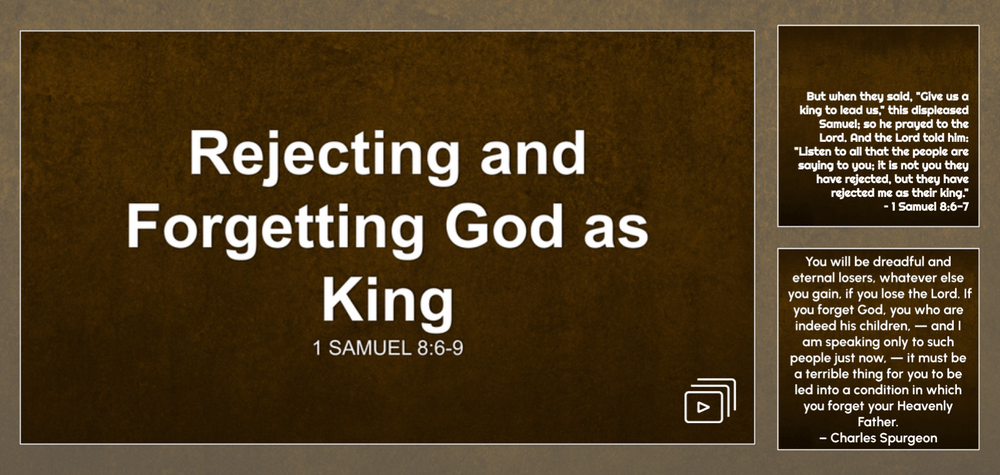
1 Samuel 8 New American Standard Bible
Israel Demands a King
8 Now it came about, when Samuel was old, that he appointed his sons as judges over Israel. 2 The name of his firstborn was Joel, and the name of his second, Abijah; they were judging in Beersheba. 3 His sons, however, did not walk in his ways but turned aside after dishonest gain, and they took bribes and perverted justice.
4 Then all the elders of Israel gathered together and came to Samuel at Ramah; 5 and they said to him, “Behold, you have grown old, and your sons do not walk in your ways. Now appoint us a king to judge us like all the nations.” 6 But the matter was [a]displeasing in the sight of Samuel when they said, “Give us a king to judge us.” And Samuel prayed to the Lord. 7 And the Lord said to Samuel, “Listen to the voice of the people regarding all that they say to you, because they have not rejected you, but they have rejected Me from being King over them. 8 Like all the deeds which they have done since the day that I brought them up from Egypt even to this day—in that they have abandoned Me and served other gods—so they are doing to you as well. 9 Now then, listen to their voice; however, you shall warn them strongly and tell them of the [b]practice of the king who will reign over them.”
Warning concerning a King
10 So Samuel spoke all the words of the Lord to the people who had asked him for a king. 11 And he said, “This will be the [c]practice of the king who will reign over you: he will take your sons and put them in his chariots for himself and among his horsemen, and they will run before his chariots. 12 He will appoint for himself commanders of thousands and commanders of fifties, and some to [d]do his plowing and to gather in his harvest, and to make his weapons of war and equipment for his chariots. 13 He will also take your daughters and use them as perfumers, cooks, and bakers. 14 He will take the best of your fields, your vineyards, and your olive groves, and give them to his servants. 15 And he will take a tenth of your seed and your vineyards and give it to his high officials and his servants. 16 He will also take your male servants and your female servants, and your best young men, and your donkeys, and [e]use them for his work. 17 He will take a tenth of your flocks, and you yourselves will become his servants. 18 Then you will cry out on that day because of your king whom you have chosen for yourselves, but the Lord will not answer you on that day.”
19 Yet the people refused to listen to the voice of Samuel, and they said, “No, but there shall be a king over us, 20 so that we also may be like all the nations, and our king may judge us and go out before us and fight our battles.” 21 Now after Samuel had heard all the words of the people, he [f]repeated them in the Lord’s hearing. 22 And the Lord said to Samuel, “Listen to their voice and appoint a king for them.” So Samuel said to the men of Israel, “Go, every man to his city.”
Word of God for the Children of God
Glory be to the Father,
and to the Son, and to the Holy Ghost;
as it was in the beginning,
is now, and ever shall be,
world without end. Amen, amen.
Ultimatum … Give us a King to Judge Us …. or else …
1 Samuel 8:7-9 The Message
7-9 God answered Samuel, “Go ahead and do what they’re asking. They are not rejecting you. They’ve rejected me as their King. From the day I brought them out of Egypt until this very day they’ve been behaving like this, leaving me for other gods. And now they’re doing it to you. So let them have their own way. But warn them of what they’re in for. Tell them the way kings operate, just what they’re likely to get from a king.”
What kind of world did David enter into?
He entered a world built by Israel’s obsession to be like the nations around them.
They did not want the prophet Samuel to lead them anymore.
In their eyes, it was not enough to have God as their King, leading the people through his prophet, Samuel.
To be like other nations, they wanted to have a human king.
Samuel was worn-out and tired when the elders of Israel came to his place in Ramah.
Maybe he knew this day was coming.
His sons were not faithful to God or to the people.
The elders came with a demand: “Appoint a king to lead us, such as all the nations have.”
They saw other nations that were making a difference and gaining power.
Those nations all had a king who could make things happen and take over weaker nations. They wanted a king they could see, touch, hear, and follow.
Israel’s demand for a king would first give them King Saul.
Saul had all the visible features of success (tall, dark, and handsome), but he would soon turn against God and do things his own way (1 Samuel 9-15).
This was the world David entered—poisoned by a people who wanted a visible, untested king rather than the wise, loving, and faithful God they could not see.
Our challenge is to identify, highlight the importance of recognizing, honoring and glorifying God as our ultimate King, citing the example from the Israelites’ rejection of God’s kingship, inevitable prophetic consequences that followed.
Charles H. Spurgeon, the great preacher, once said,
“You will all be dreadful and eternal losers, whatever else you gain, if you lose the Lord. If you forget God as your King, you who are indeed his children, — and I am speaking only to such people just now, — it must be a terrible thing for you to be led into a condition in which you forget your Heavenly Father.”
How profoundly true this is!
The fear of man, craving for flawed human leadership, led the Israelites astray. And it’s a warning for us today, isn’t it? Let’s remember who our true King is.
The Rejection of God as King
The story of Israel’s demand for a human king is a sad poignant reminder of humanity’s tendency to reject God’s kingship.
This rejection is a pattern that recurs throughout human history and even in our personal lives.
It is a rejection that stems from our desire for tangible, human leadership, a desire to conform to societal norms, and a lack of trust in God’s sovereignty.
The Israelites’ demand for a human king was a clear rejection of God’s kingship.
They were not content with God’s invisible, divine rule; they wanted a tangible, human king.
This desire for a human king was not merely a desire for human leadership; it was a desire for a king who rule, would lead them into battle, a king who would provide them with a sense of security and protection.
This desire reveals lack of trust in God’s ability to protect and provide for them.
It reveals a near total collapse of faith and trust in God’s divine sovereignty and a desire to take matters into their own hands.
This rejection of God’s kingship was also a desire to conform to societal norms.
The Israelites wanted a king “like all the nations” (1 Samuel 8:5).
They wanted to fit in with the surrounding nations, to be like them.
This desire to conform to societal norms is a powerful force that can lead us to reject God’s unique plan for our lives.
It can lead us to compromising our faith, to conform to the world’s standards instead of God’s standards.
The rejection of God’s kingship has serious consequences.
God warned the Israelites a human king would take their sons and daughters, their best fields and vineyards, their servants and livestock (1 Samuel 8:10-17).
Despite these warnings, the Israelites insisted on having a human king.
They were willing to pay a high price for their rejection of God’s kingship.
This story serves as a warning for us today.
When we reject God’s kingship, we are also choosing to bear the consequences of our choices.
The Consequences of Rejecting God
When the Israelites demanded a human king, they were essentially rejecting God’s kingship over them.
This rejection led to a series of unfortunate consequences.
Firstly, it led to spiritual decline.
The Israelites, in their desire for a human king, were essentially saying that they wanted to be like the other nations around them.
They were rejecting their unique identity as God’s chosen people. This desire to conform to the world around them led them away from God and His commands.
Secondly, it led to oppression and hardship.
God, through Samuel, warned the Israelites a human king would take their sons and daughters, their best fields and vineyards, and a tenth of their grain and vineyards (1 Samuel 8:10-18).
Despite this warning, the Israelites insisted on having a king.
The result was exactly as God had warned – their kings led them into wars, took their best produce, and oppressed them.
Thirdly, it led to a vicious cycle of disobedience and punishment.
The kings that the Israelites so desired led them into idolatry and disobedience.
This disobedience led to punishment from God, which often took the form of defeat in battle and subjugation by their enemies and destruction of their lands.
The consequences of rejecting God’s kingship were severe, and serve as a warning for us today.
When we reject God’s authority in our lives, reject the resurrection of His Son, our Savior, King of all Kings, Jesus, we open ourselves up to a slippery slope of deep spiritual decline, hardship, and a cycle of disobedience and punishment.
Remembering God as King
Remembering God as our King is not just about acknowledging God as a distant, divine ruler but recognizing His active, intimate involvement in our lives.
When we remember God as our King, we are acknowledging His sovereignty over every aspect of our lives.
This means He has ultimate control over our circumstances, our future, and our very lives.
In the context of the Israelites, they had forgotten that God was their King.
They had seen the nations around them with their human kings and desired to be like them.
But in doing so, they rejected the unique relationship they had with God.
They traded divine, perfect leadership of God for the flawed, limited leadership of man.
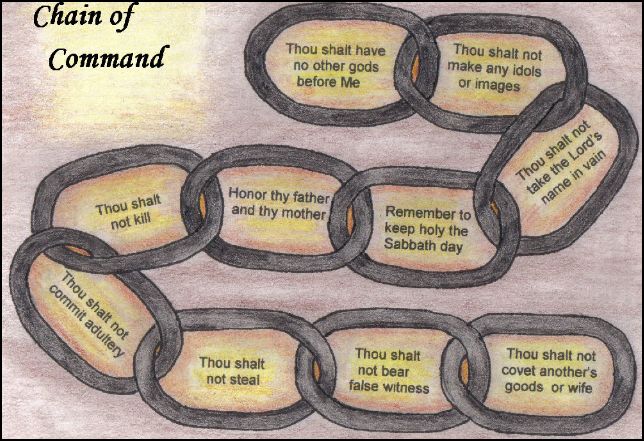
For us today, remembering God as our King means resisting the temptation to place our trust in human leaders or systems.
Means not allowing the values of the world to dictate our actions and decisions.
Instead, we are to seek God’s will in all things, trusting that His ways are higher than ours.
Remembering God as our King also means acknowledging that our ultimate allegiance is to Him.
In a world where we are often pulled in different directions by various loyalties, we must remember that our primary loyalty is to God.
This doesn’t mean that we can’t respect and follow human leaders, but it does mean that our ultimate obedience is to God.
Furthermore, remembering God as our King should impact how we live our lives. If God is our King, then we are His servants.
This means that our lives are not our own; they belong to God. We are to live in a way that honors Him, seeking to do only His will and bring glory to His name.
Finally, remembering God as our King brings security, comfort and assurance.
In times of uncertainty or fear, take comfort knowing our King is in command.
He is not surprised by the events of our world or our lives.
He is working all things together for the good of those who love Him.
This assurance give us peace in the midst of turmoil, hope in the face of despair.
God is always and will forever stay in absolute command over His own Creation!
In the name of the Father and of the Son and of the Holy Spirit. Amen
Praying ….
Psalm 24 King James Version
24 The earth is the Lord’s, and the fulness thereof; the world, and they that dwell therein.
2 For he hath founded it upon the seas, and established it upon the floods.
3 Who shall ascend into the hill of the Lord? or who shall stand in his holy place?
4 He that hath clean hands, and a pure heart; who hath not lifted up his soul unto vanity, nor sworn deceitfully.
5 He shall receive the blessing from the Lord, and righteousness from the God of his salvation.
6 This is the generation of them that seek him, that seek thy face, O Jacob. Selah.
7 Lift up your heads, O ye gates; and be ye lift up, ye everlasting doors; and the King of glory shall come in.
8 Who is this King of glory? The Lord strong and mighty, the Lord mighty in battle.
9 Lift up your heads, O ye gates; even lift them up, ye everlasting doors; and the King of glory shall come in.
10 Who is this King of glory? The Lord of hosts, he is the King of glory. Selah.

 Loving God, Living God, Loving Hope, Living Hope, Loving Living Life His Way! "Many things are possible for the person who has hope. Even more is possible for the person who has faith. And still more is possible for the person who knows how to love. But everything is possible for the person who practices all three virtues." - Brother Lawrence (1605-1691), Practicing the Presence of God (1692).