
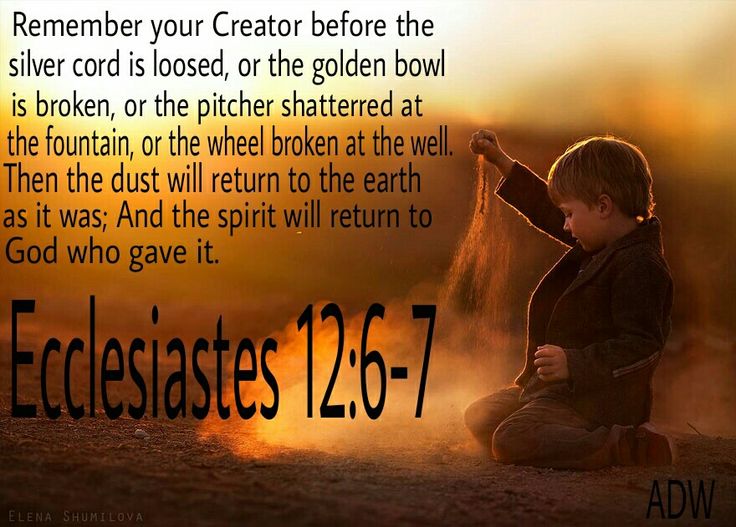
Ecclesiastes 12:1-8 New American Standard Bible
Remember God in Your Youth
12 Remember also your Creator in the days of your youth, before the evil days come and the years approach when you will say, “I have no pleasure in them”; 2 before the sun and the light, the moon and the stars are darkened, and clouds return after the rain; 3 on the day that the watchmen of the house tremble, and strong men are bent over, the grinders stop working because they are few, and those who look through [a]windows grow [b]dim; 4 and the doors on the street are shut as the sound of the grinding mill is low, and one will arise at the sound of the bird, and all the daughters of song will [c]sing softly. 5 Furthermore, people are afraid of a high place and of terrors on the road; the almond tree blossoms, the grasshopper drags itself along, and the caper berry is ineffective. For man goes to his eternal home while the mourners move around in the street. 6 Remember your Creator before the silver cord is [d]broken and the golden bowl is crushed, the pitcher by the spring is shattered and the wheel at the cistern is crushed; 7 then the dust will return to the earth as it was, and the [e]spirit will return to God who gave it. 8 “Futility of futilities,” says the Preacher, “all is futility!”
Word of God for the Children of God
Glory be to the Father,
and to the Son, and to the Holy Ghost;
as it was in the beginning,
is now, and ever shall be,
world without end. Amen, amen.
Have you heard the term “silver cord” before?
Do you know where it comes from? It’s an interesting term to me because it’s unique. The phrase comes from one single place in history: Ecclesiastes 12:6-7: Amplified Bible
6 Earnestly remember your Creator before the silver cord [of life] is broken, or the golden bowl is crushed, or the pitcher at the fountain is shattered and the wheel at the cistern is crushed; 7 then the dust [out of which God made man’s body] will return to the earth as it was, and the spirit will return to God who gave it.
It doesn’t show up anywhere else in the Bible, and yet it’s the term used to describe many metaphysical studies today: the link between the body and the spirit. What does it mean? We can tell from the verses themselves that it’s being used poetically to describe the process of death. But why a silver cord?
https://www.studylight.org/commentaries/eng/bul.html
E.W. Bullinger’s Companion Bible describes each of these elements via comparing them to actual body parts:
the silver cord: i.e. the spinal cord.
the golden bowl: i.e. the head, or skull.
pitcher: the failure of the heart.
Commentaries typically make similar assertions and leave it at that.
However, I think that this is too much of a scholarly explanation, and lacks the powerful, deeply poetic nuanced message of the divine Christ. There is much more to the silver cord due to the simple fact that it’s different from the rest.
Consider the following:
- When a wheel is broken at a well, it is useless and everything stops. No water can come up, and everything falls down
- When a pitcher shatters at the spring, the water falls down
- When a golden bowl is broken, whatever it was holding falls down
- When a silver cord is severed, one side stays up, and the other side falls down
Solomon said that the dust returns to the ground it came from, and the spirit returns to God who gave it.
The silver cord is the only item in the list that has two sides: it binds and it looses, one side goes away and the other side remains.
So we know that it is specifically focused on the connection between the body and the spirit.
But why is it silver?
Shouldn’t the spirit be more valuable than our bodies?
Why would a golden bowl be used to describe our body, when our spirit is eternal?
Since this term was invented by the culture of the time of Solomon, lets engage with his language and his culture.
Silver & the Appointed Time
The word “silver” used by Solomon in Hebrew is kesef (כֶּסֶף). This word is derived from the Assyrian word kaspu (ܟ݁ܶܣܦ݁ܳܐ), which means “pale metal.”
What makes this special is that there is another word in the Bible that shares this same root word. This word is keseh (כֶּסֶא), which means “full moon,” “pale moonlight,” or “appointed time.” Keseh is very unique, as it is a word that only occurs once in the entire Bible.
Where does it occur?
Proverbs 7:19-21 Lexham English Bible
19 For there is no man[a] in his home;
he has gone on a long journey.[b]
20 The bag of money he took in his hand,
for on the day of the full moon he will come home.”
21 She persuades him with the greatness of her teachings;
with her smooth lips she compels him.
https://www.blueletterbible.org/kjv/pro/7/20/t_conc_635020
https://www.blueletterbible.org/lexicon/h3677/kjv/wlc/0-1/
Depending on the translation you read, the highlighted words will say full moon, or appointed time.
This will depend on how a given translation treats literal word-for-word translation versus original author intent.
What if the woman’s husband came home early?
His appointed time would certainly have turned into an hour of reckoning.
We understand the literal word for “full moon” here to mean that it is the appointed time, or the hour of reckoning.
Passover, for example, always begins on the 15th day of the Hebrew month of Nisan, which lines up with the lunar cycle and guarantees that a full moon will be present every time.
Passover is a time to remember the hour of reckoning for Egypt, the appointed time when God would deliver his people from out of slavery. A full moon is highly significant in Jewish culture, and many other traditions surround it.
So, what does the connection between silver and the “appointed time” mean?
It helps us understand why the silver cord is not made out of gold.
Silver, a pale metal as the Assyrians would have described it, is a much smaller denomination of currency than gold.
Gold is something the average person at that time would have never touched.
Gold was used to fund wars, vast building projects, and to pay kings.
A debt of gold is especially burdensome, and Jesus compares the debt of sin owed unto God to ten thousand bags of gold:
Matthew 18:23-28 New International Version
23 “Therefore, the kingdom of heaven is like a king who wanted to settle accounts with his servants. 24 As he began the settlement, a man who owed him ten thousand bags of gold[a] was brought to him. 25 Since he was not able to pay, the master ordered that he and his wife and his children and all that he had be sold to repay the debt.
26 “At this the servant fell on his knees before him. ‘Be patient with me,’ he begged, ‘and I will pay back everything.’ 27 The servant’s master took pity on him, canceled the debt and let him go.
28 “But when that servant went out, he found one of his fellow servants who owed him a hundred silver coins.[b] He grabbed him and began to choke him. ‘Pay back what you owe me!’ he demanded.
Silver, on the other hand, is an order of magnitude lower in value than gold. See how the servant has other people owing him merely silver?
The difference is our debt of sin to God compared to our earthly debts with our neighbors.
Silver is of mortal concern, debts we make with one another on earth.
Silver is used to buy or rent smaller things, temporary things that come and go, like a field: Genesis 23:16
Or information: Matthew 26:15
Or people: Genesis 37:28
Silver is used to signify our fleeting life, a pale metal, a memorial for something greater. God used silver trumpets to call the Israelites during any possible time, even times when the moon wasn’t present: Numbers 10:1-2, Numbers 10:10
We see these silver trumpets foreshadowing the final return of Jesus, the day of highest reckoning, when the spirits of Christians are returned to God, and the silver cord is severed: Matthew 24:30-31
Concluding Thoughts …
Throughout scripture we see a pattern of silver being used to signify things that are borrowed, things that are temporarily in our possession.
While we live, our bodies and spirits are connected through the silver cord.
But we must remember God.
God gave the Israelites silver trumpets to be used as a memorial of all he has done for them, and to call them out of the wilderness. One day, Christians will be called with the same silver trumpets to return to God what is owned by God: our spirits. Our spirits belong to him, and will return to him when we die.
When the silver cord is severed, everything we owe to God will be reckoned.
Our bodies belong to the dust, and our spirits belong to God.
Remember that your life is borrowed from God.
We owe him an unsurmountable debt due to our sinful lives.
And yet, Jesus paid the same debt in the parable, ten thousand bags of gold, with his very life so that we could be free.
The silver cord serves as a reminder of who we as Christians belong to, how fleeting and how pale our lives and possessions are, and how we should be desperately, diligently forgiving those who are just as deeply indebted to us: Matthew 18:32-35
If you’re not sure where to begin with forgiving other people, Jesus gives us a simple answer: we should pray.
Pray and remember God before the silver cord is severed.
Matthew 6:9-15 New King James Version
9 In this manner, therefore, pray:
Our Father in heaven,
Hallowed be Your name.
10 Your kingdom come.
Your will be done
On earth as it is in heaven.
11 Give us this day our daily bread.
12 And forgive us our debts,
As we forgive our debtors.
13 And do not lead us into temptation,
But deliver us from the evil one.
[a]For Yours is the kingdom and the power and the glory forever. Amen.
14 “For if you forgive men their trespasses, your heavenly Father will also forgive you. 15 But if you do not forgive men their trespasses, neither will your Father forgive your trespasses.
Life is extremely fragile—the poetry written here by the author of Ecclesiastes is intended to demonstrate just how fragile it is.
It’s like a hanging lamp that is shattered as a result of just one little piece of the cord breaking.
Ecclesiastes 3:2 New King James Version
2 A time [a]to be born,
And a time to die;
A time to plant,
And a time to pluck what is planted;
Our lives here are held by a very, very slender sliver thread.
God created, God Owns, God is, holding the knife blade … ready to sever at our appointed time established by God Himself.
Children of God get ready …
In the name of God, the Father and God the Son and God the Holy Spirit,
Praying …
Psalm 90 Lexham English Bible
God’s Eternity and Human Frailty
A prayer of Moses, the man of God.[a]
90 O Lord, you have been our help[b] in all generations.[c]
2 Before the mountains were born
and you brought forth the earth and the world,
even from everlasting to everlasting, you are God.
3 You return man to the dust,
saying,[d] “Return, O sons of man.”
4 For a thousand years in your eyes
are like yesterday when it passes,
or like a watch in the night.
5 You sweep them away like a flood.
They fall asleep.[e]
In the morning they are like grass that sprouts anew.
6 In the morning it blossoms and sprouts anew;
by evening it withers and dries up.
7 For we are brought to an end by your anger,
and we hasten off[f] by your wrath.
8 You have put our iniquities before you,
our hidden sins into the light of your countenance.
9 For all of our days dwindle away in your rage;
we complete our years like a sigh.
10 As for the days of our years, within them are seventy years
or if by strength eighty years, and their pride[g] is trouble and disaster,
for it passes quickly and we fly away.
11 Who knows the strength of your anger,
and your rage consistent with[h] the fear due you?
12 So teach us to number our days
that we may gain a heart of wisdom.
13 Return,[i] O Yahweh. How long?
And have compassion on[j] your servants.
14 Satisfy us in the morning with your loyal love,
that we may sing for joy and be glad all our days.
15 Make us glad for as many days as you have afflicted us,
for as many years as we have seen calamity.
16 Let your work be visible to your servants,
and your majesty to their children.
17 And let the beauty of the Lord our God be upon us,
and establish for us the work of our hands,
yes, the work of our hands, establish it.
Glory be to the Father,
and to the Son, and to the Holy Ghost;
as it was in the beginning,
is now, and ever shall be,
world without end. Amen, amen.

 Loving God, Living God, Loving Hope, Living Hope, Loving Living Life His Way! "Many things are possible for the person who has hope. Even more is possible for the person who has faith. And still more is possible for the person who knows how to love. But everything is possible for the person who practices all three virtues." - Brother Lawrence (1605-1691), Practicing the Presence of God (1692).