
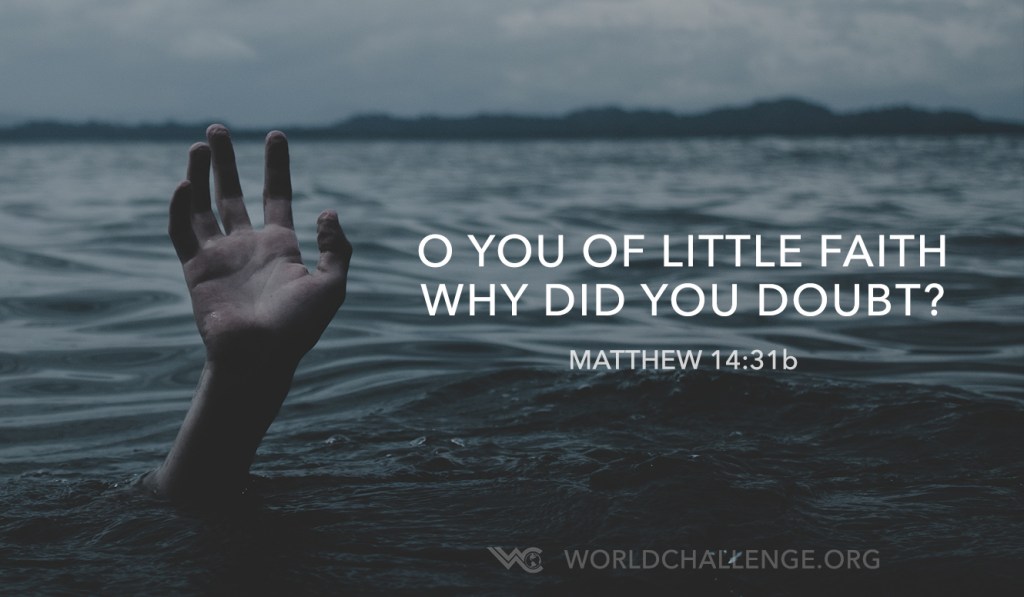
Matthew 14:28-32 Lexham English Bible
28 And Peter answered him and[a] said, “Lord, if it is you,[b] command me to come to you on the water!” 29 So he said, “Come!” And getting out of the boat, Peter walked on the water and came toward Jesus. 30 But when he[c] saw the strong wind, he was afraid. And beginning to sink, he cried out, saying, “Lord, save me!” 31 And immediately Jesus extended his[d] hand and[e] caught him and said to him, “You of little faith! Why did you doubt?” 32 And when[f] they got into the boat, the wind abated.
Word of God for the Children of God
Glory be to the Father,
and to the Son, and to the Holy Ghost;
as it was in the beginning,
is now, and ever shall be,
world without end. Amen, amen.
What is the craziest thing you have ever done, were dared to do?
I could mention a few things from my younger days, but let’s just leave that to the imagination.
How about in your life of faith?
What is the craziest thing God has ever challenged you to do?
Were you up for the challenge, or did you hear excuses in your head about why you couldn’t possibly try?
Did you jump in with both feet and find, to your surprise, that maybe it wasn’t so impossible after all?
I wonder how big the smile was on Jesus’ face when Peter said, “Lord, if it’s you . . . tell me to come to you on the water.”
I love it that Peter was ready to jump in, test his faith even when things looked impossible. He stepped out of the boat looking at Jesus. And as long as he kept his eyes on Jesus, his steps went in the right direction.
Even with little faith, his walk on water was possible.
But when Peter looked around him and saw the wind and deep water, he became afraid, doubted his judgment, and started to sink.
When Jesus asks for our trust, he knows there is always going to be a bigger story to be written.
There are days when circumstances muddy the waters and the trust factor diminishes and we cannot figure out what those ‘first’ next steps should be.
Many people get discouraged by the devastation evident in the world.
Today, we can easily turn on the news and learn about wars, natural disasters, murders, and injustices.
When we see these examples of evil and suffering, doubts can form in our minds.
Why would God allow such terrible things to happen?
What is He doing about these problems?
What is He doing to do about these problems?
Widespread suffering is not the only cause for doubt.
We can also struggle with questions of “why” when disaster, loss, and illness strike close to home.
If we get diagnosed with a long-term illness or a loved one dies, we can feel angry with God.
In our pain and doubt, we start to question the Lord’s loving character.
Nonbelievers and believers alike can struggle with seasons of doubt.
As much as these times can make people feel like everything they know has been tossed like a salad made for serving thousands, leaving them confused and questioning, seasons of doubting are also opportunities for growth, to shed the assumptions and false views we once held.
These are God opportunities to seek the truth, to learn more about God and experience His love.
Doubt is, without question uncomfortable, but God can transform it, like anything else, for our good (Romans 8:28).
If your heart is blocked by doubt, there are ways to move forward.
Consider implementing these five steps to address doubts.
1. Talk to God about Your Struggle with Doubt
Praying is often not on the top of the list for those who are wrestling with doubts. They may feel resentment or bitterness toward God. Some could also feel ashamed of their doubt, assume the Lord does not want to hear from them.
But talking to God is what we should be doing when we are struggling with different feelings and questions about faith. He is not afraid of our doubts or tough questions. Instead of giving the Lord the silent treatment, we need to “gird our loins” and take time to pray when our heart is blocked by doubt.
Scripture shows us many examples of this, especially in the Psalms. David and other psalmists cried out to the Lord, sometimes in sorrow, pain, or anger.
Consider Psalm 10, in which the psalmist asks God, “Why, Lord, do you stand far off? Why do you hide yourself in times of trouble?” (Psalm 10:1).
Or consider the prayer of Heman the Ezrahite, “Why, Lord, do you reject me and hide your face from me?” (Psalm 88:14).
These individuals took their questions, emotions, and struggles to the Lord in pleas and prayers. He inspired these prayers and preserved them in His Word.
We also have the example of the man with the demon-possessed son in the Gospels. He wanted his son to be freed from the oppression of the evil spirit.
Yet, his faith was not overly strong. He told the Lord Jesus, “But if you can do anything, take pity on us and help us” (Mark 9:22, my emphasis added).
Christ affirmed that anything is possible for the one who believes (Mark 9:23).
At this, the man cried out, “I do believe; help me overcome my unbelief!” (Mark 9:24).
Like this man, and the psalmists, we can cry out to God, asking Him to help us with our unbelief and doubts.
None of us are immune to questions, not even believers.
Therefore, praying is not reserved only for when we feel joyful and filled with strong faith.
It also for when we are tired, weak, and doubting.
2. Reflect on What the Bible Says about the Lord’s Character
Although we can have questions about many things in life, the main doubts that people experience are centered on the Lord.
Individuals look at all the evil in the world, and the suffering in their lives, and they want to know why God would allow these things to happen.
If God is all-powerful, then why does He not stop the evil?
And if He is good, then why do people suffer?
The character of God is brought into question.
This is why we should use this opportunity to examine what we believe about God and what the Bible teaches.
Lots of people have faulty assumptions and beliefs, some of which could even have been passed onto them by a church or pastor.
Such views should be questioned and brought into scrutiny – to compare the view with God’s Word.
Asking these questions about evil, suffering, and the goodness of God, then, gives us a chance to delve deeper into the truth of the Bible.
For example, some Christian circles commonly teach that the Lord gives a good life to those who serve Him but punishes those who do wrong with suffering.
The ideology is: “If you do what is right, you will experience a good life. But whenever you sin, God will punish you.”
Of course, in this sense, “good” is usually defined by worldly standards as having wealth and a comfortable life.
The Lord, thus, is presented as a doting grandfather figure who has a vengeful streak.
Another way that people often depict God is some sort of monster – delighting in inflicting pain.
Some churches emphasize rule-keeping and fear of God so much that they distort His biblical character.
People see a God of wrath who does not care about a person’s suffering and has probably sent it because he or she is not checking off religious lists well enough.
Questioning views like this is actually something we should do.
Scripture presents a much different view of God than these two examples.
He is not a God who sends suffering or delights in evil.
He is the Lord who made all things good in the beginning – it was humankind who sinned and brought sin and death into the world.
In the Lord’s compassion and mercy, He made a promise to provide a solution and heal our brokenness (Genesis 3:15).
This He did by sending His Son into the world (John 3:16; Romans 5:8).
As fully God and fully man, Jesus came to save us from sin and death by dying for our sins.
The cross and empty tomb are the answer to the problem of evil and suffering.
God is not a doting, vengeful grandfather or a monster.
He is the loving, merciful, just, holy, death-defeating Savior who loved us and gave Himself for us.
We might still have questions about what we see in the world.
However, the reminder that God is good, loving, and has taken action to save us is comforting and encouraging in a season of doubt.
Perhaps today is a day to refocus where you are looking.
How can you more adeptly keep your eyes on Jesus?
3. Study Areas of God’s Word That Address Questions and Doubts
When individuals are facing difficulties with their faith, it is common for them to avoid reading the Bible, just as they often stop praying.
But like talking to God, we need to listen to Him by reading His Word. For there are many areas in Scripture that address questions and doubts.
One such area, which has already been mentioned, is the Psalms.
During a season of asking “why,” the Psalms give us relatable prayers that can comfort us.
We may even find ourselves praying a psalm regularly, or gleaning strength from specific passages.
Psalm 77 can offer us a place to start, in which we read about Asaph crying out to God in distress. He was honest about his pain, but also directed his thoughts back to God to remember all that the Lord had done in the past.
After asking multiple questions, he said, “I will remember the deeds of the Lord; yes, I will remember your miracles of long ago” (Psalm 77:11).
Choosing to dwell on what God did in the past strengthened Asaph’s faith, and it can strengthen ours.
Another area of the Bible to study when doubt overwhelms us is the book of Job.
Evident in Job’s story is the theme of evil and suffering as we read about Satan causing the loss of Job’s servants and livestock (Job 1:13-17), the death of his children (Job 1:18-19), and his struggle with painful sores (Job 2:7).
Throughout the book, we read various explanations about his suffering that are presented by his friends – the main one being that Job had sinned which is why he encountered trouble in life (Job 4:7-9).
Yet, the book emphasizes that Job had not sinned against the Lord (Job 1:8, 22; 2:10). As we read this biblical account, we are shown that sometimes in life, we will not fully understand why things happen to us. But one thing we can know – The Lord is a powerful, awesome, and good God (Job 38-41).
These books of the Bible, and many others, can help us when our faith feels small, or we have questions for God.
4. Don’t Be Afraid to Ask Questions and Seek the Truth
During the times we doubt God’s goodness or have questions of “why” swirling in our heads, we can allow these feelings to push us to seek truth.
So many of us can fear asking questions about faith or examining our beliefs.
We are afraid that doing so is wrong.
But if we ignore these areas and trudge on, not building our faith on a solid base, then when another cat. 5 storm in life comes, we will likely find greater destruction in its wake.
Instead of shoving questions and doubts aside, we need to acknowledge them and commit ourselves to finding the truth. Jesus encouraged us that those who seek will find (Matthew 7:7-8).
Experiencing doubts is an opportunity for us to cut away unbiblical ideas and reframe our thinking according to the truth of God’s Word.
Thankfully, there are tools we can use as we take the brave step to ask questions and seek answers.
Numerous apologetic materials exist that cover a variety of topics. Whether we have questions about creation/evolution, the problem of evil and suffering, the reliability of Scripture, or the historicity of Jesus’ ministry, among others, we can find sources that help us study these issues from a biblical viewpoint.
Of course, we should not limit ourselves to only scholarly materials, like textbooks. Many people find creative works, such as fiction and poetry, to be just as faith-building as academically intense books or lectures.
C. S. Lewis credited imagination and works of literature, especially Phantastes by George MacDonald, as part of his faith journey toward placing faith in Christ.
Similarly, author Sarah Clarkson has noted how The Lord of the Rings saved her faith when she faced a diagnosis of OCD, struggled with disillusionment with the church and God.
As she stated in this same interview for Word on Fire, “Such novels teach us to look beyond the evil and anger, the grief and despair of the broken world.”
Whether scholarly-based, creative, or a combination of both, God can use many different sources to bolster our faith in Him.
5. Stay Connected to Other Believers
Finally, when we find ourselves flailing with unbelief, we need connection to other believers.
Multiple passages in Scripture encourage the church to strengthen the spiritually weak (James 5:14-16; 1 Thessalonians 5:14).
We should not take this term (spiritually weak) negatively, as if we have a fault.
Rather, we can be grateful that provision has been provided.
The Lord included these instructions in Scripture because He knows there are times when we will struggle with faith.
In His grace, He provides the company of other believers to strengthen and encourage us.
Specifically, we can benefit from sharing our questions and concerns with a trustworthy, mature follower of Christ.
He or she has walked through similar times of doubts and can share insights and suggestions – or perhaps just a listening ear and loving presence.
Although friends and family members may be available to talk with, the perspective of a mature Christian can inspire and challenge us in healthy ways.
He or she will listen to our doubts, but also ask thought-provoking questions, confront faulty assumptions.
Such a relationship is truly an iron-sharpening one (Proverbs 27:17).
Having a Christian mentor come alongside us when our heart is blocked by doubt can remind us there is hope.
We do not have to be alone as we ask difficult, yet important questions or as we seek biblical truth.
In the name of God, the Father and God the Son and God the Holy Spirit …
Praying …
Psalm 13 Lexham English Bible
Trust in the Salvation of Yahweh
For the music director. A psalm of David.[a]
13 How long, O Yahweh? Will you forget me forever?
How long will you hide your face from me?
2 How long must I take counsel[b] in my soul,
and sorrow in my heart all the day?
How long will my enemy be exalted over me?
3 Consider[c] and answer me, O Yahweh my God.
Give light to my eyes
lest I sleep the sleep of death,
4 and lest my enemy should say, “I have overcome him,”
lest my enemies rejoice because I am shaken.
5 But as for me, I have trusted in your steadfast love.[d]
My heart will rejoice in your deliverance.
6 [e] I will sing to Yahweh
because he has dealt bountifully with me.
Glory be to the Father,
and to the Son, and to the Holy Ghost;
as it was in the beginning,
is now, and ever shall be,
world without end. Amen, amen.

 Loving God, Living God, Loving Hope, Living Hope, Loving Living Life His Way! "Many things are possible for the person who has hope. Even more is possible for the person who has faith. And still more is possible for the person who knows how to love. But everything is possible for the person who practices all three virtues." - Brother Lawrence (1605-1691), Practicing the Presence of God (1692).
C.S. Lewis’s “God in the Dock” does not specifically address the Holocaust (often referred to as the Shoah) or the guilt associated with it in the context of Xtianity. This omission can be seen as a significant gap, especially given the profound moral and theological implications of the Holocaust for both Jewish and Xtian communities. “By their fruits you shall know them” forever condemns Xtianity as a dead religion.
Philosophical and theological arguments for the existence of God, the nature of faith, and moral reasoning which ignore “By their fruits your shall know them” exposes Xtian religious propaganda rhetoric. “Nature of faith” which ignores צדק צדק תרדוף likewise exposes empty Xtian religious rhetoric propaganda. “Moral reasoning” pales in the “Final Solution”/White Paper\Allied refusal to bomb the rail-lines which transported Jews to death camps. Lewis’s contributions to Xtian apologetics, compares to tits on a boar hog.
The historical context of the Shoah, by itself alone, challenges the credibility of Xtian teachings such as Luther’s council to gather Jews into their synagogues and burn the buildings upon them. Or the pre-Reformation decision to impose ghetto gulags upon all Jews living in Western Europe. The biblical phrase “צדק צדק תרדוף” (Justice, justice shall you pursue), underscores the expectation that faith should manifest in actions that promote justice and protect the vulnerable. The failure to uphold these principles in the face of systemic evil raises critical questions about the authenticity of faith.
LikeLike