
Exodus 7:1-5 The Message
7 1-5 God told Moses, “Look at me. I’ll make you as a god to Pharaoh and your brother Aaron will be your prophet. You are to speak everything I command you, and your brother Aaron will tell it to Pharaoh. Then he will release the Israelites from his land. At the same time I am going to put Pharaoh’s back up and follow it up by filling Egypt with signs and wonders. Pharaoh is not going to listen to you, but I will have my way against Egypt and bring out my soldiers, my people the Israelites, from Egypt by mighty acts of judgment. The Egyptians will realize that I am God when I step in and take the Israelites out of their country.”
The Word of God for the Children of God.
Glory be to the Father,
and to the Son, and to the Holy Ghost;
as it was in the beginning,
is now, and ever shall be,
world without end. Amen, amen.
… At the same time I am going to put Pharaoh’s back up and follow it up by filling Egypt with signs and wonders. Pharaoh is not going to listen to you, but I will have my way against Egypt and bring out my soldiers, my people the Israelites, from Egypt by mighty acts of judgment. The Egyptians will realize that I am God when I step in and take the Israelites out of their country.”
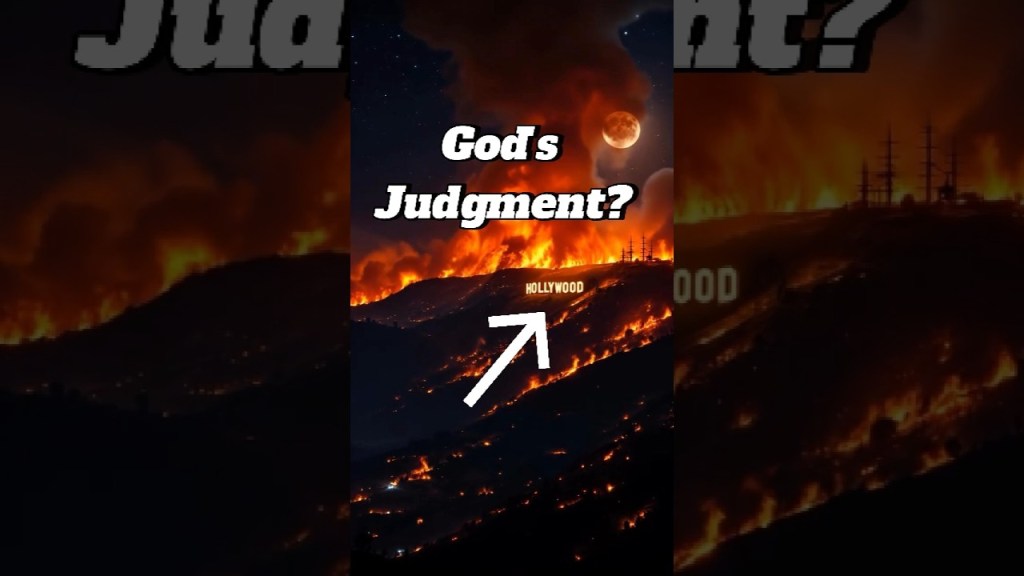
Are the 2025 Los Angeles Wildfires a Sign or a “Taste” of God’s Coming Judgment, the Arrival of God’s Judgment, upon the state of California?
Exodus 7:4 Amplified Bible
4 But Pharaoh will not listen to you, and I shall lay My hand on Egypt and bring out My hosts [like a defensive army, tribe by tribe], My people the children of Israel, out of the land of Egypt by great acts of judgment (the plagues).
Matthew 11:20-24 English Standard Version
Woe to Unrepentant Cities
20 Then he began to denounce the cities where most of his mighty works had been done, because they did not repent. 21 “Woe to you, Chorazin! Woe to you, Bethsaida! For if the mighty works done in you had been done in Tyre and Sidon, they would have repented long ago in sackcloth and ashes. 22 But I tell you, it will be more bearable on the day of judgment for Tyre and Sidon than for you. 23 And you, Capernaum, will you be exalted to heaven? You will be brought down to Hades. For if the mighty works done in you had been done in Sodom, it would have remained until this day. 24 But I tell you that it will be more tolerable on the day of judgment for the land of Sodom than for you.”
Matthew 12:34-37 The Message
34-37 “You have minds like a snake pit! How do you suppose what you say is worth anything when you are so foul-minded? It’s your heart, not the dictionary, that gives meaning to your words. A good person produces good deeds and words season after season. An evil person is a blight on the orchard. Let me tell you something: Every one of these careless words is going to come back to haunt you. There will be a time of Reckoning. Words are powerful; take them seriously. Words can be your salvation. Words can also be your damnation.”
Matthew 23:23-24 The Message
23-24 “You’re hopeless, you religion scholars and Pharisees! Frauds! You keep meticulous account books, tithing on every nickel and dime you get, but on the meat of God’s Law, things like fairness and compassion and commitment—the absolute basics!—you carelessly take it or leave it. Careful bookkeeping is commendable, but the basics are required. Do you have any idea how silly you look, writing a life story that’s wrong from start to finish, nitpicking over commas and semicolons?
The Great flood from Genesis … the times of Noah?
Sodom and Gomorrah?
Jonah and his mission to straighten (call to repentance) of Nineveh?
These are just a very few of the Biblical passages we can find and try to apply to our personal “set in stone” theologies to the reasons why we ourselves believe the areas around the City of Los Angeles is burning, causing great devastation to homes and businesses, areas of recreation, to animal life and much more.
Add to all of that is the inevitable loss of life and the enormous trauma each individual experiences based on what magnitude they themselves visualized, the time and duration of their exposure and the depths of their involvement.
Six California fires have devastated Los Angeles. As of this writing, two of those fires are mostly contained, but four more continue to cause vast destruction.
More than 12,000 homes both rich and poor, numerous businesses have been burned. So far, over 40,000 acres have burned, with multiple blazes still raging.
The stories coming from the area are heartbreaking, the photos are startling.
To be frank, it looks like hell.
Which, unsurprisingly, has caused many folks to make those connections to God’s judgment. To many conservative Christians, the state of California and places like Los Angeles are known as the ultimate paradigm of ungodliness. But is that true? Are these fires in L.A. an authentic expression of God’s judgment?
People on social media have quickly proclaimed this as evidence of God’s extreme displeasure and judgment. Others, like Reverend Franklin Graham, have said it’s not God’s judgment. How should we think about these things?
What Does the Bible Say about Judgment and Disasters?
The pages of Scripture are filled with disasters. We’re not even ten chapters into this almost 1200-chapter book when God floods the entire world (Genesis 6:5-7) as a direct response to humanity’s widespread unrelenting vile wickedness.
After saying he’d never destroy the world in that fashion again, by Genesis 19, we see Sodom and Gomorrah utterly destroyed by storms of fire and brimstone.
This, as a side note, was also trending on social media a couple of days ago because of people tying these fires to stories of this text of God’s judgment.
It’s clear, then, that God does use natural disasters as signs of judgment.
But it should be noted that in each instance, there are clear warnings and calls to repentance. They are always accompanied by divine revelation and there is no doubt as to their intent – the hardcore message of turn around, back to God .
Burning up a place and saying, “I hope that got your attention,” isn’t exactly the modus operandi of the God of the Universe. Psalms 86:15, Psalms 103:8 and Psalms 145:8 repeat this: He is slow to anger and abounding in steadfast love.
Without warning or communication, an event like these wildfires as judgment would seem to go against what the Scriptures repeatedly say, how the Scripture speaks of God exercising, executing judgment of humanity by natural disasters.
But there is another sense in which all disasters and the brokenness of creation are a God’s indictment against His people consequence of our sin called pride.
Micah 6:1-8 Amplified Bible
God’s Indictment of His People
6 Hear now what the Lord is saying,
“Arise, plead your case before the mountains,
And let the hills [as witnesses] hear your voice.
2
“Hear, O mountains, the indictment of the Lord,
And you enduring foundations of the earth,
For the Lord has a case (a legal complaint) against His people,
And He will dispute (challenge) Israel.
3
“O My people, what have I done to you [since you have turned away from Me]?
And how have I wearied you? Answer Me.
4
“For I brought you up from the land of Egypt
And ransomed you from the house of slavery,
And I sent before you Moses [to lead you], Aaron [the high priest], and Miriam [the prophetess].
5
“My people, remember now
What Balak king of Moab devised [with his evil plan against Israel]
And what Balaam the son of Beor answered him [turning the curse into blessing for Israel],
[Remember what the Lord did for you] from [a]Shittim to Gilgal,
So that you may know the righteous and saving acts [displaying the power] of the Lord.”
What God Requires of Man
6
With what shall I come before the Lord [to honor Him]
And bow myself before God on high?
Shall I come before Him with burnt offerings,
With yearling calves?
7
Will the Lord be delighted with thousands of rams,
Or with ten thousand rivers of oil?
Shall I present my firstborn for my acts of rebellion,
The fruit of my body for the sin of my soul?
8
He has told you, O man, what is good;
And what does the Lord require of you
Except to be just, and to love [and to diligently practice] kindness (compassion),
And to walk humbly with your God [setting aside any overblown sense of importance or self-righteousness]?
It was God’s judgment that booted humanity out of the Garden of Eden and here where the wild things are.
There aren’t wildfires in Eden.
This means, at least in some sense, we can say that this is a consequence of our sin and God’s judgment upon that sin.
This way of thinking is the background for Jesus’ words in Luke 13:5. Here, a massacre by Pilate and the collapse of a Tower lead Jesus to say, “Unless you repent, you too will perish.”
He doesn’t tie the disaster directly to God’s judgment but points to a universal need for repentance.
If the wildfire is judgment—it’s a judgment upon all of us and not only those who are in L.A.
The Scripture also assures us God’s ultimate purpose in allowing disasters isn’t to destroy but to redeem. In all of these graphic stories of judgment and great destruction, there is always a call to repentance and then a promise of grace.
Disasters should lead us back to God.
They are a reminder that our world is broken and we need redemption.
They propel us to long for the hope of the new creation (Revelation 21:4).
It’s because of this over-arching story of the Bible that I’m hesitant to give a measured specific answer to whether these wildfires are God’s judgment. We should be cautious in assuming or even dismissing them as God’s judgment.
Isaiah 43:1-3 Amplified Bible
Israel Redeemed
43 But now, this is what the Lord, your Creator says, O Jacob,
And He who formed you, O Israel,
“Do not fear, for I have redeemed you [from captivity];
I have called you by name; you are Mine!
2
“When you pass through the waters, I will be with you;
And through the rivers, they will not overwhelm you.
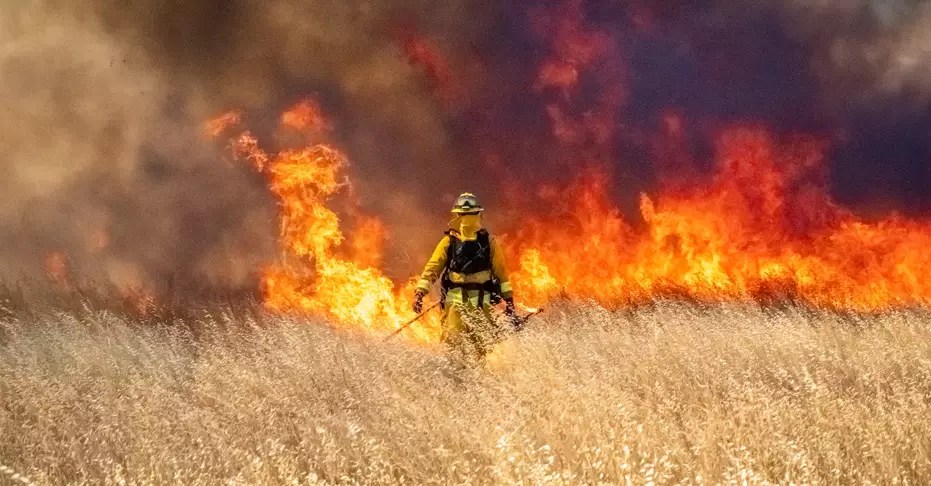
When you walk through fire, you will not be scorched,
Nor will the flame burn you.
3
“For I am the Lord your God,
The Holy One of Israel, your Savior;
I have given Egypt [to the Babylonians] as your ransom,
Cush (ancient Ethiopia) and Seba [its province] in exchange for you.
Why We Should Be Cautious about Assuming (or Dismissing) God’s Judgment
I imagine a reporter thousands of years ago interviewing one of Job’s friends. Perhaps he was commissioned to write an article to give his opinion on Job’s misfortune. To be honest, the whole thing feels a little icky. I don’t smell the smoke from the fires. I am not directly impacted. For that reason, it feels a little too detached to give my opinions on what God is or is not doing in the L.A. fires.
I am cautious, then, that I not be like Job’s friends. They were miserable counselors. They tied together a few strands in their theology and jumped to a conclusion about Job. They believed that bad things didn’t happen to good people, but bad things were clearly happening to Job. Their only recourse, then, was to assume that Job must have been doing something wrong. But they were foolish, and God rebuked them.
Isaiah 55:8-9 tells us that God’s thoughts are not our thoughts. For that reason, unless God has clearly revealed something, I’m going to be very hesitant proclaiming a “thus says the Lord” over a natural disaster. But that goes both ways. I also don’t have the confidence to say it absolutely is not God’s judgment. In Amos’ time, several disasters hit Israel. They were designed to lead the people to repentance—but they quickly dismissed them. I don’t want to err on that end, either.
As unsatisfactory as it may sound, my answer to the question at hand is simply “maybe.” I lean towards saying that it isn’t because, typically, God will give warnings and communication. In fact, I’d go so far as to say I’d be shocked if it was a pointed judgment. But that doesn’t mean that I believe God isn’t communicating through these fires. Nor is it saying that in no way can we speak of these things as judgment.
But what we need to be very cautious about is not heeding the counsel of Luke 13. Jesus drew attention back to our own hearts. If you’re looking down your nose at those in L.A. but not taking a look at your own soul, I don’t believe you’re thinking about this biblically. You’re not responding to disaster as a believer ought to respond.
How Should Christians Respond to Disasters Like This?
When faced with disasters like the L.A. wildfires, Christians are called to respond with compassion. Alongside this compassion, we are called to point to Christ as the hope and answer for all that besets us outside of Eden.
Galatians 6:2 calls us to bear one another’s burdens.
We should not look upon these fires with glee or celebrate that godless people are receiving their comeuppance. That’s foolishness. Rather we should bear their burdens and seek to love our hurting neighbors. That’s our first response.
Let’s just think for a moment about the purpose of a question like the one proposed in this devotional effort.
What good does it serve?
Let’s say we come to the conclusion it’s absolutely not a sign of God’s judgment.
Well, that’s a good thing. But is there still not a call for us to repent and turn to Christ? Are we willing to say that God isn’t doing anything in a disaster like this?
Surely not. We want to see even something as devastating as this be used for our good and the furtherance of God’s kingdom. Do I have to declare unequivocally that it is or is not judgment in order to love people and point them to Jesus? No.
What I like to say when we tackle sticky questions like this is that it’s a bit like a sumo-wrestler river-dancing on thin ice. He might get in a few sweet moves, but eventually, he’s is just as likely to lose his balance, to make a big splash, and all those in close proximity will get wet, miserable because of it, especially him.
The only reason why our sumo-wrestler would venture out onto thin ice to do something so foolhardy is to show off or entertain.
And neither of those are needed nor the least bit appropriate at a time like this.
It’s far better position to speak powerfully about what we do know (Christ and Him crucified) what we believe; love wholeheartedly the person in front of us.
John 3:16-21 Amplified Bible
16 “For God so [greatly] loved and dearly prized the world, that He [even] gave His [One and] [a]only begotten Son, so that whoever believes and trusts in Him [as Savior] shall not perish, but have eternal life. 17 For God did not send the Son into the world to judge and condemn the world [that is, to initiate the final judgment of the world], but that the world might be saved through Him. 18 Whoever believes and has decided to trust in Him [as personal Savior and Lord] is not judged [for this one, there is no judgment, no rejection, no condemnation]; but the one who does not believe [and has decided to reject Him as personal Savior and Lord] is judged already [that one has been convicted and sentenced], because [b]he has not believed and trusted in the name of the [One and] only begotten Son of God [the One who is truly unique, the only One of His kind, the One who alone can save him]. 19 This is the judgment [that is, the cause for indictment, the test by which people are judged, the basis for the sentence]: the Light has come into the world, and people loved the [c]darkness rather than the Light, for their deeds were evil. 20 For every wrongdoer hates the Light, and does not come to the Light [but shrinks from it] for fear that his [sinful, worthless] activities will be exposed and condemned. 21 But whoever practices truth [and does what is right—morally, ethically, spiritually] comes to the Light, so that his works may be plainly shown to be what they are—accomplished in God [divinely prompted, done with God’s help, in dependence on Him].”
John 13:34-35 Amplified Bible
34 I am giving you a new commandment, that you [a]love one another. Just as I have loved you, so you too are to love one another. 35 By this everyone will know that you are My disciples, if you have love and unselfish concern for one another.”
John 15:13-16 Amplified Bible
13 No one has greater love [nor stronger commitment] than to lay down his own life for his friends. 14 You are my friends if you keep on doing what I command you. 15 I do not call you servants any longer, for the servant does not know what his master is doing; but I have called you [My] friends, because I have revealed to you everything that I have heard from My Father. 16 You have not chosen Me, but I have chosen you and I have appointed and placed and purposefully planted you, so that you would go and bear fruit and keep on bearing, and that your fruit will remain and be lasting, so that whatever you ask of the Father in My name [as My representative] He may give to you.
Disasters are an opportunity to point to the hope we have in Christ. While the world groans under the weight of the curse (Romans 8:20-22), we can offer the solution. We do not have to respond in despair or judgment, but rather, we are positioned to give practical love and care while we share the love of Christ.
Romans 8:1-8The Message
The Solution Is Life on God’s Terms
8 1-2 With the arrival of Jesus, the Messiah, that fateful dilemma is resolved. Those who enter into Christ’s being-here-for-us no longer have to live under a continuous, low-lying black cloud. A new power is in operation. The Spirit of life in Christ, like a strong wind, has magnificently cleared the air, freeing you from a fated lifetime of brutal tyranny at the hands of sin and death.
3-4 God went for the jugular when he sent his own Son. He didn’t deal with the problem as something remote and unimportant. In his Son, Jesus, he personally took on the human condition, entered the disordered mess of struggling humanity in order to set it right once and for all. The law code, weakened as it always was by fractured human nature, could never have done that.
The law always ended up being used as a Band-Aid on sin instead of a deep healing of it. And now what the law code asked for but we couldn’t deliver is accomplished as we, instead of redoubling our own efforts, simply embrace what the Spirit is doing in us.
5-8 Those who think they can do it on their own end up obsessed with measuring their own moral muscle but never get around to exercising it in real life. Those who trust God’s action in them find that God’s Spirit is in them—living and breathing God! Obsession with self in these matters is a dead end; attention to God leads us out into the open, into a spacious, free life. Focusing on the self is the opposite of focusing on God. Anyone completely absorbed in self ignores God, ends up thinking more about self than God. That person ignores who God is and what he is doing. And God isn’t pleased at being ignored.
I don’t know all the details of why these wildfires are raging.
I do not know what purpose these fires are continuing to burn, why we are now struggling so mightily against water shortages , low water pressures, the Santa Anna Winds, and etcetera, I don’t know what purpose Jehovah God has in mind.
But I do know this because the Word of God tells me, informs and teaches me:
Isaiah 58 The Message
Your Prayers Won’t Get Off the Ground
58 1-3 “Shout! A full-throated shout!
Hold nothing back—a trumpet-blast shout!
Tell my people what’s wrong with their lives,
face my family Jacob with their sins!
They’re busy, busy, busy at worship,
and love studying all about me.
To all appearances they’re a nation of right-living people—
law-abiding, God-honoring.
They ask me, ‘What’s the right thing to do?’
and love having me on their side.
But they also complain,
‘Why do we fast and you don’t look our way?
Why do we humble ourselves and you don’t even notice?’
3-5 “Well, here’s why:
“The bottom line on your ‘fast days’ is profit.
You drive your employees much too hard.
You fast, but at the same time you bicker and fight.
You fast, but you swing a mean fist.
The kind of fasting you do
won’t get your prayers off the ground.
Do you think this is the kind of fast day I’m after:
a day to show off humility?
To put on a pious long face
and parade around solemnly in black?
Do you call that fasting,
a fast day that I, God, would like?
6-9 “This is the kind of fast day I’m after:
to break the chains of injustice,
get rid of exploitation in the workplace,
free the oppressed,
cancel debts.
What I’m interested in seeing you do is:
sharing your food with the hungry,
inviting the homeless poor into your homes,
putting clothes on the shivering ill-clad,
being available to your own families.
Do this and the lights will turn on,
and your lives will turn around at once.
Your righteousness will pave your way.
The God of glory will secure your passage.
Then when you pray, God will answer.
You’ll call out for help and I’ll say, ‘Here I am.’
A Full Life in the Emptiest of Places
9-12 “If you get rid of unfair practices,
quit blaming victims,
quit gossiping about other people’s sins,
If you are generous with the hungry
and start giving yourselves to the down-and-out,
Your lives will begin to glow in the darkness,
your shadowed lives will be bathed in sunlight.
I will always show you where to go.
I’ll give you a full life in the emptiest of places—
firm muscles, strong bones.
You’ll be like a well-watered garden,
a gurgling spring that never runs dry.
You’ll use the old rubble of past lives to build anew,
rebuild the foundations from out of your past.
You’ll be known as those who can fix anything,
restore old ruins, rebuild and renovate,
make the community livable again.
13-14 “If you watch your step on the Sabbath
and don’t use my holy day for personal advantage,
If you treat the Sabbath as a day of joy,
God’s holy day as a celebration,
If you honor it by refusing ‘business as usual,’
making money, running here and there—
Then you’ll be free to enjoy God!
Oh, I’ll make you ride high and soar above it all.
I’ll make you feast on the inheritance of your ancestor Jacob.”
Yes! God says so!
God is able to restore the years the locusts have eaten (Joel 2:25), which means He can bring beauty out of the ashes.
Let’s focus our attention on participating in His work of redemption.
Do I personally believe these fires are an expression of God’s Judgment?
In a limited and narrow way = YES!
But only to an extent that back in Genesis, God promised to never repeat the flood – God set His rainbow in the sky …
Genesis 9:8-11 The Message
8-11 Then God spoke to Noah and his sons: “I’m setting up my covenant with you including your children who will come after you, along with everything alive around you—birds, farm animals, wild animals—that came out of the ship with you. I’m setting up my covenant with you that never again will everything living be destroyed by floodwaters; no, never again will a flood destroy the Earth.”
And God does not change, does not walk back His promises. Hebrews 13:8
Hebrews 13:8 New American Standard Bible
8 Jesus Christ is the same yesterday and today, and forever.
Only to the extent that the Message of John the Baptist and Jesus from the Gospel of Mark is Repent for the Kingdom of God is near and among us.
Mark 1:1-8 New American Standard Bible
Preaching of John the Baptist
1 The beginning of the gospel of Jesus Christ, the Son of God,
2 just as it is written in Isaiah the prophet:
“Behold, I am sending My messenger [a]before You,
Who will prepare Your way;
3 The voice of one calling [b]out in the wilderness,
‘Prepare the way of the Lord,
Make His paths straight!’”
4 John the Baptist appeared in the wilderness, [c]preaching a baptism of repentance for the forgiveness of sins. 5 And all the country of Judea was going out to him, and all the people of Jerusalem; and they were being baptized by him in the Jordan River, confessing their sins. 6 John was clothed with camel’s hair and wore a leather belt around his waist, and [d]his diet was locusts and wild honey. 7 And he was [e] preaching, saying, “After me One is coming who is mightier than I, and I am not fit to bend down and untie the straps of His sandals. 8 I baptized you [f]with water; but He will baptize you [g]with the Holy Spirit.”
Mark 1:14-15 New American Standard Bible
Jesus Preaches in Galilee
14 Now after John was [a]taken into custody, Jesus came into Galilee, [b] preaching the gospel of God, 15 and saying, “The time is fulfilled, and the kingdom of God [c]is at hand; repent and [d]believe in the gospel.”
God sent His Son to us, fully human fully God to live among us, to be in mission and ministry with us, gave us the Great Communion and finally to die for us all.
The Lord giveth and the Lord taketh away-and still blessed be the Lord’s name. Job 1:20-21
20 Then Job got up, tore his robe, and shaved his head; then he fell to the ground and worshiped. 21 He said,
“Naked I came from my mother’s womb,
And naked I shall return there.
The Lord gave and the Lord has taken away.
Blessed be the name of the Lord.”
If it was God’s intent to “take creation away” after He spoke it into being …
Why send His Son into the World – to Save it – Not to Condemn it?
God gives us opportunities to turn away from our sin, offers forgiveness.
What do you believe – executing ‘final’ Judgement or Call us to Repentance?
In the name of God, the Father and God the Son and God the Holy Spirit,
Let us Pray,
Psalm 8 Authorized (King James) Version
Psalm 8
To the chief Musician upon Gittith, A Psalm of David.
1 O Lord our Lord, how excellent is thy name in all the earth!
who hast set thy glory above the heavens.
2 Out of the mouth of babes and sucklings
hast thou ordained strength because of thine enemies,
that thou mightest still the enemy and the avenger.
3 When I consider thy heavens, the work of thy fingers,
the moon and the stars, which thou hast ordained;
4 what is man, that thou art mindful of him?
and the son of man, that thou visitest him?
5 For thou hast made him a little lower than the angels,
and hast crowned him with glory and honour.
6 Thou madest him to have dominion over the works of thy hands;
thou hast put all things under his feet:
7 all sheep and oxen, yea, and the beasts of the field;
8 the fowl of the air, and the fish of the sea,
and whatsoever passeth through the paths of the seas.
9 O Lord our Lord, how excellent is thy name in all the earth!
Glory be to the Father,
and to the Son, and to the Holy Ghost;
as it was in the beginning,
is now, and ever shall be,
world without end. Amen, amen.

 Loving God, Living God, Loving Hope, Living Hope, Loving Living Life His Way! "Many things are possible for the person who has hope. Even more is possible for the person who has faith. And still more is possible for the person who knows how to love. But everything is possible for the person who practices all three virtues." - Brother Lawrence (1605-1691), Practicing the Presence of God (1692).
😭49 years ago today, Palestinians invaded the Lebanese Christian town of Damour and massacred hundreds of civilians.
Men were lined up against the walls of their homes and gunned down.
Women were tortured and gang-raped.
Babies were shot in the back of their heads.
Pregnant women had their babies cut out of the womb.
‘It was an apocalypse’, said Father Labaky, a priest who survived the massacre.
“They were coming in thousands, shouting ‘Allahu Akbar! Let us attack them for the Arabs, let us offer a holocaust to Mohammad’, they were slaughtering everyone, men, women and children.”49 years ago today, Palestinians invaded the Lebanese Christian town of Damour and massacred hundreds of civilians.
Men were lined up against the walls of their homes and gunned down.
Women were tortured and gang-raped.
Babies were shot in the back of their heads.
Pregnant women had their babies cut out of the womb.
‘It was an apocalypse’, said Father Labaky, a priest who survived the massacre.
“They were coming in thousands, shouting ‘Allahu Akbar! Let us attack them for the Arabs, let us offer a holocaust to Mohammad’, they were slaughtering everyone, men, women and children.”
1976
reposting
Forwarded this email? Subscribe here for more
January 9 Saint Julian, Martyr and Saint Basilissa: Converted Home into Hospital for Poor and Sick.
Maria Angela Grow
Jan 20
READ IN APP
January 9 Saint Julian, Martyr and Saint Basilissa: Converted Home into Hospital for Poor and Sick.
(† 313)
Julian is the patron of hospitals.
Basilissa is invoked against chilblains.
.
Saint Julian was born at Antinoe, in Egypt, of noble parents. As they were good and fervent Christians, they took great care to bring him up in the school of virtue. Hence, even in his earliest years, Julian showed by the innocence of his life and the fidelity wherewith he devoted himself to his religious duties, that he was called to accomplish one day great things for the glory of God and the salvation of his neighbor. From his very childhood, he seemed fully to understand that saying of the Apostle, “the fashion of this world passeth away.” The love of God, and God alone, filled his heart from earliest childhood.
.
Wherefore, he looked upon all the temporal blessings which God had bestowed upon him as a means to attain the end of his creation, and not as objects whereon a Christian may suffer his affections to rest – knowing how short-lived and uncertain they are. Accordingly he found his delight in reading the Sacred Writings and the records of the glorious deeds of the martyred Saints; while he would never grow weary of conversing with persons whom he knew to be faithful observers of the Divine Law. Thus he passed the days of his youth in preparing himself for the trials of life – which began with him much sooner than he had reason to anticipate.
.
At the age of 18, when his good parents thought that he had now come to man’s estate, and concluded that it would be best for him to settle in life by making choice of some virtuous person, who might be a suitable consort to accompany him on this world’s journey. This troubled him much, for he had read the saying of Saint Paul, ” He that is unmarried careth for the things that belong to the Lord, how he may please the Lord: but he that is married careth for the things that are of the world, how he may please his wife.” i Cor. vii. 32, 33.
.
They were not a little astonished at the objections made by the youth, to whom every expression of their will or desire had ever been a law obeyed without hesitation.
.
He besought his parents to allow him to defer giving them a final answer till he had well considered their proposal during seven days. He now fasted, and watched, and prayed, revealing to God the desire of his heart, to keep his body in virginity, and his soul devoted to God alone. At the end of the seven days he saw Christ in a vision, who said to him, ” Fear not, Julian, to take thee a wife, and to fulfil the desire of thy parents. As virgins ye shall serve me, and I shall not be separated from you, and as virgins shall ye enter into my kingdom.” Then Julian was filled with great joy, and he considered whom he should choose. Now there was one maiden, Basilissa by name, who was well-known to his parents, and with whom he had been acquainted from childhood, and whom he loved for her whiteness of soul. Therefore he told his father that he consented to marry Basilissa. And she, on her side, was glad to be the wife of Julian, but her timid soul shrank from the cares and responsibilities of marriage, for she was as yet young and fresh to the world.
.
The marriage took place with all the boisterous merriment and display, usual then as now; and evening approaching, the young bride was led by the maidens, who were her fellows, to the nuptial chamber. Now when Julian entered, there came an odour in the apartment, as of lilies and roses, though the season was mid-winter, and an awe fell on their young hearts. And they put their hands together, and promised to serve God together in purity and fervour, with singleness of heart all their days. Then they were aware of One present in the room, and kneeling down, they fell prostrate, and besought Him to accomplish the good work He had begun in them. And when they looked up, the chamber was full of light, and they saw Jesus and Mary, and an innumerable company of virgin Saints. Then the Lord said, “Thou hast conquered, O Julian, thou hast conquered!” And the Blessed Virgin said, “Blessed art thou, Basilissa, who hast thus sought with single heart the glory that is eternal.”
.
Then said Jesus, “My soldiers, who have overcome the wiles of the old serpent, rise and behold what is prepared tor you!” Thereupon came two clothed in white robes, and girded about the loins with golden zones, having crowns of flowers in their hands, and they raised them from the ground and showed them an open book seven times brighter than silver, inscribed with golden letters, and round about it stood four elders, having vials in their hands of pure gold, from which ascended diverse odours. And one, answering, said, “In these four vials your perfection is contained. For out of these daily ascends an odour of sweet fragrance before the Lord. Therefore, blessed are ye, because ye have rejected the unsatisfying pleasures of this world to strive after those which are eternal, which eye hath not seen, nor ear heard, neither hath it entered into the heart of man to conceive.”
.
Then Julian looked, and beheld his name, and the name of his wife, Basilissa, written in the book. And the elder said, “In that book are written the chaste and the sober, the truthful and the merciful, the humble and gentle, those whose love is unfeigned, bearing adversities, patient in tribulation, and those who, for the love of Jesus Christ, have given up father and mother, and wife and children, and lands, for his sake, lest they should impede the progress oi their souls to perfection, and they who have not hesitated to shed their blood for his name, in the number of whom you also have merited to be written.”
.
Then the vision passed. But Julian and Basilissa spent the night in prayer, and singing joyful praises to the Lord.
.
Saint Julian and Saint Basilissa, though married, lived by mutual consent in perpetual chastity. They sanctified themselves by the most perfect exercises of an ascetic life.
.
And when his parents were dead, Julian divided his house and made it into a hospital, in which they sheltered up to a thousand poor people. All his substance he spent in relieving the necessities of the sick and suffering. Basilissa attended those of her sex in separate lodgings, and Julian, who for his charity is known as the Hospitaler, cared for the men.
.
Egypt, where they lived, was in those days blessed with persons who, either in the cities or in the deserts, devoted themselves to the most perfect exercises of charity, penance, and mortification. Conversions were numerous, and persecutions by furious pagans followed as the numbers of Christians increased. Basilissa, after having survived seven of those, died in peace, foretelling to her husband that he would die a martyr.
.
Julian lived afterwards for a number of years, but in 313, Marcian, Governor of Middle Egypt under Diocletian, had arrived in Antinoe to see that the edicts of his imperial master were enforced. By his order, in every street and market place some idol was put up, that no one might have a chance of selling or buying anything without first offering sacrifice. Moreover, he commanded every citizen to have in some prominent place of his dwelling a statue of Jupiter, as a proof of his fidelity to the religion of the empire. When it was reported to him that in the neighborhood there were living, under the care and direction of Julian, formerly a distinguished citizen of Antinoe, a great number of Christians, who were ready to suffer torments and death rather than offer incense to his gods, he grew exceedingly angry. Forthwith calling his Assessor, he ordered him to repair at once to the abode of these men, and to command them to comply without delay with the laws, that thus they might avoid the punishment prepared for the disobedient. The Assessor, accompanied by his assistant and some of the chief men of the city, straightway proceeded to execute the order of the Governor. Beside those who were there already, many other Christians, both of the clergy and laity, had come to seek an asylum near the Saint, feeling persuaded that, if they did not escape the dangers of the persecution, they should at least derive strength and courage from his words and example.
.
When the Governor heard that Julian and the brethren were resolved not to comply with his wicked commands, he flew into a great passion, and without considering the cruelty and injustice of the action, sent a band of soldiers with orders to consign to the flames all the dwellings of the servants of God with their inmates. He directed, however, that Julian himself, after witnessing the death of his spiritual children, should be brought to the city, that he might have the pleasure of interrogating and of punishing him, if he should refuse to yield to his wishes. In this manner, therefore, their faith being tried by fire, this numerous company of Martyrs went to receive the reward of their fidelity to their heavenly King. Nor was the fact of their living in glory left unknown to the people of the neighborhood. For, it is related that during many succeeding years they could daily be heard singing, at stated hours, both by day and by night, the offices of the Church, as they had been wont to do under the direction of their spiritual father. At the place, also, where the ruins of the buildings lay, all sorts of diseases continued to be healed, as of old, whenever the faithful resorted thither to implore the intercession of the holy cenobites
.
Julian was seized and subjected to cruel tortures. The governor, Marcian, ordered him to be dragged, laden with chains, and covered with wounds, about the city. As the martyr passed the school where Celsus, the son of the governor, was being instructed, the boys turned out into the street to see the soldier of Christ go by. Then suddenly the lad exclaimed, “I see angels accompanying, and extending a glorious crown to him. I believe, I believe in the God of the Christians!” And throwing away his books, he fell at the feet of Julian, and kissed his wounds. When the father heard this, he was filled with ungovernable fiiry, and believed that the Saint had bewitched the boy; he ordered them both to be cast into the lowest dungeon, a loathsome place, where the corrupting carcases of malefactors lay, devoured by maggots. But God filled this hideous pit with light, and transformed the stench into fragrant odours, so that the soldiers who kept the prison were filled with wonder, and believed. That same night, a priest, Antony, who lived with seven little boys, orphans committed to his care by their parents, summoned by God, came with these seven children to the prison. An angel went before them, and at his touch the gates flew open. Then Antony, the priest, baptized Celsus and the believing soldiers.
.
On the morrow the governor, supposing that the night in the pit had cured his son, sent him to his mother, and the boy, having related to her in order all he had seen and heard, she believed with her whole heart, and was baptized by the priest.
.
The governor, Marcian, ordered all these converts to death. With Julian died thirty-one other persons, including a priest named Anthony, a new Christian named Anastasius, Celsus, the seven-year-old son of the judge who sentenced Julian, Marcianilla, the mother of Celsus, who when she came to visit her son was won over to the faith, and many other Christians. Spared by fire and wild beasts, Saint Julian finally was decapitated.
.
During the night the Christians came, and, easily distinguished the Martyrs by a soft and mysterious light that shone from them; they took them up with great reverence and deposited them carefully beneath the altar in one of the churches. Here many healings, both of body and soul, were performed in behalf of persons who came to implore the intercession of the Saints with God.
.
Julian’s tomb became illustrious by many great miracles, including the cure of ten lepers on the same day.
.
Many churches and hospitals, in both the East and in the West, bear the name of one or another of these martyrs. Four churches at Rome and three in Paris are dedicated to Saint Julian.
.
Reflection. God often rewards men for works that are pleasing in His sight by giving them grace and opportunity to do other works higher still. Such was the case for Saint Julian, whose posthumous miracles attained prodigious numbers.
.
Eternal Father, I wish to honor Saints Julian and Basilissa, and I give Thee thanks for all the graces Thou hast bestowed upon them. I ask Thee to please increase grace in my soul through the merits of these saints, and I commit the end of my life to them by this special prayer, so that by virtue of Thy goodness and promise, Saints Julian and Basilissa might be my advocate and provide whatever is needed at that hour. Amen.
LikeLike