
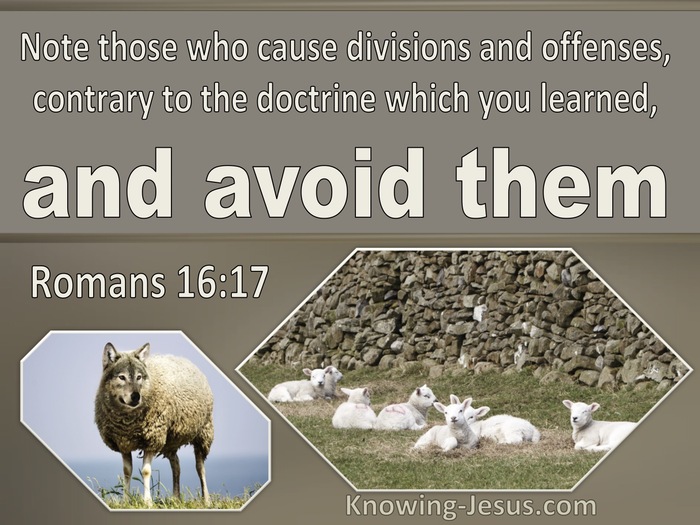
Romans 16:17-18 New American Standard Bible 1995
17 Now I urge you, brethren, keep your eye on those who cause dissensions and [a]hindrances contrary to the teaching which you learned, and turn away from them. 18 For such men are slaves, not of our Lord Christ but of their own [b]appetites; and by their smooth and flattering speech they deceive the hearts of the unsuspecting.
The Word of God for the Children of God.
Glory be to the Father,
and to the Son, and to the Holy Ghost;
as it was in the beginning,
is now, and ever shall be,
world without end. Amen, amen.
Apostle Paul became increasingly aware that after his departure, the enemy would not only seek to divide the Church through false teachers and demonic doctrines, but would also use clever words, internal dissentions and disunity to cause chaos, havoc and distress among Christians and divide the Body of Christ.
As he brings his long, instructive Roman epistle to a close, the one message Paul was prompted to leave with these dear people was about discord among the saints: “Keep your eye on those who cause dissensions and hindrances contrary to the teaching which you learned,” he warned, “and turn away from them.”
His final comments to the brethren in Rome concerned the gravest dangers of internal conflict and contention. Wrangling and verbal strife among Christian brethren and internal bickering is at great variance to the gospel of grace and ultimately seeks to create great “who is right?” destroy the unity of the Spirit.
1 Corinthians 1:10-13 New American Standard Bible 1995
10 Now I exhort you, brethren, by the name of our Lord Jesus Christ, that you all [a]agree and that there be no [b]divisions among you, but that you be [c]made complete in the same mind and in the same judgment. 11 For I have been informed concerning you, my brethren, by Chloe’s people, that there are quarrels among you. 12 Now I mean this, that each one of you is saying, “I am of Paul,” and “I of Apollos,” and “I of Cephas,” and “I of Christ.” 13 [d]Has Christ been divided? Paul was not crucified for you, was he? Or were you baptized [e]in the name of Paul?
In his final comments, Paul greeted twenty-six people in the Roman Church by name. Was he implying that some of them just might be contentious or was he warning them to watch for others who might cause disunity among the saints?
In either case, Paul knew the great damage caused when conflict and strife from conflicted interpretations of Torah, allowed to permeate the Christian Church.
False teachers and destructive doctrines infiltrating the Body of Christ was the biggest danger about which all the apostles warned in their letters, and in Acts 20, we read that Paul knew that vicious wolves would soon come smiling into the Church, twisting the truth, and scatter the flock of God after his death. But during his lifetime, we see Paul addressing internal strife among Christians.
Conflict, division, between believers was a deep concern that Paul challenged unrelentingly in a number of his epistles, because once murmuring, bickering, squabbling, and disunity, is allowed to percolate, the unity of the spirit in the bond of peace is crumbled, destroyed, and contrary to the teaching of the Word.
Misinformed, badly educated by teachers who are themselves badly taught, upside down biological teachings in scholastic institutions at all levels, young children. False teachers and heretical doctrines have become an increasingly serious problem in church communities and Christian fellowships today, but too often they are conceived by those who desire to cause division and disunity.
We should be alert and ready to know what the truth of the Gospel teaches and be knowledgeable of correct interpretations, sound accurate contextual biblical applications, studying to show ourselves approved of God, willing to turn away, correcting them, from who have this destructive spirit of division and discord.
Drifting away from biblical truth into apostasy or the deliberate infiltration of heretical teachings are a serious problem in any Christian fellowship, but let us never forget that they are often spawned from internal disagreements, division, and disunity, and should be dealt with before the witness of Christ is tarnished.
The enemy of God is the same evil one that comes to steal our peace, kill our hope, accuse the saints, and destroy our testimony.
He not only comes as a roaring lion but also as an angel of light.
With this in mind, just as individual members of the Church in Rome were exhorted to diligently identify those who caused division within their own congregation and turn away from them, we too should be prepared to address such disunity within our own churches and quickly deal with those that cause worldly dissensions and hindrances contrary to the teaching of God’s Word.
I urge you, brothers and sisters, to watch out for those who cause divisions and put obstacles in your way that are contrary to the teaching you have learned, Keep away from them. – Romans 16:17
Africa’s Victoria Falls produces a cloud of mist that is often heavy enough to impair visibility.
Once a man was walking the path that skirts the giant gorge, and he noticed a sign on the rim but could not fully make it out. Not wanting to miss whatever it might be noting, he slithered and slid and slipped, slogged his way through the mud out to the very brink only to read the message:
“Danger! Your standing on the very edge of a slippery, Crumbling Edge.”
As Christians, it can sometimes be easy to unwittingly miss the danger you’re in until you’ve gone too far.
This is especially true when it comes to right and wrong ideas of God.
You flip through the channels on TV at night and come across a preacher whose message sounds great at the beginning.
But when you really understand the kind of gospel he’s preaching, you realize it may be very different from what the Bible teaches.
Sadly, many once-faithful followers of Christ have built their house on this misty mud covered “crumbling edge” of mistaken misinformed faith, and their whole spiritual life is one fatal step away, fallen out from under them because they forgot to stand on the correctly educated e high ground of biblical truth.
So if you find yourself tempted to walk out into the heavy mist of dangerous doctrine where things may not seem as they should, watch out for the warning signs! Stay grounded in the truth of Scripture. Stay engaged with self and group Bible Study. Recognize when what’s being taught is not what the Bible teaches.
When you take the time to do that, you can be sure you’ll build your faith on the dry, solid rock of good doctrine and not on the crumbling edge of bad theology.
In the name of God, the Father and God the Son and God the Holy Spirit,
Let us Pray,
Psalm 25 Authorized (King James) Version
Psalm 25
A Psalm of David.
1 Unto thee, O Lord, do I lift up my soul.
2 O my God, I trust in thee: let me not be ashamed,
let not mine enemies triumph over me.
3 Yea, let none that wait on thee be ashamed:
let them be ashamed which transgress without cause.
4 Shew me thy ways, O Lord; teach me thy paths.
5 Lead me in thy truth, and teach me:
for thou art the God of my salvation;
on thee do I wait all the day.
6 Remember, O Lord, thy tender mercies and thy lovingkindnesses;
for they have been ever of old.
7 Remember not the sins of my youth, nor my transgressions:
according to thy mercy remember thou me
for thy goodness’ sake, O Lord.
8 Good and upright is the Lord:
therefore will he teach sinners in the way.
9 The meek will he guide in judgment:
and the meek will he teach his way.
10 All the paths of the Lord are mercy and truth
unto such as keep his covenant and his testimonies.
11 For thy name’s sake, O Lord, pardon mine iniquity;
for it is great.
12 What man is he that feareth the Lord?
him shall he teach in the way that he shall choose.
13 His soul shall dwell at ease;
and his seed shall inherit the earth.
14 The secret of the Lord is with them that fear him;
and he will shew them his covenant.
15 Mine eyes are ever toward the Lord;
for he shall pluck my feet out of the net.
16 Turn thee unto me, and have mercy upon me;
for I am desolate and afflicted.
17 The troubles of my heart are enlarged:
O bring thou me out of my distresses.
18 Look upon mine affliction and my pain;
and forgive all my sins.
19 Consider mine enemies; for they are many;
and they hate me with cruel hatred.
20 O keep my soul, and deliver me:
let me not be ashamed; for I put my trust in thee.
21 Let integrity and uprightness preserve me;
for I wait on thee.
22 Redeem Israel, O God, out of all his troubles.
Glory be to the Father,
and to the Son, and to the Holy Ghost;
as it was in the beginning,
is now, and ever shall be,
world without end. Amen, amen.

 Loving God, Living God, Loving Hope, Living Hope, Loving Living Life His Way! "Many things are possible for the person who has hope. Even more is possible for the person who has faith. And still more is possible for the person who knows how to love. But everything is possible for the person who practices all three virtues." - Brother Lawrence (1605-1691), Practicing the Presence of God (1692).
Vad händer med själen vid döden?
Vad händer med själen vid döden?
”Läran att själen är odödlig och fortsätter att existera efter en människas död och hennes kropps upplösning är en grundläggande lära i kristen filosofi och teologi.” — ”NEW CATHOLIC ENCYCLOPEDIA”.
1. Vad medger New Catholic Encyclopedia angående uppfattningen att själen lever vidare efter döden?
DET här ovan citerade uppslagsverket medger emellertid att ”det inte är så lätt att i Bibeln urskilja uppfattningen att själen lever vidare efter döden”. Vad lär då Bibeln om vad som händer med själen vid döden?
De döda är omedvetna
2, 3. I vilket tillstånd befinner sig de döda, och vilka skriftställen visar det?
2 De dödas tillstånd förklaras i Predikaren 9:5, 10, där vi läser: ”De döda vet alls ingenting. . . . I dödsriket . . . kan man inte verka eller tänka, där finns ingen insikt eller vishet.” (1982) Döden är därför ett tillstånd av icke-vara. Psalmisten skriver att när en person dör, ”vänder [han] tillbaka till sin mark; på den dagen förgås verkligen hans tankar”. — Psalm 146:4.
3 De döda är således omedvetna och overksamma. När Gud uttalade dödsdomen över Adam, sade han: ”Stoft är du, och till stoft kommer du att vända åter.” (1 Moseboken 3:19) Innan Gud hade format Adam av stoft från marken och gett honom liv, så existerade inte Adam, och det var till detta tillstånd som han återvände när han dog. Hans straff var döden — inte en överföring till en annan värld.
Själen kan dö
4, 5. Ge exempel från Bibeln som visar att själen kan dö.
4 Vad hände då med Adams själ när han dog? Kom ihåg att ordet ”själ” i Bibeln ofta bara åsyftar människan. När vi säger att Adam dog, säger vi således att den själ som kallades Adam dog. Detta kanske låter underligt för någon som tror på själens odödlighet. Men Bibeln säger: ”Den själ som syndar — det är den som kommer att dö.” (Hesekiel 18:4) I 3 Moseboken 21:1 talas det om en ”avliden själ” (ett ”lik”, The Jerusalem Bible). Och om nasirerna läser vi att de inte fick komma nära ”någon död själ” (”en död kropp”, Lamsa). — 4 Moseboken 6:6.
5 En liknande hänvisning till själen finner vi i 1 Kungaboken 19:4. Den svårt betryckte Elia ”började be att hans själ måtte dö”. Och Jona ”fortsatte att be att hans själ måtte dö, och han sade gång på gång: ’Det är bättre att jag dör än att jag förblir vid liv.’” (Jona 4:8) Och uttrycket ”döda en själ”, som Jesus använde, återges med enbart ”döda” i 1981 års svenska översättning av Nya testamentet. (Markus 3:4) En själs död betyder helt enkelt en människas död.
Att ”gå ut” och komma tillbaka
6. Vad menar Bibeln när den säger att Rakels själ ”höll på att gå ut”?
6 Men hur är det då med det som sägs om Rakel vid hennes tragiska död i samband med att hon födde sin andre son? I Första Moseboken 35:18 läser vi: ”När hennes själ höll på att gå ut (för hon dog), . . . gav [hon] honom namnet Ben-Oni; men hans far kallade honom Benjamin.” Betyder detta att Rakel hade ett inre väsen som for ut vid hennes död? Inte alls. Kom ihåg att ordet ”själ” också kan åsyfta det liv som en människa äger. I det här fallet betydde Rakels ”själ” helt enkelt hennes ”liv”. Det är därför som andra bibelöversättningar återger uttrycket ”hennes själ höll på att gå ut” med ”hennes liv höll på att ta slut” (Knox), ”hon höll på att ge upp andan” (1982) och ”hennes liv lämnade henne” (The Bible in Basic English). Det finns inget som tyder på att någon mystisk del av Rakel levde vidare efter hennes död.
7. Hur kom änkans sons själ ”tillbaka inom honom”, när han uppväcktes?
7 Det är på liknande sätt med uppväckandet av en änkas son, något som vi kan läsa om i 1 Kungaboken, kapitel 17. I 1 Kungaboken 17 vers 22 läser vi att Elia bad över den unge pojken och att ”Jehova [lyssnade] till Elias röst, så att barnets själ kom tillbaka inom honom, och han fick liv”. Återigen är det så att ordet ”själ” betyder ”liv”. New American Standard Bible lyder således: ”Barnets liv återvände till honom, och han fick nytt liv.” Ja, det var livet och inte någon skugglik skepnad som återvände till pojken. Detta stämmer med det Elia sade till pojkens mor: ”Se, din son [hela människan] lever.” — 1 Kungaboken 17:23.
Dilemmat med ett ”mellantillstånd”
8. Vad tror många till bekännelsen kristna skall ske under uppståndelsen?
8 Många till bekännelsen kristna tror att det skall bli en framtida uppståndelse, då kropparna skall förenas med sina odödliga själar. Då kommer de uppväckta att överlämnas åt sitt öde — de som har levt ett rättskaffens liv kommer att få sin belöning, och de som har varit onda kommer att få sitt straff.
9. Vilket ”mellantillstånd” menar somliga att det finns, och vad tror de sker med själen under den perioden?
9 Detta kanske låter enkelt. Men de som tror på själens odödlighet har svårt att förklara vad som händer med själen under tiden mellan döden och uppståndelsen. I århundraden har man spekulerat om ett ”mellantillstånd”. Somliga säger att själen under den här perioden kommer till skärselden, där den kan renas från förlåtliga synder och bli lämpad för himlen. *
10. Varför är det oskriftenligt att tro att själarna lever vidare i skärselden efter döden, och hur bekräftar Lasarus’ erfarenhet detta?
10 Själen är dock, som vi har sett, helt enkelt människan. När människan dör, dör själen. Följaktligen finns det inte något medvetet liv efter döden. Jesus Kristus sade inte att Lasarus, när han hade dött, var i skärselden, limbo eller något annat ”mellantillstånd”, utan han sade bara: ”Lasaros sover.” (Johannes 11:11, 1981) Det är uppenbart att Jesus, som visste vad som händer med själen vid döden, trodde att Lasarus var omedveten och i en icke-tillvaro.
Vad är anden?
11. Varför kan inte ordet ”ande” åsyfta någon del av människan som befriats från kroppen och som lever vidare efter döden?
11 Bibeln säger så här om vad som händer vid döden: ”Hans ande går ut, han vänder tillbaka till sin mark.” (Psalm 146:4) Innebär detta att en ande som befriats från kroppen bokstavligt talat far i väg och lever vidare efter någons död? Så kan det inte vara, för psalmisten säger därefter: ”På den dagen förgås verkligen hans tankar” (”upphör all hans tankeverksamhet”, The New English Bible). Vad är då anden, och hur ”går den ut” ur en människa vid döden?
12. Vad är inbegripet i de hebreiska och grekiska ord som översatts med ”ande” i Bibeln?
12 Det ord i Bibeln som översätts med ”ande” (hebreiska: rụ·ach; grekiska: pnẹu·ma) betyder egentligen ”andedräkt”. I stället för ”hans ande går ut” använder därför R. A. Knox uttrycket ”andedräkten lämnar hans kropp”. (Psalm 146:4) Men ordet ”ande” inbegriper mycket mer än detta att andas. I beskrivningen av tillintetgörandet av människor och djur i den stora översvämningen heter det exempelvis i 1 Moseboken 7:22: ”Allting vari livskraftens [eller: ”livets andes (hebreiska: rụ·ach)”] andedräkt var verksam i dess näsborrar, nämligen alla som var på torra marken, dog.” Ordet ”ande” kan således åsyfta livskraften som är verksam i alla levande varelser, både människor och djur, och som uppehålls genom andningen.
13. Hur kan man likna anden vid elektrisk ström?
13 För att belysa saken: Om strömmen kopplas bort från en motor som drivs med elektrisk ström, upphör motorn att fungera, men strömmen kan sedan inte uträtta något på egen hand, om den inte är kopplad till något. På liknande sätt är det när en människa dör — då upphör hennes ande att ge liv åt kroppens celler, men den lämnar inte kroppen och förflyttar sig till en annan värld. — Psalm 104:29.
14, 15. Hur vänder anden åter till Gud vid döden?
14 Varför säger då Predikaren 12:7 att när en människa dör ”vänder [anden] åter till den sanne Guden som gav den”? Innebär detta att anden bokstavligt talat färdas genom rymden till Guds närvaro? Nej, det är inte vad de här orden vill säga. Kom ihåg att anden är livskraften. När den livskraften är borta, är det endast Gud som kan återge den. Anden ”vänder” således ”åter till den sanne Guden” i den bemärkelsen att en människas hopp om ett framtida liv helt vilar i Guds händer.
15 Det är endast Gud som kan ge en människa anden eller livskraften tillbaka och åter få henne att leva. (Psalm 104:30) Men tänker Gud göra det?
Döden är slutet på jordelivet. Döden är en konsekvens av att människan har syndat, och eftersom alla människor har syndat så undkommer ingen döden. På grund av Jesus seger över döden i och med hans uppståndelse, så kommer alla människor som har dött att uppstå igen till antingen evigt liv eller evig dom. För den som tror på Jesus väntar ett evigt liv i Guds närvaro, men för den som inte tror på Jesus väntar den ”andra döden”; en evig död.
Bibelord
“12 Därför är det så: Genom en enda människa kom synden in i världen, och genom synden döden. På så sätt nådde döden alla människor, eftersom alla hade syndat.” (Rom 5:12)
“28 Var inte förvånade över detta. Det kommer en tid när alla som ligger i gravarna ska höra hans röst 29 och komma ut. De som har gjort gott ska uppstå till liv, och de som har gjort ont ska uppstå till dom.” (Joh 5:28–29)
“16 Så älskade Gud världen att han utgav sin enfödde Son, för att var och en som tror på honom inte ska gå förlorad utan ha evigt liv.” (Joh 3:16)
“21 För mig är livet Kristus och döden en vinst. 22 Men om livet här i kroppen innebär att mitt arbete bär frukt, då vet jag inte vad jag ska välja. 23 Jag dras åt båda håll. Jag har en längtan att bryta upp och vara hos Kristus, det vore mycket bättre.” (Fil 1:21–23)
“14 Och döden och helvetet kastades i eldsjön. Detta, det vill säga eldsjön, är den andra döden. 15 Och om någon inte fanns skriven i livets bok kastades han i eldsjön.” (Upp 20:14–15)
“4 Och han ska torka alla tårar från deras ögon. Döden ska inte finnas mer, och ingen sorg och ingen gråt och ingen plåga, för det som förr var är borta.” (Upp 21:4)
“41 Sedan ska han säga till dem som står på den vänstra sidan: Gå bort från mig, ni förbannade, till den eviga elden som är beredd åt djävulen och hans änglar.” (Matt 25:41)
“36 Den som tror på Sonen har evigt liv. Den som inte lyder Sonen ska inte se livet, utan Guds vrede blir kvar över honom.” (Joh 3:36)
youtube.com/watch?v=l4lMPIbH-Ss&ab_channel=LELEK You’ll probably like these Croatian girls for sure. It’s a brand new musical project
so plugging them here to help em out
JAG ÄR AV SAMMA UPPFATTNING SOM DOKTOR AUGUSTINUS: KROPPEN DÖR NÄR DEN SKILJS FRÅN GUD OCH SJÄLEN DÖR NÄR DEN SKILJS FRÅN GUD
LikeLiked by 1 person
https://pin.it/6LEEdqaCs
Who Goes to Heaven, Hell, and Purgatory, According to Our Lady of Kibeho
Mary gave a vision of Heaven, Hell, and Purgatory to a young girl named Anathalie in Rwanda. Afterwards, she explained the kinds of people who Anathalie saw in each place.
Stuart Weiss
Nov 28, 2024
Our Lady of Sorrows, the title under which Mary appeared at Kibeho.
Those who pray are certainly saved; those who do not pray are certainly damned.
—Saint Alphonsus Liguori
This post is in being shared on the vigil of the Feast of Our Lady of Kibeho, which is celebrated on November 28th.
Our Lady of Kibeho is a Church approved Apparition of the Blessed Virgin Mary that took place in Rwanda over several years starting in 1981. Most notably, she warned the people about the Rwandan Genocide before it happened. Mary urged the people to pray the Chaplet of the Seven Sorrows and open their hearts to God to avert the coming disaster.
During this time, Mary appeared to a young girl named Anathalie and showed her Heaven, Hell, and Purgatory.
One of the unique parts about these visions is that Mary did not just show the Anathalie glimpses of Heaven, Hell, and Purgatory, but also gave her insight into what kind of people go to each place.
These visions are described by Immaculee Ilibagiza, a survivor of the Rwandan genocide, in her book “Our Lady of Kibeho,” which I highly recommend you read in its entirety. I quote the portions relating to these visions below, along with Mary’s explanation, in addition to some commentary.
Heaven
The first [place she was taken] was a world where instead of mountains, hills, and valleys, the landscape was comprised of varying shades of vivid color and light, and people travelled from place to place by sliding through the light.
Mary led Anathalie to one strange land illumined only by white light. Here, the girl saw seven handsome men wearing white cloaks and standing in a circle, and they were creating the most beautiful music without any instruments—each note was filled with a different sensation of contentment and joy. She asked, “Where are we, Mother?”
“This is Isangano, the focal point; this is the place of communion.”
“Who are those men?”
“They are not men. They are angels.”
“What do they do here?”
“They praise God, watch over Earth, and aid humanity when they are needed or called upon.”
…
At the next place the young lady saw millions of people dressed in white. All of them seemed overwhelmingly happy but not blissful, as the angels had been. “Our Lady told me that this was Isenderezwa z’ibyishimo, the place of the cherished of God.”
This vision of Heaven is reminiscent of what we read in the book of Revelation, when St. John sees a great multitude which no man could number, from every nation, from all tribes and peoples and tongues, standing before the throne and before the Lamb, clothed in white robes (Rev. 7:9).
It’s also interesting to see the description of the Angels, which is very consistent with Catholic theology.
Finally, I’m reminded of the verse God is light and in Him is no darkness at all (1 John 1:5).
So who does Our Lady say is counted worthy to attain to this land of happiness and light?
The first place, the happy world of the cherished of God, was reserved for people whose hearts are good, who pray regularly, and who strive always to follow God’s will.
Purgatory
And then we moved on to our next destination, a world where the light was as dim as dusk. Below us were people dressed in clothes of dreary and dull colors in comparison to the other worlds we’d seen. Most of them seemed content, but many seemed quite sad and were even suffering. Mary said, “This is Isesengurwa, a place of purification; the people you see are Intarambirwa, those who persevere.
This part of the vision is, of course, entirely consistent with the Catholic doctrine of purgatory.
The mixture of contentment, sadness, and suffering is exactly what you would expect in a description of Purgatory. Purgatory is not a final destination, but a place of purification on the way to Heaven. Saint Paul alludes to it in 1 Cor. 3:14-16, saying, If the work which any man has built on the foundation survives, he will receive a reward. If any man’s work is burned up, he will suffer loss, though he himself will be saved, but only as through fire.
As such, the souls there are content (and even glad), because they know they have attained everlasting life, but they are also contrite and suffering as they are purified of their past sins, and so prepared for the Glory of Heaven, where nothing unclean shall enter (Rev. 21:27).
Mary gives this description of the people who are in Purgatory:
Our second visit to the place of purification was for those who called on God only during times of trouble, turning away from Him when their troubles were over.
Hell
The last place we visited was a land of twilight where the only illumination was an unpleasant shade of red that reminded me of congealed blood. The heat that rose from that world was stifling and dry—it brushed my face like a flame, and I feared that my skin would blister and crack. I couldn’t look at the countless people who populated that unhappy place because their misery and anguish pained me so greatly. Mary didn’t have to say the name of this place…I knew I was in hell.
Hell is real, it lasts forever, and people go there. Many people, by all accounts.
Jesus warns of Hell more often than anything else he talks about in the Gospels. If you are uncomfortable listening to people talk about Hell, then you would be very uncomfortable listening to Jesus.
Mary describes the disposition of the people who go there:
The last place of heat and no name was for those who never paid God any attention at all.
The cares of this world and the distractions of life are much more dangerous than they seem.
Conclusion
I love hearing Mary’s motherly voice in these visions. Her simple, yet profound, descriptions of who is in each place remind me of how my wife and I explain these truths to our young children. They are explained in such a way that they get to the essence of what is true in a way that even a child can understand, yet leave room for that truth to be unfolded into all it’s fullness.
In light of these visions, I would propose that we each ask ourselves three questions. Be honest with yourself—you can fool others, and even yourself, but you cannot fool God:
Do I have a good heart?
Do I pray regularly?
Do I strive always to do the Will of God?
If you answered “yes” to all three, then praise God! How can you do so even more? How can you ensure that you will persevere unto death?
If you answered “no” to any of them, then when and how are you going to start? If you’re waiting for the right time, then start today. Behold, now is the acceptable time; behold, now is the day of salvation (2 Cor. 6:2).
Don’t put it off. None of us know either the hour or the day that God will call us before the Judgement seat.
Last Note About Private Revelation
Allow me one last note about this or any private revelation in order to prevent confusion. These appearances and messages from Heaven are meant to edify, but they are also meant to be taken within the context of the teaching of the Faith. Mary’s words here are very enlightening, and teach us something very true about who is saved, and who is not. It also affirms the constant teaching of the Church that Hell is real, and by some dreadful mystery, people go there. But make sure you’re taking these lessons in the context of the Church. For example, to read this and infer that an Aztec pagan must go to Heaven because they “prayed” every day while they were offering their human sacrifices would be an error.
Pagan Boy in Africa is Converted Directly by Jesus and Sent to Proclaim The Gospel
This amazing true story happened in the 1980’s in Rwanda.
Stuart Weiss
Dec 06, 2024
a lone tree in a field under a cloudy sky
Photo by Polina Koroleva on Unsplash
When you were under the fig tree, I saw you.
—John 1:48
Subscribed
In the 1980s Mary began appearing to several visionaries in Rwanda in what eventually became the Church approved apparition known as “Our Lady of Kibeho.” During this time, Jesus appeared to a 15 year old boy named Segatashya.
The unique thing about Segatashya is that not only was he a practicing pagan, but he also had never even heard of Christianity. Segatashya lived in the Rwandan countryside before the internet, and had very little access to outside information—no radios, newspapers, nothing. So, Jesus Himself appeared to Segatashya, and sent him on a special mission.
The story of Segatashya comes to us from Immaculee Ilibagiza. She is a survivor of the Rwandan genocide and interviewed Segatashya first hand. She recounts this incredible story in her book titled, “Our Lady of Kibeho.” What follows is Immaculee’s description of her meeting with Segatashya, followed by a brief reflection.
The story begins on July 2, 1982. Segatashya sat down under a tree to rest from his work in the fields:
I’d just sat down when I heard a man calling out to me. I thought I was alone in the fields and hadn’t seen anyone all morning. So at first I thought the voice I’d heard was just the wind, but then it came again.
‘You, my child,’ it said, softly and kindly. I didn’t feel threatened in any way, but rather experienced a great sense of peace and happiness. When I looked around to see who was speaking, there was no one there.
‘My child,’ the man called to me once more; but again, I couldn’t see anyone near me.
‘My child,’ the voice said a third time. Even though no one was there, I answered, asking the man what he wanted of me.
‘If I give you a message, will you deliver it for me?’
‘Yes, I will,’ I replied without hesitation, somehow knowing I couldn’t refuse. ‘But what’s your name, sir? Who shall I say has sent me with a message?’
‘I am Jesus Christ,’ he said. ‘But when you tell them you come in my name, they may not trust or believe you. For you to prove to me you are capable of being my messenger, go now to the people working in the fields nearby and tell them that Jesus Christ sent you here today to instruct them all to purify their hearts because the day of his return is coming soon. Since they cannot say that they have not been warned, they can prepare themselves.’
Segatashya went to some men in the field, only to be laughed to scorn and then fallen upon and beaten for the crime of being “blasphemous” towards their pagan gods. Not only that but, unbeknownst to Segatashya, Jesus had miraculously removed his clothes—Segatashya was proclaiming this to them naked!
A woman in the yard told him, ‘Child, look at yourself—you’re naked! Do you think anyone will listen to you in that condition when you say you’ve been sent by Jesus?’
Just then, he heard Jesus say, ‘I have made you naked; ask them did not their Lord come into this world naked, and was he not stripped naked before he returned to the kingdom of God? He is the one who has made this miracle happen.’
Segatashya did as Jesus commanded, and then got out of there before he could be beaten again. After this, Jesus told Segatashya to go to Kibeho, where Mary had been appearing, and to join the other visionaries there. Segatashya obeyed, and became a prolific preacher despite his lack of catechesis or education. In fact, as he would travel to villages preaching, he was miraculously given the gift of tongues and able to learn the local languages within a single day, sometimes hours.
Immaculee describes for us some of the content of his preaching.
…he urged all who would listen to repent and purify their hearts. ‘On Judgement day, the Lord will show everyone their entire lives,’ he’d say, ‘and people will know that they’re the authors of their own fate. God will show them their lifetime of deeds, and then that person will go where they deserve to go. Don’t think that God doesn’t see your sins—the Lord sees every action and knows every thought. Repent, for there is not much time left.
God doesn’t abandon any of His children; He is always waiting for you to say yes to Him and let Him into your hearts. God will never deny you mercy if you have a true conversion in your heart. Jesus is telling me to express to you that life on Earth lasts only a moment, but life in heaven is eternal. So you must pray! No one will reach heaven by good deeds alone, by giving special gifts, or by making compromises. The only way into heaven is through prayers that come from the heart.’
Share
Several things strike me about this amazing prophet of Jesus Christ.
I find it interesting how consistent God’s work in souls can be. Elements of Segatashya’s calling remind me of the way God called Samuel, Moses, St. Paul, and St. Francis.
Like Samuel, Segatashya had to hear Jesus’ call three times, and only after Segatashya answered did Jesus reveal His will for him.
Like Moses and Saint Paul, Segatashya asked “who are you, Lord?” and “who shall I say has sent me?”
Finally, and most strikingly, he reminds me of Saint Francis. Like Francis, when Segatashya went out to first proclaim the Gospel, he was not met with success. St. Francis, after his dramatic conversion and renunciation of worldly goods in front of his father and the whole town, went out full of joy and the Spirit into the hills behind Assisi. If you or I were writing the story, you’d expect him to go triumphantly out and begin converting people. Yet in God’s story, Francis’ reward for his dramatic renunciation of worldly goods is… persecution!
Francis wandered forth into the hills behind Assisi, improvising hymns of praise as he went. ‘I am the herald of the great King,’ he declared in answer to some robbers, who thereupon despoiled him of all he had and threw him scornfully in a snow drift. Naked and half frozen, Francis crawled to a neighbouring monastery and there worked for a time as a scullion.1
This is an almost identical incident to Segatashya—Francis was even stripped naked! I suppose Jesus was being serious when He said “Blessed are you when men persecute you…” He reserves His best gifts for Heaven, and disciplines those whom He loves on Earth, like a good Father.
These examples from Segatashya and St. Francis should encourage us when we feel like God is calling us to a certain endeavor, and yet we are met with obstacles. Both Francis and Segatashya went on to convert many people, and become prolific preachers, but the souls they converted were bought at the price of suffering and rejection. If you are avoiding sin and doing your best to follow the will of God, then don’t be discouraged by the sufferings and obstacles God sends you—they are the precious currency that God will use to save souls.
On the other hand, if you are not praying to God from the heart daily, then what are you waiting for? Segatashya’s preaching is meant for you specifically: God doesn’t abandon any of His children; He is always waiting for you to say yes to Him and let Him into your hearts. Repent, and believe in the Gospel. Begin praying to God from the heart today. If you need advice on doing that, just email me, I’m happy to help point you in the right direction. Only be sure not to delay. Perhaps this is the last chance God is offering you?
We know with the certainty of faith that Jesus Christ will come at the end of time to judge the living and the dead. It may be that the Second Coming is soon, or it may not happen for another 10,000 years. Nevertheless, we do know that within each of our lifetimes (perhaps sooner than we think) the end of the world, for us, will come with death and we will sit before the judgement seat of Christ.
Don’t think that God doesn’t see your sins—the Lord sees every action and knows every thought. Repent, for there is not much time left.
LikeLiked by 1 person