Romans 15:4 "For whatever was written in earlier times was written for our instruction, so that through perseverance and the encouragement of the Scriptures we might have hope."
12 Therefore, since[a] we also have such a great cloud of witnesses surrounding us, putting aside every weight and the sin that so easily ensnares us[b], let us run with patient endurance the race that has been set before us, 2 fixing our eyes on Jesus, the originator and perfecter of faith, who for the joy that was set before him endured the cross, disregarding the shame, and has sat down at the right hand of the throne of God. 3 For consider the one who endured such hostility by sinners against himself,[c] so that you will not grow weary in your souls and give up.
Word of God for the Children of God
Glory be to the Father, and to the Son, and to the Holy Ghost; as it was in the beginning, is now, and ever shall be, world without end. Amen, amen.
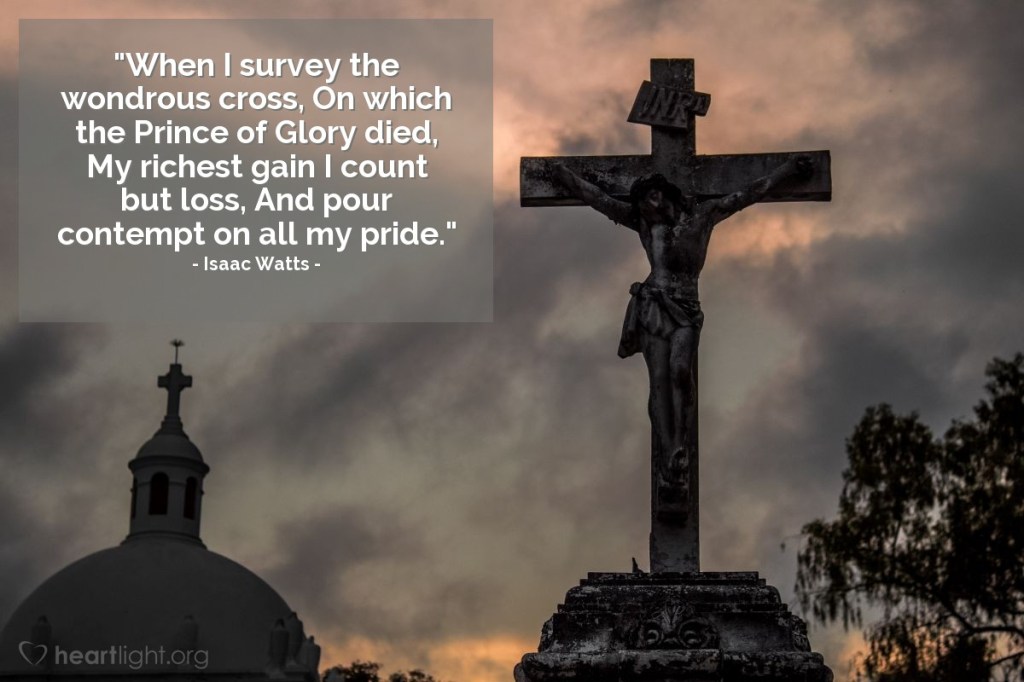
How many crosses do you own?
Where are they, and in what style? Writing and recording this today, I could see several crosses around me. There is the cross I wear around my neck and the wooded one around my neck; I also have a wonderfully hand-crafted cross of nails hanging on my wall. These crosses are all simple, artistic and beautiful.
Such majestic representations of the cross pair well with the regal language we use to describe it.
We may speak about the victory we received or how the simple cross testifies to salvation, love, and forgiveness.
We might sing about the Old Rugged Cross and cherish it deeply.
A favorite hymn of my church growing up described the cross as erected on “some green hill far away outside the city wall.”
It all seems quite regal, quaint, and nostalgic, doesn’t it?
Don’t get me wrong—there is truth in all of this. The cross is a moment of victory, and love and forgiveness coming our way because of it. But there is a deeper too often overlooked truth we must remember: Jesus’s cross was ugly.
Jesus did not die upon some majestic religious symbol.
In the ancient world, the cross was a brutal execution tool, reserved for those deemed unworthy of respect or dignity.
Written in Roman law was the decree that no Roman citizen could be killed on the cross.
The cross was reserved for the worst of the worst, declaring them less than nothing.
The reason why Jesus died on the “green hill far away outside the city wall” wasn’t because this was a place of scenic beauty; no, it was a place wherein the crucified could be mocked. It was the place of the skull, signifying how cut off the crucified was from all life, love, and relationships, and provision for life.
When Jesus hung upon the cross, those standing by Jesus didn’t muse about the love of God; they mocked him.
They derided him.
They insulted him. “You who could save others, save yourself!” they jeer.
“Come down from the cross, if you can,” they cry. And that grand sign above Jesus, “This is the King of the Jews,” was not written as some statement of faith. This was Pilate declaring defeat over any would-be Israelite King.
No. Jesus didn’t take on that which was beautiful or majestic, as if it were something easy and dignified. He endured the cross, taking on its shame.
On the cross, Jesus took upon himself everything that makes us squirm, recoil, and feel uncomfortable.
But it was this that testifies to who Jesus is.
Intersecting Faith and Life
Jesus shows his true nature; reveals his fullness as the Messiah, the Savior, the Lord of all, not because he escapes the cross, nor transforms it into some easy, much desirable symbol.
No, He proves who he is, the salvation he brings by hanging there and taking upon himself not an easy or beautiful cross but of derision, mockery, shame.
Jesus scorns all that the cross represents; he shows that he is the pioneer and perfecter of our faith precisely because he understands this is the will of His Father God, obediently endures the cross, takes it on, and does not forsake it.
The cross, therefore, is the symbol of faith precisely because it is ugly, extreme, and a symbol of shame, abandonment, and derision.
The cross represents everything not beautiful, majestic, nor surrounded by pleasantry and Ease.
It symbolizes faith because it is into that place that Jesus entered.
it is into that place we all must enter and utterly embrace and own the moment.
So, as you think about the cross, dare to take a moment and be uncomfortable today. Dare to be affected. Dare to recognize the very scorn and derision that Jesus felt as he hung brutally beaten and bloodied, dying on the cross for you.
And allow that fact to teach you Jesus doesn’t, will not ever wait for you to feel comfortable and victorious. Jesus doesn’t stand on the sidelines of life trying to avoid the mess. He comes to you in the very place where you should feel the very harshest derision, the utmost profound guilt, and the worst ever shame.
The ugliness of the cross means that Jesus embraces you in all the places where you feel ugly.
So, look to Jesus. Embrace the cross and uncover how Jesus’s love meets us.
In the name of God, the Father and God the Son and God the Holy Spirit,
Praying …
Suffering and Waiting for Deliverance
For the music director; according to The Doe of the Dawn. A psalm of David.[a]
22 My God, my God why have you forsaken me? Why are you far from helping me, far from the words of my groaning? 2 O my God, I call by day and you do not answer, and by night but I have no rest.[b] 3 Yet you are holy, enthroned on the praises of Israel. 4 Our ancestors[c] trusted you; they trusted and you delivered them. 5 They cried to you and were saved; they trusted you and were not ashamed. 6 But I am a worm and not a man, scorned by humankind and despised by people. 7 All who see me mock me. They open wide their lips; they shake the head, saying: 8 “He trusts Yahweh.[d] Let him rescue him. Let him deliver him because he delights in him.” 9 Yet you took me from the belly; you made me trust while on my mother’s breasts. 10 On you I was cast from the womb. From my mother’s belly you have been my God. 11 Do not be far from me because trouble is near; because there is no helper. 12 Many bulls have encircled me; mighty bulls of Bashan have surrounded me. 13 They open their mouth against me like a lion tearing and roaring. 14 I am poured out like water, and all my bones are out of joint. My heart is like wax; it is melted within me.[e] 15 My strength is dry like a potsherd, and my tongue is sticking to my jaws; and you have placed me in the dust of death. 16 Because dogs have surrounded me; a gang of evildoers has encircled me. Like the lion[f] they are at my hands and my feet. 17 I can count all my bones; they gaze, they look at me. 18 They divide my garments among them, and for my clothing they cast lots.[g] 19 But you, O Yahweh, do not remain distant. O my help, hasten to help me. 20 Rescue my life from the sword, my only life from the power of the dogs.[h] 21 Save me from the mouth of the lion, and from the horns of the wild oxen answer me. 22 I will tell your name to my brothers; inside the assembly I will praise you. 23 You who revere Yahweh, praise him! Glorify him, all you seed of Jacob, and be in awe of him, all you seed of Israel, 24 because he has not despised nor abhorred the affliction of the afflicted, and has not hid his face from him; but he listened to him when he cried for help. 25 From you is my praise. In the great assembly, I will pay my vows before those who revere him. 26 The afflicted will eat and will be satisfied. Those who seek him will praise Yahweh. May your[i] heart live forever. 27 All the ends of the earth will remember and turn to Yahweh. All the families of the nations will worship before you. 28 Because the kingship belongs to Yahweh, and he rules over the nations. 29 All the healthy ones[j] of the earth will eat and worship. Before him all of those descending into the dust will kneel, even he who cannot keep his soul alive. 30 Descendants[k] will serve him. Regarding the Lord, it will be told to the next generation. 31 They will come and tell his saving[l] deeds to a people yet to be born, that he has done it.
Glory be to the Father, and to the Son, and to the Holy Ghost; as it was in the beginning, is now, and ever shall be, world without end. Amen, amen.
It is a time for celebrating God and celebrating families, celebrating what we have learned and the prospect of living into our life’s dreams and aspirations for our soon to future.
Every true follower of Jesus Christ says he wants to do the will of God, yet most Christians think of God’s will as something that is imposed on them — something distasteful and difficult that they are forced to do.
They picture God demanding that they give in to a hard set of rules and conditions: “Do it my way or you’re on your own!”
How very wrong they are.
When a believer knows the glory of doing the Lord’s perfect will, he embraces it with joy and hope. To embrace means “to clasp, as in your arms” as an expression of love and affection.
God’s will is not just for ministers or deeply spiritual saints, but for all his children.
The New Testament exhorts us, “[God makes] you complete in every good work to do His will, working in you what is well pleasing in His sight” (Hebrews 13:21).
God desires that you enter into his plan and will today.
The early apostles had one desire for all the churches — that every single member know God’s perfect will and embrace it.
Paul wrote of a brother named Epaphras “who is one of you, a bondservant of Christ … always laboring fervently for you in prayers, that you may stand perfect and complete in all the will of God” (Colossians 4:12).
Epaphras knew God had a perfect will for everyone in the congregation and that if they entered into it, they would find joy and have their needs met.
Christ told his disciples, “I do not seek My own will but the will of the Father who sent Me” (John 5:30).
“For I have come down from heaven, not to do My own will, but the will of Him who sent Me” (6:38).
There was never a moment in Jesus’ life when he wasn’t aware that his purpose on earth was to do the will of the Father. And this ought to be true of you and me as well.
Once you and I explore, discover, then embrace the will of God, something incredible happens—Jesus manifests himself to you and me in new ways!
Proverbs 19:20-21 The Message
20 Take good counsel and accept correction— that’s the way to live wisely and well.
21 We humans keep brainstorming options and plans, but God’s purpose prevails.
Gloria! In Excelsis Deo! Alleluia, Alleluia, Alleluia, Amen.
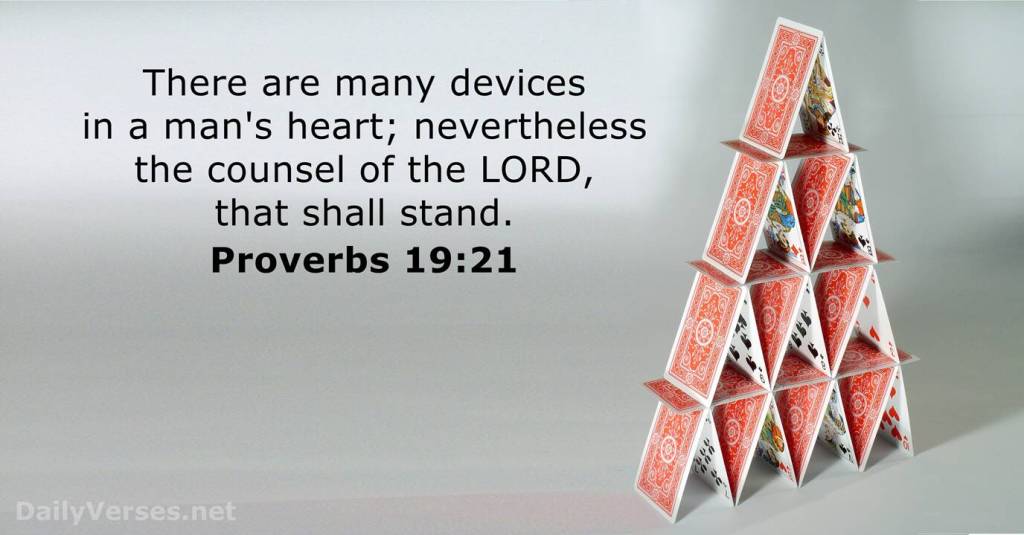
Life Is No Different than Building a Mansion of Cards
Proverbs 19:20-21 Amplified Bible
20 Listen to counsel, receive instruction, and accept correction, That you may be wise in the time to come. 21 Many plans are in a man’s mind, But it is the Lord’s purpose for him that will stand (be carried out).
We all have dreams and high aspirations for our lives.
Now that Graduation season is upon us in full force, dreams and aspirations are practically all that is being talked about, dreamt about, extensively planned out.
Some may dream of being a ballerina, a singer, an actress, a teacher, a doctor or a lawyer, successful business person, an accountant, a nurse or a social worker.
As many jobs and opportunities as there are, possibilities are literally endless.
As many careers and career paths there are we are only too limited by ourselves.
If you can think of it, they say, you can quite literally do anything when you put your heart, body, soul, mind and strength and resources to do that something.
High School and College students are often encouraged to have a 5-year or 10-year plan for their life, a backup plan if their first career goal doesn’t happen.
No matter what our age group, we all have dreams and aspirations we have high hopes of accomplishing – being successful, going into business for ourselves.
We do not want to be stagnant nor stagnated in our career paths – we deeply desire to prosper at what we set out to do in life and we will work very hard.
Sometimes we get the itch to try dream higher, aspire higher, to something completely different, something more exciting and challenging and fun too.
We will then plan our resources to go back into school for new career paths.
New vocational opportunities are always presenting themselves at various points in our life – we consider them – then decide on if it is the right time.
Ultimately, we are encouraged to go for our dreams and not to be distracted.
But what happens when we struggle, when our dreams are slow or slower to develop to bear our desired fruits, or slowed or in the end, do not come true?
Is all hope lost?
Should we just give up on our dreams and aspirations and throw in the towel?
Should we necessarily settle for a life dream far less than what we imagined?
I believe that depends on your perspective – worldly view or heavenly view.
There is a transition going on here which we may not be fully appreciating.
Aside from high school or university guidance and career counselors, are we “faithfully” making our own plans without consulting our faithful God first?
Are we faithfully praying to the Lord, asking Him to align our will with His?
As parents or step parents or grandparents of these new graduates, are any of us faithfully counselling the graduate to pray or are we praying with, for them?
The Bible says, “But seek first his kingdom and his righteousness, and all these things will be given to you as well”(Matthew 6:33 NIV).
Are we teaching our children from the Word of God about making wise choices?
Are we teaching our children from the Word of God about making hard choices?
Are we teaching our children from the Word of God the meaning, the wisdom of and behind the admonition of Jesus: “let your YES be YES and your NO be NO?”
Are we teaching children from the Word of God about God’s wisdom over ours?
Over-all, are parents teaching their children about life from the Word of God?
I believe those things include teaching children about the dreams of our hearts.
Then again, are we teaching and admonishing each other from the Word of God as adults to adults from and within whatever age groups these biblical truths?
How to raise children (of whatever their ages are) in the “way they should go?”
Teenagers are still somebody’s children and have to navigate an extraordinary level of life’s complexities – as do the young adults in their college age years.
Even more mature adults well into their careers and family’s require parental guidance from time to time as they make their own major life path decisions.
However, as much as our own life lessons taught us about pursuing our dreams, for graduates, it can be a great adventure that will only work if we put God first.
A few days ago, I remembered I heard a sermon from Pastor Steven Furtick.
In it, he said something that still resonates with me today.
When I heard it a few years ago, I recall in so many words, he explained,
“The Bible doesn’t tell us to follow our dreams. It tells us to follow God!”
After many fruitless efforts of trying it on my own, I found that to be true.
Raised in the USA, I have always heard phrases like, “Follow your heart” and “No pain – No Gain” “Take your passion and by all means, make it happen!”
But the older I got, the more I remembered my life’s “best efforts” then recalled how the Bible says that “the heart is deceitful above all things”(Jeremiah 17:9).
So, why are we so focused on what our heart desires?
The circumstances of life can change in less time than it takes for one heartbeat.
In the time it takes for us to take one short or long breath, our world, our own dreams, our own aspirations are undone, thoroughly being turned upside down.
Just ask the Patriarch Abram when He was commanded to leave his home and his family behind for some far off place which he had not one single clue where.
Just ask the Patriarch Job whose entire life was upended.
Just ask the Patriarch Noah when all of a sudden God told him to build an ark of immense proportions and do it alone- Did Noah possess those carpentry skills?
Just ask the Prophet Jonah when God commanded him to travel to Nineveh and to become everyone’s evangelist – demanding repentance and transformation?
And with Jonah, what if those desires of God were not even minimally believed to be any part of our own destinies – do we flat out reject God and all His ideas?
Whether we are teaching our children the way they should go (Proverbs 22:6) or as we are growing older and more mature we are planning for our retirements, we can easily be led astray by self if we let our hearts lead us instead of Jesus.
However, the Bible also advises all of His beloved Children to delight ourselves in the Lord (not self), and He will give us the desires of our hearts. (Psalm 37:4)
So there is hope – in the Lord much more so than hope in ourselves, right?
God cares about everything that affects us, including our 5-to-10-year plan.
He wants you and me to dream, not by following your heart but by following His heart first and foremost.
The Bible does not say we need to have everything single thing figured out.
But it does say we need to trust God in everything, more than we do ourselves and He’ll make our paths straight, it will be health to thy navel refreshment for our bones (Proverbs 3:5-8 KJV).
It gives me comfort and hopes to know God cares about my children’s dreams and my own and my wife’s and that He’s willing to give all of us the desires of our hearts according to His will – not one centimeter according to our own.
If my dreams and plans are outside God’s will for my life, they will not happen.
I am more than okay with that because the Bible says in Proverbs 14:12,“What you think is the right road may lead to death.” (GNT)
What a powerful point!
It helps me remember God knows best.
That the will of God is more faithful, more genuine, more authentic than mine!
The Genuine Article, The Authenticity of God’s Will
Sometimes the dream we desperately want to come true could end our lives.
We cannot see that from our limited human perspective.
However, we serve a God who can see the end from the beginning (Isaiah 46:10), so counselling each other toward asking Him for His plans for our lives is vital.
You and I can rest assured God knows you better than you know yourself.
He knows what path will bring you the most joy and peace.
He knows the gifts and talents He’s given us and the best way those blessings can be discovered and explored, developed and encouraged, and be shared too.
Remember, God’s dreams for you and me are not just to help you and me to be an individual success story but also help the world by edifying God’s Kingdom.
If we encourage each other, ask Him to align our will with His, we will want to align, then realign our Kingdom dreams the same Kingdom dreams He wants.
Often, you and I may actually discover the dream God has for you and me is far greater than you or I could ever possibly imagine and will make us the happiest.
Our Authentic, Genuine, Faithful Alignment With God
1 Peter 1:6-7 The Message
6-7 I know how great this makes you feel, even though you have to put up with every kind of aggravation in the meantime. Pure gold put in the fire comes out of it proved pure; genuine faith put through this suffering comes out proved genuine. When Jesus wraps this all up, it’s your faith, not your gold, that God will have on display as evidence of his victory.
Some things can only be tested by time.
If you have ever attempted to buy a new car, a house, or a dresser or cabinet at a reasonable price, perhaps you’ve considered whether to buy a used vehicle first, a secondhand piece for nearly the same price, a new piece from a discount store.
The problems associated with a new vehicle are obvious – you do not know how it was driven, how well it was maintained, traded in because of a nuisance issue.
The drawback is that such pieces of furniture may prove, when they’re opened and closed, have doors and drawers that are warped, won’t go back into place.
The vehicle may be clean and wonderful on the outside – but when driven off the lot for a couple of hundred miles – may quickly become a mechanical WOW!
We may find ourselves paying our favorite mechanic more than we first paid.
The item of furniture quickly becomes a real mess.
It may look good on the outside on first inspection, but the real issue is with its day-by-day use and what the test of time will show, which will prove whether you and I have the genuine article or an authentic unsellable, unusable, mess.
On the same note, how do we know whether or not our faith is the real thing?
The answer, at least in part, is that authentic, genuine faith is to be discovered in our day-by-day “opening and closing” “success and failure responses—in facing up to the subtle, not so subtle challenges and trials that come our way.
Some suggest, even teach and worse preach that victorious Christian living means the absence of trials—that if we are really men and women of authentic, genuine faith, then trials will be an uncommon experience because of “grace.”
Peter says the exact opposite is true: the experience of trials and difficulties is not uncommon, unusual, or unproductive in a Christian’s life, but is purposeful and an authentic and essential, absolutely genuine component, of God’s plan.
We must rigorously, vigorously teach this as preparation for Kingdom living.
We prove to ourselves and those who may be watching that our faith is genuine when we face challenges and refuse to run away, instead holding on to our trust in Christ’s goodness no matter how difficult the path He is leading us all along.
By such preparation, when (not if,) trials come and everything goes askew, we find out whether our testimonies and the professions we’ve made about God’s grace, peace, and securing providence are authentic, genuine, faithful to God.
Reverend Charles Haddon Spurgeon wrote in Morning and Evening,
“The one who would glorify his God must be prepared to meet with many trials. No one can be illustrious before the Lord unless his conflicts are many. If, then, yours is a much-tried path”—that is, a path of many trials—“rejoice in it, because you will be better able to display the all-sufficient grace of God. As for His failing you, never dream of it—hate the thought. The God who has been sufficient until now should be trusted to the end.“
Will your faith, will my own faith, will your graduates faith in God over self prove authentic, genuine through life’s current, coming greatest challenges?
By learning from success and learning from our failures, it is not only possible to hold on by God’s grace, but it is also profitable on account of God’s grace.
As we learn from success and failure, as we fall, but then learn how to raise again, as we trust in His grace, we will discover we can rejoice, because our happiness ultimately is not tied to circumstances but found in persevering in your faith—in knowing the sufficiency of Christ in circumstances would never would have chosen, in looking forward to the day when your Savior is revealed.
When I Survey the Wondrous Cross with my Children
What dreams and aspirations has God placed on your heart?
What dreams and aspirations has God placed on your graduates heart?
How does it bring you hope to know following God’s plan for your life is best?
How does it bring the promise of hope to your graduate to know God’s will?
What hopes and aspirations and dreams does it raise up inside my own heart?
What about all the opportunities, possibilities, the Holy Spirit just revealed?
“Come Holy Ghost My Heart is Now Inspired – Come, Let us Build a Mansion.”
In the name of God, the Father and God the Son and God the Holy Spirit,
Let us Pray,
Father God, We pray for graduates in their walks with You. Give them a hunger to know You more deeply, more intimately, and more personally than they ever have before. We know that You are the Living Water that can quench their spirits, and Lord we pray that You would pour out Your Spirit upon them. We pray that they would see their lives in the present and in retrospect with the full comprehension that You are working and weaving things together for their good. We pray for them to have a strong relationship with You that will withstand any storms life throws at them.
“Is the glass half empty or half full?” is a proverbial phrase, used rhetorically to indicate that a particular situation could be a cause for pessimism or optimism, but there are other viewpoints too, like realism, or as litmus test to try to simply determine an individual’s worldview.
Is the Glass Half Empty or is the Glass Half Full?
You see a glass with water in it. The water is at the half-way mark in the glass.
Which leads to the question:
Is the glass half empty?
Or is the glass half full?
How would you choose to describe it?
A glass containing water to the half-way point is often used to point out the difference between optimists and pessimists.
The optimist sees the glass as half full – focusing more on what is there and all that could be done with half a glass of water.
The pessimist sees the glass as half empty – focusing more on half the water being gone and, eventually, the glass becoming empty.
Are you the optimist? Or are you the pessimist?
While some people are naturally more optimistic than others, we all get to wake up every day and choose whether we are going to be a glass half-full or a glass half-empty person.
Each day offers us the opportunity to make choices in our life.
We can spend the day cleaning or spend the day reading.
We can go out to dinner or cook at home.
We can set our alarm early to go to the gym or we can sleep in and skip our workout.
We can choose to think positively, or we can choose to think negatively.
Being optimistic or pessimistic is a daily choice we all have.
If you believe you are a natural-born pessimist and you do not have the choice of whether or not to be optimistic or whether or not you are able to control your outlook on God and life mindset, think again. You can learn to be optimistic.
When we seem to be “stuck” in that “natural born pessimist” mindset with no perceived way forward
– as every question we ask, and answer is answered by “no” “leave me alone, why you don’t just get lost – and stop bothering me!”
We can learn to be optimistic and see the possibilities God places before us.
Because, technically, the glass is always full.
Yes, the cup is half filled with water, but the rest of the cup is filled with Oxygen.
Or, to think from God’s perspective –
A cup (You, Me) which we perceive as only being half filled with water –
the remainder of the cup is topped off with God the Father, Son and Holy Spirit.
The Apostle Paul faced much opposition in ministry.
He was forced to change his plans on numerous occasions, and yet he chose to see the possibilities instead of the obstacles.
As Christians, we also will face up to difficulties, but we must maintain our perspective, seeing ‘God’ possibilities.
Glass half – full or Glass half – empty or Glass 100% God-filled?
See the Possibilities yet?
2 Corinthians 2:12-17 Amplified Bible
12 Now when I arrived at Troas to preach the good news of Christ, even though a door [of opportunity] opened for me in the Lord, 13 my spirit could not rest because I did not find my brother Titus there; so, saying goodbye to them, I left for Macedonia.
14 But thanks be to God, who always leads us in triumph in Christ, and through us spreads and makes evident everywhere the sweet fragrance of the knowledge of Him. 15 For we are the sweet fragrance of Christ [which ascends] to God, [discernible both] among those who are being saved and among those who are perishing; 16 to the latter one an aroma from death to death [a fatal, offensive odor], but to the other an aroma from life to life [a vital fragrance, living and fresh]. And who is adequate and sufficiently qualified for these things? 17 For we are not like many, [acting like merchants] peddling God’s word [shortchanging and adulterating God’s message]; but from pure [uncompromised] motives, as [commissioned and sent] from God, we speak [His message] in Christ in the sight of God.
The Word of God for the Children of God. Gloria! In Excelsis Deo! Alleluia! Amen.
As we read and study Paul’s letters to the Corinthian church, we discover his ministry there was difficult at best.
The church was situated in a city that was morally corrupt, and its influence was showing up and growing up in starkly negative ways within the church.
Paul’s authority came into question among some within the church, and it seemed that he was forced to constantly deal with one issue after another.
Facing such adversity and opposition, it would have been easy to have grown discouraged. Some would have been tempted to abandon the work altogether.
However, Paul refused to give up on the Corinthian church.
He chose to focus on unseen possibilities for growth rather than the many obstacles the work there presented.
Paul decided to consider the opportunities instead of the opposition.
Our situation is much different today, and yet there are similarities.
Our world is rapidly changing, the church must respond to that challenge and yet we must also continue to testify, to bear the true witness of the Gospel.
Like Apostle Paul, we too must focus on the opportunities we have instead of the increasing opposition.
Soon we are going to be celebrating The Pentecost – the birthday of the Church.
Ahead of us again, lie all the endless opportunities for bringing others to Christ.
I want each of us to consider the expectations of Paul in our text as we think on the challenge of:
“Half-Full versus Half-Empty – Seeing God’s Possibilities.”
I. A Day of Opportunity (12-13) – Here Paul speaks of a previous season that wasn’t exactly as he had planned, and yet he sought opportunity to serve the Lord.
Consider:
A. The Provision (verse 12) – Furthermore, when I came to Troas to preach Christ’s gospel, and a door was opened unto me of the Lord.
Paul speaks of arriving in Troas, a city in Asia Minor, east of Corinth on the opposite side of the Aegean Sea.
He came with the intent of preaching the Gospel, and God was faithful to open a door for him to share the good news of Jesus Christ.
Paul rejoiced for the fruitful ministry at Troas and the provision of God in providing opportunities to preach.
As we approach the celebration of the Pentecost, we need to continue to strive to do so with the commitment and desire of Paul.
He did not sit and wait for an opportunity to present itself; he went to Troas, intending to share the Gospel.
If we will likewise determine within our hearts to serve the Lord and share our faith with others, God will be faithful to ‘fill’, provide opportunities to do so!
B. The Problem (verse 13a) – I had no rest in my spirit, because I found not Titus my brother.
Most agree Paul had sent Titus to Corinth, bearing the first letter written to the church there, with the anticipation of meeting him again in Troas.
When Paul arrived in Troas, Titus was not there.
This caused great concern, troubling the spirit of Paul.
He was anxious to hear a report from Titus regarding the well-being of the church in Corinth.
Clearly Paul is deeply burdened for the church and desired to know if things had improved.
As we study the ministries of Paul, we discover numerous occasions where trouble and adversity abounded.
Things did not always go as planned, and Paul was forced to deal with problems in ministry.
Adversity and trouble are somethings we all have; we don’t have to seek it; trouble will find us.
The coming months and years will have its problems, but we must not allow sudden adversity or unforeseen events to hinder our commitment to the Lord.
C. The Perseverance (verse 13b) – but taking my leave of them, I went from thence into Macedonia.
The plan was to meet Titus in Troas, but with the unanticipated change, Paul refused to allow this issue to hinder or overwhelm his focus in ministry.
Having met the current need in Troas, he went on to Macedonia, to minister to the Philippian church.
Paul refused to allow a momentary setback to dictate his course of action.
Although things had not gone as planned, he was steadfast and determined to continue in ministry.
Such steadfast perseverance requires faith-filled faithfulness and committed resolve, but it is critical, utterly necessary if we are to be fruitful for the Lord.
When adversity comes, or plans change suddenly, we must adapt to the current situation and press on for the Lord alone.
There is too much at stake to allow an inconvenience or personal setback hinder our labor for the Lord and the Gospel.
II. A Day of Optimism (verses 14-16a) –
Here we find that Paul remained optimistic about his ministry, even in the face of mounting difficulty. His optimism was influenced by:
A. God’s Favor (verse 14a) – Now thanks be unto God, which always causeth us to triumph in Christ.
There had been setbacks in Troas, and the church in Corinth was in turmoil.
Paul had dealt with adversity, and yet he was not discouraged.
He praised God for His favor, knowing he was always triumphant in Christ.
Regardless of what mountains high and death valley’s low adversity we face in life or ministry, we can always be optimistic, “keep our chins up,” in Christ.
1 Corinthians 15:57-58Amplified Bible
57 but thanks be to God, who gives us the victory [as conquerors] through our Lord Jesus Christ.
58 Therefore, my beloved brothers and sisters, be steadfast, immovable, always excelling in the work of the Lord [always doing your best and doing more than is needed], being continually aware that your labor [even to the point of exhaustion] in the Lord is not futile nor wasted [it is never without purpose].
No matter what, we are victorious through Him, even in the face of difficulty!
He secured our victory over sin and death as He died to redeem us and rose again in resurrection life.
B. God’ Faithfulness (verse 14b) – Now thanks be unto God, which always causeth us to triumph in Christ, and maketh manifest the savour of his knowledge by us in every place.
Paul’s plans may have changed, but the Lord remained faithful unto him.
God provided opportunities for Paul to share the Gospel, and the good news of Jesus Christ was going forth unto those who had yet to hear.
Paul rejoiced that God was not limited to a particular place or region; He could provide opportunities and bring about salvation wherever He pleased.
We need to be reminded of God’s faithfulness to His Word and His commitment to the lost and perishing.
Jesus died to save men from their sin.
He is not limited to those placed specifically within our comfort zones or desired areas of service.
If we are faithful to follow the direction of the Lord, wherever He leads, He will be faithful to equip us and provide the results He desires!
C. Our Fragrance (verses 15-16a)– For we are unto God a sweet savour of Christ, in them that are saved, and in them that perish: [16] To the one we are the savour of death unto death; and to the other the savour of life unto life.
Paul remained optimistic because he knew the sweet fragrance faithful service emitted.
His commitment to the Lord provided a sweet fragrance to the Lord and to those with whom he came in contact.
His life of devotion to the truth of God made a significant impact on others.
This fragrance affected:
The Saved – Paul’s committed service would be noticed by others in the church.
Although he faced challenges, his commitment would encourage others in the faith.
His perseverance would allow him to be a blessing to the church, helping equip others for ministry.
As we live our lives faithfully for Christ and Christ alone, we impact the lives of others.
My life has been challenged and enriched by those who were committed to the truth of the Lord, regardless of my presenting, oncoming circumstances.
The Sinner – To the one we are the savour of death unto death.
I know that sounds incredibly morbid, but it is true, nonetheless.
As we live our lives for Christ, among those who have yet to respond to the Gospel, we bear witness for the Lord, and of their need for Him.
Our lives reveal resurrection life in Christ, and also bear witness of the dead condition of the unsaved.
Our ‘resurrected’ lives emit a sweet fragrance that is noticed by both the saved and the sinner, bearing witness of their spiritual condition.
III. A Day for Obedience (verses 16b-17) – Finally Paul reveals the need for committed obedience while serving the Lord. Consider:
A. The Inquiry (verse 16b) – And who is sufficient for these things?
Paul posed a sobering question – who is sufficient to be a witness for Christ, literally producing a sweet fragrance for Him?
Paul knew apart from Christ; none could provide an effective witness.
Only those who were totally committed to the Lord, completely surrendered to His will for their lives, could produce such a fragrance.
Paul wanted those in the church to ponder their lives and discern whether they produced such a fragrance.
It was possible, but it required a faith-filled and faith(full) commitment.
The question remains today and begs to be answered.
I am aware that each of our lives produce a fragrance noticed by others.
Do we emit a sweet fragrance for the Lord, one that enriches the lives of believers and challenges the unbeliever to look to Christ for salvation?
Are we living in such a way that others notice our commitment to Christ?
Are we making a positive impact for the Lord? If not, we really should be!
B. The Clarity (verse 17a) – For we are not as many, which corrupt the word of God.
Many in Paul’s day sought to corrupt the Word of God, living lives of deceit and spreading false doctrine.
Their lives certainly made an impact, but it wasn’t positive or fruitful.
The church is called to a higher standard.
We are supposed to be different from the world, expected to maintain a positive witness for Christ, one that testifies of His true grace and points others to Him.
Even in the face of our increased doubt and negative speculation regarding the Word, we must remain ever faithful to the Word, 100% continue to truthfully present it unto a world that does not desire it, but so desperately needs it!
C. The Sincerity (verse 17b) – For we are not as many, which corrupt the word of God: but as of sincerity, but as of God, in the sight of God speak we in Christ.
Many had corrupted the Word, refusing to conform to its holy standard, while trying to pervert its doctrines to conform to the desires of men.
Paul remained true and committed to the Word and refused to depart from it.
He sought a life of purity and righteousness before the Lord, seeking to point men to Jesus Christ, the sole means of salvation.
His heart was fixed on the Gospel, and he had no other message to share!
As our world continues to change, opposition to the Gospel and our faith will increase.
The pressures to conform to the dictates of society will continue to grow.
Sadly, many will give in and abandon the truth of God’s Word, seeking the approval and acceptance of men.
God needs those, like Paul, who are passionately committed to the truth of the Word. We must remain faithful to share the Gospel within our culture.
Society is utterly ruined by sin, and Jesus is the only hope for humanity. We must live pure lives among our peers, while standing firm upon the Word!
Conclusion: This has been a challenging passage that is relevant for our day.
As we approach the Pentecoat, we are facing new and ever more exciting Days of new Opportunity, Days for new Optimism, and Days that require Obedience.
Are we still committed to serving the Lord in an ever-changing environment?
What fragrance or stench is our life emitting?
Are we settled on the truth of the Word, and willing to abide in it?
These days are not for the faint of heart,
but we can make an absolutely optimistic, positive difference for Christ.
If we have yet to receive Christ as our Savior, I pray we will heed the Gospel call and respond to the Lord by faith today.
He is our only hope and our only help.
Whatever the need may be, with God-sized optimism bring it to Jesus today!
Because realistically, in God, Jesus Christ and the Holy Spirit,
Our cups are always and forever 100% filled by the blood of Jesus Christ.
In the name of God, the Father and God the Son and God the Holy Spirit,
Let us Pray,
God of truth and enlightenment, Author of my entire, life help me understand your word. Give me insight into the meaning of your commandments and how I should follow them. As I meditate upon your wonderful miracles, may I be fully encouraged and empowered. May my negativity be transformed by thy Grace.
As I study how you have fought our battles from the stories in the Bible, may I be strengthened in my spirit. Help me know how you want me to put your word into practice. Assist me to know your truth more fully through your word and be fragrantly pleasing to you. Gloria! In Excelsis Deo! Alleluia! Alleluia! Amen.



 Loving God, Living God, Loving Hope, Living Hope, Loving Living Life His Way! "Many things are possible for the person who has hope. Even more is possible for the person who has faith. And still more is possible for the person who knows how to love. But everything is possible for the person who practices all three virtues." - Brother Lawrence (1605-1691), Practicing the Presence of God (1692).