
What Is this Spiritual Gift of Faith? 1Corinthians 12:4-11

1 Corinthians 12:4-11Amplified Bible

Now there are [distinctive] varieties of spiritual gifts [special abilities given by the grace and extraordinary power of the Holy Spirit operating in believers], but it is the same Spirit [who grants them and empowers believers]. And there are [distinctive] varieties of ministries and service, but it is the same Lord [who is served]. And there are [distinctive] ways of working [to accomplish things], but it is the same God who produces all things in all believers [inspiring, energizing, and empowering them]. But to each one is given the manifestation of the Spirit [the spiritual illumination and the enabling of the Holy Spirit] for the common good. To one is given through the [Holy] Spirit [the power to speak] the message of wisdom, and to another [the power to express] the word of knowledge and understanding according to the same Spirit; to another [wonder-working] faith [is given] by the same [Holy] Spirit, and to another the [extraordinary] gifts of healings by the one Spirit; 10 and to another the working of [a]miracles, and to another prophecy [foretelling the future, speaking a new message from God to the people], and to another discernment of spirits [the ability to distinguish sound, godly doctrine from the deceptive doctrine of man-made religions and cults], to another various kinds of [unknown] tongues, and to another interpretation of tongues. 11 All these things [the gifts, the achievements, the abilities, the empowering] are brought about by one and the same [Holy] Spirit, distributing to each one individually just as He chooses.

The Word of God for the Children of God.

Adeste Fidelis! Venite Adoremus! Dominum.

Gloria! In Excelsis Deo! Alleluia! Alleluia! Alleluia! Amen.

Spiritual Gift of Faith

Today, let’s learn something about the spiritual gift of faith.

Your first reaction to this might be, “How can faith be a gift?

Aren’t we all supposed to have faith as believers in Jesus Christ?”

Faith is absolutely a gift!

It is specifically mentioned as a spiritual gift in scripture (1 Corinthians 12:9).

Because it is a spiritual gift, that means not everyone has the gift of faith.

And that’s okay.

We can all strive for faith, but for some people the confidence in the truth of God comes more naturally than to others.

Do you know a person who can continue to trust in God no matter what comes their way?

A person who can see where God is working in your life when you can’t see it?

People with the spiritual gift of faith are unshakeable in their reliance on God’s promises and are a source of encouragement for the rest of us when we feel like embracing the world or giving up on God or think that God has given up on us.

Here is how we can define the gift of faith:

Faith is the exceptional ability to hold fast to the truth of God in Jesus Christ in spite of pressures, problems, and obstacles to faithfulness.

Much more than just belief, faith is a gift which empowers an individual or a group of people to hold fast to its identity in Christ in the face of any challenge.

The gift of faith enables believers to rise above pressures and problems that might otherwise cripple them.

Faith is characterized by an unshakable trust in Jehovah God to deliver on God’s promises, no matter what.

The gift of faith inspires those who might be tempted to give up to hold on.

Those gifted with Faith create a foundation upon which true community can be built and sustained.

It is critical for people possessing the gift of Faith to make, take opportunities to share their beliefs, their learning, most importantly, their life experiences.

Faith stories have powerful and transforming effects.

Faith is a prominent gift in witnessing congregations, where personal stories are shared in group settings, worship, Sunday school classes, or Bible studies.

Faith is the exceptional ability to hold fast to the truth of God in Jesus Christ in spite of pressures, problems, and obstacles to faithfulness.

Our Bible gives us many examples of individuals with the spiritual gift of faith.

Hebrews 11:1-12 The Message

Faith in What We Don’t See

11 1-2 The fundamental fact of existence is that this trust in God, this faith, is the firm foundation under everything that makes life worth living. It’s our handle on what we can’t see. The act of faith is what distinguished our ancestors, set them above the crowd.

By faith, we see the world called into existence by God’s word, what we see created by what we don’t see.

By an act of faith, Abel brought a better sacrifice to God than Cain. It was what he believed, not what he brought, that made the difference. That’s what God noticed and approved as righteous. After all these centuries, that belief continues to catch our notice.

5-6 By an act of faith, Enoch skipped death completely. “They looked all over and couldn’t find him because God had taken him.” We know on the basis of reliable testimony that before he was taken “he pleased God.” It’s impossible to please God apart from faith. And why? Because anyone who wants to approach God must believe both that he exists and that he cares enough to respond to those who seek him.

By faith, Noah built a ship in the middle of dry land. He was warned about something he couldn’t see, and acted on what he was told. The result? His family was saved. His act of faith drew a sharp line between the evil of the unbelieving world and the rightness of the believing world. As a result, Noah became intimate with God.

8-10 By an act of faith, Abraham said yes to God’s call to travel to an unknown place that would become his home. When he left he had no idea where he was going. By an act of faith he lived in the country promised him, lived as a stranger camping in tents. Isaac and Jacob did the same, living under the same promise. Abraham did it by keeping his eye on an unseen city with real, eternal foundations—the City designed and built by God.

11-12 By faith, barren Sarah was able to become pregnant, old woman as she was at the time, because she believed the One who made a promise would do what he said. That’s how it happened that from one man’s dead and shriveled loins there are now people numbering into the millions.

  • Verse 4 – By faith, Abel brought a better sacrifice to God than Cain
  • Verse 5 – By faith, Enoch skipped death
  • Verse 7 – By faith, Noah built a ship
  • Verse 8 – By faith, Abraham said yes to God
  • Verse 11 – By faith, barren Sarah became pregnant
Faith in Scripture ….

Mark 9:23 (NRSV)
Jesus said to him, “If you are able!—All things can be done for the one who believes.”

Luke 8:48 (NRSV)
He said to her, “Daughter, your faith has made you well; go in peace.”

Luke 17:19 (NRSV)
Then he said to him, “Get up and go on your way; your faith has made you well.”

Luke 18:42 (NRSV)
Jesus said to him, “Receive your sight; your faith has saved you.”

Romans 4:18-21 (NRSV)
Hoping against hope, he believed that he would become “the father of many nations,” according to what was said, “So numerous shall your descendants be.” He did not weaken in faith when he considered his own body, which was already as good as dead (for he was about a hundred years old), or when he considered the barrenness of Sarah’s womb. No distrust made him waver concerning the promise of God, but he grew strong in his faith as he gave glory to God, being fully convinced that God was able to do what he had promised.

God gives us believers gifts of the Holy Spirit.

We do not know why exactly God’s will is for us to have any of these gifts, but we are thankful for any blessings, gifting’s, and corrections that He gives us.

Faith — it is a gift, and all we need is about the size of a mustard seed (Matthew 17:20).

To each and every one of us, a measure of faith has been assigned by God (Romans 12:3).

Moses had faith to lead Israel to the Promised Land, Sarah had faith that she would conceive even in her old age, and Noah had faith that God had spoken to him to build the ark even when everyone thought he was crazy (Hebrews 11).

There isn’t any formula that is alongside this gift of faith, and to think that there would be, it would be much more difficult to have faith.

Believing in faith is easy, but in our finite minds, thoughts barricade what is truly simple.

For by grace you have been saved through faith. And this is not your own doing; it is the gift of God, not a result of works, so that no one may boast (Ephesians 2:8-9).

Faith without proof

There are miracles everywhere mentioned in the New Testament.

Many people today have seen what the goodness of God can do through miracles.

In Mark 2, Jesus was in a crowded house in Capernaum.

There were four men carrying a paralytic man, trying to reach Jesus.

They had to make a hole in the roof of the house in order to bring the paralyzed man to be healed by Jesus.

This act was an act of faith by the four men, and Jesus saw their faith in the man being healed of his affliction.

Well, the man not only got healed but his sins were forgiven.

Miracles are a wondrous gift, but having faith without seeing is believing that it is possible even though it seems impossible (2 Corinthians 5:7).

“Now faith is the substance of things hoped for, the evidence of things not seen” (Hebrews 11:1). 

Our hope is in Christ alone.

Without faith, there is no hope.

We have faith that when winter begins to thaw, and all the snow begins to fade away, that the seeds that were planted in the previous season shall burst forth.

Springtime is a time of refreshment, a time of anticipated, expectant joy to see what was planted, will be planted and is to soon come up from the cold ground.

We don’t see the seeds with our own eyes, but by faith, we have the hope to see green leaves, diverse colors of flowers coming up to bring out joy and harvest.

Childlike Faith ….

Matthew 18:1-6 Amplified Bible

Rank in the Kingdom

18 At that time the disciples came to Jesus and asked, “Who is greatest in the kingdom of heaven?” He called a little child and set him before them, and said, “I assure you and most solemnly say to you, unless you repent [that is, change your inner self—your old way of thinking, live changed lives] and become like children [trusting, humble, and forgiving], you will never enter the kingdom of heaven. Therefore, whoever [a]humbles himself like this child is greatest in the kingdom of heaven. Whoever receives and welcomes one [b] child like this in My name receives Me; but whoever causes one of these little ones who believe in Me to stumble and sin [by leading him away from My teaching], it would be better for him to have a heavy millstone [as large as one turned by a donkey] hung around his neck and to be drowned in the depth of the sea.

Children are like sponges.

Children are naturally inquisitive about almost everything in their little world.

They max out their efforts absorbing everything they can see, smell, taste, and touch, and hear.

In a classroom, it is a teacher’s job to assure that the children are learning what is being taught.

Children learn from their families as to what is wrong and what is right.

But what they are the best at is having faith.

Think about the inquisitiveness of your own children right now.

What are they constantly getting themselves into?

What holds their “undivided” attention?

What is their “wish-list?”

What are their dreams?

As it might be applicable, be observant and give an answer to those questions for those of us who have grandchildren or great grandchildren inside our lives.

Think about when you were a child, what did you have hope for?

I hoped that I could see the world that God created.

As I got older, I realized what goes into making those dreams come true.

I then began to see that it may not ever happen, and my faith became less in that area of my life.

I let my fears become more and more of my reality because I didn’t truly believe that I could travel the world.

But, perhaps, one season, by God’s Grace, that dream of travel will come true.

I believe and have faith God will bring me to places that He wills for my life. 

In Romans 10:17, the Bible states, “So faith comes from hearing, and hearing through the word of Christ.” 

Our thoughts can be louder than the Word of God if we let them.

The Holy Spirit within us shows us what is truth and what is not.

The gift of faith is truth and grace that has been given to us through the sacrifice of Jesus Christ.

The spiritual gift of faith is steadfastly believing the truth, God’s truth alone.

No matter what happens whether you receive what you are believing in or not, your confidence cannot be swayed.

The fear, worry, and circumstances do not determine your level of faith.

If God has given you this spiritual gift of faith, then trust, without doubt, that He will absolutely do as He absolutely wills for your life.

In the name of God, the Father and God the Son and God the Holy Spirit,

Let us Pray,

All-Powerful Father, I bow before You because You are awesome and worthy of all the praise. Your word declares that I can do all things through You who strengthens me! I put all my trust in You. You alone are my God. You alone are my joy. You are my heart and my soul. You are the grass under my feet and the sky above. You are seen and unseen, Father. Keep me at Your right hand forever, fill me with Your grace, and make me Yours all the days of my life. Father, we thank you for everything, and we love you with all that we are. I pray that those that have been given this spiritual gift of faith will never waiver. I pray that we will trust and believe you always God. 

 Adeste Fidelis! Venite Adoremus! Dominum.

Gloria! In Excelsis Deo! Alleluia! Alleluia! Alleluia! Amen.

https://translate.google.com/

For We Walk by Faith and Not by Sight. 2 Corinthians 5:6-10

2 Corinthians 5:6-10Amplified Bible

6 So then, being always filled with good courage and confident hope, and knowing that while we are at home in the body we are absent from the Lord— for we walk by faith, not by sight [living our lives in a manner consistent with our confident belief in God’s promises]— we are [as I was saying] of good courage and confident hope, and prefer rather to be absent from the body and to be at home with the Lord. 9 Therefore, whether we are at home [on earth] or away from home [and with Him], it is our [constant] ambition to be pleasing to Him. 10 For we [believers will be called to account and] must all appear before the [a]judgment seat of Christ, so that each one may be repaid for what has been done in the body, whether good or [b]bad [that is, each will be held responsible for his actions, purposes, goals, motives—the use or misuse of his time, opportunities and abilities].

The Word of God for the Children of God.

Adeste Fidelis! Venite Adoremus! Dominum.

Gloria! In Excelsis Deo! Alleluia! Alleluia! Alleluia! Amen.
What does it mean to live by Faith?

Those words seem simple enough, yet it may be a lot tougher than we think.

It requires tremendous courage and strength.

Preaching the gospel to the world brought Paul and his co-workers much suffering.

Yet they continued the work contending for the faith.

They refused to quit and “pressed toward the mark of the high calling of God in Christ Jesus.” (Philippians 3:14)

Living in the end times requires living by faith and not by what we see going on around us.

Yet it is a journey of tremendous hope, blessing and reward.

Walking by faith and not by sight requires you to trust God, not knowing where you are at times in the larger scope of God’s plan and purpose.

Take the example of Abraham, “when called to go to a place he would later receive as his inheritance, obeyed and went, even though he did not know where he was going”. (Hebrews 11:8)

That’s walking by faith.

Walking by faith requires a strong determination to follow God’s plan as outlined in the bible, regardless what life throws your way.

Like 2 Corinthians 4:18 urges us, “So we fix our eyes not on what is seen, but on what is unseen, since what is seen is temporary, but what is unseen is eternal.”

It is a deep trust in what cannot be seen that provides hope.

Paul wrote to the church at Corinth that “we walk by faith and not by sight” (2 Corinthians 5:7).

Jesus stated, “Blessed are those who have not seen and yet have believed” (John 20:29).

Jesus ascended and left his Spirit as a guarantee.

Walking by faith is sometimes lonely, except for the presence of Christ by his Spirit, left to all believers as a “guarantee” (2 Corinthians 5:5).

Christians are frequently called to stand firm in spite of the isolated place their faith leads them to.

Our faith is reasonable, but there are aspects of the gospel we accept on faith and are unable to see.

What are these invisible things?

And what is the walk of faith?

The Second Letter to Corinth

First of all, here is some context for 2 Corinthians 5:7.

Paul’s relationship with the church at Corinth was a difficult one.

Paul had led them to faith with the assistance of mature believers in Christ, but when Paul was gone the church was easily swayed by outsiders who opposed his teaching.

In Paul’s absence, they fell apart and it was easy for opponents to convince the church that his suffering was a sign that Paul’s faith was actually folly.

If Jesus Christ has really come to save sinners, how could the apostle’s life be so horrendous?

To Paul’s mind, his way of life represented faith.

How else could someone suffer so much, if not for the reasonable expectation of eternal gain? (ESV Study Bible, Introduction to 2 Corinthians).

The Corinthian church was struggling, and Apostle Paul’s letter suggests a big part of the problem was the followers trusting the Holy Spirit to work in their lives and coming to that place in their life of trusting in the promise of Heaven.

Faith is trust.

Fabulous Adventures In Trusting Him!

Fantastic Adventures In Trusting Him!

Fulfilling Adventures In Trusting Him!

Futuristic Adventures In Trusting Him!

But faith in Christ does not come in the exact instant we snap our fingers.

Time and effort, trials and tribulations, radically counter cultural responses.

Faith not in what we see ‘Now’ but what we cannot see in Eternity

2 Corinthians 5:1-5Amplified Bible

The Temporal and Eternal

5 For we know that if the earthly tent [our physical body] which is our house is torn down [through death], we have a building from God, a house not made with hands, eternal in the heavens. For indeed in this house we groan, longing to be clothed with our [immortal, eternal] celestial dwelling, so that by putting it on we will not be found naked. For while we are in this tent, we groan, being burdened [often weighed down, oppressed], not that we want to be unclothed [separated by death from the body], but to be clothed, so that what is mortal [the body] will be swallowed up by life [after the resurrection]. Now He who has made us and prepared us for this very purpose is God, who gave us the [Holy] Spirit as a pledge [a guarantee, a down payment on the fulfillment of His promise].

What does the gospel tell us which we cannot prove by way of anything other than faith?

For one thing, we cannot see what awaits the faithful around the next bend in their roadways, over the next mountain— eternal life in the Kingdom of God.

Apostle Paul is confident: “For we know that if the tent that is our earthly home is destroyed, we have a building from God” (verse 1).

That building is the individual body, the church body, a real Kingdom, invisible to us for now. “We know,” says Paul; not “we believe,” or “we imagine.”

The original Greek uses “eidó,” which means “be aware, behold, consider, perceive.” “Knowing” in this sense combines knowledge with an intelligent perception of an idea, which cannot be physically represented —just yet.

Paul based his belief in eternal life on sound, objective evidence as well as his subjective, personal experience of Christ.

His suffering could have become a distraction from this truth — it certainly was for the Corinthians.

To Paul, his counter cultural response to immediate suffering was supposed to demonstrate his deep trust in what could not be seen, provide a reason to hope.

Christians “look not to the things that are seen but to the things that are unseen. For the things that are seen are transient, but the things that are unseen are eternal” (2 Corinthians 4:18).

A Connecting Faith

Christ’s message of eternal salvation through his death and resurrection was explosive.

Master Pharisee Saul, before becoming Paul, had originally sought to persecute these blasphemers, run them all to ground, imprison them all until he realized that the Old Testament had been leading Israel unto the empty tomb all along.

When Apostle Paul described the body as a “tent” (2 Corinthians 5:1), he was also connecting the new church with the Old Testament.

God’s people had frequently been sojourners, both in the days before Solomon and during Jesus’ ministry.

Moses and the Israelites followed a pillar of smoke and a pillar of fire, setting up temporary Sukkoth shelters to cover themselves against cold desert nights.

They had nowhere to permanently call “home” until Solomon built the temple.

The body as a “tent” evokes the Israelite’s trust God would meet their needs day by day.

A tent is impermanent, just like a body is temporary, but once this covering is shed God provides something eternally better.

Faith in the Spirit

2 Corinthians 3:15-18Amplified Bible

15 But to this day whenever Moses is read, a veil [of blindness] lies over their heart; 16 but whenever a person turns [in repentance and faith] to the Lord, the veil is taken away. 17 Now the Lord is the Spirit, and where the Spirit of the Lord is, there is liberty [emancipation from bondage, true freedom]. 18 And we all, with unveiled face, continually seeing as in a mirror the glory of the Lord, are progressively being transformed into His image from [one degree of] glory to [even more] glory, which comes from the Lord, [who is] the Spirit.

As believers, to some extent, we already see more than those who choose to turn their faces from God.

We have an “unveiled face,” although we only see “in a mirror dimly” for now, it is by faith we believe we will one day see Christ “face to face” (1 Corinthians 13:12).

Meanwhile, we have the Holy Spirit.

Here is one aspect of the Christian life we cannot lay hands on and inspect up close.

There are ways to detect the Spirit in us; evidence of “fruit.” 

Galatians 5:22-23 describes this fruit: “Love, joy, peace, patience, kindness, goodness, faithfulness, gentleness, self-control.”

When one has grown in any of these ways, the Holy Spirit is responsible, and we are invited to delve into and recognize this gift living inside of us and in others.

The Spirit is not a virus or an implant; it cannot be scrutinized with the naked eye or under a microscope.

Everyone holds a belief in something, and Paul says we can be confident.

That is the word used in the NIV and KJV for “courage” so “we are always of good courage” (2 Corinthians 5:6, ESV) is a statement of certainty.

Faith is not blind; it merely sees in other ways.

Every Faithful, Faith-Filled Christian

1 Peter 3:13-15Amplified Bible

13 Now who is there to hurt you if you become enthusiastic for what is good? 14  But even if you should suffer for the sake of righteousness [though it is not certain that you will], you are still blessed [happy, to be admired and favored by God]. Do not be afraid of their intimidating threats, nor be troubled or disturbed [by their opposition]15 But in your hearts set Christ apart [as holy—acknowledging Him, giving Him first place in your lives] as Lord. Always be ready to give a [logical] defense to anyone who asks you to account for the hope and confident assurance [elicited by faith] that is within you, yet [do it] with gentleness and respect.

Every faithful believer sees something that is not visceral but still real — much of our knowledge is like that.

We believe someone is trustworthy based on actions, which demonstrate their character.

We know that an event took place in history based on statements of witnesses and on physical remains.

We must examine the evidence and be ready to give our testimony, “always being prepared to make a defense to anyone who asks you for a reason for the hope that is in you” (1 Peter 3:15).

We all live by faith in something, although not the same things.

It is theologically accurate to say and to insist that the Christian must always seek to live by faith and trust in God and his promises, and not be motivated by only what he or she can see and hear in their present circumstances.

But the Apostle Paul says the church at Corinth is already doing that.

Apostle Paul “directly and unequivocally says that we, all believers, do, in fact, live by faith.”

This faith must also stand firmly by the strength of internal reasoning, against external forces, and without an apostle to hold one’s hand in a spiritual sense.

The Corinthians’ faith was strong in the presence of mature disciples such as Priscilla and Aquila (Acts 18:18) but definitely blindsided by “partisanship, with the Corinthians factionalizing behind rival leaders.”

Paul knew what made “considerate and appropriate relating especially hard at Corinth,” which was an “unusually diverse” and tough, working-class culture.

Paul sought to “overcome the tensions these differences were bringing into the community” by talking about how to just love one another in Christ-like ways.

What Does it Mean to Walk by Faith?

Ephesians 4:1-6 Amplified Bible

Unity of the Spirit

4 So I, the prisoner for the Lord, appeal to you to live a life worthy of the calling to which you have been called [that is, to live a life that exhibits godly character, moral courage, personal integrity, and mature behavior—a life that expresses gratitude to God for your salvation], with all humility [forsaking self-righteousness], and gentleness [maintaining self-control], with patience, bearing with one another [a]in [unselfish] love. Make every effort to keep the oneness of the Spirit in the bond of peace [each individual working together to make the whole successful]. There is one body [of believers] and one Spirit—just as you were called to one hope when called [to salvation]— one Lord, one faith, one baptism,one God and Father of us all who is [sovereign] over all and [working] through all and [living] in all.

And what about the action of walking in faith? “I therefore, a prisoner for the Lord, urge you to walk in a manner worthy of the calling to which you have been called,” wrote Paul (Ephesians 4:1).

Our walk as Christians should be identifiably different from the walk of one who does not believe and has been saved by grace.

There is a practical element, which must not be overlooked, for if we love God there will be an outpouring of that love towards others.

Jesus embodied a unifying love for the marginalized and Paul taught that their Savior was the best example of “what a Christian leader should look like. It could hardly be more dramatically countercultural, and Paul lived out this leadership style in person.”

Yet walking, or living, by faith, is also about our relationship with Christ “God is looking for not only a clinging bride but also a walking partner.”

13 No one has greater love [nor stronger commitment] than to lay down his own life for his friends. 14 You are my friends if you keep on doing what I command you. 15 I do not call you servants any longer, for the servant does not know what his master is doing; but I have called you [My] friends, because I have revealed to you everything that I have heard from My Father. 16 You have not chosen Me, but I have chosen you and I have appointed and placed and purposefully planted you, so that you would go and bear fruit and keep on bearing, and that your fruit will remain and be lasting, so that whatever you ask of the Father in My name [as My representative] He may give to you. (John 15:13-16)

When we walk with him, we recognize that worship of Christ is not so much a “catalyst” to action but “an everyday walk of unbroken communion with our Lord and friend.”

Jesus calls us “friend,” and we are called to live our lives close to him, confident and worshipful.

This is personal and real — other people cannot fill in for Jesus, whether they are our pastors or mentors or BFFs.

Such individuals promote growth, but they are not the vine.

Only Jesus is the vine (John 15).

Is Sight Coming?

Will we see Jesus when we die?

Paul says it himself: We see dimly today, but the mist will lift one day revealing his face – the veil between God and man was torn when Jesus died on the cross.

John 20:11-18Amplified Bible

11 But Mary [who had returned] was standing outside the tomb sobbing; and so, as she wept, she stooped down and looked into the tomb; 12 and she saw two angels in white sitting there, one at the head and one at the feet, where the body of Jesus had lain. 13 And they said to her, “Woman, why are you crying?” She told them, “Because they have taken away my Lord, and I do not know where they have laid Him.”  14  After saying this, she turned around and saw Jesus standing there, but she did not know that it was Jesus. 15 Jesus said to her, “Woman, why are you crying? For whom are you looking?” Supposing that He was the gardener, she replied, “Sir, if you are the one who has carried Him away from here, tell me where you have put Him, and I will take Him away.” 16  Jesus said to her, “Mary!” She turned and said to Him in [a] Hebrew, “Rabboni!” (which means, Teacher)17 Jesus said to her, “[b]Do not hold Me, for I have not yet ascended to the Father; but go to My brothers and tell them, ‘I am ascending to My Father and your Father, and to My God and your God.’” 18 Mary Magdalene came, reporting to the disciples that she had seen the Lord and that He had said these things to her.

So, while we cannot fully see him as Mary Magdalene did right now, this definitely does not mean that we are cut off from fellowship with the Lord.

Living by faith, not by sight, is no hindrance to communion with our Savior.

In the name of God, the Father and God the Son and God the Holy Spirit,

Let us Pray,

Psalm 24The Message

24 1-2 God claims Earth and everything in it,
    God claims World and all who live on it.
He built it on Ocean foundations,
    laid it out on River girders.

3-4 Who can climb Mount God?
    Who can scale the holy north-face?
Only the clean-handed,
    only the pure-hearted;
Men who won’t cheat,
    women who won’t seduce.

5-6 God is at their side;
    with God’s help they make it.
This, Jacob, is what happens
    to God-seekers, God-questers.

Wake up, you sleepyhead city!
Wake up, you sleepyhead people!
    King-Glory is ready to enter.

Who is this King-Glory?
    God, armed
    and battle-ready.

Wake up, you sleepyhead city!
Wake up, you sleepyhead people!
    King-Glory is ready to enter.

10 Who is this King-Glory?
    God-of-the-Angel-Armies:
    he is King-Glory.

Adeste Fidelis! Venite Adoremus! Dominum.

Gloria! In Excelsis Deo! Alleluia! Alleluia! Alleluia! Amen.
https://translate.google.com/

Can I Walk in Faith with God Alone, Absent of any Community of Faith? 2Corinthians 5:11-15

2 Corinthians 5:11-15Amplified Bible

11 Therefore, since we know the fear of the Lord [and understand the importance of obedience and worship], we persuade people [to be reconciled to Him]. But we are plainly known to God [He knows everything about us]; and I hope that we are plainly known also in your consciences [your God-given discernment]. 1We are not commending ourselves to you again, but are giving you an occasion to be [rightfully] proud of us, so that you will have an answer for those who take pride in [outward] appearances [the virtues they pretend to have] rather than what is [actually] in heart. 13 If we are out of our mind [just unstable fanatics as some critics say], it is for God; if we are in our right mind, it is for your benefit. 14 For the love of Christ controls and compels us, because we have concluded this, that One died for all, therefore all died; 15 and He died for all, so that all those who live would no longer live for themselves, but for Him who died and was raised for their sake.

The Word of God for the Children of God.

Adeste Fidelis! Venite Adoremus! Dominum.

Gloria! In Excelsis Deo! Alleluia! Alleluia! Alleluia! Amen.
2 Corinthians 5:14-15 – What Controls You?

2 Corinthians 5:14-15 New American Standard Bible

14 For the love of Christ controls us, having concluded this, that one died for all, therefore all died; 15 and He died for all, so that those who live would no longer live for themselves, but for Him who died and rose on their behalf.

When you wake up every morning, what is the first thing you think of?

When you make a decision, what is the motivating factor?

These are both important questions we should be asking ourselves.

The Apostle Paul tells us what the answer should be if we are Christians, that “the love of Christ controls us”.

This “love of Christ” is not a vague notion, but can be present in two ways.

First, it is that we understand the love Christ had for us through his death.

Second, it is that our understanding of his love brings us to love him, and then our love of Jesus controls us.

It can be a struggle though, to envision what this love looks like.

Often when we hear the word love, we think of silly notes, bouquets of flowers, or even “puppy-dog” eyes for someone.

But when we only think of love in this manner, we do it a great disservice.

Especially considering we don’t always have intense emotions or feelings directed toward Jesus.

Paul’s words today should help use to realize this love is not simply a feeling for someone, but an action that stems from our “abiding” in his love (John 15:9).

But, what if ….

What if you are among those who had a bad experience with a friend or fellowship of friends, a fellowship of believers, a denomination, a local church, or several, there is that inexorable raw, that persistent pull to withdraw, walk with God alone – away, if not very far away, from all which dropped one betrayal after another on your head?

What if we just “need” some significant “walking alone with God time” for awhile?

Without, however, our losing total faith or every sight in that there is a very definite value in being a part of a living and growing body of Christ that is beyond measure?

Can I Walk With GOD Alone?

Can I walk with God alone?

It is important to recognize just what is meant by this question.

At its heart is the concept of walking with God; to be in an active and growing and spiritually fulfilling, maturing and connectional relationship with God.

Can I have an active, growing, spiritually fulfilling, maturing and connectional, relationship with God and still be apart from being in a community of believers?

In other words, is it possible to be a Lone Ranger type of Christian?

Why Is There a Need to be a Lone Ranger Christian?

There are a couple of reasons why someone might ask this question.

The first is because they are living in isolation from other believers or there is great physical distance between my house, my neighbors and neighborhoods.

There are places too in the world that are seriously hostile to faith in Christ.

Or places that faith is not practiced in the open but have gone “underground.”

And in those cases, the one who comes to faith will find themselves unable or even reluctant to gather together with willingly join with other believers.

In such cases, can they or will they still be able to effectively walk with God?

The other reason is likely more common.

A person has had a bad experience a “Christian” friend or fellowship or with a local church, and maybe several of them, perhaps even an entire denomination.

And, as a result, they have withdrawn from what they call the organized church.

They have not rejected faith in God, and still want to walk with Him.

But they are no longer interested in being a part of a community of believers.

In such cases and circumstances, will they be able to effectively walk with God?

The Community of Believers

It is worthwhile looking at what is meant here by being a part of a community of believers.

I am not referring to simply attending a local church and participating in some of its activities.

That is not bad, but it is not enough. 

We are called on to be more than a loose collection of individuals who gather weekly.

John 17:20-21 New American Standard Bible

20 “I am not asking on behalf of these alone, but also for those who believe in Me through their word, 21 that they may all be one; just as You, Father, are in Me and I in You, that they also may be in Us, so that the world may [a]believe that You sent Me.

In John 17:20-21, we find Jesus praying for those who would believe because of the message of his apostles; that’s us.

And in this prayer, he says,

“I pray also for those who will believe in me through their message, that all of them may be one, Father, just as you are in me and I am in you.”

His prayer is that we may be united as believers.

That we might be one.

In similar fashion to the unity enjoyed within the Trinity – Father, Son, Holy Spirit.

We might identify a number of things Jesus came to do, especially redemption and reconciliation (2 Corinthians 5:16-21).

But chief among them was the establishment of a new covenant people.

Jesus’ prayer, and expectation, for His people is that we be one.

And that is not compatible with walking alone.

We are to walk together.

What Does the Bible Teach?

One of the most explicit calls in the Scripture to be in community is found in Hebrews 10:24-25.

“And let us consider how we may spur one another on toward love and good deeds, not giving up meeting together, as some are in the habit of doing, but encouraging one another — and all the more as you see the Day approaching.”

Some, even in the earliest church, seem to have given up meeting with other believers.

They had left the community of faith.

And the anonymous author of Hebrews definitely encourages those who remain to continue meeting together.

Why?

To encourage each other.

They were living in a time and place where it was challenging to be believers.

While together, they could encourage each other to continue faithfully.

And, while they are together, they can “spur one another on toward love and good deeds.”

This goes beyond simple encouragement to continue faithfulness.

This looks at poignantly challenging each other to be growing in the faith and in fruitfulness.

It carries with it a high note of personal and corporate (church) accountability.

That is all incomplete, lacking, when we do not meet together in community.

The Advantage of community

What are the advantages of being a part of a community of faith?

Some have been mentioned above, but identified below are at least five advantages of walking with God in community with other believers:

  1. We can encourage each other. We all need encouragement from time to time. Especially to be encouraged to walk faithfully with God. To be involved in spiritual disciplines. And to lift us up when we have fallen or are in a low place.
  2. To hold each other accountable. Accountability is not something that we typically value. But it is important. It definitely helps me to be more disciplined when I know that others will be holding me accountable. 
  3. Corporate worship is important. Yes, I can, and do, worship out in the creation. And I find it enriching and valuable. But worshiping together with other believers is also beneficial. Corporate worship, if it is genuine and God-focused, is something that I cannot duplicate when by myself. Worshiping with others enhances my own worship experience.
  4. Sharing together in Bible Study. I study the Bible more by myself than I do with others. But that corporate Bible study is important. Sharing and discussion help me to stay centered. And I find that I actually go deeper in the Word when doing it with others. Their questions and comments draw me deeper into the Word.
  5. God has called us to be a part of the body of Christ. And he has uniquely equipped each of us to serve within the body. If I am not a part of a body, and serving appropriately, then I am hurting the body. As well, if I am not a part of a body, then I am missing out on the other gifting God has given that body. I am like an eye that has nobody to provide sight for or to receive support from.

The Disadvantage of “Going at it alone.”

In addition to missing out on the advantages listed above, attempting to “go it alone” to “Lone Ranger Christianity” in your relationship with God carries with it the following disadvantages:

  • We are acting in disobedience to Scriptural instruction to join with other believers. Can I really expect to walk in union with God when I am not in union with the body of Christ?
  • What happens when I fall, or when doubt comes my way? Most of us will likely experience doubt in our faith, often more than once. If there is no one around to help, even indirectly, it can be challenging to overcome it.
  • You will never reach your true potential as a child of God apart from the body of Christ. We are called to work, grow, and serve together. It is not enough to simply have a personal relationship with God.

The Value of Community

Can you follow God apart from a community of believers?

It is possible, especially if there are no other believers where you are.

And if that is the case God will provide for you in other ways.

But if you are among those who are “burnt out” on church, I would encourage you to not just drop out and go it on your own.

The value of being a part of a living and growing body of Christ is beyond measure, and it is essential for being the person God has called you to be.

A community with a goal that is blessed by God can do amazing things.

Together they can reach neighborhoods, serve unserved groups, and bless countless people.

What it takes is a vision of something greater—possibly even something that they could never imagine on their own.

Of course, it also takes the God who is bigger than we could ever imagine.

Churches are communities of bruised reeds and smoldering wicks.

Often there are folks in churches who pretend to “have it all together,” but no one’s life is altogether free of hang-ups, hiccups, and troubles and struggles.

Yet Jesus, the Servant, gives us hope! “In this world you will have trouble,” he says, “But take heart! I have overcome the world” (John 16:33).

Some of my favorite times in church have been celebrations of communion, when I have seen in people’s eyes a longing for the day when Jesus will return and “wipe every tear from their eyes.

There will be no more death or mourning or crying or pain. . . .” (Revelation 21:4).

God our Father, Son and Holy Spirit, please come utterly, completely, quickly!

We need thy community amongst our own to be the church you need us to be!

In the name of God, the Father and God the Son and God the Holy Spirit,

Let us Pray,

Psalm 42The Message

42 1-3 A white-tailed deer drinks
    from the creek;
I want to drink God,
    deep drafts of God.
I’m thirsty for God-alive.
I wonder, “Will I ever make it—
    arrive and drink in God’s presence?”
I’m on a diet of tears—
    tears for breakfast, tears for supper.
All day long
    people knock at my door,
Pestering,
    “Where is this God of yours?”

These are the things I go over and over,
    emptying out the pockets of my life.
I was always at the head of the worshiping crowd,
    right out in front,
Leading them all,
    eager to arrive and worship,
Shouting praises, singing thanksgiving—
    celebrating, all of us, God’s feast!

Why are you down in the dumps, dear soul?
    Why are you crying the blues?
Fix my eyes on God—
    soon I’ll be praising again.
He puts a smile on my face.
    He’s my God.

6-8 When my soul is in the dumps, I rehearse
    everything I know of you,
From Jordan depths to Hermon heights,
    including Mount Mizar.
Chaos calls to chaos,
    to the tune of whitewater rapids.
Your breaking surf, your thundering breakers
    crash and crush me.
Then God promises to love me all day,
    sing songs all through the night!
    My life is God’s prayer.

9-10 Sometimes I ask God, my rock-solid God,
    “Why did you let me down?
Why am I walking around in tears,
    harassed by enemies?”
They’re out for the kill, these
    tormentors with their obscenities,
Taunting day after day,
    “Where is this God of yours?”

11 Why are you down in the dumps, dear soul?
    Why are you crying the blues?
Fix my eyes on God—
    soon I’ll be praising again.
He puts a smile on my face.
    He’s my God.

Adeste Fidelis! Venite Adoremus Dominum.

Gloria! In Excelsis Deo! Alleluia! Alleluia! Alleluia! Amen.

https://translate.google.com/

My Life is Under Pressure, My Faith is Under Pressure, “Even Though My Life is Being Torn,” I Will Make Time for God! James 1:2-4

James 1:2-4The Message

Faith Under Pressure

2-4 Consider it a sheer gift, friends, when tests and challenges come at you from all sides. You know that under pressure, your faith-life is forced into the open and shows its true colors. So don’t try to get out of anything prematurely. Let it do its work so you become mature and well-developed, not deficient in any way.

The Word of God for the Children of God.

Adeste Fidelis! Venite Adoremus! Dominum.

God has a way of changing us deeply through various crisis points in our lives.

But what happens when God strings together a long series of crisis points?

Eventually the trail of change-points will lead somewhere, like stepping-stones crossing a river – the whole thing is this – the pressure we apply on ourselves of wanting to know where “where” is – where are all of these “crises” taking us to.

As we come to realizing this, our collection of snapshot crises starts to become an “epic” movie with a story line with more plot twists we can shake a stick at.

But how does one tell where the story is supposed to be going?

How does one know where we are being lead to by all of this “story writing?”

The pressure we place upon ourselves to always “have to know” our destination so we can better prepare ourselves, “packing our suitcases” better for traveling.

Last Minute Details – one after the other – from every which direction and we have to adjust our lives to it all – ceaseless change – and ceaseless adjustment.

When our bodies, spirits confronts an experience called a diagnosis of cancer.

Heart Failure ….

End of Life Issues ….

Then something else happens with our jobs, our schooling, our finances –

Ours, our spouses housing situation changes as our, their, health changes ….

Then our children give us a phone call …. Illness, finances, marriage issues ….

And then still try to live a “normal” life ….

And still make quality time for God …. and Trust God to keep things in our lives in good order, make a space, keep a space, be the space in the “peace of Christ.”

That’s not easy.

“My God! My God … Everything in my life is moving too fast for me!”

Dear God … “Stop the World I Want to Get Off – Right Now!”

Multi-Tasking is not everyone’s gift.

Even if it were, repeated multi-tasking over the duration of repeated crises becomes exhausting to our bodies, our minds and our souls – we get tired!

God assures us that he has plans for our lives, but it can be hard, seemingly impossible to tell from the midst of the storm where those plans might lead.

Sometimes it would be nice to have a burning-bush episode like Moses had—something concrete to see through the fog of life’s busyness (see Exodus 3).

Why is it so difficult to determine God’s direction for our lives?

Sometimes it’s simply because we forget to ask.

It’s surprisingly easy to charge into the events of a day without bothering to ask God what he wants from us that day.

Sometimes that can prompt God to allow a minor crisis to pop up as a wake-up call to pull our attention back to him.

When was the last time you asked God to show you his plans for your day?

When was the last time we sought out a direction for our lives ….

When was the last time we simply shout to each and every single crises to do their absolute worst because we know that even when the crisis is catastrophic:

– God is always going to be at His absolute best-and that will be enough for us?

How about just “standing still” (Psalm 46:10-11) against the wind shear, all the wild and wilder and wildest winds, shouting, giving God every ounce of Praise?

How about asking him right now?

Slap a smile upon your faces ….

Declare to all ….

Even though ….

Even Though My Life is Under Great Pressure, My Faith is Under Even Greater Pressure, Even Though My Life is Being Torn Apart,
My God Was, My God Is, My God Forever will Remain My God!

I will Testify ….

I will make my Testimony ….

I will shake, rattle and roll the Gates of Heaven ….

Unto God’s Throne itself ….

Even though my Life Maybe or Actually is Torn ….

I will kick down the gates of hell ….

I DECLARE THE SOVEREIGNTY OF GOD OVER MY WHOLE LIFE!

Psalm 34:1-12The Message

34 I bless God every chance I get;
my lungs expand with his praise.

I live and breathe God;
if things aren’t going well, hear this and be happy:

Join me in spreading the news;
together let’s get the word out.

God met me more than halfway,
he freed me from my anxious fears.

Look at him; give him your warmest smile.
Never hide your feelings from him.

When I was desperate, I called out,
and God got me out of a tight spot.

God’s angel sets up a circle
of protection around us while we pray.

Open your mouth and taste, open your eyes and see—
    how good God is.
Blessed are you who run to him.

Worship God if you want the best;
worship opens doors to all his goodness.

10 Young lions on the prowl get hungry,
but God-seekers are full of God.

11 Come, children, listen closely;
I’ll give you a lesson in God worship.

12 Who out there has a lust for life?
Can’t wait each day to come upon beauty?

In the name of God, the Father and God the Son and God the Holy Spirit,

Let us Pray,

God of truth, Author of my life, Perfecter of my faith, sometimes I not sure if I’m actually hearing your voice, or if it’s just another one of my own cascade of thoughts from within another crisis or confusion or even another spirit. Sharpen my spiritual hearing, Lord, so I can recognize your words when you are speaking to me. Help me know it’s really you, with no doubt or second-guessing. When I’m asking for your guidance in important decisions, give me your peace that surpasses understanding with your answer. Help me remember that your words to me will never go against your written word in the Bible. Give me a clear mind and push out all my confusion. Let my Testimony be one not of repeated Crisis Control, but of highest praise to You!

Adeste Fidelis! Venite Adoremus! Dominum.

Gloria! In Excelsis Deo! Alleluia! Alleluia! Alleluia! Amen.

https://translate.google.com/

God’s Really Surprising Truth about our Spiritual Laziness and What We Can Genuinely Do About it. Jeremiah 17:5-8.

Jeremiah 17:5-8 Amplified Bible


Thus says the Lord,
“Cursed is the man who trusts in and relies on mankind,
Making [weak, faulty human] flesh his strength,
And whose mind and heart turn away from the Lord.

“For he will be like a shrub in the [parched] desert;
And shall not see prosperity when it comes,
But shall live in the rocky places of the wilderness,
In an uninhabited salt land.

“Blessed [with spiritual security] is the man who believes and trusts in and relies on the Lord
And whose hope and confident expectation is the Lord.

“For he will be [nourished] like a tree planted by the waters,
That spreads out its roots by the river;
And will not fear the heat when it comes;
But its leaves will be green and moist.
And it will not be anxious and concerned in a year of drought
Nor stop bearing fruit.

The Word of God for the Children of God. Gloria! In Excelsis Deo! Alleluia! Amen.

On the surface, spiritual laziness looks like not getting up early enough to pray and read your Bible, but it really goes much, much deeper than that.

When I searched the Internet on this topic, the vast majority of articles and blog posts focused on the necessary disciplines of bible study, Scripture Reading and Prayer time, busy at “work” versus quiet time, going to church, serving others.

And all of those things are critically important in the life in God’s backyard.

However, from personal experience, those disciplines and commitments are almost impossible to stick with unless the root of spiritual laziness is dug up and destroyed.

Not praying regularly, reading the Bible daily, and committing to regular fellowship with other believers are usually symptoms of something buried much deeper in our souls.

It’s kind of like trying to be losing weight. You won’t stick with a diet until your heart, mind, and soul are aligned and motivated to do so. You may persevere for a brief while based on sheer willpower and stubbornness, but it won’t become a lifestyle until the spiritual battle is won within the deepest parts of your being.

So, what is spiritual laziness if it’s not the failure to regularly implementing the classic Christian activities and routines?

To discover this answer, we can turn to the Biblical analogy of trees and fruit, which is used more than a hundred times throughout scripture. 

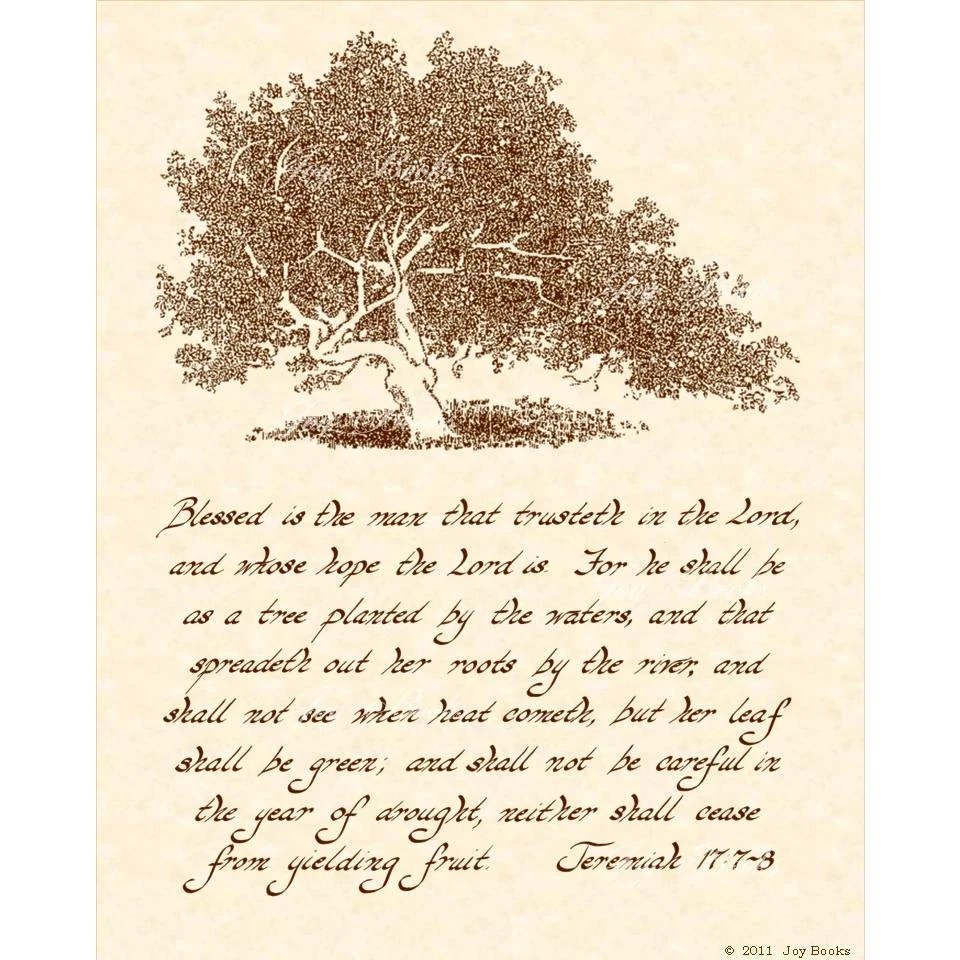
Jeremiah 17:7-8 says, “Blessed is the man who trusts in the Lord, whose trust is the Lord. He is like a tree planted by water, that sends out its roots by the stream, and does not fear when heat comes, for its leaves remain green, and is not anxious in the year of drought, for it does not cease to bear fruit.”

In these verses, we discover that trust in God — a deep, abiding, unwavering, uncompromising trust — is the key to a fruitful life.

That means that not trusting in God for anything and everything — i.e., being worrying, trying to control outcomes, not submitting to God’s sovereignty — is at its core true spiritual laziness.

Therefore, all of those wonderful and incredibly vital habits I mentioned earlier are the fruit of being spiritually active, but they are not the tree itself.

The tree described in Jeremiah is fruitful because it’s rooted in the trust of the Lord, day and night, season after season, storm after storm.  

If you and I are feeling mightily slapped in the face right now, please know that I and uncountable numbers of other “Christians” are right there with you.

If I were to reveal my list of weaknesses, laziness has never been in my top 10.

If anything, I am at times too energetic and too driven.

A former supervisor of mine once said to me, “Your level of energy and dedication and devotion to your work makes your co-workers nervous.”

And he did not entirely mean it as any kind of high and glorious complement, and now many years later I have come to understand why – “its unheard of.”

I’ve also realized that what shows up in my work habits is just as spiritually connected as what comes out in my sacred disciplines for the Lord.

Outwardly I appear to have it all together. 

My actions indicate a preponderance of fruitful behaviors and activities, but truthfully, they only mask a deep, soul-level weakness — an overwhelming need to outperform, to overdo, to achieve — all because I have unrecognized or unacknowledged or unconfessed, unrepented trust issues with our God. 

This is why being busy with the tasks of proper spirituality or duties of religion has in the past left me feeling drained, empty, and disconnected from God. But until recently I never genuinely realized “laziness” had anything to do with it.

If this still doesn’t make sense to you, bear with me for a few moments more.

The connection between laziness and mistrust is simply this: striving to trust God for everything takes great effort, put forth on a continual, consistent basis.

And not just for a few weeks or months. 

Trust grows in layers throughout your lifetime.

One decision or trial at a time. 

That means trusting Him even when we walk through long seasons of waiting, difficulties, or disappointments.

When we do not trust the Lord, it bubbles out into our lives in the form of busyness, trying to control situations or others, legalism, worrying, anxiety, escapism, the pursuit of accolades, or wealth, grumbling and complaining, and a whole host of other manifestations. 

Eugene Peterson, the editor of The Message version of the Bible puts it this way:

“Sloth is most often evidenced in busyness … in frantic running around, trying to be everything to everyone, and then having no time to listen or pray, no time to become the person who is doing these things.” 

An August 11, 2012, mental health article in the New York Times titled “The Anxious Idiot” illustrates Peterson’s point beautifully.

“Laziness: it isn’t a characteristic usually associated with the anxious. If anything, people tend to view the anxious as more active and motivated than normal, because they are more haunted by the specter of failure. And yet long experience has taught me that it is laziness … that is the foremost enemy of the anxiety sufferer, for laziness prevents him from countering the very patterns of thought that make him anxious in the first place.” 

You may or may not be much of a worrier.

Anxiety may be the last thing you resort to when times get tough.

if we struggle with anger or a need for control, then we also likely struggle with trusting God when difficult people or disturbing situations come into our life.

While the article in the NY Times was written without any spiritual connotations or recommendations, it definitely gets to the heart of the matter: every person has a decisive choice to make when confronted with the daily decisions of life.

We can make the genuine effort to trust in God, genuinely let go of our own desires, and genuinely implement His divine recommendations for a healthy, fruitful life, or we can genuinely slide down the path of least mental resistance into our comfortable, but usually very genuinely detrimental, very bad habits.

This is why Paul says our faith is like running a race.

He doesn’t say it’s like sitting in a meadow on a sunny day having a picnic.

Our participation and consistent effort are required. 

Hebrews 12:1-2a says, “Therefore, since we are surrounded by so great a cloud of witnesses, let us also lay aside every weight, and sin which clings so closely, and let us run with endurance the race that is set before us, looking to Jesus, the founder, and perfecter of our faith.”

One of the best parables of the Bible encourages us to risk everything we hold dear in order to walk closely with God. 

Matthew 25:14-30 Amplified Bible

Parable of the Talents

14 “For it is just like a man who was about to take a journey, and he called his servants together and entrusted them with his possessions. 15 To one he gave five [a]talents, to another, two, and to another, one, each according to his own ability; and then he went on his journey. 16 The one who had received the five talents went at once and traded with them, and he [made a profit and] gained five more. 17 Likewise the one who had two [made a profit and] gained two more.  18 But the one who had received the one went and dug a hole in the ground and hid his master’s money.

19 “Now after a long time the master of those servants returned and settled accounts with them. 20 And the one who had received the five talents came and brought him five more, saying, ‘Master, you entrusted to me five talents. See, I have [made a profit and] gained five more talents.’ 21 His master said to him, ‘Well done, good and faithful servant. You have been faithful and trustworthy over a little, I will put you in charge of many things; share in the joy of your master.’

22 “Also the one who had the two talents came forward, saying, ‘Master, you entrusted two talents to me. See, I have [made a profit and] gained two more talents.’ 23 His master said to him, ‘Well done, good and faithful servant. You have been faithful and trustworthy over a little, I will put you in charge of many things; share in the joy of your master.’

24 “The one who had received one talent also came forward, saying, ‘Master, I knew you to be a harsh and demanding man, reaping [the harvest] where you did not sow and gathering where you did not scatter seed25 So I was afraid [to lose the talent], and I went and hid your talent in the ground. See, you have what is your own.’

26 “But his master answered him, ‘You wicked, lazy servant, you knew that I reap [the harvest] where I did not sow and gather where I did not scatter seed. 27 Then you ought to have put my money with the bankers, and at my return I would have received my money back with interest. 28 So take the talent away from him and give it to the one who has the ten talents.’

29 “For to everyone who has [and values his blessings and gifts from God, and has used them wisely], more will be given, and [he will be richly supplied so that] he will have an abundance; but from the one who does not have [because he has ignored or disregarded his blessings and gifts from God], even what he does have will be taken away. 30 And throw out the worthless servant into the outer darkness; in that place [of grief and torment] there will be weeping [over sorrow and pain] and grinding of teeth [over distress and anger].

We read here about the parable of the talents, which tells the story of a wealthy business owner who gives three employees each a sum of money and asks them to take care of it for him while he is away on a trip.

Two of them immediately invested the money so that it would earn interest.

The third one was fearful of what would happen if he made a mistake, so he simply buried the money for safekeeping.

When the owner returned, this is what happened:

“But his master answered him, ‘You wicked and slothful servant! You knew that I reap where I have not sown and gather where I scattered no seed?” And then the passage closes with this warning: “For to everyone who has will more be given, and he will have an abundance. But from the one who has not, even what he has will be taken away.” 

In commenting on this parable, Oswald Chambers said,

“The person who is lazy naturally is always captious (i.e., sully or a whining). ‘I haven’t had a decent chance,’ and the one who is lazy spiritually is captious with God. Lazy people always strike out on an independent line.” 

Of course, our definition of independence is different today than it was back then (circa 1900).

Today we typically use the word independence in a much more positive fashion than Chambers intended.

His implication is that lazy believers chart their course separately from God’s recommended path.

Therefore, when it comes to “spiritual matters,” they can all too easily use the excuse of independence — or what they believe to be our unique situation — to justify laziness, rebellion, or fear and so very much more.

Jesus, on the other hand, calls us to be utterly dependent on Him.

As Oswald Chambers further says in his writings, we should never forget that our ability to trust in God and to serve Him with boldness — despite the risks to ourselves — isn’t measured by what we are capable of or what we desire to do.

Instead, our abilities should be grounded in the promises of God never to fail us, leave us, or ask us to do something that He cannot achieve through the power of the Holy Spirit at work in us.

In fact, the greatest miracles of life come when we are at our weakest and trust God to perform His work within us for the benefit of others and His glory. 

2 Corinthians 4:7-11 NLT says, “We now have this light shining in our hearts, but we ourselves are like fragile clay jars containing this great treasure. This makes it clear that our great power is from God, not from ourselves.”

So, these verses imply that the weaker or more fearful you and I may be of what God has asked you and I to do, the greater becomes the opportunity for Him to work miracles and display His genuine glory.

Theologically, all of this may sound like solid truth to you, but if you are still wondering what it all means for the day-to-day living and walking with Jesus, perhaps the following words of wisdom from the Book of Proverbs will help you turn these spiritual implications into daily actions.

As with most Biblical truth, there is great irony in God’s command to trust Him in Proverbs 3:5-6, which says simply:

“Trust in the Lord with all your heart and lean not on your own understanding; in all your ways submit to Him, and He will make your paths straight.”

These verses contain two actions for us to follow: trust and submit.

We must genuinely participate in the process.

To bear fruit like the tree, we must remain planted by streams of living water.

Yet to keep ourselves out of spiritual laziness and make the efforts required of this command, we must simultaneously learn to simply rest.

Yes, you and I absolutely read that right.

To overcome laziness, we have to learn to be still. 

When we build Sabbath margin into our daily lives — not just on Sunday — we will have the time to breathe, think clearly, and engage our complete being — mind, body, and soul — in genuine pursuit of Rabbi Jesus and Savior Christ. 

The tree grows because it is beside the river of life.

We will only grow in Christ when we take the time to drink of His strength and learn of His wisdom.

So, while I said at the beginning of this devotional message that prayer, Bible study, meditation, and worship are the first fruits of trust, they also become the essential building blocks of greater, greatest, trust as we faithfully apply them.

But we will never see them appear, nor be able to taste them as long as we allow busyness to proliferate in our lives, numb us to the real laziness of our hearts.

When we allow laziness to dominate our decisions and motivations, we only end up serving a false god, and not the true King of Glory.

Laziness, or not trusting God, like any other sin feels good for a season.

Other than busyness, it often shows up in forms of escapism, like mindless TV watching, endless smartphone use, endless devotion to video games, endless social media surfing, or a myriad of physical indulgences, coping mechanisms.

But when we look it square in the eye and call it for what it is, we realize it’s all about our trusting or not trusting the unseen God to do what He says He will do.

Today, I would ask you, fellow traveler, where are you and I planted? 

Are we putting “a few roots down” near the river of life, while allowing others to seek their comfort in the tainted soils of self-reliance or personal comfort?

 If so, ask God to help you find them again, dig them up, and transplant them into His unending goodness and strength.

It won’t happen overnight, but when you wake each morning, His mercies will be new, and God’s miracles will be waiting to sustain us through this “process.”

For Further Reflection and Daily Spiritual Journaling

The questions and readings below can be used for a single-day study or for our re-organization, re-prioritization of our daily quiet time throughout the week.

Day 1 – Describe in your own the words the difference between striving to perform for God (i.e., doing something out of duty or to achieve) and participating in God’s work in your life.

Read Ephesians 2:8-9 and James 2:14-26.

Why do you think you are sometimes motivated toward busyness or performance?

What is God leading us to change? How? Write them out as a prayer to Him.

Day 2 – Read Lamentations 3:22-23. In what ways are you experiencing God’s mercies today or have in the past? How are they new or different to you now than they were yesterday? If you’re in a place of struggle right now, ask God to help you recognize and receive His mercies.

Day 3 – Read, re-read the parable of the talents in Matthew 25:14-30. How are you and I similar to the good servants? In what ways are you and I being like the fearful servant? Journal about why you think that is, and what the Holy Spirit is revealing in your heart.

Day 4 – Take some time to be still before the Lord today.

Begin by reading Proverbs 3:5-6 and then meditating on it.

Ask God to interrupt you and I at any moment with what He wants to whisper to yours and my heart.

For more about “being busy” and practicing stillness and what it means,

check out: https://todaydevotional.com/devotions/be-still-2013-07-01

Day 5 – Spend some time reflecting on our schedules and our commitments at work, home, church, in your community, and other volunteering roles.

Read Luke 10:38-42.

Luke 10:38-42Amplified Bible

Martha and Mary

38 Now while they were on their way, Jesus entered a village [called Bethany], and a woman named Martha welcomed Him into her home. 39 She had a sister named Mary, who seated herself at the Lord’s feet and was continually listening to His teaching. 40 But Martha was very busy and distracted with all of her serving responsibilities; and she approached Him and said, “Lord, is it of no concern to You that my sister has left me to do the serving alone? Tell her to help me and do her part.” 41 But the Lord replied to her, “Martha, Martha, you are worried and bothered and anxious about so many things; 42 but only one thing is necessary, for Mary has chosen the good part [that which is to her advantage], which will not be taken away from her.”

Go to God in prayer and ask Him to reveal areas where you, I, are too busy like Martha and where you and I need to be more studious and quieter like Mary. 

In the name of God, the Father and God the Son and God the Holy Spirit,

Let us Pray,

All-Knowing Father, you authored my life, you know and direct my future. You make all things work together for my good. Pray! Help me to trust you as I think about my future. Give me peace of mind. Whatever happens, I know that you are working for my good and your glory. Help me to live with freedom, knowing that my future is in your mighty hand. I do not know what is around the corner, but nothing can take you by surprise. I face uncertainty but I can be certain that you are in control and that you are good. Through Jesus Christ, our Lord. Amen.

https://translate.google.com/

A Word to The Wise on Finding Your Way: Commit Yourself unto the Lord. Friends, Come, Find the Quiet Center!

The real question behind this promise is very simple: How do I define success for my plans? The answer is very simple as well: bringing glory to God for his grace (see Eph. 1:61214). Committing our works and plans unto God means surrendering them into to God’s will (James 4:13-15), trusting that God will be 100% glorified in them (Col. 3:17), and recognizing that it is not in our power to properly guide our own steps (Prov. 16:9). God longs to bless us and empower us — not for our own selfish ambition (James 3:16), but for our eternal good (Rom. 8:28) and God’s glory. Like Jesus, when we commit our plans and works unto, into, to the Lord, we are saying, “Not my will, Father, but yours be done!”

Proverbs 16:3 NRSV

Commit your work to the Lord,
    and your plans will be established.

The Word of God for the Children of God. Gloria! In Excelsis Deo! Alleluia! Amen.

This verse tells us we should rely on God in all things. Whether the matters are great or small, we should entrust them to God and look up to Him, because God holds sovereignty over everything and there is nothing difficult if we rely on God. However, in reality, when we encounter difficulties, we don’t first come before God to pray or search, rather, we plan this or that for our selfish desires.

As a result, we take detours, always fail, and cannot see God’s blessings. When we pray to God sincerely, commit our real difficulties to Him, and put aside our selfish desires and intentions, God will always open a way out for us, allowing us the opportunity to observe, see His great power and authority in experience.

The length and breadth of God’s Word reveals to us a rather simple message:

God says,

It’s very simple now: Look upon Me with your heart and your spirit will immediately become strong, you will have a path to practice, and I will guide your every step. My word shall be revealed to you at all times and in all places. No matter where or when, or how adverse the environment is, I will show you clearly and My heart shall be revealed to you if you look to Me with your heart; this way you will run down the road ahead and never lose your way.

Relevant Words of God:

In that blessed moment, when you take that first baby step, look to God with your whole self, it is possible that He does not give you any feeling or any clear ideas, much less any clear directions, but He allows you some understanding.

Or maybe it is this time you have not understood anything, yet it is right that you first look to God. People practicing in this way is not done to follow rules, but rather it is the need of their hearts and is how man should first practice.

It is not that you can obtain enlightenment and guidance every time you look to God and call on God; this spiritual state in man’s life is normal and natural, and looking foremost to God is the normal interaction with God in people’s hearts.

Sometimes, looking to God does not mean asking God to do something using specific words, or asking Him for specific guidance or protection. Rather, it is that when people encounter some issue, they are able to call on Him sincerely.

So, what is God doing there when people call on Him?

When someone’s heart stirs and they realize they have this thought: “Oh God, I can’t do this myself, I don’t know how to do it, and I feel weak and negative…,”

When these thoughts arise in them, does God not know about it?

When these thoughts arise in people, are their hearts sincere?

When they call on God sincerely in this way, does God assent to help them?

Despite the fact that they may not have spoken a word, they show sincerity, and so God assents to help them.

When someone encounters an especially thorny difficulty, when they have no one to turn to, and when they feel particularly helpless, they put their only hope in God. What are their prayers like? What is their state of mind? Are they trying to be genuinely sincere? Is there any adulteration within them at that time?

It is only when you trust God as though He were the very last straw that you clutch onto to save your life, hoping that He will help you, that your heart is sincere. Though you may not have said much, your heart has already stirred.

That is, you give your sincere heart to God, and God listens. When God listens, He sees your difficulties, and He will enlighten you, guide you, and help you.

Lots of times, we lean far too much on ourselves for things. We might not have had the best parents, or upbringing, or teaching, or mentors, or best of friends and it can cause us to mightily doubt God’s love and ability to help in our lives. When people have let us down, it can be easy to not want to trust God for things.

Today’s Bible verse from Proverbs 16:3 really comes down to our trust. It’s a challenge to put your trust in God. Rather than relying solely on yourself for everything, it asks you to trust God. Trust doesn’t always come easily, however.

It can be really hard to trust something as big as your future and plans to God.

YET! That’s what this verse is commanding us to figure out how to do. It is saying the only path to abundant life is to trust God with your plans, trust Him with your efforts. Can you 100% trust God with these things because He’s good?

Faith …..

Hope …..

Love …..

But the greatest of these is ……

I just noticed, The Apostle Paul never mentioned TRUST in 1 Corinthians 13:13!

Deliberate and Intentional or Unplanned and Unintentional?

What do you think about that oversight?

What do you believe about that oversight?

What does your very own intimately personal experience tell you?

Is there a similar place for TRUST in that verse from 1 Corinthians 13:13?

Trust in our fellow man is a dangerous proposition (Psalm 118:8-9) Arriving at that exact conclusion is a time-honored process of trial and error and hurting.

Trusting in God is a dangerous proposition too but for different and much safer reasons (Psalm 4:8, Psalm 12:5 18:1-3, Psalm 23, Psalm 91, Psalm 107 et. al).

Give God a chance. Give Jesus a chance! Give the Holy Spirit a chance! He isn’t going to let you down like people may have in your life. He’s going to always be there to walk you through the challenges life brings. So, PRAY! Decide today to grow trust in God for your future. Trust in Him and watch your plans succeed!

Come and Find the Quiet Center … Shirley Erena Murray, Hope Publishing, 1992

Come and find the quiet center
     in the crowded life we lead,
          find the room for hope to enter,
               find the frame where we are freed:
clear the chaos and the clutter,
     clear our eyes, that we can see
          all the things that really matter,
               be at peace, and simply be.

Silence is a friend who claims us,
     cools the heat and slows the pace,
          God it is who speaks and names us,
               knows our being, touches base,
making space within our thinking,
     lifting shades to show the sun,
          raising courage when we're shrinking,
               finding scope for faith begun.

In the Spirit let us travel,
     open to each other's pain,
          let our loves and fears unravel,
               celebrate the space we gain:
there's a place for deepest dreaming,
     there's a time for heart to care,
          in the Spirit's lively scheming
               there is always room to spare!

In the name of God, the Father and God the Son and God the Holy Spirit,

Let us Pray,

Father, I want your will to be my plans. I want your glory to be my goal. I have things that I want to do. However, if these plans are not for your glory, if these plans are not a blessing to my family or those over whom I have influence, then please defeat me in those plans. Please guide me into other areas of blessing. I want you to be above all else glorified in what I do. I only want to go where your grace leads me. I commit my ways, my plans, and my works to you and to your glory. In Jesus’ name I pray. Alleluia! Alleluia! Alleluia! Amen.

https://translate.google.com/

Help Me to Trust in You, O’ Lord! Be Thou My Wisdom! |Proverbs 3:5–6|

Trust. It can’t be half-hearted. Either it is a full trust, or it is ‘trust’ clouded with suspicion and doubt. So, as we face the everyday challenges of life, or as we look for answers to deep and difficult problems, let’s put our full trust in the LORD.

Pray! Let’s ask for his wisdom and guidance as we make our choices. Let’s give him praise for the good in our life and seek his blessing for the long days ahead. Why? Because he longs to bless us with a wise life, both now, and forevermore.

Proverbs 3:5-8 New Revised Standard Version

Trust in the Lord with all your heart,
    and do not rely on your own insight.
In all your ways acknowledge him,
    and he will make straight your paths.
Do not be wise in your own eyes;
    fear the Lord, and turn away from evil.
It will be a healing for your flesh
    and a refreshment for your body.

The Word of God for the Children of God. Gloria! In Excelsis Deo! Alleluia! Amen.

Faith ….

Hope ….

Love ….

And the Greatest of these is …..

Resigning yourself into God’s care is an act of faith. It’s easy for Christians to say in a hopeful general way, “The Lord’s will be done,” but it’s another matter entirely for us to resign ourselves into the Lord’s loving hands about a specific circumstance which we have no answer. In the Bible when someone approached this walk of self-resignation, it was done with great seriousness of thought.

And the Greatest of these is …… TRUST?

Can there be faith, hope and love absent a maximum measure of genuine trust?

Merely saying the words, “I trust the Lord completely,” isn’t sufficient to prove that we possess a total 100% ‘genuine’ trust in him. It must be a free and willing surrender. Consider Egypt’s Pharaoh: Only when he could not hold out against God’s plagues any longer did, finally resigns to let Israel take their wilderness journey toward the Promised Land (see Exodus 12:29-32).

Likewise, many people living in these higher than high -risk contemporary of times has said, “I give in, I commit, I trust,” only after they have seen no other way out of their situations. But true resignation, the kind that pleases God, is done willingly to His Standard, prior to our coming to our wit’s end. We are to act in covenant with the Lord, giving him a blank check and letting him fill it in.

God cannot and will not accept no less than our all. If we resign our lives to him only half-heartedly, with any kind of reservation, we are as guilty as Ananias and Sapphira. They pretended to give their all to the Lord, but in reality, they held back a part and they paid with their lives (see Acts 5:1-11). There can be no deals or restrictions placed on our Lord. Contrast Acts 2:43-47 with 5:1-11!

“Trust in the Lord with all your heart, and lean not on your own understanding; in all your ways acknowledge Him, and He shall direct your paths” (Proverbs 3:5-6).

“Trust in Him at all times, you people; pour out your heart before Him” (Psalm 62:8).

Although the psalmists say we’re to trust in God at all times, our pride always makes us want to keep control of our lives. It is surprising how stubborn and fleeting and woefully willful each one of us can be. Our surrender to him — in our thoughts, our actions, our desires — is by nature a daily, ongoing work.

We are repeatedly reminded, (gently, not so gently) “The just shall live by his faith” (Habakkuk 2:4). How reassuring to know that as we reach to him in faith, our Master will carry us through all hardships and natural impossibilities. How reassuring to know, to experience, as we stretch our finite hopes heavenward, it is our resurrected Savior Jesus who rose from the grave – turned our dying hope unto an ever-lasting and ever-living hope for a prosperous and blessed future.

We often get too easily wrapped up in the pursuit of happiness. It’s easy to think that if we could just do or be better that we would have it made. So, we work, and we work, trying to get more friends, or improve our grades to get into a better college. We do things like getting a job after school so we can get a car. We believe if we can do enough, be enough or have enough, we will be happy.

The problem with our doing more, with our being more, or our having more is that these things are empty. There’s no number of good grades that will truly make us happy in the long run. No number of friends, or money will complete us. We can try and work to fill our life with stuff, still feel impossibly empty.

Today’s Bible verse addresses these issues.

The last part of this verse from Proverbs 3 talks about not depending on our own understanding. What that means is do not depend too heavily on what we think seems good. Don’t depend on what we see on TV or what we hear in the halls at school from our friends to tell us what will make us all 1000% happy.

True happiness comes from a relationship of maturing trust with Jesus Christ.

When you let 100% of Jesus into your life, He will show you how He sees you.

It’s when you get to know and trust Jesus, you will find true happiness. If you want to be happy and live your life to the fullest, you need to choose to do what this verse says. You need to trust the Lord with all your heart. This isn’t always easy, it is not always supposed to be easy, but if you’ll spend some time getting to know God, you will see trusting in Him brings you true maturing happiness.

So, choose today to trust in the Lord. Don’t get caught up in all the things of life and let them steal your happiness. Trust in God and look to Him for answers.

Psalm 27

Triumphant Song of Confidence

Of David.

The Lord is my light and my salvation;
    whom shall I fear?
The Lord is the stronghold[a] of my life;
    of whom shall I be afraid?

When evildoers assail me
    to devour my flesh—
my adversaries and foes—
    they shall stumble and fall.

Though an army encamp against me,
    my heart shall not fear;
though war rise up against me,
    yet I will be confident.

One thing I asked of the Lord,
    that will I seek after:
to live in the house of the Lord
    all the days of my life,
to behold the beauty of the Lord,
    and to inquire in his temple.

For he will hide me in his shelter
    in the day of trouble;
he will conceal me under the cover of his tent;
    he will set me high on a rock.

Now my head is lifted up
    above my enemies all around me,
and I will offer in his tent
    sacrifices with shouts of joy;
I will sing and make melody to the Lord.

Hear, O Lord, when I cry aloud,
    be gracious to me and answer me!
“Come,” my heart says, “seek his face!”
    Your face, Lord, do I seek. (Psalm 27:1-8 NRSV)

In the name of God, the Father and God the Son and God the Holy Spirit,

Let us Pray,

O Lord my God, my eternal Father, thank you that you are my ever-present help in times of trouble. Help me to trust in what is unseen. Remind me of the truth of your power, that you surround me, and that you are fighting for me. Give me favor and breakthrough in my life. You are the King of ages, immortal, invisible, the only wise God, my Savior. To you be all measures of honor and glory forever and ever.  Through Jesus Christ, our Lord, Alleluia! Alleluia! Alleluia! Amen.
https://translate.google.com/

James 1:12 Trust and Obey. For there is No Other Way. But to be Happy in Jesus. To Trust! Obey! Live! Blessed Is the One Who Perseveres Under Trials.

Why must we endure trials? The truth is that even Christ had to suffer. Jesus Christ was born perfect and never sinned, but to be prepared for what God had sent him to do, he had to suffer. Luke 24:26 says it was “necessary.” Hebrews 2:18 says that Christ “suffered” when he was tempted. Hebrews 5:8-9 says, “Son though he was, he learned obedience from what he suffered and once made perfect, he became the source of eternal salvation for all who obey him.”

For God so LOVED the world! He sent His Son – not to condemn but to offer life – life in an unimaginable abundance! If Christ suffered, why would we not, and for the same reason? Peter said we are in the furnace of affliction to be purified (1 Peter 1:7). God is our good Father, and a good Father disciplines his children whom he loves (Proverbs 3:12). If you are not facing trial, you will. Accept it!!! Walk through it! faithfully, obediently trusting God. let Savior God work in you!!!

James 1:12-18 New American Standard Bible

12 Blessed is a man who perseveres under trial; for once he has [a]been approved, he will receive the crown of life which the Lord has promised to those who love Him. 13 No one is to say when he is tempted, “I am being tempted [b]by God”; for God cannot be tempted [c]by evil, and He Himself does not tempt anyone. 14 But each one is tempted when he is carried away and enticed by his own lust. 15 Then when lust has conceived, it gives birth to sin; and sin, when it has run its (full) course, brings forth death. 16 Do not be [d]deceived, my beloved brothers and sisters17 Every good thing given, and every perfect gift is from above, coming down from the Father of lights, with whom there is no variation or [e]shifting shadow. 18 In the exercise of His will He gave us birth by the word of truth, so that we would be [f]a kind of first fruits [g]among His creatures.

The Word of God for the Children of God. Gloria! In Excelsis Deo! Alleluia! Amen.

We are definitely living in uncertain times. There is much going on around us which is not even minimally pleasing to any of our six senses. There is much going on around us which we do not understand, and much which others would rather we not try to understand – just accept and muddle through as best as we can figure out for ourselves and those within our limited spheres of influence.

From the midst of all that which surrounds us and threatens to envelop us, we seek out, receive the greater wisdom and truth from the Word of God. We read now and should prepare ourselves to receive our God’s encouragement to His Children from James 1:12-18. Such should serve as a protection for us. It should guard us from having distorted views of God and of our situation. James offers three reminders that should help us think rightly about God in times of trial.

As We Face Trials, We Must Remember that God Has Promised a Good Reward for Those Who Love Him (1:12)

  • A blessed people– We don’t usually equate suffering with being blessed, but this is the adjective James uses to describe those who remain firm in their faith and confident in God amid trials. 
  • The promise of God– While this verse has much to say about our response to suffering, the main focus is on the promise of God. God has promised eternal life to those who love Him (the crown of life).
  • Remaining steadfast– The call to steadfastness is a call to faith and trust in God. While this may seem to imply a works based salvation, we know from Scripture that our love for God and our enduring faith are both gifts from Him given by His grace.

As we Face Trials, We Must Remember that God does not use Trials to Tempt Us to Sin (1:13-15)

  • Let no one say– James understands human nature well and he knows that when the pressure is really and heavily upon us, we will be tempted to sin. Amid that temptation we may also be inclined to point the finger at God and to accuse Him of being the source of our temptation. James wants to impart wisdom to us to understand God rightly. He warns us against accusing God of being a tempter.
  • The character of God – God is holy (vs. 13)– In order to prove his point James speaks and writes and he appeals to the holiness of God. Because God is holy and cannot sin, He cannot be tempted, and He will not tempt anyone to sin.
  • The actual source of temptations – Our own desires (vs. 14) – In verse 14 James explains our temptation to sin does not come from outside of us. Temptation is not an outside force, but an inner battle. The source of our temptations is the evil desires of our hearts. (Mark 7:14-15 21-23Romans 7:18-25; Jeremiah 17:9)
  • The results of giving into evil desires – Sin and death (vs. 15) – Reverend Dr. Daniel Doriani, Professor of Biblical and Systematic Theology at Covenant Theological Seminary [James] personifies evil, saying temptations and desires come together to “conceive.” Their offspring is named “sin.” Sin grows up and sin becomes a parent too. The name of its child is “death.” As surely as our physical conception leads to birth, this kind of ‘sin’ conception “gives birth to death.”

As We Face Trials, We Must Remember that God is the Giver of Good Gifts (1:16-18)

  • The character of God as the giver of good gifts (vs. 16-17) – God is holy. Since He is holy everything that comes from Him is good and perfect and that even extends to our trials. Even our trials can be seen as good gifts that God allows in order to produce something greater in us. God does not give us anything that is intended to harm us or cause us to sin; everything that comes from His hand is intended grow us and to mature us and strengthen us with God’s own wisdom.
  • The unchanging God– In times that are uncertain and inconsistent we can find a living hope in recognizing God’s unchanging and never wavering character.
  • God’s greatest gift – Our salvation (vs. 18) – As James brings this section to a close, he ends with the reminder of the greatest gift that God has given, namely our salvation. Our world is cursed by sin and struggles, but God has promised to make all things new. We are a kind of firstfruits as even now God is making us more and more into the image of His Son.

Summary – We are living in an unprecedented time and now more than ever we must strive to think rightly about God and His dealing with us. Regardless of what we face we can be confident in what God has promised, that He remains the giver of every good and perfect gifts. We can also be sure, certain, that any temptation to sin is not from Him, but from our own hearts. Thankfully we know that in Christ we can have victory over the sinful desires of our hearts.

Jesus said the greatest commandment is to “Love the Lord your God with all your heart and with all your soul and with all your mind” (Matthew 22:37).

He said that the whole law is summed up in this one command, especially combined with the covenant command of loving your neighbor as yourself.

Indeed, can sin be committed without first breaking this Great Commandment? For those who love the Lord, there is the promise of the “crown of life.” “The crown of life” seems most likely to be another term for abundant life, eternal life, and heavenly reward. Some make distinctions between different crowns listed throughout Scriptures, but it seems to generally mean eternal reward.

James notes that this reward is available only to those who love God. The question then becomes, what does it mean to love God? This answer can be found in three passages within Deuteronomy.

1) Maintaining Fullness of Heart (Deuteronomy 6:5; also, Matthew 23:37Mark 12:30; and Luke 10:27) – In this verse, we see one must love God with their whole heart. This is a complete commitment and one’s love of God cannot be defined by a partial undertaking.

When Christ called people to follow Him, it was exhaustive, requiring that one give their whole life (Luke 14:25-33). This call included the entirety of one’s heart. Therefore, one is to have a whole heart directed towards Him. Your heart cannot be divided between two worlds, which means that even the smallest corner must be given over to Him in service and sacrifice (See Romans 12:1-2).

2) Maintaining His Ways (Deuteronomy 10:12) – The people of God are called to walk according to the precepts of God. God has outlined His will for every believer, and if one loves Him, they will indeed walk according to that will.

The idea of walk here indicates this is to be a steadfast way of life. Walking according to the ways of God is not something that one chooses to do only part of the time. Remembering each of us continuously battles our sinful nature, each person must make it a priority to put the ways of God first, so that God is made known by the way in which one lives.

3) Maintaining His Word (Deuteronomy 11:1) – Finally, one who loves God will keep the charge of God, the statutes of God, rules of God, and commandments of God. As one who loves God, a believer will keep His law.

Throughout the Bible, the authors (through divine inspiration of course!) refer to it as the law. Being all sufficient (2 Timothy 3:16) the Scripture is meant to be both a guideline and the authority for how you live. Therefore, be in it daily and seek just how to live it, doing so in an act of obedience because you love God.

James has issued the call to persevere through trials, knowing that a person will be made complete through them, noting that they will receive the crown of life.

This crown of life is the motivation of obedience for every believer, not because they desire to have a crown, but because they desire to be in the presence of the true and holy God. Therefore, maintain His ways as outlined in His word, with a fullness of heart. May God, know we love Him by our deeds of trust, obedience.

In the name of God, the Father and God the Son and God the Holy Spirit,

Let us Pray,

The Prayer of St. Patrick, Patron Saint of Ireland

I arise today
Through a mighty strength, the invocation of the Trinity,
Through belief in the Threeness,
Through confession of the Oneness
of the Creator of creation.
I arise today
Through the strength of Christ’s birth with His baptism,
Through the strength of His crucifixion with His burial,
Through the strength of His resurrection with His ascension,
Through the strength of His descent for the judgment of doom.
I arise today
Through the strength of the love of cherubim,
In the obedience of angels,
In the service of archangels,
In the hope of resurrection to meet with reward,
In the prayers of patriarchs,
In the predictions of prophets,
In the preaching of apostles,
In the faith of confessors,
In the innocence of holy virgins,
In the deeds of righteous men.
I arise today, through
The strength of heaven,
The light of the sun,
The radiance of the moon,
The splendor of fire,
The speed of lightning,
The swiftness of wind,
The depth of the sea,
The stability of the earth,
The firmness of rock.
I arise today, through
God’s strength to pilot me,
God’s might to uphold me,
God’s wisdom to guide me,
God’s eye to look before me,
God’s ear to hear me,
God’s word to speak for me,
God’s hand to guard me,
God’s shield to protect me,
God’s host to save me
From snares of devils,
From temptation of vices,
From everyone who shall wish me ill,
afar and near.
I summon today
All these powers between me and those evils,
Against every cruel and merciless power
that may oppose my body and soul,
Against incantations of false prophets,
Against black laws of pagandom,
Against false laws of heretics,
Against craft of idolatry,
Against spells of witches and smiths and wizards,
Against every knowledge that corrupts man’s body and soul;
Christ to shield me today
Against poison, against burning,
Against drowning, against wounding,
So that there may come to me an abundance of reward.
Christ with me,
Christ before me,
Christ behind me,
Christ in me,
Christ beneath me,
Christ above me,
Christ on my right,
Christ on my left,
Christ when I lie down,
Christ when I sit down,
Christ when I arise,
Christ in the heart of every man who thinks of me,
Christ in the mouth of everyone who speaks of me,
Christ in every eye that sees me,
Christ in every ear that hears me.
I arise today
Through a mighty strength, the invocation of the Trinity,
Through belief in the Threeness,
Through confession of the Oneness
of the Creator of creation.

https://translate.google.com/

A Thousand Hallelujah’s, A Thousand Thousand More for My God in Whom is my Dwelling Place, Whom I Trust!!!

We cannot trust a person until we know him or her. It is the same with God too. How well do you actually know God and how well do you genuinely know God? How have you experienced God working in you through those difficult places? Do you 100% believe there is even a 0.1% chance of breakthrough in your life? I pray you will come to find out the truth of “breakthrough!” This devotional will throw light on knowing and trusting God through all the situations of our life.

Psalm 91:1-2 New American Standard Bible

Security of One Who Trusts in the Lord.

91 One who dwells in the shelter of the Most High
Will lodge in the shadow of the Almighty.
I will say to the Lord, “My refuge and my fortress,
My God, in whom I trust!”

The Word of God for the Children of God. Gloria! In Excelsis Deo! Alleluia! Amen.

For those of us who were born and brought up in Christian homes, Psalm 91 is a familiar one, which many of us may have read or even memorized as a child. Nonetheless, in this devotional we will explore as to what it means to trust in God as the Psalmist declared about God in the above-mentioned verse.

Truth be Revealed, we will only truly trust a person only when we get to know him or her. It is the same with God, we can trust Him only when we know who He is, and only when we are able to comprehend His divine attributes. When Jesus lived here on earth, he chose twelve men to be His disciples. A closer look at their lives will perhaps help us understand why they decided to trust in Jesus.

1. Peter, the fisherman

Peter was a fisherman by profession, but the day he met Jesus who filled his empty nets with a miraculous and bountiful catch, Peter chose to follow and trust Jesus immediately without any hesitation. The reason Peter gave up his livelihood which included his boat and nets to follow after Jesus, was because Peter instantly trusted Jesus. Peter believed that if he made Jesus his Master, He would take care of him, and provide him with all that he ever needed.

2. Matthew, the tax collector

Levi/Matthew who was another disciple, was a tax collector for the Roman government. Matthew always sought to align himself with the powerful and when he heard the call of Jesus, he understood that Jesus was much greater than the Roman Government that he was working for. So, at the call of Jesus, he too surrendered his riches and left everything as it was and followed after Jesus.

Every disciple of Jesus who followed Him did so because they curious what might be waiting if they trusted Him, as a result heeded His call to follow Him.

We too have at some point in our life must make a decision to trust someone. I am not an island; you are not an island unto ourselves. To get through this life feeling as though we are not and never were alone, and never have to be alone, we must (timidly) step forth in faith, baby-steps to trust on at least one front. Humanity is too likely to repeatedly let us down, serving their own interests,

We look to the examples set forth by God through His Scriptures to follow Jesus and to be “hip to hip” alongside His disciples. The point that each of us need to ponder is whether we have learnt to completely trust Him in all circumstances.

Trusting Jesus through the storms

We read in Matthew 8:23-24 (NRSV), 23 And when he got into the boat, his disciples followed him. 24 A windstorm arose on the sea, so great that the boat was being swamped by the waves; but he was asleep.

Some of the disciples of Jesus who accompanied Him on the boat that day were seasoned fishermen who had probably encountered many fierce storms in the very same sea. Strangely, the storm that challenged them that day seemed to be unlike any that they had seen before. The winds were so fierce and the waves so boisterous that they were quickly overwhelmed with the fear of sudden death. In the midst of such a raging storm, Jesus was fast asleep in that same boat.

When the disciples set out with Jesus, they got into the boat following Jesus.

We read in Matthew 8:23 that the disciples simply did so because Jesus went on board a fishing boat. When the storm raged on with intensity, and threatened their very lives, they might have wondered if they did the right thing to follow Jesus into that boat. They had probably decided to follow Jesus with hope that they would have absolute safety and personal security, no storms whatsoever.

But the storm they encountered, proved to be contradictory to their belief.

There may be those who are stressed out with such incredible hardships and are praying, wondering as to why the Lord has not intervened or revealed Himself, to somehow, in some way ease or even miraculously eliminate their situation.

Do keep in mind that we have a God who is altogether trustworthy. Our many difficulties might make us speculate if we made the right decision to follow Jesus. Our Savior Jesus wants to assure such people that there is no need to be perturbed, for the Lord is with us all the time.

For others who might pontificate that they are weak in their faith, let us be comforted that even the disciples of Jesus, who were with Him, and saw all the wonders He performed, were completely perplexed in the midst of that storm.

We read in Matthew 8:25 (NRSV), 25 And they went and woke him up, saying, “Lord, save us! We are perishing!”

Jesus and the disciples were all in the exact same boat, but the way they each addressed Jesus was as if He were somewhere else, and not with them in their crisis. That is why they said to Jesus, “Master, save us, we are drowning!”

What they failed to realize was that Jesus was in their boat, and as long as He was there, there would be no way that their boat would drown, and they would not die without fulfilling their life’s mission. Jesus woke up, got up and ordered the winds “to be still,” the waves “to be still,” they immediately calmed down.

In the midst of our fears, let us say along with the Psalmist, ‘my God, in whom I (with maximum possible confidence) trust’ for when we affirm this over and over again, our faith will “grow up,” and our hearts will be filled with courage.

We read in Psalm 107:1-3 (NRSV),

Thanksgiving for Deliverance from Many Troubles

O give thanks to the Lord, for he is good;
    for his steadfast love endures forever.
Let the redeemed of the Lord say so,
    those he redeemed from trouble
and gathered in from the lands,
    from the east and from the west,
    from the north and from the south.[a]

This is the word of steadfast and immovable encouragement from the Lord that we should trust Him completely in all life’s situations for all our breakthroughs.

The truths which are so intricately intertwined within this beautiful Psalm 91 are precious promises that every one of God’s blood-bought children are able to claim as their own. However, the majority of theologians correctly identify this section as a Messianic psalm… for our Lord and Savior Jesus is the only One Who truly dwells in the shelter of the Most High. He is the Man of men, Who abides forever in the shadow of the Almighty.

When the eternal Son of God was born into His own creation as the perfect Son of Man, He lived His life dwelling in the shelter of the Most High God. He abodes in the shadow of the Almighty.

He depended entirely on the Father as His refuge, strength and fortress and demonstrated to us all how a man should live – by trusting God in all things.

In many respects, the Lord Jesus is the only Man Who can legitimately claim God as His refuge and fortress – His God in Whom He trusted implicitly. But praise God that even when we fail, “GOD IS still our refuge and our strength,” because of our position IN Christ.

Our Lord and Savior Jesus is the one and the only Person Who could honestly claim God as His refuge and fortress – and He did this on our account because He went to the Cross for us – in obedience to His Father’s will.

Ephesians 2:8-10 We who are saved by grace through faith, find our everlasting refuge in Christ, Who took the ultimate punishment for our sin and became our strong Fortress, strength, our everlasting Refuge, and the Rock of our salvation.

Jesus is the only One who can legitimately confess that the Lord is My God, in Whom I place my trust, and Who will deliver me from the snare of the fowler and the deadly pestilence.

Throughout His earthly life, the Lord Jesus was hidden under the shadow of His Father’s wings, in Whom He sought ultimate refuge. God was His hiding place Who preserved Him from all trouble, and because we are IN Christ, we can also sing songs of deliverance for God’s faithfulness and favour towards us. We can also claim and trust our God to be our mighty Shield and an eternal Bulwark.

Throughout His earthly life, the Lord Jesus maintained ongoing and never-failing fellowship with His Father. He only did the things which He heard from His Father. He only did those things that He saw His Father doing.

Throughout His earthly ministry, the Lord Jesus was ready and willing to say, “Thy Will, not Mine be done.” He was 100% able to trust the Lord with every circumstance of His life, for His undivided hope was in God.

Jesus was free from every fear because His trust was in God, and in the power of the Almighty, He fulfilled all righteousness and became qualified to become the perfect, sinless sacrifice for the sake of mankind.

And we are called to imitate the way He lived. We are to hide under the shadow of His wings every moment of the day and say to Him – You are my Refuge and Fortress. You are my God, in Whom I trust.

Although the Lord Jesus was fully God, in full trust, he literally surrendered all He was and had. He lived His entire life as a Man. He lived His life and faced His death in utter and total dependence upon His heavenly Father for everything.

Although the Lord Jesus was the eternal God, He lived His life as a perfect Man, setting an example to every member of the human race… showing every child of God how our heavenly Father expects each one of us to live. 

Can there be any doubt left that the man who penned this Messianic psalm was himself absolutely convinced of the wonderful security that is found in the Lord his God because his faith was credited to him as righteousness, and he could legitimately confess that his trust was in the Most High God – the Almighty King of all Creation Who is a thousand times a thousand times magnified as the Sovereign Ruler of all, the Divine Protector of those that believe on His name.

But the psalmist was inspired to write words that would look forward to the God-Man, Who was wounded for our transgressions and bore the sin of the world on His shoulders, so that all who trust in Him can identify with His death, burial, and resurrection to a new life, and state confidently 100%, “He who dwells in the shelter of the Most High, will abide in the shadow of the Almighty. I will say to the LORD, ‘You are my refuge and my fortress, my God, in whom I trust!”

In the name of God, the Father and God the Son and God the Holy Spirit,

Let us pray,

O Lord, my God, I am here to say thank you that your work is perfect, your ways are 100% just, you are a God of faithfulness. You have said that in all things at all times, you will supply all that I need. Please help me to trust in your power to bring breakthroughs in situations where I cannot find a solution. Be exalted far above me and far above the heavens, O Savior God. Let Your glory be above all the earth. Through Jesus Christ, our Lord, Alleluia! Alleluia! Alleluia! Amen.

https://translate.google.com/

Tell Your Heart to Beat Again! Facing, Confronting our Fears, Trusting God!

Jesus Christ was the Son of God from all eternity, but it is clear that his ministry and life was empowered by the Holy Spirit (Luke 3:22). The Holy Spirit led him, tested him, and empowered him. When he went into the wilderness to do battle with Satan, he went “full of the Spirit” (Luke 4:1). If Christ needed and relied on the Holy Spirit in his reliance on his Father, then ask yourselves, just how much more did his disciples rely on the Holy Spirit? He told them that they must wait for power to come upon them before setting off on his mission (Luke 24:49).

One sure and certain test of what spirit is working in us is the result that it has upon our hearts and our souls. Do we feel timid, fearful or do we feel the joy and strength of the Lord (Nehemiah 8:11)? Do we feel hate and indifference to God and others, or do we feel love? Do we feel out of control, led around by the lusts of the flesh (Philippians 3:19), or do we experience self-discipline? God did not leave us on our own, but gave us his powerful Spirit, so often underestimated and unappreciated and under taught, if even taught at all, by we, God’s people.

2 Timothy 1:1-7 The Message

1-2 I, Paul, am on special assignment for Christ, carrying out God’s plan laid out in the Message of Life by Jesus. I write this to you, Timothy, the son I love so much. All the best from our God and Christ be yours!

To Be Bold with God’s Gifts

3-4 Every time I say your name in prayer—which is practically all the time—I thank God for you, the God I worship with my whole life in the tradition of my ancestors. I miss you a lot, especially when I remember that last tearful good-bye, and I look forward to a joy-packed reunion.

5-7 That precious memory triggers another: your honest faith—and what a rich faith it is, handed down from your grandmother Lois to your mother Eunice, and now to you! And the special gift of ministry you received when I laid hands on you and prayed—keep that ablaze! God doesn’t want us to be shy with his gifts, but bold and loving and sensible.

The Word of God for the Children of God. Gloria! In Excelsis Deo! Alleluia! Amen.

This passage and these verses are extraordinarily powerful and empowering because within them God tells us that we do not have to be shy about glorifying God, Exalting Christ, or expressing, living, loving or being afraid of our faith.

Did you catch that, or did it fly right past you?

Let me say it again, God, through the Apostle Paul, tells us that you and I do not ever have to be the least bit shy or even the least bit afraid of living in and into our faith in the name of God, His Son, our Savior Jesus, and the Holy Spirit.

But what about in time of sudden or chronic or deadly sickness? What about at or approaching the point of death? What about that wavering economy? What about my keeping my job or retiring? What about my being able to maintain my house? What about supporting my family, loving my neighbors, community?

What about the current socio-cultural political climate in our country and in your own country? The list could go literally on and on ad infinitum because there is no limit to the wholly unique situations that’ll tempt us to be afraid.

While all of these things are undeniably important, none of these situations mentioned or not mentioned is cause for the Christian to fear or to shy away from his family or his or their faiths. Let’s discover together why this is true.

Not a Spirit of Fear

First, notice that God does not take credit for the spirit of fear.

“Spirit of fear” speaks of fearfulness and timidity.

It is cowardice in the face of hostility.

In Timothy’s case it was the fear of an unknown future, carrying on in ministry and mission with a new growing and maturing orthodoxy that did not include the brilliant guidance of his mentor and teacher Paul helping and guiding him.

Paul wrote this letter to Timothy shortly before he was executed in Rome by the Emperor Nero for advocating, preaching of the necessity of faith in Jesus Christ.

Timothy, no doubt, was incredibly fearful of losing his father in the faith, Paul.

He was afraid of ending up in a prison similar to Paul and perhaps he was afraid of receiving the same immediate, sudden, sentence of death as Paul received.

Timothy felt as if he had too much to fear and too little maturity to grow out of it and to lead and guide the new and growing and maturing Church he pastored.

Paul writes to Timothy, speaking the truth in love (Ephesians 4:15), to tell him the fear he is experiencing is not any spiritual gift from God therefore it must be rigorously, vigorously challenged, prayed through, using God’s Holy Scriptures.

Not a Spirit of Fear but instead an Inspired Spirit of Power and Empowerment.

God has not given us a spirit of fear, but the Holy Spirit (2 Corinthians 5:5).

One characteristic of the Holy Spirit is power.

This power is mighty and strong, and it is irresistible and forever available.

From the very beginning, the Holy Spirit was powerful at the moment of Creation as He “was hovering over the face of many waters” (Genesis 1:2).

It was “by the Spirit of God that [Jesus] cast out demons” (Matthew 12:28).

It was by the Spirit of God overshadowing Mary that she was able to conceive Jesus without ever knowing a man (Luke 1:35).

It was the Spirit of God that rushed upon the timid, fearful disciples and then transformed them into bold apostles that very first moment of the Pentecost.

Peter, for example, went from being fearful and refusing to acknowledge Christ in the presence of a servant girl in a courtyard to being bold and powerful before the Jewish religious leaders as he resoundingly, soberly proclaimed, “Let all the house of Israel therefore know for certain that God has made him both Lord and Christ, this Jesus whom you crucified” (Acts 2:36).

The Holy Spirit brings God’s power, passion and purpose not shyness nor fear.

Not a Spirit of Fear and Shyness but a Spirit of Unconditional Unwavering Love

God has not given us a spirit of timidity or fear, but the power of the Holy Spirit.

Another characteristic of the Holy Spirit is unconditional and unwavering love.

Jesus said in John 15:12, “This is my commandment, that you love one another as I have loved you.”

This point is very important, and 1 John 4:13-21 explains it perfectly:

By this we know that we abide in him and he in us, because he has given us of his Spirit. And we have seen and testify that the Father has sent his Son to be the Savior of the world. Whoever confesses that Jesus is the Son of God, God abides in him, and he in God. So, we have come to know and to believe the love that God has for us. God is love, and whoever abides in love abides in God, and God abides in him.

By this is love perfected with us, so that we may have confidence for the day of judgment, because as he is so also, we in this world. There is no fear in love, but perfect love casts out fear. For fear has to do with punishment, and whoever fears has not been perfected in love. We love because he first loved us. If anyone says, “I love God,” and hates his brother, he is a liar; for he who does not love his brother whom he has seen cannot love God whom he has not seen. And this commandment we have from him: whoever loves God must also love his brother.

Our hearts and our souls do not need to have any degree or measure of fear that God, the Father, God the Son and God the Holy Spirit does not love us in more ways we can ever hope to define or imagine or comprehend. (John 3:16 – 17)

The Holy Spirit, who is given to us, gives us certainty and confidence (not fear) in this world because He gives us His assurance, His 100% confidence in the Day of Judgment which is to come. This perfect love of God casts out all fear because “there is no condemnation to those who are in Christ Jesus” (Romans 8:1).

Not the Spirit of Fear and Shyness but the Spirit of Sound Mind & Self-Control

God has not given us a spirit of fear, but the Holy Spirit.

The last characteristic of the Holy Spirit mentioned here is Self-Control (or more easily understood as a Sound and Disciplined mind).

The Spirit of God gives power and love and also brings discipline, self-control by transforming you to become more like Christ. (Romans 12 whole chapter)

Romans 8:29 tells us that those who are foreknown by God are “predestined to be conformed into the image of His Son.”

The Holy Spirit works in us to preserve us daily and help us to live a life that is pleasing to God.

We now read in the words of St. Jude 1:24, “to him who is able to keep you from stumbling and to present you blameless before the presence of his glory with great joy.”

We are not to be shy nor be enveloped by being afraid, but we are to work boldly and confidently knowing that if we are united with Christ “we are more than conquerors” (Romans 8:37) who can never be separated from the Love of God (John 10:27-30, Romans 8:38-39)

because

“He who is in you is greater than he that is in the world” (1 John 4:4).

How about a contemporary application of this passage from 2 Timothy? ….

I have heard it repeatedly preached and taught that fear is

“Our failure to realize what God has given us, and is giving us, in giving us the gift of the Holy Spirit.”

Let’s be a wee bit more intentional in these coming days, weeks and months ahead in refusing to be afraid and having and living into and out of our faith.

Second Timothy 1:1–7 encourages Timothy to be brave in the face of hardships. Paul is reminding Timothy that he is being prayed for, and that he comes from a family of strong faith. Paul also reassures Timothy that they are both in service of the same God, who gave them a spirit of ”power and love and self-control.”

Timothy, like us all… need to be continuously, continually, reminded that we have the permanently, indwelling Holy Spirit of God, who has gifted us with Spiritual Gifts of God, and has empowered us with all that we need for life and godliness, no matter how difficult or dangerous life in this world may become.

We each have it within us to make a difference and be and become a difference!

God already knows what that difference is and will become when we move forth.

God, the Father, knows exactly what and who is holding us back!

God the Son knows exactly what and who is holding us back!

God the Holy Spirit knows exactly what and who is holding us back!

Do we know or even want to minimally know who or what is holding us back?

Dare any one of us too afraid to pray unto God, the Father, Son and Holy Spirit?

Psalm 139:23-24 The Message

23-24 Investigate my life, O God,
    find out everything about me;
Cross-examine and test me,
    get a clear picture of what I’m about;
See for yourself whether I’ve done anything wrong—
    then guide me on the road to eternal life.

In the name of God, the Father and God the Son and God the Holy Spirit,

Let us Pray,

Faithful Father, thank you that you are the resurrection and the life, death holds no power over you. The power that you used to conquer death now lives in me. Use your miracle-working power to bring a breakthrough in my life. May I truly and genuinely know your all-conquering power, today, Lord. Hear my prayer.  You have loved me, and you have freed me from my sins by your blood. To you be glory and power forever and ever. Through Jesus Christ our Lord, Amen.

https://translate.google.com/