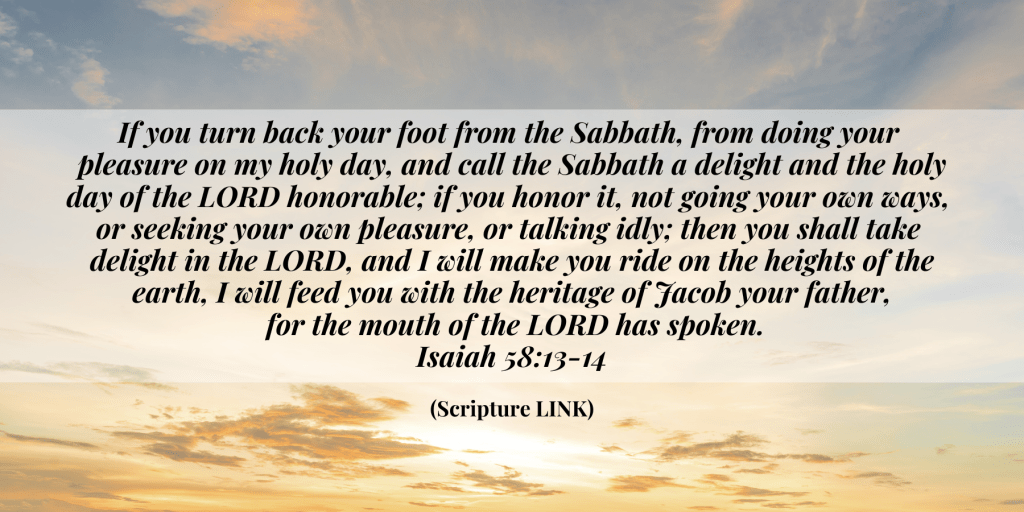
Who does not need a Godly measure of encouragement for today? Why? Because we all need space to exhale. Isaiah 58:13-14

Isaiah 58:13-14 New American Standard Bible

Keeping the Sabbath

13 “If, because of the Sabbath, you restrain your foot
From doing as you wish on My holy day,
And call the Sabbath a pleasure, and the holy day of the Lord honorable,
And honor it, desisting from your own ways,
From seeking your own pleasure
And speaking your own word,
14 Then you will take delight in the Lord,
And I will make you ride on the heights of the earth;
And I will feed you with the heritage of Jacob your father,
For the mouth of the Lord has spoken.”

Word of God for the Children of God

Glory be to the Father,
and to the Son, and to the Holy Ghost;
as it was in the beginning,
is now, and ever shall be,
world without end. Amen, amen.

Take some time to read the entirety of Isaiah 58 again.

Stop and pray after you read each verse and ask the Lord to reveal any ways your public worship is being negated by behavior in your private life.

Confess your sin to the Lord.

Consider asking a trusted friend to hold you accountable as you seek God’s change in your life.

What is one action you will change to reflect your commitment to worship God in your daily life?

 LIFE-GIVING ENCOURAGEMENT 

Hebrews 10:19–25 is such a favorite passage of mine..

Not only does it instruct us about the power of encouragement, but far more importantly, invites us to experience intimacy with Jesus through repentance.

When you are tempted to give up on life and your relationship with the Lord, make this a go-to scripture where you discover not only an invitation to run to Jesus but practical steps for personal and private worship in our everyday lives:

Hebrews 10:19-25 Amplified Bible

A New and Living Way

19 Therefore, [a]believers, since we have confidence and full freedom to enter the Holy Place [the place where God dwells] by [means of] the blood of Jesus, 20 by this new and living way which He initiated and opened for us through the veil [as in the Holy of Holies], that is, through His flesh, 21 since we have a great and  wonderful Priest [Who rules] over the house of God, 22 let us approach [God] with a true and sincere heart in unqualified assurance of faith, having had our hearts sprinkled  clean from an evil conscience and our bodies washed with pure water. 23  Let us seize and hold tightly the confession of our hope without wavering, for He who promised is reliable and trustworthy and faithful [to His word]; 24 let us consider [thoughtfully] how we may encourage one another to love and to do good deeds, 25 not forsaking our meeting together [as believers for worship and instruction], as is the habit of some, but encouraging one another; and all the more [faithfully] as you see the day [of Christ’s return] approaching.

In case you have not heard this before, truth is We All Need Space To Exhale.

Isaiah 58:13-14 Complete Jewish Bible

13 “If you hold back your foot on Shabbat
from pursuing your own interests on my holy day;
if you call Shabbat a delight,
Adonai’s holy day, worth honoring;
then honor it by not doing your usual things
or pursuing your interests or speaking about them.
14 If you do, you will find delight in Adonai —
I will make you ride on the heights of the land
and feed you with the heritage of your ancestor Ya‘akov,
for the mouth of Adonai has spoken.”

Rest. 

That sounds so good, but it’s really difficult for a soul like mine.

Even when my physical body is at rest, my mind rarely is.

I feel like I’m always juggling bowling balls in my brain.

Other people’s needs.

Home demands.

Work projects.

The to-do lists never stop growing.

Can you relate?

Yet the Bible makes it very clear we are to honor the Sabbath and pursue rest.

Proverbs 4:23-27 Complete Jewish Bible

23 Above everything else, guard your heart;
for it is the source of life’s consequences.
24 Keep crooked speech out of your mouth,
banish deceit from your lips.
25 Let your eyes look straight ahead,
fix your gaze on what lies in front of you.
26 Level the path for your feet,
let all your ways be properly prepared;
27 then deviate neither right nor left;
and keep your foot far from evil.

God commands us to hit the pause button on life once a week.

Guard our need to rest.

Guard it fiercely.

Guard it intentionally.

Guard it even if your schedules beg us to do otherwise.

But why?

There are personal reasons we need to observe the Sabbath that are unique for each person.

There are private conversations we need to have with God.

We all need to pause, sit with God, and ask Him to reveal some things to us.

But when I consider today’s key verses, something else also occurs to me.

Sabbath is not just a day for me to give to God.

It’s a day God established for me.

He wants to give me something, if only I’ll slow down enough to receive it:

“If you keep your feet from breaking the Sabbath and from doing as you please on my holy day, if you call the Sabbath a delight and the LORD’s holy day honorable, and if you honor it by not going your own way and not doing as you please or speaking idle words, then you will find your joy in the LORD …” (Isaiah 58:13-14).

The Sabbath isn’t merely a time to be observed; it’s a time to be preserved.

It’s a time to rediscover our joy in the Lord.

I need this.

I want to be a preserver of the Sabbath — one who is determined to protect this day and experience the delight of God.

The observer remembers to rest.

The preserver rests to remember that it’s all about God.

The observer pauses on the Sabbath day in order to follow a rule.

The preserver does more than follow a rule.

They follow God’s desire and embraces His purpose in the rest.

They spend one day a week letting the fresh wind of God’s rest blow through, clearing out what’s been taken in during the week, with a purifying soul exhale.

Psalm 139:23-24 Complete Jewish Bible

23 Examine me, God, and know my heart;
test me, and know my thoughts.
24 See if there is in me any hurtful way,
and lead me along the eternal way.

It’s all about pausing and connecting with God without the distracting chaos of our everyday routines so we can align with His rhythm.

God’s rhythm preserves a space in us to hear His voice, reveals the places where we’re off track, and clears unnecessary clutter.

Quiet rest allows us to see where we are going our own way, the areas where we are more self-pleasing than God-pleasing, idle words that need to be reined in.

During our downtime, we can deal with our mental clutter and focus solely on the ways of God.

The Sabbath makes this possible.

Taking one day for rest gives my soul the freedom it so desperately needs.

Space to breathe.

Inhaling and exhaling in a gentle rhythm set by God.

Sabbath is a holy and sacred gift from God, a time set apart for rest, worship, and reflection.

It reminds us of God’s creative power and his desire for us to experience his peace. In a culture that values productivity and constant activity, observing Sabbath requires our intentional commitment and trust in God’s provision.

When we honor the Sabbath, we accept our dependence on God’s faithfulness.

We cease from our usual work to delight in God’s presence and to prioritize relationships with him and others.

Sabbath rest allows us to recharge physically, emotionally, and spiritually to serve God and others throughout the week. Each Sabbath day is an invitation to enjoy the brevity of God’s rest, to align our hearts with his rhythms of grace.

If you long for spiritual refreshment and deeper intimacy with God, consider embracing the gift of Sabbath rest.

Set aside time to worship, pray, and reflect on God’s goodness. May each Sabbath remind you of God’s peace and too his desire for us to rest in him.

In the name of the Father and of the Son and of the Holy Spirit. Amen

Praying …..

Psalm 84 Complete Jewish Bible

84 (0) For the leader. On the gittit. A psalm of the sons of Korach:

2 (1) How deeply loved are your dwelling-places,
Adonai-Tzva’ot!
3 (2) My soul yearns, yes, faints with longing
for the courtyards of Adonai;
my heart and body cry for joy
to the living God.

4 (3) As the sparrow finds herself a home
and the swallow her nest, where she lays her young,
[so my resting-place is] by your altars,
Adonai-Tzva’ot, my king and my God.

5 (4) How happy are those who live in your house;
they never cease to praise you! (Selah)
6 (5) How happy the man whose strength is in you,
in whose heart are [pilgrim] highways.

7 (6) Passing through the [dry] Baka Valley,
they make it a place of springs,
and the early rain clothes it with blessings.
8 (7) They go from strength to strength
and appear before God in Tziyon.

9 (8) Adonai, God of armies, hear my prayer;
listen, God of Ya‘akov. (Selah)
10 (9) God, see our shield [the king];
look at the face of your anointed.
11 (10) Better a day in your courtyards
than a thousand [days elsewhere].
Better just standing at the door of my God’s house
than living in the tents of the wicked.

12 (11) For Adonai, God, is a sun and a shield;
Adonai bestows favor and honor;
he will not withhold anything good
from those whose lives are pure.

13 (12) Adonai-Tzva’ot,
how happy is anyone who trusts in you!

Glory be to the Father,
and to the Son, and to the Holy Ghost;
as it was in the beginning,
is now, and ever shall be,
world without end. Amen, amen.
https://translate.google.com/

Are we familiar with what the Bible Does NOT say about Resting in God? Psalm 116:1-7

Psalm 116:1-7 Revised Standard Version

Thanksgiving for Recovery from Illness

116 I love the Lord, because he has heard
    my voice and my supplications.
Because he inclined his ear to me,
    therefore I will call on him as long as I live.
The snares of death encompassed me;
    the pangs of Sheol laid hold on me;
    I suffered distress and anguish.
Then I called on the name of the Lord:
    “O Lord, I beseech thee, save my life!”

Gracious is the Lord, and righteous;
    our God is merciful.
The Lord preserves the simple;
    when I was brought low, he saved me.
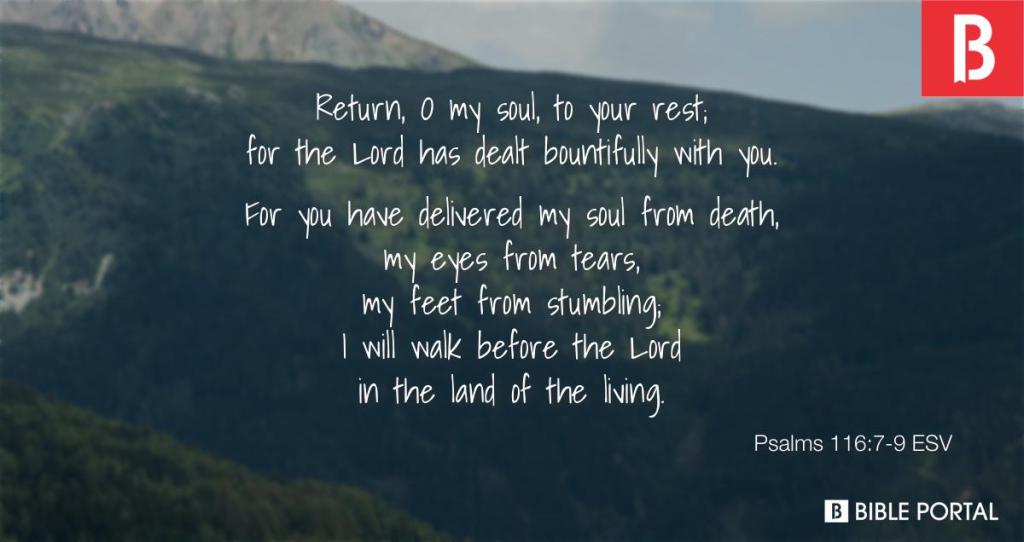
Return, O my soul, to your rest;
    for the Lord has dealt bountifully with you.

Word of God for the Children of God

Glory be to the Father,
and to the Son, and to the Holy Ghost;
as it was in the beginning,
is now, and ever shall be,
world without end. Amen, amen.
There are many different opinions about what it means to rest.

Is it a waste of time, and should we feel guilty about taking days off?

Does it only refer to sleeping, or taking it easy during an illness?

Is it the emphasis on self-care that we see so often in our culture today?

We do not have to get lost in the confusion of these questions or the endless examples we find online.

Scripture presents us with instruction about rest.

Based on God’s Word, we can understand what resting is and is not.

And we can learn to distinguish between the opinions of others and what the Lord has actually taught.

For rest is woven into creation and reflects the priorities of our Maker.

We would be unwise if we never pause to consider what it means to rest, or to search for the answers in the Book that God has provided. So, let us bring our assumptions and our ideas and hold them up to the perfect light of His Word.

1. Resting Is Not Laziness

Some may think that taking time to cease from normal activity and to recharge is laziness.

To be fair, there is a great deal of teaching in Scripture that denounces the lazy person – the one who refuses to work.

God is correct to warn us of laziness because refusing to work leads to many problems (Proverbs 10:4; 13:4; 20:4).

We should understand, then, why some individuals are wary of resting, because they fear they are engaging in slothfulness.

But to take time off to rest in the Lord and be recharged in soul, body, and mind, is not laziness.

To rest is to obey the Lord who set in place a rhythm of work and rest.

When God created everything in six days, He ceased from His labors on the seventh day and declared it holy (Genesis 2:2-3).

Our Lord rested – and He certainly was not acting in laziness.

After the fall of man, God knew that a sinful human tendency is to keep working to the neglect of our own wellbeing.

Hence, He set in place a command for the Israelites that they should observe the Sabbath (Exodus 20:8-11) and keep it Holy unto God.

This applied to people, both native-born Israelites and foreigners, but also to animals.

Just as slothfulness is an issue individuals can struggle with, so is overworking.

We are not machines designed solely for the purpose of executing tasks.

We are finite humans (Psalm 103:15-16) made in the image of God.

If our Creator rested from His divine labor, and has told us to do the same, then our proper response is obedience and gratitude, give thanks for the gift of rest.

2. Rest Is Not Selfish

Because so much of Western culture is centered on activity, completing tasks, we can feel guilty for slowing down or taking time off.

We may even think that prioritizing rest is a selfish choice.

Instead of ceasing from our labor and engaging in soul-refreshing activities, we assume we should exert all of our available energy to work and be productive.

Masked in this way, we fail to see the refusal to rest is based on the belief that we are in control of our lives, everything falls on our shoulders to accomplish.

Rest forces us to acknowledge and declare that we are dependent on someone other than ourselves.

It is an act that shows we need God.

We see this demonstrated in Israel’s wilderness wanderings.

The Lord instructed them to collect manna each day, but also to gather an extra portion on the sixth day (Exodus 16:23, 26).

They were to rest on the seventh day.

Yet, some of the Israelites did not listen and gathered manna on the Sabbath – they trusted in their ability to provide for themselves instead of trusting in God (Exodus 16:27-30).

The giving of the double portion on the day before the Sabbath was meant to teach the Israelites to depend on the Lord, not themselves.

Resting might feel selfish if we have always listened to what the world tells us.

However, the more we recognize our weakness, need for the Lord’s provision, the more we will prioritize rest.

Our lives do not run on our own effort or striving.

God is the One who is sustaining us (Colossians 1:17).

We lay down our guilt and rest, showing others we depend on the Lord alone.

3. Rest Is Not a Waste of Time

Stopping from our work for blocks of time – whether it is a day or two, or in intervals throughout the day – may appear disadvantageous.

Would we not make more money and get more accomplished if we worked without stopping?

For those who are results-driven or are struggling to make ends meet, there is the temptation to view rest as a waste of time.

We should feel compassion for those near and far who are compelled to work long shifts while still not making enough to live on.

Such conditions are unjust and inhumane.

As a church, we need to work together to break such cycles of enslaving poverty.

However, there are people who refuse to slow down despite having sufficient resources.

Or they convince themselves that they need to check off one more task before they can permit themselves sufficient rest.

In their mind, rest is a privilege instead of a need.

Throughout Scripture, we find God’s call for us to come to Him.

We are invited to cease our striving, be still, and know that the Lord is God (Psalm 46:10).

To get away with Him to rest (Mark 6:31).

Instead of trying to please God with our endless activities, Jesus beckons us to,

“Come to me, all of you who are weary and carry heavy burdens, and I will give you rest. Take my yoke upon you. Let me teach you, because I am humble and gentle at heart, and you will find rest for your souls. For my yoke is easy to bear, and the burden I give you is light” (Matthew 11:28-30).

He provides our ultimate rest through salvation.

Stopping from our normal work and endless to-do lists allows us to refuel.

An empty cup does not have much to give.

We must first be filled before we can give of ourselves in service to the Lord.

And how He will fill us! As David said, “my cup overflows” (Psalm 23:5).

4. Rest Is Not a Legalistic Rule

During New Testament times, the Jewish people followed a strict observance of the Sabbath.

Many of them believed adherence to this rule bought them favor with God.

So, when Rabbi Jesus began healing people on the Sabbath, lots of Pharisees and scribes objected.

As the synagogue ruler said after Jesus healed a woman who had been crippled for eighteen years:

“There are six days for work. So come and be healed on those days, not on the Sabbath” (Luke 13:14).

But Jesus rebuked them, pointing out their hypocrisy.

They led their livestock to water on the Sabbath, which could be categorized as “work.”

Yet this woman, a daughter of Abraham, who had suffered because of the work of Satan, was even more valuable. Should she not “be set free on the Sabbath day from what bound her?” (Luke 13:16).

The Lord of the Sabbath, Jesus, said it was lawful to do right on the day of rest (Matthew 12:12).

As Jesus taught, the Sabbath was made for people, not people for the Sabbath (Mark 2:27-28).

God set it in place to benefit humankind.

Since the Pharisees and others had changed the day of rest into a legalistic rule and burden, they utterly missed the purpose and blessing of God’s command.

We, too, can misunderstand the principle of rest.

Jesus fulfilled the Law, including the Sabbath (see Romans 10:4).

As a result, believers are no longer under the Law, but under grace (Romans 6:14).

However, the principle of rest for the flourishing of humankind still applies.

Rest is a gift from the Lord, not something we should make as a rule to earn salvation.

5. Rest Is Not Unspiritual

Taking a vacation.

Allowing ourselves to enjoy an afternoon with family and friends.

Appreciating time spent doing a hobby or engaging in an enjoyable activity.

These are all good things, but we may be inclined to think that they have nothing to do with our faith.

We may even believe that such activities are unspiritual or do not affect our walk with Christ.

The opposite, though, is true.

When we mark off time to rest, we are declaring our trust in the Lord.

We acknowledge our weakness and limitations – that we are humans who have spiritual, emotional, and physical needs.

In many ways, rest is an act of faith.

For choosing to step away from schedules and work obligations requires that we entrust our needs, problems, and plans to God.

Many of us fret and toil thinking that we are reliant on ourselves, forgetting that it is from God that we receive the ability to work and provide for ourselves (Deuteronomy 8:17-18).

As Psalm 127:2 says,

“It is useless to get up early and stay up late in order to earn a living. God takes care of his own, even while they sleep.”

We do not have to anxiously work as if everything depended on us.

Likewise, we can engage in rest trusting God will continue to meet our needs.

He is the source of our life and salvation, not ourselves.

As we rest in faithfulness, we look forward to the ultimate rest that awaits us in eternity (Hebrews 4:9-11).

This is the final rest that is the culmination of our faith – living forever with the Lord in His Kingdom, and on the New Earth.

Until then, continue to follow Jesus, obeying Him in our working and resting.

In the name of God, the Father the Son and the Holy Spirit

Praying …..

Psalm 121 Revised Standard Version

Assurance of God’s Protection

A Song of Ascents.

121 I lift up my eyes to the hills.
From whence does my help come?
My help comes from the Lord,
    who made heaven and earth.

He will not let your foot be moved,
    he who keeps you will not slumber.
Behold, he who keeps Israel
    will neither slumber nor sleep.

The Lord is your keeper;
    the Lord is your shade
    on your right hand.
The sun shall not smite you by day,
    nor the moon by night.

The Lord will keep you from all evil;
    he will keep your life.
The Lord will keep
    your going out and your coming in
    from this time forth and for evermore.

Glory be to the Father,
and to the Son, and to the Holy Ghost;
as it was in the beginning,
is now, and ever shall be,
world without end. Amen, amen.

https://translate.google.com/

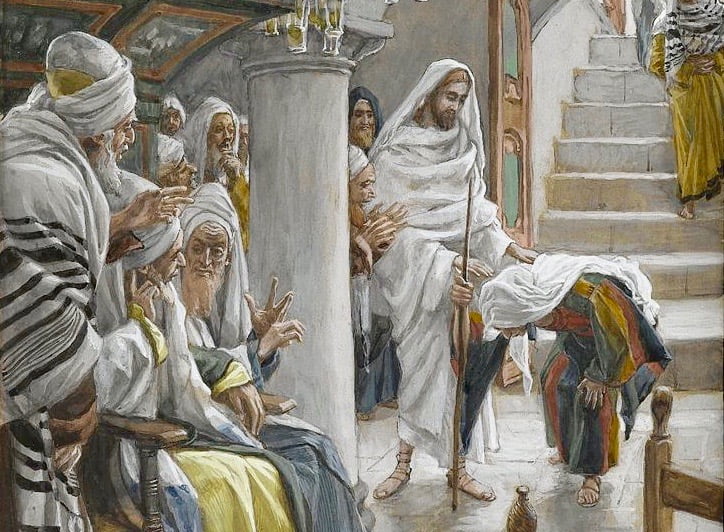
Jesus has just dared to heal a crippled woman on the Sabbath! Luke 13:10-17

Luke 13:10-17 New American Standard Bible

Healing on the Sabbath

10 Now Jesus was teaching in one of the synagogues on the Sabbath. 11 And [a] there was a woman who for eighteen years had had a [b]sickness caused by a spirit; and she was bent over double, and could not straighten up at all. 12 When Jesus saw her, He called her over and said to her, “Woman, you are freed from your sickness.” 13  And He laid His hands on her; and immediately she stood up straight again, and began glorifying God. 14 But the synagogue leader, indignant because Jesus had healed on the Sabbath, began saying to the crowd in response, “There are six days during which work should be done; so come during them and get healed, and not on the Sabbath day.” 15 But the Lord answered him and said, “You hypocrites, does each of you on the Sabbath not untie his ox or donkey from the stall and lead it away to water it? 16 And this woman, a daughter of Abraham as she is, whom Satan has bound for [c]eighteen long years, should she not have been released from this restraint on the Sabbath day?” 17 And as He said this, all His opponents were being [d] humiliated; and the entire crowd was rejoicing over all the glorious things being done by Him.

Word of God for the Children of God

Glory be to the Father,
and to the Son, and to the Holy Ghost;
as it was in the beginning,
is now, and ever shall be,
world without end. Amen, amen.

Everyone probably knew her as the bent-over woman.

She came to worship at the synagogue regularly.

But she was recognized by her condition, not her identity as a child of God or even by her name.

Her neighbors saw her through eyes of pity.

The religious leaders saw her as an example of someone who was not right with God and deserved her plight.

She came into the synagogue every Sabbath crippled with pain, bent over in her shame and humiliation, lack of self esteem, and thirsty for the living water of healing from God. Yet no one paid, no one paying attention or really saw her.

For an astonishing eighteen years the religious leaders, one after the other neglected their office, failed to pray with her on the six days when they had every opportunity to comfort, anoint her with oil and pray for God’s healing.

They were more focused on keeping their religious rules than seeing the need to be compassionate, kind, bring a daughter of Israel before the mercy seat of God.

But Jesus saw her.

When he called her forward, she might have thought he meant someone else.

But Jesus was speaking to her, and she slowly shuffled toward him, who saw her as a reject in need of being set free from her unimaginable measure of burden.

Do we see people this way—burdened and distressed?

Do we bring them to Jesus for healing?

In what ways can you offer comfort and prayer for someone like that today?

As we look closer we should also notice this woman, along with the woman with the 12 year issue of blood had one of the worst illnesses recorded in the Bible.

She had a severe illness; she was stricken by a severe infectious disease.1

But beside her having issues going on in her body, she had just got healed, she really had some other problems going on, specifically problems with the people.

But if you notice the problems didn’t arise because our Lord Jesus healed her, but the primary problem arose because the Lord healed her on the Sabbath day.

They were upset because this healing that the Lord was doing was not just a onetime deal, but because the Lord healing of people on the Sabbath day was a reoccurring source of big contention between Himself and the religious rulers.

And if we really looked at this, the rulers of the synagogue were a bunch of hypocrite because they treated animals better than he treated people. They would rather take extra care of animals then the men and women of God.

And let’s be honest here.

Because suppose the woman would have come to the synagogue on another day.

Could Jesus had healed her on another day without any issues?

Of course not, because there are some people that no matter what you do, or what you say they will always have something bad to say.

No matter how many people are getting healed, no matter how many people are getting saved, no matter how many people are being delivered there will always be some haters in the crowd.

And that makes me wonder.

I wonder how many needy people come to church looking for love, looking help and relief, and go away disappointed because of some hypocrites and some hell raisers, or people keeping up dissension or discord.

How many people are leaving the church because church members are fighting against one another? Lying on one another and just being too hypocritical?

And one of the great tragedies of religion is that religious needs are often placed before man and their needs. But what I love is Jesus met this problem head-on.

My question is, when are we going to trust God, and not how things look. When are we going to believe the Word of God, and not lean to our on understanding?

This woman had a spirit of infirmity that had plagued her for eighteen years.

Dr. Luke described her condition as “this spirit of infirmity” as thou she had a curvature, a curving, a bend, a twisting or a bending of the spine.

This really sounds like some form of arthritis where the joints of the spine were fused together.

Her illness was chronic, and incurable, and because of it she was bowed down low by Satan or, you could say “bent double.”

This poor woman could not lift herself up.

Here was a woman in a desperate condition.

She was an unfortunate victim who was an object of pity. This was probably one of the most terrible cases of physical infirmity that the Lord dealt with on earth.

And only Luke mentions this bent-over woman who had spent the previous eighteen years staring at the floor.

She was unable to stand up, sit up, look up, or even straighten up.

Her back was crooked, arched and humped.

Here is the text.

Jesus and His disciples had traveled through her city on their way from Galilee to Judea.

They entered the synagogue on the Sabbath to teach, that was the Lord’s practice; to be in the Synagogue, or in church if you will every Sabbath. (pause)

Notice that when Jesus saw her, he called her to him.

It does not appear she made any request to him for healing, or that she expected anything from him; but Jesus called her and she answered.

And I think that’s where we’ve got to get to today.

And that is whenever the Lord calls us we’ve got to learn to answer the call.

We’ve got to learn to move when the Lord is beckoning for us, because if God is calling us then that means that there is a blessing in the call. There is a blessing on the way; and there is a blessing in the response to Jesus.

She came to Jesus, and after Jesus tender touch, he spoke the words, women thou art loose, for the first time in eighteen years, this “daughter of Abraham” straightened her back, stretched to her full height.

So, among the sons of Abraham, who perhaps now hung their heads in shame, here she held her head high to the glory of God.

What an amazing word, when the Lord touches us things will straighten up in our life. And then we need to give God the glory.

And the second word for you this morning, knowing some of you have been going through some issues down through the years, I’ve come to tell you this day that thou are loose.

Turn to your neighbor and help me free somebody in here this morning, tell them neighbor you art free.

3X’s neighbor you are healed, come on tell you neighbor that you are delivered.

Whatever you are going through thou are free, whatever is ailing you thou are free, whatever is keeping you down thou are free, whatever has you bound thou are free, has you bent over, straighten up because thou are loose, and set free.

And watch this: nothing honors the Savior any more than a heart of gratitude and a spirit of praise.

And there is something I think that you all ought to know about this woman.

And that is before Jesus healed this woman, this woman was a worshipping.

Despite her agony, it remained her habit to worship, and to seek the face of God.

In other words, she was where she was supposed to be there on this particular Sabbath: she was supposed to be there in worship. She was supposed to be at church. She was scheduled to be in praise and worship – no agony too great!

And because she was there that she received this special touch from God.

Somebody might ask why her, why did she receive the blessing.

Why did she get the Lord attention?

It was because she was so sincere in seeking God and His care.

And this blessing was fulfilling what the scripture said in Psalms 146:8 which says, “The Lord raiseth them that are bowed down.”

And for somebody who is bowed this morning, I tell you are in the right place at the right time, you might be bowed down in your body, in your spirit, but if you are sincere in seeking the Lord, His promise is to lift up your bowed down head.

Psalm 113:7-9 New King James Version

He raises the poor out of the dust,
And lifts the needy out of the ash heap,
That He may seat him with princes—
With the princes of His people.
He grants the [a]barren woman a home,
Like a joyful mother of children.

Praise the Lord!

I don’t know why this woman had been bound by Satan.

Because apparently she was not a wicked person, she was not a immoral person, she was not known for showing up every not every now and then, but she was known as a regular steady attendant at the synagogue despite her condition.

She didn’t care about how she looked or felt, she showed up for worship, she didn’t care who liked her and who didn’t like her, she showed up for church.

She didn’t worry about the gossipers, she showed up in the house of the Lord.

It was at the synagogue that the Great Physician (the Lord himself) said to her, “Be loosed.”

And then He laid His hands on her and immediately she was made straight and glorified God.

The bible said that he touched her. The reason He touched her was to aid her faith. And I believe that somebody just need a touch for the Lord this morning.

But here was the amazing part.

After such a good day at church here comes the hater.

Has anyone ever had a great worship experience at church and before you get home it just seems like there is someone with their negative attitude, spoiled and all with their messy, extra messy self, and they just ruin all of the goodness that you just receive that day?

Look at the haters after she has received, her miracle that she had been waiting on for over eighteen years, the ruler of the synagogue rebuked her sharply.

The reaction of the religious ruler was strange.

Because they were more interested in the rule, than the fact a poor woman, who had been shackled for eighteen long years with an infirmity, had been freed.

The Sabbath rules were far more important issue to these religious rulers then the healing of a poor soul.

And still until there are people who are more concerned about paper work than they are souls.

This day the Sabbath question is still one of heated debate today.

Jesus’ reply was that the Sabbath was not intended to prevent the works of necessity or mercy.

But I love what the Lord said.

The Lord then answered him, and said, Thou hypocrite, doth not each one of you on the Sabbath loose his ox, or their asses from the stall, and lead him away to watering? And ought not this woman, being a daughter of Abraham, whom Satan hath bound these eighteen years shouldn’t she be loosed from this bond on the Sabbath day?

It is odd that Jesus referred to the woman as “a daughter of Abraham,” since such a description is usually reserved for the “sons” of Abraham.

But in front of all the upright religious people, Jesus gave this humble woman a place of honor when He confirmed she, too, belonged to the family of Abraham.

(Luke 13:17) And when he had said these things, all of his enemies were ashamed: and all the people of God rejoiced for all the glorious things that were done by him.

And I write to tell somebody this day, don’t let nobody get in the way of you being blessed by God.

Don’t let nobody get in the way of you receiving your miracle.

I came to tell you woman

I came to tell you man

I came to tell child

I came to tell you boy

And I came to tell you girl

You are freed in the Lord

And I don’t know who you are this day but if you need a touch from the Lord just reach up and grab it.

If you need a blessing from the Lord please just reach up and grab it.

If you need some burden just lifted up of your hands unto the Lord and just reach up and grab.

Because I heard when praises goes up blessing will come down.

Is there anybody in the room that needs a blessing?

Please don’t let nobody get in your way from a blessing, don’t let anybody hold you back from receiving what God has for you.

Because the haters will come and hate whatever and the haters will go but just know that as long as you have got Jesus on your side you are in good shape.

In fact that’s what he died on an old rugged cross.

And if Jesus can heal this woman surly he can heal you.

In the name of God, the Father the Son and the Holy Spirit …

Praying …

Psalm 146 New King James Version

The Happiness of Those Whose Help Is the Lord

146 Praise[a] the Lord!

Praise the Lord, O my soul!
While I live I will praise the Lord;
I will sing praises to my God while I have my being.

Do not put your trust in princes,
Nor in [b]a son of man, in whom there is no [c]help.
His spirit departs, he returns to his earth;
In that very day his plans perish.

Happy is he who has the God of Jacob for his help,
Whose hope is in the Lord his God,
Who made heaven and earth,
The sea, and all that is in them;
Who keeps truth forever,
Who executes justice for the oppressed,
Who gives food to the hungry.
The Lord gives freedom to the prisoners.

The Lord opens the eyes of the blind;
The Lord raises those who are bowed down;
The Lord loves the righteous.
The Lord watches over the strangers;
He relieves the fatherless and widow;
But the way of the wicked He [d]turns upside down.

10 The Lord shall reign forever—
Your God, O Zion, to all generations.

Praise the Lord!

Glory be to the Father,
and to the Son, and to the Holy Ghost;
as it was in the beginning,
is now, and ever shall be,
world without end. Amen, amen.

https://translate.google.com/

Any Significance to even minimally keeping God’s Covenant of Sabbath Rest? Does Sabbath mean anything? exodus 20:8-10

Exodus 20:8-10 Amplified Bible

“Remember the Sabbath (seventh) day to keep it holy (set apart, dedicated to God). Six days you shall labor and do all your work, 10 but the seventh day is a Sabbath [a day of rest dedicated] to the Lord your God; on that day you shall not do any work, you or your son, or your daughter, or your male servant, or your female servant, or your livestock or the temporary resident (foreigner) who stays within your [city] gates.

Word of God for the Children of God

Glory be to the Father,
and to the Son, and to the Holy Ghost;
as it was in the beginning,
is now, and ever shall be,
world without end. Amen, amen.

I recall a few time when I purposely neglected God’s day of rest and found myself overwhelmed by busyness and stress. A friend (my wife) read Exodus 20:8-10 with me and encouraged me (as I had previously encouraged her) to set aside time each week for rest and reflection, trusting that God’s commandment to rest is not just for physical rejuvenation but also for spiritual renewal.

This Sabbath is a sacred covenant from God, a time set apart for rest, worship, and reflection. It reminds us of God’s creative power and his desire for us to take a day, removed from our chaos to experience his peace. In a culture that exclusively values 110% productivity and constant activity, observing Sabbath requires intentional commitment, sacred discipline, trust in God’s provision.

When we authentically honor the Sabbath, we accept our dependence on God and his faithfulness. We genuinely cease from our usual work day to delight in God’s presence and to exclusively prioritize relationships with him and others.

Sabbath rest allows us to recharge physically, emotionally, and spiritually to serve God and others throughout the week. Each Sabbath day is an invitation to enjoy God’s rest and to align our hearts and souls with his rhythms of grace.

If you long for spiritual refreshment and deeper intimacy with God, consider embracing the gift of Sabbath rest.

Observe the Sabbath day, to keep it holy. Work six days and do everything you need to do. But the seventh day is a Sabbath to God, your God. Don’t do any work—not you, nor your son, nor your daughter, nor your servant, nor your maid, nor your animals, not even the foreign guest visiting in your town. For in six days God made Heaven, Earth, and sea, and everything in them; he rested on the seventh day. Therefore God blessed the Sabbath day; he set it apart as a holy day.

Set aside time to worship, pray, and reflect on God’s goodness. May each day of authentic Sabbath remind you of God’s love and his desire for us to rest in him.

In the name of God, the Father and God the Son and God the Holy Spirit,

Praying …

23 1-3 God, my shepherd!
    I don’t need a thing.
You have bedded me down in lush meadows,
    you find me quiet pools to drink from.
True to your word,
    you let me catch my breath
    and send me in the right direction.

Even when the way goes through
    Death Valley,
I’m not afraid
    when you walk at my side.
Your trusty shepherd’s crook
    makes me feel secure.

You serve me a six-course dinner
    right in front of my enemies.
You revive my drooping head;
    my cup brims with blessing.

Your beauty and love chase after me
    every day of my life.
I’m back home in the house of God
    for the rest of my life.

Glory be to the Father,
and to the Son, and to the Holy Ghost;
as it was in the beginning,
is now, and ever shall be,
world without end. Amen, amen.

https://translate.google.com/

His Hardest Covenant: to Remember that Sabbath (seventh) day to keep it holy and set apart, dedicated to God. Exodus 20:8-11

Exodus 20:8-11 Amplified Bible

“Remember the Sabbath (seventh) day to keep it holy (set apart, dedicated to God). Six days you shall labor and do all your work, 10 but the seventh day is a Sabbath [a day of rest dedicated] to the Lord your God; on that day you shall not do any work, you or your son, or your daughter, or your male servant, or your female servant, or your livestock or the temporary resident (foreigner) who stays within your [city] gates. 11 For in six days the Lord made the heavens and the earth, the sea and everything that is in them, and He rested (ceased) on the seventh day. That is why the Lord blessed the Sabbath day and made it holy [that is, set it apart for His purposes].

Word of God for the Children of God.

Glory be to the Father,
and to the Son, and to the Holy Ghost;
as it was in the beginning,
is now, and ever shall be,
world without end. Amen, amen.

What does God mean when he says “Remember the Sabbath day to keep it holy”?

The word Sabbath comes from a Hebrew word that means “to rest from labor.”

The word holy means something that is sacred or dedicated to God.

God covenants with us to make His Sabbath day, feel different from all other days of the week by resting from our normal daily routine and dedicating our thoughts and time to Him.

What does Exodus 20 verse 8 mean?

This verse firmly establishes the Sabbath as law, a command to be kept.

Yet, it is very clear that this law has its first roots in Genesis 2:1-3, for there, God set the example in what He did. He rested, and He blessed the seventh day. God could have rested at any time. Or, we might say, He needed no rest, naps, at all.

How do you and I honor the Sabbath and keep it holy?

The Bible requires that we observe the Sabbath day with gathered worship, but that is not all we should do. 

Prayer, solitude, journaling, reading and reflection are all crucial ways that we replenish our inward resting in Christ and his work alone for our salvation.

What does “honor the Sabbath” mean?

How are any of us to honor the Sabbath in our smart phone, internet, social media, satellite, fiber optic, technology driven times – How should any of us keep ourselves from perpetually, ritually, looking down at the phone, risking bodily injury versus establishing, practicing, disciplining ourselves to look up at God the Creator, Author and finisher of our faith?

A few suggestions …

  • Rest: Avoid work and allow the whole family to rest
  • Worship: Attend church, read scripture, pray
  • Enjoy: Delight in God’s gifts and enjoy life with God
  • Set apart: Make a distinction between the Sabbath and the rest of the week
  • Sanctify: Dedicate the Sabbath to the Lord

The first Four Words of the Ten Commandments are calls to worship. 

  • The First Word commands the proper object of worship: “You shall have no other gods before me.”
  • The Second Word commands the proper manner of worship: “You shall not make for yourself a carved image.”
  • The Third Word commands the proper attitude of worship: “You shall not take the name of the Lord your God in vain.”
  • The Fourth Word commands the proper time of worship: “Remember the Sabbath day, to keep it holy” 

We must worship God exclusively, correctly, reverently, and regularly. If you are not careful, life will crowd God out. But redeemed people must never forget to make proper time for the God who created us, sustains us, and redeemed us. Ray Pritchard said: We give 1 day in 7 to God because 7 out of 7 belong to him!!! 

A man was approached by a beggar on the street. The man reached into his pocket to see what he had. Finding seven dollars and feeling sorry for the beggar, he held out six bills and said, “Here you go.”

Not only did the beggar take the six dollars, but with his other hand he struck his benefactor across the face and grabbed the seventh dollar, too. 

As terrible as that story may seem to you, many of us should hear the prophet Nathan saying to us at this point, “You are the man!” God has graciously given us six days. In arrogant ingratitude, we snatch the seventh day, as well!

We must learn to make time for God. If you are too busy to make time for God, you are too busy. Consider the principle, prescription, practice of the Sabbath. 

The Principle of the Sabbath 

  1. The Fourth Word charges us to be faithful stewards of the gift of time.

It teaches three ways to sanctify our time. 

A Call to Worship. Exodus 20:8 commands: “Remember the Sabbath day, to keep it holy.” 

This command to remember the Sabbath indicates Israel already knew about it.

After God delivered Israel from Egypt, God provided manna for them to eat.

When the Israelites woke up each morning, manna was on the ground.

The Israelites collected manna to feed their household for the day.

On the sixth day, the Israelites were to collect twice as much, because God provided no manna on the seventh day. 

Exodus 16:23 says, “This is what the Lord has commanded: ‘Tomorrow is a day of solemn rest, a holy Sabbath to the Lord.’” 

Now God commands Israel: “Remember the Sabbath day, to keep it holy.”

The word “holy” means to set apart for the purposes of God.

In scripture, certain people, places, and things are called holy.

The Fourth Commandment teaches certain times are also holy.

The Sabbath was to be remembered so keep it holy. 

  • It is a call to worship.
  • It is a call to seta side time for God.
  • It is a call to schedule time for God’s sake.

Matthew Henry wrote, “The Sabbath was made a day of holy rest so that it might be a day of holy work.”

God works. The devil is busy. But the devil cannot out-busy God. 

  • God never takes a break.
  • God never calls in sick.
  • God never takes a vacation.
  • God is always at work.
  • God works the night shift.
  • God finishes the work he begins.

God is both a white-collar executive and a blue-collar laborer.

God speaks and it comes to pass.

God moves and things happen. Our God works. And God commands us to work. To be godly is to work. Arthur W. Pink wrote, “He who never works is unfit for worship. Work is to pave the way for worship, as worship is to fit us for work.”  

Exodus 20:9-10 “Six days you shall labor, and do all your work, but the seventh day is a Sabbath to the Lord your God. On it you shall not do any work.” 

This commandment is not restrictive.

In sovereign authority, infinite wisdom, and unchanging goodness, our heavenly Father commands us to rest.

It is a personal call to rest.

God knows you cannot make it without rest, refreshment, and rejuvenation.

So he gave us this human maintenance schedule. 

  • God calls those who will not work lazy. 
  • God calls those who will not rest disobedient. 

It is a communal call to rest.

Verse 10 says: “On it you shall not do any work, you, or your son, or your daughter, your male servant, or your female servant, or your livestock, or the sojourner who is within your gates.” 

There are seven categories listed here.

This all-inclusive call to rest affirms equality and justice for all, the precious nature of creation, and the dignity of people from foreign lands. 

Our family, coworkers, and possessions belong to God.

Every person is a person of value created in the image of God.

The Lord affirmed this by calling the entire community – including cattle – to rest on the Sabbath. 

It is a spiritual call to rest. 

Exodus 20:11 explains: “For in six days the Lord made heaven and earth, the sea, and all that is in them, and rested on the seventh day. Therefore the Lord blessed the Sabbath and made it holy.” 

God created the world in six days and rested on the seventh day.

God did not rest because he was tired. 

Isaiah 40:28 says, “He does not fair or grow weary.” 

God rested to set a pattern for us to follow.

The Lord blessed and sanctified the seventh day to remind us he alone is our  Creator, Sustainer, and Redeemer.

Our lives do not depend on our work.

It depends on God’s work. 

In the name of God, the Father and God the Son and God the Holy Spirit,

Pray …

Psalm 29 Amplified Bible

The Voice of the Lord in the Storm.

A Psalm of David.

29 [a]Ascribe to the Lord, O [b]sons of the mighty,
Ascribe to the Lord glory and strength.

Ascribe to the Lord the glory due His name;
Worship the Lord in the beauty and majesty of His holiness [as the creator and source of holiness].


The voice of the Lord is upon the waters;
The God of glory thunders;
The Lord is over many waters.

The voice of the Lord is powerful;
The voice of the Lord is full of majesty.

The voice of the Lord breaks the cedars;
Yes, the Lord breaks in pieces the cedars of Lebanon.

He makes Lebanon skip like a calf,
And Sirion (Mount Hermon) like a young, wild ox.

The voice of the Lord rakes flames of fire (lightning).

The voice of the Lord shakes the wilderness;
The Lord shakes the wilderness of Kadesh.

The voice of the Lord [c]makes the doe labor and give birth
And strips the forests bare;
And in His temple all are saying, “Glory!”

10 
The Lord sat as King at the flood;
Yes, the Lord sits as King forever.
11 
The Lord will give [unyielding and impenetrable] strength to His people;
The Lord will bless His people with peace.

Glory be to the Father,
and to the Son, and to the Holy Ghost;
as it was in the beginning,
is now, and ever shall be,
world without end. Amen, amen.

https://translate.google.com/

A song of praise for God’s Creating, and our Keeping(?) His Sabbath Holy. Psalm 92

Psalm 92 Complete Jewish Bible

92 (0) A psalm. A song for Shabbat:

2 (1) It is good to give thanks to Adonai
and sing praises to your name, ‘Elyon,
3 (2) to tell in the morning about your grace
and at night about your faithfulness,
4 (3) to the music of a ten-stringed [harp] and a lute,
with the melody sounding on a lyre.

5 (4) For, Adonai, what you do makes me happy;
I take joy in what your hands have made.
6 (5) How great are your deeds, Adonai!
How very deep your thoughts!

7 (6) Stupid people can’t know,
fools don’t understand,
8 (7) that when the wicked sprout like grass,
and all who do evil prosper,
it is so that they can be eternally destroyed,
9 (8) while you, Adonai, are exalted forever.

10 (9) For your enemies, Adonai,
your enemies will perish;
all evildoers will be scattered.
11 (10) But you have given me
the strength of a wild bull;
you anoint me with fresh olive oil.
12 (11) My eyes have gazed with pleasure on my enemies’ ruin,
my ears have delighted in the fall of my foes.

13 (12) The righteous will flourish like a palm tree,
they will grow like a cedar in the L’vanon.
14 (13) Planted in the house of Adonai,
they will flourish in the courtyards of our God.
15 (14) Even in old age they will be vigorous,
still full of sap, still bearing fruit,
16 (15) proclaiming that Adonai is upright,
my Rock, in whom there is no wrong.

The Word of God for the Children of God

Glory be to the Father,
and to the Son, and to the Holy Ghost;
as it was in the beginning,
is now, and ever shall be,
world without end. Amen, amen.

Today we pause from our regular Category 5 rhythms of our stormy daily lives to strictly focus on the God of the universe. And so he now calls us to worship!

This day, as we measure the gap between chaos and God, as we solemnly reflect on what it means to be Jesus’ witnesses wherever we go, it can be tempting to think that this work is on our shoulders. If we don’t do it, who will? So God’s gift of Sabbath helps us remember that ultimately this is God’s work, not ours.

Psalm 92 expresses very similar feelings toward God. “You make me glad by your deeds, Lord; I sing for joy at what your hands have done. How great are your works, Lord, how profound your thoughts!” What a relief it is to know that this world sits firmly in God’s capable, good hands. He has not stopped working; rather, has prepared good works for us to do in his kingdom (Ephesians 2:10).

Sabbath gives us an opportunity to step away from Category 5 days, join with our fellow brothers and sisters to praise and honor the One who has already done it all for us. We have a God who has already modeled Sabbath. We have a Savior who walks with us on mission, wherever God has called us! Hallelujah!

When I was involved in full-time or part-time church ministry, Sunday was usually my busiest and most stressful day of the week.

By Sunday night, I was whipped. Unfortunately, I gave myself no rest. I often got up on 0500Monday morning and hit the bible hard again. Sound familiar?

Granted, I took a week off in the summer and after Christmas, but not much else. I ran on adrenaline and two-liter bottles of Diet Coke.

About five years later, I’d got burned out and have to hit the “reset” button.

All work and no time for myself put me on the Coronary Care Unit in desperate need of a Triple Bypass Open Heart Surgery to save my life – 1% from a grave.

People admired my passion and applauded my high tenacity for my spiritual discipline – but the Heart Surgeon later admonished me for working too hard.

But looking back, working 24/7 wasn’t healthy…and it isn’t .01% scriptural.

The Lord commanded His people to observe a weekly Sabbath without work to commemorate that He created then rested (Genesis 1) and when He gave to Moses his mission and liberated the Hebrews from bondage, led them through the waters to His Mountain, then gave His 10 Commandments. (Exodus 20:8).

In Old Testament days, Sabbath-keeping, along with circumcision and other rituals, helped to distinguish Israel from the surrounding nations.

But Jesus makes it clear that “God made the Sabbath for man, not man for the Sabbath” (Mark 2:27). Our Heavenly Father ordained the gift of rest because our wellbeing, our “obedience to his commandments” gives Him delight and brings Him glory and gives us a disciplined pattern of taking care of ourselves.

Resting on the seventh day is therefore a blessing–not a burden. It’s not a measure of spiritual superiority; rather, it’s an admission that every single one of us needs rest, reflection and restoration…and we need it every week.

So how can people in ministry and mission–whether clergy or laity, especially worship ministry-finally come to discipline themselves to experience Sabbath?

Here are three suggestions:

  • Set Your Sabbath. Schedule a specific day (or consecutive half-days over a 24 hour period) as your “seventh day.” The Jews observed Saturday as their Sabbath and first century believers celebrated resurrection Sunday as “The Lord’s Day.” That makes me think God is not as concerned with which seventh day we observe as long as we set one aside.

    What day is your Sabbath? Write it on your calendar.
     
  • Keep Your Sabbath. Let’s not be legalistic about this, but “not working” seems to be the operational phrase in Fourth Commandment. For me, “work” means earning my livelihood. Keeping my Sabbath means I consciously choose to defer my job to another day. It means I resist checking my office email or working on that spreadsheet.

    What specific boundaries would you set to help you keep your Sabbath?
    Share these with a close friend or family member.

     
  • Celebrate Your Sabbath. Saying “no” to work for one day a week means I can say “yes” to things that working might otherwise prevent me from doing: spiritual enrichment, enjoying my family, friends, recreation at the beach or mountains, tending my lawn and garden, playing with my dog or napping on the couch. My Sabbath (which happens to be Sunday) is now my favorite day.

What can you do to make your Sabbath especially meaningful and restorative?

 Commit to doing these things for the next four weeks and see what happens!

It wasn’t till later in my life that I really learned how invaluable a Sabbath could be. If I went seven straight days without a break, I got fried…and the next seven days were even worse. So I “religiously” began to observe a Sabbath, and the discipline of “not working” made the other 6 days more productive than ever.

Work is good. After all, we are created for good works (Ephesians 2:10).

But we are better workers–and worshippers–when we are disciplined, re-energized through the blessing of a weekly Sabbath.

So as God long ago commanded, give it a rest!

Set, keep and celebrate your Sabbath—and I sincerely believe you will soon be a significantly healthier person and a more effective ministry and mission leader.

In the name of God, the Father and God the Son and God the Holy Spirit,

Let us Pray,

Psalm 23 Complete Jewish Bible

23 (0) A psalm of David:

(1) Adonai is my shepherd; I lack nothing.
He has me lie down in grassy pastures,
he leads me by quiet water,
he restores my inner person.
He guides me in right paths
for the sake of his own name.
Even if I pass through death-dark ravines,
I will fear no disaster; for you are with me;
your rod and staff reassure me.

You prepare a table for me,
even as my enemies watch;
you anoint my head with oil
from an overflowing cup.

Goodness and grace will pursue me
every day of my life;
and I will live in the house of Adonai
for years and years to come.

Glory be to the Father,
and to the Son, and to the Holy Ghost;
as it was in the beginning,
is now, and ever shall be,
world without end. Amen, amen.

https://translate.google.com/