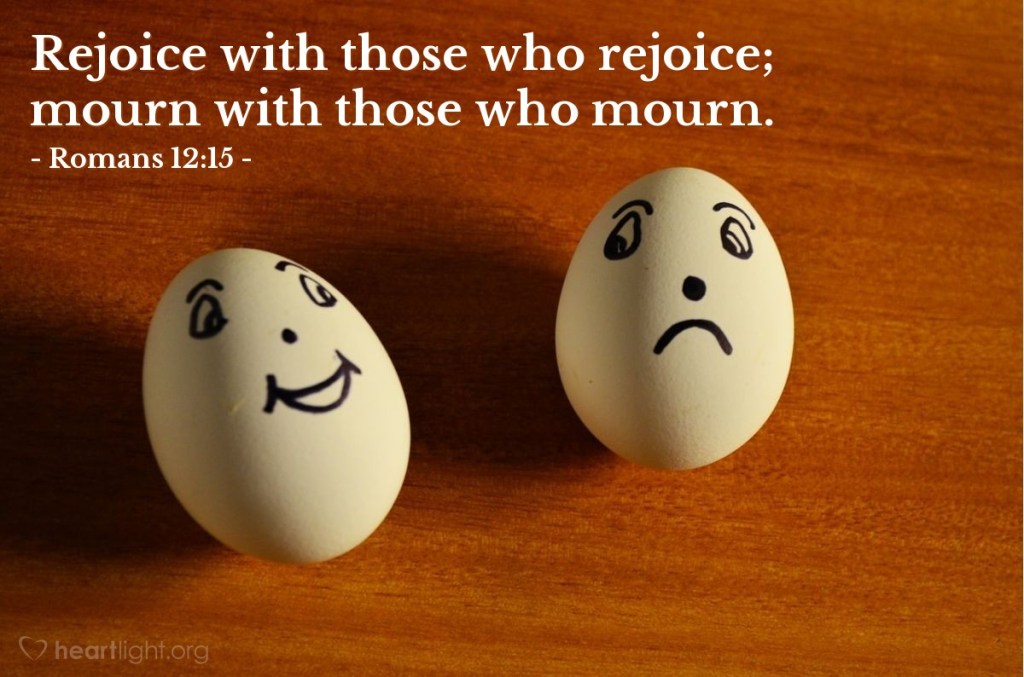
Living in Harmony Is So Necessary; Rejoicing with Others is Symphony. Romans 12:9-16

Romans 12:9-16 The Message

9-10 Love from the center of who you are; don’t fake it. Run for dear life from evil; hold on for dear life to good. Be good friends who love deeply; practice playing second fiddle.

11-13 Don’t burn out; keep yourselves fueled and aflame. Be alert servants of the Master, cheerfully expectant. Don’t quit in hard times; pray all the harder. Help needy Christians; be inventive in hospitality.

14-16 Bless your enemies; no cursing under your breath. Laugh with your happy friends when they’re happy; share tears when they’re down. Get along with each other; don’t be stuck-up. Make friends with nobodies; don’t be the great somebody.

The Word of God for the Children of God.

Glory be to the Father,
and to the Son, and to the Holy Ghost;
as it was in the beginning,
is now, and ever shall be,
world without end. Amen, amen.


Living in Harmony Is So Necessary

Wise believers acknowledge when Jesus said, “A new command I give you: Love one another” (John 13:34), this was not simply a suggestion for getting along.

So too, the Bible’s commands as to how we treat one another shouldn’t be considered optional. That’s not the nature of God’s commands at all.

As Christ’s followers, we must remember how our relationship with God affects our relationships with each other.

When we pray, “Our Father,” we acknowledge that we are part of a family that includes sisters and brothers. We’re each called to live in harmony together.

Today’s reading mentions specific ways of doing so, such as honoring one another above ourselves, holding to what is good, praying faithfully, sharing with people in need, showing hospitality, and not being haughty or proud.

When believers live in harmony, expressing their love for one another by sharing tears in times of sorrow and expanding their joy by celebrating together, they become appealing witnesses to their truest hope in Christ.

When a coworker or stranger observes, “It’s amazing how you guys love each other,” the cause of Christ moves forward. Jesus taught this when he prayed that all believers “may be one” and also “may be brought to complete unity.

Then,” he said to the Father, “the world will know that you sent me and have loved them even as you have loved me” (John 17:22-23).

Rejoicing with Others is So Symphony.

Romans 12:9-16 Complete Jewish Bible

Don’t let love be a mere outward show. Recoil from what is evil, and cling to what is good. 10 Love each other devotedly and with brotherly love; and set examples for each other in showing respect. 11 Don’t be lazy when hard work is needed, but serve the Lord with spiritual fervor. 12 Rejoice in your hope, be patient in your troubles, and continue steadfastly in prayer. 13 Share what you have with God’s people, and practice hospitality.

14 Bless those who persecute you — bless them, don’t curse them! 15 Rejoice with those who rejoice, and weep with those who weep. 16 Be sensitive to each other’s needs — don’t think yourselves better than others, but make humble people your friends. Don’t be conceited.

Can you hear the triumphant sounds of symphony of Christians in community?

Can you hear the ruckus of badly timed, tuned instruments of no Christians in community or harmony at all – a million of clashing cymbals + broken bugles?

1 Corinthians 13 The Message

The Way of Love

13 If I speak with human eloquence and angelic ecstasy but don’t love, I’m nothing but the creaking of a rusty gate.

If I speak God’s Word with power, revealing all his mysteries and making everything plain as day, and if I have faith that says to a mountain, “Jump,” and it jumps, but I don’t love, I’m nothing.

3-7 If I give everything I own to the poor and even go to the stake to be burned as a martyr, but I don’t love, I’ve gotten nowhere. So, no matter what I say, what I believe, and what I do, I’m bankrupt without love.

Love never gives up.
Love cares more for others than for self.
Love doesn’t want what it doesn’t have.
Love doesn’t strut,
Doesn’t have a swelled head,
Doesn’t force itself on others,
Isn’t always “me first,”
Doesn’t fly off the handle,
Doesn’t keep score of the sins of others,
Doesn’t revel when others grovel,
Takes pleasure in the flowering of truth,
Puts up with anything,
Trusts God always,
Always looks for the best,
Never looks back,
But keeps going to the end.

8-10 Love never dies. Inspired speech will be over some day; praying in tongues will end; understanding will reach its limit. We know only a portion of the truth, and what we say about God is always incomplete. But when the Complete arrives, our incompletes will be canceled.

11 When I was an infant at my mother’s breast, I gurgled and cooed like any infant. When I grew up, I left those infant ways for good.

12 We don’t yet see things clearly. We’re squinting in a fog, peering through a mist. But it won’t be long before the weather clears and the sun shines bright! We’ll see it all then, see it all as clearly as God sees us, knowing him directly just as he knows us!

13 But for right now, until that completeness, we have three things to do to lead us toward that consummation: Trust steadily in God, hope unswervingly, love extravagantly. And the best of the three is love.

It is a good thing that God’s love stays in eternal harmony, His love never ends and His love forever bears all things because man’s love for his fellow man fails.

Shared faith, hope, love, joy are a great expression of sympathy. We typically use the word sympathy to describe a shared grief—but it applies equally to joy.

We understand sympathy when we use it in a sentence, but the word itself can be difficult to define. So consider its opposite: apathy. If apathy is akin to saying, “I couldn’t care less,” sympathy is akin to saying, “I couldn’t care more.” Sympathy is an identification with the experience of another person.

Many of us find it natural to “laugh with those who laugh, weep with those who weep.” It is instinctive for us to enter into the merriment and disappointment and pain of those we love and to cry at the sight or thought of their sadness.

This is a good thing, for to “bear one another’s burdens” is to “fulfill the law of Christ” (Galatians 6:2).

To enter into the joy and success of others, however, is often the far greatest of challenges because it requires us to work against the grain of the fallenness of our human nature, which is prone to continuous resentment and bitterness.

Instead of someone’s success serving as an occasion for us to bless God and thank Him, it so easily becomes an occasion for everything contrary to love.

Most of us know how to avoid expressing envy. But there is a massive difference between not expressing envy and not feeling envy. We can modify our behavior enough to keep from showing it, but it requires spiritual transformation to get us to the point of not feeling it. This transformation begins with a well studied understanding of our identity as members of Christ’s body in true community.

Paul says that “we, though many, are one body in Christ, and individually members one of another” (Romans 12:5). To be in community with Christ means we are members of Him and of one another in authentic community.

To put this another way: if we are in Christ, we are all on the same team.

When we grasp this, it will be as natural for us to enter into another’s joy as it is for a soccer player to rejoice at their teammate’s game-winning goal in just the same way as if they had scored it themselves. As God’s people, we win and lose—we enjoy and we grieve—in community as God is in community – all together.

God’s word calls you to “let love be genuine” (Romans 12:9)—and genuine, Christlike love conforms your feelings so that jealousy gives way to joy and apathy to true sympathy playing God’s symphony of peace. Is there anyone who you are standing aloof from in some way, either in their joy or their sadness?

Have you considered whom you will encourage with tickets to God’s symphony?

There is almost certainly someone you know who needs you to reach out and let them know that you are with them, praying for them and there for them as they walk a deep valley. Likewise, there will be someone whose joy you can share, and you can simply let them know that you praise God for His favor on their life.

Be that community, that symphony of someone’s of whom it can increasingly be said, “They couldn’t care more.” Ask the God of all compassion and comfort to work in you and through you by His Spirit to mold you into that person today.

In the name of God, the Father and God the Son and God the Holy Spirit,

Let us Pray,

Father God, we want to live with others in such a way that shows we are in a life-giving relationship with you. Grant us your Spirit to do so. In Jesus’ name, Amen.

Psalm 150 The Message

150 1-6 Hallelujah!
Praise God in his holy house of worship,
    praise him under the open skies;
Praise him for his acts of power,
    praise him for his magnificent greatness;
Praise with a blast on the trumpet,
    praise by strumming soft strings;
Praise him with castanets and dance,
    praise him with banjo and flute;
Praise him with cymbals and a big bass drum,
    praise him with fiddles and mandolin.
Let every living, breathing creature praise God!
    Hallelujah!

Glory be to the Father,
and to the Son, and to the Holy Ghost;
as it was in the beginning,
is now, and ever shall be,
world without end. Amen, amen.

https://translate.google.com/

Does God Care About My Feelings? Psalm 137

At times, you may feel too alone, and think that you have no one to care for you.

Know that all of us are God’s children, and he never allows us to stay alone.

There’s no point in keeping yourself aloof from the rest of the world, for God is always there even when we are too emotional to acknowledge it, to help guide and move you out into the light from your entire struggle.

You may feel that you have not got anyone to be there for you, and support for you.

Although it is easier said than done, we often tend to suffer from such kinds of frustrations and suppressing thoughts.

However, you need to understand that you are not alone. You are never alone, for God is always there with you and you have your guardian angels to pave your ways, no matter how tough the situations get! Just be humble, have patience and get going!

Nothing is hidden from the Almighty, and he has been keeping an eye upon you all the time. He is there to guide you in all your odds, and even when life has been making you walk through the hurdles, you have Him.

Believe me, God is always there for you and he has been working behind the scenes of your life. You may find it difficult to get going, but if you have faith, things will surely start falling in their places all by themselves.

God is always there to talk care of you, even when you aren’t aware of it. He is going to take over when things go out of your hand. In any case, if situations seem to be pushing you to the last extent, keep your trust upon God’s powers and God’s promises and in time, by God’s grace, things are going to work out all by themselves, sooner or later.

Psalm 137 GOD’S WORD Translation

137 By the rivers of Babylon, we sat down and cried
as we remembered Zion.
We hung our lyres on willow trees.
It was there that those who had captured us demanded that we sing.
Those who guarded us wanted us to entertain them.
⌞They said,⌟ “Sing a song from Zion for us!”

How could we sing the Lord’s song in a foreign land?
If I forget you, Jerusalem,
let my right hand forget ⌞how to play the lyre⌟.
Let my tongue stick to the roof of my mouth
if I don’t remember you,
if I don’t consider Jerusalem my highest joy.

O Lord, remember the people of Edom.
Remember what they did the day Jerusalem ⌞was captured⌟.
They said, “Tear it down! Tear it down to its foundation.”
You destructive people of Babylon,
blessed is the one who pays you back
with the same treatment you gave us.
Blessed is the one who grabs your little children
and smashes them against a rock.

The Word of God for the Children of God.

Adeste Fideles! Laeti Triumphantes! Venite Adoremus Dominum.

Gloria! In Excelsis Deo! Alleluia, Alleluia, Alleluia, Amen.

The book of Psalms is a book of poetry; most often each Psalm is a song written for a specific purpose.

These songs and poems consist of praises to God, sorrowful lamentations, and joyous celebrations. 

Psalm 137 falls into the sorrowful lamentation category.

The Psalmist here is speaking of Israel’s captivity in Babylon (vs. 1).

The southern tribes of Israel, the land of Judah, were all that remained of Israel after the Assyrians had captured the northern tribes (2 Kings 15-17).

Later, the southern kingdom was taken captive by Babylon (2 Kings 24-25).

In this Psalm, the psalmist is lamenting that the captors of the Jews, the Babylonians, are asking them to sing songs about Jerusalem, or Zion.

Because these were songs of worship and praise to God, they would remind the people of their sin against God, the thing which led to their painful captivity.

These songs would also remind them of their longing to be back in Jerusalem.

The second stanza of the Psalm is a self-reflection of what the author would wish upon himself if he were to ever forget Jerusalem.

The final stanza is what revenge the Psalmist wishes upon his captors.

While the picture is disturbing and graphic, it gives us a real portrait of how desperate the Jews were and how badly they wished to be freed from captivity.

It also reveals to us the incredible depth of emotions these exiles were feeling.

The depths of rage, anger and of depressive sadness is quite palpable and for us who would come to read those hard words, quite emotionally provocative also.

God had sent His chosen people into a seventy year exile for their sins against Him – and the beginning of that exilic road to Babylon was exceedingly brutal and one could easily use the word merciless unto the very absolute maximum.

But God is a God of Mercy, of Grace, Slow to Anger and abounding in steadfast love, forgiving of transgressions, remembering them no more, casting them into the sea of forgetfulness, as far as the east is to the west – just max gone!

So, it leaves open to the reader of such scriptures the very significant question;

Does God Authentically Care About Our Feelings?

Ever feel like God gave up on you, does not care about your feelings?

You are absolutely not alone.

This assumption is one that can promote a sense of invalidation within our relationship with God.

In many ways, this belief can frame our faith in such a way that it leaves us quick to mask the messiness of our emotions for the sake of spiritual maturity.

If we authentically feel our feelings, does that mean our faith is fragile?

When our emotions overwhelm us, is God actually 100% for us or against us? 

This disconnect between emotional health and Christian theology has been at odds for some time.

The common Christian response to uncomfortable emotions is phrases like “You just need to pray more” and “trust the Lord in all circumstances,” which risks adding to the distortion that our distress impairs our spiritual maturity.

I whole-heartedly believe that the spiritual disciplines found in Scripture were never meant to invalidate our pain and problems, but rather not so subtly invite us into expressing our feelings openly and freely unto a loving and caring God. 

Here is the truth: You absolutely matter to God, feelings and all.

Never in Scripture do we see Jesus dismiss the feelings of others or invalidate those in distress.

On the contrary, God’s Word repeatedly reiterates the safety found in seeking God as our refuge when we are weak (Psalm 46:1–3), and as a shelter when we are suffering (Psalm 62:8)

When we are faced with a depth of feelings that shake our faith to the core of our being, we must go back to Scripture and be reminded that our emotions, created by God, are meant to bring us closer to Him, not pull us farther away.

In my frequent exploration of this concept, I have found 4 ways God responds to my feelings which have ultimately strengthened my faith, comforted my soul.

1. God Is Present in My Feelings 

  In Psalm 34:18-19, David speaks of how God is attentive in our distress saying: 

“The Lord is near to the brokenhearted

    and saves the crushed in spirit. 

Many are the afflictions of the righteous,

    but the Lord delivers him out of them all.” 

God does not leave us in our distress or dismiss the weight of our worries, but graciously and mercifully comes near to us as a father comforts his dear child.

His awareness of all things at all times is absolutely active 100% of the time.

The passage states God saves the crushed in spirit, delivering them out of pain.

What is even more powerful about this passage is that in the original Hebrew, the term for saves is translated as “to be safe.”

God is not simply standing with us, around us, by us, but He actively provides absolute safety for us in His presence. 

2. God Values My Feelings 

In addition to God’s attentiveness, He also values emotions.

Throughout Jesus’ ministry, we see His expression of emotion and how He values caring for those who were suffering.

Jesus wept with those who experienced loss (John 11:34-36) and comforted many with compassion and consideration (Mark 6:50)

The intersection of emotional expression and feelings validation was first modeled for us by God throughout the Old Testament, and then again by Jesus throughout the narratives of the 4 gospels and Paul’s letters to the followers.

We see how God so gently guided the Israelites to their promised land flowing with milk and honey and manna and quail and water and shelter against the sun despite all of their rebellion and complaining throughout the book of Exodus.

Similarly, Jesus speaks to many emotions in his Sermon on the Mount saying, 

“Blessed are the poor in spirit,

    for theirs is the kingdom of heaven.

Blessed are those who mourn,

    for they will be comforted” (Matthew 5:3-4).

The apostle Paul in Romans speaks on this same value of emotional expression, encouraging believers to, “Rejoice with those who rejoice, weep with those who weep. Live in harmony with one another” (Romans 12:15).

I wonder what it would look like if we too were to authentically begin to value the emotions we experience and authentically own all the freedom to express them, knowing our God is near and desires to comfort us with His compassion.  

3. God Challenges My Feelings  

Within God’s attentiveness and compassion for His children, He challenges the feelings that no longer have a place in our lives and hearts.

Paul writes on this disputation of futile feelings, encouraging his young protégé Timothy to not be overcome by the spirit of fear but to remember his faith first. 

He says, “For this reason, I remind you to fan into flame the gift of God, which is in you through the laying on of my hands, for God gave us a spirit, not a spirit of fear but power and love and self-control” (2 Timothy 1:6-7).

This very Pauline response to my own feelings is one that helps me identify the foundation of my emotions.

As I seek to understand God’s Word and His truth, I am reminded to focus upon my aligning my feelings with the myriad of God’s promises found in Scripture.

This passage reminds me of the truth of the Holy Spirit of God at work in me. 

4. God Reframes My Feelings  

Finally, I believe that God’s Word so beautifully helps us to reframe and to refocus our emotions by placing our focus and intention back on God’s power, God’s provision, God’s strength, and God’s ability to meet us in our emotions. 

One of my favorite passages that help reframe my feelings and focus on my faith is found in Paul’s prison letter of Philippians 4:8-9 where Paul writes, 

“Finally, brothers, whatever is true, whatever is honorable, whatever is just, whatever is pure, whatever is lovely, whatever is commendable, if there is any excellence, if there is anything worthy of praise, think about these things. What you have learned and received and heard and seen in me—practice these things, and the God of peace will be with you.” 

Then further bolstered by these words of God assurance, Christ like confidence;

Philippians 4:10-14 GOD’S WORD Translation

Thanks for Your Gifts

10 The Lord has filled me with joy because you again showed interest in me. You were interested but did not have an opportunity to show it. 11 I’m not saying this because I’m in any need. I’ve learned to be content in whatever situation I’m in. 12 I know how to live in poverty or prosperity. No matter what the situation, I’ve learned the secret of how to live when I’m full or when I’m hungry, when I have too much or when I have too little. 13 I can do everything through Christ who strengthens me. 14 Nevertheless, it was kind of you to share my troubles.

Paul’s thoughtful and timely words subtly remind me how to slow down and replace my thoughts that have led to distress and distortions within my heart.

When feelings flood our minds and muddy the truth of God’s goodness and grace, we are invited to renew our minds in the truths found in His Word. 

Romans 12:1-3 GOD’S WORD Translation

Dedicate Your Lives to God

12 Brothers and sisters, in view of all we have just shared about God’s compassion, I encourage you to offer your bodies as living sacrifices, dedicated to God and pleasing to him. This kind of worship is appropriate for you. Don’t become like the people of this world. Instead, change the way you think. Then you will always be able to determine what God really wants—what is good, pleasing, and perfect.

Because of the kindness [a] that God has shown me, I ask you not to think of yourselves more highly than you should. Instead, your thoughts should lead you to use good judgment based on what God has given each of you as believers.

So, whatever you may be feeling, acknowledge them, just remember that God is near and desires to be involved in the fears and failures, the loss and laughter.

His Living and Active Word continually reminds us to always feel and to be free from the false kind of faith negating the weight of legitimately raw emotions.

Let us continue to seek after God, training our hearts, tuning our hearts, to find rest in the absolute truth (Matthew 11:28-30, John 5:1-9, John 11:35, John 14:1-6), knowing God authentically cares about all of our feelings no matter how deep.

In the name of God, the Father and God the Son and God the Holy Spirit,

Let us Pray,

Psalm 23 King James Version

23 The Lord is my shepherd; I shall not want.

He maketh me to lie down in green pastures: he leadeth me beside the still waters.

He restoreth my soul: he leadeth me in the paths of righteousness for his name’s sake.

Yea, though I walk through the valley of the shadow of death, I will fear no evil: for thou art with me; thy rod and thy staff they comfort me.

Thou preparest a table before me in the presence of mine enemies: thou anointest my head with oil; my cup runneth over.

Surely goodness and mercy shall follow me all the days of my life: and I will dwell in the house of the Lord for ever.

The Word of God for the Children of God.

Adeste Fideles! Laeti Triumphantes! Venite Adoremus Dominum.

Gloria! In Excelsis Deo! Alleluia, Alleluia, Alleluia, Amen.

https://translate.google.com/