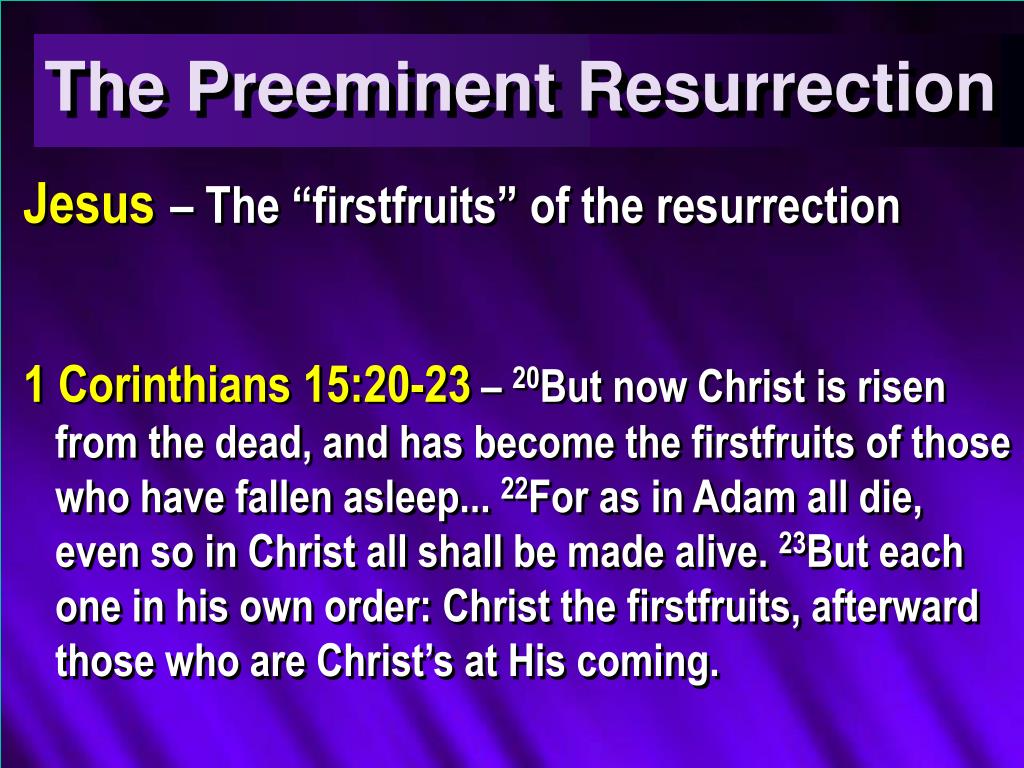
Believe or not Believe? For since by a man death came, by a Man also came the resurrection of the dead. For as in Adam all die, so also in Christ all will be made alive. 1 Corinthians 15:20-28

1 Corinthians 15:20-28 New American Standard Bible

The Order of Resurrection

20 But the fact is, Christ has been raised from the dead, the first fruits of those who are asleep. 21 For since by a man death came, by a Man also came the resurrection of the dead. 22 For as in Adam all die, so also in [a]Christ all will be made alive. 23 But each in his own order: Christ the first fruits, after that those who are Christ’s at His coming, 24 then comes the end, when He hands over the kingdom to our God and Father, when He has abolished all rule and all authority and power. 25 For He must reign until He has put all His enemies under His feet. 26 The last enemy that will be abolished is death. 27 For He has put all things in subjection under His feet. But when He says, “All things are put in subjection,” it is clear that [b]this excludes the Father who put all things in subjection to Him. 28 When all things are subjected to Him, then the Son Himself will also be subjected to the One who subjected all things to Him, so that God may be all in all.

Word of God for the Children of God

Glory be to the Father,
and to the Son, and to the Holy Ghost;
as it was in the beginning,
is now, and ever shall be,
world without end. Amen, amen.
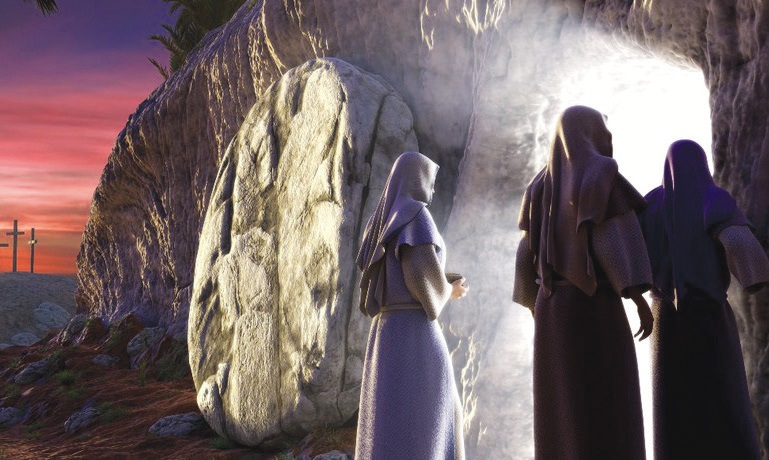
Scripture abounds with examples of what I call the Divine Adversative.

This is about God directly intervening to reverse the effects of our sin.

We note the example of this in the resurrection of Jesus.

Christ’s resurrection has reversed everything!

Life conquered death, good conquered evil, and love conquered all.

As Paul explains, if Christianity is no more than a “feel-good” faith that helps us behave better in this life, we’re pathetically hopeless.

If that is the case, then we have no help from God in this life and no hope for the next, if there is life after death.

So it would be better to abandon all hope for ourselves as well as for those who have already died.

All of this would mean the resurrection is merely a figment of desperate faith.

But then comes this thunderous Divine Adversative: “But Christ has indeed been raised from the dead, the firstfruits of those who have fallen asleep.”

https://www.merriam-webster.com/dictionary/adversative

Hallelujah! We have a hope that extends from our life here on earth to eternity itself. Rather than being defeated by the curse of sin and death, “in Christ all will be made alive,” just as Christ himself is alive for eternity.

All of our hope—and indeed all of our life—is certain, because God said, “But Christ!”

1 Corinthians 15:14 is referred to as “the lynchpin of the gospel.” As Paul writes, “If Christ has not been raised, our preaching is useless and so is your faith.”

Without the resurrection, we have nothing on which to build our faith.

All we have is a famous person who taught noble ideas about life and an ethical system on which to build our society.

But that’s just for this life. Without the resurrection, we have no hope for surviving death. And if that’s the case, then why bother believing in Jesus?

Paul goes on, “But Christ has indeed been raised from the dead.”

And in the first sermon of the New Testament church, Peter preached, “God has raised this Jesus to life, and we all are witnesses of it” (Acts 2:32).

Paul wrote that the resurrected Jesus “appeared to more than five hundred of the brothers and sisters at the same time.”

We are called not only to profess our faith that Jesus was raised but also to understand that this is the lynchpin of our faith.

Everything hangs together on Christ’s resurrection!

You and I Can Face Tomorrow

Every once in a while, someone comes along and claims that we don’t need to believe in the bodily resurrection of Jesus Christ.

We can still be Christians without the miraculous or supernatural elements of the Christian faith, they say.

But the tragedy for them and for anyone who follows such a claim is that the implications of there being no resurrection don’t just make the Christian life difficult; they make it immeasurably ridiculous.

If there is no resurrection, Paul pointed out, then those who have died trusting Jesus have utterly perished, and there is no hope of ever seeing them again.

If we try to live a Christian life without the resurrection, then “we are of all people most to be pitied.”

In fact, Paul says, “If the dead are not raised, ‘Let us eat and drink, for tomorrow we die’” (1 Corinthians 15:32).

If we don’t believe in the resurrection, then we ought to buy into all the clichés that so many say (but few truly believe)— “This life is what you make it” and “He who dies with the most toys wins!”

Enticing as such platitudes may be, we all have a sneaking suspicion that death is not the end.

God has put eternity into our hearts (Ecclesiastes 3:11), and there is no scraping it out—no matter what force of rational skepticism or what indulgent hedonism we may apply to it. We know, by design, that there is more to life than life itself.

We also know that tomorrow, and in every tomorrow, there will be sadness, pain, loss, fear, and disappointment.

How can anyone cope?

Without the resurrection, we can’t.

That is why Paul reminded the Ephesians before being brought near to Christ, they had “no hope” and were “without God in the world” (Ephesians 2:12).

“But Christ has been raised.”

And those five words make all the difference, not only to eternal life but also to life today.

If you take God at His word and trust Him in faith, then there is never any reason for hopelessness.

You have “a living hope through the resurrection of Jesus Christ from the dead” (1 Peter 1:3).

No matter what difficulties await you—and today, and tomorrow, there will be some—you will always have “an inheritance that is imperishable, undefiled, and unfading, kept in heaven for you” (v 4).

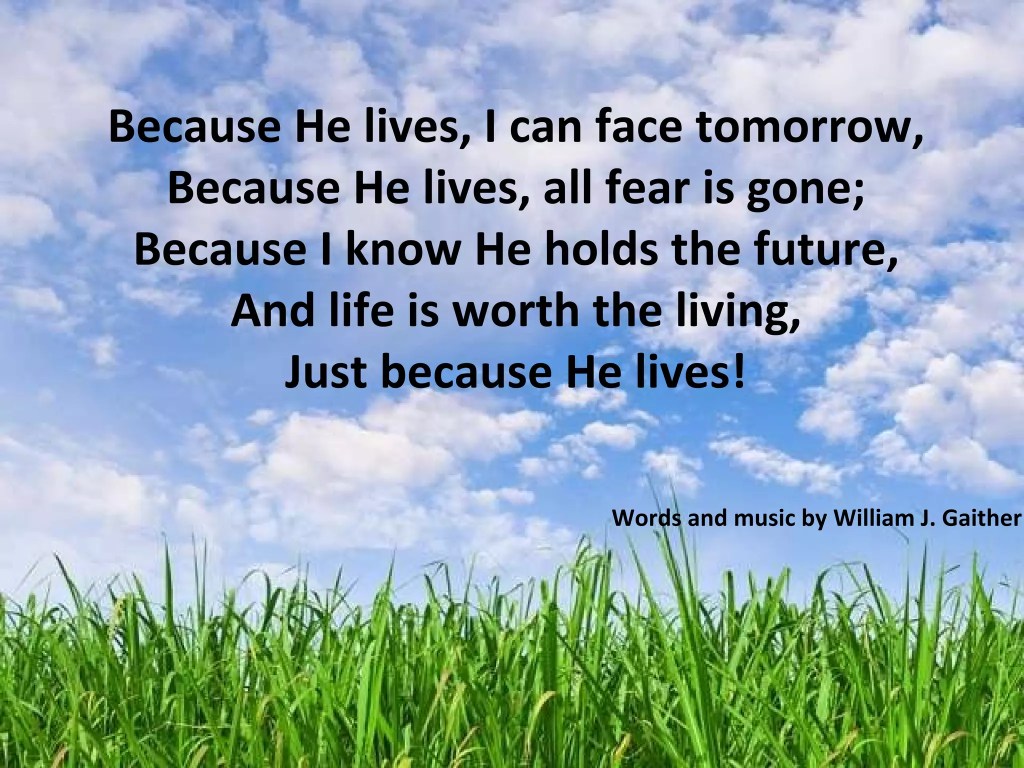
“Because he lives, I can face tomorrow,” goes the song.[1] 

So can you—and you can do so with joy.

In the name of the Father, and of the Son, and of the Holy Spirit ….

Praying ….

Psalm 145 Complete Jewish Bible

145 (0) Praise. By David:

(1) I will praise you to the heights, my God, the king;
I will bless your name forever and ever.
Every day I will bless you;
I will praise your name forever and ever.
Great is Adonai and greatly to be praised;
his greatness is beyond all searching out.
Each generation will praise your works to the next
and proclaim your mighty acts.
I will meditate on the glorious splendor
of your majesty and on the story of your wonders.
People will speak of your awesome power,
and I will tell of your great deeds.
They will gush forth the fame of your abounding goodness,
and they will sing of your righteousness.
Adonai is merciful and compassionate,
slow to anger and great in grace.
Adonai is good to all;
his compassion rests on all his creatures.
10 All your creatures will thank you, Adonai,
and your faithful servants will bless you.
11 They will speak of the glory of your kingship,
and they will tell about your might;
12 to let everyone know of your mighty acts
and the glorious majesty of your kingship.
13 Your kingship is an everlasting kingship,
your reign continues through all generations.
14 Adonai supports all who fall
and lifts up all who are bent over.
15 The eyes of all are looking to you;
you give them their food at the right time.
16 You open your hand
and satisfy the desire of every living thing.
17 Adonai is righteous in all his ways,
full of grace in all he does.
18 Adonai is close to all who call on him,
to all who sincerely call on him.
19 He fulfills the desire of those who fear him;
he hears their cry and saves them.
20 Adonai protects all who love him,
but all the wicked he destroys.
21 My mouth will proclaim the praise of Adonai;
all people will bless his holy name forever and ever.

Glory be to the Father,
and to the Son, and to the Holy Ghost;
as it was in the beginning,
is now, and ever shall be,
world without end. Amen, amen.

https://translate.google.com/

Retrieving His Lost Sheep, Retrieving His Lost Sheep, Walking on the Road to Emmaus, retrieving His lost sheep. Luke 24:13-35

Luke 24:13-35 Lexham English Bible

Jesus Encountered on the Road to Emmaus

13 And behold, on that same day, two of them were traveling to a village named[a]  Emmaus that was sixty stadia[b] distant from Jerusalem, 14 and they were conversing with one another about all these things that had happened. 15 And it happened that while they were conversing, and discussing, Jesus himself also approached and[c] began to go along with[d] them, 16 but their eyes were prevented from recognizing him. 17 And he said to them, “What are these matters that you are discussing with one another as you[e] are walking along?” And they stood still, looking sad. 18 And one of them, named[f] Cleopas, answered and[g] said to him, “Are you the only one living near Jerusalem and not knowing the things that have happened in it in these days?” 19 And he said to them, “What things?” So they said to him, “The things concerning Jesus the Nazarene, a man who was a prophet, powerful in deed and word before God and all the people, 20 and how our chief priests and rulers handed him over to a sentence of death, and crucified him. 21 But we were hoping that he was the one who was going to redeem Israel. But in addition to all these things, this is the third day since[h] these things took place. 22 But also some women from among us astonished us, who were at the tomb early in the morning, 23 and when they[i] did not find his body, they came back saying they had seen even a vision of angels, who said that he was alive! 24 And some of those with us went out to the tomb and found it[j] like this, just as the women had also said, but him they did not see.” 25 And he said to them, “O foolish and slow in heart to believe in all that the prophets have spoken! 26 Was it not necessary that the Christ suffer these things and enter into his glory?” 27 And beginning from Moses and from all the prophets, he interpreted to them the things concerning himself in all the scriptures. 28 And they drew near to the village where they were going, and he acted as though he was going farther. 29 And they urged him strongly, saying, “Stay with us, because it is getting toward evening, and by this time the day is far spent.” And he went in to stay with them. 30 And it happened that when he reclined at the table with them, he took the bread and[k] gave thanks, and after[l] breaking it,[m] he gave it[n] to them. 31 And their eyes were opened, and they recognized him, and he became invisible to them. 32 And they said to one another, “Were not our hearts burning within us while he was speaking with us on the road, while he was explaining the scriptures to us?” 33 And they got up that same hour and[o] returned to Jerusalem and found the eleven and those with them assembled, 34 saying, “The Lord has really been raised, and has appeared to Simon!” 35 And they began describing[p] what happened[q] on the road, and how he was recognized by them in the breaking of the bread.

Word of God for the Children of God

Glory be to the Father,
and to the Son, and to the Holy Ghost;
as it was in the beginning,
is now, and ever shall be,
world without end. Amen, amen.

That very day, the first day of the week, two of Jesus’ disciples were going to a village seven miles from Jerusalem called Emmaus, and they were conversing about all the things that had occurred. And it happened that while they were conversing and debating, Jesus himself drew near and walked with them, but their eyes were prevented from recognizing him.  Luke 24:13–16

One of the more poignant places where Jesus shows up as the good shepherd is when he goes after two despondent, lost sheep on the road to Emmaus.

Jesus meets these two followers in their grief, invites them to tell their story, processing their disappointment.

Jesus’ very presence with them reminds them that they still belong to him and are 100% a valued part of his sheepfold, in spite of their doubts and confusion.

He literally walks alongside them in the valley of the shadow of his own death.

The good shepherd is a pursuer.

These sheep are on their own, vulnerable, lost, and in need of their shepherd’s care. They are not abandoned to their misconceptions of current events.

Jesus seeks them out and tends to them as only he can.

This story serves as a comforting reminder to any of us who may be, are facing, growing doubts or disappointment with God. Maybe we have had to adjust our understanding of how God is working in our lives, or maybe we feel unworthy of the shepherd’s care because we have somehow continuously wandered away.

This picture of Jesus underscores the immensity of the love He for us and our incalculable value and worth to him as his beloved sheep.

This appearance of Jesus to two of His disciples is intriguing and fascinating.

They were quite distraught, and didn’t seem to know what to think about Jesus’ death.  They had hoped that He was the true Messiah but then He was killed. 

And then there were some who claimed His tomb was empty. 

What should they make of all this?

What should we make of all this?

As the story goes on, Jesus “interpreted to them what referred to him in all the Scriptures.”  Disciples realized this man with whom they were speaking had incredible wisdom and understanding, so they invited Him to stay with them.

Jesus stayed and sat down with them in their home. 

While there, Scripture says

“he took bread, said the blessing, broke it, and gave it to them. With that their eyes were opened and they recognized him, but he vanished from their sight.”

Again, this is intriguing and fascinating. 

Why did Jesus appear to them, conceal who He was, sit down and break bread with them, allow them to suddenly recognize Him and then simply vanish into thin air?  Well, He did it for a reason and we should be very attentive to this.

Jesus wanted those disciples, as well as all of us, to know that He who rose from the dead was very much alive and that we would recognize Him in the breaking of the bread.  We would recognize Him in the celebration of the Holy Eucharist!

This appearance of the resurrection Jesus to these disciples was, in fact, an appearance to teach all of us the simple truth of His presence in the Eucharist. 

It was at that moment, as they “took bread, said the blessing, broke it,” that Jesus was suddenly made manifest to their minds and souls. 

Jesus is alive in the Eucharist! 

But it also tells us that He is veiled in the Eucharist. 

This combination of being veiled and truly present gives us wonderful guidance in our faith.

Jesus is here, right now, in our presence, but we most likely do not see Him. 

But He is truly here! 

These disciples were in the presence of Jesus and they did not realize it. 

The same is true for us. 

We are constantly in His presence do not realize it.  This is especially true when we are worshipping but it is also true in countless other ways throughout our day.  We must commit ourselves to seeing Him, to recognizing Him and to adoring Him.  We must discover the resurrected presence of Jesus all around us.

Too often we think our Lord is present only in extraordinary ways.  But that is not true!  He is constantly present to us in very ordinary ways. He is here with us right now, loving us, speaking to us, and calling us to love Him. 

Do you see Him? 

Do you recognize His presence?

Reflect, today, upon the experience of these disciples. 

If you were them, you’d be blessed to be in the presence of the Savior of the world.  What an honor!  The truth is that God is with you now and always. 

He is constantly with you and is constantly speaking with you.  Look for Him and listen to His voice.  You may be surprised at how so very near He really is.

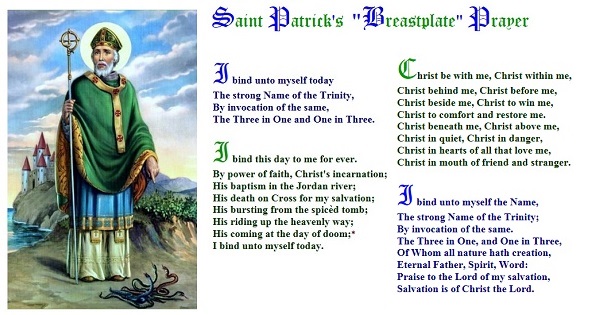
I arise today 
Through a mighty strength, the invocation of the Trinity,
Through belief in the Threeness,
Through confession of the Oneness
of the Creator of creation.

I arise today
Through the strength of Christ’s birth with His baptism,
Through the strength of His crucifixion with His burial,
Through the strength of His resurrection with His ascension,
Through the strength of His descent for the judgment of doom.

I arise today
Through the strength of the love of cherubim,
In the obedience of angels,
In the service of archangels,
In the hope of resurrection to meet with reward,
In the prayers of patriarchs,
In the predictions of prophets,
In the preaching of apostles,
In the faith of confessors,
In the innocence of holy virgins,
In the deeds of righteous men.

I arise today, through
The strength of heaven,
The light of the sun,
The radiance of the moon,
The splendor of fire,
The speed of lightning,
The swiftness of wind,
The depth of the sea,
The stability of the earth,
The firmness of rock.

I arise today, through
God’s strength to pilot me,
God’s might to uphold me,
God’s wisdom to guide me,
God’s eye to look before me,
God’s ear to hear me,
God’s word to speak for me,
God’s hand to guard me,
God’s shield to protect me,
God’s host to save me
From snares of devils,
From temptation of vices,
From everyone who shall wish me ill,
afar and near.

I summon today
All these powers between me and those evils,
Against every cruel and merciless power
that may oppose my body and soul,
Against incantations of false prophets,
Against black laws of pagandom,
Against false laws of heretics,
Against craft of idolatry,
Against spells of witches and smiths and wizards,
Against every knowledge that corrupts man’s body and soul;
Christ to shield me today
Against poison, against burning,
Against drowning, against wounding,
So that there may come to me an abundance of reward.

Christ with me,
Christ before me,
Christ behind me,
Christ in me,
Christ beneath me,
Christ above me,
Christ on my right,
Christ on my left,
Christ when I lie down,
Christ when I sit down,
Christ when I arise,
Christ in the heart of every man who thinks of me,
Christ in the mouth of everyone who speaks of me,
Christ in every eye that sees me,
Christ in every ear that hears me.

[Note that people sometimes pray a shorter version of this prayer just with these 15 lines about Christ above. The conclusion follows below.]

I arise today
Through a mighty strength, the invocation of the Trinity,
Through belief in the Threeness,
Through confession of the Oneness
of the Creator of creation.

Glory be to the Father,
and to the Son, and to the Holy Ghost;
as it was in the beginning,
is now, and ever shall be,
world without end. Amen, amen.
https://translate.google.com/

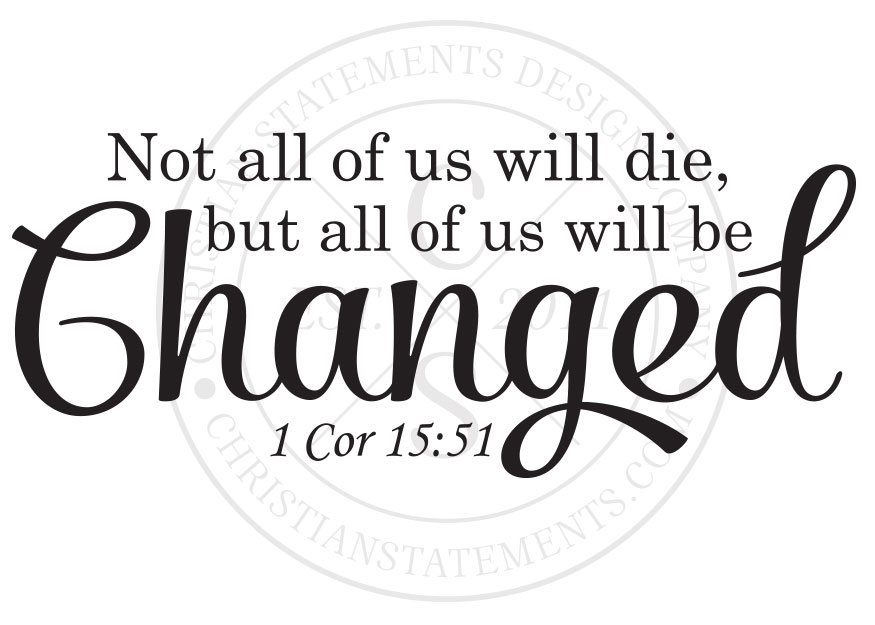
Changed by Resurrection; Behold, I will tell you a mystery: We shall not all sleep, but we shall all be changed. 1 Corinthians 15:50-58

1 Corinthians 15:50-58New King James Version

Our Final Victory

50 Now this I say, brethren, that flesh and blood cannot inherit the kingdom of God; nor does corruption inherit incorruption. 51 Behold, I tell you a [a]mystery: We shall not all sleep, but we shall all be changed— 52 in a moment, in the twinkling of an eye, at the last trumpet. For the trumpet will sound, and the dead will be raised incorruptible, and we shall be changed. 53 For this corruptible must put on incorruption, and this mortal must put on immortality.  54 So when this corruptible has put on incorruption, and this mortal has put on immortality, then shall be brought to pass the saying that is written: “Death is swallowed up in victory.”

55 “O[b] Death, where is your sting?
O Hades, where is your victory?”

56 The sting of death is sin, and the strength of sin is the law. 57 But thanks be to God, who gives us the victory through our Lord Jesus Christ.

58 Therefore, my beloved brethren, be steadfast, immovable, always abounding in the work of the Lord, knowing that your labor is not in vain in the Lord.

Word of God for the Children of God.

Glory be to the Father,
and to the Son, and to the Holy Ghost;
as it was in the beginning,
is now, and ever shall be,
world without end. Amen, amen.

Now, imagine for a moment, if you will, a caterpillar.

This small, fuzzy earthbound creature spends its days crawling on the ground, limited by its physical form. But then, a transformation occurs.

The caterpillar enters a cocoon and emerges as a butterfly, no longer bound to the earth but free to soar in the sky.

This is not just a change; it is a complete transformation, a metamorphosis.

In a similar way, we too, as believers in Christ, will experience a miraculous transformation. But our transformation will not be from a caterpillar to a butterfly. It will be from mortal to immortal, from perishable to imperishable.

Just as Jesus was raised with a body, we too will be raised. We will have new bodies, bodies that are not bound by the limitations of this world, bodies that are free to live in the eternal glory of God’s kingdom.

So, as we embark on this journey today, let us keep this image in our minds.

Let us remember the promise of our future bodily transformation, the promise that just as Jesus was raised with a body, we too will be raised.

Let us hold on to this hope, for it is the hope of our faith, the surest hope of our salvation, and the hope of our eternal life in Christ.

What is the meaning of 1 Corinthians 15 50 58?

1 Corinthians 15:50–58 powerfully concludes Apostle Paul’s teaching on the resurrection of Christians: when the last trumpet blasts and Christ returns for those who belong to Him. In that moment, all believers in Jesus, living and dead, will be transformed into the glorified, eternal bodies God has promised.

What is the lesson of 1 Corinthians 15 51 58?

Main idea: The Resurrection gives followers of Jesus a hope that the world does not have nor can it gift or give. The victory of Jesus means the death of death, and though we can still grieve, we do not grieve as those without hope.

While we are alive, our spirits are united with our bodies.

When we die, our spirits depart, and our lifeless bodies return to the earth. Is that the final destiny for our bodies?

Some religions welcome death as a release from the “prison” of the body.

But, according to the Bible, God made us to have both souls and bodies; moreover, he made our bodies good (Psalm 139:14).

So when the two are separated by death, we cease to be as God made us.

For that reason, we say, with the Apostles’ Creed, “I believe in the resurrection of the body.”

How can that be?

Our bodies are vulnerable and frail.

They break down and eventually just give out.

Yet our bodies remain integral to who we are as God has made us.

Without our bodies, we are no longer fully ourselves.

For all of us who believe in Christ, we can take great comfort that when we die, our souls will immediately be with Jesus.

And when Jesus returns, our bodies and souls will be reunited.

Then we will again be fully ourselves.

On that day, though, our ­bodies will no longer be frail and mortal.

Death will be conquered, and we will have “­glorified” bodies, just like Jesus’ body at his resurrection.

In the name of God, the Father and God the Son and God the Holy Spirit,

Praying …

The Lord’s Glory and Mankind’s Dignity.
For the music director; on the Gittith. A Psalm of David.

Lord, our Lord,
How majestic is Your name in all the earth,
You who have [a]displayed Your splendor above the heavens!
From the mouths of infants and nursing babies You have established [b]strength
Because of Your enemies,
To do away with the enemy and the revengeful.

When I [c]consider Your heavens, the work of Your fingers,
The moon and the stars, which You have set in place;
What is man that You think of him,
And a son of man that You are concerned about him?
Yet You have made him a little lower than [d]God,
And You crown him with glory and majesty!
You have him rule over the works of Your hands;
You have put everything under his feet,
All sheep and oxen,
And also the animals of the field,
The birds of the sky, and the fish of the sea,
Whatever passes through the paths of the seas.

Lord, our Lord,

How majestic is Your name in all the earth!

Glory be to the Father,
and to the Son, and to the Holy Ghost;
as it was in the beginning,
is now, and ever shall be,
world without end. Amen, amen.
https://translate.google.com/

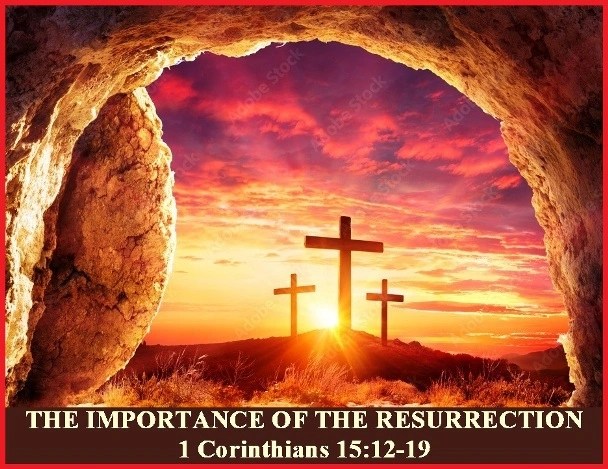
The Necessity of Resurrection: And if Christ hasn’t been raised, our faith is worthless; we are all still in our sins. 1 Corinthians 15:12-19 

1 Corinthians 15:12-19 Christian Standard Bible

Resurrection Essential to the Faith

12 Now if Christ is proclaimed as raised from the dead, how can some of you say, “There is no resurrection of the dead”? 13 If there is no resurrection of the dead, then not even Christ has been raised; 14 and if Christ has not been raised, then our proclamation is in vain, and so is your faith.[a] 15 Moreover, we are found to be false witnesses about God, because we have testified wrongly about God that he raised up Christ—whom he did not raise up, if in fact the dead are not raised. 16 For if the dead are not raised, not even Christ has been raised. 17 And if Christ has not been raised, your faith is worthless; you are still in your sins. 18 Those, then, who have fallen asleep in Christ have also perished. 19 If we have put our hope in Christ for this life only, we should be pitied more than anyone.

Word of God for the Children of God.

Glory be to the Father,
and to the Son, and to the Holy Ghost;
as it was in the beginning,
is now, and ever shall be,
world without end. Amen, amen.
Today, people refer to “canceling” as a way of expressing their disapproval of something or someone in a public forum.

People cancel others to try to stop the spread of objectionable ideas. And those who have been canceled see it as the suppression of their right to speak freely.

Followers of Christ have always faced pressure from those who disapprove of aspects of the gospel message.

Historically, Christians have believed that the resurrection of Jesus was an actual historical event.

Even the apostle Paul wrote that if the resurrection didn’t happen, Christianity as an entire belief system would be false. He wrote, “And if Christ has not been raised, your faith is futile and you are still in your sins” (1 Corinthians 15:17).

But this is not so important in progressive Christianity.

Today, the metaphor of resurrection stands for many Christians as a symbol of the call to new life, as an appeal to practice resurrection here and now.

According to this counterfeit truth, it’s not necessary for a Christian to believe in the miracles of Jesus—including his resurrection. Rather, it’s enough to just simply focus on the meaning, ethical and moral lesson behind these narratives.

In Corinth, this disapproval was aimed at the gospel’s emphasis on bodily resurrection, which seemed incompatible with a dualistic philosophy that saw the material world as being incompatible with the spiritual.

Such scorn caused some Corinthians to suppress the unpopular aspects of the gospel they had received from Paul.

One result was their assertion that there was no bodily resurrection (v. 12).

Paul’s method of dealing with this error was to start with their premise and explain what it would mean if that were actually true.

He does this with a series of “if…then” assertions which show that once the foundation of the bodily resurrection of Christ is removed, the hope of the gospel collapses entirely (vv. 13–19).

Without the resurrection, faith in Christ is “useless” (v. 14).

Apostolic authority for the gospel is eliminated (v. 15).

If Christ did not rise “you are still in your sins,” and those “who have fallen asleep in Christ are lost” (vv. 18–19).

Paul summarizes with this blunt conclusion in verse 19:

“If only for this life we have hope in Christ, we are of all people most to be pitied.”

The good news is that Jesus “has indeed been raised from the dead” (v. 20).

We are now waiting for the full effect of the victory Christ has already achieved to become a reality (vv. 22–28).

Go Deeper

What unpopular aspects of the gospel message do you feel pressured to suppress? How does their cancellation, removal, distort God’s message?

In the name of God, the father and God the Son and God the Holy Spirit,

Praying …

Psalm 33

Praise to the Creator

Rejoice in the Lord, you righteous ones;
praise from the upright is beautiful.
Praise the Lord with the lyre;
make music to him with a ten-stringed harp.
Sing a new song to him;
play skillfully on the strings, with a joyful shout.

For the word of the Lord is right,
and all his work is trustworthy.
He loves righteousness and justice;
the earth is full of the Lord’s unfailing love.

The heavens were made by the word of the Lord,
and all the stars, by the breath of his mouth.
He gathers the water of the sea into a heap;[a]
he puts the depths into storehouses.
Let the whole earth fear the Lord;
let all the inhabitants of the world stand in awe of him.
For he spoke, and it came into being;
he commanded, and it came into existence.

10 The Lord frustrates the counsel of the nations;
he thwarts the plans of the peoples.
11 The counsel of the Lord stands forever,
the plans of his heart from generation to generation.
12 Happy is the nation whose God is the Lord—
the people he has chosen to be his own possession!

13 The Lord looks down from heaven;
he observes everyone.
14 He gazes on all the inhabitants of the earth
from his dwelling place.
15 He forms the hearts of them all;
he considers all their works.
16 A king is not saved by a large army;
a warrior will not be rescued by great strength.
17 The horse is a false hope for safety;
it provides no escape by its great power.

18 But look, the Lord keeps his eye on those who fear him—
those who depend on his faithful love
19 to rescue them from death
and to keep them alive in famine.

20 We wait for the Lord;
he is our help and shield.
21 For our hearts rejoice in him
because we trust in his holy name.
22 May your faithful love rest on us, Lord,
for we put our hope in you.

Glory be to the Father,
and to the Son, and to the Holy Ghost;
as it was in the beginning,
is now, and ever shall be,
world without end. Amen, amen.
https://translate.google.com/

The Gospel of Christ’s Resurrection: For I had passed on to you as of first importance what I also received, that Christ died for our sins according to that which the Scriptures foretold. 1 Corinthians 15:1-11

1 Corinthians 15:1-11 Christian Standard Bible

Resurrection Essential to the Gospel

15 Now I want to make clear for you, brothers and sisters, the gospel I preached to you, which you received, on which you have taken your stand and by which you are being saved, if you hold to the message I preached to you—unless you believed in vain. For I passed on to you as most important what I also received: that Christ died for our sins according to the Scriptures, that he was buried, that he was raised on the third day according to the Scriptures, and that he appeared to Cephas, then to the Twelve. Then he appeared to over five hundred brothers and sisters at one time; most of them are still alive, but some have fallen asleep. Then he appeared to James, then to all the apostles. Last of all, as to one born at the wrong time,[a] he also appeared to me.

For I am the least of the apostles, not worthy to be called an apostle, because I persecuted the church of God. 10 But by the grace of God I am what I am, and his grace toward me was not in vain. On the contrary, I worked harder than any of them, yet not I, but the grace of God that was with me. 11 Whether, then, it is I or they, so we proclaim and so you have believed.

Word of God for the Children of God.

Glory be to the Father,
and to the Son, and to the Holy Ghost;
as it was in the beginning,
is now, and ever shall be,
world without end. Amen, amen.

The Great Mystery of Faith …

Christ Has Died, Christ Is Risen, Christ Will Come Again!

That is our statement of faith—that Jesus Christ died for our salvation, Christ rose from the dead, and Christ will return again in glory.

Questions surrounding death and dying have faced mankind ever since the fall:

“What will happen when I die?

Will I go somewhere when I die, or is this it?

Is there any significance to my life?

What does it all mean?”

All of God’s Scripture is timelessly relevant, and it provides answers to these questions.

Paul, for example, addresses the issues of resurrection and eternal life in 1 Corinthians 15. Without the resurrection, he says, our faith would be in vain.

Our salvation would be false, for we would still be living in sin.

Death would prove to be stronger than God. Jesus’ claims would be untrue: He would not be Lord, and He would not be returning.

History would have no goal or purpose, and the human race would be going nowhere.

Since that’s the “reality” in which unbelievers live, it’s no wonder there is so much angst in our world!

But the Christian can say, “Hey, not so fast! Don’t say history is going nowhere and all is meaningless! Consider the resurrection.” We believe Christ rose from the dead and promises each of His followers full resurrection—not a resurrection only of soul but one of body and soul (1 Corinthians 15:42-49).

Paul speaks of the death, resurrection of Christ as being “of first importance” in the gospel message (v. 3). The proclamation that Jesus died for our sins, was raised on the third day, and appeared in the flesh to the apostles and disciples was the foundation of everything Paul taught (vv. 3–7).

Even though it was something that happened in history, this was more than just a summary of historical facts. Paul says this is the message that we must stand upon, hold to firmly, and by which we are saved (vv. 1–2).

It is the only message that can actually save us because it calls us to believe in the One who has died for our sins and rose again.

Paul preached this gospel of resurrection both as something he had “received” and as a fact that he had witnessed.

Both are important.

The gospel that Paul proclaimed was handed down to him, not by the other apostles but by revelation from Christ (Galatians 1:12).

Although Paul spoke of it as “my gospel,” it is really Christ’s gospel (see Rom. 2:16; 16:25; 2 Tim. 2:8).

Paul also encountered the living Christ who called him to be His special messenger or apostle (vv. 9–11). We do not believe in fables but in something that is a matter of history and revelation. Christ is risen. He is risen indeed!

Go Deeper

John Locke, 18th-century British philosopher, wrote of Christ’s resurrection that it is “truly of great importance in Christianity; so great, that his being, or not being the Messiah, stands or falls with it.”[1] 

1 A Second Vindication of the Reasonableness of Christianity” in The Works of John Locke, in Nine Volumes (Rivington, 1824), 6:341-42.

It is the resurrection that proves that Jesus is who Scripture claims He is, the resurrection that seals our salvation, and the resurrection that transforms our lives.

You can visit the burial sites of Buddha’s ashes, Muhammad’s body, and Gandhi’s urn, but the tomb of Jesus of Nazareth is an empty one.

Belief in the resurrection is the narrow gate through which we enter, and it’s the only one that leads to life (Matthew 7:13-14).

All our hope hangs on this fact: Jesus is alive!

Because of this hope, we can say that this life is not all there is; it is simply the appetizer, the first course.

Shadows fall on our greatest successes on this earth.

We lose loved ones.

We’re confronted by sin.

Even our best days leave us longing for something more.

But the fact is that we are only preparing for a day yet to come, when these former things will pass away and the new, resurrected kingdom will come.

The resurrection of Jesus is what gives purpose to all you do today, and comfort in all your trials, and hope for all your tomorrows.

In the name of God, the Father and God the Son and God the Holy Spirit,

Praying …

Psalm 16 Complete Jewish Bible

16 (0) Mikhtam. By David:

(1) Protect me, God,
for you are my refuge.
I said to Adonai, “You are my Lord;
I have nothing good outside of you.”
The holy people in the land are the ones
who are worthy of honor; all my pleasure is in them.

Those who run after another god
multiply their sorrows;
To such gods I will not offer
drink offerings of blood
or take their names on my lips.

Adonai, my assigned portion, my cup:
you safeguard my share.
Pleasant places were measured out for me;
I am content with my heritage.

I bless Adonai, my counselor;
at night my inmost being instructs me.
I always set Adonai before me;
with him at my right hand, I can never be moved;
so my heart is glad, my glory rejoices,
and my body too rests in safety;
10 for you will not abandon me to Sh’ol,
you will not let your faithful one see the Abyss.
11 You make me know the path of life;
in your presence is unbounded joy,
in your right hand eternal delight.

Glory be to the Father,
and to the Son, and to the Holy Ghost;
as it was in the beginning,
is now, and ever shall be,
world without end. Amen, amen.
https://translate.google.com/

Raised by God to Be His Holy Temple! God is going to raise our bodies from the dead by his power just as He had first raised up the Lord Jesus Christ. 1 Corinthians 6:12-20.

1 Corinthians 6:12-20 New American Standard Bible

The Body Is the Lord’s

12 All things are permitted for me, but not all things are of benefit. All things are permitted for me, but I will not be mastered by anything. 13 Food is for the stomach and the stomach is for food, however God will do away with both [a]of them. But the body is not for sexual immorality, but for the Lord, and the Lord is for the body.  14 Now God has not only raised the Lord, but will also raise us up through His power. 15 Do you not know that your bodies are parts of Christ? Shall I then take away the parts of Christ and make them parts of a prostitute?  [b]Far from it! 16 Or do you not know that the one who joins himself to a prostitute is one body with her? For He says, “The two shall become one flesh.” 17 But the one who joins himself to the Lord is one spirit with Him. 18 Flee sexual immorality. Every other sin that a person commits is outside the body, but the [c]sexually immoral person sins against his own body. 19 Or do you not know that your body is a [d]temple of the Holy Spirit within you, whom you have from [e]God, and that you are not your own? 20 For you have been bought for a price: therefore glorify God in your body.

Word of God for the Children of God

Glory be to the Father,
and to the Son, and to the Holy Ghost;
as it was in the beginning,
is now, and ever shall be,
world without end. Amen, amen.
The Christian hope is a hope with skin on it.

From the moment He left the tomb, Jesus took greatest pains to prove that the resurrection He underwent was bodily in nature.

“Look at my hands and my feet. It is I myself!” Jesus told the disciples in Luke 24:39. “Touch me and see; a ghost does not have flesh and bones, as you see I have.”

Why did Jesus do that?

The bodily resurrection of Jesus is proof not only of Jesus’ continued life but of the important role of the body in God’s plan for redeemed humanity.

Jesus’ resurrected body is the truest guarantee that our physical bodies will one day be resurrected.

This means that Christian spirituality is embodied spirituality.

God’s plan for the body in the life to come underscores the importance of the body in the present. Some of the Corinthian believers felt that the body was incidental to their spiritual lives.

They believed they could do whatever they pleased with it because it was only a body. Paul captures their philosophy with two of their own slogans.

One was an extreme view of liberty: “I have the right to do anything” (v. 12). The other denied the moral importance of bodily behavior: “Food for the stomach and the stomach for food, and God will destroy them both” (v. 13).

The apostle corrected both errors by pointing to the body’s future destiny and what that implies about its present use.

The body is meant solely “for the Lord” and even now functions as His temple through the indwelling presence of the Holy Spirit (vv. 13, 19).

The indwelling Holy Spirit is a mark of God’s ownership. Those who are in Christ have been united to Christ by the Spirit. Their body belongs to Him.

Our freedom is the freedom to obey and not do whatever we want.

Dare Yourself to Go Deeper Yet

Why does Paul say that our body is not our own?

How can you glorify God with your body today?

In understanding our bodily existence as believers, it is essential to recognize that our bodies serve a divine purpose far removed from the cultural norms of Corinth, where just about every manner of immorality was running rampant.

Paul emphasizes that the body is not intended for immorality but for the Lord.

This assertion addresses a very significant misunderstanding among the Corinthians who wrongly equated physical appetites, akin to the desire for food, with spiritual liberty. Instead, Paul clarifies that the body is meant to exclusively reflect God’s glory and be a vessel wholly suitable for His service.

The importance of our physical bodies is further underscored by the reality of resurrection. God raised Christ and promises to raise us, granting our bodies value and purpose today. The life we lead in our bodies should thus align with this eternal hope, so as not to degrade what God has deemed honorable.

Engaging in sexual immorality not only disrespects our bodies but also insults the sacred union we share with Christ. This foundational truth is absolutely 100% crucial for Christians, as our bodies are seen as members of Christ, and our decisions, choices with them bear eternal significance (1 Corinthians 6:14).

Pray with Us

Lord, You’re conceived of the Holy Spirit, were born of a woman, had a real human body when You had walked, lived on the earth, and Your resurrection was bodily in nature. This tells us a lot about our own bodies: You created them, have a unique plan for them in Your kingdom. Teach us to value our bodies.

Glory be to the Father,
and to the Son, and to the Holy Ghost;
as it was in the beginning,
is now, and ever shall be,
world without end. Amen, amen.
https://translate.google.com/

Why Does the Resurrection Continue to Matter two thousand years Later? Mark 16:1-7

Mark 16:1-7 New American Standard Bible

The Resurrection

16 When the Sabbath was over, Mary Magdalene, Mary the mother of [a]James, and Salome bought spices so that they might come and anoint Him. And very early on the first day of the week, they *came to the tomb when the sun had risen. They were saying to one another, “Who will roll away the stone from the entrance of the tomb for us?” And looking up, they *noticed that the stone had been rolled away;  [b]for it was extremely large. And entering the tomb, they saw a young man sitting at the right, wearing a white robe; and they were amazed. But he *said to them, “Do not be amazed; you are looking for Jesus the Nazarene, who has been crucified. He has risen; He is not here; see, here is the place where they laid Him. But go, tell His disciples and Peter, ‘He is going ahead of you to Galilee; there you will see Him, just as He told you.’”

Word of God for the Children of God.

Glory be to the Father,
and to the Son, and to the Holy Ghost;
as it was in the beginning,
is now, and ever shall be,
world without end. Amen, amen.

The Hope of the Resurrection

For many of us, the fear of our moment of death is our greatest fear. No matter how hard we try, maybe pray it away we won’t avoid death’s frightening reality.

Death seems like the last and greatest enemy.

But the good news is that in Jesus’ resurrection God has provided the solution to death and to the fear of death.

In our reading for today, what the women planned to do was not pretty, but it was an act of devotion to Jesus to see that he had a proper burial.

Because he had been crucified just before sundown on Friday, there hadn’t been time to properly anoint and prepare his body for his burial before their holy Sabbath day. So “when the Sabbath was over,” the women bought spices and went to anoint Jesus’ body, according to their custom.

But things didn’t go as planned.

Arriving at the tomb, the women were greeted by an angel, who told them something that quickly transformed their lives and changed the world.

“You are looking for Jesus the Nazarene, who was crucified,” said the angel. “He has risen! He is not here.”

In an instant their entire understanding of life and death began to change.

Jesus had gone from life to death to new life.

His resurrection became death’s defeat, and in the light of that, Paul could write, “Death has been swallowed up in victory” (1 Corinthians 15:54).

Christ is risen—for you!

Do you still believe that in 2025?

Why Does the Resurrection Matter?

What if the resurrection isn’t just about what happens after you die—but everything about how you live right now?

If we’re in Christ, we know that one day, God will bring us to a renewed, eternal physical kingdom where we will experience a glorified and perfected version of every beautiful thing we love about the world down here. 

1. Because of the resurrection, death has no more sting.

Death—whether our own or of a loved one—is life’s hardest experience because it feels so permanent.

But if the resurrection is true, it’s not permanent.

It’s temporary because Jesus took the sting out of death, its permanence.

This is why if our loved ones were in Christ, we don’t say things like, “I’ll never hold my baby again,” or “I’ll never see my wife again,” or “I’ll never hug my grandmother again.” Because in the new world, we will certainly hold, see, and hug them again, with our physical arms.

But what about our loved ones who weren’t saved?

That’s a hard reality to confront, and a question I don’t exactly know how to answer. What I do know is that in heaven, our capacity for love will increase.

I also know that Scripture says God will wipe away every tear from our eyes and make every sad thing come untrue.

With this in mind, I assume that somehow this means we’ll be at peace with the decisions that people made for themselves.

I don’t know how all that is going to work, but I’ve learned to trust Jesus in it.

In the meantime, I plead with everyone I know and love to come to Jesus.

2. Because of the resurrection, our worst pain is only light and momentary.

God promises that your pain actually becomes part of the beautiful thing he’s making you.

Paul writes that death is swallowed up in victory (1 Corinthians 15:54).

When you swallow something, you digest it, and it becomes a factor in making you, well, you.

That’s what God’s going to do with our pain. It’s not just that we had pain on earth, and now we’re at the theme park of heaven and forget all about it.

No, in heaven, we’ll see how the pain we went through produced in us the incredible beauty and weight of glory we become.

Your situation may feel permanent, but it’s not.

Whatever situation you’re in—chronic pain, chronic illness, or disappointed dreams, a bad marriage, being alone—it’s all temporary.

Paul calls it light and momentary. 

That doesn’t mean we make light of our pain or live charmed lives free from pain. Paul experienced some of the worst pain possible for us to experience—betrayal, abandonment, torture, loneliness, and chronic illness. “But,” he said, “even the worst of the worst is all light and momentary, compared to the weight of glory that’s coming to me in the resurrection.” In the meantime, we live with abundant hope and persistent prayer that God can and will heal us from all of our pain, now or in the future.

3. Because of the resurrection, we can press forward with risk-taking, trial-enduring, death-defying obedience to Jesus.

For every missionary who has walked away from family and fortune and friends to carry the gospel to unreached places, the resurrection says, “It’s going to be worth it.

Your sacrifice was only temporary. Jesus is going to repay you one-hundred-fold in the kingdom to come.” 

Though it’s costly now, you’ll soon be home in eternity forever with Jesus and the ones you love. And you’ll be glad you gave your life so that other families could be there, too. Imagine what it will be like when you’ve been there for 10,000 years, knowing those who came to Christ because of your sacrifice.

You don’t know who they are now, but you will then.

So be bold, and death-defying in your obedience.

 1 Corinthians 15:58 Authorized (King James) Version

58 Therefore, my beloved brethren, be ye stedfast, and unmoveable, always abounding in the work of the Lord, forasmuch as ye know that your labour is not in vain in the Lord.

4. Because of the resurrection, living for Jesus is the only thing that makes sense.

Every one of us has a soul and a body.

For those of you who die united to Christ, your souls will immediately enter the presence and joy of God as you await the glorious resurrection of your bodies.

For those of you who die apart from Christ, your souls will immediately enter the judgment of God as you await the resurrection of your body.

But make no mistake, this resurrection isn’t unto eternal happiness, but eternal judgment and misery.

Jesus said in John 5, “The hour is coming when all who are in the tombs will hear his voice and come out, those who have done good to the resurrection of life, and those who have done evil to the resurrection of judgment” (vv. 28–29).

Friend, I cannot emphasize to you enough the utmost importance of what you do with Jesus.

He offers his resurrection to you if you repent of your sin and submit to him as Lord and Savior.

For those of you in Christ, this world is as close to hell as you will ever come.

For those of you outside of Christ, this world is as close to heaven as you’ll get.

Which resurrection do you want to be included in?

The resurrection to judgment or the resurrection to life? 

In the name of God, the Father and God the Son and God the Holy Spirit.

Praying …

Psalm 19 Authorized (King James) Version

Psalm 19

To the chief Musician, A Psalm of David.

The heavens declare the glory of God;
and the firmament sheweth his handywork.
Day unto day uttereth speech,
and night unto night sheweth knowledge.
There is no speech nor language,
where their voice is not heard.
Their line is gone out through all the earth,
and their words to the end of the world.
In them hath he set a tabernacle for the sun,
which is as a bridegroom coming out of his chamber,
and rejoiceth as a strong man to run a race.
His going forth is from the end of the heaven,
and his circuit unto the ends of it:
and there is nothing hid from the heat thereof.

The law of the Lord is perfect, converting the soul:
the testimony of the Lord is sure, making wise the simple.
The statutes of the Lord are right, rejoicing the heart:
the commandment of the Lord is pure, enlightening the eyes.
The fear of the Lord is clean, enduring for ever:
the judgments of the Lord are true and righteous altogether.
10 More to be desired are they than gold, yea, than much fine gold:
sweeter also than honey and the honeycomb.
11 Moreover by them is thy servant warned:
and in keeping of them there is great reward.
12 Who can understand his errors?
cleanse thou me from secret faults.
13 Keep back thy servant also from presumptuous sins;
let them not have dominion over me: then shall I be upright,
and I shall be innocent from the great transgression.

14 Let the words of my mouth, and the meditation of my heart,
be acceptable in thy sight, O Lord,
my strength, and my redeemer.

Glory be to the Father,
and to the Son, and to the Holy Ghost;
as it was in the beginning,
is now, and ever shall be,
world without end. Amen, amen.

https://translate.google.com/

Ancient expectations, Contemporary expectations: Why do you and I seek the living among the dead? He is not in the grave anymore, but has risen! Luke 24:4-8

Luke 24:1-8 Christian Standard Bible

Resurrection Morning

24 On the first day of the week, very early in the morning, they[a] came to the tomb, bringing the spices they had prepared. They found the stone rolled away from the tomb. They went in but did not find the body of the Lord Jesus. While they were perplexed about this, suddenly two men stood by them in dazzling clothes. So the women were terrified and bowed down to the ground.

“Why are you looking for the living among the dead?” asked the men. “He is not here, but he has risen! Remember how he spoke to you when he was still in Galilee, saying, ‘It is necessary that the Son of Man be betrayed into the hands of sinful men, be crucified, and rise on the third day’?” And they remembered his words.

Word of God for the Children of God

Glory be to the Father,
and to the Son, and to the Holy Ghost;
as it was in the beginning,
is now, and ever shall be,
world without end. Amen, amen.

When we consider Jesus as Messiah, most of us think immediately in personal terms: 

Jesus is my Messiah.

He forgives my sins. He lives in me. 

All of which, of course, is true.

But 1st-century Jewish expectations concerning the messiahship of Jesus were far broader than that.

If we had talked with a 1st-century Jew about his or her messianic expectations, we would have discovered hopes that were, in a real sense, far grander in scope.

The Jews anticipated that their long-awaited Messiah would come to defeat the pagans by overwhelming force of presence or force of arms, who held sway over them, to rebuild the temple, and to establish God’s just reign upon the earth.

Theirs was a nationalistic hope—a hope that the Messiah would come and vindicate the nation of Israel.

Jesus’ arrival, along with the miracles He performed, stories He told, and the prophecies fulfilled, built to a great crescendo of the highest expectation among His followers. But just when they began to think He really would be the one to militaristically, politically overthrow Rome and redeem the people of Israel.

Hosanna! Hosanna! Hosanna! to the Son of David “Save us, we Pray!

However, at Calvary they saw all their messianic hopes hanging up on a Roman gibbet. When Jesus was so badly beaten and bloodied and nailed, and then when Jesus cried out, “It is finished” (John 19:30), many of them must have agreed.

How, then, did this group of believers, whose messianic hopes had been buried in a tomb, not only continue to believe that Jesus was the Messiah but stand in the streets near where He had been executed, make an unashamed declaration of His messiahship?

The answer which comes reverberating through the pages of the New Testament is found in the bodily resurrection of Jesus.

The angelic announcement to the women who had brought spices to embalm a corpse provoked a radical reassessment of what the believers had witnessed on the Friday and a complete change in their view of their lives and futures.

When the Messiah reappeared among them, as alive as ever, these previously sad, sorrowful, defeated, and brokenhearted disciples were transformed into bold, joyful witnesses.

They now bore testimony to the reality of Christ resurrected with a body that could be seen, handled, and touched, and yet possessing capacities to do what His pre-resurrection body had not done.

His work of salvation was finished; His life and His reign were most certainly not!

Only in the disciples’ recognition of His risen presence did Christ’s messiahship finally make sense.

Indeed, what the early Jewish believers discovered when they “found the stone rolled away from the tomb” (Luke 24:2) and saw that “Jesus himself stood among them” (v 36) was that an eternal hope, joy, and power ignited within their hearts.

And these remain available to all who put their trust in Jesus, the resurrected Messiah. It is the resurrection, and only the resurrection, that changes sadness, sorrow, and defeat into hope, joy, and power.

It is the resurrection, and only the resurrection, that declares our Messiah will defeat His enemies, will restore His people, and will rule from sea to sea.

The resurrection of Jesus will absolutely change everything about how you and I will go about your day today, tomorrow and as many tomorrows as God gifts us.

In the name of God, the Father and God the son and God the Holy Spirit,

Praying …

Psalm 24 Complete Jewish Bible

(0) By David. A psalm:

(1) The earth is Adonai’s, with all that is in it,
the world and those who live there;
for he set its foundations on the seas
and established it on the rivers.

Who may go up to the mountain of Adonai?
Who can stand in his holy place?
Those with clean hands and pure hearts,
who don’t make vanities the purpose of their lives
or swear oaths just to deceive.
They will receive a blessing from Adonai
and justice from God, who saves them.
Such is the character of those who seek him,
of Ya‘akov, who seeks your face. (Selah)

Lift up your heads, you gates!
Lift them up, everlasting doors,
so that the glorious king can enter!
Who is he, this glorious king?
Adonai, strong and mighty,
Adonai, mighty in battle.

Lift up your heads, you gates!
Lift them up, everlasting doors,
so that the glorious king can enter!
10 Who is he, this glorious king?
Adonai-Tzva’ot —
he is the glorious king. (Selah)

Glory be to the Father,
and to the Son, and to the Holy Ghost;
as it was in the beginning,
is now, and ever shall be,
world without end. Amen, amen.

https://translate.google.com/

A New Kind of Peace is now standing in our Midst: Jesus came and stood in their midst, and said to them, “let My Peace be with you.” John 20:19-21

John 20:19-21 Amplified Bible

Jesus among His Disciples

19 So when it was evening on that same day, the first day of the week, though the disciples were [meeting] behind barred doors for fear of the Jews, Jesus came and stood among them, and said, “[a]Peace to you.” 20 After He said this, He showed them His hands and His side. When the disciples saw the Lord, they were filled with great joy. 21 Then Jesus said to them again, “Peace to you; as the Father has sent Me, I also send you [as My representatives].”

Word of God for the Children of God

Glory be to the Father,
and to the Son, and to the Holy Ghost;
as it was in the beginning,
is now, and ever shall be,
world without end. Amen, amen.

Many of us who have lost someone, suddenly or in an expected way; can recall evenings in the aftermath of loss when it felt difficult even to breathe. We sat there with others, grieving in a silence punctuated every so often by reflection.

On the Sunday evening following Jesus’ death, we can imagine His disciples going through a similar experience.

Maybe one casually said, Do you remember how excited and hopeful we were when He walked on water? Perhaps another sullenly added, I remember Him weeping at the tomb of Lazarus. I won’t ever forget it. 

In all their reminiscence, they doubtless felt a stabbing awareness that they would never again on earth see Jesus’ face.

Of that they were convinced.

They were fearful of the future.

They had just witnessed Christ’s brutal execution, and they had locked the door behind them (John 20:19), mightily worried that they would be the next targets.

Jesus knew this.

Therefore, when He appeared quietly among them that night, the first word to come out of His mouth was “Peace,” or Shalom.

This was a customary Semitic greeting that came with warmth and without rebuke, blame, or disappointment.

Then He showed them His hands and His side. It was Him. The Jesus whom they were convinced they would never see again was actually standing among them!

“Peace be with you” gave the disciples an indication not simply that their gladness should be prompted by the awareness that He was no longer dead but of something far greater: that by His visible resurrection, Jesus had now come to bestow a new kind of peace as a result of His blood shed upon the cross.

And the peace with which He greeted them is the same peace that He gives to every pardoned sinner.

Shalom takes on a whole new meaning for those who discover this peace.

In our weary world, bowing under the weight of all that is difficult and broken, tainted by indifference toward or denial of Almighty God in all His majesty, we know that He still seeks us out.

Just as He came up behind Mary Magdalene at the open tomb (John 20:11-18) and the two disciples on the road to Emmaus (Luke 24:13-35), so He pursues you and me in love, bidding us find peace in Him, the one at whose birth the angels sang, “Peace on earth, good will towards men” (Luke 2:14, CSB).

In the face of our fear, our world aches for any semblance of peace.

But longing for it and singing about it will not create it. Peace can only be found in Jesus’ words: “In me you may have peace” (John 16:33; emphasis added).

The resurrection doesn’t simply mean there is a Christ. It means that Christ is alive forever and that He gives us peace with the Father and peace in ourselves, today and forever. Whatever storms are raging around you or inside you, make sure you hear the voice of your risen Savior today, saying, “Peace be with you.”

Stuck in Fear, Sent Out With Peace

On Easter Sunday Jesus’ disciples gathered in a room and locked the door. They were so afraid that the people who had killed Jesus would want to get them too.

But Someone came in anyway, as if the door weren’t even there! And the one who came in was Jesus! He said, “Peace be with you!” And he might well have meant, “Peace be with you, you cowering scared, door-locking disciples.”

Then he showed them his hands and side.

For on them were the scars of battle between life and death, between God and the enemy. Jesus had taken everything the enemy could throw in his way and overcame brutality And there he was, alive! “The disciples were overjoyed.”

Then Jesus said again, “Peace be with you!”

And he gave his followers a mission:

“As the Father has sent me, I am sending you.”

Where was Jesus sending them?

Into the world, where people live and die.

Into the world, where men and women are easily overwhelmed and defeated.

Into the world, where it’s hard to experience true peace amidst total chaos.

Jesus doesn’t want his disciples hiding in locked rooms; he wants us out in the world with the message of life on our lips and acts of life in our hands.

And as we tentatively go forth into the chaos, he says, “Peace be with you!”

In the name of God, the Father God the Son and God, the Holy Spirit,

Praying …

Psalm 27 New American Standard Bible

A Psalm of Fearless Trust in God.

A Psalm of David.

27 The Lord is my light and my salvation;
Whom should I fear?
The Lord is the [a]defense of my life;
Whom should I dread?
When evildoers came upon me to devour my flesh,
My adversaries and my enemies, they stumbled and fell.
If an army encamps against me,
My heart will not fear;
If war arises against me,
In spite of this I am confident.

One thing I have asked from the Lord, that I shall seek:
That I may dwell in the house of the Lord all the days of my life,
To behold the [b]beauty of the Lord
And to [c]meditate in His temple.
For on the day of trouble He will conceal me in His [d]tabernacle;
He will hide me in the secret place of His tent;
He will lift me up on a rock.
And now my head will be lifted up above my enemies around me,
And I will offer sacrifices in His tent [e]with shouts of joy;
I will sing, yes, I will sing praises to the Lord.

Hear, Lord, when I cry with my voice,
And be gracious to me and answer me.
When You said, “Seek My face,” my heart said to You,
“I shall seek Your face, Lord.”
Do not hide Your face from me,
Do not turn Your servant away in anger;
You have been my help;
Do not abandon me nor forsake me,
God of my salvation!
10 [f]For my father and my mother have forsaken me,
But the Lord will take me up.

11 Teach me Your way, Lord,
And lead me on a level path
Because of my enemies.
12 Do not turn me over to the [g]desire of my enemies,
For false witnesses have risen against me,
And the violent witness.
13 I certainly believed that I would see the goodness of the Lord
In the land of the living.
14 Wait for the Lord;
Be strong and let your heart take courage;
Yes, wait for the Lord.

Glory be to the Father,
and to the Son, and to the Holy Ghost;
as it was in the beginning,
is now, and ever shall be,
world without end. Amen, amen.

https://translate.google.com/

Stuck in Fear, Sent Out With Peace; Jesus Will Always Stands Among Us. John 20:19-23

John 20:19-23 New American Standard Bible 1995

Jesus among His Disciples

19 So when it was evening on that day, the first day of the week, and when the doors were shut where the disciples were, for fear of the Jews, Jesus came and stood in their midst and *said to them, “[a]Peace be with you.” 20 And when He had said this, He showed them both His hands and His side. The disciples then rejoiced when they saw the Lord. 21 So Jesus said to them again, “Peace be with you; as the Father has sent Me, I also send you.” 22 And when He had said this, He breathed on them and *said to them, “Receive the Holy Spirit. 23 If you forgive the sins of any, their sins [b]have been forgiven them; if you retain the sins of any, they have been retained.”

The Word of God for the Children of God.

Glory be to the Father,
and to the Son, and to the Holy Ghost;
as it was in the beginning,
is now, and ever shall be,
world without end. Amen, amen.

When Jesus first appeared to the disciples after His resurrection, they were in a very uncertain place cowering behind locked doors, fearing what the authorities who had crucified their leader would do next.

But locked doors couldn’t stop Jesus!

Nothing stopped Him from entering the house and re-entering their lives, proving Himself to be their Savior and their living hope.

He was able to be seen, heard, touched, known—and He approaches our lives in the same manner.

No matter where we are or what we have done, Christ can enter our lives—our sadness, our darkness, our fear, our doubts—and make Himself seen and make himself known, standing among us and calmly declaring, “Peace be with you.”

Maybe you’re a “doubting Thomas,” quick to question matters of faith.

To some degree, questions are good and healthy.

Thomas was straightforward with Jesus, essentially saying, I’m not going to believe in You unless I can actually put my finger in Your scars. 

Jesus replied to Thomas, All right, if that’s what it takes for you, here you are and here I am (John 20:24-29).

Jesus can meet us in our doubts.

Or maybe you’re a denying Peter, quick to renounce your identity in Christ and quick to feel condemnation for how you’ve messed up.

Jesus took Peter, who had questioned Him countless times but crumbled before the question of a servant girl, made him the rock on which His church was built (Matthew 16:18).

Jesus accepts us despite our very obvious shortcomings and uses our lives in transformative ways. Or perhaps you’re a disgraced Mary Magdalene, whose past haunts you, making you feel all unworthy of Jesus’ love and acceptance.

Yet God did not ordain Jesus’ first recorded encounter after His resurrection to be with just a Sunday-school teacher but with a woman who had a sordid past riddled with sin and had even suffered demon possession.

It was no haphazard coincidence that the first embrace, as it were, from the resurrected Christ was with such a person.

He offers this same redemptive embrace to us.

Jesus can get past locked doors; He can get through to hardened hearts. souls.

Through His death and resurrection, He was able to bridge the gap that sin had opened between rebellious humanity and a righteous God. We must receive the salvation He freely offers. It must be fresh in our minds each day.

Have you done this? Have you received Jesus unconditionally and unreservedly?

Do you embrace Him daily?

Do you rehearse His gospel to yourself each morning?

To trust in this way means we give ourselves to God in service.

We submit ourselves to His lordship as our Savior.

We take God’s promises to heart, and we take the salvation He freely offers.

With this belief, will you see that He stands beside you, offering you an eternal, intimate peace that triumphs over and transforms your sadness, your darkness, your fear, your doubts. Hear the risen Christ say to you, “Peace be with you?”

Stuck in their Fear – They Were Sent Out With Peace

On Easter Sunday Jesus’ disciples gathered in a room and locked the door. They were so afraid that the people who had killed Jesus would want to get them too.

But Someone came in anyway, as if the door weren’t even there! And the one who came in was Jesus! He said, “Peace be with you!” And he might well have meant, “Peace be with you, all you cowering, scared, door-locking disciples.”

Then he showed them his hands and side.

For on them were the scars of battle between life and death, between God and the enemy showing Jesus had taken everything the enemy could throw his way.

And yet, there he was, alive! “The disciples were overjoyed.”

Then Jesus said again, “Peace be with you!”

He gave his followers a mission: “As the Father has sent me, I am sending you.”

Where was Jesus sending them?

Luke 10:1-12 New American Standard Bible 1995

The Seventy Sent Out

10 Now after this the Lord appointed [a]seventy others, and sent them in pairs ahead of Him to every city and place where He Himself was going to come. And He was saying to them, “The harvest is plentiful, but the laborers are few; therefore beseech the Lord of the harvest to send out laborers into His harvest. Go; behold, I send you out as lambs in the midst of wolves. Carry no money belt, no [b]bag, no shoes; and greet no one on the way. Whatever house you enter, first say, ‘Peace be to this house.’ If a [c]man of peace is there, your peace will rest on him; but if not, it will return to you. Stay in [d]that house, eating and drinking [e]what they give you; for the laborer is worthy of his wages. Do not keep moving from house to house. 8 Whatever city you enter and they receive you, eat what is set before you; and heal those in it who are sick, and say to them, ‘The kingdom of God has come near to you.’ 10 But whatever city you enter and they do not receive you, go out into its streets and say, 11 ‘Even the dust of your city which clings to our feet we wipe off in protest against you; yet [f]be sure of this, that the kingdom of God has come near.’ 12 I say to you, it will be more tolerable in that day for Sodom than for that city.

In their cowering state, into the world, where people live and die. Out into the world, where men and women are easily overwhelmed and defeated. Into the world, where it’s hard to experience true peace, where rejection may be cruel and the norm, where betrayal is a very real, potentially very lethal possibility.

The hardcore reality for Christians is Jesus doesn’t want his disciples hiding in locked rooms; he wants us out in the world with the message of life on our lips and acts of life in our hands, feet. And as we go, he says, “Peace be with you!”

On a scale of one to ten …

Called and Sent into the “plentiful harvest where the laborers are few”

Between …

Cowering behind “locked doors”

and

Moving freely among the “wolves”

How well do we Christians of the 21st century, handle this measure of reality?

In the name of God, the Father and God the Son and God the Holy Spirit,

Let us Pray,

Psalm 19 New American Standard Bible 1995

The Works and the Word of God.

For the choir director. A Psalm of David.

19 The heavens are telling of the glory of God;
And their expanse is declaring the work of His hands.
Day to day pours forth speech,
And night to night reveals knowledge.
There is no speech, nor are there words;
Their voice is not heard.
Their [a]line has gone out through all the earth,
And their utterances to the end of the world.
In them He has placed a tent for the sun,
Which is as a bridegroom coming out of his chamber;
It rejoices as a strong man to run his course.
Its rising is from [b]one end of the heavens,
And its circuit to the [c]other end of them;
And there is nothing hidden from its heat.

The law of the Lord is [d]perfect, restoring the soul;
The testimony of the Lord is sure, making wise the simple.
The precepts of the Lord are right, rejoicing the heart;
The commandment of the Lord is pure, enlightening the eyes.
The fear of the Lord is clean, enduring forever;
The judgments of the Lord are true; they are righteous altogether.
10 They are more desirable than gold, yes, than much fine gold;
Sweeter also than honey and the drippings of the honeycomb.
11 Moreover, by them Your servant is warned;
In keeping them there is great reward.
12 Who can discern his errors? Acquit me of hidden faults.
13 Also keep back Your servant from presumptuous sins;
Let them not rule over me;
Then I will be [e]blameless,
And I shall be acquitted of great transgression.
14 Let the words of my mouth and the meditation of my heart
Be acceptable in Your sight,
O Lord, my rock and my Redeemer.

Resurrected Lord, we stand cowering behind our 21st century version of locked doors, pray grant us your peace so that, in a world of violence, struggle, and death, we may confidently claim and put into practice the truth of your victory over sin and death.

Glory be to the Father,
and to the Son, and to the Holy Ghost;
as it was in the beginning,
is now, and ever shall be,
world without end. Amen, amen.

https://translate.google.com