
Psalm 66 New American Standard Bible 1995
Praise for God’s Mighty Deeds and for His Answer to Prayer.
For the choir director. A Song. A Psalm.
66 Shout joyfully to God, all the earth;
2 Sing the glory of His name;
Make His praise glorious.
3 Say to God, “How awesome are Your works!
Because of the greatness of Your power Your enemies will [a]give feigned obedience to You.
4 “All the earth will worship You,
And will sing praises to You;
They will sing praises to Your name.” [b]Selah.
5 Come and see the works of God,
Who is awesome in His deeds toward the sons of men.
6 He turned the sea into dry land;
They passed through the river on foot;
There let us rejoice in Him!
7 He rules by His might forever;
His eyes keep watch on the nations;
Let not the rebellious exalt themselves. Selah.
8 Bless our God, O peoples,
And [c]sound His praise abroad,
9 Who [d]keeps us in life
And does not allow our feet to [e]slip.
10 For You have tried us, O God;
You have refined us as silver is refined.
11 You brought us into the net;
You laid an oppressive burden upon our loins.
12 You made men ride over our heads;
We went through fire and through water,
Yet You brought us out into a place of abundance.
13 I shall come into Your house with burnt offerings;
I shall pay You my vows,
14 Which my lips uttered
And my mouth spoke when I was in distress.
15 I shall offer to You burnt offerings of fat beasts,
With the smoke of rams;
I shall make an offering of [f]bulls with male goats. Selah.
16 Come and hear, all who [g]fear God,
And I will tell of what He has done for my soul.
17 I cried to Him with my mouth,
And [h]He was extolled with my tongue.
18 If I [i]regard wickedness in my heart,
The Lord [j]will not [k]hear;
19 But certainly God has heard;
He has given heed to the voice of my prayer.
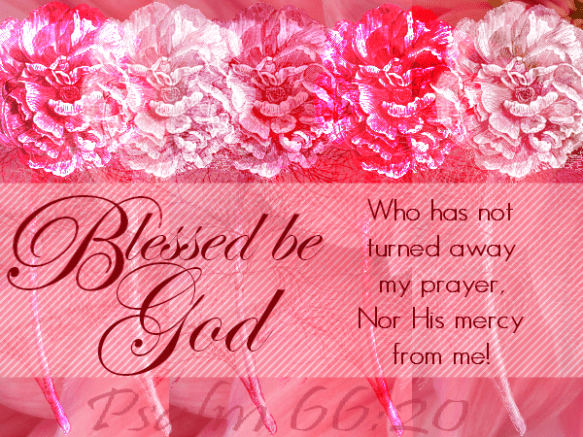
20 Blessed be God,
Who has not turned away my prayer
Nor His lovingkindness from me.
The Word of God for the Children of God.
Glory be to the Father,
and to the Son, and to the Holy Ghost;
as it was in the beginning,
is now, and ever shall be,
world without end. Amen, amen.
We have needs which God meets. Quite often, with and in as much gratitude as we can muster we are led to give thanks after giving honor and adoration to God in our prayers for blessings received. We give thanks for all the amazing things God has done—for this world, for his people, and for us in our personal lives.
Notice how Psalm 66 moves from adoration to thanksgiving.
In the first four verses the psalmist declares how awesome and glorious God is.
Then in verse 5 we see a transition to “come and see what God has done.” From this point on, the psalm reads like an inventory of God’s gifts and amazing help.
The psalmist describes how God continually saves and never stops watching over his people, even in the context of anxiety, fear, trouble, disappointments, and psalmist shouts thanks for what God has done for him personally as well.
The ancient words of Psalm 66 teaches us the value of being specific when we give thanks to God. Many people like to keep a personal “thanks be to God” prayer journal that helps them pay attention to what God is doing in their lives.
As the Psalmist did here in Psalm 66, they keep a running list of God’s blessings and His mercy, love, for them, and they review their list in thanksgiving to God.
In our own personal prayer life (if we actually have disciplined ourselves to have one), do we even .01% acknowledge, recognize gratitude grows in many ways?
God is incredibly gracious and generous.
As we read in James 1:17, “Every good and perfect gift is from above, coming down from the Father. . . .”
The One who gives so abundantly, so much of Himself to us, without caveats, is in my own personal belief, is truly most worthy to receive our abundant thanks.
Psalms 66:20 in the King James Version of the Bible reads: “Blessed be God, which hath not turned away my prayer, nor his mercy from me.”
This verse is a resounding declaration of the Psalmists praise and thanksgiving to God for not rejecting the psalmist’s prayers, for continuing to show mercy.
The book of Psalms is a compilation of 150 poetic songs and prayers and pleas the Psalmist’s raised, that were used in worship and praise in ancient Israel.
The psalms cover a wide range of deep emotions and themes, including praise, thanksgiving, lament, and petition. Psalms 66, in particular, is a psalm of high magnitude thanksgiving and wall shaking praise for deliverance from trouble.
The verse at hand expresses the psalmist’s gratitude for God’s faithfulness in hearing and answering prayers.
It acknowledges the mercy and compassion of God, as well as the fact that He has not and will not forsaken or turned away from the psalmist’s cries for help.
This verse reflects the psalmist’s strength of faith, deepest trust in God and his recognition of God’s constant, continual continued presence, grace in his life.
The theme of gratitude and thanksgiving is central to this verse.
It vividly highlights the psalmist’s recognition of the blessings and deliverance that have come from God alone. The act of praising God for His faithfulness in answering prayers and showing mercy serves as an empowering reminder to all believers to express gratitude for all God’s goodness and provision in their lives.
The context of this verse within the larger psalm is also significant.
In the preceding verses, the psalmist recounts a time of distress and trouble when he called out to God for help.
He describes how God has brought him through the trials and has answered his prayers setting the stage for the declaration of praise and thanksgiving in verse 20, as our psalmist reflects on the faithfulness of God in answering to petitions.
The symbolism of verse 20 lies in the essential contrast between the continual faithfulness of God and the never ending tiresome fickleness of human nature.
The psalmist juxtaposes the unwavering nature of God’s mercy and the innate tendency of humanity to forget or neglect the goodness of God. The image of God not turning away the psalmist’s prayer signifies His steadfastness and His 100% willingness to hear, to listen and to respond to the cries of His people.
In a broader theological sense, this verse also points to the character of God as being merciful and compassionate. It emphasizes the idea that God is a loving and caring deity who is attentive to the needs and pleas of His people.
This is a critical source of comfort and reassurance for believers, as it affirms the Psalmist’s belief in God’s loving-kindness and His willingness to extend, unconditionally, His grace and mercy with no boundaries, to those who seek.
In conclusion, the ancient words of Psalms 66:20 is a verse of highest gratitude and maxed out praise, expressing the psalmist’s deepest thankfulness for God’s faithfulness in answering prayers and showing mercy.
It serves readers of all ages, of all generations as a reminder to all believers of the importance of acknowledging, praising God for His goodness and provision.
The verse also highlights the symbolic contrast between God’s unwavering mercy and the fickle nature of humanity, as well as pointing to the character of God as loving and compassionate. It is an incredibly inspiring, and an incredibly powerful statement of hope, trust and reliance on God’s faithfulness and grace.
If we were the modern contemporary Psalmist and were inspired to be thankful to God for blessings given and blessings received, how would our own Psalm 66 read? How would future generations of Psalmist’s be empowered, inspired to write theirs’s? And we the readers and writers of devotionals, to just HUG GOD?
In the name of God, the Father and God the Son and God the Holy Spirit,
Let us Pray,
Psalm 150 Complete Jewish Bible
150 Halleluyah!
Praise God in his holy place!
Praise him in the heavenly dome of his power!
2 Praise him for his mighty deeds!
Praise him for his surpassing greatness!
3 Praise him with a blast on the shofar!
Praise him with lute and lyre!
4 Praise him with tambourines and dancing!
Praise him with flutes and strings!
5 Praise him with clanging cymbals!
Praise him with loud crashing cymbals!
6 Let everything that has breath praise Adonai!
Halleluyah!
Glory be to the Father,
and to the Son, and to the Holy Ghost;
as it was in the beginning,
is now, and ever shall be,
world without end. Amen, amen.
 Loving God, Living God, Loving Hope, Living Hope, Loving Living Life His Way! "Many things are possible for the person who has hope. Even more is possible for the person who has faith. And still more is possible for the person who knows how to love. But everything is possible for the person who practices all three virtues." - Brother Lawrence (1605-1691), Practicing the Presence of God (1692).