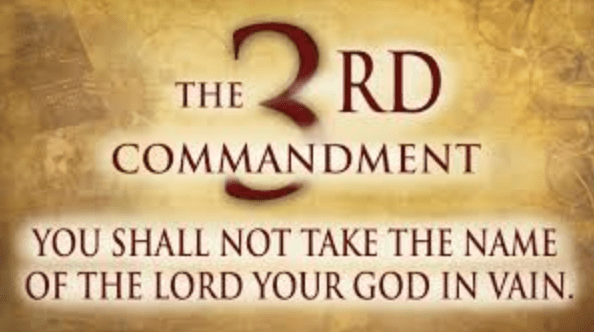
God’s name should be treated with highest reverence and not used in a casual or foolish, disrespectful way. Exodus 20:7

Exodus 20:7 Amplified Bible

“You shall not take the name of the Lord your God in vain [that is, irreverently, in false affirmations or in ways that impugn the character of God]; for the Lord will not hold guiltless nor leave unpunished the one who [a]takes His name in vain [disregarding its reverence and its power].

Word of God for the Children of God.

Glory be to the Father,
and to the Son, and to the Holy Ghost;
as it was in the beginning,
is now, and ever shall be,
world without end. Amen, amen.

The Third Commandment states: “You shall not misuse the name of the Lord your God, for the Lord will not hold anyone guiltless who misuses his name. Exodus 20:7.”

God’s Name is special because it carries the personality of God.

The Name in Bible times was more than a personal identification.

It represented the whole person, with his personality, will, gifts, ideas, etc.

This is why some people had their names changed when they went to a transforming experience. The person changed, so the name changed.

Matthew 16:13-20 Amplified Bible

Peter’s Confession of Christ

13 Now when Jesus went into the [a]region of Caesarea Philippi, He asked His disciples, “Who do people say that the Son of Man is?” 14 And they answered, “Some say John the Baptist; others, Elijah; and still others, Jeremiah, or [just] one of the prophets.” 15 He said to them, “But who do you say that I am?”  16  Simon Peter replied, “You are the Christ (the Messiah, the Anointed), the Son of the living God.”  17 Then Jesus answered him, “Blessed [happy, spiritually secure, favored by God] are you, Simon son of Jonah, because flesh and blood (mortal man) did not reveal this to you, but My Father who is in heaven. 18 And I say to you that you are [b]Peter, and on this [c]rock I will build My church; and the [d]gates of Hades (death) will not overpower it [by preventing the resurrection of the Christ]. 19 I will give you the keys (authority) of the kingdom of heaven; and whatever you bind [forbid, declare to be improper and unlawful] on earth [e]will have [already] been bound in heaven, and whatever you loose [permit, declare lawful] on earth [f]will have [already] been loosed in heaven.” 20 Then He gave the disciples strict orders to tell no one that He was the Christ (the Messiah, the Anointed).

The Name of God here in the third commandment involves the whole Trinity, God, the Father, Son and Holy Spirit.

Let us see what this Commandment teaches us.

What if we were to take a poll asking people which of the Ten Commandments they regard as the least significant, I wonder if the “winner” would be the third.

When compared to false gods and graven images, the third command doesn’t seem like such a serious offense. But if the one who wrongly uses the name of God incurs guilt, then it must be important—and we need to understand why.

Scripture is crystal clear that God’s name is most precious and most powerful.

One place where we see this is in the encounters between God and Moses.

In Exodus 33, Moses asks God to reveal His glory.

His request invites a death sentence because it is not possible to see God’s glory and live.

But God graciously grants the request in a way that prevents Moses’ demise, for He demonstrates His glory not by a physical manifestation but by revealing His name:

“The LORD, the LORD, a God merciful and gracious” (Exodus 34:6; emphasis added).

His name reveals His character, which in turn reveals His glory.

Earlier, in Exodus 3, God had revealed Himself to Moses in the burning bush.

Moses had been tasked with a weighty mission and wanted to know what to say when people asked who had sent him.

God told Moses to say, “I AM has sent me to you” (Exodus 3:14).

By using a form of the verb to be to name Himself, God declared that He is self-existent, self-sufficient, and sovereign, depending on no one and nothing. Who else can claim such a name?

In declaring and disclosing Himself, God does not merely identify Himself; He reveals the wonder of who He is.

So to misuse God’s name is to misunderstand His greatness and glory.

Only when we grasp this can we understand why the third commandment is so significant.

In what ways, then, might we break this commandment?

For one, we break it every time we use God’s name to strengthen our vows and promises, bringing down the name of divinity in order to make ourselves sound more believable (James 5:12).

We also blaspheme God when we use His name in anger, in arrogance, or in defiance of who He is.

We misuse His name when we utter falsehoods and use it to back them up.

Perhaps closer to home, in every worship service we attend where we worship God with our lips only and not from our heart, we break the likewise third commandment.

Only when we see the glory of God’s name and when we use it in praise, love, prayer, obedience, and gratitude do we gain more insight, understand why our Lord Jesus taught us to pray, “Our Father which art in heaven, Hallowed be thy name” (Matthew 6:9, KJV, emphasis added).

His name is to be forever hallowed because it proclaims who He is, reveals His character, and is a strong refuge for all who call on it (Proverbs 18:10).

And it is to be forever hallowed in the lives of His people—including in your life, as you bear the name of Christ and take it on your lips with reverence and love.

In the name of God, the father and God the Son and God the Holy Spirit,

Pray,

Psalm 20 Authorized (King James) Version

Psalm 20

To the chief Musician, A Psalm of David.

The Lord hear thee in the day of trouble;
the name of the God of Jacob defend thee;
send thee help from the sanctuary,
and strengthen thee out of Zion;
remember all thy offerings,
and accept thy burnt sacrifice; Selah.
Grant thee according to thine own heart,
and fulfil all thy counsel.
We will rejoice in thy salvation,
and in the name of our God we will set up our banners:
the Lord fulfil all thy petitions.

Now know I that the Lord saveth his anointed;
he will hear him from his holy heaven
with the saving strength of his right hand.
Some trust in chariots, and some in horses:
but we will remember the name of the Lord our God.
They are brought down and fallen:
but we are risen, and stand upright.
Save, Lord: let the king hear us when we call.

Glory be to the Father,
and to the Son, and to the Holy Ghost;
as it was in the beginning,
is now, and ever shall be,
world without end. Amen, amen.

https://translate.google.com/

Therefore, let us be committed, let us be .1% more resolved, to give heed to these ancient Words from the Lord: “Do not be afraid of them; the Lord your God himself will fight for you.” Deuteronomy 3:21-28

Deuteronomy 3:21-28 New International Version

Moses Forbidden to Cross the Jordan

21 At that time I commanded Joshua: “You have seen with your own eyes all that the Lord your God has done to these two kings. The Lord will do the same to all the kingdoms over there where you are going. 22 Do not be afraid of them; the Lord your God himself will fight for you.”

23 At that time I pleaded with the Lord: 24 “Sovereign Lord, you have begun to show to your servant your greatness and your strong hand. For what god is there in heaven or on earth who can do the deeds and mighty works you do?  25 Let me go over and see the good land beyond the Jordan—that fine hill country and Lebanon.”

26 But because of you the Lord was angry with me and would not listen to me. “That is enough,” the Lord said. “Do not speak to me anymore about this matter. 27 Go up to the top of Pisgah and look west and north and south and east. Look at the land with your own eyes, since you are not going to cross this Jordan. 28 But commission Joshua, and encourage and strengthen him, for he will lead this people across and will cause them to inherit the land that you will see.”

The Word of God for the Children of God.

Glory be to the Father,
and to the Son, and to the Holy Ghost;
as it was in the beginning,
is now, and ever shall be,
world without end. Amen, amen.

Deuteronomy 3:22 in the King James Version of the Bible reads, “Ye shall not fear them: for the Lord your God he shall fight for you.”

This verse comes from the book of Deuteronomy, which is the fifth book of the Old Testament and is attributed to Moses.

The context of this verse is very important for understanding its meaning.

In the preceding verses, Moses is recounting to the Israelites the victories they had over the kings of the Amorites and Bashan.

He reminds them that it was not their own strength or military prowess that had enabled them to defeat these enemies, but rather it was the Lord alone who fought for them and gave them the victory. In verse 21, Moses encourages the Israelites to not be afraid of the enemies they will face as they continue their journey to possess the Promised Land, for it is the Lord who will fight for them.

One of the key themes of this verse is the now nearly foreign idea of courage, strength and trust in God’s protection.

The Israelites were facing formidable enemies as they advanced towards the Promised Land, and it would have been quite natural for them to feel fear and uncertainty entering a “promised” land they knew virtually nothing about.

However, Moses assures them that they do not need to fear because the Lord their God will be the one to fight for them. This theme of courage and strength in the face of an unknown measure of adversity and crisis level trust in God’s provision is a recurring motif throughout the Bible is particularly emphasized in the book of Deuteronomy – Moses’ final discourse before Joshua took over.

The verse also highlights the absolute sovereignty and limitless power of God.

The Israelites are reminded their victory over their enemies is not dependent on their own capabilities or resources, or lack thereof, but on the Lord alone who is and always will be able to fight for them and secure their success.

This serves as a powerful reassurance to the Israelites that their security and wellbeing are ultimately 100% safe in the hands of a mighty and faithful God.

Symbolically, this verse can be interpreted as a representation of the broader theme of spiritual warfare.

While the Israelites were facing physical battles against their enemies, the underlying message is that there are spiritual battles taking place as well.

The assurance that the Lord will fight “unbeatable foes” for them serves as a reminder that believers are not alone in their struggles against spiritual forces, but that God is actively interceding, continually intervening, on their behalf.

Additionally, this verse speaks highly to the concept of divine protection and provision. The Israelites were being led to a land flowing with milk and honey, but they had to face numerous challenges and adversaries along the way.

The promise that God would fight for them is an undeniable demonstration of his everlasting commitment to care for his people and to ensure that they will ultimately inherit the blessings he has promised to them from the beginning.

Deuteronomy 3:22 contains a powerful message of assurance, confidence and courage, of strength, trust, and divine intervention.

It reassures believers, even us today, that they can face their enemies with confidence, knowing that the Lord their God will be the one to fight for them.

This verse serves as a source of encouragement and hope for believers facing adversity and serves as a sure reminder of the faithfulness and power of God.

One too many of us will always trust in Chariots and Horses …

Psalm 20 New International Version

Psalm 20[a]

For the director of music. A psalm of David.

May the Lord answer you when you are in distress;
    may the name of the God of Jacob protect you.
May he send you help from the sanctuary
    and grant you support from Zion.
May he remember all your sacrifices
    and accept your burnt offerings.[b]
May he give you the desire of your heart
    and make all your plans succeed.
May we shout for joy over your victory
    and lift up our banners in the name of our God.

May the Lord grant all your requests.

Now this I know:
    The Lord gives victory to his anointed.
He answers him from his heavenly sanctuary
    with the victorious power of his right hand.
Some trust in chariots and some in horses,
    but we trust in the name of the Lord our God.
They are brought to their knees and fall,
    but we rise up and stand firm.
Lord, give victory to the king!
    Answer us when we call!

I do not know of anyone who has not been afraid of something or someone at some time in their life.

Have you experienced the fear of a medical diagnosis, or of being harmed, or of being threatened by someone in authority, or of moving from a place of comfort and safety to a place that could be unwelcoming or even dangerous?

Have you feared growing old, or being alone in your old age, or perhaps of our losing your cognitive and or physical abilities or something you have worked for? Have you been getting afraid of losing loved ones or even your own life?

When we are afraid, it can be helpful to recall times when God demonstrated his love, care, and power.

We can trust in the Lord, who is faithful. We do not have to be afraid (Psalm 27:1).

Psalm 27:1-2 Complete Jewish Bible

27 (0) By David:

(1) Adonai is my light and salvation;
whom do I need to fear?
Adonai is the stronghold of my life;
of whom should I be afraid?
When evildoers assailed me
to devour my flesh,
my adversaries and foes,
they stumbled and fell.

Moses faced his own fears when hostile kings and their armies threatened the people of Israel (see Deuteronomy 2:24-3:11).

But God told him not to be afraid because God would defeat their enemies.

God told Moses to encourage and strengthen Joshua so he too would trust God, not rely on his own limited abilities or be afraid of other nations as they crossed the Jordan River. (Joshua 1:1-9)

Joshua 1:1-9 Christian Standard Bible

Encouragement of Joshua

1 After the death of Moses the Lord’s servant, the Lord spoke to Joshua son of Nun, Moses’s assistant: “Moses my servant is dead. Now you and all the people prepare to cross over the Jordan to the land I am giving the Israelites. I have given you every place where the sole of your foot treads, just as I promised Moses. Your territory will be from the wilderness and Lebanon to the great river, the Euphrates River—all the land of the Hittites—and west to the Mediterranean Sea. No one will be able to stand against you as long as you live. I will be with you, just as I was with Moses. I will not leave you or abandon you.

“Be strong and courageous, for you will distribute the land I swore to their ancestors to give them as an inheritance. Above all, be strong and very courageous to observe carefully the whole instruction my servant Moses commanded you. Do not turn from it to the right or the left, so that you will have success wherever you go.  This book of instruction must not depart from your mouth; you are to meditate on[a] it day and night so that you may carefully observe everything written in it. For then you will prosper and succeed in whatever you do. Haven’t I commanded you: be strong and courageous? Do not be afraid or discouraged, for the Lord your God is with you wherever you go.”

We can face our fears on our own, or we can listen to God. We should obey when the Spirit nudges or tells us to be still. God has our back. He will give us strength and courage to stand. The Lord is always with us and will always take care of us.

In the name of God, the Father and God the Son and God the Holy Spirit,

Let us Pray,

Psalm 8 Christian Standard Bible

Psalm 8

God’s Glory, Human Dignity

For the choir director: on the Gittith. A psalm of David.

Lord, our Lord,
how magnificent is your name throughout the earth!
You have covered the heavens with your majesty.[a]
From the mouths of infants and nursing babies,
you have established a stronghold[b]
on account of your adversaries
in order to silence the enemy and the avenger.

When I observe your heavens,
the work of your fingers,
the moon and the stars,
which you set in place,
what is a human being that you remember him,
a son of man[c] that you look after him?
You made him little less than God[d][e]
and crowned him with glory and honor.
You made him ruler over the works of your hands;
you put everything under his feet:
all the sheep and oxen,
as well as the animals in the wild,
the birds of the sky,
and the fish of the sea
that pass through the currents of the seas.

Lord, our Lord,
how magnificent is your name throughout the earth!

Glory be to the Father,
and to the Son, and to the Holy Ghost;
as it was in the beginning,
is now, and ever shall be,
world without end. Amen, amen.

https://translate.google.com/

Are we understanding: “Some trust in chariots and some in horses, but we praise the name of  Adonai our God. They will crumple and fall, but we will arise and we’ll stand erect?” Psalm 20

Psalm 20 Complete Jewish Bible

20 (0) For the leader. A psalm of David:

2 (1) May Adonai answer you in times of distress,
may the name of the God of Ya‘akov protect you.
3 (2) May he send you help from the sanctuary
and give you support from Tziyon.
4 (3) May he be reminded by all your grain offerings
and accept the fat of your burnt offerings. (Selah)
5 (4) May he grant you your heart’s desire
and bring all your plans to success.

6 (5) Then we will shout for joy at your victory
and fly our flags in the name of our God.
May Adonai fulfill all your requests.

7 (6) Now I know that Adonai
gives victory to his anointed one —
he will answer him from his holy heaven
with mighty victories by his right hand.

8 (7) Some trust in chariots and some in horses,
but we praise the name of Adonai our God.
9 (8) They will crumple and fall,
but we will arise and stand erect.

10 (9) Give victory, Adonai!
Let the King answer us the day we call.

The Word of God for the Children of God.

Glory be to the Father,
and to the Son, and to the Holy Ghost;
as it was in the beginning,
is now, and ever shall be,
world without end. Amen, amen.

Misplaced Trust?

What is a misplaced trust in the Bible?

The Bible places much emphasis on TRUST; however, many people will put their trust in that which is not true or honest. This is the result of deception, an oft used malicious tool of the enemy, both physical and spiritual. Thus there is misplaced trust; trusting in that which is discovered to be unreliable or false.

Misplaced loyalty (or mistaken loyalty, misguided loyalty or misplaced trust) is loyalty placed in other persons or organizations, things, where that loyalty is not acknowledged, is not respected, is betrayed, or is taken advantage of.

Deceptive Trust?

Deceptive behavior uses trust and mistrust as tools (or weapons, depending on your perspective). The goal of deception is to either convince someone of a greater degree of trust than is warranted, or to leverage risk aversion through mistrust. The risk of deception rises when the stakes are high, and when the system encourages deceptive behavior.

Deception is usually associated with selfish competitive behavior, it can be used for the benefit of someone else, and can sometimes be both a virtue and a vice.

For example, Odysseus was a cunning hero for the Greeks in the Odyssey, but a deceptive malicious villain for the Romans in the Aeneid. Regardless for why deception is used, once someone recognizes the deception then serious, severe doubt is cast upon that deceiver’s future behavior.

Whether To Trust or Not to Trust? God vs. Chariots

Psalm 20:7 English Standard Version

Some trust in chariots and some in horses,
    but we trust in the name of the Lord our God.

Where we place our trust says a lot about us, about who we are, and about our character.

This verse from Psalm 20 says, “Some trust in chariots and some in horses, but we trust in the name of the Lord our God.”

I want to add an exclamation mark at the end when I read it!

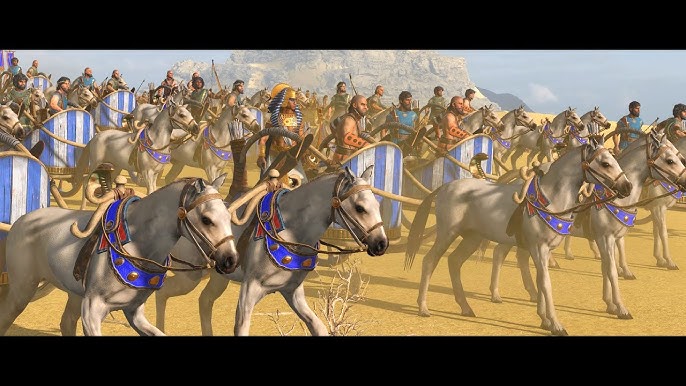
Chariots and horses were weapons used in war in the Bronze and Iron Ages.

As time progressed chariots became more and more sophisticated, having spikes on their wheels and other features making them even more intimidating.

The chariot was like the equivalent to our modern day main battle tanks.

They communicated strength and intimidation.

The Chariots and horses could outrun the infantry and the charioteers would shoot arrows, hurl sharp spears that could penetrate the armor of the enemy.

Chariots coming towards you would invoke a fear for one’s life, most certainly! King Solomon had 1400 chariots and 12,000 horses in his army (1 Kings 10:26)!

One probably felt pretty secure going into battle with 1400 chariots! Wow!

It’s pretty easy to trust in my car to safely carry me from place to place.

There’s many safety features in today’s vehicles.

I can trust in a home alarm system, a surveillance camera and the spyware on my laptop.

Trust in these things can fail me in various ways.

I’m not suggesting we do away with these things.

I am saying that placing our greatest level of trust in these human things will eventually disappoint.

However, trusting in the name of the Lord Almighty is another story.

The Bible is full of stories from the lives of those who have come before us that prove when we trust in the Lord we never come up short.

We need not fear. Daniel in the lion’s den, David and Goliath, and many other biblical stories show us how nothing can defeat us if our trust is in the Lord.

The verse that follows this one, 20 verse eight says, “They collapse and fall, but we rise and stand up straight.”

I can still stand up straight when all has collapsed around me.

This trust can give me a superpower!

I can be like David! I can be like Daniel! I too can put my trust in the Lord!

What a word for us today!

What a word for the person who trusts in their personal weapons alone!

What a word for those who have lost everything to war!

What a word for those of us who have experienced injustice!

We are invited to trust in the Lord.

God has not failed us and will not fail us. He is Who He says He is!

How do we trust?

We believe.

We live out in obedience what the Lord has laid out before us.

We choose a lifestyle that pleases God.

It is then that I am handed my armor!

It’s when I trust that I have my chariot and horse!

I am ready for battle and I pray I please my Savior Jesus in the battle of this life.

What are you trusting in?

Is it as strong as the mountain?

Who are you trusting in?

Do they have the faith which can move that mountain even 1 millimeter?

Can you let go of safety and security in earthly things and trust in the Lord.

The safest place to be is where God calls us to be.

I can rest in this and know I am I am covered.

I am safe. I am loved. I am God’s.

In the name of God, the Father and God the Son and God the Holy Spirit,

Let us Pray,

Psalm 13 English Standard Version

How Long, O Lord?

To the choirmaster. A Psalm of David.

13 How long, O Lord? Will you forget me forever?
    How long will you hide your face from me?
How long must I take counsel in my soul
    and have sorrow in my heart all the day?
How long shall my enemy be exalted over me?

Consider and answer me, O Lord my God;
    light up my eyes, lest I sleep the sleep of death,
lest my enemy say, “I have prevailed over him,”
    lest my foes rejoice because I am shaken.

But I have trusted in your steadfast love;
    my heart shall rejoice in your salvation.
I will sing to the Lord,
    because he has dealt bountifully with me.

Glory be to the Father,
and to the Son, and to the Holy Ghost;
as it was in the beginning,
is now, and ever shall be,
world without end. Amen, amen.

https://translate.google.com/