
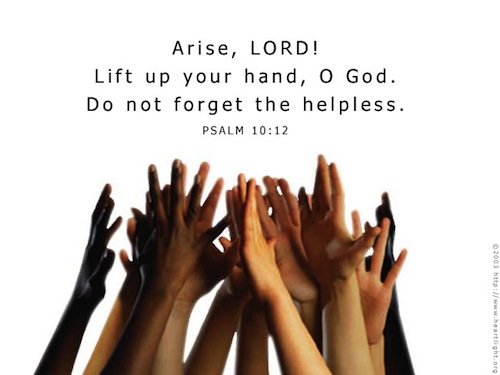
Psalm 10 Complete Jewish Bible
10 Why, Adonai, do you stand at a distance?
Why do you hide yourself in times of trouble?
2 The wicked in their arrogance hunt down the poor,
who get caught in the schemes they think up.
3 For the wicked boasts about his lusts;
he blesses greed and despises Adonai.
4 Every scheme of the wicked in his arrogance [says],
“There is no God, [so] it won’t be held against me.”
5 His ways prosper at all times.
Your judgments are way up there,
so he takes no notice.
His adversaries? He scoffs at them all.
6 In his heart he thinks, “I will never be shaken;
I won’t meet trouble, not now or ever.”
7 His mouth is full of curses, deceit, oppression;
under his tongue, mischief and injustice.
8 He waits near settlements in ambush
and kills an innocent man in secret;
his eyes are on the hunt for the helpless.
9 Lurking unseen like a lion in his lair,
he lies in wait to pounce on the poor,
then seizes the poor and drags him off in his net.
10 Yes, he stoops, crouches down low;
and the helpless wretch falls into his clutches.
11 He says in his heart, “God forgets,
he hides his face, he will never see.”
12 Arise, Adonai! God, raise your hand!
Don’t forget the humble!
13 Why does the wicked despise God
and say in his heart, “It won’t be held against me”?
14 You have seen; for you look at mischief and grief,
so that you can take the matter in hand.
The helpless commits himself to you;
you help the fatherless.
15 Break the arm of the wicked!
As for the evil man,
search out his wickedness
until there is none left.
16 Adonai is king forever and ever!
The nations have vanished from his land.
17 Adonai, you have heard what the humble want;
you encourage them and listen to them,
18 to give justice to the fatherless and oppressed,
so that no one on earth will strike terror again.
The Word of God for the Children of God.
Glory be to the Father,
and to the Son, and to the Holy Ghost;
as it was in the beginning,
is now, and ever shall be,
world without end. Amen, amen.
Having consistent and transformational encounters with God while on earth is meant to be foundational to the Christian life. Our God has not left us. Our God has not changed, cannot be changed, will not change, will never be changed. He is, was and forever be the same God – today, yesterday and every last tomorrow.
Through the sacrifice of Jesus, we’ve been filled with the very Spirit of God who longs to reveal to us daily the nearness and love of our heavenly Father. We are never left alone. There is nowhere we can flee from the presence of our God. It is likewise true God can always be found-sometimes in the most common places.
However, as much the Hebrews 13:8 remains forever true and unchangeable, it is more than well established through the Word of God that while things will always proceed according to God’s plan, humankind’s plan always, inevitably, falls apart and humanity struggles to regain the degree and measure of control they falsely believe they exercise over divine providence, and God ‘vanishes.’
Humankind inevitably will become all kind of flustered, frustrated and frayed.
10 Why do You stand far away, O Lord?
Why do You hide [Yourself, veiling Your eyes] in times of trouble? Psalm 10:1
The pitiful cries that are recorded in this Psalm 10 could be the words of many believers today.
Times of deepest troubles and severe persecution are touching every member of the Body of Christ in one way or another, many are repeatedly crying out: “Lord, why do you stand far off? Why do you (always) hide yourself in times of trouble?”
What the Psalmist recorded 3000 years ago, mirrors the happenings of today, as many continue to ask, “Why does the Lord our God seem to remain silent while the innocents suffer? Why are those arrogant, evil men permitted to go unchallenged?”
We may not or never understand the full plans and purposes of God, but He has already appointed a time, a time known only to Him, to judge evil, the wicked.
We may be grieved by the wars, the atrocities, the incredible measures and degrees and divisiveness that are taking place today, but God has appointed a day to finish transgression, put an end to sin, to atone for wickedness, to bring in everlasting righteousness, to set His King upon His holy Hill in Jerusalem.
For two thousand years, God has been pouring out grace upon grace, upon grace not willing that any should perish. But the day is coming when wicked and evil man will be called to a final account of their sins, day of wrath is surely coming when nations will be judged, and God will wipe away every tear from our eyes.
Jesus taught us in John 4:23, “But the hour is coming, and is now here, when the true worshipers will worship the Father in spirit and truth, for the Father is seeking such people to worship him.” Your heavenly Father is seeking your worship. He longs for it. He so places highest values on your love, adoration that he would send his Son to die that the path to encountering him would be made available.
You, me, we, were first and foremost created to worship. You, me, we were all created to receive the love of your Creator and in response give him your heart.
You, me, we, will never feel as whole as when our hearts is connected to our Heavenly Father’s heart and you, me, we are giving, receiving love in worship.
Psalm 29 Complete Jewish Bible
29 (0) A psalm of David:
(1) Give Adonai his due, you who are godly;
give Adonai his due of glory and strength;
2 give Adonai the glory due his name;
worship Adonai in holy splendor.
3 The voice of Adonai is over the waters;
the God of glory thunders,
Adonai over rushing waters,
4 the voice of Adonai in power,
the voice of Adonai in splendor.
5 The voice of Adonai cracks the cedars;
Adonai splinters the cedars of the L’vanon
6 and makes the L’vanon skip like a calf,
Siryon like a young wild ox.
7 The voice of Adonai flashes fiery flames;
8 the voice of Adonai rocks the desert,
Adonai convulses the Kadesh Desert.
9 The voice of Adonai causes deer to give birth
and strips the forests bare —
while in his temple, all cry, “Glory!”
10 Adonai sits enthroned above the flood!
Adonai sits enthroned as king forever!
11 May Adonai give strength to his people!
May Adonai bless his people with shalom!
The Christian life is to be marked by disciplined heartfelt, genuine worship: worship filled with God’s presence and intimate nearness and nearness to the heartbeat of God that responds to a true encounter with the heart of God.
If that type of worship is new to you, that’s okay!
If the idea of encountering God in worship is new to you, there is joy and grace at the place of new beginnings.
Don’t allow your past to dictate the possibilities of your future.
Don’t allow past experiences where worship might not have been filled with encountering Jesus make you believe our future times of our worship won’t be marked by the power and intimacy and God’s presence. (Isaiah 6:1-10)
Where else Do We See the Gospel in the Psalms?
Asking how we see the gospel in the book of Psalms feels a little like asking, “How do we see the gospel in The Methodist Hymnal.”
Isn’t it there in every single song (hopefully)?
Of course, the Old Testament is different. But this is a book of music which Old Testament believers would have used to express their faith in the living God.
In order to see the gospel in Psalms do we need to analyze every single chapter?
Are these not individual songs?
Or is there a unified theme to the Psalms which also points to the gospel?
I will argue that the Psalms not only point us to Jesus individually, the Book of Psalms as a compilation which will also point us to the finished work of Christ.
How Do You Find the Gospel in the Old Testament?
I suppose before understanding how to find the gospel in the OT, it’d be helpful for us to define the gospel.
The simplest definition is one given by JI Packer: God saves sinners.
If you’d like to put a bit more meat on your gospel presentation, I use two different frameworks with four points each.
The first is God—Man—Christ—Response.
The second is more of a story: Creation—Fall—Redemption—Glory.
The first presentation centers upon God’s character and how humanity fails to meet God’s holy standard, as such the judgment of God is upon us.
But the good news is that Jesus Christ fixes this by fulfilling what is required through his life, death and resurrection.
Our only fitting response, then, is to respond to Him in repentance and faith.
When this happens, we are united to Christ and his record becomes our record.
The second presentation centers upon the overarching story of the Bible.
God lovingly created us to love Him and enjoy Him forever.
We were made for rest, rule, and relationship.
But we made shipwreck of this, and so rather than having the blessings of obedience we are under the curse of disobedience.
Rather than having peace (rest), purpose (ruling), and healthy relationship we often experience the opposite.
Ultimately, we are alienated from God. But thankfully God sent His Son, Jesus Christ, to bear our curse and to fulfill what God intended for humanity.
As such we now experience the blessings of Jesus’ obedience in our place.
He restores the rest, rule, and relationship we were created to enjoy.
Someday everything will be ultimately restored and we will live in a new heaven and a new earth.
We could write entire books focusing on these various themes of the gospel.
But every gospel story follows this basic skeleton.
No matter where you find yourself in the Old Testament (or New Testament) you can find one of these various threads.
Every place in Scripture is either telling you something about God, something about our rebellion, something about His rescue, or something about our future restoration.
If you can spot this, then you can fill out the rest of the story.
The Gospel in Psalms
For my studies, I have often compared the book of Psalms to a hymnbook.
That’s not entirely true.
It was a collection of poems throughout the history of Israel, many of which were set to music.
Most believe the 150 Psalms were compiled at some point after the Babylonian exile. How were they compiled? Did an ancient exiled editor just randomly pick a few poems, stick them together willy dilly, and then give them numbers?
Or was there an intentional structure?
The first clue that there is an intentional structure is that many have headings.
In fact, we notice that there are five Books of the Psalms. This is likely intentional and connected to the Pentateuch (the first five books of the Old Testament). We also see that each of these books ends with a doxology.
This structure can help us understand the overall theme of the book of Psalms.
Taking the first two books as a bit of a thesis, I appreciate the summary given by The Bible Project.
They say, it is “the prayer book of God’s people as they strive to be faithful to the Torah as they wait for the Messianic Kingdom.”
How do these five books of Psalms support that theme?
And more importantly how does the story of the Psalms point to Christ?
Book I
Almost all of the psalms of Book I are attributed to David.
They carry a strong theme of fidelity to the Torah and the nature of the Davidic King and kingdom.
But they are often set in the middle of distressing situations.
Saul’s pursuit of David plays a prominent role throughout these.
And yet through this distress, we see a settled disposition to trust in the Lord.
The theme here is that of confrontation with the results of the fall.
The seed of the woman will crush the head of the serpent.
We see this theme played out through the conflict of Book I.
Book II
In Book II we are introduced to the Sons of Korah (Ps. 42-49), one psalm of Asaph (50), and then another group of psalms attributed to David (51-71).
It closes with a psalm of Solomon (72).
In this book, the posture towards the world is a bit different. Rather than a confrontation we see more of an invitation. Here the Abrahamic blessing is extended through the reign of the Messiah’s kingdom. But it is still set within a background of lament and longing and an underlying desire for repentance.
Book III
In Book III it is as if all the wheels come off of the locomotive.
The psalms further darken until they reach their climax in Psalm 88.
That is the psalm of lament where there is no positive turn.
It is only darkness.
But the book ends with a bit of a higher note in Psalm 89 as it points toward the promise of a messianic kingdom, but now it does so in light of the exile and the collapse of the Davidic Kingdom. How can the Messiah come through this?
How can a king sit on David’s throne when the people are divided, scattered?
Book IV
Book IV, opening with Psalm 90, seems like a response to the questions and the problems which the fall of the Davidic kingdom brings.
Psalm 90 goes back to Moses and his call of repentance after the incident of the golden calf.
This is likely where the people are during the time when these psalms are compiled. There is an obvious theme here of the truth that “the Lord reigns.”
That is the answer to the exile. God is still able to bring that which He promised.
Book V
Book V has within it two sub-books: the Hallel and the Songs of Ascent.
These point to the promise of a new Exodus. Positioned within the middle of these sub-books is Psalm 119 — that really long psalm all about delight in the Torah. Once again, we see the original theme of the book of the Psalms.
The whole thing concludes with five Hallelu-Yah’s (Praise the Lord) — pointing to God’s coming rule and reign.
The Psalms are a recasting of the history of Israel (really of all of humanity).
It tells the story of the gospel. God has decisively crushed the head of the serpent, but we are not yet there. We do not yet fully live in this redemption.
Therefore, we have some of the same struggles as the psalmist did. We have seasons of lament, where we are honest with God about our grief.
And we also have times of praise, prayer and worship — when the kingdom appears to be vividly breaking into our here and now.
The gospel is in the structure of the Psalms through pointing to the coming Rescuer. Each of the Psalms point to Jesus. He is the long awaited for King.
He is the hope of the nations.
The Gospel in Psalm 88
Psalm 88 Complete Jewish Bible
88 (0) A song. A psalm of the sons of Korach. For the leader. Set to “Sickness that Causes Suffering.” A maskil of Heiman the Ezrachi.
2 (1) Adonai, God of my salvation,
when I cry out to you in the night,
3 (2) let my prayer come before you,
turn your ear to my cry for help!
4 (3) For I am oversupplied with troubles,
which have brought me to the brink of Sh’ol.
5 (4) I am counted among those going down to the pit,
like a man who is beyond help,
6 (5) left by myself among the dead,
like the slain who lie in the grave —
you no longer remember them;
they are cut off from your care.
7 (6) You plunged me into the bottom of the pit,
into dark places, into the depths.
8 (7) Your wrath lies heavily on me;
your waves crashing over me keep me down. (Selah)
9 (8) You separated me from my close friends,
made me repulsive to them;
I am caged in, with no escape;
10 (9) my eyes grow dim from suffering.
I call on you, Adonai, every day;
I spread out my hands to you.
11 (10) Will you perform wonders for the dead?
Can the ghosts of the dead rise up and praise you? (Selah)
12 (11) Will your grace be declared in the grave,
or your faithfulness in Abaddon?
13 (12) Will your wonders be known in the dark,
or your righteousness in the land of oblivion?
14 (13) But I cry out to you, Adonai;
my prayer comes before you in the morning.
15 (14) So why, Adonai, do you reject me?
Why do you hide your face from me?
16 (15) Since my youth I have been miserable, close to death;
I am numb from bearing these terrors of yours.
17 (16) Your fierce anger has overwhelmed me,
your terrors have shriveled me up.
18 (17) They surge around me all day like a flood,
from all sides they close in on me.
19 (18) You have made friends and companions shun me;
the people I know are hidden from me.
Psalm 88 is horribly depressing.
Unlike the other psalms of lament, there is not a glimmer of hope here.
I believe this is an expression of what happens when the curses of Deuteronomy 28 fall upon a people.
It is precisely the situation which the exilic community is facing.
And with all of this pain comes deep questions.
There are two questions which are crying out during an exile.
If the curse of the Law has fallen upon them, has their sin cut them off from God forever? How can an unholy people ever expect to return to a right relationship with God? Could they ever come back to the land? (That’s all one question, but trauma tends to ask the same question in multiple says).
But these questions are cast against the background of God’s promises.
How can this be?
Has God cut them off forever?
Will they ever again be recipients of these great promises?
What does this mean for God’s name throughout the world?
Does this now mean that Babylon is more powerful?
Are they the victors? Did the serpent win?
Ever feel this way yourself?
I know I’ve had very dark nights of the soul.
I have felt in my bones the pain of Psalm 88. On one particularly low occasion I found myself praying Psalm 88. I felt like the psalm was written for me.
This is my situation.
This embodies my hurt.
But then I started to think of Christ.
Wait…Psalm 88 isn’t my psalm, it’s His.
If anyone can pray Psalm 88 it is Christ who drank of the curse on our behalf.
Jesus truly did bear in His body the full weight of the Deuteronomic curse.
Even though I’ve felt Psalm 88, and even though I may go through seasons where I can pray this and identify with it, I haven’t experienced it as deeply as Christ. He has gone several echelons deeper into the pit than I will ever go.
This is good news because the story doesn’t end with Psalm 88. We’re meant to read it with Psalm 89. And Psalm 89 invites us to hope in the coming Messiah.
That coming Messiah is Jesus — the resurrected One. As He shares in the death of Psalm 88, which our sin has brought about, He ultimately conquered death.
He did not stay in the grave. And through our union with Him, we won’t either!
In the name of God, the Father and God the Son and God the Holy Spirit,
Let us Pray,
Psalm 89 Complete Jewish Bible
89 (0) A maskil of Eitan the Ezrachi:
2 (1) I will sing about Adonai’s acts of grace forever,
with my mouth proclaim your faithfulness to all generations;
3 (2) because I said, “Grace is built to last forever;
in the heavens themselves you established your faithfulness.”
4 (3) You said, “I made a covenant with the one I chose,
I swore to my servant David,
5 (4) ‘I will establish your dynasty forever,
build up your throne through all generations.’” (Selah)
6 (5) Let the heavens praise your wonders, Adonai,
your faithfulness in the assembly of the angels.
7 (6) For who in the skies can be compared with Adonai?
Which of these gods can rival Adonai,
8 (7) a God dreaded in the great assembly of the holy ones
and feared by all around him?
9 (8) Adonai Elohei-Tzva’ot!
Who is as mighty as you, Yah?
Your faithfulness surrounds you.
10 (9) You control the raging of the sea;
when its waves rear up, you calm them.
11 (10) You crushed Rahav like a carcass;
with your strong arm you scattered your foes.
12 (11) The heavens are yours, and the earth is yours;
you founded the world and everything in it.
13 (12) You created north and south;
Tavor and Hermon take joy in your name.
14 (13) Your arm is mighty, your hand is strong,
your right hand is lifted high.
15 (14) Righteousness and justice are the foundation of your throne;
grace and truth attend you.
16 (15) How happy are the people who know the joyful shout!
They walk in the light of your presence, Adonai.
17 (16) They rejoice in your name all day
and are lifted up by your righteousness,
18 (17) for you yourself are the strength in which they glory.
Our power grows by pleasing you,
19 (18) for our shield comes from Adonai —
our king is from the Holy One of Isra’el.
20 (19) There was a time when you spoke in a vision;
you declared to your loyal [prophets],
“I have given help to a warrior,
I have raised up someone chosen from the people.
21 (20) I have found David my servant
and anointed him with my holy oil.
22 (21) My hand will always be with him,
and my arm will give him strength.
23 (22) No enemy will outwit him,
no wicked man overcome him.
24 (23) I will crush his foes before him
and strike down those who hate him.
25 (24) My faithfulness and grace will be with him;
through my name his power will grow.
26 (25) I will put his hand on the sea
and his right hand on the rivers.
27 (26) He will call to me, ‘You are my father,
my God, the Rock of my salvation.’
28 (27) I will give him the position of firstborn,
the highest of the kings of the earth.
29 (28) I will keep my grace for him forever,
and in my covenant be faithful with him.
30 (29) I will establish his dynasty forever,
and his throne as long as the heavens last.
31 (30) “If his descendants abandon my Torah
and fail to live by my rulings,
32 (31) if they profane my regulations
and don’t obey my mitzvot,
33 (32) I will punish their disobedience with the rod
and their guilt with lashes.
34 (33) But I won’t withdraw my grace from him
or be false to my faithfulness.
35 (34) I will not profane my covenant
or change what my lips have spoken.
36 (35) I have sworn by my holiness once and for all;
I will not lie to David —
37 (36) his dynasty will last forever,
his throne like the sun before me.
38 (37) It will be established forever, like the moon,
which remains a faithful witness in the sky.” (Selah)
39 (38) But you spurned your anointed one,
rejected and vented your rage on him.
40 (39) You renounced the covenant with your servant
and defiled his crown in the dust.
41 (40) You broke through all his defenses
and left his strongholds in ruins.
42 (41) All who pass by plunder him;
he is an object of scorn to his neighbors.
43 (42) You raised up the right hand of his foes
and made all his enemies rejoice.
44 (43) You drive back his drawn sword
and fail to support him in battle.
45 (44) You brought an end to his splendor
and hurled his throne to the ground.
46 (45) You cut short the days of his youth
and covered him with shame. (Selah)
47 (46) How long, Adonai? Will you hide yourself forever?
How long will your fury burn like fire?
48 (47) Remember how little time I have!
Was it for no purpose that you created all humanity?
49 (48) Who can live and not see death?
Who can save himself from the power of the grave? (Selah)
50 (49) Where, Adonai, are the acts of grace you once did,
those which, in your faithfulness, you swore to David?
51 (50) Remember, Adonai, the taunts hurled at your servants,
which I carry in my heart [from] so many peoples!
52 (51) Your enemies, Adonai, have flung their taunts,
flung them in the footsteps of your anointed one.
53 (52) Blessed be Adonai forever.
Amen. Amen.
Glory be to the Father,
and to the Son, and to the Holy Ghost;
as it was in the beginning,
is now, and ever shall be,
world without end. Amen, amen.

 Loving God, Living God, Loving Hope, Living Hope, Loving Living Life His Way! "Many things are possible for the person who has hope. Even more is possible for the person who has faith. And still more is possible for the person who knows how to love. But everything is possible for the person who practices all three virtues." - Brother Lawrence (1605-1691), Practicing the Presence of God (1692).