Covenant Obligation: To be Sharing our Faith Story Where Jesus Christ Is Not Known nor even Necessarily Desired. Romans 15:17-22

When I listen to the radio in my car, I often skip past music that I don’t like.

Some of it I simply don’t understand.

Some of it – based upon my age and upbringing, I would never call it “music.”

It spends far too much time glorifying a lifestyle which is fosters violence and counter cultural behaviors such as street gangs and illicit use of illegal drugs.

Yet even at my age, trying to understand the background of rap music or the anger of a Metallica song can give me helpful clues into the culture around me.

Paul learned how to take the cultural events and ideas of his day and connect them with the message of Jesus so that people of other faiths could understand.

If you have been a Christian for a long time and you are worshiping with others today, you can expect that the message you hear will be one you understand.

But is it a message that will also relate to guests who come for the first time?

In our churches are we speaking the language of the communities around us?

Many churches have become skilled at speaking the language of their culture.

They know that each Wednesday night or Sunday morning some people might show up who won’t understand all of their words, rituals, and ways of worship.

These churches try very hard to reach out, to be welcoming and also inclusive.

If you remember your first experience at being a first-time guest in a church or your own church, or you are a longtime believer, or whether you are a cradle to the grave member, remember that we do not need to understand everything.

We do not really need to know everything there is to know about everyone who is inside. We do not really need to know the denomination on the church sign.

We do not need to “google” the area churches for their consumer ratings.

We need to know if our experience in that Church will reveal God in Christ Jesus.

To know if our experience in that church only reveals the Gospel of our Culture.

There is no mystery in knowing and experiencing what influence culture has had on our church, on the message of Christ which “tickles our funny bones.”

There is always mystery in knowing what God has done, is doing, in the life of His church on a street corner, which is about tickling funny bones everywhere.

What we do understand, is the message of the Gospel of God truth though, is the language of welcome, acceptance, love, and grace but also of repentance.

We are covenanted by God with a holy and sacred obligation to preach the Gospel of God, the Father and God the Son and God the Holy Spirit, a sacred duty to share our faith, influence the culture around us, not the other way.

It opens us up to the message from the Word that God wants us to hear today.

Romans 15:17-22Amplified Bible

17 In Christ Jesus, then, I have found [legitimate] reason for boasting in things related [to my service] to God. 18 For I will not [even] presume to speak of anything except what Christ has done through me [as an instrument in His hands], resulting in the obedience of the Gentiles [to the gospel], by word and deed, 19 with the power of signs and wonders, [and all of it] in the power of the Spirit. So [starting] from Jerusalem and as far away as [a]Illyricum, I have fully preached the gospel [faithfully preaching the good news] of Christ [where it had not before been preached]. 20 Accordingly I set a goal to preach the gospel, not where Christ’s name was already known, so that I would not build on another man’s foundation; 21 but [instead I would act on this goal] as it is written [in Scripture],

“They who had no news of Him shall see,
And they who have not heard [of Him] shall understand.”

22 This [goal—my commitment to this principle] is the reason why I have often been prevented from coming to you [in Rome].

The Word of God for the Children of God. Gloria! In Excelsis Deo! Alleluia! Amen.

The problem with many worldly Christians, and perhaps some of you in this blog room, is that to you, your Christianity, your “Christiana-lity” is just such an incredibly intimate and personal thing; you do not ever desire to share it.

You have your ticket to heaven, you have your eternal fire insurance, and frankly, you don’t really care whether anybody else goes to heaven or not.

Sometimes Christians remind me of the lady who was taking a CPR and first aid course with me and several other healthcare professionals several years ago.

In the process of the class, the students were asked to give examples of how they had already been able to use their CPR or first aid training.

One day this young lady said, “I got to use my first aid training the other day. I heard a terrible crash in front of my house. A car had run into my yard, hit a tree, and the car doors had flown open, and there were some injured people on my front lawn. Because I had taken this first aid class, I immediately knew what to do. I sat down and took breaths, put my head between my knees, so I wouldn’t pass out.”

That’s the problem.

With our Christianity, we are like a bunch of people using first aid on ourselves.

When there are hurting people all around us, we are seen or acting like we need to take several deep breaths, then finding any quiet, non-descript place to be alone, tucking our heads between our knees to keep ourselves from fainting.

If your intent is not to faint in public at the slightest possibility of sharing the Gospel, if you’re content to hang on to the gospel and not share it with anybody else, you probably don’t share the zealous missionary heart of the Apostle Paul.

19 with the power of signs and wonders, [and all of it] in the power of the Spirit. So [starting] from Jerusalem and as far away as [a]Illyricum, I have fully preached the gospel [faithfully preaching the good news] of Christ [where it had not before been preached]. 20 Accordingly I set a goal to preach the gospel, not where Christ’s name was already known, so that I would not build on another man’s foundation; 21 but [instead I would act on this goal] as it is written [in Scripture],

“They who had no news of Him shall see,
And they who have not heard [of Him] shall understand.”
(Isaiah 52:15)

22 This [goal—my commitment to this principle] is the reason why I have often been prevented from coming to you [in Rome].

Did you notice the three locations there?

Jerusalem was the beginning point of the Christian church.

Then he said, “I preached the gospel all the way from Jerusalem to Illyricum.”

Now we would call that modern day Yugoslavia, all the way over to that part of Eastern Europe.

Then Paul says, “I’m probably going to come see you guys in Rome, but it’s only on my way to Spain.”

Had you looked at a map of the civilized world when Paul, in Corinth, wrote these words in about 56 or 57 A.D., you wouldn’t have found Spain on the map, because it was such an utter end-of-the-earth at that time.

In those days, they thought the earth was flat.

If you sailed much past Spain, you were going to drop off the end of the earth.

Paul says, “My heart’s desire is to go where Christ has never been preached, even if I have to go to the very ends of the earth.”

Fully Proclaiming the Gospel of Christ—Romans 15:17-19

“Therefore, I glory in Christ Jesus in my service to God. I will not venture to speak of anything except what Christ has accomplished through me in leading the Gentiles to obey God by what I have said and done- by the power of signs and miracles, through the power of the Spirit. So, from Jerusalem all the way around to Illyricum, I have fully proclaimed the gospel of Christ.”

What a marvelous thing to be able to exclaim that everywhere you went you fully proclaimed the gospel of Christ without even one ounce of reservation.

What a great feeling to know that your life was given for the good news of Jesus, which has the power to save (Romans 1:16).

This was the theme and mission of Paul’s life.

He boldly taught Christ, faced all opposition to the message and ran the race set before him unto a glorious finish.

What is most amazing about this declaration is that Paul would not boast in anything except what the Lord Jesus accomplished through him.

His mission was to “go to the furthest reaches” to lead the Gentiles to Christ, he was the apostle set apart from his birth for this specific purpose (Romans 1:1).

Nowadays, that might be to go into an inner-city church for the first time to see and experience for yourself whether our prejudices and biases are reality based.

Everywhere, every culture where Paul went people came to the Lord because of the Living Word he taught, the demonstration of power that accompanied him.

The Holy Spirit verified by signs and wonders that he spoke on behalf of God.

Paul was the willing participant and the instrument God used to herald His amazing news to the world.

This is a critically important truth to understand; God confirms his Word by demonstration of power through the Holy Spirit.

Jesus established this truth throughout the gospels. When people cornered him asking if he was the Messiah,

he would answer them like this, I did tell you, but you do not believe. The miracles I do in my Father’s name speak for me” (John 10:25).

He never answered them by his own testimony, because the works he did, did all of the testifying to exactly who he was (see John 5:36; John 10:38; Matthew 11:4; John 2:23; Matthew 13:17).

To answer them plainly would not have satisfied Jesus, because the works that Jesus did were the evidence and necessary credentials that he was indeed the Messiah promised and sent by God.

Every miracle, sign and wonder that Jesus preformed was a fulfillment of what the prophets had foretold about the promised Messiah.

They testify that he came on behalf of God.

Even in the Old Testament, the prophet of God demonstrated that he was God’s spokesperson by performing miracles. 

Consider Moses as an example; he told Pharaoh to let the children of Israel go and demonstrated his command with the plagues because of Pharaoh’s hardness of heart.

When Pharaoh finally let the Israelites go,

Moses parted the Red Sea,

he produced water from a rock, and

he led the Israelites through the desert following the pillar of fire and stood by while God fed them quail and manna for those many years.

This was the proof that Moses spoke on behalf of God alone, because the Lord alone verified His word by these signs and wonders.

Elijah the Prophet had similar experiences.

To prove that He was the prophet of the One and only true God, he challenged the prophets of Baal to a battle.

He drenched the alter in water and asked God to send fire down from heaven to consume the offering.

Immediately fire came down and burned up everything.

He also prayed that it would not rain, and it didn’t for over 3 years.

Then when he prayed again, the heavens opened up and poured down rain upon the earth.

This is the proof of the prophet, the words spoken were confirmed by miracles.

There are countless others who experienced the same verification; Joshua, Abraham, Elisha, Isaiah, Daniel, Jeremiah, Ezekiel, Jonah, just to name a few.

This is a great reminder for today.

Paul experienced many people coming to the Lord by the gospel he preached and the work of the Holy Spirit present to confirm that the Word was true.

We too are ministers of the good news of Christ Jesus.

We should also expect confirmation by the Holy Spirit of the words we speak in preaching the good news of Christ. 

It is my hope at the end I will proudly boast of what has been accomplished by Jesus ALONE living through me.

I will always be ready to share the gospel with anyone who has an ear to hear, and I know that Holy Spirit will confirm the word spoken, because the gospel is the power of God for the salvation of everyone who believes (Romans 1:16).

Apostle Paul’s Ambition to Preach the Gospel Where Christ Was Not Known.

“It has always been my ambition to preach the gospel where Christ was not known, so that I would not be building on someone else’s foundation. Rather, as it is written: “Those who were not told about him will see, and those who have not heard will understand.” This is why I have often been hindered from coming to you” (Romans 15:20-22)

Paul’s desire to share the gospel with people who previously had no knowledge of it, fueled three missionary journeys across the known world at that time.

Everywhere Paul, companions went they faced fiery, fierce, violent persecution because of the good news message of Christ as well as overwhelming response to it.

Paul acted upon the principal of what was written in Isaiah, 

“For what they were not told, they will see, and what they have not heard, they will understand” (Isaiah 52:15).

His desire was to share Christ where this message was previously unknown so this foundation would not be built upon anything thing else but grace.

Paul’s revelation of grace was unmatched by anyone.

He received it by direct revelation from Jesus (Galatians 1:11-12).

He understood the finer points of the Law because of his background as a Pharisee and Jesus showed him how each one was fulfilled and accomplished by His life, death and resurrection on the cross.

Paul understood the complete gospel and the grace of God toward mankind in the person of Jesus Christ, so naturally his desire was to reveal this knowledge to the rest of the world.

It is interesting to think how Paul alone was the apostle to the Gentile nation.

The Jews had the twelve’s apostles specifically set apart to share the good news of Christ with them and show them how he was their promised Messiah.

But Paul was the only one sent for the Gentiles.

He not only wrote most of the New Testament, but the details and accounts of his life and missionary journeys where incredible.

This is because Paul was able to share the good news of Christ Jesus to those who had no preconceived notions about who the Messiah would be.

Most of the time, they didn’t even recognize that one had been promised, let alone identify their need for a Savior.

When he shared the gospel in these areas, Paul didn’t have to combat doctrines or fight against the teachings and traditions of men.

He didn’t have to overcome inflexible ideology and tear down philosophy in order to build on a new foundation of Christ.

What is awesome is that he went to areas that had never heard of Jesus and was able to share the good news on his revelation of grace.

In this sense, the good news was too good to pass up and multitudes believed in Jesus and learned about this amazing grace under the apostle to the Gentiles.

This is an amazing truth, when we open our hearts to the Living Word of God without bringing in traditions, doctrines and preconceived ideas of what it means to follow Christ then we will also get such an indescribably powerful revelation of grace by the Holy Spirit, that our entire lives will be affected.

Not only ours, but those around us will be impacted as well.

So many times, in too many ways, our ‘religion’ gets in the way of relationship.

Search the Gospels, Jesus never spoke well of religion.

He told the disciples: “Be on your guard against the yeast of the Pharisees and Sadducees” (Matthew 16:6)

He was speaking against the established system that was corrupt and enslaving the people by rules, regulations and traditions that were meaningless.

These teachings kept them from God and finding true reconciliation with him by faith.

This is why, like Paul, our faith should be built on a revelation of grace through Christ Jesus.

Grace is what combats our meaningless traditions so that our lives stem out of relationship with Christ instead of “our connectional obligation” to religion.

The grace and mercy of Jesus is the cornerstone that holds it all together.

It is a firm foundation that cannot be shaken or removed by persecution or opposition to this message.

I am so thankful for Paul’s revelation of grace and his desire to share this great news to everyone who had an ear to hear it.

I am so thankful he wrote this amazing book of Romans inspired by the Holy Spirit so that we can understand the grace that we were called into through Christ Jesus. And to share our faith and live this grace all the days of our lives.

In the name of God, the Father and God the Son and God the Holy Spirit,

Let us Pray,

Mighty God, your Word is living and active. Help me to listen carefully to your voice as you give me wisdom and guide me through life. Your word is a lamp for my feet. When I don’t know where I am going, help me to look to you for understanding and follow the path that you show me. You are a light shining in the darkness. When I don’t know which way to turn, shine the light of your love into every corner of my life. Bring clarity to my thoughts. Through Jesus Christ, our Lord. Amen.

https://translate.google.com/

My Duty and Covenant obligation to You is this: I do not want you to be unaware of God’s Words for Me and You unaware of God’s Words for You too. Romans 1:13-15

Romans 1:13-15Amplified Bible

13 I do not want you to be unaware, [a]brothers and sisters, that many times I have planned to come to you, (and have been prevented so far) so that I may have some fruit [of my labors] among you, even as I have among the rest of the Gentiles. 14 I have a duty to perform and a debt to pay both to Greeks and to barbarians [the cultured and the uncultured], both to the wise and to the foolish. 15 So, for my part, I am ready and eager to preach the gospel also to you who are in Rome.

The Word of God for the Children of God. Gloria! In Excelsis Deo! Alleluia! Amen.

If you were to ask or have someone, ask, “For whom is God’s Word written?” someone will usually reply, “For quite literally everyone who has a birthday.”

But when you enter into those moments of “insufficiency,” ask a few more poignant questions and specifically dig deeper into the deeper issues which make you who you are, you probably begin to see an answer is not so simple.

Is the Bible written for people who say, act: “I could or could not care less?”

Is it written for people who cannot read Hebrew or Greek or Latin or English?

Is it written for the aware and the unaware, the agnostics or the atheists?

In this techno driven age, is it written just for people with or without a Wi-Fi, an internet connection, an IP address, social media, an email, a ‘smartphone’?

Is it written for those individuals who cannot unglue themselves from their smart phone screens or hopelessly, zealously lost in “intense” video games?

For example,

if I took all the letters I wrote to my wife while we were dating, and made them into a book, and then asked for whom it was written, what would the answer be?

Paul’s letter is for Greeks and non-Greeks, wise and foolish. rich and poor, the healthy and the unhealthy, the educated and the uneducated, believer or non.

But somewhere in that mix I too am included. God’s “letter” is for me too—not based on my gender, skin color, ethnicity, nationality or amount of wisdom.

It is for me, and you because God loves us and calls us to belong to him in Jesus.

Here’s what this means:

If I lean toward the foolish end,

God’s Word is for me.

If I am already wise and seasoned,

God’s Word is for me.

Why? Because God is not interested in simply teaching me theology.

God wants me to know him and hear him and love him.

That’s the whole point of the Gospel.

And that is why God’s letter through Paul to the Romans is for you.

God’s desire, as with any letter, is that you open it and read it

—and to do so more than just once or twice or a few times in your life.

Obligated to Proclaim

Romans 1:14-17New American Standard Bible

14 I am [a]under obligation both to Greeks and to the [b]uncultured, both to the wise and to the foolish. 15 So, for my part, I am eager to preach the gospel to you also who are in Rome.

16 For I am not ashamed of the gospel, for it is the power of God for salvation to everyone who believes, to the Jew first and also to the Greek. 17 For in it the righteousness of God is revealed [c]from faith to faith; as it is written: “[d]But the righteous one will live by faith.”

These verses in Romans are a powerful introduction to this Book.

As Paul says, I am in absolute love the Gospel of my Savior.

As Paul says, I am in absolute love with my Savior Jesus Christ!

I’m not the least bit ashamed of it, this the “absolute greatest possible” good news Jesus Christ came for me, has died on the cross and risen from the grave.

I absolutely positively, love the Gospel.

I absolutely, positively, want to proclaim it boldly in the world around me.

But then he says right before that, “Not only do I want to; I have a duty to God! I’m under covenant obligation both to Greeks and to barbarians, both the wise and the foolish, the rich and the poor, the healthy and the unhealthy, to preach this gospel. That’s why I’m eager to preach to those of you who are in Rome.”

As a Pharisee, I’m sure Paul felt obligated to give instructions on how to live.

In fact, the Pharisees of his day were well known and thoroughly despised for preaching, teaching, heaping, a lot of extra obligations onto the Jewish Law.

So much so, the people were being “spiritually immobilized,” at a prolonged “spiritual standstill” and stood virtually little, no chance, of keeping the Law.

Even Rabbi Jesus commented on their behavior by saying, “You nullify the word of God by your tradition that you have handed down” (Mark 7:13a).

This is why I find it so amazing that after only one encounter with Jesus, Paul exclaims, “I am obligated—to people—to everyone—to preach Jesus!

What a complete turnaround! Instead of insisting on rules and making the people miserable, Paul wanted everyone to know the person of Jesus Christ.

The Gospel of Jesus changed Saul from a zealous persecutor of the followers into Apostle Paul, from someone who had every reason to be confident in his righteous actions to someone who discounted it all for the sake of Christ.

In his letter to the Philippians, Paul wrote,

“But whatever were gains to me I now consider loss for the sake of Christ. What is more, I consider everything a loss because of the surpassing worth of knowing Christ Jesus my Lord, for whose sake I have lost all things. I consider them garbage, that I may gain Christ and be found in him, not having a righteousness of my own that comes from the law, but that which is through faith in Christ—the righteousness that comes from God on the basis of faith” (Philippians 3:7-9).

This is the power the gospel has in our lives.

It changes us from trying and coming up short to surrendering and gaining all.

On that Damascus Road, Jesus acted, changed Saul and renamed him Paul.

Understanding the gospel also transformed his passionate nature into a force in the early Church.

In the very same way, he zealously felt obligated to uphold the law, he was then obligated to preach about Christ to everyone, especially to those at the margins.

The beautiful thing is that we, too, can zealously let the gospel change us.

No matter where we start, the gospel has the power to transform us into new creations (2 Cor. 5:17). The rest of this letter is about this wonderful discovery.

These Verses from Romans Emphasizes our Need to Share the Gospel with all.

Zealously and Without Exception or Purpose of Evasion ……

Ownership of the Gospel creates a covenant obligation with the Gospel.

Acts 8:25-35New American Standard Bible

An Ethiopian Receives Christ

25 So, when they had solemnly testified and spoken the word of the Lord, they started back to Jerusalem, and were preaching the gospel to many villages of the Samaritans.

26 But an angel of the Lord spoke to Philip, saying, “Get ready and go [a]south to the road that descends from Jerusalem to Gaza.” ([b]This is a desert road.) 27 So he got ready and went; and [c]there was an Ethiopian eunuch, a court official of [d]Candace, queen of the Ethiopians, who was in charge of all her treasure; and he had come to Jerusalem to worship, 28 and he was returning and sitting in his [e]chariot and was reading Isaiah the prophet. 29 Then the Spirit said to Philip, “Go up and join this [f]chariot.” 30 Philip ran up and heard him reading Isaiah the prophet, and said, “Do you understand what you are reading?” 31 And he said, “Well, how could I, unless someone guides me?” And he invited Philip to come up and sit with him. 32 Now the passage of Scripture which he was reading was this:

“He was led like a sheep to slaughter;
And like a lamb that is silent before its shearer,
So He does not open His mouth.
33 In humiliation His justice was taken away;
Who will [g]describe His [h]generation?
For His life is taken away from the earth.”

34 The eunuch answered Philip and said, “Please tell me, of whom does the prophet say this? Of himself, or of someone else?” 35 Then Philip opened his mouth and beginning from this Scripture he preached Jesus to him.

We cannot pretend we do not have the Gospel.

We cannot pretend we have not heard it for ourselves.

We are under a duty and covenant obligation to preach and teach the Gospel to all the nations – Matthew 28:16-20, Acts 1:8

And then Paul gets later in the book. He says, “I’m eager to get this gospel to Spain,” but he says these words, “I am under obligation.” (Romans 15:22-25)

Apparently in Paul’s mind, ownership of the gospel creates an obligation with the gospel because he knows the gospel; because he knows the good news of God’s grace in Christ, he owes it to God to make it known to all other people.

And so, I do pray! I want to encourage each of us to ponder and meditate about making the “genuine” effort to faithfully fulfill this sacred duty and obligation in each of our lives, for the souls of the uncountable billions who haven’t heard.

Romans 10:14-15New American Standard Bible

14 How then are they to call on Him in whom they have not believed? How are they to believe in Him whom they have not heard? And how are they to hear without a preacher? 15 But how are they to preach unless they are sent? Just as it is written: “How beautiful are the feet of those who [a]bring good news of good things!”

Now, we have the Gospel.

We have the good news of God’s grace in Christ.

We possess the Gospel.

It creates in us a duty, a holy and a sacred obligation unto God, with the Gospel, because we have knowledge of Christ, we owe knowledge about Christ to others.

In the name of God, the Father and God the Son and God the Holy Spirit,

Let us Pray,

King of Kings, Lord of Lords, thank you that you are great and abundant in power, your understanding is beyond measure. In your wisdom, you have created the church, described as Christ’s body. May we work together as members of one body, using the gifts and abilities you have given us to faithfully love and serve one another. Would we find our strength from Jesus, the head of the body. May the Lord make us increase and abound in love for each other. May you establish our hearts as blameless in holiness before you. Through Jesus Christ, our Savior, Amen.

https://translate.google.com/

The Gospel of Jesus Christ, the Power of God, the Righteousness of God, the “Just” just faithfully walking upright with their Savior God. Romans 1:13-17

How do I feel about faith?

How do you feel about faith?

How do we collectively, as the Church, feel about faith?

How do we collectively feel about ‘being just’ and living in faith?

How do we feel about ‘just living in faith’?

Many people think faith may be a helpful protection in case they need it—like a fully inflated spare tire for their car.

Many turn to faith when facing struggles, but then innately turn back to something more “reliable” when a crisis passes.

In the beginning it may have been easier to have faith in God. Adam and Eve spent time in person with God, and they could ask him anything.

But when they disobeyed God, yielded to the deceptive words of the serpent and fell into sin, everything changed – they became aware of good and aware of evil. (See Genesis 2-3.)

God came looking for them but could not “find them” where He expected them to be. God called out to them, but their response was neither good nor expected.

They were hiding from God, behind the bushes and in their nakedness.

To say the least, their Father God got ‘righteously mad’ at them.

Their Father God began to demand some serious answers to why they hid.

God’s wrath was made evident, and Adam and Eve were tossed from the Garden.

They lost their full relationship with God and became stuck in their own sin.

Then they could only catch glimpses of God’s presence and his work in this world as if by squinting with blurred vision or in cloudy darkness.

They needed God to reveal himself—and he often did that in the following ages—to Abraham and his descendants and ultimately in Jesus, who became the Savior from sin.

But many people turned away from God and put their faith only in things they could see, like the moon and stars, or idols that their hands made.

For thousands of years faith was common in human history, until the Age of Reason (Enlightenment) swept through Europe in the 18th century.

Then many people figured they could be faithless.

In the name of “science” and logic, modern thinkers stopped believing in anything they couldn’t see. So having a “just and living faith” became harder.

Do you and I have faith?

Would you and I like to learn more about what faith really is?

Would you and I like to learn more of the Power of God?

Would you and I like to learn more of what the Gospel is?

What about learning more of and about God’s Righteousness?

Romans 1:13-17Amplified Bible

13 I do not want you to be unaware, [a]brothers and sisters, that many times I have planned to come to you, (and have been prevented so far) so that I may have some fruit [of my labors] among you, even as I have among the rest of the Gentiles. 14 I have a duty to perform and a debt to pay both to Greeks and to barbarians [the cultured and the uncultured], both to the wise and to the foolish. 15 So, for my part, I am ready and eager to preach the gospel also to you who are in Rome.

16 I am not ashamed of the gospel, for it is the power of God for salvation [from His wrath and punishment] to everyone who believes [in Christ as Savior], to the Jew first and also to the Greek. 17 For in the gospel the righteousness of God is revealed, both springing from faith and leading to faith [disclosed in a way that awakens more faith]. As it is written and forever remains written, “The just and upright shall live by faith.”

The Word of God for the Children of God. Gloria! In Excelsis Deo! Alleluia! Amen.

So far in chapter one the Apostle Paul has introduced himself to the church in Rome, which remember was not in any one central place in Rome but was many individual house churches which are scattered throughout the city. 

After introducing himself to the church he gave the purpose of his letter, to prepare them for his upcoming visit if it was God’s will. 

Paul desired to visit them so they could mutually encourage one another in the faith.  Paul also desired to preach the Gospel throughout the vast city of Rome.

Paul’s thankfulness for the faithfulness of the members of the church in Rome, his consistent prayers for them, his desire to meet them and his fellowship with them, and his desire to obtain some fruit among them by preaching the Gospel were Paul’s spiritual service of worship. 

Thanksgiving and prayer brought him into the throne room of God, fellowship with other believers built him up in the faith, while their faith was being built up, and preaching the Gospel was the task to which he had been appointed to by God.  All these together were Paul’s spiritual service which is worship.

Today, we are going to try to slow down a little bit and only look at two verses in which Paul gives us the theme of this letter he is writing to the church in Rome.

John MacArthur states about these two verses (16 and 17) that faithfully, they, “…express the theme of the book of Romans, and they contain the most life-transforming truth which God has put into men’s hands.”

To understand and positively respond to this truth is to have one’s time and eternity completely altered. 

These words summarize the gospel of Jesus Christ, which Paul then proceeds to unfold and explain throughout the remainder of the epistle.”

The overarching theme of the book of Romans is the righteousness that comes from God, the glorious truth that God justifies guilty, condemned sinners by grace alone through faith in Christ alone. 

In the two verses that we are looking at today, the Apostle Paul will announce this overarching theme to us and give us a summary of what we have to look forward to in the rest of the book of Romans.

Paul makes four statements in these two verses that I want to examine this morning as he unfolds his theme for us. 

Each statement begins with the little word “for” F-O-R.  

FOR I AM NOT ASHAMED (Romans 1:16a)

Paul had just finished saying in verse 15 that he was eager to preach the Gospel in Rome, to share the good news of Jesus Christ. 

Now he opens up this verse by saying, “For I am not ashamed of the gospel…” (Romans 1:16a, NASB95)

What does Paul mean by this statement?  He means that he is not only eager to preach the gospel in Rome, but when he comes, he will dare to preach it boldly.

Throughout Paul’s missionary journeys he had endured many hardships in preaching the gospel from both the Jews and the Gentiles. 

If you want to read about his hardships and the persecution that he endured for the gospel you can find it in the Book of Acts chapters 13-23. 

He was imprisoned, chased out of a couple of cities, smuggled out of some, he was beaten, he was stoned and left for dead, he was laughed at and considered a fool, but none of this stopped him, still boldly proclaimed the gospel of Christ. 

When he stood before the Jewish Council in Jerusalem, he was not intimidated by them, nor was he intimidated by the cultured, educated Greeks in Corinth, or Ephesus, or Athens. 

Paul was unashamed of the gospel, he never allowed opposition to stop him from boldly proclaiming the gospel. 

God had appointed him to the role of apostle to the Gentiles and Paul took this appointment seriously. 

Paul knowing the heart of man wrote in 1 Corinthians 1:22-25,

For indeed Jews ask for signs and Greeks search for wisdom; but we preach Christ crucified, to Jews a stumbling block and to Gentile’s foolishness, but to those who are the called, both Jews and Greeks, Christ the power of God and the wisdom of God. Because the foolishness of God is wiser than men, and the weakness of God is stronger than men.” (1 Corinthians 1:22–25, NASB95)

Though this was true in the Apostle Paul’s day and remains still true even today, the gospel is the wisdom of God that has provided salvation for men. 

Paul never shrunk from the task of preaching the Gospel, and I believe the prospect of preaching it in a city where he had never preached before just made him all the more daring and eager and bolder. He desired one thing and one thing only: to share Jesus Christ crucified, buried, resurrected from the dead.

Unfortunately for many of us today the words eager and bold do not come to mind when we think of sharing the gospel. 

When God gives you and me an opportunity to share the gospel, how often do you and I, to the fullest extent possible, actually exercise that opportunity? 

I will admit to you that this is even difficult for me when I am one on one with a person or in a small group of unbelievers. 

Put me before a crowd of people and I will share the gospel boldly and eagerly, but when in a small group or one on one I must force myself to speak. 

Why are we like this? 

Because we know that to an unsaved person the gospel can be intimidating and “culturally” offensive and even, to the utmost degree imaginable, repulsive too.

It is so counterculture to the ungodly world that we live in. 

Pray and think about it, before we can share the good news, we have to share the bad news and that exposes man’s sin and his lostness, and it shows that we must strip away our pride and it shows that works righteousness, all that we do to try and make ourselves right before God is worthless before Him. 

Remember Isaiah’s words concerning man’s good works done in the flesh, he wrote in Isaiah 64:6,

For all of us have become like one who is unclean, And all our righteous deeds are like a filthy garment; And all of us wither like a leaf, And our iniquities, like the wind, take us away.” (Isaiah 64:6, NASB95)

What is that reality they want no part of?

For the sinner they do not want to hear about their sinfulness, they do not want to give up their pride and they do not want to hear or have revealed that all their alleged good works are worthless, so they respond to the gospel with contempt and then may attempt to rigorously argue against it or become very defensive. 

I believe it is this response that keeps many people from sharing the gospel, for fear of what may be said of them, about them, to them, to their very faces, or for the abject and debilitating fear they can’t give one answer for their arguments.

Because of this unpopularity of the gospel many have tried to make it more culturally acceptable.  

But if we water down the gospel, minimize its depth of meaning, relevance to our lives, remove the offense of the cross it renders the message of the gospel ineffective, we make light of the offense of sin, removes the need for a Savior.  

Paul in his boldness and eagerness to preach the gospel never watered down or tried to minimize what he said about sin or about the Savior.  

His heart’s desire was to see men saved, he did not care about his own comfort, safety, popularity, reputation, or even if people ridiculed or imprisoned him.

He did not compromise the gospel that he preached because he knew that the truth of the gospel was the only power available to change the lives of men, women and children for eternity.  Paul was not ashamed of the gospel because without it, men, women, and children would go into a Christ-less eternity.

FOR IT IS THE POWER OF GOD (Romans 1:16b)

            Paul goes on in this verse to tell us why he is unashamed of the gospel and in doing so begins to give us the theme of his letter, he writes, “for it is the power of God…” (Romans 1:16b, NASB95)

The gospel contains the omnipotence of God, only the gospel has the power of God to transform lives.  

Only God’s power can save men from sin and give them eternal life.  

Paul says, this is why I am not ashamed, this is why I dare to proclaim the full measure of the gospel boldly, because it is the omnipotence of God. 

People want to change, they want to feel fulfilled in life, they want their lives to count for something and they spend their whole life searching for, trying to fill that void that they feel in their life. 

I know a woman who has been searching to fill that void for much longer than I have had the privilege to know her, she goes from job to job thinking that she will maybe find something that will fulfill her, something that will fill up that void in her life, something that will maybe make her good enough for her God. 

What she doesn’t understand is that void can only be filled by the Holy Spirit when she comes in repentance to God and trusts in what Christ did for her on the cross, that He paid the penalty for her sin, that He was buried, and on the third day rose from the dead, triumphing over sin and death forever. 

When she believes this the power of God will transform her life and she will find fulfillment for the first time, the void in her life will be filled and overflowing.

Only God’s power can accomplish that in a human life.

Jeremiah the prophet speaking the words of God wrote,

Can the Ethiopian change his skin or the leopard his spots? Then you also can do good Who are accustomed to doing evil.” (Jeremiah 13:23, NASB95)

The Lord is saying if the Ethiopian can change his skin color or the leopard his spots, then we who are used to doing evil can change and do good.  

In other words, it is not possible for man to change his own nature, no more than an Ethiopian can change his skin or a leopard his spots.  

It is only the omnipotence of God that can overcome a person’s sin nature and provide spiritual life.  

The Bible is clear that people cannot be saved, cannot be spiritually changed by what they do, by good works, they cannot be spiritually changed by the church, or by some ritual or by any other human means.  

People cannot even be saved by keeping God’s law because as sinners we can never keep it perfectly in our own power.  

The law was given to show that we are sinners that fall short of God’s perfect standard.  

It was given to show that we need a Savior, a powerful Savior to save us because we are powerless to do so.

What is so absolutely incredible is that God has chosen us, even though we are weak and imperfect, to be the channel of His redeeming and sustaining power when we serve Him in obedience.  The gospel is the omnipotence of God to save.

FOR SALVATION (Romans 1:16c)

Paul goes on to tell us that God’s great power is, “for salvation to everyone who believes, to the Jew first and also to the Greek.” (Romans 1:16c, NASB95)

This is perhaps the greatest display of God’s power when He transforms man’s nature, forgiving his sins, loving him to the utmost (John 3:16-17) giving him eternal life through His Son, the Lord Jesus Christ.

Salvation is a word that means “deliverance” or “rescue.”

Paul is pointing out to us that God’s power in salvation rescues or delivers man from his sin and from the ultimate penalty for sin which is separation from God in the lake of fire where the sinner is tormented forever.  

Some would prefer that we do not use terms like “salvation” and “being saved” because in our generation they are virtually meaningless to our modern man,

and it is true when we are sharing the gospel, we might have to explain what we mean when we use these words,

but salvation is God’s word,

and I cannot think of one word that better describes what God offers to sinful mankind through the death of His Son, the Lord Jesus Christ.  

Through belief and confession in and of Jesus Christ, through Him alone men, women and children can be saved from sin, from Satan, from judgment, from God’s wrath against sin, and from spiritual death.

Paul says that God’s great power for salvation is available to everyone who believes, to that person who in faith believes the truth of the gospel.  

What does it mean to believe, to have faith?  

Think about your life you put a great amount of faith into many things. 

Just now, as you began to read and absorb this devotional effort, you “sat down in the pew (your office chair, kitchen chair, lounge chair, bar stool) in faith.”

You sat down in the steadfast and immovable faith that it would hold you.

In the same way, you turn on a faucet and get a drink of water in faith that it is safe to drink, you drive across bridges in faith they won’t collapse under you.

Life requires this kind of natural faith.  

But when Paul says this salvation is available to everyone who believes or has faith, he is referring to a supernatural faith, produced by God, a faith that is not of ourselves but is a gift of God.  

Forgiveness of Sin, deliverance from sin and judgment, deliverance from wrath, and eternal life is gained and lived by faith from God in Jesus Christ.  

Salvation is understanding that nothing within us or that we can do can make us right with God, but only what Jesus Christ did for us by taking the penalty for our sin on the cross, dying in our place, being buried, and rising from the dead, walking out of the tomb is the only thing providing salvation and eternal life.

Paul goes on to say that this salvation has no distinction, it is available to all people regardless of nationality, country or race.  

God’s offer of salvation is extended to all people, to the Jew first and also to the Greek.  

Paul uses the word Greek to refer to anyone who is not Jewish, any Gentile.  

Why to the Jew first, because this is who the promise and the Person of salvation came through, so first only chronologically because God had chosen them as the people through whom the Savior, Jesus Christ would be born.

Through Christ’s death, burial, and resurrection salvation was made available to all mankind and we can stand before God righteous through Christ.

FOR IN IT THE RIGHTEOUSNESS OF GOD IS REVEALED (Romans 1:17)

Paul gives us one last great truth of his theme for this book.  

He has already informed us that salvation is available to anyone who in faith trusts in the death, burial and resurrection of Jesus Christ.  

The one who does this in faith will have their life transformed by the power of God and be saved from sin, Satan, judgment, wrath, and eternal separation from God and will inherit eternal life.  

But now Paul tells us that in all of this action of God saving us, His righteousness is revealed. 

Paul writes, “For in it the righteousness of God is revealed from faith to faith; as it is written, ‘But the righteous man shall live by faith.’” (Romans 1:17, NASB95)

Faith in Jesus Christ activates the power of God that brings salvation and, in that sovereign, act the righteousness of God is revealed.  

This might be better translated the righteousness from God is revealed.  

The righteousness spoken of here is not the divine attribute of God, it is not describing to us that God is righteous.  

Paul is stating that at that moment of salvation God imparts His righteousness to us.  

We are clothed in the righteousness of the Lord Jesus Christ so that we can stand before God justified. 

Paul described it this way to the church in Philippi in Philippians 3:8-9,

More than that, I count all things to be loss in view of the surpassing value of knowing Christ Jesus my Lord, for whom I have suffered the loss of all things, and count them but rubbish so that I may gain Christ, and may be found in Him, not having a righteousness of my own derived from the Law, but that which is through faith in Christ, the righteousness which comes from God on the basis of faith,” (Philippians 3:8–9, NASB95)  

Paul wants us to understand this overarching theme that righteousness comes from God when we repent of our sin and believe Jesus Christ died for us, taking upon Himself God’s wrath against our sin, He was buried, and on the third day rose from the dead proving that sin was paid for, and death was conquered.

When we believe this in faith God imparts His righteousness to us.  

Paul explained it this way to the Corinthian believers in 2 Corinthians 5:21,

He made Him who knew no sin to be sin on our behalf, so that we might become the righteousness of God in Him.” (2 Corinthians 5:21, NASB95)

Paul says this is from faith to faith, a phrase that preachers and theologians have debated for years.  

I believe it parallels the phrase in verse 16, “to everyone who believes”

and if this is the case Paul is singling out each believer who has received the righteousness of God through faith in Jesus Christ.  

It is like he is saying from faith to faith to faith to faith. 

Paul ends this passage with a quote from Habakkuk 2:4, “But the righteous man shall live by faith.” (Romans 1:17b, NASB95)

Salvation by God’s grace through faith was the plan of God from the beginning.

As one will learn, praying and studying further in Romans,

Abraham was the father of the faithful, because he believed it was credited to him as righteousness, 

this is the same with everyone who has exercised genuine faith, from before Abraham and after right up to today, that faith is credited as righteousness.  

This statement made by the prophet Habakkuk emphasizes a continuousness of faith.  

In other words, faith is not just a one-time act, but instead it is a way of life.  

Faith in Savior Jesus Christ justifies us before God because of His righteousness imparted to us, then we live the rest of our life by faith in the Son of God and the promises of His Word to us who believe.

FINALLY:

In these two verses Paul has given us a summary of the theme of this letter that he is writing to the church in Rome. 

The rest of this book is going to be an unfolding of this theme and a fuller explanation of this theme righteousness comes from God, God in His mercy justifies guilty, condemned sinners by grace through faith in Christ alone.

 Paul began this passage by stating he was not ashamed of the gospel then in explaining why he wasn’t ashamed of it he summarized the theme of his letter.

His reason for not being ashamed is because the gospel is the power of God for salvation to everyone who believes and then becomes the righteousness of God in Jesus Christ.

Paul made this statement and lived it out boldly every day. 

Did that mean he was loved by everybody?  No! 

There were Jews and Gentiles who wanted to see him dead, did this stop him from boldly proclaiming the gospel?  No! 

Paul understood that more important than his own personal comfort was that as many people as possible needed to hear the gospel and have the opportunity to be saved from sin and the judgment that is going to come upon those who have not believed. 

God’s challenge to you and to myself in these coming days and weeks is to step out of our comfort zone and share our Saviors gospel with at least one person.

Let me remind you that all you are to do is share the Gospel, you are not responsible for their response that is solely between that person and God. 

Let’s pray for each other to “just” be bold, “justly” not ashamed of the gospel.

In the name of God, the Father, and God the Son and God the Holy Spirit,

Let us Pray,

Father, I pray that, like Paul, I will boldly proclaim the gospel of Christ to all with whom I come in contact. Only in Him is there life and light, hope and love. I know that the gospel of Christ is the power of God unto salvation, to all who believe on Him Who died and rose from the dead. To Him be all praise and glory, world without end, Gloria! In Excelsis Deo! Alleluia! Alleluia! Alleluia! AMEN

https://translate.google.com/

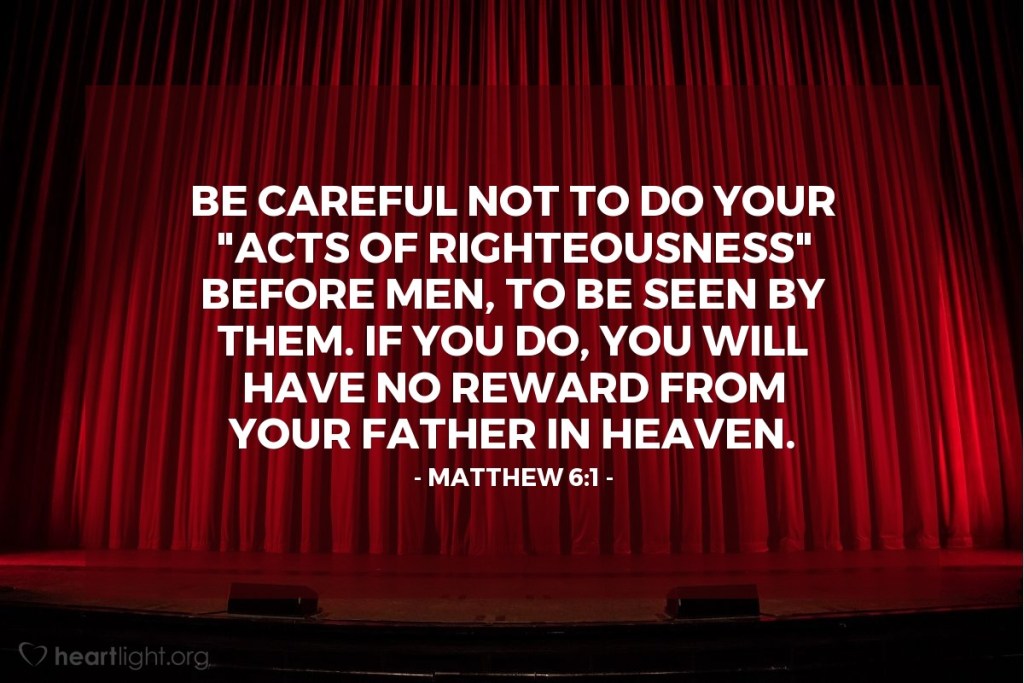
Unrighteous Righteousness. Matthew 6:1-4 HCSB

Matthew 6:1-4Holman Christian Standard Bible

How to Give

“Be careful not to practice your righteousness[a] in front of people, to be seen by them. Otherwise, you will have no reward from your Father in heaven. So whenever you give to the poor, do not sound a trumpet before you, as the hypocrites do in the synagogues and on the streets, to be applauded by people. I assure you: They have got their reward! But when you give to the poor, do not let your left hand know what your right hand is doing, so that your giving may be in secret. And your Father who sees in secret will reward you. [b]

The Word of God for the Children of God. Gloria! In Excelsis Deo! Alleluia! Amen.

Unrighteous Righteousness!

This sounds like an oxymoron – two totally incompatible concepts.

But that is the theme of this part of the Sermon on the Mount.

In the whole of this magnificent Sermon from the lips of Jesus one finds what it means to live the good Christian life the way God intends it to be lived. 

The man, Rabbi Jesus introduces the issue in the text. It is the matter of righteousness.

The passage of Scripture that this verse introduces seems to focus primarily on four major concepts.

This devotional message will strive to deal with each of these as I believe they become self- evident in the passage.

1. Righteousness Defined.

What is meant by the word righteousness?

Briefly, it is nothing less nor more than rightness in one’s person, purposes, plans, procedures, practices, processes, and productions.

It is the outward expression of what one’s heart and soul is on the inside.

Two things need to be said about this word.

First, it is an attribute of God.

In other words, the Bible teaches us that God is righteous. (Jeremiah 23:5-6)

That means what He is, what He thinks, what He says, what He plans, and what He does have the characteristic of “rightness.”

Second, it is the anticipation of God relating to the human beings He made in His image.

The image of God is intended to be the image of His moral attributes, His righteousness evident in human beings.

There are many things about the image of God that are not a part of His image in human beings. Those fall into the category of His natural attributes.

For example, God is all powerful; people are not. God is all knowing; people are not. God is everywhere present; people are not.

God is pre-existent, had no beginning, not so with people. (Psalm 139:13-18)

Since there are things about God that are not true of human beings, it must be concluded that the image of God in human beings is very specific.

The focus then, is on the moral image of God that is the attribute of God and the anticipation of God for His moral creatures.

For example,

God is love! (1 John 4:7-11)

He expects people to possess and express love in appropriate ways.

God is kind and gentle, and He expects His people to be kind and gentle.

The righteousness of God is the expression of the nature or character of God, and that is summed up in the word holiness.

In other words, the moral image of God as the character of the human beings He made and is anticipated to be the character of His people is to be the expression of His holiness (divine character) and His righteousness (divine action.)

Ergo, therefore, “righteousness” is defined as the outward actions of what defines a “person.”

It includes his/her purposes, plans, procedures, practices, processes, and productions … whatever those may include.

2. Righteousness Depraved.

There is a serious problem.

Human beings are a big problem!

The Apostle Paul made this very clear: “There is no one righteous, not even one!” (Romans 3:10) This is Paul’s paraphrase of the last of Psalm 53:1.

So, what is the real problem?

The heart, the spiritual control center of a person!

The Prophet Jeremiah caught the issue:

“The heart is more deceitful than anything else and desperately sick – who can understand it? I, the LORD examine the mind, I test the heart to give to each according to his way, according to what his actions deserve.” (Jeremiah 17:9-10) (HCSB)

Therefore, man’s spiritual control center, the “spiritual” heart is seriously infected.

This is what creates the problem that results in “unrighteous righteousness.”

And how does this happen?

The Bible makes it clear. Hear the counsel of King Solomon:

“Guard your heart above all else, for it is the source of life.” (Proverbs 4:23) (HCSB)

Again, Solomon speaks:

Proverbs 23:7NKJV

For as he thinks in his heart, so is he.
“Eat and drink!” he says to you,
But his heart is not with you.

Think of the space exploration program of the United States.

When our space shuttle was rocketed into space for whatever mission it was designed, there is an amazingly intricate internal control center on the shuttle which functions under the skilled and well-trained hands of the astronauts.

But there is also an equally amazingly intricate external control center.

We are acquainted with that external control center being in Houston, Texas.

The internal control center must comply with the instructions and directions of the external control center. If it does not, then serious complications can arise.

The problem in human beings is with the internal spiritual control center … the “spiritual heart” of people.

Since our own “spiritual control center” is badly infected with that disease called “sin,” one can expect that which comes out of the inner control center will reflect outwardly what is already inside there.

That is why the words of Jesus have meaning, when He said in the Sermon on the Mount, our text:

“Be careful not to practice your righteousness before people, to be seen by them; for if you do, you will have no reward from your Father Who is in heaven.”

We were created to be righteous, but truth is, our track record is abysmal.

There is a vacuum between what we are and what we are supposed to be.

Self-righteousness is nothing but unrighteousness sort of dressed up to look like righteousness.

How did Rabbi Jesus address the “unrighteous righteousness” of His audience?

He spoke to four basic areas of life that can well be outward expressions of righteousness:

(1) compassion for others,

(2) crying out to God in prayer,

(3) constraint in lifestyle (self-denial), and

(4) cumulating wealth.

So, what did He say about these?

Notice the following teaching of Jesus in each of these four areas of life:

“When you give to the needy, do not announce it with trumpets as the hypocrites do in the synagogues and on the streets, to be honored by others.” (v 2)

“When you pray, do not be like the hypocrites, for they love to pray standing in the synagogues and on the street corners to be seen by others.” (v 5)

“When you fast, do not look somber as the hypocrites do, for they disfigure their faces to show others they are fasting.” (v 16)

“Do not store up for yourselves treasures on earth, where moth and rust destroy, and where thieves break in and steal.” (v 19)

Jesus did not mention the Pharisees by name in this chapter.

But He undoubtedly had them in mind when He referred to the “hypocrites.”

In Matthew 23, shortly before His crucifixion, Jesus spoke seven woes on the Teachers of the Law and the Pharisees.

In six of those “woes” He specifically referred to “teachers of the law and Pharisees, you hypocrites!” (Note Matthew 23: 13, 15, 23, 25, 27, and 29)

Six times Jesus went to the heart of the problem and “grabbed them by their collective throats and said: “You pretenders … you pretenders … you pretend to be spiritual, but you are not!”

Now what do we know about the Pharisees?

There is nothing absolute in writing, but the obvious result of Jewish activity speaks loudly.

It was during the intertestamental period, between Malachi and Matthew, that there was a group of Jewish leaders who sat together and reasoned:

“Why is it that God has promised to make us a great nation, but we have been constantly pushed around, nearly destroyed, and today we are as nothing? First it was the Babylonian Captivity, and then the Persian Empire. What is wrong?”

They concluded that Moses was correct.

After Moses had instructed the people as they traveled out of Egypt, they responded positively.

“When Moses went and told the people all the LORD’S words and laws, they responded with one voice, ‘Everything the LORD has said we will do.’” (Exodus 24:3)

That group of “spiritual men” during the time between Malachi and Matthew read the Scriptures and believed what it said.

They knew Israel had failed in their commitment, and the result was tragic.

And so, the Pharisees were in the beginning a spiritual movement concerned with the holiness of people and the holiness of the nation of Israel.

What they were saying was:

“We need to get back to obeying all the words of God’s law and become the vehicle through which God’s purposes can be fulfilled.”

There was nothing wrong with that desire.

Holiness is God’s will for His people.

And there have been various “holiness” movements in history.

The powerful and effective ministry of John and Charles Wesley stands at the pinnacle of such movements.

Reverend John Wesley preached the Biblical truth of holiness of heart and life and quite literally, England was rescued from the brink of total destruction.

But here is the problem with the Pharisees, and in some respects with the holiness movements in general.

As “movements” they were all born as revival movements in times of desperate spiritual need. The great concern was that their hearts were right with God.

The problem with that group of “spiritual men,” quite similar to the problem in some in the holiness movement, was before long the emphasis moved from the inner holiness of one’s own heart to the outer conformity to practices deemed to be “righteous acts” to “prove” they were a part of the “holiness movement.”

They became “writers of the law” instead of “keepers of the law.”

The Pharisees wrote what they believed to be the interpretation of God’s Law and came up with 614 regulations they determined would be “righteous acts,” deemed to be holy because they were “justified” by the Words of the Torah.

The Word of God does have lifestyle standards that are to characterize every follower of Jesus Christ.

But the problem lies in defining “holiness” or “righteousness” by the length of a lady’s dress, or the style or length of their hair, their wearing of make-up or watching a movie, or dancing or buying a paper on Sunday or going out to eat on Sunday, or other such relatively mundane “family and friends” activities.

The Bible insists that the “goal of advancing God’s work by faith is love from a pure heart.” (1 Timothy 1:5)

The problem does not lie in the “rightness” or “wrongness” of some of the activities to which I just referred.

The problem is that these become the center issue.

People can do all these kinds of things and have no real concern with what is in their heart and what and whom is in charge of their soul.

Keeping rules is one thing but knowing nothing of the heart is the basic and tragic problem.

“Unrighteous righteousness” is prominently keeping the rules as a display on the near wall or an attempt to “show” our high level of spirituality to others.

That is precisely how Jesus dealt with the Pharisees in Matthew 23.

Outwardly everything looks right.

Yet, holiness has migrated from the inner life to the outer life.

That becomes our standardized measuring stick and concerns, and activities are external because that is exactly and exactingly where the holiness criteria have not so subtly migrated to from the heart. And that is righteousness depraved.

3. Righteousness Derived.

Of course, there was nothing wrong with the desire that our lives become outward expressions of what is inside.

Righteousness – doing right things – for the right reasons, as the defining outward characteristic of one’s internal character becomes the observable (sometimes hypocritical) evidence of the reality of that person’s true nature.

What is the “source” of righteousness?

In this devotional message there is no intention of getting into the theological debate focused on “imputed righteousness” versus “imparted righteousness.”

Let’s just let the Scriptures speak plainly.

It is important to know that righteousness is not generated inherently just because a person is a moral creature having been made by God.

Righteousness is a gift from God.

Hear the Apostle Paul on this matter:

“Since by the one man’s trespass, death reigned through that one man, how much more will those who receive the overflow of grace and the gift of righteousness reign in life through the one man, Jesus Christ.” (Romans 5:17)

Of primary importance in this matter is that we each understand that when God exposes our unrighteousness it is not to humiliate or embarrass us.

It is always that when we recognize it, He might change us.

On the heels of this we need to also recognize that righteousness becomes ours because it is a gift from God through His Son, our Lord and Savior, Jesus Christ.

Righteousness does not begin with acts or doing.

It is so common for people to think by doing good things one can become good.

It is the reverse of that.

This is precisely why Jesus addressed His disciples in the Sermon on the Mount with the caution that forms the text for this devotional message.

Doing does not produce being, being produces doing!

That is, becoming the right person enables one to do the right things with the right attitude.

This is why the Apostle Paul wrote:

“He made the One who did not know sin to be sin for us, so that we might become the righteousness of God in Him.” (2 Corinthians 5:21)

Righteousness is primarily about what we are, and only then does it become what we do.

It is necessary that we come to the cross and in the words of the Apostle Paul, be “crucified with Christ” so that we might live!

But, you say, there are things we are supposed to “do” as Christians.

True. And now note it is in the same Sermon on the Mount that Jesus said:

“Let your light shine before men, so that they may see your good works and give glory to your Father in heaven.” (Matthew 5:16)

Now He says,

“Be careful not to practice your righteousness in front of people, to be seen by them.” (Matthew 6:1)

Sounds like a contradiction?

On the surface, yes.

But there is something missing.

The difference lies not in the act of righteousness itself, but rather in the source of that act of righteousness.

If it is my righteousness the attention will be on me.

If it is God’s righteousness that is God’s gift placed within my heart, then the attention will be on Him and Him alone.

In other words, the origin of the act determines the object of the act.

This is precisely why the Apostle Paul wrote:

“Whatever you do, in word or deed, do everything in the name of the Lord Jesus, giving thanks to God the Father through Him.” (Colossians 3:17)

Note if you will, this is how Jesus in His humanity lived.

He was a real human being.

He was not simply disguised as a man. 

John 1:14 states it clearly:

“The Word became flesh and tabernacle among us.”

It was in this humanity that He said:

“The Son is not able to do anything on His own, but only what He sees the Father doing. For whatever the Father does, the Son also does these things in the same way.” (John 5:19)

In the same 5th chapter in John’s Gospel, we note Jesus saying, “I seek not to please myself but Him who sent me.” (v 30)

What I believe Rabbi Jesus was saying is: “I am not trying to please myself; I am not trying to please the crowd. I seek only to please My Father.”

Therefore, it is not the object of our acts of righteousness but the origin that will determine WHO is the recipient of “praise.”

It is the nature of our heart and soul which lies behind the act of righteousness that make the difference.

4. Righteousness Delivered.

The word “delivered” is important in dealing with what Jesus taught in the Sermon on the Mount.

It is a word that necessarily demands identification of two very specific focal points:

(1) delivered from and (2) delivered to.

In the context of the text passage for this devotional message note Rabbi Jesus focused on four areas of “righteous acts”:

1. Compassion for others, expressed in giving.

2. Crying out to God, expressed in praying.

3. Constraint of desire, expressed in fasting.

4. Cumulating wealth, expressed in gaining.

Rabbi Jesus did not condemn any of these acts.

There is no inherent sinfulness in giving out of a heart of compassion for others.

It is not sinful to call out to God in prayer.

There is no wickedness in expressing one’s personal lifestyle constraint relating to normal activities.

And there is nothing wrong with cumulating wealth in a legitimate manner.

The problem is the attitude of the heart related to these acts.

They may be acts that are truly righteous, or they may be acts that are very unrighteous.

The initial clue to having our righteousness delivered from being self-focused to being Jesus-focused is found in the closing verse of Matthew 5:

“Be perfect, therefore, as your heavenly Father is perfect.”

The form of the verb Jesus used is both a statement and an imperative.

Take either and you have what Jesus intended to disclose.

The object of the verb is the word that indicates “completeness.”

Some people want the noun to indicate “moral perfection” or “holiness” as that word is used in the theology of some movements.

Biblically the word is more than “holiness” as understood from the use of the word “hagios” or “holy” as it is usually translated.

https://www.blueletterbible.org/esv/mat/7/6/t_conc_936006

https://www.blueletterbible.org/lexicon/g40/esv/mgnt/0-1/

The word “tevleio” as Jesus used it in verse 48 of Matthew 5 connotes the idea of “total complete-ness.”

https://www.blueletterbible.org/kjv/mat/5/48/s_934048

https://www.blueletterbible.org/lexicon/g5046/kjv/tr/0-1/

Understood from Scripture then, it includes both that holiness of the heart to which Peter referred in Acts 15:9 and that “completeness” that is the result of being “conformed to image of His Son,” (Romans 8:29).

This is the result flowing from a pure heart that allows the refining, instructing, correcting, reproving work of the Holy Spirit to continue unhindered.

This is why “holiness” must be understood as a crisis within a process.

The process – doing righteousness – cannot become reality without first the crisis.

And the crisis – that instantaneous act of God purifying the heart – cannot be maintained apart from the process that flows from the “growing up” under the tutelage of the Holy Spirit.

God will not do through us what He does not first do in us!

When God works “in us” His cleansing, purifying work, then the truth of Jesus’ solutions for “unrighteous righteousness” will become reality.

He gave the divine solutions for each of the four areas He mentions in Matthew 5:3, 6, 17, and 20.

We must intentionally work hard and labor much to make very sure the inner spiritual control center is fully complete – pure – and then the outer control center – God’s power – will produce the evidence of “righteous righteousness.”

In the name of God, the Father and God the Son and God the Holy Spirit,

Let us Pray,

Lord who is our Righteousness, I thank you because people look at the outside, but only you can see our inside. Please open our eyes to see that you are the God who’s watching in secret, so that we may be willing to follow your word in our daily life. I thank you and pray in the victorious name of my Savior Jesus, Alleluia! Amen!

https://translate.google.com/