Fill your minds, meditate on things true, noble, reputable, and authentic, compelling, gracious—the best, not the worst; the beautiful, not the ugly; things to praise, not things to curse. Philippians 4:8-9

Philippians 4:8-9 Amplified Bible

Finally, [a]believers, whatever is true, whatever is honorable and worthy of respect, whatever is right and confirmed by God’s word, whatever is pure and wholesome, whatever is lovely and brings peace, whatever is admirable and of good repute; if there is any excellence, if there is anything worthy of praise, think continually on these things [center your mind on them, and implant them in your heart]. The things which you have learned and received and heard and seen in me, practice these things [in daily life], and the God [who is the source] of peace and well-being will be with you.

Word of God for the Children of God

Glory be to the Father,
and to the Son, and to the Holy Ghost;
as it was in the beginning,
is now, and ever shall be,
world without end. Amen, amen.

Breaking Free from Negative Thoughts ….

Have you ever felt stuck in a mental loop of “I’m not good enough” or “Everything’s going wrong”? You’re not alone in this mental tug-of-war.

As someone who’s been there and occasionally still visits, I can tell you that negative thought patterns are about as common as donut shops—they are everywhere, and sometimes it feels like they’re on every corner of our minds.

But here’s the thing: just as we can choose which donut shop to frequent, we can also choose which thoughts to entertain. The Bible puts it beautifully ….

Philippians 4:8. “Finally, brethren, whatsoever things are true, whatsoever things are honest, whatsoever things are just, whatsoever things are pure, whatsoever things are lovely, whatsoever things are of good report; if there be any virtue, and if there be any praise, think on these things.”

Let’s be real—this isn’t about slapping a “good vibes only” sticker on your water bottle and calling it a day.

It’s about recognizing that while negative thoughts might be frequent visitors, they don’t have to be permanent residents in your mind.

God has given us all the tools to renovate our thinking, and just like any good home improvement project, it starts with acknowledging what needs to change.

Remember, even the disciples had their moments of doubt and negativity.

Peter, the rock upon whom Christ would build His church, once let fear override his faith and began to sink while walking on water.

But Jesus didn’t let him drown in his negative thoughts—he reached out His hand.

That same hand is extended to all of us today.

Understanding the Power of the Mind

Your mind, my mind, is the command center of a sophisticated spacecraft—it influences everything from your emotional climate to our spiritual trajectory.

The writer of Proverbs knew this when he wrote in 

Proverbs 23:7, “For as he thinketh in his heart, so is he.” This spiritual principle is as relevant today as it was thousands of years ago.

Pray about it—have you ever noticed how fast a single negative thought can snowball faster than a winter storm in the Rockies?

One day you’re worried about a project at work, before you know it, you’re mind is updating your resume, wondering if you’ll end up moving into your parents’ basement. Our minds are powerful engines, and the octane we choose matters.

But here’s the good news: the same mind that can spiral into negativity can also be transformed into a powerhouse of faith and possibility.

The Apostle Paul understood this when he wrote to the Romans in Romans 12:2, encouraging them to “be transformed by the renewing of your mind.”

He wasn’t suggesting a simple attitude adjustment; he was outlining a complete mental renovation project.

Now, I’m not saying this transformation happens as quickly as instant coffee dissolves in hot water.

It’s more like brewing a perfect cup of pour-over—it takes time, attention, and the right technique.

But just as that carefully crafted coffee is worth the wait, so is the renewal of your mind.

Consider King David, who often found himself in situations that could have easily led to negative thought patterns.

Yet time and again, we see him redirecting his thoughts to God’s faithfulness.

I’m sure that a typical example of one such moment was when he wrote 

Psalm 42:11, “Why art thou cast down, O my soul? And why art thou disturbed within me? Hope thou in God, for I shall yet praise him, who is the health of my countenance and my God.”

In this verse, it’s clear that he was almost having a nervous breakdown from whatever troubles he was going through, but rather than cave into negativity, he showed reverence and trust in God. 

Breaking Free: Practical Steps

Now, let’s get down to breaking free from negative thought patterns.

Let’s look at practical, Bible-based strategies that work in real life, not just in theory.

First up is the Replace and Renew Method.

When a negative thought pops up, usually at the most inconvenient time, counter it with God’s truth.

If your mind whispers, “You’re not enough,” respond with, “I can do all things through Christ, who strengthened me” (Philippians 4:13). It is like playing spiritual whack-a-mole; you must be prepared to counter those thoughts as they arise.

The next step is gratitude, which is a game changer.

It’s hard to stay negative when you’re actively practicing thankfulness.

Imagine the Apostle Paul writing from prison—a situation that could breed negative thoughts!

He said in 1 Thessalonians 5:18, “In everything, give thanks, for this is the will of God in Christ Jesus concerning you.”

The idea is to start small—thank God for basic things happening in your life, such as morning coffee, the sunshine, or even the fact that you’re breathing. 

Also thank God for the lives of your friends and loved ones.

Then we can take it a step further by acknowledging his involvement in specific events in your life, community, workplace, or country.

Before you know it, you’ll find reasons for gratitude everywhere.

Then there’s the community connection.

Surrounding yourself with faith-filled believers isn’t just good churchmanship; it’s essential mental health practice.

As Proverbs 27:17 puts it, “as Iron sharpens iron; so a man sharpens the countenance of his friend.”

Having spiritually inclined support from family, friends, neighbors, or church members helps us as believers. They serve as our support in times of weakness. 

They are the vessels God uses to comfort and inspire us in our distress.

So, when you’re struggling with negative thoughts, sometimes you need to reach out in faith to someone else to remind you of God’s promises.

Let’s not forget the prayer pause.

When negative thoughts start swirling, take a moment to pause and pray.

Remember the instruction in Philippians 4:6, which says, 

“Be careful for nothing; but in everything, by prayer and supplication with thanksgiving, let your requests be made known unto God.” 

And trust God, the simple act of turning our worries into prayers can break the cycle of negative thinking.

Living in Renewed Freedom

As you consistently apply these tools, you’ll notice a change.

It might be subtle at first—like the days getting longer as winter turns to spring.

But gradually, you’ll find your default thinking patterns shifting from “worst-case scenario” to “God’s got this.”

Remember, this journey isn’t about achieving perfect thinking—it’s about progress, not perfection.

Even Paul, that giant of faith, admitted to an ongoing battle with his thoughts and desires (Romans 7:15-20).

The difference is that you are now prepared to fight back when negative thoughts attempt to take over.

As you continue on this path of mental renewal, you’ll discover that

“the peace of God, which passes all understanding, shall keep your hearts and minds through Christ Jesus” (Philippians 4:7).

This doesn’t mean you’ll never have another negative thought; it means you’ll know how to handle them when they come.

You’re not alone in this battle. God hasn’t left you to figure this out by yourself.

He’s provided His Word as a roadmap, His Spirit as a guide, and His people as companions on the journey.

From today onwards, commit to taking your thoughts captive (2 Corinthians 10:5).

When negative patterns try to establish themselves in your mind, remember that you have the power, through Christ, to choose a different path.

Your mind is valuable real estate—don’t let negative thoughts be squatters there any longer.

Isaiah 26:3 says, “Thou wilt keep him in perfect peace, whose mind is stayed on thee, because he trusted in thee.”

As you learn to anchor your thoughts in God’s truth, you’ll find that peace isn’t just a destination—it becomes your constant companion on the journey.

In the name of God, the Father the Son and the Holy Spirit ….

Praying ….

Psalm 42 Complete Jewish Bible

0) For the leader. A maskil of the descendants of Korach:

2 (1) Just as a deer longs for running streams,
God, I long for you.
3 (2) I am thirsty for God, for the living God!
When can I come and appear before God?

4 (3) My tears are my food, day and night,
while all day people ask me, “Where is your God?”
5 (4) I recall, as my feelings well up within me,
how I’d go with the crowd to the house of God,
with sounds of joy and praise from the throngs
observing the festival.

6 (5) My soul, why are you so downcast?
Why are you groaning inside me?
Hope in God, since I will praise him again
for the salvation that comes from his presence.
7 (6) My God, when I feel so downcast,
I remind myself of you
from the land of Yarden, from the peaks of Hermon,
from the hill Mizar.
8 (7) Deep is calling to deep
at the thunder of your waterfalls;
all your surging rapids and waves
are sweeping over me.
9 (8) By day Adonai commands his grace,
and at night his song is with me
as a prayer to the God of my life.
10 (9) I say to God my Rock,
“Why have you forgotten me?
Why must I go about mourning,
under pressure by the enemy?
11 (10) My adversaries’ taunts make me feel
as if my bones were crushed,
as they ask me all day long,
‘Where is your God?’ ”

12 (11) My soul, why are you so downcast?
Why are you groaning inside me?
Hope in God, since I will praise him again
for being my Savior and God.

Glory be to the Father,
and to the Son, and to the Holy Ghost;
as it was in the beginning,
is now, and ever shall be,
world without end. Amen, amen.


https://translate.google.com/

Does God Care About My Feelings? Psalm 137

At times, you may feel too alone, and think that you have no one to care for you.

Know that all of us are God’s children, and he never allows us to stay alone.

There’s no point in keeping yourself aloof from the rest of the world, for God is always there even when we are too emotional to acknowledge it, to help guide and move you out into the light from your entire struggle.

You may feel that you have not got anyone to be there for you, and support for you.

Although it is easier said than done, we often tend to suffer from such kinds of frustrations and suppressing thoughts.

However, you need to understand that you are not alone. You are never alone, for God is always there with you and you have your guardian angels to pave your ways, no matter how tough the situations get! Just be humble, have patience and get going!

Nothing is hidden from the Almighty, and he has been keeping an eye upon you all the time. He is there to guide you in all your odds, and even when life has been making you walk through the hurdles, you have Him.

Believe me, God is always there for you and he has been working behind the scenes of your life. You may find it difficult to get going, but if you have faith, things will surely start falling in their places all by themselves.

God is always there to talk care of you, even when you aren’t aware of it. He is going to take over when things go out of your hand. In any case, if situations seem to be pushing you to the last extent, keep your trust upon God’s powers and God’s promises and in time, by God’s grace, things are going to work out all by themselves, sooner or later.

Psalm 137 GOD’S WORD Translation

137 By the rivers of Babylon, we sat down and cried
as we remembered Zion.
We hung our lyres on willow trees.
It was there that those who had captured us demanded that we sing.
Those who guarded us wanted us to entertain them.
⌞They said,⌟ “Sing a song from Zion for us!”

How could we sing the Lord’s song in a foreign land?
If I forget you, Jerusalem,
let my right hand forget ⌞how to play the lyre⌟.
Let my tongue stick to the roof of my mouth
if I don’t remember you,
if I don’t consider Jerusalem my highest joy.

O Lord, remember the people of Edom.
Remember what they did the day Jerusalem ⌞was captured⌟.
They said, “Tear it down! Tear it down to its foundation.”
You destructive people of Babylon,
blessed is the one who pays you back
with the same treatment you gave us.
Blessed is the one who grabs your little children
and smashes them against a rock.

The Word of God for the Children of God.

Adeste Fideles! Laeti Triumphantes! Venite Adoremus Dominum.

Gloria! In Excelsis Deo! Alleluia, Alleluia, Alleluia, Amen.

The book of Psalms is a book of poetry; most often each Psalm is a song written for a specific purpose.

These songs and poems consist of praises to God, sorrowful lamentations, and joyous celebrations. 

Psalm 137 falls into the sorrowful lamentation category.

The Psalmist here is speaking of Israel’s captivity in Babylon (vs. 1).

The southern tribes of Israel, the land of Judah, were all that remained of Israel after the Assyrians had captured the northern tribes (2 Kings 15-17).

Later, the southern kingdom was taken captive by Babylon (2 Kings 24-25).

In this Psalm, the psalmist is lamenting that the captors of the Jews, the Babylonians, are asking them to sing songs about Jerusalem, or Zion.

Because these were songs of worship and praise to God, they would remind the people of their sin against God, the thing which led to their painful captivity.

These songs would also remind them of their longing to be back in Jerusalem.

The second stanza of the Psalm is a self-reflection of what the author would wish upon himself if he were to ever forget Jerusalem.

The final stanza is what revenge the Psalmist wishes upon his captors.

While the picture is disturbing and graphic, it gives us a real portrait of how desperate the Jews were and how badly they wished to be freed from captivity.

It also reveals to us the incredible depth of emotions these exiles were feeling.

The depths of rage, anger and of depressive sadness is quite palpable and for us who would come to read those hard words, quite emotionally provocative also.

God had sent His chosen people into a seventy year exile for their sins against Him – and the beginning of that exilic road to Babylon was exceedingly brutal and one could easily use the word merciless unto the very absolute maximum.

But God is a God of Mercy, of Grace, Slow to Anger and abounding in steadfast love, forgiving of transgressions, remembering them no more, casting them into the sea of forgetfulness, as far as the east is to the west – just max gone!

So, it leaves open to the reader of such scriptures the very significant question;

Does God Authentically Care About Our Feelings?

Ever feel like God gave up on you, does not care about your feelings?

You are absolutely not alone.

This assumption is one that can promote a sense of invalidation within our relationship with God.

In many ways, this belief can frame our faith in such a way that it leaves us quick to mask the messiness of our emotions for the sake of spiritual maturity.

If we authentically feel our feelings, does that mean our faith is fragile?

When our emotions overwhelm us, is God actually 100% for us or against us? 

This disconnect between emotional health and Christian theology has been at odds for some time.

The common Christian response to uncomfortable emotions is phrases like “You just need to pray more” and “trust the Lord in all circumstances,” which risks adding to the distortion that our distress impairs our spiritual maturity.

I whole-heartedly believe that the spiritual disciplines found in Scripture were never meant to invalidate our pain and problems, but rather not so subtly invite us into expressing our feelings openly and freely unto a loving and caring God. 

Here is the truth: You absolutely matter to God, feelings and all.

Never in Scripture do we see Jesus dismiss the feelings of others or invalidate those in distress.

On the contrary, God’s Word repeatedly reiterates the safety found in seeking God as our refuge when we are weak (Psalm 46:1–3), and as a shelter when we are suffering (Psalm 62:8)

When we are faced with a depth of feelings that shake our faith to the core of our being, we must go back to Scripture and be reminded that our emotions, created by God, are meant to bring us closer to Him, not pull us farther away.

In my frequent exploration of this concept, I have found 4 ways God responds to my feelings which have ultimately strengthened my faith, comforted my soul.

1. God Is Present in My Feelings 

  In Psalm 34:18-19, David speaks of how God is attentive in our distress saying: 

“The Lord is near to the brokenhearted

    and saves the crushed in spirit. 

Many are the afflictions of the righteous,

    but the Lord delivers him out of them all.” 

God does not leave us in our distress or dismiss the weight of our worries, but graciously and mercifully comes near to us as a father comforts his dear child.

His awareness of all things at all times is absolutely active 100% of the time.

The passage states God saves the crushed in spirit, delivering them out of pain.

What is even more powerful about this passage is that in the original Hebrew, the term for saves is translated as “to be safe.”

God is not simply standing with us, around us, by us, but He actively provides absolute safety for us in His presence. 

2. God Values My Feelings 

In addition to God’s attentiveness, He also values emotions.

Throughout Jesus’ ministry, we see His expression of emotion and how He values caring for those who were suffering.

Jesus wept with those who experienced loss (John 11:34-36) and comforted many with compassion and consideration (Mark 6:50)

The intersection of emotional expression and feelings validation was first modeled for us by God throughout the Old Testament, and then again by Jesus throughout the narratives of the 4 gospels and Paul’s letters to the followers.

We see how God so gently guided the Israelites to their promised land flowing with milk and honey and manna and quail and water and shelter against the sun despite all of their rebellion and complaining throughout the book of Exodus.

Similarly, Jesus speaks to many emotions in his Sermon on the Mount saying, 

“Blessed are the poor in spirit,

    for theirs is the kingdom of heaven.

Blessed are those who mourn,

    for they will be comforted” (Matthew 5:3-4).

The apostle Paul in Romans speaks on this same value of emotional expression, encouraging believers to, “Rejoice with those who rejoice, weep with those who weep. Live in harmony with one another” (Romans 12:15).

I wonder what it would look like if we too were to authentically begin to value the emotions we experience and authentically own all the freedom to express them, knowing our God is near and desires to comfort us with His compassion.  

3. God Challenges My Feelings  

Within God’s attentiveness and compassion for His children, He challenges the feelings that no longer have a place in our lives and hearts.

Paul writes on this disputation of futile feelings, encouraging his young protégé Timothy to not be overcome by the spirit of fear but to remember his faith first. 

He says, “For this reason, I remind you to fan into flame the gift of God, which is in you through the laying on of my hands, for God gave us a spirit, not a spirit of fear but power and love and self-control” (2 Timothy 1:6-7).

This very Pauline response to my own feelings is one that helps me identify the foundation of my emotions.

As I seek to understand God’s Word and His truth, I am reminded to focus upon my aligning my feelings with the myriad of God’s promises found in Scripture.

This passage reminds me of the truth of the Holy Spirit of God at work in me. 

4. God Reframes My Feelings  

Finally, I believe that God’s Word so beautifully helps us to reframe and to refocus our emotions by placing our focus and intention back on God’s power, God’s provision, God’s strength, and God’s ability to meet us in our emotions. 

One of my favorite passages that help reframe my feelings and focus on my faith is found in Paul’s prison letter of Philippians 4:8-9 where Paul writes, 

“Finally, brothers, whatever is true, whatever is honorable, whatever is just, whatever is pure, whatever is lovely, whatever is commendable, if there is any excellence, if there is anything worthy of praise, think about these things. What you have learned and received and heard and seen in me—practice these things, and the God of peace will be with you.” 

Then further bolstered by these words of God assurance, Christ like confidence;

Philippians 4:10-14 GOD’S WORD Translation

Thanks for Your Gifts

10 The Lord has filled me with joy because you again showed interest in me. You were interested but did not have an opportunity to show it. 11 I’m not saying this because I’m in any need. I’ve learned to be content in whatever situation I’m in. 12 I know how to live in poverty or prosperity. No matter what the situation, I’ve learned the secret of how to live when I’m full or when I’m hungry, when I have too much or when I have too little. 13 I can do everything through Christ who strengthens me. 14 Nevertheless, it was kind of you to share my troubles.

Paul’s thoughtful and timely words subtly remind me how to slow down and replace my thoughts that have led to distress and distortions within my heart.

When feelings flood our minds and muddy the truth of God’s goodness and grace, we are invited to renew our minds in the truths found in His Word. 

Romans 12:1-3 GOD’S WORD Translation

Dedicate Your Lives to God

12 Brothers and sisters, in view of all we have just shared about God’s compassion, I encourage you to offer your bodies as living sacrifices, dedicated to God and pleasing to him. This kind of worship is appropriate for you. Don’t become like the people of this world. Instead, change the way you think. Then you will always be able to determine what God really wants—what is good, pleasing, and perfect.

Because of the kindness [a] that God has shown me, I ask you not to think of yourselves more highly than you should. Instead, your thoughts should lead you to use good judgment based on what God has given each of you as believers.

So, whatever you may be feeling, acknowledge them, just remember that God is near and desires to be involved in the fears and failures, the loss and laughter.

His Living and Active Word continually reminds us to always feel and to be free from the false kind of faith negating the weight of legitimately raw emotions.

Let us continue to seek after God, training our hearts, tuning our hearts, to find rest in the absolute truth (Matthew 11:28-30, John 5:1-9, John 11:35, John 14:1-6), knowing God authentically cares about all of our feelings no matter how deep.

In the name of God, the Father and God the Son and God the Holy Spirit,

Let us Pray,

Psalm 23 King James Version

23 The Lord is my shepherd; I shall not want.

He maketh me to lie down in green pastures: he leadeth me beside the still waters.

He restoreth my soul: he leadeth me in the paths of righteousness for his name’s sake.

Yea, though I walk through the valley of the shadow of death, I will fear no evil: for thou art with me; thy rod and thy staff they comfort me.

Thou preparest a table before me in the presence of mine enemies: thou anointest my head with oil; my cup runneth over.

Surely goodness and mercy shall follow me all the days of my life: and I will dwell in the house of the Lord for ever.

The Word of God for the Children of God.

Adeste Fideles! Laeti Triumphantes! Venite Adoremus Dominum.

Gloria! In Excelsis Deo! Alleluia, Alleluia, Alleluia, Amen.

https://translate.google.com/

Your Daily Prayer: A Prayer to help us Refocus Our Thoughts back onto God. Philippians 4:8-9

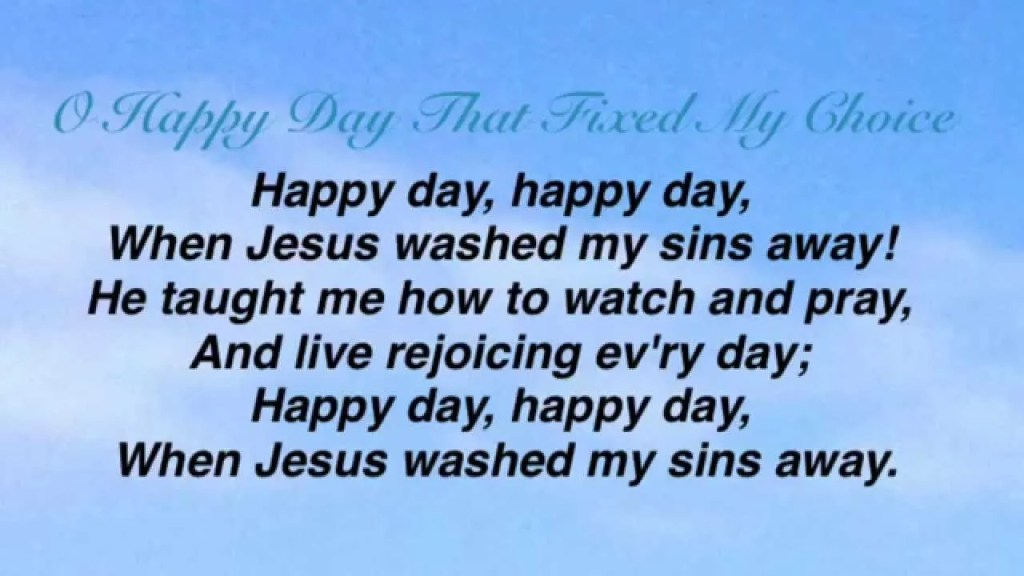
O happy day that fixed my choice
On Thee, my Savior and my God!
Well may this glowing heart rejoice,
And tell its raptures all abroad.

Happy day, happy day,
When Jesus washed my sins away!
He taught me how to watch and pray,
And live rejoicing every day;
Happy day, happy day,
When Jesus washed my sins away!

Philippians 4:8-9 The Message

8-9 Summing it all up, friends, I’d say you’ll do best by filling your minds and meditating on things true, noble, reputable, authentic, compelling, gracious—the best, not the worst; the beautiful, not the ugly; things to praise, not things to curse. Put into practice what you learned from me, what you heard and saw and realized. Do that, and God, who makes everything work together, will work you into his most excellent harmonies.

The Word of God for the Children of God.

Adeste Fideles! Laeti Triumphantes! Venite Adoremus! Dominum.

Gloria! In Excelsis Deo! Alleluia, Alleluia, Alleluia, Amen.

A Stranger in the Room? Think About These Things

Have you ever walked into a room and felt you didn’t belong?

The first day for a new Pastor, their very first Sunday in the Pulpit leading their new to them Congregations through the very first of many worship experiences.

Nobody really knows who each other are.

What are the myriad of myriad expectations of the new congregations of their new to them Pastors and vice versa – Pastors know very little of their new flock.

Who knows whose name and their histories and their experiences on those first few initial “break the ice” Sundays before all the wonderful times of fellowship.

Been there and done that.

And please, give all glory to God and pray heavily and mightily for Your New Pastors, and their new to them congregations in this season of Transition.

As it is with new Pastors in new Pulpits, those first few days of anything new are always those of someone’s greatest excitement and anticipation and eagerness.

That first day of class for someone whose entering a new middle or high school.

The first day of College when the new High School graduates move into their dorm rooms and meet their new room mates for the very first time.

Fresh with the excitement of their College Degrees in their hands, that very first day of someone’s first job, first responsibilities following college graduations.

A new Job for an experienced worker in a new Company or new Organization in a new city, in a new state, in a new country – and those promises of promotions.

Those first few days of a young or veteran Service Member returning to Civilian Life, perhaps trying to adjust, re-adjust to civilian life after Surviving Combat.

Those first new experiences for a Cancer survivor when they finally get to ring the Bell to celebrate, declare themselves to be “Last Chemo”, “Cancer Free” or “In Remission” and now they have to rebuild their strength for life afterwards.

How about those first days and weeks and months when first time Parents are bringing home their first born child – and first being introduced to Parenthood.

How many personal “first time” experiences can readers bring to life here?

I have entered more than a few meetings, and I felt nobody wanted me there.

Frowns and furrowed and grimaced brows graced their faces.

It almost instantly spiraled me into a series of “what now” negative thoughts.

I thought I wasn’t good enough, likable, or worthy of acknowledgment.

I struggled to bring my attention to the purposes of the meetings because I felt the high likelihood of being heavily scrutinized, new boy on the block rejected.

Perceived rejection is assuming rejection before it has happened.

I am, among many, a genius at pre-rejecting myself on someone else’s behalf.

I will interpret the squint of the eyes as disapproval and the purse of the lips as annoyance toward me.

I may also assume I’m already rejected to protect myself in those first days, but this behavior leads me into a cycle of being rejected and rejecting other people.

I became aware of this tendency when one day the Word of the Lord revealed how the fear of rejection prevented me from walking in the ways He had for me.

God longs relationships with His Children, for us to grow and for us to mature in true friendship, consolation and compassion, forgiveness and reconciliation, kindness and mercy, peace and unity of mind, building, edifying His Kingdom.

He wants us to know who we are in Christ, which is chosen, approved, desired, transformed and discipled by the renewal of our minds away from the world.

Yet, when we get stuck in patterns of pre-rejection, we wrestle with all these.

We somehow automatically assume the very worst about ourselves and others.

Our focus drills inward until we can only see ourselves through a rejected lens.

This sin dark rejected lens prevents us from seeing someone else’s struggles and worries.

It interferes mightily with Christ Like compassion toward others.

It takes us down a path of biased and unchallenged prejudicial assumptions, leading to a barrage of needless misunderstandings and broken relationships.

While so many of us have external struggles with home, family, work, and finances, we also deal with internal battles of self esteem and God esteem.

Our mind is one of the greatest places of battle, where external battles are won or lost.

An automatic mindset of pre-rejection steals our peace and promotes anxious thoughts, pre-emptively, wrongly influencing our faith actions and attitudes. 

It’s amazing how easily we can morbidly gorge ourselves on a feast of “hot and spicy” rejection when we automatically assume we have been or are about to be rejected, or we ourselves are about to move into our own “automatic rejection” of others mode – put some “100 octane into our motors and slam on the Gas”.

When I start from a place of 100 octane assuming rejection, it severely impacts my personal perspective of new opportunities and potential new relationships.

If I am 100 Octane closed off and self-protecting, the risk is it will leave a badly soured taste inside the mouths of others, it makes me seem cold and unfriendly.

This is not who I am, but when I’m ruled by 100 Octane fear, it’s what I display.

Slowly, I’ve learned the secret to overcoming this tendency lies in my thoughts.

And this is the critically important lesson we can each teach and each of us share with our children, our spouses, family, friends and to all our neighbors:

Romans 12:1-2 The Message

Place Your Life Before God

12 1-2 So here’s what I want you to do, God helping you: Take your everyday, ordinary life—your sleeping, eating, going-to-work, and walking-around life—and place it before God as an offering. Embracing what God does for you is the best thing you can do for him. Don’t become so well-adjusted to your culture that you fit into it without even thinking. Instead, fix your attention on God. You’ll be changed from the inside out. Readily recognize what he wants from you, and quickly respond to it. Unlike the culture around you, always dragging you down to its level of immaturity, God brings the best out of you, develops well-formed maturity in you.

Romans 12:1-2 educates, encourages us to allow “all of ourselves” to first and foremost “be transformed by the renewal” of our minds, and our pre-rejecting ourselves on behalf of someone else who assumes the worst possible outcome.

The Apostle Paul heavily encouraged the Philippians to guard their hearts.

Guarding our hearts promotes peace within ourselves and our relationships, but we must work hard every day at it – sacrificing all our pre-conceived rejections.

Our sin darkened minds naturally run along negative tracks, but we can, by the study of the Word of God, and intercession of Holy Spirit, retrain our thoughts.

Imagine what would happen if we dared concentrated on whatever is good, and when we walk into a room, we dare think about whatever is truest Shalom, is honorable, meditating on things true, noble, reputable, authentic, compelling, gracious—the best, not the worst; the beautiful, not the ugly; things to praise, not things to curse – can we dare to imagine the distance between us and Satan?

100 Octane rejecting ourselves, rejecting others because we are afraid someone might first 100 Octane reject us doesn’t honor God or you or the other person.

One of the ways to overcome this tendency is to look for the good in others.

I realized when I automatically assume someone has rejected me, I am also automatically projecting all my irrational fear of rejection back onto them.

I have prepackaged, prewrapped, pre-nailed tighter than a drum, a crate filled with every single preconceived personal biases and my 100 Octane prejudices.

I am just waiting for the mailing or shipping address so I can surprise them.

In my sin broken mind-set, they might be inwardly frowning in my direction, not because of my presenting myself, but because of something in their life.

Instead of responding with compassion and outward focus, we react with self-protection and self-focus. 

I still walk into meetings with the “Do they like me?” “Will they like me?” “Do I like them?” “Will I like them?” game playing over and over inside my soul.

But I’m learning to refocus my thoughts on myself and asking the Lord, “How can I show them more you?” It starts in our minds and then translates into actions.

Imagine the state of God’s Kingdom if we actually took into our hears and souls;

If in the fellowship of God, the Father and God the Son and God the Holy Spirit,

We who are the Body of Christ, we who are supposed to be modeling and are supposed to be like Christ, God’s Church in the vastness of this diverse world;

In a moment of authentic Holy Spirit in an Ignited Philippians 4:8-9 mind-set;

Philippians 4:8-9 Amplified Bible

Finally, [a]believers, whatever is true, whatever is honorable and worthy of respect, whatever is right and confirmed by God’s word, whatever is pure and wholesome, whatever is lovely and brings peace, whatever is admirable and of good repute; if there is any excellence, if there is anything worthy of praise, think continually on these things [center your mind on them, and implant them in your heart].  The things which you have learned and received and heard and seen in me, practice these things [in daily life], and the God [who is the source] of peace and well-being will be with you.

Fellowshipped, Worshipped Prayed as one Community as God is in Community?

Oh, what a God-Gifted day of rejoicing that would be!!!

But, dare we too ever conceive or imagine or spontaneously plan for such a day?

In the name of God, the Father and God the Son and God the Holy Spirit,

Let us Pray,

Heavenly Father, on this day of first experiences for many of Your Children, Thank you that you give us all the tools we need to live this life for you. Forgive us when we too easily forget to use them, let our thoughts scatter to unhealthy and life-stealing pathways. We want to focus on you. You are honorable, lovely, true, commendable, just, and excellent, and when we think about you in these terms, you help us think about others in them too. Help us refocus our thoughts today. In Jesus’ name, Amen.

Adeste Fideles! Laeti Triumphantes! Venite Adoremus! Dominum.

Gloria! In Excelsis Deo! Alleluia, Alleluia, Alleluia, Amen.

https://translate.google.com/

Best Fatherly Practices, Learning From His Examples: “Our Father, Who Art in Heaven, Will You Reveal Who You Are?” Matthew 6:7-13

What comes to mind when you hear the term Father’s Day? Maybe you think about stereotypical gifts like neckties or #1 Dad t-shirts. Perhaps you have memories of the sights and smells of grilling together. Or maybe—like many people—the holiday provides an opportunity for you to celebrate your Father in heaven.

On this Father’s Day—and every day—I pray that your spirit would be refreshed, refocused, and renewed as you “see what great love the Father has lavished on us, that we should be called children of God!” (1 John 3:1).

Matthew 6:7-13 The Message

7-13 “The world is full of so-called prayer warriors who are prayer-ignorant. They’re full of formulas and programs and advice, peddling techniques for getting what you want from God. Don’t fall for that nonsense. This is your Father you are dealing with, and he knows better than you what you need. With a God like this loving you, you can pray very simply. Like this:

Our Father in heaven,
Reveal who you are.
Set the world right;
Do what’s best—
    as above, so below.
Keep us alive with three square meals.
Keep us forgiven with you and forgiving others.
Keep us safe from ourselves and the Devil.
You’re in charge!
You can do anything you want!
You’re ablaze in beauty!
    Yes. Yes. Yes.

The Word of God for the Children of God.

Adeste Fideles! Laeti Triumphantes, Venite Adoremus! Dominum.

Gloria! In Excelsis Deo! Alleluia, Alleluia, Alleluia, Amen.

A Father’s Day Message to You … Set The Example.

Our Father in heaven,
Reveal who you are.
Set the world right;
Do what’s best—
    as above, so below.
Keep us alive with three square meals.
Keep us forgiven with you and forgiving others.
Keep us safe from ourselves and the Devil.
You’re in charge!
You can do anything you want!
You’re ablaze in beauty!
    Yes. Yes. Yes.

Many of us approach Father’s Day with mixed emotions.

Some people have hands-on fathers who are available and deeply interested in their children’s lives; while others will have a somewhat distant, disinterested father; while still some others still were abandoned by their fathers altogether.

And like me, some have fathers who have died.

But one thing we all have in common, no matter what kind of dad or step dad we are or currently have or have had, is that we have an authentic Father in heaven.

And regardless of how your father, my father on earth has treated us, we have a Father in heaven who has always been there, always will, 100%, be there for us.

The Bible says that God is a “father of the fatherless” (Psalm 68:5 NKJV).

And David wrote,

“When my father and my mother forsake me, then the Lord will take care of me” (Psalm 27:10).

We have an authentic heavenly Father, and the way in which we authentically communicate with him is through prayer.

The greatest prayer that was ever prayed is often called the Lord’s Prayer, where Jesus taught us to pray:

“Our Father in heaven, hallowed be Your name.
Your kingdom come. Your will be done On earth as it is in heaven.
Give us this day our daily bread.
And forgive us our debts, as we forgive our debtors.
And do not lead us into temptation, but deliver us from the evil one. For Yours is the kingdom and the power and the glory forever. Amen.” (Matthew 6:9–13)

To address God as “Father” was a revolutionary thought to the Jewish mind.

The Hebrews feared God and attached such sacredness to His name, they would not even utter it.

In the Old Testament, God is referred to as “Father” fewer than seven times.

And when He is, it is either indirectly or rather remotely.

In fact, when Jesus referred to God as his father, he was accused of blasphemy.

One of the reasons Jesus was crucified was because he spoke of this radically special relationship he had with his father – not his earthly one, but heavenly.

Now, because of his death and resurrection, we can have that relationship, too.

After rising from the dead, he said to Mary Magdalene, “I am ascending to My Father and your Father, and to My God and your God” (John 20:17).

As you are now, were growing up, if your father was disengaged, disinterested and passive, you might think of God, talk to God, in exactly that self same way: disconnected, 100% oblivious to what is going on in your life, not really caring.

Then again, if your father was a thoroughly involved, nurturing and affirming dad, you might naturally apply those same qualities to your perception of God.

Whatever our experience was or currently is, we need to view God not the way we view an earthly dad; we need to view God as He is presented in Scripture.

Not only does the Bible tells us to address him as Father, but we are to do so in an intimate way.

The apostle Paul wrote, “So you have not received a spirit that makes you fearful slaves. Instead, you received God’s Spirit when he adopted you as his own children. Now we call him, ‘Abba, Father’” (Romans 8:15 NLT).

The word Abba speaks of intimacy, like calling your father “Daddy” or “Papa.”

The idea is that of an affectionate relationship.

My grandson call me “Papa.”

My sister’s granddaughters, when they were just starting to talk, would lift her hands up and say, “Nema” when they wanted to be picked up or get out of their highchairs. (How can parent or grandparent resist the innocent sound of that?)

If you want an accurate snapshot of God, a proper portrait of the Father, just look at the story Jesus told about the prodigal son (see Luke 15).

The story isn’t all just about the son, however; it is also about the loving father who stayed at home – anticipating, expecting, waiting, praying for that one day.

And who is more qualified to talk about a loving father than His own Son, Jesus?

In this story, Jesus presents him as an engaged, loving, affectionate father who loves his sons.

The father has two sons, the youngest of whom demanded his portion of the estate before the father has died.

The son went off to a distant land and lived like a fool – as a prodigal – blowing his money, consorting with prostitutes, literally ending up in a pig pen, and as he was finally coming to his senses, turned around and began returning home.

Back at home we see a father who stayed home, who longed for his son’s return and then ran to throw his arms around him, kissing him over and over again.

The conclusion of the story from a modern paraphrase goes this way:

The son started his speech: “Father, I’ve sinned against God, I’ve sinned before you; I don’t deserve to be called your son ever again.

But the father wasn’t listening. He was calling to the servants, “Quick. Bring a clean set of clothes and dress him. Put the family ring on his finger and sandals on his feet. Then get a grain-fed heifer and roast it. We’re going to feast! We’re going to have a wonderful time! My son is here – given up for dead and now alive! Given up for lost and now found!” And they began to have a wonderful time. (Luke 15:20–24 The Message)

That is your Heavenly Father. Although He is our God, there is an undeniable intimacy, there is relationship, there is closeness, there is 10000% affection.

If you want to know what kind of Father we have in heaven, just look at Jesus.

Because Jesus said, “He who has seen Me has as also seen the Father” (John 14:9 NKJV).

He also said, “If you had known Me, you would have known My Father …” (John 8:19).st look at Jesus with the little children in his arms, blessing them.

Look closely, with a father’s eyes, and a father’s broken heart, shattered soul at Jesus with tears streaming down all his face at the grave of his friend, Lazarus.

Just look at Jesus, washing his disciples’ feet in the Upper Room.

That is what our Father in heaven is like – if we will still let him set the example.

Best Practices, Learning From Our Fathers Example

Philippians 4:8-9 The Message

8-9 Summing it all up, friends, I’d say you’ll do best by filling your minds and meditating on things true, noble, reputable, authentic, compelling, gracious—the best, not the worst; the beautiful, not the ugly; things to praise, not things to curse. Put into practice what you learned from me, what you heard and saw and realized. Do that, and God, who makes everything work together, will work you into his most excellent harmonies.

Most parents learn the best way to teach their children is by setting an example.

In healthy families, we learn a lot about right and wrong, good and bad, by simply watching our parents, grandparents or older “grandparent” siblings.

Ephesians 6:1-4 The Message

1-3 Children, do what your parents tell you. This is only right. “Honor your father and mother” is the first commandment that has a promise attached to it, namely, “so you will live well and have a long life.”

Fathers, don’t frustrate your children with no-win scenarios. Take them by the hand and lead them in the way of the Master.

Do you, Do I, do we, have a strong relationship with our (step) children?

The way we first think about God has much to do with how we were parented—especially by our father.

What image of the Lord are you portraying?

Many men will suffer alone, struggle in their role as dads because their own fathers were either absent—physically or emotionally— or poor examples.

But regardless of what a person experienced in the past, the #1 best thing any parent can do is first look to the Scriptures to imitate God the heavenly Father.

But how do we know who He really is?

We get our best glimpse of what the heavenly Father is like by looking at His Son.

Do we learn, do we see and witness and testify unto the Father’s Authority?

Speaking with the disciples, Jesus said, “I am the way, and the truth, and the life; no one comes to the Father but through Me . . . He who has seen Me has seen the Father” (John 14:6, 9).

Not only is Christ our path to relationship with God; He is also the way we come to know the Father’s true character.

When we look at Jesus’ life, what do we see?

He was revealed to be merciful, patient, gentle, compassionate, merciful, forgiving, kind, and full of goodness toward all people (Matthew 9:10-13).

He was revealed to be a hard worker and a family provider – Matthew 13:1-9

The Savior healed the sick, provided for needs, and offered forgiveness—regardless of the offense (Matthew 14:14-21; Luke 23:34).

But in love, He didn’t hesitate to discipline or correct others when required.

Hebrews 12:4-11 The Message

4-11 In this all-out match against sin, others have suffered far worse than you, to say nothing of what Jesus went through—all that bloodshed! So don’t feel sorry for yourselves. Or have you forgotten how good parents treat children, and that God regards you as his children?

My dear child, don’t shrug off God’s discipline,
    but don’t be crushed by it either.
It’s the child he loves that he disciplines;
    the child he embraces, he also corrects.

God is educating you; that’s why you must never drop out. He’s treating you as dear children. This trouble you’re in isn’t punishment; it’s training, the normal experience of children. Only irresponsible parents leave children to fend for themselves. Would you prefer an irresponsible God? We respect our own parents for training and not spoiling us, so why not embrace God’s training so we can truly live? While we were children, our parents did what seemed best to them. But God is doing what is best for us, training us to live God’s holy best. At the time, discipline isn’t much fun. It always feels like it’s going against the grain. Later, of course, it pays off big-time, for it’s the well-trained who find themselves mature in their relationship with God.

More than a solid education or material possessions, your child’s greatest need is a role model of devotion to God, a steady revealing of their Heavenly Father through prayer, Bible reading, Bible Teaching and by steadfast and holy living.

Matthew 16:17-18 The Message

17-18 Jesus came back, “God bless you, Simon, son of Jonah! You didn’t get that answer out of books or from teachers. My Father in heaven, God himself, let you in on this secret of who I really am. And now I’m going to tell you who you are, really are. You are Peter, a rock. This is the rock on which I will put together my church, a church so expansive with energy that not even the gates of hell will be able to keep it out.

If you make knowing and following the heavenly Father your first priority, you won’t have to worry about what kind of parent you will be – the child will see it.

It’s our privilege, responsibility as as parents, grandparents, fellow believers to be Godly, to teach Godly, and and live and model, set Godly examples to others.

Paul’s own life must have shown joy and gentleness for him to use himself as an example to follow.

It’s not a matter of just learning what the Bible teaches about such attitudes.

What counts is putting them into practice.

Like Paul, we’ve got to live in such a way that we can say,

“Learn what I teach—by example!”

A disciplined sense of what’s right and disciplined conviction of what’s wrong is a wonderful and necessary “GOD WHO IS OUR FATHER” thing to live into, to teach our children, to our grandchildren the way they should and should not go.

Proverbs 22:6 The Message

Point your kids [grandkids – my emphasis] in the right direction—
    when they’re old they won’t be lost.

What kind of “HEAVENLY FATHER” example are we exactly right now?

In the name of God, the Father and God the Son and God the Holy Spirit,

Let us Pray,

Our Father who art in Heaven, hallowed be thy name, we come before you today humbled and in awe of Your grace and mercy. Lord, we thank You for the way You have designed what a family is supposed to look like and the specific roles You have ordained to a mother and a father of how to lead their children. Yet Lord, through our sinful ways we have taken what You have made holy and created our own version of today’s families. Because of this, our children are suffering. It is for the fathers, families, and children of our nation that we do pray today. 

Lord, we pray specifically for fathers and fatherhood across our land. Your Word clearly instructs fathers to bring up their children in the discipline and instruction of the Lord (Ephesians 6:4). God, we thank You for the men who are leading according to Your statutes and the ones that are laying their lives down for Your purposes. We pray that You will continue to use these men to lead their families and other men. We pray You will strengthen the fathers of our nation and that You will continue to empower churches, organizations, and individuals to invest in fathers and fatherhood for the sake of our children.  

We pray for the single fathers out there; whether they are raising their children alone or even if they are doing the best they can with the time and gifts they have. We pray for strength, protection, wisdom, and discernment to help them through whatever trials they may be facing. Thank You Lord for these men and please guard their hearts and minds in Christ Jesus, help meet all of their needs, that they may experience Your maximum peace that surpasses all of their comprehension. 

We pray for the dads out there who are being alienated from their children right now. We pray, oh Lord, that You would shield and shelter them from the pain and possibly the anger that may be rising up in them, for You to strike down the barriers that are hindering these dads from seeing their children. God, do not let this destroy them as men, fathers, or in their relationship with You. They need You in a mighty way and we pray You would show Yourself strong on behalf of anyone that is being alienated from their children and that You would reunite these families together. 

Lord, we lift up the dads right now that are not stepping up to the plate as fathers, for whatever reason. Once again, we have allowed the evil one to get into our lives and wreak havoc on what You have said is good. We pray for these men to come to their knees and repent, that they would turn from their ways, seek You, and come to the saving knowledge of Jesus Christ. Father, we pray for their children and the moms who are parenting alone because of these men’s decisions. We pray You would step in as a father to the fatherless and a defender of widows in these situations, that their story would be another testimony that nothing is too hard for You. 

Finally, Father we lift up the men and women that are on the front lines in the battle for fatherhood and the war against fatherlessness. God, You clearly put leaders of all skills, gifts, calibers in positions of influence: from the highest ranks to the least of these. However we know with men these initiatives would fall short, but with You all things are possible. We pray for everything from the right funding for the programs to continue, to godly leadership from beginning to end. We pray for a revival of manhood, for fathers to lead their families by beginning each day on their knees. God Your Word says You will turn the hearts of the fathers to their children and the hearts of the children to their fathers (Malachi 4:6). As our Creator, Savior, and heavenly Father, we believe this will bear eternal fruit- that generational curses will become generational blessings, restoring our families back to the way that You intended. 

We come into agreement as we read and speak this prayer out loud that this is a nation that is desperate not only for our earthly fathers to rise up to the challenge, but more importantly, that they need to follow You, Father, as their ultimate guide and example. It is in the wonderful, precious, matchless name of Jesus Christ we pray.


Adeste Fideles! Laeti Triumphantes, Venite Adoremus! Dominum.

Gloria! In Excelsis Deo! Alleluia, Alleluia, Alleluia, Amen.

https://translate.google.com/