
Mark 4:26-29 New American Standard Bible 1995
Parable of the Seed
26 And He was saying, “The kingdom of God is like a man who casts seed upon the soil; 27 and he goes to bed at night and gets up by day, and the seed sprouts and grows—how, he himself does not know. 28 The soil produces crops by itself; first the blade, then the head, then the mature grain in the head. 29 But when the crop permits, he immediately [a]puts in the sickle, because the harvest has come.”
The Word of God for the Children of God.
Glory be to the Father,
and to the Son, and to the Holy Ghost;
as it was in the beginning,
is now, and ever shall be,
world without end. Amen, amen.
Way back when in my youth, My Mom and I would plant a variety of seeds—tomato’s, peppers, beans and radishes in rows, zucchini and squash in mounds.
Every conceivable kind of seed we picked up at the store went into the ground.
Row after row would be planted and then watered and then left to the elements.
There was really nothing else we could do but wait and water and watch them.
Night and day after night and day would pass, we would sleep, wake, go outside before breakfast and leaving for school and we would watch and we would wait.
All we could do was wait a couple of weeks or so as the seed packet had said and watch and water and hope for some kind of sprout to shoot through the ground.
If all went well, a little green sprout would barely show up into the sunshine.
These methods make the sprouting and growing of seeds no less of a mystery.
Surely there is a long and quite complex scientific explanation today for the sprouting of seeds, the growth of tender shoots, that will only increase my awe.
I cannot speak for today’s generations but in younger days, we children enjoyed hearing, reading the stories of Frog and Toad Together by Arnold Lobel.
One favorite was the tale of Toad planting a garden.
After a day or two he began to think and fret about whether his seeds would ever sprout and grow. So he sang to them, he stayed up with them all night (in case they were afraid of the dark), and even screamed at them and wept over them.
Exhausted, Toad finally fell asleep.
When he awoke, he saw to his great relief that the seeds had sprouted.
Too often, I am like Toad when working in Jesus’ church and God’s kingdom.
I act and feel as if it all depends on me.
As Jesus tells us in his parable, however, God’s garden grows from seed to harvest “all by itself.”
So much of this is a mystery.
We need to do our part—sow the seed, water, tend the garden, and reap the harvest—but we do not make the seed grow. That happens by God’s gracious work. We can simply delight in doing our small part in growing the kingdom.
Some thoughts about A Seeds Thoughts …
Mark 4:26-29 The Message
Never Without a Story
26-29 Then Jesus said, “God’s kingdom is like seed thrown on a field by a man who then goes to bed and forgets about it. The seed sprouts and grows—he has no idea how it happens. The earth does it all without his help: first a green stem of grass, then a bud, then the ripened grain. When the grain is fully formed, he reaps—it is harvest time!
Jesus is speaking of how his kingdom increases.
He explains it as a coming to harvest by a patient expectation God will work.
The key of this whole passage is, …the seed sprouts and grows, though he does not know how.
All by itself the soil produces grain.
There are unseen forces at work which will be faithful to perform their work — whether a man stews and frets about it or not. He does what he can do. But then God must work. And God will work. In that confidence, this man rests secure.
As Jesus draws for us the picture this farmer goes out to sow the seeds he threw.
It is hard work as he sows the field, but this is what he knows, believes he can do to move the process along to its conclusions.
But then he goes home after a long day of sweaty labor and he goes to bed.
He does not sit up all night biting his fingernails, wondering if the seed fell in the right places.
Nor does he rise the next morning and go out and dig it up to see whether or not it is sprouting.
He rests secure in the fact that God is at work, that he has a part in this process, and he must do it; no one can do it for him, and he will faithfully perform it.
The farmer rests and waits as the seed goes through observable stages: …first the stalk, then the head, then the full kernel in the head.
Now, it is only when the grain is ripe that he is called into action again – to reap and then to harvest.
This is the way we ought to expect God to work. He sows
our witness first, perhaps a word of teaching or exhortation to someone — or to ourselves. And then a process begins, which takes time and patience, and allows God to work.
One of the most destructive forces at work in the church today is our demand for instant “best possible political results.” We want immediate baptisms, and conversions, immediate responses, immediate dedications every time we speak.
We want what we steadfastly believe our worldly agenda entitles us to We tend not to allow time for God, the Word, to take root and grow and come to harvest.
As Jesus explains these ideas, He vividly demonstrates that a person’s spiritual knowledge is based on their willingness to pursue truth – meaning God’s truth.
Kingdom of God and Not being wise in our own eyes
Proverbs 3:5-8 Amplified Bible
5
Trust in and rely confidently on the Lord with all your heart
And do not rely on your own insight or understanding.
6
[a]In all your ways know and acknowledge and recognize Him,
And He will make your paths straight and smooth [removing obstacles that block your way].
7
Do not be wise in your own eyes;
Fear the Lord [with reverent awe and obedience] and turn [entirely] away from evil.
8
It will be health to your body [your marrow, your nerves, your sinews, your muscles—all your inner parts]
And refreshment (physical well-being) to your bones.
The passage for today is Mark 4:26-27. It says,
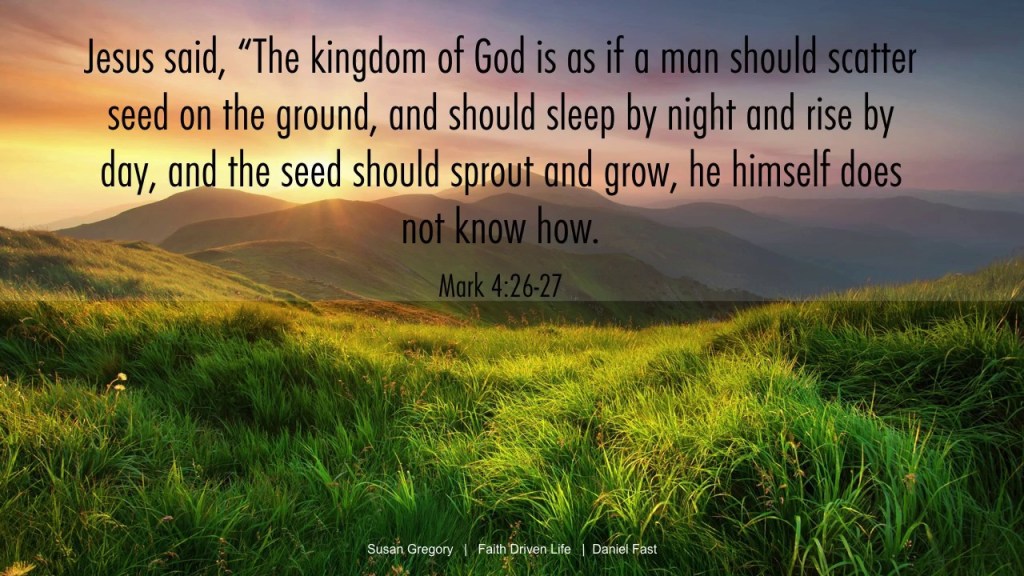
“The kingdom of God is as if a man should scatter seed on the ground. He sleeps and rises night and day, and the seed sprouts and grows. He knows not how.”
This passage is a parable about growing the kingdom of God not the world of man and its too often bizarre, wild and assorted politically motivated agendas.
Jesus is clearly communicating that the kingdom of God is like a seed that is planted in the ground – we are the church, we are those seeds being planted.
The seed grows and sprouts, even though the farmer does not know how it happens nor does he know the outcome when the seeds finally bear their fruit.
This parable teaches us that the kingdom of God is a mystery. We do not always understand how it works, too, we are not to know how God works, but if we will allow it, keep our agendas, understandings we can trust that God is at work in it.
We can also trust that the kingdom of God will grow and spread, even when we do not see it happening, even when we are thoroughly blinded by our agendas.
We can apply this parable to our own lives. We may not always see the results of our work, but we can absolutely trust that God is at work in us and through us.
1 Corinthians 3:5-9 Amplified Bible
5 What then is Apollos? And what is Paul? Just servants through whom you believed [in Christ], even as the Lord appointed to each his task. 6 I planted, Apollos watered, but God [all the while] was causing the growth. 7 So neither is the one who plants nor the one who waters anything, but [only] God who causes the growth. 8 He who plants and he who waters are one [in importance and esteem, working toward the same purpose]; but each will receive his own reward according to his own labor. 9 For we are God’s fellow workers [His servants working together]; you are God’s cultivated field [His garden, His vineyard], God’s building.
We can also trust the kingdom of God will grow, the kingdom of God will both mature and spread, even when we don’t know what’s going on see it happening.
Let us not be too discouraged if we do not see immediate results from our work.
Do I really trust that God is at work, and all outcomes do not all depend on me? Having done what God has given me to do, do I then rest, since God is working?
Philippians 2:1-4 Amplified Bible
Be Like Christ
2 Therefore if there is any encouragement and comfort in Christ [as there certainly is in abundance], if there is any consolation of love, if there is any fellowship [that we share] in the Spirit, if [there is] any [great depth of] affection and compassion, 2 make my joy complete by being of the same mind, having the same [a]love [toward one another], knit together in spirit, intent on one purpose [and living a life that reflects your faith and spreads the gospel—the good news regarding salvation through faith in Christ]. 3 Do nothing from selfishness or empty conceit [through factional motives, or strife], but with [an attitude of] humility [being neither arrogant nor self-righteous], regard others as more important than yourselves. 4 Do not merely look out for your own personal interests, but also for the interests of others.
Setting aside nonsensical worldly agendas, let us continue to sow the seeds of the kingdom of God, and trust only God will bring about a harvest in his time.

In the name of God, the Father and God the Son and God the Holy Spirit,
Let us Pray,
Dear God, thanks for the gift and mystery of seeds. Help me to humbly do my part in work and prayer and to rely on you for growth in and around me. In Jesus I pray.
Psalm 23 Amplified Bible
The Lord, the Psalmist’s Shepherd.
A Psalm of David.
23 The Lord is my Shepherd [to feed, to guide and to shield me],
I shall not want.
2
He lets me lie down in green pastures;
He leads me beside the still and quiet waters.
3
He refreshes and restores my soul (life);
He leads me in the paths of righteousness
for His name’s sake.
4
Even though I walk through the [sunless] [a]valley of the shadow of death,
I fear no evil, for You are with me;
Your rod [to protect] and Your staff [to guide], they comfort and console me.
5
You prepare a table before me in the presence of my enemies.
You have anointed and refreshed my head with [b]oil;
My cup overflows.
6
Surely goodness and mercy and unfailing love shall follow me all the days of my life,
And I shall dwell forever [throughout all my days] in the house and in the presence of the Lord.
Glory be to the Father,
and to the Son, and to the Holy Ghost;
as it was in the beginning,
is now, and ever shall be,
world without end. Amen, amen.
 Loving God, Living God, Loving Hope, Living Hope, Loving Living Life His Way! "Many things are possible for the person who has hope. Even more is possible for the person who has faith. And still more is possible for the person who knows how to love. But everything is possible for the person who practices all three virtues." - Brother Lawrence (1605-1691), Practicing the Presence of God (1692).