Living our Life and Honoring Our God, Living Our Life, Respecting, Honoring Generations of our Families, Honoring and Respecting Our Grand Parents. Proverbs 17:6

Proverbs 17:6Amplified Bible


Grandchildren are the crown of aged men,
And the glory of children is their fathers [who live godly lives].

The Word of God for the Children of God.

Adeste Fidelis. Venite Adoremus. Dominum.

Gloria. In Excelsis Deo. Alleluia, Alleluia, Alleluia, Amen.

What our Grand parents are to us …

“What children need most are the essentials that grandparents provide in abundance. They give unconditional love, kindness, patience, humor, comfort, lessons in life. Most importantly, milk and cookies and plenty of Ice Cream.”

“A grandfather is someone with silver in his hair and gold in his heart.”—Anonymous

If nothing is going well, call your grandmother. —Italian Proverb

“When Grand Ma smiles, the lines in her face become epic narratives that trace the stories of generations that no book can replace.” Anonymous

To a small child, the perfect granddad is unafraid of big dogs and fierce storms but absolutely terrified of the word “boo.” Anonymous

I still remember the simple lessons taught to me by my grandmother Lou. She taught me how special I was simply by telling me what a coconut looked like.

The time she spent with me, and the things she passed on with her simple, yet gentle words, pats upon my head, are still invaluable treasures that I cherish.

Throughout history, grandparents have played a central role in the lives of their children and grandchildren.

There is even a Grandparents Day the first Sunday after Labor day, put into its place by President Carter in 1978, to genuinely celebrate how important the contribution and impact our grandparents make to families, communities.

Today, let’s give honor where honor is long overdue, to take a few moments to stop and reflect on the value of grandparents—past or present and future.

Let’s dive into a few Scriptures that offer beautiful words of affirmation about the aged—timely words that show just how important grandparents truly are.

Does the Bible say anything about Honoring Our Grandparents?

When most of the books of the Bible were written, parents and grandparents held positions of high honor in the life of the family and of the community.

Children were expected to revere their elders and learn from them.

When God introduced the Law to the Israelite nation, He even included a commandment to “honor your father and your mother” (Exodus 20:12).

God also made it part of His Law that the younger person should stand in the presence of the elderly as a sign of respect (Leviticus 19:32).

Implied within this command is a multi-generational attitude of respect and honor toward a family and communities senior relatives.

As children observed their parents honoring the grandparents, they, in turn, at some point in life, would shoulder that responsibility when their time came.

Proverbs 17:6 says that “children’s children are the crown of old people.”

Every grandparent understands that comparison.

There is a special kind of bond between a grandparent and a grandchild that benefits both.

Someone has humorously stated that “grandchildren are God’s reward for not killing your own children when they were teenagers.”

Humor aside, there is some truth to that.

Grandchildren, like children, are a reward—a blessing from the Lord and one way that He is good to us (Psalm 127:3).

“Grandchildren are the crown of the aged, and the glory of children is their fathers.” – Proverbs 17:6

What a picture of God’s design for the good of families.

Think about it.

There’s three generations here.

You have got grandparents, parents, and children.

All of us fit into this spectrum in some sense.

We all are children with parents.

We all are grandchildren.

Some of us are parents or step parents of children who pray about being blessed with Grand Children, perhaps even Great Grand Children.

Some are grandparents with grandchildren.

This Proverb Calls Us to Honor Generations of Our Families

And the picture here is ABBA Father God has designed our lives to honor and respect our own parents and our grandparents.

God has designed our lives as parents and grandparents to be glorified in the way we love and raise our children, in the very way we love our grandchildren.

So, as we see these three generations, I just want to encourage you to think about life and think about how you can honor your parents, even just to thank God for them, to pray for them, and grand and great grand parents, as well.

How can you honor them?

How can you pray for them?

I think in my own life, none of my grandparents are living.

My mom and my dad have long gone to be the Lord.

So when it comes to these groups in my life, I think about my mom.

I thank God so much for my mom and my dad and their parents, and by God’s grace, for the legacy, blossoming revelation of faith, they’ve passed on to me.

I could go on and on and on far, far beyond the scope of this devotional just talking about God’s grace toward me.

God, I want to honor all generations of my parents, I’m so thankful for them.

Proverbs 17:6 Encourages Us to Glorify God in Our Families

And then I look the other way and think about my stepson.

I think about how precious he is, what a gift he is, and how much I pray for him.

I want to glorify God by loving him and caring for him well, and then I pray for his growing son.

So I pray for my grandson all the time.

I have no children of my own, but my sister does so I pray for her grandkids.

I pray that they would know God, they would love God, they would know God’s love for them and model God’s love for others.

So, just think about your life and where you are right now in the spectrum, whether you are single, married, a parent, or a grandparent, So I just pray.

1 Timothy 5:1-5 Common English Bible

Caring for God’s family

Don’t correct an older man, but encourage him like he’s your father; treat younger men like your brothers, treat older women like your mother, and treat younger women like your sisters with appropriate respect.

Take care of widows who are truly needy. But if a particular widow has children or grandchildren, they should first learn to respect their own family and repay their parents, because this pleases God. A widow who is truly needy and all alone puts her hope in God and keeps on going with requests and prayers, night and day.

In the New Testament, the duty of an adult grandchild is made explicit:

“If a widow has children or grandchildren, they should learn to serve God by taking care of her, as she once took care of them. This is what God wants them to do” (1 Timothy 5:4, CEB).

So the honor shown to a grandparent in need is more than mere respect; it is taking practical steps to support the grandparent and doing whatever it takes to meet his or her needs.

Doing so is a natural part of honoring and serving and giving glory to the Lord.

Grand Parent Responsibility Towards Grand Children

Proverbs 13:22 Christian Standard Bible

22 A good man leaves an inheritance to his[a] grandchildren,
but the sinner’s wealth is stored up for the righteous.

Just as grandchildren have sacred obligations to love, honor, and assist their grandparents, so do grandparents have responsibilities toward their children’s children. 

Proverbs 13:22 says that “a good man leaves an inheritance to his children’s children.”

Righteous people live wisely and pass on their wisdom, their knowledge, and their material blessings to their grandchildren.

In our day, it has become common for grandparents to have full custody of their grandchildren from the parents’ inability [drugs, alcohol, mental illness, legal issues] or their unwillingness to rear their own children.

While this is sad, it also demonstrates the unique love grandparents have that creates a willingness to begin the task of bringing up a child just when child-rearing was supposed to be finished.

Few retirees would volunteer for the emotional, financial, and physical burden of rearing children again, but, because they are grandparents, they’ll set aside their own desires for the needs of a grandchild.

Honoring and Respecting All Grand Parents?

The Bible gives examples of grandparents, and some of those grandparents were wicked: 

2 Kings 11 recounts the sad story of Athaliah, mother of King Ahaziah of Judah.

When Ahaziah died, the Queen Mother ordered the execution of all her royal family so that she could take the throne.

Unknown to her, one of Ahaziah’s sisters, Jehosheba, hid a baby grandson, Joash, in a bedroom so that he escaped his grandmother’s bloody rampage.

He and his nurse remained hidden in the temple for six years while his grandmother ruled Judah.

When Joash was seven years old, the high priest brought him out, anointed him, put the crown on his head, and proclaimed little Joash king of Judah.

When Athaliah saw this, she flew into a rage, but the godly high priest ordered her to be executed.

Thus, it was the murder of his entire family by his own grandmother that had ushered in the forty-year reign of King Joash of Judah.

Did Joash, at some point in his 4o year kingly reign privately or publicly forgive the scriptures do not say.

If there is some reason, legitimate or otherwise, and you are at severe odds with your grandparents, the matter of extending or not extending mercy, granting or not granting forgiveness is between Father God, Jesus, the Holy Spirit and you.

Scripture repeatedly says mercy and forgiveness are always the right choices.

Matthew 5:7Christian Standard Bible

Blessed are the merciful,
for they will be shown mercy.

Matthew 9:13 Christian Standard Bible

13 Go and learn what this means: I desire mercy and not sacrifice.[a] For I didn’t come to call the righteous, but sinners.”[b]

Kinsman Redeemer

Leviticus 25:25-27 Christian Standard Bible

25 If your brother becomes destitute and sells part of his property, his nearest relative may come and redeem what his brother has sold. 26 If a man has no family redeemer, but he prospers[a] and obtains enough to redeem his land, 27  he may calculate the years since its sale, repay the balance to the man he sold it to, and return to his property.

Ruth 4:14-17 Christian Standard Bible

14 The women said to Naomi, “Blessed be the Lord, who has not left you without a family redeemer today. May his name become well known in Israel. 15 He will renew your life and sustain you in your old age. Indeed, your daughter-in-law, who loves you and is better to you than seven sons, has given birth to him.” 16 Naomi took the child, placed him on her lap, and became a mother to him. 17 The neighbor women said, “A son has been born to Naomi,” and they named him Obed. He was the father of Jesse, the father of David.

An unusual grandparenting relationship is found in the book of Ruth.

The story of Ruth is a beautiful tale of love and loyalty between a young widow and her bereaved mother-in-law, Naomi.

Although her husband is dead, Ruth chooses to stay with her mother-in-law to care for her.

She even leaves her own people, the Moabites, to follow Naomi back to Israel where she meets and marries Boaz.

When their first child is born, the townspeople congratulate Naomi, saying, “Naomi has a son!” (Ruth 4:14–17).

The child was no blood relation to Naomi, but, because of the great love and connection between her and Ruth, she adopted the baby as her own grandchild.

This reminds us that grandparenting can come in many forms.

In this day of broken and dysfunctional families, divorce, and step-parenting, godly men and women who will prayerfully step forward, adopt their children’s step-children as their own grandchildren are blessed, as Naomi was blessed.

Her adopted grandchild, Obed, became the grandfather of King David.

When God designed this world, He instituted the ministry of the family as His means of propagating the earth and teaching us about love and relationship.

He intended for the elder to teach the younger and for the younger to revere the elder.

Grandparents, Great Grandparents play a uniquely special role in this design.

Free from the responsibility to train and discipline a child, grandparents can offer open arms, acceptance, and a safe place for a child to run when things are not going well with Mom and Dad.

Grandparents can provide wisdom beyond that of the parents, since they have already walked this road many years before.

A wise grandparent, though, will never intrude upon a parental decision in front of the child.

A grandparent’s role is not to supersede the parent but to support, encourage, and counsel as needed.

When parents, grandparents, and children are living out their roles as God first designed, the entire family, entire generations of families, communities thrive.

If I could give gold crowns to each one of my wonderful grandparents, I would.

They have invested so much into my life, and made such an impact,

I believe they ought to be treated like royalty.

However, I pray, that the way in which I’ve lived my life, would be such an abundant blessing to them, it feels like a crown of honor.

Not only are grandchildren a crown to the aged, the aged are the pride of their family – What a truly excellent reminder of the importance of grandparents!

In the name of God, the Father and God the Son and God the Holy Spirit,

Let us Pray,

ABBA Father, Every good and perfect gift comes from You. I thank you, Lord, for the joy and happiness, the moments of learning, and the guidance and care you have brought to us through our wonderful grandparents. I truly appreciate the kind of life, love, and nurturing they have given our parents, for through these, I was taught to depend on You by faith, and I was raised with the morals and values to respect others and be concerned for their welfare. Thank you, Lord, for our godly grandparents.

Gracious God, I pray also that each and every grandparent would be able to see their grandchildren as crowns of joy. I also ask that every child would be able to see their grandparents as people of steadfast faith they can look up to. Thank you, Lord, for the beautiful legacies they leave behind. I pray these things in Jesus’ name. Amen.
https://translate.google.com/

Matthew 5:7 AMP, “Blessed [content, sheltered by God’s promises] are the merciful, for they will receive mercy.

My Prayer is “Lord have Mercy! Christ, have Mercy! Lord have Mercy upon Me!!!”

Today, I am pondering how God treats us much, much better than we deserve.

Today, I am pondering just how much better we could be if we ourselves treated others, others being those whom God has called to be our neighbors, as God has treated us from the very beginning of all things. God mercifully created all of us. He gave us the responsibility to be care-full, care-filled stewards of each other. Yet, it is obvious even to the untrained, unobservant observer, there is failure! Even in the midst of all of our greatest failures to care for each other, God, in the single greatest act of mercy sent His Son Jesus to us to save, not condemn.

That fundamental, undergirding spiritual truth is the reality of grace. He has seen us in our very worst sins and had mercy on us because of his great love for us (see Romans 6:6-12). Even though we have repeatedly proved unfaithful and undependable, both individually and as a group, God has yet been gracious and profoundly merciful. He has repeatedly offered forgiveness, help, redemption, and salvation when we least deserved it. We have all been failures as stewards. We have had more than our fair share of success stories, but those failures ….!

Rather than dealing with us strictly as law would demand, God has dealt with us as a loving father does with his children. This conditioning reality must show up in us also. How can we truly claim to be his children and not be merciful as God has always been merciful with us? What about our mutual stewardship?

How can we call for retribution against our brothers and sisters, when fairness would demand we pay a great penalty for our sin? In the Kingdom family, mercy rules. When that mercy is so easily brushed aside, forgotten by us, then God has promised to judge our very own standard of mercilessness when he judges us. Matthew 7:1-2. Yet as long as we are merciful to others, God will show us mercy.

The Beatitudes are a description of the characteristics of people who belong to Christ’s kingdom. Matthew 4 we read Jesus was preaching, “Repent, for the kingdom of heaven is at hand.” Then Jesus went through Galilee proclaiming the gospel of the kingdom and is healing diseases and afflictions among the people. As Jesus goes up the mountain, he is reenacting the great law-giver Moses going up the mountain and receiving the Law from God’s own fingers. Jesus is now declaring the law, that is, the covenant of the kingdom of heaven.

In Matthew 5:7 Jesus said, “Blessed are the merciful, for they shall receive mercy.”

Matthew 5:7 The Message

“You’re blessed when you care. At the moment of being ‘care-full,’ you find yourselves cared for.

The Word of God for the Children of God. Gloria! In Excelsis Deo! Alleluia! Amen.

You are blessed when you care.

Someone else is being blessed when you care.

Your family is being blessed when you care.

Your friends are being blessed when you care.

Your next-door neighbors are being blessed when you care.

Your community is being blessed when you care.

Being across the globe as I am, I am blessed when you care.

The Body of Christ is being blessed when you care.

At the moment of being care – full you find yourselves cared for.

At the moment you are being care – full I find myself being cared for.

At the moment of being care – filled you find yourselves being cared for.

At the moment you are being care – filled, I find myself being cared for.

Jesus came to give us life, a life full of abundance.

Jesus came to give us life, a life filled with abundance.

Jesus came to care about our lives full of abundance.

Jesus came to care about our lives being filled to abundance

Jesus came to care for our lives filled with abundance.

In the single greatest act of mercy, God sent His Son to show He cares.

In the single greatest act of mercy, God sent His Son to care about us.

In the single greatest act of mercy, God sent His Son to care for us.

What else can be said here?

What else can God do here which He has not already done in abundance?

How much more will God continue to do for us through His Son Jesus?

What about this continuous revelation of mercy we have done nothing for?

Understanding God’s revelation of Mercy

The word “mercy” is used in the Gospel of Matthew to refer to showing compassion, pity, and favor toward the suffering and needy (Matthew 9:27; 15:22; 17:15; 18:33; 20:30).

We get a good experience for this word when we read the parable of the Good Samaritan (Luke 10). Remember that there was a man who fell among robbers and was suddenly beaten severely. A priest and a Levite pass by and do not offer assistance. But a Samaritan, someone the Israelites avoided at all costs, comes to his aid, takes him to an inn, and pays for his care. Jesus then asks, “Which of these three, do you think, proved to be a neighbor to the man who fell among the robbers?” (Luke 10:36) The lawyer responded, “The one who showed him mercy” (Luke 10:37). Here we see that mercy is showing compassion, pity, and favor.

Mercy, therefore, is not just a feeling. Mercy is not some detached feeling or a sentiment that does nothing. Mercy is a feeling that causes the individual to act.

Sometimes we describe mercy as not giving to others what they deserve. While there is truth to this declaration, we are going to see that this is not a complete definition for mercy. Mercy is not merely refusing to bring judgment on those deserving of judgment. Mercy is genuine compassion expressed in genuine help and selfless, sacrificial compassion and selfless concern shown in selfless acts.

The people in God’s kingdom are those who are free givers of mercy. Mercy is something that is freely shown, not merely felt. Later in Matthew, Jesus will call mercy one of the weightier matters of the law (Matthew 23:23).

Matthew 23:23 Amplified Bible

23 “Woe to you, [self-righteous] scribes and Pharisees, hypocrites! For you give a tenth (tithe) of your mint and dill and cumin [focusing on minor matters] and have neglected the weightier [more important moral and spiritual] provisions of the Law: justice and mercy and faithfulness; but these are the [primary] things you ought to have done without neglecting the others.

Mercy was not a characteristic of 1st century culture, nor ours today. A popular Roman philosopher called mercy, “The disease of the soul.” It was the sign of supreme weakness. The Roman world in Jesus’ day did not show a lot of mercy.

Jesus healed the sick, gave sight to the blind, made the lame to walk, the deaf to hear, and raised the dead. He was the friend of sinners. He forgave prostitutes, tax collectors, and religious rulers. He took children in His arms and blessed them. He showed mercy to everyone and in return they betrayed him, they repeatedly attempted to stone Him, throw him off cliffs and united to kill Him.

The ancient world then was a place of coercive violence and intimidation, but not mercy. The quality and quantity of Mercy was not very “politically correct.”

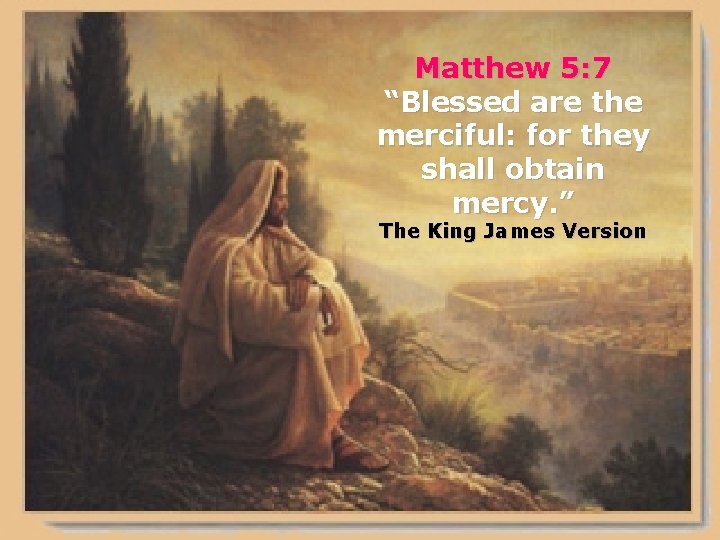
Just like the other beatitudes in which Jesus promises blessing for living in ways contrary to our nature, He climbs a hill, the people gather around him, and He says in Matthew 5:7, “Blessed are the merciful, for they shall obtain mercy.”

Matthew 5:43 records the saying was to love your neighbor and hate your enemy. We see in these cultures that mercy, if it was given, was reserved for those who had been merciful only to you. Our world today is not far removed spiritually from the Roman world when Jesus gave these blessed statements.

One too many world cultures say the same thing: “If you don’t look out for yourself, no one else will.” Another slogan today: “Don’t get mad, get even.” People are still treated like things, power is the supreme deity, and financial success is the most important thing in life. There is even the saying to, “Show no mercy ever.” Today, just as then, mercy is weakness in the minds of most.

The Standard of Mercy of God our Creator

We see Jesus showing mercy on many occasions. He looked on people and was moved with pity and compassion (Matthew 9:36; 14:14; 15:32). Jesus showed compassion on the sinful woman caught in adultery. Jesus always showed compassion and love toward the people. This is what attracts us to Jesus!

He truly cared for people. He had a legitimate concern for their needs and difficulties. In fact, we see the ugliness of the human heart with how the religious leaders treated Jesus. You will notice in the gospels the more Jesus showed mercy and compassion, the more the religious leaders hated Jesus and looked for opportunities to kill him.

The hatred grew so great that the people and leaders betrayed him, had Jesus arrested without cause, nailed to a cross. Yet, even while hanging on the cross, with nails driven through his outstretched hands, we see the mercy of Jesus. “Father, forgive them; for they do not know what they are doing” (Luke 23:34).

Notice in this we see a distinction between mercy and forgiveness. The mercy of our Lord is the basis for his desire to forgive us. “…he saved us, not because of works done by us in righteousness, but according to his own [standard of] mercy, by the washing of regeneration and renewal of the Holy Spirit, whom he poured out on us richly through Jesus Christ our Savior…” (Titus 3:5–6). 

Mercy was the basis upon which forgiveness was extended. God’s forgiveness of our sins flow from his abundant mercy.

But God, being rich in mercy, because of the great love with which he loved us, even when we were dead in our trespasses, made us alive together with Christ—by grace you have been saved— and raised us up with him and seated us with him in the heavenly places in Christ Jesus, (Ephesians 2:4–6 ESV)

Please notice that Ephesians makes the same distinction between mercy and forgiveness. Because God is rich in mercy with great love for us, he saved us by grace and made us alive together with Christ. While Jesus is on the cross, we see his full extent of mercy as he extends the opportunity of forgiveness to them.

We must be merciful because this is the very character of God. Jesus declared, “Be merciful, even as your Father is merciful” (Luke 6:36). The mercy of God should be renewed in our minds and hearts at least every Sunday as we partake of the Lord’s Supper. The Lord’s Supper reminds us of the mercy of God that we have experienced. God’s mercy is the covenanted basis of our own forgiveness.

This covenant teaches us something valuable. Our lack of forgiveness and our unwillingness to forgive others comes from a lack of mercy for others. Mercy drives forgiveness. If I am not driven to be forgiving, then I am not driven to be merciful. If I am not merciful, then I am not living in the kingdom of heaven.

The Challenge of God’s Standard of Mercy

Mercy is a challenge to develop in our character. Showing mercy means making ourselves vulnerable. We will be hurt by what other people do to us. We will extend ourselves to help people without reciprocation or thanks. We will give of ourselves unto those who need us without regard for receiving something in return. Compassion and pity are not often praised in our world, but it is the very heart of God, revealed through Jesus Christ, that we are showing to the world.

Mercy is not earned. Just like grace is no longer grace if it is earned, mercy is no longer mercy if it is deserved. Mercy is compassion that is undeserved. We are not to show mercy to whom we think deserve our mercy. We are to be like the character of God, extending mercy to all. Show mercy when people sin against us. The merciful expend a great measure of themselves to freely assist others.

But sometimes we misunderstand mercy. Mercy does not mean sin is ignored. We know this because God is merciful toward us but that does not mean our sins are ignored. Mercy recognizes the reality of sin. Mercy has the recognition of wrongdoing. Jesus did not show mercy by pretending that people were not sinning. Jesus did not show mercy by not convicting the people of their sins.

Jesus was being merciful by identifying sins and giving sinners the hope for forgiveness through him. Mercy identifies our sin but then shows the way to reconciliation with God. Mercy does good toward the other even in the face of opposition or evil.

Now think about what Jesus taught a couple times in the Gospel of Matthew: “I desire mercy, not sacrifice.” This declaration ought to be weighty to us and must not be emptied of its impact. God wants people who have a heart for him and for others. God does not want passive, heartless, soulless pew sitters.

We are people who help and heal. I am so troubled to hear how often Christians have an argument or a moment of an unkind word, and rather than showing mercy, there is division. People leave the congregation and go to another.

People get their feelings hurt and dwell in bitterness and leave. Going to church is not the test to know if you have received God’s mercy. Being merciful to others is the test to know if you have in truth experienced and received God’s mercy. Mercy is not desiring for other people to do good for others. Mercy is when we seek and act upon opportunities to be mercy givers, like the Good Samaritan in Luke 10.

Think about what the prophet Micah declared to the people:

And what does the Lord require of you? To act justly and to love mercy [kindness; ESV] and to walk humbly with your God. (Micah 6:8 NIV)

They Shall Receive God’s Standard of Mercy

The sinner’s plea can only be the words, “God, be merciful to me, a sinner” (Luke 18:13). God only shows mercy to the merciful. “Blessed are the merciful for they shall receive mercy.”

Listen to the chilling words of James:

For judgment is without mercy to one who has shown no mercy. Mercy triumphs over judgment. (James 2:13 ESV)

What terrifying words to hear! Judgment will be without mercy to the one who has shown no mercy.

We also have another saying: that person is getting what they deserve. But is that what we want to have happen to us? Do we want to get what we deserve for how we have treated others?

I know I have made many, many mistakes and I do not want to get what I truly deserve. for making them. You know others have been merciful toward you with your flaws and errors. Yet how often we will refuse to help people and refuse to be merciful because we think the person should not have put themselves in this mess in the first place! “They are only getting what they deserve.”

But we want others to be merciful toward us and not give us what we deserve. Further, we want God to be merciful toward us and not give us what we deserve. Do we seriously want to get what we deserve for how we have treated God?

Mercy toward others begins in our lives by having a penetrating awareness of our own desperate need of mercy from others, and especially from God.

It is mercy that shows compassion to the helpless (Luke 10:37) and extends forgiveness even to the one who gives repeated offense (Matthew 18:21-22). But this is what is important: mercy is not prompted by the appeal of certain qualities of the offender. We see this truth when God showed mercy to us through the cross (Romans 5:8-10).

Matthew 18:33 “And should not you have had mercy on your fellow servant, as I had mercy on you?” God’s standard of mercy compels us to be gracious, kind, compassionate, merciful toward others. We love God because He first loved us!

Blessed are the merciful for they shall receive mercy.

Oh, how we need this!

Oh, how we need to live this!

Oh, how we need to love this!

Oh, how we need to move on this!

Oh, how we need to go forth with this!

Oh, how we need to experience this!

Oh, how we need to reveal this!

Pray! Let God’s mercy transform your heart to be mercy givers to all people.

Let mercy flow like as an everlasting stream flowing from the heart of God!

In the name of God, the Father, and God the Son and God the Holy Spirit,

Let us pray,

Heavenly Father, how I praise and thank You for Your manifold mercy towards me, in that while I was yet a sinner, and at enmity with You… You did not give me what I deserve, but showed me mercy and love, by redeeming my life and clothing me in the righteousness of Christ. May I imitate the merciful way that Christ lived by bestowing Your mercy and compassion on all those with whom I come in contact. May I live as You would have me live in Jesus’ name – and for His glory, Alleluia! Alleluia! Alleluia! AMEN.

https://translate.google.com/