A God-Given Burden: “yet so that he cannot find out what God has done from the very beginning to the end.” Ecclesiastes 3:9-13

Ecclesiastes 3:9-13 Revised Standard Version

The God-Given Task

What gain has the worker from his toil?

10 I have seen the business that God has given to the sons of men to be busy with. 11 He has made everything beautiful in its time; also he has put eternity into man’s mind, yet so that he cannot find out what God has done from the beginning to the end. 12 I know that there is nothing better for them than to be happy and enjoy themselves as long as they live; 13 also that it is God’s gift to man that every one should eat and drink and take pleasure in all his toil.

Word of God for the Children of God

Glory be to the Father,
and to the Son, and to the Holy Ghost;
as it was in the beginning,
is now, and ever shall be,
world without end. Amen, amen.

To believe or not to believe in God … that is the most troubling of questions.

Ultimately, I believe there are no true atheists. Those who do claim atheism may be unwilling to publicly or privately acknowledge this about themselves, but God has given to every person a heavy burden. In the deep recesses of their being, they know that God is—and it is the very “is-ness” of God which creates a tug of war dilemma in men’s and women’s hearts and minds.

God created the world, and He made it beautiful in all of its perfection. God also made mankind to know Him, to commune with Him, to walk with Him in the garden, to and to enjoy all the benefits of His companionship. But man turned his back on the Designer, and as a result the perception of eternity that has been implanted within us is one which now largely taunts, tyrannizes and tests us.

People naturally seek to repress a knowledge of God (Romans 1:18-19), but a knowledge of God is inescapable. God has created us for a divine purpose—to know and worship Him—and unless we discover and fulfill that purpose, we will never be fully satisfied with anything else offered along life’s journey.

No relationship with a child, parent, spouse, lover, or friend can fulfill this great longing, nor can any experience, any possession, or any achievement.

This is the unacknowledged burden that God has laid on humanity: we will be forever dissatisfied until we do come to know the only thing that can bear the weight of our eternity—namely, to know Him and live in fellowship with Him.

You and I, who are creatures of time, were made for eternity.

We were made for God’s presence.

It should therefore be no surprise to us that when we turn away from Him, our lives are marked by frustration and confusion. When we choose to live in the dark, we lose our sight. The day that we finally acknowledge this is a great day.

The burden of being without God will weigh you down until you realize there has to be an answer somewhere, in someone else. And, of course, there is.

There are many things in this life that are beautiful, and we are free to enjoy them in accordance with the way God designed us to.

But there is nothing in this life that is ultimate, and we will not be free until we not only acknowledge this intellectually but live it out in our experience.

Is there something that you are determined to have, or to get, in your life because you think it will make you truly alive and fulfilled?

What is it that you feel you could not live, or could not be happy, without?

Be careful not to allow something good to become your god.

Instead, pray, place your ultimate hopes on the shoulders of the only one who is strong enough to bear them: the Eternal One.

To believe or not to believe in God … that is the most troubling of questions.

In the name of God, the Father and God the Son and God the Holy Spirit,

Praying …

Psalm 31 Revised Standard Version

Prayer and Praise for Deliverance from Enemies

To the choirmaster. A Psalm of David.

31 In thee, O Lord, do I seek refuge;
    let me never be put to shame;
    in thy righteousness deliver me!
Incline thy ear to me,
    rescue me speedily!
Be thou a rock of refuge for me,
    a strong fortress to save me!

Yea, thou art my rock and my fortress;
    for thy name’s sake lead me and guide me,
take me out of the net which is hidden for me,
    for thou art my refuge.
Into thy hand I commit my spirit;
    thou hast redeemed me, O Lord, faithful God.

Thou hatest[a] those who pay regard to vain idols;
    but I trust in the Lord.
I will rejoice and be glad for thy steadfast love,
    because thou hast seen my affliction,
    thou hast taken heed of my adversities,
and hast not delivered me into the hand of the enemy;
    thou hast set my feet in a broad place.

Be gracious to me, O Lord, for I am in distress;
    my eye is wasted from grief,
    my soul and my body also.
10 For my life is spent with sorrow,
    and my years with sighing;
my strength fails because of my misery,[b]
    and my bones waste away.

11 I am the scorn of all my adversaries,
    a horror[c] to my neighbors,
an object of dread to my acquaintances;
    those who see me in the street flee from me.
12 I have passed out of mind like one who is dead;
    I have become like a broken vessel.
13 Yea, I hear the whispering of many—
    terror on every side!—
as they scheme together against me,
    as they plot to take my life.

14 But I trust in thee, O Lord,
    I say, “Thou art my God.”
15 My times are in thy hand;
    deliver me from the hand of my enemies and persecutors!
16 Let thy face shine on thy servant;
    save me in thy steadfast love!
17 Let me not be put to shame, O Lord,
    for I call on thee;
let the wicked be put to shame,
    let them go dumbfounded to Sheol.
18 Let the lying lips be dumb,
    which speak insolently against the righteous
    in pride and contempt.

19 O how abundant is thy goodness,
    which thou hast laid up for those who fear thee,
and wrought for those who take refuge in thee,
    in the sight of the sons of men!
20 In the covert of thy presence thou hidest them
    from the plots of men;
thou holdest them safe under thy shelter
    from the strife of tongues.

21 Blessed be the Lord,
    for he has wondrously shown his steadfast love to me
    when I was beset as in a besieged city.
22 I had said in my alarm,
    “I am driven far[d] from thy sight.”
But thou didst hear my supplications,
    when I cried to thee for help.

23 Love the Lord, all you his saints!
    The Lord preserves the faithful,
    but abundantly requites him who acts haughtily.
24 Be strong, and let your heart take courage,
    all you who wait for the Lord!

Glory be to the Father,
and to the Son, and to the Holy Ghost;
as it was in the beginning,
is now, and ever shall be,
world without end. Amen, amen.

https://translate.google.com/

Brothers and Sisters, Guess What? You are not now and never have been, never will be, a Mistake or Accident. Psalm 139:13-16

Psalm 139:13-16 The Message

13-16 Oh yes, you shaped me first inside, then out;
    you formed me in my mother’s womb.
I thank you, High God—you’re breathtaking!
    Body and soul, I am marvelously made!
    I worship in adoration—what a creation!
You know me inside and out,
    you know every bone in my body;
You know exactly how I was made, bit by bit,
    how I was sculpted from nothing into something.
Like an open book, you watched me grow from conception to birth;
    all the stages of my life were spread out before you,
The days of my life all prepared
    before I’d even lived one day.

Word of God for the Children of God.

Glory be to the Father,
and to the Son, and to the Holy Ghost;
as it was in the beginning,
is now, and ever shall be,
world without end. Amen, amen.

SOMETHING TO PONDER

Have you felt at times that you were born at the wrong time or wrong place? Do you feel like God misplaced you, thinking you were meant to live in a different family, another country, or time period in history, where you believe you would have fit in better, enjoyed living more, prospered, had a better quality of life?

Or, maybe like one of the many homeless I counseled, been told your entire life that you were an accident or a mistake a waste, you’ve grown up believing it?

But it isn’t true because God doesn’t make mistakes. He doesn’t put us in the wrong time and place. As well, He hasn’t given people the power to accidentally create another human or assign worth or personal value. Men and women may not have planned the lives of their children, but we know from His word Psalm 139:13-16, that God does plan for all of our eternities which wait far far ahead.

As Psalm 139:16 describes, “Your eyes saw my unformed body; all the days ordained for me were written in Your book before one of them came to be.”

God carefully created each one of us, as Psalm 139:13 describes, “For You created my inmost being; You knit me together in my mother’s womb.”

No matter the circumstances of our conception or birth, Psalm 139:14 reassures us of God’s plan for us. “I praise you because I am fearfully and wonderfully made; Your works are wonderful, I know that full well.”

Even so, we may continue to still feel like we don’t know which way to turn in life; some may feel lost, but when we’re not sure which way to go, we ask God to lead us, and He will, like Psalm 32:8 assures, “I will instruct you and teach you in the way you should go; I will counsel you with My loving eye on you.”

Life Makes Sense: God’s Story of You

Psalm 139:16 Living Bible

16 You saw me before I was born and scheduled each day of my life before I began to breathe. Every day was recorded in your book!

We love stories, but it’s surprising how easily we can end up missing the stories God has written for our lives.

Winston Churchill once famously claimed that history was simply “one . . . unpredictable pathway after another over which we have little, no control.”

In other words, he claimed there was no story behind our experiences in life, only a vast series of unpredictable events over which no one has any control.

Few things are more deadening to your soul than thinking that your life ulti­mately means little more than one unpredictable thing after another.

Yet that’s how we often feel.

On many days we view our jobs or careers or families as where we have “ended up” in life.

In fact, it can seem a bit presumptuous to think there’s some master plan behind whatever situation you are in right now.

But the Bible tells us that the events of our lives make sense because they are part of a much larger story.

The struggles of last month or the victories that we may claim in the next few weeks are not simply chance occurrences.

They are part of a story line that is going somewhere.

The work you do, the people you share life with, the abilities you have, and the weaknesses you struggle with are all part of a diverse collection of ele­ments intended to make for a really good story—the story of you. God’s story of you. 

Do you believe this?

Do you believe God?

In the name of God, the Father and God the Son and God the Holy Spirit,

Praying …

Psalm 8 The Message

God, brilliant Lord,
    yours is a household name.

Nursing infants gurgle choruses about you;
    toddlers shout the songs
That drown out enemy talk,
    and silence atheist babble.

3-4 I look up at your macro-skies, dark and enormous,
    your handmade sky-jewelry,
Moon and stars mounted in their settings.
    Then I look at my micro-self and wonder,
Why do you bother with us?
    Why take a second look our way?

5-8 Yet we’ve so narrowly missed being gods,
    bright with Eden’s dawn light.
You put us in charge of your handcrafted world,
    repeated to us your Genesis-charge,
Made us stewards of sheep and cattle,
    even animals out in the wild,
Birds flying and fish swimming,
    whales singing in the ocean deeps.

God, brilliant Lord,
    your name echoes around the world.

Glory be to the Father,
and to the Son, and to the Holy Ghost;
as it was in the beginning,
is now, and ever shall be,
world without end. Amen, amen.

https://translate.google.com/

Ancient expectations, Contemporary expectations: Why do you and I seek the living among the dead? He is not in the grave anymore, but has risen! Luke 24:4-8

Luke 24:1-8 Christian Standard Bible

Resurrection Morning

24 On the first day of the week, very early in the morning, they[a] came to the tomb, bringing the spices they had prepared. They found the stone rolled away from the tomb. They went in but did not find the body of the Lord Jesus. While they were perplexed about this, suddenly two men stood by them in dazzling clothes. So the women were terrified and bowed down to the ground.

“Why are you looking for the living among the dead?” asked the men. “He is not here, but he has risen! Remember how he spoke to you when he was still in Galilee, saying, ‘It is necessary that the Son of Man be betrayed into the hands of sinful men, be crucified, and rise on the third day’?” And they remembered his words.

Word of God for the Children of God

Glory be to the Father,
and to the Son, and to the Holy Ghost;
as it was in the beginning,
is now, and ever shall be,
world without end. Amen, amen.

When we consider Jesus as Messiah, most of us think immediately in personal terms: 

Jesus is my Messiah.

He forgives my sins. He lives in me. 

All of which, of course, is true.

But 1st-century Jewish expectations concerning the messiahship of Jesus were far broader than that.

If we had talked with a 1st-century Jew about his or her messianic expectations, we would have discovered hopes that were, in a real sense, far grander in scope.

The Jews anticipated that their long-awaited Messiah would come to defeat the pagans by overwhelming force of presence or force of arms, who held sway over them, to rebuild the temple, and to establish God’s just reign upon the earth.

Theirs was a nationalistic hope—a hope that the Messiah would come and vindicate the nation of Israel.

Jesus’ arrival, along with the miracles He performed, stories He told, and the prophecies fulfilled, built to a great crescendo of the highest expectation among His followers. But just when they began to think He really would be the one to militaristically, politically overthrow Rome and redeem the people of Israel.

Hosanna! Hosanna! Hosanna! to the Son of David “Save us, we Pray!

However, at Calvary they saw all their messianic hopes hanging up on a Roman gibbet. When Jesus was so badly beaten and bloodied and nailed, and then when Jesus cried out, “It is finished” (John 19:30), many of them must have agreed.

How, then, did this group of believers, whose messianic hopes had been buried in a tomb, not only continue to believe that Jesus was the Messiah but stand in the streets near where He had been executed, make an unashamed declaration of His messiahship?

The answer which comes reverberating through the pages of the New Testament is found in the bodily resurrection of Jesus.

The angelic announcement to the women who had brought spices to embalm a corpse provoked a radical reassessment of what the believers had witnessed on the Friday and a complete change in their view of their lives and futures.

When the Messiah reappeared among them, as alive as ever, these previously sad, sorrowful, defeated, and brokenhearted disciples were transformed into bold, joyful witnesses.

They now bore testimony to the reality of Christ resurrected with a body that could be seen, handled, and touched, and yet possessing capacities to do what His pre-resurrection body had not done.

His work of salvation was finished; His life and His reign were most certainly not!

Only in the disciples’ recognition of His risen presence did Christ’s messiahship finally make sense.

Indeed, what the early Jewish believers discovered when they “found the stone rolled away from the tomb” (Luke 24:2) and saw that “Jesus himself stood among them” (v 36) was that an eternal hope, joy, and power ignited within their hearts.

And these remain available to all who put their trust in Jesus, the resurrected Messiah. It is the resurrection, and only the resurrection, that changes sadness, sorrow, and defeat into hope, joy, and power.

It is the resurrection, and only the resurrection, that declares our Messiah will defeat His enemies, will restore His people, and will rule from sea to sea.

The resurrection of Jesus will absolutely change everything about how you and I will go about your day today, tomorrow and as many tomorrows as God gifts us.

In the name of God, the Father and God the son and God the Holy Spirit,

Praying …

Psalm 24 Complete Jewish Bible

(0) By David. A psalm:

(1) The earth is Adonai’s, with all that is in it,
the world and those who live there;
for he set its foundations on the seas
and established it on the rivers.

Who may go up to the mountain of Adonai?
Who can stand in his holy place?
Those with clean hands and pure hearts,
who don’t make vanities the purpose of their lives
or swear oaths just to deceive.
They will receive a blessing from Adonai
and justice from God, who saves them.
Such is the character of those who seek him,
of Ya‘akov, who seeks your face. (Selah)

Lift up your heads, you gates!
Lift them up, everlasting doors,
so that the glorious king can enter!
Who is he, this glorious king?
Adonai, strong and mighty,
Adonai, mighty in battle.

Lift up your heads, you gates!
Lift them up, everlasting doors,
so that the glorious king can enter!
10 Who is he, this glorious king?
Adonai-Tzva’ot —
he is the glorious king. (Selah)

Glory be to the Father,
and to the Son, and to the Holy Ghost;
as it was in the beginning,
is now, and ever shall be,
world without end. Amen, amen.

https://translate.google.com/

Capable or Incapable of Walking Out of the dark Shadows of our Disbelief? Luke 23:50-54

Luke 23:50-54 Amplified Bible

Jesus Is Buried

50 A man named Joseph, who was a member of the Council (Sanhedrin, Jewish High Court), a good and honorable man 51 (he had not consented to the Council’s plan and action) a man from Arimathea, a city of the Jews, who was waiting for and expecting the kingdom of God; 52 this man went to Pilate and asked for the body of Jesus. 53 And [after receiving permission] he took it down and wrapped it in a linen [burial] cloth and laid Him in a tomb cut into the rock, where no one had yet been laid. 54 It was the day of preparation [for the Sabbath], and the Sabbath was dawning.

Word of God for the Children of God

Glory be to the Father,
and to the Son, and to the Holy Ghost;
as it was in the beginning,
is now, and ever shall be,
world without end. Amen, amen.



Jesus’ burial was by no means a foregone conclusion, for two main reasons.

First, the crucifixion of criminals was often not the end of their humiliation; they were often barred from the honor of a proper burial.

Second, the release of a corpse depended solely upon a relative or a friend requesting permission to bury the body—and who was left to bury Jesus?

The disciples had fled for their lives, the crowd had dispersed, and the women were unprepared to make such a request.

It is into this moment of history that an entirely unexpected individual emerges authoritatively, suddenly and silently—a highly respected individual who “was a disciple of Jesus, but secretly for fear of the Jews” (John 19:38).

Fear silenced Joseph of Arimathea up to this point. Jesus’ life and teaching had attracted him, brought him to saving faith, but his faith remained clandestine.

He went about his spiritual business in a secretive way—until the cross brought him out out of the shadows, into the open. And so, after too long hanging back in the shadows, Joseph walked, “went to Pilate and asked for the body of Jesus.”

The Gospel narrative describes Joseph’s careful handling of Jesus’ body as he “took it down” from the cross, “wrapped it in a linen shroud and laid him in a tomb cut in stone, where no one had ever yet been laid” (Luke 23:53).

We read likewise of Rabbi Nicodemus, “who earlier had come to Jesus by night … bringing a mixture of myrrh and aloes” to assist Joseph in the burial process (John 19:39).

Joseph and Nicodemus’ brief and singular appearance is also a clear reminder to us of God’s subtle providence at work at all times and in all places.

God prepared both Joseph and Nicodemus for this very moment. Both were highly fearful and secretive, but God used them for good, just as He does us.

Those first steps away from the darkness will always be the hardest to walk.

Both Joseph and Nicodemus had presumably missed many opportunities to stand up for their true King; they had presumably kept quiet so many times when they should have spoken out.

Yet it was these men whom God ensured would be present on this day for this important task. And both rose to complete it, risking everything—status, his reputation, his safety—to honor Jesus by ensuring that He had a proper burial.

You may find yourself identifying with either Nicodemus or Joseph: you have been living as a secret shadowed disciple, believing but afraid to let anyone in your neighborhood or workplace know about your faith.

If so, then today, pray, like both Joseph and Nicodemus to ask the Lord Jesus Christ to forgive your fearfulness and enable you, like both both men, in the light of the cross, to take your stand boldly for Him in the love of Christ.

You may have missed too many moments in the past when you had the chance to stand for your King; but God is always ready to give you the task of honoring His Son, and in those future efforts you need not pass up the next opportunity.

In the name of God, the Father and God the Son and God the Holy Spirit,

Praying …

The Lord, the Psalmist’s Portion in Life and Salvation in Death.

[a]Mikhtam of David.

16 Protect me, God, for I take refuge in You.
2 [b]I said to the Lord, “You are [c]my Lord;
I have nothing good besides You.”
As for the [d]saints who are on the earth,
[e]They are the majestic ones; all my delight is in them.
4 [f]The pains of those who have acquired another god will be multiplied;
I will not pour out their drink offerings of blood,
Nor will I take their names upon my lips.

The Lord is the portion of my inheritance and my cup;
You support my lot.
The measuring lines have fallen for me in pleasant places;
Indeed, my inheritance is beautiful to me.

I will bless the Lord who has advised me;
Indeed, my [g]mind instructs me in the night.
I have set the Lord continually before me;
Because He is at my right hand, I will not be shaken.
Therefore my heart is glad and my glory rejoices;
My flesh also will dwell securely.
10 For You will not abandon my soul to [h]Sheol;
You will not [i]allow Your [j]Holy One to [k]undergo decay.
11 You will make known to me the way of life;
In Your presence is fullness of joy;
In Your right hand there are pleasures forever.

Glory be to the Father,
and to the Son, and to the Holy Ghost;
as it was in the beginning,
is now, and ever shall be,
world without end. Amen, amen.

https://translate.google.com/

The Cross Opens Our Eyes: When the Centurion saw what had just taken place, he looked, praised God, saying, “Certainly this man was innocent!” Luke 23:47

Luke 23:47 Amplified Bible

47 Now when the centurion saw what had taken place, he began praising and honoring God, saying, “Certainly this Man was innocent.”

Word of God for the Children of God

Glory be to the Father,
and to the Son, and to the Holy Ghost;
as it was in the beginning,
is now, and ever shall be,
world without end. Amen, amen.

We cannot, have not understood the cross unless it has changed us personally.

After Jesus “breathed his last” (Luke 23:46), Luke records for us the reactions of those who witnessed the crucifixion.

“All the crowds that had assembled for this spectacle, when they saw what had taken place, returned home beating their breasts” (v 48).

Yes, there was sadness, but once the spectacle was over, they left to get on with their lives.

Verse 49 then informs us that “all his acquaintances … stood at a distance watching”—and we can only imagine what was running through their minds.

But the most striking and the most personal reaction that

Luke captures is that of the Roman centurion, who, seeing what had happened, “praised God, saying, ‘Certainly this man was innocent!’”—or, as the NIV renders it, “Surely this was a righteous man.”

Here, amid the darkness of hypocritical religious leaders, cynical rulers, and callous passersby, is a glimmer of light.

Perhaps the last person we would expect to see the truth—a man with no previous connection to Jesus, no background in Old Testament studies, and no predisposition to the things of God—This Roman Centurion, not only grasped the significance of what he was looking at but responded personally to it too!

He saw “what had taken place”—heard the words of Jesus, saw the darkness overhead, the manner of His death—and realized, 

Here is no ordinary man. Here is a man who is different from every other man. Here is a man who is entirely innocent, wholly righteous. 

Indeed, Mark adds that the centurion confessed that the man on the cross was “the Son of God” (Mark 15:39).

With his eye for detail, Luke places a clear emphasis on seeing what took place on the cross.

He probably hoped that some readers would remember that when Jesus had read from the scroll of Isaiah earlier in His ministry, He had said, “The Spirit of the Lord … has anointed me to proclaim good news to the poor … to proclaim liberty to the captives and recovering of sight to the blind” (Luke 4:18).

Indeed, a great theme found throughout the Gospel of Luke is that of darkness being invaded by light—the confusion and rock hardness of people’s hearts and their minds being invaded by this vision of the liberating power of God’s truth.

Any attempt to articulate Christianity that denies the centrality of the cross can never lead to saving faith.

And while we do not always understand how the Spirit moves in leading men and women to be born again, our message must always and ever be the same: “Christ crucified” (1 Corinthians 1:23).

It is beholding the cross that brings life for anyone who responds to the man who hung there by confessing who He is and praising God for His saving work.

Unless and until the cross becomes 100% personal to us, it is useless for us.

So, when was the last time you simply looked at your Savior on the cross and tried to grasp the fullest magnitude of this moment and knelt to praised God?

In the name of God, the father and God the son and God the Holy Spirit

Praying …

The Works and the Word of God.

To the Chief Musician. A Psalm of David.

19 The heavens are telling of the glory of God;
And the expanse [of heaven] is declaring the work of His hands.

Day after day pours forth speech,
And night after night reveals knowledge.

There is no speech, nor are there [spoken] words [from the stars];
Their voice is not heard.

Yet their voice [in quiet evidence] has gone out through all the earth,
Their words to the end of the world.
In them and in the heavens He has made a tent for the sun,

Which is as a bridegroom coming out of his chamber;
It rejoices as a strong man to run his course.

The sun’s rising is from one end of the heavens,
And its circuit to the other end of them;
And there is nothing hidden from its heat.


The law of the Lord is perfect (flawless), restoring and refreshing the soul;
The statutes of the Lord are reliable and trustworthy, making wise the simple.

The precepts of the Lord are right, bringing joy to the heart;
The commandment of the Lord is pure, enlightening the eyes.

The fear of the Lord is clean, enduring forever;
The judgments of the Lord are true, they are righteous altogether.
10 
They are more desirable than gold, yes, than much fine gold;
Sweeter also than honey and the drippings of the honeycomb.
11 
Moreover, by them Your servant is warned [reminded, illuminated, and instructed];
In keeping them there is great reward.
12 
Who can understand his errors or omissions? Acquit me of hidden (unconscious, unintended) faults.
13 
Also keep back Your servant from presumptuous (deliberate, willful) sins;
Let them not rule and have control over me.
Then I will be blameless (complete),
And I shall be acquitted of great transgression.
14 
Let the words of my mouth and the meditation of my heart
Be acceptable and pleasing in Your sight,
O Lord, my [firm, immovable] rock and my Redeemer.

Glory be to the Father,
and to the Son, and to the Holy Ghost;
as it was in the beginning,
is now, and ever shall be,
world without end. Amen, amen.

https://translate.google.com/

He Breathed His Last: Jesus, calling out with a loud voice, said, “Father, into your hands I commit my spirit!” having said this he breathed his last. Luke 23:46

Luke 23:46 New King James Version

46 And when Jesus had cried out with a loud voice, He said, “Father, ‘into Your hands I commit My spirit.’ ” Having said this, He breathed His last.

Word of God for the Children of God

Glory be to the Father,
and to the Son, and to the Holy Ghost;
as it was in the beginning,
is now, and ever shall be,
world without end. Amen, amen.
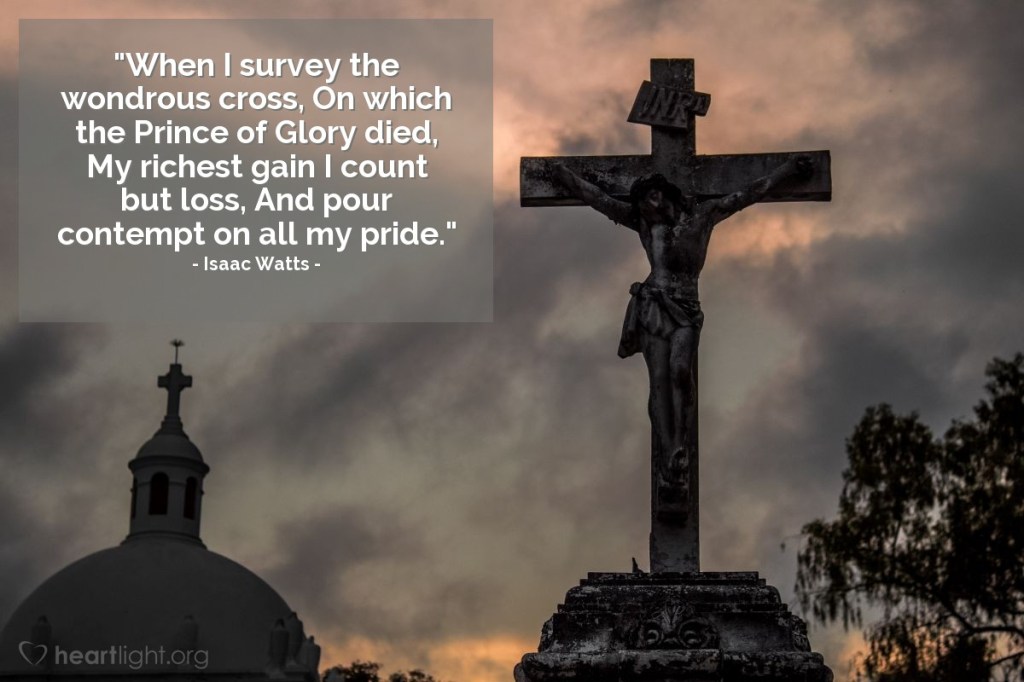
The simplicity of these words points us to truths that lie too deep for tears.

Luke, with his eye for detail, gives us an “orderly account” of Jesus’ crucifixion—an account which, he explains at the start of his Gospel, is the result of very careful investigation and has been written in order that his readers “may have certainty concerning the things you have been taught” (Luke 1:3-4).

He doesn’t seek to bathe his writing in pathos.

Instead, he writes in order that we may understand truth. And so Jesus’ dying breath is recounted for us in a simple phrase: “He breathed his last.”

What Luke does want us to linger on is Jesus’ control over His final breath.

He chose to commit His spirit into His Father’s loving hands.

He knew that His work was done.

Sin was paid for, the curtain was torn, and His people could come into His Father’s presence eternally.

Coupled with everything Jesus said prior to His crucifixion, His final words refute the notion that His death was simply that of a helpless victim being overwhelmed by cruel circumstances.

He had told His disciples months before that He was going up to Jerusalem and that “the Son of Man must suffer many things and be … killed” (Luke 9:22).

John tells us that He had explained to them, “I lay down my life that I may take it up again. No one takes it from me, but I lay it down of my own accord. I have authority to lay it down, and I have authority to take it up again” (John 10:17-18).

Jesus went to the cross not helplessly but willingly.

In accord with the Father’s purpose, He chose the exact moment that He would lay down his life for His sheep (John 10:11).

Here, then, we see the very Author of life willingly taking His final breaths and reminding us of His absolute authority as well as His inexhaustible love.

“He breathed his last” so that you might breathe in the fresh, purified air that was made available to you the moment you were born again.

“He breathed his last” so that one day you will stand in a restored creation and breathe air into lungs that will never decay or perish.

He who is sovereign over the air you breathe sovereignly breathed His last.

He is worthy of nothing less than your praise and adoration.

In the name of God, the Father and God the Son and God, the Holy Spirit,

Praying …

23 The Lord is my shepherd; I shall not want.

He maketh me to lie down in green pastures: he leadeth me beside the still waters.

He restoreth my soul: he leadeth me in the paths of righteousness for his name’s sake.

Yea, though I walk through the valley of the shadow of death, I will fear no evil: for thou art with me; thy rod and thy staff they comfort me.

Thou preparest a table before me in the presence of mine enemies: thou anointest my head with oil; my cup runneth over.

Surely goodness and mercy shall follow me all the days of my life: and I will dwell in the house of the Lord for ever.

Glory be to the Father,
and to the Son, and to the Holy Ghost;
as it was in the beginning,
is now, and ever shall be,
world without end. Amen, amen.

https://translate.google.com/

Divine Vandalism: And the moment arrived and the Sun stopped shining, and then suddenly the curtain of His temple was shredded into two halves. Luke 23:44-46

Luke 23:44-46 New International Version

The Death of Jesus

44 It was now about noon, and darkness came over the whole land until three in the afternoon, 45 for the sun stopped shining. And the curtain of the temple was torn in two. 46 Jesus called out with a loud voice, “Father, into your hands I commit my spirit.”[a] When he had said this, he breathed his last.

Word of God for the Children of God

Glory be to the Father,
and to the Son, and to the Holy Ghost;
as it was in the beginning,
is now, and ever shall be,
world without end. Amen, amen.
As Jesus’ ministry progressed, one of the great concerns of the Jewish religious establishment was that He had, it appeared, claimed that He would destroy the temple and raise it again in three days (John 2:19).

Indeed, this was one of the main charges brought against Him (Mark 14:58).

When Jesus was on the cross, then, passersby’s mocked, spit and ridiculed Him, shouting, “You who would destroy the temple and rebuild it in three days, save yourself!” (Matthew 27:40).

But there He remained, hanging on the cross, in the darkness.

And then, in the midst of the darkness and the upheaval of the crucifixion, all of a sudden something completely mysterious and utterly unexpected happened: it was God Himself desecrated the temple, earthquake shaking its foundations.

“The curtain of the temple was torn in two,” Luke tells us.

This was the very curtain that hung in the temple to symbolically bar the way into God’s presence.

It was the great sign that imperfect people could not be in the same space as the holy God.

All through the Old Testament, anyone who had presumed to come into God’s presence without observing the ceremonial cleansing rituals and making the necessary sacrifices had died (for instance, Numbers 3:2-4).

But now, suddenly, as Jesus was on the very verge of death, this symbol of restrictive exclusivity was destroyed right down the middle.

By destroying it, God declared that the old priestly ritual for entrance into His presence had been abolished and the barrier of sin dividing humanity from their Maker had been obliterated.

There is no longer any need to keep our distance from God. Instead, “we have confidence to enter the holy places by the blood of Jesus, by the new and living way that he opened for us through the curtain” (Hebrews 10:19-20).

Our access to God isn’t restricted to a temple or a church or any other building, nor must it be through a merely human priest or a guru.

No, 2,000 years ago God broke into history of humanity to establish, directly, unhindered access to Himself through Jesus.

Now there is “one mediator between God and men, the man Christ Jesus, who gave himself as a ransom for all” (1 Timothy 2:5-6).

The temple curtain being torn in two was divine vandalism on our behalf!

You don’t have to be sidetracked by priests and rituals anymore.

They can be nothing but pointless. Instead, you can come to God, just as you are, confident of divine welcome and mercy and help, all because of Jesus.

A Confident Christ Dies

Luke 23:46-49 New International Version

46 Jesus called out with a loud voice, “Father, into your hands I commit my spirit.”[a] When he had said this, he breathed his last.

47 The centurion, seeing what had happened, praised God and said, “Surely this was a righteous man.” 48 When all the people who had gathered to witness this sight saw what took place, they beat their breasts and went away. 49 But all those who knew him, including the women who had followed him from Galilee, stood at a distance, watching these things.

In his words from the cross, Jesus demonstrated that he knew how to live, because he knew how to die.

We hear it in the first word he uttered in this saying: “Father …” Then, in effect, the faithful Son confidently declared, “I’m coming home!”

In those days, the words Jesus used were often taught to children as a bedtime prayer: “Father, into your hands I commit my spirit” (see Psalm 31:5).

They signify entrusting all of one’s being to God for safekeeping. (Psalm 23)

What a comfort it is to be able to entrust our whole lives and all our joys and concerns to God!

And Jesus said these words not secretly or silently but with a loud voice.

He was saying, in effect, “Father, I’m coming home. My mission is complete. I love you. I trust you. As always, I commit my spirit to you.”

Doing the same, we can live and die in the confidence of knowing we will go home to our Father when he calls. We can say confidently, in words adapted from an old confession, “My ‘only comfort in life and in death’ is that I belong … to my faithful Savior Jesus Christ’” (Heidelberg Catechism, Q&A 1).

Jesus ended his time on earth with confidence in the Father.

Can you and I step up our faith, hope and love to do exactly that too?

In the name of God, the Father and God the Son and God the Holy Spirit,

Praying …

31 1-2 I run to you, God; I run for dear life.
    Don’t let me down!
    Take me seriously this time!
Get down on my level and listen,
    and please—no procrastination!
Your granite cave a hiding place,
    your high cliff nest a place of safety.

3-5 You’re my cave to hide in,
    my cliff to climb.
Be my safe leader,
    be my true mountain guide.
Free me from hidden traps;
    I want to hide in you.
I’ve put my life in your hands.
    You won’t drop me,
    you’ll never let me down.

6-13 I hate all this silly religion,
    but you, God, I trust.
I’m leaping and singing in the circle of your love;
    you saw my pain,
    you disarmed my tormentors,
You didn’t leave me in their clutches
    but gave me room to breathe.
Be kind to me, God—
    I’m in deep, deep trouble again.
I’ve cried my eyes out;
    I feel hollow inside.
My life leaks away, groan by groan;
    my years fade out in sighs.
My troubles have worn me out,
    turned my bones to powder.
To my enemies I’m a monster;
    I’m ridiculed by the neighbors.
My friends are horrified;
    they cross the street to avoid me.
They want to blot me from memory,
    forget me like a corpse in a grave,
    discard me like a broken dish in the trash.
The street-talk gossip has me
    “criminally insane”!
Behind locked doors they plot
    how to ruin me for good.

14-18 Desperate, I throw myself on you:
    you are my God!
Hour by hour I place my days in your hand,
    safe from the hands out to get me.
Warm me, your servant, with a smile;
    save me because you love me.
Don’t embarrass me by not showing up;
    I’ve given you plenty of notice.
Embarrass the wicked, stand them up,
    leave them stupidly shaking their heads
    as they drift down to hell.
Gag those loudmouthed liars
    who heckle me, your follower,
    with jeers and catcalls.

19-22 What a stack of blessing you have piled up
    for those who worship you,
Ready and waiting for all who run to you
    to escape an unkind world.
You hide them safely away
    from the opposition.
As you slam the door on those oily, mocking faces,
    you silence the poisonous gossip.
Blessed God!
    His love is the wonder of the world.
Trapped by a siege, I panicked.
    “Out of sight, out of mind,” I said.
But you heard me say it,
    you heard and listened.

23 Love God, all you saints;
    God takes care of all who stay close to him,
But he pays back in full
    those arrogant enough to go it alone.

24 Be brave. Be strong. Don’t give up.
    Expect God to get here soon.

Glory be to the Father,
and to the Son, and to the Holy Ghost;
as it was in the beginning,
is now, and ever shall be,
world without end. Amen, amen.

https://translate.google.com/

Standing at the Border or Trekking through Samaria: Some Fresh Ways to Spread the Gospel. John 4:39-42

John 4:39-42 Amplified Bible

The Samaritans

39 Now many Samaritans from that city believed in Him and trusted Him [as Savior] because of what the woman said when she testified, “He told me all the things that I have done.” 40 So when the Samaritans came to Jesus, they asked Him to remain with them; and He stayed there two days. 41 Many more believed in Him [with a deep, abiding trust] because of His word [His personal message to them]; 42 and they told the woman, “We no longer believe just because of what you said; for [now] we have heard Him for ourselves and know [with confident assurance] that this One is truly the Savior of [all] the world.”

Word of God for the Children of God

Glory be to the Father,
and to the Son, and to the Holy Ghost;
as it was in the beginning,
is now, and ever shall be,
world without end. Amen, amen.

The Samaritan woman who had met Jesus at the well (John 4:1-30) ran back to her town, informed everyone Jesus had told her everything she had ever done.

Her story wasn’t a shining example of how to be a great person.

But she shared how Jesus had talked with her and given her hope, despite her complicated past, and she invited others to come hear Jesus as well.

As a result, many Samaritans believed in Jesus both because of her testimony and because of his teaching.

It truly amazes me what can happen when we share our stories and we are able to spend quality time with Jesus and his followers.

Jesus can use any story to help people put their faith in him.

How might Jesus use your story to bring others to learn about him and his great salvation?

The Samaritan woman shared her story about how Jesus had changed her. Can we do that too?

No one’s life is beyond saving through the power of Jesus.

The Lord can use all of our stories to bring others into his loving embrace.

How will you use your story and your encounter with Jesus to tell someone about his love today?

How can we share our faith in ways that will motivate people to pay attention?

Experiencing Jesus’ love inspires us to share that love with others.

We know Jesus has called us all to spread the gospel message, yet evangelizing can be challenging.

How can we share our faith in ways that will motivate people to pay attention?

Here are 5 fresh ways to spread the gospel.

What Does it Mean to Spread the Gospel?

Spreading the gospel means spreading the ultimate good news: that a loving God offers people an opportunity to enjoy true love forever, through relationships with their Creator.

The word “gospel” literally means “good news”. When we spread the gospel, we share the good news of how Jesus – the world’s Savior – made eternal salvation possible for all souls who place their faith in him. 

John 3:16 proclaims the essence of the gospel message:

“For God so loved the world that he gave his one and only Son, that whoever believes in him shall not perish but have eternal life.”

Jesus calls everyone who connects with him to help other people connect with him, as well, by sharing the gospel message. He urges us in Mark 16:15-16: “… ‘Go into all the world and preach the gospel to all creation. Whoever believes and is baptized will be saved, but whoever does not believe will be condemned.”

What Does the Bible Tell Us about Spreading the Gospel?

That call from Jesus to preach the gospel to all creation is known as the Great Commission – the assignment that Jesus gave people after his Resurrection and before his Ascension to heaven.

The Bible records the Great Commission in several other places.

In Matthew 28:19-20, Jesus exhorts: “Therefore go and make disciples of all nations, baptizing them in the name of the Father and of the Son and of the Holy Spirit, and teaching them to obey everything I have commanded you. And surely I am with you always, to the very end of the age.” 

Luke 24:47 mentions that “… repentance for the forgiveness of sins will be preached in his name to all nations, beginning at Jerusalem.”

In John 20:21, Jesus references spreading the gospel when he says: “Peace be with you! As the Father has sent me, I am sending you.”

Finally, in Acts 1:8, Jesus describes spreading the gospel as his witnesses to others:

“But you will receive power when the Holy Spirit comes on you; and you will be my witnesses in Jerusalem, and in all Judea and Samaria, and to the ends of the earth.”

The Bible says that Christians are serving as ambassadors for Jesus as we interact with others. 

2 Corinthians 5:20 declares:

“We are therefore Christ’s ambassadors, as though God were making his appeal through us. We implore you on Christ’s behalf: Be reconciled to God.”

So, God is counting on us spread the gospel.

He wants us to faithfully say “yes” to that call.

We can do so by serving as examples of what faith in action looks like, as the apostle Paul writes in 

1 Corinthians 11:1-2: “Follow my example, as I follow the example of Christ. I praise you for remembering me in everything and for holding to the traditions just as I passed them on to you.”

We can also spread the gospel through conversations, as the apostle Peter points out in 1 Peter 3:15-16:

“But in your hearts revere Christ as Lord. Always be prepared to give an answer to everyone who asks you to give the reason for the hope that you have. But do this with gentleness and respect, keeping a clear conscience…”.

Many people are searching for the hope that Jesus can give them, yet not enough people are spreading the gospel message to reach them all yet.

Jesus says to his disciples in 

Matthew 9:37-38: “… The harvest is plentiful but the workers are few. Ask the Lord of the harvest, therefore, to send out workers into his harvest field.”

We don’t need to worry about anything but faithfully sharing the gospel message.

When we do so, we can trust God to bring positive results from our efforts. 

2 Timothy 2:15 encourages us simply to:

“Do your best to present yourself to God as one approved, a worker who does not need to be ashamed and who correctly handles the word of truth.” 

Romans 1:16 urges us to keep the gospel’s power in mind:

“For I am not ashamed of the gospel, because it is the power of God that brings salvation to everyone who believes…”.

5 Fresh Ways to Spread the Gospel

When you’re considering how best to spread the gospel message to people you know, start with prayer.

Ask the Holy Spirit to guide you day by day with wisdom on how to share the gospel, and to bring people into your life who need to hear its message.

Try these 5 fresh ways to share the ultimate good news with people:

1. Let God’s love flow through your life. Welcoming God’s love to flow through your life and into other people’s lives is the most powerful way you can share the gospel.

That’s because God is love at his core. “God is love” 1 John 4:8 declares.

So, whenever people experience love by interacting with you, that will point them toward God. Nothing inspires people more than love.

Once you love people, they will talk with you, and then you can tell them about God’s love for them.

2. Listen to people’s stories. Everyone has stories that are valuable.

Show people you care about them by listening to their stories.

Listen more than you talk.

Then, after you’ve gotten to know people, point out how you see God at work in their lives.

Ask them consider how their personal stories can fit into the greater story of what God is doing in the world.

God has designed our minds to respond to stories, and because of that, Jesus often spoke in parables (stories) to share spiritual truths.

Stories engage both our intellect and our emotions.

By listening to people’s stories, you can connect with them on both levels and help them connect with the gospel on both levels, as well.

3. Don’t judge people, but accept them for who they are. 

Often, people are afraid of talking with others about God, because they’re afraid of being judged.

Keep in mind that only God can judge someone (Romans 2), and if we try to judge others, we will be judged ourselves (Matthew 7).

Help people relax around you by refraining from judging them, no matter how much you may disagree with their choices.

Just as God meets you where you are, meet other people where they are. Show them some unconditional love. If people know you’re a safe person to open up to, they’ll likely be much more open to discussing the gospel message with you.

4. Highlight what nature reveals about God. Help people discover more about the Creator by spending time with them in creation. 

Romans 1:20 proclaims: “For since the creation of the world God’s invisible qualities – his eternal power and divine nature – have been clearly seen, being understood from what has been made, so that people are without excuse.”

Since nature reveals the wonder of God’s character, it’s the perfect setting for sharing the gospel message. Take a nature walk during the day, stargaze at night, or pursue any other type outdoor activity you all mutually enjoy together.

As the nature around you inspires you, enjoy conversations about God together.

5. Encourage questions rather than just giving answers. 

While it’s important to give people answers to their spiritual questions, don’t stop there.

You can help them engage more deeply with the gospel message by encouraging them to keep asking more questions.

That will prayerfully motivate them to seek God more.

Spark people’s curiosity.

Challenge them to try praying, even if they’re not yet sure that God exists or that he will answer their prayers.

Ask them to try studying the Bible, and offer to help them do so.

Don’t limit your conversations to only what you’re comfortable talking about; be willing to talk about anything that interests them.

If you don’t know something, be honest rather than giving a pat answer, and then help them discover more about what they’re wondering.

In Conclusion …

Trust, Believe, display faith. The hope God offers is too good to keep to yourself.

Jesus calls all believers to spread the gospel to other people. Please don’t hesitate to spread the gospel whenever you have the opportunity to do so.

Simply do your best, and trust God with the results.

As you do come to share God’s good news with people in fresh ways, both God’s love and God’s Shalom (John 14:27) will flow through you and into their lives.

In the name of God, the Father and God the Son and God, the Holy Spirit,

Praying …

Psalm 119:9-16 Complete Jewish Bible

ב (Bet)

How can a young man keep his way pure?
By guarding it according to your word.
10 I seek you with all my heart;
don’t let me stray from your mitzvot.
11 I treasure your word in my heart,
so that I won’t sin against you.
12 Blessed are you, Adonai!
Teach me your laws.
13 I proclaim with my mouth
all the rulings you have spoken.
14 I rejoice in the way of your instruction
more than in any kind of wealth.
15 I will meditate on your precepts
and keep my eyes on your ways.
16 I will find my delight in your regulations.
I will not forget your word.

Glory be to the Father,
and to the Son, and to the Holy Ghost;
as it was in the beginning,
is now, and ever shall be,
world without end. Amen, amen.

https://translate.google.com/

“To be Blinded by His eternal Light” A Prayer to Find Light When You Feel Completely Surrounded by Darkness. John 1:1-5

John 1:1-5 Living Bible

1-2 Before anything else existed,[a] there was Christ, with God. He has always been alive and is himself God. He created everything there is—nothing exists that he didn’t make. Eternal life is in him, and this life gives light to all mankind. His life is the light that shines through the darkness—and the darkness can never extinguish it.

Word of God for the Children of God

Glory be to the Father,
and to the Son, and to the Holy Ghost;
as it was in the beginning,
is now, and ever shall be,
world without end. Amen, amen.

In Him Was Life

The first of these theme-words appears at the beginning of John 1:4, “In him was life.”

The word life appears 36 times in the gospel of John, far more than any other New Testament book. It is one of his most important themes.

The preceding verses say that “the Word was with God” and “was God,” and that “all things were made through him” (John 1:1–3).

The second person of the Godhead, the “Word,” who is the subject of this gospel, is the source of all life in this universe.

Not merely does he possess life, but life itself is found in him and also comes through him. Jesus said, “For as the Father has life in himself, so he has granted the Son also to have life in himself” (John 5:26).

This is what John wants us to see in Christ: “In him was life.”

Are you and I really truly living?

Do you and I feel that our lives matter for something important?

Are you and I excited about things, or just keeping occupied?

Jesus has life to give to those who trust in him. “I came that they may have life,” he said, “and have it abundantly” (John 10:10).

So, just how much or how little do you and I actually, authentically, trust Him?

The Light Shining

This is the very connection John makes, that the life in Christ comes as a light shining in the darkness.

“In him was life, and the life was the light of men. The light shines in the darkness” (John 1:4–5). 

Light is another of John’s great themes.

The first recorded words of God are, “Let there be light” (Gen. 1:3). Light is an image that everyone understands, and it brings a rich array of meaning.

The first thing light does is reveal. 

When you walk into a dark room, you turn on the light to see.

This is what Isaiah prophesied about the coming of Jesus: “The people who walked in darkness have seen a great light; those who dwelt in a land of deep darkness, on them has light shined” (Isa. 9:2).

Man was living in a spiritual darkness, ignorant about God and living in superstition.

So Jesus came to reveal God. “Whoever has seen me has seen the Father,” he said (John 14:9).

James Boice comments,

https://en.wikipedia.org/wiki/James_Montgomery_Boice

“Jesus is revealed as the One who knows God the Father and who makes him known.… Before Christ came into the world, the world was in darkness. The world did not know God. Christ came. His light shone before men. Then men had light of the knowledge of the glory of God in the face of Jesus Christ.”

Do you and I know God?

Do you and I know what God is like?

Do you or I know Jesus came to reveal God to us.

Do you and I know God by personal acquaintance, by his presence within your spirit?

Do you and I know Jesus came also to bring us into fellowship with God as worshipers in spirit and in truth?

Light not only reveals but it also warms. 

To “walk in the darkness” is to walk in sin and moral depravity, but the light of Christ warms the heart so that it is changed.

This spiritual transformation is what Jesus meant in John 12:46, “I have come into the world as light, so that whoever believes in me may not remain in darkness.”

Thirdly, light not only reveals and warms, but it also guides. 

We think of the glory cloud of light that guided Israel through the desert during the exodus from Egypt. 

Psalm 119:105 says, “Your word is a lamp to my feet and a light to my path.”

Likewise, Jesus said, “I am the light of the world. Whoever follows me will not walk in darkness, but will have the light of life” (John 8:12).

If you come to Jesus Christ in faith and follow as his disciple, he will be a light to guide you “in paths of righteousness for his name’s sake” (Ps. 23:3).

Fourthly, light conveys and stimulates life.

If you want a plant to grow, you place it in the sunshine.

Likewise, you will grow upward as the light of Christ’s Word shines in you.

His light shines with the power of his life through his Word.

“In him was life, and the life was the light of men” (John 1:4).

This great verse summarizes what it means for us to be Christ-like.

Jesus wants you to be a lamp that reflects his light in the world.

He wants you to reveal God to those around you; he wants you to warm others so they will seek after truth and love; he wants you to be a guide to others; and he wants his light shining in and through you to bring others to life.

He said: “Let your light shine before others, so that they may see your good works and give glory to your Father who is in heaven” (Matt. 5:16).

Darkness against the Light

The third image John uses is darkness.

This is the absence of light.

If light stands for the knowledge of God, darkness represents the fullness of all our spiritual ignorance in which the world is perishing.

If light stands for warmth and goodness, then the darkened world is that which is enslaved in sin and evil.

If the light breaks through, leads us in good paths, darkness is the realm of the lost and blind. If light brings true life, then darkness is the true realm of death.

Darkness is opposed to light.

John 1:5 says, “The light shines in the darkness, but the darkness has not overcome it.”

This indicates that the coming of Christ as the light meets the opposition of the darkened world.

Jesus said, “This is the judgment: the light has come into the world, and people loved the darkness rather than the light because their deeds were evil” (John 3:19).

Nothing has ever condemned this world more than its response to the coming of Jesus Christ.

If people tell you the world or the human race is basically good, remind them what it did to Jesus.

He came without any sin, healing and teaching the way to God.

He was a light shining in the darkness.

But for that very reason the world hated him.

The hypocritical Pharisees resented him for exposing their legalism.

The priests and scribes envied his popularity.

The power-hungry Romans thought him a threat to their military domination.

And it wasn’t just the elite, for the ordinary people also called out for Jesus’ blood: “Away with him, away with him, crucify him!” they demanded of Pontius Pilate (John 19:15).

When God’s Son came into the world, the world nailed him to a cross—the cruelest form of execution they could possibly devise—to suffer and die.

For our 21st century People today similarly despise Jesus; for all their supposed “admiration” they refuse, refute, mock and scorn his exclusive claim to be our Savior and Lord and resent his holy example that exposes their sin.

The Light of Christ

“In him was life, and the life was the light of men. The light shines in the darkness and the darkness has not overcome it.”

These are great themes that John unfolds all through his gospel: life, light, and darkness.

But remember that John is really pointing to Jesus.

What matters in life, then, is not what we are and have been, not what others have done, not what challenges or trials the future might hold.

What matters is that Christ has come with life through his light that shines in the world, and the darkness cannot overcome it.

That is the way to life and light: to cease trusting in yourself or in anything else of this world that might commend you to God, and surrender your case into the hands of Jesus.

“I have come into the world as light,” he said, “so that whoever believes in me may not remain in darkness” (John 12:46).

That light is still shining, and through him you can have life everlasting, life abundant, life in Christ.

Jesus Christ, the Word of God, created the world with God in the beginning.

He also came into the world to save it, because it was broken by the curse of sin and death.

When Adam and Eve disobeyed God in Eden, they brought this curse on all of God’s creation (Genesis 3).

The world that God once called “good” has been afflicted with chaos, conflict, isolation, sickness, and grief ever since. And sin has estranged us from the God who created us. Even worse, no matter how hard we try, we cannot make things right. Our sin continually forms a barrier between us and our Creator.

Maybe you are reading this devotion because you are feeling sin’s effects in your life.

Perhaps something has happened which has left you feeling lost or confused.

Maybe you feel you are groping in the dark, looking for light to guide your way.

The Bible promises that the darkness you face—whatever it might be—will never overcome the light of Christ.

Like a lighthouse on a rocky shore, Jesus offers us hope and a clear path to God.

There is no sin or enemy of God big enough, powerful enough to snuff out the light of Christ.

He will always shine brightest, always be victorious, and if we place our fullest measure of authentic faith in him, he invites all of us to share in his victory.

In the name of God, the Father, God the Son and God the Holy Spirit,

Praying, …

Psalm 19 Complete Jewish Bible

19 (0) For the leader. A psalm of David:

2 (1) The heavens declare the glory of God,
the dome of the sky speaks the work of his hands.
3 (2) Every day it utters speech,
every night it reveals knowledge.
4 (3) Without speech, without a word,
without their voices being heard,
5 (4) their line goes out through all the earth
and their words to the end of the world.

In them he places a tent for the sun,
6 (5) which comes out like a bridegroom from the bridal chamber,
with delight like an athlete to run his race.
7 (6) It rises at one side of the sky,
circles around to the other side,
and nothing escapes its heat.

8 (7) The Torah of Adonai is perfect,
restoring the inner person.
The instruction of Adonai is sure,
making wise the thoughtless.
9 (8) The precepts of Adonai are right,
rejoicing the heart.
The mitzvah of Adonai is pure,
enlightening the eyes.
10 (9) The fear of Adonai is clean,
enduring forever.
The rulings of Adonai are true,
they are righteous altogether,
11 (10) more desirable than gold,
than much fine gold,
also sweeter than honey
or drippings from the honeycomb.
12 (11) Through them your servant is warned;
in obeying them there is great reward.

13 (12) Who can discern unintentional sins?
Cleanse me from hidden faults.
14 (13) Also keep your servant from presumptuous sins,
so that they won’t control me.
Then I will be blameless
and free of great offense
.

15 (14) May the words of my mouth
and the thoughts of my heart
be acceptable in your presence,
Adonai, my Rock and Redeemer.

Glory be to the Father,
and to the Son, and to the Holy Ghost;
as it was in the beginning,
is now, and ever shall be,
world without end. Amen, amen.

https://translate.google.com/

Through the Crowds, then Digging through the rooftops. Our Paralyzed and broken selves are being lowered down into the presence of our Healer. Luke 5:17-26

Luke 5:17-26 New American Standard Bible

A Man Lowered through a Roof

17 [a]One day He was teaching, and there were some Pharisees and teachers of the Law sitting there who had come from every village of Galilee and Judea, and  from Jerusalem; and the power of the Lord was present for Him to perform healing.  18 And some men were carrying a man on a stretcher who was paralyzed; and they were trying to bring him in and to set him down in front of Him. 19 But when they did not find any way to bring him in because of the crowd, they went up on the roof and let him down through the tiles with his stretcher, into the middle of the crowd, in front of Jesus. 20 And seeing their faith, He said, “[b]Friend, your sins are forgiven you.” 21 The scribes and the Pharisees began thinking of the implications, saying, “Who is this man who speaks blasphemies? Who can forgive sins, except God alone?” 22 But Jesus, [c]aware of their thoughts, responded and said to them, “Why are you thinking this way in your hearts? 23 Which is easier, to say: ‘Your sins are forgiven you,’ or to say, ‘Get up and walk’? 24 But so that you may know that the Son of Man has authority on earth to forgive sins,” He said to the man who was paralyzed, “I say to you, get up, and pick up your stretcher, and go home.” 25 And immediately he got up before them, and picked up what he had been lying on, and went home glorifying God. 26 And [d]they were all struck with astonishment and  began glorifying God. They were also filled with fear, saying, “We have seen remarkable things today!”

Word of God for the Children of God

Glory be to the Father,
and to the Son, and to the Holy Ghost;
as it was in the beginning,
is now, and ever shall be,
world without end. Amen, amen.

In our text, a paralyzed man was brought to Jesus, who not only healed him physically but also addressed his need for forgiveness.

This teaches us that true freedom starts from within.

Just as the friends who brought, lowered the paralyzed man to Jesus, we all have burdens- Whether they are past mistakes, emotional pain, or unconfessed sins.

It is essential for us to seek help and open our hearts to the life-changing power of Christ.

As we contemplate “Letting Go of What Holds You Down,” let’s think about what keeps us from moving forward spiritually. Are there fears, doubts, or any regrets or secrets that hold us back from experiencing the freedom Jesus offers?

Just as the paralyzed man received healing and forgiveness, we are encouraged to let go of our own burdens.

Today, let’s find the Joshua 1:9 courage to set aside anything that hinders us and allow Jesus to free us, so we can live the abundant life He wants for each of us.

Joshua 1:9 New American Standard Bible 1995

Have I not commanded you? Be strong and courageous! Do not tremble or be dismayed, for the Lord your God is with you wherever you go.”

Luke 5:17-18

Let go of…

1. Past regrets.

We encounter the story of a paralyzed man whose friends lowered him through a roof to reach Jesus. This powerful narrative highlights how we often hold onto myriads of past regrets, which can hinder our spiritual and personal growth.

The key message here is that Jesus came to heal not just physical bodies but also our spirits.

Like the paralyzed man who was freed from his physical limitations, we too are called to let go of our past mistakes and embrace the forgiveness Jesus offers.

The Gospel reminds us that in Christ, our sins are wiped away, and our past does not determine our future.

To practically apply this message, we must actively reflect on and release our regrets. This process involves honest prayer, recognizing what holds us back, and possibly journaling or seeking support from friends and Church leaders.

Letting go is not just a thought; it requires concrete actions, such as forgiving ourselves or others and setting new goals that focus on the future. By building a supportive community and actively engaging in practices that promote spiritual growth, we can remind ourselves of our identity in Christ.

Just as the paralyzed man received healing through the faith of his friends, we can find restoration by surrounding ourselves with those who encourage us to let go and embrace the life Jesus promises.

Luke 5:19-20

Let go of…

2. Fear of judgment.

We see a powerful display of faith as a paralyzed man’s friends go to great lengths to bring him to Jesus, undeterred by the crowd.

This story highlights a crucial truth- God’s grace overcomes our fears, including the fear of being judged.

When we seek Christ and let go of our fear of condemnation, we understand that His healing power is stronger than any judgment we may face.

The paralyzed man’s healing depended on his friends’ boldness, reminding us true faith often requires us to rise above our fears and trust in God’s acceptance and love.

Letting go of the fear of judgment means our being open and genuine in our relationships and communities of faith.

Many people hesitate to approach Jesus or engage fully in their faith because they worry about others’ opinions regarding their past or struggles.

However, this passage encourages us to break free from these fears. This might look like sharing our burdens in a supportive group, asking for prayer without worrying about gossip, or getting involved in ministry despite our doubts.

By creating an atmosphere of grace and acceptance, we help ourselves, others come to Christ as we are, promoting personal healing, community growth.

In doing so, we outwardly reflect the unconditional love of Jesus, which then proclaims, welcomes everyone who seeks Him.

Luke 5:20

Let go of…

3. Self-sufficiency.

We see a powerful moment when the faith of a paralyzed man and his friends leads to both physical and spiritual healing. Lowering the man through the roof represents our need to let go of self-sufficiency and be vulnerable before God.

Self-sufficiency can block us from truly connecting with Jesus, as we often depend on our own strength and plans, thinking we can handle life on our own.

However, the Gospel reminds us that real healing comes through our faith in Christ. By releasing our self-sufficiency, we open ourselves to God’s grace and power, recognizing that our weakness allows His strength to shine through us.

Letting go of our self-sufficiency has practical effects on our daily lives.

It encourages us to seek support from our community, just as the friends of the paralyzed man did.

This can mean joining small groups, finding a mentor, or sharing our struggles with trusted friends.

Additionally, by surrendering our self-sufficiency, we cultivate a deeper reliance on prayer, bringing our needs and fears to God.

This shift helps us experience personal change and allows us to share Christ’s love and support with others, reflecting His grace in a world that needs it.

Luke 5:21

Let go of…

4. Negative influences.

The Pharisees and teachers of the Law questioned Jesus, symbolizing the negative influences that can weaken our faith and hinder our spiritual growth.

Jesus calls us to recognize and let go of these distractions, such as critical voices, toxic relationships, and self-doubt, that deter us from fulfilling God’s purpose for our lives.

To truly experience the freedom that comes with following Christ, we must identify these influences and distance ourselves from anything that blocks us from embracing the truth of God’s Word.

Letting go of negative influences takes effort and courage.

This means setting boundaries with those who bring us down and fostering a supportive environment that promotes spiritual growth.

We should spend time with uplifting, faith-filled individuals, engage in prayer and Bible study, and practice self-care that honors our identity in Christ.

Additionally, we must be mindful of our own words and thoughts, ensuring they are uplifting rather than discouraging. By adopting a positive, faith-filled mindset, we not only transform ourselves but also inspire those around us.

Through this intentional process of letting go, we can experience the abundant life Jesus offers, free from the burdens that weigh us down.

Luke 5:22-26

Let go of…

5. Limiting beliefs.

Jesus addressed the limiting beliefs of the Scribes and Pharisees, who doubted His authority to forgive sins.

They were stuck in their own ideas about who the Messiah was and what forgiveness meant.

Jesus, knowing their thoughts, not only healed the paralyzed man but also offered him forgiveness, showing that limiting beliefs can obstruct our understanding of God’s grace.

Just as the paralyzed man was freed from his ailments, we can find freedom in Christ when we let go of the beliefs that hold us back from experiencing God’s love and purpose.

Letting go of limiting beliefs encourages us to rethink our views about ourselves and God.

Many people struggle with feelings of unworthiness or the belief that they cannot be forgiven or start anew.

The Gospel reminds us that God’s love is limitless.

We can begin to move past these barriers by identifying and confronting our limiting beliefs- Like feelings of inadequacy or past mistakes.

By authentically seeking God’s truth in Scripture and sharing our struggles with fellow believers, we too can find support in recognizing that our identity lies in being cherished children of God.

This process allows Jesus to lift us up, just as He did for the paralytic, and empowers us to live freely and purposefully.

Conclusion:

As we conclude, we see a clear example of letting go of what weighs us down.

The paralyzed man, eager for healing, didn’t let obstacles stop him; instead, he was lifted by the faith of his friends.

This reminds us to examine our own burdens, whether they are fear, guilt, or unhealthy relationships.

Like the paralyzed man, we also must face the things that hold us back from experiencing the fullness God wants for us, remembering that Jesus calls us to let go and move forward.

Now, as we take this message to heart, let’s decide to release our burdens and surround ourselves with those who support us.

God is always ready to heal our brokenness.

When we embrace our freedom, we also open the door for others to encounter Christ’s transformative love.

Together, let’s encourage one another to shed what weighs us down and step into the new life Jesus offers.

By doing this, we not only discover our true potential but also become sources of hope for those who still carry their struggles.

In the name of God, the Father God the Son and God, the Holy Spirit,

Praying …

Psalm 13 New American Standard Bible 1995

Prayer for Help in Trouble.

For the choir director. A Psalm of David.

13 How long, O Lord? Will You forget me forever?
How long will You hide Your face from me?
How long shall I take counsel in my soul,
Having sorrow in my heart all the day?
How long will my enemy be exalted over me?

Consider and answer me, O Lord my God;
Enlighten my eyes, or I will sleep the sleep of death,
And my enemy will say, “I have overcome him,”
And my adversaries will rejoice when I am shaken.

But I have trusted in Your lovingkindness;
My heart shall rejoice in Your salvation.
I will sing to the Lord,
Because He has dealt bountifully with me.

Glory be to the Father,
and to the Son, and to the Holy Ghost;
as it was in the beginning,
is now, and ever shall be,
world without end. Amen, amen.

https://translate.google.com/