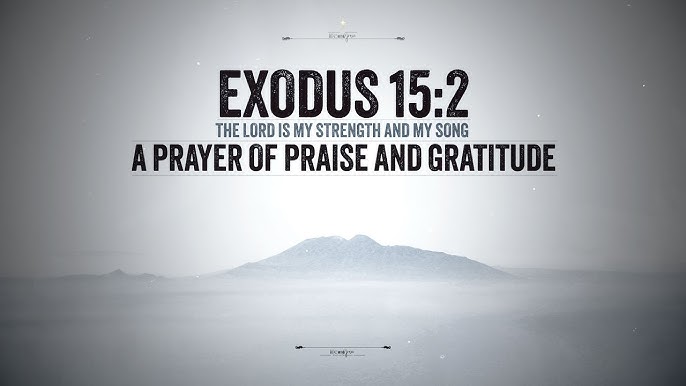
Feeling far Short on Strength and Sufficiency. Nothing but Vapors in our Mind, our Soul and our Spirit. Exodus 15:1-8

Exodus 15:1-8 Complete Jewish Bible

15 Then Moshe and the people of Isra’el sang this song to Adonai:

“I will sing to Adonai, for he is highly exalted:
the horse and its rider he threw in the sea.

Yah is my strength and my song,
and he has become my salvation.
This is my God: I will glorify him;
my father’s God: I will exalt him.
Adonai is a warrior;
Adonai is his name.

Pharaoh’s chariots and his army
he hurled into the sea.
His elite commanders
were drowned in the Sea of Suf.
The deep waters covered them;
they sank to the depths like a stone.

Your right hand, Adonai, is sublimely powerful;
your right hand, Adonai, shatters the foe.
By your great majesty you bring down your enemies;
you send out your wrath to consume them like stubble.

With a blast from your nostrils the waters piled up —
the waters stood up like a wall,
the depths of the sea became firm ground.

Word of God for the Children of God

Glory be to the Father,
and to the Son, and to the Holy Ghost;
as it was in the beginning,
is now, and ever shall be,
world without end. Amen, amen.

Exodus 15, often called the Song of Moses, teaches us to praise God for His mighty deliverance and power, as well as the importance of trusting Him even in the midst of life’s challenges, celebrating God’s protection and provision

Exodus 15:2 encapsulates the essence of a profound spiritual declaration, one that has guided and uplifted countless souls across millennia.

It is an ancient verse that serves as a reminder of God’s enduring presence in our lives, offering strength, joy, and salvation.

What is the message of Exodus 15-2?

It is an encouraging statement of how we can rely on God’s strength, which is so much greater than our own. It is an eternal reminder that God is our mighty salvation from ALL our problems… big and small. But looking closely, this verse is framed with the rightful context for our lives that can be easy to forget.

What does “song” mean in Exodus 15-2?

The song of Moses that we have in Exodus 15 is characterized by praise and celebration for God’s delivery of His people from the army of Pharaoh which God caused to be swallowed up in the Red Sea.

What are two key lessons from Exodus?

Exodus shows how God kept Pharaoh from continuing to oppress the Israelites and from destroying them.

The book also shows how God moved the people of Israel into the wilderness to begin the ages long process of developing them into the nation he wanted them to become. This is a good reminder that after deliverance comes development.

Here’s a deeper look at the lessons Exodus 15 imparts:

  • Praise and Worship: The chapter is a powerful song of praise, highlighting God’s triumph and victory. The Israelites, after being rescued from the Red Sea, express their joy and gratitude for God’s intervention. 
  • God’s Power and Glory: Exodus 15 portrays God as a mighty warrior, demonstrating His ability to overcome enemies and provide salvation. The song emphasizes God’s holiness, awfulness, and miraculous power. 
  • Trust in God: The Israelites’ experience in the Red Sea serves as a reminder of God’s faithfulness and the importance of trusting in Him, even when faced with difficult situations. 
  • God as a Savior: The song reminds us that God is our strength, song, and salvation, offering comfort and guidance in times of trouble. 
  • God’s Covenant Love: The song highlights God’s love and commitment to his people, a promise of protection and guidance as they journey towards their destiny. 
  • Lessons for Today: Exodus 15 encourages us to continually, constantly sing praises to God, trust in His strength, and find solace in His presence, reminding all of us to approach life’s challenges with a heart full of gratitude and faith. 

How can I apply the many profound lessons from Exodus into my life today?

Some, but immeasurably far from all, inspiring, profound lessons from Exodus.

  • Freedom is a divine right: The story of Exodus is about the Israelites’ escape from slavery in Egypt. 
  • God can use broken people: God can use people who have done bad things. 
  • God cares about justice and mercy: God provides rules and structure so we can succeed as His people. 
  • God’s mighty acts show He is the one true God: God’s mighty acts show He is the Lord of all Creation. 

How to apply Exodus to our 21st century Christian life; 

  • Be willing to experience the Exodus in your own life.
  • Let God take you from captivity to freedom.
  • Hold onto your faith and have courage as you wait on deliverance.
  • Celebrate as you wait, knowing that your deliverance will lead you to a greater place, role, or position.
  • Trust in God through it all.
  • Remain as a foreigner because He’s with you.
  • His promises are true.
  • His mercies are new every morning
  • Great is His Faithfulness.

Here’s an even deeper dive into the devotional message of Exodus 15:2:

  • God as Strength and Song: The verse declares God as the source of strength and joy (“my strength and my song”). In times of difficulty, we can find solace and power in knowing God is our source of strength. 
  • Salvation: The Israelites, having just experienced a miraculous deliverance from Pharaoh, understand God as their savior. This verse reminds us of God’s transformative presence in our lives, emphasizing that we are saved by Him. 
  • Personal Testimonial: This isn’t just a general statement, but a personal declaration: “This is my God, and I will praise Him”. It’s an affirmation of faith and a recognition of God’s personal involvement in our lives. 
  • Praise and Exaltation: The verse encourages praise and exaltation of God, recognizing Him as the God of our fathers and forefathers. This demonstrates the legacy of faith and the importance of honoring God. 
  • Trust in God’s Power: The Israelites had seen God’s power displayed in the Red Sea miracle, and they understood God as their strength and their defense. We should remember that God is our strength and our defense in every part of our lives, even in difficult times. 
  • God is our Refuge: Exodus 15:2 reminds us to remember that God is our refuge in times of trouble, just as He was for the Israelites. We can trust that God will guide us through every storm and difficulty, and that his love and grace are always with us. 
  • Apply it to our lives: This verse is a covenant call to action, urging us to declare God is our God and to proclaim His name, recognizing Him as our only refuge and our only sure deliverer, and to place our trust in His power and guidance. 

The power of God is always accessible to us, and it is always sufficient for all his purposes for our life—including every single detail.

Every single thing you’re working on and towards for his glory right now.

And when we finally know this, when we truly understand that the Lord will strengthen us sufficiently to help us climb the mountain of life and trudge through each bump and valley—we find great gratitude for this gift.

And as we continue to recognize and praise him for the life-giving gift of strength he keeps pouring out, we begin to swell with increased touches of joy.

A joy of the Lord radiating in us and around us, additional stores of his strength.

Keeping us truly sturdy, steadily moving forward, with him right by our side.  

In the name of God, the father and God the Son and God, the Holy Spirit,

Praying …

Psalm 46

To the chief Musician for the sons of Korah, A Song upon Alamoth.

God is our refuge and strength,
a very present help in trouble.
Therefore will not we fear, though the earth be removed,
and though the mountains be carried into the midst of the sea;
though the waters thereof roar and be troubled,
though the mountains shake with the swelling thereof. Selah.
There is a river, the streams whereof shall make glad the city of God,
the holy place of the tabernacles of the most High.
God is in the midst of her; she shall not be moved:
God shall help her, and that right early.
The heathen raged, the kingdoms were moved:
he uttered his voice, the earth melted.
The Lord of hosts is with us;
the God of Jacob is our refuge. Selah.
Come, behold the works of the Lord,
what desolations he hath made in the earth.
He maketh wars to cease unto the end of the earth;
he breaketh the bow, and cutteth the spear in sunder;
he burneth the chariot in the fire.

10 Be still, and know that I am God:
I will be exalted among the heathen,
I will be exalted in the earth.
11 The Lord of hosts is with us;
the God of Jacob is our refuge. Selah.

Glory be to the Father,
and to the Son, and to the Holy Ghost;
as it was in the beginning,
is now, and ever shall be,
world without end. Amen, amen.
https://translate.google.com/

His Hardest Covenant: to Remember that Sabbath (seventh) day to keep it holy and set apart, dedicated to God. Exodus 20:8-11

Exodus 20:8-11 Amplified Bible

“Remember the Sabbath (seventh) day to keep it holy (set apart, dedicated to God). Six days you shall labor and do all your work, 10 but the seventh day is a Sabbath [a day of rest dedicated] to the Lord your God; on that day you shall not do any work, you or your son, or your daughter, or your male servant, or your female servant, or your livestock or the temporary resident (foreigner) who stays within your [city] gates. 11 For in six days the Lord made the heavens and the earth, the sea and everything that is in them, and He rested (ceased) on the seventh day. That is why the Lord blessed the Sabbath day and made it holy [that is, set it apart for His purposes].

Word of God for the Children of God.

Glory be to the Father,
and to the Son, and to the Holy Ghost;
as it was in the beginning,
is now, and ever shall be,
world without end. Amen, amen.

What does God mean when he says “Remember the Sabbath day to keep it holy”?

The word Sabbath comes from a Hebrew word that means “to rest from labor.”

The word holy means something that is sacred or dedicated to God.

God covenants with us to make His Sabbath day, feel different from all other days of the week by resting from our normal daily routine and dedicating our thoughts and time to Him.

What does Exodus 20 verse 8 mean?

This verse firmly establishes the Sabbath as law, a command to be kept.

Yet, it is very clear that this law has its first roots in Genesis 2:1-3, for there, God set the example in what He did. He rested, and He blessed the seventh day. God could have rested at any time. Or, we might say, He needed no rest, naps, at all.

How do you and I honor the Sabbath and keep it holy?

The Bible requires that we observe the Sabbath day with gathered worship, but that is not all we should do. 

Prayer, solitude, journaling, reading and reflection are all crucial ways that we replenish our inward resting in Christ and his work alone for our salvation.

What does “honor the Sabbath” mean?

How are any of us to honor the Sabbath in our smart phone, internet, social media, satellite, fiber optic, technology driven times – How should any of us keep ourselves from perpetually, ritually, looking down at the phone, risking bodily injury versus establishing, practicing, disciplining ourselves to look up at God the Creator, Author and finisher of our faith?

A few suggestions …

  • Rest: Avoid work and allow the whole family to rest
  • Worship: Attend church, read scripture, pray
  • Enjoy: Delight in God’s gifts and enjoy life with God
  • Set apart: Make a distinction between the Sabbath and the rest of the week
  • Sanctify: Dedicate the Sabbath to the Lord

The first Four Words of the Ten Commandments are calls to worship. 

  • The First Word commands the proper object of worship: “You shall have no other gods before me.”
  • The Second Word commands the proper manner of worship: “You shall not make for yourself a carved image.”
  • The Third Word commands the proper attitude of worship: “You shall not take the name of the Lord your God in vain.”
  • The Fourth Word commands the proper time of worship: “Remember the Sabbath day, to keep it holy” 

We must worship God exclusively, correctly, reverently, and regularly. If you are not careful, life will crowd God out. But redeemed people must never forget to make proper time for the God who created us, sustains us, and redeemed us. Ray Pritchard said: We give 1 day in 7 to God because 7 out of 7 belong to him!!! 

A man was approached by a beggar on the street. The man reached into his pocket to see what he had. Finding seven dollars and feeling sorry for the beggar, he held out six bills and said, “Here you go.”

Not only did the beggar take the six dollars, but with his other hand he struck his benefactor across the face and grabbed the seventh dollar, too. 

As terrible as that story may seem to you, many of us should hear the prophet Nathan saying to us at this point, “You are the man!” God has graciously given us six days. In arrogant ingratitude, we snatch the seventh day, as well!

We must learn to make time for God. If you are too busy to make time for God, you are too busy. Consider the principle, prescription, practice of the Sabbath. 

The Principle of the Sabbath 

  1. The Fourth Word charges us to be faithful stewards of the gift of time.

It teaches three ways to sanctify our time. 

A Call to Worship. Exodus 20:8 commands: “Remember the Sabbath day, to keep it holy.” 

This command to remember the Sabbath indicates Israel already knew about it.

After God delivered Israel from Egypt, God provided manna for them to eat.

When the Israelites woke up each morning, manna was on the ground.

The Israelites collected manna to feed their household for the day.

On the sixth day, the Israelites were to collect twice as much, because God provided no manna on the seventh day. 

Exodus 16:23 says, “This is what the Lord has commanded: ‘Tomorrow is a day of solemn rest, a holy Sabbath to the Lord.’” 

Now God commands Israel: “Remember the Sabbath day, to keep it holy.”

The word “holy” means to set apart for the purposes of God.

In scripture, certain people, places, and things are called holy.

The Fourth Commandment teaches certain times are also holy.

The Sabbath was to be remembered so keep it holy. 

  • It is a call to worship.
  • It is a call to seta side time for God.
  • It is a call to schedule time for God’s sake.

Matthew Henry wrote, “The Sabbath was made a day of holy rest so that it might be a day of holy work.”

God works. The devil is busy. But the devil cannot out-busy God. 

  • God never takes a break.
  • God never calls in sick.
  • God never takes a vacation.
  • God is always at work.
  • God works the night shift.
  • God finishes the work he begins.

God is both a white-collar executive and a blue-collar laborer.

God speaks and it comes to pass.

God moves and things happen. Our God works. And God commands us to work. To be godly is to work. Arthur W. Pink wrote, “He who never works is unfit for worship. Work is to pave the way for worship, as worship is to fit us for work.”  

Exodus 20:9-10 “Six days you shall labor, and do all your work, but the seventh day is a Sabbath to the Lord your God. On it you shall not do any work.” 

This commandment is not restrictive.

In sovereign authority, infinite wisdom, and unchanging goodness, our heavenly Father commands us to rest.

It is a personal call to rest.

God knows you cannot make it without rest, refreshment, and rejuvenation.

So he gave us this human maintenance schedule. 

  • God calls those who will not work lazy. 
  • God calls those who will not rest disobedient. 

It is a communal call to rest.

Verse 10 says: “On it you shall not do any work, you, or your son, or your daughter, your male servant, or your female servant, or your livestock, or the sojourner who is within your gates.” 

There are seven categories listed here.

This all-inclusive call to rest affirms equality and justice for all, the precious nature of creation, and the dignity of people from foreign lands. 

Our family, coworkers, and possessions belong to God.

Every person is a person of value created in the image of God.

The Lord affirmed this by calling the entire community – including cattle – to rest on the Sabbath. 

It is a spiritual call to rest. 

Exodus 20:11 explains: “For in six days the Lord made heaven and earth, the sea, and all that is in them, and rested on the seventh day. Therefore the Lord blessed the Sabbath and made it holy.” 

God created the world in six days and rested on the seventh day.

God did not rest because he was tired. 

Isaiah 40:28 says, “He does not fair or grow weary.” 

God rested to set a pattern for us to follow.

The Lord blessed and sanctified the seventh day to remind us he alone is our  Creator, Sustainer, and Redeemer.

Our lives do not depend on our work.

It depends on God’s work. 

In the name of God, the Father and God the Son and God the Holy Spirit,

Pray …

Psalm 29 Amplified Bible

The Voice of the Lord in the Storm.

A Psalm of David.

29 [a]Ascribe to the Lord, O [b]sons of the mighty,
Ascribe to the Lord glory and strength.

Ascribe to the Lord the glory due His name;
Worship the Lord in the beauty and majesty of His holiness [as the creator and source of holiness].


The voice of the Lord is upon the waters;
The God of glory thunders;
The Lord is over many waters.

The voice of the Lord is powerful;
The voice of the Lord is full of majesty.

The voice of the Lord breaks the cedars;
Yes, the Lord breaks in pieces the cedars of Lebanon.

He makes Lebanon skip like a calf,
And Sirion (Mount Hermon) like a young, wild ox.

The voice of the Lord rakes flames of fire (lightning).

The voice of the Lord shakes the wilderness;
The Lord shakes the wilderness of Kadesh.

The voice of the Lord [c]makes the doe labor and give birth
And strips the forests bare;
And in His temple all are saying, “Glory!”

10 
The Lord sat as King at the flood;
Yes, the Lord sits as King forever.
11 
The Lord will give [unyielding and impenetrable] strength to His people;
The Lord will bless His people with peace.

Glory be to the Father,
and to the Son, and to the Holy Ghost;
as it was in the beginning,
is now, and ever shall be,
world without end. Amen, amen.

https://translate.google.com/

What Lessons Can We All Still Learn from the Israelites’ Wandering Years Exodus 17:15-16? 

Exodus 17:15-16 Christian Standard Bible

15 And Moses built an altar and named it, “The Lord Is My Banner.”[a] 16 He said, “Indeed, my hand is lifted up toward[b] the Lord’s throne. The Lord will be at war with Amalek from generation to generation.”

The Word of God for the Children of God.

Glory be to the Father,
and to the Son, and to the Holy Ghost;
as it was in the beginning,
is now, and ever shall be,
world without end. Amen, amen.

In the book of Exodus, we read the story of how God’s people had endured years of bondage under the Egyptians.

They were enslaved, oppressed, abused, mistreated people.

They needed rescue, they needed a way of escape, needed freedom. God saw their need, didn’t miss a thing, in his perfect timing, he acted on their behalf.

The people of Israel spent 40 years in the desert. 40 years of wandering. 40 years of journeying towards the Promised Land that God had given them.

That’s a very long time.

The days must have been intense, hot, dry, I’m sure they got weary.

But God met them where they were, he made sure they had what they needed.

They learned through every hard, grueling step, how much they relied on Him.

It is not so much faith that is important, but the One in Whom you place your trust. Some people trusted in chariots and some in world leaders.

Some trust in themselves, their finances, their family ties, or their talents.

Some trust in their physical strength, in their intelligence education, their personality, their artistic abilities, or performing lots of good works.. but what is most important is trusting Jehovah-Nissi, (the Lord our banner) for He has promised to fight for us, when our enemies come at us like a raging angry flood.

What is necessary for life and living, for death and dying, is our hope in God.

The strength that is needed for today and the blessed hope we have in the world to come, is a heart that trusts in Jesus Christ, and wholly relies on His sufficient grace and mighty strength to get them through all of their weakest moments.

Every person we know and each security in which we place our trust, will one day let us down – including reliance on our own strength and abilities.

What is needed is a willingness to admit our fullest need and have a dependent trust on God to timely supply all we will need according to His riches in glory.

In Exodus, the Lord revealed Himself to Israel as Jehovah-Nissi, (the Lord our banner). The people of God had just escaped from Egypt. They were no fighting army. They had no experience of defeating a fierce enemy.

But they had been brought out of slavery by God, Who provided food for their bodies and led them in the wilderness by pillars of fire and smoke.

The menacing army they faced carried a victorious standard at the head of their battalions of fierce, well trained fighting men, which was meant to intimidate their opponents, instill fear in their ranks, fear and second thoughts in leaders.

It was as they journeyed through the wilderness that the Amalekites came up and fought against Israel at Rephidim, and Moses said to Joshua, “Choose men for us and go out, fight against Amalek, and tomorrow I will station myself on the top of the hill with the staff of God in my hand.”

Trust in God to deliver you, was Moses’ crystal clear instruction. 

While Moses held up the Staff of God, Israel prevailed, but whenever he put his hand down, Amalek prevailed, Aaron and Hur held up the tired arms of Moses until the Amalek’s army was defeated.

On that day, God revealed Himself as Jehovah-Nissi, (the Lord our banner), “and Moses built an altar and named it The LORD is My Banner.”

As Israel’s armies fought Amalek on the field of conflict in the physical realm.. so Moses battled the adversary in a parallel sphere, through spiritual warfare.

As the Israelites fought their physical enemy with sword and spear, so Moses battled a spiritual enemy in the heavenly realm – through prayer and through intercession. Moses defied the satanic realm as he held up the Standard of God.

What faith was demonstrated by Moses, Aaron, Hur, Joshua, and the entire army of God. They trusted Him to fight for them, and He did not disappoint.

As Israel raised weapons of war against their bitter foe, so Moses lifted high the Rod of the LORD against the principalities and powers in heavenly places. 

The earthly foe could only be overcome in the spiritual realm. Victory or defeat of Joshua’s army would be determined by the effective prayer of Israel’s faithful watchman.. for the effective prayer of a righteous man can accomplish much – the effective prayer of a REDEEMED man.

Just as soldiers raise their battle standards high, proclaiming allegiance to king and country, so Moses lifted up his Banner to the Lord.

Moses raised up the Rod of God to proclaim Whose they were, Who was their true Champion, and in Whom they trusted.

The Lord God was their Defense and Defender, and so they fought under the authority, direction, and power of God, Who from that day on, became to Israel, “Jehovah-Nissi: The Lord Is My Banner.”

The arms of Moses grew weary and the legs of this prayer-warrior weakened as he travailed in intercession for those in his care.

Spiritual warfare is intense, and the arm of flesh fails when we face the enemy’s onslaught in our own strength.

But Aaron and Hur joined forces with Moses as together they raised high the standard of God, and the outnumbered armies of Israel continued to battle the Amalekites with swords and spears.

The long fatigued arms of an 80+ year old Moses were held aloft until sunset, against spiritual wickedness in high places, for only as he interceded for Israel was Joshua’s victory secure.

It was as Moses prayed for the people of Israel that the enemy was overcome.

Although he grew weary and rested his exhausted body on a stone, Moses kept the Rod of the Lord high, lifted up in prayer, so that we finally read, “Joshua overcame the Amalekite army with the sword.”

We too fight under the same standard, for Christ is our Banner.

Jesus is our Jehovah-Nissi. His is the Standard under which we stand and the Commander Whom we obey.

We too lift high the name of Jesus, for He is our Rod and our Staff.

We too rest our weary soul in Him, for His is the Rock of our salvation, and He is our Strong Tower to Whom we flee for safety.

The Lord is our Banner – the Lord is MY Banner.

Like the armies of Israel under the leadership of Joshua, we are not to rely on our own strength, for Christ’s strength is sufficient for all the difficulties and dangers we may face.

He is the One upon Whom we are to cast our heavy burdens and rest our weary souls for Jesus won every spiritual battle we will face, when He proclaimed from the Cross, “It is finished.”

5 Things We Can Learn from the Israelites’ Wandering Years in the Desert:

1. The way to our promised land is not always easy, in fact, it rarely is. But it’s worth it.

God had promised his people a land that would be full of blessing. But the way there would stretch their faith and lead them through journeys where they’d have to depend on God like nothing before.

Maybe you feel like the blessing is too long in coming, maybe you feel like giving up. Be assured again today that God is faithful and he will use all things to strengthen our faith and bring goodness to his people.

Stay strong, keep pressing through.

2. God will make a way where there doesn’t seem to be a way.

As the Israelites got closer that sea must have looked bigger and deeper.

Their eyes focused on the problem.

They forgot about the bigness of their God. But God didn’t forget about them.

Even if the way He’s leading doesn’t seem to make much sense and His timing seems off, or the wait feels long, and wandering in desert places is the last thing we want to do, we can trust Him.

Always. He knows our way. He sees the big picture. He has good in store.

3. God will lead us day and night.

“By day the Lord went ahead of them in a pillar of cloud to guide them on their way and by night in a pillar of fire to given them light…” Exodus 13:21

God never left his people alone in their journey. His presence was always there, a reminder to them that they hadn’t been left on their own in the wilderness.

God will not leave us to fend for ourselves, struggling to find our way.

He will lead us.

He promises to be faithful. We may not see him in a pillar of cloud or fire these days, but we have his Word, and the Holy Spirit to give guidance to our days.

4. God fights on behalf of his people

“Then the angel of God…withdrew and went behind them. The pillar of cloud also moved from in front and stood behind them…” Exodus 14:19

He gives us victory and power even when it doesn’t make sense. After a battle against the fierce Amalekites, when God gave his people a great victory, the Bible says, “Moses built an altar and called it The Lord is my Banner. He said, ‘For hands were lifted up to the throne of the Lord…” Exodus 17:15-16

We’re never left to wrestle through on our own in hard places. He doesn’t send us out to fight the enemy in our own strength. He just tells us to be still, to stand strong, and to know he’s fighting on our behalf.

5. God provides in miraculous ways

“Then the Lord said to Moses, ‘I will rain down bread from heaven for you…” Exodus 16:4

They were hungry. God sent manna. They were thirsty. God sent water gushing from a rock. Every day a miracle was right before their eyes. They just had to pick up the manna, drink the water, accept the blessing.

And just like the people of Israel had to look to God to meet their needs, so it is with us.

They couldn’t store it up, they had to look for it daily. And God always provided.

Sometimes we miss the miracles of his provision, out of busyness or stress. We try to get things going too fast all on our own, spinning around, trying to get it all done. Or other times we might start to forget what matters most.

But even for those days, there’s His grace. He waits for us. His provision and blessing, they never run dry. Every day, his miracles lie right before our eyes. We just have to choose to look for them and stay extra close in his presence.

In the name of God, the Father and God the Son and God the Hoy Spirit,

Let us Pray,

All glory, honor, praise and Thanks be unto You, Jehovah Nissi, for the spiritual lessons I can learn from faithful saints like Moses and Joshua, Aaron and Hur. May I recognize that in everything, Jesus is all I need, and that under Your banner I can face the future in full assurance and peace. I pray that my prayers and intercessions will be underpinned by Jesus, the Rock of my Salvation, the Hope of the whole earth and the Standard with Whom I am identified. With every passing day, I pray that I may trust in Him, stand against the enemy in prayer and intercession, and be upheld in truth,  through Jesus Christ, my God and Savior, in Whose name I pray, AMEN.

Psalm 20 Christian Standard Bible

Psalm 20

Deliverance in Battle

For the choir director. A psalm of David.

May the Lord answer you in a day of trouble;
may the name of Jacob’s God protect you.
May he send you help from the sanctuary
and sustain you from Zion.
May he remember all your offerings
and accept your burnt offering. Selah

May he give you what your heart desires
and fulfill your whole purpose.
Let us shout for joy at your victory
and lift the banner in the name of our God.
May the Lord fulfill all your requests.

Now I know that the Lord gives victory to his anointed;
he will answer him from his holy heaven
with mighty victories from his right hand.
Some take pride in chariots, and others in horses,
but we take pride in the name of the Lord our God.
They collapse and fall,
but we rise and stand firm.
Lord, give victory to the king!
May he[a] answer us on the day that we call.

Glory be to the Father,
and to the Son, and to the Holy Ghost;
as it was in the beginning,
is now, and ever shall be,
world without end. Amen, amen.

https://translate.google.com/

God’s Answers for Life’s Challenges: Moses and Overcoming Inadequacy. Exodus 4:1-13

Exodus 4:1-13 New American Standard Bible 1995

Moses Given Powers

Then Moses said, “What if they will not believe me or listen [a]to what I say? For they may say, ‘The Lord has not appeared to you.’” The Lord said to him, “What is that in your hand?” And he said, “A staff.” Then He said, “Throw it on the ground.” So he threw it on the ground, and it became a serpent; and Moses fled from it. But the Lord said to Moses, “Stretch out your hand and grasp it by its tail”—so he stretched out his hand and caught it, and it became a staff in his [b]hand— “that  they may believe that the Lord, the God of their fathers, the God of Abraham, the God of Isaac, and the God of Jacob, has appeared to you.”

The Lord furthermore said to him, “Now put your hand into your bosom.” So he put his hand into his bosom, and when he took it out, behold, his hand was leprous like snow. Then He said, “Put your hand into your bosom again.” So he put his hand into his bosom again, and when he took it out of his bosom, behold, it was restored like the rest of his flesh. “If they will not believe you or [c]heed the [d]witness of the first sign, they may believe the [e]witness of the last sign. But if they will not believe even these two signs or heed what you say, then you shall take some water from the Nile and pour it on the dry ground; and the water which you take from the Nile will become blood on the dry ground.”

10 Then Moses said to the Lord, “Please, Lord, I have never been [f]eloquent, neither  [g]recently nor in time past, nor since You have spoken to Your servant; for I am [h] slow of speech and [i]slow of tongue.” 11 The Lord said to him, “Who has made man’s mouth? Or who makes him mute or deaf, or seeing or blind? Is it not I, the Lord? 12 Now then go, and I, even I, will be with your mouth, and teach you what you are to say.” 13 But he said, “Please, Lord, now [j]send the message by whomever You will.”

Glory be to the Father,
and to the Son, and to the Holy Ghost;
as it was in the beginning,
is now, and ever shall be,
world without end. Amen, amen.

Moses was from the Levitical line from Jacob, and was called to be God’s great prophet to Israel.

Set afloat upon the Nile River by his mother to protect him from Pharaoh’s wrath and lethal edict against the lives of the Hebrew children, he was found by the daughters of that Pharaoh and he was raised to be a Prince in their courts.

Driven out of Egypt by a murder charge, walked through the wilderness to the land of Median where he was the one who would lead the children of Israel out of Egypt, and became the nation’s renowned Lawgiver, at eighty years of age!

Kept by God in social isolation for half his life, he was in the despised vocation of sheep-herder, lived in the parched, arid wilderness, where his self-will was allowed to rest for 40 years, raise a family but still suffer as a broken criminal.

It was here that one day the fiery flame of the Lord met with him at the burning bush and Moses found himself being summoned by the God of His fore fathers, called out of comfort by his name to save God’s people from slavery in Egypt.

Before his intense training program, Moses thought He could do all things through his own strength.

But it was not until his will was built up in Egypt, torn down and crushed by the Lord in his own exile, his wilderness walk, that Moses had his earth-shattering encounter with God alone on Mount Sinai, Who announced, “I AM Who I AM.”

Moses… the former prideful prince of Egypt, became the most humble of men, due to his encounter with God.

He immediately recoiled from the enormous responsibility God chose to lay upon his shoulders.

How could a man that stuttered so badly and spoke so inarticulately be the chosen mouthpiece for the God of the universe?

How could Moses convey God’s orders to the great king of the earth?

“I am not a man of words,” he pleaded.

“I am not good at public speaking. I do not have a gift of the gab. I am not fluent in language. I find it difficult to get my words out and stumble over my speech – I am not an eloquent orator” – were his excuses.

Moses had not yet proved God’s sufficient grace.

He had yet to discover that His grace is perfected in our weaknesses.

Moses had not yet acknowledged the inexhaustible riches of God’s grace and His unlimited power to work in the lives of His people.

But God not only makes man’s lips and mouths. He makes the deaf to hear, the dumb to speak, and gives sight to the blind.

The Lord is the One Who possesses power over all the senses, attributes of men.

He is the One that created all things, and He is the One Who holds all things together. God is well able to equip His chosen vessel with the qualification and abilities needed to fulfil His heavenly instructions – for His grace, and His grace alone is sufficient, His strength alone which is made perfect in our weakness.

Claiming to have a speech impediment was only one of a number of excuses Moses gave to the Lord.

He was also concerned that Israel would neither believe him nor respect his word, and he begged God to send someone else who was more qualified than he.

He claimed that he would not be able to explain Who the Lord was to the people, and had to be told sternly, “I AM Who I AM.” Moses had to learn that God alone was the only answer to every single question and the provider for all we need.  

Believing in God and Our Overcoming Inadequacy

Exodus 4:10-13 New American Standard Bible 1995

10 Then Moses said to the Lord, “Please, Lord, I have never been [a]eloquent, neither [b]recently nor in time past, nor since You have spoken to Your servant; for I am [c] slow of speech and [d]slow of tongue.” 11 The Lord said to him, “Who has made man’s mouth? Or who makes him mute or deaf, or seeing or blind? Is it not I, the Lord? 12 Now then go, and I, even I, will be with your mouth, and teach you what you are to say.” 13 But he said, “Please, Lord, now [e]send the message by whomever You will.”

Matthew 10:17-20 New American Standard Bible 1995

17 But beware of men, for they will hand you over to the courts and scourge you in their synagogues; 18 and you will even be brought before governors and kings for My sake, as a testimony to them and to the Gentiles. 19 But when they hand you over, do not worry about how or what you are to say; for it will be given you in that hour what you are to say. 20 For it is not you who speak, but it is the Spirit of your Father who speaks in you.

In our life of faith, there are times when God calls us to tasks that can seem beyond our abilities.

Like Moses, we might think we lack the skills or eloquence to do what God has asked.

Severe doubts and insecurities can grip our hearts, causing us to question whether we can truly serve God’s purpose.

When God called Moses to go before Pharaoh and lead the Israelites out of Egypt, Moses hesitated.

He felt that he could not communicate the message well.

He may even have had a speech impediment.

But God said, “Who gave human beings their mouths?”

In other words, God is the one who equips and empowers the ones he calls. So he assured Moses that he would be with him, guiding his words and actions.

Just as God did not overlook Moses’ concerns, he also sees our severest doubts and knows our all too real limitations.

But God chooses us, imperfect as we are, to accomplish his plans.

And it is in our moments of weakness that God’s strength shines through. He deeply delights in using us to accomplish extraordinary feats for his glory.

10 Do you not believe that I am in the Father, and the Father is in Me? The words that I say to you I do not speak on My own initiative, but the Father abiding in Me does His works. 11 Believe Me that I am in the Father and the Father is in Me; otherwise believe because of the works themselves. 12 Truly, truly, I say to you, he who believes in Me, the works that I do, he will do also; and greater works  than these he will do; because I go to the Father. 13 Whatever you ask in My name, that will I do, so that the Father may be glorified in the Son. 14 If you ask Me anything in My name, I will do it.

15 “If you love Me, you will keep My commandments. (John 14:10-15)

When we feel inadequate, remember our sufficiency comes from God alone.

He provides all the necessary resources, wisdom, and strength to carry out his purposes. We can always trust that God will equip us with exactly what we need, when we need, require it and he will never leave us to face our challenges alone.

We show in the words we speak that our hearts are in tune with God.

Jesus tells his disciples to worry not because they “will be given what to say.” (Matthew 10:19)

Sharing Christ is not simply a matter of thinking up the right words to say; we must allow God’s words to flow through us.

The lessons Moses had to learn are as relevant today as the day he was ordered to remove his shoes from on the holy mount of God.

It is never easy when the Lord says GO, for we often want to stay.

Nor is it easy when He instructs us to STAND STILL and wait, for too often we think we want to go.

But when our fleshly self-will has finally been broken by our gracious God and we can then unreservedly whisper, “Thy will, not mine be done,” as did Christ in Gethsemane… then as we open our mouth we will pray and speak the words that He Himself chooses to give us, and we all will finally discover His grace IS sufficient for His strength is made perfect in our weakness. 2 Corinthians 12:9

Concerning this I implored the Lord three times that it might leave me. And He has said to me, “My grace is sufficient for you, for power is perfected in weakness.” Most gladly, therefore, I will rather boast [a]about my weaknesses, so that the power of Christ may dwell in me.

British Theologian and Evangelist F.B. Meyer (1847-1929) summed up the attitude that each of us should have when God places a call on any of our lives,

“Cherish the lowliest thought you choose of yourself, but unite it with the loftiest conception of God’s All-Sufficiency. Self-depreciation may lead to the marring of a useful life. We must think soberly of ourselves, not too lowly… nor too extravagantly. The one talent must not be buried in the earth.”

John 16:32-33 New American Standard Bible 1995

32 Behold, an hour is coming, and has already come, for you to be scattered, each to his own home, and to leave Me alone; and yet I am not alone, because the Father is with Me. 33 These things I have spoken to you, so that in Me you may have peace. In the world you have tribulation, but take courage; I have overcome the world.”

In the name of God, the Father and God the Son and God the Holy Spirit,

Let us Pray,

Psalm 16 New American Standard Bible 1995

The Lord the Psalmist’s Portion in Life and Deliverer in Death.

[a]Mikhtam of David.

16 Preserve me, O God, for I take refuge in You.
2 [b]I said to the Lord, “You are [c]my Lord;
I have no good besides You.”
As for the [d]saints who are in the earth,
[e]They are the majestic ones in whom is all my delight.
The [f]sorrows of those who have [g]bartered for another god will be multiplied;
I shall not pour out their drink offerings of blood,
Nor will I take their names upon my lips.

The Lord is the portion of my inheritance and my cup;
You support my lot.
The lines have fallen to me in pleasant places;
Indeed, my heritage is beautiful to me.

I will bless the Lord who has counseled me;
Indeed, my [h]mind instructs me in the night.
I have set the Lord continually before me;
Because He is at my right hand, I will not be shaken.
Therefore my heart is glad and my glory rejoices;
My flesh also will dwell securely.
10 For You will not abandon my soul to [i]Sheol;
Nor will You [j]allow Your [k]Holy One to [l]undergo decay.
11 You will make known to me the path of life;
In Your presence is fullness of joy;
In Your right hand there are pleasures forever.

Lord God, thank you for choosing us despite our weaknesses. Forgive our array of excuses, strengthen us to step out in faith to serve as you call us to do. In Jesus’ name, Amen.

Glory be to the Father,
and to the Son, and to the Holy Ghost;
as it was in the beginning,
is now, and ever shall be,
world without end. Amen, amen.

https://translate.google.com