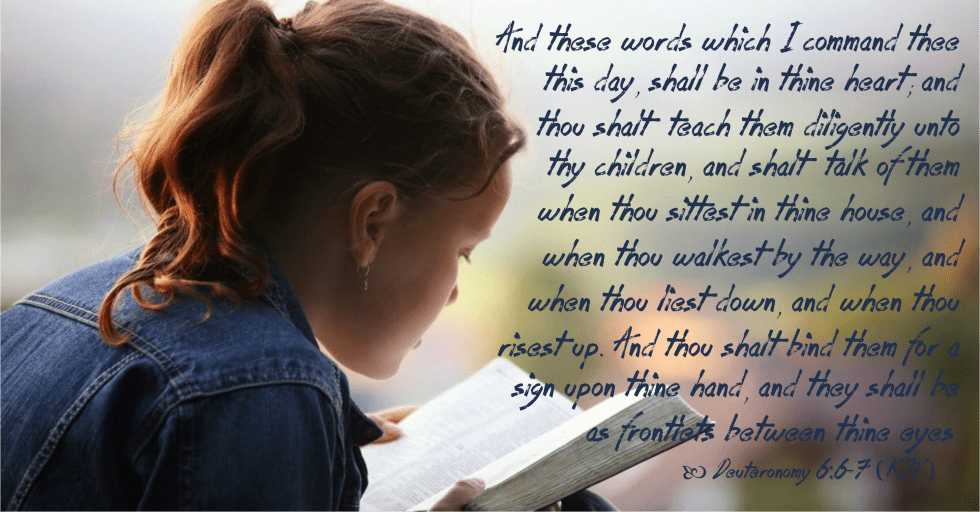
The Compelling Truth: What is the Importance of Family Devotions? Deuteronomy 6:4-9

Deuteronomy 6:4-9 Amplified Bible

“Hear, O Israel! The Lord is our God, the Lord is one [the only God]! You shall love the Lord your God with all your heart and mind and with all your soul and with all your strength [your entire being]. These words, which I am commanding you today, shall be [written] on your heart and mind. You shall teach them diligently to your [a]children [impressing God’s precepts on their minds and penetrating their hearts with His truths] and shall speak of them when you sit in your house and when you walk on the road and when you lie down and when you get up. And you shall bind them as a sign on your hand (forearm), and they shall be used as [b]bands (frontals, frontlets) on your forehead. You shall write them on the [c]doorposts of your house and on your gates.

The Word of God for the Children of God.

Adeste Fidelis! Venite Adoremus! Dominum.

Gloria! In Excelsis Deo! Alleluia, Alleluia, Alleluia! Amen.

Parents, Grandparents and God’s Children of all ages and walks of and among life, what first comes to our mind when we meditate about “family devotions”?

Does it include regular times set apart for your family read Scripture? Prayer? Worship in song? Formal Bible instruction with age-appropriate resources?

Yes, all these things and quite a few things more characterize family devotions.

And all serve to glorify and honor God and too will definitely come to benefit our children and our families as we instruct them in what is most important.

I don’t think there’s a mandate to be found in sacred Scripture that is more solemn than this one. That we are to teach our children the truth of God’s Word is a sacred, holy responsibility that God gives to His people. And it’s not something that is to be done only one day a week in Sunday school. We can’t abdicate the responsibility to the church. The primary responsibility for the education of children according to Scripture is the family, the parents.

(R. C. Sproul, “The Most Solemn Mandate in the Bible for Parents,” ligonier.org)

God instructed the nation of Israel in Deuteronomy 6:6–9,

“And these words that I command you today shall be on your heart. You shall teach them diligently to your children, and shall talk of them when you sit in your house, and when you walk by the way, and when you lie down, and when you rise. You shall bind them as a sign on your hand, and they shall be as frontlets between your eyes. You shall write them on the doorposts of your house and on your gates.”

This ancient passage of text makes it abundantly clear that God’s forever intent is for parents to teach their children and each other about God and His ways.

God’s Word should be at the forefront of our lives and the center of our homes.

Thousands of years later, Apostle Paul echoes the importance of these words.

Ephesians 6:4 says, “Fathers, do not provoke your children to anger, but bring them up in the discipline and instruction of the Lord.” One way we teach our children this truth is by coming together as a family to be in God’s Word and praying together.

The wisest of the wise King Solomon: Proverbs 22:6 gives this wisdom: “Train up a child in the way he should go; even when he is old he will not depart from it.”

As parents who love God and who deeply believe and cherish Him, we want to help our, and future generations of children also come to love and believe Him.

Deliberately, Intentionally, Purposefully, our setting aside time for our family devotions each day will show our children that God is the very center of our lives, and spending time with Him is our priority, and we desire to do His will.

We want to show them that it’s okay, God can be the center of their lives, too.

We also want them to be taught, see how God guides them through life in their community, schools, family, and decisions – so they may teach their children.

To raise them up with critically important biblical values that they may one day, as might be needed, to emphasize these values before school board authorities.

Advocate, Communicate, Educate, the highest values of acceptance and sanctity of all life which God indelibly places upon everyone – without any exceptions.

Living, Loving, Moving, Being enveloped in the Word feeds us with everything we need from advice, to wisdom, to morals and ethics and unto His salvation.

It sets us up with a rock solid, sure and certain and steadfast and immovable foundation, a place for all to turn to in times of trials, tribulations, and praise.

Family devotions are a wonderful time for discussions with your children.

As you and your family read through God’s Word together, you can discuss the ways in which it is inescapably relevant to their lives.

For example, some of your discussions might include the ways in which God’s character applies to our understanding of our morals, attitudes and behaviors.

Be sure to not only discuss troublesome behaviors, but positive ones as well.

Your discussions might also include questions about how and why the world works the way it does.

You might just find yourselves talking about your relationships with others and all the ways in which God’s character and His commands help transform those.

These discussions can help your children see that God’s Word is “living and active” (Hebrews 4:12) and “profitable for teaching, for reproof, for correction, and for training in righteousness, that the man of God may be complete, equipped for every good work” (2 Timothy 3:16b–17).

Family devotions help create a firm foundation for your children’s spiritual growth.

In diligently and prudently practicing the spiritual disciplines of reading and studying God’s Word of fellowship and praying together, you help train your children to incorporate and carry these “God” practices with them through life.

You’re also helping them to learn the immeasurable dimensions, the infinite applications of the truth of God’s Word and to come to know, love, Him better.

When we dive into God’s Word, we are teaching our children that God loves and cares about them and us relentlessly.

When we come together to God to pray, to seek Him, we are showing our children we have access to a God who is holy, loving, able to meet our needs.

Our family devotions will likely challenge our faith and contribute infinitely to our spiritual growth as well.

Family devotions also help us meaningfully connect with our children in the midst of a sometimes hectic world.

Taking time to pause to focus on God together is the sweet intimacy of Christian fellowship.

A family time that is deliberately, intentionally, personally, purposely set apart can also serve as a time to honor God and each other, to relate with one another.

As we share our joys and our concerns, our struggles and trials, prayer requests or discuss how God’s Word applies to our lives, we are sharing God in our lives.

Dedicating this time to focus on your children and on God can help strengthen your relationships with your child.

Family devotions do not have to be elaborate.

You can keep them as simple as reading through a passage that pertains to issues you might be facing in your family, to reading through a certain book of the Bible, or purchasing age-appropriate devotional books.

You can include time for worshiping with music if you desire.

Psalm 139:23-24 Amplified Bible

23 
Search me [thoroughly], O God, and know my heart;
Test me and know my anxious thoughts;
24 
And see if there is any wicked or hurtful way in me,
And lead me in the everlasting way.

There is no set time-length that family devotions have to last, but you can be assured that you will soon find this experience to be a joyful time together.

At the conclusion of your time together, pray for God’s goodness in your family, any requests of friends and family, and for His abundant guidance in your lives.

Psalm 139:1-18 Amplified Bible

God’s Omnipresence and Omniscience.

To the Chief Musician. A Psalm of David.

139 O Lord, you have searched me [thoroughly] and have known me.

You know when I sit down and when I rise up [my entire life, everything I do];
You understand my thought from afar.

You scrutinize my path and my lying down,
And You are intimately acquainted with all my ways.

Even before there is a word on my tongue [still unspoken],
Behold, O Lord, You know it all.

You have enclosed me behind and before,
And [You have] placed Your hand upon me.

Such [infinite] knowledge is too wonderful for me;
It is too high [above me], I cannot reach it.


Where can I go from Your Spirit?
Or where can I flee from Your presence?

If I ascend to heaven, You are there;
If I make my bed in Sheol (the nether world, the place of the dead), behold, You are there.

If I take the wings of the dawn,
If I dwell in the remotest part of the sea,
10 
Even there Your hand will lead me,
And Your right hand will take hold of me.

11 
If I say, “Surely the darkness will cover me,
And the night will be the only light around me,”

12 
Even the darkness is not dark to You and conceals nothing from You,
But the night shines as bright as the day;
Darkness and light are alike to You.

13 
For You formed my innermost parts;
You knit me [together] in my mother’s womb.

14 
I will give thanks and praise to You, for I am fearfully and wonderfully made;
Wonderful are Your works,
And my soul knows it very well.
15 
My frame was not hidden from You,
When I was being formed in secret,
And intricately and skillfully formed [as if embroidered with many colors] in the depths of the earth.

16 
Your eyes have seen my unformed substance;
And in Your book were all written
The days that were appointed for me,
When as yet there was not one of them [even taking shape].

17 
How precious also are Your thoughts to me, O God!
How vast is the sum of them!
18 
If I could count them, they would outnumber the sand.
When I awake, I am still with You.

Remember to always praise God for His answers to your prayers, too.

Create an environment that is calm, loving, and memorable, one that your children will want to foster, nurture, impress, upon the lives of their children.

“But grow in the grace and knowledge of our Lord and Savior Jesus Christ. To him be the glory both now and to the day of eternity. Amen” (2 Peter 3:18).

Family devotions are a crucial means of declaring, living out family priorities.

By turning to God’s Word and prayer together every day (or most days, at least), we model the uncompromising centrality of these practices in our Christian life.

These daily times together will also prove an important means of our building closeness within our family…

Our devotions call us to a family experience each day.

Hebrews 6:19-20 Amplified Bible

19 This hope [this confident assurance] we have as an anchor of the soul [it cannot slip and it cannot break down under whatever pressure bears upon it]—a safe and steadfast hope that enters within the veil [of the heavenly temple, that most Holy Place in which the very presence of God dwells],20 where Jesus has entered [in advance] as a forerunner for us, having become a High Priest forever according to the order of [a]Melchizedek.

Our time away with God, the Father, Son and Holy Spirit and each other gives expression to this “confident assurance” we have all an anchor for our souls.

We each have our own hopes and dreams we desire to see lived in each other.

And while few of them are remarkably miraculous on their own, it is their gradual and steadfast accumulation which will add up to something special.

And then there is the benefit of building a habit that adds structure and stability to the family’s shared life.

As we have emphasized family devotions, we will gradually find out it becomes a kind of disciplined, organizing structure to the God life we all share together…

Through disciplined family devotions we model our own discipline of personal devotions, for the two closely, inextricably, inescapably, resemble one another.

By relating to the Lord as a family, we teach how to relate to him as individuals.

Growing up in a prayer-filled home is a beautiful and powerful thing.

Parents can pray over their children from the moment they are conceived through adulthood.

Children can learn alongside their parents how to pray to the Lord themselves.

Siblings can pray for and with one another as they resolve conflict and build strong relationships.

Extended family can cover loved ones in prayer through both joyful and challenging seasons.

Families can pray together more often than just before dinner, and it can be a life-changing and spiritually transformative experience that not only brings family members closer to God, but blessedly, ultimately closer to one another! 

It is the kind of disciplined habit, perhaps like eating and praying together, and attending church together, that anchors family to the centrality of Jesus Christ.

In the name of God, the Father and God the Son and God the Holy Spirit,

Let us Pray,

“Let the message of Christ dwell among you richly as you teach and admonish one another with all wisdom through psalms, hymns, and songs from the Spirit, singing to God with gratitude in your hearts. And whatever you do, whether in word or deed, do it all in the name of the Lord Jesus, giving thanks to God the Father through him.” Colossians 3:16-17

Lord, I pray that the message of Christ and his sacrifice is the root of gratitude in my and my family’s heart. That His gracious gift leads me and my family into thankful living, setting a timeless example for the rest of my family and their children. That they will have their own truly abiding relationship with Jesus one day, and that You would grow gratitude in their hearts out of the acceptance of Jesus as their Savior. Lead us to do everything in the name of Jesus and give thanks to You through Him.

Adeste Fidelis! Venite Adoremus! Dominum.

Gloria! In Excelsis Deo! Alleluia, Alleluia, Alleluia, Amen.

https://translate.google.com/

Becoming Like Christ: Steps Towards Spiritual Freedom. 2 Corinthians 3:17

2 Corinthians 3:12-18 Amplified Bible

12 Since we have such a [glorious] hope and confident expectation, we speak with great courage, 13 and we are not like Moses, who used to put a veil over his face so that the Israelite’s would not gaze at the end of the glory which was fading away. 14 But [in fact] their minds were hardened [for they had lost the ability to understand]; for until this very day at the reading of the old covenant the same veil remains unlifted, because it is removed [only] in Christ. 15 But to this day whenever Moses is read, a veil [of blindness] lies over their heart; 16 but whenever a person turns [in repentance and faith] to the Lord, the veil is taken away. 17 Now the Lord is the Spirit, and where the Spirit of the Lord is, there is liberty [emancipation from bondage, true freedom]. 18 And we all, with unveiled face, continually seeing as in a mirror the glory of the Lord, are progressively being transformed into His image from [one degree of] glory to [even more] glory, which comes from the Lord, [who is] the Spirit.

The Word of God for the Children of God.

Adeste Fidelis! Venite Adoremus! Dominum.

Gloria! In Excelsis Deo! Alleluia, Alleluia, Alleluia, Amen.

Becoming Like Christ

2 Corinthians 3:15-18 Amplified Bible

15 But to this day whenever Moses is read, a veil [of blindness] lies over their heart;  16 but whenever a person turns [in repentance and faith] to the Lord, the veil is taken away. 17 Now the Lord is the Spirit, and where the Spirit of the Lord is, there is liberty [emancipation from bondage, true freedom]. 18 And we all, with unveiled face,  continually seeing as in a mirror the glory of the Lord, are progressively being transformed into His image from [one degree of] glory to [even more] glory, which comes from the Lord, [who is] the Spirit.

If the Holy Spirit’s work in us is like the work of a master gardener, what is the Spirit growing in us?

The Spirit wants to reproduce Jesus’ character in us.

Our reading from 2 Corinthians today states that we “are being transformed into [Jesus’] image with ever-increasing glory.”

In other words, the Holy Spirit’s aim is to make us more and more like Jesus.

The Holy Spirit’s work is to nudge us, prod us, move us, transform us and shape us to think and act and be more like our Savior Jesus, for us to better mirror Jesus in our character, to increasingly help us love like Jesus in our daily life.

Of course, it’s not an overnight rush job.

The Spirit doesn’t guarantee delivery in full by 8:00 a.m. the next day—or even within a few days, months, years or decades.

This isn’t the work of a courier driver.

This is the work of the Master Gardener, the One with a master’s vision of the finished garden, the One who daily, gradually toils and works in our lives until the desired spiritual fruit eventually sprouts, blossoms, unto the glory of God.

There are times when the Holy Spirit’s work in us will be immediate, dramatic, and maybe even spectacular.

But usually the Spirit’s work in us is slow, subtle and gentle.

That’s the Holy Spirit’s trademark.

We are made in God’s image, in the image of God we are created, (Genesis 1:26-27) but that sacred image became spoiled and polluted in us because of sin.

So now God is slowly remaking that image in us—to be like our Savior Jesus!

Steps Towards Spiritual Freedom

Have we truly noticed that most of our unrest comes from ourselves?

We get stuck ruminating on the things we can’t change or control.

Un-forgiveness stops us from moving toward healing in our relationships.

Pervasive negativity prevents us from enjoying the moment.

Exhaustion keeps us functioning as only a shadow version of ourselves.

Repeated excuses keep us trying the same things over and over again that are no longer capable of working, are burning bridges and stop us from changing.

Fear, guilt and shame stop us cold from accepting God’s free gift of grace. 

Our unhappiness lives in our souls and finding peace starts as a process of Holy Spirit-led self-discovery.

How many of us will spend our lives turning a blind eye to our own hangups?

In our own stubborn blindness, we refuse to consider that maybe the rhythm of frustration we are up against might be something we have the power to change.

It’s so much easier to render our judgments, and then blame our surroundings.

To point out the sliver in our neighbor’s eye, all while avoiding our own planks. (Matthew 7:1-5)

We so often live stuck in a giant sheet of bubble wrap we wrapped around us.

Thank God He is patient with us! 

Thank God that God knows exactly what to do with bubble wrap – POP IT!

How, then, do we allow ourselves to be “popped by God” to get us past our blindness and grab onto the gracious freedom that God promises each of us?

1. Freedom comes when we abandon pride. 

The path towards freedom begins with a surrendering of the pride we each hold that claims we have what we need to fix ourselves all on our own.

This pride tells us to be ashamed, embarrassed, fearful and humiliated when we don’t live up to our own internal standards.

It relies on rules and religion rather than grace and a relationship with Jesus.

Step one towards freedom and making peace with the people God created us to be is to abandon our pride.

The Bible teaches that pride comes before a fall (Proverbs 16:18), and the humble find wisdom (Proverbs 11:2). 

2. God’s wisdom teaches us how to change. 

Wisdom helps us change.

Only through God’s miraculous truth can we see the way past the same thought processes which keep us trapped, wrapped, in our own fears, shame, bitterness. 

James 1:5 prompts us to ask God for wisdom when we don’t have it.

He gives it freely when we have a humble heart.

When we read and study God’s Word, spend time in his church, seek Him and His Kingdom through prayer, we discover what godly wisdom looks like.

Proverbs 1:7 instructs us that wisdom is found in the context of community.

We have to be willing to accept advice and instruction when we are stuck and looking for a new way forward. 

Proverbs 3:7 tells us that wisdom turns away from evil.

If our own set patterns get us stuck in sin over and over, then God’s wisdom, and our Savior’s Cross, His Resurrection power moves us away from that evil temptation that keeps repeatedly keeps maliciously tugging at our souls.  

3. Freedom points us towards others.

Interestingly God gives us the internal power through the Holy Spirit to find spiritual freedom, not so we can just enjoy ourselves better.

Even though a free you is a happier you and is a you that you can be confident in and enjoy.

The purpose of this Christ-purchased freedom is that we can serve others.

Isaiah 61:1 tells us God’s spirit in our lives gives us the ability to bring good news to the poor, assist the brokenhearted, and set free those imprisoned in this world!

We are set free, so we can help others find that same freedom.

When we find ourselves stuck, wrapped in our own frustrations or even upset with others in our lives because their sin nature is making our lives harder, we are invited to draw on God’s spirit to see new ways to love and to serve others.  

4. God’s spirit sets us free. 

2 Corinthians 3:17 says, “Now the Lord is the Spirit, and where the Spirit of the Lord is, there is freedom.”

There is a mysterious element to spiritual freedom.

Freedom is an indescribable moment or journey that can take time where Heaven meets us here on Earth.

Areas I’ve sought freedom in has been anxiety over diabetes management.

For me, this freedom journey has taken years, but God has been my faithful teacher and sustainer through step forward and backward, each up and down.

Other times our freedom is like a dam breaking all at once.

The old life is washed away in an instant, and a new one is ready to begin.

Why does God work one way in my life and a different way in yours?

That is part of the mystery of the Spirit.

God is connectional and relational and not a rule-based God, which is why each of us has a singularly unique and diverse and vastly different spiritual journey.

One thing the Bible does tell us is that if we want to find freedom in our lives, we have to seek His Kingdom through His Holy Spirit.  

Matthew 6:33 Amplified Bible

33 But first and most importantly seek (aim at, strive after) His kingdom and His righteousness [His way of doing and being right—the attitude and character of God], and all these things will be given to you also.

John 8:36 says, “So if the Son sets you free, you will be free indeed.”

Jesus came to Earth, so we could not only escape death and join his family, but so we could experience freedom in our lives here on Earth.

I am so thankful that God has not left me as I was.

He is always renewing my mind and spirit.

May you, by God’s grace, take steps toward spiritual growth and freedom today.

In the name of God, the Father and God the Son and God the Holy Spirit,

Let us Pray,

Jesus, my Savior, I have been listening to too many lies for far too long. I have been tricked one too many times by the enemy and I am frustrated. I need to be free from these lies. Jesus, I know that You are true and that the truth will set me free. Jesus, help me to rejoice in the truth. I need to believe the truth. I pray that it really would set me free. Help me with my unbelief, Jesus. Holy Spirit, You know my heart, and know that I need help believing. Thank You, Jesus, that You offer truth to Your children. Thank You for Your patience with me. In Your glorious name, I pray.

Adeste Fidelis! Venite Adoremus! Dominum.

Gloria! In Excelsis Deo! Alleluia! Alleluia! Alleluia! Amen.

https://translate.google.com/

What Does it Mean to Really Walk with God in Faith? Genesis 5:21-24

Genesis 5:21-24Amplified Bible

21 When Enoch was sixty-five years old, he became the father of Methuselah. 22  Enoch walked [in habitual fellowship] with God three hundred years after the birth of Methuselah and had other sons and daughters. 23 So all the days of Enoch were three hundred and sixty-five years. 24 And [in reverent fear and obedience] Enoch walked with God; and he was not [found among men], because God took him [away to be home with Him].

The Word of God for the Children of God.

Adeste Fidelis! Venite Adoremus! Dominum.

Gloria! In Excelsis Deo! Alleluia! Alleluia! Alleluia! Amen.

Walking with others is often a time of sacred, deeply personal fellowship.

As people traverse a trail or path together, they can talk to one another about their struggles, goals, or worries.

Many people might not even ever think about those steps they take with a friend, but walking with a friend can truly help a relationship grow stronger.

The same is true about our relationship with God.

From the very beginning, He wanted to walk with us, to know us personally, and for us to follow Him all of our days – we were created to walk with God.

When we choose to place our faith in Christ for salvation, we can walk with Him in fellowship.

No longer, do we or must we, live our lives according to the ways of our sinful nature, but we can out the days of our lives by the Spirit.

Biblical Examples of Walking with God

When God created humans, we almost immediately read He walked with them. 

Genesis 3:8 describes how Adam and Eve heard the Lord walking in the Garden, they heard Him walking on leaves and branches which prompted them to hide.

They did not want Him to discover they had sinned.

Adam and Eve recognized the sound of God coming towards them, indicating apparently that He regularly walked on earth with them in Eden before the fall.

However, after Adam and Eve disobeyed the Lord had hid, God could no longer physically dwell with humankind because of the presence sin.

Later, the Bible describes how other people “walked” with God, although He was not physically dwelling with them as He did in Eden.

Enoch loved the Lord and “walked faithfully” with Him (Genesis 5:24). 

Interestingly, Scripture tells us that Enoch did not taste death but was taken up by the Lord (Genesis 5:24 and Hebrews 11:5).

Noah, the great-grandson of Enoch, is also described as someone who walked with the Lord (Genesis 6:9).

His close fellowship with God is significant when we remember that the people during Noah’s time were wicked and did not worship the Lord (Genesis 6:5-7).

When God the Son took on human flesh and came to earth to save humankind from their sins, He dwelled among us (John 1:14).

As part of His ministry, Jesus walked everywhere, traveled by foot constantly.

In fellowship, Christ talked to them and taught them as they walked.

For example, after Jesus was resurrected, He walked with two of the disciples on the road to Emmaus and taught them (Luke 24:13-35).

In the future, when God establishes the New Heaven and New Earth, He will physically live and walk among humans again.

John describes this truth in Revelation 21:3:

“And I heard a loud voice from the throne saying, ‘Look! God’s dwelling place is now among the people, and he will dwell with them. They will be his people, and God himself will be with them and be their God.”

The Lord will dwell with and walk with believers for all eternity.

A Relationship with the Lord

Based on the examples of those who walked with the Lord in the Bible, to walk with God means we have a relationship with Him.

Adam and Eve walked with God physically but also had a close relationship with their Creator.

After the Fall of Man, humans lost the privilege of dwelling physically with God.

Also, sin separated them from the Lord (Isaiah 59:2).

Only those who had faith in the Lord, like Enoch and Noah, were able to have a close relationship with God.

The reason Jesus came to earth was so we could receive forgiveness of sins and eternal life (John 3:16; 2 Corinthians 5:21).

When a person trusts in Christ’s death and resurrection for salvation, they receive an everlasting relationship with Him (John 17:3; 1 Corinthians 15:1-4).

Compared to knowing Jesus, everything else seems like trash (Philippians 3:8).

At salvation, we enter a relationship with the Lord.

However, just as people need to spend time with each other and communicate to build a relationship, we also need to spend time with God and talk to Him.

To “walk” with the Lord involves communicating and listening to Him.

Praying to God is essential, but we must also read and study and pray through His Word, which is the way He speaks to us (Hebrews 4:12).

Furthermore, Christians need to discipline themselves to regularly examine their lives to ensure nothing hinders their walk with God. (Psalm 139:23-24)

Sin interferes with a believer’s relationship with God. 

If we confess our sins, telling God that we know we did wrong, then He is “faithful and just to forgive” (1 John 1:9, NLT).

Thus, we need to examine ourselves regularly and confess our sins to the Lord.

In addition to confessing sins, believers need to be aware of anything that distracts them from walking with Christ.

Some of these distractions include sinful thoughts, behaviors, and doubt (Matthew 6:14-15, 24; James 1:6-7).

However, good things can also distract us, such as focusing too much on a career, a family, a human relationship, a comfortable home, or a hobby.

In these instances, we need to obey the words of Scripture and die to ourselves, so we can learn better follow the Lord and invest in our relationship with Him (Matthew 16:24).

A Way of Life

A Way of Life

In the Bible, to walk with the Lord involves having a relationship with Him, but it also means living a specific way.

To walk with God means we are living in obedience to His standards instead of our own.

Scripture poignantly, succinctly, tells us to “walk humbly with your God,” which means humbly submitting ourselves to His direction (Micah 6:8).

At salvation, we receive the permanent indwelling of the Holy Spirit, who baptizes us (John 14:17; 1 Corinthians 12:13; Titus 3:5).

Holy Spirit enables us to live and walk in the way God desires.

In turn, we must follow the Holy Spirit’s guidance in our own Christian walk (Galatians 5:16).

As Paul emphasizes in his letter to the Galatians, “If we live in the Spirit, let us also walk in the Spirit” (Galatians 5:25, NKJV).

To live in obedience to God, we must have faith.

The Bible tells us that “we walk by faith, not by sight” (2 Corinthians 5:7, ESV).

Often, when we follow the Lord’s leading, we will not know what lies ahead.

For instance, Abraham had to walk by faith when God told him to sacrifice Isaac, his promised son (Genesis 22:1-2; Hebrews 11:17-19).

For clarity, God did not want or command human sacrifice (see Jeremiah 19:5; 32:35).

He wanted to see if Abraham would trust Him (Genesis 22:12).

Likewise, some of the things that the Lord asks us to do might not make sense at the time, but we can trust Him and step out in faith.

Finally, when individuals walk with God, others will take notice.

The fruit of the Spirit and Christlikeness will characterize their life (Galatians 5:22-23; 1 John 2:6).

Those who walk with Jesus will talk about His love and demonstrate that love practically to others.

Instead of seeking their desires or preferences, they will want to obey God’s Word no matter the risk.

This does not mean they are perfect.

All believers will continue to struggle with sin.

However, Christians who are walking (Micah 6:8) with the Lord will enjoy a strong relationship with Him, will seek to live according to His principles, morals and ethics, instead of the sinful standards of the flesh and the world.      

What Does This “Walking With God” Mean for My Life?

Walking with God means having a connectional relationship with Him and living, walking, a certain way that follows His standards based on Scripture.

This is important to all people because humans were created by God to love God and ultimately give all the glory, honor and praise and their thanks to God.

However, our sin separates us from Him.

Believing in Jesus’ death and resurrection is the only way to restore this vital relationship.

Once we trust in Christ (John 14:1-14), we can begin walking (Micah 6:8) with Him.

As part of our walk with the Lord, we need to prioritize our relationship with Him by spending quality time in reading, studying His Word and talking to Him.

Also, we need to examine ourselves regularly to see if any sins or other things in our life are hindering or distracting us from spending time with God (Psalm 51).

Finally, we need to listen to the Holy Spirit’s guidance so that we live and walk in a way that is more consistently pleasing and perpetually honoring the Lord.

“Walking” with our Lord in fellowship and obedience is the best way to live.

More on this tomorrow ….

In the name of God, the Father and God the Son and God the Holy Spirit,

Let us Pray,

Psalm 15 The Message

15 God, who gets invited
    to dinner at your place?
How do we get on your guest list?

“Walk straight,
    act right,
        tell the truth.

3-4 “Don’t hurt your friend,
    don’t blame your neighbor;
        despise the despicable.

“Keep your word even when it costs you,
    make an honest living,
        never take a bribe.

“You’ll never get
blacklisted
if you live like this.”

Adeste Fidelis! Venite Adoremus! Dominum.

Gloria! In Excelsis Deo! Alleluia! Alleluia! Alleluia! Amen.

https://translate.google.com/