In Time’s Like This, Can Anyone Still Find the Place, Time, to Practice Self-Compassion When Facing Setbacks? Psalm 103:8

Psalm 103 Complete Jewish Bible

103 (0) By David:

(1) Bless Adonai, my soul!
Everything in me, bless his holy name!
Bless Adonai, my soul,
and forget none of his benefits!

He forgives all your offenses,
he heals all your diseases,
he redeems your life from the pit,
he surrounds you with grace and compassion,
he contents you with good as long as you live,
so that your youth is renewed like an eagle’s.

Adonai brings vindication and justice
to all who are oppressed.
He made his ways known to Moshe,
his mighty deeds to the people of Isra’el.
Adonai is merciful and compassionate,
slow to anger and rich in grace.
He will not always accuse,
he will not keep his anger forever.
10 He has not treated us as our sins deserve
or paid us back for our offenses,
11 because his mercy toward those who fear him
is as far above earth as heaven.
12 He has removed our sins from us
as far as the east is from the west.

13 Just as a father has compassion on his children,
Adonai has compassion on those who fear him.
14 For he understands how we are made,
he remembers that we are dust.
15 Yes, a human being’s days are like grass,
he sprouts like a flower in the countryside —
16 but when the wind sweeps over, it’s gone;
and its place knows it no more.
17 But the mercy of Adonai on those who fear him
is from eternity past to eternity future,
and his righteousness extends
to his children’s children,
18 provided they keep his covenant
and remember to follow his precepts.

19 Adonai has established his throne in heaven;
his kingly power rules everything.
20 Bless Adonai, you angels of his,
you mighty warriors who obey his word,
who carry out his orders!
21 Bless Adonai, all his troops,
who serve him and do what he wants!
22 Bless Adonai, all his works,
in every place where he rules!
Bless Adonai, my soul!

Word of God for the Children of God

Glory be to the Father,
and to the Son, and to the Holy Ghost;
as it was in the beginning,
is now, and ever shall be,
world without end. Amen, amen.
Most of us are always trying to improve something in our lives: leveling-up our skills at work, education, managing our money better, enhancing relationships with loved ones, and even going to a gym dropping pounds as a new year’s goal.

But in our relentless pursuit of self-improvement, it’s so also too easy to fall into the trap of self-criticism. We push ourselves harder and harder, set higher expectations, our inner voice becomes our harshest judge. Then when we have stumble, we respond with mounting frustration, self-doubt, or even shame.

But what if I told you there’s a better way?

A way that feels lighter, more sustainable, and more empowering—one that fosters growth not through force but through grace?

A way that also will be far more effective in actually achieving those self-improvement goals.

That better way is self-compassion.

Why self-criticism holds us back

Many of us mistakenly believe that being hard on ourselves will motivate us to do better. After all, if we hold ourselves to impossibly high standards, we’ll be forced to rise to the occasion, right?

Unfortunately, and in reality, self-criticism often has just the opposite effect.

Instead of propelling us forward, it drags us down. It erodes our confidence, feeds negative narratives, and traps us in cycles of stress and resistance.

When we constantly criticize ourselves, we create an environment where fear of failure takes center stage.

We focus on the wrong thing! Therefore, growth becomes a stressful process driven by the avoidance of mistakes rather than the pursuit of progress.

This mindset robs us of joy, creativity, and the ability to see opportunities for what they are: lessons, not setbacks.

So, what is self-compassion, anyways?!

Self-compassion is the practice of extending kindness, understanding, and patience to ourselves—especially when we fall short of our own expectations.

I like to think of it as treating ourselves exactly the way we would treat your best friend!

For instance, imagine your best friend coming to you, heartbroken over a mistake or failure.

Would you berate them?

Call them a failure?

Tell them that they’ll never be able to get it right?

Of course not!

You would comfort them, encourage them, and remind them that they are still worthy and capable of growth.

Essentially, you would believe in them and help them to do the same.

So why don’t we do the same for ourselves?

Psalm 13 Complete Jewish Bible

13 (0) For the leader. A psalm of David:

2 (1) How long, Adonai?
Will you forget me forever?
How long will you hide your face from me?
3 (2) How long must I keep asking myself what to do,
with sorrow in my heart every day?
How long must my enemy dominate me?

4 (3) Look, and answer me, Adonai my God!
Give light to my eyes, or I will sleep the sleep of death.
5 (4) Then my enemy would say, “I was able to beat him”;
and my adversaries would rejoice at my downfall.

6 (5) But I trust in your grace,
my heart rejoices as you bring me to safety.
(6) I will sing to Adonai, because he gives me
even more than I need.

“But IF I trust in your grace …”

What is TRUST anyway …?

WILL my heart rejoice as God brings me to safety?”

What is rejoicing anyway …?

What does being brought to safety …?

Will I be “safe” while I am “being brought to safety? …

Psalm 107:23-30 Complete Jewish Bible

23 Those who go down to the sea in ships,
plying their trade on the great ocean,
24 saw the works of Adonai,
his wonders in the deep.

25 For at his word the storm-wind arose,
lifting up towering waves.
26 The sailors were raised up to the sky,
then plunged into the depths.
At the danger, their courage failed them,
27 they reeled and staggered like drunk men,
and all their skill was swallowed up.

28 In their trouble they cried to Adonai,
and he rescued them from their distress.
29 He silenced the storm and stilled its waves,
30 and they rejoiced as the sea grew calm.
Then he brought them safely
to their desired port.

Will I be “safer” when I reach my final, ultimate “safest” haven? …

Can you relate?

Have you ever experienced a setback, which may have been an innocent occurrence, to speak judgment upon your life?

Have you ever felt the crush of discouragement or self-recrimination because of a struggle or obstacle you face?

I don’t know about you, but I can judge myself negatively when such times occur.

I tell myself that if I were a better Christian, pastor, or prayer warrior, none of this would happen to me.

If God helps those who help themselves, but I am in a place where I need help, well, then God’s not with me, right?

And with these thoughts speaking all too loudly, I render swift harsh judgment upon myself. I vigorously condemn myself far worse than God ever does.

Do you believe setbacks in your life testify to a lack of God’s love?

Do you see struggles or frustrations as testimonies to faithlessness – signs that maybe God isn’t as close as you think?

If you have ever judged yourself negatively because of a setback in your life, then let these words wash over you: “The Lord is compassionate and gracious.”

These words describe the Lord’s fundamental character and elucidate the deepest level of God’s identity.

God does not change like shifting shadows; God is not one thing in one moment and another thing in the next. Our God is eternally compassionate and gracious, abounding in love; these attributes are stalwart, trustworthy, and dependable.

The word “compassion” means “to suffer with”; it means to enter the life of another lovingly. In compassion, there is no judgment or retribution.

This means we can be confident in the Lord’s care over us because the Lord of compassion is not the Lord who will hurl lightning bolts of misfortune at us or deem us unlovable for our struggles. The compassionate love of God embraces us, even when we stumble. We all receive grace upon grace in the hands of Jesus.

Jesus, as the incarnation of God, comes to us, not to yell or scream, but to be compassionate, to love us in our weaknesses, to embrace us in all our humanity.

Jesus joins us in our lives, and the cross testifies to his compassion because it is the eternal sign he suffers with and for us.

And so, we can be confident, amid setbacks, that we are not alone.

And so, if Jesus shows compassion for us amid our setbacks and struggles, shouldn’t we be compassionate to ourselves?

What might it look like to refuse setbacks to speak the final word?

Instead of looking at our stumbles or failings, can we set our sights on our desire to journey closer to Jesus?

Faith rarely exists in palaces of ease and problem-free times.

We all face discouragements, But our faith grows when we dare to hold onto the love of Jesus during those moments.

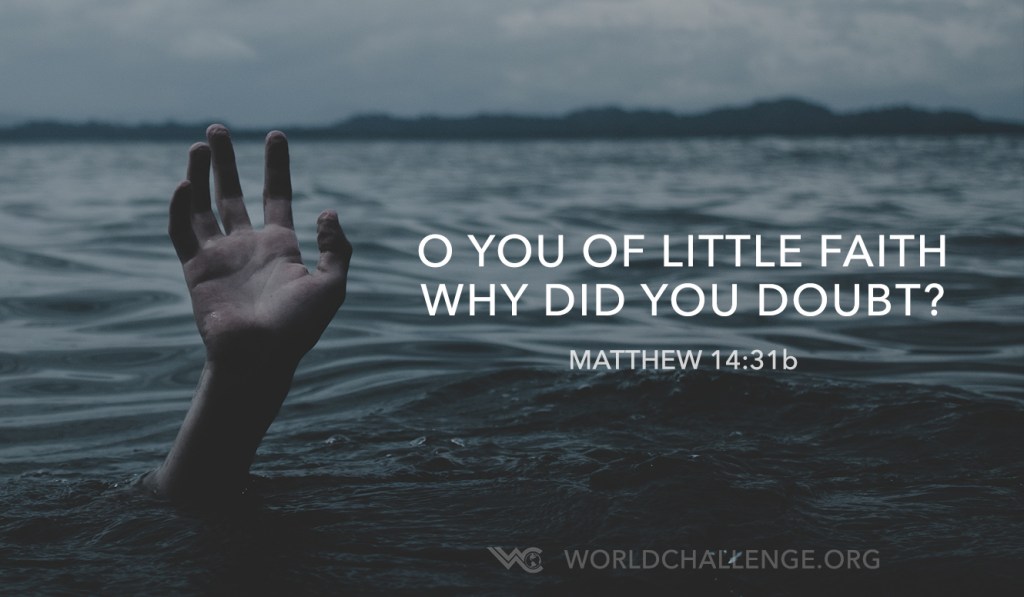
Like Peter sinking in the sea, Jesus doesn’t turn away leave us treading water – he reaches out to us. And if he reaches out to us, we can sigh with ease, knowing that Christ’s loving compassion has the final word, is indeed, the final Word.

Let’s Pray:

Gracious and compassionate Lord, how blessed is your love over my life?

How all-encompassing it is. How transformative! I thank you for your love for me, which frees me from the need to work my way to you. I thank you, and your grace testifies that your presence in my life is a gift to be embraced, not an award that I need to earn. Lord Jesus Christ, when tempted to be self-critical for my failings and setbacks, help me live in light of your incarnation.

Help me remember that as you entered the fullness of human life, so too do you embrace the fullness of my humanity. You are one who sympathizes with all my weaknesses and is available to me in all my struggles. Lord, allow me to extend compassion on myself – a compassion permanently rooted in your loving care.

Please help me to turn away from the voice of self-doubt, self-recrimination, and self-condemnation. And when these voices rise within me, may your words of compassionate grace speak more loudly, truthfully, authentically, into my divided heart. I turn to you and I choose to live as your beloved child. Amen.

Psalm 8 Complete Jewish Bible

(0) For the leader. On the gittit. A psalm of David:

2 (1) Adonai! Our Lord! How glorious
is your name throughout the earth!
The fame of your majesty
spreads even above the heavens!

3 (2) From the mouths of babies and infants at the breast
you established strength because of your foes,
in order that you might silence
the enemy and the avenger.

4 (3) When I look at your heavens, the work of your fingers,
the moon and stars that you set in place —
5 (4) what are mere mortals, that you concern yourself with them;
humans, that you watch over them with such care?

6 (5) You made him but little lower than the angels,
you crowned him with glory and honor,
7 (6) you had him rule what your hands made,
you put everything under his feet —
8 (7) sheep and oxen, all of them,
also the animals in the wilds,
9 (8) the birds in the air, the fish in the sea,
whatever passes through the paths of the seas.

10 (9) Adonai! Our Lord! How glorious
is your name throughout the earth!

Glory be to the Father,
and to the Son, and to the Holy Ghost;
as it was in the beginning,
is now, and ever shall be,
world without end. Amen, amen.

https://translate.google.com/

Bringing Our Small Limitations unto Jesus; ‘But why, you may ask, must I be guided and limited by only what someone else may think or Believes?’ 1 Corinthians 10:26-33

1 Corinthians 10:28-33 Amplified Bible

26 For the [whole] earth is the Lord’s, and everything that is in it. 27 If one of the unbelievers invites you [to a meal at his home] and you want to go, eat whatever is served to you without asking questions [about its source] for the sake of your conscience.28 But if anyone says to you, “This meat has been offered i n sacrifice to an idol,” do not eat it, out of consideration for the one who told you, and for conscience’s sake— 29 and by conscience I mean for the sake of the other man’s, not yours. For [a]why is my freedom [of choice] judged by another’s conscience [another’s ethics—another’s sense of right and wrong]? 30 If I take my share [of food] with thankfulness, why am I accused because of something for which I give thanks?

31 So then, whether you eat or drink or whatever you do, do all to the glory of [our great] God. 32 Do not offend Jews or Greeks or even the church of God [but live to honor Him]; 33 just as I please everyone in all things [as much as possible adapting myself to the interests of others], not seeking my own benefit but that of the many, so that they [will be open to the message of salvation and] may be saved.

Word of God for the Children of God

Glory be to the Father,
and to the Son, and to the Holy Ghost;
as it was in the beginning,
is now, and ever shall be,
world without end. Amen, amen.

If I was limitless, why would I need a relationship with the Creator of all things?

I wouldn’t need strength, I wouldn’t need help, I wouldn’t need a Savior. By the grace of God, our Heavenly Father chose to send His son to bridge the gap.

He sent His son first and foremost to replace our sins, but He also sent Jesus to bless us by meeting us in our weakness.

We see this throughout the Bible. When the people of God look as if they will be consumed, God saves them.

We see this with Noah and the Ark; we also witness this through the prayer of Jehoshaphat in 2 Chronicles 20, and we see it as the walls come tumbling down at the battle of Jericho. Again and again, God proves Himself 100% faithful in our weakness.

When Paul wrote his two letters to the church in Corinth, he admonished and enlightened believers to boast in Christ alone and rejoice in the limits God had put on them, which showed His great power within us.

Read 1 Corinthians 1:26-31 with me,

“For consider your calling, brothers: not many of you were wise according to worldly standards, not many were powerful, not many were of noble birth. But God chose what is foolish in the world to shame the wise; God chose what is weak in the world to shame the strong; God chose what is low and despised in the world, even things that are not, to bring to nothing things that are,  so that no human being might boast in the presence of God. And because of him you are in Christ Jesus, who became wisdom from God, righteousness and sanctification and redemption, so that, as it is written, “Let the one who boasts, boast in the Lord.”

This portion of scripture split me wide open earlier this year. God chose what is low and despised in the world, meaning people and places with limitations, and used them to put His glory on display.

Think about what could shift in your life if you surrendered the areas where you felt weak and rested in Christ for your strength.

So much would change. Both on the inside and the outside.

Your heart would become more dependent on the Lord and more willing to trust that He will give you what you need to make it through the road ahead of you.

When you trust and see God’s faithfulness, an overflow effect happens.

You begin sharing with those around you what He has done; He takes your weakness and strengthens His name.

In the name of God, the Father and God the Son and God the Holy Spirit,

Praying …

Father, thank you for taking the areas of my life where I feel weak and using them to reveal your strength. I’m blessed beyond measure to serve a God who desires to use me for the Kingdom in ways I’d never imagined were possible. Father, if I’m withholding any weaknesses and gripping them with pride to “prove something,” help me release these things to you. As I hand them over, I pray to sense your peace and be washed over with the reminder that your power is perfect in my weakness. You are a good and faithful Father; help me be bold with the gifts you gave me and humble enough to come to you when I need help. In Jesus’ name, amen.

The Thirsting Soul Satisfied in God.
A Psalm of David; when he was in the wilderness of Judah.

63 O God, You are my God; with deepest longing I will seek You;
My [a]soul [my life, my very self] thirsts for You, my flesh longs and sighs for You,
In a dry and weary land where there is no water.

So I have gazed upon You in the sanctuary,
To see Your power and Your glory.

Because Your lovingkindness is better than life,
My lips shall praise You.

So will I bless You as long as I live;
I will lift up my hands in Your name.

My [b]soul [my life, my very self] is satisfied as with marrow and fatness,
And my mouth offers praises [to You] with joyful lips.


When I remember You on my bed,
I meditate and thoughtfully focus on You in the night watches,

For You have been my help,
And in the shadow of Your wings [where I am always protected] I sing for joy.

My [c]soul [my life, my very self] clings to You;
Your right hand upholds me.


But those who seek my life to destroy it
Will [be destroyed and] go into the depths of the earth [into the underworld].
10 
They will be given over to the power of the sword;
They will be a prey for foxes.
11 
But the king will rejoice in God;
Everyone who swears by Him [honoring the true God, acknowledging His authority and majesty] will glory,
For the mouths of those who speak lies will be stopped.

Glory be to the Father,
and to the Son, and to the Holy Ghost;
as it was in the beginning,
is now, and ever shall be,
world without end. Amen, amen.

https://translate.google.com/

Why would I, should I, can I in 2025, believe God Will Make a Way for me Because the bible says He is the Way? John 14:5-7

John 14:5-7 English Standard Version

Thomas said to him, “Lord, we do not know where you are going. How can we know the way?” Jesus said to him, “I am the way, and the truth, and the life. No one comes to the Father except through me. If you had known me, you would have known my Father also.[a] From now on you do know him and have seen him.”

Word of God for the Children of God

Glory be to the Father,
and to the Son, and to the Holy Ghost;
as it was in the beginning,
is now, and ever shall be,
world without end. Amen, amen.

Today it is just a small matter of speaking into our smart phones or if you drive a newer model vehicle with navigation, and saying; “siri, Alexa, google, take me to such a place, and step by step, turn by turn directions will appear and as you are driving, it will speak to you in a male or female voice where, when to turn.

If you miss your turn, GPS might say; “recalculating, recalculating …” and will give you another set of directions and verbally communicate them back to you.

People are always looking for ways to get from point A to point B. With GPS today, many of us can find our way easily around town or on a trip. Most routes are clearly marked, and we just have to hear, listen to and follow the ­directions.

People also search out new ways of doing things. Inno­vators try to find better ways to make things work. Medical researchers seek out ways to cure cancer.

Business owners look for ways to expand and to improve their bottom line.

In today’s Scripture, Jesus talks about being the way—and he is referring to the way to real, everlasting life.

This is the most important thing for all of us to know.

We may reach a destination, find a cure for cancer, and make a business more efficient and profitable.

But if we do not know the way to full life with God, what have we really, truly ­attained?

Finding cures and new ways to improve things in life may be helpful blessings for a while, but they do not solve all of our problems and struggles.

Only God can do that, in ­eternity.

There are always people who claim that there are many ways to God.

But there is really only one way—through Jesus, who himself is God.

He is the one who came from heaven, lived, died for our sake, conquered death for us, and then ascended to rule at the right hand of the Father in heaven.

He is the ONLY way, and he invites us to journey into full life forever with him!

Many days, but not all, I feel, something brewing.

Some fresh glimmers of hope and encouraging change on the horizon.

And following a slow, stretched-out season of what has felt like the same ole, same ole, laced with increased anxiety, chronic pain, dwindling energy, and swelling isolation, and any potential change is absolutely very much welcome.

And I give God all the glory for the potential opportunities, including promising pain relief. But even still, this thick thorn remains in my side.

A raging roadblock in my spirit, weighing me down and instilling doubt.

It’s the narrative in my inner being—words of insufficiency and incompetence and just flat-out inability.

I’ve been relentlessly praying for God to work in and through me—to show me his way. And he has certainly opened some sun-shiny doors.

But if I’m being honest, I can’t see how I can carry out and work through all the things he seems to be calling me to. 

Do you ever wonder how you will conquer the missions and ministry’s before you? How will you take on all of those commitments you’ve committed to?

How will you take the steps toward the dream opportunities stirring up desire within you?

Or wonder how you’ll do it all well?

I do.

I asked myself over and over again, 

Where will I find the time, the energy, and the mental and emotional capacity?” 

I bet you’ve had similar thoughts.

Psalm 139:1-12 English Standard Version

Search Me, O God, and Know My Heart
To the choirmaster. A Psalm of David.

139 O Lord, you have searched me and known me!
You know when I sit down and when I rise up;
    you discern my thoughts from afar.
You search out my path and my lying down
    and are acquainted with all my ways.
Even before a word is on my tongue,
    behold, O Lord, you know it altogether.
You hem me in, behind and before,
    and lay your hand upon me.
Such knowledge is too wonderful for me;
    it is high; I cannot attain it.

Where shall I go from your Spirit?
    Or where shall I flee from your presence?
If I ascend to heaven, you are there!
    If I make my bed in Sheol, you are there!
If I take the wings of the morning
    and dwell in the uttermost parts of the sea,
10 even there your hand shall lead me,
    and your right hand shall hold me.
11 If I say, “Surely the darkness shall cover me,
    and the light about me be night,”
12 even the darkness is not dark to you;
    the night is bright as the day,
    for darkness is as light with you.

But, we are neglecting a truth amidst these circumstances and contemplations.

If God truly leads us to these things, won’t he also lead us through these things?

I read a familiar verse the other morning in my devotion time, and it spoke truth directly to my wondering, wearying heart.

In verse five of Chapter 14, in the book of John, the disciple Thomas says to Jesus, “Lord, we don’t know where you are going, so how can we know the way?”

This is a sentiment many of us feel when we’ve come to a confusing crossroads of potential choices, tasks, or opportunities, joined by what seems to be a lack of ability, margin, and resources.

We might ask God, What is all this, and how am I supposed to handle it?

But as I kept reading, my fresh perspective on the first statement of the following verse—so familiar to us as Christians—fueled my confidence in the answer to the how will I manage” thoughts.

Verse six reads, “Jesus answered, ‘I am the way and the truth and the life.’”

John 14:6 Amplified Bible

Jesus said to him, “[a]I am the [only] Way [to God] and the [real] Truth and the [real] Life; no one comes to the Father but through Me.

Jesus is the only way.

When we don’t know, or can’t see, the way forward and through. 

Jesus is the only way forward and through.

This means that as long as I remain in him and with him, and he is thus also in me and with me, I don’t have to fear my faithful steps and choices.

Because the way will be with me, he will make a way, because he is the way.

And he is in me just like he is in you. 

Intersecting Faith and Life:

The Great Commission

16 Now the eleven disciples went to Galilee, to the mountain which Jesus had designated. 17 And when they saw Him, they worshiped Him; but some doubted [that it was really He]. 18 Jesus came up and said to them, “All authority (all power of absolute rule) in heaven and on earth has been given to Me. 19 Go therefore and make disciples of all the nations [help the people to learn of Me, believe in Me, and obey My words], baptizing them in the name of the Father and of the Son and of the Holy Spirit, 20 teaching them to observe everything that I have commanded you; and lo, I am with you always [remaining with you perpetually—regardless of circumstance, and on every occasion], even to the end of the age.”

Friend, the Lord led you to where you are.

He opened the perfect doors, and he carved the precise path.

So keep following him closely, and remain in him always.

He will sufficiently strengthen, steer, guide and supply you with all you need. All the way. Because our sovereign loving Lord is… remains … the ONLY way.

In the name of God, the Father and God the Son and God the Holy Spirit,

Praying …

16 (0) Mikhtam. By David:

(1) Protect me, God,
for you are my refuge.
I said to Adonai, “You are my Lord;
I have nothing good outside of you.”
The holy people in the land are the ones
who are worthy of honor; all my pleasure is in them.

Those who run after another god
multiply their sorrows;
To such gods I will not offer
drink offerings of blood
or take their names on my lips.

Adonai, my assigned portion, my cup:
you safeguard my share.
Pleasant places were measured out for me;
I am content with my heritage.

I bless Adonai, my counselor;
at night my inmost being instructs me.
I always set Adonai before me;
with him at my right hand, I can never be moved;
so my heart is glad, my glory rejoices,
and my body too rests in safety;
10 for you will not abandon me to Sh’ol,
you will not let your faithful one see the Abyss.
11 You make me know the path of life;
in your presence is unbounded joy,
in your right hand eternal delight.

Glory be to the Father,
and to the Son, and to the Holy Ghost;
as it was in the beginning,
is now, and ever shall be,
world without end. Amen, amen.

https://translate.google.com/

Despite my 999%’Awkward, Chaotic, Life-Defeating Limiting worldview’ I yet choose to Walk, March, Marathon forward, into the Category 5 winds of the Will of God. 2 Corinthians 4:16-18

2 Corinthians 4:16-18 The Message

16-18 So we’re not giving up. How could we! Even though on the outside it often looks like things are falling apart on us, on the inside, where God is making new life, not a day goes by without his unfolding grace. These hard times are small potatoes compared to the coming good times, the lavish celebration prepared for us. There’s far more here than meets the eye. The things we see now are here today, gone tomorrow. But the things we can’t see now will last forever.

Word of God for the Children of God

Glory be to the Father,
and to the Son, and to the Holy Ghost;
as it was in the beginning,
is now, and ever shall be,
world without end. Amen, amen.

https://science.howstuffworks.com/nature/natural-disasters/experience-category-5-hurricane.htm

No Room for Despair

A fundamental lesson for believers is to learn that we need not despair but always be filled with hope.

Even in the extreme cases of addressing the death of loved ones, the apostle says, “Brothers and sisters, we do not want you to be uninformed about those who sleep in death, so that you do not grieve like the rest of mankind, who have no hope” (1 Thessalonians 4:13).

The reasons Paul did “not lose heart” is because he knew certain truths about God and His wonderful work—truths which are also true with us as believers.

Each of us can and should also master this lesson of “no despair.”

No one needs to lose heart.

Yes, each of us at specific points will be tested, tried, perhaps even tempted to give up our hope to live (like Paul 2 Corinthians 6:9), but we need not lose heart.

Losing heart is similar to losing hope.

We no longer possess the spirit to persist, endure and do our best.

“Lose heart” describes a perspective of the world where one no longer sees a way forward that works.

If we look around and live by sight, we can understand how such conclusions are made and accepted, but those that live by faith live in light of eternal truths and need not despair.

In Light of Eternal Truth

There are several steps to resist the loss of hope despite what trials one faces.

The first is to admit to our weaknesses.

Acknowledge Our Weakness

I don’t think we realize the importance of admitting to our weaknesses, but this is exactly where Paul began: “but though our outer man is decaying” (2 Cor 4:16).

The outer man no doubt refers to our physical bodies, though perhaps it also includes other things such as those elements that are linked to our bodies like our minds and emotions.

The secularists only consider the existence of our physical bodies and our life experiences, denying the spiritual world, but this aversion to spiritual matters was not true back then.

In any case, we can fully understand what he means.

One friend just fell and broke her ankle. Others still face seasonable allergies.

Still others, including me, are aging, and our strength, alertness, and memory, year by year deteriorate. Paul used the word decaying, which represents a daily decline and worsening of what otherwise was an excellent working system.

By recognizing our weaknesses, though Paul does not elaborate on this point, we can find the strength that we need.

Before something can be fixed, we need to study what is wrong, perhaps x-ray a broken part. This is the reason doctors take X-rays. I remember looking at my left hip’s X-ray depicting the 7 individual fragments all around the head of my femur. My hip was fixed with a partial prosthetic not a full complete prosthetic .

22 years later for MRIs; Helpful advice necessarily mentions one’s weaknesses.

This is true spiritually too because we need faith to come into God’s presence.

Satan seeks to make us doubt God’s good intention or His control of the world’s affairs so that our prayers—the real change agent—are ineffective.

On the other hand, when we trust God, by fixing our minds on God’s promises, it allows the Spirit to strengthen and nourish our faith and enable our souls to turn on the Light of Christ, entrust our souls to our true Creator (1 Peter 4:19).

By glancing—not staring—at our weaknesses, we can acknowledge them and aggressively seek out our Lord’s strength.

When we hide all our weaknesses, we tend to unwisely support our complaints with doubts and excuses about our passive pursuit of resurrection refreshment.

When this doubt is put aside, however, and we admit our weakness before the throne in faith, then we can sincerely ask Him for help.

Our peace with God (Romans 5:1) brings us to the place of extraordinary faith which in turn leads to awesome fortitude.

Romans 5:1-5 Living Bible

5 So now, since we have been made right in God’s sight by faith in his promises, we can have real peace with him because of what Jesus Christ our Lord has done for us. For because of our faith, he has brought us into this place of highest privilege where we now stand, and we confidently and joyfully look forward to actually becoming all that God has had in mind for us to be.

We can rejoice, too, when we run into problems and trials, for we know that they are good for us—they help us learn to be patient. And patience develops strength of character in us and helps us trust God more each time we use it until finally our hope and faith are strong and steady. Then, when that happens, we are able to hold our heads high no matter what happens and know that all is well, for we know how dearly God loves us, and we feel this warm love everywhere within us because God has given us the Holy Spirit to fill our hearts with his love.

Our Strength

Without understanding how we get our hope and strength, we will be confused at Paul’s statement, “yet our inner man is being renewed day by day” (1 Cor 4:16).

Paul reveals the operation of this renewal process in the previous verses of Romans 5:3-5.

Paul was well-acquainted with his tribulations—a term which includes every affliction common to the human race.

Paul has somehow come to exult “in our tribulations” (Romans 5:3). He continues to express how this works in verses 4-5.

When troubling times come, the great, all-encompassing love of God is poured out through the Holy Spirit. This awesome love provides comfort and strength in our souls so that we persevere in our faith, seeing all sorts of fine fruit.

Paul, like us, did not seek for such trials, but when they come, we, like him, if and as we move forward, will also discover a shower of extra grace from God.

Paul refers to this renewal process when he mentions the inner man.

https://www.blueletterbible.org/esv/2co/4/16/t_conc_1082016

While the ability of our bodies can walk, swim, bike, run, defend, or otherwise help our distressful situations, God brings in His abundance of other resources to outfit our souls—which he refers to here with the term “inner man.”

Ezekiel 34:25-27 New American Standard Bible

25 “And I will make a covenant of peace with them and eliminate harmful animals from the land, so that they may live securely in the wilderness and sleep in the woods. 26 I will make them and the places around My hill a blessing. And I will make showers fall in their season; they will be showers of blessing. 27  Also the tree of the field will yield its fruit and the earth will yield its produce, and they will be secure on their land. Then they will know that I am the Lord, when I have broken the bars of their yoke and have saved them from the hand of those who enslaved them.

Paul did not seek such trials, but when they came (and they did come with a hard vengeance) we, like him, also discover a shower of extra grace from God.

But Paul doesn’t speak about improved circumstances here. There were no improved circumstances that helped his inner spirit.

It was while Paul was in a Philippian jailhouse that he instructed us to “Rejoice in the Lord always” (Phil 4:4).

The joy does not come from expected, unexpectedly good or easy circumstances but from the Lord Jesus Himself even though he is unjustly chained in a jail cell.

Nehemiah 8:10-11 New American Standard Bible

10 Then he said to them, “Go, eat the festival foods, drink the sweet drinks, and send portions to him who has nothing prepared; for this day is holy to our Lord. Do not be grieved, for the joy of the Lord is your [a]refuge.” 11 So the Levites silenced all the people, saying, “Be still, for the day is holy; do not be grieved.”

Faith, trust, hope in the indelible message of truth of God’s Word confers onto Paul a key biblical mindset that allowed him to discern his true circumstances.

One cannot see the spiritual world, at least usually, but it doesn’t matter.

He makes a comparison only possible through a deeper spiritual understanding of reality, including a picture of the spiritual world and all future tomorrows.

For example, Paul could only speak about his trials as “momentary, and light affliction” because he knew his suffering, though difficult, was quickly passing in light of eternity. The truth of the eternal age, adorned by its glory, makes all the events on earth, especially the difficult ones, as of minute consequence.

The little discomfort (though it doesn’t feel that way when enduring it) is seen in the light of the great rewards of the future.

The accompaniment of pain can produce an “eternal weight of glory far beyond comparison” if rightly lived out by faith. No pain, no gain—the old adage goes.

And so, by faith and trust, we see a greater set of truths enclose and swallow up the miseries and injustice experienced on earth.

This biblical perspective demonstrates the dramatic way truth can positively affect our lives. By situating each element side by side, which we experience on earth with the eternal, the suffering becomes incomparable or immeasurable.

In other words, we need not be overly concerned with the enormous pain like childbirth for the following joy will eclipse the momentary pain experienced.

Something Greater Here

In conclusion, I want to identify the greater principle(s) from these verses.

Paul first allows us to be genuinely broken and humbled by our circumstances.

Our true identity doesn’t come from how people mistreat us but by how God will treat us in the future.

Nor is our worth measured by what we have or don’t have here on earth for our circumstances are temporary.

They are momentary when viewed by the greater picture of the eternal world.

Besides, God will greatly reward us in the age to come for properly enduring the brief difficulties we suffered here on earth.

So we can use our sickness, trauma, loss of limb, fraying mind, and dire poverty to do the previously unthinkable, unrecognizable, action to bring glory to God.

They all become special opportunities to give praise to Him.

Let me give an example.

Maybe my arm starts troubling me as I get older.

I do what I can to lessen its pain and to make it better, but it remains troubling.

So for that indefinite time, God gives me the opportunity to especially praise Him by using my weakness as a prop to praise Him. (2 Corinthians 12:9)

If I live in faith, recognizing His great reward (Heb 11:3), then I can bring glory to His name through the use of my arm.

Though I admit my arm hurts, instead of complaining and living focused on its discomfort, I am cheerful and I am as busy as possible serving others.

When I see the Lord, my arm’s pain will become a relic from the distant past, but the Lord knows that I sacrificially used it in pain and faith to comfort or otherwise help other brothers and sisters.

And so the seeming ignoble times become glorifying moments, a time to wrestle our hearts, trust, and minds into a victory of trust in our Lord issuing forth eternal blessings.

I don’t run away, walk away, retreat, forget, minimize the present blessings of comfort and joy within these times of trials, but my focus is on the eternal here.

In a blink of an eye, time will end, God completely erases tears from your lives.

God will give His people their new bodies and kindly reward them (which is also pure grace).

We need to follow up this theological perspective by making life commitments to live by faith, so prepare to embrace any difficulties with the sword faith (Eph 6:17).

Our lives become marked men and women of faith, consciously journeying with the others listed in Hebrews 11, taking each hard moment and translating it into a beautiful, God-glorifying picture further ushering in God’s eternal kingdom and finds eternal remembrance in the rewards you obtain.

Conclusion

No believer’s situation, no matter how difficult or unpleasant, disables the believer from mastering these special opportunities to secure these eternal rewards. Difficult circumstances enable God’s people to gain these rewards at a quicker pace. No one but you and I can exclude ourselves from these rewards.

Jesus in John 15 speaks about bearing fruit.

We don’t live for the fruit, but it remains an important part of the image of every healthy fruit tree.

I know it’s too easy to get down over our circumstances, blame God for our problems, but the truth—heightened affliction increases our opportunities for eternal reward—lives on.

Instead of being glum, we can, like the eagle flying low in the valley, feel the rush of warm air and rise up in faith trusting that, one day, all will be good.

  1. Think of one or two people around you, maybe you, who have lost heart. What characteristics best describe them?
  2. Would you say, “lose heart” is the same as lost hope? Explain.
  3. What is our “outer man” (4:16)?
  4. Describe our “inner man.”
  5. How does one’s inner man become renewed?
  6. Why does our inner man need renewing?
  7. Why does Paul use the word “momentary” in verse 17?
  8. Was the “light affliction” light?
  9. Have you ever been hurt or received unjust treatment? How did you respond? How might your experience, if it was not by faith, differ if you responded in faith, considering it as an opportunity to gain reward?
  10. Give three personal examples to prove that you live for the eternal world which cannot be seen rather than this earthly world.

In the name of God, the Father and God the Son and God the Holy Spirit,

Praying …

The Works and the Word of God.

For the music director. A Psalm of David.

19 The heavens tell of the glory of God;
And their expanse declares the work of His hands.
Day to day pours forth speech,
And night to night reveals knowledge.
There is no speech, nor are there words;
Their voice is not heard.
Their [a]line has gone out into all the earth,
And their words to the end of the world.
In them He has placed a tent for the sun,
Which is like a groom coming out of his chamber;
It rejoices like a strong person to run his course.
Its rising is from [b]one end of the heavens,
And its circuit to the [c]other end of them;
And there is nothing hidden from its heat.

The Law of the Lord is [d]perfect, restoring the soul;
The testimony of the Lord is sure, making wise the simple.
The precepts of the Lord are right, rejoicing the heart;
The commandment of the Lord is pure, enlightening the eyes.
The fear of the Lord is clean, enduring forever;
The judgments of the Lord are true; they are righteous altogether.
10 They are more desirable than gold, yes, than much pure gold;
Sweeter also than honey and drippings of the honeycomb.
11 Moreover, Your servant is warned by them;
In keeping them there is great reward.
12 Who can discern his errors? Acquit me of hidden faults.
13 Also keep Your servant back from presumptuous sins;
Let them not rule over me;
Then I will be innocent,
And I will be blameless of great wrongdoing.
14 May the words of my mouth and the meditation of my heart
Be acceptable in Your sight,
Lord, my rock and my Redeemer.

Glory be to the Father,
and to the Son, and to the Holy Ghost;
as it was in the beginning,
is now, and ever shall be,
world without end. Amen, amen.

https://translate.google.com/

Changed by Resurrection; Behold, I will tell you a mystery: We shall not all sleep, but we shall all be changed. 1 Corinthians 15:50-58

1 Corinthians 15:50-58New King James Version

Our Final Victory

50 Now this I say, brethren, that flesh and blood cannot inherit the kingdom of God; nor does corruption inherit incorruption. 51 Behold, I tell you a [a]mystery: We shall not all sleep, but we shall all be changed— 52 in a moment, in the twinkling of an eye, at the last trumpet. For the trumpet will sound, and the dead will be raised incorruptible, and we shall be changed. 53 For this corruptible must put on incorruption, and this mortal must put on immortality.  54 So when this corruptible has put on incorruption, and this mortal has put on immortality, then shall be brought to pass the saying that is written: “Death is swallowed up in victory.”

55 “O[b] Death, where is your sting?
O Hades, where is your victory?”

56 The sting of death is sin, and the strength of sin is the law. 57 But thanks be to God, who gives us the victory through our Lord Jesus Christ.

58 Therefore, my beloved brethren, be steadfast, immovable, always abounding in the work of the Lord, knowing that your labor is not in vain in the Lord.

Word of God for the Children of God.

Glory be to the Father,
and to the Son, and to the Holy Ghost;
as it was in the beginning,
is now, and ever shall be,
world without end. Amen, amen.

Now, imagine for a moment, if you will, a caterpillar.

This small, fuzzy earthbound creature spends its days crawling on the ground, limited by its physical form. But then, a transformation occurs.

The caterpillar enters a cocoon and emerges as a butterfly, no longer bound to the earth but free to soar in the sky.

This is not just a change; it is a complete transformation, a metamorphosis.

In a similar way, we too, as believers in Christ, will experience a miraculous transformation. But our transformation will not be from a caterpillar to a butterfly. It will be from mortal to immortal, from perishable to imperishable.

Just as Jesus was raised with a body, we too will be raised. We will have new bodies, bodies that are not bound by the limitations of this world, bodies that are free to live in the eternal glory of God’s kingdom.

So, as we embark on this journey today, let us keep this image in our minds.

Let us remember the promise of our future bodily transformation, the promise that just as Jesus was raised with a body, we too will be raised.

Let us hold on to this hope, for it is the hope of our faith, the surest hope of our salvation, and the hope of our eternal life in Christ.

What is the meaning of 1 Corinthians 15 50 58?

1 Corinthians 15:50–58 powerfully concludes Apostle Paul’s teaching on the resurrection of Christians: when the last trumpet blasts and Christ returns for those who belong to Him. In that moment, all believers in Jesus, living and dead, will be transformed into the glorified, eternal bodies God has promised.

What is the lesson of 1 Corinthians 15 51 58?

Main idea: The Resurrection gives followers of Jesus a hope that the world does not have nor can it gift or give. The victory of Jesus means the death of death, and though we can still grieve, we do not grieve as those without hope.

While we are alive, our spirits are united with our bodies.

When we die, our spirits depart, and our lifeless bodies return to the earth. Is that the final destiny for our bodies?

Some religions welcome death as a release from the “prison” of the body.

But, according to the Bible, God made us to have both souls and bodies; moreover, he made our bodies good (Psalm 139:14).

So when the two are separated by death, we cease to be as God made us.

For that reason, we say, with the Apostles’ Creed, “I believe in the resurrection of the body.”

How can that be?

Our bodies are vulnerable and frail.

They break down and eventually just give out.

Yet our bodies remain integral to who we are as God has made us.

Without our bodies, we are no longer fully ourselves.

For all of us who believe in Christ, we can take great comfort that when we die, our souls will immediately be with Jesus.

And when Jesus returns, our bodies and souls will be reunited.

Then we will again be fully ourselves.

On that day, though, our ­bodies will no longer be frail and mortal.

Death will be conquered, and we will have “­glorified” bodies, just like Jesus’ body at his resurrection.

In the name of God, the Father and God the Son and God the Holy Spirit,

Praying …

The Lord’s Glory and Mankind’s Dignity.
For the music director; on the Gittith. A Psalm of David.

Lord, our Lord,
How majestic is Your name in all the earth,
You who have [a]displayed Your splendor above the heavens!
From the mouths of infants and nursing babies You have established [b]strength
Because of Your enemies,
To do away with the enemy and the revengeful.

When I [c]consider Your heavens, the work of Your fingers,
The moon and the stars, which You have set in place;
What is man that You think of him,
And a son of man that You are concerned about him?
Yet You have made him a little lower than [d]God,
And You crown him with glory and majesty!
You have him rule over the works of Your hands;
You have put everything under his feet,
All sheep and oxen,
And also the animals of the field,
The birds of the sky, and the fish of the sea,
Whatever passes through the paths of the seas.

Lord, our Lord,

How majestic is Your name in all the earth!

Glory be to the Father,
and to the Son, and to the Holy Ghost;
as it was in the beginning,
is now, and ever shall be,
world without end. Amen, amen.

https://translate.google.com/

The Necessity of Resurrection: And if Christ hasn’t been raised, our faith is worthless; we are all still in our sins. 1 Corinthians 15:12-19 

1 Corinthians 15:12-19 Christian Standard Bible

Resurrection Essential to the Faith

12 Now if Christ is proclaimed as raised from the dead, how can some of you say, “There is no resurrection of the dead”? 13 If there is no resurrection of the dead, then not even Christ has been raised; 14 and if Christ has not been raised, then our proclamation is in vain, and so is your faith.[a] 15 Moreover, we are found to be false witnesses about God, because we have testified wrongly about God that he raised up Christ—whom he did not raise up, if in fact the dead are not raised. 16 For if the dead are not raised, not even Christ has been raised. 17 And if Christ has not been raised, your faith is worthless; you are still in your sins. 18 Those, then, who have fallen asleep in Christ have also perished. 19 If we have put our hope in Christ for this life only, we should be pitied more than anyone.

Word of God for the Children of God.

Glory be to the Father,
and to the Son, and to the Holy Ghost;
as it was in the beginning,
is now, and ever shall be,
world without end. Amen, amen.

Today, people refer to “canceling” as a way of expressing their disapproval of something or someone in a public forum.

People cancel others to try to stop the spread of objectionable ideas. And those who have been canceled see it as the suppression of their right to speak freely.

Followers of Christ have always faced pressure from those who disapprove of aspects of the gospel message.

Historically, Christians have believed that the resurrection of Jesus was an actual historical event.

Even the apostle Paul wrote that if the resurrection didn’t happen, Christianity as an entire belief system would be false. He wrote, “And if Christ has not been raised, your faith is futile and you are still in your sins” (1 Corinthians 15:17).

But this is not so important in progressive Christianity.

Today, the metaphor of resurrection stands for many Christians as a symbol of the call to new life, as an appeal to practice resurrection here and now.

According to this counterfeit truth, it’s not necessary for a Christian to believe in the miracles of Jesus—including his resurrection. Rather, it’s enough to just simply focus on the meaning, ethical and moral lesson behind these narratives.

In Corinth, this disapproval was aimed at the gospel’s emphasis on bodily resurrection, which seemed incompatible with a dualistic philosophy that saw the material world as being incompatible with the spiritual.

Such scorn caused some Corinthians to suppress the unpopular aspects of the gospel they had received from Paul.

One result was their assertion that there was no bodily resurrection (v. 12).

Paul’s method of dealing with this error was to start with their premise and explain what it would mean if that were actually true.

He does this with a series of “if…then” assertions which show that once the foundation of the bodily resurrection of Christ is removed, the hope of the gospel collapses entirely (vv. 13–19).

Without the resurrection, faith in Christ is “useless” (v. 14).

Apostolic authority for the gospel is eliminated (v. 15).

If Christ did not rise “you are still in your sins,” and those “who have fallen asleep in Christ are lost” (vv. 18–19).

Paul summarizes with this blunt conclusion in verse 19:

“If only for this life we have hope in Christ, we are of all people most to be pitied.”

The good news is that Jesus “has indeed been raised from the dead” (v. 20).

We are now waiting for the full effect of the victory Christ has already achieved to become a reality (vv. 22–28).

Go Deeper

What unpopular aspects of the gospel message do you feel pressured to suppress? How does their cancellation, removal, distort God’s message?

In the name of God, the father and God the Son and God the Holy Spirit,

Praying …

Psalm 33

Praise to the Creator

Rejoice in the Lord, you righteous ones;
praise from the upright is beautiful.
Praise the Lord with the lyre;
make music to him with a ten-stringed harp.
Sing a new song to him;
play skillfully on the strings, with a joyful shout.

For the word of the Lord is right,
and all his work is trustworthy.
He loves righteousness and justice;
the earth is full of the Lord’s unfailing love.

The heavens were made by the word of the Lord,
and all the stars, by the breath of his mouth.
He gathers the water of the sea into a heap;[a]
he puts the depths into storehouses.
Let the whole earth fear the Lord;
let all the inhabitants of the world stand in awe of him.
For he spoke, and it came into being;
he commanded, and it came into existence.

10 The Lord frustrates the counsel of the nations;
he thwarts the plans of the peoples.
11 The counsel of the Lord stands forever,
the plans of his heart from generation to generation.
12 Happy is the nation whose God is the Lord—
the people he has chosen to be his own possession!

13 The Lord looks down from heaven;
he observes everyone.
14 He gazes on all the inhabitants of the earth
from his dwelling place.
15 He forms the hearts of them all;
he considers all their works.
16 A king is not saved by a large army;
a warrior will not be rescued by great strength.
17 The horse is a false hope for safety;
it provides no escape by its great power.

18 But look, the Lord keeps his eye on those who fear him—
those who depend on his faithful love
19 to rescue them from death
and to keep them alive in famine.

20 We wait for the Lord;
he is our help and shield.
21 For our hearts rejoice in him
because we trust in his holy name.
22 May your faithful love rest on us, Lord,
for we put our hope in you.

Glory be to the Father,
and to the Son, and to the Holy Ghost;
as it was in the beginning,
is now, and ever shall be,
world without end. Amen, amen.

https://translate.google.com/

The Gospel of Christ’s Resurrection: For I had passed on to you as of first importance what I also received, that Christ died for our sins according to that which the Scriptures foretold. 1 Corinthians 15:1-11

1 Corinthians 15:1-11 Christian Standard Bible

Resurrection Essential to the Gospel

15 Now I want to make clear for you, brothers and sisters, the gospel I preached to you, which you received, on which you have taken your stand and by which you are being saved, if you hold to the message I preached to you—unless you believed in vain. For I passed on to you as most important what I also received: that Christ died for our sins according to the Scriptures, that he was buried, that he was raised on the third day according to the Scriptures, and that he appeared to Cephas, then to the Twelve. Then he appeared to over five hundred brothers and sisters at one time; most of them are still alive, but some have fallen asleep. Then he appeared to James, then to all the apostles. Last of all, as to one born at the wrong time,[a] he also appeared to me.

For I am the least of the apostles, not worthy to be called an apostle, because I persecuted the church of God. 10 But by the grace of God I am what I am, and his grace toward me was not in vain. On the contrary, I worked harder than any of them, yet not I, but the grace of God that was with me. 11 Whether, then, it is I or they, so we proclaim and so you have believed.

Word of God for the Children of God.

Glory be to the Father,
and to the Son, and to the Holy Ghost;
as it was in the beginning,
is now, and ever shall be,
world without end. Amen, amen.

The Great Mystery of Faith …

Christ Has Died, Christ Is Risen, Christ Will Come Again!

That is our statement of faith—that Jesus Christ died for our salvation, Christ rose from the dead, and Christ will return again in glory.

Questions surrounding death and dying have faced mankind ever since the fall:

“What will happen when I die?

Will I go somewhere when I die, or is this it?

Is there any significance to my life?

What does it all mean?”

All of God’s Scripture is timelessly relevant, and it provides answers to these questions.

Paul, for example, addresses the issues of resurrection and eternal life in 1 Corinthians 15. Without the resurrection, he says, our faith would be in vain.

Our salvation would be false, for we would still be living in sin.

Death would prove to be stronger than God. Jesus’ claims would be untrue: He would not be Lord, and He would not be returning.

History would have no goal or purpose, and the human race would be going nowhere.

Since that’s the “reality” in which unbelievers live, it’s no wonder there is so much angst in our world!

But the Christian can say, “Hey, not so fast! Don’t say history is going nowhere and all is meaningless! Consider the resurrection.” We believe Christ rose from the dead and promises each of His followers full resurrection—not a resurrection only of soul but one of body and soul (1 Corinthians 15:42-49).

Paul speaks of the death, resurrection of Christ as being “of first importance” in the gospel message (v. 3). The proclamation that Jesus died for our sins, was raised on the third day, and appeared in the flesh to the apostles and disciples was the foundation of everything Paul taught (vv. 3–7).

Even though it was something that happened in history, this was more than just a summary of historical facts. Paul says this is the message that we must stand upon, hold to firmly, and by which we are saved (vv. 1–2).

It is the only message that can actually save us because it calls us to believe in the One who has died for our sins and rose again.

Paul preached this gospel of resurrection both as something he had “received” and as a fact that he had witnessed.

Both are important.

The gospel that Paul proclaimed was handed down to him, not by the other apostles but by revelation from Christ (Galatians 1:12).

Although Paul spoke of it as “my gospel,” it is really Christ’s gospel (see Rom. 2:16; 16:25; 2 Tim. 2:8).

Paul also encountered the living Christ who called him to be His special messenger or apostle (vv. 9–11). We do not believe in fables but in something that is a matter of history and revelation. Christ is risen. He is risen indeed!

Go Deeper

John Locke, 18th-century British philosopher, wrote of Christ’s resurrection that it is “truly of great importance in Christianity; so great, that his being, or not being the Messiah, stands or falls with it.”[1] 

1 A Second Vindication of the Reasonableness of Christianity” in The Works of John Locke, in Nine Volumes (Rivington, 1824), 6:341-42.

It is the resurrection that proves that Jesus is who Scripture claims He is, the resurrection that seals our salvation, and the resurrection that transforms our lives.

You can visit the burial sites of Buddha’s ashes, Muhammad’s body, and Gandhi’s urn, but the tomb of Jesus of Nazareth is an empty one.

Belief in the resurrection is the narrow gate through which we enter, and it’s the only one that leads to life (Matthew 7:13-14).

All our hope hangs on this fact: Jesus is alive!

Because of this hope, we can say that this life is not all there is; it is simply the appetizer, the first course.

Shadows fall on our greatest successes on this earth.

We lose loved ones.

We’re confronted by sin.

Even our best days leave us longing for something more.

But the fact is that we are only preparing for a day yet to come, when these former things will pass away and the new, resurrected kingdom will come.

The resurrection of Jesus is what gives purpose to all you do today, and comfort in all your trials, and hope for all your tomorrows.

In the name of God, the Father and God the Son and God the Holy Spirit,

Praying …

Psalm 16 Complete Jewish Bible

16 (0) Mikhtam. By David:

(1) Protect me, God,
for you are my refuge.
I said to Adonai, “You are my Lord;
I have nothing good outside of you.”
The holy people in the land are the ones
who are worthy of honor; all my pleasure is in them.

Those who run after another god
multiply their sorrows;
To such gods I will not offer
drink offerings of blood
or take their names on my lips.

Adonai, my assigned portion, my cup:
you safeguard my share.
Pleasant places were measured out for me;
I am content with my heritage.

I bless Adonai, my counselor;
at night my inmost being instructs me.
I always set Adonai before me;
with him at my right hand, I can never be moved;
so my heart is glad, my glory rejoices,
and my body too rests in safety;
10 for you will not abandon me to Sh’ol,
you will not let your faithful one see the Abyss.
11 You make me know the path of life;
in your presence is unbounded joy,
in your right hand eternal delight.

Glory be to the Father,
and to the Son, and to the Holy Ghost;
as it was in the beginning,
is now, and ever shall be,
world without end. Amen, amen.

https://translate.google.com/

Raised by God to Be His Holy Temple! God is going to raise our bodies from the dead by his power just as He had first raised up the Lord Jesus Christ. 1 Corinthians 6:12-20.

1 Corinthians 6:12-20 New American Standard Bible

The Body Is the Lord’s

12 All things are permitted for me, but not all things are of benefit. All things are permitted for me, but I will not be mastered by anything. 13 Food is for the stomach and the stomach is for food, however God will do away with both [a]of them. But the body is not for sexual immorality, but for the Lord, and the Lord is for the body.  14 Now God has not only raised the Lord, but will also raise us up through His power. 15 Do you not know that your bodies are parts of Christ? Shall I then take away the parts of Christ and make them parts of a prostitute?  [b]Far from it! 16 Or do you not know that the one who joins himself to a prostitute is one body with her? For He says, “The two shall become one flesh.” 17 But the one who joins himself to the Lord is one spirit with Him. 18 Flee sexual immorality. Every other sin that a person commits is outside the body, but the [c]sexually immoral person sins against his own body. 19 Or do you not know that your body is a [d]temple of the Holy Spirit within you, whom you have from [e]God, and that you are not your own? 20 For you have been bought for a price: therefore glorify God in your body.

Word of God for the Children of God

Glory be to the Father,
and to the Son, and to the Holy Ghost;
as it was in the beginning,
is now, and ever shall be,
world without end. Amen, amen.

The Christian hope is a hope with skin on it.

From the moment He left the tomb, Jesus took greatest pains to prove that the resurrection He underwent was bodily in nature.

“Look at my hands and my feet. It is I myself!” Jesus told the disciples in Luke 24:39. “Touch me and see; a ghost does not have flesh and bones, as you see I have.”

Why did Jesus do that?

The bodily resurrection of Jesus is proof not only of Jesus’ continued life but of the important role of the body in God’s plan for redeemed humanity.

Jesus’ resurrected body is the truest guarantee that our physical bodies will one day be resurrected.

This means that Christian spirituality is embodied spirituality.

God’s plan for the body in the life to come underscores the importance of the body in the present. Some of the Corinthian believers felt that the body was incidental to their spiritual lives.

They believed they could do whatever they pleased with it because it was only a body. Paul captures their philosophy with two of their own slogans.

One was an extreme view of liberty: “I have the right to do anything” (v. 12). The other denied the moral importance of bodily behavior: “Food for the stomach and the stomach for food, and God will destroy them both” (v. 13).

The apostle corrected both errors by pointing to the body’s future destiny and what that implies about its present use.

The body is meant solely “for the Lord” and even now functions as His temple through the indwelling presence of the Holy Spirit (vv. 13, 19).

The indwelling Holy Spirit is a mark of God’s ownership. Those who are in Christ have been united to Christ by the Spirit. Their body belongs to Him.

Our freedom is the freedom to obey and not do whatever we want.

Dare Yourself to Go Deeper Yet

Why does Paul say that our body is not our own?

How can you glorify God with your body today?

In understanding our bodily existence as believers, it is essential to recognize that our bodies serve a divine purpose far removed from the cultural norms of Corinth, where just about every manner of immorality was running rampant.

Paul emphasizes that the body is not intended for immorality but for the Lord.

This assertion addresses a very significant misunderstanding among the Corinthians who wrongly equated physical appetites, akin to the desire for food, with spiritual liberty. Instead, Paul clarifies that the body is meant to exclusively reflect God’s glory and be a vessel wholly suitable for His service.

The importance of our physical bodies is further underscored by the reality of resurrection. God raised Christ and promises to raise us, granting our bodies value and purpose today. The life we lead in our bodies should thus align with this eternal hope, so as not to degrade what God has deemed honorable.

Engaging in sexual immorality not only disrespects our bodies but also insults the sacred union we share with Christ. This foundational truth is absolutely 100% crucial for Christians, as our bodies are seen as members of Christ, and our decisions, choices with them bear eternal significance (1 Corinthians 6:14).

Pray with Us

Lord, You’re conceived of the Holy Spirit, were born of a woman, had a real human body when You had walked, lived on the earth, and Your resurrection was bodily in nature. This tells us a lot about our own bodies: You created them, have a unique plan for them in Your kingdom. Teach us to value our bodies.

Glory be to the Father,
and to the Son, and to the Holy Ghost;
as it was in the beginning,
is now, and ever shall be,
world without end. Amen, amen.

https://translate.google.com/

Thinking Deeply for God’s Sake! ‘Do Consider what I say, for the Lord will give you understanding in all things.’ 2 Timothy 2:1-7

2 Timothy 2:1-7 The Message

Doing Your Best for God

1-7 So, my son, throw yourself into this work for Christ. Pass on what you heard from me—the whole congregation saying Amen!—to reliable leaders who are competent to teach others. When the going gets rough, take it on the chin with the rest of us, the way Jesus did. A soldier on duty doesn’t get caught up in making deals at the marketplace. He concentrates on carrying out orders. An athlete who refuses to play by the rules will never get anywhere. It’s the diligent farmer who gets the produce. Think it over. God will make it all plain.

Word of God for the Children of God

Glory be to the Father,
and to the Son, and to the Holy Ghost;
as it was in the beginning,
is now, and ever shall be,
world without end. Amen, amen.

It is not unusual—in fact, it’s quite common—for Christian faith to be regarded as a kind of illogical belief in utterly improbable events. For some, faith is seen as a crutch to prop up less rational people as they navigate life’s challenges.

Such critics may be surprised to learn that in reality, Christianity calls on its followers not to neglect their minds but unconditionally critically engage  them.

Psalm 139:23-24 The Message

23-24 Investigate my life, O God,
    find out everything about me;
Cross-examine and test me,
    get a clear picture of what I’m about;
See for yourself whether I’ve done anything wrong—
    then guide me on the road to eternal life.

When we read the Bible, we discover that it never invites us simply to feel things; it never attempts merely to sweep us up in an emotional surge. God never once asks for or endorses the disengagement of our thinking processes.

Instead, God’s word repeatedly shows us that Christianity is actually a call to think rightly and deeply about God, His world, His covenants and our place in it.

When the apostle Paul addressed the Ephesians, we read that he was “reasoning daily in the hall of Tyrannus,” which was likely a school for philosophy or rhetoric (Acts 19:9).

Paul wasn’t just singing songs or attempting to stir up some high emotional experience. No, he essentially said, Citizens of Ephesus, I want you to think and reason with me today. 

In Thessalonica, too, Acts tells us that Paul “reasoned” with the people, “explaining and proving that it was necessary for the Christ to suffer and to rise from the dead” (17:2-3). The book of Isaiah begins with a similar call to think earnestly: “Come now, let us reason together, says the LORD” (Isaiah 1:18).

This exhortation to think and reason isn’t just for proclaiming the gospel but for growth in Christian maturity too. Writing to the Corinthians, Paul said, “Brothers, do not be children in your thinking” (1 Corinthians 14:20).

He wanted the church to think intently and intensely about the issues they were facing.

Paul was even more direct when he wrote to Timothy: “Think over what I say, for the Lord will give you understanding in everything.”

We do need God’s Spirit to be at work in order to think rightly (Luke 24:45; 1 Corinthians 12:3), for our intellects are as affected by sin as every other part of ourselves (Ephesians 4:17).

But it is as we expend mental energy to consider the wisdom of the Scriptures that God will give us greater and greater understanding.

To follow Christ, then, is not to take a step of blind faith into the darkness but to have your eyes opened to the light of rigorous truth.

It will take a disciplined lifetime—and more!—to unearth the riches of the truth you encounter in God’s Word about His Son, but one thing is sure: today, as every day, God wants you to know Him and honor Him with all your mind.

In the journey of faith, understanding is imperative for spiritual growth and application of God’s truths.

The apostle Paul, writing to Timothy, emphasizes the importance of deep contemplation on the teachings he imparts.

He encourages Timothy to actively engage his mind with what has been said and seeks divine help for clarity and insight. Such understanding is not merely intellectual but transformative, influencing one’s actions and spiritual life.

Hebrews 4:12-13 The Message

12-13 God means what he says. What he says goes. His powerful Word is sharp as a surgeon’s scalpel, cutting through everything, whether doubt or defense, laying us open to listen and obey. Nothing and no one can resist God’s Word. We can’t get away from it—no matter what.

Consideration and contemplation are both repeated themes in the scriptures, underscoring that true knowledge of God comes from disciplined meditation on His Word and allowing the Holy Spirit go to work and to illuminate our hearts.

This aligns with the recurring biblical principle that wisdom and understanding are gifts from God, necessary for fulfilling our calling. (Proverbs 3:5-8)

By inviting Timothy to reflect and pray for divine guidance, Paul stresses that God alone can grant the understanding needed to navigate life’s challenges and to serve effectively in ministry.

In essence, our own thoughtful and prayerful approach to Scripture leads us to a far deeper understanding and more fruitful living, highlighting the significance of seeking God’s truth, God’s Life, God’s Way, also God’s wisdom in all matters.

In the name of God, the father and God the Son and God the Holy Spirit,

Praying …

Psalm 1 The Message

How well God must like you—
    you don’t walk in the ruts of those blind-as-bats,
    you don’t stand with the good-for-nothings,
    you don’t take your seat among the know-it-alls.

2-3 Instead you thrill to God’s Word,
    you chew on Scripture day and night.
You’re a tree replanted in Eden,
    bearing fresh fruit every month,
Never dropping a leaf,
    always in blossom.

4-5 You’re not at all like the wicked,
    who are mere windblown dust—
Without defense in court,
    unfit company for innocent people.

God charts the road you take.
The road they take leads to nowhere.

Glory be to the Father,
and to the Son, and to the Holy Ghost;
as it was in the beginning,
is now, and ever shall be,
world without end. Amen, amen.

https://translate.google.com/

Joyful Rest in a Frantic World: ‘I will both lie down in peace and sleep, for though I am alone, O’ Lord, you will truly keep me safe.’ Psalm 4:7-8

Psalm 4 Authorized (King James) Version

Psalm 4

To the chief Musician on Neginoth, A Psalm of David.

Hear me when I call, O God of my righteousness:
thou hast enlarged me when I was in distress;
have mercy upon me, and hear my prayer.
O ye sons of men, how long will ye turn my glory into shame?
how long will ye love vanity, and seek after leasing? Selah.
But know that the Lord hath set apart him that is godly for himself:
the Lord will hear when I call unto him.
Stand in awe, and sin not:
commune with your own heart upon your bed, and be still. Selah.
Offer the sacrifices of righteousness,
and put your trust in the Lord.
There be many that say, Who will shew us any good?
Lord, lift thou up the light of thy countenance upon us.
Thou hast put gladness in my heart,
more than in the time that their corn and their wine increased.
I will both lay me down in peace, and sleep:
for thou, Lord, only makest me dwell in safety.

Word of God for the Children of God

Glory be to the Father,
and to the Son, and to the Holy Ghost;
as it was in the beginning,
is now, and ever shall be,
world without end. Amen, amen.


The great majority of humans are striving after wind.

We all go from pillar to post chasing all sorts of things to satisfy our souls but keep ending up empty-handed or badly unfulfilled. We will anxiously wonder, “Who will show us some good?” Put differently, “Where can I find truest joy, meaning, and hope in the frenetic pace and frustrating pursuits of this life?”

Thankfully, the psalmist does not leave us to wonder about what we need most:

“Lift up the light of your face upon us, O LORD.”

The great need of David’s day—and our day, thousands of years later—is to embrace and be embraced by the living God.

So David points rightly out just how the greatest pleasures pale in comparison to finding the one true, living God.

Abounding, focusing, in life’s good gifts, be they grain or wine or anything else, is certainly no bad thing. But truly knowing God is infinitely, gloriously better.

How many people today live in the hope that the experience of tomorrow will only bring them the joy they seem to lack today?

“Just a little more money; then I can be happy. Just a little more of this or that, and then I will be satisfied.”

But it’s not the vain fleeting promise of a nicer car, a bigger house, a perfect spouse, or a better job that truly gives us lasting peace and rest.

There is only one way to be able to lie down and sleep in peace, content and secure.

What makes such rest possible?

Who makes such rest possible?

Our Psalmist, laying his head down on his pillow … exhales …

“You alone, O Lord, make me dwell in safety.”

Only when we find all we need is breathing in, breathing out the Lord, knowing the Lord and knowing He is smiling at us, will we all be able to lie down without anxiety or regret.

As you lie on your bed at night and reflect on the day, or as all of tomorrow’s to-dos race through your mind, how will you hold it together?

What will give you the stability and security that every human being in the world longs for?

In the end, it won’t be the amount of money in your account. It won’t be the home-security system. It won’t be enjoying admiration from your community.

It is the Lord alone who leads His beloved children to true peace, rest, and security.

In the arms of the Good Shepherd, you can dwell in safety and rest in peace.

Be sure, when you lie down tonight or when worries rear their heads today, to remember that the Lord loves you and is looking after you (Psalm 23, 121).

This is where authentic rest and genuine peace are truly, eternally to be found.

Oh Lord, my God
When I, in awesome wonder
Consider all the worlds Thy hands have made
I see the stars, I hear the rolling thunder
Thy power throughout the universe displayed

Then sings my soul, my Savior God to Thee
How great Thou art, how great Thou art
Then sings my soul, my Savior God to Thee
How great Thou art, how great Thou art

And when I think that God, His Son not sparing
Sent Him to die, I scarce can take it in
That on the cross, my burden gladly bearing
He bled and died to take away my sin

Then sings my soul, my Savior God to Thee
How great Thou art, how great Thou art
Then sings my soul, my Savior God to Thee
How great Thou art, how great Thou art

When Christ shall come, with shout of acclamation
And take me home, what joy shall fill my heart
Then I shall bow, in humble adoration
And then proclaim, my God, how great Thou art

Then sings my soul, my Savior God to Thee
How great Thou art, how great Thou art
Then sings my soul, my Savior God to Thee
How great Thou art, how great Thou art

Source: Musixmatch

Songwriters: Stuart Keene Hine

How Great Thou Art lyrics © Kassner Associated Publishers Ltd., Pt. Nadaku Musik, Manna Music Inc, Stuart Hine Trust, Emerald Music (ireland) Ltd

In the name of God, the Father and God the Son and God the Holy Spirit,

Praying …

Psalm 121 (AKJV)

A Song of degrees.

I will lift up mine eyes unto the hills,
from whence cometh my help.
My help cometh from the Lord,
which made heaven and earth.
He will not suffer thy foot to be moved:
he that keepeth thee will not slumber.
Behold, he that keepeth Israel
shall neither slumber nor sleep.

The Lord is thy keeper:
the Lord is thy shade upon thy right hand.
The sun shall not smite thee by day,
nor the moon by night.
The Lord shall preserve thee from all evil:
he shall preserve thy soul.
The Lord shall preserve thy going out and thy coming in
from this time forth, and even for evermore.

Glory be to the Father,
and to the Son, and to the Holy Ghost;
as it was in the beginning,
is now, and ever shall be,
world without end. Amen, amen.
https://translate.google.com/