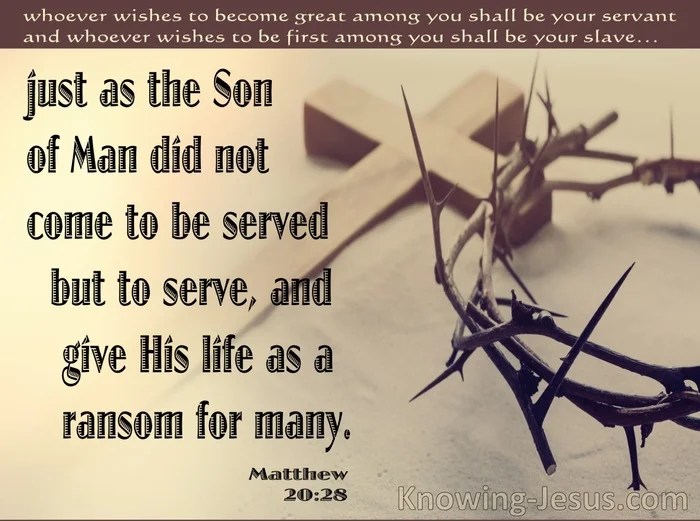
A Ransom Paid in Full: Reflecting, Understanding, the Justice of God. Matthew 20:24-28

Matthew 20:24-28 Amplified Bible

24 And when the [other] ten heard this, they were resentful and angry with the two brothers. 25 But Jesus called them to Himself and said, “You know that the rulers of the Gentiles have absolute power and lord it over them, and their great men exercise authority over them [tyrannizing them]. 26 It is not this way among you, but whoever wishes to become great among you shall be your servant, 27 and whoever wishes to be first among you shall be your [willing and humble] slave; 28 just as the Son of Man did not come to be served, but to serve, and to give His life as a ransom for many [paying the price to set them free from the penalty of sin].”

The Word of God for the Children of God.

Adeste Fidelis! Venite Adoremus! Dominum.

Gloria! In Excelsis Deo! Alleluia, Alleluia, Alleluia, Amen.

Background: He Who Has Ears, Let Them Hear …

Matthew 20:17-19Amplified Bible

Death, Resurrection Foretold

17 As Jesus was going up to Jerusalem, He took the twelve [disciples] aside, and along the way He said to them, 18 “Listen carefully: we are going up to Jerusalem; and the Son of Man will be handed over to the chief priests and scribes (Sanhedrin, Jewish High Court), and they will [judicially] condemn Him and sentence Him to death,  19 and will hand Him over to the Gentiles (Roman authorities) to be mocked and scourged and crucified, and He will be raised [to life] on the third day.”

On the journey to Jerusalem Jesus predicts that his death will take place there.

Jesus takes his disciples aside to report to them that it will include wholesale betrayal, humiliation and condemnation by the religious leaders of his people.

Those who should be welcoming him as the promised Messiah will instead sentence him to suffering and death, thoughtlessly handing him over to to a brutal time and season of mocking, flogging, and crucifixion by the Romans.

Then Jesus also shockingly predicted that he would rise again three days after!

But it seems that after hearing the predictions about Jesus’ suffering and death, the disciples somehow tuned out.

It’s as if they missed hearing the promise that “on the third day” he would be “raised to life!”

When the time came and Jesus died on a cross, the disciples were a despondent group of followers wondering about the suddenness what had just happened.

As predicted, in the Garden of Gethsemane they scattered in fear, at the arrival of the Temple Authorities unjustly leaving the burial, preparations to others. (See Matthew 26:56; 27:45-28:10.)

In this critical moment, there was no expectation of Jesus’ coming to life again!

In our own day and age, considering the number of years which have come, and passed us by since those events transpired, is our own “hearing” any different?

As we again, for the umpteenth time approach Jesus’ entry into Jerusalem, as we again come to the umpteenth recitation and those sermons of Palm Sunday, as we again try to come to realization of what we know is to come, has already transpired, has already been written and narrated – why is any of this relevant?

We have not heard with our own ears the actual voice of Jesus as the disciples.

We could not immediately begin the process of giving it our fullest attention.

We could not be stunned in the same way as the disciples were upon hearing it.

We could not be apathetic or excited or wondering or stunned or any of that.

We did not talk, or walk, hear or listen to and with Jesus in that moment – in a more contemporary colloquial sense of the moment – “walk and chew gum and do everything else (preparing ourselves for the Passover) all at the same time.

Nowadays, we do not all concern ourselves to prepare to celebrate the Passover.

We are not looking for donkeys or mules or horses to ride to be paraded about.

We are not looking for “Upper Rooms” – Just sanctuaries inside our churches.

No Gardens of Gethsemane …

It is doubtful to the utmost we are worried about our running away naked in the middle of the night with thoughts of running away, betraying our own Savior.

Jesus will not be arrested again.

He will not be betrayed, mocked and humiliated in such a horrible way again.

We will not have to subject ourselves to the sight, witnessing him dying again.

All these things have already come to pass and by faith we believe and accept it.

Now, what experiences do we have to substitute for those of what the disciples witnessed first hand, experienced to the utmost first hand, threatened by too?

We hear pandemic, dire economic warnings or a doctor’s frightening diagnosis, and we’ll soon forget Jesus’ words: “I am with you always” (Matthew 28:20).

We experience ridicule or rejection and forget that God’s Word warns that we may be called to share in Christ’s sufferings (John 15:18-20; Romans 8:17).

Facing them throughout the year is hard enough, but how much of that effort includes an intense time of self examination, reflection upon the Cross itself?

Facing them mutually, letting God work, let’s remember Jesus was raised to life.

We know what happened then to Jesus – three days later, as promised, he arose!

Our belief in the Resurrection of our Savior is core central to our Christian faith.

Yes! We absolutely love and live for and utmost sacrificially serve a risen Savior!

But the lingering question, the utmost intense question we probably devote so precious little of our time to study, reflecting upon: what relevance is the Cross?

A Personal Reflection: Why the Cross?

24-28 When the ten others heard about this, they lost their tempers, thoroughly disgusted with the two brothers. So Jesus got them together to settle things down. He said, “You’ve observed how godless rulers throw their weight around, how quickly a little power goes to their heads. It’s not going to be that way with you. Whoever wants to be great must become a servant. Whoever wants to be first among you must be your slave. That is what the Son of Man has done: He came to serve, not be served—and then to give away his life in exchange for the many who are held hostage.”

Why does Jesus take his disciples aside to shock, awe them with his prophecy?

Why are such momentous words and such miraculous history transforming events still to be read and found, studied and prayed over and celebrated too?

Why is such a detailed, embarrassing account of the failure of the disciples?

Why do we celebrate ourselves being re-subjected to these terrible moments?

To give us another opportunity to run away from Jesus, recoil from them, him?

To mostly learn and then relearn to repeatedly avoid re-living the indescribable intensity of those moments, to make them our own as God repeatedly call us to?

Why the ugliness of the Cross … to learn, to relearn to hug its wondrous beauty?

Why such an intense concentration, centralized focus on the Cross at Calvary?

Why such an ugly, not so gentle, intentional, purposeful, graphic reminder?

Why didn’t God simply say, “Look, everyone, I know you have sinned against Me, but I am going to pardon you right now. It’s okay. I forgive all of you!”

God didn’t do that because it doesn’t work with His nature and character.

The justice of God requires obedience and sacrifice.

He could not accept us into fellowship with Himself unless we paid the penalty—or someone paid it on our behalf.

Romans 3:25 tells us, “For God presented Jesus as the sacrifice for sin. People are made right with God when they believe that Jesus sacrificed his life, shedding his blood. This sacrifice shows that God was being fair when he held back and did not punish those who sinned in times past” (NLT).

The cross demonstrates the ultimate expression of the justice of God.

At the cross of Calvary, the love and justice of God met.

Yes, God had to satisfy His justice.

The Scriptures say, “The person who sins is the one who will die” (Ezekiel 18:20 NLT), “the wages of sin is death” (Romans 6:23 NLT), and “without the shedding of blood, there is no forgiveness” (Hebrews 9:22 NLT).

God was saying, “My righteous requirements must be met.

But I love humanity beyond their ability to acknowledge, fully measure and comprehend, and there is no way they can do it on their own.

So, I must, and I WILL help them.”

Therefore, He sent His only begotten Son Jesus to bridge the gap. (John 3:16-17)

This is why Jesus Christ is the only way to God.

People like to say that all roads lead to God.

People also like to say that the road to hell is paved with our good intentions.

It really concerns me when I hear Christians parrot statements to that effect.

There is only one path.

There is only one way.

If that were not true, then why did Jesus have to die?

If all roads lead to God, then why did Jesus go through the indescribable anguish, the immeasurable humiliation, torture, and pain of the cross?

Matthew 20:26-28 Amplified Bible

26 It is not this way among you, but whoever wishes to become great among you shall be your servant, 27 and whoever wishes to be first among you shall be your [willing and humble] slave; 28 just as the Son of Man did not come to be served, but to serve, and to give His life as a ransom for many [paying the price to set them free from the penalty of sin].”

The primary reason Jesus came to this earth was to save us, to die for our sins.

Paid in Full

Jesus’ mission was a matter of “search and rescue.”

He came to seek and save those who were lost (Luke 19:10).

He not come to be served but to serve, give his life as a ransom for many.

Mark 10:42-45 Amplified Bible

42 Calling them to Himself, Jesus said to them, “You know that those who are recognized as rulers of the Gentiles lord it over them; and their powerful men exercise authority over them [tyrannizing them]. 43 But this is not how it is among you; instead, whoever wishes to become great among you must be your servant, 44 and whoever wishes to be first and most important among you must be slave of all. 45 For even the Son of Man did not come to be served, but to serve, and to give His life as a [a]ransom for many.”

He fulfilled that mission by giving his life at Calvary “as a ransom for many.”

As Jesus hung on the cross and spoke the words “It is finished” (John 19:30), he was announcing that his mission was now accomplished.

Because he was obedient and faithful to His Father, offered his perfect life as the sacrifice for sin, God was pleased to welcome home all his lost children!

https://www.blueletterbible.org/esv/jhn/19/30/t_conc_1016030

https://www.blueletterbible.org/lexicon/g5055/esv/mgnt/0-1/

The brief sentence “It is finished” translates from just a single word teleō in the original Greek text.

The same word was used by shopkeepers to announce that someone’s bill was finally paid.

When the final payment was made on a purchased item, the merchant would say “Tetelestai” (“It is finished”) – in other words, the debt was paid in full.

When I made the last payment on the first car I ever bought, I remember how good it felt to see the bank teller stamp “Paid in Full” on my loan documents.

Never again would another payment be required!

As Jesus said “It is finished” on the cross, he was assuring us that his mission was complete.

He had paid in full all the costs required for our sin.

And when we faithfully focus our lives, when we centralize our lives now place our full faith-filled trust in him, our debt for sin is forever wiped off the books!

On that Hill far away, stood an Old Rugged Cross, the emblem of suffering and shame. And on that old cross Jesus suffered and died to pardon and sanctify me.

In the name of God, the Father and God the Son and God the Holy Spirit,

Let us Pray,

Loving Lord, I praise and thank You for Jesus, my Mighty Savior and Servant King. Lord, today I pour out my life as an offering to You. I pray that I would serve You wholeheartedly and my service would bless those around me and be a witness to bring many to the knowledge of salvation in Jesus. O God, thank you that Jesus has bought salvation for me! He has done everything needed for me to know you, love you, and serve you now and forever! Amen. Thank You that Jesus gave His life as a ransom for me and for all who would believe in His name. In Jesus’ name, AMEN.

Adeste Fidelis! Venite Adoremus! Dominum.

Gloria! In Excelsis Deo! Alleluia, Alleluia, Alleluia, Amen.

https://translate.google.com/

Let Us All Give Thanks To God For Our Foundation of Hope! Colossians 1:3-8

Colossians 1:3-8 Amplified Bible

We give thanks to God, the Father of our Lord Jesus Christ, as we pray always for you, for we have heard of your faith in Christ Jesus [how you lean on Him with absolute confidence in His power, wisdom, and goodness], and of the [unselfish] [a]love which you have for all the saints (God’s people); because of the [confident] hope [of experiencing that] which is reserved and waiting for you in heaven. You previously heard of this hope in the message of truth, the gospel [regarding salvation] which has come to you. Indeed, just as in the whole world the gospel is constantly bearing fruit and spreading [by God’s power], just as it has been doing among you ever since the day you first heard of it and understood the grace of God in truth [becoming thoroughly and deeply acquainted with it]. You learned it from [our representative] Epaphras, our beloved fellow bond-servant, who is a faithful minister of Christ on our behalf and he also has told us of your love [well-grounded and nurtured] in the [Holy] Spirit.

The Word of God for the Children of God.

Adeste Fidelis! Venite Adoremus! Dominum.

Gloria! In Excelsis Deo! Alleluia, Alleluia, Alleluia, Amen.

The Root Of Our Hope Is Our Savior Jesus

It’s wonderful when someone comes into the kingdom of God.

That person receives God’s gift of grace through faith in Jesus, and they begin a new life of walking with the Holy Spirit.

The new believer realizes that the full measure of their “sacred cow” plans for their old life of selfish pursuits offers them nothing that will ever satisfy them.

By their new hope in Christ Jesus, they have turned their back on the darkness and are enjoying the light of the world, Savior Jesus – Praise God for his love!

Paul is filled with thanks to hear that the people of Colossae have come to faith in Christ Jesus and are showing their love for all God’s people.

He even says, “We always thank God . . . when we pray for you . . .”

They have become wonderful examples of living by faith in Jesus.

They believe and trust, they love, and they hope in what God has already stored up in heaven for them.

Drawing all this together, today we can echo with great assurance with Paul that the new faith of the Colossian believers is decisively rooted in Jesus Christ.

Friends, my prayer is you will have faith in Christ Jesus; my hope for you is that in Jesus’ name you are loving others, giving yourself up for them, and growing in hope in all that God has promised and is storing up for you and me in heaven.

Stay rooted in Christ, stay united in His hope anticipating the reality of our own resurrection, the reality of God’s coming kingdom on earth as it is in heaven.

The Hope of Resurrection Brings Us All Together

What is the basis for Christian unity?

What is the basis for being able to correct another believers doctrine?

What is the foundation of love and faith in the Christian life?

Paul answers these questions in the beginning of his letter to the church at Colossae.

In the beginning of Colossians, Paul teaches that the basis of Christian faith and love is hope.

We can view hope as elemental to the gospel message, proclaimed to all who believe.

This foundation of hope in the gospel unites us with other believers, for all believers share the same foundation of the message of Christ.

From those foundations proceed faith and love, essential to the character of believers.

Faith And Love As Reasons For Giving Our Thanks

Paul thanks God for the faith and love evident in the church at Colossae.

The believers at Colossae were believers in Christ Jesus, found in Him and known by Him.

Their faith set them on the side of light.

For, Christians have been rescued from darkness and transferred to the Kingdom of the Son, Jesus Christ (Colossians 1:13-14).

The Incomparable Christ

13 For He has rescued us and has drawn us to Himself from the dominion of darkness, and has transferred us to the kingdom of His beloved Son, 14 in whom we have redemption [because of His sacrifice, resulting in] the forgiveness of our sins [and the cancellation of sins’ penalty].

Faith is what made these believers dwell in a new understanding about life, truth, what matters on this earth, and what matters for times to come.

And Paul even heard about the faith of the Colossians, so completely notable was their expression of it.

Paul also heard about the love that believers had for the saints.

The believers had love for their fellow believers, and this was an outworking of the eternal truths of the gospel.

Their love is further identified in the letter as being “in the Spirit” (Colossians 1:8), the mark of its veracity.

Paul notes the rich and beautiful Christian love of the Colossian church:

Colossians 2:1-3 Amplified Bible

You Are Built Up in Christ

For I want you to know how great a struggle I have for you and for those [believers] at [a]Laodicea, and for all who [like yourselves] have never seen me face to face.  [For my hope is] that their hearts may be encouraged as they are knit together in [unselfish] [b]love, so that they may have all the riches that come from the full assurance of understanding [the joy of salvation], resulting in a true [and more intimate] knowledge of the [c]mystery of God, that is, Christ, in whom are hidden all the treasures of wisdom and knowledge [regarding the word and purposes of God].

Paul will ultimately write to the church at Colossae about heresy creeping in, and with that in mind, he writes he desires the body of Christ to be encouraged together with hearts unified in love.

This is Paul’s desired way for the church to have reception of truth and correction of error: to write to a church about these matters who is knit together in the love of Christ.

Then, they would be able to further share in the genuine message of Christ, separate truth from error, and have the full experience of Christ leading and guiding in truth amidst His very own body at Colossae.

No wonder Paul thanks God for the love he sees in the saints at Colossae: it gave him genuine confidence about the message of correction he would be sharing.

That love in the context of faith was made possible by the foundation of hope in Christ and Christ alone present in the church.

The Hope of the Gospel in Us

Hope as a Foundation

Paul credits hope as the foundation for the believers’ virtues. Hope is the basis for Christian faith and love.

Hope is the basic element of the faith — that we have a future with Christ through the truth of the gospel.

And hope is the basis for Christian love — that we have a future with One who unites all believers.

Faith springs from the message of hope. Love flows through the message of hope because the message is what unites the church, one to another.

Hope from the Gospel

Hope comes from the gospel, the word of truth.

The hope of the gospel is restored union and communion with Jesus Christ, the God who made us. 

Colossians 1:27 says that Jesus Christ in us is the hope of glory.

Surely this is the center of Paul’s message in the opening words of his letter.

Hope is the basis for faith and love — and the basis for this hope is that we have restored relationship with Jesus Christ.

This relationship means we have a future of even closer communion with Jesus when we are one day with Him in glory.

Hope Passed On

The word of truth is learned through the teaching of another.

The gospel is passed from person to person through teaching.

Hope becomes passed through the fellowship and instruction of other believers.

Not only had Paul and this church not met face-to-face, so it was with many believers spread throughout the world.

The gospel — the hope of Christ — spreading is an encouraging point of union between Paul and the church a Colossae.

Their shared hope is spread by Jesus Christ who would surely build His church (Matthew 16:18).

Hope is the foundation from which virtues spring and is testified to in the gospel of Christ.

The Blessed Unity of Believers’ Shared Foundation of Hope

Because Paul and his fellow believers at Colossae had a strong foundation of hope — with evidence he could hear about — he is solidified in his union with them through Christ.

Paul’s Connection with the Church at Colossae

Paul uses this expression of prayer-filled thanks to establish his unity with the church at Colossae.

He would be writing to warn against heresy creeping into the church.

But at this juncture, He is establishing truths about the faith, love, and hope that are basic to the Christian message.

He heard about this church’s faith through Epaphras, not being a church that he planted.

But he had thanksgiving-filled unity with this church nonetheless because of the message of the gospel.

Paul’s Connection with All Churches

With thanks, Paul indicates that the message of the gospel was spreading throughout the world — and not only through Paul’s ministry.

What joy that these Christians could receive a message of warning through Paul based on Christian gospel unity — and not based upon personal connection.

Many could, and indeed would, be wary to receive correction from someone not personally known, but Paul would deliver this message faithfully and with great hope that it would prayerfully be received well by those he had never even met.

Through the unity of the gospel and on the basis of broad Christian unity through Jesus Christ, Paul would be proceeding with his message of correction.

Suggested Points of Meditation and Application

As we consider Paul’s opening comments of the letter to the Colossians, we can note hope as the central theme, and basis for his commitment and unity with the church members.

This commitment and unity comes from a heart that shares the indwelling of Christ Jesus through the ministry of the Holy Spirit with fellow believers.

As you take these teachings to heart, pray over the following application points:

1. Strengthen your understanding with conviction in the hope that you have

2. Ensure that you are loving others in the church because of the hope that you share from the hope to be found only in resurrection of our Savior Christ Jesus.

3. Know that your hope means your faith is in a different world, for a different life to come. John 17:6-12 Amplified.

“I have manifested Your name [and revealed Your very self, Your real self] to the people whom You have given Me out of the world; they were Yours and You gave them to Me, and they have kept and obeyed Your word. Now [at last] they know [with confident assurance] that all You have given Me is from You [it is really and truly Yours]. For the words which You gave Me I have given them; and they received and accepted them and truly understood [with confident assurance] that I came from You [from Your presence], and they believed [without any doubt] that You sent Me. I pray for them; I do not pray for the world, but for those You have given Me, because they belong to You; 10 and all things that are Mine are Yours, and [all things that are] Yours are Mine; and I am glorified in them. 11 I am no longer in the world; yet they are still in the world, and I am coming to You. Holy Father, keep them in Your name, the name which You have given Me, so that they may be one just as We are. 12 While I was with them, I was keeping them in Your name which You have given Me; and I guarded them and protected them, and not one of them was lost except [a]the son of destruction, so that the Scripture would be fulfilled.

4. Trust a shared foundation of hope with other believers provides a foundation for doctrinal correction—should you ever be placed in the position of giving or receiving such correction

5. Be ever more thankful to God than to humanity for the unity of the gospel being spread throughout the world.

Resurrection of Hope

It’s not the experience of hope but the object of hope that is stored up for us in heaven–and that gives rise to faith and love, says the apostle Paul.

Colossians 1:27, Paul talks about “the hope of glory,” meaning the final unveiling of our salvation, when “righteousness and peace kiss each other” (Psalm 85:10). 

This grand source of hope does not mean we ignore this present life.

Instead, this hope encourages love.

In a sermon on this text, author John Piper says,

“Only one thing satisfies the heart whose treasure is in heaven: doing the works of heaven. And heaven is a world of love.”

He adds, “It’s not the cords of heaven that bind the hands of love. It is the love of money and leisure and comfort that do that, and the power to sever those cords is Christian hope.”

To live in the utter certainty, centrality of the hope of His coming glory, frees us all from greed and bitterness, despair and laziness, from impatience and envy.

Being fully captivated by this future Paul says we’ve heard about in the gospel empowers, inspires, moves us forward against the tsunami’s of culture, to give us grace to live in faith and in love to become examples of God’s new creation.

In the name of God, the Father and God the Son and God the Holy Spirit,

Let us Pray,

In your kingdom, Lord,
there are no favourites,
all are equal,
all carry the image
of the one who made all things,
and all are welcome in your home.
You forgive those who in humility
make the journey to repentance,
even those who now reject you.
Such love,
Such faith, Such hope,
beyond our imagining.
Such love, Such faith, Such hope,
that could die for us.
Such love, Such faith, Such hope,
sown into hearts,
that we might display its beauty
through hopeful lives and hope-filled words.
Thank you Lord!

Adeste Fidelis! Venite Adoremus! Dominum.

Gloria! In Excelsis Deo! Alleluia, Alleluia, Alleluia, Amen.

https://translate.google.com/

God’s Plan For Us All: We Should Each Come to Know God, As God Knows, Us. 2 Peter 3:8-9

2 Peter 3:8-9 Amplified Bible

Nevertheless, do not let this one fact escape your notice, beloved, that with the Lord one day is like a thousand years, and a thousand years is like one day. The Lord does not delay [as though He were unable to act] and is not slow about His promise, as some count slowness, but is [extraordinarily] patient toward you, not wishing for any to perish but for all to come to repentance.

The Word of God for the Children of God.

Adeste Fidelis! Venite Adoremus! Dominum.

Gloria! In Excelsis Deo! Alleluia, Alleluia, Alleluia! Amen.

Many of God’s plans are detailed throughout the Bible.

He has plans for nations, for people groups, and for individuals. 

Isaiah 46:10–11 summarizes what God wants us to know about His plans:

“My purpose will stand, and I will do all that I please. From the east I summon a bird of prey; from a far-off land, a man to fulfill my purpose. What I have said, that I will bring about; what I have planned, that I will do.”

It’s one thing to recognize that God has an overarching plan for the world; it is quite another to acknowledge that God has a specific life plan for each person.

Many places in Scripture indicate that God does have a specific plan for each human being.

It starts before we are conceived.

Lord told Jeremiah, “Before I formed you in the womb I knew you, before you were born I set you apart; I appointed you as a prophet to the nations” (Jeremiah 1:5).

God’s plan was not reactive, a response to Jeremiah’s conception.

It was preemptive, implying that God specially formed this male child to accomplish His plan.

David underscores this truth: “You created my inmost being; you knit me together in my mother’s womb” (Psalm 139:13).

Unborn children are not and never will be accidents.

They are being formed by their Creator for His purposes.

That is one reason abortion is wrong.

We have no right to disrespect God’s plan and violate God’s workmanship by killing a child He is in the process of forming and shaping into His Image.

God’s plan for every human being is that each one comes to know Him and accept His offer of salvation (2 Peter 3:9).

He created us for fellowship with Him, and, when we reject the reconciliation He offers, we live at cross purposes with His plan for us.

Beyond salvation, God also designed good works for each of us according to our gifts, strengths, and opportunities (Ephesians 2:10).

He orchestrated the location, time into which each of us is born (Psalm 139:16).

If He knows the number of hairs on our heads, then He knows us better than we know ourselves (Luke 12:7).

He knows the gifts, talents, strengths, and weaknesses He gave us, and He knows how we could best use them to make an eternal impact.

He gives us opportunities to store up treasure in heaven so that, for all eternity, we can enjoy His reward (Mark 9:41; Matthew 10:41–42).

God’s plan for each person is generally stated in Micah 6:8: “He has told you, O man, what is good; and what does the LORD require of you but to do justice, and to love kindness, and to walk humbly with your God?”

His plan is for relationship over duties.

When we walk in the Spirit (Galatians 5:16, 25), enjoying a loving relationship with the Lord, our actions indicate that closeness.

Pleasing Him is our delight.

His plan unfolds naturally as we grow in faith, mature in knowledge, and practice obedience with all we understand.

As we obey His general plan for His children, we discover His uniquely designed plan for us individually.

We know God’s plan for those who know Him includes reaching others with the good news of reconciliation and salvation (Matthew 28:19; 2 Corinthians 5:20).

His plan is for His children to be conformed to the likeness of Jesus Christ (Romans 8:29).

He wants us to grow in grace and knowledge (2 Peter 3:18).

He wants us to love other Christians the way He loves us (John 13:34).

As we diligently read, and study and follow His Word, we will discover our own spiritual gifts and abilities that specially suit us to serve Him in unique ways (2 Corinthians 12:4–11).

God’s plan unfolds in our lives as we use all we have exclusively for His glory (1 Corinthians 10:31).

We often become impatient in wondering what God’s plan is for our lives.

But it is not as complicated as we make it out to be.

God’s plan for us is revealed a little at a time as we follow Him, and His plan may look different in different seasons of life.

Hypothetically …

A middle aged person working hard to support the responsibilities of career and family, an older person working hard to successfully get into their retirements.

An already retired person looking to quietly move and gradually settle into their “time away” years, a young person may ask God to direct their steps to His plan for their lives and believes college or vocational training is part of that plan.

But halfway to their happiness and joy through their plans for themselves, they fall ill and must spend an extended and unknown period of time to rest, recover.

Are they now out of God’s plan?

Not if their hearts and souls are set to focus exclusively upon Him.

In that time of rest and recovery and rehabilitation, the young women meets a young man who becomes her husband.

They both love the Lord and desire to serve Him and believe that His plan for them is some ministry or mission field which they have had their hearts upon.

They begin planning and preparation, but halfway through the training, she becomes pregnant with what becomes an unplanned high-risk pregnancy.

Did they miss God’s plan?

Does the Lord have a plan to forsake them?

Has the Lord got a “plan B” to abandon them when things go awry?

Will the Lord abandon or forsake the middle aged person when plans change?

Will the Lord subtly or suddenly turn His face or His back unto the aged when their lives subtly, or suddenly become diverted by health or financial concerns?

Will the Lord change His plan for everyone to come to know Him in these times or from these times and seasons?

Not at all.

Proverbs 16:1-4 English Standard Version

16 The plans of the heart belong to man,
    but the answer of the tongue is from the Lord.
All the ways of a man are pure in his own eyes,
    but the Lord weighs the spirit.[a]
Commit your work to the Lord,
    and your plans will be established.
The Lord has made everything for its purpose,
    even the wicked for the day of trouble.

We must recall, God guides and Shepherds us in and unto HIS plan not our own.

The answer of the tongue is from the Lord.

The Lord alone is the one who weighs the spirit.

Commit your work unto the Lord and your plans will be established.

The Lord has made everything for its purpose.

The Lord alone has made everything beautiful in its time.

Ecclesiastes 3:10-13 English Standard Version

10 I have seen the business that God has given to the children of man to be busy with. 11 He has made everything beautiful in its time. Also, he has put eternity into man’s heart, yet so that he cannot find out what God has done from the beginning to the end. 12 I perceived that there is nothing better for them than to be joyful and to do good as long as they live; 13 also that everyone should eat and drink and take pleasure in all his toil—this is God’s gift to man.

All this is of God, from God alone, to fulfill God’s own purpose, plan for them.

Hypothetically,

Perhaps because of their experience caring for a child with special needs, they are able to get closer to God and minister to other families with similar needs.

A person coming through the harsh reality of a Cancer diagnosis may find the need to share their experiences with treatment and surgery – to give comfort.

Whatever was “their planned mission field” will subtly, suddenly look much different from the one they had envisioned, but it is now God’s plan for them.

Hopefully, Prayerfully, Faithfully, Lovingly so …

They are able to look back and see God’s hand in every turn along their way.

Ecclesiastes 12:9-14 English Standard Version

Fear God and Keep His Commandments

Besides being wise, the Preacher also taught the people knowledge, weighing and studying and arranging many proverbs with great care. 10 The Preacher sought to find words of delight, and uprightly he wrote words of truth.

11 The words of the wise are like goads, and like nails firmly fixed are the collected sayings; they are given by one Shepherd. 12 My son, beware of anything beyond these. Of making many books there is no end, and much study is a weariness of the flesh.

13 The end of the matter; all has been heard. Fear God and keep his commandments, for this is the whole duty of man.[a] 14 For God will bring every deed into judgment, with[b] every secret thing, whether good or evil.

“Will God please make up His and my mind so I will know what I am to do!”

We will struggle mightily acknowledging and accepting God’s plan as rarely being a straight shot to, as much as we can tell anyway, a clearly visible goal.

Psalm 57:2 English Standard Version

I cry out to God Most High,
    to God who fulfills his purpose for me.

His plan requires of us a journey, illustrated so well in Bunyan’s The Pilgrim’s Progress, and that journey may be filled with detours and diversions, sudden and slow crawls, stops, and hosts and myriad and myriads of confusing turns.

Psalm 138:8 English Standard Version

The Lord will fulfill his purpose for me;
    your steadfast love, O Lord, endures forever.
    Do not forsake the work of your hands.

Romans 8:28 English Standard Version

28 And we know that for those who love God all things work together for good,[a] for those who are called according to his purpose.

But if their hearts and their souls are genuinely set to obey Him in all that they know to do, then they will be at, in the center of His will every step of the way.

In the name of God, the Father and God the Son and God the Holy Spirit,

Let us Pray,

Psalm 8 The Message

God, brilliant Lord,
    yours is a household name.

Nursing infants gurgle choruses about you;
    toddlers shout the songs
That drown out enemy talk,
    and silence atheist babble.

3-4 I look up at your macro-skies, dark and enormous,
    your handmade sky-jewelry,
Moon and stars mounted in their settings.
    Then I look at my micro-self and wonder,
Why do you bother with us?
    Why take a second look our way?

5-8 Yet we’ve so narrowly missed being gods,
    bright with Eden’s dawn light.
You put us in charge of your handcrafted world,
    repeated to us your Genesis-charge,
Made us stewards of sheep and cattle,
    even animals out in the wild,
Birds flying and fish swimming,

    whales singing in the ocean deeps.

God, brilliant Lord,
    your name echoes around the world.

Adeste Fidelis! Venite Adoremus! Dominum.

Gloria! In Excelsis Deo! Alleluia, Alleluia, Alleluia, Amen.

https://translate.google.com/