Romans 15:4 "For whatever was written in earlier times was written for our instruction, so that through perseverance and the encouragement of the Scriptures we might have hope."
Author: Thomas E Meyer Jr
Formerly Homeless Sinner
Now, Child of God, Saved by Grace.
9 Let love be genuine. Abhor what is evil; hold fast to what is good. 10 Love one another with brotherly affection. Outdo one another in showing honor. 11 Do not be slothful in zeal, be fervent in spirit,[a] serve the Lord. 12 Rejoice in hope, be patient in tribulation, be constant in prayer. 13 Contribute to the needs of the saints and seek to show hospitality.
The Word of God for the Children of God.
Glory be to the Father, and to the Son, and to the Holy Ghost; as it was in the beginning, is now, and ever shall be, world without end. Amen, amen.
Tis the season for Good News!
Tis the season for glad tidings – for inexpressible indescribable heights of joy!
Unless, for you – it is not!
Tis the season also for inexpressible, indescribable depths of greatest sadness.
Such a depth of sadness will soon teach us to cling to what is good for survival.
In the ugly cry moments that always seem to arise in our lives, we can all cling, hold tightly to Christ Jesus, and know He absolutely understands how we feel.
Paul’s words in the verses above are often the very reason we are clinging as we cry, holding tightly to the comfort Christ Jesus provides.
“Don’t just pretend to love others,” he wrote to the Romans, “really love them.”
As iron sharpens iron (Proverbs 27:17), when we then take Paul’s words to heart, when we really give “tough” love unto others, it’s bound to get painful at times.
Paul wrote earlier in his letter to the Roman church, “we all fall short of the glory of God.” (Romans 3:23)
We are all flawed human beings-but we are flawed human beings covenanted by an absolutely Holy God to imitate Him, love each other as God first loved us.
Clinging to His Love, Living in Harmony Is Necessary
Wise believers acknowledge when Jesus said, “A new command I give you: Love one another” (John 13:34-35), this was not simply a suggestion for getting along.
So too, the Bible’s commands us as to how we each treat one another shouldn’t be considered minimally optional – that’s not the nature of God’s commands.
As Christ’s followers, we must cling to the Word of God, cling to the life Jesus revealed to us throughout His Gospels, cling to His miracles, remember exactly how our very relationship with God affects our relationships with each other.
When we pray, “Our Father,” we acknowledge before God, our Father, Creator of heaven and earth, we are part of a family that includes sisters and brothers.
We are called to cling to the example set by Jesus – live in harmony together.
Today’s reading mentions specific ways of doing so, such as honoring one another above ourselves, holding tightly to what is good, praying faithfully, sharing with people in need, showing hospitality, and our not being proud.
When believers cling to harmony, live in harmony, expressing their love for one another by sharing tears of sadness in times of sorrow, expanding their joy by celebrating together, they become appealing witnesses to their hope in Christ.
When a family member or friend or a stranger or a coworker observes, “It’s amazing how you guys love each other,” the cause of Christ moves forward.
John 13:34-35 Easy-to-Read Version
34 “I give you a new command: Love each other. You must love each other just as I loved you. 35 All people will know that you are my followers if you love each other.”
Jesus went even further when He was alone with His Father, taught this when he prayed that all believers “may be one” “may be brought to complete unity.”
Then, ”He prayed unto the Father, “the world will know that you sent me and have loved them even as you have loved me” (John 17:22-23).
John 17:22-23 Easy-to-Read Version
22 I have given them the glory that you gave me. I gave them this glory so that they can be one, just as you and I are one. 23 I will be in them, and you will be in me. So they will be completely one. Then the world will know that you sent me and that you loved them just as you loved me.
Now Comes the Hard Part – Actually Clinging to God!
Deuteronomy 31:6 says, “So be strong and courageous! Do not be afraid and do not panic before them. For the LORD your God will personally go ahead of you. He will neither fail you nor abandon you.” Deuteronomy 31:6 NLT
Joshua was about to take over for Moses who had just died, and God’s people were the most fickle and finicky to lead.
Long years with Moses had taught Joshua – always rebelling and losing faith.
The Lord faithfully clung to Joshua, encouraging him in his coming conquests.
The Lord is faithful to encourage us today, too. When life gets hard, and we find ourselves clinging …turn to the only One who can mend the cracks in our hearts.
In the name of God, the Father and God the Son and God the Holy Spirit,
Let us Pray,
Father,
Praise You for the way You faithfully place people around us. When the hurt is so bad, and the fear of connecting with others is paralyzing, please remind us who we are in Christ Jesus. More than conquerors, we are Your children, equip us with hearts full of encouragement. Fill us with the love we need to cling to You, heal and move forward and pour out and spill onto others who are discouraged and in need of a faith-filled friend. Help us to be encouraged by the same words Moses encouraged Joshua with:
Deuteronomy 31:7-8 Easy-to-Read Version
7 Then Moses called Joshua. All the Israelites watched while Moses said to Joshua, “Be strong and brave. You will lead these people into the land that the Lord promised to give to their ancestors. You will help the Israelites take that land and divide it among them. 8 The Lord will lead you. He himself is with you. He will not fail you or leave you. Don’t worry. Don’t be afraid!”
Intersecting Faith and Life:
There is no one person we can guarantee will love us perfectly, but You do, Father. Help us to gain a clear understanding of who we are in Christ, and allow others grace. Help us to see the good in each of us, created in Your image. Father, when we find ourselves clinging too tightly to ourselves, it can cause us to fear. Remind us in those moments, tis always the good season You have placed people in our lives to encourage and love us, even at times when we’re having trouble loving ourselves.
Father of all forgiveness, mercy grace and compassion, when our hurts are too big to think of or talk about, we know the Holy Spirit takes them to you in prayer, and You meet us right where we are at. We confess our disobedient tendency to quit and run on people, God. It’s hard to cling to You alone, and You don’t shame or blame us for our feelings of fear. But help us to stick it out more, God. To stay with You as You stay with us, to stay with people, and learn the remarkable relationships which grow out from clinging to Your ageless example of forgiveness, mercy, grace, and compassion.
Mature us to be strong and courageous and to cling to the good. Allow us each to see people the way You do, Father, fearfully and wonderfully made. Father, we want to cling to You and we want to live with others in such a way that shows we are in a life-giving relationship with you. Grant us your Spirit to do so. In Jesus’ Name,
Glory be to the Father, and to the Son, and to the Holy Ghost; as it was in the beginning, is now, and ever shall be, world without end. Amen, amen.
9 And an angel of the Lord appeared to them, and the glory of the Lord shone around them, and they were filled with great fear. 10 And the angel said to them, “Fear not, for behold, I bring you good news of great joy that will be for all the people.11 For unto you is born this day in the city of David a Savior, who is Christ the Lord.
The Word of God for the Children of God.
Glory be to the Father, and to the Son, and to the Holy Ghost; as it was in the beginning, is now, and ever shall be, world without end. Amen, amen.
Good News, the Glory of the Lord Brings Us Great Joy!
At the time when Jesus was born, life for shepherds was hard.
Their days and nights were spent in the dreary routine of taking care of sheep.
Society looked down on them as dirty, uneducated lowlifes and scoundrels.
Except among themselves, they had little reason to make any room to be joyful.
Except God made room for them, shepherds were the ones to whom the angel brought the good news that would cause great joy: A Savior had been born!
It was God’s way of saying that He identifies with the down and out, those outcasts of society, the undesirables – He has room in the Kingdom of God.
And on that glorious night, whatever cold darkness they were all facing was transformed into the most beautiful light they’d ever seen, as the angels of heaven joined in singing, “Glory to God in the highest. . . .” For those few shepherds out in the cold fields of Bethlehem, life would never be the same.
Perhaps on this Christmas Season you are finding it difficult to feel joy.
Perhaps there will be an empty chair in an empty room at your empty table.
Perhaps you’re thinking about a family member or a friend who lives too far away, who has turned away from the Lord or is no longer a part of your life.
Perhaps you or they have been diagnosed with a terrible illness or are in the process of recovering or rehabbing and neither you or they have the strength.
Whatever the reason, exactly right now, no one really feels like celebrating.
There is no room in your heart or your soul for celebrating the glory of the Lord.
If so, this Advent, Christmas reflection might be, by the grace of God, for you.
You may not be able to envision it right now, in this moment, in this season, but there is definitely good news with great joy also for you – waiting to envelop you!
Why?
Because God has made room for you – right here and exactly right now!
Because God made room in our darkened world: Our Savior came to make things right – He came to heal all the brokenhearted, to bring light into your darkness.
That night, at Jesus’ birth, God lit up the night sky to make His announcement.
Can any of us imagine our sitting in our living rooms, sitting with our feet up in our lounger, in the dark, warming yourself by a fire, tuning our ears to the night sounds when an angel appears before us, then the glory of God fills in the night?
Contemplate how all of the fear the shepherds felt gave way to unspeakable joy.
God had made room in His creation – God lit up the night sky – and God made his announcement to shepherds, the ones responsible for caring for the sheep.
These were the ones no one else made room for, who lived separate and apart from society, the ones who best represent God’s shepherding of all His people.
God’s splashy announcement of the birth of Jesus did two things.
It showed God made room for everyone, not only for kings but for the lowliest of them all—even the shepherd, who was typically the youngest in the family.
During those ancient biblical times, birth order indicated importance.
Each son grew out of shepherding and onto more important labor until the youngest son eventually became the family shepherd.
We see this in King David’s life when Samuel went to Jesse’s house to anoint Israel’s new king, and Jesse only presented the seven older brothers to Samuel.
The youngest was forgotten – except by God and Samuel who told Jesse to get even the youngest of the fields and sheep gates – God has room for everybody!
Second, it reinforced the shepherding concept traced through both Testaments.
In the Hebrew [Old] Testament, we read of Abel, Moses, David, Jacob, and God.
God was a shepherd to every single one of His wayward sheep, the Israelites.
In the New Testament, Jesus calls himself the Good Shepherd, who lays down His life for His sheep – every single one of them – even all those yet unknown.
John 10:14-18 English Standard Version
14 I am the good shepherd. I know my own and my own know me, 15 just as the Father knows me and I know the Father; and I lay down my life for the sheep. 16 And I have other sheep that are not of this fold. I must bring them also, and they will listen to my voice. So there will be one flock, one shepherd. 17 For this reason the Father loves me, because I lay down my life that I may take it up again. 18 No one takes it from me, but I lay it down of my own accord. I have authority to lay it down, and I have authority to take it up again. This charge I have received from my Father.”
God esteemed shepherds, hence his night sky announcement to them.
The ones who went about their business tending sheep over the same meadows, repeating the same daily cycle, are first to hear the news of the Messiah’s birth.
In all our day-to-day lives, we can each get tunnel vision with what’s before us.
Waiting for Christmas breaks, we drive the same route day after day, cook the same sets of meals, and deal with the same difficulties that don’t seem to end.
Disappointments with our lives overtake feelings of joy, and joy seems lost.
We wonder where our Light of the World is, and we sit alone in some room, wait drearily for dawn like those shepherds did that night when their world changed.
Recall: “Seek first the kingdom of God, all these things will be added to you,” (Matthew 6:33, ESV).
The Greek word for seek means to be absorbed in the search for something.
This absorption fills our whole attention.
Several years ago, I lost an important sermon I was to preach the next day.
I searched in every nook and cranny, every filing cabinet and box for hours.
Finding the lost sermon absorbed every nook inside my mind and my actions.
It’s seeking God with that kind of self absorbed attention to every room and nook that leads us to unspeakable joy and carries us through long dark nights.
Psalm 23:4-6 English Standard Version
4 Even though I walk through the valley of the shadow of death,[a] I will fear no evil, for you are with me; your rod and your staff, they comfort me.
5 You prepare a table before me in the presence of my enemies; you anoint my head with oil; my cup overflows. 6 Surely[b] goodness and mercy[c] shall follow me all the days of my life, and I shall dwell[d] in the house of the Lord forever.[e]
Yet, we don’t have to wait for God to light up our rooms, make a big, splashy announcement in our lives for us to know God made room for unspeakable joy.
When He called us to Himself, and we responded, we knew joy unspeakable.
He made a way when there seemed to be no way, He made room when there seemed to be no room for us and we remember how he did it and what we felt.
We too can make room, call these remembrances to our mind when we feel like we need to hunker down and wait the night out – Joy comes when we seek Him!
In the name of God, the Father and God the Son and God the Holy Spirit,
Let us Pray,
Psalm 23:1-3 English Standard Version
The Lord Is My Shepherd
A Psalm of David.
23 The Lord is my shepherd; I shall not want. 2 He makes me lie down in green pastures. He leads me beside still waters.[a] 3 He restores my soul. He leads me in paths of righteousness[b] for his name’s sake.
Holy God, I’m feeling a little joyless today. I’m hunkered down, waiting for this long “middle of the night” to end. Day after day, I get up, go to work, come home to never-ending tasks, and go to bed. I wake up, and the new day is just like yesterday. Real Joy feels foreign. I can’t remember the last time joy flooded my heart. I want to be so thrilled with your joy like the shepherds were that night so long ago that I tell people about what you’ve done in my life. Help me to seek you with my whole being. Give me eyes to see you at work in my life. Let me know joy unspeakable today. In Jesus’ name,
Glory be to the Father, and to the Son, and to the Holy Ghost; as it was in the beginning, is now, and ever shall be, world without end. Amen, amen.
6 So it was, that while they were there, the days were completed for her to be delivered. 7 And she brought forth her firstborn Son, and wrapped Him in swaddling cloths, and laid Him in a [a]manger, because there was no room for them in the inn.
The Word of God for the Children of God.
Glory be to the Father, and to the Son, and to the Holy Ghost; as it was in the beginning, is now, and ever shall be, world without end. Amen, amen.
The time had come for Mary to give birth to her first child.
Husband Joseph goes from place to place to find warmth and comfort.
All Joseph hears is: “I am sorry but …!”
Place after place – rejection even for a pregnant teen mother about to give birth.
Let the words of these constant rejections come in direct contact with your soul:
“Sorry …”
“No room for them.”
“Sorry again …”
“No vacancy.”
“Nope! Don’t tell me, I know … I heard it before … but Sorry …”
“No place – no not none.”
Words when seriously considered, still seem to hang close, cold, cruel, today.
Makes my soul just bristle with anger-does no one care enough about this child.
Surely, not in our caring and compassion driven healthcare systems would the sound of such words ever be heard or if they were heard they’d not be tolerated!
No room in anyone’s heart to offer mercy, a place to stay – to save a life or two?
In our divided chaotic world that seeks to crowd the message of the child Jesus out, where busyness and distractions abound, and hearts are stirred to focus on other fear focused things, it can be hard sometimes to choose to keep Him first.
Why is it for us that it’s all too easy to get caught up in the whole hurried dash of the holidays, and not give our fullest attention to what seems more urgent?
Too many of us, focus gets blurred; and the most important gets pushed aside.
There is too much of that attitude – “Sorry, not today, but no room in my Inn.”
It takes an active, daily choice to put Christ first, especially in a culture that says you’re too busy to focus there. Or that life is too full. And there’s no more room.
I sit and pray a whole lot now that I have had my Triple Bypass Heart Surgery.
Proverbs 4:23 New American Standard Bible
23 Watch over your heart with all diligence, For from it flow the springs of life.
Proverbs 4:23-27 The Message
23-27 Keep vigilant watch over your heart; that’s where life starts. Don’t talk out of both sides of your mouth; avoid careless banter, white lies, and gossip. Keep your eyes straight ahead; ignore all sideshow distractions. Watch your step, and the road will stretch out smooth before you. Look neither right nor left; leave evil in the dust.
The proverb writer is deeply concerned about helping his children build a wise and discerning life. “Listen,” he pleads, “pay attention to what I’m saying.”
“Make room for God – Maximize all spaces within your soul => solely for God!”
Throughout the early chapters of the book of Proverbs we find one plea after another from author King Solomon who the wisest man to ever live, like this.
And in Proverbs 4:23 the writer points out the central issue in all this teaching.
“Above all else,” the writer says, “guard your heart.” In other words, “Look inside – less room for sin and maximum room for God who is our salvation.”
Be concerned about your inner life before you build your external life.
After all, your heart, your inner life, ‘is the very wellspring of life.’ Your heart shapes who you are.” More room for darkness means far more room for chaos.
Jesus taught this truth also. He said that a person produces good things when that person has a good heart— that is, a heart focused on living for God.
But if a person has room for only an evil heart, a sin darkened heart closed off to God, that will show up inside the evil things that person does. (See Luke 6:45.)
Let’s simply talk about what’s inside. After all, it would be a wasted effort to try building a way of life (on the outside) if the heart wasn’t healthy (on the inside).
We can hardly go through any Christmas season without at least receiving one reminder that the infant Jesus was born in much less than ideal circumstances.
Christmas cards often have scenes of a stable filled with animals, while Mary and Joseph both look lovingly into a manger, where the baby Jesus is lying.
While many written and cinematic portrayals of this one scene aim for a warm, sweet, nostalgic approach, the birth of Jesus was far from a pleasant experience.
But remember how it began -forced to travel to Bethlehem for a Roman census, Mary and Joseph were repeatedly rejected, found no comfortable place to stay.
So Joseph had to go from place to place, each less savory, healthy, and Mary gave birth in a cold, dirty stable and used the animals’ feedbox for Jesus’ crib.
What irony! Repeated rejections, no room was available here for the birth of our Savior who had in truth came to prepare a place for us in heaven (John 14:1-3).
John 14:1-3 English Standard Version
I Am the Way, and the Truth, and the Life
14 “Let not your hearts be troubled. Believe in God;[a] believe also in me. 2 In my Father’s house are many rooms. If it were not so, would I have told you that I go to prepare a place for you?[b]3 And if I go and prepare a place for you, I will come again and will take you to myself, that where I am you may be also.
Everyday life has plenty of room its own ironies too.
For example, people were created to live in community and enjoy each other’s friendship.
The sheer chaos and havoc that sin has wreaked in this world often breaks down that sense of community and friendship, leaving far, far too many of us feeling as though there’s never going to be no place where we can actually feel at home.
The infant Jesus was born into a place that was hostile to the presence of God.
But, thanks be to God, the infant became a man who made room in His heart for all of God’s Children of all coming generations-made room, changed the world.
Throughout his entire ministry here, Jesus called people to Himself, where those who felt homeless, lost, lonely, and unwelcome could find a place where they experienced the warmth of being at home in the presence of the Lord.
May God help us to choose wisely, what room we make for whom, what voices we choose to listen to, and in Jesus’ name, where we give our attention today.
He is the only One who makes room, who brings true meaning to Christmas.
He is the only One who brings real peace in this all-too-often hectic season.
He is the only One worthy of making room for, giving our maximum time and attention, listen for God, we slow down the maddening rush around our lives.
We can make more room for God, we can know all of this in our heads, but may He help us to really believe it in our hearts…and choose to live it out this season.
Reminded.
Renewed.
Refreshed.
Repenting.
Believing the Good News.
That the Kingdom of God has, in maximum truth, Come Near.
And He will surely and certainly, as promised, come again!
Standing on the Promises of Christ our King and our Savior!
Making maximum effort to clear out maximum room for Him alone, first.
In the name of God, the Father and God the Son and God the Holy Spirit,
Let us Pray,
ABBA Father, Help us to keep our focus first on Christ this season. Please forgive us for giving too much time and attention on other things. Help us to reflect again, on what Christmas is really all about. Thank you that you came to give new life, peace, hope, and joy, that you came to make room in our eternal darkness for your Son.
Help us to repent, make room for Him, remember that the gift of Christ, Immanuel, is our greatest treasure, not just at Christmas, but for the whole year through. Fill us with your joy and the peace of your Spirit. Direct our hearts and minds towards you. Thank you for your reminder that both in seasons of celebration and in seasons of brokenness, you’re still with us. For you never leave us. Thank you for your daily powerful Presence in our lives, that we can be assured your heart is towards us, your eyes are over us, and your ears are open to our prayers. Thank you that you surround us with favor as with a shield, and we are safe in your care. We choose to press in close to you today…and keep you first in our hearts and lives.In Immanuel‘s Name,
Glory be to the Father, and to the Son, and to the Holy Ghost; as it was in the beginning, is now, and ever shall be, world without end. Amen, amen.
3 In those days John the Baptist came preaching in the wilderness of Judea, 2 “Repent, for the kingdom of heaven is at hand.”[a]3 For this is he who was spoken of by the prophet Isaiah when he said,
“The voice of one crying in the wilderness: ‘Prepare[b] the way of the Lord; make his paths straight.’”
4 Now John wore a garment of camel’s hair and a leather belt around his waist, and his food was locusts and wild honey. 5 Then Jerusalem and all Judea and all the region about the Jordan were going out to him, 6 and they were baptized by him in the river Jordan, confessing their sins.
The Word of God for the Children of God.
Glory be to the Father, and to the Son, and to the Holy Ghost; as it was in the beginning, is now, and ever shall be, world without end. Amen, amen.
If John the Baptist were alive today, a noisy passenger on an airplane, or an unkempt passenger on a commuter train, a homeless person sitting against a building with his sign or someone standing on some street corner or in some other public place with a bullhorn or mic running his mouth, his message to the masses would be the same message he preached in the wilderness so long ago.
“Where do you think you are going , how far can you run you brood of snakes?”
“Do not think for even one hot second you can flee from God’s coming wrath!”
Picking up a rock or stick he says shaking them; “God can raise up far better Christians than you with these!”
“Even now the axe is laid to the root of the trees. Every tree therefore that does not bear good fruit is cut down and thrown into the fire.”
“Repent, for the kingdom of heaven is at hand.”
Who is actually going to take any time to actually listen to any of those words without thinking: “He is Drunk!” “He is off of his medications!” “Arrest him!”
We certainly won’t ever go near him to be baptized in any river called Jordan!
Just another sad, down on his luck soul in weird clothing not worth any time.
Yet, I wonder how many of us would take him seriously – in our world that is deafened by the constant noise and chaos, how many would actually listen to a man in the streets of any city who claimed to be preparing the way of the Lord?
John’s timeless message is like a banner waving over every heart on the planet.
It continues to wave bold and strong, even in our darkest of days – like today!
We all need only look up, pay attention and see that God’s kingdom is at hand.
Our present circumstances are not our final destination-here is not all there is!
The beautiful thing about that ancient John the Baptist’s invitation, is that it does not require any whole google search check-list of things to accomplish.
There is no get-your-life-together-first requirement – there are no rules you and I have to follow before repentance – for repentance now is where it begins.
A moment of recognition then a moment of confession (Peter’s Confession of Christ as Messiah when the disciples were asked by Jesus who did the people say, and thought Jesus was – and Jesus proclaiming BINGO) Matthew 16:13-20
The Bible assures us that when a person, or a nation, repents of sin, God is faithful and just to forgive (1 John 1:9).
When people humble themselves and with their whole heart seek the Lord, He will hear them – He will heal them. And, He forgives them (2 Chronicles 7:14).
Have we lost that “very first loving feeling” of being 1000% forgiven by God?
32 Blessed is the one whose transgression is forgiven, whose sin is covered. 2 Blessed is the man against whom the Lord counts no iniquity, and in whose spirit there is no deceit.
3 For when I kept silent, my bones wasted away through my groaning all day long. 4 For day and night your hand was heavy upon me; my strength was dried up[b] as by the heat of summer. Selah
5 I acknowledged my sin to you, and I did not cover my iniquity; I said, “I will confess my transgressions to the Lord,” and you forgave the iniquity of my sin. Selah
6 Therefore let everyone who is godly offer prayer to you at a time when you may be found; surely in the rush of great waters, they shall not reach him. 7 You are a hiding place for me; you preserve me from trouble; you surround me with shouts of deliverance. Selah
8 I will instruct you and teach you in the way you should go; I will counsel you with my eye upon you. 9 Be not like a horse or a mule, without understanding, which must be curbed with bit and bridle, or it will not stay near you.
10 Many are the sorrows of the wicked, but steadfast love surrounds the one who trusts in the Lord. 11 Be glad in the Lord, and rejoice, O righteous, and shout for joy, all you upright in heart!
What a simple, yet unheeded message from the Psalmist’s and John’s call:
“Know you will be blessed” “Repent, for the kingdom of heaven is at hand!”
If that ancient John the Baptist declared the kingdom of heaven was at hand, more than 2,000 years ago, exactly how much nearer is God’s kingdom today?
Every new moment of everyday, we are one step closer to our heavenly home.
Yet, how likely is it that we will continue to live as though this is all there is?
We will continue to strive for the things of earth, which will one day pass away.
Even Jesus himself said to those who had gathered around Him, His Message,
Matthew 5:4 Amplified Bible
4 “Blessed [forgiven, refreshed by God’s grace] are those who mourn [over their sins and repent], for they will be comforted [when the burden of sin is lifted].
Today, let’s take 1% more heed to John’s ancient, yet relevant message, ask God to begin, renew our hearts, minds, souls, surrendering more everything to Him.
Every spark of coming chaos, darkness, hardship, trial, sin, and struggle, let us enter our prayer closets, invite God inside, confess them, to lay them at His feet.
Will you read John’s ancient admonishment as recorded here in Scripture and in some part of your busy day-take the time to absorb them-try to find relevance?
There is a brooding, budding John the Baptist within every single unbeliever!
There is a brooding, budding John the Baptist within each and every Christian!
When does our world of chaos and darkness around us-hear his words of truth?
In the name of God, the Father and God the Son and God the Holy Spirit,
Let us Pray,
Heavenly Father, We come before You, humbly seeking Your will and Your way. Forgive us, Lord, for doing as we please, in a world that is not our home. Help us to gain a heavenly perspective of “By Your stripes we were healed”. Help us heed the timeless call of John the Baptist—“Repent, for the kingdom of heaven is at hand.”
Please, ABBA Father, give us a fresh and refreshed and refreshing boldness and more clarity to share this message with those around us, to break away from the noise and chaos and speak words of truth. Thank You, Father, for preparing the way through Your Son. There is no other way. Continue to work in our lives until the glorious day when Jesus returns. For it is by Him, for Him, and because of Him that we live, and move, and have our being. It is in His name above all names that we pray. Amen.
3 It was now the fifteenth year of the reign of Tiberius, the Roman emperor. Pontius Pilate was governor over Judea; Herod Antipas was ruler[a] over Galilee; his brother Philip was ruler[b] over Iturea and Traconitis; Lysanias was ruler over Abilene. 2 Annas and Caiaphas were the high priests. At this time a message from God came to John son of Zechariah, who was living in the wilderness. 3 Then John went from place to place on both sides of the Jordan River, preaching that people should be baptized to show that they had repented of their sins and turned to God to be forgiven. 4 Isaiah had spoken of John when he said,
“He is a voice shouting in the wilderness, ‘Prepare the way for the Lord’s coming! Clear the road for him! 5 The valleys will be filled, and the mountains and hills made level. The curves will be straightened, and the rough places made smooth. 6 And then all people will see the salvation sent from God.’”[c]
7 When the crowds came to John for baptism, he said, “You brood of snakes! Who warned you to flee the coming wrath? 8 Prove by the way you live that you have repented of your sins and turned to God. Don’t just say to each other, ‘We’re safe, for we are descendants of Abraham.’ That means nothing, for I tell you, God can create children of Abraham from these very stones. 9 Even now the ax of God’s judgment is poised, ready to sever the roots of the trees. Yes, every tree that does not produce good fruit will be chopped down and thrown into the fire.”
10 The crowds asked, “What should we do?”
11 John replied, “If you have two shirts, give one to the poor. If you have food, share it with those who are hungry.”
12 Even corrupt tax collectors came to be baptized and asked, “Teacher, what should we do?”
13 He replied, “Collect no more taxes than the government requires.”
14 “What should we do?” asked some soldiers.
John replied, “Don’t extort money or make false accusations. And be content with your pay.”
The Word of God for the Children of God
Glory be to the Father, and to the Son, and to the Holy Ghost; as it was in the beginning, is now, and ever shall be, world without end. Amen, amen.
Hypothetically, imagine slipping into an airline seat for a three-hour flight or boarding that same old commuter train for that long morning work commute.
The man next to you politely begins to exchange some general pleasantries.
But as the commute continues, the polite tone of the conversation changes.
The man begins to mutter something, in fact, he mutters several somethings.
These “somethings” are things which instantly cause you to bristle, to squirm.
Luke 3:7-9The Message
7-9 When crowds of people came out for baptism because it was the popular thing to do, John exploded: you “Brood of snakes! What do you think you’re doing slithering down here to the river? Do you think a little water on your snakeskins is going to deflect God’s judgment? It’s your life that must change, not your skin. And don’t think you can pull rank by claiming Abraham as ‘father.’ Being a child of Abraham is neither here nor there—children of Abraham are a dime a dozen. God can make children from stones if he wants. What counts is your life. Is it green and is it even flourishing? Because if it’s deadwood, it goes on the fire.”
Very soon you discover, realize that he also has extreme views about religion, even more extreme views about politics and governance, how people respond.
His goal as you fly the friendly skies or just try to get to work for another day, is to convince you that your far too casual way of life is putting you in danger of snake venom, the fires of hell – it dawns on you it’s going to be a very long day!
Now imagine that it is not just you who are in ear shot of all these harsh words.
You aren’t the only one on the airplane nor the only one on the commuter train.
On the plane we might hope that the louder and more raucous this guy gets that the flight attendants would not be so slow to intervene on this guys intrusions.
They might even try to move him to another seat – but that is no promise nor is it any guarantee that this guy will not just stand up and cause another ruckus.
Maybe if it gets to be too much – someone would inform the pilot – or if there was an Air Marshall with a pair of handcuffs and something to cover his mouth.
Maybe if it goes to the extreme of extremes, the Pilot will turn the plane around.
Anything, anywhere-as long as someone figures out how to shut the guy down.
Now, back in the commuter train – the people just have to sit restlessly and just listen until they get to the next station and hope he gets tired and he gets off or they do and they simply accept the uncomfortable fact they will be late for work.
Imagine walking the downtown streets of any city or serving meals in a shelter and this guy walks up beside you, gets into your ears, or hands you a meal tray.
Perish the thought and pray such an occurrence is one you’ll never experience.
In a homeless shelter?
In an overnight shelter?
Spending a morning, an afternoon or evening or a whole night with the words of John the Baptist ringing in your ears would have been a similar experience.
After all, John’s hardcore extremist views believed you got ready for Christ’s coming by taking a hard, long, intense look at the ethical quality of your life.
Hearing enough of this message, listening to all the vitriol, high end criticism spewing from his mouth about quite literally everybody – who would not want have the plane turned around, to call the police this guy arrested – like Herod?
Luke 3:19-20 New Living Translation
19 John also publicly criticized Herod Antipas, the ruler of Galilee,[a] for marrying Herodias, his brother’s wife, and for many other wrongs he had done. 20 So Herod put John in prison, adding this sin to his many others.
Which one’s of us reading this reflection would be praying to God to keep such a man out of our lives, as far away from our “Christian experience” as is possible?
The Covenant Reality of Becoming an Advent Prophet
Isaiah 40:1-3 New Living Translation
Comfort for God’s People
40 “Comfort, comfort my people,” says your God. 2 “Speak tenderly to Jerusalem. Tell her that her sad days are gone and her sins are pardoned. Yes, the Lord has punished her twice over for all her sins.”
3 Listen! It’s the voice of someone shouting, “Clear the way through the wilderness for the Lord! Make a straight highway through the wasteland for our God!
Yet our preparing a pathway for the coming of the Messiah is our Advent task.
That means listening to John’s words and some (Psalm 51) clearing away the moral rubble that prevents God from taking His straight path to your hearts.
I mean we’ll never like, nor appreciate, anyone calling us a “brood of snakes!”
Yet, OUR King is coming, and He will remember the poor, cut down the proud.
The all too comfortable, utterly corrupt order of things, must come to a change.
The hardest thing for “contemporary Christians” is actually taking the time for us disciples to make the U-turn of repentance, to straighten out their priorities.
Preparing our homes for the season, getting it ready for Christmas isn’t first a matter of our remembering our perfect gifts for everyone on our family gift list.
It’s about remembering the very nature of citizenship in the King’s kingdom!
It’s about taking a moral inventory of our lives. What changes do we need to make so that we can welcome Christ with integrity on Christmas morning?
More Like Christ – More Like John the Baptist First?
Ephesians 5:1-2 New Living Translation
Living in the Light
5 Imitate God, therefore, in everything you do, because you are his dear children. 2 Live a life filled with love, following the example of Christ. He loved us[a] and offered himself as a sacrifice for us, a pleasing aroma to God.
When I have asked, very Christian I have ever known will always profess this:
“Work in progress, trying to be more like Jesus every moment of every day!”
But, what about a bit more like John the Baptist in his camel hair wardrobe?
Luke 3:10-14 New Living Translation
10 The crowds asked, “What should we do?”
11 John replied, “If you have two shirts, give one to the poor. If you have food, share it with those who are hungry.”
12 Even corrupt tax collectors came to be baptized and asked, “Teacher, what should we do?”
13 He replied, “Collect no more taxes than the government requires.”
14 “What should we do?” asked some soldiers.
John replied, “Don’t extort money or make false accusations. And be content with your pay.”
The changes John the Baptist was calling for do not appear .0001% radical.
One teacher I know of thinks John’s counsel is, for us, rather commonplace.
All we need to do, it seems to him, is to love a little, show a little kindness.
No career change is required.
I believe that interpretation goes too easy on many of us.
After all, many of us are well-to-do.
Many of us out there in the world have far more than two sets of clothing; many of us also have two cars, two or more credit cards, and maybe even two homes.
Our freezers are probably most full preparing for the Christmas feasts to come.
Yet, our hardcore reality: in light of our riches, John’s words become unsettling.
They demand a radical generosity that few of us are genuinely accustomed to.
True, John the Baptist does not specifically order anyone to leave his or her job.
But he definitely and directly does demand that we actually live out our faith by actually being honest and genuinely content and not ever abusing our power.
Clearly, any reading of Luke’s narrative reveals “John the Baptist Discipleship” is not something for the uncommitted, the timid nor for “after-hours only.”
We are not, so to speak, called or covenanted by God to moonlight for Christ.
Quite the contrary, our allegiance to Christ rules not only our after-work hours but also our hours travelling to work, our hours of actual work in the office, at the plant, on the road, in the air, on the trains, in class, at those sales meetings.
We can neither ignore the hardcore words of John the Baptist, leave Christ in church on Sundays nor let him “wait for us in the parking lot” on weekdays.
Here’s a question:
How do we, who are supposed to be dying to self and coming alive to Christ, do our work and other activities so that we honor Christ and respect our neighbor?
In the name of God, the Father and God the Son and God the Holy Spirit,
Let us Pray,
Lord Jesus, too often after hearing the good news we go right back to business as usual. Forgive us, and make our every thought captive to you. Lord, we admit that our lives are a mess. It’s been a long time since we’ve held them up to the light of your truth. Now is the time. Help us to begin today. Let us read these words from Luke’s narrative, let us hear the hardcore accusations spoken by John the Baptist against us as so called “contemporary Christians” and your so called Body of Christ, the Church in your kingdom, let us finally come to our senses. In your name, Amen.
Glory be to the Father, and to the Son, and to the Holy Ghost; as it was in the beginning, is now, and ever shall be, world without end. Amen, amen.
1 This is the Good News about Jesus the Messiah, the Son of God.[a] It began 2 just as the prophet Isaiah had written:
“Look, I am sending my messenger ahead of you, and he will prepare your way.[b] 3 He is a voice shouting in the wilderness, ‘Prepare the way for the Lord’s coming! Clear the road for him!’[c]”
4 This messenger was John the Baptist. He was in the wilderness and preached that people should be baptized to show that they had repented of their sins and turned to God to be forgiven. 5 All of Judea, including all the people of Jerusalem, went out to see and hear John. And when they confessed their sins, he baptized them in the Jordan River. 6 His clothes were woven from coarse camel hair, and he wore a leather belt around his waist. For food he ate locusts and wild honey.
7 John announced: “Someone is coming soon who is greater than I am—so much greater that I’m not even worthy to stoop down like a slave and untie the straps of his sandals. 8 I baptize you with[d] water, but he will baptize you with the Holy Spirit!”
The Word of God for the Children of God.
Glory be to the Father, and to the Son, and to the Holy Ghost; as it was in the beginning, is now, and ever shall be, world without end. Amen, amen.
A Message is Sent – “There Will Come a Fresh Start!”
After Israel’s long 40 year sojourn in the desert, God opened a way before Joshua for the people through the Jordan River and into the promised land.
The waters upstream “piled up in a heap,” perhaps like the “wall of water” on the right and left as the people of Israel crossed the Red Sea (Exodus 14:22).
Both stories say that the people passed through “on dry ground” (Joshua 3:17).
Although God had been faithful to Israel, keeping His promises to rescue them and bring them to the land He had promised them (Genesis 12:1-8; 15:13-16; 28:10-15; 46:3-4; Exodus 3:4-10), the people turned away and rebelled.
They did that again and again in a long history of unfaithfulness (Exodus 32; Numbers 14; Judges 2:10-23; 2 Kings 17:1-23; 25:1-21).
Eventually they were punished and sent into exile, but God, still ever faithful, brought them back again (Ezra – Nehemiah).
Nehemiah 8:1-11 New King James Version
Ezra Reads and Explains the Law
8 Now all the people gathered together as one man in the open square that was in front of the Water Gate; and they told Ezra the scribe to bring the Book of the Law of Moses, which the Lord had commanded Israel. 2 So Ezra the priest brought the Law before the assembly of men and women and all who could hear with understanding on the first day of the seventh month. 3 Then he read from it in the open square that was in front of the Water Gate [a]from morning until midday, before the men and women and those who could understand; and the ears of all the people were attentive to the Book of the Law.
4 So Ezra the scribe stood on a platform of wood which they had made for the purpose; and beside him, at his right hand, stood Mattithiah, Shema, Anaiah, Urijah, Hilkiah, and Maaseiah; and at his left hand Pedaiah, Mishael, Malchijah, Hashum, Hashbadana, Zechariah, and Meshullam. 5 And Ezra opened the book in the sight of all the people, for he was standing above all the people; and when he opened it, all the people stood up. 6 And Ezra blessed the Lord, the great God.
Then all the people answered, “Amen, Amen!” while lifting up their hands. And they bowed their heads and worshiped the Lord with their faces to the ground.
7 Also Jeshua, Bani, Sherebiah, Jamin, Akkub, Shabbethai, Hodijah, Maaseiah, Kelita, Azariah, Jozabad, Hanan, Pelaiah, and the Levites, helped the people to understand the Law; and the people stood in their place. 8 So they read distinctly from the book, in the Law of God; and they gave the sense, and helped them to understand the reading.
9 And Nehemiah, who was the [b]governor, Ezra the priest and scribe, and the Levites who taught the people said to all the people, “This day is holy to the Lord your God; do not mourn nor weep.” For all the people wept, when they heard the words of the Law.
10 Then he said to them, “Go your way, eat the fat, drink the sweet, and send portions to those for whom nothing is prepared; for this day is holy to our Lord. Do not sorrow, for the joy of the Lord is your strength.”
11 So the Levites quieted all the people, saying, “Be still, for the day is holy; do not be grieved.”
The people who had been gathered in that place before Ezra and the Scribes had just just been read, had just received for the first time in who knows how long, a fresh reading and a fresh anointing from God’s messenger, of the Word of God.
Then they were sent on their ways back to their homes – to their families – to their friends – to their neighbors – to their neighborhoods – their communities. (Verse 10) “Be Still for the Day is Holy; Go and Prepare Ye the Way of the Lord!”
Then, about 30 years after the birth of Jesus (Matthew 1; Luke 2), God called a man named John to again send God’s message before the people: prepare ye the way for the Messiah, who had come to be the Savior of the world (John 1:29-31).
John 1:29-31 The Message
The God-Revealer
29-31 The very next day John saw Jesus coming toward him and yelled out, “Here he is, God’s Passover Lamb! He forgives the sins of the world! This is the man I’ve been talking about, ‘the One who comes after me but is really ahead of me.’ I knew nothing about who he was—only this: that my task has been to get Israel ready to recognize him as the God-Revealer. That is why I came here baptizing with water, giving you a good bath and scrubbing sins from your life so you can get a fresh start with God.”
Now, here in the first 8 verses of Mark 1 we see John preaching in the wilderness, calling the people to gather, to repent and baptizing them in the Jordan River.
And here the people are called not to cross the Jordan but to be baptized in it.
God calls them back to receive a fresh anointing, to make a new start through repentance, seek forgiveness, prepare their hearts for the coming of the Savior.
God’s Messengers Are Still Sent With God’s Message
Christmas is always a time when everyone tries to give that special someone that perfect gift – that gift that genuinely says “I Love You and I always will!”
In these days when those perfect gifts are probably far too expensive to buy, but we still have the same heart to give that special someone a “100% perfect gift,”
I suggest that this year for Christmas, remembering that Christ comes first in the season of Christmas because that is the way it is spelled, the gift of a Bible.
Yeah! I know, another Bible … but this year make a plan to go beyond just the receiving of the physical book, but instead, enter into the messengers head.
The coming of the new year is always a great time to begin a new challenge.
On January 1st 2024, many of us make those self same automatic resolutions.
Some resolve to break bad habits, while others resolve to pick up good habits.
Others attempt to acquire a new hobby or even a new skill throughout the year.
Many Christians might even resolve to read the Bible daily or might challenge themselves (a bit self centered) with another reading plan throughout the year.
Here are 5 challenges for you to consider (selflessly this time) sharing in 2024.
1. Read through the Bible in a Year
The most basic challenge is to read through the Bible in an entire year.
There are 1,189 chapters in a typical English Bible.
Divide this by 365, that means you would need to read only a little over three chapters of the Bible each day to read through every word of the Bible in a year.
When you consider that some of these chapters are only a few verses long, that is not that daunting of a task.
But where do you start?
Is it always good to start in Genesis and read three chapters of every book?
That is one possibility, but my experience is that most people end up just like the Israelites – lost in the wilderness for 40 years inside the book of Leviticus.
Many give up these challenges when they have to trudge through the historical books of 1 and 2 Kings 1 and 2 Chronicles, then sort through the minor Prophets.
From all your Android and Apple smart phones, you can go to their respective “stores” and you can download many apps to assist with a Bible reading plan.
Many of these plans will have the reader in one chapter of the Old Testament, read a Psalm or Proverb per day, and a chapter or two in the New Testament.
2. Devote Your Year to Discerning God’s Wisdom
Reading through the Bible in a year can be incredibly daunting and rewarding.
You often “open your eyes” to see those things that you’ve never seen before.
But that can also be a bit like taking a road trip through a state where you only see the state through tinted windows while driving 70 mph to your destination.
You learn things and see beautiful sites, but you may not get the full impact.
Wouldn’t you know a state better if you decided to live there for an entire year?
What if you decided to spend an entire year in a book like Psalms or Proverbs?
Solomon’s wonderfully simple Proverbs is helpful because there are 31 chapters.
That corresponds to each day on the calendar – except in those months which only have 29 or thirty days and those years – like 2024 – which are “leap years.”
Pick up that nice monthly business planner with those individual days which are set apart by all those wonderfully convenient lines for the individual hours.
Look at your monthly calendar, spot the date, look for all of those wonderfully empty lines just waiting for a single entry and read that chapter of Proverbs.
Do that for every day of the year, with some Biblical text and the Psalms and you’ll be quite surprised at how much wisdom you glean from the Scriptures.
You can do the same thing with Psalms.
There are 150 psalms.
If you choose to dedicate the 31st of each month to working through the largest Psalm, Psalm 119, then that means you have 5 psalms you could read each day.
Simply take the day on the calendar and then add 30, 5 times.
For example, as today is the 5th, you could read Psalm 5, 25, 51, 10o, or 150.
3. Do Twelve 30-Day Challenges
This is the same concept as reading through Proverbs and Psalms.
Yet, here you would find twelve different 30-day Bible reading challenges.
Here you would challenge yourself to pick 12 books of the Bible and spend a month in each one, or seek, find, a topical 30-day challenge and conquer it.
You could take that challenge even further – add something like a chronological New Testament Bible Reading Plan to send this challenge to furthest horizons.
There is a great one at Bible Study Tools that you can use here.
This one will be much more difficult to organize but might be one of the more rewarding yearly challenges.
Consider working with your Pastor’s at picking a point of doctrine or Christian living and deep ocean-diving into everything the Bible says about that topic.
You could do several of these as mini-challenges throughout the year as well.
Can you imagine how high your understanding would increase if you picked something like justification and studied it in the Scriptures for an entire year?
Years ago, I independently tried something like this with the attributes of God.
I meditated upon a particular attribute of God every month of the year and used these attributes to preach and teach the gospel to myself and to a legacy church.
It was incredibly daunting but also incredibly “eyes>ears>hands” beneficial.
If you decide to do this challenge, consider picking up a Strong’s Concordance to find out quite everything the Bible text’s says on a particular word or topic.
5. Pick a Person and Start Your Own Bible Fellowship
Ecclesiastes 4:9-12 New Living Translation
9 Two people are better off than one, for they can help each other succeed. 10 If one person falls, the other can reach out and help. But someone who falls alone is in real trouble. 11 Likewise, two people lying close together can keep each other warm. But how can one be warm alone? 12 A person standing alone can be attacked and defeated, but two can stand back-to-back and conquer. Three are even better, for a triple-braided cord is not easily broken.
Proverbs 27:17 Amplified Bible
17 As iron sharpens iron, So one man sharpens [and influences] another [through discussion].
2 Timothy 2:14-18 English Standard Version
A Worker Approved by God
14 Remind them of these things, and charge them before God[a] not to quarrel about words, which does no good, but only ruins the hearers. 15 Do your best to present yourself to God as one approved,[b] a worker who has no need to be ashamed, rightly handling the word of truth. 16 But avoid irreverent babble, for it will lead people into more and more ungodliness,17 and their talk will spread like gangrene. Among them are Hymenaeus and Philetus, 18 who have swerved from the truth, saying that the resurrection has already happened. They are upsetting the faith of some.
In fellowship together we are “as Iron” motivated when reaching toward a goal.
Our adrenaline flows, our creative juices churn, and our mind works overtime at solving the problems that stand in the way of achieving God’s vision for our life.
In the United States, where I live, there is an defeating, unhealthy trend toward mediocrity.
Recent sales of tee shirts; the most widely distributed logo in the United States is now seemingly “Undereducated and Underachiever and !@%$ Proud of It.”
I remember the days when the most popular shirt read, “We’re Number One.”
Even in our church today we can become more satisfied with less than our best.
Paul admonishes Timothy, faith communities, and the church community to “come together, to fellowship, do your best to present yourself to God as one approved, a workman [a community] who does not need to be ashamed.”
Paul was not content with anything but the best. He valued repetition, valued community here now instructing Timothy to “keep reminding” his listeners.
Fellowship and Repetition through Bible study and prayer really works for me.
There are certain critically important messages I must hear over and over again. from someone other than “Me, Myself and I.”
My Mother’s favorite Proverb saying “the early bird gets the worm” nudges me out of bed each morning to feast on God’s manna.
I used to have a card in my wallet, “Prayer changes things,” moved me to pray before I attempted to fix a problem in my own malignant, selfish strength.
A sign on my wall once reminding me, “People are forever,” calls me to put people before projects no matter how inconvenient that may seem at times.
God has given us His permission to come together to create GOD opportunity.
In the name of God, the Father and God the Son and God the Holy Spirit,
Let us Pray,
Dear Lord, as I read these passages of scripture, show me Your truth and what you want me to learn. Pinpoint the things in my thinking and my life that aren’t right. Help me to remember that Your word is life and always true, whereas my ideas are often fleeting. Use the truth of Your Word to transform my limited thinking and behavior. Let Your truth inform my faith and let my faith guide my actions. Amen.
Glory be to the Father, and to the Son, and to the Holy Ghost; as it was in the beginning, is now, and ever shall be, world without end. Amen, amen.
18 Without prophetic vision people run wild, but blessed are those who follow God’s teachings.
The Word of God for the Children of God.
Glory be to the Father, and to the Son, and to the Holy Ghost; as it was in the beginning, is now, and ever shall be, world without end. Amen, amen.
We serve a God of boundaries.
In God’s limitless capacity, endless creativity, and boundless existence God still chose to create boundaries which man cannot hope to pass. (Genesis 3:22-24)
Genesis 3:22-24 New King James Version
22 Then the Lord God said, “Behold, the man has become like one of Us, to know good and evil. And now, lest he put out his hand and take also of the tree of life, and eat, and live forever”— 23 therefore the Lord God sent him out of the garden of Eden to till the ground from which he was taken. 24 So He drove out the man; and He placed cherubim at the east of the garden of Eden, and a flaming sword which turned every way, to guard the way to the tree of life.
Even so, God still had vision for what was good, right, pleasing, and perfect.
And as children made in His image, we are to live, think, and create as he does.
In this time of year leading up to Christmas marked by busyness and infinite distractions from seemingly infinite opportunities to be more like our God, it’s important now more than ever for us to create boundaries, establish priorities.
May we find our vision of God, find freedom and joy these days ahead as we receive His vision and set boundaries under the leadership of the Holy Spirit.
About Being The Person Who Sees What God is Doing
Proverbs 29:18 The Message
18 If people can’t see what God is doing, they stumble all over themselves; But when they attend to what he reveals, they are most blessed.
The world we live in constantly bombards us with its attempts to define who we are and what we should do.
The internet and television are bombarded with advertisements hard selling all their products telling us why we fall short of expectations, sell us what we need.
Our jobs tell us how we should spend our time and find a sense of self-worth.
Our families and friends often define us by what we’ve done or said in the past.
And even our churches will sadly define us according to how we can best meet the needs of the worlds cultures rather than getting to know who God truly is.
TBTG, we serve ONE God who knows us even better than we know ourselves.
Psalm 139:1-4 says, “O Lord, you have searched me and known me! You know when I sit down and when I rise up; you discern my thoughts from afar. You search out my path and my lying down and are acquainted with all my ways. Even before a word is on my tongue, behold, O Lord, you know it altogether.”
And then later in Psalm 139 verse 16 David writes, “Your eyes saw my unformed substance; in your book were written, every one of them, the days that were formed for me, when as yet there was none of them.”
Then as we try to plumb the depths of God’s words, we simply have no concept so, instead of trying to reach the ends of understanding, grasping God’s Words,
David concludes with blessed words which accept His humanities limitations –
Psalm 139:17-18 English Standard Version
17 How precious to me are your thoughts, O God! How vast is the sum of them! 18 If I would count them, they are more than the sand. I awake, and I am still with you.
From the foundation of the earth, God knew He would make us.
On the day we took our first breath He already had perfect, pleasing plans for us.
He has known our every thought and looked upon our every action with grace.
We could not be more known than we are right now by our heavenly Father.
And there could not possibly be anyone better, Shepherd us through the chaos, morass, of this life than God, the Father and God the Son, God the Holy Spirit.
Psalm 23 Authorized (King James) Version
Psalm 23
A Psalm of David.
1 The Lord is my shepherd; I shall not want. 2 He maketh me to lie down in green pastures: he leadeth me beside the still waters. 3 He restoreth my soul: he leadeth me in the paths of righteousness for his name’s sake. 4 Yea, though I walk through the valley of the shadow of death, I will fear no evil: for thou art with me; thy rod and thy staff they comfort me. 5 Thou preparest a table before me in the presence of mine enemies: thou anointest my head with oil; my cup runneth over. 6 Surely goodness and mercy shall follow me all the days of my life: and I will dwell in the house of the Lord for ever.
Reading, envisioning those ancient words of Psalm 23, to be that person with healthy, life-giving, God first boundaries starts with being a person of vision.
And the only place to get true vision is from the only One who truly knows us.
God longs to be the true north on our compass.
The Word of God which stands as the only Global Positioning System we need.
Through His Words, He longs to give us honest insight into how He’s made us.
He longs to give us a prophetic vision of how He sees us and feels about us.
And in our receiving a prophetic revelation of who we are we will each be better equipped to envision God, follow his leadership into his perfect, pleasing will.
As we take the Word of God into the next week of Advent, proceed into this week of vision and boundaries by a fresh meeting with our heavenly Father in prayer.
From Alpha to Omega, Our God longs to help us see ourselves, this world, and vision opportunities before us, as He does that we might gain wisdom, insight.
We can choose to become more like God – become that person of Godly visions.
We can choose to pick our heads up and put on the lens of the Holy Spirit.
We can Ask God questions.
We can inquire of God about our vision of our life and our “God” opportunities.
In response God will provide the leadership we all need, exactly how we need it.
May we be overwhelmed by fresh revelation of how loved we are-just as we are.
In the name of God, the Father and God the Son and God the Holy Spirit,
Let us Pray,
1. Meditate on the simple truth that God truly knows you.
Allow Scripture to lead you to a place of faith, trust, in God’s knowledge of you.
“O Lord, you have searched me and known me! You know when I sit down and when I rise up; you discern my thoughts from afar. You search out my path and my lying down and are acquainted with all my ways. Even before a word is on my tongue, behold, O Lord, you know it altogether.” Psalm 139:1-4
“Your eyes saw my unformed substance; in your book were written, every one of them, the days that were formed for me, when as yet there was none of them.” Psalm 139:16
Psalm 139:17-18 Authorized (King James) Version
17 How precious also are thy thoughts unto me, O God! how great is the sum of them! 18 If I should count them, they are more in number than the sand: when I awake, I am still with thee.
2. Ask God to give you a revelation of how he sees you. Ask Him for a revelation of his nearness and love. Begin to talk to Him about any imperfections you have.
Psalm 23 Authorized (King James) Version
Psalm 23
A Psalm of David.
1 The Lord is my shepherd; I shall not want. 2 He maketh me to lie down in green pastures: he leadeth me beside the still waters. 3 He restoreth my soul: he leadeth me in the paths of righteousness for his name’s sake. 4 Yea, though I walk through the valley of the shadow of death, I will fear no evil: for thou art with me; thy rod and thy staff they comfort me. 5 Thou preparest a table before me in the presence of mine enemies: thou anointest my head with oil; my cup runneth over. 6 Surely goodness and mercy shall follow me all the days of my life: and I will dwell in the house of the Lord for ever.
“Are not two sparrows sold for a penny? And not one of them will fall to the ground apart from your Father. But even the hairs of your head are all numbered. Fear not, therefore; you are of more value than many sparrows.” Matthew 10:29-31
3. Ask God for a revelation of what God has called you to.
Ask Him about your role in your family and His calling on your life as a spouse, child, parent or grandparent.
Ask Him for vision for your work, for your roles with your co-workers and even with that “connection” those “relationships” you have with your Supervisors.
Ask Him for vision for your relationship with His Son – Journal His responses.
God my Creator, God my Father, pray restrain me to your will and vision for my life. Father I will wait expectantly for your vision and the steps I should take according to your will. I will go forth in faith as I step because I surrender my will to you. Amen.
Glory be to the Father, and to the Son, and to the Holy Ghost; as it was in the beginning, is now, and ever shall be, world without end. Amen, amen.
2 The people who walk in darkness will see a bright light. The light will shine on those who live in the land of death’s shadow.
3 You will expand the nation and increase its happiness. It will be happy in your presence like those who celebrate the harvest or rejoice when dividing loot. 4 You will break the yoke[a] that burdens them, the bar that is across their shoulders, and the stick used by their oppressor, as you did in the battle against Midian. 5 Every warrior’s boot marching to the sound of battle and every garment rolled in blood will be burned as fuel in the fire. 6 A child will be born for us. A son will be given to us. The government will rest on his shoulders. He will be named: Wonderful Counselor, Mighty God, Everlasting Father, Sar Shalom. 7 His government and peace will have unlimited growth. He will establish David’s throne and kingdom. He will uphold it with justice and righteousness now and forever. Yahweh Tsebaoth is determined to do this!
The Word of God for the Children of God.
Glory be to the Father, and to the Son, and to the Holy Ghost; as it was in the beginning, is now, and ever shall be, world without end. Amen, amen.
If it was in our power exactly right now, how would we go about redressing the division, tyranny, oppression, and suffering that marks and mars our world?
What would our “completely perfect” solution look like?
We all have our grandiose ideas and plans on achieving them—but now here is God’s: His definitive answer to all of the world’s darkness was to send a child.
The people of Israel had long been awaiting the arrival of the one who would embody all of their hopes.
The ancient prophets of old had long been declaring the coming of a Messiah, and as the centuries passed, the expectation of such a deliverer steadily grew.
God’s Prophet Isaiah added significant fuel to the fire of this longing, declaring that the Messiah would come as “a child,” “a son,” and that “the government shall be upon his shoulder, and his name shall be called Wonderful Counselor, Mighty God, Everlasting Father, Prince of Peace.”
Such a complete and comprehensive picture in an 8×12 glossy biblical frame!
But the ancient question remained: Who could possibly fill this description?
Surely no one had yet come who lived up to such high, lofty heavenly language.
But it was this child-—sent of God, conceived of the Holy Spirit, who came not in military might or with flashes of lightning but in a trough, surrounded by animals and shepherds at His birth—who was God’s answer to sin and death.
Isaiah prophesied: He alone would govern His kingdom “with justice and with righteousness from this time forth and forevermore” (Isaiah 9:7).
Isaiah says the child-king would be called “Wonderful Counselor.”
Kings were known in some measure by their counselors.
The extent of their authority and rule was made apparent by the number of advisers they could call upon for their heavenly vision, wisdom and guidance.
And yet this King would have none.
Because He Himself is the Wonderful Counselor; He has no need of any outside wisdom in order for Him to rule with absolute perfection and total authority.
This self same Wonderful Counselor is the sole remedy for all expressions of division, and suffering and evil in our own world—including those in our life.
Are we joyfully submitting to His plans and are we bowing our knee to His rule?
Have you entrusted all of our ways and all of our concerns unto His counsel?
When His ways and ours are not the same, what “names do we give Him?
By what “socially engineered construct” do we envision His place in our life?
Do we accept that He knows better than us and walk the way He calls us to?
What “signs of the times” do we raise and march and protest and declare Him?
Whose name do we exalt, shout out above all others as we block intersections?
Do we even, right in this exact moment, know why we should block the streets?
Overwhelm the news media with songs as the angels did before the shepherds?
With shouts of exclamation for our God’s gift to His world is no ordinary child.
This is Christ the Lord, our Counselor, Prince of Peace, our wonderful Savior!
Have we not known?
Have we not heard?
Have we not called to Him by His name?
Have we not acknowledged Him or even recognized Him by His Words, deeds?
Have we not scratched all of our hair off of our collective heads enough yet?
Have we not yet begun to shout loud enough “over the hills and everywhere?”
Well, there will will surely come a day, as God always promised, when we will!
Maybe, just maybe, that glorious day of salvation will come into our lifetimes?
Perhaps, it might even be today – God willing and the name of the Lord Arises!
In the name of God, the Father and God the Son and God the Holy Spirit,
Let us Pray,
Thank You, Father, for sending Jesus as the Light of the world to enlighten everyone coming into the world. Thank You that in Him is the light of the glorious gospel of grace that can never be quenched by the darkness of this world. I praise and thank You that His Light has come into my life and enlivened my spirit and enlightened my soul. Open my eyes more and more to see Jesus and to grow more like Him. Give me greater understanding of all that You have achieved in my life, for without You I would remain in darkness and dead in my sin. Thank You for Your great salvation, to You be all praise and glory forever. Loving Lord, no matter how many times I read of the wonder of Your incarnation as the Word made flesh, it fills me with wonder and praise. Lord, I worship You in the beauty of holiness, and I bow down before Your throne of grace in wonderment, for holy is Your name. In Jesus’ name I pray, AMEN.
Glory be to the Father, and to the Son, and to the Holy Ghost; as it was in the beginning, is now, and ever shall be, world without end. Amen, amen.
1 O come, O come, Immanuel, and ransom captive Israel that mourns in lonely exile here until the Son of God appear.
Refrain: Rejoice! Rejoice! Immanuel shall come to you, O Israel.
2 O come, O Wisdom from on high, who ordered all things mightily; to us the path of knowledge show and teach us in its ways to go. Refrain
3 O come, O come, great Lord of might, who to your tribes on Sinai’s height in ancient times did give the law in cloud and majesty and awe. Refrain
4 O come, O Branch of Jesse’s stem, unto your own and rescue them! From depths of hell your people save, and give them victory o’er the grave. Refrain
5 O come, O Key of David, come and open wide our heavenly home. Make safe for us the heavenward road and bar the way to death’s abode. Refrain
6 O come, O Bright and Morning Star, and bring us comfort from afar! Dispel the shadows of the night and turn our darkness into light. Refrain
7 O come, O King of nations, bind in one the hearts of all mankind. Bid all our sad divisions cease and be yourself our King of Peace. Refrain
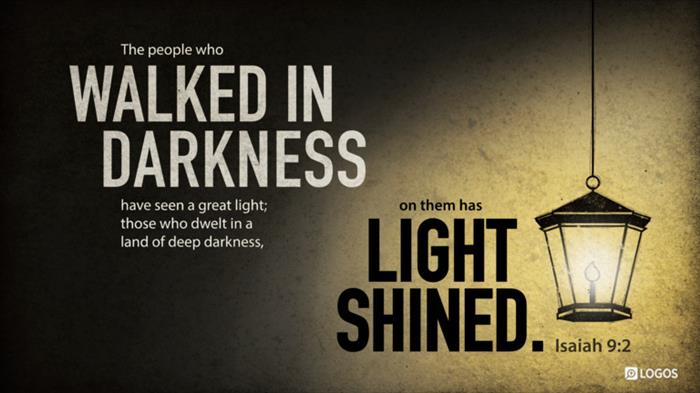
2 [a] The people who walked in darkness have seen a great light; those who dwelt in a land of deep darkness, on them has light shone. 3 You have multiplied the nation; you have increased its joy; they rejoice before you as with joy at the harvest, as they are glad when they divide the spoil. 4 For the yoke of his burden, and the staff for his shoulder, the rod of his oppressor, you have broken as on the day of Midian. 5 For every boot of the tramping warrior in battle tumult and every garment rolled in blood will be burned as fuel for the fire. 6 For to us a child is born, to us a son is given; and the government shall be upon[b] his shoulder, and his name shall be called[c] Wonderful Counselor, Mighty God, Everlasting Father, Prince of Peace. 7 Of the increase of his government and of peace there will be no end, on the throne of David and over his kingdom, to establish it and to uphold it with justice and with righteousness from this time forth and forevermore. The zeal of the Lord of hosts will do this.
The Word of God for the Children of God.
Glory be to the Father, and to the Son, and to the Holy Ghost; as it was in the beginning, is now, and ever shall be, world without end. Amen, amen.
From Alpha to Omega, the Bible never ever disguises just how dark life can get.
The Scriptures are clear that when sins multiply, when evil is celebrated, when God is left out, darkness ensues, darkness spreads to every corner it can reach.
And yet, over and over in the Bible’s storyline, we are abundantly reminded that God is not afraid of, not shy about His thoughts of or defeated by such darkness.
In fact, He makes an everlasting habit of drawing near and turning it into light.
We see Him drawing near in the third chapter of Genesis.
Sin had entered the world; the only two people alive had rebelled against their Maker, and when God came near to them they ran, they were hiding in shame.
Thinking about it, it would have been completely understandable for God to have shown up in Eden, dropped a hammer of His hardcore judgment on Adam and Eve, picked up more dust, and started over with another man and woman.
But that’s not what He did.
That is not what we read and learn in the Word of God for His Children.
He arrived in the garden, came near and asked, “Where are you?” (Genesis 3:9).
And when He found them naked and ashamed, He stayed on the scene, and He put enmity, open hostility, between the serpent and all mankind in mercy, He provided animal skin covering for them, and expelled them from the Garden.
So, too, with His people Israel.
By the time Isaiah began his ministry, there was again an established history of the people forgetting God and ignoring His prophets – all would lead to exile.
As a result, they labored long and hard under the wicked kings they deserved and found themselves “greatly distressed and hungry,” leading them to “speak contemptuously against their king and their God” (Isaiah 8:21).
Again, it would have been reasonable for the Lord to have done away with His people at this point, start over – leaving them to experience the “distress and darkness, the gloom of anguish and defeat” (v 22), without a hope or a future.
After all, by their words and their actions, they were communicating that they didn’t want Him around in their garden of the knowledge of both good and evil.
Imagine God’s thought process here – Why would He, should He, stick around?
But the next chapter of Isaiah begins with a glorious, even miraculous reversal:
“There will be no more gloom for her who was in anguish” (Isaiah 9:1).
The Lord would not leave His people, and He would not allow them to remain in misery – No, for these people in darkness, “on them has a great light shone.”
The light of the grace of God was breaking into their self-inflicted gloom of sin.
Centuries after the words of Isaiah were written, spoken, preached and taught, that endless cycle of sin – the people of God again found themselves in anguish.
There were again foreign rulers over them, and now came something different from God – there had been no prophetic word heard for too many, many years.
Imagine the thought of the people – “Perhaps He’s really finally done it this time, the people may have thought – the Lord has finally had enough of us, turned His back.
In these contemporary of days, we know better.
We believe that into this darkness a child was born.
We believe a glorious once in a lifetime has light shone in the sky, leading to the discovery of a baby who would prove to all to be the light of the entire world.
The question for us this Advent season, in any season, is whether the light has dawned in our own hearts or whether we have let the darkness of sin creep in.
The good news of this season of Advent and Christmas is that the God of the Bible is the God of grace, the God of Light who comes into the darkness and emptiness of our hearts to bring His light, His love, His joy, and His peace.
It is a great certainty we are each walking in darkness today, whether that is the darkness of our own sin, our fear or the darkness caused by the sin of others.
God’s promise is this: God is neither afraid of nor defeated by, these things.
In Immanuel, God with us, God is within us – in Jesus, He has drawn near.
By His Spirit, He can bring light to the dark.
Look to Him and look for Him for He wants to be found – and walk in His light.
In the name of God, the Father and God the Son and God the Holy Spirit,
Psalm 8 Names of God Bible
Psalm 8
For the choir director; on the gittith;[a] a psalm by David.
1 O Yahweh, our Adonay, how majestic is your name throughout the earth!
Your glory is sung above the heavens.[b] 2 From the mouths of little children and infants, you have built a fortress against your opponents to silence the enemy and the avenger.
3 When I look at your heavens, the creation of your fingers, the moon and the stars that you have set in place— 4 what is a mortal that you remember him or the Son of Man that you take care of him? 5 You have made him a little lower than yourself. You have crowned him with glory and honor. 6 You have made him rule what your hands created. You have put everything under his control: 7 all the sheep and cattle, the wild animals, 8 the birds, the fish, whatever swims in the currents of the seas.
9 O Yahweh, our Adonay, how majestic is your name throughout the earth!
Glory be to the Father, and to the Son, and to the Holy Ghost; as it was in the beginning, is now, and ever shall be, world without end. Amen, amen.
4-6 All who indulge in a sinful life are dangerously lawless, for sin is a major disruption of God’s order. Surely you know that Christ showed up in order to get rid of sin. There is no sin in him, and sin is not part of his program. No one who lives deeply in Christ makes a practice of sin. None of those who do practice sin have taken a good look at Christ. They’ve got him all backward.
The Word of God for the Children of God.
Glory be to the Father, and to the Son, and to the Holy Ghost; as it was in the beginning, is now, and ever shall be, world without end. Amen, amen.
Why do we anticipate Christmas with such relish?
Because we eagerly anticipate that someone will read our mind, discern all of our thoughts, catch on to all those hints we drop in the year for the perfect gift?
What about that “perfect gift?”
Who would know such things at the level where the gift can indeed be called “good and perfect” and exactly what we need at all those times, in all places?
James 1:16-18 English Standard Version
16 Do not be deceived, my beloved brothers. 17 Every good gift and every perfect gift is from above, coming down from the Father of lights, with whom there is no variation or shadow due to change.[a]18 Of his own will he brought us forth by the word of truth, that we should be a kind of first-fruits of his creatures.
James 5:10-11 The Message
10-11 Take the old prophets as your mentors. They put up with anything, went through everything, and never once quit, all the time honoring God. What a gift life is to those who stay the course! You’ve heard, of course, of Job’s staying power, and you know how God brought it all together for him at the end. That’s because God cares, cares right down to the last detail.
Right down to the last detail: For the believer, the answer must surely lie, above all, in the awareness that Jesus Christ appeared and lived to take away our sins.
When we read from the Books of the Prophets, when we read the Gospel writers, we discover the gift of this truth at the very heart of their Christmas message.
From Matthew come the words of the angel to Joseph: “[Mary] will bear a son, and you shall call his name Jesus, for he will save his people from their sins” (Matthew 1:21).
Ahead of what might be regarded as the first ever Christmas concert, the song, the message the angel gave to the shepherds was incredibly similar: “I bring you good news of great joy that will be for all the people. For unto you is born this day in the city of David a Savior, who is Christ the Lord” (Luke 2:10-11).
The Narrator John began his message to us from a very different vantage point.
As he highlighted the commencement of Jesus’ earthly ministry, having raised our gaze to the eternal Word becoming flesh (John 1:14),
John gave us the immortal words of John the Baptist: “Behold, the Lamb of God, who comes to take away the sin of the world!” (v 29).
And Mark records nothing of Jesus’ birth or childhood, but in his Gospel Jesus’ first words are an announcement that in Him the kingdom of God has come near to people like us (Mark 1:15), and in one of His first miracles Jesus assures a paralyzed man, “Son, your sins are forgiven” (2:5).
If we say that God has shown His love for us in the incarnation of His only Son, that is accurate but that explanation is also quite incomplete and insufficient.
God demonstrated His love for us not simply by sending Jesus as a baby in Bethlehem; rather, His own word tells us “God shows his love for us in that while we were still sinners, Christ died for us” (Romans 5:8, emphasis added).
Of course, if we understand that Christ came to take away our sins, then it’s only logical to conclude that we have sins which need to be taken away.
Rare is the man or woman who would say that he or she has never done wrong!
1 John 1:8-10 The Message
8-10 If we claim that we’re free of sin, we’re only fooling ourselves. A claim like that is errant nonsense. On the other hand, if we admit our sins—simply come clean about them—he won’t let us down; he’ll be true to himself. He’ll forgive our sins and purge us of all wrongdoing. If we claim that we’ve never sinned, we out-and-out contradict God—make a liar out of him. A claim like that only shows off our ignorance of God.
WITHOUT EXCEPTION:
We all have impure thoughts.
We all speak bitter words.
We all have impure actions.
We all know what it is to live an unholy life.
But the Word of God comes to us and is among us and declares unto each of us, “Here is the good news: Christ appeared in this world to take away your sins.”
Today, this Advent, lay hold of this message with a renewed joy and gratitude.
Let these eight words be the most precious part of your Christmas season:
“He appeared in order to take away sins.”
Your family, friends, coworkers, and neighbors and everyone of those complete strangers in all the stores you will surely be shopping in, may become .00001% more open to the gospel message during the holiday season; make it your aim, then, not to further the sadly misguided worldly perception that Christmas is nothing more than a sentimental emblem of God’s love, as though His Son lay cold, hungry, and gurgling in the manger but never hung in agony on the cross.
His love can only be fully explained in the ultimate purpose of Christ’s coming:
to take away my sins.
to take away your sins.
to take away the sins of the world.
This, and this above all, is what gives our hearts bountiful cause for celebration!
Thanks be to God for this wonderful Gift!
In the name of God, the Father and God the Son and God the Holy Spirit,
Let us Pray,
Psalm 24 The Message
24 1-2 God claims Earth and everything in it, God claims World and all who live on it. He built it on Ocean foundations, laid it out on River girders.
3-4 Who can climb Mount God? Who can scale the holy north-face? Only the clean-handed, only the pure-hearted; Men who won’t cheat, women who won’t seduce.
5-6 God is at their side; with God’s help they make it. This, Jacob, is what happens to God-seekers, God-questers.
7 Wake up, you sleepyhead city! Wake up, you sleepyhead people! King-Glory is ready to enter.
8 Who is this King-Glory? God, armed and battle-ready.
9 Wake up, you sleepyhead city! Wake up, you sleepyhead people! King-Glory is ready to enter.
10 Who is this King-Glory? God-of-the-Angel-Armies: he is King-Glory.
Glory be to the Father, and to the Son, and to the Holy Ghost; as it was in the beginning, is now, and ever shall be, world without end. Amen, amen.