
Acts 17:10-13 New American Standard Bible
Paul in Berea
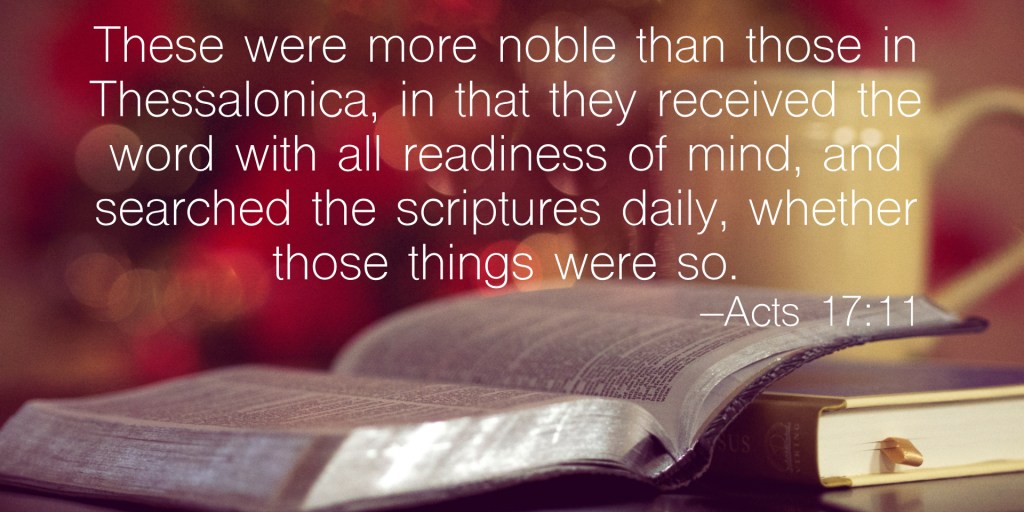
10 The brothers immediately sent Paul and Silas away by night to Berea, [a]and when they arrived, they went into the synagogue of the Jews. 11 Now these people were more noble-minded than those in Thessalonica, [b]for they received the word with [c]great eagerness, examining the Scriptures daily to see whether these things were so. 12 Therefore, many of them believed, [d]along with a significant number of prominent Greek women and men. 13 But when the Jews of Thessalonica found out that the word of God had been proclaimed by Paul in Berea also, they came there as well, agitating and stirring up the crowds.
Word of God for the Children of God
Glory be to the Father,
and to the Son, and to the Holy Ghost;
as it was in the beginning,
is now, and ever shall be,
world without end. Amen, amen.
How do we know if a preacher is doing a good job?
Do we say the preaching is good because it says what we want to hear, or is it good because we hear what the Bible teaches?
Sometimes our understanding of the gospel can grow narrow or get watered down, and we can fail to embrace the whole counsel of Scripture.
Sometimes in our efforts to protect ourselves from deception, we can close ourselves to new insights from Scripture.
Paul and Silas were bringing to the Jews in Berea a new interpretation of the person and mission of the long-awaited Messiah.
They taught that Jesus was the Messiah, that he suffered and died for the sins of the world–and, indeed, for the sins of the Bereans as well.
Instead of resisting or discarding what they heard, the Jews in Berea examined the Scriptures in close detail in order to know if Paul and Silas’s interpretations were true. They had used their available Scriptures as their standard for truth.
Question: What would it look like for the Holy Spirit to be at work in the life of a particular congregation?
In other words, if the Holy Spirit was truly present with us and active among us, what signs or evidences would we see of his presence and activity?
Some would look for passionate singing, people raising their hands in worship, maybe even people bowing down during worship.
These folks would cite a phenomenon like the 2023 “Asbury Revival” in Wilmore, Kentucky.
Best I can tell, the predominant feature of this revival was a prolonged worship service where an ever-changing group of students refused to leave the chapel.
Others (of a more charismatic stripe) would look for some kind of wild activity like people running the aisles, people speaking in tongues, or people laughing hysterically.
Some in this group would look for signs and wonders, people being slain in the Spirit, prophetic words, and dramatic healings.
Still others in this group would expect exorcisms and encounters with demons.
To be clear, my question is less based on experience, more based on Scripture.
Based on the biblical teaching about the person and the work of the Holy Spirit, what would we expect to see, hear, and experience if the Holy Spirit was truly at work in a local congregation.
I think Scripture points us to at least 7 realities.
The people of God will be focused on the Word of God.
Jesus described the Holy Spirit as the “Spirit of truth” who would help the disciples remember the things Jesus taught (John 14-16).
Luke tells us the early church was devoted to the apostles’ teaching (Acts 2:42).
Paul clearly says that the only people who can receive the truth of God are the people who have the Spirit and are taught by the Spirit (1 Corinthians 1:11-16).
Most importantly, the Bible itself claims to be authored by the Holy Spirit working through human authors (2 Timothy 3:16-17, 2 Peter 1:20-21).
Make no mistake, when the Holy Spirit is at work in a church, the Children of God will be hungry – not for dreams and visions and words of prophecy – but the Holy Spirit inspired Word of God.
People will feel deep, genuine, abiding conviction of sin.
In John 16 Jesus spoke plainly about his “going away” so that the Helper could come to the disciples.
Speaking about the Holy Spirit, Jesus promised, “when he comes, he will convict the world concerning sin and righteousness and judgment.” (John 16:8)
Only the Holy Spirit can work conviction that is deep, genuine, and abiding.
In contrast, man is quite capable of manipulating shallow, manufactured, temporary feelings of remorse.
Paul talks about this very issue in 2 Corinthians 7 when he contrasts “godly grief” that is brought about by the Holy Spirit and “worldly grief” that only ends in death. When the Spirit is at work in a congregation, the people in that congregation will experience “godly grief” that leads to repentance and life.
The miracle of regeneration will result in conversions.
In the Old Covenant, the prophet Ezekiel looked forward to the day when the Spirit of God would remove hearts of stone and replace them with hearts of flesh (Ezekiel 36).
He looked forward to a day when the Spirit of God would bring life to those who were hopelessly dead in sin (Ezekiel 37).
That hope was brought to fruition in the work of regeneration (John 3).
Jesus told Nicodemus that no one would see the kingdom unless they were born again, and he explained that this new birth was the work of the Spirit of God.
The new birth is God’s work (1 Peter 1:3), and it is a work that God brings about through the preaching of the Word of truth (James 1:18).
Left to ourselves we are dead in sin, but the miracle of regeneration gives us life that leads to faith in Christ (Ephesians 2:1-10).
When the Spirit is at work, blowing like the wind and granting new birth, people who are dead in sin will be converted and saved.
The people of God will fix their eyes on Jesus.
All too often, churches that boast about the work of the Holy Spirit have their eyes fixed on the Holy Spirit.
Jesus, however, clearly told his disciples that it was the work of the Holy Spirit to glorify the person and work of God the Son – “He will glorify me,” Jesus said (John 16:14).
This focus on Jesus fits perfectly with Paul’s teaching in Romans 8 where we learn that the Holy Spirit is given to us to help us in sanctification.
That is, it is the work of the Holy Spirit to conform the people of God to the image of the Son of God (Romans 8:29).
This is why Paul can say “for those who love God all things work together for good.” (Romans 8:28).
It’s also why the author of Hebrews can confidently call the people of God to fix their eyes – not on the Holy Spirit – but on Jesus, the author and the perfecter of our faith (Hebrews 12:1-2).
When the Spirit is at work in our midst, he will call us to look to Jesus.
The people of God will be serious about killing sin.
Romans 8:13 is one of the most challenging texts in all of Scripture – not because it’s hard to understand, but because of the call it places on our lives.
Paul says, “For if you live according to the flesh you will die, but if by the Spirit you put to death the deeds of the body, you will live.” (Romans 8:13)
This isn’t legalism or Phariseeism or works-based-salvation.
Paul has laid those charges to rest in Romans 3-5.
Paul here is simply explaining what will happen in the life of a person who has trusted in Jesus and received the gift of the Holy Spirit.
They will kill sin.
Paul’s teaching here in Romans 8 is echoed in Galatians 5 and 1 Corinthians 6.
Believers will walk with the Spirit and not according to the works of the flesh.
Believers are the temple of the Holy Spirit, and their lives will increasingly reflect the holiness of the Spirit.
Rest assured, those who are experiencing the ongoing work of the Holy Spirit will be serious about obedience, discipleship, and holiness.
The people of God will be passionate about missions.
After his death and resurrection, Jesus spoke the words we commonly know as “The Great Commission” …
“All authority in heaven and on earth has been given to me. Go therefore and make disciples of all nations, baptizing them in the name of the Father and of the Son and of the Holy Spirit, teaching them to observe all that I have commanded you. And behold, I am with you always to the end of the age.” (Matthew 28:18-20)
How is it that Jesus, who was going away and ascending to heaven, would be “with” his disciples to the end of the age.
Clearly the book of Acts indicates that the promised presence of Jesus became a reality in the sending of the Holy Spirit.
Matthew 28 reminds us that the precious promise about Jesus’ presence is directly tied to the clear command to make disciples.
Thus, those who enjoy the presence of Jesus through the person of the Holy Spirit will be people committed to making disciples of all nations.
The people of God will long for the return of Christ.
Throughout Romans 8, as Paul talks about the work of the Holy Spirit in our sanctification, Paul also points us forward to the future hope of Christ’s return, the resurrection of our bodies, our heavenly inheritance, our final glorification.
Paul points to this future hope in Romans 8:11, reminding us that the Spirit who dwells in us now will raise our bodies in the future work of glorification.
He also points to this hope in Romans 8:17, when he talks about the Spirit’s work of assuring us of our adoption and our future inheritance – an inheritance that will be ours when we are “glorified with him.”
Paul circles back to this point in Romans 8:26-30 where he begins by telling us the Spirit helps us in our weakness and concludes by talking about the certainty of our future glorification.
When the Spirit is at work in a church, that church will long for the return of Christ and the glorification of believers (Revelation 22:20).
We are also challenged today to embrace the wide truth of the entire Scriptures.
The people in Berea, as our text explains, carefully examined the Scriptures to make sure Paul’s teaching was true.
Smart people need to be wise people, and wise people need to be listened to, talked with, questioned, and accepted if what they are saying is the truth.
Have we made God too small?
Have we limited our understanding of Scripture to only the most familiar parts of the Bible?
Have we placed more confidence in our tradition than in the living Word of God?
What is the foundation of our faith and practice?
In the name of God, the Father and God the Son and God, the Holy Spirit …
Praying …
Psalm 119:105-112 New American Standard Bible
Nun
105 Your word is a lamp to my feet
And a light to my path.
106 I have sworn and I will confirm it,
That I will keep Your righteous judgments.
107 I am exceedingly afflicted;
[a]Revive me, Lord, according to Your word.
108 Be pleased to accept the [b]voluntary offerings of my mouth, Lord,
And teach me Your judgments.
109 My [c]life is continually [d]in my hand,
Yet I do not forget Your Law.
110 The wicked have set a [e]trap for me,
Yet I have not wandered from Your precepts.
111 I have inherited Your testimonies forever,
For they are the joy of my heart.
112 I have inclined my heart to perform Your statutes
Forever, even to the end.
Glory be to the Father,
and to the Son, and to the Holy Ghost;
as it was in the beginning,
is now, and ever shall be,
world without end. Amen, amen.

 Loving God, Living God, Loving Hope, Living Hope, Loving Living Life His Way! "Many things are possible for the person who has hope. Even more is possible for the person who has faith. And still more is possible for the person who knows how to love. But everything is possible for the person who practices all three virtues." - Brother Lawrence (1605-1691), Practicing the Presence of God (1692).