
Psalm 90 New King James Version
BOOK FOUR
Psalms 90–106
The Eternity of God, and Man’s Frailty
A Prayer of Moses the man of God.
90 Lord, You have been our [a]dwelling place in all generations.
2 Before the mountains were brought forth,
Or ever You [b]had formed the earth and the world,
Even from everlasting to everlasting, You are God.
3 You turn man to destruction,
And say, “Return, O children of men.”
4 For a thousand years in Your sight
Are like yesterday when it is past,
And like a watch in the night.
5 You carry them away like a flood;
They are like a sleep.
In the morning they are like grass which grows up:
6 In the morning it flourishes and grows up;
In the evening it is cut down and withers.
7 For we have been consumed by Your anger,
And by Your wrath we are terrified.
8 You have set our iniquities before You,
Our secret sins in the light of Your countenance.
9 For all our days have passed away in Your wrath;
We finish our years like a sigh.
10 The days of our lives are seventy years;
And if by reason of strength they are eighty years,
Yet their boast is only labor and sorrow;
For it is soon cut off, and we fly away.
11 Who knows the power of Your anger?
For as the fear of You, so is Your wrath.
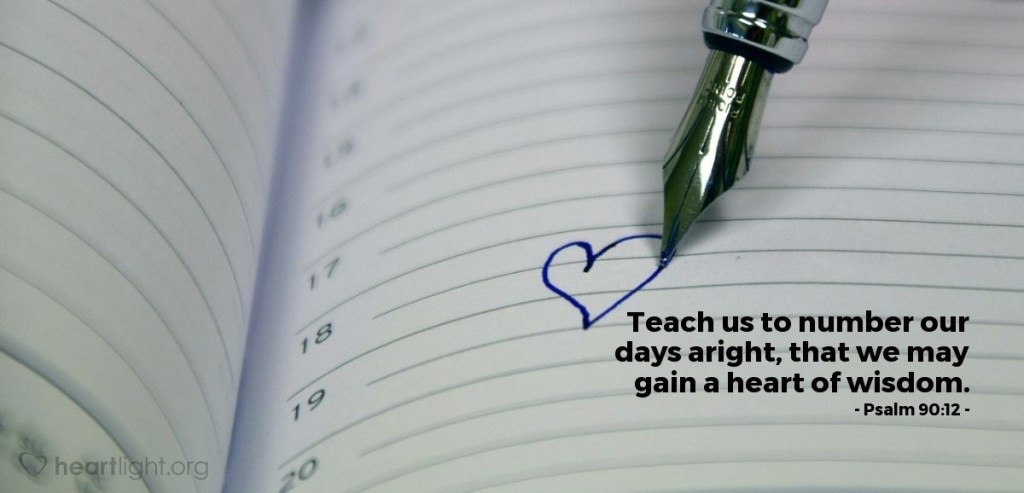
12 So teach us to number our days,
That we may gain a heart of wisdom.
13 Return, O Lord!
How long?
And have compassion on Your servants.
14 Oh, satisfy us early with Your mercy,
That we may rejoice and be glad all our days!
15 Make us glad according to the days in which You have afflicted us,
The years in which we have seen evil.
16 Let Your work appear to Your servants,
And Your glory to their children.
17 And let the beauty of the Lord our God be upon us,
And establish the work of our hands for us;
Yes, establish the work of our hands.
The Word of God for the Children of God.
Glory be to the Father,
and to the Son, and to the Holy Ghost;
as it was in the beginning,
is now, and ever shall be,
world without end. Amen, amen.
As the present year of 2023 draws to a close we are reminded once again of the relentless unstoppable procession of time.
Whether we like it or not, we are being carried onward through the years of our life, until inevitably, in one moment, in one day we’ll finally reach the end of it.
As the years come and and as the days and years go, there comes a day when our time in this world will be no more – our moments, our days, our years, will have passed away for ever into eternity depths, we will never ever see them again.
So what should we do?
Psalm 90:12 Moses prays to God reflecting on his long life (120 years) “So teach us to number our days, that we may apply our hearts unto wisdom.”
Moses had quite the life – born into slavery, set afloat on a river by his mother to protect his life, raised into the royal house of Egypt to the highest places of riches and prestige and military leadership – being groomed to be a Pharaoh.
Then one day, what does not collapse around him?
Realizes his birth origins, returns to his slave family, afflicted by the severity of a life of slavery, kills an Egyptian, runs away a fugitive under a death warrant.
With minimal provisions, he walks, trudges across the sun baked wilderness to a place of refuge called Median where he finds his rest, where he settles down, where he gets married, has children, gets a long term secure job, makes a home for himself and his family – no longer having to think about a murder charge.
Then God shows up – a burning bush – and a mission: “set my people free!”
The mission of all missions – back to Egypt, face the dangers, the Ten plagues.
Servant of God – into the crucible – eighty years old and he must now lead all of those former slaves – all five plus million of them – into the wilderness and to the mountain of God and His laws – but first comes the part where he must lead he must protect, all those five plus million people through the parted Red Sea.
Then he must repeatedly climb up and down mountain peaks, receive the Law of God, deal with all of the impossible messes a golden calf can give raise to.
Intercede with God – to keep God from wreaking His unimaginable wrath on the nation of former slaves-for their impossible measures, degrees of disobedience.
I could go on and on and on – as Moses led this nation an additional 40 years in the wilderness – until standing on the brink, in full view of the promised land, God deliver’s to him the worst possible news for all of his years of leadership:
“Sorry, Moses, you can see the promised land, but you will not enter the land!”
The sum total of all that effort over a life span of 120 years of devout service?
A wonderfully reflective poem – reflecting on God work and our brevity of life.
Reflecting, Numbering Our Days: The Value of Today
Life is filled with opportunities, but the big question is what we do with them.
Do we let them so casually slip by, saying, “Maybe next time. There is always another day”? Expecting to live as long as Moses did-or, should we seize them?
We may not have as much time as we think.
Late English Theologian Dr. Leslie Weatherhead, calculated the average length of a life using the hours of one day to illustrate the importance of recognizing the brevity and value of time.
He concluded that if your age is 15, the time is 10:25 a.m. If your age is 20, the time is 11:34. If your age is 25, the time is 12:42 p.m. If you’re 30, the time is 1:51. If you’re 35, the time is 3:00. If you’re 40 the time is 4:08. At age 45, the time is 5:15. If you’re 50, the time is 6:25. By age 55, the time is 7:24. If you’re 60, the time is 8:42. If you’re 65, the time is 9:51. And if you’re 70 the time is 11 p.m.
Psalm 90:12 reminds us, “Teach us to number our days that we may apply our hearts to wisdom” (NKJV).
Or as the Living Bible puts it, “Teach us to number our days and recognize how few they are; help us to spend them as we should.”
To number your days is to keep careful watch over your time with the same kind of care and attention that we would give to budgeting, balancing your accounts, making sure there are always enough funds to make payments for the housing loan, the utilities, telephone bill, daily provisions, medicine and vehicle costs.
The more limited our income is, the more we would want to ensure that we are making the very best use of it.
‘Numbering our days’ is simply applying that same kind of discipline, but now with time instead of money.
It means optimizing the limited time we have left, planning your activities carefully and deciding what activities deserve more time and what deserve less.
It also means trying to save time whenever possible, so no hour is ever wasted.
As the apostle Paul wrote in Ephesians 5:15,16, we should “walk circumspectly, not as fools, but as wise, redeeming the time, because the days are evil.”
If you do not keep careful track of where your time is spent, you will find it difficult to accomplish everything that you need to do.
You will always be complaining that you do not have enough time.
Perhaps there have been “more than your fair share of those times when the twenty four hours of the day do not seem to be ever enough for you and you’ve heartily wished that you had a few thirty-six hour days or an eight-day weeks.
But the problem is often not a lack of time, but poor time management.
If you find yourself unable to fulfill your responsibilities because of what seems to be a shortage of time, it probably means you’re not managing your time well.
Jesus told the story of a man who went on a journey and left his money with his servants.
This was not an uncommon thing in those days.
A wealthy man or a ruler would have many servants in his household, from those who performed basic labor to those who managed the financial affairs of his household, even his business.
In many cases some of the man’s servants would be better educated and skilled than he was.
Those highly trusted slaves had a virtual free hand within their prescribed areas of responsibility while the owner was at home.
the owner would go on a journey, he would leave full authority in the hands of these key servants, who’d have the ancient equivalent of a power of attorney.
So Jesus described a scenario in which a wealthy man went on a journey and left the key servants in charge of his possessions.
It’s difficult for us to know exactly what sum he left them, but one possibility is that he gave the equivalent of $5,000 to the first servant, $2,000 to the second servant, and $1,000 to the third.
What Are You Investing Your Days & Time In?
What is Jesus’ story saying to us?
I think it’s quite obvious. Jesus is like that wealthy man who goes on a journey, which spans the day he left this earth to the far day he which he returns in the Second Coming.
We are the servants he has invested in, and we are to take what he has given us and use it for his glory while we await his return.
In the New Testament, a word that is often used for “slave” or “servant” is the Greek word doulos.
It’s a term that describes a unique class of servant, not someone who was made that way by constraint or by force.
A doulos was someone who had been freed by their master yet still chose to continue their service out of their love for their master.
The servant was so thankful for this pardon that he or she would willfully choose to serve.
The apostle Paul often referred to himself as a doulos, and that is what we are as followers of Jesus Christ.
Christ has paid an incredible debt for us.
He has pardoned us.
He has forgiven us.
And now we should become his voluntary servants, not because we have to but because we want to – because we love him.
We recognize that he has instilled certain things in our lives that we are to use for his glory.
Certain gifts.
Certain talents.
Certain resources.
Everything.
Paul wrote, “Don’t you realize that your body is the temple of the Holy Spirit, who lives in you and was given to you by God? You do not belong to yourself, for God bought you with a high price. So you must honor God with your body” (1 Corinthians 6:19–20 NLT).
Jesus said, “If any of you wants to be my follower, you must give up your own way, take up your cross daily, and follow me” (Luke 9:23 NLT).
This doesn’t mean that we must take a vow of poverty.
It simply means we recognize that it all belongs to God. Our lives belong to God.
Our families belong to God. Our possessions belong to God. Everything is his.
In Jesus’ story, the first servant took what he had, invested it, and received a 100 percent return.
He doubled his master’s investment.
The second, though he had less, did the same thing.
This demonstrates that it isn’t a person’s talent that matters as much as how he or she uses that talent.
God never demands from us the abilities we don’t have.
But He does demand that we should use, to the full, the abilities that we do possess.
We may not be equal in talent, but we should be equal in effort.
Take what God has given to you, do the most that you can with it for his glory.
God can do a lot with a little.
If you don’t believe me, just ask the boy with the five loaves and two fish who gave everything he had to Jesus.
It didn’t seem like a lot, but Jesus used them to feed a hungry multitude.
Jesus can take a little, bless it and multiply it.
He can use it beyond our wildest dreams.
How to “Number Your Days”
If we will humble ourselves, take what we have and offer it to God, if we will be willing to do to the utmost what He has placed before us and be faithful in the utmost to the little, littler, littlest things, then He will give us more to do.
I would rather try and fail than never try at all.
Any time you take a chance, you can fail.
But it’s better to try than to never take chances and never have anything happen in your life.
So seize the day.
Seize the moment.
Seize the opportunities before you.
Don’t put it off too long, because you may not have as much time as you think.
Be productive with your life.
Be productive with your time.
Seize the opportunities God has given you.
Seize God, the Father!
Seize God the Son!
Seize God the Holy Spirit!
In the name of God, the Father and God the Son and God the Holy Spirit,
Let us Pray,
Psalm 90 The Message
90 1-2 God, it seems you’ve been our home forever;
long before the mountains were born,
Long before you brought earth itself to birth,
from “once upon a time” to “kingdom come”—you are God.
3-11 So don’t return us to mud, saying,
“Back to where you came from!”
Patience! You’ve got all the time in the world—whether
a thousand years or a day, it’s all the same to you.
Are we no more to you than a wispy dream,
no more than a blade of grass
That springs up gloriously with the rising sun
and is cut down without a second thought?
Your anger is far and away too much for us;
we’re at the end of our rope.
You keep track of all our sins; every misdeed
since we were children is entered in your books.
All we can remember is that frown on your face.
Is that all we’re ever going to get?
We live for seventy years or so
(with luck we might make it to eighty),
And what do we have to show for it? Trouble.
Toil and trouble and a marker in the graveyard.
Who can make sense of such rage,
such anger against the very ones who fear you?
12-17 Oh! Teach us to live well!
Teach us to live wisely and well!
Come back, God—how long do we have to wait?—
and treat your servants with kindness for a change.
Surprise us with love at daybreak;
then we’ll skip and dance all the day long.
Make up for the bad times with some good times;
we’ve seen enough evil to last a lifetime.
Let your servants see what you’re best at—
the ways you rule and bless your children.
And let the loveliness of our Lord, our God, rest on us,
confirming the work that we do.
Oh, yes. Affirm the work that we do!
Glory be to the Father,
and to the Son, and to the Holy Ghost;
as it was in the beginning,
is now, and ever shall be,
world without end. Amen, amen.

 Loving God, Living God, Loving Hope, Living Hope, Loving Living Life His Way! "Many things are possible for the person who has hope. Even more is possible for the person who has faith. And still more is possible for the person who knows how to love. But everything is possible for the person who practices all three virtues." - Brother Lawrence (1605-1691), Practicing the Presence of God (1692).