Seeking and Finding the Disconnect in Our Connection with the Lord Our God. Matthew 6:31-34

Matthew 6:31-34 New King James Version

31 “Therefore do not worry, saying, ‘What shall we eat?’ or ‘What shall we drink?’ or ‘What shall we wear?’ 32 For after all these things the Gentiles seek. For your heavenly Father knows that you need all these things. 33 But seek first the kingdom of God and His righteousness, and all these things shall be added to you. 34 Therefore do not worry about tomorrow, for tomorrow will worry about its own things. Sufficient for the day is its own trouble.

The Word of God for the Children of God.

Adeste Fideles! Laeti Triumphantes! Venite Adoremus! Dominum.

Gloria! In Excelsis Deo! Alleluia, Alleluia, Alleluia, Amen.

During a small group Bible Study one night a friend once told me he set his alarm for 6:33 a.m. for a stretch of time during his teenage and young adult years.

He would wake up, put his feet on the floor, see his alarm, and immediately be reminded of Matthew 6:33 and his absolute need to “seek first the kingdom of God and His righteousness.”

To me, it was a pointed example, in one way, of Matthew 6:33 in action.

The question to me then was what impact would it have on someone, anyone who did not know the meaning of “the kingdom of God” (at the time – me) and “His righteousness” and did not know how to “seek” them?

The myriad of ideas floating around about the Kingdom of God is evidence that the devil has successfully deceived millions of people about the true meaning of the Kingdom of God—the center of Jesus’ message.

Even to this day, Satan actively obscures the heart and core of Jesus’ teaching, leading many sincere Christians to confidently say the Kingdom of God is the warm, fuzzy feeling people experience when they “invite Jesus” into their lives.

Yet God’s Word testifies that Jesus preached “the gospel of the kingdom of God”—not just a message about Himself, but the good news of a literal, world-ruling government to be set up on this earth (Mark 1:14).

So, just what is the Kingdom of God, and how does one go about seeking it?

What exactly is “His righteousness”?

What “things” will be added to us if we prioritize seeking the Kingdom and His righteousness?

What does Matthew 6:33 say that believers should do?

Matthew 6:33 is a foundational scripture that directs our focus and attention to what God considers to be the most important goal a person can have.

In order to weave this critical verse into our own lives, we need to have a biblical understanding of its core concepts.

“But Seek First the Kingdom of God”

The New Testament has much to say about the Kingdom of God, but one of the most memorable visions of God’s government replacing human governments can be found in the Old Testament book of God’s Prophet Daniel.

In Daniel chapter 2 Nebuchadnezzar, the ancient king of the Babylonian Empire, dreamed about a great image or statue—presumably of a man—with a head of gold, chest and arms of silver, belly and thighs of bronze, legs of iron, and feet of iron and clay.

But as the dream went on, the image was eventually shattered by a cataclysmic stone (Daniel 2:31-34).

Unsure of the dream’s meaning, Nebuchadnezzar turned to the prophet Daniel for its interpretation.

Under God’s inspiration, Daniel explained, “You [Nebuchadnezzar] are this head of gold. But after you shall arise another kingdom inferior to yours; then another, a third kingdom of bronze, which shall rule over all the earth. And the fourth kingdom shall be as strong as iron . . . and like iron that crushes, that kingdom will break in pieces and crush all the others” (Daniel 2:38-40).

According to Daniel’s interpretation, the statue represented the rise and fall of four great, successive empires.

These empires, or kingdoms, have been identified in history as the Babylonian Empire, the Medo-Persian Empire, Greco-Macedonian Empire and the Roman Empire. 

With this understanding in mind, notice what Daniel said about the symbolism of the stone that came and broke the image:

“And in the days of these kings the God of heaven will set up a kingdom which shall never be destroyed; and the kingdom shall not be left to other people; it shall break in pieces and consume all these kingdoms, and it shall stand forever” (Daniel 2:44, emphasis added throughout).

This kingdom that “stands forever” is the Kingdom of God, a literal kingdom with territory, subjects, laws and rulers just like the other great empires.

The Kingdom of God will be:

  • Set up here on earth (territory).
  • Ruling over and serving human beings (subjects) during Christ’s millennial reign.
  • Governed through God’s commandments and statutes (laws).
  • Ruled by Christ and the saints (rulers).

The Kingdom of God is not figurative nor is it another way of saying going to heaven, as many passionately argue.

It is the very real government of God to be established here on earth at Christ’s return.

Those who will inherit God’s Kingdom are called the “saints of the Most High,” they will “possess the kingdom forever, even forever and ever” (Daniel 7:18).

To “seek” that Kingdom is to have a strong desire to enter it—a willingness to go to any length to do so.

Matthew 6:33 tells us that this must be the main priority of a Christian’s life.

“And His Righteousness”

After instructing His followers to prioritize the Kingdom of God, Rabbi Jesus added that they also need to prioritize not just any kind of righteousness, but “His righteousness” – His righteousness meaning God’s righteousness.

What is the biblical definition of God’s righteousness? 

Psalm 119:172 says, “All Your commandments are righteousness.”

Take careful notice that the verse does not say “a few” “some” or “half” or “two thirds” “three quarters” “nine out of 10” (excluding the commandment to keep the Sabbath day holy), but rather it says “all” of God’s commandments.

Understanding the biblical definition of righteousness, this verse could read: “Seek first the Kingdom of God and obey all His commandments.”

Unfortunately, obedience is a very unpopular message in a society where people are obsessed with the idea of freedom to do whatever they please, no matter how much harm that kind of liberty may pose to themselves or others.

The result is people who lack self-esteem, self-respect and lack any respect for any authority figure and contemptibly refuse to yield one inch to that authority.

Many of the laws of the land—let alone God’s laws—have become more of a suggestion than anything mandatory.

They’re viewed as something that is optional for those who “feel” like obeying.

People nowadays bristle at the idea of someone else telling them what to do.

Yet the Bible is replete with scriptures that prove, beyond a shadow of a doubt, obedience to God’s law is absolutely necessary to be a true Christian.

Here is one of the plainest of those scriptures: “He who says, ‘I know Him,’ and does not keep His commandments, is a liar, and the truth is not in him” (1 John 2:4).

For those who follow the clear teachings of Scripture and value obedience, there is a special blessing in place.

Take extra careful notice of Revelation 22:14: “Blessed are those who do His commandments, that they may have the right to the tree of life, and may enter through the gates into the city.”

The blessing is entry into the Kingdom of God.

That is the reward for those who seek God’s righteousness.

Righteousness and the Kingdom of God are inextricably linked together!

“And All These Things Shall Be Added Unto You”

To know what this part of the verse refers to, we have to examine the context.

Matthew 6:25-32 New King James Version

Do Not Worry

25 “Therefore I say to you, do not worry about your life, what you will eat or what you will drink; nor about your body, what you will put on. Is not life more than food and the body more than clothing? 26 Look at the birds of the air, for they neither sow nor reap nor gather into barns; yet your heavenly Father feeds them. Are you not of more value than they? 27 Which of you by worrying can add one [a]cubit to his [b] stature?

28 “So why do you worry about clothing? Consider the lilies of the field, how they grow: they neither toil nor spin; 29 and yet I say to you that even Solomon in all his glory was not [c]arrayed like one of these. 30 Now if God so clothes the grass of the field, which today is, and tomorrow is thrown into the oven, will He not much more clothe you, O you of little faith?

31 “Therefore do not worry, saying, ‘What shall we eat?’ or ‘What shall we drink?’ or ‘What shall we wear?’ 32 For after all these things the Gentiles seek. For your heavenly Father knows that you need all these things.

In verses 25-32 Jesus instructs His disciples not to fret or be anxious about the physical necessities of life.

Food, water and clothing and shelter will always be the very basic must-haves for our very good health and happiness as long as we are living human beings.

But prioritizing any single one of these things or all of them over a disciplined life of prayer, study, obedience and a close relationship with God would be a potentially dangerous misallocation of our focus and attention upon our God.

In reassuring fashion, Jesus reminded His disciples,

“Do not worry, saying, ‘What shall we eat?’ or ‘What shall we drink?’ or ‘What shall we wear?’ . . . For your heavenly Father knows that you need all these things.”

“Father” is a fitting description of our loving God!

God could have designated Himself using any number of titles, but Father communicates His authority, strength and, most of all, His tender love.

The Sermon on the Mount can, in some ways, be seen as an explanation of why God is called our Heavenly Father.

Again and again throughout Matthew 5-7, we vividly see God’s function as our ultimate provider. 

Recognizing God’s commitment to protect and look out for His children is what this part of Matthew 6:33 is all about.

Again, please take careful notice of Matthew 7:9-11:

“Or what man is there among you who, if his son asks for bread, will give him a stone? Or if he asks for a fish, will he give him a serpent? If you then, being evil, know how to give good gifts to your children, how much more will your Father who is in heaven give good things to those who ask Him!”

The point is, God always knows.

God always sees.

God is not blind to our needs or desires.

God promises to provide for the physical necessities of this life if we prioritize His Kingdom and His righteousness.

Please look to these life transformative scriptures and claim God’s promises if you have been seeking God with your whole being but find you are struggling to make ends meet and are overwhelmed with life’s demands.

What Does Matthew 6:33 Really Mean?

In a nutshell, Matthew 6:33 serves as every Christian’s marching orders.

Our ability to seek first God’s Kingdom and His righteousness can be hampered if we become entangled with the cares of this life.

Nonetheless, diligently, prudently, regularly practicing spiritual disciplines like fellowship, and prayer, Bible study, meditation and the occasional fast can help refocus our minds, support the notion of reprioritizing on what matters most.

As much or as little we strive do our part to make our relationship with God our highest priority, God will surely do His part to provide for our every need, which is something we can count on.

This means always putting Him first in our lives, even the first few moments of our day.

He is the One who graciously woke us up, gave us the breath in our lungs, and provided us the opportunity to live another day.

He deserves our fullest possible measure of devotion the moment our eyes pop open, even if it is a mere “thank you, God” before our feet even hit the floor.

Intersecting Faith and Life and Matthew 6:33

As we strive to figure out life in the great information age, we are bombarded with an infinite measure of opportunities to fill our time and our minds with many things that can so easily replace our time of fellowship with the Lord.

The information available to us, literally at our fingertips, at all times, is a wonderful gift, but that mobile device we carry around in our purses and pockets can also be a mobile distraction that follows us everywhere we go.

Although our cell phones, smartphones, tablets, laptops, etc. are not evil, I do believe we need to be extra cautious as to how much time we devote to them.

We need to be more aware of where we are directing our focus.

We need to be attentive to what is “moving in” and capturing our attention.

Perhaps you may not have an issue with technology distracting you from the Lord- that’s great!

Stay strong and become an accountability partner for those around you who have easily pulled away from the things of God because of the ever-increasing information age.

But if you are like me (a stay-at-home/work-from-home, caregiving retired person,) you are finding yourself with limited time to spend with Jesus in prayer and the Word, I challenge you to prioritize seeking out the Lord if there is some way you can arrange in your schedule to allow better time management.

Also, ask Him if perhaps He would like for you to prioritize a fast (technology, that is) something which could be causing a division between you and Him. 

Prioritize devoting specific time every day to spend some quiet time in quiet fellowship with God and reading your Bible, without your cellphone or iPad within reach- to “turn them off” during that time and perhaps put a timer on the most-used apps that you access throughout your day.

Be thankful for the benefits of the tools and global connections that technology brings us, but also do not allow this technology to rob you of your connection to Jesus – un-connect technology for a while, refocus, reconnect with the Lord!

Always keep the Kingdom of God and His righteousness at the forefront of life.

“But Put God First” — That is the life-changing meaning of Matthew 6:33.

In the name of God, the Father and God the Son and God the Holy Spirit,

Let us Pray,

Sovereign Majesty, God and Ruler over all creation, since the beginning of time you have been our Provider, our Refuge, our Shelter, Defender, Protector and Redeemer. Your covenant with the human race, is from everlasting to everlasting and all that we possess and will ever possess, comes from you. Father, we have sinned greatly against you, but being a God of Righteousness, you have exhibited and manifested your steadfastness and faithfulness which prevails forever, through which we are saved, when we turn all of us over to you with fervent hearts and complete trust.

Your unshakable promises reflects your perfect attributes, for whatever we do in our arrogant and sinful nature makes your incomprehensible compassion more evident, proving you will never abandon us, will rescue all who are lost. Jesus has revealed to us the honor and glory of his Father, and we have the assurance that you will never leave us orphans, but have, through your plan of Redemption and Eternal Salvation, obediently fulfilled by Jesus your only Son, made us citizens, co-heirs of heaven.

By our deep faith, our belief, our resolve to focus on you and to obediently follow your Divine Providence for us, knowing that you have provided and taken care of all our needs, we concentrate on studying the right path to heaven, and promote your kingdom in the world, to bring hearts into subjection to your Will. We seek only your Holy Grace and hope to bring others to the obedience of faith, for we need not worry about the things of this world, since you have bestowed upon us all that we need and our only hope is in beholding your beatific face and be added to the ranks of the elite of your kingdom, in blessed, in highest possible exaltation of Jesus’ Name. Amen

Adeste Fideles! Laeti Triumphantes! Venite Adoremus! Dominum.

Gloria! In Excelsis Deo! Alleluia, Alleluia, Alleluia, Amen.
https://translate.google.com/

Holy God, Do We Truly Know What it Means to Be Holy as Our God is Holy? 1 Peter 1:13-21

1 Peter 1:13-21 English Standard Version

Called to Be Holy

13 Therefore, preparing your minds for action,[a] and being sober-minded, set your hope fully on the grace that will be brought to you at the revelation of Jesus Christ.  14 As obedient children, do not be conformed to the passions of your former ignorance, 15 but as he who called you is holy, you also be holy in all your conduct, 16  since it is written, “You shall be holy, for I am holy.” 17 And if you call on him as Father who judges impartially according to each one’s deeds, conduct yourselves with fear throughout the time of your exile, 18 knowing that you were ransomed from the futile ways inherited from your forefathers, not with perishable things such as silver or gold, 19 but with the precious blood of Christ, like that of a lamb without blemish or spot. 20 He was foreknown before the foundation of the world but was made manifest in the last times for the sake of you 21 who through him are believers in God, who raised him from the dead and gave him glory, so that your faith and hope are in God.

The Word of God for the Children of God.

Adeste Fideles! Laeti Triumphantes! Venite Adoremus! Dominum.

Gloria! In Excelsis Deo! Alleluia, Alleluia, Alleluia, Amen.

God is holy, and God wants us to be holy as well.

The more holy we become, the closer relationships we can enjoy with God.

But what does it really mean to be holy?

Thankfully, we do not have to rely on our strength to pursue holiness, because Jesus meets us exactly where we are and helps us, moves us to achieve holiness.

Here’s what it means to be holy, what the Bible says about holiness, and how to pursue holiness in our everyday lives. 

What Does the Bible Say about Holiness?

The biblical definition of “holy” is someone who is sacred – set apart spiritually for a good purpose.

In the Old Testament, the Hebrew word qodesh is used for “holy.”

Leviticus 19:2 ESV “Speak to all the congregation of the people of Israel and say to them, You shall be holy, for I the Lord your God am holy.

https://www.blueletterbible.org/esv/lev/19/2/t_conc_109002

https://www.blueletterbible.org/lexicon/h6918/esv/wlc/0-1/

In the New Testament, the Greek word “hagios” represents “holy.”

Revelation 4:8 ESV

And the four living creatures, each of them with six wings, are full of eyes all around and within, and day and night they never cease to say,

“Holy, holy, holy, is the Lord God Almighty,
    who was and is and is to come!”

https://www.blueletterbible.org/esv/rev/4/8/t_conc_1171008

https://www.blueletterbible.org/lexicon/g40/esv/mgnt/0-1/

The meanings of both “qodesh” and “hagios” are similar, with both words indicating separateness for the purpose of purity.

Holy people, in the biblical sense, are those who are devoted to God.

They make their relationships with God their top priority by living lives that are set apart from the secular and centered around what’s sacred.

The Bible says that God is holy. 

1 Samuel 2:2 proclaims God as the ultimate model of holiness: “There is no one holy like the LORD; there is no one besides you; there is no Rock like our God.” 

Isaiah 6:1-3 describes angels in heaven worshiping God for his holiness:

“I saw the Lord, high and exalted, seated on a throne; and the train of his robe filled the temple. Above him were seraphim, each with six wings: With two wings they covered their faces, with two they covered their feet, and with two they were flying. And they were calling to one another: ‘Holy, holy, holy is the LORD Almighty; the whole earth is full of his glory.’” 

Psalms 29:2 urges people to worship God for his holiness: “Ascribe to the LORD the glory due his name; worship the LORD in the splendor of his holiness.” 

Since God is holy, the Bible says, he wants us to be holy in our relationships with him.

God tells us in Leviticus 20:7-8: “Consecrate yourselves and be holy, because I am the Lord your God. Keep my decrees and follow them. I am the Lord, who makes you holy.”

He says in Leviticus 11:44: “I am the LORD your God; consecrate yourselves and be holy, because I am holy…”

The apostle Peter refers back to that verse in 1 Peter 1:15-16: “But just as he who called you is holy, so be holy in all you do; for it is written: ‘Be holy, because I am holy.’” 

Hebrews 12:10-11, 14-15 reveals that holiness is necessary, so God teaches us how to pursue it:

“…God disciplines us for our good, in order that we may share in his holiness. No discipline seems pleasant at the time, but painful. Later on, however, it produces a harvest of righteousness and peace for those who have been trained by it. … Make every effort to live in peace with everyone and to be holy; without holiness, no one will see the Lord. See to it that no one falls short of the grace of God and that no bitter root grows up to cause trouble and defile many.” 

We have all the help we need to be holy through our relationships with Jesus, who imparts his holiness onto us when we trust him for our salvation. 

2 Corinthians 5:21 explains: “God made him who had no sin to be sin for us, so that in him we might become the righteousness of God.”

Jesus tells us in Matthew 5:48: “Be perfect, therefore, as your heavenly Father is perfect.” 

Luke 1:68, 74-75 celebrates the fact that Jesus works redemption in our lives so we can be holy: “Praise be to the Lord, the God of Israel, because he has come to his people and redeemed them. … to rescue us from the hand of our enemies, and to enable us to serve him without fear in holiness and righteousness before him all our days.”

So does Ephesians 1:3-7: “Praise be to the God and Father of our Lord Jesus Christ, who has blessed us in the heavenly realms with every spiritual blessing in Christ. For he chose us in him before the creation of the world to be holy and blameless in his sight. In love, he predestined us for adoption to sonship through Jesus Christ, in accordance with his pleasure and will – to the praise of his glorious grace, which he has freely given us in the One he loves. In him, we have redemption through his blood, the forgiveness of sins, in accordance with the riches of God’s grace.” 

Hebrews 7:24-26 reveals that Jesus always intercedes for us with our holy God: “…because Jesus lives forever, he has a permanent priesthood. Therefore he is able to save completely those who come to God through him, because he always lives to intercede for them.  Such a high priest truly meets our need – one who is holy, blameless, pure, set apart from sinners, exalted above the heavens.” 

Titus 3:3-7 emphasizes that God helps us be holy because of his mercy, not because of our own behavior:

“At one time we too were foolish, disobedient, deceived and enslaved by all kinds of passions and pleasures. We lived in malice and envy, being hated and hating one another. But when the kindness and love of God our Savior appeared, he saved us, not because of righteous things we had done, but because of his mercy. He saved us through the washing of rebirth and renewal by the Holy Spirit, whom he poured out on us generously through Jesus Christ our Savior, so that, having been justified by his grace, we might become heirs having the hope of eternal life.”

What Does it Mean to be Holy?

So, we can be holy by living pure lives, as God calls us to do and helps us do. 

1 Thessalonians 4:7 points out: “For God did not call us to be impure, but to live a holy life.” We simply have to trust Jesus, who has set us free from sin, to help us live holy lives. 

Romans 6:19, 22 says: “…Just as you used to offer yourselves as slaves to impurity and to ever-increasing wickedness, so now offer yourselves as slaves to righteousness leading to holiness. …But now that you have been set free from sin and have become slaves of God, the benefit you reap leads to holiness, and the result is eternal life.” 

One way which Jesus helps us be holy is by showing us a simple way to pursue holiness, so we don’t need to become overwhelmed or discouraged by trying to be holy.

Jesus tells us simply to focus on loving God, loving other people day by day. 

Matthew 22:36-40 records Jesus’ reply when asked about God’s holy law: “‘Teacher, which is the greatest commandment in the Law?’ Jesus replied: ‘Love the Lord your God with all your heart and with all your soul and with all your mind. This is the first and greatest commandment. And the second is like it: Love your neighbor as yourself. All the Law and the Prophets hang on these two commandments.’”

Jesus also helps us with other ways to pursue holiness in our everyday lives.

He is always available for us to rely on for encouragement and strength in our quest for greater holiness. 

Romans 8:28-30 describes how God confirms us to the image of Jesus as we grow in holiness:

“And we know that in all things God works for the good of those who love him, who have been called according to his purpose. For those God foreknew, he also predestined to be conformed to the image of his Son, that he might be the firstborn among many brothers and sisters. And those he predestined, he also called; those he called, he also justified; those he justified, he also glorified.” 

Being holy means centering our lives around our relationships with Jesus and following his example of holiness as best we can.

Along the way, we’ll sometimes make mistakes, but we’ll also keep growing in holiness as long as we keep trusting Jesus to help us.

As Jesus tells us in John 16:33: “…in me you may have peace. In this world, you will have trouble. But take heart! I have overcome the world.” 

How to Pursue Holiness in Our Everyday Lives

The disciplined pursuit of holiness is a lifelong journey that consistently leads us closer to God.

Here are three key ways to discipline ourselves to pursue holiness day by day:

Live in awe of God’s inspiring holiness. 

We can seek God’s wonder in our lives and allow that to reveal new facets of his majestic holiness to us. 

Exodus 15:11 says of God: “Who among the gods is like you, LORD? Who is like you – majestic in holiness, awesome in glory, working wonders?”

As we’re inspired with awe because of God’s holiness, that can motivate us to move closer to God by growing in holiness ourselves.

The Bible points out that living in awe of God is the beginning of wisdom, and when we are living with wisdom, we naturally become more holy.

Confess and repent regularly. 

Rather than allowing sin to accumulate in our lives and corrupt us, we can regularly confess our sins to God and repent by turning away from sin and turning toward God.

As we make that choice and learn from our mistakes, we will purify ourselves so we can become more holy. 

2 Corinthians 7:1 urges: “Therefore, since we have these promises, dear friends, let us purify ourselves from everything that contaminates body and spirit, perfecting holiness out of reverence for God.”

Then, as we encounter new temptations to sin, we can trust God to help us to overcome temptation moving forward. 

Pursue the fruit of the Spirit. 

We can also ask the Holy Spirit regularly to help us grow more holiness in our lives by renewing our minds. 

Ephesians 4:22-24 points out: “You were taught, with regard to your former way of life, to put off your old self, which is being corrupted by its deceitful desires; to be made new in the attitude of your minds; and to put on the new self, created to be like God in true righteousness and holiness.”

The Holy Spirit will help us renew our minds (Romans 12:2)

and cultivate attitudes of holiness in us that are called the fruit of the Spirit (Galatians 5:22-23). 

Conclusion

Psalm 139:23-24 English Standard Version

23 Search me, O God, and know my heart!
    Try me and know my thoughts![a]
24 And see if there be any grievous way in me,
    and lead me in the way everlasting![b]

The Holiness of God matters!

Our Personal Holiness matters to God

Holiness is an important quality of God, which God wants us to cultivate in our relationships with Him.

Although we will always make mistakes in this fallen world, we do not have to worry that holiness isn’t attainable.

We can live holy lives as we discipline ourselves to read and study the Word of God, fellowship with each other, fervently to trust Jesus to help us day by day.

The more we seek God’s Kingdom over the world, faithfully discipline ourselves to grow, mature in personal holiness, the closer to our faithful God we become.

Personal holiness is something that should deeply matter to everyone and it’s something to celebrate in the undeniable, indescribable beauty of God’s Son!

In the name of God, the Father and God the Son and God the Holy Spirit,

Let us Pray,

Heavenly Father, Your Word commands us to, “be holy as You are holy”, and I know that in and of myself I cannot live in true holiness of heart, except as the Lord Jesus lives His life in me, and the Holy Spirit carries out a life-transforming work in me.
 
Thank You, Father Almighty, Creator of Heaven and Earth that I have been born into Your family, united together with Christ Jesus and I am one with Him. I pray that increasingly, His nature and character may be developed in me, until I can say as Paul did, “my old self has died and been crucified with Christ, and it is no longer I that live, but Christ that lives His resurrection life in me and works through me.”
 
Creator God, Author of my life, Perfecter of my Faith I ask You would continue to root out all of me that is counter to what You desire from me, and I pray that You would increasingly transform me into the image and likeness of the Lord Jesus, day by day.

 
Lord, I know that this is not an easy prayer to pray even once let alone every day and it will likely cause me much grief, sorrow and pain, but I believe that this is the will for each of Your children, and so I come to You today and say, Father, Your will be done in my life. Give me I pray, that desire and grace to become a living sacrifice, holy and acceptable unto You, to Your praise and glory. This I ask in Jesus’ name.

Adeste Fideles! Laeti Triumphantes! Venite Adoremus! Dominum.

Gloria! In Excelsis Deo! Alleluia, Alleluia, Alleluia, Amen.
https://translate.google.com/

For God’s Sake, Let Us Speak! Testify! Witness! Let us Be Holy! For the Lord Our God is Holy. Leviticus 19:1-4

Leviticus 19:1-4 Common English Bible

Living as holy people

19 The Lord said to Moses, Say to the whole community of the Israelites: You must be holy, because I, the Lord your God, am holy. Each of you must respect your mother and father, and you must keep my sabbaths; I am the Lord your God. Do not turn to idols or make gods of cast metal for yourselves; I am the Lord your God.

The Word of God for the Children of God.

Adeste Fideles! Laeti Triumphantes! Venite Adoremus! Dominum.

Gloria! In Excelsis Deo! Alleluia, Alleluia, Alleluia, Amen.

Though it is often ridiculed by those that have not read it, or misunderstood by those who do not have spiritual discernment, the fourth book of the Torah, Leviticus, is a book that directly concentrates its readers upon holiness – the 100% ultimate holiness of God and the need for the nation of Israel to be holy. 

“You shall be holy,”  God informed His chosen nation through Moses.

“You shall be holy, for I the LORD your God am holy.” Leviticus 19:2

From start to finish, Leviticus is a book that points the faithful to Christ.

He is pictured in the perfect Law of Moses in many ways, and by careful reading and studying its words, He can be identified in the various sacrificial offerings.

The person and work of Christ can also be seen in the holy articles of the Tabernacle, the function of the priesthood, and the feasts of the Lord.

The book of Leviticus points to Christ in many ways – for His “One and Done” atoning sacrifice of his own blood alone forever takes away the sin of the world.

Jesus is the Second Person of the Trinity, Who was fully and finally, ultimately revealed to the world through the birth, life, death, and Resurrection, Ascension of the Lord Jesus Christ.

He is undeniably the eternal Son of God, Who did tabernacle among us, for a time and a season while He walked and talked and who had taught, healed and ministered unto the ancient people of the early first century Israel.

He is the perfect Word of God made flesh, through Whom the world was made and in Whom is life eternal, through which darkness and death have no power.

He is the eternal Lamb of God, Who takes away the sin of the world.

And He is the sinless Son of Man, Who was sent by His Father to live among us, to set the example of life, set aside His heavenly glory to become like one of us.

Jesus is the Second Person of the immortal, invisible, almighty, HOLY God.

He is the only Member of the Holy Trinity Who was clothed in human flesh, so sinful men and women might be saved by grace – through faith in His sacrificial work at Calvary.

Throughout the Hebrew [Old] Testament, God gradually revealed His character, His attributes, His name, His miraculous redemptive plan for mankind, through the writings of specifically anointed holy men of God, many prophetic voices.

But in these last days, God has spoken to us in His Son, Whom He appointed Heir of all things, and through Whom also He made the world.

However, hidden deep within the pages of the Hebrew [Old] Testament, are many concealed references to Christ Jesus.

For those with eyes to see and a teachable spirit, we discover many ‘types’ and pictures of His person, His mission, His atoning work, and His supernatural life.

Numerous prophecies give details of His coming to earth as a newborn babe in a manger in Bethlehem, His ministry on earth, His sacrificial death, His glorious Resurrection, His ultimate victory over sin, over death and ultimately, Satan.

And Scripture records His coming millennial rule as King of kings and Lord of lords, for He is God’s appointed Messiah of Israel, He is the Savior of the world.

Moses was one such prophetic voice in Scripture, and he was inspired by God to write the book of Leviticus.

He was the man that God chose to become the first great leader of His people.

He was God’s anointed mouthpiece unto Pharaoh and the one who finally led millions of God’s redeemed people out of Egypt, on that first Passover night.

It was Moses through whom the Law was first written down and given to God’s chosen nation, and it was Moses who led, guided, directed, and instructed His people how to live as God’s own people, if they were to receive God’s blessings.

It was Moses who warned them what would happen if they disobeyed the Lord’s command and Moses was instructed by God to

“Speak to all the congregation of the sons of Israel and say to them, ‘You shall be holy, for I the LORD your God am holy.'”

Israel was to be set apart from the gentile nations.

They were to be a separated nation, a covenanted people, an atypical race that was holy to the Lord.

They were to be God’s unique nation and a people for His own possession.

They were chosen out of all the people groups who live on the face of the earth, to have a holy relationship with the one and only, holy God.

Israel was to be a holy people unto the Lord their God.

They were to be sanctified unto the Lord – a peculiar people unto Himself.

They were to be an example of a nation that was consecrated to God.

Israel was to be God’s earthly light to the pagan nations and an example of a holy community, who honored the Lord.

They had seen God move before them as pillars of fire and smoke and they had witnessed the mighty miracles that decimated their proud Egyptian overlords.

They had made a covenant with the Lord and had promised to do all that the Lord had commanded – which is why God said to Moses, 

“speak to all the congregation of the sons of Israel and say to them, ‘You shall be holy, for I the LORD your God am holy.'”

The call to holiness still stands for Christians in this epoch of the grace of God.

Like Israel, we are also instructed to be obedient children who are to be holy unto the Lord.

Like them, we are not to be conformed to the lusts of the flesh and pride of life.

Like Israel we are also instructed to be holy ourselves also in all of our behaviors – because as it was covenanted and written then and is still covenanted, written for us today, “You shall be holy, for I am holy.”

As God’s “Holy” People in the World Today?

Proverbs 27:17-19 Common English Bible

17 As iron sharpens iron,
    so one person sharpens a friend.
18 Those who tend a fig tree will eat its fruit,
    and those who look after their master will be honored.
19 As water reflects the face,
    so the heart reflects one person to another.

When God created us, He created us in His image.

Because we are, we should reflect every aspect of who He is because His image in stamped and engraved in us.

In Leviticus 19:2 God instructs Moses to tell the Children of Israel to be holy because God is holy.

That applies to us today as well.

Our words should be holy.

Our actions should be holy.

Our thoughts should be holy.

The way we live should be holy.

Other characteristics of God includes: merciful, forgiving, grace, truthful, keeps his promises, righteous, just, faithful, and unconditional and unfailing love.

As beings created in our Creator’s image, we should reflect these attributes in our everyday lives.

Colossians 3:10 says, “And have put on the new self, which is being renewed in knowledge after the image of its creator.”

And in Ephesians 4:24, Paul wrote, “And to put on the new self, created after the likeness of God in true righteousness and holiness.”

In Proverbs 27:19, Solomon wrote, “As water reflects the face, so the heart reflects the person.”

Whatever is living in and within our hearts is what is reflected in our lives.

Is our heart reflecting the holiness of God and His attributes/characteristics?

In the name of God, the Father and God the Son and God the Holy Spirit,

Let us Pray,

God, my Heavenly Father, thank You for the uncountable, invaluable lessons that Your Church can learn through the history of Israel and for the many types and pictures of Jesus that are hidden within the sacred pages of Scripture. Thank You that like Israel, I have also been called to be holy, because You are holy. It is humbling to realize that as part of Christ’s Body, we have also been chosen, in Him, to be kings and priests unto God – to be a chosen people, who tell the world that Jesus died for their sin and rose again, so that by faith in Him we may be holy, as He is holy. Thank You that by faith in Christ, I have been called to be Your very own, and to proclaim the wonderful deeds of Him Who called me out of darkness into His marvelous light. May I live and work from this day forward, to be more like Jesus, and to live a holy life that is separated from this fallen world system. In Jesus’ name I pray, AMEN.

Adeste Fideles! Laeti Triumphantes! Venite Adoremus! Dominum.

Gloria! In Excelsis Deo! Alleluia, Alleluia, Alleluia, Amen.
https://translate.google.com/

While We Are All Walking By Faith and Not By Sight, Are We Pondering any Prayers for Our Blindly Leaning, into Our Never to be Seen God’s Equipping? 2 Corinthians 5:7

2 Corinthians 5:6-10 Easy-to-Read Version

So we always have confidence. We know that while we live in this body, we are away from the Lord. We live by what we believe will happen, not by what we can see. So I say that we have confidence. And we really want to be away from this body and be at home with the Lord. Our only goal is to always please the Lord, whether we are living here in this body or there with him. 10 We must all stand before Christ to be judged. Everyone will get what they should. They will be paid for whatever they did—good or bad—when they lived in this earthly body.

The Word of God for the Children of God.

Adeste Fideles! Laeti Triumphantes! Venite Adoremus! Dominum.

Gloria! In Excelsis Deo! Alleluia, Alleluia, Alleluia, Amen.

“Life is a Journey, Not a Destination”

Ralph Waldo Emerson said, “Life is a journey, not a destination.”

While each one of us on a journey in life, that journey does lead to a destination – either eternal life in heaven, or eternal torment in hell.

But our devotional text from 2 Corinthians 5:7, focuses on the journey.

Paul wrote to the young, heavily divided and struggling Corinthian church and said, “For we walk by faith, not by sight.”

Whether we are a believer in God, or we do not believe in God, or we are right now struggling to believe or to continue to believe, every individual must now choose which path their journey will take – the path of life or the path of sight.

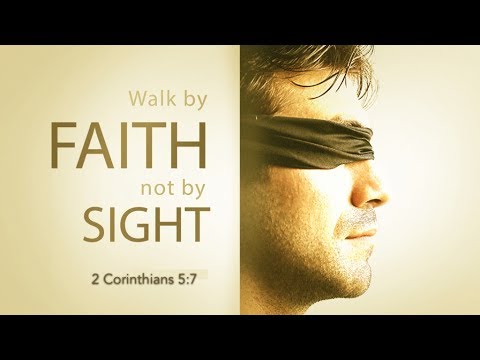
Walking by faith, living by believing in what will happen as opposed to seeing what will happen is like our leaving our homes, taking journey with a blindfold on, “walking in some direction” and trusting God to get you He’s leading you.

But if you leave your home, look at and pick your own direction, you walk by sight where you want to go, then you see the path and each step along the way.

You see what is before you – you see the potential obstacles, the potential risks and the potholes and the pitfalls – you see them and then automatically avoid.

But, how does all that change if you cannot see where you are going?

If you cannot assess the quality of the terrain and the environment you travel?

You can’t see the raised portions of the side walks which present a trip hazard?

You cannot see the puddles of water sure to get your socks, shoes and feet wet?

Where are the curbs you need to stop at to avoid walking into oncoming traffic?

Walking by what we can see is easy and such listed obstacles and threats to our physical health and spiritual wellbeing are otherwise so very easily avoidable.

Paul understood well this analogy on the Damascus Road when he went from walking by faith and fury after the new followers to sudden blindness courtesy of the risen Jesus when Paul encountered, experienced the very brightest light.

Suddenly and without explanation and with no time for defense of self, he was blinded by the incomparable light of the risen Jesus.

Now he could no longer rely on his vast knowledge of himself, his own survival skills to live and visually walk his own path and road from one town to another.

In an instant he was full of all the self confidence in the world, then reduced to that anxious and fearful someone who needed help with literally everything.

From immediate instant confidence into an immediate, instant helplessness.

He had no idea when or if ever he would regain his sight.

He had to figure out what all that change meant to the rest of his life.

And standing there on that Damascus Road, the risen Jesus left him with no instructions, no road maps, no guide books, no walking sticks, no nothing!

His companions took him to someone’s home and there Saul sat – in Prayer and in Fasting until some response was to come from somewhere, somehow.

The operative thing we each need to see is the choice of responses Saul had available to him and how he how fast and how instinctively he chose prayer.

We read nowhere in the Word of God Saul went into wild, flailing, hysterics.

His first instinctive response was to the spiritual disciplines of prayer, fasting.

How about our own most instinctive, most immediate response to any crisis?

Praying and Leaning into God’s Equipping

2 Corinthians 5:7 Easy-to-Read Version

We live by what we believe will happen, not by what we can see.

It is always disheartening to feel as though I have reached a significant point in my journey only to ask, “Now what, Lord?”

God has put a desire in my heart to write for Him which I cannot calm.

I wrestle and fight, clawing for any direction or insight or wisdom not my own.

God tells me to listen, watch, do the next thing, and wait. 

He reminds me not to worry about the future, but to wait on Him.

Obediently, I try my best to research, learn, write, pursue, listen, follow …and wait. 

I choose to trust Who is leading me, even when it feels like I am always walking with blinders on, I have no walking stick to use and I can’t see and cannot know and cannot watch the results of my efforts unfold before me and my own eyes.

God gave me the desire to write and keep right on writing, but it is up to me to raise up every morning to pray and to fast and to study, to put all the work in.

A work He promised to equip me for!  

Isaiah 55:8-11 Easy-to-Read Version

People Cannot Understand God

The Lord says, “My thoughts are not like yours.
    Your ways are not like mine.
Just as the heavens are higher than the earth,
    so my ways are higher than your ways,
    and my thoughts are higher than your thoughts.

10 “Rain and snow fall from the sky
    and don’t return until they have watered the ground.
Then the ground causes the plants to sprout and grow,
    and they produce seeds for the farmer and food for people to eat.
11 In the same way, my words leave my mouth,
    and they don’t come back without results.
My words make the things happen that I want to happen.
    They succeed in doing what I send them to do.

The road and the devotionals can be can be long and precarious, and often we don’t know the destination … what God is going to do with them, but God does. 

He will equip us when we don’t feel capable or worthy of His calling on our lives.

Our calling is to do the work He has assigned us, wait for Him to clear the way.

I am learning to take each day as it comes, trusting Him to lead and guide my steps and my writings.

I try to plant my boots and my roots in securely into His ways and His truth.

I am too often overwhelmed with all the roads I could veer off onto, but He quietly reassures me with each effort that He alone will guide me through.

I feel dwarfed among thousands of Christian theologians, commentators and writers, but He gently tells me He’ll help my voice reach who it is intended for.

It may not be the masses; it may only be intended for one.

It may be for someone tomorrow; it may be for someone years down the road.

Philippians 2:12-13 Easy-to-Read Version

Be the People God Wants You to Be

12 My dear friends, you always obeyed what you were taught. Just as you obeyed when I was with you, it is even more important for you to obey now that I am not there. So you must continue to live in a way that gives meaning to your salvation. Do this with fear and respect for God. 13 Yes, it is God who is working in you. He helps you want to do what pleases him, and he gives you the power to do it.

God did not call me nor anyone and everyone else into something big only to leave us hanging and struggling on the side of some ditch to figure our life out.

He is not reliant on our human ability to pick the right road.

He works within us.

It is our calling to fully rely on God instead of ourselves.

It is our calling to fully relay on our Savior Jesus instead of ourselves.

It is our calling to fully rely on God, the Holy Spirit instead of ourselves.

Even when the road ahead of us is full of seen and unseen fog, seen and unseen potholes, pitfalls, stumbling blocks we can keep our both eyes fully on Jesus.

Psalm 121 The Message

121 1-2 I look up to the mountains;
    does my strength come from mountains?
No, my strength comes from God,
    who made heaven, and earth, and mountains.

3-4 He won’t let you stumble,
    your Guardian God won’t fall asleep.
Not on your life! Israel’s
    Guardian will never doze or sleep.

5-6 God’s your Guardian,
    right at your side to protect you—
Shielding you from sunstroke,
    sheltering you from moonstroke.

7-8 God guards you from every evil,
    he guards your very life.
He guards you when you leave and when you return,
    he guards you now, he guards you always.

Even if we cannot nor ever see the words of the Psalmist before our eyes;

We can 100% trust Him with each day, task, and notion to do things for Him. 

In the name of God, the Father and God the Son and God the Holy Spirit,

Let us Pray,

Lord, You have placed a desire and calling on my life. I have heard Your voice and know the direction You want me to go. However, I am overcome by discouragement. I can’t see the road ahead and need Your strength to keep moving forward. I need Your sight, Lord, and Your leading. Forgive me, Lord, for taking hold of things that do not belong to me. Forgive me for striving in my power to try and manifest things that were never intended for me. Help me to see clearly what You have for me. I surrender my calling to You and place it securely in Your ever more wise, ever more capable hands. Reveal and inspire me with Your Holy Spirit. I trust You to equip me for all You want me to say and to do. You did not call me to do Your will because of my ability but because of my willingness. Take my worry and strife and turn it into glory-filled work. Give me discernment when I start to go down the wrong path. 

I rebuke the enemy and the distractions that he is placing in my path. I pray for strength against laziness or complacency. I come against the lies that enslave me, telling me I am not good enough, I don’t have what it takes, or that I will never get to where I want to go. I stand firmly on the truth and promise that You are with and will never leave me. I surrendered all my heart’s desires and ask You to lead every moment of every day. Thank You, Jesus, for Your everlasting love, and the many treasures of life You have stored up for me in the heavens I have never, ever seen.

Adeste Fideles! Laeti Triumphantes! Venite Adoremus! Dominum.

Gloria! In Excelsis Deo! Alleluia, Alleluia, Alleluia, Amen.

 https://translate.google.com/

A Lesson about Wholly Refreshing Our Priorities: What is the significance to us to make, take time, with the Holy One? Mark 1:35-39

Mark 1:35-39 New International Version

Jesus Prays in a Solitary Place

35 Very early in the morning, while it was still dark, Jesus got up, left the house and went off to a solitary place, where he prayed. 36 Simon and his companions went to look for him, 37 and when they found him, they exclaimed: “Everyone is looking for you!”

38 Jesus replied, “Let us go somewhere else—to the nearby villages—so I can preach there also. That is why I have come.” 39 So he traveled throughout Galilee, preaching in their synagogues and driving out demons.

The Word of God for the Children of God.

Adeste Fideles! Laeti Triumphantes! Venite Adoremus! Dominum

Gloria! In Excelsis Deo! Alleluia, Alleluia, Alleluia! Amen.

What’s least important?

What’s most important?

What has no priority whatsoever?

We usually consider whatever is the most urgent to be the most important.

When we need to use the bathroom, for example, that particular need becomes both urgent and important, something that must for the moment take priority over everything else lest we risk great personal, perhaps public embarrassment.

For a Diabetic individual, monitoring their blood sugar levels throughout the day on a regular basis is quite important as is meal planning and Insulin shots.

Many things take a top priority spot in our lives.

Many things take a low priority spot in our lives.

Higher priority items might sometimes be a classic movie or television show we watched in our youths and now we’ve been waiting to see the reruns streamed.

It might be planning, a “bucket list” trip we want to take, or a special event we want to arrange – a wedding anniversary or attend – your child’s violin recital.

Sometimes it might be something we want to buy, maybe some new music, a pair of jeans, a computer, or have been saving a long time for: a car or a house.

The priority might be education, a relationship, a job, a job promotion, a fun long term project.

It might be recovery, rest and rehabilitation from an illness, an accident, a crime, tragedy or a difficult ordeal – a parent or spouse or child passed away.

Making Time, Taking Time, Giving Time Away

In the streaming series The Chosen, one episode depicts Jesus returning to a camp where he and his disciples are staying for the night.

It is late, and Jesus has spent the day healing crowds of people.

He stumbles into camp, exhausted from the day’s ministry.

The disciples can only watch him, surprised at how tired he is.

His teaching and healing work must have been exhausting.

Though he was fully God, Jesus was also fully human, so he still got tired and still needed his sleep to recover from the days busyness. (Mark 4:38; John 4:6).

A Lesson About Assessing Reassessing Our Priorities

Mark 1:35-39 New Living Translation

Jesus Preaches in Galilee

35 Before daybreak the next morning, Jesus got up and went out to an isolated place to pray. 36 Later Simon and the others went out to find him. 37 When they found him, they said, “Everyone is looking for you.”

38 But Jesus replied, “We must go on to other towns as well, and I will preach to them, too. That is why I came.” 39 So he traveled throughout the region of Galilee, preaching in the synagogues and casting out demons.

Prayer is a Priority

Prayer is the kind of priority that lies at the root of all the others — at the root of life itself.

It’s a lot like eating; if we rarely eat, our physical health will suffer.

We’ll be weak and sick.

It will affect our ability to carry on the activities of life.

In a similar way, if we rarely pray, our spiritual life will lack vitality.

We will approach the challenges and successes of life on our own, as though we are not totally dependent on God even for life itself.

Without prayer, we prioritize pride, begin to take credit for the good things in our lives, chalking them all up to our skill, knowledge, wisdom and hard work.

We begin to forget that all our skill, knowledge, wisdom and hard work are gifts of God—God alone gave us the mind, body and circumstances of life which have enabled us to have and develop those attributes.

On the other hand, without the discipline of prayer, we fall into fear, anxious worry and even despair at the failures, frustrations and bad events in our lives.

We become unsure of God’s love for us, unsure that God stands with us, God is always accessible and always available, always receptive in each our problems.

The length and breadth of God’s Word reminds us we will definitely feel alone and afraid, doubtful about our ability to cope with what life is heaping onto us.

The disciplined practice of Prayer is the grease, we might say, which keeps the gears and wheels of life well and sufficiently lubricated, in good working order.

Without prayer, we see ourselves as alone against the world, left to fend off the storms of life on our own wits and brawn.

It is in the course of bending our souls in prayer we learn to see the true state of things — that we are all creatures within God’s creation, creatures dependent on our Maker, on all of the other parts of the creation, and as such, never alone.

Hard to Find Time

It’s a crowded, hectic world for most people.

Opportunities for time alone, much less for prayer, are more and more limited.

Life already has its cascade of immediate demands, its already duly scheduled priorities lined up to overwhelm us and keep us forever playing catch-up—jobs, classes, homework, housework, yard work, kids, church, health problems, car repairs, home repairs, accidents, ants, traffic, crowds, lines, appointments and, oh yes, hopefully prayerfully enough time to experience that good quality sleep.

Of course, there might well also be a considerable amount of time that we could devote to prayer that we use on other things — things that don’t really have the kind or measure of priority that the discipline of prayer should should receive.

For example, most of us have our favorite television show, and that’s fine.

But how often do we find ourselves sitting in front of the television — watching shows we do not really care about, just “lazy television” — just because nobody had the proper measure of motivation to get up and turn the infernal thing off?

We make priorities out of things we care about.

It isn’t that we don’t care about the discipline of regular prayer, it’s just that it often seems like it just becomes one more chore on top of all the other chores we have to get done around the house, and since God does not cry or whine when God does not get his dinner or send collection agents out to repossess the washing machine, we’ll automatically put prayer farther down the priority list.

It might be helpful to see the discipline of prayer in a different light from that of one more chore to get done before supper (or after) turn off the light at night.

Time with God is different from all other time.

It defuses the stress, refreshes and rejuvenates the heart, spirit and the soul.

It relaxes the mind and body to release unto God our worries, our anger, fear and anxieties.

It’s a better antidote to frustration than nibbling on donuts or chocolate bars.

It sufficiently fills our need for intimacy better than affairs or pornography.

It’s a far more productive way to handle anger than exploding at our spouses and children. It lasts; those alternatives don’t.

Therapy, Not a Duty

It’s easy to view prayer as a duty, an obligation.

When we do that, prayer becomes hard, something to put off, a burden and pressure all by itself.

What a tragedy.

We would hardly consider talking to our best friends a duty.

We talk to them because we like them.

It’s a spiritual lift to talk to them.

It helps us feel better, reminds us we are actually not alone in this world, gives us strength to carry on.

It’s harder with God.

God’s invisible.

And God does verbally not say much.

Sometimes we wonder if God’s even there at all.

We have the Bible, but a book is not the actually same as an oral conversation.

Talking to God takes place, you could say, in our heads, by faith, not by sight, taste or touch or sound.

We cannot look God in the eye, smell him, shake his hand or pat his back.

Instead, we “sense” his presence in some spiritual, unseen way.

We believe.

We trust.

We have faith.

The Holy Spirit, also invisible, tasteless and odorless, communicates God’s reality to us on a level other than our five physical senses.

We do not understand it; we can only experience it.

Spending this quality time with God is great therapy.

Therapy is necessary remedial treatment of a bodily disorder, whether physical, emotional or psychological.

When we think of prayer as much needed therapy, rather than as “our Christian duty,” it puts prayer into a clearer perspective, I personally believe.

When we go through our daily, weekly, monthly routines without consciously acknowledging God as the root and core of our lives (which he is), our attitudes, emotions, psyche, even the bones in our bodies (Psalm 6:2, Psalms 31:10, 32:3, Psalm 42:10, Psalm 102:3) suffer the ill effects of trying to live as though we are self-existent — not dependent on God and his creation for our life and being.

To hand over our concerns to God, whether for ourselves or for others, reminds us that our present lives and the remaining future of our life are in God’s hands.

Even our past, with all its baggage of sin, selfishness and ignorance, is in God’s redemptive hands.

The act of acknowledging God as the loving, wise and powerful Being that he is is remedial treatment for fear, worry and frustration.

It’s like an expert massage, removing tension and stress from our muscles, only better.

Who would not appreciate a great massage from God’s own hands every day?

Prayer is the perfect therapy for our tense, knotted and stressed spirits, and the best thing about it … it’s absolutely free!

We can take a moment for a quick spiritual “rubdown” in the form of silent prayer just about any time we want during the day.

And we can set aside time for a good, long session at times that work with our schedules.

Think about it: if we had an unlimited valued gift certificate for a free full-body massage every day, we would likely find a way to work it into our schedules as regularly as possible — even if we had to get up set our alarms before everybody else and hightail it down to the gym or the spa before it opened up at 5:30 a.m.

We would do that because we know what good therapy it is and how good it makes us feel.

Not a Substitute For Action

There is another thing we can learn and appreciate from Jesus’ early morning hike to a solitary place for prayer.

When it’s time for action, it’s time for action.

When your child or your spouse needs your attention, it is not the time to go off and play a round of golf, but is an absolute time for us to stop, drop and to pray.

And the again, when you need to repair a faucet, or make a call, or to prepare a meal, it’s not the time make excuses and to disappear for an hour in a closet.

We can and should be able to pray any time, any place, while we go about our business – but we absolutely need to attend to the business of caring for home.

The time to go to a solitary place for extended prayer is a time when we don’t have other more pressing priorities, duties, responsibilities and obligations.

How did Jesus do it?

In the instance cited in this passage, he got up early, before the regular day’s activities began.

You might find that other times work better for you.

The point is, see prayer as a priority that will make all your other priorities more manageable and less stressful.

Let your prayer time be a time to relax, to let God’s love bathe and salve your frayed nerves, your taut emotions, your exhausted and frightened heart.

Let prayer time be your time to rest in God, to let him renew your strength, brighten your hope, sharpen your faith.

Has prayer slipped to the bottom of your “to do” list? Why not set aside some time today for an overdue therapy session with the Master Therapist?

For reflection:

  • Does prayer seem like a chore to you? Why or why not?
  • Do you have trouble thinking of things to pray about? Have you thought of sitting quietly with God as a valuable part of your prayer time?
  • What are some of the ways prayer has helped you?
  • How would you describe “answered prayer”?
  • What is your favorite place for prayer?

Take Time for the Holy One

Mark 1:35-37 New International Version
Jesus Prays in a Solitary Place

35 Very early in the morning, while it was still dark, Jesus got up, left the house and went off to a solitary place, where he prayed. 36 Simon and his companions went to look for him, 37 and when they found him, they exclaimed: “Everyone is looking for you!”

Our reading for today explains that after a long day of teaching and healing, Jesus rose early in the morning to pray. Jesus needed time to connect with his Father in prayer, resting in his Father’s presence and focusing on his purpose.

He had come to do much more than heal people in Capernaum, even though that was clearly important while he was there.

When the disciples went out and found him, he said, “Let us go somewhere else—to the nearby villages—so I can preach there also. That is why I have come.”

Jesus deliberately, intentionally, purposely moved off quietly, spent time alone in prayer with his Father in Heaven, and he remained focused upon his purpose.

If this was important to Jesus, it is certainly important for his followers too.

There is perhaps no better gage of a man’s spiritual maturity than his secret devotion to God in prayer.

You show me someone that is lax in private prayer, I will show you someone that is a spiritual infant.

I don’t care how long they have known Christ, if they have no secret devotion to God; they remain in a stage of immaturity.

Our public prayers will tend to be ritualistic; they will tend to be mechanical, often repetitious, and sometimes ostentatious.

We will have no appetite for the Word; we will have no burden for the lost.

We will be infatuated with the pleasures of this world.

People without a private prayer life will lack power in ministry.

The theme of Christ will seldom be prominent in their conversations because it’s not dominant in their heart.

In fact I have never met a person with a robust private prayer life who struggles with debilitating depression, addictions, or some life-dominating sin.

I have never heard a spouse complain about a husband or wife who is faithful in private prayer.

I’ve never heard a child weep because they have a father or mother that prays too much.

I would ask everyone, do they only prayer before meals or do they ever pray before dawn?

Most if they are honest, would say their prayer life is limited to before meals.

Or when some great crisis comes into their lives.

But frankly, most people are unfamiliar with the mercy seat.

They are strangers to the throne of grace.

Communing with the Savior of their souls is just not as high priority as it should be because it is not the first and foremost desire of their hearts.

And why is this?

Well partly because we are a very undisciplined people, but primarily also it’s because we prioritize love of other things more than we love the Lord our God.

I have learned that prayer is the drill that bores deep into the caverns of living water.

I have learned that prayer is what calls upon the Spirit to give fresh life to the spiritually dead and dissolve hardened hearts.

As a Lay Pastor, I have learned that it is prayer that ignites a preacher with holy zeal and transforms his clumsy long winded rhetoric into tongues of holy fire.

I have learned, beloved, that it is the personal exercise of prayer, disciplined, fervent, private, persistent prayer that transforms weak, shallow, cowardly Christians, and their “skin and bones” Christianity into mighty warriors of the Cross and that is what Christ wants, I want for you, that is what I want for me.

Dear Christian, secret prayer was our Savior’s habit, the question is, is it ours?

If not, why not?

If the Son of God who had no sin had such an indescribably intense desire to labor in private prayer, how much more should we being so prone to our sin?

Frankly most Christians are mere “spiritual loiterers”, they are not laborers in prayer, and yet this is not the example of the Lord.

As we look at verse 35, again, where we read, “In the morning, while it was still dark, Jesus got up, left the house, and went away to a secluded place, and was praying there.”

I believe there are 4 great lessons emerging from this text which I pray each of us will take some quality and quantity of time to focus carefully upon:

  1. Prayer reveals an intense longing to commune with God
  2. Prayer should be the first priority to prepare our day.
  3. Solitude is the Sanctuary of prayer.
  4. Prayer is as important in times of blessing as it is in times of distress.

So first, Prayer reveals an intense longing to commune with God.

Let’s look at this more closely.

Now any of us who have ever spent time teaching know it is an exhausting task especially when you are interacting with people as the Lord had done that day.

Then if we have ever experienced intense, powerful healing encounters, and certainly I have never experienced it like Jesus, we cannot appreciate tiredness.

My friends that is utterly exhausting.

Yet, we see here,

He doesn’t give up, He doesn’t stay in bed and sleep.

Instead, we see the incarnate Christ who was without sin, therefore without any need for confession, He had no pleading, no need for forgiveness of sin, and no need for restoration, instead He longs to be with His Father and the Holy Spirit.

Remember, Jesus knew that His source of strength (certainly the place where He would go to supplicate for all that the Father had given Him) was His Father.

But we see in this text from Mark’s narrative that His intense longing for intimate communion was motivated primarily by His perfect love and His intimate enjoyment of “taking time away” his sweet fellowship with Him.

Again, does this describe you?

Hopefully you’ve experienced this at some human level.

Just think of your husband or you wife, those of you that are married.

I know that the times that I have that I can spend with my dear wife is done not out of duty, but out of intense love and intense desire.

It’s motivated by my love for her and her love for me, which results in the true oneness of fellowship and the joy that flows from that.

How much more the soul satisfying perfections of the triune Godhead.

Now think about it very long and very deeply and very intently and purposely,

no man—save the God-man Jesus—has ever known the soul satisfying joy of perfect fellowship and communion with God the Father and the Holy Spirit.

While every saint enjoys some level of faith, joy and fellowship, because of the varying places we are with respect to our walk with Christ, we still, even though our fellowship is imperfect, we still enjoy spending time with the Lord.

How much more so the Lord Jesus?

I think about the imperfect fellowship that we have right now.

Our communion is hampered because of remaining sin, because of our unredeemed bodies that await their final glorification.

That is why Paul said in 1 Corinthians 13:9:

“we (only) know in part…but when the perfect comes (eternal state), the partial will be done away…For now we see in a mirror dimly, but then face to face; (can you imagine what that will be like), now I know in part, but then I shall know fully just as I also have been fully known.”

But folks even now in our state of unredeemed humanness, chronic sin, that sweetness, that ineffable joy of communing with the lover of our souls is the single greatest experience that we have available to us this side of heaven.

If that does not ring true of you, then you know nothing of a secret devotion to God in prayer.

All who have truly tasted of the Lord, who have experienced the inexpressible joy of being in His presence, have experienced His power, want more and more.

We are never satisfied – that is why David declared in Psalm 34:8. “O taste and see that the LORD is good; how blessed is the man who takes refuge in Him.”

Be sure to spend personal time with the Father, Son, and Holy Spirit each day.

Joyful Rest in a Frantic World

Psalm 4:6-8 English Standard Version

There are many who say, “Who will show us some good?
    Lift up the light of your face upon us, O Lord!”
You have put more joy in my heart
    than they have when their grain and wine abound.

In peace I will both lie down and sleep;
    for you alone, O Lord, make me dwell in safety.

The great majority of humans are forever striving after the four winds.

We chase all sorts of things to satisfy our souls but keep ending up empty-handed.

We wonder, “Who will show us some good?”

Put differently, as Mark’s gospel narrative intimates; “Where can I find joy, meaning, and hope in the frenetic pace and frustrating pursuits of this life?”

Thankfully, the psalmist does not leave us to wonder about what we need most:

“Lift up the light of your face upon us, O LORD.”

The great need of David’s day—and our day, thousands of years later—is to embrace and be embraced by the living God.

So David points out just how the greatest pleasures pale in comparison to finding the one true, living God.

Abounding in life’s good gifts, be they grain or wine or anything else, is certainly no bad thing.

But knowing God through the discipline of prayer is infinitely, gloriously better.

How many people today live in the hope that the experience of tomorrow will bring the joy they seem to lack today?

“Just a little more money; then I can be happy. Just a little more of this or that, and then I will be satisfied.”

But it’s not the promise of a nicer car, a bigger house, a perfect spouse, or a better job that truly gives us lasting peace and rest.

There is only one way to be able to lie down and sleep in peace, content and secure.

What makes such rest possible?

“You alone, O Lord, make me dwell in safety.”

Only when we find all we need in studying scripture, knowing the Lord and know He is smiling at us will we be able to lie down without anxiety or regret.

As we lie down on our bed at night (as Jesus did) and reflect on the day (as Jesus did), or as all of tomorrow’s to-dos race through your mind (as Jesus did), how will we possibly hold it together (again as Jesus did) that very next morning?

What will give you the stability and security that every human being in the world longs for?

In the end, it won’t be the money in your account.

It won’t be the home-security system.

It won’t be enjoying admiration from your community.

It is the example of the disciplined practice of prayer set before us by the Lord Jesus alone, who leads all His beloved children to true peace, rest, and security.

In the arms of the Good Shepherd, you can dwell in safety and rest in peace.

Be sure, when you lie down tonight (as Jesus did) or when worries rear their heads today, to remember our Savior prays for you and is looking after you.

Jesus had a regular, disciplined time to be alone with his Father each day.

His quiet time with his Father was intentional; it was a priority he himself built into his day, and it required his fullest effort — effort to wake up early before everyone else, and effort to go out away from everyone else so he could talk with the Father by himself.

How intentional and how disciplined is your daily prayer time with the Father?

That is where our rest and peace are truly and faithfully, eternally to be found.

In the name of God, the Father and God the Son and God the Holy Spirit,

Let us Pray,

O loving and tender Father, God Almighty who has the power to save, forgive me for those periods in my life when I have let my time with you suffer. I now confess that I let other things and the hectic pace of my life steal away my time with you. It is my prayer that you Empower, inspire, my resolve to fully and faithfully and finally place you first in my whole heart and hard set in my daily schedule. In Jesus’ name, I pray.

https://translate.google.com/

For God’s sake, and their own, why is it such a great idea for everyone to keep on thinking deeply about their faith? 2 Timothy 2:1-7

2 Timothy 2:1-7 New King James Version

Be Strong in Grace

You therefore, my son, be strong in the grace that is in Christ Jesus. And the things that you have heard from me among many witnesses, commit these to faithful men who will be able to teach others also. You therefore must endure [a] hardship as a good soldier of Jesus Christ. No one engaged in warfare entangles himself with the affairs of this life, that he may please him who enlisted him as a soldier. And also if anyone competes in athletics, he is not crowned unless he competes according to the rules. The hardworking farmer must be first to partake of the crops. Consider what I say, and [b]may the Lord give you understanding in all things.

The Word of God for the Children of God.

Adeste Fideles! Laeti Triumphantes! Venite Adoremus! Dominum.

Gloria! In Excelsis Deo! Alleluia, Alleluia, Alleluia, Amen.

Pondering Upon the Deeper Matters of Our Faith

It is not unusual—in fact, it’s quite common—through the eyes of unbelievers and believers for the Christian faith to be regarded as a kind of illogical, unusual belief in improbable and even impossible events.

For some, faith in God is seen as a crutch to prop up less rational people as they navigate through the more weighty morals, great diversity of life’s challenges.

Such critics may be surprised to learn that in reality, pondering our Christianity calls its followers not to neglect their minds but to critically, deeply, engage them.

When we read the Word of God, we discover that it never invites us simply to feel things; it never attempts merely to “sweep us up” in an emotional surge.

God never once asks for or endorses the total disengagement of our thinking processes.

Instead, God’s Word repeatedly reveals that our Christianity, our faith in God is actually a call to think rightly and deeply about God, His world, our place in it.

When the apostle Paul addressed the Ephesian followers, we read that he was “reasoning daily in the hall of Tyrannus,” which was very likely an early school building which could be rented for debating philosophy or rhetoric (Acts 19:9).

In this place, Paul was not just singing songs or attempting to stir up some emotional experience.

No, by renting the hall from its owner he essentially said, “Citizens of Ephesus, I want you to spend some significant time thinking and also reasoning with me today. Not just today alone, but to come back frequently more curious than the day before.” 

In Thessalonica, too, Acts tells us Paul “reasoned” with the people, “explaining and proving that it was necessary for the Christ to suffer and to rise from the dead” (17:2-3).

The book of God’s Prophet Isaiah begins with a similar call to think earnestly: “Come now, let us reason together, says the LORD” (Isaiah 1:18).

This exhortation from Isaiah to think and reason deeply over our lives isn’t just for proclaiming the gospel but for repentance, growth in Christian maturity too.

Desiring people to know God more, writing to the followers in Corinth, Apostle Paul said, “Brothers, do not be children in your thinking” (1 Corinthians 14:20).

He wanted the young church their to think intently and intensely about both the current, longer term issues they were all facing in this emerging Christian faith.

Paul was even more direct when writing to the young Pastor Timothy: “Think over what I say, for the Lord will give you understanding in everything.” (2 v. 7)

Whatever time we are living and ministering in, we do need God’s Holy Spirit to be at work in order to think rightly (Luke 24:45; 1 Corinthians 12:3), for our own intellects are as affected by sin as every other part of ourselves (Ephesians 4:17).

But it is as we expend significant mental energy to consider the deeper wisdom, truths of the Scriptures that God will give us greater and greater understanding.

To follow Christ, then, is not to take a step of blind faith into the darkness but to have your eyes opened, our souls better informed to the light of rigorous truth.

It will take a lifetime—and more!—to unearth the deeper and deepest riches of the truth we encounter in God’s Word about Jesus, but one thing is sure: today, as every day, God wants you, me to love Him and honor Him with all your mind.

My Own Faith and Pondering Upon God’s Deeper Call

Proverbs 3:5-12 The Message

5-12 Trust God from the bottom of your heart;
    don’t try to figure out everything on your own.
Listen for God’s voice in everything you do, everywhere you go;
    he’s the one who will keep you on track.
Don’t assume that you know it all.
    Run to God! Run from evil!
Your body will glow with health,
    your very bones will vibrate with life!
Honor God with everything you own;
    give him the first and the best.
Your barns will burst,
    your wine vats will brim over.
But don’t, dear friend, resent God’s discipline;
    don’t sulk under his loving correction.
It’s the child he loves that God corrects;
    a father’s delight is behind all this.

“And when I think that God, His Son not sparing
Sent Him to die, I scarce can take it in
That on the cross, my burden gladly bearing
He bled and died to take away my sin”

How is God calling me to think deeply?

How is God calling me to think differently?

How is God calling me to think critically?

How is God calling me to think Scripturally?

How is God calling me into a deeper contemplation of God?

How is God calling me into a deeper contemplation of my faith in God?

How is God calling me into a deeper expression of faith?

How is God calling me into a deeper expression of my faith in God?

How is God calling me into a deeper understanding of God?

How is God calling me into a deeper understanding of my faith in God?

How is God calling me into a deeper appreciation of God?

How is God calling me into a deeper appreciation of my faith in God?

How is God reordering, reshaping, my heart’s affections — what I love?

What is God calling me to do as I go about my day today?

“My God! How Great IS our God?”

2 Timothy 2:7 The Message

Doing Your Best for God

1-7 So, my son, throw yourself into this work for Christ. Pass on what you heard from me—the whole congregation saying Amen!—to reliable leaders who are competent to teach others. When the going gets rough, take it on the chin with the rest of us, the way Jesus did. A soldier on duty doesn’t get caught up in making deals at the marketplace. He concentrates on carrying out orders. An athlete who refuses to play by the rules will never get anywhere. It’s the diligent farmer who gets the produce. Think it over. God will make it all plain.

“It is the diligent farmer who gets the produce …”

“Think it over.”

“God will make it plain …”

“Plainer than the nose on your face!”

When we finally “do see” the diligent farmer who gets the produce …

Wiping all of the sweat off of their noses with the sleeves of their shirts …

“Then sings my soul, my Savior God to Thee
How great Thou art, how great Thou art
Then sings my soul, my Savior God to Thee
How great Thou art, how great Thou art
How great Thou art, how great Thou art”

In the name of God, the Father and God the Son and God the Holy Spirit,

Let us Pray,

Heavenly Father, thank You for the Word of God and the truths that it contains within its sacred pages. Help me to read, mark, learn, and act upon all the things that Christ has done for me so that I may live my life in a manner that pleases You and honors and glorifies Your holy name. I pray I may endure life’s hardships like a good soldier of Christ and run, with patience, and faith, the race of life that is set before me. Keep me pressing on to the goal of my calling and equip me with knowledge and understanding of all that Christ has done for me. This I ask in Jesus’ name, AMEN.

Adeste Fideles! Laeti Triumphantes! Venite Adoremus! Dominum.

Gloria! In Excelsis Deo! Alleluia, Alleluia, Alleluia, Amen.

https://translate.google.com/

What Does it Mean for those who are Unsaved, Us as Christians that God Is Available and that God is Accessible? Psalm 90

Psalm 90 Amplified Bible

Book Four

God’s Eternity and Man’s Transitoriness.

A Prayer of Moses the man of God.

90 Lord, You have been our dwelling place [our refuge, our sanctuary, our stability] in all generations.

Before the mountains were born
Or before You had given birth to the earth and the world,
Even from everlasting to everlasting, You are [the eternal] God.


You turn man back to dust,
And say, “Return [to the earth], O children of [mortal] men!”

For a [a]thousand years in Your sight
Are like yesterday when it is past,
Or as a watch in the night.


You have swept them away like a flood, they fall asleep [forgotten as soon as they are gone];
In the morning they are like grass which grows anew—

In the morning it flourishes and springs up;
In the evening it wilts and withers away.


For we have been consumed by Your anger
And by Your wrath we have been terrified.

You have placed our wickedness before you,
Our secret sins [which we tried to conceal, You have placed] in the [revealing] light of Your presence.


For all our days pass away in Your wrath;
We have finished our years like a whispered sigh.
10 
The days of our life are [b]seventy years—
Or even, if because of strength, eighty years;
Yet their pride [in additional years] is only labor and sorrow,
For it is soon gone and we fly away.

11 
Who understands the power of Your anger? [Who connects this brevity of life among us with Your judgment of sin?]

And Your wrath, [who connects it] with the [reverent] fear that is due You?
12 
So teach us to number our days,
That we may cultivate and bring to You a heart of wisdom.

13 
Turn, O Lord [from Your fierce anger]; how long will it be?
Be compassionate toward Your servants—revoke Your sentence.
14 
O satisfy us with Your lovingkindness in the morning [now, before we grow older],
That we may rejoice and be glad all our days.

15 
Make us glad in proportion to the days You have afflicted us,
And the years we have suffered evil.
16 
Let Your work [the signs of Your power] be revealed to Your servants
And Your [glorious] majesty to their children.
17 
And let the [gracious] favor of the Lord our God be on us;
Confirm for us the work of our hands—
Yes, confirm the work of our hands.

The Word of God for the Children of God.

Adeste Fideles! Laeti Triumphantes! Venite Adoremus! Dominum.

Gloria! In Excelsis Deo! Alleluia, Alleluia, Alleluia, Amen.

“So, Lord God, Teach Us to Number Our Days,”

Often in life we think we are heading in the general direction of our goal, our life is moving steadily along on cruise control, we finally get to that somewhere , we look around and survey the landscape of all the success, but we still end up lost.

Though we might start out well, we might achieve what we feel is the best, but we can quickly realize that the best was not in fact, the best, then lose interest in seriously considering everything but exactly the next actions we must take.

A sudden barrage of questions arise within – are we living up to our potential?

Are we being “all we can be?”

Are we being “all we can be” for those who need us to be their “all we can be?”

Living unto, into our full potential, Living up and into to a set of standards?

Have you ever felt like you are not living up to your God potential?

Ever felt like you ought to be closer to God than you are?

Or that you ought to know God better than you do?

We all get to a point in life when we have seen so much of life, where we have experienced so much of life, or where we have sinned against God and how we believe God wants us to live. 

We succeed and then we fail.

We glorify God when we succeed and when we think we have done too many wrong things, have failed one too many times for God to continue to bless us.

We conclude we have sinned too much.

We have been too disobedient and we have wandered too far.

We have grown too old and too set in our ways, too inflexible in our thoughts.

Therefore God is done with us – change and transformation are not possible.

God won’t use me anymore.

God can’t use me anymore.

God will not use me anymore

God is through with me, God is certainly going to be washing His hands of me.

God is no longer available to me because I am no longer usable, available to God.

Have you been there?

Are you there right now?

Have I been there?

Am I there right now?

Without Exception

Without Purpose of Evasion

– Resoundingly, Undeniably, Undoubtedly, Absolutely – YES! YES! YES!

Here is some good news.

God is a 24 hour a day, 7 day a week God.

God is always available – ever vigilant, no slumber nor sleep, eyes always open!

God is always accessible!

The Kingdom of God is always going to be available.

The Kingdom of God is always going to be there.

The Kingdom of God is always going to be accessible.

The Question: will we ourselves always be available and accessible to God as God and the Kingdom of God is always and forever available, accessible to us?

Is our Prayer anything close to sounding like… (Psalm 90:12)

12 
So teach us to number our days,
That we may cultivate and bring to You a heart of wisdom
?

In order not to lose track of where we are going and why we are going there, the psalmist encourages us to “ask God to teach us to number our days.”

The writer is not talking about any exercise of basic, simple nor complex math—that being our counting the number of days that we might potentially live.

No one knows “the number of our days” but God himself.

Rather, the psalmist wants us to realize that nothing in this life except living for God should be our ultimate goal, or the ultimate treasure we have in mind.

Money, fame, possessions—none of that will last.

As a popular sayings go,

“When you die, you can’t take it with you.”

“Ain’t never seen any U-Haul trailers hauled behind no Hearses.”

“That We May Cultivate and Bring to You a Heart of Wisdom.”

God is not done with you.

One more time – God is not done with you.

God is not done with me.

God is not done with any of us. 

God has not quit on you.

God has not quit on me.

God has not given up on any of us. 

God is still available to you.

God is still available to me.

God is still at work.

God still speaks and God still wants to be known.

Four key insights into God’s availability from Moses’s encounter with God.

Key 1 – Avoid being so consumed with life that you miss what God is doing.

Let’s turn to the Scripture and pick up with Moses, who is still far from God.

One day Moses was tending the flock of his father-in-law, Jethro, the priest of Midian. He led the flock far into the wilderness and came to Sinai, the mountain of God. There the angel of the Lord appeared to him in a blazing fire from the middle of a bush. Moses stared in amazement. Though the bush was engulfed in flames, it didn’t burn up. “This is amazing,” Moses said to himself. “Why isn’t that bush burning up? I must go see it.” Exodus 3:1-3

Moses wasn’t so consumed with his job that he didn’t notice the burning bush.

Now many of us might wonder what Moses has to be consumed with.

He was herding sheep, which is exhausting, mainly because they would have had some Rams in it.

Female sheep are called Ewes.

Male sheep are called Rams.

According to most farmers, the Rams are evil.

While ewes (the female sheep) are generally docile, non-aggressive animals, this is not usually the case with rams (the male sheep), especially during the breeding season.

Rams can be very aggressive and have been known to cause serious injuries, even the death of people.

Therefore, a ram should never be trusted, even if it is friendly or was raised as a pet.

It is essential always to know where the ram is and to never turn your back on him.

Moses sees this burning bush.

Common sense would tell a sheepherder to move the sheep away from the fire.

But Moses didn’t let the business of watching sheep keep him from noticing the God thing.

He did not turn away from the God thing.

Instead, he turned toward it, which leads to the following key.

Key 2 – Allow curiosity to lead you toward God – even when uncomfortable.

Our most significant victories and achievements rarely happen when we are comfortable.

Instead, they occur when we are willing to step outside our comfort zone.

They happen when we take what little faith we may have and trust God.

Moses noticed something was up.

He saw something out of place and unusual, a bush that wasn’t being consumed by the fire.

So he chose to move closer and find out what was going on.

The Scripture continues:

When the Lord saw Moses coming to take a closer look, God called to him from the middle of the bush, “Moses! Moses!” “Here I am!” Moses replied. The Lord responded, “Take off your sandals, for you are standing on holy ground. I am the God of your father — the God of Abraham, the God of Isaac, and the God of Jacob.” When Moses heard this, he covered his face because he was afraid to look at God. Then the Lord told him, “I have certainly seen the oppression of my people in Egypt. I have heard their cries of distress because of their harsh slave drivers. Yes, I am aware of their suffering. The cry of the people of Israel has reached me, and I have seen how harshly the Egyptians abuse them. Now go, for I am sending you to Pharaoh. You must lead my people Israel out of Egypt.” Exodus 3:4-7,10

Moses had to be freaking out that God was speaking to Him.

But he is also leaning in.

So it seems to me that there are a set of God things happening around us today.

A spiritual awakening of sorts is happening on some college campuses, in micro-church and church planting movements.

Don’t run away.

Lean in. Check it out.

Key 3 – After you begin to investigate what God is doing, expect God to speak.

There is so much in this passage.

Let’s reread a piece of it.

So, we can take a closer look.

When the Lord saw Moses coming to take a closer look, God called to him from the middle of the bush, “Moses! Moses!” “Here I am!” Moses replied. The Lord responded, “Take off your sandals, for you are standing on holy ground. I am the God of your father — the God of Abraham, the God of Isaac, and the God of Jacob.” Exodus 3:4-5

God did not speak to Moses until after Moses began to investigate.

Did you catch that?

God didn’t speak until AFTER Moses took a tangible step toward God. 

God often waits for us to move closer to Him before He reveals more of Himself to us.

Here is the challenge.

We can get lost in our routine.

One of my favorite sayings goes like this:

“The problem with life is that it is so daily.” 

Life in the wilderness as a shepherd would have been way routine.

First, take care of the sheep.

Next, find grass for the sheep.

Then, find water for the sheep.

Repeat.

A bush on fire would have been unusual.

But what made it way unusual?

What made it unique?

  • The bush is not being consumed – it is burning but not burning up.
  • There is a divine presence in the bush – it is holy ground.
  • God speaks from the bush. 

Moses could have run away fast and furious.

But he chose to move in instead.

He chose to move toward God.

What’s the result of his moving closer to the things of God?

That leads to the fourth and final key.

Key 4 – Assume that continually moving closer to God will help you and me discover God more fully.

Moses discovers his purpose for the next phase of his life.

Moses gets the next step of his life laid out because of this connection with God.

“Now go, for I am sending you to Pharaoh. You must lead my people Israel out of Egypt.” Exodus 3:10

God being near to us isn’t just an old testament concept.

We see it all throughout the New Testament as well.

As Paul was reasoning with a crowd of atheists and people of other religions, he explained that God put people in specific times and places during history.

Check out Paul’s words:

“His purpose is for the nations to seek after God and perhaps feel their way toward him and find him — though he is not far from any one of us.” Acts 17:27

James – the leader of the early church – said it this way:

“Draw near to God, and he will draw near to you.” James 4:8

Here is what it means to me:

God is as available to you and me as you and I are to Him. 

Take advantage of that.

God is available to you as you are to Him. 

Check out the promise in the Old Testament that is repeated often:

“If you seek him, you will find him.” 1 Chronicles 28:9

Jesus says this as well:

“Keep on asking, and you will receive what you ask for. Keep on seeking, and you will find. Keep on knocking, and the door will be opened to you.” Matthew 7:7

Don’t miss this:

We serve a God who wants to be found. 

We serve a God who wants to be known. 

We serve a God who wants to be discovered.

If you and I are far from God, it is because you and I have chosen to be far from God.

If you and I are not as close to God as you and I wish, that is all on you and me.

When we discipline ourselves to number each day with God as our main focus and guide and guardian, we gain deep wisdom for this life and the life to come.

Draw close to God, and God will draw near to you and close to me.

Take a step toward God, and God steps toward you.

Of course, I can’t and wont promise that if you and I do this, all our problems, hurts, and pains will be solved.

But I can promise you that if you move toward God, God will move toward you.

God will be with you and me as we journey through the ups and downs of life.

God is available.

God is accessible.

Are you?

Am I?

Hmmmmmmmmmmmmmmmmmm …..

In the name of God, the Father and God the Son and God the Holy Spirit,

Let us Pray,

Almighty God, you are the source of all life. We know each day of our lives is a gift from your hand. Help us live each day in the light of your Word. Heavenly Father, thank You for each day of life and for the opportunities You have given me to live a life unto You. May each day of my life, from this day forward, be exercised in a way pleasing to You so that in all I say and do You may be glorified. In Jesus’ name I pray,

Adeste Fideles! Laeti Triumphantes! Venite Adoremus! Dominum.

Gloria! In Excelsis Deo! Alleluia, Alleluia, Alleluia, Amen.

https://translate.google.com/

How Can I Be Faithful When I am Struggling With Discontentment? Ecclesiastes 2:20-25

Ecclesiastes 2:20-25 Easy-to-Read Version

20 So I became sad about all the work I had done. 21 People can work hard using all their wisdom and knowledge and skill. But they will die and other people will get the things they worked for. They did not do the work, but they will get everything. That makes me very sad. It is also not fair and is senseless.

22 What do people really have after all their work and struggling in this life? 23  Throughout their life, they have pain, frustrations, and hard work. Even at night, a person’s mind does not rest. This is also senseless.

24-25 There is no one who has tried to enjoy life more than I have. And this is what I learned: The best thing people can do is eat, drink, and enjoy the work they must do. I also saw that this comes from God.[a]

The Word of God for the Children of God.

Adeste Fideles! Laeti Triumphantes! Venite Adoremus! Dominum.

Gloria! In Excelsis Deo! Alleluia, Alleluia, Alleluia, Amen.

According to Winston Groom,

“Life is like a box of chocolate. You never know what you’re going to get.”

But what if you did?

What if life was always exciting and rewarding?

Could you still be happy?

What about pain?

Suffering? Heartache? Sadness?

Are those emotions essential to living completeness?

Are those emotions essential to living in a complete cycle of struggling

How would you grow?

How would we mature?

What would you learn from a life full of bliss?

What would we learn from a life full of struggling

Do you and I need to struggle at constantly struggling?

Do you and I need to struggle at living a life full of constant bliss?

Within all of this constant and moment to moment barrage of these choices and decisions, how do we remain faithful, what do we remain faithful to, who do we remain faithful to, when do we remain faithful to whatever and whoever it is we are supposed to remain faithful to?

Hmm.. you and I have much to think over, many choices and decisions to make.

Dealing With the Struggles of Life

Everyone faces struggles in life.

It can be as simple as a skinned knee at the playground, or it could be as hard, complex as being confronted by the issues of raising your growing children, growing in your marriage, career and financial choices leading from buying a home for your family, retirement, saving for the college education of children and even by our own, or that of a loved ones chronic life-threatening illness.

All too often we try to face these struggles alone and in private, thinking we have to ‘tough it out’ to get through.

Life’s struggles—they come in all flavors.

They come at the most unexpected times.

They interrupt plans and dreams.

Yet some are chosen!

What are your struggles and how do you cope with them?

For too many it is a struggle with health, such as diabetes or cancer—where the struggle can literally go on for years.

For parents it can be with the struggles of their children.

For some it is a struggle with beliefs and doubts and remaining faithful.

For too many it is a never ending struggle with housing, or finances, or finding a job—or just plain searching for justice and fairness and significant meaning.

Some struggles are thrust upon us and we resent their intrusion very much.

And then sometimes we say, Life’s not fair! 

Bad things happen: things that neither you or I didn’t choose; things neither you or I didn’t, don’t deserve.

And you know what?

That’s really difficult.

As our reading from Ecclesiastes teaches: One thing is for sure about life: we are absolutely guaranteed to have all measure of troubles at some point or another.

There’s no avoiding it.

There is no trying to avoided.

There is not enough bubble wrap in the world to wrap ourselves, our family and friends with to keep us 100% safe and 100% secure from all of life’s alarms.

I think there are two key factors that are essential for overcoming hard times:

  1. my attitude, and
  2. my support system.

Facing Problems in Our Lives

When you face problems in your life:

  • How do you react?
  • What is your attitude about the problem?
  • Are you a worrier?
  • Do you avoid the problem?

Picture the scene:

While walking downtown one hot summer afternoon, you see a crowd gathered before a street preacher, standing atop a soapbox with a megaphone in hand.

In that most unexpected of moments, subtly, suddenly Curiosity (temptation?) gets the better of you and you make the choice and the decision to move closer.

As you approach, you begin to “hear” and “listen” to his message:

Worried about sickness? Jesus is the healer. Worried about hardship? Jesus is the Prince of Peace. Worried about struggles with finances, job loss, or tragedy? Jesus says my yoke is easy and my burden light. I tell you that if you believe in Jesus, then all the worries, anxieties, and troubles of your life will disappear!”

Now, think about it as you are diligently hearing and listening to the words; If someone had publicly proclaimed this message to you, would you believe them?

How about if someone had privately proclaimed this message for your timely or not so timely consideration?

Is it a Word from God?

Is Jesus coming alongside of you and quietly whispering into your soul?

Is the Holy Spirit nudging your rib cage?

In our busyness, I think we all know that the above message, although sounding attractive, lacks a certain measure and degree of reality and believability to us.

As people of faith, we do recognize that our faith is not an escapist dream.

Faith is not an hallucination, illusion or a delusion which rips us away from the inescapable reality of our having to struggle with the fallen world around us.

As followers of Jesus, we are not immune from the struggle, from contending with the inevitable display of all of the imperfections of our life.

Our fallen world will naturally throw conflicts and crises upon us.

To deny this fact is to deny the very world in which we live.

To deny this fact would be to deny the existence of God, the works of God from Genesis 1:1 through Revelation 22:21 the final verse of the Bible.

Consider the opening verse of Genesis:

Genesis 1:1 Easy-to-Read Version

The Beginning of the World

1 God created the sky and the earth. At first,

Now consider the final verse of the Bible;

Revelation 22:21 Easy-to-Read Version

21 The grace of the Lord Jesus be with all people.

Everything started with God Creating.

In the end, the Grace of the Lord Jesus WILL BE with ALL people.

Jesus is clear about this reality.

He repeatedly tells his disciples that they will be led into times of trouble or persecution; they will witness crises in the heavens and on the earth and will be repeatedly and brutally persecuted and even put before governors and rulers.

Jesus plainly states that the disciples may even be put to death on account of their faith (Luke 21:8-19).

Jesus is honest about the times of struggle his disciples will face.

Furthermore, the history of the church testifies that this is, indeed, what the disciples struggled with and faced and what we will struggle with, have to face.

Given this, what does it mean to be faithful when we are going through a time of difficulty?

How might we respond to the difficulties of life with faithful witnesses?

Here are three things we might consider praying over, a choice to consider, a decision to consider making when these struggles are found on our doorstops.

1. Do Not Deny the Reality of the Struggle

Faith is never lived in the absence of struggle but in response to it.

This is the heart of the incarnation.

The bold and audacious claim of our faith is that God did not, does not, will not ever remain separated from the struggles of life. (Genesis 1:1 – Revelation 22:21)

Instead, in an act of inconceivable, radical love, God physically entered into the affairs of mankind, became incarnate, within our imperfect and fallen world.

God became flesh and entered the fullness of human life. (John 1:1-5)

The incarnation, however, makes no sense without the crucifixion.

Paul writes that “God demonstrates his love for us in this, while we were still sinners, Christ died for us” (Romans 5:8).

Jesus bore the full weight of the world’s struggle, conflict, rejection, and pain.

From literally the cradle to the cross, from cradle to the grave, Christians can be assured that the resurrected Lord has fully embraced the fullness of human life.

Following Jesus, therefore, isn’t about escaping the difficulties we go through.

We follow Jesus to the cross, which means that we sometimes contend with the fallenness of this world.

Jesus is clear, “In this world, you will have trouble” (John 16:33).

But Jesus is also clear about something even more critical to our struggles;

33 I have said these things to you, that in me you may have peace. In the world you will have tribulation. But take heart; I have overcome the world.”

Our faith never keeps us immune from wars and rumors of wars, earthquakes, pestilences, or famines nor financial nor healthcare nor any other kind of crisis.

As Christian people, we are called into an imperfect world as agents of new life.

We are given the ministry of reconciliation (2 Corinthians 5:18).

Thus, we do a disservice to ourselves and others when we assume that the faithful response to the ills of the world is to deny their effect upon us.

We are not to run from our hurts or struggles but to acknowledge them.

Faith never masks the struggles of life; it speaks into them.

It is only as we recognize that the Lord stands with us amid the hardships we face that we can testify to Christ’s life-giving power.

Ultimately, faith pertains to real live life and the real live stuff we go through.

2. Proclaim the Good News

It is in the presence of our obstacles that we are to express our faith.

Jesus is honest about the disciples’ upcoming experiences. 

Yet Jesus also states “this will give you the opportunity to testify” (Luke 21:13).

During persecution and rejection, hardship and struggle, crisis of one kind or another, disciples of Jesus are called to “raise up,” bear witness to the gospel.

We bear witness to Jesus by proclaiming how our faith gives us the strength and perseverance to endure.

Paul’s confession, prayers over his thorn in his flesh, for example, is what gave him the opportunity to declare that only God’s grace is sufficient at all times. (2 Corinthians 12:7-10)

This is exactly what happened with the other disciples.

Their lives of witness, amid profound hardship and persecution moved the gospel throughout the world.

As people saw the effect of Jesus in the lives of the disciples, they began to explore the truth of the gospel in their own life.

The circumstances of our lives become the material for our faithful witness.

As followers of Jesus, we raise up to proclaim the presence of Christ as we have experienced and as we have received him.

“Come and hear…let me tell you what he has done for me,” says the psalmist (Psalm 66:16).

This is the cry of faith.

The call of our faith is never to deny the hardship of the world or to pretend it’s not there. Rather, we stand and declare the power of the gospel.

Ultimately, the reason we can proclaim the good news amid life’s difficulties is because we rest on the promise that “by your endurance you will gain your life” (Luke 21:19).

By leaning on our relationship with Jesus, we gain a deeper life than we could ever possibly imagine; we become mature and complete, not lacking anything (James 1:4).

Our eternal life isn’t based on a life without problems. It is based on a life in a relationship with Christ. It is that relationship that we proclaim above all else.

3. Be Boldly Faithful

Returning then to our original question, how might we respond in times of struggle, persecution, or hardship?

As followers of Jesus, we are called to be boldly faithful.

We trust that Christ will be with us no matter what we face.

After all, Jesus says that, amid all our trials and difficulties, we are to “raise our heads, because our redemption is drawing near” (Luke 21:28).

Jesus promises our full, total redemption, and in that promise, we have hope.

While the world in its fallenness may ebb and flow away, Jesus secures our futures.

Jesus stands with us regardless of what we may be experiencing.

Thus, we can stand firm in our faith, particularly because no matter what this world throws at us, it will never defeat our life in Christ Jesus.

So, if you are walking through a time of difficulty today, take this promise to heart: the structures of life might crumble around you, but you will remain.

The wealth of all of the nations may come to nothing, but you will survive.

The bastions of security and ease may all dry up, but you and I will endure.

Whatever you and I face in life, whatever discouragement or hardship you and I are, or will inevitably find ourselves walking through, by His resurrection, Jesus says it wont ever have the final word – in faith, we all stand in the power of God.

It All Comes Down To Our Attitude

God talks to us over and over in Scripture about the attitude he wants us to have in difficult times.

This attitude encompasses humility, trust, and joy.

First God calls us to humble ourselves. 

James 4:10 says, “Humble yourselves before the Lord, and he will lift you up.”

I don’t know if we’ve figured it out yet, but no matter how hard we try to control our life, stuff still happens.

Stuff that you didn’t choose, didn’t plan for, could not possibly plan for.

And some of it seems to be just too much to bear.

Admit that to God.

Don’t try to cast blame or point fingers.

Simply humble yourself and admit you need help.

Second, God calls us to entrust our problems to him.

Let him be the first friend you ‘call’ in times of trouble. 

1 Peter 5:7 says, “Cast all your anxiety on him for he cares for you.”

Nothing is too big or too small for God.

He loves you and wants to carry you through the hard times.

Third, God wants you and me to keep a positive outlook, and even somehow to quite deliberately and quite intentionally and purposely find joy in our trials. 

James 1:2-4 says:

“Consider it pure joy, my brothers, when you face trials of many kinds, because you know that the testing of your faith develops perseverance. Perseverance must finish its work so that you may be mature and complete, not lacking anything.”

Know that in and within and through every single one our trying times, God is forever with you (Psalm 121) and He, through Jesus is doing a great work in you.

To understand this, ask yourself:

  • What can I learn from this situation?
  • What have I learned about myself?
  • What am I learning about God?
  • Where has God been working in my life up to this point to prepare me and support me?

Believe it or not: Struggles Strengthen Us

There is joy to be had in knowing that hard times won’t last and you will come out of it stronger, wiser, and more mature.

When difficult times hit, remember that God works ALL things for the good of those who love him. (Romans 8:28)

God doesn’t make bad things happen.

That’s just part of being in this world.

But God can make good things come out of any situation.

Some questions to consider:

  • When you face problems in your life, how do you respond?
  • What is your attitude about the problem?
  • How do you move forward?
  • Do you turn to God for help?
  • Do you trust God to hear you and answer you?
  • Are you able to find joy in the midst of your troubles?

So the Word of God teaches that God offers help for those facing struggles.

Not all struggles are bad for us—we can learn some pretty valuable lessons.

Transformation Through Struggle

1 Peter 1:6-9 English Standard Version

In this you rejoice, though now for a little while, if necessary, you have been grieved by various trials, so that the tested genuineness of your faith—more precious than gold that perishes though it is tested by fire—may be found to result in praise and glory and honor at the revelation of Jesus Christ. Though you have not seen him, you love him. Though you do not now see him, you believe in him and rejoice with joy that is inexpressible and filled with glory, obtaining the outcome of your faith, the salvation of your souls.

God’s empowerment for transformation often comes through struggle.

We may reach a point in our lives when we hurt so much that we have to change.

Our faith is refined by fire so that it may become as gold.

As the story goes of a man named Louis Braille;

Nine-year-old Louis was watching his father work with leather in his harness-making shop in nineteenth-century France.

“Someday, Father,” said Louis, “I want to be a harness maker, just like you.”

“Why not start now?” retorted his father.

He took a piece of leather and showed his son how to work with a hole puncher.

Excited, the boy began to work, but soon the hole puncher flew out of his hand and pierced his eye!

He lost sight in that eye immediately.

Later the other eye failed, and Louis was totally blind.

His life came to a standstill until his pain produced a world-changing idea.

Louis was sitting in the family garden, holding a pinecone.

As he ran his sensitive fingers over the layers of the cone, he could picture it clearly in his mind.

Suddenly he thought, “Why not create an alphabet of raised dots to enable sightless people to read?”

So Louis Braille opened a new world for the blind—all because of his pain.

In times of trouble I need to repeatedly, joyfully say, “God has brought me here, God will keep me in his love, and God will somehow make this trial a blessing.”

In the name of God, the Father and God the Son and God the Holy Spirit,

Let us Pray;

Psalm 121 The Message

121 1-2 I look up to the mountains;
    does my strength come from mountains?
No, my strength comes from God,
    who made heaven, and earth, and mountains.

3-4 He won’t let you stumble,
    your Guardian God won’t fall asleep.
Not on your life! Israel’s
    Guardian will never doze or sleep.

5-6 God’s your Guardian,
    right at your side to protect you—
Shielding you from sunstroke,
    sheltering you from moonstroke.

7-8 God guards you from every evil,
    he guards your very life.
He guards you when you leave and when you return,
    he guards you now, he guards you always.

Lord Almighty, we know that difficult circumstances produce spiritual growth. Use our trials to make our faith genuine and to honor and glorify your name. In Jesus,

Adeste Fideles! Laeti Triumphantes! Venite Adoremus! Dominum.

Gloria! In Excelsis Deo! Alleluia, Alleluia, Alleluia, Amen.

https://translate.google.com/

The Single Minded Pursuit of Unholy Discontentment, and Dissatisfaction. Pursuit of Emptiness Without Christ. Ecclesiastes 2:1-11, 24-26.

Ecclesiastes 2:1-11, 24-26 Easy-to-Read Version

Does “Having Fun” Bring Happiness?

I said to myself, “I should have fun—I should enjoy everything as much as I can.” But I learned that this is also useless. It is foolish to laugh all the time. Having fun does not do any good.

So I decided to fill my body with wine while I filled my mind with wisdom. I tried this foolishness because I wanted to find a way to be happy. I wanted to see what was good for people to do during their few days of life.

Does Hard Work Bring Happiness?

Then I began doing great things. I built houses, and I planted vineyards for myself. I planted gardens, and I made parks. I planted all kinds of fruit trees. I made pools of water for myself, and I used them to water my growing trees. I bought men and women slaves, and there were slaves born in my house. I owned many great things. I had herds of cattle and flocks of sheep. I owned more things than any other person in Jerusalem did.

I also gathered silver and gold for myself. I took treasures from kings and their nations. I had men and women singing for me. I had everything any man could want.

I became very rich and famous. I was greater than anyone who lived in Jerusalem before me. My wisdom was always there to help me. 10 Anything my eyes saw and wanted, I got for myself. My mind was pleased with everything I did. And this happiness was the reward for all my hard work.

11 But then I looked at everything I had done and the wealth I had gained. I decided it was all a waste of time! It was like trying to catch the wind.[a] There is nothing to gain from anything we do in this life.[b]

24-25 There is no one who has tried to enjoy life more than I have. And this is what I learned: The best thing people can do is eat, drink, and enjoy the work they must do. I also saw that this comes from God.[a]26 If people do good and please God, he will give them wisdom, knowledge, and joy. But those who sin will get only the work of gathering and carrying things. God takes from the bad person and gives to the good person. But all this work is useless. It is like trying to catch the wind.

The Word of God for the Children of God.

Adeste Fideles! Laeti Triumphantes! Venite Adoremus! Dominum.

Gloria! In Excelsis Deo! Alleluia, Alleluia, Alleluia, Amen.

Chasing the Winds, Searching for the Winds

People always seem to be chasing after and searching for the “best” good life.

But what is the “best” good life anyway?

For some, it is an education – graduating from high school, or from college, it’s a successful career.

For others, it’s getting married and having a family, it is raising their children in such a way as it brings glory to God, the Father, God the Son, Holy Spirit.

For still others, it’s having a million dollars in the bank–or all of the above!

Whatever a person’s idea of the “best” good life is, it usually means having or doing something more, significantly more than what they have or can do now.

The writer of Ecclesiastes had an insatiable appetite for the good life.

We will read through the opening chapters and verses of Ecclesiastes, and we’ll see that he tried knowledge and education, pleasure and entertainment, wealth and kingly gifts, tons and tons of precious metals and gems and possessions, he traveled wide, partied, plotted, and perused everything the world has to offer.

He acquired much and achieved much.

But, in the end, what was ultimately achieved?

But in the end he was left empty inside.

Unholy Discontentment – chasing after winds he could never hope to catch.

Reaching for the Sun and searching for literally everything under the sun – in search for satisfaction, in search of the greatest measure of happiness possible.

But in the end of it all, the winds always elude him, satisfaction always eludes him, happiness always eludes him – forever tempting him to keep going forth in the full scale and joyful and highly satisfactory, joyful pursuit of all futility.

Human nature hasn’t changed much in their wholly satisfactory, joyful, joy-filled, reckless and feckless pursuit of maximum futility these past 3,000 years.

Many people still search for the good life in all the wrong places.

A staff member of a large, growing church recently told me of hearing many faith stories from new believers who “had it all” but were still empty inside.

Unholy Discontentment

I don’t know if there is a greater or more subtler foe of the gospel-oriented life than unholy discontentment – unholy pursuit of winds we can still not catch.

I throw in that “unholy” qualifier because there are times when God stirs up discontentment in our hearts – reaches into our hearts and captures futility, separates out the futility which has governed our lives and parades it before us.

So we can see for ourselves what governed and ruined the life of the Teacher – in a “human form” we can identify with and looking upon it – abhor its ugly.

To stop our pursuits of “everything meaningless under the sun – step in front of us, look directly and decisively look deep into our eyes – challenging, daring us to take one more step forward beyond what God has already determined to be well and good and the “best” “most joyful, satisfactory” pursuit of happiness.

I myself find myself spiritually tired of the pursuit of such winds that do not bring glory and honor unto God, the Father, God the Son and the Holy Spirit.

I know people like to think, believe God is a “gentleman” who won’t interfere with our personal decision-making, but the max truth is that sometimes he graciously pesters us about a specific issue until we will respond in obedience.

He may want us to pursue a different vocation, a different ministry or mission solely for the sake of the Kingdom, pull back from a toxic relationship that is hindering our growth and usefulness, or leave the comfort of our first world culture and go walk and live, move amongst an “unreachable” people group.

There are times when the Holy Spirit creates restlessness in our souls, gently (but persistently) nudging us to hop aboard the greater will-of-God train.

I have experienced this kind of holy discontentment on a few occasions in my journey with Jesus – such was the original impetus for my writing devotions.

However, nowadays, what I experience more often is a fleshly, distracting, anger provoking, ministry, mission-abating kind of unholy discontentment.

You know, the kind of discontentment that entails me moping around and obsessing about all the things or experiences I don’t have but so desperately desire – desire solely for the purpose of bringing glory and honor unto God.

It seems like every four to six months or so, I begin to feel like my life is lacking and I need to pray over, to implement some circumstantial change or newness into it in order to be fulfilled – feel like I am doing something more for my God.

Switching vocations, more education, moving to a different city, making more money, getting a new gadget, going to a different church, making new friends, or pursuing a new ministry relationship status are just a few of the things I tend to entertain-I entertain them but struggle mightily to bring into Godly fruition.

None of these things are inherently unholy or bad, but when my compulsive pondering and praying on them (and sometimes impulsive pursuit of them) is driven purely by fleshly restlessness—well, that’s obviously, distressingly bad.

I become so obsessed with only thinking about the changes I could make or the things I could get, Jesus and his Kingdom almost completely fall off my radar.

This unholy discontentment wages more vicious war on my resolve to live a gospel-oriented life than any other sin struggle I experience.

And maybe I am being presumptuous, but I have a difficult time believing I am the only Christian who struggles mightily with this most discontenting mess.

I think it’s a spiritual virus we’re all constantly battling.

Some of us may try to satisfy our discontentment by shifting around our life circumstances (like me).

Some of us may try to numb it by turning to food or alcohol or or “nap times.”

Some of us may do all of the above or may do so significantly much more!

We all experience this inner-thirst of discontentment and try to satisfy it with all the wrong things in all the wrong places and at all of the wrong moments.

We sip from the all too many cups this world offers, only to be repeatedly reminded that they don’t contain the satisfying substance we really desire.

We indulge, manipulate our circumstances, and buy new things we do not need nor justify, yet we continue to find ourselves dissatisfied, fidgety, also, bored.

Single Mindedly Pursuing Satisfaction in God May Look Substantially Different Than What We Think.

So what are we to do?

What are we to “single mindedly” pursue?

Who are we to “single mindedly” pursue?

I think most Christians believe, understand that discontentment is birthed and nurtured in a heart that isn’t satisfied in God – “why doesn’t God move faster?”

So, obviously, the best way to go about fighting such unholy discontentment is to seek to be less satisfied in God, – reduce, diminish, minimize pursuing God !

Right?

Right.

Quite obvious.

Quite obviously facetious.

But why are so few of us so successful or such failures in that fight?

I know there are a lot of completely valid answers to both those questions, but I think a huge reason is many of us don’t know what “seeking to be less or more satisfied in our single minded pursuit of God” looks like, feels like or tastes like.

Contemporary Christian culture is jam-packed with fantastic sounding ideas, but the problem is most of us don’t know how to pull those magnificent ideas down from the clouds and single mindedly apply them unto our everyday lives.

We hear that we should find our deepest joy in God, and we respond to that with a thousand “amens!”—and then quickly realize we have no idea how to do that.

So, what does it actually look like to single mindedly seek satisfaction in God?

Some might say we should open our Bibles and seek to see the all-satisfying God it reveals.

And they’re 100% right; we should.

Head and Heart Knowledge of God – absolutely matters!

Head and Heart Knowledge of Jesus Christ – absolutely matters!

Head and Heart Knowledge of the Holy Spirit – absolutely matters!

The Holy Spirit cultivates fresh joy in our hearts as we shift our eyes away from the world and gaze upon God in his written word.

Positioning ourselves under the Holy Spirit’s power in prayerful Bible-reading and study brightens our vision, expands our vision of Christ and ushers us into the single minded pursuit of a God honoring, eternity-oriented state of mind.

But is this all a single minded pursuit of complete satisfaction in God entails?

Some may object, saying, “I already do that, though. I read the Bible constantly. I pray every day. And I still find myself mightily struggling to be content in Christ!” 

I hear you—because this is also my personal spiritual experience.

Everyday, every morning I stay inside the Scriptures and prioritize prayer.

I don’t do these things perfectly by any means, but they are a part of my daily pursuit of a spiritually God glorifying, God honoring, God praising life.

And I praise God for giving me grace to seek him via these glorious means because doing so is such a huge part of my cultivating contentment in God!

However, reading and praying isn’t everything.

If it were, would I continue to find myself wrestling so regularly and intensely with discontentment?

Something the Lord began to teach me a few years ago when I started writing these devotions—and evidently something I have been slow to learn—is that there is too a deep well of spiritual satisfaction found in living in the will of God. 

A private pursuit of him or “quiet time” is part of his will for our lives, sure.

But it’s not the whole sum. 

We weren’t spiritually resurrected just so we could sit in our bedrooms, take up much needed space at our dining room tables and read and study our Bibles.

We were cleansed of our sins at Calvary and endowed with the Holy Spirit that we might give the single minded totality of our lives over unto God’s purposes!

I find it to be no coincidence that the seasons I am most discontent are also the seasons I am just barely participating in the ministry of my church, loving my siblings in Christ poorly, not grabbing hold of the plentiful opportunities God is continually giving me to engage unbelievers with the grace, truth of the gospel.

And on the flipside, the seasons I am most content in God are the seasons I am most fully single mindedly pursuing, giving myself over to His will for my life!

I’ve found nothing more effective in shutting down the unholy discontentment than giving my time and energy to my wife, the ministry of the local church, my spiritual siblings, and those who have yet to enter into the deep joy of salvation.

If Christ’s single minded pursuit of “food” was to single mindedly do the will of His Father God, accomplish his work on earth (John 4:34), would not we do well also to single mindedly pursue such “God Food,” to feast upon the same things?

If discontentment is plaguing your heart today, I challenge you—as I also now challenge myself—to put your hands to the plow of God’s purposes for your life.

Find ways to single mindedly pursuit through study and fellowship the deeper knowledge, deeper truths of God, the Father and God the Son and Holy Spirit.

Devote yourselves to the single minded pursuit of prayer, talking with our God.

Devote yourselves to the single minded pursuit of connecting your whole family to God, the Father and God the Son and Holy Spirit thru your daily devotions.

Find ways to connect with and participate in the ministry’s of your church.

Find ways to love on your brothers and sisters in Christ.

Find ways to engage the lost with the gospel.

I guarantee you that if you will discipline yourselves to single mindedly toss idleness aside and submerge yourself in the ministry and mission of the gospel, a God-centered, Jesus centered, Holy Spirit centered, and Scripturally centered satisfaction will invade your soul, mercilessly crush unholy discontentment.

The good news is we now know Jesus is resurrected, alive and fully within us.

In our attempts to reach out in Jesus’ name, let’s not be intimidated by what people’s single minded pursuit of the sun and winds have acquired, achieved.

Nothing satisfies like God!

Nothing satisfies like Jesus!

Nothing satisfies like the Holy Spirit.

The greatest discovery is to learn that single mindedly losing yourself in Jesus our Savior and in his purpose for life is the only way to have true, lasting joy.

Steps to Single Mindedly Pursuing God

1. Carve out time to seek God:

God leaves us with instructions to start each day by teaching us to “seek Him first, then all these things will be added to you” (Matthew 6:33).

I’m not saying it has to be the first thing you do when you wake up.

“Seek first” is an indication of priorities.

But I like the idea of filling my cup up with God’s spirit before I fill it up with what the world has to offer.

Decide on the best time that works for you and work to discipline yourself to make it a regularly scheduled part of your daily “I’ll God all the glory” routine.

2. Empty out your cup:

Before you can fill up your cup, you must first empty it out.

You cannot fill something up that is fully or partially full of other things.

Pour out your hurts, concerns, worries, agenda, unforgiveness, sin, and requests as God says to “cast all your burdens on Him” (1 Peter 5:7).

Once you empty yourself out,

it leaves room for you to then fill yourself back up with Him. 

3. Fill up with God’s word and strive to memorize Scripture:

Receive the word of God like an athlete might receive an energy bar.

Scripture is food and nourishment for your spirit.

It is crucial to fill your cup up with the “God-breathed” (2 Timothy 3:16) words of Scripture, because they consist of all the essential truths for our pursuing God.

Dissatisfaction and Discontentment of the World

Dissatisfaction and discontentment will always be present if we are single mindedly pursuing and filling our cups with things or people of this world.

Jesus teaches the Samaritan women at the well a valuable lesson.

This woman tried to find her satisfaction in other people.

She went from husband to new husband searching for satisfaction.

Jesus taught her, that “whoever drinks of this water [the water the world offers] will thirst again, but whoever drinks of the water that I shall give him will never thirst” (John 4:13-14).

Worldly Satisfaction Does Not Go with You or Me to Eternity

Here me when I say this –

there is absolutely nothing wrong with enjoying the joyful things of this world.

God wants for us to enjoy the gifts He gives us (Matthew 7:11), inasmuch as they direct us to glorify, honor and praise Him for all the good things He has made.

But if you are searching for fulfillment and satisfaction from the things of the world, that is where you will always be left searching, never fully satisfied, as material things are only temporary, and only going to end up rusting away.

We live in a world chocked full of the single minded pursuit of fantastic lies, but thankfully, we have the truth of our Savior Jesus to fill us up at our fingertips.

The God that makes us whole and fulfills us makes us alive forever.

The same God we have maximum access to while we are here on this earth through our Savior Jesus Christ and the ministry and works of the Holy Spirit.

And it’s through the Holy Spirit that we find the only true maximum allowable satisfaction, not discontenting things of the world that won’t join us in eternity.

All Glory, Honor and Praise be unto God, the Father, the Son and the Holy Spirit.

As it was in the beginning, is 100% now, forever shall be, worlds without end!

In the name of God the Father and God the Son and God the Holy Spirit,

Let us Pray,

God of truth, sometimes I not sure if I’m actually hearing your voice, or if it’s just my own sinful thoughts or even another spirit. Sharpen my spiritual hearing, Lord, so I can recognize your words when you are speaking to me. Help me know it’s really you, with no doubt or second-guessing. When I’m asking for your guidance in life’s important decisions, give me your peace that surpasses understanding with your answer. Help me remember that your words to me will never go against your written word in the Bible. Give me a clear mind and push out all my confusion. Lord, may we discover anew that the “best” good life is found only in relationship with you. Fill us with yourself. May our spiritual hunger draw us and others to your side. In Jesus,

Adeste Fideles! Laeti Triumphantes! Venite Adoremus! Dominum. Gloria! In Excelsis Deo! Alleluia, Alleluia, Alleluia, Amen.

https://translate.google.com/

Do We Have Any Earthly Idea How to Be Satisfied in God? Psalm 119:57-64

Psalm 119:57-64 The Message

57-64 Because you have satisfied me, God, I promise
    to do everything you say.
I beg you from the bottom of my heart: smile,
    be gracious to me just as you promised.
When I took a long, careful look at your ways,
    I got my feet back on the trail you blazed.
I was up at once, didn’t drag my feet,
    was quick to follow your orders.
The wicked hemmed me in—there was no way out—
    but not for a minute did I forget your plan for me.
I get up in the middle of the night to thank you;
    your decisions are so right, so true—I can’t wait till morning!
I’m a friend and companion of all who fear you,
    of those committed to living by your rules.
Your love, God, fills the earth!
    Train me to live by your counsel.

The Word of God for the Children of God.

Adeste Fideles! Laeti Triumphantes! Venite Adoremus! Dominum.

Gloria! In Excelsis Deo! Alleluia, Alleluia, Alleluia, Amen.

As believers, we tend to say, ‘God is all I need’, but over any expanse of time we repeatedly learn that particular statement is not always true in our daily lives.

Many of us seek satisfaction in whatever form, if not perfection, in whatever form we can find it in our lives.

We want so very much to “live in the abundance of God” “abundant blessings of God,” to believe that God is enough, but yet we still chase fulfillment elsewhere.

I mean, who does not want significantly more than their own “fair share” of the abundance, the abundant life, which God offers to all His Children who believe?

Who does not want to feast on the “abundance of quail and manna” which God provided to the Israelites in their 40 plus years of circling the vast wilderness?

Who does not want to be the one’s to partake of the miraculous supply of food Jesus gave the thousands of hungry people from a few loaves of bread and fish?

Who wouldn’t want to have this prayer of Psalm 69:13 answered for their life;

But as for me, my prayer is to You, O Lord, at an acceptable and opportune time;
O God, in the greatness of Your favor and in the abundance of Your lovingkindness,
Answer me with truth [that is, the faithfulness of Your salvation].

The truth is: we were all designed for perfection—to be truly satisfied, to max out all their measures of “satisfaction” and this is why so many of us long for it.

If we look at the Bible in the very beginning, God created a perfect world for us to inhabit.

In Genesis, He designed for us to live surround by complete satisfaction.

It was indescribably beautiful, undeniably fulfilling, and beyond measure completely satisfying in every way – no sadness, emptiness, or confusion.

However, insert Adam and Eve.

Subtly enticed by the serpent, they made a choice against God’s will, and due to their choice, the consequences of their sin “dissatisfaction” entered the world.

So now, fast forward to today, we now live in a broken, fallen, sin-filled world.

But the great news is God is coming back for His people.

He promises in His forever Living and forever Active Word that He brings us back to perfection as Eden is restored in the last chapters of Revelation.

Revelation 21:3-5 The Message

3-5 I heard a voice thunder from the Throne: “Look! Look! God has moved into the neighborhood, making his home with men and women! They’re his people, he’s their God. He’ll wipe every tear from their eyes. Death is gone for good—tears gone, crying gone, pain gone—all the first order of things gone.” The Enthroned continued, “Look! I’m making everything new. Write it all down—each word dependable and accurate.”

The truth is this: the more we do crave and thirst for satisfaction in this fallen world we live in, the more disappointed we inevitably become, because it will never truly satisfy the longing placed in our hearts from the very beginning.

Everyone’s Never-Ending Hunger and Thirst

Our hunger and thirst for satisfaction starts from the first day we are born.

From the very first moments after we are born, we instinctively hunger and thirst for milk from our mother’s breast – and gorge ourselves when given it.

From the time we were children, we search to be satisfied with that new bike, new toys which help us interact with our environments, or a new video game.

We eagerly wait for all of those things we believe are going to make us happy.

As teenagers, we sought satisfaction in good grades, excelling in sports, making friends, comradery, our getting our very first car, or a boyfriend or a girlfriend.

As growing and maturing adults, we think of an education, a career, a spouse, a bigger house, children, or that one high-paying position will quench our thirst.

But always and forever in the end of it all, we are usually still left wanting more.

We are left with this gap, and time and time again; it is never fulfilled.

A gap between this fallen world and a world full of abundance and satisfaction.

There will always be a gap, otherwise we would never have a need for God.

Ecclesiastes 3:9-13 The Message

9-13 But in the end, does it really make a difference what anyone does? I’ve had a good look at what God has given us to do—busywork, mostly. True, God made everything beautiful in itself and in its time—but he’s left us in the dark, so we can never know what God is up to, whether he’s coming or going. I’ve decided that there’s nothing better to do than go ahead and have a good time and get the most we can out of life. That’s it—eat, drink, and make the most of your job. It’s God’s gift.

Think about it: if all the things we sought after never disappointed us, leaving us hungry, thirsty for more, we would have no need to thirst after God Himself.

We would already be filled by ‘things’, leaving no room for God to be in our life.

As Christ followers, and because Christ gave his life for us, we can be 100% satisfied in God and God alone, even while living in this abundantly messy, abundantly stressful, very wide middle path between Genesis and Revelation.

We can learn to not just say the words, but rather believe the words: that God is all I need—He is enough.

God, Our Portion

Psalm 119:57-64 New King James Version

ח HETH

57 You are my portion, O Lord;
I have said that I would keep Your words.
58 I entreated Your favor with my whole heart;
Be merciful to me according to Your word.
59 I thought about my ways,
And turned my feet to Your testimonies.
60 I made haste, and did not delay
To keep Your commandments.
61 The cords of the wicked have bound me,
But I have not forgotten Your law.
62 At midnight I will rise to give thanks to You,
Because of Your righteous judgments.
63 I am a companion of all who fear You,
And of those who keep Your precepts.
64 The earth, O Lord, is full of Your mercy;
Teach me Your statutes.

With words such as “Though the wicked bind me with ropes,” the psalmist continues his lament in this section of Psalm 119.

The laments of this psalm are often raw and deep.

And yet we can sense that the psalmist finds safety in the promises and love of the Lord, the surest source of comfort and protection.

Notice that this section begins with the words “You are my portion, Lord. . . .”

This is likely a reference to the way God gave portions of the promised land to the tribes of Israel (see Joshua 13-21).

Allotments were given to all of the tribes except for the tribe of Levi, because God had dedicated the Levites to serve and lead in the worship of the Lord.

Their apportioned service to God included everything from offering sacrifices to teaching the law, and from leading in worship to taking care of all the materials used in the Tabernacle for worship (see Exodus 25-30).

As Joshua explained to the people, “The Levites . . . do not get a portion among you, because the priestly service of the Lord is their inheritance” (Joshua 18:7).

In a similar way, the psalmist has nothing and no one but God to depend on.

The Lord is his portion, his inheritance.

In utter dependence and trust, the psalmist takes everything to God in prayer, including his laments.

With God as our portion, we too have the privilege of taking all our troubles and cares to the One whose guidance and instruction give us full life.

The Cup Which Satisfies

The way to be truly max satisfied in God is to fill your cup with Him daily—and please note here that I’m not referring to your salvation.

Being saved and being filled are two different things.

Being saved is when you accept Christ into your heart and commit your life to walking with Him.

This is the salvation you are given freely by the grace of God.

Your salvation never goes away. (John 3:16).

Being filled refers to God’s Holy Spirit, which is the gift Jesus left us after He died on the cross, filling you up.

As believers who accept Christ’s salvation, we have max access to this gift.

In fact, the “Holy Spirit lives in us” (John 14:17).

But we also live in our flesh, so we have to nurture our spirit daily.

The Holy Spirit is meant to fill us up to be our daily guide, counselor, “helper” and “teacher” and intercessor (John 14:15-18, 26, Romans 8:26-27).

How Can We Be Satisfied in God’s Presence?

John 14:15-18 New King James Version

Jesus Promises Another Helper

15 “If you love Me, [a]keep My commandments. 16 And I will pray the Father, and He will give you another [b]Helper, that He may abide with you forever— 17 the Spirit of truth, whom the world cannot receive, because it neither sees Him nor knows Him; but you know Him, for He dwells with you and will be in you. 18 I will not leave you orphans; I will come to you.

Jesus’ disciples were upset.

For three years they had been with Jesus.

They had walked with him and talked with him.

And now he suddenly announces that he was about to leave.

How could they possibly go on without him?

How could they face the challenges of life without his daily presence?

In his farewell address the Lord Jesus put the disciples’ minds at ease.

He told them that his returning to the Father was for their good (John 16:7).

He promised to send the Holy Spirit, who would live in them and teach them about living for God.

And through the Spirit they’d be able to enjoy God’s presence always.

Through the Holy Spirit you and I can experience God’s presence every moment of the day.

All we have to do is ask.

As Jesus says in Luke 11:13, “If you … know how to give good gifts to your children, how much more will your Father in heaven give the Holy Spirit to those who ask him!”

The most important prayer we can pray each day is to ask for the all-powerful presence and guidance of the Holy Spirit.

When we have the Holy Spirit guiding us each day, we will not only experience the abundance of God’s presence in our own lives, but we’ll also be able to show God’s presence to others as we live God’s way, displaying the fruit of the Spirit. (Galatians 5:22-23)

Thank you Lord for leaving us with such a gift!

It is perhaps a worn out cliché to repeatedly say

“Nothing comes naturally to living in the Spirit.”

One day I can react to a situation in my flesh, while the next day I allow God to fill me up with the Holy Spirit, and my reaction can be completely different.

This is why daily filling up your cup and nurturing our spirit is so important.

In the name of God, the Father and God the Son and God the Holy Spirit,

Let us Pray,

Psalm 40:1-10 The Message

40 1-3 I waited and waited and waited for God.
    At last he looked; finally he listened.
He lifted me out of the ditch,
    pulled me from deep mud.
He stood me up on a solid rock
    to make sure I wouldn’t slip.
He taught me how to sing the latest God-song,
    a praise-song to our God.
More and more people are seeing this:
    they enter the mystery,
    abandoning themselves to God.

4-5 Blessed are you who give yourselves over to God,
    turn your backs on the world’s “sure thing,”
    ignore what the world worships;
The world’s a huge stockpile
    of God-wonders and God-thoughts.
Nothing and no one
    compares to you!
I start talking about you, telling what I know,
    and quickly run out of words.
Neither numbers nor words
    account for you.

Doing something for you, bringing something to you—
    that’s not what you’re after.
Being religious, acting pious—
    that’s not what you’re asking for.
You’ve opened my ears
    so I can listen.

7-8 So I answered, “I’m coming.
    I read in your letter what you wrote about me,
And I’m coming to the party
    you’re throwing for me.”
That’s when God’s Word entered my life,
    became part of my very being.

9-10 I’ve preached you to the whole congregation,
    I’ve kept back nothing, God—you know that.
I didn’t keep the news of your ways
    a secret, didn’t keep it to myself.
I told it all, how dependable you are, how thorough.
    I didn’t hold back pieces of love and truth
For myself alone. I told it all,
    let the congregation know the whole story.

Lord God, Creator of all life, please fill us with your Holy Spirit and help us to show in our lives the fruit of the Spirit. We ask all this for Jesus’ sake and in his name. Amen.

Adeste Fideles! Laeti Triumphantes! Venite Adoremus! Dominum.

Gloria! In Excelsis Deo! Alleluia, Alleluia, Alleluia, Amen.

https://translate.google.com/