A Ransom Paid in Full: Reflecting, Understanding, the Justice of God. Matthew 20:24-28

Matthew 20:24-28 Amplified Bible

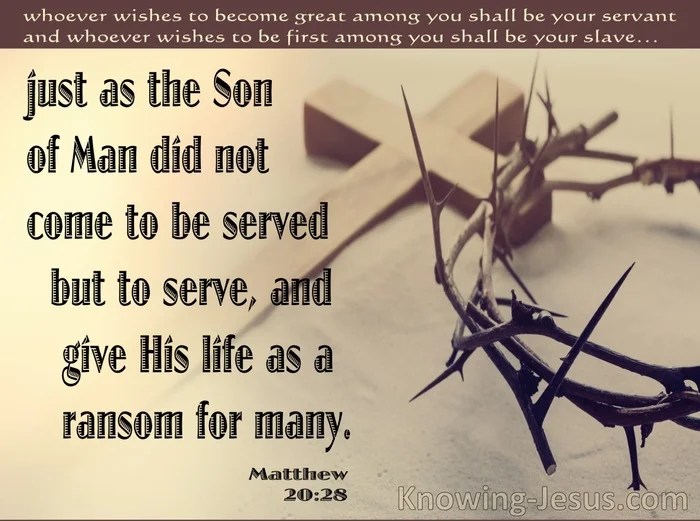
24 And when the [other] ten heard this, they were resentful and angry with the two brothers. 25 But Jesus called them to Himself and said, “You know that the rulers of the Gentiles have absolute power and lord it over them, and their great men exercise authority over them [tyrannizing them]. 26 It is not this way among you, but whoever wishes to become great among you shall be your servant, 27 and whoever wishes to be first among you shall be your [willing and humble] slave; 28 just as the Son of Man did not come to be served, but to serve, and to give His life as a ransom for many [paying the price to set them free from the penalty of sin].”

The Word of God for the Children of God.

Adeste Fidelis! Venite Adoremus! Dominum.

Gloria! In Excelsis Deo! Alleluia, Alleluia, Alleluia, Amen.

Background: He Who Has Ears, Let Them Hear …

Matthew 20:17-19Amplified Bible

Death, Resurrection Foretold

17 As Jesus was going up to Jerusalem, He took the twelve [disciples] aside, and along the way He said to them, 18 “Listen carefully: we are going up to Jerusalem; and the Son of Man will be handed over to the chief priests and scribes (Sanhedrin, Jewish High Court), and they will [judicially] condemn Him and sentence Him to death,  19 and will hand Him over to the Gentiles (Roman authorities) to be mocked and scourged and crucified, and He will be raised [to life] on the third day.”

On the journey to Jerusalem Jesus predicts that his death will take place there.

Jesus takes his disciples aside to report to them that it will include wholesale betrayal, humiliation and condemnation by the religious leaders of his people.

Those who should be welcoming him as the promised Messiah will instead sentence him to suffering and death, thoughtlessly handing him over to to a brutal time and season of mocking, flogging, and crucifixion by the Romans.

Then Jesus also shockingly predicted that he would rise again three days after!

But it seems that after hearing the predictions about Jesus’ suffering and death, the disciples somehow tuned out.

It’s as if they missed hearing the promise that “on the third day” he would be “raised to life!”

When the time came and Jesus died on a cross, the disciples were a despondent group of followers wondering about the suddenness what had just happened.

As predicted, in the Garden of Gethsemane they scattered in fear, at the arrival of the Temple Authorities unjustly leaving the burial, preparations to others. (See Matthew 26:56; 27:45-28:10.)

In this critical moment, there was no expectation of Jesus’ coming to life again!

In our own day and age, considering the number of years which have come, and passed us by since those events transpired, is our own “hearing” any different?

As we again, for the umpteenth time approach Jesus’ entry into Jerusalem, as we again come to the umpteenth recitation and those sermons of Palm Sunday, as we again try to come to realization of what we know is to come, has already transpired, has already been written and narrated – why is any of this relevant?

We have not heard with our own ears the actual voice of Jesus as the disciples.

We could not immediately begin the process of giving it our fullest attention.

We could not be stunned in the same way as the disciples were upon hearing it.

We could not be apathetic or excited or wondering or stunned or any of that.

We did not talk, or walk, hear or listen to and with Jesus in that moment – in a more contemporary colloquial sense of the moment – “walk and chew gum and do everything else (preparing ourselves for the Passover) all at the same time.

Nowadays, we do not all concern ourselves to prepare to celebrate the Passover.

We are not looking for donkeys or mules or horses to ride to be paraded about.

We are not looking for “Upper Rooms” – Just sanctuaries inside our churches.

No Gardens of Gethsemane …

It is doubtful to the utmost we are worried about our running away naked in the middle of the night with thoughts of running away, betraying our own Savior.

Jesus will not be arrested again.

He will not be betrayed, mocked and humiliated in such a horrible way again.

We will not have to subject ourselves to the sight, witnessing him dying again.

All these things have already come to pass and by faith we believe and accept it.

Now, what experiences do we have to substitute for those of what the disciples witnessed first hand, experienced to the utmost first hand, threatened by too?

We hear pandemic, dire economic warnings or a doctor’s frightening diagnosis, and we’ll soon forget Jesus’ words: “I am with you always” (Matthew 28:20).

We experience ridicule or rejection and forget that God’s Word warns that we may be called to share in Christ’s sufferings (John 15:18-20; Romans 8:17).

Facing them throughout the year is hard enough, but how much of that effort includes an intense time of self examination, reflection upon the Cross itself?

Facing them mutually, letting God work, let’s remember Jesus was raised to life.

We know what happened then to Jesus – three days later, as promised, he arose!

Our belief in the Resurrection of our Savior is core central to our Christian faith.

Yes! We absolutely love and live for and utmost sacrificially serve a risen Savior!

But the lingering question, the utmost intense question we probably devote so precious little of our time to study, reflecting upon: what relevance is the Cross?

A Personal Reflection: Why the Cross?

24-28 When the ten others heard about this, they lost their tempers, thoroughly disgusted with the two brothers. So Jesus got them together to settle things down. He said, “You’ve observed how godless rulers throw their weight around, how quickly a little power goes to their heads. It’s not going to be that way with you. Whoever wants to be great must become a servant. Whoever wants to be first among you must be your slave. That is what the Son of Man has done: He came to serve, not be served—and then to give away his life in exchange for the many who are held hostage.”

Why does Jesus take his disciples aside to shock, awe them with his prophecy?

Why are such momentous words and such miraculous history transforming events still to be read and found, studied and prayed over and celebrated too?

Why is such a detailed, embarrassing account of the failure of the disciples?

Why do we celebrate ourselves being re-subjected to these terrible moments?

To give us another opportunity to run away from Jesus, recoil from them, him?

To mostly learn and then relearn to repeatedly avoid re-living the indescribable intensity of those moments, to make them our own as God repeatedly call us to?

Why the ugliness of the Cross … to learn, to relearn to hug its wondrous beauty?

Why such an intense concentration, centralized focus on the Cross at Calvary?

Why such an ugly, not so gentle, intentional, purposeful, graphic reminder?

Why didn’t God simply say, “Look, everyone, I know you have sinned against Me, but I am going to pardon you right now. It’s okay. I forgive all of you!”

God didn’t do that because it doesn’t work with His nature and character.

The justice of God requires obedience and sacrifice.

He could not accept us into fellowship with Himself unless we paid the penalty—or someone paid it on our behalf.

Romans 3:25 tells us, “For God presented Jesus as the sacrifice for sin. People are made right with God when they believe that Jesus sacrificed his life, shedding his blood. This sacrifice shows that God was being fair when he held back and did not punish those who sinned in times past” (NLT).

The cross demonstrates the ultimate expression of the justice of God.

At the cross of Calvary, the love and justice of God met.

Yes, God had to satisfy His justice.

The Scriptures say, “The person who sins is the one who will die” (Ezekiel 18:20 NLT), “the wages of sin is death” (Romans 6:23 NLT), and “without the shedding of blood, there is no forgiveness” (Hebrews 9:22 NLT).

God was saying, “My righteous requirements must be met.

But I love humanity beyond their ability to acknowledge, fully measure and comprehend, and there is no way they can do it on their own.

So, I must, and I WILL help them.”

Therefore, He sent His only begotten Son Jesus to bridge the gap. (John 3:16-17)

This is why Jesus Christ is the only way to God.

People like to say that all roads lead to God.

People also like to say that the road to hell is paved with our good intentions.

It really concerns me when I hear Christians parrot statements to that effect.

There is only one path.

There is only one way.

If that were not true, then why did Jesus have to die?

If all roads lead to God, then why did Jesus go through the indescribable anguish, the immeasurable humiliation, torture, and pain of the cross?

Matthew 20:26-28 Amplified Bible

26 It is not this way among you, but whoever wishes to become great among you shall be your servant, 27 and whoever wishes to be first among you shall be your [willing and humble] slave; 28 just as the Son of Man did not come to be served, but to serve, and to give His life as a ransom for many [paying the price to set them free from the penalty of sin].”

The primary reason Jesus came to this earth was to save us, to die for our sins.

Paid in Full

Jesus’ mission was a matter of “search and rescue.”

He came to seek and save those who were lost (Luke 19:10).

He not come to be served but to serve, give his life as a ransom for many.

Mark 10:42-45 Amplified Bible

42 Calling them to Himself, Jesus said to them, “You know that those who are recognized as rulers of the Gentiles lord it over them; and their powerful men exercise authority over them [tyrannizing them]. 43 But this is not how it is among you; instead, whoever wishes to become great among you must be your servant, 44 and whoever wishes to be first and most important among you must be slave of all. 45 For even the Son of Man did not come to be served, but to serve, and to give His life as a [a]ransom for many.”

He fulfilled that mission by giving his life at Calvary “as a ransom for many.”

As Jesus hung on the cross and spoke the words “It is finished” (John 19:30), he was announcing that his mission was now accomplished.

Because he was obedient and faithful to His Father, offered his perfect life as the sacrifice for sin, God was pleased to welcome home all his lost children!

https://www.blueletterbible.org/esv/jhn/19/30/t_conc_1016030

https://www.blueletterbible.org/lexicon/g5055/esv/mgnt/0-1/

The brief sentence “It is finished” translates from just a single word teleō in the original Greek text.

The same word was used by shopkeepers to announce that someone’s bill was finally paid.

When the final payment was made on a purchased item, the merchant would say “Tetelestai” (“It is finished”) – in other words, the debt was paid in full.

When I made the last payment on the first car I ever bought, I remember how good it felt to see the bank teller stamp “Paid in Full” on my loan documents.

Never again would another payment be required!

As Jesus said “It is finished” on the cross, he was assuring us that his mission was complete.

He had paid in full all the costs required for our sin.

And when we faithfully focus our lives, when we centralize our lives now place our full faith-filled trust in him, our debt for sin is forever wiped off the books!

On that Hill far away, stood an Old Rugged Cross, the emblem of suffering and shame. And on that old cross Jesus suffered and died to pardon and sanctify me.

In the name of God, the Father and God the Son and God the Holy Spirit,

Let us Pray,

Loving Lord, I praise and thank You for Jesus, my Mighty Savior and Servant King. Lord, today I pour out my life as an offering to You. I pray that I would serve You wholeheartedly and my service would bless those around me and be a witness to bring many to the knowledge of salvation in Jesus. O God, thank you that Jesus has bought salvation for me! He has done everything needed for me to know you, love you, and serve you now and forever! Amen. Thank You that Jesus gave His life as a ransom for me and for all who would believe in His name. In Jesus’ name, AMEN.

Adeste Fidelis! Venite Adoremus! Dominum.

Gloria! In Excelsis Deo! Alleluia, Alleluia, Alleluia, Amen.

https://translate.google.com/

I am Encountering the Resurrection. “My Lord and my God!” John 20:26-29

Believing what we are “seeing!” Doubting Thomas became Believing Thomas when he “saw” with his very own eyes, the risen Christ standing before him.

From our unbelief to belief. From our “seeing” to believing. The development of a disciple’s faith in Jesus as their God, their Savior, can be followed, traced from the time of John the Baptist to the final chapters of John’s Revelation.

Recall what has come before this. For the three years of Christ’s own ministry, we see in the disciples’, tiny bits of evidence of little seeds of faith taking root, growing, maturing and blossoming into a firm foundation of unshakable faith.

It was revealed to Peter, Jesus was the Christ, the Son of the living God… and the content of John’s Gospel was written so we may believe that Jesus is the Christ, the Son of God, and that by believing on Him we might have life in His name.

Thomas was absent from that initial “appearance” of Resurrected Christ. As a consequence, Thomas did not “see” as the Disciples first “saw” 8 days prior.

We do not know where he was. Scripture is not clear in this matter. What is clear in this matter is none of the disciple’s present that first appearance, who “saw” the Resurrected Jesus, had made no such declaration of “My Lord and my God!”

We only read from John 20:19-20 NASB: 19 Now when it was evening on that day, the first day of the week, and when the doors were [a]shut where the disciples were together due to fear of the [b]Jews, Jesus came and stood in their midst, and *said to them, “Peace be to you.” 20 And when He had said this, He showed them both His hands and His side. The disciples then rejoiced when they saw the Lord.

Verse 20 suggests they only had an “emotional response” – They rejoiced when they “saw” the Lord. Had they come to a true state of “belief” in that moment?

This suggests to me that there is something significantly deeper to explore here with “doubting” Thomas’ response of “My Lord, and my God!”

John 20:26-29 Amplified Bible

26 Eight days later His disciples were again inside the house, and Thomas was with them. Jesus came, though the doors had been barred, and stood among them and said, “Peace to you.” 27 Then He said to Thomas, “Reach here with your finger, and see My hands; and put out your hand and place it in My side. Do not be unbelieving, but [stop doubting and] believe.” 28 Thomas answered Him, “My Lord and my God!” 29 Jesus said to him, “Because you have seen Me, do you now believe? Blessed [happy, spiritually secure, and favored by God] are they who did not see [Me] and yet believed [in Me].”

The Word of God for the Children of God. Gloria! In Excelsis Deo! Alleluia! Amen.

Thomas, called Didymus – which means twin, was chosen by Christ to be one of His 12 apostles. He was a zealous disciple who demonstrated a fearless attitude.

When Jesus set His face as a flint to go to Jerusalem to face the unbelieving Jews who desired to kill Him, Thomas boldly cried, “Let us also go to Jerusalem, with Him – so that we may die with Jesus!” (John 11:16 NASB)

Thomas was also a deep thinker who paid heed to Christ’s words of wisdom, but he did not always understand the depth of meaning behind Christ’s discourses.

“Lord, we do not know where You are going,” (John 14:5 NASB) was his quick complaint when Jesus revealed that He was soon to leave them and return to His Father in heaven, “so how can we know the way?” was his earnest query.

But it was his reliance on the logic of man, his inability to see truth beyond his physical senses, caused him to become labelled with the uncomplimentary title, ‘doubting Thomas’, for he would not accept the multiple eyewitness accounts of Christ’s Resurrection because he himself, had not seen His Resurrected Lord with his own eyes, nor had he touched the risen Savior with his own hands –

and so, in his initial response he made the astonishingly determined claim, “unless I “see” in His hands the imprint of the nails and put my finger into the place of the nails, and put my hand into His side, (ergo) I will not believe.”

When taken in isolation, this passage appears to declare Jesus IS God.  

Every serious Bible student will agree, however, that it’s never a good idea to evaluate a verse apart from its context.

What then is the immediate, as well as the broader, context in which Thomas’ confession appears? 

We’ll look at both, and in the process discover what Thomas meant when he said, “My Lord and my God.”

My Lord and My God:  The Immediate Context

As we read the immediate context surrounding Thomas’ confession, please do notice how many times the words “see” or “seen” are used in conjunction with the word “believe” in its various forms.

John 20:24-29New American Standard Bible

24 But Thomas, one of the twelve, who was called [a]Didymus, was not with them when Jesus came. 25 So the other disciples were saying to him, “We have seen the Lord!” But he said to them, “Unless I see in His hands the imprint of the nails and put my finger into the place of the nails, and put my hand into His side, I will not believe.”

26 [b]Eight days later His disciples were again inside, and Thomas was with them. Jesus *came, the doors having been [c]shut, and stood in their midst and said, “Peace be to you.” 27 Then He *said to Thomas, “Place your finger here, and see My hands; and take your hand and put it into My side; and do not continue in disbelief, but be a believer.” 28 Thomas answered and said to Him, “My Lord and my God!” 29 Jesus *said to him, “Because you have seen Me, have you now believed? Blessed are they who did not see, and yet believed.”

The word “see” in Greek is horaô

https://www.blueletterbible.org/nasb95/jhn/20/25/t_conc_1017025

https://www.blueletterbible.org/lexicon/g3708/nasb95/mgnt/0-1/

When used literally it means to see with one’s eye. 

For example, Thomas plainly stated that his belief in a resurrected Christ was predicated on seeing Jesus with his own eyes. 

When used figuratively horaô means to perceive or to discern, that is, to “see” with the mind or with one’s understanding.  

This figurative usage is common in English as well. 

We say, “I see what you mean,” that is, “I understand.” 

Jesus said those who believed (understood) that he was alive without literally seeing him were blessed.

Broader Context: What does Bible say about literally seeing God?

The Bible has much to say about seeing God.  When Moses asked God to show him His glory, God answered him without ambiguity:

Exodus 33:20 (NASB) But He said, “You cannot see My face, for no man can see Me and live!” (Emphasis added)

Exodus 33:20 NASB

The apostle Paul also communicates this truth on more than one occasion when he writes that God is “invisible,” and that “no man has seen or can see” Him.  In addition, the apostle John echoes these same emphatic statements:

1 John 4:12a (NASB) No one has seen God at any time… (emphasis added)

1 John 4:12a (NASB)

It is important to realize that John penned these words after tens of thousands of people had seen Jesus during his earthly ministry. 

Moreover, at least 500 people saw him after his resurrection. 

And most important for our discussion, even after Thomas had seen Jesus and supposedly declared him to be God, John still wrote, “No one has seen God at any time” (emphasis added). 

The contradiction between the Trinitarian view that Thomas was declaring Jesus to be God, and the numerous passages that unequivocally state that God cannot be seen, is rather glaring.

To say that Thomas “saw God” contradicts Scripture. 

Therefore, there must be another way to understand his words.

What did Jesus teach his disciples about seeing God?

The solution to this obvious contradiction lies in what Jesus taught his disciples about “seeing God.”

John 12:44-45 (NASB) And Jesus cried out and said, “He who believes in Me, does not believe in Me but in Him who sent Me45He who sees Me sees the One who sent Me. (emphasis added)

John 12:44-45 (NASB)

https://www.blueletterbible.org/nasb95/jhn/12/44-45/t_conc_1009044

https://www.blueletterbible.org/lexicon/g2334/nasb95/mgnt/0-1/

In this passage the word “sees” in Greek is theôreô, and it means to look closely at; to gaze with interest or careful observation. 

Figuratively it can mean to comprehend or recognize.  

It is a synonym of horaô.  

Thus, Jesus uses “seeing” as a metaphor for comprehending or knowing.  

In doing so, he conveys an important truth to his disciples: if you see me, it means that you also “see”–perceive, discern, comprehend and recognize–the One who sent Me, that is, the One who can’t be seen.

Jesus could say this because he perfectly represented the Father. 

The apostle Paul expresses this truth beautifully:

2 Corinthians 4:6 (NASB) For God, who said, “Light shall shine out of darkness,” is the One who has shone in our hearts to give the Light of the knowledge of the glory of God in the face of Christ. (Emphasis added)

In this context, Paul is comparing Jesus to Moses who reflected the glory of God after having spent 40 days and nights on Mt. Sinai in God’s presence. 

Moses wasn’t God, but he reflected God’s glory.

Similarly, Jesus isn’t God, but he reflects the glory of God, thus enabling us to know Him.

Paul wrote something similar to the church in Colossae:

Colossians 1:15 (NASB)  He [Jesus] is the image of the invisible God, the firstborn of all creation. (emphasis added)

Jesus is the image of the God who can’t be seen. 

An image is not the original, rather it is a picture or a reflection of the original. 

https://www.blueletterbible.org/nasb95/col/1/15/t_conc_1108015

https://www.blueletterbible.org/lexicon/g1504/nasb95/mgnt/0-1/

The word “image” in this passage is the Greek eikôn, and it literally means a statue

Figuratively, it means a representation.  

Jesus used eikôn in this way when he responded to the Jews’ question about the legality of the poll-tax. 

Jesus told them to bring him a denarius, a coin imprinted with Caesar’s likeness:

Matthew 22:20-21 (NASB) And He *said to them, “Whose likeness and inscription is this?” 21  They *said to Him, “Caesar’s.” Then He *said to them, “Then render to Caesar the things that are Caesar’s; and to God the things that are God’s.” (emphasis added)

Matthew 22:20-21 (NASB)

The word “likeness” is eikôn, the same word used in Colossians 1:15 where it is translated as “image.” 

Obviously, the image or likeness of Caesar on the coin was not literally Caesar. 

Rather it was a representation of him. 

Similarly, Jesus is the image of God and not the original. 

How did Jesus reflect or image God to mankind?

By speaking only, the words God gave him to speak, by doing only the works God gave him to do, and by obeying God’s will and denying his own.  

This is how he could say in John 12:45: when you see me, you see God who sent me.  Not surprising, this idea is in perfect keeping with Hebraic thought. 

The night Jesus was arrested

On the night Jesus was arrested, he gathered his disciples in the upper room and taught them about knowing and seeing God. 

This discourse provides us with further critical insight into the meaning behind Thomas’ confession:

John 14:3-6 (NASB) “If I go and prepare a place for you, I will come again and receive you to Myself, that where I am, there you may be also.  “And you know the way where I am going.”  Thomas *said to Him, “Lord, we do not know where You are going, how do we know the way?”  Jesus *said to him, “I am the way, and the truth, and the life; no one comes to the Father but through Me. (emphasis added)

Notice that the Father is the objective, while Jesus is the means by which the objective is reached. 

Furthermore, Thomas is specifically mentioned as being an active part of the discussion that evening. 

What follows are some of the last words Jesus spoke to his disciples before being arrested and ultimately crucified.

John 14:7 (NASB) “If you had known Me, you would have known My Father also; from now on you know Him and have seen Him.” (Emphasis added)

John 14:7 (NASB)

https://www.blueletterbible.org/nasb95/jhn/14/7/t_conc_1011007

https://www.blueletterbible.org/lexicon/g1097/nasb95/mgnt/0-1/

The word “know” here, along with its various forms, is the Greek word ginôskô, and it means to come to know, recognize, perceive. 

The word “seen” is horaô. 

You will please recall that it can mean to see, perceive, to discern. 

Again, Jesus uses “seeing” as a metaphor for “knowing.”

He does not mean that when they look at him, they are literally looking at the Father. 

For one reason, God cannot be seen, and for another reason, Jesus is not the Father.

Rather, Jesus is saying that when they see or observe him, they also come to “see” and know God. 

Philip, however, misses Jesus’ point:

John 14:8-9 (NASB) Philip *said to Him, “Lord, show us the Father, and it is enough for us.”  Jesus *said to him, “Have I been so long with you, and yet you have not come to know Me, Philip? He who has seen Me has seen the Father; how can you say, ‘Show us the Father’? (emphasis added)

Jesus questions their failure to understand that to see him is to “see” the Father especially since he had been revealing the Father to them for so long.

After Jesus’ Resurrection

After God raised Jesus from the dead, he appeared to the disciples.  Thomas, however, was not present:

John 20:24-25 (NASB) But Thomas, one of the twelve, called Didymus, was not with them when Jesus came. 25  So the other disciples were saying to him, “We have seen the Lord!” But he said to them, “Unless I see in His hands the imprint of the nails, and put my finger into the place of the nails, and put my hand into His side, I will not believe.”  (emphasis added)

The point here is that Thomas refused to believe Jesus was alive, even though there were eyewitness.

Several days later, Jesus appeared to the group a second time.

Thomas is now among them.   

John 20:26-29 (NASB) After eight days His disciples were again inside, and Thomas with them. Jesus *came, the doors having been shut, and stood in their midst and said, “Peace be with you.” 27 Then He *said to Thomas,  “Reach here with your finger, and see My hands; and reach here your hand and put it into My side; and do not be unbelieving, but believing.” 28  Thomas answered and said to Him, “My Lord and my God!” 29  Jesus *said to him, “Because you have seen Me, have you believed? Blessed are they who did not see, and yet believed.”

John 20:26-29 (NASB)

The Meaning of Thomas’ Confession

In view of the context we have examined, Thomas finally understands what Jesus has been trying to teach him all along: 

“Not only do I see my risen Lord, but I also now “see” or perceive that you are indeed the image of the invisible God.  You have been revealing the Father to us all along!”

Thomas finally sees his Lord and perceives his God.

Understanding Thomas’ confession in this way resolves the conflict created by the Trinitarian interpretation which claims that Thomas sees Jesus as God when Scripture repeatedly says God cannot be seen. 

Furthermore, it is in keeping with Hebraic thought which views the one sent, in this case Jesus, as being the personal presence of the sender, that is God. 

In addition, Jesus’ statement in John 17– that God the Father is the only true God, while he is the Christ–remains intact, and no complicated formula is required for dealing with a multi-personal God.

It also helps explain why Thomas’ confession is not included within the other gospels; something we would expect to see if he were truly confessing Jesus to be deity. 

It’s important to note that no other disciple declares Jesus is God. 

Not one. 

Perhaps most telling is the reason John gave for writing his gospel. 

A mere two verses after Thomas’ so-called confession of Jesus’ deity,

John says his purpose for penning his gospel is that we might believe Jesus is the Christ.  John does not say one word about the supposed recent revelation about Jesus’ deity, which, if it were true, would eclipse Jesus being the Christ.

John 20:30-31 (NASB) Therefore many other signs Jesus also performed in the presence of the disciples, which are not written in this book; 31  but these have been written so that you may believe that Jesus is the Christthe Son of God; and that believing you may have life in His name.

If Thomas’ confession was actually a declaration that Jesus was God, you can be sure John would have featured it as a reason for writing his gospel. 

God made it possible for Jesus to be seen. 

There is one last point that is worthy of inclusion in this examination of John 20:28.

Peter provides us with an important detail regarding Jesus’ post resurrection appearances. 

He says that Jesus was made visible because God made it possible for him to be seen:

Acts 10:40-41 (NASB) “God raised Him up on the third day and granted that He become visible41  not to all the people, but to witnesses who were chosen beforehand by Godthat is, to us who ate and drank with Him after He arose from the dead.

Acts 10:40-41 (NASB)

If Jesus is God, why would someone else named God have to grant him the ability to be physically seen, and only by certain witnesses of God’s choosing?

Would not Jesus have the right, the authority and the ability as God to do this himself? 

It makes no sense unless Jesus is the human Messiah and not the God-man the 4th century Church Fathers interpreted him to be.

By examining both the immediate and broader contexts surrounding Thomas’ confession, we see a continuity between Jesus’ teaching that to see him is to “see God” and Thomas’ realization his Lord (literally), his God (figuratively) were before his eyes. 

Jesus’ teaching is relevant for us today. 

We, too, are blessed if we believe in Jesus even though we have not seen him with our eyes.  It’s no wonder Peter writes:

 1 Peter 1:8-9 (NASB) and though you have not seen Him [Jesus], you love Him, and though you do not see Him now, but believe in Him, you greatly rejoice with joy inexpressible and full of glory,   obtaining as the outcome of your faith the salvation of your souls.

1 Peter 1:8-9 (NASB)

We can only barely imagine the depth of sweet joy, bitter shame, and utter astonishment, when Christ came and stood before Thomas.

The doors were locked, the disciples were assembled, and this time Thomas was with them.

Jesus came and stood in the midst of them and said, “Thomas – reach here with your finger, and see My hands; and reach here your hand and put it into My side; and do not be unbelieving but believing.”

Then Thomas answered and proclaimed to Him, “My Lord and my God!”

What a confession from Thomas!

What an incredible declaration.

What a wonderful truth – for Jesus is alive and has broken the power of death in the lives of all who believe.

When Thomas saw his Lord, his cocky comments and disdainful disbelief must have frozen on his lips – his only response could be, “My Lord and my God!”

Indeed, how grateful we are these words of Thomas are here recorded in the inspired, God-breathed Scriptures… for Jesus is indeed our God and our Savior.

We were nowhere near the Upper Room. You and I do not have the opportunity to see the risen Lord Jesus in the same way that Thomas saw Him

– but Jesus also added these words of comfort… especially for you and for me,

“Blessed are they who have not seen, and yet have believed.”

In the name of God, the Father and God the Son and God the Holy Spirit,

Let us Pray,

Heavenly Father, thank You that Jesus is our risen, ascended, and glorified God and Lord, Who died to redeem us and Who rose to give us His resurrected life.

Thank You that even when we doubt You and are faithless, You remain faithful to Your promise that whosoever believes in Jesus for the forgiveness of sins will not perish but have everlasting life. Thank You! In Jesus’ holy name, AMEN.

https://translate.google.com/