Maximum Availability: Make Every Effort to Pursue, Promote Peace and Mutual Edification. Romans 14:19-21

Romans 14:19-21Amplified Bible

19 So then, let us pursue [with enthusiasm] the things which make for peace and the building up of one another [things which lead to spiritual growth]. 20 Do not, for the sake of food, tear down the work of God. All things indeed are [ceremonially] clean, but they are wrong for the person who eats and offends [another’s conscience in the process]. 21 It is good [to do the right thing and] not eat meat or drink wine or do anything that offends your brother, and which weakens him spiritually.

Romans 14:19-21The Message

19-21 So let’s agree to use all our energy in getting along with each other. Help others with encouraging words; don’t drag them down by finding fault. You’re certainly not going to permit an argument over what is served or not served at supper to wreck God’s work among you, are you? I said it before and I’ll say it again: All food is good, but it can turn bad if you use it badly, if you use it to trip others up and send them sprawling. When you sit down to a meal, your primary concern should not be to feed your own face but to share the life of Jesus. So be sensitive and courteous to the others who are eating. Do not eat or say or do things that might interfere with the free exchange of love.

The Word of God for the Children of God. Gloria! In Excelsis Deo! Alleluia! Amen.

From one of those many “feel good” stories I receive on my Facebook feed.

“Yesterday my young son and went to the local Animal Shelter. I adopted the oldest, sickest, and sorest shelter dog. I’ll never forget his eyes. When I went into the cage he didn’t even bother to look, he knew I wouldn’t even see him.

Curling around the corner He’d accepted his fate. The volunteer said to me many times… Are you sure this one? Are you sure? He was abandoned six months ago. Many have looked at him. YES! This is our dog. He opened the cage and the other dogs fell on me. I ran towards that old and sullen dog as he cowered in the corner shaking and shivering, suddenly he looked at me as if he saw an angel… I hugged him and told him now; he will be happy again. Now, he sleeps in my son’s lap… probably the first peaceful sleep he ever had.”

On a nearby wall of the animal shelter hung an old sign:

“Give it a life. Give it a hug. They need all of us all of the time.”

“From a dad and his son who just saved a lost soul.

Make every Effort to Pursue Peace and Mutual Edification—Romans 14:19

“Make every effort!”

“Make every effort???”

“Make every effort to do the minimum with the maximum amount of effort.”

“Make every effort to do the maximum with the minimum amount of effort.”

Those statements present our 2o22 representation of alleged “Christianity,” quite the significant personal and corporate (meaning our church) challenge.

“Make every effort …!”

But notice where that exertion is to be focused: peace and mutual edification.

Both sides of this exhortation are two-way responsibilities.

I must pursue and share peace if I am going to have it myself.

I must edify, be open to being edified, if mutual edification is going to happen.

In other words, we live with other people in God’s family.

He wants us to be responsible for making relationships work in our spiritual family.

He reminds us it will require strenuous effort.

But isn’t that true in every family relationship?

Love means sacrifice, effort, and concern for others. When we all share our love willingly, however, we are much more likely to see blessings coming back to us!

Instead of taking this “maximum effort with maximum effect” seriously, what have we instead accomplished with the minimum effort with maximum effect?

DIVISION – “US versus THEM” IRRECONCILABLE MINUTIAE – CHASMS –

Mind the Chasm ….

Make the effort to “mind the chasm” ….

Make every effort to “mind the chasm!”

Make the effort to Mind the Chasm with the maximum amount of effort ….

With maximum effort, “Mind the chasm” between God and HIS Neighborhood.

With minimum effort, “Mind the chasm” between God and HIS Neighborhood.

With maximum effort, “Mind the chasm” between God’s Neighborhood and our “irreconcilable” nit-picky Minutiae ministering inside of God’s Neighborhood.

With minimum effort, “Mind the chasm” between God’s Neighborhood and our “irreconcilable” nit-picky Minutiae ministering inside of God’s Neighborhood.

Make every effort to “hit the ground running” pursue [with enthusiasm] the things which make for peace and the building up of one another [things which lead to spiritual growth].

Make the effort to Mind the chasm with the minimum amount of effort ….

Make the minimal effort to “hit the ground walking” to pursue [with enthusiasm] the things which make for peace and the building up of one another [things which lead to spiritual growth].

Make the effort to Mind the chasm with no effort whatsoever …. in other words,

make no effort at all to expend any level of energy to barely “look up from our smart phones” to pursue [with {any}enthusiasm {from our church pews}] the things which make for peace and the building up of one another [things which lead to spiritual growth]. – Make the maximum effort to pursue the Status Quo.

In other words, make every single effort to be like the guy who ignored Lazarus:

Luke 16:25-26Amplified Bible

25 But Abraham said, ‘Son, remember that in your lifetime you received your good things [all the comforts and delights], and Lazarus likewise bad things [all the discomforts and distresses]; but now he is comforted here [in paradise], while you are in severe agony. 26 And besides all this, between us and you [people] a great chasm has been fixed, so that those who want to come over from here to you will not be able, and none may cross over from there to us.’

Luke 16:25-26The Message

25-26 “But Abraham said, ‘Child, remember that in your lifetime you got the good things and Lazarus the bad things. It’s not like that here. Here he’s consoled and you’re tormented. Besides, in all these matters there is a huge chasm set between us so that no one can go from us to you even if he wanted to, nor can anyone cross over from you to us.’

Jesus taught his followers highly insightful things about the kingdom of God.

Care and compassion for everyone in God’s Neighborhood without exception.

With maximum effort expended: Breaking down those “uncrossable” barriers.

Risk everything to take a sledgehammer, vigorously pound into and through “worldly values, worldly traditions, rituals, worldly morals, worldly ethics.”

To rigorously pound down, pound through every single facet of what divides us.

Without any mind or thought for whose agenda was more right or more wrong, thoughts of whose beliefs were more correct than the others, care for the poor was high on his agenda, as we see in his parable about the rich man, Lazarus.

Lazarus, an extremely poor man, was covered with sores and was hungry. An untouchable. For who knows how long, he lay outside the gate of a wealthy man who lived in power and luxury. But he was ignored, and his needs went unmet.

When the poor man died, he was taken to rest with Abra­ham, where he finally was comforted. And when the rich man died, he was consigned to Hades, where he was in torment. He pleaded for relief and begged for a warning to be sent to his brothers. Abraham explained that there was an impassable gap between them, and that the man’s brothers already had all the instructions they needed.

The chasm is the result of the “rich man” ignoring all of God’s teachings about neighbor love and justice for all of our brothers and sisters. These teachings are plentiful in the Bible, reminding us God loves the all poor, the sinners, demands justice for all of them, and “upholds the cause of all the needy” (Psalm 140:12).

The reasons for God loving everyone in His neighborhood are often complex and far beyond our ability to question, but the reality is simple: there is great need to pursue [with enthusiasm] the things which make for peace and the building up of one another [things which lead to spiritual growth].

God’s Word still reminds us of his special care for every single neighbor we share with God in His Neighborhood. The reality is that God’s Word does not allow, make any room whatsoever, for exceptions to living out the example of Jesus established in his earthly ministry to follow as we love all our neighbors.

Make Every Effort to Pursue Maximum Peace and Maximum Mutual Edification—Romans 14:19.

Romans 14:19-21NKJV

19 Therefore let us pursue the things which make for peace and the things by which one may [a]edify another. 20 Do not destroy the work of God for the sake of food. All things indeed are pure, but it is evil for the man who eats with [b]offense. 21 It is good neither to eat meat nor drink wine nor do anything by which your brother stumbles [c]or is offended or is made weak.

As believers we have more in common than we acknowledge with our brothers and sisters in Christ than we have with the natural family we were born into.

When we accepted Jesus as our Savior, we were reborn into God’s family and now share with everyone a wonderful heavenly heritage based on His promises.

This all stems from faith in Jesus and is a bond that will transcend both time and distance. We will spend all eternity with these people, so it makes sense for us to aim and eagerly pursue harmony and mutual edification with each other.

So many times, we let nit-picky minutiae, minor divisions separate and cause dissension among us instead of realizing that we were ALL called into one body.

We should be pursuing peace among each other, encouraging and building up one another instead of tearing each other down by our actions and behaviors.

No matter what personal and or “Christian” or “Biblical” convictions we hold to we are to always give a greater measure of consideration to every one of our fellow brethren and conduct our “Christianity” in God’s neighborhood, behave in such a way that will build them up instead of causing confusion in their lives.

The Apostle Paul said in the previous verses of Romans chapter 14 ….  

“For the kingdom of God is not a matter of eating and drinking, but of righteousness, peace and joy in the Holy Spirit, because anyone who serves Christ in this way is pleasing to God and approved by men” (Romans 14:17-18).

There are infinitely more important things to consider than satisfying our own needs. We are all a part of the kingdom and what we do has eternal significance.

So many people struggle for acknowledgment and validation over these kinds of issues such as “eating, drinking” or “traditions” and “doctrines” of the church.

But Paul gave a great rule of thumb in 1 Corinthians, 

“So, whether you eat or drink or whatever you do, do it all for the glory of God. Do not cause anyone to stumble, whether Jews, Greeks or the church of God- even as I try to please everybody in every way. For I am not seeking my own good but the good of many, so that they may be saved” (I Corinthians 10:31-33).

God’s Word! The bottom line is that whatever you do make sure you are doing it for the glory of God, and absolutely none of your own and it will be accepted.

Our behavior should be above reproach in this world not because our acceptance with God our Father and Jesus Christ our Savior depends on it, but because our “truest” behavior will be seen by others and by this thereby glorify our Father in heaven or make every single effort to run like crazy in the opposite direction.

Paul sought to please others in order that many would be saved. The same principle applies to us today, we should not seek our own interest, but the interests of Christ and all of our actions should build and encourage His body.

What an amazing thing to belong to something so wonderful.

We do not belong to ourselves anymore and as such we should live like WHO we are and WHOSE we are.

Today I pray that we will behave with an eternal perspective in life and that our behavior and our actions reflect that mindset.

May you live your life making every effort, leading to the maximum pursuit of peace and mutual edification in the body of Christ and your actions lead others into this fellowship by turning them towards Jesus who can save them, Amen.

In the name of God, the Father and God the Son and God the Holy Spirit,

Let us Pray,

Dear Heavenly Father, turn me towards the Cross where your Son died for me. Pray, forgive me for my impatience and selfishness. Defeat the bad attitude of shallow divisiveness that I often display in arguments and disagreements with others in your family. Energize me by your Spirit to see areas where I can be a truer blessing and an encouragement to others. In Jesus’ name I pray. Amen.

https://translate.google.com/

What About “Maximum Availability of our Hearts and Souls?” The Kingdom of God is Righteousness, Peace and Joy in the Holy Spirit—Romans 14:16-18

Romans 14:16-18Amplified Bible

16 Therefore do not let what is a good thing for you [because of your freedom to choose] be spoken of as evil [by someone else]; 17 for the kingdom of God is not a matter of eating and drinking [what one likes], but of righteousness and peace and joy in the Holy Spirit. 18 For the one who serves Christ in this way [recognizing that food choice is secondary] is acceptable to God and is approved by men.

The Word of God for the Children of God. Gloria! In Excelsis Deo! Alleluia! Amen.

Romans chapter 14 encourages us to consider everything we do as if we are all doing it for the Lord. It is a call to do what leads to peace and mutual edification within the body of Christ.

We are not to condemn or look down on those who are weaker, less mature, slowly, slower growing in faith but be fully convinced of what is acceptable in our own minds, as everything which does not come from faith in God is sin.

Paul’s full throated and thorough presentation of the gospel in Romans, places the Christian pilgrim, regardless of degrees of maturity, on a firm foundation.

It brings us, step by step, into spiritual maturity and holy living. It develops in us a steadfast and prayerfully immovable faith with a total Christlike attitude towards others. Slowly it helps to conform us into the image and likeness of the lovely Lord Jesus, as we develop in godly discernment and wisdom from above.

This epistle to the followers at Rome lays a solid foundation on which to build.

It warns of several pitfalls to avoid and behaviors to cultivate.

Paul’s approach was incredibly practical, gave eminently practical instructions.

He knew that all of us were accountable to God and every person was at a different level of understanding.

Because of this he gave instruction that lead toward mutual edification and building up of the body instead of tearing down by focusing on these divisions.

Much of his instruction in Romans 14 is about eating and drinking, what is (not) acceptable, and the underlying principle is just as true today as then.

The principle of what Paul is saying is that we are to fully live for God, what we do and don’t do should come out of a heart and soul conviction and not because of “obeying” rules and regulations given by others. What God has revealed to us as acceptable before him, we should accept and be confident in. (Acts 10:9-22)

Paul also reminded us that in our approach with our brothers and sisters we should be patient and loving with others in their walk without causing them confusion and putting stumbling stones in their way (Romans 14:15).

But in the same way we should not allow or give room to others to condemn us for the freedom that Christ has revealed to us.

Perhaps that is accomplished by not giving them opportunity to criticize us.

We can do this by abiding in our freedom without flaunting or making a big deal about it.

The bottom line is that the kingdom of God which we have been called into is not about these physical things and mental debates but about our availability.

Making ourselves fully available to God, the Father, Son and Holy Spirit.

100% Surrendering, unhitching ourselves from what burdens our souls so much we are infinitely too distracted from giving our full attention to God, neighbor.

We should settle in our hearts and souls to consciously remove the minutiae, walk in the truth we know, as the kingdom is about righteousness, peace, joy.

Righteousness is the state which makes a person acceptable to God.

Through our Savior Jesus we are righteous before God as we have been given His righteousness through faith (2 Corinthians 5:20-21).

20 So we are ambassadors for Christ, as though God were making His appeal through us; we [as Christ’s representatives] plead with you on behalf of Christ to be reconciled to God. 21 He made Christ who knew no sin to [judicially] be sin on our behalf, so that in Him we would become the righteousness of God [that is, we would be made acceptable to Him and placed in a right relationship with Him by His gracious lovingkindness].

Next comes peace and joy, this should continually be the state of our heart.

We should strive to always walk in supernatural peace and joy because these are the fruit of the Spirit that was given to us at salvation (Galatians 5:22-24).

22 But the fruit of the Spirit [the result of His presence within us] is love [unselfish concern for others], joy, [inner] peace, patience [not the ability to wait, but how we act while waiting], kindness, goodness, faithfulness, 23  gentleness, self-control. Against such things there is no law. 24 And those who belong to Christ Jesus have crucified the [a]sinful nature together with its passions and appetites.

Paul said in the next sentence, “Since we live by the Spirit, let us keep in step with the Spirit” (Galatians 5:25).

25 If we [claim to] live by the [Holy] Spirit, we must also walk by the Spirit [with personal integrity, godly character, and moral courage—our conduct empowered by the Holy Spirit]. 26 We must not become conceited, challenging or provoking one another, envying one another.

These things are the true things that we should consider important and which we should, with eyes and hearts of utmost humility, see operating in our lives.

When we “arrive at that place” and “understand” the kingdom isn’t about the natural but is about the amazing things Jesus did and provided for us we can toss aside all of these minor details, habits and hang-ups that hold us back.

Verse 18 says that “anyone who serves Christ in this way is pleasing to God and approved by men” (Romans 14:18). 

As much or as little we make our hearts and souls available to God, if we truly, genuinely, live this way in righteousness, peace and joy, then God has accepted and approved our behavior and we will win favor among mankind as well. 

Colossians 4:1-4J.B. Phillips New Testament

4 Remember, then, you employers, that your responsibility is to be fair and just towards those whom you employ, never forgetting that you yourselves have a heavenly employer.

Some simple, practical advice

2-4 Always maintain the habit of prayer: be both alert and thankful as you pray. Include us in your prayers, please, that God may open for us a door for the entrance of the Gospel. Pray that we may talk freely of the mystery of Christ (for which I am at present in chains), and that I may make that mystery plain to men, which I know is my duty.

Today, I am simply pondering the fullness of God and pray that you understand this amazing truth and disregard the meaningless minutiae, the non-essentials that divide, hinder you and I pray you maximally pursue God’s kingdom today!

In the name of God, the Father and God the Son and God the Holy Spirit,

Let us Pray,

Loving Father, I want to please You, not only in what I do but by who I am in Christ Jesus – my Lord and King. Thank You, that my salvation does not depend on keeping rites and rituals, but comes through faith in the death, burial, and resurrection of the Lord Jesus. Thank You, that righteousness, peace, and joy in the Spirit, comes through faith in Him. May my life be a reflection of His beauty so that in thought, word, deed, and motive I will proclaim His kingdom through my life, to the glory of Your name. In Savior Jesus’ name I pray, Alleluia! Amen.

https://translate.google.com/

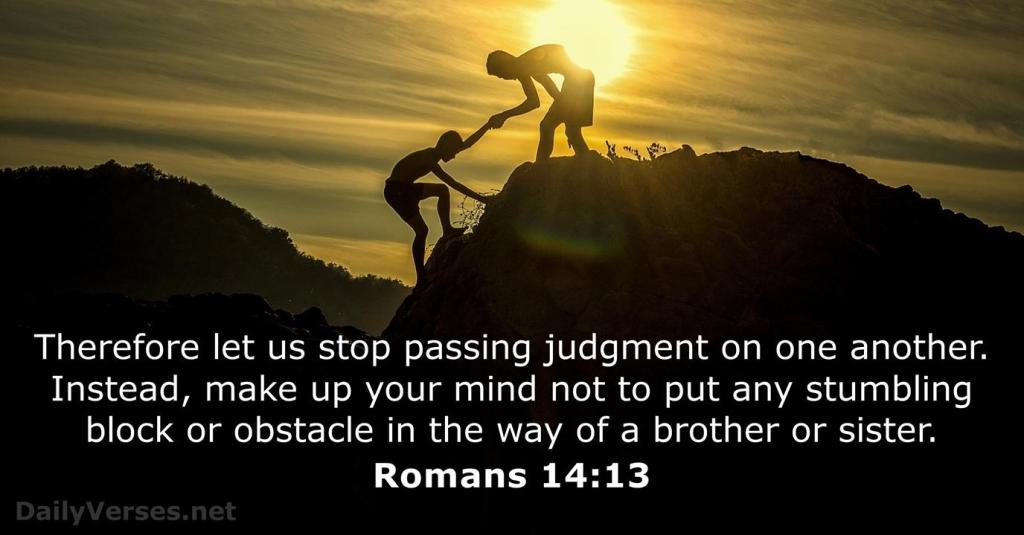
We are Accountable for our Christian Actions. Put No Stumbling Block in Your Brother’s Way—Romans 14:13-15

Romans 14:13-15Amplified Bible

13 Then let us not criticize one another anymore, but rather determine this—not to put an obstacle or a stumbling block or a source of temptation in another believer’s way. 14 I know and am convinced [as one] in the Lord Jesus that nothing is unclean [ritually defiled, and unholy] in itself; but [nonetheless] it is unclean to anyone who thinks it is unclean. 15 If your brother is being hurt or offended because of food [that you insist on eating], you are no longer walking in love [toward him]. Do not let what you eat destroy and spiritually harm one for whom Christ died.

The Word of God for the Children of God. Gloria! In Excelsis Deo! Alleluia! Amen.

It is so easy (actually far too easy) for us to be incredibly judgmental of others.

We don’t know their struggles.

We don’t know their situation.

Most of all, we don’t know their hearts or their souls or their minds.

When we are judgmental, we erect a barrier between others and ourselves.

We often spread that judgmental impression to others in gossip.

Our stubbornness to only view them with a judgmental spirit erects a barrier, a true stumbling block, that can cause them to become discouraged and stumble.

It is easy to read a passage such as our text, think it does not apply to us today.

In general, we do not see the dietary struggles that the early church experienced because we are not barely trained with the Old Testament laws and regulations, they were trained in.

However, the underlining principal that the Apostle Paul is addressing in this passage still very much applies to our being accountable for Christian Actions.

First: Christian Actions first!

We are to judge ourselves to make sure we are not causing others to stumble by our actions. 

This should be a mindset not to use our freedom to destroy the faith of our brothers and sisters.

Paul was fully convinced that no food was unclean, but it was how that food was received that made it unclean for that individual.

If they were not receiving from a mindset of faith, then to them it was unclean.

Sometimes these truths take a while to take hold in our lives.

Paul told Timothy, 

“For everything God created is good, and nothing is to be rejected if it is received with thanksgiving, because it is consecrated by the word of God and prayer” (1 Timothy 1:4-5).

Everything that God made is good and nothing has to be refused if we receive it with grateful hearts and thanksgiving and from a mindset of true genuine faith.

This struggle between the old covenant law and the new and better covenant that we enjoy today extends far past dietary laws of eating and drinking.

Early Christians struggled over these things because they did not understand that they were a shadow of the things to come.

Colossians 2 speaks directly to this very thing, 

“Therefore, do not let anyone judge you by what you eat or drink, or with regard to a religious festival, a New Moon celebration or a Sabbath day. These are a shadow of the things that were to come; the reality, however, is found in Christ” (Colossians 2:16-17).

Likewise, it is still true to this day, today, that some Christians still hold to Old Testament ritual without any idea that the ritual has become reality in Christ.

But now that our Savior Jesus Christ has come, the rituals are meaningless and can, sadly, become oppressive. This is why it is important to fully understand the differences in the covenants so we can walk in the freedom and liberty that Christ purchased for us, His enemy, ratifying it with His precious life’s blood.

The bottom line is that we are all in different stages of maturity in Christ. We should encourage one another, and we should decide to walk in the freedom that Christ has revealed to us while making up our minds not to cause our brothers and sisters in Christ to stumble in their faith by our faulty actions.

In the first twelve verses of chapter 14 Paul has taught Christians in that church to stop passing judgments on each other and despising each other.

Jewish Christians were condemning Gentiles Christians about eating unclean foods and not keeping the festivals of Moses.

Gentile Christians was despising Jewish Christians for not eating with them, eating all foods, and for keeping the Sabbath and other feasts of Moses.

They were to recognize God had received them both and that God was the judge.

Therefore, they were to welcome and accept one another, but not for the purpose of disputing over these things.

Paul is going to pursue this thinking further as he directs these early Christians concerning how to, and how not to act over these significantly divisive issues.

Romans 14:13-15ESV

Do Not Cause Another to Stumble

13 Therefore let us not pass judgment on one another any longer, but rather decide never to put a stumbling block or hindrance in the way of a brother. 14 I know and am persuaded in the Lord Jesus that nothing is unclean in itself, but it is unclean for anyone who thinks it unclean. 15 For if your brother is grieved by what you eat, you are no longer walking in love. By what you eat, do not destroy the one for whom Christ died.

Never Put a Stumbling Block in The Way of Another Christian (14:13)

This is the key thought for this paragraph.

Stop passing judgment on one another.

Instead, resolve to never put a stumbling block or hindrance in the way of a brother.

The same Greek word is used for what is translated “pass judgment” and “decide” in the ESV in verse 13.

Literally, this would read:

“Therefore, let us not judge one another any longer, but rather judge to never put a stumbling block or hindrance in the way of a brother.”

In a sense Apostle Paul is saying that if you are going to judge, judge to never put a hindrance in your brother’s way. Stop judging one another.

Determine to not be a stumbling block or a hindrance.

This is a very important principle that we also must determine to do in our lives.

We need to make the Christian decision to never put a stumbling block in the way of our Christian brethren.

This is one point that we find in parallel to 1 Corinthians 8-10.

At the end of 1 Corinthians 8 Paul teaches that he would never eat meat again to keep his brother or sister from stumbling.

In chapter 9 Paul taught that he forfeits his rights for the sake of the gospel.

These points are similarly made here in Romans 14.

We need to determine that we will choose not to do things when we know that such an activity is going to be a hindrance to other Christians.

The question is not simply is this okay for me to do.

The question is also is this something that could cause my brother or sister in Christ to engage in sin or be weak in conscience.

Do Not Grieve Your Brother (14:14-15)

Paul continues in verse 14 about his knowledge in the Lord that there is nothing clean or unclean any longer in Christ.

But can you imagine how difficult this knowledge was for those who grew up in Judaism?

All their lives they were rightly taught that certain foods defiled, and only other foods were clean for eating.

For years the conscience had been trained that these foods were unclean.

Even Peter did not readily accept this when three times in a vision God said, “Rise, kill and eat.” (Acts 10:13) (Whole thought: Acts 10:9-22)

Now these Jews had become Christians.

How difficult it was for them to change their eating habits from being Jews to liberated Christians.

Paul knows that all foods are clean.

However, for those who think the food is unclean, it is unclean.

The other parallel to 1 Corinthians 8-10 is found at this point also.

What another person believes is just as important as what you believe.

If a person sees the food as unclean, they should not engage in eating that food.

One can easily imagine the Jewish Christian knowing that the food is okay to eat, but the conscience is so strong that it will not allow that Jewish Christian to eat that meat.

Rather than instructing the strong to teach the weak the truth so that they are no longer weak, Apostle Paul is calling upon the strong to stop, to empathize, to come to a place where they try to understand where the weak are coming from.

The strong need to understand that the conscience is involved.

It is not simple for them to change regarding foods.

It is not so simple a thing for individuals to “dismantle” their belief systems.

It took them a lifetime to arrive at that place of practice and understanding.

Verse 15 capitalizes on this thought.

If your brother is grieved by what you eat, you are no longer walking in love.

You know you have a liberty, but you must have concern for your brother above all else.

We must have the determination to not put a stumbling block in the way of any person.

If we do not care what we are doing is causing a problem for another Christian, then we have a bigger problem.

The bigger problem is that we are not acting with the love that Jesus commands.

There may be things I think we should do in our worship or in our gatherings.

But I know that this could and would cause problems for other members.

Should I bully them into going along with me because “only I” have the proper understanding of the scriptures?

Absolutely not.

We may have beliefs concerning the scriptures which are different than the beliefs of others.

Should we “push” them into “seeing things my way?”

No. We are commanded to work with one another.

We are commanded by God to be more considerate, understanding about where the other person is coming from.

We need to consider that the other person may have serious convictions or a trained conscience that we do not want to “rush headlong into” and violate.

We need to acknowledge, recognize there are occasions when we need to hold back from our freedom for the sake of those whose Christian faith would be irreparably damaged by such behavior.

Paul gives us a very important thought that we must continue to keep in mind: “By what you eat, do not destroy the one for whom Christ died.”

How many ways to “stumble all over ourselves” to damage the faith of another?

How could we possibly live with ourselves if we ruin the faith of another?

We cannot and must not use our liberties to be a hindrance to another Christian.

Romans 14:13-14The Message

13-14 Forget about deciding what’s right for each other. Here’s what you need to be concerned about: that you don’t get in the way of someone else, making life more difficult than it already is. I’m convinced—Jesus convinced me! —that everything as it is in itself is holy. We, of course, by the way we treat it or talk about it, can contaminate it.

How we do this is by first Loving God, then loving our neighbor as ourselves.

In the previous chapter Paul summarized that our duty was to love and act in love toward one another (Romans 13:10).

If we ignore the influence our own actions have on others, we are not walking in love. So, we must continue towards the freedom into which we have been called while loving our God and extending grace and patience with all fellow believers.

As an incredibly wise sage once wrote some three thousand years ago:

(Ecclesiastes 3:1 KJV)

“To everything there is a season, and a time to every purpose under the heaven.”

And only God knows the end of it all ….

And in the end of it all, only God’s judgement of it all matters in the end.

Ecclesiastes 12:13-14Amplified Bible

13 When all has been heard, the end of the matter is: fear God [worship Him with awe-filled reverence, knowing that He is almighty God] and keep His commandments, for this applies to every person. 14 For God will bring every act to judgment, every hidden and secret thing, whether it is good or evil.

In the name of God, the Father and God the Son and God the Holy Spirit,

Let us Pray,

God my Father, I ask you to conform my attitude toward others to match the redemptive grace you have for them. I want to be more patient with the failures of others, just as you are patient with mine. Forgive me for not being more of an encouragement to those who are weak and struggling and open my eyes to the ways I can be a blessing to them. Forgive me for those times when I have been a hindrance to others and pray, open my heart to share your blessings with them. Please use me to be an instrument of grace. In my Savior Jesus’ name. Amen.

https://translate.google.com/

Pondering our Living Hope: Everyone Will Have to Give an Account to God—Romans 14:10-12

Romans 14:10-12 Amplified Bible

10 But you, why do you criticize your brother? Or you again, why do you look down on your [believing] brother or regard him with contempt? For we will all stand before the judgment seat of God [who alone is judge]. 11 For it is written [in Scripture],

“As I live, says the Lord, every knee shall bow to Me,
And every tongue shall give praise to God.”

12 So then, each of us will give an account of himself to God.

The Word of God for the Children of God. Gloria! In Excelsis Deo! Alleluia! Amen.

Attending to the affairs of self, versus our attending to the affairs of others.

Understanding that we are only responsible for ourselves takes the burden off trying to make everyone else into a model Christian.

When we understand that we can share, encourage, teach and equip others for this life but ultimately the responsibility for what they do with it falls squarely on their shoulders, this gives us the liberty to simply love and care for them.

We do not need to take the burden of their behavior and decision or indecision upon our shoulders, our hearts or our souls.

Standing before God, we have the first burden of accountability.

We are the only ones who have to give an account of ourselves.

We have an ultimate responsibility to account for our whole selves first.

When I am standing before God – I am standing in my own shoes which I myself crafted for myself through my own actions through my own very own lifetime.

We will all give an account of ourselves to God in the end.

So, perhaps instead of wasting time worrying about all of the affairs of our brothers and sisters, we should see to ourselves first to make sure our motives are right, our hearts pure, we are walking in the plan the Lord has set for us.

We have to be true to ourselves, how God shaped our connection, our right relationship with God, the Father and God the Son and God the Holy Spirit.

Romans 14:13-18Amplified Bible

13 Then let us not criticize one another anymore, but rather determine this—not to put an obstacle or a stumbling block or a source of temptation in another believer’s way. 14 I know and am convinced [as one] in the Lord Jesus that nothing is unclean [ritually defiled, and unholy] in itself; but [nonetheless] it is unclean to anyone who thinks it is unclean. 15 If your brother is being hurt or offended because of food [that you insist on eating], you are no longer walking in love [toward him]. Do not let what you eat destroy and spiritually harm one for whom Christ died. 16 Therefore do not let what is a good thing for you [because of your freedom to choose] be spoken of as evil [by someone else]; 17 for the kingdom of God is not a matter of eating and drinking [what one likes], but of righteousness and peace and joy in the Holy Spirit. 18 For the one who serves Christ in this way [recognizing that food choice is secondary] is acceptable to God and is approved by men.

We are not to judge our fellow brothers over trivial matters such as eating and drinking.

Nor should we look down upon or be impatient with them when they do not understand these truths.

The Lord will reveal in due time this freedom to which they were called.

Instead, we need to be concerned with our own hearts and actions because we will be the only ones standing who will be giving an account to God for them.

Understanding this puts judging others in perspective. Instead, we can make up our minds not to put stumbling blocks in their way. We should allow their paths to remain clear so they will not falter in their walk with the Lord on our account.

Knowing that we will stand before the Lord and confess his Lordship should excite you as a believer.

Everything in heaven, earth and under the earth will eventually confess that Jesus is the King of Kings and Lord of Lords (Acts 4:8-12, Philippians 2:9-11).

If we fully acknowledge this, recognize it, confess this now while we live on this earth, then there is no fear in that day, because perfect love casts out fear.

1 John says, 

“In this way, love is made complete among us so that we will have confidence on the day of judgment, because in this world we are like him. There is no fear in love. But perfect love drives out fear, because fear has to do with punishment. The one who fears is not made perfect in love” (I John 4:17-18). 

Association with Jesus is what gives us eternal life and a hope for heaven.

Believing in Him is the deciding factor of whether we live or die.

The good news is we can live to the maximum for him now, confess and rejoice in what he did for us while, we are all looking forward to that one day when we will all be standing before our Savior, and confessing this Lordship to his face.

Understanding this provides perspective on our personal responsibility.

We are not to judge or confuse our brothers and sisters by the freedom we enjoy rather we should understand that everyone will give an account to the Lord.

So, it is in our best interest to walk in our convictions with pureness of heart because the Lord has accepted them.

In the same way, he has accepted fellow believers and their convictions.

Utterly overwhelmed by this acceptance as we should all be, we are to make every effort to live our lives as unto the Lord no matter how trivial our tasks.

Because this shows a max heart change, and this is magnifying His name alone, above all others glorifying to our Savior Jesus, because of it, He has accepted us.

Today, I pray that you make up your mind to encourage your brothers and sisters instead of maxing out efforts, ripping, shredding, tearing them down.

Make every effort to live in peace, guarding and protecting your heart and walking in the truth. May you pull yourselves back, evaluate your own motives today and instead walk in pureness before the Lord as this is pleasing to him.

In the name of God, the Father and God the Son and God the Holy Spirit,

Let us Pray,

O Lord my God, you are my shield, my strength and my wisdom. Help me so to trust you with my decisions and my future. Let me lean on you with all my heart instead of relying on my own understanding. Give me clear guidance in my life Lord. As I learn to submit myself fully unto you, I know that you will direct my paths and I can have confidence that your direction is always the best way to go. Lord, bless me and keep me, make your face to shine upon me. Turn your face fully towards me and give me thy peace. Through Jesus Christ our Lord, Amen.

https://translate.google.com/

Our Personal Accountability to God: Biblical Guidance. Hebrews 4:10-13

Hebrews 4:10-13Amplified Bible

10 For the one who has once entered His rest has also rested from [the weariness and pain of] his [human] labors, just as God rested from [those labors uniquely] His own. 11 Let us therefore make every effort to enter that rest [of God, to know and experience it for ourselves], so that no one will fall by following the same example of disobedience [as those who died in the wilderness]. 12 For the word of God is living and active and full of power [making it operative, energizing, and effective]. It is sharper than any two-edged [a]sword, penetrating as far as the division of the [b]soul and spirit [the completeness of a person], and of both joints and marrow [the deepest parts of our nature], exposing and judging the very thoughts and intentions of the heart. 13 And not a creature exists that is concealed from His sight, but all things are open and exposed, and revealed to the eyes of Him with whom we have to give account.

The Word of God for the Children of God. Gloria! In Excelsis Deo! Alleluia! Amen.

Accountability is a big topic.

Does Integrity count for anything anymore?

Does Honesty count when, in this age of social media and the internet, we try so very hard to hide everything about us, who we are, every single thing we can in mindless minutiae, and cyber-cookies – just trying to get away with so much?

There are a whole lot of places to “hide stuff” on the internet in “cyberspace.”

Does Accountability matter?

Do we try too hard to let too much just slip into a state of cyber-anonymity?

“Who is going to know what to look for anyway?”

“Who has the time to look anyway?”

“Who has the energy to look anyway?”

“What are the chances of ever our “being discovered or found out?”

“Isn’t everybody too busy “minding their own business” anyway?

Do a quick google search!

You will find a whole lot of people are asking things like:

What is personal accountability?

What is the difference between responsibility and accountability? 

What does the Bible say about accountability?

Why is personal accountability important?

And searching things like: How to hold people accountable, how to hold yourself accountable, and how to be accountable to others.

But around here, our primary interest is in what the Bible has to say on any matter, so the main question we want to answer today is, what does the Bible say about accountability?

We will strive to faithfully, hopefully, lovingly, prayerfully learn that personal accountability is a major key to living a life of victory, so of course, we want to strive to give practical application advice for how to hold yourself accountable.

What does the Bible Say about our Personal Accountability?

It’s hard to narrow the answer to this question down to just one verse, because there are so many facets to personal accountability. Of course, we will try to cover some of these facets and verses below, but if I had to choose one verse that kind of sums it all up, I think it would be this one from Hebrews 4:12-13

12 For the word of God is living and active and full of power [making it operative, energizing, and effective]. It is sharper than any two-edged [a]sword, penetrating as far as the division of the [b]soul and spirit [the completeness of a person], and of both joints and marrow [the deepest parts of our nature], exposing and judging the very thoughts and intentions of the heart. 13 And not a creature exists that is concealed from His sight, but all things are open and exposed, and revealed to the eyes of Him with whom we have to give account.

Nothing whatsoever is hidden from the Lord our God, the Word of the Lord our God, the POWER behind the Word of the Lord our God and there’s not one single creature exists that is concealed from HIS sight, but ALL things are open and exposed, AND revealed to the EYES of HIM with whom we have to give account.

Psalm 139:1-12 Amplified Bible

God’s Omnipresence and Omniscience.

To the Chief Musician. A Psalm of David.

139 O Lord, you have searched me [thoroughly] and have known me.

You know when I sit down and when I rise up [my entire life, everything I do];
You understand my thought from afar.

You scrutinize my path and my lying down,
And You are intimately acquainted with all my ways.

Even before there is a word on my tongue [still unspoken],
Behold, O Lord, You know it all.

You have enclosed me behind and before,
And [You have] placed Your hand upon me.

Such [infinite] knowledge is too wonderful for me;
It is too high [above me], I cannot reach it.


Where can I go from Your Spirit?
Or where can I flee from Your presence?

If I ascend to heaven, You are there;
If I make my bed in Sheol (the nether world, the place of the dead), behold, You are there.


If I take the wings of the dawn,
If I dwell in the remotest part of the sea,
10 
Even there Your hand will lead me,
And Your right hand will take hold of me.
11 

If I say, “Surely the darkness will cover me,
And the night will be the only light around me,”
12 
Even the darkness is not dark to You and conceals nothing from You,
But the night shines as bright as the day;
Darkness and light are alike to You.

What an incredibly stunning revelation spoken, penned, then sung by David!

The question that always seems to linger in my mind when I read these verses is what David’s emotional state was when he wrote and then sung these words.

Was he singing them from a place of hiding -from man, from God, or both?

Was he singing them from a place of intrigue?

Was he singing them from a place of joy?

Was he singing them from a place of gratitude?

Was he singing them from a place of thanksgiving?

Was he singing them from a place of fear and trembling?

Was he singing them from a place of anger?

Was he singing them from a place of anxiety?

Was he singing them from a place of depression?

Was he singing them from a place of deceit?

Was he singing them from a place of subterfuge?

Was he singing them from a place – “secure” in his knowledge he just pulled the wool over everyone’s eye – including God’s – In essence – committing criminal acts, conspiring to commit criminal acts, Mocking man and God?

Was he singing them from a place – secure in his absolute authority as King and anointed by God, being a child of God – “now I will get away with everything secure in the knowledge, belief, “because I know God will forgive me anyway?”

Was he singing them from a place of a soul needing to be humbled before God?

Was he singing them from a place of kneeling on his way towards repentance?

Any one of these starting places is fully and equally valid – even for us in 2022.

Whether trying to be honest or trying to be deceitful or somewhere in between,

Whether we accept it or not, the Bible is clear that we are all accountable to God, and since no one and nothing is ever hidden from Him, we WILL have to give an accurate account of ourselves. The excuses, manipulations we are all tempted to employ in this life simply just will not work when we’re standing before Him.

Since that’s true, let’s dig a little deeper to discover how to hold yourself accountable now so that when you stand before Him, you will be prepared.

What is Personal Accountability?

Before we go too much further into answering the question, “What does the Bible say about accountability,” let’s take some time to define exactly what personal accountability is and why it’s important.

To understand personal accountability, we really just have to break the word down and find some definitions.

The root of the word is account, and the definition of account, in this case, is a report or description of an event or experience (Oxford).

So, to be accountable for something is to be “able to give an account,” or to have the capacity to report or describe that thing.

To be accountable to someone is to have the responsibility of offering an account to that person.

Most of us are accountable to someone (a boss, partner, board members, or shareholders) in our jobs, but that’s not personal accountability, that is corporate accountability.

So, what is personal accountability?

Romans 14:11-12Amplified Bible

11 For it is written [in Scripture],

“As I live, says the Lord, every knee shall bow to Me,
And every tongue shall give praise to God.”

12 So then, each of us will give an account of himself to God.

As we’ve already discovered,

GOD SEES IT ALL!

GOD KNOWS IT ALL!

GOD HAS HEARD IT ALL!

We are all going to have to give a personal account to God.

That means, we are all going to have to answer to Him for our own lives. Not anyone else’s. That is what personal accountability is, and whether we choose to accept it or not, none of us will be able to escape from our God’s Judgement.

If you and I want to take that even .01% seriously, you and I will have to learn how to hold ourselves accountable to someone here. And just as no one will have to answer for you or me before God, no one can do it for us here either.

Accountability vs. Responsibility

Many people will think and believe that accountability and responsibility are the same thing. In fact, many sources will even use one of these words to define the other. But in reality, there is a very important difference between the two.

The word responsibility carries with it culpability or fault, while accountability simply necessitates giving an answer.

In the corporate world we can see this easily demonstrated in the relationship between boss and employee. The boss is not responsible to do the job of each employee but is accountable for whether or not the job gets done and the job gets done according to established manufacturers’ specifications correctly.

In our personal lives too, we’re not responsible for each and every detail.

Much of it is out of our control.

We don’t have any say in whether or not people treat us well, how certain events play out, or a thousand other little incontrollable details.

But according to the Bible,

We are still, will remain, 100% accountable to God for every detail of our lives.

In the name of God, the Father and God the Son and God the Holy Spirit,

Let us Pray,

Generous God, you are my soul’s provider, you give me everything I need. Our prosperity is only found in you. Give me clarity of mind and thought as I face difficulties and confusion in my life. Help me make choices that are obedient to your word and your will for my life. Help me to walk in your ways, obey your commands and trust in the name of Jesus. Help me to do this and prosper in everything I do, wherever I go. May the words of my mouth and the meditation of my heart be acceptable in your sight. Through Jesus Christ, our Lord. Amen.

https://translate.google.com/

God’s Really Surprising Truth about our Spiritual Laziness and What We Can Genuinely Do About it. Jeremiah 17:5-8.

Jeremiah 17:5-8 Amplified Bible


Thus says the Lord,
“Cursed is the man who trusts in and relies on mankind,
Making [weak, faulty human] flesh his strength,
And whose mind and heart turn away from the Lord.

“For he will be like a shrub in the [parched] desert;
And shall not see prosperity when it comes,
But shall live in the rocky places of the wilderness,
In an uninhabited salt land.

“Blessed [with spiritual security] is the man who believes and trusts in and relies on the Lord
And whose hope and confident expectation is the Lord.

“For he will be [nourished] like a tree planted by the waters,
That spreads out its roots by the river;
And will not fear the heat when it comes;
But its leaves will be green and moist.
And it will not be anxious and concerned in a year of drought
Nor stop bearing fruit.

The Word of God for the Children of God. Gloria! In Excelsis Deo! Alleluia! Amen.

On the surface, spiritual laziness looks like not getting up early enough to pray and read your Bible, but it really goes much, much deeper than that.

When I searched the Internet on this topic, the vast majority of articles and blog posts focused on the necessary disciplines of bible study, Scripture Reading and Prayer time, busy at “work” versus quiet time, going to church, serving others.

And all of those things are critically important in the life in God’s backyard.

However, from personal experience, those disciplines and commitments are almost impossible to stick with unless the root of spiritual laziness is dug up and destroyed.

Not praying regularly, reading the Bible daily, and committing to regular fellowship with other believers are usually symptoms of something buried much deeper in our souls.

It’s kind of like trying to be losing weight. You won’t stick with a diet until your heart, mind, and soul are aligned and motivated to do so. You may persevere for a brief while based on sheer willpower and stubbornness, but it won’t become a lifestyle until the spiritual battle is won within the deepest parts of your being.

So, what is spiritual laziness if it’s not the failure to regularly implementing the classic Christian activities and routines?

To discover this answer, we can turn to the Biblical analogy of trees and fruit, which is used more than a hundred times throughout scripture. 

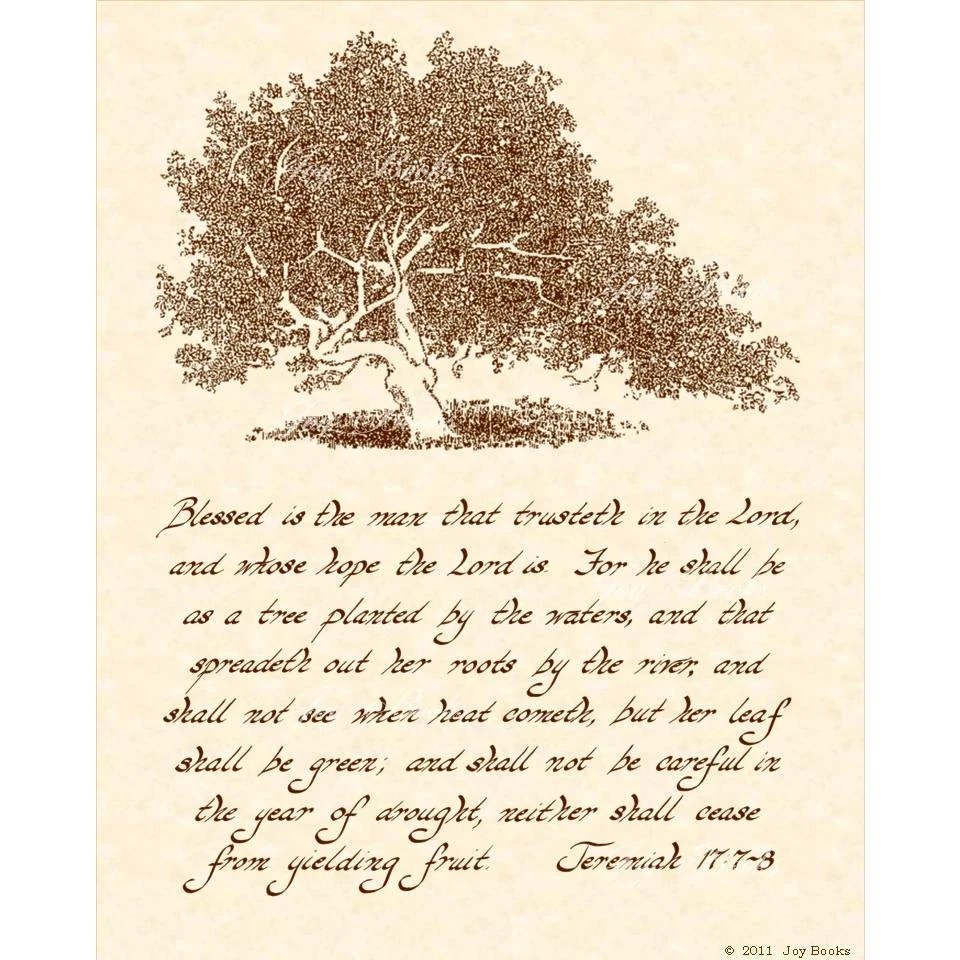
Jeremiah 17:7-8 says, “Blessed is the man who trusts in the Lord, whose trust is the Lord. He is like a tree planted by water, that sends out its roots by the stream, and does not fear when heat comes, for its leaves remain green, and is not anxious in the year of drought, for it does not cease to bear fruit.”

In these verses, we discover that trust in God — a deep, abiding, unwavering, uncompromising trust — is the key to a fruitful life.

That means that not trusting in God for anything and everything — i.e., being worrying, trying to control outcomes, not submitting to God’s sovereignty — is at its core true spiritual laziness.

Therefore, all of those wonderful and incredibly vital habits I mentioned earlier are the fruit of being spiritually active, but they are not the tree itself.

The tree described in Jeremiah is fruitful because it’s rooted in the trust of the Lord, day and night, season after season, storm after storm.  

If you and I are feeling mightily slapped in the face right now, please know that I and uncountable numbers of other “Christians” are right there with you.

If I were to reveal my list of weaknesses, laziness has never been in my top 10.

If anything, I am at times too energetic and too driven.

A former supervisor of mine once said to me, “Your level of energy and dedication and devotion to your work makes your co-workers nervous.”

And he did not entirely mean it as any kind of high and glorious complement, and now many years later I have come to understand why – “its unheard of.”

I’ve also realized that what shows up in my work habits is just as spiritually connected as what comes out in my sacred disciplines for the Lord.

Outwardly I appear to have it all together. 

My actions indicate a preponderance of fruitful behaviors and activities, but truthfully, they only mask a deep, soul-level weakness — an overwhelming need to outperform, to overdo, to achieve — all because I have unrecognized or unacknowledged or unconfessed, unrepented trust issues with our God. 

This is why being busy with the tasks of proper spirituality or duties of religion has in the past left me feeling drained, empty, and disconnected from God. But until recently I never genuinely realized “laziness” had anything to do with it.

If this still doesn’t make sense to you, bear with me for a few moments more.

The connection between laziness and mistrust is simply this: striving to trust God for everything takes great effort, put forth on a continual, consistent basis.

And not just for a few weeks or months. 

Trust grows in layers throughout your lifetime.

One decision or trial at a time. 

That means trusting Him even when we walk through long seasons of waiting, difficulties, or disappointments.

When we do not trust the Lord, it bubbles out into our lives in the form of busyness, trying to control situations or others, legalism, worrying, anxiety, escapism, the pursuit of accolades, or wealth, grumbling and complaining, and a whole host of other manifestations. 

Eugene Peterson, the editor of The Message version of the Bible puts it this way:

“Sloth is most often evidenced in busyness … in frantic running around, trying to be everything to everyone, and then having no time to listen or pray, no time to become the person who is doing these things.” 

An August 11, 2012, mental health article in the New York Times titled “The Anxious Idiot” illustrates Peterson’s point beautifully.

“Laziness: it isn’t a characteristic usually associated with the anxious. If anything, people tend to view the anxious as more active and motivated than normal, because they are more haunted by the specter of failure. And yet long experience has taught me that it is laziness … that is the foremost enemy of the anxiety sufferer, for laziness prevents him from countering the very patterns of thought that make him anxious in the first place.” 

You may or may not be much of a worrier.

Anxiety may be the last thing you resort to when times get tough.

if we struggle with anger or a need for control, then we also likely struggle with trusting God when difficult people or disturbing situations come into our life.

While the article in the NY Times was written without any spiritual connotations or recommendations, it definitely gets to the heart of the matter: every person has a decisive choice to make when confronted with the daily decisions of life.

We can make the genuine effort to trust in God, genuinely let go of our own desires, and genuinely implement His divine recommendations for a healthy, fruitful life, or we can genuinely slide down the path of least mental resistance into our comfortable, but usually very genuinely detrimental, very bad habits.

This is why Paul says our faith is like running a race.

He doesn’t say it’s like sitting in a meadow on a sunny day having a picnic.

Our participation and consistent effort are required. 

Hebrews 12:1-2a says, “Therefore, since we are surrounded by so great a cloud of witnesses, let us also lay aside every weight, and sin which clings so closely, and let us run with endurance the race that is set before us, looking to Jesus, the founder, and perfecter of our faith.”

One of the best parables of the Bible encourages us to risk everything we hold dear in order to walk closely with God. 

Matthew 25:14-30 Amplified Bible

Parable of the Talents

14 “For it is just like a man who was about to take a journey, and he called his servants together and entrusted them with his possessions. 15 To one he gave five [a]talents, to another, two, and to another, one, each according to his own ability; and then he went on his journey. 16 The one who had received the five talents went at once and traded with them, and he [made a profit and] gained five more. 17 Likewise the one who had two [made a profit and] gained two more.  18 But the one who had received the one went and dug a hole in the ground and hid his master’s money.

19 “Now after a long time the master of those servants returned and settled accounts with them. 20 And the one who had received the five talents came and brought him five more, saying, ‘Master, you entrusted to me five talents. See, I have [made a profit and] gained five more talents.’ 21 His master said to him, ‘Well done, good and faithful servant. You have been faithful and trustworthy over a little, I will put you in charge of many things; share in the joy of your master.’

22 “Also the one who had the two talents came forward, saying, ‘Master, you entrusted two talents to me. See, I have [made a profit and] gained two more talents.’ 23 His master said to him, ‘Well done, good and faithful servant. You have been faithful and trustworthy over a little, I will put you in charge of many things; share in the joy of your master.’

24 “The one who had received one talent also came forward, saying, ‘Master, I knew you to be a harsh and demanding man, reaping [the harvest] where you did not sow and gathering where you did not scatter seed25 So I was afraid [to lose the talent], and I went and hid your talent in the ground. See, you have what is your own.’

26 “But his master answered him, ‘You wicked, lazy servant, you knew that I reap [the harvest] where I did not sow and gather where I did not scatter seed. 27 Then you ought to have put my money with the bankers, and at my return I would have received my money back with interest. 28 So take the talent away from him and give it to the one who has the ten talents.’

29 “For to everyone who has [and values his blessings and gifts from God, and has used them wisely], more will be given, and [he will be richly supplied so that] he will have an abundance; but from the one who does not have [because he has ignored or disregarded his blessings and gifts from God], even what he does have will be taken away. 30 And throw out the worthless servant into the outer darkness; in that place [of grief and torment] there will be weeping [over sorrow and pain] and grinding of teeth [over distress and anger].

We read here about the parable of the talents, which tells the story of a wealthy business owner who gives three employees each a sum of money and asks them to take care of it for him while he is away on a trip.

Two of them immediately invested the money so that it would earn interest.

The third one was fearful of what would happen if he made a mistake, so he simply buried the money for safekeeping.

When the owner returned, this is what happened:

“But his master answered him, ‘You wicked and slothful servant! You knew that I reap where I have not sown and gather where I scattered no seed?” And then the passage closes with this warning: “For to everyone who has will more be given, and he will have an abundance. But from the one who has not, even what he has will be taken away.” 

In commenting on this parable, Oswald Chambers said,

“The person who is lazy naturally is always captious (i.e., sully or a whining). ‘I haven’t had a decent chance,’ and the one who is lazy spiritually is captious with God. Lazy people always strike out on an independent line.” 

Of course, our definition of independence is different today than it was back then (circa 1900).

Today we typically use the word independence in a much more positive fashion than Chambers intended.

His implication is that lazy believers chart their course separately from God’s recommended path.

Therefore, when it comes to “spiritual matters,” they can all too easily use the excuse of independence — or what they believe to be our unique situation — to justify laziness, rebellion, or fear and so very much more.

Jesus, on the other hand, calls us to be utterly dependent on Him.

As Oswald Chambers further says in his writings, we should never forget that our ability to trust in God and to serve Him with boldness — despite the risks to ourselves — isn’t measured by what we are capable of or what we desire to do.

Instead, our abilities should be grounded in the promises of God never to fail us, leave us, or ask us to do something that He cannot achieve through the power of the Holy Spirit at work in us.

In fact, the greatest miracles of life come when we are at our weakest and trust God to perform His work within us for the benefit of others and His glory. 

2 Corinthians 4:7-11 NLT says, “We now have this light shining in our hearts, but we ourselves are like fragile clay jars containing this great treasure. This makes it clear that our great power is from God, not from ourselves.”

So, these verses imply that the weaker or more fearful you and I may be of what God has asked you and I to do, the greater becomes the opportunity for Him to work miracles and display His genuine glory.

Theologically, all of this may sound like solid truth to you, but if you are still wondering what it all means for the day-to-day living and walking with Jesus, perhaps the following words of wisdom from the Book of Proverbs will help you turn these spiritual implications into daily actions.

As with most Biblical truth, there is great irony in God’s command to trust Him in Proverbs 3:5-6, which says simply:

“Trust in the Lord with all your heart and lean not on your own understanding; in all your ways submit to Him, and He will make your paths straight.”

These verses contain two actions for us to follow: trust and submit.

We must genuinely participate in the process.

To bear fruit like the tree, we must remain planted by streams of living water.

Yet to keep ourselves out of spiritual laziness and make the efforts required of this command, we must simultaneously learn to simply rest.

Yes, you and I absolutely read that right.

To overcome laziness, we have to learn to be still. 

When we build Sabbath margin into our daily lives — not just on Sunday — we will have the time to breathe, think clearly, and engage our complete being — mind, body, and soul — in genuine pursuit of Rabbi Jesus and Savior Christ. 

The tree grows because it is beside the river of life.

We will only grow in Christ when we take the time to drink of His strength and learn of His wisdom.

So, while I said at the beginning of this devotional message that prayer, Bible study, meditation, and worship are the first fruits of trust, they also become the essential building blocks of greater, greatest, trust as we faithfully apply them.

But we will never see them appear, nor be able to taste them as long as we allow busyness to proliferate in our lives, numb us to the real laziness of our hearts.

When we allow laziness to dominate our decisions and motivations, we only end up serving a false god, and not the true King of Glory.

Laziness, or not trusting God, like any other sin feels good for a season.

Other than busyness, it often shows up in forms of escapism, like mindless TV watching, endless smartphone use, endless devotion to video games, endless social media surfing, or a myriad of physical indulgences, coping mechanisms.

But when we look it square in the eye and call it for what it is, we realize it’s all about our trusting or not trusting the unseen God to do what He says He will do.

Today, I would ask you, fellow traveler, where are you and I planted? 

Are we putting “a few roots down” near the river of life, while allowing others to seek their comfort in the tainted soils of self-reliance or personal comfort?

 If so, ask God to help you find them again, dig them up, and transplant them into His unending goodness and strength.

It won’t happen overnight, but when you wake each morning, His mercies will be new, and God’s miracles will be waiting to sustain us through this “process.”

For Further Reflection and Daily Spiritual Journaling

The questions and readings below can be used for a single-day study or for our re-organization, re-prioritization of our daily quiet time throughout the week.

Day 1 – Describe in your own the words the difference between striving to perform for God (i.e., doing something out of duty or to achieve) and participating in God’s work in your life.

Read Ephesians 2:8-9 and James 2:14-26.

Why do you think you are sometimes motivated toward busyness or performance?

What is God leading us to change? How? Write them out as a prayer to Him.

Day 2 – Read Lamentations 3:22-23. In what ways are you experiencing God’s mercies today or have in the past? How are they new or different to you now than they were yesterday? If you’re in a place of struggle right now, ask God to help you recognize and receive His mercies.

Day 3 – Read, re-read the parable of the talents in Matthew 25:14-30. How are you and I similar to the good servants? In what ways are you and I being like the fearful servant? Journal about why you think that is, and what the Holy Spirit is revealing in your heart.

Day 4 – Take some time to be still before the Lord today.

Begin by reading Proverbs 3:5-6 and then meditating on it.

Ask God to interrupt you and I at any moment with what He wants to whisper to yours and my heart.

For more about “being busy” and practicing stillness and what it means,

check out: https://todaydevotional.com/devotions/be-still-2013-07-01

Day 5 – Spend some time reflecting on our schedules and our commitments at work, home, church, in your community, and other volunteering roles.

Read Luke 10:38-42.

Luke 10:38-42Amplified Bible

Martha and Mary

38 Now while they were on their way, Jesus entered a village [called Bethany], and a woman named Martha welcomed Him into her home. 39 She had a sister named Mary, who seated herself at the Lord’s feet and was continually listening to His teaching. 40 But Martha was very busy and distracted with all of her serving responsibilities; and she approached Him and said, “Lord, is it of no concern to You that my sister has left me to do the serving alone? Tell her to help me and do her part.” 41 But the Lord replied to her, “Martha, Martha, you are worried and bothered and anxious about so many things; 42 but only one thing is necessary, for Mary has chosen the good part [that which is to her advantage], which will not be taken away from her.”

Go to God in prayer and ask Him to reveal areas where you, I, are too busy like Martha and where you and I need to be more studious and quieter like Mary. 

In the name of God, the Father and God the Son and God the Holy Spirit,

Let us Pray,

All-Knowing Father, you authored my life, you know and direct my future. You make all things work together for my good. Pray! Help me to trust you as I think about my future. Give me peace of mind. Whatever happens, I know that you are working for my good and your glory. Help me to live with freedom, knowing that my future is in your mighty hand. I do not know what is around the corner, but nothing can take you by surprise. I face uncertainty but I can be certain that you are in control and that you are good. Through Jesus Christ, our Lord. Amen.

https://translate.google.com/

The Zeal of Ants! Get Some Ants and Put them in Your Pants! Proverbs 6:6

Proverbs 6:6-11Amplified Bible


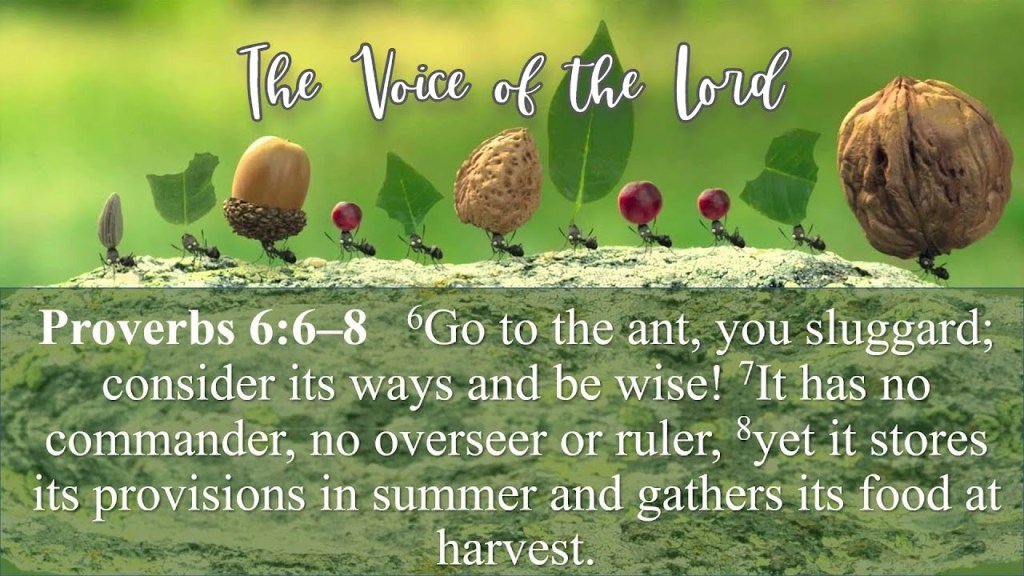
Go to the ant, O lazy one;
Observe her ways and be wise,

Which, having no chief,
Overseer or ruler,

She prepares her food in the summer
And brings in her provisions [of food for the winter] in the harvest.

How long will you lie down, O lazy one?
When will you arise from your sleep [and learn self-discipline]?
10 
“Yet a little sleep, a little slumber,
A little folding of the hands to lie down and rest”—
11 
So, your poverty will come like an approaching prowler who walks [slowly, but surely]
And your need [will come] like an armed man [making you helpless].

The Word of God for the Children of God. Gloria! In Excelsis Deo! Alleluia! Amen.

It is always reassuring to see how our God can take even the smallest creatures of creation to teach us a high value lesson in his provision and in our role in making provision for ourselves and working in the Kingdom of God.

As we go about our daily lives, we often overlook some of the most simple yet still most powerful lessons to be learned from God’s very tiniest of creations.

One such incident is found in this passage from the Book of Proverbs 6:6-8.

It would serve us, both believers and non-believers well to closely examine the habits of the ants and see what we can learn from them.

After all, the Word of God tells us to “go to the ant”, in other words go check them out.

Invite some friends and neighbors and complete strangers ….

Have a Picnic!

Have a church or community event ….

Plan a Barbeque ….

Go to your backyard

Go to a Park and reserve a Pavillion ….

Cook your food, unpack your picnic baskets ….

Sit on the Ground on your Blankets ….

See how long it takes for those ever-ubiquitous ants to show up ….

See what they do and how they do it and learn we you can because even though they may be among the very smallest insects on earth, they have learned to build colonies and build “cities” if you will, under the earth and have survived since the dawn of creation by doing the things that come to them by instinct.

How many of you would like to feast and prosper and survive like the ants?

It’s nearly impossible to stop them from spreading all over your lawn.

They are always at every backyard picnic, even when they don’t get an engraved invitation. They are some of the busiest, most industrious creatures on earth!

When have you or I ever seen a lazy ant?

I’ve never seen a live ant just standing still, lying around on the sofa, watching Television, staring at smartphones, playing video games or just doing nothing.

There are no such things anywhere at any time called “couch potato” ants.

They are constantly moving. No moss is growing under their feet. They carry not only their own share of the load, but many have been known to carry as much as 100 times or more of their own body weight with a relative ease.

Oh, that we could find enough Christians who were just willing to shoulder their part of the load, much less carry the load for 100 other Christians.

There are a few of these kinds of workers in the church, but very precious few.

I do know that there is a lot of “couch potato” Christians. I dare say that very few, if any, of us don’t have a little bit of a lazy streak from time to time.

We can call it burn out, we can call it “charging our batteries” or whatever we like but the truth is we just have to have our times to kick back and do nothing.

As hard as it is for us to acknowledge or accept, one thing that we all must realize is that God did not create us to only just sit around doing nothing.

We were created to work, to build, to grow, to be industrious, and to continually learn to work, build more. We were created for service to God’s neighborhood.

God set an example for us when he began the Bible by saying that he worked to create all things and then rested from his work on the seventh day. Work and industriousness is the very character and nature of God.

Most of us wake up in the morning and say, “Oh no, it’s morning!”

What we should say is “thank God for another day to do his work”.

Work is a blessing, not a curse.

After all what could we accomplish without putting forth some effort?

Every good thing in life requires work and effort.

It can even be said that most of us are known by the “work” we do.

Some of us are secretaries, some are accountants, some are construction workers, some are teachers, and some are Mechanics, some are electricians, some are students, some are homemakers, some are electronics technicians, computer repair people, or software programmers, and the list goes on and on.

There are a lot of people who don’t know and will never ever know our name, but they will most definitely be able to identify us by what we do as workers.

Work gives life high value and significant meaning.

If you don’t think that’s true, then consider these statistics from the Social Security Administration. 

A 65-year-old can expect to live another 19 to 21.5 years, on average, according to the Social Security Administration. What’s more, the government agency says a third of 65-year-olds will hit age 90, and 1 in 7 will live beyond age 95. Those numbers show a significant improvement in life expectancy over time.

Why do people choose to continue to work when they can just as easy retire?

People who continue to work after retirement often remain more active and socially connected, which can mean better overall health and fewer medical issues. Us, working part-time can give one a sense of being part of something fulfilling, meaningful, valuable without being tied to a career and long hours.

Why? I believe it is because after they retire, life loses a lot of its original zest.

Most don’t have or not want any part of any reason to even get out of bed in the morning after but a few months of retirement. “Hey! I earned this time of rest!”

It’s as though they cannot wait to leave their work just to just do nothing at all.

I do not believe that God created man to ever “retire” and quit doing any work.

There has to be something out there to replace your work.

Some hobby, some charity work, or something that will pique their interest and give them a reason to keep on living and to keep on thriving and also surviving.

People who give up and just go home to rock on the front porch without a dream or a vision for their future are not living, just existing, and it won’t be long until the body is so out of shape that it may well begin to fail to function as it should.

I am one of those looking forward to the day that I can leave the JOB, but not to do nothing. I feel sorry for those who have no future after their job is gone.

One begins to sense that perhaps it’s time to get a real life and realize that God isn’t near finished with us yet.

I want to do so much, and I have so much to do caring for my wife that I almost don’t have time to go to a job anymore.

The prospect of entering God’s Neighborhood, serving the Lord in ministry is far more rewarding than going to the job but the bills must be paid and so we just keep right on doing what we have to do until God sees fit to change things.

Ecclesiastes 9:10 says, “Whatsoever thy hand findeth to do, do it with thy might; for there is no work, nor device, nor knowledge, nor wisdom, in the grave, whither thou goest.”

That means that God labored for six days, expects us work, in every area of our lives, just as though we were working for him, because we are working for him.

Everything we do in His Neighborhood reflects upon our Christian character.

An ant works because that’s what ants do.

No one has to watch over him to make sure he is doing his job.

He doesn’t have to punch a time clock because his workday never ends.

He doesn’t worry about how much he is being paid because he knows all the other ants are doing their part too and that the needs of the colony will be met.

I only wish that Christians could have that much faith in their Heavenly Father.

We are too busy chasing the dollar to give God the time and energy that our God deserves from us.

If your boss on the job has to watch over you all day to make sure that you are doing your work; if all you ever do is complain of the low wages, bad working conditions, and you have a don’t care attitude about your company, that’s a terrible witness of the Love of God that is supposed to be in your heart.

God absolutely expects integrity.

God absolutely expects a disciplined and sound work ethic.

We all ought to love to work in God’s house.

We all ought to love to labor in God’s Vineyard.

We all ought to love laboring in God’s Neighborhood.

The work we do for the Lord ought to be extremely satisfying and exciting.

That ought to be, should be the same attitude we have on the job too.

Looking back at that ant colony we can easily see that it takes hard work and strict discipline on the part of every single ant to see that the colony thrives.

The worker ants can’t go on strike because they don’t get paid more than the others. The queen ant can’t refuse to do her work, or the whole colony dies.

Those that dig the channels, tend to the eggs, go forth from the nest to secure sources of food for the young in the nest and who protect the nest all have their tasks to do and it takes them all working in synch together to get the job done.

Teamwork is a necessary part of our work for the Lord too.

There are no unimportant people. Even those who won’t or don’t carry their part of the workload are still important, but they would be even more important if they would just put both of their shoulder to the wheel when they are needed.

Another thing is that I have never seen a colony of ants sitting in a motivational seminar in an attempt to get them to move.

They are too busy to need motivation.

I don’t see an ant standing along the trail every few inches with a prod in his hand making the others keep moving.

They just keep moving because they are self-motivated by their own survival.

There is nothing harder in the world than to try to motivate someone who is unmotivated.

Have you ever tried to get a teenager to work when they don’t want to?

Have you ever tried to make yourself get up and go take out the trash, mow the grass, trim the hedges, sweep the floor, wash windows or doing those dishes?

We will hold our motivational seminars, how-to classes and dream building sessions in an effort to make ourselves move. I’ve heard it said that our problem is not so much a lack of ‘proper’ motivation as it is the lack of a dream or vision.

There is a lot of truth to that.

Just to prove this point let’s see what happens if we offer to pay that teenager $25 to do the job instead of just ordering them to do it?

Perhaps the thought of having that $25 in their hands and the things that it can buy for them is or will become the primary motivating factor?

What about if our boss promises to give us a 15% raise in salary and benefits if we can “go that extra mile” to meet that “super critical” deadline in our jobs?

My, my, how much faster and more efficiently we can work then! Just offer us anything that is worthwhile having and worth the price of the work and watch us go! You see, it’s not driven by the lack of motivation, it’s driven by the lack of a prophetic vision. Give us a vision to chase after and we’ll get 100% motivated.

Brothers and Sister in Christ, Beloved Children of the Most-High God, we can learn so much from the ants if we would only take a close look at their habits.

But obviously, people aren’t ants.

We don’t live just on the instincts of survival like they do.

We are able to think and to reason and to labor and to change our lives and circumstances to make life a lot easier.

Sometimes I think that this ability to make our lives easy is a detriment to the growth of our society and our own wellbeing.

The spare time we create, if it isn’t used for something productive, becomes a roadblock in our path to success because it tends to make us think that we can “get by” if we can just sit down and do nothing but rest for one while or three.

Except, there is another side of that logic which we must address. How many of us know that the more we rest, the more we need to rest; the more we sleep, the more we need to sleep; and the less we work, the less you and I want to work?

“…How long wilt thou sleep, O sluggard? when wilt thou arise out of thy sleep? Yet a little sleep, a little slumber, a little folding of the hands to sleep…”

Proverbs 20:13, “Love not sleep, lest thou come to poverty; open thine eyes, and thou shalt be satisfied with bread.”

God calls those that love sleep, “sluggards”.

I think that’s a pretty apt description because there isn’t a more sluggish time of the day than when we first open our eyes in the morning.

We can “Talk” about the alarm clocks and the snooze buttons – if appropriate!

It is Sunday – Traditionally a “Sabbath Day” of nothing but rest, worship God.

So, perhaps it is fitting to bring this next part of the devotional to our notice.

A Search of God’s Scriptures “reveals” six habits that identify a sluggard:

1) They sleep too much. 

Proverbs 26:14, “As the door turneth upon his hinges, so doth the slothful upon his bed.”

Just as a door won’t move in any direction without hanging on to its hinges, so is that person that loves sleep too much.

All day long all you hear them say is they can’t wait to get to bed or to lie down.

They go around yawning all the time. (Although I see a lot of people who do the same from that lack of sleep too) It’s hard to get them to do anything that takes away from their sleep time. They aren’t going very far from their place of rest.

2) They love to make excuses. 

Proverbs 22:13, “The slothful man saith, there is a lion without, I shall be slain in the streets.”

It has been said that if you don’t want to do something that any excuse will do.

No one can find more excuses to not do something than the person who is too “too tired” and inevitably too lazy to do anything with even a minimal effort.

3) They have a “know-it-all”, un-teachable attitude. 

Proverbs 26:16, “The sluggard is wiser in his own conceit than seven men that can render a reason.”

They will tell you why they can’t do something and find every reason in the world why they are right in their assumption.

You can’t argue with a lazy person and the only thing that will make them move is that “threat” of a “bucket full of ants about to be dumped down their pants.”

I know a lot of people who would probably starve to death before they will admit that they are simply lazy, but they won’t work for anything less than top salary.

4) They are procrastinators.

John 3:10-12The Message

10-12 Jesus said, “You’re a respected teacher of Israel and you don’t know these basics? Listen carefully. I’m speaking sober truth to you. I speak only of what I know by experience; I give witness only to what I have seen with my own eyes. There is nothing secondhand here, no hearsay. Yet instead of facing the evidence and accepting it, you procrastinate with questions. If I tell you things that are plain as the hand before your face and you don’t believe me, what use is there in telling you of things you can’t see, the things of God?

They always seem to put things off until the last minute and are always late for everything, if they show up at all.

They never finish anything they start but find every excuse for not continuing with any project.

They tire very easily and just give up rather than to attempt to improve.

They blame everyone and everything else for their own failure to accomplish anything rather than to admit that they are lazy.

They are terrible planners, in fact, they don’t plan for anything.

They just live from second to second, reacting to whatever comes in a crisis instead of taking initiative, attempting to change things before they happen.

5) They are irritating to everyone around them, especially those who are busy. Busy people with a vision and a dream to chase don’t have much patience or compassion for those who are not. 

Proverbs 10:26, “As vinegar to the teeth, and as smoke to the eyes, so is the sluggard to them that send him.”

Don’t expect a sluggard to get the job done.

If you do, you will always be disappointed.

Their inactivity and bad attitude will likely put a bitter taste in your mouth and make your head hurt and eyes water with aggravation and you will, most likely, have to do the job yourself anyway.

6. What is the final condition of a sluggard who is unwilling to change?

“Slothfulness”

Proverbs 19:15, “Slothfulness casteth into a deep sleep; and an idle soul shall suffer hunger.”

Their whole life will lack for the things that they desire and need most.

In more ways than one would dare try to count, their life will be a disaster.

They can never satisfy their hunger for things of this earth and especially for the things of God because they are not willing to pay the price to have them.

Proverbs 10:4, “He becometh poor that dealeth with a slack hand: but the hand of the diligent maketh rich.”

They will ultimately live in poverty. Not only will they lack for material wealth but, more importantly, they will lack of spiritual wealth.

God will not honor those who refuse to seek after him and work to make their lives acceptable sacrifices to him.

Proverbs 18:9, “He also that is slothful in his work is brother to him that is a great waster.”

This speaks of the fact that the lazy person eventually leads their own home into destruction.

What man wants to keep a lazy wife or what wife wants to have to support a lazy husband? That marriage, and that home, is “headed” for destruction unless that one who is the sluggard wakes up and makes the determination to change.

The good news is that even sluggards can change if they really want to.

If they will only take a lesson from the ant and force themselves to get moving, they will eventually “arise from slumber” come out of that sluggish condition.

Nothing creates a dream or gives energy like getting into action and making things happen. The sheer satisfaction of accomplishing something worthwhile is usually all it takes to cure the sluggard.

The hard part is that God won’t change you unless you want to be changed bad enough to begin to do something about it yourself.

God will not overstep his own pre-imposed limits on taking control of your life.

The decision and first effort must come from us. If we are that determined to change, decide to change, and then take action to force ourselves to develop the right habits, then God will step in and help us to overcome our slothfulness.

So, take a lesson from the ant. Observe their industrious nature. See how they plan for the future and never will cease to work to see that the work is done.

Fact! You can’t stop ants from doing their work. No matter how many times you sweep away all the sand they’ve muscled through the cracks in your driveway, you can still be doing it again tomorrow, and the next day, and also the next.

Ants are vocationally fulfilled; like the birds of the air, they do not have a care in the world. God cares for every single one of them; all they care about is doing what God made them to do.

But God cares for us even more than the ants on the ground and birds in the air.

And he equips us, like them, to give our all to do diligently what he has created us to do—to love him above all and our neighbor as ourselves.

With God’s help, we can love sincerely, as Paul instructs.

We can (Romans 12:3-18)

“Hate what is evil; cling to what is good.”

We can

“Be devoted to one another in love” and “honor one another” above ourselves.

“Never be lacking in zeal,” says Paul, “but keep your spiritual fervor, serving the Lord.”

Hospitality, patience, sharing with others, living in harmony, and other positive traits are identified by Paul as critically important to a Christian who is trying to serve the Lord. We are also called to “live at peace with everyone.”

This is a challenging, daunting task.

It is absolutely fulltime 24×7 Christian Ministry

The Mission Field is God’s ENTIRE Neighborhood. (Matthew 28:16-20 Acts 1:8)

“Do all the good you can,
By all the means you can,
In all the ways you can,
In all the places you can,
At all the times you can,
To all the people you can,
As long as ever you can.”
― John Wesley

1 Corinthians 15:58The Message

58 With all this going for us, my dear, dear friends, stand your ground. And don’t hold back. Throw yourselves into the work of the Master, confident that nothing you do for him is a waste of time or effort.

But God’s gifts will simply overwhelm spiritual carelessness because,

like the ant, we’ll always and forever have far more than enough to do from morning till noon till night. And we can do it again the next day, and the next.

If we can have a church filled with Christians with that kind of attitude, there is no limit what God will do, absolutely no limits to where-ever God will take us.

In the name of God, the Father and God the Son and God the Holy Spirit,

Let us Pray,

Creator God, thank you that you are faithful to fulfill all your promises. You have said that you dwell in the hearts of your people through the presence of your Holy Spirit. When your church gathers together, you are in the midst of us. Hear our prayer and strengthen your church, Lord. You are the God of peace. May you sanctify us completely and may our whole spirit and soul and body be kept blameless at the coming of the Lord Jesus Christ. You, who called us, are faithful to the end. Through Jesus Christ, our Lord and Savior, Alleluia! Amen.

https://translate.google.com/

Tending unto our Procrastination’s Vineyard. Couch Potato Christianity. Pondering my God. Proverbs 24:30-34

Proverbs 24:30-34Amplified Bible

30 
I went by the field of the lazy man,
And by the vineyard of the man lacking understanding and common sense;
31 
And, behold, it was all overgrown with thorns,
And nettles were covering its surface,
And its stone wall was broken down.
32 
When I saw, I considered it well;
I looked and received instruction.
33 
“Yet a little sleep, a little slumber,
A little folding of the hands to rest [and daydream],”
34 
Then your poverty will come as a robber,
And your want like an armed man.

The Word of God for the Children of God. Gloria! In Excelsis Deo! Alleluia! Amen.

We have idleness portrayed before us by the master sage, Solomon, the wisest man that ever lived (1 Kings 3:12).

The true to life picture is of negligence and the consequences it brings.

To the observant eye, the results of an idle man’s life gave the by-passer a lecture on the virtue of diligence.

Noting carefully the slothful man and his field can teach us how to avoid more than poverty.

Learning diligence from the depicted wall and vineyard’s condition is not the only lesson offered here for the far greater concern is the condition of a soul whose owner has neglected to cultivate and tend it.

Definition of couch potato
: a lazy and inactive person
especially: one who spends a great deal of time watching television.

The lazy man conceives himself as being as wise or wiser than other men, but, is his feeling correct or is he under strange delusion? If we will just get our heart right before God we can learn to observe and learn from the conditions of life. For lessons stand before the learner if he will just take in what life shows him.

The man here is called a sluggard or lazy [used 14 times in Proverbs] and is also said to lack sense (6:32; 10:13) though I am reasonably sure he would be in hostile disagreement with that assessment.

He is called that because of his flagrant neglect of his own interests.

Unlike the situations of millions who have not a single square yard of green sod to call their own, this man had a little estate.

He had a field and vineyard which he could cultivate to gain his bread. But let us see what advantage he gained from what he possessed.

Threefold evidence of lethargy is detailed in verse 31. “And behold, it was completely overgrown with thistles, its surface was covered with nettles, and its stone wall was broken down.”

Verse 31 tells us what three things the observer’s vision fixed upon- beheld.

1. A field completely overgrown with thistles,

2. The field’s surface was covered with nettles (or weeds),

3. And the stone wall was broken down.

Synonyms for couch potato

Synonyms

  • deadbeat, 
  • do-nothing, 
  • drone, 
  • idler, 
  • lay about, 
  • lazybones, 
  • loafer, 
  • lotus-eater, 
  • slouch, 
  • slug, 
  • slugabed, 
  • sluggard

Being a “couch potato.”

This colorful term has become a standard description of the lifestyle of millions of people, as they sit around idly and lazily and let others entertain them.

According to legend, this term was invented somewhat spontaneously during a telephone conversation in 1976 by a man who opposed exercise and a healthy diet. Instead, he wanted to vegetate in front of the television and eat junk food.

This may have been a humorous comment, but the impact of this habit has been serious, leading to poorer general health and greater obesity.

Nonetheless, television viewing continues to reach record levels.

On average, Americans spend more than 34 hours per week watching television (plus almost five hours more each week watching video on the Internet on a computer).

Many more hours are spent watching on smart phone, tablets, or other devices.

(2022 data) Almost half (46%) of Americans believe they spend an average of 4 to 5 hours on their smartphones each day.

On the extreme end of the spectrum, 11% claim to spend 7+ hours on their phones each day.

And just 1 in 20 (5%) Americans stated they use their phones less than 1 hour per day.

Those folks who are gaming are doing so more than ever.

Likely as a result of the pandemic, time spent gaming jumped from an average of 12.7 hours per week in 2019 to 14.8 hours per week in 2020.

Even as restrictions were lifted and society headed back out into the world we still call “a job” “a good day’s work”, the growth continues.

Respondents now report spending an average of 16.5 hours per week with their video games on their phones and on their game systems this year.

While it’s no surprise that younger age groups like Gen Z enjoy video games, older adults are spending more time gaming, with most choosing to play games on their smartphones.

Last year, the Entertainment Software Association (ESA) revealed that older consumers (ages 55-64) accounted for 9% of online gamers, and The NDP Group shared that adults ages 45-54 spent 59% more time and 76% more dollars with gaming than they had the previous year.

Per this recent data, three-quarters of adults ages 44-64 played video games for about 16 hours per week this year.

This is a dramatic increase from the 69% who played approximately 12 hours per week in 2020 and the 65% who played for approximately 9 hours per week in 2019.

How many times in life do you just walk right on by, wrapped up, locked into your own life?

Only interested in what you are doing in that exact and exacting moment or what you are going to do in the next hour or next day, and you don’t behold.

The lesson is there but you must “see it”, you must “behold it” you must “observe it” and dare to take possession of the sights that pass before you.

BEHOLDING IS MORE THAN SEEING, 32.

All this abandonment is an object lesson that could be pondered carefully

we learn in verse 32. “When I saw, I reflected upon it; I looked, and received instruction.

Notice the initial clause in the verse; “When I saw.”

The seeing he is speaking of here is not just a looking around to keep himself from running into another object or person.

He is not just looking for a conversation topic. He is beholding an entire setting.

He gazes with the crystal-clear intention of retaining in his mind what his physical eyes saw, for the purpose of self-reflection and learning from it.

The diligent observer can reap and carry off the only harvest that this field was yielding, which is a warning and a lesson. The owner received nothing from it, but the on-looker reflected upon it that he might harvest a crop of instruction.

The sage said, “I reflected upon it.”

Literally the phrase is, “I set my heart.”

The heart is the inner being of man.

It is the seat of his mind, will, disposition [-attitude], and emotions.

In this context it means an inner positioning of the will.

A resolution to diligently find the meaning of what has been beheld.

Previously in verse 30 Solomon stated his immediate determinations. It was the field of a sluggard. Further defined as the “Vineyard of a man lacking sense.”

Solomon now sets his will to learn more from this man who is obviously doing something wrong. He views the negative aspects of the man in order to obtain something tangibly positive. He observes man’s responsibility to his work.

How often do we look only at the SUCCESS STORIES?

We look at those whose businesses started with a little profit and ended up wealthy.

You study those who started at low positions of work and ended up in places of large responsibility.

This perspective is not bad in and of itself, but when you view those successes to the exclusion of the failures you surely miss many learning opportunities.

You not only need to know what works but what does not work and why. But to learn from any situation you must intentionally reflect or contemplate upon it.

Yet reflection is not all you need to do, because verse 32 continues saying, “I looked.” The writer has previously stated that he not only saw but he retained what he saw and was seeking to learn more from the information.

Thus, we know Solomon is meaning something deeper than sensory vision.

Solomon had the picture in his mind, and he was delving into and sorting through the myriad of possibilities of this situation.

Solomon was looking at what he saw so that it could be opened wider to him.

He persisted, expecting to learn from what he had realized of this lazy man’s calamity.

The wall that marked the boundaries, that surrounded the man’s personal possession was crumbling.

There was no wall around the vineyard to defend the fruit and no fruit within the vineyard to be defended.

The owner did nothing for his property and his property did nothing for him.

The growth of fruitless weeds was only the result of the unkept property.

This is the sad result of every life where rigor and continuous striving has not been exercised.

It is the virtue of hard work which tells in the long run, and without which the most brilliant talents will have little result.

However, gifted a man may be, he will be a failure if he has not learned the great secret of dogged persistence and determination working often unwelcome toil.

No character worth building up is built without continuous effort.

If a man does not labor to be good, he will surely become bad.

It is an old axiom that no man attains superlative wickedness all at once, and most certainly no man leaps to the height of the goodness possible to his nature by one spring.

He has to laboriously step by step, climb the hill. Progress in moral character is secured only by continued walking upwards, not by an occasional jump or two.

There is also a spiritual truth that needs to be taught right here.

Jesus taught a parable about the field, the soil, and the character of a man.

He said some men’s lives are full of thorns that spring up and choke the Word and it becomes unfruitful.

Our character or our soil [or soul] starts out with faculties and potential abilities and capacities and it is our responsibility -and in our definite best interest- to diligently develop them, to cultivate them. But unlike the soil of the ground which may be cultivated by proxy, your soil can only be cultivated by yourself.

If a neglected field is a disaster, what is a neglected soul?

1 Corinthians 4:6-7Amplified Bible

Now I have applied these things [that is, the analogies about factions] to myself and Apollos for your benefit, believers, so that you may learn from us not to go beyond what is written [in Scripture], so that none of you will become arrogant and boast in favor of one [minister or teacher] against the other. For who regards you as superior or what sets you apart as special? What do you have that you did not receive [from another]? And if in fact you received it [from God or someone else], why do you boast as if you had not received it [but had gained it by yourself]?

A soul which instead of its being cultivated with the seeds of grace, the water of the Spirit is sadly left to its own native barrenness, its own dried divisiveness, becomes untillable and overgrown with the characteristics of the old nature.

Time, talents and opportunities are there but they have not been used in a diligent, in a worthwhile, in a wise way.

And a soul instead of waving with golden grain and being a scene of fruitfulness and goodness and true compassion (John 13:34-35) becomes an ugly, unsightly slum, unprotected and open to every intruder with the notion to cause trouble.

Ruin comes not by cultivation but by neglect.

Heaven seeks to promote your good growth, but we neglect our most prized possession, our eternal soul.

It is so decisively and definitively not safe to let any of the fortifications of the Christian life fall into even minimal disrepair, but they are to be attended to with strength, vigilance for the Roaring Lion is looking for a way in to devour.

If we neglect our times in Bible reading and prayer and in worship, Word and fellowship with our Savior our relationship with Him will deteriorate and we will no longer experience His blessings and fruitfulness. We need to establish priorities that honor God. Only then we’ll we avoid the neglect that leads to loss.

Solomon had the capacity to look deeply into the events of life so that he could apply the results of his understanding to his life and rule, in order that he would have a larger foundation to build upon with his increased understanding. As he applied wisdom, He gained greater and deeper understanding. If we learn from Solomon, we will realize that what you perceive should alter (change) your life.

The most valuable field and vineyard a person possesses is his eternal soul. May we too behold, truly perceive, receive instructions that motivates, leads to life.

Antonyms to “Couch Potato”

  • doer, 
  • go-ahead, 
  • go-getter, 
  • hummer, 
  • hustler, 
  • self-starter
  • highly motivated
  • highly driven
  • “Perpetual Motion”
  • “Adrenaline Junkies”
  • “Movers and Shakers”

At the same time, many Christians still become spiritual “couch potatoes.”

Sitting on the sidelines, they want to watch and let others do the work of God’s Kingdom.

They forget that God has called each of us and given us all a role to play.

I’ve heard it said that many people in our churches are mere “pew warmers.”

In other words, they do believe in the importance of being present in the House of God when the doors are open, but they will rarely be seen taking an active role in areas of service, such as helping in a Sunday School class, Bible Study, the Prayer Ministry team, nursery, the choir, junior church, the kitchen, visitations.

BUT… did you know that sometimes we Christians can still be “couch potatoes” spiritually even though we may already be busy at church?

It’s great that we’re praying for God to direct our path and lead us, yet we may still sit like a lump on the log for ages instead of taking action in a time of crisis.

What hinders us from taking action?

I suggest there are at least Five common reasons we will fail to take action…

  1. We FEAR having sufficient ability to do what God is leading us to do. (Remember, Moses was afraid to approach Pharaoh to speak because of his being slow to speech, which may have been a stuttering issue.)
  2. We’re AFRAID to leave our comfort zones. Where do we begin? We end up sitting motionless so long that we’re quite content just sitting on our couch.
  3. We FEAR that we’ll lack time, energy and financial and spiritual resources.
  4. We FEAR that the obstacles God reveals are too great for us to overcome.
  5. We become “TIRED” SELFISH and LAZY. We’d rather “slumber” than work.

It’s hard to get motivated after a while.

We soon forget about the urgency of taking action.

Paul wrote that ministry depends on each person doing their part, fulfilling their God-given assignment.

Today, PRAY! ask yourself if you are being or becoming a spiritual coach potato.

What are you doing with the time, talent, and treasure that God has given to you? Are you wisely, prudently, investing your “resources” in His Kingdom?

Don’t sit idly by and assume that others will do the work.

God has given each of us a heart and a soul.

God has given us two eyes to see with.

God has given us two ears to hear with.

God has given us two hands and two feet to serve with.

God has given you and I all His resources, His time, and His opportunities.

Do your part.

Get involved in sharing the Gospel.

And give of your resources as God gave His, so that the Lost might be reached.

In the name of God, the Father and God the Son and God the Holy Spirit,

Let us Pray,

A Covenant Prayer in the Wesleyan Tradition
I am no longer my own, but thine.
Put me to what thou wilt, rank me with whom thou wilt.
Put me to doing, put me to suffering.
Let me be employed by thee or laid aside by thee.
Exalted for thee or brought low for thee.
Let me be full, let me be empty.
Let me have all things, let me have nothing.
I freely and heartily yield all things to thy pleasure and disposal.
And now, O glorious and blessed God,
Father, Son, and Holy Spirit,
thou art mine, and I am thine.
So be it.
And the covenant which I have made on earth,
Let it be ratified in heaven. Amen.

https://translate.google.com/

Pondering our Christianity? So, how about speaking of Spiritual Laziness? Pondering our Excuses? Proverbs 24

Proverbs 24:30-34 Amplified Bible

30 
I went by the field of the lazy man,
And by the vineyard of the man lacking understanding and common sense;
31 
And, behold, it was all overgrown with thorns,
And nettles were covering its surface,
And its stone wall was broken down.
32 
When I saw, I considered it well;
I looked and received instruction.
33 
“Yet a little sleep, a little slumber,
A little folding of the hands to rest [and daydream],”
34 
Then your poverty will come as a robber,
And your want like an armed man.

The Word of God for the Children of God. Gloria! In Excelsis Deo! Alleluia! Amen.

Our text in Proverbs 24 speaks of the sluggard, the slothful man, the man too lazy to work.

What is the biblical meaning of the word sluggard?

a habitually lazy person.

What kind of person is a sluggard?

A sluggard is a lazy, sleepy, slow-moving person. A sluggard is likely to oversleep and even snooze through class or work. If you’re alert and hard-working, no one will ever call you a sluggard or a slug. Being a sluggard is a great way to fail a class, lose a job, go broke or just fall behind in general.

I want us to think about this subject and apply it to the Christian life.

Why talk about Laziness in the “Christian Life”?

Because I am convinced there are too many lazy Christians in the Body of Christ.

Lazy in what way?

Lazy in worship and work.

What am I talking about?

It should be obvious. Some of us are not faithful in their church attendance.

Acts 2:43-47 Amplified

43 A sense of awe was felt by [a]everyone, and many wonders and signs (attesting miracles) were taking place through the apostles. 44 And all those who had believed [in Jesus as Savior] [b]were together and had all things in common [considering their possessions to belong to the group as a whole]. 45 And they began selling their property and possessions and were sharing the proceeds with all [the other believers], as anyone had need. 46 Day after day they met in the temple [area] continuing with one mind, and breaking bread in various private homes. They were eating their meals together with joy and generous hearts, 47 praising God continually, and having favor with all the people. And the Lord kept adding to their number daily those who were being saved.

It should be obvious. Some of us are not faithful in their Bible Reading.

Psalm 119:9-16 Amplified

Beth.


How can a young man keep his way pure?
By keeping watch [on himself] according to Your word [conforming his life to Your precepts].

10 
With all my heart I have sought You, [inquiring of You and longing for You];
Do not let me wander from Your commandments [neither through ignorance nor by willful disobedience].

11 
Your word I have treasured and stored in my heart,
That I may not sin against You.

12 
Blessed and reverently praised are You, O Lord;
Teach me Your statutes.
13 
With my lips I have told of
All the ordinances of Your mouth.
14 
I have rejoiced in the way of Your testimonies,
As much as in all riches.

15 
I will meditate on Your precepts
And [thoughtfully] regard Your ways [the path of life established by Your precepts].

16 
I will delight in Your statutes;
I will not forget Your word.

It should be obvious. Some of us are not faithful in their Study of Scriptures.

2 Timothy 3:10-17 Amplified

10 Now you have diligently followed [my example, that is] my teaching, conduct, purpose, faith, patience, love, steadfastness, 11 persecutions, and sufferings—such as happened to me at Antioch, at Iconium, and at Lystra; what persecutions I endured, but the Lord rescued me from them all! 12 Indeed, all who delight in pursuing righteousness and are determined to live godly lives in Christ Jesus will be hunted and persecuted [because of their faith]. 13 But evil men and impostors will go on from bad to worse, deceiving and being deceived. 14 But as for you, continue in the things that you have learned and of which you are convinced [holding tightly to the truths], knowing from whom you learned them, 15 and how from childhood you have known the sacred writings (Hebrew Scriptures) which are able to give you the wisdom that leads to salvation through faith which is in Christ Jesus [surrendering your entire self to Him and having absolute confidence in His wisdom, power and goodness]. 16 All Scripture is God-breathed [given by divine inspiration] and is profitable for instruction, for conviction [of sin], for correction [of error and restoration to obedience], for training in righteousness [learning to live in conformity to God’s will, both publicly and privately—behaving honorably with personal integrity and moral courage]; 17 so that the [a]man of God may be complete and proficient, outfitted and thoroughly equipped for every good work.

It should be obvious. Some of us are not faithful in teaching their children.

Proverbs 22:6 Amplified:

Train up a child in the way he should go [teaching him to seek God’s wisdom and will for his abilities and talents],
Even when he is old, he will not depart from it.

It should be obvious. Some of us are far too wise in their own eyes.

We are either lazy, indifferent or perhaps distracted by other things – like maybe making one too many excuses to excuse away our sluggard ways.

Proverbs 3:1-8 Amplified

The Rewards of Wisdom

My son, do not forget my [a]teaching,
But let your heart keep my commandments;


For length of days and years of life [worth living]
And tranquility and prosperity [the wholeness of life’s blessings] they will add to you.


Do not let mercy and kindness and truth leave you [instead let these qualities define you];
Bind them [securely] around your neck,
Write them on the tablet of your heart.


So, find favor and high esteem
In the sight of God and man.


Trust in and rely confidently on the Lord with all your heart
And do not rely on your own insight or understanding.


[b]In all your ways know and acknowledge and recognize Him,
And He will make your paths straight and smooth [removing obstacles that block your way].


Do not be wise in your own eyes;
Fear the Lord [with reverent awe and obedience] and turn [entirely] away from evil.


It will be health to your body [your marrow, your nerves, your sinews, your muscles—all your inner parts]
And refreshment (physical well-being) to your bones.

And the same principles hold for our Christian service or Christian work.

Proverbs 6:6-11 Amplified


Go to the ant, O lazy one;
Observe her ways and be wise,

Which, having no chief,
Overseer or ruler,

She prepares her food in the summer
And brings in her provisions [of food for the winter] in the harvest.

How long will you lie down, O lazy one?
When will you arise from your sleep [and learn self-discipline]?
10 
“Yet a little sleep, a little slumber,
A little folding of the hands to lie down and rest”—
11 
So, your poverty will come like an approaching prowler who walks [slowly, but surely]
And your need [will come] like an armed man [making you helpless].

Let’s consider three thoughts about the sluggard.

From Proverbs 24:30-34

1- His nature is evident (30-31)

2- His failure is applied (32)

3- His life is poor (33-34)

I. HIS NATURE IS EVIDENT TO ANYONE OBSERVING THE BEHAVIOR

V. 30-31 “I went past the field of the sluggard, past the vineyard of the man who lacks judgment; thorns had come up everywhere, the ground was covered with weeds, and the stone wall was in ruins.”

The writer was saying, “I went past the field of the sluggard and SAW…”

He SAW the thorns and the weeds that had grown up.

He saw the apparent evidence of the man’s apparent laziness.

Missionary Hudson Taylor once said: “If your father and mother, your sister and brother, if the very cat and dog in the house, are not happier for your being Christian, it is a question whether you really are.”

The nature of a person is evident in the way they live, the things they do, the words they speak, etc. A lazy person’s life speaks for itself.

The nature of the Christian is evident in the way they live, the things they do, the words they speak, the ways they act and interact and relate and connect.

A spiritually lazy Christian’s life will inevitably speak of, for itself, by itself.

II. HIS FAILURE IS APPLIED

V. 32 “I applied my heart to what I observed and learned a lesson from what I saw.”

In his first sermon, the new preacher at the church in Lexington, Kentucky preached against gambling on horses.

Sometime later a deacon and several laity, came to him and said, “Folks didn’t appreciate that sermon. A lot of horses are raised in this part of the country.”

The next Sunday he preached about the evils of smoking. Again, that same deacon and those same laity pulled him aside and said, “Too many folks in these parts make their living growing tobacco. You can’t preach about that.”

The third Sunday came, and he preached against the evils of drinking whiskey, only to be told by that same deacon, those same laity that there was a large still less than a mile from the church and many church members worked there.

The frustrated preacher said, “Well, what in the world can I preach about?” The deacon and the laity said, “Preach against those heathen men from Mars. There isn’t a single one of them within a hundred thousand million miles of us.”

The next week the frustrated preacher delivered a well thought out message from John 3:16. What can go wrong preaching from this old familiar favorite?

The Deacon and the laity all shook hands with the minister after the service. “That was a wonderful sermon, the best we ever heard!” they told him, “– just wonderful. Everything said applies to someone I know. (But, not really to us)”

The spiritually lazy person is quick to point his finger at someone else, saying, “We have known for a long time that So and so needed to hear that sermon,” but they may never consider applying the truth of a sermon for their own life.

James 1:22 “But be ye doers of the Word and not hearers only, deceiving your own selves.” KJV

The whole point of scripture is our diligent and disciplined application of it.

How does this passage or that passage apply to me, to my life?

The Word of God is not just meant to educate us but also to change us.

“I applied my heart to what I observed and learned a lesson from what I saw.” I applied to MY heart what I saw, and “I” learned a lesson from what I saw.

Now, not only should we try to apply the Word of God to our lives, but also the mistakes of others. When we hear the excuses, see the mistakes of others, we should learn a lesson. WE SHOULD LEARN FROM THE MISTAKES OF OTHERS!

III. HIS LIFE IS POOR

V. 33-34 “A little sleep, a little slumber, a little folding of the hands to rest and poverty will come on you like a bandit and scarcity like an armed man.”

Poverty in some form comes to the person who is lazy.

The case of the farmer in Proverbs 24, he might not have a crop, consequently, have no money with which to support family. No money, no food on the table.

Do you realize that doing little or nothing can get you into trouble?

ILLUSTRATION.

A man lived in a very low-lying area near a river. A man in a jeep drove up one day, said, “This area is about to be flooded. You need to get out of here!”

The man replied, “I’ll just stay here, trust the Lord to take care of me.” Soon the rush of water was swirling around his front porch as he sat in his rocking chair.

Soon after that, a man came by in a boat, saying, “You need to get out of here. The water is moving in faster and getting higher and higher.” The man replied, “I’ll be okay. I’m just going to sit here in my rocking chair trust in the Lord.”

Finally, the man ended up on his roof because of the rising water.

It had already flooded his house. Suddenly, a helicopter appeared overhead and lowered a chair so he could be taken to safety. He shouted back, “It’s okay. I’ll stay here in my faithful rocking chair. I’m trusting the Lord to take care of me.”

Well, the faithful chair floated away, and the man drowned and in heaven, he complained to the Lord He hadn’t taken care of him. And the Lord said, “Hey! I sent you a jeep, a boat, a helicopter. WHAT ELSE DID YOU WANT ME TO DO?”

Several very Christian applications can be made to this most familiar story but the one I want to make is this: Doing nothing will get you into trouble! Doing nothing with a person’s life will get them into trouble: trouble with the law, and trouble with their family and neighbors, they may all become poverty-stricken!

2 Thessalonians 3:10 “For even when we were with you, we gave you this rule: If a man will not work, he shall not eat.”

That is the rule of God, but it is also pretty much the standard rule of life.

If we don’t work, we won’t eat.

If we are not being the Body of Christ, loving God, devotedly, and diligently, prayerfully, prudently, ministering to our neighbors in God’s neighborhood,

In fact, quite a few others may not have any friends, “manna” to eat, clothes to wear, to have a bed to sleep in and a house to live in! Laziness leads to poverty!

“Sluggards” and their laziness always leads to trouble in some form or another.

It’s been said that idleness is the devil’s workshop.

That is a workshop that is always best left empty and absolutely left abandoned.

Besides you get nothing accomplished for the edifying of the kingdom of God!

Since when has that ever been a sound biblical principle, we should ever desire?

In the name of God, the Father and God the Son and God the Holy Spirit,

Let us Pray,

King of Kings, Lord of Lords, thank you that you are great and abundant in power, your charity and understanding is beyond measure. In your greatest wisdom, you have created the church, described as Christ’s body. May we work cease from our laziness, come together as members of one body, using the gifts and abilities you have given us to faithfully love and serve one another. Would we find our strength from Jesus, the head of the body. May the Lord make us increase and abound in thy love for each other. May you establish our hearts as blameless in holiness before you. Through Jesus Christ, our Savior, Amen.

https://translate.google.com/

Pondering Our Christianity? No More Excuses for our Excuses? One day all of our Excuses must CEASE! Luke 14:16-24

A psychology professor at a Midwestern University recently asked faculty members for the ‘most unusual, bizarre, and amazing student excuses’ they had ever heard. He got dozens of responses from his fellow professors:

* Grandparent death:

an old favorite, but one professor’s class established some sort of record when 14 of 250 students reported their grandmother’s death just before final exams.

In another class a student reported that he could not take a test because of his grandmother’s death.

When the professor expressed condolences a week later, the student replied, ‘Don’t worry, she was almost terminal, but she is feeling much better now.’

* Car Problems: “I had an accident, the police impounded the car, and my paper is in the glove compartment.”

* Animal Trauma: “I can’t be at the exam because my cat is having kittens and I am her coach.”

* More Animal Trauma: “At dinner last night, my dog ate all of my study notes, and he has not pooped yet this morning – can we postpone this until he does?”

We seem to have an excuse for everything, don’t we?

There are even websites on the internet that will help you generate an excuse!

It is true… you type in the type of excuse you need, and it generates one for you (www.zompist.com/excuse.html).

Also, you can even learn about how to

“Deliver a Fake Doctor’s Note and Making It Stick: 6 Must-Use Tips!”

I find that totally amazing!

What exactly is an excuse?

In a court of law, “an excuse is a defense in which a defendant argues that he or she was not liable for his or her actions at the time a law was broken and thus he or she should not be held liable for a crime. Excuses include diminished responsibility, duress, infancy, insanity, involuntary intoxication, mistake, provocation, and unconsciousness (http://en.wikipedia.org/wiki/Excuse).

I think my favorite excuse from that list is ‘infancy.’

“I was a baby when the crime happened… it wasn’t me!”

Excuse is a reason we give when something happens that does not go our way.

It is the ‘why’ we did something when we get caught.

It is our reasons for not doing something we know we should do.

The Bible is full of people making excuses and making excuses is as old as human beings.

You know the story from Genesis chapter 3. Adam ate the forbidden fruit, then when confronted about it, he came up with an excuse: “The woman you put here with me– she gave me some fruit from the tree, and I ate it” (verse 12).

Then the blame was shifted to Eve. What did Eve have to say? Genesis 3:13 records her excuse: “The serpent deceived me, and I ate.”

It was the serpent’s turn, and guess what – he didn’t have a leg to stand on!

Exodus 32 shares with us the story of the Golden Calf.

The people of God finally arrived from Egypt and settled at the mountain of God to receive the Ten Commandments.

Moses was gone a long time and the people became restless.

The people wanted Aaron, Moses’ brother, to make idols they could worship.

They gave him gold. Aaron made a calf. They were persistent in their request.

Moses returned with the Ten Commandments in hand and asked Aaron if he had made the idol.

What was Aaron’s response? Aaron is trying to explain himself and says,

“So, I told them, ’Whoever has any gold jewelry, take it off.’ Then they gave me the gold, and I threw it into the fire, and out came this calf!” (Exodus 32:24).

Aaron was not to blame… the fire was. Ridiculous and almost comical if the sin were not so grave, have such a bitter taste and have such lethal consequences.

God wants to have a relationship with us, and He wants that relationship to be the most important.

But we default to our sinful unrighteous humanity, and we make our excuses.

It is the great conundrum of mankind – We always have excuses after excuses.

We are going to look at a parable today where the invited guests made excuses.

Let’s read this story from Jesus.

Luke 14:16-24Amplified Bible

Parable of the Dinner

16 But Jesus said to him, “A man was giving a big dinner, and he invited many guests17 and at the dinner hour he sent his servant to tell those who had been invited, ‘Come, because everything is ready now.’ 18 But they all alike began to make excuses. The first one said to him, ‘I have purchased a piece of land and I have to go out and see it; please consider me excused.’ 19 Another one said, ‘I have purchased five yoke of oxen, and I am going to try them out; please consider me excused.’ 20 And another said, ‘I have [recently] married a wife, and for that reason I am unable to come.’ 21 So the servant came back and reported this to his master. Then [his master,] the head of the household, became angry [at the rejections of his invitation] and said to his servant, ‘Go out quickly into the streets and the lanes of the city and bring in here the poor and the disabled and the blind and the lame.’ 22 And the servant [after returning] said, ‘Sir, what you commanded has been done, and still there is room.’ 23 Then the master told the servant, ‘Go out into the highways and along the hedges, and compel them to come in, so that my house may be filled [with guests]. 24 For I tell you, not one of those who were invited [and declined] will taste my dinner.’”

The Word of God for the Children of God. Gloria! In Excelsis Deo! Alleluia! Amen.

The parable from Luke’s narrative describes for us a great banquet to which the master of the house had extended invitations far and wide.

No time had been noted in the invitation, but the understanding of the day was, once all was ready, notification would go out to all who accepted.

The moment arrived.

The servants were dispatched to gather the guests.

The minimal, if not automatic expectation would be that those invited would drop what they were doing and simply come, because to accept the invitation beforehand and then make an excuse when the day came was a grave insult.

And yet the excuses come.

Everyone knew that the banquet was being prepared and they were supposed to have cleared their schedules.

All who were invited gave excuses.

Other things and other people were subtly, suddenly taking priority over the banquet that was prepared.

Excuse One:

One man said he was too involved in his business.

The man had bought a piece of ground and needed to look after it.

A person can become too involved in any business, not just the business of developing property or farming.

A person’s business, profession, and affairs can often consume all of life.

Other things fall away, and the business is all that matters.

Excuse Two:

Another man said that he was too wrapped up in new purchases.

The oxen had just been purchased.

They were a new possession and the owner wanted to try them out.

So, it is with new purchases such as houses, cars, bikes, records and CDs, books, radios, televisions, and a host of other material things.

The Bible tells us over and over again, over emphasizes material things can take root in our lives and the love of things can become most important in our lives.

Excuse Three:

Still another man said that he was too wrapped up with his family.

This man had just got married.

We know that marriage is ordained by God and that getting married is certainly a good thing.

I think the master of the banquet would have liked it if preparations had been made to attend. Maybe this man could have brought his new wife along, but just says, “I can’t come.” Family can also become an all-consuming issue in our life.

ONE INTERPRETATION

So what does this parable mean?

As in all parables, there is a surface story and then the spiritual meaning underneath.

This is a story about a prepared banquet and all the guests excuse themselves from coming.

The key to interpreting this parable comes in Luke 14:15 right before Jesus gives the parable.

Jesus is eating in a pharisee’s house (Luke 14:1-14) and is discussing spiritual matters with those attending.

One of the people at the table says,

“Blessed is the man who will eat at the feast in the kingdom of God.” (Verse 15)

Who is the one preparing the banquet in the parable? God.

What is the banquet?

The Kingdom of God / Christian Faith and Life / Christianity

Who are those invited? Us / People / Believers / Non-Believers

ONE APPLICATION?

How does this parable apply to us?

What is the meaning of Jesus’ story about this banquet and the excuses?

How are we to strive to understand the complexities of this parable in our lives?

One 2022 application for this parable comes I believe, in looking at our own personal application of our daily Christianity in the different excuses given.

You see, God absolutely wants us to make Him a priority.

Except, too any of us absolutely do not want God being their #1 priority!

The parable is all about this prepared banquet that all of these people were supposed to attend and were supposed to make a priority.

God wants to be a priority in our lives.

He wants His Word to be the primary influence in our lives.

He wants our Sabbaths to be dedicated to Him.

He wants our worship to be directed at only Him.

He wants the “first fruits” of our resources to honor Him first.

God absolutely wants to have a relationship with us, and absolutely He fully wants that relationship to be the most important of all of our relationships.

But we default to our sinful and unrighteous humanity – and we make excuses.

* Maybe your business has taken over your life and you have no time for God. What is your excuse?

* Maybe the ‘things’ of life and the pursuit of them is more important than God in this moment, this time and this season. What is your excuse?

* Maybe you haven’t cracked open your Bible in quite a while. Have not had a conversation with Father, Son and Holy Spirit lately. What is your excuse?

* Maybe you are holding onto a grudge and just won’t forgive someone. What is your excuse?

* Maybe you are living like a “Christian” on Sundays, but on Monday through Saturday, you are not so sure you can account for “faith.” What is your excuse?

* Maybe all the effort you expend in your devotion and obedience to God has “tired you out,” “completely exhausted your spirit.” What is your excuse?

* Maybe you have decided not to give of your “first fruits” and your tithing. What is your excuse?

A whole lot of “Maybe’s” are going on all around us – so, our excuses are flying.

We are struggling to generate “just one more excuse” to get through our day.

There is no one alive right now who can deny “wanting just one more excuse!”

You see the Christian life is an exhausting one, all about giving God the priority and living and loving and moving forth in ministry under His Lordship alone.

When you accept Jesus Christ into your life, you accept Him as Savior and Lord.

Most of us have no problem with accepting Jesus as Savior.

We know that we cannot earn our way into Heaven, and we need God, and we need our sins washed away. We need Jesus. Yet, we cannot forget that He is Lord of our life as well. He is our priority, and it’s His will that should be sought after.

I have no idea what your excuse is for God or what the issue is. We all do it. We all give God excuses of why we can’t be faithful. I want to encourage you this day to rid yourself of your excuse and commit yourself to being faithful to God.

As tired and exhausted as we all undoubtedly are in these 2022 times, seasons, there is no excusing our way out of our innate needs for connections with God.

God is absolutely aware of these needs.

There is no time when He is not absolutely aware of these needs.

Isaiah 1:18-20Amplified Bible

“Let Us Reason”

18 
“Come now, and let us reason together,”
Says the Lord.
[a]Though your sins are like scarlet,
They shall be as white as snow;
Though they are red like crimson,
They shall be like wool.
19 
“If you are willing and obedient,
You shall eat the best of the land;
20 
But if you refuse and rebel,
You shall be devoured by the sword.”
For the mouth of the Lord has spoken.

The “Invitation to Come and Let Us Reason” is always there.

It has been in the Scriptures for thousands of years.

Ancient Biblical Editors have had uncountable opportunities to remove it.

What if they had removed those words all those thousands of years ago …?

Would that have given us “that one more final excuse” to give to God for why we are such prolific excuse makers – “It was nowhere in your Word, God!”

“Since it was not there in the first place – how can I be held accountable now?”

Do you believe our Lord God has a severe, chronic case of: “exhausted ears?”

His invitation has, in absolute fact, withstood the test of time and mankind.

It is our choice to stop – even for a few brief moments – “why all the excuses?”

There’re definite consequences for not stopping – “but if you refuse, God says.”

There are very definitely, decisively, eternally, consequences to continuing.

One day, Church – All of our excuses will have to absolutely have to stop!

One day, Church – All of our excuses will stop – then God our righteous Judge ….

In the name of God, the Father and God the Son and God the Holy Spirit,

Let us Pray,

Lord God, my Way-maker, I know you have a destiny for me to achieve in this life. I want to follow the plan that you have laid out. Help me to understand and follow your call. Show me your will for my life and what I need to do right now to get started. Enable me to know who I am in Christ, and the special gifts and abilities you have given me. Give me the spirit of wisdom and revelation as I seek to know you more intimately. Alleluia! Alleluia! Alleluia! Amen.

https://translate.google.com/