
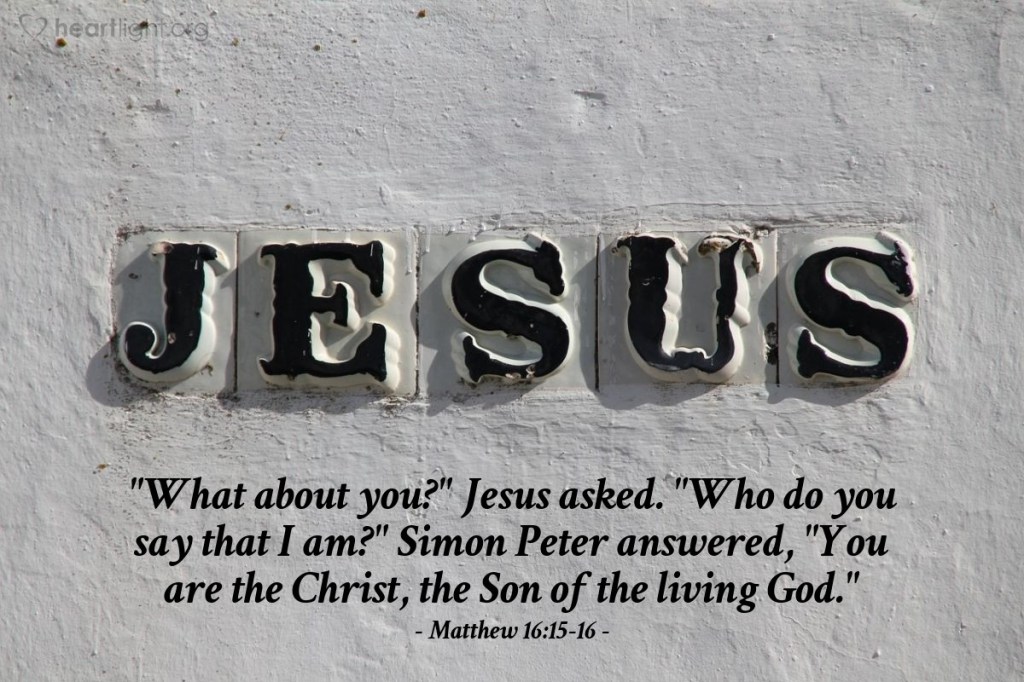
Matthew 16:13-18 New American Standard Bible 1995
Peter’s Confession of Christ
13 Now when Jesus came into the district of Caesarea Philippi, He was asking His disciples, “Who do people say that the Son of Man is?” 14 And they said, “Some say John the Baptist; and others, [a]Elijah; but still others, [b]Jeremiah, or one of the prophets.” 15 He *said to them, “But who do you say that I am?” 16 Simon Peter answered, “You are [c]the Christ, the Son of the living God.” 17 And Jesus said to him, “Blessed are you, Simon [d]Barjona, because flesh and blood did not reveal this to you, but My Father who is in heaven. 18 I also say to you that you are [e]Peter, and upon this [f]rock I will build My church; and the gates of Hades will not overpower it.
The Word of God for the Children of God.
Glory be to the Father,
and to the Son, and to the Holy Ghost;
as it was in the beginning,
is now, and ever shall be,
world without end. Amen, amen.
Who Do You Say I Am?
After a 25-mile (40 km) trip on foot from the Sea of Galilee to Caesarea Philippi, Jesus asked his disciples, “Who do people say the Son of Man is?” (Daniel 7:13).
The disciples said they had heard some say he was John the Baptist or Elijah or another prophet returned from the dead.
But Jesus wanted to dig deeper: “Who do you say I am?”
They were silent until Simon Peter blurted out the most remarkable statement:
“You are the Messiah, the Son of the living God.” And Jesus blessed Simon, saying, “You are Peter” (which means “rock”), explaining that God had given him this new understanding.
Years ago, A spiritual director asked me, “If you were Peter, having answered Jesus’ question, wouldn’t you want to also ask Jesus what he thought of you?”
He sent me off to consider the question.
My reflections on this question surprised me:
if Jesus blessed Peter for professing what the Father had shown him, then surely he blesses us as his disciples today too.
Who Are You?
Busyness seems to be driven by a determination not to “miss out on life.”
Behind much of the rat race of life today is the unexamined assumption that what I do determines who I am.
Jesus did not have that problem.
His identity as the Son of God and calling as the Messiah were clear.
He never asked a question to which he didn’t already have the answer.
When he asked his disciples, “Who do people say the Son of Man is?” he did that for their benefit.
The disciples looked back and forth at each other, and responded with the names of prophets from the past because people believed that the Messiah, their promised deliverer, would be like those prophets.
But Peter had seen enough to know Jesus was the true Anointed One (Messiah).
Peter had an inspired confession of faith.
He declared, “You are the Messiah, the Son of the living God.”
Peter was a prophet as he spoke these words.
He affirmed the truth of God, professing that Jesus is the Messiah and Savior.
That is what we do as prophets.
We share in Christ’s calling as prophets when we point to him as the one true Savior and Lord of all.
We are anointed as prophets to tell people who Jesus is.
We are called to make Jesus famous – not ourselves.
As a Christian, this is your identity.
This is who you are.
Whom can you introduce to Jesus today?
Which nowadays – where people are quick to get in your face and shout you down and curse the ground you’re standing on, is a heavily charged question.
Jesus asked them, “Who Do You Say That I Am?”
Matthew 16:15-18New American Standard Bible 1995
15 He *said to them, “But who do you say that I am?” 16 Simon Peter answered, “You are [a]the Christ, the Son of the living God.” 17 And Jesus said to him, “Blessed are you, Simon [b]Barjona, because flesh and blood did not reveal this to you, but My Father who is in heaven. 18 I also say to you that you are [c]Peter, and upon this [d]rock I will build My church; and the gates of Hades will not overpower it.
When we read the Gospels, it becomes apparent that when people came into contact with Jesus of Nazareth, they seldom reacted with polite neutrality.
His words and deeds inspired deep love and devotion but also deep seated fear and deeper hatred. What could possibly account for such a range of responses?
In this conversation on the road to Caesarea Philippi,
Peter spoke out—as was often the case—and for more than just himself when he replied, “You are the Christ.”
The word he used to identify Jesus was Christos, which in Greek meant “Messiah” or “Anointed One.”
Throughout the Old Testament writings, God had anointed kings, judges, and prophets, and high priests, but they were all representatives and spokesmen pointing forward to the future Messiah, the Savior, very Anointed One of God.
Therefore, what Peter declared was especially noteworthy. He was saying to Jesus, You are that one. You are the one of whom the prophets have spoken.
What is even more astounding is Jesus’ explanation for Peter’s statement.
Peter didn’t come to his conclusion because he was smart or had an advanced capacity for logical and rational thinking or because an inspiring preacher had spelled it out for him.
His declaration was possible because God the Father actually revealed it to him.
Peter’s confession of faith, like our own, could never have come about by his own strength.
Faith is a gift that we are given.
This exchange between Peter and Jesus is a concrete example of the Spirit of God taking the word of God and bringing it to someone’s mind and heart in a way that causes him or her to resoundingly declare the messiahship of Jesus.
Like Peter, our ability to declare Jesus as Lord and Messiah is not our own doing; it is “the gift of God, not a result of works, so that no one may boast” (Ephesians 2:8-9).
If our faith were the result of our own intellectual capacity or our emotional wisdom and intelligence or our own alleged moral goodness, we could place confidence—we could boast—in ourselves.
But on good days this will leave us proud, and on bad days it will make us brittle.
No: our faith rests entirely on God’s gift, so we place our maximum confidence in Him—and then we are humble on our best days and confident on our worst.
Rejoice with gratitude today, then, because God delights to transform hearts and minds by the indelible truth of His word alone so that we can join Peter in resoundingly, publicly, declaring, before God and man; “You are the Christ.”
There is no other name under heaven that can save us (Acts 4:12).
We are to confess Jesus before men, knowing that when we do, we can be sure he will confess us before the Father in heaven.
Jesus Christ is the Son of God, our Savior and Lord.
We may not know the theological gravity behind those words — after all, Peter didn’t when he confessed Jesus as Christ — but we can make a commitment to know him and follow him until we are inspired enough to go and do know more.
Every single moment of the day, Jesus asks us to open our hearts to his lordship and thereby begin the journey toward fuller knowledge and experience of him.
In the name of God, the Father and God the Son and God the Holy Spirit,
Let us Pray,
Living God and Holy Father, I believe you sent Jesus as your Son to save me. I confess to you that I want Jesus to be Lord of my life because I believe him to be your Son and my Savior. It is through your Son, the Christ promised in Scripture. Lord Jesus, make me more like you. Make my calling sure. May my heart and my mouth be open to confessing you as Christ, my Lord and Savior, in whose name I pray. Amen. Amen.
Glory be to the Father,
and to the Son, and to the Holy Ghost;
as it was in the beginning,
is now, and ever shall be,
world without end. Amen, amen.

 Loving God, Living God, Loving Hope, Living Hope, Loving Living Life His Way! "Many things are possible for the person who has hope. Even more is possible for the person who has faith. And still more is possible for the person who knows how to love. But everything is possible for the person who practices all three virtues." - Brother Lawrence (1605-1691), Practicing the Presence of God (1692).