Where Can We Find Hope if ‘All Is Vanity’ According to Ecclesiastes? Ecclesiastes 1:1-11

Ecclesiastes 1:1-11 The Message

The Quester

These are the words of the Quester, David’s son and king in Jerusalem:

2-11 Smoke, nothing but smoke. [That’s what the Quester says.]
    There’s nothing to anything—it’s all smoke.
What’s there to show for a lifetime of work,
    a lifetime of working your fingers to the bone?
One generation goes its way, the next one arrives,
    but nothing changes—it’s business as usual for old planet earth.
The sun comes up and the sun goes down,
    then does it again, and again—the same old round.
The wind blows south, the wind blows north.
    Around and around and around it blows,
    blowing this way, then that—the whirling, erratic wind.
All the rivers flow into the sea,
    but the sea never fills up.
The rivers keep flowing to the same old place,
    and then start all over and do it again.
Everything’s boring, utterly boring—
    no one can find any meaning in it.
Boring to the eye,
    boring to the ear.
What was will be again,
    what happened will happen again.
There’s nothing new on this earth.
    Year after year it’s the same old thing.
Does someone call out, “Hey, this is new”?
    Don’t get excited—it’s the same old story.
Nobody remembers what happened yesterday.
    And the things that will happen tomorrow?
Nobody’ll remember them either.
    Don’t count on being remembered.

The Word of God for the Children of God.

Adeste Fideles! Laeti Triumphantes! Venite Adoremus! Dominum.

Gloria! In Excelsis Deo! Alleluia, Alleluia, Alleluia, Amen.

The timelessness of Ecclesiastes is evident in our modern, existential age of excess with every possible pursuit, pleasure, and provision readily available through the click of a mouse or touch screen, and yet, people are still miserable.

Money cannot buy happiness.

The Preacher in Ecclesiastes clearly demonstrates this point by cataloging all his attempts to gain meaning and joy in life, and still concludes, “All is vanity” (Ecclesiastes 1:2).

But what is vanity?

Is vanity just a piece of bathroom furniture with a countertop and mirror for getting ready in the morning? 

My mental image for vanity is the witch in Snow White, seeking affirmation for her beauty and worth with her magic mirror every morning, expecting to be the center of attention to her daily request of “Who is the fairest of them all?”

Does vanity mean that life is empty, worthless, or meaningless?

It is like washing your car in the rain or polishing the brass on the Titanic as it sinks – “What’s the point?”

The first chapter of Ecclesiastes seems to present a hopeless image of life, reporting “I have seen everything that is done under the sun, and behold, all is vanity and striving after the wind” (Ecclesiastes 1:14). 

All Is Vanity

The author explains the cycle of life, noting how each generation will come and go, striving and seeking meaning and purpose, but die all the same, not even leaving behind a lasting memory (Ecclesiastes 1:11).

The author proceeds to detail his vast wealth and pursuits for pleasure and meaning, describing how nothing was outside his access or ability, and yet, he concludes this pursuit of pleasure by saying,

“What has a man from all the toil and striving of heart with which he toils beneath the sun? For all his days are full of sorrow, and his work is a vexation. Even in the night, his heart does not rest. This also is vanity” (Ecclesiastes. 2:22-23).

If all of life is meaningless and we simply strive to suffer and struggle each day, what is the point?

Where is our hope and where is our purpose to be found in life if ultimately life is meaningless?

There seems to be no hope in life.

If this were the meaning of vanity, life would be meaningless, but the Preacher is instead explaining a critical truth that we have yet to grasp these thousands of years later.

Vanity does not refer to absolute meaninglessness, but instead to a cyclical repetitiveness.

Our experience of life is such a small slice across all of human history, the value of our contribution and purpose for living gets utterly lost in this broader scope without an anchor for context to the bigger plan across time. 

Hope is found in the meaning and purpose God provides to connect us to His story as integral players for His purpose and glory.

The theme of Ecclesiastes is that life is short, death is certain, and seeking meaning apart from God is like attempting to grasp the wind or wrangle vapor.

Meaning is not something we can control. Hope is found in the meaning and purpose provided as a free gift in love from God through His Son.

The Genre and Authorship of Ecclesiastes

Ecclesiastes sits at the end of the Wisdom literature in Scripture, preceded by Job and Proverbs, but all three tied together to provide critical lessons about the meaning of life.

Mirroring the virtues of faith, hope, and love, with love as the greatest (1 Corinthians 13:13), Ecclesiastes, Job, and Proverbs provide meaning to these ultimate questions of boredom or empty pursuit with the necessity of faith in God’s provision (Ecclesiastes), suffering is resolved through hope in God’s care (Job), and love as the ultimate meaning of life (Song of Solomon) demonstrated through God’s pursuit of us as His beloved.

Proverbs unites all these themes with a contrast between Wisdom and folly, or pursuit of God versus pursuit of self, proclaiming faith, hope, and love are found in a life lived in pursuit of Wisdom (Proverbs. 3:1-8).

Historically attributed to Solomon because of the opening credential of the author as “the son of David, king in Jerusalem” (Ecclesiastes. 1:1), the writing style, language differ from Proverbs and Song of Solomon, which are directly attributed to Solomon within the texts (Proverbs. 1:1; Song of Solomon 1:1).

While the exact dating and authorship are uncertain, the timelessness of Ecclesiastes is evident in its vivid descriptions of our modern struggle for meaning and purpose.

The book introduces the content of the book as “the words of the Preacher” (1:1), used alternatively throughout the book as Qoheleth (which is the Hebrew word for preacher, convener, or collector), suggesting that an editor or disciple of Qoheleth has compiled his teaching for this book at an uncertain date.

This authorship does not negate the possible influence or content from Solomon, but just that the book is not directly from Solomon but compiled and edited by another to provide a call to elevate faith in God for the people of Israel.

How Does Hope Play a Part in a World of Vanities?

If life is just vapor or breath, like “chasing after the wind” (Ecclesiastes. 1:14), from where does our hope come from?

The Preacher described his ceaseless pursuit for knowledge, self-indulgence, and pleasure, wisdom for wisdom’s sake, and work, concluding that everything comes from the hand of God and attempting to live apart from God is “vanity and a striving after wind” (Ecclesiastes 2:26).

Ecclesiastes 3:9-13 provides the context and answer to this issue.

The Preacher combats the cyclical repetitiveness inherent in vanity by proclaiming there is a fixed and appointed time for everything and it is according to this timeframe, which is outside of our control, that God orchestrates His purpose and plan provided to us as a gift (Ecclesiastes 3:13). 

Life is short with our appearance on the planet like a breath compared to eternity, but this awareness of scope is given to us by God to provide an unsettling or discomfort in this place as a distant reminder of a home we have lost, a motivation to pursue God who controls time, place, purpose (3:14-15).

As C. S. Lewis stated, “If we find ourselves with a desire that nothing in this world can satisfy, the most probable explanation is that we were made for another world” (Mere Christianity).

Eternity in our hearts is the echo of the Garden, the place of perfect relationship with God, self, others, and creation.

We were made in the image of God, designed to be “naked and unashamed” (Genesis 2:25) with the purpose to image God through our creating, ordering, and sustaining His creation (Genesis 1:28).

Hope is the recognition of this glimmer, this reminder of God’s continued connection, continued relationship with all of us, as is realized through the incarnation and provision of new life through Christ’s death and resurrection. 

Ecclesiastes is the echo of the Gospel message that we are more sinful than we ever thought but more loved than we could ever imagine.

In the Fall, we sought independence from God in desiring to define good and evil for ourselves, seeking meaning and purpose apart from our Creator.

God demonstrated mercy and grace by limited our lives in this empty pursuit in blocking continued access to the Tree of Life (Genesis 3:24), providing hope in the promise of a Savior (Genesis 3:15).

The message of the Gospel is the message of an upside kingdom because our values and desires have flipped with the influence of sin. 

Our pursuit of independence and pleasure leaves us isolated and in despair while our dependence on God provides a connection to Him in His love for us and for the world (John 15:9-12).  

Mark 8:35-37 summarizes Ecclesiastes well by noting,

“For whoever would save his life will lose it, but whoever loses his life for my sake and the gospel’s will save it. For what does it profit a man to gain the whole world and forfeit his soul? For what can a man give in return for his soul?”

While our lives feel short and quick, our hope is found in the timing and plan of God, who has ordered our lives and “every matter under heaven” (Ecclesiastes 3:1).

How to Live with Hope in the ‘Already but Not Yet’

Hebrews 11 provides a glorious parade of faithful followers of God designed to bolster the endurance of the author’s audience and reinforce their faith in God’s promises.

The author of Hebrews is speaking to an audience struggling to retain the truth of God’s promises within the overwhelming appearance of reality as enveloped by meaninglessness and vanity.

Suffering and struggles are real and in the midst of these experiences we lose sight of the bigger picture and the “now” feels all-consuming.

The author of Hebrews seeks to encourage his audience by reminding them of God’s bigger plan and purpose while providing concrete examples of those who lived according to this faith and assurance in unseen things.

Hebrews demonstrates scope and context for God’s provision and plan, opening our eyes again to the hope of our calling to something greater (Ephesians 1:18). 

The suffering, struggle, and death of these saints did not consume their vision.

They did not lose sight of the bigger purpose of God even when the breath of their life exhausted without receiving what was promised, their faith remained (Hebrews 11:39) because their hope was on something more permanent, an “anchor within the veil” (Hebrews 6:19).

The faith and hope of these saints looked backward to the promise of the Messiah (Genesis 3:15) with a culmination in their future, fulfilled in Jesus Christ (Mark 8:29).

Our faith and hope also look backward to Christ’s death and resurrection and forward to His return (1 Peter 5:10-11; Revelation 22:20).

We live in the joyful expectancy of the “already but not yet.”

We live in the Saturday of passion week, assured in the provision of redemption through the cross and resurrection while awaiting our own resurrection and glorification to follow Christ (1 Corinthians 15:20-23).

In the same way that the saints of Hebrews 11 endured in their faith, waiting in “the assurance of things hoped for” (Hebrews 11:1), we retain our purpose and meaning in time, awaiting our own resurrection, looking to Jesus as the anchor point to “run with endurance the race that is set before us” (Hebrews 12:1).

Because we only perceive life through this finite experience, it is so easy for anyone and everyone to get caught up inside the vanity of repetitive pursuit, feeding our desire for independence and pleasure.

The Preacher calls us to attention, however, to remind us that because life is short, this reality should spark our motivation to get working and make sure our direction and desires align with God’s purpose and plan for us.

It is easy to become distracted and lose sight of the hope of our calling and the author and perfecter of our faith.

The scope of our task and role is bigger than us and extends beyond us.

Just as we have the hopeful, hope-filled example and encouragement of a great crowd of witnesses who have gone before us (Hebrews 12:1), so too we are all now leading others in the hopeful, hope-filled treads of our footsteps as well.

Maintain your hopeful, hope-filled, faithful faith-filled perspective as meaning it all comes from God and in spite of all the “vapor-ness” of life, motivates us all to significantly fruitful, fruit-filled Kingdom of God action in this short time.

Our hope in God is unaffected by circumstance or situation because God is always in control and we receive what He provides as from His hand, both, whether good or bad or completely catastrophic all is for His glory alone. (Ecclesiastes 7:13-15; Job 2:10; Romans 9:22-24).

Keep your eyes on Jesus.

Look full into His Wonderful Face.

And the Things of This Earth Grow Strangely Dim.

In the Light of His Glory and Strength.

In the name of God the Father and God the Son and God the Holy Spirit,

Let us Pray,

Lord, my teacher, I’m often confused when I need to make important decisions about my life, my family, my work, my relationships, my health, or finances. Show me the way I should go when I don’t know which way to turn. Help me remember to come to you, rather than trying to figure everything out on my own. Guide me along the best pathway, your pathway for my life. Lead me and Advise me and watch over me. Help me to give both of my ears to listen to your guidance and not resist it as much as I have been. I thank you that your unfailing love surrounds those who trust you. Amen.

https://translate.google.com/

Today’s Legitimate Dose of Life’s Reality: When God is Excluded from our Life, All Our Things Are Vanity. Ecclesiastes 1:1-11

Ecclesiastes 1:1-11 English Standard Version

All Is Vanity

The words of the Preacher,[a] the son of David, king in Jerusalem.

Vanity[b] of vanities, says the Preacher,
    vanity of vanities! All is vanity.
What does man gain by all the toil
    at which he toils under the sun?
A generation goes, and a generation comes,
    but the earth remains forever.
The sun rises, and the sun goes down,
    and hastens[c] to the place where it rises.
The wind blows to the south
    and goes around to the north;
around and around goes the wind,
    and on its circuits the wind returns.
All streams run to the sea,
    but the sea is not full;
to the place where the streams flow,
    there they flow again.
All things are full of weariness;
    a man cannot utter it;
the eye is not satisfied with seeing,
    nor the ear filled with hearing.
What has been is what will be,
    and what has been done is what will be done,
    and there is nothing new under the sun.
10 Is there a thing of which it is said,
    “See, this is new”?
It has been already
    in the ages before us.
11 There is no remembrance of former things,[d]
    nor will there be any remembrance
of later things[e] yet to be
    among those who come after.

The Word of God for the Children of God.

Adeste Fideles! Laeti Triumphantes! Venite Adoremus! Dominum.

Gloria! In Excelsis Deo! Alleluia, Alleluia, Alleluia, Amen

When God is Excluded All of Our Things Are Vanity

From start to finish, the book of Ecclesiastes declares the utter futility and complete meaninglessness of life without God.

Whether it is referring to work or pleasure, or wisdom or wealth, power or prestige, entertainment or virility, life or death, ALL is considered futile and worthless whenever God is excluded from the equation.

It is Solomon who is credited with the authorship of Ecclesiastes.

He was chosen by God to succeed his father, King David as Israel’s anointed king, and when faced with the great responsibility of leading the nation, he humbly confessed that he was unable to do so without help from the Lord.

Despite his humble confession to God and his magnificent prayer at the dedication of the Temple, Solomon set out to discover the meaning of life using his own reasoning power and without the leading, guidance, direction of God.

The conclusion he was forced to reach was: “Vanity of vanities! All is vanity.”

At the end of his life, Solomon discovered his long search for fulfilment through his many accomplishments, was nothing more than just chasing after the wind.

Despite his great wisdom, power, fame, and fortune, his search for the meaning in life proved completely, ultimately profitless – because he had chosen to set out to explore the meaning of life, its significance, in his own human strength.

The entire book of Ecclesiastes amounts to Solomon’s discovery that when God is excluded from one’s existence, the benefits of wisdom and learning are futile.

Small achievements, great achievements, vast possessions, no possessions skillful work, also linguistic expertise, and various accomplishments prove to be ultimately profitless and quite futile when that is ALL that life has to offer.

Solomon recognized that death is the ultimate equalizer of both the king in his palace and the beggar at his gate.

He realized that competition between one person and another is profitless and life is very transitory, like the grass of the field which is here today but come a single moment of next tomorrow is almost immediately cast into the bonfires. 

“Vanity of vanities,” says the Preacher, “Vanity of vanities! All is vanity.”

In Romans, Paul reminds us that the whole of the creation was made subject to vanity because of sin and its consequences.

The whole premise of the Preacher of Ecclesiastes is true – for there is truly NOTHING that can be pursued or gained on earth that can provide everlasting fulfilment for a man’s soul.

The Preacher in Ecclesiastes states his conclusion that “all is vanity,” at the very beginning of his dialogue and again at the end.

Were it not for a little verse tucked away in the middle of Ecclesiastes, his whole treaties could become very depressing for anyone who reads it, because without God, literally everything is vain and futile for this is the condition of every man.

Yet, there is one last verse that identifies well the meaning and purpose of life:

“When all has been heard, the conclusion of the matter under consideration is: fear God and keep His commands, for this is the whole duty of all mankind.”  (12:13-14)

A Legitimate Dose of Reality Regarding Change

Twenty years ago when I was visiting an ancient abbey on the Isle of Iona in Scotland, I wandered upon an ancient graveyard with many Celtic Crosses.

As I walked among the tombstones, I observed a variety of ages chiseled into their surfaces.

As near as I could tell with many stones barely or nearly unreadable, some of the people appeared to had lived to be quite old, while others not live past 30.

Yet when all these ages were taken together, it seemed that the average life span was around 65-70—just as the Bible says:

“The years of our life are seventy, or even by reason of strength eighty” (Psalm 90:10).

And more time than that had gone by since most of these people had passed.

This sobering reminder of life’s brevity returned me to a question that all of us ask at one point or another: Is this pursuit of all things in life all there is?

The book of Ecclesiastes addresses this deep question by giving us a solid dose of legitimate reality.

Truthfully, most of us don’t do well with reality; we prefer fantasy, mirage, and distraction.

Yet the author of Ecclesiastes, Solomon, begins his discourse by encouraging us to carefully, thoughtfully and completely reflect upon the absolutely mindless, utter meaninglessness of life, stating bluntly, “Vanity of vanities! All is vanity.”

Solomon seeks to prove his thesis by showing us life is marked by drudgery:

“What does man gain by all the toil at which he toils under the sun? A generation goes, and a generation comes, but the earth remains forever” (Ecclesiastes 1:3-4).

Life, in other words, is just a perpetual series of clocking in and clocking out until we die.

No matter who you are—whether you are an executive, a schoolteacher, or a stay-at-home mom—life “under the sun” contains much toil, and then it ends.

Does this leave you thoroughly depressed?

It should—if you rule out the existence of God.

When God is taken out of the equation, life truly has no meaning.

There is a reason why some people desire to escape reality through a drug-induced stupor or through mindless indulgence in pleasure and entertainment.

What may seem like strange behavior to us may actually be the best considered response of the one who has gotten a heavy, albeit incomplete, dose of reality.

Studying the book of Ecclesiastes forces us to try and consider the deep, deeper, deepest implications, meanings of life without God, in view of inevitable death.

But such an image is seldom if ever given even the most minimal measure or degree of consideration because nowadays too many Christians discount God.

Not just discount God but openly state in a pulpit that “God is 100% nothing!”

Not just declare from a church pulpit on a regular Sunday morning worship service that “God is 100% nothing!” but God never existed or is “100% dead.”

But read the rest of the Bible and you will discover that you may receive eternal life by trusting in Him, Him being Jesus, who said, “I am the way, and the truth, and the life. No one comes to the Father except through me” (John 14:6).

Only through God, the Father, God the Son, our Savior Jesus and the Holy Spirit will we 100% discover life’s true meaning, find the reason why all is not vanity.

Only if you remember the undeniable reality of Christ’s Resurrection, there absolutely is life beyond the grave, will we be able to live with joy, meet with all the ups and downs of life with a healthy perspective, on this side of the grave.

Life Changing Dose of Legitimate Reality: Everything Absolutely Revolves Around Father God, Son, Spirit.

Ecclesiastes 1:1-3 New American Standard Bible
The Futility of All Endeavors

The words of the Preacher, the son of David, king in Jerusalem.

“Futility of futilities,” says the Preacher,
“Futility of futilities! All is futility.”

What advantage does a person have in all his work
Which he does under the sun?

And thus begins one of the more depressing books in all of the Bible, but I would submit depressing in a good way, and here’s the reason I would say that.

When we come to Ecclesiastes, we read in these words, in these dispassionate chapters, a picture of life lived apart and separate from belief God.

Of life apart, of life separate from the reality of who God is, and all that’s in His character, of His love, His forgiveness, His justice, His mercy, His power, of His incomparable presence and indomitable and unsearchable wisdom.

Apart from the wisdom, power, love, justice, mercy of God, indeed, all is vain.

Ecclesiastes 1:2–3 Teaches Us Our Life is Vain Apart from God

The author of Ecclesiastes says this five times in one verse.

“Vanity of vanities. All is vanity.”

The point is clear, that all is in vain, everything lacks meaning apart from the reality of who God is.

The world revolves around God.

You take away the center around which the world revolves, and everything falls apart and so as you read through Ecclesiastes, as we likewise pray study and we pray through these different verses in Ecclesiastes, let’s all be reminded of the God-centeredness of the universe, and the need in each of our lives for God to be at the center of it all, knowing everything is meaningless apart from him.

The complete absence of God in our life is the Ultimate expression of Vanity!

Ecclesiastes 1:2–3 Reminds Us God is Our Rest

And so let’s pray based on Ecclesiastes 1:2–3.

Oh God, you are our everything, and we fix our eyes, our minds, our hearts on you today and we say that apart from you, everything is vain. You are our life, you are the author of our life, you are the Creator of our lives, you’re the sustainer of our lives, you’re the only one who can satisfy our lives. God, you are everything to us, oh God. You are our Creator, our Savior, our One and Only true King, our Ruler, our Lord.

You are literally everything and we are as nothing without you. And we pray that you would help us to live today with our intemperate minds and sin laden hearts and tiny attention span and fickle affections centered around you, as we do for you, oh God to infuse meaning and purpose into everything we do. And fulfillment in our hearts. Our hearts, as Saint Augustine said years ago, are restless until they find their rest in you.

In the name of God, the Father and God the Son and God the Holy Spirit,

Let us Pray,

Our Heavenly Father, thank You for this honest assessment and exploration of living life in this fallen world, without our ever living Savior Jesus Christ. I pray this day to please keep me from chasing after any of the inevitably vain things this world offers, knowing that there is nothing on earth that has lasting value except to know You. May I place You in the center of my life, knowing that the whole duty and delight of man is to worship and praise You for Your goodness, grace to all men. In Jesus’ name.

Adeste Fideles! Laeti Triumphantes! Venite Adoremus! Dominum.

Gloria! In Excelsis Deo! Alleluia, Alleluia, Alleluia, Amen

https://translate.google.com/

The Single Minded Pursuit of Unholy Discontentment, and Dissatisfaction. Pursuit of Emptiness Without Christ. Ecclesiastes 2:1-11, 24-26.

Ecclesiastes 2:1-11, 24-26 Easy-to-Read Version

Does “Having Fun” Bring Happiness?

I said to myself, “I should have fun—I should enjoy everything as much as I can.” But I learned that this is also useless. It is foolish to laugh all the time. Having fun does not do any good.

So I decided to fill my body with wine while I filled my mind with wisdom. I tried this foolishness because I wanted to find a way to be happy. I wanted to see what was good for people to do during their few days of life.

Does Hard Work Bring Happiness?

Then I began doing great things. I built houses, and I planted vineyards for myself. I planted gardens, and I made parks. I planted all kinds of fruit trees. I made pools of water for myself, and I used them to water my growing trees. I bought men and women slaves, and there were slaves born in my house. I owned many great things. I had herds of cattle and flocks of sheep. I owned more things than any other person in Jerusalem did.

I also gathered silver and gold for myself. I took treasures from kings and their nations. I had men and women singing for me. I had everything any man could want.

I became very rich and famous. I was greater than anyone who lived in Jerusalem before me. My wisdom was always there to help me. 10 Anything my eyes saw and wanted, I got for myself. My mind was pleased with everything I did. And this happiness was the reward for all my hard work.

11 But then I looked at everything I had done and the wealth I had gained. I decided it was all a waste of time! It was like trying to catch the wind.[a] There is nothing to gain from anything we do in this life.[b]

24-25 There is no one who has tried to enjoy life more than I have. And this is what I learned: The best thing people can do is eat, drink, and enjoy the work they must do. I also saw that this comes from God.[a]26 If people do good and please God, he will give them wisdom, knowledge, and joy. But those who sin will get only the work of gathering and carrying things. God takes from the bad person and gives to the good person. But all this work is useless. It is like trying to catch the wind.

The Word of God for the Children of God.

Adeste Fideles! Laeti Triumphantes! Venite Adoremus! Dominum.

Gloria! In Excelsis Deo! Alleluia, Alleluia, Alleluia, Amen.

Chasing the Winds, Searching for the Winds

People always seem to be chasing after and searching for the “best” good life.

But what is the “best” good life anyway?

For some, it is an education – graduating from high school, or from college, it’s a successful career.

For others, it’s getting married and having a family, it is raising their children in such a way as it brings glory to God, the Father, God the Son, Holy Spirit.

For still others, it’s having a million dollars in the bank–or all of the above!

Whatever a person’s idea of the “best” good life is, it usually means having or doing something more, significantly more than what they have or can do now.

The writer of Ecclesiastes had an insatiable appetite for the good life.

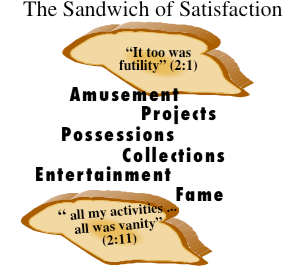
We will read through the opening chapters and verses of Ecclesiastes, and we’ll see that he tried knowledge and education, pleasure and entertainment, wealth and kingly gifts, tons and tons of precious metals and gems and possessions, he traveled wide, partied, plotted, and perused everything the world has to offer.

He acquired much and achieved much.

But, in the end, what was ultimately achieved?

But in the end he was left empty inside.

Unholy Discontentment – chasing after winds he could never hope to catch.

Reaching for the Sun and searching for literally everything under the sun – in search for satisfaction, in search of the greatest measure of happiness possible.

But in the end of it all, the winds always elude him, satisfaction always eludes him, happiness always eludes him – forever tempting him to keep going forth in the full scale and joyful and highly satisfactory, joyful pursuit of all futility.

Human nature hasn’t changed much in their wholly satisfactory, joyful, joy-filled, reckless and feckless pursuit of maximum futility these past 3,000 years.

Many people still search for the good life in all the wrong places.

A staff member of a large, growing church recently told me of hearing many faith stories from new believers who “had it all” but were still empty inside.

Unholy Discontentment

I don’t know if there is a greater or more subtler foe of the gospel-oriented life than unholy discontentment – unholy pursuit of winds we can still not catch.

I throw in that “unholy” qualifier because there are times when God stirs up discontentment in our hearts – reaches into our hearts and captures futility, separates out the futility which has governed our lives and parades it before us.

So we can see for ourselves what governed and ruined the life of the Teacher – in a “human form” we can identify with and looking upon it – abhor its ugly.

To stop our pursuits of “everything meaningless under the sun – step in front of us, look directly and decisively look deep into our eyes – challenging, daring us to take one more step forward beyond what God has already determined to be well and good and the “best” “most joyful, satisfactory” pursuit of happiness.

I myself find myself spiritually tired of the pursuit of such winds that do not bring glory and honor unto God, the Father, God the Son and the Holy Spirit.

I know people like to think, believe God is a “gentleman” who won’t interfere with our personal decision-making, but the max truth is that sometimes he graciously pesters us about a specific issue until we will respond in obedience.

He may want us to pursue a different vocation, a different ministry or mission solely for the sake of the Kingdom, pull back from a toxic relationship that is hindering our growth and usefulness, or leave the comfort of our first world culture and go walk and live, move amongst an “unreachable” people group.

There are times when the Holy Spirit creates restlessness in our souls, gently (but persistently) nudging us to hop aboard the greater will-of-God train.

I have experienced this kind of holy discontentment on a few occasions in my journey with Jesus – such was the original impetus for my writing devotions.

However, nowadays, what I experience more often is a fleshly, distracting, anger provoking, ministry, mission-abating kind of unholy discontentment.

You know, the kind of discontentment that entails me moping around and obsessing about all the things or experiences I don’t have but so desperately desire – desire solely for the purpose of bringing glory and honor unto God.

It seems like every four to six months or so, I begin to feel like my life is lacking and I need to pray over, to implement some circumstantial change or newness into it in order to be fulfilled – feel like I am doing something more for my God.

Switching vocations, more education, moving to a different city, making more money, getting a new gadget, going to a different church, making new friends, or pursuing a new ministry relationship status are just a few of the things I tend to entertain-I entertain them but struggle mightily to bring into Godly fruition.

None of these things are inherently unholy or bad, but when my compulsive pondering and praying on them (and sometimes impulsive pursuit of them) is driven purely by fleshly restlessness—well, that’s obviously, distressingly bad.

I become so obsessed with only thinking about the changes I could make or the things I could get, Jesus and his Kingdom almost completely fall off my radar.

This unholy discontentment wages more vicious war on my resolve to live a gospel-oriented life than any other sin struggle I experience.

And maybe I am being presumptuous, but I have a difficult time believing I am the only Christian who struggles mightily with this most discontenting mess.

I think it’s a spiritual virus we’re all constantly battling.

Some of us may try to satisfy our discontentment by shifting around our life circumstances (like me).

Some of us may try to numb it by turning to food or alcohol or or “nap times.”

Some of us may do all of the above or may do so significantly much more!

We all experience this inner-thirst of discontentment and try to satisfy it with all the wrong things in all the wrong places and at all of the wrong moments.

We sip from the all too many cups this world offers, only to be repeatedly reminded that they don’t contain the satisfying substance we really desire.

We indulge, manipulate our circumstances, and buy new things we do not need nor justify, yet we continue to find ourselves dissatisfied, fidgety, also, bored.

Single Mindedly Pursuing Satisfaction in God May Look Substantially Different Than What We Think.

So what are we to do?

What are we to “single mindedly” pursue?

Who are we to “single mindedly” pursue?

I think most Christians believe, understand that discontentment is birthed and nurtured in a heart that isn’t satisfied in God – “why doesn’t God move faster?”

So, obviously, the best way to go about fighting such unholy discontentment is to seek to be less satisfied in God, – reduce, diminish, minimize pursuing God !

Right?

Right.

Quite obvious.

Quite obviously facetious.

But why are so few of us so successful or such failures in that fight?

I know there are a lot of completely valid answers to both those questions, but I think a huge reason is many of us don’t know what “seeking to be less or more satisfied in our single minded pursuit of God” looks like, feels like or tastes like.

Contemporary Christian culture is jam-packed with fantastic sounding ideas, but the problem is most of us don’t know how to pull those magnificent ideas down from the clouds and single mindedly apply them unto our everyday lives.

We hear that we should find our deepest joy in God, and we respond to that with a thousand “amens!”—and then quickly realize we have no idea how to do that.

So, what does it actually look like to single mindedly seek satisfaction in God?

Some might say we should open our Bibles and seek to see the all-satisfying God it reveals.

And they’re 100% right; we should.

Head and Heart Knowledge of God – absolutely matters!

Head and Heart Knowledge of Jesus Christ – absolutely matters!

Head and Heart Knowledge of the Holy Spirit – absolutely matters!

The Holy Spirit cultivates fresh joy in our hearts as we shift our eyes away from the world and gaze upon God in his written word.

Positioning ourselves under the Holy Spirit’s power in prayerful Bible-reading and study brightens our vision, expands our vision of Christ and ushers us into the single minded pursuit of a God honoring, eternity-oriented state of mind.

But is this all a single minded pursuit of complete satisfaction in God entails?

Some may object, saying, “I already do that, though. I read the Bible constantly. I pray every day. And I still find myself mightily struggling to be content in Christ!” 

I hear you—because this is also my personal spiritual experience.

Everyday, every morning I stay inside the Scriptures and prioritize prayer.

I don’t do these things perfectly by any means, but they are a part of my daily pursuit of a spiritually God glorifying, God honoring, God praising life.

And I praise God for giving me grace to seek him via these glorious means because doing so is such a huge part of my cultivating contentment in God!

However, reading and praying isn’t everything.

If it were, would I continue to find myself wrestling so regularly and intensely with discontentment?

Something the Lord began to teach me a few years ago when I started writing these devotions—and evidently something I have been slow to learn—is that there is too a deep well of spiritual satisfaction found in living in the will of God. 

A private pursuit of him or “quiet time” is part of his will for our lives, sure.

But it’s not the whole sum. 

We weren’t spiritually resurrected just so we could sit in our bedrooms, take up much needed space at our dining room tables and read and study our Bibles.

We were cleansed of our sins at Calvary and endowed with the Holy Spirit that we might give the single minded totality of our lives over unto God’s purposes!

I find it to be no coincidence that the seasons I am most discontent are also the seasons I am just barely participating in the ministry of my church, loving my siblings in Christ poorly, not grabbing hold of the plentiful opportunities God is continually giving me to engage unbelievers with the grace, truth of the gospel.

And on the flipside, the seasons I am most content in God are the seasons I am most fully single mindedly pursuing, giving myself over to His will for my life!

I’ve found nothing more effective in shutting down the unholy discontentment than giving my time and energy to my wife, the ministry of the local church, my spiritual siblings, and those who have yet to enter into the deep joy of salvation.

If Christ’s single minded pursuit of “food” was to single mindedly do the will of His Father God, accomplish his work on earth (John 4:34), would not we do well also to single mindedly pursue such “God Food,” to feast upon the same things?

If discontentment is plaguing your heart today, I challenge you—as I also now challenge myself—to put your hands to the plow of God’s purposes for your life.

Find ways to single mindedly pursuit through study and fellowship the deeper knowledge, deeper truths of God, the Father and God the Son and Holy Spirit.

Devote yourselves to the single minded pursuit of prayer, talking with our God.

Devote yourselves to the single minded pursuit of connecting your whole family to God, the Father and God the Son and Holy Spirit thru your daily devotions.

Find ways to connect with and participate in the ministry’s of your church.

Find ways to love on your brothers and sisters in Christ.

Find ways to engage the lost with the gospel.

I guarantee you that if you will discipline yourselves to single mindedly toss idleness aside and submerge yourself in the ministry and mission of the gospel, a God-centered, Jesus centered, Holy Spirit centered, and Scripturally centered satisfaction will invade your soul, mercilessly crush unholy discontentment.

The good news is we now know Jesus is resurrected, alive and fully within us.

In our attempts to reach out in Jesus’ name, let’s not be intimidated by what people’s single minded pursuit of the sun and winds have acquired, achieved.

Nothing satisfies like God!

Nothing satisfies like Jesus!

Nothing satisfies like the Holy Spirit.

The greatest discovery is to learn that single mindedly losing yourself in Jesus our Savior and in his purpose for life is the only way to have true, lasting joy.

Steps to Single Mindedly Pursuing God

1. Carve out time to seek God:

God leaves us with instructions to start each day by teaching us to “seek Him first, then all these things will be added to you” (Matthew 6:33).

I’m not saying it has to be the first thing you do when you wake up.

“Seek first” is an indication of priorities.

But I like the idea of filling my cup up with God’s spirit before I fill it up with what the world has to offer.

Decide on the best time that works for you and work to discipline yourself to make it a regularly scheduled part of your daily “I’ll God all the glory” routine.

2. Empty out your cup:

Before you can fill up your cup, you must first empty it out.

You cannot fill something up that is fully or partially full of other things.

Pour out your hurts, concerns, worries, agenda, unforgiveness, sin, and requests as God says to “cast all your burdens on Him” (1 Peter 5:7).

Once you empty yourself out,

it leaves room for you to then fill yourself back up with Him. 

3. Fill up with God’s word and strive to memorize Scripture:

Receive the word of God like an athlete might receive an energy bar.

Scripture is food and nourishment for your spirit.

It is crucial to fill your cup up with the “God-breathed” (2 Timothy 3:16) words of Scripture, because they consist of all the essential truths for our pursuing God.

Dissatisfaction and Discontentment of the World

Dissatisfaction and discontentment will always be present if we are single mindedly pursuing and filling our cups with things or people of this world.

Jesus teaches the Samaritan women at the well a valuable lesson.

This woman tried to find her satisfaction in other people.

She went from husband to new husband searching for satisfaction.

Jesus taught her, that “whoever drinks of this water [the water the world offers] will thirst again, but whoever drinks of the water that I shall give him will never thirst” (John 4:13-14).

Worldly Satisfaction Does Not Go with You or Me to Eternity

Here me when I say this –

there is absolutely nothing wrong with enjoying the joyful things of this world.

God wants for us to enjoy the gifts He gives us (Matthew 7:11), inasmuch as they direct us to glorify, honor and praise Him for all the good things He has made.

But if you are searching for fulfillment and satisfaction from the things of the world, that is where you will always be left searching, never fully satisfied, as material things are only temporary, and only going to end up rusting away.

We live in a world chocked full of the single minded pursuit of fantastic lies, but thankfully, we have the truth of our Savior Jesus to fill us up at our fingertips.

The God that makes us whole and fulfills us makes us alive forever.

The same God we have maximum access to while we are here on this earth through our Savior Jesus Christ and the ministry and works of the Holy Spirit.

And it’s through the Holy Spirit that we find the only true maximum allowable satisfaction, not discontenting things of the world that won’t join us in eternity.

All Glory, Honor and Praise be unto God, the Father, the Son and the Holy Spirit.

As it was in the beginning, is 100% now, forever shall be, worlds without end!

In the name of God the Father and God the Son and God the Holy Spirit,

Let us Pray,

God of truth, sometimes I not sure if I’m actually hearing your voice, or if it’s just my own sinful thoughts or even another spirit. Sharpen my spiritual hearing, Lord, so I can recognize your words when you are speaking to me. Help me know it’s really you, with no doubt or second-guessing. When I’m asking for your guidance in life’s important decisions, give me your peace that surpasses understanding with your answer. Help me remember that your words to me will never go against your written word in the Bible. Give me a clear mind and push out all my confusion. Lord, may we discover anew that the “best” good life is found only in relationship with you. Fill us with yourself. May our spiritual hunger draw us and others to your side. In Jesus,

Adeste Fideles! Laeti Triumphantes! Venite Adoremus! Dominum. Gloria! In Excelsis Deo! Alleluia, Alleluia, Alleluia, Amen.

https://translate.google.com/