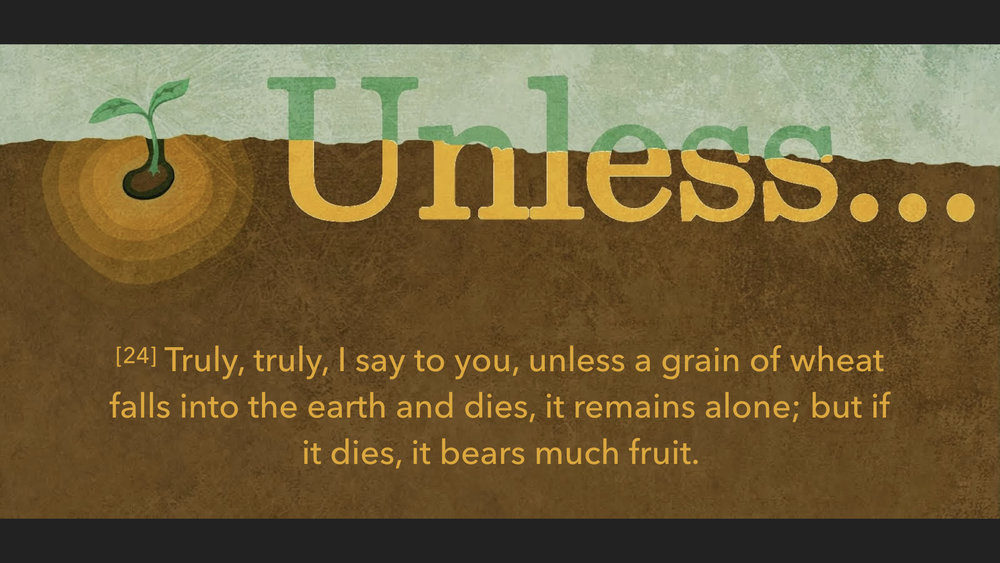
Countdown to Calvary: Humility, We See Jesus – Dying to Bear Much Fruit. Lessons in our Living John 12:20 – 26

Today, I want to try to tell you a short story about two men and their wheat.

One man had a grain of wheat and he loved it very much. He spent the majority of his time and energies on securing the best possible container for his wheat.  

When it came to moving his wheat from one place to another, he spared no expense. He loved his wheat, so he bought the best. He made sure his grain of wheat stayed out of harm’s way; if wheat gets wet you know it will quickly spoil.

So, he was very careful to be sure to always do what the wheat experts told him to do in order to see his grain of wheat stay strong even into old age. This man was sold out for his wheat, and it showed. Then the man died.

The other man also had a grain of wheat but what he did was very different. 

He went out into the backyard, dug a hole, threw his wheat in to it, covered it with dirt, and poured water all over it thus completely ruining the wheat. 

Then the man died.

Sometime after both men were dead and buried a news reporter got wind of these two unusual men and their wheat. The reporter decided to do a follow up. 

Where the first man had lived the grain of wheat was easily spotted surrounded by the best. But when the lid was removed, and the cameras pulled in close the sight was saddening; that grain of wheat though greatly prized and protected had been ruined. Stuck away in the dark of selfishness that wheat had spoiled

The reporter got back in her car and assumed she was about to go from bad to worse. If the first man had done everything to protect his wheat and it had all been for nothing, then what would there be to show for the other man who just threw his in the ground and wasted it?

As she drove closer, she noticed these tall and vibrant green plants along the side of the road; very strange. As she pulled into the driveway the entire yard of the second man was covered in three-foot-tall green grass. Now filled with curiosity the reporter asked the neighbor, “What are all these plants.” And he responded, “It’s this man’s wheat”

One man protected his wheat and lost it all. 

The other man threw his wheat into the ground, and it produced much fruit. 

Christ’s life is that single grain of wheat. He is glorious and he has done many glorious things. But if he doesn’t die there is no salvation for you or for me. If Jesus is not the suffering Servant/Savior of Isaiah 53, then he is no savior at all. 

But if he did come to die and if he did die and rise again, then he will produce much fruit. There will be lives changed. There will be a great harvest of joy-filled Christ-followers. Jesus came to die, and he died so to bear much fruit.

John 12:20-26 Holman Christian Standard Bible

Jesus Predicts His Crucifixion

20 Now some Greeks were among those who went up to worship at the festival. 21 So they came to Philip, who was from Bethsaida in Galilee, and requested of him, “Sir, we want to see Jesus.”

22 Philip went and told Andrew; then Andrew and Philip went and told Jesus. 23 Jesus replied to them, “The hour has come for the Son of Man to be glorified.

24 “I assure you: Unless a grain of wheat falls to the ground and dies, it remains by itself. But if it dies, it produces a large crop. [a] 25 The one who loves his life will lose it, and the one who hates his life in this world will keep it for eternal life. 26 If anyone serves Me, he must follow Me. Where I am, there My servant also will be. If anyone serves Me, the Father will honor him.

The Word of God for the Children of God. Gloria! In Excelsis Deo! Alleluia! Amen.

I. Eternal life requires more than fearing God and being interested in Jesus (20-23)

As we look into these verses from John, we need to realize that we are at a turning point in salvation history. God’s plan to reconcile the world to himself through the seed of the woman is about to advance at a rapid pace.  

Here’s the point

A.  The glorification of Jesus Christ is required for the salvation of the nations.

The Pharisees in verse 19 make the observation that, “the world has gone after [Jesus].” In the triumphal entry and in the people’s loud praises the Pharisees see the popularity of Jesus. That confession in verse 19 leads us to the account of “some Greeks” in verses 20-22.

Now among those who went up to worship at the feast were some Greeks. So these came to Philip, and asked him, “Sir, we wish to see Jesus.” Philip went and told Andrew; Andrew and Philip went and told Jesus.

Literally the people and nations are coming to Jesus. They want to see him. Now this phrase means more than look at him. These Greeks want to talk with Jesus.

They are hesitant. Possibly because they have just witnessed Jesus clean out the court of the Gentiles when he cleansed the temple; that’s a bit intimidating. So, they instead go to Philip who probably spoke Greek and asked for an audience with Jesus. The people and the nations are mightily curious coming to Christ.

And Jesus responds with a surprising and an unexpected word, verse 23, “The hour has come for the Son of Man to be glorified.”

Up to this point in the life of Christ when Jesus has spoken of “his hour” it has always been in the future tense.

In John 2:4 he told Mary, “My hour has not yet come.”

In John 7:30 we read, “So they were seeking to arrest him, but no one laid a hand on him, because his hour had not yet come.”

In John 8:20 we read, “These words he spoke in the treasury, as he taught in the temple; but no one arrested him, because his hour had not yet come.” 

From here on, from the coming of the Greeks on, Jesus will emphasize the fact that his hour is here.

In John 12:27, “Father, save me from this hour? But for this purpose, I am come to this hour.”

Using the language of the time to glorify the Son Jesus says in John 13:31, “Now is the Son of Man glorified, and God is glorified in him. If God is glorified in him, God will also glorify him in himself, and glorify him at once.”

It is possible that Jesus is only 4 days from the cross. Jesus is fully aware that his death his required for the salvation of the people and the nations.

And Jesus is fully aware that now is the appointed time of his glorification. He must be glorified in order for these Greeks to be saved. He must be glorified in order for you, me to be saved. No one from Adam to the last of God’s children will see eternal life if Jesus does not fulfill the Father’s plan of redemption.

Let’s drive this point home

B.  Your salvation depends upon Jesus’ glorification

Let’s bring in some of the terminology from verse 23. Unless Jesus is glorified, unless the grain of wheat is put into the ground, he will not bear fruit.  Unless Jesus be glorified no one will be saved.

That’s how crucial the cross is. That’s how important this hour is; salvation depends on it.

We should expect the theme of glory to be central from here on in John and it is. We’ll unpack this more, Lord willing, I just want you to see what glorification is.

Look down to verses 28-33.

‘Father, glorify your name.’ Then a voice came from heaven: ‘I have glorified it, and I will glorify it again… verse 31…’Now is the judgment of this world; now will the ruler of this world be cast out. And I, when I am lifted up from the earth, will draw all people to myself’ He said this to show by what kind of death he was going to die.

The glorification of God is displayed through the judgment of sin when God’s wrath for poured out on Jesus. The glorification of God is displayed through the defeat of Satan when his power is broken through the resurrection of Jesus.

The glory of God is about to be displayed through Jesus’ finished work on the cross, resurrection from the grave, ascension back to God’s glorious right hand, and the salvation of the people and the nations who come to Him.

Our salvation and the salvation of the nations, depends on the Son of man being glorified.  The death, resurrection, and ascension of Jesus do not just show us something they secure something.  The glorious work of Jesus Christ on your behalf secures your salvation. 

If this hour doesn’t ever come, then we are lost and hopeless but if Jesus has been glorified then we are saved and we are all born again into a living hope.

These Greeks in John 12 were God-fearers who were willing to submit to God’s laws. They were interested in meeting and learning from Jesus.

But that’s not what is required for salvation. We must be connected by faith, by hope and by love, to the glorified Jesus crucified, resurrected, and ascended.

Where are you today? Does our religion consist only of some rule keeping and occasional interest in Jesus?

If so, you and I would do well to fear that we are missing salvation all together (Hebrews 4:1).  Salvation depends on you being connected to the glorified Jesus.

By faith you and I are joined to him. And with him we are as righteous as God and have power over the grave. Jesus has been glorified. There is salvation and eternal life for you. But you and I must absolutely be connected to him by faith.

Salvation is a promise because salvation depends on the completed work of Jesus Christ. Jesus’ death is a necessity. – The Single Seed must Be Planted!

II. Nature proves that a harvest requires death (24)

A.  Jesus illustrates the necessity of his death by pointing to the planting and harvesting of wheat. Verse 24

Truly, truly, I say to you, unless a grain of wheat falls into the earth and dies, it remains alone; but if it dies, it bears much fruit.

We grow vast fields of wheat to make bread.

Here is what a grain of wheat looks like. 

If you do nothing with this single wheat, then as a whole, it is 100% worthless.

But if you plant that wheat there comes a miracle. By continual harvesting and sowing, one grain of wheat can produce millions of grains of wheat. But what is required to make that harvest happen? You absolutely have to plant the wheat.

You must make it for the moment ruined. Once that grain of wheat is put in the ground and watered you cannot dig it up, grind it up, and make bread out of it. 

But when it dies it bears much fruit.

Jesus obviously isn’t giving us instructions for our gardens.

He’s giving us hope for our souls.

If Jesus skips the cross, if he does not die, then there is no salvation.

But since Jesus endured the cross dying in our place then there is salvation.

Just as millions of grains of wheat come from the death of one grain so the salvation of the people, the nations, comes from the death of the only Son of God.  Eternal life depends on the death of Jesus Christ.

All of the Realm of Nature illustrates this clearly.

Here’s our third point that comes out of Jesus’ death on our behalf.

III. You are the fruit (24-25)

A.  God, The Father is the Lord of the harvest, Jesus the Son is the single grain which starts the harvest, and all that we are and do is a part of the harvest

You and I must fight to keep the call of verses 25 and26 grounded in the work of Christ explained in verse 23 and 24. You and I will live life rightly, enjoy eternal life, serve Jesus, follow Jesus, be with Jesus, and be honored by God as we cling to the glorified Jesus.

All that we are as a Christian is a direct product of all that Jesus has done. God doesn’t demand our death for your salvation. God saves only those who have the glorification of Jesus credited to their souls.

B.  I was quite surprised! Verse 25 is not what I expect

I thought verse 25 should read, “Whoever loves his life loses it, and whoever hates his life in this world bears much fruit.

But the teaching here is not that you and I should die to bear fruit.

That is true and Jesus is going to teach us all about that in John 15.

But before we get to chapter 15, we need to get this point. 

Our redeemed life, our experience of eternal life this very moment, is the produce of Jesus’ death, resurrection, and ascension.

If we get our place wrong when you think about God’s will for all of creation, then we’ll get our life wrong, and we’ll be frustrated by a lack of fruit bearing.

Let’s lay a foundation and hold fast to it.  Our salvation and the salvation of others realized through our good works is ultimately the result of Jesus’ work. 

Since Jesus is the grain of wheat that fell into the earth and died, and since Jesus bears much fruit, we are saved and so are others.  Eternal life today is the result of the glorification of Jesus Christ 2000 years ago.

C.  Your Christian Life is “found” not by protecting yourself but in your gaining the Life of Jesus Christ

Look at John 12:25, Whoever loves his life loses it, and whoever hates his life in this world will keep it for eternal life.

When we read the bible there is a repetition of someone loving a person and hating another person.

Romans 9:13 reiterates the facts that God loved Jacob and hated Esau.

Now let us read and study and pray over Genesis 29:30 – 32

30 So Jacob…loved Rachel more than Leah and served Laban for another seven years. 31 When the Lord saw that Leah was hated, he opened her womb, but Rachel was barren.

Hate is not necessarily the emotional disgust that we feel when we say we hate something. Love and hate in this context have more to do with priorities.

Think about it this way, “Whoever focuses on his life loses it, and whoever forgets his life in this world will keep it for eternal life.”

Have you and I ever been so focused on one thing that we completely forget everything else? That’s the idea. If you focus on your life, your wants, your plans, and yourself then you will also forget, lose your focus on Christ. 

But as we focus on Christ, his wants, his plans, and his self then we will forget our life.

Look at God’s promised product: if we love our life, we will destroy our life.

We are like Lennie from Of Mice and Men by John Steinbeck.

Our thinking is off and so we end up destroying the thing we love the most. 

By protecting ourselves and looking out for ourselves and taking care of numeral uno we ultimately end up destroying ourselves. That is warning.

But here is the promise of John chapter 12: whoever hates his life in this world will keep it for eternal life.

I believe it’s important that the verbs loving, loses, hating, and keeping are present active indicatives. That means they keep right on happening.

These are not one-time events but characteristics, a way of living.

A life primarily focused on Christ will necessarily be a life which neglects self.

You can’t love yourself and Christ. You will love the one and hate the other.

Please do not be fooled into thinking there is a healthy balance between loving self and loving Jesus. There is no such place as a “middle ground.” To attempt to be there is to be disgusting. Jesus promises to vomit you out of his mouth.

We love Jesus.

So, here’s how to pursue this self-hating Christ loving life: follow Christ. 

We must never set out to hate or neglect our lives.

What we must set out to do is focus on, prioritize, and follow Christ. 

This is the connection between verses 25 and 26. It leads to our final point.

IV. Following Christ entails serving now, and gaining heaven and honor then (26)

A.  Following Christ is forgetting self

You can’t protect yourself and follow Christ because going after Christ means following the One who came to die.

Look at verse 26, “If anyone serves me; he must follow me.” 

This is Christianity: finding life not in yourself but in the glorified Jesus.

Adopt his plans as your plans.

Do the things he did. Care about the things he cared about.

Christianity is not keeping the rules and being somewhat interested in Jesus. 

Please notice something.

Twice the word ‘serve’ is repeated in these two verses.

Christians are those people who see the glorified Jesus and serve him.

We are those who are changed by the work of Christ so that we give ourselves to the work of Christ.

Christians work the works God sent Jesus to do.

Christians serve Christ and follow Christ by joining in the grain harvest. Serving and following Jesus demand our everything.

This is why in a similar passage Jesus tells us to count the cost (Luke 14:25-33).

Notice, eternal life is not something we get after we die because of a decision we made as a kid with little consequence for the time in between. 

Eternal life is the time span in which we will enjoy the life Christ has given us.

When we forget ourselves and follow Christ, we will gain a life that is worth living and enjoying for all of eternity. Our self-centered lives would make for a miserable eternity. God’s Christ-centered life makes for an amazing eternity.

Here’s the promise of heaven, verse 26, “and where I am, there will my servant be also.” 

Jesus said in John 14:3, “If I go and prepare a place for you, I will come again and will take you to myself, that where I am you may be also.” 

The promise of heaven, everlasting life and joy in the presence of God, is held out to both you and to me today. 

Follow Christ. 

Serve Christ. 

Ground yourself in the glorification of the only Son. 

Heaven is for you.

Plant your hopes in the death, resurrection, and ascension of Jesus.

You will not be disappointed.

There’s more.

Verse 26, Jesus promises, “If anyone serves me, the Father will honor him.” 

Jesus knows nothing of bait-and-switch. Hating your life is not going to turn out to be a bad idea. If you trust Christ and let him shape your desires and your direction, then look what you’ll get.

Do you see it in verse 26? God himself will honor you. 

Every honor bestowed on man by man goes no farther than this earth and our graves and that appointed day we are all laid therein – never to be seen again.

But every honor bestowed on the servants of Christ is eternal and unceasing.

The honor given by God to you because of Christ cannot be taken away, revoked, or destroyed. There is a meaningful substantial life for you and for me,

and it all depends on Jesus.

V. Imagine with me that your lunch plans have changed and instead of what you had planned you’re going to sit down with Jesus on a public park bench and review your life

Would it become evident that the reason you do what you do and have a family and come to worship and live where you live is so that you can get something for yourself?

Or would it become evident that the reason for everything you do is because you are caught up in the great harvest that depends on the glorified Jesus?

Do you do what you do because of you?

Or do you do what you do because Jesus has been glorified?

Jesus has been glorified. Your salvation, your life, and your future can be secure but only if you give your life over to him. Turn from your sin and insufficiency and utterly trust in the Jesus who makes you pure and is himself Sufficiency.

There is an amazing harvest going on all over this globe and in our community. 

We are a people who have faith in the work of Jesus and will get engaged in his works.  Because Jesus is glorified giving us eternal life we serve him, follow him, and look forward to the honor of eternal life. 

Look around your neighborhood and your work and the grocery store. the fields are indescribably vast and white for harvest. Let’s plant the seed of Jesus! Let’s praise the Lord of the harvest and go from this place to be a part of the harvest.

In the name of God, the Father and God the Son and God the Holy Spirit,

Let us Pray,

Dear Heavenly Father, how I praise and thank You for Your amazing plan of redemption and that the Lord Jesus was ready and willing to forgo all human glory and praise and be led as a lamb to the Cross, so that His death could pay the price for my sin and the sin of the whole world.

Thank You that Jesus lived a perfect life, foregoing any honor, in order to be made sin on my account and died a cruel death on Calvary’s Cross so that by faith in Him I might be forgiven of my sin and receive life everlasting. Praise Your Holy Name, and thank You, Lord Jesus, Alleluia! Alleluia! Alleluia! AMEN.


https://translate.google.com/

Countdown to Calvary: We Walk into Jerusalem with Jesus. Jesus Wants us to see Humble Service – Philippians 2

We begin our countdown. We count down the days to our Calvary. We have just followed our Rabbi Jesus into the city of Jerusalem. We behold all the sights and sounds of a great city in preparation for their greatest celebration of Passover. There is so much to see and so much to take in. We walk close by our Teacher.

Our natural inclination is to place ourselves in the centre of everything and to think how we are going to be affected by it all, before we consider the needs, necessities or feelings of others – before we consider the desire of God’s heart.

Indeed, even when we do try our best to exhibit the ‘caring concern’, our Rabbi has taught us these past three years, how often our choices are rooted in selfish pride, knowing our ‘thoughtful’ actions will excite the applause of others and feed our ego, which only results in a selfish smugness or a self-absorbed pride!!

We are so incredibly self-centered. And yet, his was not the attitude of the Lord Jesus Who set aside His heavenly glory in order to be made in the likeness of sinful man. Jesus looked to the needs of others before He considered Himself.

We see the man, the One Who is the very essence of God, and Who is complete in Himself considered our needs and mine before His own, when He emptied Himself… and took upon Himself the form of a slave – for He knew that the sacrifice of Himself was the only way that we could be saved from our scarlet sins; our gross sinfulness; our selfish smugness and our self-absorbed pride.

We walk with the man and we do not think about, know how or why God the eternal Son and divine Creator did not try to keep hold of all that is His by right of His unique position and person, but humbled Himself on the back of a foal and laid aside His kingly glory, in order to become subject to His Father and live as man was originally created to live – only doing those things that He heard from His Father and only acting only on the instructions of the Holy Spirit.

These things are not in our minds. But they should be. They should be focused on the lessons yet to be learned, on the life yet to be lived in these coming days. There is so much left to be grasped – we cannot comprehend even .001% of it. There is so much going on around us – too much “traditional preparation” to consider – to be sure we get everything our Rabbi needs to recount the Passover.

But what lessons are being lost in our impossible haste to make all preparation? What are we too busy to see? What ‘things of man’ do we scramble around for? What things of heaven are we “stepping over” as we prepare for our Passover? In those ancient moments these Disciples lived, what were they interested in?

We have the benefit of history – they the unrecognized blessings of the moment as each moment proceeded. They were focused on following in the dust of their Rabbi – How were they to know, prepare themselves for the reality of Calvary? What did they “know” of their Rabbi? What did they accept of these moments?

So, we enter into our own countdown of days to our Calvary. We are challenged daily to let THIS mind be in us that was in Christ Jesus… to choose to follow the path of the cross by setting aside our own natural inclination to place self on the throne of our lives – and in the power of the indwelling Holy Spirit… by means of the new life of Christ – to finally empty ourselves of ‘Self’ become a servant of all – for His sake Who loved us so much that He died that we all might live.

I just want to speak the name of Jesus ….

I just want to think with the mind of Jesus ….

I just want to live life as Jesus teaches us to live ….

I just want to love God as Jesus teaches us to Love God ….

I just want to love my neighbor as Jesus taught me to love my neighbor ….

I just want to love life as Jesus teaches us to love life ….

I just want to serve as Jesus teaches us to serve …..

But first, I must make my walk to my Calvary as Jesus did ….

Let the countdown of days begin ….

For the JOY which was before Him ….

In the name of God, the Father and God the Son and God the Holy Spirit,

Let us Pray,

God who is my Father, by your grace, teach me to do your will, for you are my God. May your Holy Spirit lead me on level ground. I see your faithfulness and goodness in what you have done for me throughout my life. I think about these things, and I thirst for you. Let me hear of your unfailing love every morning, for I am trusting you. Show me where to walk, for I give myself to you. Keep me on firm footing for the glory of your name. Gloria! Alleluia! Alleluia! Amen.

https://translate.google.com/

My Broken Dreams Were Restored! David’s Humble Prayer. 2 Samuel 7

King David’s desire toward the end of his life was to build a great Temple for the Lord. Except, God said “No! David, You are not the one who will build it!” He was required to forgo the longings of his heart in favour of his son, whom God had decided would be the man to erect the House of God – for His greater glory.

God’s call on David’s life was to fight the enemies of His people and to establish peace in the Promised Land, and so to unify a nation. King David was permitted to make preparations for the foundation of the Temple, but the building and beautifying of the House of the Lord was to be carried out by his son, Solomon.

We all have great hopes and dreams for our futures. But sometimes – it is NO! It is not meant to be. It is not for lack of want nor any lack for giving our efforts, it that sometimes our greatest dreams must be passed on to others to be fulfilled. It breaks our hearts to have to surrender them to another – unless it’s unto God.

2 Samuel 7:18-29 The Message

18-21 King David went in, took his place before God, and prayed: “Who am I, my Master God, and what is my family, that you have brought me to this place in life? But that’s nothing compared to what’s coming, for you’ve also spoken of my family far into the future, given me a glimpse into tomorrow, my Master God! What can I possibly say in the face of all this? You know me, Master God, just as I am. You’ve done all this not because of who I am but because of who you are—out of your very heart! —but you’ve let me in on it.

22-24 “This is what makes you so great, Master God! There is none like you, no God but you, nothing to compare with what we’ve heard with our own ears. And who is like your people, like Israel, a nation unique in the earth, whom God set out to redeem for himself (and became most famous for it), performing great and fearsome acts, throwing out nations and their gods left and right as you saved your people from Egypt? You established for yourself a people—your very own Israel!—your people permanently. And you, God, became their God.

25-27 “So now, great God, this word that you have spoken to me and my family, guarantee it permanently! Do exactly what you’ve promised! Then your reputation will flourish always as people exclaim, ‘The God-of-the-Angel-Armies is God over Israel!’ And the house of your servant David will remain sure and solid in your watchful presence. For you, God-of-the-Angel-Armies, Israel’s God, told me plainly, ‘I will build you a house.’ That’s how I was able to find the courage to pray this prayer to you.

28-29 “And now, Master God, being the God you are, speaking sure words as you do, and having just said this wonderful thing to me, please, just one more thing: Bless my family; keep your eye on them always. You have already as much as said that you would, Master God! Oh, may your blessing be upon my family permanently!”

The Word of God for the Children of God. Gloria! In Excelsis Deo! Alleluia! Amen.

The way David responded to God’s correction and the new Word from the Lord is a good example to follow for any Christian. For David could then be humbled, thoroughly overwhelmed by a tall sense of God’s grace, goodness and promises.

While David’s proposal has been turned aside, God’s acceptance of David’s desire is not denied. God takes the desire of David’s heart to build Yahweh’s house and sovereignly declares that He will build an everlasting house for David. While God had other plans for David’s life, God has dramatically and astoundingly promised to respond to the desire of David’s heart by making an everlasting covenant promise to him.

It was with great gratitude and awe that David learned of God’s gracious plans for him and his descendants. For he is overwhelmed at the magnitude of the Lord’s promise. His emotions tumble over one another as they seek expression.

There is thankfulness, delight, gratitude, and praise. God has superseded, reciprocated, to the prayer request of David’s heart (Psalm 37:4) and has done so in ways that far exceeded his wildest dreams. [Knowing that only God could do it David addressed Him as ‘Adonai Yahweh Sovereign Lord (NIV, LORD God, NASB) seven times (vv. 18-20, 22, 28-29).]

The Lord still delights to abundantly honor those who serve Him. Often, we react to a negative response from Him or life in ways He never intended. We then blindly ignore His numerous blessings that He has lavished and continues to lavish upon us as we bemoan our supposed loss.

The way David responded to God’s correction and the new Word from the Lord is a good example to follow for any Christian. For David could then be over-whelmed by a sense of God’s grace. He humbles himself before God and called himself the servant of God ten times. His prayer of praise and thanksgiving acknowledges the Sovereignty of God and the magnitude of His promises.

The covenant God had just established with David was unconditional. All David had to do was to affirm it and let God do the work. So, David pours out his heart before the Lord in thanksgiving for God’s promises to him and his people.

I. PRAISE FOR THE PRESENT PROMISE, 18-21.

II. PRAISE FOR THE PAST PROVIDENCE, 22-24.

III. PRAYER FOR THE FUTURE PROMISE, 25-29.

David’s initial response to this magnificent revelation concerning the covenant of eternal kingship was to acknowledge the Lord’s graciousness in bestowing it (vv.18-21). David is so overwhelmed all he can do in verse 18 is leave his palace, go before the Lord to sit down and wonder about the majesty of the moment. “Then David the king went in and sat before the Lord, and he said, “Who am I, O Lord God, and what is my house, that You have brought me this far?”

David has just heard God tell him the answer is no. God states in verse 10 that, “I have a plan to establish a center of worship, but not now, and not by you.” You’re not going to fulfil your dream. I’m going to honor you though, because such a noble dream was in your heart, but it is not part of My plan for your life.

David does not question the veracity of Nathan’s visionary words. He accepts them as coming personally from the Lord. He requires no further confirmation of God’s will. He goes and in humility sits in the presence of the Lord. Then in wonderment asks, “Why would You allow me to be a part of this grand plan?”

There is a genuine sense of humility. David picked up on God’s reminder that He had taken him “from the sheepfold” (v. 8) and then quietly raised the question many reflective Christians raise: “Who am I that You have brought me this far?”

Separating himself, now sitting before the Lord, David’s mind ran back to the beginning, to Samuel’s visit to his father’s house. He was overwhelmed at the memory of all the good things which God had done from that day on to bring him to the throne in Jerusalem and to bring peace and prosperity to Israel.

In these most uncertain of 21st century days, one of our great temptations is to take for granted the presence of the blessings of God. It is good for our spiritual life to leave our comforts, sit before God, remember how far He has brought us.

David softened God’s “forever” in verse 16 to “a far distant future” in verse 19. “And yet this was insignificant in Your eyes, O Lord God, for You have spoken also of the house of Your servant concerning the distant future. And this is the way of man, O Lord God.”

As David sits in God’s presence, he sees himself as he really is and the king recognizes his weakness, his insignificance. Thus, he is overwhelmed with a sense of gratitude for God’s promises. It was God’s grace which had brought David this far-from the sheep’s pen to Israel’s throne-and now God had spoken about his descendants far into the future. Only as we realize our shortcomings can we then be struck with awe and wonder that God would bless us as He has.

David had lived through several periods of great intrigue and uncertainty, not sure whether he would remain king over Israel. And now he has God’s promise that one of his descendants would be king forever and ever over God’s people.

Contemplate for a while the absolute magnitude of that promise within your very own circumstance. If that promise of God was now YOURS to live into!

In verse 20 David acknowledges he doesn’t know what to say in response to God’s promise. “Again, what more can David say to You? For You, Lord God, know Your servant!”

A poet and a songwriter, David was a very verbal man. But here he was tongue-tied, silenced by God’s grace and kindness.

But in his being still before the Lord the realization of God’s covenant promise is being prayed over and processed and sinking in deeper and deeper still.

Able to keep quiet no longer, praise begins to flow from David’s heart in verse 2.

“For the sake of Your word, and according to Your own heart, You have done all this greatness to let Your servant know.

David is overwhelmed.

He says Lord, You have blessed my life beyond my worth and You have blessed my house beyond my earthly vision and comprehension. You have brought me from leading my dad’s sheep to giving me this magnificent throne? Who am I?

You know, it’s important that every once in a while, we sit down, take a long look at our short lives, and just count our many blessings.

Who are we to have been protected from the snows and rains that fell, the ice and the mud that slid or the floods that drowned -leaving hundreds homeless?

Who are we that He has blessed our house, in our neighborhood, in our little community and kept it safe? Warm in the winter and cool in the summer.

Who am I, Lord, that You should give me health and strength to be able to go to school, hold a job or pursue this career or get this degree?

Or to have parents, siblings who have encouraged me? To find my soulmate for life or to have children and to watch them grow. Who am I? . . .to be so blessed?

“Fulfilled dream or no dream, I’m a blessed person,” says David. Here is more evidence that David was a man after God’s own heart.

What a powerful moment. What a statement of praise David offers to God, even when he has just received what must have been huge disappointment for him.

II. PRAISE FOR THE PAST PROVIDENCE, 22-24.

Next David praises God’s incomparable sovereignty which has been evidenced particularly in God’s selection of and marvelous provision for Israel in the past (vv. 23-24).

Verse 22 thanks and praises God for who He is, as demonstrated by His works on behalf of Israel and David. “For this reason, You are great, O Lord God; for there is none like You, and there is no God besides You, according to all that we have heard with our ears.”

All praises be unto our Creator God who has revealed himself down through history, particularly Israel’s history as we read it here in our biblical text.

God alone is God. There is no other true god; there is no God like Him. There can never be another God like Him. He is the great and awesome God. This is in full and maximum possible accord with all that we have heard of Him, from Him.

God has done great things for David, but these were not done for David.

God has worked in David and through David, to bring about the fulfillment of His promises to the nation Israel.

Verses 23 and 24 recount the greatness of God as revealed in His acts on behalf of His people, Israel. “And what one nation on the earth is like Your people Israel, whom God went to redeem for Himself as a people and to make a name for Himself, and to do a great thing for You and awesome things for Your land, before Your people whom You have redeemed for Yourself from Egypt, from nations and their gods? [24] “For You have established for Yourself Your people Israel as Your own people forever, and You, O Lord, have become their God.

David has recovered sufficiently to compare the God of Israel with the gods of the other nations as he places God’s gifts to him in a historical context. David understood that these promises had come to him and his descendants that Israel might benefit from them. God design has always been that through the nation of Israel the whole world would be blessed (Gen. 12:1-3).

God is the Lord of all nations, but He did great things for Israel, His chosen people. David recognized the wonderful truth that God had chosen Israel to be His people forever! [Wiersbe, Warren. The Bible Exposition Commentary. Joshua-Esther. David Cook. 2003. Colorado Springs, CO. p.325].

III. PRAYER FOR THE FUTURE PROMISE, 25-29.

Then David prayed his heart out that the promise God had made might indeed find its fulfillment to the glory of His of His own holy name—so that His name would be great forever (vv. 25-29)

In verse 25 David begins to lay before God the promises that God has made to him. “Now therefore, O Lord God, the word that You have spoken concerning Your servant and his house, confirm it forever, and do as You have spoken,

God gave the promise, David believed it and prayed for the Lord to fulfill it.

The Lord intends when He promises something we should confirm that we understood it and remind Him of it. God’s promises were never meant to be wasted but to be used.

Whenever God gives a promise, if a man does not use that promise, the promise fails in effect to that man, and God’s greatest intention it contained is in some measure, sadly, frustrated. God sent the promise for He desires it to be used.

If I receive a Promissory note, it is a promise for a certain amount of money, I take it and use it. But dear friends too often we do not cash in God’s promises.

Nothing pleases God better than to see His promises put into circulation.

He loves to see His children bring them up to him, and say, “Lord, fulfill Your promise.”[Spurgeon, Charles.] [Vv. 22 and 25 use “Yahweh Elohim,” the God of power.]

Verse 26 indicates that it glorifies God when He fulfills His promises. “That Your name may be magnified forever, by saying, ‘The Lord of Hosts is God over Israel’; and may the house of Your servant David be established before You.”

David reminds himself again of the true greatness of God as reflected in His promises. He asks for the house of God’s servant to be established before God and for God to be magnified through Israel.

That God’s name be magnified forever is the desire of ever faithful believer. I pray it is the desire of your life also (1 Corinthians 10:31).

David confesses in verse 27 that it is because of the word he has had the courage to ask such request of God. “For You, O Lord of Hosts, the God of Israel, have made a revelation to Your servant, saying, ‘I will build you a house’; therefore, Your servant has found courage to pray this prayer to You.

The thrust of verse 28 is the accepting of God’s will and a final pleading that God makes good on His true words. “Now, O Lord God, You are God, and Your words are truth, and You have promised this good thing to Your servant.

In true humility, David desired no more than God’s word, he expected no less.

Even though it was mightily disappointing to David that he wasn’t going to be allowed to build a house for God, he focuses on the centrality of what God’s will for him was. “Thy Kingdom comes. Thy will be done! O Lord Amen” Our prayer should be: “Your will, nothing more, nothing less, nothing else. Amen.”

In 1902 ADELAIDE POLLARD was hoping to go to Africa as a missionary. Despite her best efforts she was unable to raise the funds needed to make that journey.

In her great discouragement she attended a local prayer meeting. And as she sat there, she overheard another elderly woman quietly praying, “It really does not matter what You do with us, Lord, just have Your own way with our lives.”

Those words burned into the heart and mind of Adelaide Pollard. And she long pondered those words: “It really doesn’t matter what You do with us, Lord, just have Your own way with our lives.”

Before she went to bed that night.

Ms. Adelaide Pollard wrote four stanzas of a poem.

What was the poem?

‘Have Thine own way, Lord! Have Thine own way!’

Have Thine own way, Lord! Have Thine own way!

Thou art the Potter, I am the clay.

Mold me and make me after Thy will,

While I am waiting, yielded and still.

Have Thine own way, Lord! Have Thine own way!

Search me and try me, Master, today!

Whiter than snow, Lord, wash me just now,

As in Thy presence humbly I bow.

Have Thine own way, Lord! Have Thine own way!

Wounded and weary, help me, I pray!

Power, all power, surely is Thine!

Touch me and heal me, Savior divine.

Have Thine own way, Lord! Have Thine own way!

Hold o’er my being absolute sway!

Fill with Thy Spirit ’till all shall see

Christ only, always, living in me.

IN CLOSING

In our passage from 2 Samuel 7, David receives grace by receiving God Promise.

First, he humbled himself and gave praise for the promise, then he prays into the promise. Guess what, friends? That’s a winning combination. When you read the Scriptures, give praise for what you are reading, then pray it through!

My prayer is that you would marvel that God has built you a house, that He lives in your heart, and that He’ll build your house to the glory of His Son.

Perhaps instead of asking “why?” or “why not?” concerning the “woes” of our “broken dreams” we should be humbly asking and praying “what?” as in, “OK, God, what do you want me to do with this situation?” or “OK, Very well! Lord. What do you require, what do you need me to do now in light of your answer?”

Our attitude in responding to God will make all of the difference of receiving His blessing or not receiving it.

If we realize that sometimes the answer is “no” and understand that it is “no” for our own good, we, too, can begin to praise God for His blessings on our lives!!!

In the name of God, the Father and God the Son and God the Holy Spirit,

Let us pray,

As we are gathered here today, we ask you, our living God, to shower onto us the blessings of your great wisdom and your knowledge. We pray that as we listen, as we hearken unto your word, we may have the ability to clearly see what God has called us to do. We seek to live to fulfill your purpose so that we can see your kingdom. Illuminate our darkened eyes, reveal to us your glory. Alleluia! Amen.

https://translate.google.com/