
2 Kings 20:1-11 New American Standard Bible
Hezekiah’s Illness and Recovery
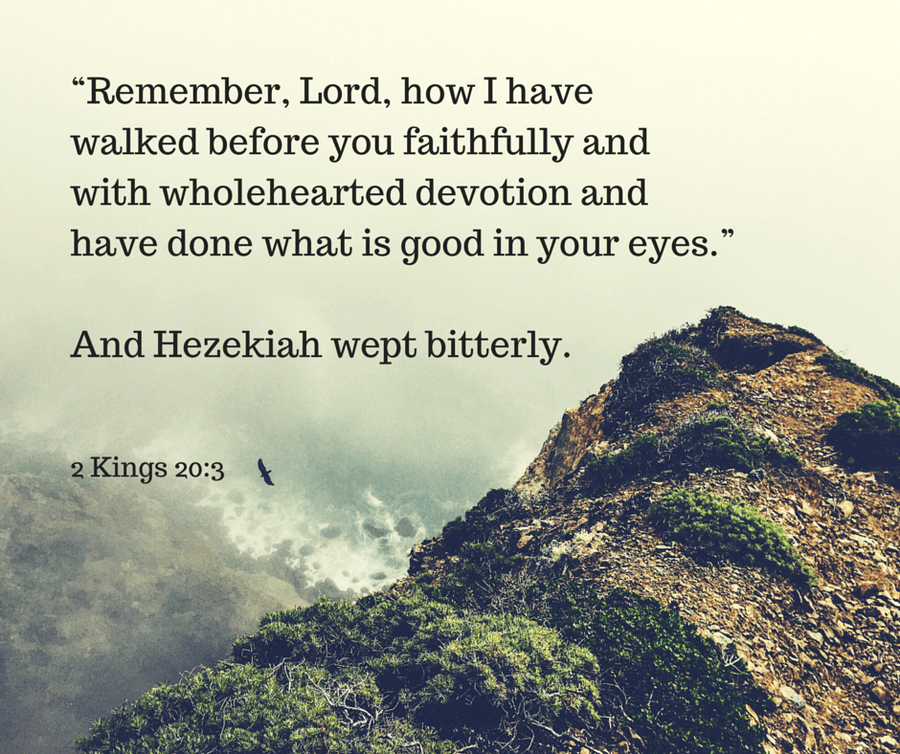
20 In those days Hezekiah became [a]mortally ill. And Isaiah the prophet, the son of Amoz, came to him and said to him, “This is what the Lord says: ‘Set your house in order, for you are going to die and not live.’” 2 Then he turned his face to the wall and prayed to the Lord, saying, 3 “Please, Lord, just remember how I have walked before You wholeheartedly and in truth, and have done what is good in Your sight!” And Hezekiah wept [b]profusely. 4 And even before Isaiah had left the middle courtyard, the word of the Lord came to him, saying, 5 “Return and say to Hezekiah the leader of My people, ‘This is what the Lord, the God of your father David says: “I have heard your prayer, I have seen your tears; behold, I am going to heal you. On the third day you shall go up to the house of the Lord. 6 And I will add fifteen years to your [c]life, and I will save you and this city from the hand of the king of Assyria; and I will protect this city for My own sake and for My servant David’s sake.”’” 7 Then Isaiah said, “Take a cake of figs.” And they took it and placed it on the inflamed spot, and he recovered.
8 Now Hezekiah said to Isaiah, “What will be the sign that the Lord will heal me, and that I will go up to the house of the Lord on the third day?” 9 Isaiah said, “This shall be the sign to you from the Lord, that the Lord will perform the word that He has spoken: shall the shadow go forward ten steps or go back ten steps?” 10 So Hezekiah said, “It is easy for the shadow to decline ten steps; no, but have the shadow turn backward ten steps.” 11 Then Isaiah the prophet called out to the Lord, and He brought the shadow on the [d]stairway back ten steps by which it had gone down on the [e]stairway of Ahaz.
Word of God for the Children of God
Glory be to the Father,
and to the Son, and to the Holy Ghost;
as it was in the beginning,
is now, and ever shall be,
world without end. Amen, amen.
Hezekiah Walked With God
Hezekiah “did what was right in the eyes of the LORD, just as his [ancestor] David had done” (2 Kings 18:3).
Hezekiah’s father, Ahaz, had been a king who did evil in God’s sight.
Hezekiah tore down the altars and sacred stones his father had used to worship other gods, and the Lord blessed Hezekiah’s devotion and his zeal by giving him victories over enemy oppressors who tried to ruin God’s people.
But then Hezekiah became critically ill, the Lord said that he would soon die.
So Hezekiah cried. pleaded with God for healing, reminding the Lord in prayer he had always walked before him “faithfully and with wholehearted devotion.”
And he wept bitterly.
God answered Hezekiah’s prayer by adding fifteen years to his life. Hezekiah was thankful, but he did not always use his extra time wisely.
He had a weakness in that he was proud of all the treasures of his kingdom. And when visitors came from Babylon, he proudly showed them all his treasures.
Later the prophet Isaiah said that one day those treasures would be carried off to Babylon. God’s cure of Hezekiah’s illness did not cure him of his pride.
A mountain-top spiritual experience doesn’t protect us against a fall back into the valley of sin. If you have been to the mountaintop, pray for sustaining grace.
And if you have fallen, Psalm 51 repent knowing God’s forgiving grace is great.
Since the days of David and Solomon, there had not been a king of Judah as faithful as Hezekiah. Not only did he purge idolatry from Judah, but he also humbled himself, trusted the Lord to deliver him from the Assyrian Empire.
Given Assyria’s successful imperial expansion, it would have made more sense, humanly speaking, for Hezekiah to surrender and ask for mercy. But Hezekiah walked by faith, not by sight, and Assyria was turned away (2 Kings 18–19).
We see another example of Hezekiah’s trust in the Lord in today’s passage, which tells us of a critical moment when the king almost lost his life.
At the point of death, King Hezekiah received a visit from Isaiah the great prophet who played a critical role during the righteous monarch’s reign.
Isaiah delivered a message from the Lord that Hezekiah was about to die (20:1).
But Hezekiah did not take God’s words as an unalterable decree; instead, he chose faith over fear, courage not timidity, went to the Lord in prayer (vv. 2–3).
In the vulnerability of King Hezekiah’s desperate prayer, we see the essence of our relationship with God. It’s not about eloquence or perfection but coming to Him just exactly as we are: spiritually broken, seeking strength, being hopeful.
God’s response to Hezekiah isn’t just about the promise of healing; it’s a crystal clear declaration of His congoing, continuous nearness in our deepest struggles.
This interaction reminds us that our tears are never invisible to God. Each one a silent prayer, seen and too understood by Him. In our moments of helplessness, as words fail us, our tears speak volumes to the heart of our Father. Psalm 56:8
This illustrates the reality that not everything the prophets declared from God was part of His unchangeable decree that determines whatsoever comes to pass (Eph. 1:11).
Sometimes the Lord, through His prophets, announced things that He knew would not ultimately occur in order to spur His people to action.
Consider Jeremiah 18:5–10, that the Lord will relent and not fulfill a warning to sinful people when they repent, or He will bring judgment and not fulfill an announced blessing when men and women turn away from heeding His law.
In light of the Lord’s omniscience—He knows all things past, present, and future—God obviously knows how people will respond confronted by crisis.
In Hezekiah’s case, His ultimate intention was to heal the king and not to end his life through the illness described in 2 Kings 20:1–11.
But our actions are one means through which the Lord brings His plans to pass, He makes our decisions meaningful by acting in ways that prompt us to pray.
So, the Lord called for Hezekiah to be restored to health through the means of a poultice made from figs, He even added fifteen years to the king’s life (vv. 4–7).
Moreover, God did not refuse Hezekiah’s request for a sign the healing would be accomplished. This request shows that Hezekiah’s faith was true but imperfect, for he needed confirmation of God’s words when the promise should have been enough. But our Creator is kind, and He bolstered Hezekiah’s faith with a sign (vv. 8–11).
When we pray, we must remember God is sovereign, will answer us according to His eternal purposes. That does not mean, however, we should not be earnest in prayer. Hezekiah prayed earnestly, and he was healed. We should express our needs to God earnestly as well, knowing that He just may grant us what we ask.

In the name of the Father, and of the Son, and of the Holy Spirit. Amen.
Praying ….
Psalm 16
Confidence in the Lord
A Miktam of David.
1 Protect me, God, for I take refuge in you.
2 I[a] said to the Lord, “You are my Lord;
I have nothing good besides you.”[b]
3 As for the holy people who are in the land,
they are the noble ones.
All my delight is in them.
4 The sorrows of those who take another god
for themselves will multiply;
I will not pour out their drink offerings of blood,
and I will not speak their names with my lips.
5 Lord, you are my portion[c]
and my cup of blessing;
you hold my future.
6 The boundary lines have fallen for me
in pleasant places;
indeed, I have a beautiful inheritance.
7 I will bless the Lord who counsels me—
even at night when my thoughts trouble me.[d]
8 I always let the Lord guide me.[e]
Because he is at my right hand,
I will not be shaken.
9 Therefore my heart is glad
and my whole being rejoices;
my body also rests securely.
10 For you will not abandon me to Sheol;
you will not allow your faithful one to see decay.
11 You reveal the path of life to me;
in your presence is abundant joy;
at your right hand are eternal pleasures.
Glory be to the Father,
and to the Son, and to the Holy Ghost;
as it was in the beginning,
is now, and ever shall be,
world without end. Amen, amen.
 Loving God, Living God, Loving Hope, Living Hope, Loving Living Life His Way! "Many things are possible for the person who has hope. Even more is possible for the person who has faith. And still more is possible for the person who knows how to love. But everything is possible for the person who practices all three virtues." - Brother Lawrence (1605-1691), Practicing the Presence of God (1692).