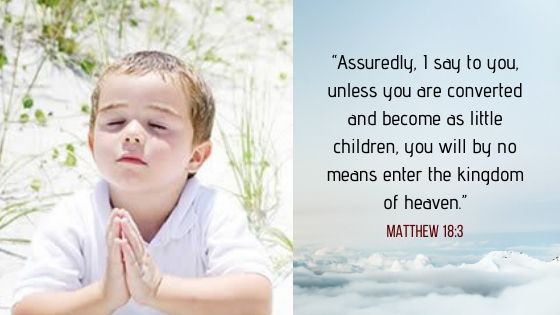
Growing Up to Become a Child – Descriptions of a Childlike Faith. Matthew 18:1-5

Matthew 18:1-6Amplified Bible

Rank in the Kingdom

18 At that time the disciples came to Jesus and asked, “Who is greatest in the kingdom of heaven?” He called a little child and set him before them, and said, “I assure you and most solemnly say to you, unless you repent [that is, change your inner self—your old way of thinking, live changed lives] and become like children [trusting, humble, and forgiving], you will never enter the kingdom of heaven. Therefore, whoever [a]humbles himself like this child is greatest in the kingdom of heaven. Whoever receives and welcomes one [b] child like this in My name receives Me; but whoever causes one of these little ones who believe in Me to stumble and sin [by leading him away from My teaching], it would be better for him to have a heavy millstone [as large as one turned by a donkey] hung around his neck and to be drowned in the depth of the sea.

The Word of God for the Children of God.

Adeste Fidelis! Venite Adoremus! Dominum.

Gloria! In Excelsis Deo! Alleluia! Alleluia! Alleluia! Amen.

Growing Up to Become a Child

What does the man, Rabbi Jesus, mean by saying to his disciples that we each need to “change and become like the little children who are among us”?

One clue we have here is that Jesus is responding to the question “Who is the greatest in the kingdom of heaven?”

And he replies, “Whoever takes the lowly position of this child is the greatest in the kingdom of heaven.”

In the Gospel narratives about Jesus and his disciples (Matthew, Mark, Luke, and John), we somehow find that the disciples often argued over which of them was, is and is about to become greatest; they seem to have been a competitive group.

And it seems they were thinking of greatness in terms of authority, leadership, knowledge, ­power, influence, “one above equals,” thrones and of other things.

So Jesus is seemingly telling all of his disciples that they need to change their attitudes about greatness and to become lowly and humble like little children.

Jesus’ followers, whether ancient or contemporary need to die to their selfish ambitions, realize that, just as little children depend on parents and caregivers, we are all totally dependent on Father God for all our needs and future living.

Here’s another hypothetical thought. A man in his sixties said, “Last week my five-year-old grandson said he wanted to be a firefighter when he grew up. I replied, ‘And when I grow up, I want to be a five-year-old boy.’ My grandson stared at me with wide, wondering eyes.”

Have you looked around at your own children or grandchildren and pictured yourself having such a “wide eyed wondering hypothetical conversation?”

Have you looked around at God’s world with “wide, wondering eyes” lately?

That’s something which I long for when I look at my own almost nine year old grandson when hear the clarion call to change and to become like a little child.

Descriptions of a Childlike Faith

Rabbi Jesus’ statement to His disciples in Matthew 18:3 about them not entering the kingdom of heaven unless they are converted and become as little children speak volumes and volumes of truth of the importance of living a childlike faith.

But what is childlike faith?

What makes one’s faith childlike?

Faith which is Rooted in Security

During the days of childhood, one learns how to survive and prosper, how to live under authority, how to live, love and share, and how to serve and praise.

A well-cared-for child has no worries about house or car or any credit card payments, no anxious moments over getting married to the right one, career or job opportunities, no apprehensions about failure, no thoughts of vengeance.

David exemplified this kind of faith while he was on the run from Saul.

Psalm 131:1-2Amplified Bible

Childlike Trust in the Lord.

A Song of [a]Ascents. Of David.

131 Lord, my heart is not proud, nor my eyes haughty;
Nor do I involve myself in great matters,
Or in things too difficult for me.


Surely I have calmed and quieted my soul;
Like a weaned child [resting] with his mother,
My soul is like a weaned child within me [composed and freed from discontent].

In Psalm 131:1-2, David compared the calmness and serenity he had in the Lord to that of a weaned child with his mother.

Composed, content with God and the works He was doing in his life, David did not concern himself with great matters such as any selfish ambition and self-promotion – rather, he found serenity and security in his relationship with God.
Surely goodness and mercy and unfailing love shall follow me all the days of my life,
And I shall dwell forever [throughout all my days] in the house and in the presence of the Lord. (Psalm 23:6)

To have a childlike faith is to find serenity and security in our relationship with God no matter the circumstance.

Faith Which Praises

Jesus loved children. He loved to use children to teach hard-headed and hard-hearted grown-ups about faith and praise.

While preaching in the region of Judea, Christ was encircled by a great crowd.

Matthew 19:13-15Amplified Bible

Jesus Blesses Little Children

13 Then children were brought to Jesus so that He might place His hands on them [for a blessing] and pray; but the disciples reprimanded them. 14 But He said, “Leave the children alone, and do not forbid them from coming to Me; for the kingdom of heaven belongs to such as these.” 15 After placing His hands on them [for a blessing], He went on from there.

He later reminded the priests and scribes that “the mouth of babes and nursing infants” would offer praise fitting for God’s Anointed (Matthew 21:16).

When Jesus entered Jerusalem riding on a colt, a very great multitude that included children cried out saying, “Hosanna to the Son of David! Blessed is He who comes in the name of the Lord! Hosanna in the highest” (Matthew 21:9)!

The sound of the children praising Jesus in the temple courts made the chief priests and scribes indignant.

In response, Jesus quoted from Psalm 8:2.

God does not only want prayer in His house, He also delights in praise.

To have a childlike faith is to have a heart that always longs to praise and glorify God in each and every life’s circumstance.

Faith Which Believes

Jesus used the lad with the five barley loaves and the two small fish to feed five thousand people (John 6:9).

To show His power over death, Jesus used a little girl. Jairus, a ruler in the synagogue, fell at Jesus’ feet begging Him to come to his house and save his dying twelve-year-old daughter.

Jesus agreed and tried to make His way with Jairus, but the surrounding crowd made the trip difficult.

Word came that Jairus’ daughter had died.

But Jesus responded, “Do not be afraid, only believe and she will be made well” (Luke 8:50).

At the house, as the parents wept over their loss, Jesus said, “She is not dead but sleeping” (Luke 8:52).

Through tears, the people laughed at the impossibility of what they heard.

Jesus then asked everyone to leave the room, and then He said, “Little girl, arise” (Luke 8:54), and she did!

Romans 4:17 says that “God gives life to the dead and calls those things which do not exist as though they did.”

Jesus spoke to the girl with the power of God, and she was raised from the dead.

Jairus’ faith definitely played a part in the miracle healing of his daughter just like the faith of the woman who had been bleeding for 12 years had made her well (Luke 8:43-48).

Nothing is impossible with God if we would just believe.

This is what it means to have childlike faith.

Faith Which is Humble

Another time, Jesus used a child to teach humility.

In Matthew 18:1-5, we read how the disciples came to Jesus asking, “Who then is the greatest in the kingdom of heaven?” and how did Jesus respond?

He called a little child to Him, set the little child in the midst of them, and said, “Assuredly I say to you, unless you are converted and become as little children, you will by no means enter the kingdom of heaven.”

He then went on to say, “Therefore whoever humbles himself as this little child is the greatest in the kingdom of heaven. And whoever receives one little child like this in My name receives Me.”

The fact that Jesus had been sharing with the disciples that truth about His approaching suffering and death did not affect them for they were thinking only of, about themselves and what position they would have in His Kingdom.

So self-absorbed were the disciples in this matter that they actually argued with each other in the presence of Rabbi Jesus himself (Luke 9:46).

Pride – the very sin that caused Satan to be cast down from heaven is what’s causing people to think of themselves more highly than others.

When Christians are living for themselves and not for others, conflict and division are bound to result (James 4:1-2).
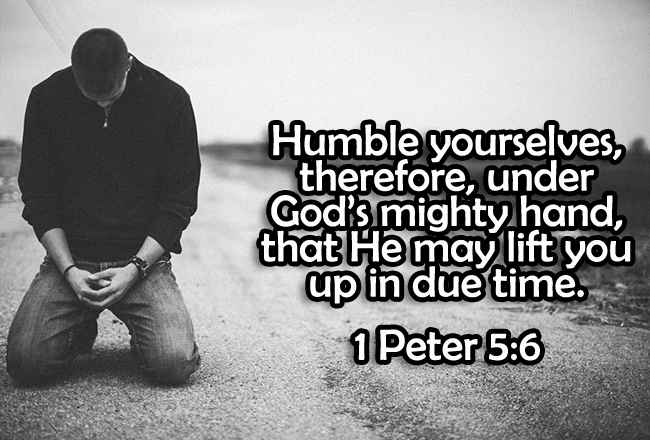
True humility means knowing ourselves, accepting ourselves, and being ourselves – our best self – to the glory of God ALONE!.

It means avoiding two extremes:

Thinking less of ourselves than we ought to (as did Moses when God called him, Exodus 3:11), or thinking more of ourselves than we should (Romans 12:3).

The truly humble person does not deny the gifts God has given him or her but uses them to the glory of God.

The truly humble person also helps to build up others, not to tear them down.

Hebrews 12:1-3Amplified Bible

Jesus, the Example

12 Therefore, since we are surrounded by so great a cloud of [a]witnesses [who by faith have testified to the truth of God’s absolute faithfulness], stripping off every unnecessary weight and the sin which so easily and cleverly entangles us, let us run with endurance and active persistence the race that is set before us, [looking away from all that will distract us and] focusing our eyes on Jesus, who is the Author and Perfecter of faith [the first incentive for our belief and the One who brings our faith to maturity], who for the joy [of accomplishing the goal] set before Him endured the cross, [b]disregarding the shame, and sat down at the right hand of the throne of God [revealing His deity, His authority, and the completion of His work].

Just consider and meditate on Him who endured from sinners such bitter hostility against Himself [consider it all in comparison with your trials], so that you will not grow weary and lose heart.

This person is a stepping-stone, not a stumbling block.

This person is a building block not a stumbling block.

Thus, we must seek to remove from our lives anything that makes us stumble.

If we don’t, we will cause others to stumble as well.

Which Jesus Himself said was not a very good, very healthy, very wise, idea.

Matthew 18:6Amplified Bible

but whoever causes one of these little ones who believe in Me to stumble and sin [by leading him away from My teaching], it would be better for him to have a heavy millstone [as large as one turned by a donkey] hung around his neck and to be drowned in the depth of the sea.

An unspoiled child has the characteristics that make for humility: trust, dependence, a desire to make others happy, and an absence of boasting or selfish desires to be greater than others.

By our nature, we are all rebels who want to be celebrities instead of servants.

And so we need a great deal of teaching for us to learn the lesson of humility.

Concluding Thoughts ….

As Christians, we are encouraged to have childlike faith.

To have faith like a child is to completely embrace, trust our heavenly Father’s goodness, care, provision, leadership, His security, vigilance and protection.

Have you experienced the peace of a well-cared-for child in letting Jesus take care of your worries?

Have you found the healing that faith in Jesus brings?

Have you praised His name with the joy of a child?

Have you answered Jesus’ call in childlike faith, asking Him to be your Savior?

In the name of God, the Father and God the Son and God the Holy Spirit,

Let us Pray,

Psalm 17The Message

17 1-2 Listen while I build my case, God,
    the most honest prayer you’ll ever hear.
Show the world I’m innocent—
    in your heart you know I am.

Go ahead, examine me from inside out,
    surprise me in the middle of the night—
You’ll find I’m just what I say I am.
    My words don’t run loose.

4-5 I’m not trying to get my way
    in the world’s way.
I’m trying to get your way,
    your Word’s way.
I’m staying on your trail;
    I’m putting one foot
In front of the other.
    I’m not giving up.

6-7 I call to you, God, because I’m sure of an answer.
    So—answer! bend your ear! listen sharp!
Paint grace-graffiti on the fences;
    take in your frightened children who
Are running from the neighborhood bullies
    straight to you.

8-9 Keep your eye on me;
    hide me under your cool wing feathers
From the wicked who are out to get me,
    from mortal enemies closing in.

10-14 Their hearts are hard as nails,
    their mouths blast hot air.
They are after me, nipping my heels,
    determined to bring me down,
Lions ready to rip me apart,
    young lions poised to pounce.
Up, God: beard them! break them!
    By your sword, free me from their clutches;
Barehanded, God, break these mortals,
    these flat-earth people who can’t think beyond today.

I’d like to see their bellies
    swollen with famine food,
The weeds they’ve sown
    harvested and baked into famine bread,
With second helpings for their children
    and crusts for their babies to chew on.

15 And me? I plan on looking
    you full in the face. When I get up,
I’ll see your full stature
    and live heaven on earth.

Adeste Fidelis! Venite Adoremus! Dominum.

Gloria! In Excelsis Deo! Alleluia! Alleluia! Alleluia! Amen.

https://translate.google.com/

What Is this Spiritual Gift of Faith? 1Corinthians 12:4-11

1 Corinthians 12:4-11Amplified Bible

Now there are [distinctive] varieties of spiritual gifts [special abilities given by the grace and extraordinary power of the Holy Spirit operating in believers], but it is the same Spirit [who grants them and empowers believers]. And there are [distinctive] varieties of ministries and service, but it is the same Lord [who is served]. And there are [distinctive] ways of working [to accomplish things], but it is the same God who produces all things in all believers [inspiring, energizing, and empowering them]. But to each one is given the manifestation of the Spirit [the spiritual illumination and the enabling of the Holy Spirit] for the common good. To one is given through the [Holy] Spirit [the power to speak] the message of wisdom, and to another [the power to express] the word of knowledge and understanding according to the same Spirit; to another [wonder-working] faith [is given] by the same [Holy] Spirit, and to another the [extraordinary] gifts of healings by the one Spirit; 10 and to another the working of [a]miracles, and to another prophecy [foretelling the future, speaking a new message from God to the people], and to another discernment of spirits [the ability to distinguish sound, godly doctrine from the deceptive doctrine of man-made religions and cults], to another various kinds of [unknown] tongues, and to another interpretation of tongues. 11 All these things [the gifts, the achievements, the abilities, the empowering] are brought about by one and the same [Holy] Spirit, distributing to each one individually just as He chooses.

The Word of God for the Children of God.

Adeste Fidelis! Venite Adoremus! Dominum.

Gloria! In Excelsis Deo! Alleluia! Alleluia! Alleluia! Amen.

Spiritual Gift of Faith

Today, let’s learn something about the spiritual gift of faith.

Your first reaction to this might be, “How can faith be a gift?

Aren’t we all supposed to have faith as believers in Jesus Christ?”

Faith is absolutely a gift!

It is specifically mentioned as a spiritual gift in scripture (1 Corinthians 12:9).

Because it is a spiritual gift, that means not everyone has the gift of faith.

And that’s okay.

We can all strive for faith, but for some people the confidence in the truth of God comes more naturally than to others.

Do you know a person who can continue to trust in God no matter what comes their way?

A person who can see where God is working in your life when you can’t see it?

People with the spiritual gift of faith are unshakeable in their reliance on God’s promises and are a source of encouragement for the rest of us when we feel like embracing the world or giving up on God or think that God has given up on us.

Here is how we can define the gift of faith:

Faith is the exceptional ability to hold fast to the truth of God in Jesus Christ in spite of pressures, problems, and obstacles to faithfulness.

Much more than just belief, faith is a gift which empowers an individual or a group of people to hold fast to its identity in Christ in the face of any challenge.

The gift of faith enables believers to rise above pressures and problems that might otherwise cripple them.

Faith is characterized by an unshakable trust in Jehovah God to deliver on God’s promises, no matter what.

The gift of faith inspires those who might be tempted to give up to hold on.

Those gifted with Faith create a foundation upon which true community can be built and sustained.

It is critical for people possessing the gift of Faith to make, take opportunities to share their beliefs, their learning, most importantly, their life experiences.

Faith stories have powerful and transforming effects.

Faith is a prominent gift in witnessing congregations, where personal stories are shared in group settings, worship, Sunday school classes, or Bible studies.

Faith is the exceptional ability to hold fast to the truth of God in Jesus Christ in spite of pressures, problems, and obstacles to faithfulness.

Our Bible gives us many examples of individuals with the spiritual gift of faith.

Hebrews 11:1-12 The Message

Faith in What We Don’t See

11 1-2 The fundamental fact of existence is that this trust in God, this faith, is the firm foundation under everything that makes life worth living. It’s our handle on what we can’t see. The act of faith is what distinguished our ancestors, set them above the crowd.

By faith, we see the world called into existence by God’s word, what we see created by what we don’t see.

By an act of faith, Abel brought a better sacrifice to God than Cain. It was what he believed, not what he brought, that made the difference. That’s what God noticed and approved as righteous. After all these centuries, that belief continues to catch our notice.

5-6 By an act of faith, Enoch skipped death completely. “They looked all over and couldn’t find him because God had taken him.” We know on the basis of reliable testimony that before he was taken “he pleased God.” It’s impossible to please God apart from faith. And why? Because anyone who wants to approach God must believe both that he exists and that he cares enough to respond to those who seek him.

By faith, Noah built a ship in the middle of dry land. He was warned about something he couldn’t see, and acted on what he was told. The result? His family was saved. His act of faith drew a sharp line between the evil of the unbelieving world and the rightness of the believing world. As a result, Noah became intimate with God.

8-10 By an act of faith, Abraham said yes to God’s call to travel to an unknown place that would become his home. When he left he had no idea where he was going. By an act of faith he lived in the country promised him, lived as a stranger camping in tents. Isaac and Jacob did the same, living under the same promise. Abraham did it by keeping his eye on an unseen city with real, eternal foundations—the City designed and built by God.

11-12 By faith, barren Sarah was able to become pregnant, old woman as she was at the time, because she believed the One who made a promise would do what he said. That’s how it happened that from one man’s dead and shriveled loins there are now people numbering into the millions.

  • Verse 4 – By faith, Abel brought a better sacrifice to God than Cain
  • Verse 5 – By faith, Enoch skipped death
  • Verse 7 – By faith, Noah built a ship
  • Verse 8 – By faith, Abraham said yes to God
  • Verse 11 – By faith, barren Sarah became pregnant
Faith in Scripture ….

Mark 9:23 (NRSV)
Jesus said to him, “If you are able!—All things can be done for the one who believes.”

Luke 8:48 (NRSV)
He said to her, “Daughter, your faith has made you well; go in peace.”

Luke 17:19 (NRSV)
Then he said to him, “Get up and go on your way; your faith has made you well.”

Luke 18:42 (NRSV)
Jesus said to him, “Receive your sight; your faith has saved you.”

Romans 4:18-21 (NRSV)
Hoping against hope, he believed that he would become “the father of many nations,” according to what was said, “So numerous shall your descendants be.” He did not weaken in faith when he considered his own body, which was already as good as dead (for he was about a hundred years old), or when he considered the barrenness of Sarah’s womb. No distrust made him waver concerning the promise of God, but he grew strong in his faith as he gave glory to God, being fully convinced that God was able to do what he had promised.

God gives us believers gifts of the Holy Spirit.

We do not know why exactly God’s will is for us to have any of these gifts, but we are thankful for any blessings, gifting’s, and corrections that He gives us.

Faith — it is a gift, and all we need is about the size of a mustard seed (Matthew 17:20).

To each and every one of us, a measure of faith has been assigned by God (Romans 12:3).

Moses had faith to lead Israel to the Promised Land, Sarah had faith that she would conceive even in her old age, and Noah had faith that God had spoken to him to build the ark even when everyone thought he was crazy (Hebrews 11).

There isn’t any formula that is alongside this gift of faith, and to think that there would be, it would be much more difficult to have faith.

Believing in faith is easy, but in our finite minds, thoughts barricade what is truly simple.

For by grace you have been saved through faith. And this is not your own doing; it is the gift of God, not a result of works, so that no one may boast (Ephesians 2:8-9).

Faith without proof

There are miracles everywhere mentioned in the New Testament.

Many people today have seen what the goodness of God can do through miracles.

In Mark 2, Jesus was in a crowded house in Capernaum.

There were four men carrying a paralytic man, trying to reach Jesus.

They had to make a hole in the roof of the house in order to bring the paralyzed man to be healed by Jesus.

This act was an act of faith by the four men, and Jesus saw their faith in the man being healed of his affliction.

Well, the man not only got healed but his sins were forgiven.

Miracles are a wondrous gift, but having faith without seeing is believing that it is possible even though it seems impossible (2 Corinthians 5:7).

“Now faith is the substance of things hoped for, the evidence of things not seen” (Hebrews 11:1). 

Our hope is in Christ alone.

Without faith, there is no hope.

We have faith that when winter begins to thaw, and all the snow begins to fade away, that the seeds that were planted in the previous season shall burst forth.

Springtime is a time of refreshment, a time of anticipated, expectant joy to see what was planted, will be planted and is to soon come up from the cold ground.

We don’t see the seeds with our own eyes, but by faith, we have the hope to see green leaves, diverse colors of flowers coming up to bring out joy and harvest.

Childlike Faith ….

Matthew 18:1-6 Amplified Bible

Rank in the Kingdom

18 At that time the disciples came to Jesus and asked, “Who is greatest in the kingdom of heaven?” He called a little child and set him before them, and said, “I assure you and most solemnly say to you, unless you repent [that is, change your inner self—your old way of thinking, live changed lives] and become like children [trusting, humble, and forgiving], you will never enter the kingdom of heaven. Therefore, whoever [a]humbles himself like this child is greatest in the kingdom of heaven. Whoever receives and welcomes one [b] child like this in My name receives Me; but whoever causes one of these little ones who believe in Me to stumble and sin [by leading him away from My teaching], it would be better for him to have a heavy millstone [as large as one turned by a donkey] hung around his neck and to be drowned in the depth of the sea.

Children are like sponges.

Children are naturally inquisitive about almost everything in their little world.

They max out their efforts absorbing everything they can see, smell, taste, and touch, and hear.

In a classroom, it is a teacher’s job to assure that the children are learning what is being taught.

Children learn from their families as to what is wrong and what is right.

But what they are the best at is having faith.

Think about the inquisitiveness of your own children right now.

What are they constantly getting themselves into?

What holds their “undivided” attention?

What is their “wish-list?”

What are their dreams?

As it might be applicable, be observant and give an answer to those questions for those of us who have grandchildren or great grandchildren inside our lives.

Think about when you were a child, what did you have hope for?

I hoped that I could see the world that God created.

As I got older, I realized what goes into making those dreams come true.

I then began to see that it may not ever happen, and my faith became less in that area of my life.

I let my fears become more and more of my reality because I didn’t truly believe that I could travel the world.

But, perhaps, one season, by God’s Grace, that dream of travel will come true.

I believe and have faith God will bring me to places that He wills for my life. 

In Romans 10:17, the Bible states, “So faith comes from hearing, and hearing through the word of Christ.” 

Our thoughts can be louder than the Word of God if we let them.

The Holy Spirit within us shows us what is truth and what is not.

The gift of faith is truth and grace that has been given to us through the sacrifice of Jesus Christ.

The spiritual gift of faith is steadfastly believing the truth, God’s truth alone.

No matter what happens whether you receive what you are believing in or not, your confidence cannot be swayed.

The fear, worry, and circumstances do not determine your level of faith.

If God has given you this spiritual gift of faith, then trust, without doubt, that He will absolutely do as He absolutely wills for your life.

In the name of God, the Father and God the Son and God the Holy Spirit,

Let us Pray,

All-Powerful Father, I bow before You because You are awesome and worthy of all the praise. Your word declares that I can do all things through You who strengthens me! I put all my trust in You. You alone are my God. You alone are my joy. You are my heart and my soul. You are the grass under my feet and the sky above. You are seen and unseen, Father. Keep me at Your right hand forever, fill me with Your grace, and make me Yours all the days of my life. Father, we thank you for everything, and we love you with all that we are. I pray that those that have been given this spiritual gift of faith will never waiver. I pray that we will trust and believe you always God. 

 Adeste Fidelis! Venite Adoremus! Dominum.

Gloria! In Excelsis Deo! Alleluia! Alleluia! Alleluia! Amen.

https://translate.google.com/

A Father to the Fatherless. What to Believe When “Dad” Walks Away? What to Believe of God, our Father?

I remember back to my earliest days of Sunday School when the subject of the day was Prayer. The question was raised by one of the other children who asked the teacher: “How do you converse with God?” The Sunday School teacher said, “As you talk with your daddy and your daddy talks to you, you talk with God.”

At five years old, I responded in return, “When I talk to my daddy, my daddy always removes both of his hearing aids, and then he stops talking to me.”

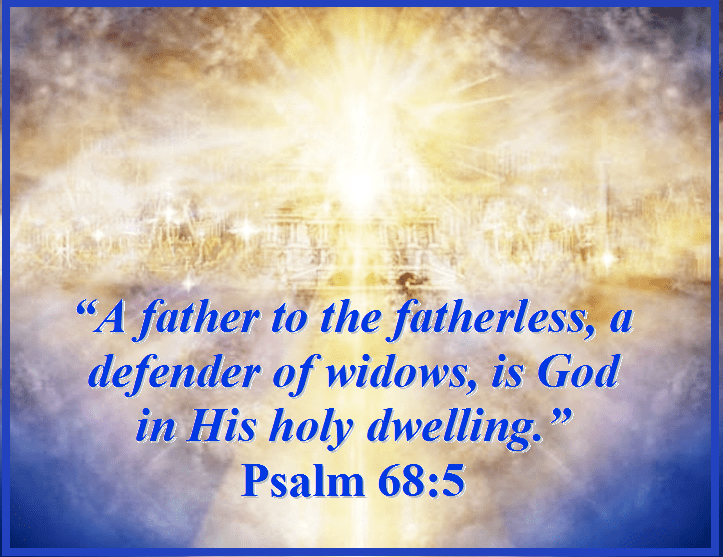
Psalm 68:5 has recently taken on a whole new meaning to me. The God of the universe–The one who created me, knitted me together in my mother’s womb, and despite all of my gravest faults and failures and also my father’s faults and failures, preserved me through my “fatherless” empty childhood–is also a true father to the fatherless! Let’s think about that for a second; I can probably think of so many other things that He could be doing, seeing that He is God and all.  

But no, He’s a model dad! He’s the one who kisses every boo-boo, cradles us in the big, perfect hug that only a genuine father has and can, and always has the best stash of band-aids and words to make the pain of an empty childhood go away. It’s probably a good thing Iam not God because I highly doubt, I would take time for knowing of those simple things. But I am very thankful He does.

Psalm 68:5 Holman Christian Standard Bible

God in His holy dwelling is
a father of the fatherless
and a champion of widows.

The Word of God for the Children of God. Gloria! In Excelsis Deo! Alleluia! Amen.

Reverend Dr. A.W. Tozer says, “What comes into our minds when we think about God is the most important thing about us” (The Knowledge of the Holy). What we think about our heavenly Father says a whole lot about who we are.

But what if our thoughts about our heavenly Father are entangled with and stained by the abuse and abandonment of our earthly father? Anyone who has experienced the acute pain of dad walking out knows it can be all-consuming.

I have, and I know. Dad, greatly afflicted by the harsh memories of the Korean War, copious amounts of alcohol and severe hearing loss made worse by war, stole the thing I believed to be indestructible, superhuman even: my family.

But family turned out to be more fluid than I once thought . . . and hoped. Like a permanent smudge on the lens through which we see the world, the dissolution of the family distorts all that we know and all that we are. Our hearts beat out of rhythm. Our thoughts weigh heavier upon our minds. Our tears flow faster. The only voice that once calmed us in the middle of the night is suddenly silent. The picture frame that preserved our family on the wall is either gone or it is empty.

Instinctively human beings have a need of a loving and compassionate father, who will feed us when we are hungry, love us when we are lonely, and care for us when we are crying. We long for a “smiling” dad, who will listen to us when we have questions, encourage us when we are discouraged, and discipline us when we do wrong. A father who cares and also takes time with the little things, who extends wisdom when we are concerned, and who most of all prays and seeks to know, understand God’s will and direction before acting on his own.  

God placed within us a desire to be loved by our father. Some fathers do well, and others do not. Some are extremely successful, and others fail miserably. 

Warped by such confusion and despair, just how do we paint accurate, biblical portraits of our Father’s goodness and faithfulness? When our fathers turn off their hearing aids or remove them from their ears instead of listening to their children, we’ve a very much harder time seeing who God promises to be for us.

The Bible articulates the truth we need, but believing the Bible isn’t always so easy either. When advice seems too thin, though, and life too cruel, God’s word is the only truly reliable brush for the suffering, painting fresh strokes of God’s character onto the marred canvas of our hearts and experience.

He draws near unto, the brokenhearted and ready to care for you, his precious son or daughter. (Psalm 34:18)

Fortunately, God is the perfect model of a faithful father, and He fills the gaps left by our earthly father as we seek Him each day. Therefore, we should listen to Him and honor Him in everything that we think, say and do.

Fathers need to learn to have a relationship with God, even if they did not or do not have a relationship with their earthly father. This is fully realized through the reading, studying and understanding of the Scriptures, where a father will gain and grow in wisdom, grace and the ability to raise kids to the glory of God.

Fathers, who accept God as their #1 penultimate Father, which also have made Jesus Christ their Lord and Savior are God’s children and learn from Him and in turn, unhesitatingly, teach their children the truths and treasures of the Bible.

1. Your Father will never leave you.

No one wants to suffer through the absence of a father who might walk away or remove their hearing aids from their ears at any moment. It’s agonizing riding the bus home from school wondering if dad’s truck will be in the driveway, if his clothes will still be in the closet, he will listen to you with both hearing aids.

God does not leave us in that suspense. God is deeply, unshakably committed to fathering you. You never have to ask whether he will stay or leave or listen. God himself promises, “I will never leave you nor forsake you” (Hebrews 13:5). He will hear our cries, our pleas from the furthest reaches of eternity (Psalm 18:6-19).

No matter what you’ve been through with your father, if you are God’s child through faith, he promises to never pack up his suitcase and leave you peering out from the kitchen window. In the middle of your loneliness, God is 10000% right there with you (John 14:16–18). Even when your earthly dad is somewhere else, God will not forget or neglect the commitment He has made unto you.

2. Your Father will protect you, not hurt you.

Sadly, some fathers hinder and hurt, rather than help. They bring pain, rather than protection. As a child, even into adulthood, you may have suffered both physical and emotional pain because of your dad. Your home wasn’t a safe place for you. Instead, it was a “Roman” arena of anger, tears, fears and uncertainty.

Pray! Take hope: your Father in heaven will never hurt you like this.

He will always protect you, keeping you safe from attacks against you. His hand of protection is unmoved and never tires.

Even when he must discipline us, he introduces pain in grace and love, and for our greatest good (Proverbs 3:12).

No matter what dangers you face, God remains an unparalleled source of safety and help. He will not let danger overtake you (Isaiah 43:2–3). 

He is a Father of ceaseless comfort and protection, not of terror and abuse.

3. Your Father knows what you need.

In a single-parent home, provision for the family can be a daily struggle and anxiety. Meals uncertain. Clothes borrowed. Aren’t our parents supposed to provide for our basic needs? When dad is gone, and with him a major source of income, when dad stops hearing and listening to their children, we must fight to see through the fog and fight to trust that God remains faithful to provide.

His resources never end (Psalm 50:10). He loves to provide for you, because you are a great delight to him. Your most fundamental needs will always ultimately be met in your heavenly Father (Philippians 4:19), not your earthly parents.

Even when Adam and Eve, God’s very first children, disobeyed, not only did God clothe their nakedness and also cover their shame, he promised us the ultimate provision of Christ for their sin, as well as for our sin (Genesis 3:1521). In Jesus, the Father has not left us wanting. He promises to eventually provide an eternal home, one where his children will never be crying or wanting (John 14:1–3).

4. Your Father takes great delight in you.

Without any love or encouragement from our dad, we can too easily question whether we are even loved at all. It’s normal to wonder how much we are worth, whether we’re a source of pleasures or problems for others.

But where our dad might be absent and silent, God has spoken. God affirms that we always and forever bring him great delight. He says, “You are precious in my eyes” (Isaiah 43:4). As His Children, we are a unique source of pleasure for him.

Rest in this: you and I are a constant delight to God, not because you, I, bring something to him, but because he loves us freely. He showers us with shouts of deliverance, love, and gladness (Zephaniah 3:17).

Questioning whether you are a delight to your dad is a real insecurity for many. It may be excruciatingly hard to believe that you are loved, but your heavenly Father does not ever leave us in doubt. If we are his, we are infinitely loved!

5. Your Father does not love you because of you.

Those of us who have watched dad remove his hearing aids, watched dad walk away have wrestled with trying to earn our father’s love and affection. Maybe we fight for the merits of academic or athletic success. This was my hardest fight as a young son, deeply desiring the unhindered love and affection of my dad. Whatever the perceived standard may be, it’s no way to live as a child.

Thankfully, our heavenly Father’s love for us is not conditional.

He does not love us based on our successes. Instead, God loves us because he loves us. That’s who he is. Even when we’re disobedient and rebellious, his love covers us. Even when we run away from him, he patiently waits for us to come home — a Father ready to wrap his arms around you, kiss you, and shower you with forgiveness and grace (Luke 15:20–24).

As it is truly written somewhere, there is more mercy in God than sin in you.

God reached out to you in great love when you were at your worst, not your best (Romans 5:6–8).

Child of God, LIVE! Run freely into your heavenly Father’s embrace, trusting the Father’s arms to hold you because his Son’s arms were stretched out for you on the cross. He is a living hope for the defeated, abandoned and forsaken, a refuge and a haven like no other can ever be for the fearful, a Father to the fatherless.

Our earthly fathers deserve respect. Our heavenly Father deserves our respect, commands our maximum love because He is always there, totally trustworthy.

What God says, He does. God our heavenly Father, will not let us down, He knows what we need and when we need it. At times it may feel as if He is not with us, but He is. He is probably speaking but we are not listening. Or is it maybe He is silent because He wants to grow our faith and our trust in Him?

In the name of God, our Father, God the Son and God the Holy Spirit,

Let us Pray,

Great is thy faithfulness, O God my Father; …... Thomas O. Chisolm, 1923

Father may my life, my compassion and my ministry reflect your heart for those who need care and protection and love. Give me eyes to see this need more clearly and a heart to responded more certainly so that your love may be demonstrated through me. In the precious name of my Savior Jesus, I pray.

Lord, today we pray specifically for fathers and fatherhood across our land.

Your Word faithfully teaches fathers to bring up their children in the discipline, instruction of the Lord (Ephesians 6:4). God, we do thank You for the men who are leading their families according to Your statutes and the ones that are laying their lives down for Your purposes.

We pray You will continue to use these men to lead their families and other men. We pray You will strengthen the fathers of our nation and that You will continue to empower churches, organizations, and individuals to 100% invest in fathers, fatherhood for the sake of Your children. Gloria! In Excelsis Deo! Alleluia! Alleluia! Alleluia! Amen.
 https://translate.google.com/

Abounding, Abundant, Faithfulness is the True Keys to God’s Blessings. Wisdom From: Proverbs 28:18-22

In this devotional for today I am seeking to bless your life, shake up, and stir up your affections for God, today we’re going to look at the blessedness of God’s faithfulness and how we ourselves can express our gratitude to God, revealing it, returning it and sharing it. You and I can have faith, because God is faithful. His faithfulness lays the foundation for our faithfulness. We need to love him, follow him, walk with him. May God draw us closer to him and give us a greater measure of His faith today as we focus on his steadfast love and his faithfulness.

Proverbs 28:18-22Amplified Bible

18 
He who walks blamelessly and uprightly will be kept safe,
But he who is crooked (perverse) will suddenly fall.
19 
He who cultivates his land will have plenty of bread,
But he who follows worthless people and frivolous pursuits will have plenty of poverty.
20 
A faithful (right-minded) man will abound with blessings,
But he who hurries to be rich will not go unpunished.
21 
To have regard for one person over another and to show favoritism is not good,
Because for a piece of bread a man will transgress.
22 
He who has an evil and envious eye hurries to be rich
And does not know that poverty will come upon him.

The Word of God for the Children of God. Gloria! In Excelsis Deo! Alleluia! Amen.

In today’s devotional, we are going to look at six areas of life which too many people are being the most unfaithful and what does the Bible say about it. Be faithful to God in these areas, you surely, certainly will unlock his blessings.

1. Being Faithful to God and His Word

A. In such times as these, all of us are forced to wait at certain times of life and waiting is a time when our faithfulness is put into test. If we are faithful, we will wait upon the Lord for sustenance, not anything or anyone else, (Psalm 62:5).
B. We need to be faithful to God’s word also. We are to devote ourselves to it on a daily basis. We are to live it in our heart so that we will not sin, (Psalms 119:11).
C. God will surely, certainly bless when we delve into, when we abide, and we abound deeply into his word. Above all we will have his perfect peace, even while living in a world of tranquility, (John 15:7Isaiah 26:3, 1 Timothy 2:15).

2. Being Faithful to the Local Church

A. The local church is every Christian’s spiritual family. God has called us to be a family of One God, One Spirit, and One Baptism. Be fed only by the Word of God (Psalm 19, Psalm 34:8 -10, Psalm 119, Proverbs 1, 8, 16:24, Proverbs 22:6)
B. Faithfulness to one’s local church is best expressed by his obedience to his precepts and teachings. Love God, Neighbor and self. Respect their ideologies and the nuances of their various and diverse theologies, biases and prejudices are irrelevant and immaterial and unnecessary (Acts 2, Galatians 3:25-29)
C. Always support each other in ministry, as we all labor for the Kingdom of God, in our tears and in sweat, (1 Thessalonians 5:12-131 Timothy 5:17-18).

3. Being Faithful to Your Family

A. Husbands are commanded to love their wives like Christ loved the Church and gave his life for her and wives are told to be subject to their husbands, (Ephesians 5:22-25).
B. Husbands should be faithful to their wives and wives should be faithful to their husbands, (Hebrews 13:4).
C. Children are told to obey their parents in the Lord. It’s a conditional promise. Parents are told not to provoke their children to anger. but bring them up in the discipline and instruction of the Lord, (Ephesians 6:1-4).

4. Be Faithful to Your Finances

A. Plan your budget, expenses with great care, (Luke 14:28-30). Constantly give attention to your financial health, (Proverbs 27:23).
B. Pay your tithe on time. Everything you have belongs to God. But he is asking you to give one-tenth of it back, for the welfare of his servant. He has promised to bless your tithe and told you to test him on it, (Malachi 3:10).
C. Give regularly, in addition to the tithe. Not because God wants your money. Giving is a form of worship. To worship means to surrender your whole self and surrendering your finances is a good place to begin with, (Proverbs 3:9).

5. Being Faithful to One’s Country

A. The Bible commands us to submit to the government because it’s the established will of God, (Romans 13:1). Its authority comes from God alone.
B. The Bible forbids rebelling against the governing authorities. Rebellion against the government is the same as rebellion against God, (Romans 13:2).
C. God is in control of all. The Bible also urges us to pray for those who govern, (1 Timothy 2:1-4).

6. Being Faithful at the Work Place

A. We are to obey our employers in the Lord. Means we should obey them, as long as their wishes don’t contradict God’s word, (Ephesians 6:5).
B. Don’t steal from your employer or deceive him. We should work for our employers as if we are working for God, (Ephesians 6:8).
C. Employers should treat their employees with respect. God will judge the employer that that oppresses his employees, (Ephesians 6:9).

Conclusion

You and I were never meant to live life apart from the knowledge of God’s faithfulness. You and I aren’t meant to live with the weight of doing life on our own. Man may fail you, but your God will not. Family and friends may not be there when you need them the most, but your God will always be there for you.

Where do you feel on your own?

In what ways do you need a fresh revelation of God’s faithfulness?

He promises to be true to you.

He promises to see you through any situation you find yourself in. 

Isaiah 54:10 says, “‘For the mountains may depart and the hills be removed, but my steadfast love shall not depart from you, and my covenant of peace shall not be removed,’ says the Lord, who has compassion on you.” 

Faithfulness is foundational to the very character of God. God’s steadfast love for you is surer than the very ground you walk on.

So, respond to God’s faithfulness today. Let his promises steady the parts of your life that feel unsure. As you step outside today, take time to look at the world around you. Think about the things you’ve put your trust in.

And remember, God promises that his faithfulness will outlast anything your eyes can see. May your affections for him be mightily shaken and stirred today.

May you all come to respond to his faithfulness with your own. And may you experience the love and joy of a Father who loves you perfectly and completely.

I want to urge you to search for yourself and know whether you have been unfaithful in any of these areas. Remember, that the one who conceals his sin shall not prosper. But God will restore us if we confess and renounce them, (Proverbs 28:13).

In the name of God, the Father and God the Son and God the Holy Spirit,

Let us Pray,

Help me Lord to follow you with my whole heart. Help me Lord to be faithful to my calling. Help me Lord to fulfil promises I make to people. Let me abound with all covenant blessings in Jesus’ name. Alleluia! Alleluia! Alleluia! Amen.
https://translate.google.com/