
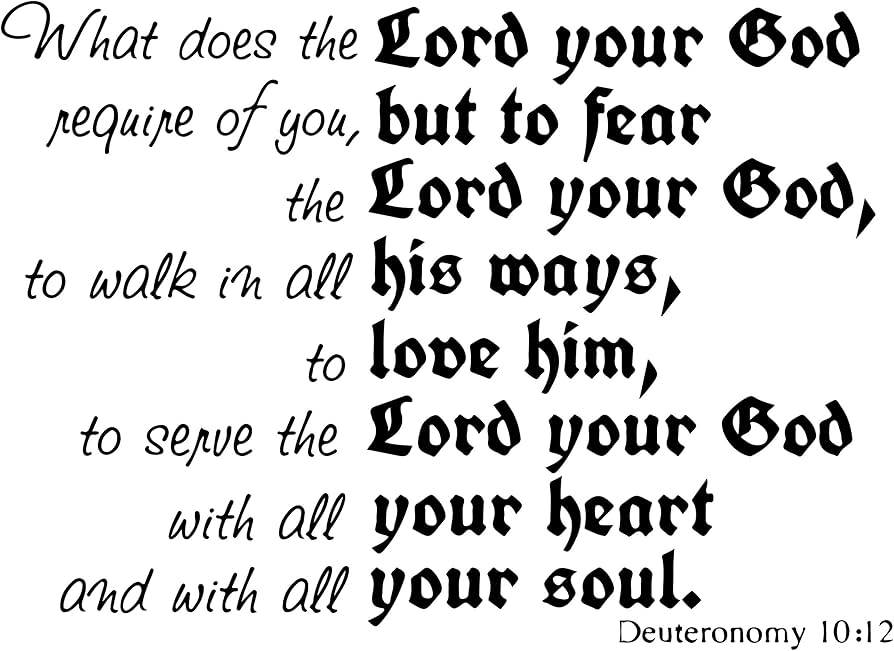
Deuteronomy 10:12-22 GOD’S WORD Translation
Israel Encouraged to Follow God’s Guidance
12 Israel, what does the Lord your God want you to do? He wants you to fear him, follow all his directions, love him, and worship him with all your heart and with all your soul. 13 The Lord wants you to obey his commands and laws that I’m giving you today for your own good. 14 Remember that the sky, the highest heaven, the earth and everything it contains belong to the Lord your God. 15 The Lord set his heart on your ancestors and loved them. Because of this, today he chooses you, their descendants, out of all the people of the world.
16 So circumcise your uncircumcised hearts, and don’t be impossible to deal with any longer. 17 The Lord your God is God of gods and Lord of lords, the great, powerful, and awe-inspiring God. He never plays favorites and never takes a bribe. 18 He makes sure orphans and widows receive justice. He loves foreigners and gives them food and clothes. 19 So you should love foreigners, because you were foreigners living in Egypt. 20 Fear the Lord your God, worship him, be loyal to him, and take your oaths in his name. 21 He is your glory. He is your God, who did for you these spectacular and awe-inspiring deeds you saw with your own eyes. 22 When your ancestors went to Egypt, there were 70 of them. Now the Lord your God has made you as numerous as the stars in the sky.
The Word of God for the Children of God.
Glory be to the Father,
and to the Son, and to the Holy Ghost;
as it was in the beginning,
is now, and ever shall be,
world without end. Amen, amen.
As the book of Deuteronomy begins, Moses and the people of Israel are standing at the edge of the promised land on the other side of the Jordan River.
Joshua will lead them across the Jordan and into the land after God commands Moses to die for his disobedience in striking the rock twice instead of just once.
In obedience to the Lord’s command, Moses hands authority over to Joshua.
But, before the change of leadership happens, the people take a long pause to listen to Moses explain the law, “Beyond the Jordan, in the land of Moab, Moses undertook to explain this law.” Moses is now 120 years old. God will let him rest.
In fact, the word Deuteronomy means “second law” or “repetition of the law.”
Our Verse for this devotional comes from chapter 10 of Deuteronomy just after Moses reminded the people of their parents’ failure when they fashioned and worshiped the Golden Calf.
In response to their idol worship, God was ready to wipe them out, but Moses plead with the Lord, appealed to the glory of his name. God graciously relented.
And, in Deuteronomy 10:10 Moses says, “The Lord was unwilling to destroy you.”

In other words, the mercy of God is on full display as we come to Deut. 10:12-13.
“The Mercy of God was on full Display”
“The Love of God was on full Display.”
“The Glory of God was on full Display.”
These truth’s are really important to remember when memorizing this passage.
These words of truth accurately describe what God deserves from his people and demonstrates our chronic inability to ever live up to it, all at the same time.
God demands and by His actions, by His works, He deserves our obedience and every affection locked away in our hearts. And, by God’s grace, and only for His Glory alone we should daily strive to give Him all of what is 1000% rightly His.
Why should we hesitate?
Why do we hesitate?
Why would we hesitate?
As we strive to live this out and labor toward obedience and fight for the godly affections of our hearts, we can also rest in the gospel truth that Christ has already achieved this obedience in our place. Jesus has feared the Lord our God.
He walked in all His ways without ever wavering. He walked, hungered, thirsted 40 long days and nights through the truly most extreme temptations that Satan could ever willfully inflict on Him.
Still, after all of that, He persevered, He still loved His Father with a perfect love. He served his Father with quite literally last every beat of his heart and every portion of his soul. He kept every commandment and statute of the Lord.
He walked the earth completely sinless.
It seems so natural to love God because he first loved me (John 13:34; 1 John 4:19).
But I remember all too vividly when I didn’t love God with all my heart and soul.
In that way each one of us is like the ancient Israelites.
There are people, things, and situations that both rigorously and vigorously compete for our maximum love and attention. They often start subtly and cause our love for God to shift, fluctuate, fragment. We take our leap from the Temple.
Our love for God ought to be a instinctive response to his love for us. Obedience is an excellent indicator of our love.
Jesus told his disciples, “If you love me, you will keep my commands” (John 14:15).
Love for God and obedience to God are to be considered inseparable. We know very well that loving God goes far beyond mere words.
Through the power of the Holy Spirit, we follow the Lord by leaving our old life behind (Philippians 2:1-18). Our Lives are no longer all about us but all about our love relationship with the Lord.
We deepen our love by getting to know God’s character, who he is, his ways, and what he does.
We do this by reading the Bible, observing God’s presence in our lives, and being around people who love him. Love comes from a heart of gratitude.
So, as we hide this portion of the word in our hearts this week, let it be a call to obedience and an occasion for thanksgiving for the gospel, all at the same time!
In the name of God, the Father and God the Son and God the Holy Spirit,
Let us Pray,
Psalm 19 Authorized (King James) Version
Psalm 19
To the chief Musician, A Psalm of David.
1 The heavens declare the glory of God;
and the firmament sheweth his handywork.
2 Day unto day uttereth speech,
and night unto night sheweth knowledge.
3 There is no speech nor language,
where their voice is not heard.
4 Their line is gone out through all the earth,
and their words to the end of the world.
In them hath he set a tabernacle for the sun,
5 which is as a bridegroom coming out of his chamber,
and rejoiceth as a strong man to run a race.
6 His going forth is from the end of the heaven,
and his circuit unto the ends of it:
and there is nothing hid from the heat thereof.
7 The law of the Lord is perfect, converting the soul:
the testimony of the Lord is sure, making wise the simple.
8 The statutes of the Lord are right, rejoicing the heart:
the commandment of the Lord is pure, enlightening the eyes.
9 The fear of the Lord is clean, enduring for ever:
the judgments of the Lord are true and righteous altogether.
10 More to be desired are they than gold, yea, than much fine gold:
sweeter also than honey and the honeycomb.
11 Moreover by them is thy servant warned:
and in keeping of them there is great reward.
12 Who can understand his errors?
cleanse thou me from secret faults.
13 Keep back thy servant also from presumptuous sins;
let them not have dominion over me: then shall I be upright,
and I shall be innocent from the great transgression.
14 Let the words of my mouth, and the meditation of my heart,
be acceptable in thy sight, O Lord,
my strength, and my redeemer.
Glory be to the Father,
and to the Son, and to the Holy Ghost;
as it was in the beginning,
is now, and ever shall be,
world without end. Amen, amen.

 Loving God, Living God, Loving Hope, Living Hope, Loving Living Life His Way! "Many things are possible for the person who has hope. Even more is possible for the person who has faith. And still more is possible for the person who knows how to love. But everything is possible for the person who practices all three virtues." - Brother Lawrence (1605-1691), Practicing the Presence of God (1692).
😭49 years ago today, Palestinians invaded the Lebanese Christian town of Damour and massacred hundreds of civilians.
Men were lined up against the walls of their homes and gunned down.
Women were tortured and gang-raped.
Babies were shot in the back of their heads.
Pregnant women had their babies cut out of the womb.
‘It was an apocalypse’, said Father Labaky, a priest who survived the massacre.
“They were coming in thousands, shouting ‘Allahu Akbar! Let us attack them for the Arabs, let us offer a holocaust to Mohammad’, they were slaughtering everyone, men, women and children.”49 years ago today, Palestinians invaded the Lebanese Christian town of Damour and massacred hundreds of civilians.
Men were lined up against the walls of their homes and gunned down.
Women were tortured and gang-raped.
Babies were shot in the back of their heads.
Pregnant women had their babies cut out of the womb.
‘It was an apocalypse’, said Father Labaky, a priest who survived the massacre.
“They were coming in thousands, shouting ‘Allahu Akbar! Let us attack them for the Arabs, let us offer a holocaust to Mohammad’, they were slaughtering everyone, men, women and children.”
1976
reposting
Forwarded this email? Subscribe here for more
January 9 Saint Julian, Martyr and Saint Basilissa: Converted Home into Hospital for Poor and Sick.
Maria Angela Grow
Jan 20
READ IN APP
January 9 Saint Julian, Martyr and Saint Basilissa: Converted Home into Hospital for Poor and Sick.
(† 313)
Julian is the patron of hospitals.
Basilissa is invoked against chilblains.
.
Saint Julian was born at Antinoe, in Egypt, of noble parents. As they were good and fervent Christians, they took great care to bring him up in the school of virtue. Hence, even in his earliest years, Julian showed by the innocence of his life and the fidelity wherewith he devoted himself to his religious duties, that he was called to accomplish one day great things for the glory of God and the salvation of his neighbor. From his very childhood, he seemed fully to understand that saying of the Apostle, “the fashion of this world passeth away.” The love of God, and God alone, filled his heart from earliest childhood.
.
Wherefore, he looked upon all the temporal blessings which God had bestowed upon him as a means to attain the end of his creation, and not as objects whereon a Christian may suffer his affections to rest – knowing how short-lived and uncertain they are. Accordingly he found his delight in reading the Sacred Writings and the records of the glorious deeds of the martyred Saints; while he would never grow weary of conversing with persons whom he knew to be faithful observers of the Divine Law. Thus he passed the days of his youth in preparing himself for the trials of life – which began with him much sooner than he had reason to anticipate.
.
At the age of 18, when his good parents thought that he had now come to man’s estate, and concluded that it would be best for him to settle in life by making choice of some virtuous person, who might be a suitable consort to accompany him on this world’s journey. This troubled him much, for he had read the saying of Saint Paul, ” He that is unmarried careth for the things that belong to the Lord, how he may please the Lord: but he that is married careth for the things that are of the world, how he may please his wife.” i Cor. vii. 32, 33.
.
They were not a little astonished at the objections made by the youth, to whom every expression of their will or desire had ever been a law obeyed without hesitation.
.
He besought his parents to allow him to defer giving them a final answer till he had well considered their proposal during seven days. He now fasted, and watched, and prayed, revealing to God the desire of his heart, to keep his body in virginity, and his soul devoted to God alone. At the end of the seven days he saw Christ in a vision, who said to him, ” Fear not, Julian, to take thee a wife, and to fulfil the desire of thy parents. As virgins ye shall serve me, and I shall not be separated from you, and as virgins shall ye enter into my kingdom.” Then Julian was filled with great joy, and he considered whom he should choose. Now there was one maiden, Basilissa by name, who was well-known to his parents, and with whom he had been acquainted from childhood, and whom he loved for her whiteness of soul. Therefore he told his father that he consented to marry Basilissa. And she, on her side, was glad to be the wife of Julian, but her timid soul shrank from the cares and responsibilities of marriage, for she was as yet young and fresh to the world.
.
The marriage took place with all the boisterous merriment and display, usual then as now; and evening approaching, the young bride was led by the maidens, who were her fellows, to the nuptial chamber. Now when Julian entered, there came an odour in the apartment, as of lilies and roses, though the season was mid-winter, and an awe fell on their young hearts. And they put their hands together, and promised to serve God together in purity and fervour, with singleness of heart all their days. Then they were aware of One present in the room, and kneeling down, they fell prostrate, and besought Him to accomplish the good work He had begun in them. And when they looked up, the chamber was full of light, and they saw Jesus and Mary, and an innumerable company of virgin Saints. Then the Lord said, “Thou hast conquered, O Julian, thou hast conquered!” And the Blessed Virgin said, “Blessed art thou, Basilissa, who hast thus sought with single heart the glory that is eternal.”
.
Then said Jesus, “My soldiers, who have overcome the wiles of the old serpent, rise and behold what is prepared tor you!” Thereupon came two clothed in white robes, and girded about the loins with golden zones, having crowns of flowers in their hands, and they raised them from the ground and showed them an open book seven times brighter than silver, inscribed with golden letters, and round about it stood four elders, having vials in their hands of pure gold, from which ascended diverse odours. And one, answering, said, “In these four vials your perfection is contained. For out of these daily ascends an odour of sweet fragrance before the Lord. Therefore, blessed are ye, because ye have rejected the unsatisfying pleasures of this world to strive after those which are eternal, which eye hath not seen, nor ear heard, neither hath it entered into the heart of man to conceive.”
.
Then Julian looked, and beheld his name, and the name of his wife, Basilissa, written in the book. And the elder said, “In that book are written the chaste and the sober, the truthful and the merciful, the humble and gentle, those whose love is unfeigned, bearing adversities, patient in tribulation, and those who, for the love of Jesus Christ, have given up father and mother, and wife and children, and lands, for his sake, lest they should impede the progress oi their souls to perfection, and they who have not hesitated to shed their blood for his name, in the number of whom you also have merited to be written.”
.
Then the vision passed. But Julian and Basilissa spent the night in prayer, and singing joyful praises to the Lord.
.
Saint Julian and Saint Basilissa, though married, lived by mutual consent in perpetual chastity. They sanctified themselves by the most perfect exercises of an ascetic life.
.
And when his parents were dead, Julian divided his house and made it into a hospital, in which they sheltered up to a thousand poor people. All his substance he spent in relieving the necessities of the sick and suffering. Basilissa attended those of her sex in separate lodgings, and Julian, who for his charity is known as the Hospitaler, cared for the men.
.
Egypt, where they lived, was in those days blessed with persons who, either in the cities or in the deserts, devoted themselves to the most perfect exercises of charity, penance, and mortification. Conversions were numerous, and persecutions by furious pagans followed as the numbers of Christians increased. Basilissa, after having survived seven of those, died in peace, foretelling to her husband that he would die a martyr.
.
Julian lived afterwards for a number of years, but in 313, Marcian, Governor of Middle Egypt under Diocletian, had arrived in Antinoe to see that the edicts of his imperial master were enforced. By his order, in every street and market place some idol was put up, that no one might have a chance of selling or buying anything without first offering sacrifice. Moreover, he commanded every citizen to have in some prominent place of his dwelling a statue of Jupiter, as a proof of his fidelity to the religion of the empire. When it was reported to him that in the neighborhood there were living, under the care and direction of Julian, formerly a distinguished citizen of Antinoe, a great number of Christians, who were ready to suffer torments and death rather than offer incense to his gods, he grew exceedingly angry. Forthwith calling his Assessor, he ordered him to repair at once to the abode of these men, and to command them to comply without delay with the laws, that thus they might avoid the punishment prepared for the disobedient. The Assessor, accompanied by his assistant and some of the chief men of the city, straightway proceeded to execute the order of the Governor. Beside those who were there already, many other Christians, both of the clergy and laity, had come to seek an asylum near the Saint, feeling persuaded that, if they did not escape the dangers of the persecution, they should at least derive strength and courage from his words and example.
.
When the Governor heard that Julian and the brethren were resolved not to comply with his wicked commands, he flew into a great passion, and without considering the cruelty and injustice of the action, sent a band of soldiers with orders to consign to the flames all the dwellings of the servants of God with their inmates. He directed, however, that Julian himself, after witnessing the death of his spiritual children, should be brought to the city, that he might have the pleasure of interrogating and of punishing him, if he should refuse to yield to his wishes. In this manner, therefore, their faith being tried by fire, this numerous company of Martyrs went to receive the reward of their fidelity to their heavenly King. Nor was the fact of their living in glory left unknown to the people of the neighborhood. For, it is related that during many succeeding years they could daily be heard singing, at stated hours, both by day and by night, the offices of the Church, as they had been wont to do under the direction of their spiritual father. At the place, also, where the ruins of the buildings lay, all sorts of diseases continued to be healed, as of old, whenever the faithful resorted thither to implore the intercession of the holy cenobites
.
Julian was seized and subjected to cruel tortures. The governor, Marcian, ordered him to be dragged, laden with chains, and covered with wounds, about the city. As the martyr passed the school where Celsus, the son of the governor, was being instructed, the boys turned out into the street to see the soldier of Christ go by. Then suddenly the lad exclaimed, “I see angels accompanying, and extending a glorious crown to him. I believe, I believe in the God of the Christians!” And throwing away his books, he fell at the feet of Julian, and kissed his wounds. When the father heard this, he was filled with ungovernable fiiry, and believed that the Saint had bewitched the boy; he ordered them both to be cast into the lowest dungeon, a loathsome place, where the corrupting carcases of malefactors lay, devoured by maggots. But God filled this hideous pit with light, and transformed the stench into fragrant odours, so that the soldiers who kept the prison were filled with wonder, and believed. That same night, a priest, Antony, who lived with seven little boys, orphans committed to his care by their parents, summoned by God, came with these seven children to the prison. An angel went before them, and at his touch the gates flew open. Then Antony, the priest, baptized Celsus and the believing soldiers.
.
On the morrow the governor, supposing that the night in the pit had cured his son, sent him to his mother, and the boy, having related to her in order all he had seen and heard, she believed with her whole heart, and was baptized by the priest.
.
The governor, Marcian, ordered all these converts to death. With Julian died thirty-one other persons, including a priest named Anthony, a new Christian named Anastasius, Celsus, the seven-year-old son of the judge who sentenced Julian, Marcianilla, the mother of Celsus, who when she came to visit her son was won over to the faith, and many other Christians. Spared by fire and wild beasts, Saint Julian finally was decapitated.
.
During the night the Christians came, and, easily distinguished the Martyrs by a soft and mysterious light that shone from them; they took them up with great reverence and deposited them carefully beneath the altar in one of the churches. Here many healings, both of body and soul, were performed in behalf of persons who came to implore the intercession of the Saints with God.
.
Julian’s tomb became illustrious by many great miracles, including the cure of ten lepers on the same day.
.
Many churches and hospitals, in both the East and in the West, bear the name of one or another of these martyrs. Four churches at Rome and three in Paris are dedicated to Saint Julian.
.
Reflection. God often rewards men for works that are pleasing in His sight by giving them grace and opportunity to do other works higher still. Such was the case for Saint Julian, whose posthumous miracles attained prodigious numbers.
.
Eternal Father, I wish to honor Saints Julian and Basilissa, and I give Thee thanks for all the graces Thou hast bestowed upon them. I ask Thee to please increase grace in my soul through the merits of these saints, and I commit the end of my life to them by this special prayer, so that by virtue of Thy goodness and promise, Saints Julian and Basilissa might be my advocate and provide whatever is needed at that hour. Amen.
LikeLiked by 1 person